
人教版八年级英语下册Unit2 SectionB (2a-2d)
1. How many percent of the students do not exercise at all? Twenty percent students. __________________________________ 2. How many percent of the students use the Internet every day? Ninety percent students. __________________________________
3.She says it’s good for my _________ health (健康) results (结果) of the 4.Here are the _______ survey. percent (百 5.We found that only fifteen _______ 分之)of our students exercise every day.
or
. He
three or four times a week and four times a day. So he is unhealthy.
单词拼写: junk 1.Eating too much ________ (无用的) food is bad for the kids.
2. Would you like tea or _______? coffee (咖啡)
Exercise
Use of the Internet
13 ______ % 4-6 times a week
2 % ______ 1-3 times a week
______ 85 % every day Watch TV
2c
Read the article again and answer the questions.
two or three times
She
every day. She
nine hours
every night. So she is very healthy.
Bill
nine hours every night,
≥ 20%
too. Is he healthy? < He 5% . He
He
0 %
use the Internet
go camping in the country
Let’s do a survey.
What do you do in your free time? Do exercise, use of the Internet or watching TV?
What activities do you think is healthy for the mind and the body?
mind together
Rank these activities according to how often you think your 2a classmates do them (1=most often, 6= least often).
watch TV go to the movies play computer games exercise or play sports
2. What is the best way to relax?
The best way to relax is through exercise. __________________________________
Read the passage carefully and complete the pie chart below.
6.Many students often chat(聊天) online (在线的) by QQ on weekends. _________ 7._______ (虽然) many students like to Although watch sports, game shows are the most popular. 8.He wentthrough ______ (通过) the forest the next day. 9.It is healthy for the ______ mind (心智) and the body. died (死亡) three years 10.His father _____ ago.
I eat it once a How often do you week. eat junk food?
Yes. But my mother Do you like doesn’t let me to eat it. She says it’s bad for my it? health.
Review :
Choose the right answers. 1. I hardly exercise so I think I’m kind of __. A. healthy B. health C. unhealthy D. unhealth 2. My sister likes fruits ___ she doesn’t like vegetables. A. and B. but C. or D. also 3. Jim’s parents want him ___ more fruit. A. eating B. eat C. to eat D. eats
1.-在周末他通常做什么? -他经常去看电影。 2.-Tom多久锻炼一次? -他每天都在锻炼。 3.他有时候帮助做家务活。 5.-你下周有空吗? 6.-下周我非常忙。
I think Tina has healthy habits. Because she every day. She
a week and never
3. How often do most students watch TV? Most students watch TV every day. _________________________________ What do they usually watch? They usually watch sports, game shows. _________________________________ 4. What does the writer think is the best way to relax? Exercising. _______________________________ Why? __________________________________ It’s healthy for the mind and the body.
Translate and write them down. 1. - 你多久喝一次牛奶?- 我每天都喝。 - How often do you drink milk? - I drink milk every day. 2. 我妈妈想让我喝牛奶。她说它对我的 健康有益。 My mother wants me to drink milk. She says it’s good for my health. 3. 你每晚睡几个小时? How many hours do you sleep every night?
percent of the students 4. 10%: Ten ____________________________ sometimes use the Internet. _____________________________ Thirteen percent of the students 5. 13%: _____________________________ usually watch TV. _____________________________ Two percent of the students 6. 2%: _____________________________ sometimes watch TV. ____________________________
______ 15 % every day
10 % ______ 3 or 4 times a week 20 % ______ no exercise 90 % ______ every day
20 % ______ 1-3 times 45 % ______ a week 4-6 times a week
4. Maria likes ___ every morning. A. run B. running C. runs D. runing 5. Her grandma often cooks delicious food for ___. A. her B. she C. hers D. him 6. Eating more fruit and vegetables is good ___ our health. A. to B. for C. at D. with
2d
According to the article and the pie charts, write sentences with the percentages using, always, usually or sometimes .
Ninety percent of the students 1. 90%:__________________________ always use the Internet. __________________________ Eighty percent of the students 2. 85%: __________________________ always watch TV. __________________________ percent of the students 3. 45%: Forty-five ____________________________ usually exercise. ___________________________
人教版英语八年级下册 Unit 2 I'll help to clean up the city parks
Unit 2 I’ll help to clean up the city parks.Section A 第1课时(1a〜2d)自主学习方案1. 自学生词,并记住拼读及拼写。
2. 预习课本,找出重点短语及句子。
3. 读记后完成自学导练作业。
课堂导学方案Step 1情景导入T:Do you know a volunteer? Do you know what the volunteers do?S1:They help the old people.S2:They help do some cleaning.…T :What can you do? Now please talk about the questions in groups.环节说明:由志愿者的活动过渡到学生讨论的话题,衔接自然,学生易于接受,能勾起学生的学习欲望。
Step 2完成教材1a—1c的任务1. 认真观察1a中的图片,写出图片中帮助他人的方法,然后写出其他帮助他人的方式。
完成后小组内交流看谁写得多。
2. 认真阅读1b中的句子,然后听听力完成1b任务。
3. 再听一遍录音,并跟读对话。
4. 结对练习1a图片中的对话,并请一些学生表演出他们的对话。
然后模仿1b材料编新的对话并表演。
5. 小结训练。
( B )I took my sister to the concert to .A. c heer up her B . cheer her upC . cheer she up D. cheer up she环节说明:听说结合,第一时间向学生传达语言目标,通过结对对话练习和小结训练,使语言目标得以强化。
Step 3 完成教材2a—2c的任务1. 认真观察2a中的图片,然后听录音圈出他们打算要做的事情。
2. 再听一遍录音,根据录音内容完成2b中的填空,然后大声地朗读五个句子。
3. 听第三遍录音,学生跟读,然后仿照2c的形式编对话。
Step 4 完成教材2d的任务1. 学生自读对话,回答下面的问题。
八年级英语下册Unit 2 Section A (2a-2d)课件
Let's watch the video.
Language points
1. We need to come up with a plan for the City Park Clean-up Day. 我们需要为“城市公园清洁日”想出一个计划。 1)need 是一个常见的动词,表示“需要”之意。它既可以作 实义动词,也可以作情态动词。其具体用法如下: need用作实义动词,有“必要”、“必需”之意,有人称、数 和时态的变化,可以接名词、代词、动名词或带to 的动词不 定式作宾语。
used to 表示过去一度存在或经常发生,但现在已经不存在 的动作或状态。其后接动词原形,且不与表示过去的时间状 语连用。used to的否定形式是didn’t use to或used not to(usedn’t to)。
➢He used to be a teacher.
➢He didn’t use to wear glasses. = He usedn’t to wear glasses.
____
making a plapnu.t up
3. Weouctould _____ ______ signs.
hand
4. Let’s make somecnalolticesu,ptoo. Then I’ll _____ them
_______ after school.
5. We could each _____ _____ 10 students and ask
2020春人教版八年级英语下册教案设计:Unit 2 Section B(2a-2e)
第四课时Section B(2a-2e)错误!未指定书签。
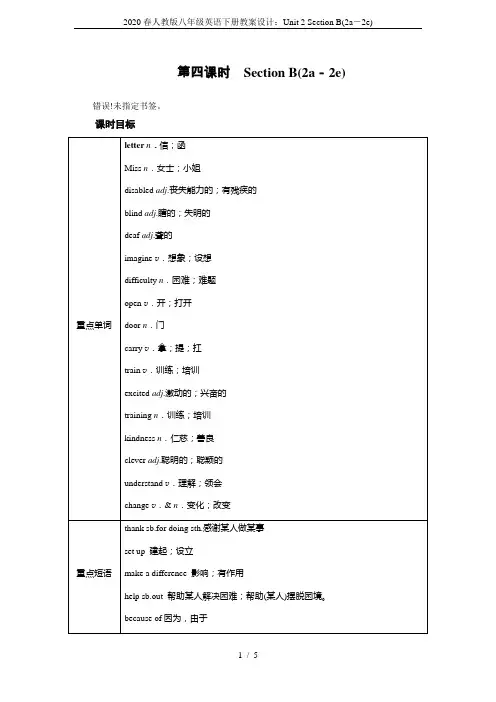
课时目标错误!未指定书签。
自主学习一、根据句意及汉语提示写出单词。
1.We should try our best to help disabled(残疾的)people.2.A blind(失明的)person can not see anything.3.I can hardly imagine(想象)such a scene.4.Jack is brave enough to face all the difficulties(困难).5.I am excited(激动的)about the idea of climbing mountains this weekend.二、写出下列画线短语的汉语意思。
1.I’m sure you know that this group was set up to help disabled people like me.建起;设立2.Lucky makes a big difference to my life.对……产生重大影响3.Then one day last year,a friend of mine helped me out.帮助……解决困难错误!未指定书签。
教学过程环节1新课导入1.Greetings.2.Ask students to look at the two pictures.Question:What can you do to help them?设计意图:以情境导入和图片展示的直观形式进行教学,引入本课时的话题,能够迅速抓住学生的眼球,激起学生的学习兴趣。
环节2学习2a-2e1.结对练习。
学生两人一组,讨论自己一般是怎么感谢他人帮助的。
教师邀请几名学生分享自己的观点。
2.让学生快速浏览2b中信的内容,掌握其主旨大意。
3.让学生浏览2b的两个问题,然后带着问题再次阅读短文,完成练习。
人教版八年级英语下册Unit2 SectionB课件
5. understand → understood (过去式)
6. fix → repair (近义词)
7. interest → interesting → interested 8. train → training
(adj. 有趣的)
(adj. 感兴趣的)
(n. 训练)
短语默写
Lucky.
3. 再次感谢您改变了我的生活。 Thank you again for changing my life.
1. 修理;装饰
fix up
2. 赠送;捐赠 give away
3. (外貌或行为)像 take after
4. 建起;设立 set up
5. 影响;有作用 make a difference
6. 帮助某人解决问题 help sb.out
句子默写
1. 我确信您知道这个组织是为了帮助像我这样的残疾人 而成立的。
序 音标
号
词性及词义
自测1 自测2
16
adj. 激动的;兴奋的
17
n. 训练;培训
序 音标
号
词性及词义 自测1 自测2
18
n. 仁慈;善良
19
adj. 聪明的;聪颖的
20
v. 理解;领会
序 音标
号
词性及词义
自测1 自测2
21
v. & n. 变化;改变
n. 兴趣;关注
22
v. 使感兴趣;使关注
序 音标
Unit 2 I’ll help to clean up the city parks. Section B
人教版八年级下册Unit2 SectionA 2a-2d课件(共13张)
照顾;非常喜欢 (使)变得高兴;振奋起来 打扫(或清除)干净 分发;散发
二.掌握提供帮助的几种句型:
I’d like to… I hope to… I could… I volunteer to… I will do…
1. 抄写总结的单词和短语1-1。 2.抄写2b句子并翻译。 3.根据2a听力,完成2c对话。
sign
notice
lonely
used to
come up with
put off
若跟 人称 代词
hand out call up
,位 care for
置必 cheer up
须放 clean up 中间 give out
Summary
n. 标志;信号 n. 通知;通告;注意v. 注意到;意识到 adj. 孤独的;寂寞的 曾经……;过去…… 想出;提出(主意,计划,回答等)
A: We need to come up with a plan for the City Park Clean-Up Day.
B: Let’s have lunch first. A: No, we need to start now. Clean-Up
Day is only two weeks from now.
I hope to
visit the old in an old people’s home.
I could
give our old books to poor children.
help to plant trees.
I volunteer to
Words and Expressions
sign
人教版英语八年级下册 Unit2_SectionB(2a-2e)教案
Unit2 SectionB(2a-2e)名师教案课型4 Reading and Learning (Section B 2a-2e )1.0Teaching Analysis教情分析1.1Teaching objectives 教学目标1.1.1Language targets 语言目标1.1.1.1Key Words and Chunks1.1.1.1.1For applying: letter, Miss, set up, disabled, make a difference to,blind, deaf, imagine, difficulty, open, door, carry, train, excited,training, kindness, clever, understand, change1.1.1.1.2For comprehending:1.1.1.2Sentence Structures1) I’d like to thank you for giving money to Animal Helpers.2) You helped to make it possible for me to have Lucky.3) What would it be like to be blind or deaf?4) Or imagine you can’t walk or use your hands easily.5) She talked to Animal Helpers about getting me a special trained dog.6) She also thought a dog might cheer me up.7) I love animals and I was excited about the idea of having a dog.8) In what other ways do you think dogs are able to help people?1.1.1.3Grammar Focus1) I’ll send you a photo of him if you like, and I could show you how hehelps me. (if you like是条件状语从句,意为“如果你喜欢”;how he helpsme是宾语从句,意为“他如何帮助我”)2) I’m su re you know that this group was set up to help disabled people likeme. (was set up是一般过去式的被动语态,一般过去时的被动语态的结构为“was/were+动词过去分词”)1.1.2Ability goals 能力目标1.1.2.1帮助学生通过单词的词性来帮助理解单词在句中的含义。
【初中英语】人教版八年级下册Unit 10 第4课时分层训练(Section B2 2a—2练习题
人教版八年级下册Unit 10 第4课时分层训练(Section B2 2a—2d)(1022)1.(根据)the ne w tr a ff ic la w,pe o p le mu stn't d r ive a f te r d r in k in g wine.2.H o w d o yo u lik e th e mo vie la s t n ig h t? (改为同义句)d o yo u the mo vie la s t n igh t?3.Th e re is a d ru g s to re o pp o s ite th e sc ho o l.(改为同义句)T h e re is a d ru g s to r e the s ch o o l.4.H e h a s live d in C h ina f or n e ar ly 13 y ear s.(对画线部分提问)h a s h e live d in Ch in a?5.I b o ug h t the b o ok in th e mid-20th ce n tu r y.(用s in c e改写句子)I the bo o k th e mid-20th c en tu r y.6.We s pe n t su ch a h app y c h ild h o od th a t we wo u ld n't f o rg e t it f o reve r.(改为同义句) We sp e n t tha t we wo u ldn't f o rg e t it f or e ve r.7.—Time pa s t ca n no t b e c a lle d b ac k a ga in.—Ye s.Wa s ting time is a .()A.p r e s su r eB.f a irn e s sC.ch o iceD.sh a me8.In th e ir c o un tr y,re d is re g a rd ed a s ymb o l o f g oo d lu c k.()A.a sB.fo rC.withD.o f9.H e is in te r e s te d in all k in d s o f sp o r ts,s k a tin g.()A.h a r d lyB.es p ec ia llyC.ne a r lyD.c o mp le te ly10.—D o yo u kn o w ?—We ca n tr y to p r od uc e le s s wa s te,r e us e o r r ec yc le th in g s.()A.wh y c a n we live a gr e e n lif eB.ho w ca n we live a gr e e n lif eC.wh y we c an live a gr e e n lif eD.h o w we ca n live a gr e e n lif e11.M r.S mith is a s u c c e s s fu l ma n.H e is ve r y r ic h.H e live s in a b ig c ity n o w.La s t mo n th he c a me b a ck to h is h o me to wn.22 p e op le kn e w h im bec a u se h e le f t th e r e wh en h e wa s a c h ild.A nd wh e n he s to pp e d ne a r a23 ho u s e h e s aw a n o ld wo ma n s itting in the su n en jo yin g he rs e lf.H e r 24we re c lo s ed a n d sh e d idn't n o tic e the r e wa s a ma n lo o k ing a t h e r c a re f u ll y.“Au n t!” M r.S mith c a lle d ou t.“Au n t!” T h e o ld wo ma n d id n't b e lie ve h e r n ep h e w(侄子) h a d c o me to s e e he r.Sh e wa s ve r y g la d a nd ex c ited.Tea r s(泪水)25 h e rf a c e.Th ir ty ye a r s! It wa s f o r th ir ty ye a r s t h a t sh e ha d n't s e en h im.A s a26 b o y in th e s ma ll villag e he wa s a lwa ysh u ng r y a n d h ad little f o od to e at.S o h e we n t to th e c it y to f in d a27 .He d idn't c o me b a c k a f te r th a t.So h e cou ld n't s e e h is p a r en ts or h is a un t 28.M r.S mith on ly h a d a29 ho lid a y.H e a s ke d s o me n e ig hbo r s to re p a ir h is a u n t's s ma ll o ld h ou s e.He ne ve r f o rgo t h is te a ch e r M r.G r e en wh o o f te n h e lp ed h im 30 h e g o t in to tr o ub le.S o h e wen t to th e sc ho o l.“31I s e e M r.Gr e e n, s ir?” h e a s ke d an o ld ma n a t th e sc h oo l g a te(门口).“S o r r y,yo u c an't,”a n s we r e d th e o ld ma n.“Bu t wh y? Wh a t h a ppe n e d to h im?”“He d ie d two ye a r s a go!”M r.S mith fe lt ve r y s a d wh en h e he a r d the ne ws.Wh a t a p ity! H e c ou ld ne ve r sa y th a n k s to M r.G re e n.(1)A.M a n yB.Lo ts o fC.A fe wD.Fe w(2)A.s ma llB.b igC.n ic eD.b e au tif u l(3)A.e yeB.mo u thC.e ye sD.mo u ths(4)A.ru n d o wnB.r an d o wnC.ru n a wa yD.ra n a wa y(5)A.twe lve-ye a r-o ldB.twe lve-ye a r s-o ldC.twe lve ye a r s o ldD.twe lve ye a r o ld(6)A.wo r kB.job sC.jobD.wo r k s(7)A.a n y lo n g e rB.no lon ge rC.no t mo r eD.n o mo r e(8)A.we e kB.wee k'sC.wee k sD.we e k s'(9)A.wh e r eB.ho wC.whe nD.wh ile(10)A.C anB.S h a llC.WillD.M u s t12.With a s ma ll c a me r a, a 25-ye a r-o ld b o y, Wa ng Tian c he ng h a s tr a ve le d a r ou nd 30 c o un tr ie s with h is f r ie nd s.O ve r th e pa s t 10 ye a r s, h e h a s ta ke n mo r e tha n 100,000 ph o to s o f tr a ins in n ea r ly 30c o un tr ie s a n d a r ea s,in c lud in g In d ia,M a la ys ia,Mo ng o lia, Ru s s ia a n dT h a ilan d…In 1995, Wan g Tia n che n g wa s b o rn in D aq ing, He ilo n g jian g.H e d e ve lo p ed h is in te r e s t in tr a in s f r o m h is c h ildh o od.“E ve r y mo n th, m y p a r e n ts to o k me to vis it my g r a n d p a r en ts b y tr a in wh o live d in an o th e r c ity a b ou t 300 kilo me te r s a wa y,” h e s aid.“I wa s a lwa ys too e x c ited to f a ll a s lee p be f o r e th e tr ip.I f e e l s o luc k y th a t my p a r e nts h a ve tr u s ted me a n d g ive n me f r e ed o m(自由)s in c e my c h ild h o od.T h e y a ls o su p po rt(支持)my id e a s.”A r ou nd2005, Wa n g ma d e f r ie n ds with tho s e wh o sh a re d th e ir in ter e s t in tr a in so n lin e.A f te r th a t, he be ga n h is ne w lif e o f c o lle c ting tra in in f o r ma tio n.Wan g tr a ve le d with h is f r ie nd s.A t f ir s t, h e ju s t to ok g ood-lo o k in g p ic tu re s.B u t la te r, h e p a id mo re a tte n tio n to wh a t's b e hin d th e ra ilwa y, a n d e xp l or e d th e re la tio n sh ip a mo n g the tr a in, time a n d p eo p le.H is ph oto g r a ph y(摄影技术)sk ill h a s b e en mu c h b ette r.With the s ma ll c a me r a,he ha s tak e n o ve r100,000 me a n in gf u l p ic tu re s.Wa ng s tud ie d h a rd a t Zh e jia n g U n ive r s ity.H e wa s po pu la r b e c au s e o f h is o u ts tan d in g p e r f o r ma n ce a t s c ho o l.He's b u s y p r e p a r ing f o r f u r the r s tu d y, b u t ta k in g ph o tos o f tr a ins h a s b e co me p a r t o f h is lif e.O ve r th e ye a r s, h e h a s fa c ed ma n y c h a lle n g e s, su c h a s d an ge r f r o m a n ima ls in th e wild a nd po o r we a the r an d b a d tr a ff ic co n d itio n s.“Tr a in s a r e a s ymb o l o f h is to r y,” Wa ng sa id.“I will n e ve r s to p my s t u d y o f ra ilwa y c u ltu r ea n d I ho p e to d e ve lo p mo r e to p ic s in the f u tu r e.”(1)Wan g Tia nc he n g wa s wh e n h e s ta r ted c o llec tin g tr a in in f or ma tio n.()A.14B.12C.10D.8(2)Ac c or d ing to th e pa s s a ge, Wa n g Tian-c he n g h a s e ve r be e n to .()A.J a p anB.S in ga p o reC.A me r ic aD.R us s ia(3)Th e u n de r lin ed wo rd“ex p lo re d”me a n s “” in Ch in e se.()A.研究B.参加C.查看D.保护(4)W h ic h se n ten c e is TR UE a bo u t Wa n g Tian c h en g?()A.H is g r an d pa r en ts live d in a villa g e in Daq in g.B.H e lik ed ta k in g a tra in whe n h e wa s a c h ild.C.It's e a s y f o r h im to ta k e p ic tu r es o f tr a in s a n ywh e r e.D.He s tud ie d in f o r ma tio n o f tr a in s in the unive r s it y.(5)W ha t ca n b e th e b es t title o f the pa s s ag e?()A.A c h a llen ge o f ta k in g p h o to s o f tr a in sB.A h a pp y tr a ve le r th r o u gh30co un tr ie s an d a r e a sC.A 25-ye a r-o ld b o y's wo n de r f u l d r ea mD.Ne ve r s to p ta k in g ph o to s o f tr a in s13.A re c en t s tud y in Au s tr a lia sh o ws th a t par e n ts a re a th e to p f ive wo r ld's h a r d e s t jo b s.14.—H o w ma n y a p p les a r e th e r e in the ba s ke t?—I d o n't k n o w.Le t's c th e m.15.You mu s t h my h a nd, o r yo u ma y g e t lo s t.16.T he y (搜寻)for th e los t s he e p in the f o r e s t a n d f in a lly f o un d it.17.I s p en t my e a r ly (童年) in my h o me to wn.18.P a u l h a s f o un d a ne w jo b a nd is (考虑)mo vin g to a n e w fla t n e a r h is c o mp a n y.19.Mo s t o f th e c h ild r en(在我的时代) lik e d to p la y to g e th e r.20.(数百万的) C h in e s e le a ve the co u n tr ys id e to s e a rc h fo r work in th e c itie s.21.H e h as f in ish e d h is h o me wo r k (到目前为止).22.I wr o te (接近) f if t y in vita tio n s th is mo r n in g.23.It to o k h im two days to(返回他的故乡).参考答案2.【答案】:What;think;of3.【答案】:across;from4.【答案】:How;long5.【答案】:have;had;since6.【答案】:so;happy;a;childhood7.【答案】:D【解析】:考查名词辨析。
英语人教版八年级下册unit2 sectionb (2a-2d)
Unit2 I’ll help clean up the city parkSection B(2a—2e)课程设计一、教学目标1、了解英语单词的词性,提高学生的阅读能力,培养学生的语感。
2、教育学生学会感恩。
二、教学内容:1、New words and expressions : letter, miss, set up , make a difference, disabled, blind, deaf, imagine, difficulty, open, door, carry, train, excited training, kindness, clever, understand, change三、教学用品:多媒体,白板Step 1 GreetingStep 2 Lead-inT: Have you ever helped others? Have you ever gotten help from others? What should we do who someone helps us? Of course, we should thank them. How do you usually thank them? Say thanks to them face to face, by calling up them or writing to them? Discuss it with your partner.设计意图:让学生学会对别人的帮助表示感谢,学会感恩,通过讨论的方式激发学生的思维,调动他们的积极性。
Step 3 Reading1.Present new words and expressions1) Let the students read the words and phrases according the phonetic symbols on Page 117.2) Write out the Chinese meanings of the words and phrases.Letter--- miss---, set up--- , make a difference---, disabled--, blind--, deaf--, imagine---, difficulty----, open---, door----, carry----, train---, excited---- training-----, kindness------, clever----, understand----, change------2.PredictGet the students to predict ”what is the passage about?”3. Fast readingRead the passage as quickly as you can, and answer the following questions.1)Who wrote the letter to Miss Li? Why?2)What did Miss Li do?4. Detail readingRead the passage carefully and answer the following questions1)What is Animal Helpers?2)What kind of person is the writer?3)What is Lucky?4)What can Lucky help the writer do?5)Would you like to help the persons like the writer?Step 4 After-readingDiscuss the questions with a partner in groups1)In what other ways do you think dogs are bale to help people?2)What other animals can we train t help people?Then every group give s a report of the answers to the class. Let’s see which group does best.Step 5 Parts of speechKnowing what part of speech a word is can help you understand the word’s meaning. What do you know about parts of speech? Then introduce something about parts of speech.Look at the list of words in 2c, Circle the part of speech of each word and make your own sentences with these words.Step 6 Basic Types of Sentence StructureLet the students know something about the five basic types of sentence structure基本句型一;S+V(主+谓)基本句型二:S+V+P(主+谓+表)基本句型三:S+V+O(主+ 谓+宾)基本句型四:S+V+o+O(主+谓+间宾+直宾)基本句型五:S+V+O+C(主+谓+宾+宾补)Then match the different parts in 2d to make true sentence设计意图:这两部分主要是让学生对英语的词性和基本句子结构有个初步了解,这样不但有利于提高学生的阅读能力,还能为以后的学习打下坚实的基础。
人教版八年级英语下册Unit 2 Section B (2a-2e)课件
Language points
4. Or imagine you can’t walk or use your hands easily. imagine v. n. 想象;设想
e.g. You don’t imagine it is true. 你别想象那是真的。
Language points
Language points 1. I’m sure you know that this group was
set up to help disabled people like me.
disabled adj. 丧失能力的;有残疾的 dis (否定前缀) able (能够) disabled
1) The flight was delayed because of bad weather. 因为天气恶劣,航班被推迟。 2) Sandy’s very upset and it’s all because of you. 桑迪很生气,全都怪你。
一、根据句意及所给提示补全句子。
1. Ted fell off the high place. He has d_if_f_ic_u_l_ty__ in standing and walking now. 2. Be careful to c_a_rr_y_ the box. It is filled with bowls and plates. 3. The little boy is missing. You can’t i_m__a_g_in_e__ how sad his mother is. 4. After two years’ physical t_ra_i_n_i_n_g_, he is stronger and healthier. 5. At first Alice didn’t want to go camping, but later she ch__a_n_g_e_d__ her mind. 6. The man spoke so quickly that nobody could u_n_d_e_r_st_a_n_d__ him.
英语人教版八年级下册Unit 2 SectionB (2a-2e)
Unit2 I’ll help to clean up the city parks.Section B 2a—2e三河市第八中学八年级组李素艳一、【教材分析】教学目标知识目标1.学习并掌握新词汇:Miss; set up; disabled; blind; deaf; imagine; difficulty; open; door;carry; train; excited; training; kindness; clever; understand;change2. 能正确使用以下常用表达:set up; make a difference; make itpossible to do3. 学会使用以下句型:1)I’d like to thank you for giving money to Animal Helpers.2)I’m sure you know that this group was set up to help disabled people like me.3)Lucky makes a big difference to my life.4)I was excited about the idea of having a dog.5) I’m only able to have a “dog helper”because of your kindness.能力目标通过阅读训练,培养学生的良好的阅读理解能力,同时使学生在理解故事情节的基础上对文章进行进一步的解读,以实现对学生进行有利的情感教育的目的。
情感目标1.通过本课的学习,培养学生乐于助人、志愿服务的精神.2.动物是我们的朋友,我们要爱护动物。
教学重点阅读短文,获得相关信息,提高学生的综合阅读能力。
教学难点在理解故事情节的基础上对文章进行进一步的解读,教会学生抓住文章细节,从细节中提高学生的阅读能力。
教学方法情景教学法;任务型教学法。