
2021年6月大学英语六级阅读理解真题及答案
2021年6月大学英语六级阅读理解真题及答案Questions 21 to 25 are based on the following passage. “There is a senseless notion that children grow up and leave home when they’re 18, and the truth is far from that,” says sociologist Larry Bumpass of the University of Wisconsin. Today, unexpected numbers of young adults are living with their parents, “There is a major shift in the middle class,” declares sociologist Allan Schnaiberg of Northwester University, whose son, 19, moved back in after an absence of eight months. Analysts cite a variety of reasons for this return to the nest. The marriage age is rising, a condition that makes home and its pleasantness particularly attractive to young people. A high divorce rate and a declining remarriage rate are sending economically pressed and emotionally hurt survivors back to parental shelters. For some, the expense of an away-from-home college education has become so excessively great that many students now attend local schools. Even after graduation, young people find their wings clipped by skyrocketing housing costs. Living at home, says Knighton, a school teacher, continues togive her security and moral support. Her mother agreed, “It’s ridiculous for the kids to pay all that money for rent. It makes sense for kids to stay at home.” But sharing the family home requires adjustments for all. There are the hassles over bathrooms, telephones and privacy (不受干扰的生活). Some families, however, manage the delicate balancing act. But for others, it proves too difficult. Michelle Del Turco, 24, has been home three times-and left three times. “What I considered a social drink, my dad considered an alcohol problem,” she explains. “He never liked anyone I dated (约会), so I either had to hide away or meet them at friends’ house.”Just how long should adult children live with their parents before moving on? Most psychologists feel lengthy homecomings are a mistake. Children, struggling to establish separate identities, can end up with “a sense of inadequacy, defeat and failure.” And aging parents, who should be enjoying some financial and personal freedom, find themselves stuck with responsibilities. Many agree that brief visits, however, can work beneficially.21. According to the author, there was once a trend in the U.S. ________.A) for young adults to leave their parents and liveindependentlyB) for middle class young adults to stay with their parentsC) for married young adults to move back home after a lengthy absenceD) for young adults to get jobs nearby in order to live with their parents22. Which of the following does not account for young adults returning to the nest?A) Young adults find housing costs too high.B) Young adults are psychologically and intellectually immature.C) Young adults seek parental comfort and moral support.D) Quite a number of young adults attend local schools.23. One of the disadvantages of young adults returning to stay with their parents is that ________.A) there will inevitably be inconveniences in every day lifeB) most parents find it difficult to keepC) the young adults tend to be overprotected by their parentsD) public opinion is against young adults staying with their parents24. The word “hassles” in the passage (Line 3, Para. 3) probably means ________.A) agreementsB) worriesC) disadvantagesD) quarrels25. According to the passage what is the best for both parents and children?A) They should adjust themselves to sharing the family expenses.B) Children should leave their parents when they are grown-up.C) Adult children should visit their parents from time to time.D) Parents should support their adult children when they are in trouble.Questions 26 to 30 are based on the following passage.The word conservation has a thrifty (节俭) meaning. To conserve is to save and protect, to leave what we ourselves enjoy in such good condition that others may also share the enjoyment. Our forefathers had no idea that human population would increase faster than the supplies of raw materials; most of them, even until very recently, had the foolish idea that the treasures were “limitless” and “inexhaustible”. Most of the citizens of earlier generations knew little or nothing about the complicated and delicate system that runs all through nature,and which means that, as in a living body, an unhealthy condition of one part will sooner or later be harmful to all the others.Fifty years ago nature study was not part of the school work; scientific forestry was a new idea; timber was still cheap because it could be brought in any quantity from distant woodlands; soil destruction and river floods were not national problems; nobody had yet studied long-terms climatic cycles in relation to proper land use; even the word “conservation” had nothing of the meaning that it has for us today.For the sake of ourselves and those who will come after us, we must now set about repairing the mistakes of our forefathers. Conservation should, therefore, be made a part of everyone’s daily life. To know about the water table (水位) in the ground is just as important to us as a knowledge of the basic arithmetic formulas. We need to know why all watersheds (上游源头森林地带集水区) need the protection of plant life and why the running current of streams and rivers must be made to yield their full benefit to the soil before they finally escape to the sea. We need to be taught the duty of planting trees as well as of cutting them. We need to know the importance of big, mature trees, because living space for most of man’s fellow creatureson this planet is figured not only in square measure of surface but also in cubic volume above the earth. In brief, it should be our goal to restore as much of the original beauty of nature as we can.26. The author’s attitude towards the current situation in the exploitation of natural resources is ________.A) positiveB) neutralC) suspiciousD) critical27. According to the author, the greatest mistake of our forefathers was that ________.A) they had no idea about scientific forestryB) they had little or no sense of environmental protectionC) they were not aware of the significance of nature studyD) they had no idea of how to make good use of raw materials28. It can be inferred from the third paragraph that earlier generations didn’t realize ________.A) the interdependence of water, soil, and living thingsB) the importance of the proper use of landC) the harmfulness of soil destruction and river floodsD) the value of the beauty of nature29. To avoid correcting the mistake of our forefathers, the author suggests that ________.A) we plant more treesB) natural science be taught to everybodyC) environmental education be directed toward everyoneD) we return to nature30. What does the author imply by saying “living space... is figured... also in cubic volume above the earth” (Lines 7-8, Para. 3)?A) Our living space on the earth is getting smaller and smaller.B) Our living space should be measured in cubic volume.C) We need to take some measure to protect space.D) We must preserve good living conditions for both birds and animals.Questions 31 to 35 are based on the following passage. Judging from recent surveys, most experts in sleep behavior agree that there is virtually an epidemic (流行病) of sleepiness in the nation. “I can’t think of a single study that hasn’t found Americans getting less sleep than they ought to,” says Dr. David. Even people who think they are sleepingenough would probably be better off with more rest.The beginning of our sleep-deficit (睡眠不足) crisis can be traced to the invention of the light bulb a century ago. From diary entries and other personal accounts from the 18th and 19th centuries, sleep scientists have reached the conclusion that the average person used to sleep about 9.5 hours a night. “The best sleep habits once were forced on us, when we had nothing to do in the evening down on the farm, and it was dark.” By the 1950s and 1960s, the sleep schedule had been reduced dramatically, to between 7.5 and eight hours, and most people had to wake to an alarm clock. “People cheat on their sleep, and they don’t even realize they’re doing it,” says Dr. David. “They think they’re okay because they can get by on 6.5 hours, when they really need 7.5, eight or even more to feel ideally vigorous.”Perhaps the most merciless robber of sleep, researchers say is the complexity of the day. Whenever pressures from work, family, friends and community mount, many people consider sleep the least expensive item on his programme. “In our society, you’re considered dynamic if you say you only need 5.5 hours’ sleep. If you’re got to get 8.5 hours, people think you lack drive and ambition.”To determine the consequences of sleep deficit, researchers have put subjects through a set of psychological and performance tests requiring them, for instance, to add columns of numbers or recall a passage read to them only minutes earlier. “We’ve found that if you’re in sleep deficit, performance suffers,” says Dr. David. “Short-term memory is weakened, as are abilities to make decisions and to concentrate.”31. People in the 18th and 19th centuries used to sleep about9.5 hours a night because they had ________.A) no drive and ambitionB) no electric lightingC) the best sleep habitsD) nothing to do in the evening32. According to Dr. David, Americans ________.A) are ideally vigorous even under the pressure of lifeB) often neglect the consequences of sleep deficitC) do not know how to relax themselves properlyD) can get by on 6.5 hours of sleep33. Many Americans believe that ________.A) sleep is the first thing that can be sacrificed when one is busyB) they need more sleep to cope with the complexities ofeveryday lifeC) to sleep is something one can do at any time of the dayD) enough sleep promotes people’s drive and ambition34. The word “subjects” (Line 1, Para. 4) refers to ________.A) the performance tests used in the study of sleep deficitB) special branches of knowledge that are being studiedC) people whose behavior or reactions are being studiedD) the psychological consequences of sleep deficit35. It can be concluded from the passage that one should sleep as many hours as is necessary to ________.A) improve one’s memory dramaticallyB) be considered dynamic by other peopleC) maintain one’s daily scheduleD) feel energetic and perform adequatelyQuestions 36 to 40 are based on the following passage.The concept of personal choice in relation to health behaviors is an important one. An estimated 90 percent of all illness may be preventable if individuals would make sound personal health choices based upon current medical knowledge. We all enjoy our freedom of choice and do not like to see it restricted when it is within the legal and moral boundaries of society. Thestructure of American society allows us to make almost all our own personal decisions that may concern our health. If we so desire, we can smoke, drink excessively, refuse to wear seat belts, eat whatever food we want, and live a completely sedentary life-style without any exercise. The freedom to make such personal decisions is a fundamental aspect of our society, although the wisdom of these decisions can be questioned. Personal choices relative to health often cause a difficulty. As one example, a teenager may know the facts relative to smoking cigarettes and health but may be pressured by friends into believing it is the socially accepted thing to do.A multitude of factors, both inherited and environmental, influence the development of health-related behaviors, and it is beyond the scope of this text to discuss all these factors as they may affect any given individual. However, the decision to adopt a particular health-related behavior is usually one of personal choice. There are healthy choices and there are unhealthy choices. In discussing the morals of personal choice, Fries and Crapo drew a comparison. They suggest that to knowingly give oneself over to a behavior that has a statistical probability of shortening life is similar to attempting suicide. Thus, for those individuals who are interested in preservingboth the quality and quantity of life, personal health choices should reflect those behaviors that are associated with a statistical probability of increased vitality and longevity.36. The concept of personal choice concerning health is important because ________.A) personal health choices help cure most illnessB) it helps raise the level of our medical knowledgeC) it is essential to personal freedom in American societyD) wrong decisions could lead to poor health37. To “live a completely sedentary life-style” (Line 7, Para.1) in the passage means ________.A) to “live an inactive life”B) to “live a decent life”C) to “live a life with complete freedom”D) to “live a life of vice”38. Sound personal health choice is often difficult to make because ________.A) current medical knowledge is still insufficientB) there are many factors influencing our decisionsC) few people are willing to trade the quality of lifeD) people are usually influenced by the behavior of their friends39. To knowingly allow oneself to purse unhealthy habits is compared by Fried and Crapo to ________.A) improving the quality of one’s lifeB) limiting one’s personal health choiceC) deliberately ending one’s lifeD) breaking the rules of social behavior40. According to Fries and Crapo sound health choices should be based on ________.A) personal decisionsB) society’s lawsC) statistical evidenceD) friends’ opinions21. A22. B23. A24. D25. C26. D27. B28. A29. C30. D31. B32. B33. A34. C35. D36. D37. A38. B39. C40. C。
2021年6月大学英语六级深度阅读理解(2)
2021年6月大学英语六级深度阅读理解(2)第一篇 (Unit one Passage 1)I live in the land of Disney, Hollywood and year-round sun. You may think people in such a glamorous, fun-filled place are happier than others. If so, you have some mistaken ideas about the nature of happiness.Many intelligent people still equate happiness with fun. The truth is that fun and happiness have little or nothing in common. Fun is what we experience during an act. Happiness is what we experience after an act. It is a deeper, more abiding emotion.Going to an amusement park or ball game, watching a movie or television, are fun activities that help us relax, temporarily forget our problems and maybe even laugh. But they do not bring happiness, because their positive effects end when the fun ends.I have often thought that if Hollywood stars have a role to play, it is to teach us that happiness has nothing to do with fun. These rich, beautiful individuals have constant access to glamorous parties, fancy cars, expensive homes, everythingthat spells “happiness”. But in memoir after memoir, celebrities reveal the unhappiness hidden beneath all their fun: depression, alcoholism, drug addiction, broken marriages, troubled children and profound loneliness.Ask a bachelor why he resists marriage even though he finds dating to be less and less satisfying. If he’s honest, he will tell you that he is afraid of making a commitment. For commitment is in fact quite painful. The single life is filled with fun, adventure and excitement. Marriage has such moments, but they are not its most distinguishing features.Similarly, couples that choose not to have children are deciding in favor of painless fun over painful happiness. They can dine out ever they want and sleep as late as they want. Couples with infant children are lucky to get a whole night’s sleep or a three-day vacation. I don’t know any parent who would choose the word fun to describe raising children.Understanding and accepting that true happiness has nothing to do with fun is one of the most liberating realizations we can ever come to. It liberates time: now we can devote more hours to activities that can genuinely increase our happiness. It liberates money: buying that new car or those fancy clothes that will do nothing to increase our happinessnow seems pointless. And it liberates us from envy: we now understand that all those rich and glamorous people we were so sure are happy because they are always having so much fun actually may not be happy at all.1.Which of the following is true?A.Fun creates long-lasting satisfaction.B.Fun provides enjoyment while pain leads to happiness.C.Happiness is enduring whereas fun is short-lived.D.Fun that is long-standing may lead to happiness.2.To the author, Hollywood stars all have an important role to play that is to __.A.rite memoir after memoir about their happiness.B.tell the public that happiness has nothing to do with fun.C.teach people how to enjoy their lives.D.bring happiness to the public instead of going to glamorous parties.3.In the author’s opinion, marriage___.A.affords greater fun.B.leads to raising children.C.indicates commitment.D.ends in pain.4.Couples having infant children___.A.are lucky since they can have a whole night’s sleep.B.find fun in tucking them into bed at night.C.find more time to play and joke with them.D.derive happiness from their endeavor.5.If one get the meaning of the true sense of happiness, he will__.A.stop playing games and joking with others.B.make the best use of his time increasing happiness.C.give a free hand to money.D.keep himself with his family.第一篇答案:CBCDB。
英语六级考试阅读真题及
2021 年 6 月英语六级考试阅读真题及答案2021 年 6 月英语六级考试阅读真题及答案Section ADirection : In this section, there is a short passagewith 5 questions or incomplete stamens. Read the passage carefully. Then answer the questions or complete thestatements in the fewest possible words. Please write youranswer on Answer Sheet 2.Question 47 to 51 are based on the following passageHighly proficient musicianship is hard won. Althoughit ’s often assumed musical ability us inherited, there’s abundant evidence that this isn’t the case. While it seems that at birth virtually everyone has perfect pitch, thereasons that one child is better than another aremotivation and practice.Highly musical children were sung to more as infants andmore encouraged to join in song games as kids than lessmusical ones, long before any musical ability could have been evident. Studies of classical musicians prove that the best ones practiced considerably more from childhood onwards thanordinary orchestral players, and this is because theirparents were at them to put in the hours from a veryyoung age.The same was true of children selected for entry tospecialist music schools, compared with those who wererejected. The chosen children had parents who had veryactively supervised music lessons and daily practice fromyoung ages, giving up substantial periods of leisure timeto take the children to lessons and concerts.The singer Michael Jackson ’s story, although unusuallybrutal and extreme, is illumination when considering musicalprodigy( 天才 ). Accounts suggest that he was subjected to cruel beatings and emotional torture ,and that he was humiliated ( 羞辱 ) constantly by his father, What sets Jackson’s family apartis that his father used his reign of terror to train his children as musicians and dancers.On top of his extra ability Michael also had more drive.This may have been the result of being the closest of hisbrothers and sisters to his mother.“He seemed different to me from the other children —special, 〞Michael ’s mother said of him. She may not have realized that treating her son asspecial may have been part of the reason be became like that.All in all, if you want to bring up a Mozart or Bach, thekey factor is how hard you are prepared to crack the whip. Thankfully, most of us will probably settle for a bit of funon the recorder and some ill-executed pieces of music-onthe piano from our children.注意:此局部试题请在答题卡 2 上作答。
2021年6月英语六级阅读真题及答案 第1套 仔细阅读2篇_1

2021年6月英语六级阅读真题及答案第1套仔细阅读2篇Passage OneQuestions 46 to 50 are based on the following passage.The Ebro Delta, in Spain, famous as a battleground during the Spanish Civil War, is now the setting for a different contest, one that is pitting rice farmers against two enemies: the rice-eating giant apple snail, and rising sea levels. What happens here will have a bearing on the future of European rice production and the overall health of southern European wetlands.Located on the Mediterranean just two hours south of Barcelona, the Ebro Delta produces 120 million kilograms of rice a year, making it one of the continent's most important rice-growing areas. As the sea creeps into these fresh-water marshes, however, rising salinity (盐分) is hampering rice production. At the same time, this sea-water also kills off the greedy giant apple snail, an introduced pest that feeds on young rice plants. The most promising strategy has become to harness one foe against the other.The battle is currently being waged on land, in greenhousesat the University of Barcelona. Scientists working under the banner "Project Neurice" are seeking varieties of rice that can withstand the increasing salinity without losing the absorbency that makes European rice ideal for traditional Spanish and Italian dishes."The project has two sides," says Xavier Serrat, Neurice project manager and researcher at the University of Barcelona, "the short-term fight against the snail, and a mid- to long-term fight against climate change. But the snail has given the project greater urgency."Originally from South America, the snails were accidentally introduced into the Ebro Delta by Global Aquatic Technologies, a company that raised the snails for fresh-water aquariums (水族馆), but failed to prevent their escape. For now, the giant apple snail's presence in Europe is limited to the Ebro Delta. But the snail continues its march to new territory, says Serrat. "The question is not whether it will reach other rice-growing areas of Europe, but when."Over the next year and a half investigators will test the various strains of salt-tolerant rice they've bred. In 2021, farmers will plant the varieties with the most promise in the Ebro Delta and Europe's other two main rice-growing regions—along the Po in Italy, and France's Rhone. A season in the field will help determine which, if any, of the varieties are ready for commercialization.As an EU-funded effort, the search for salt-tolerant varieties of rice is taking place in all three countries. Each team is crossbreeding a local European short-grain rice with a long-grain Asian variety that carries the salt-resistant gene. The scientists are breeding successive generations to arrive at varieties that incorporate salt tolerance but retain about 97 percent of the European rice genome (基因组).46. Why does the author mention the Spanish Civil War at the beginning of the passage?A) It had great impact on the life of Spanish rice farmers.B) It is of great significance in the records of Spanish history.C) Rice farmers in the Ebro Delta are waging a battle of similar importance.D) Rice farmers in the Ebro Delta are experiencing as hard a time as in the war.47. What may be the most effective strategy for rice farmers to employ in fighting their enemies?A) Striking the weaker enemy first. B) Killing two birds with one stone.C) Eliminating the enemy one by one.D) Using one evil to combat the other.48. What do we learn about "Project Neurice"?A) Its goals will have to be realized at a cost.B) It aims to increase the yield of Spanishrice.C) Its immediate priority is to bring the pest under control.D) It tries to kill the snails with the help of climate change.49. What does Neurice project manager say about the giant apple snail?A) It can survive only on southern European wetlands.B) It will invade other rice-growing regions of Europe.C) It multiplies at a speed beyond human imagination.D) It was introduced into the rice fields on purpose.50. What is the ultimate goal of the EU-funded program?A) Cultivating ideal salt-resistant rice varieties.B) Increasing the absorbency of the Spanish rice.C) Introducing Spanish rice to the rest of Europe.D) Popularizing the rice crossbreeding technology.Passage TwoQuestions 51 to 55 are based on the following passage.Photography was once an expensive, laborious ordeal reserved for life's greatest milestones. Now, the only apparent cost to taking infinite photos of something as common as a meal is the space on your hard drive and your dining companion's patience.But is there another cost, a deeper cost, to documenting a life experience instead of simply enjoying it? "You hear that you shouldn't take all these photos and interrupt the experience, and it's bad for you, and we're not living in thepresent moment," says Kristin Diehl, associate professor of marketing at the University of Southern California Marshall School of Business.Diehl and her fellow researchers wanted to find out if that was true, so they embarked on a series of nine experiments in the lab and in the field testing people's enjoyment in the presence or absence of a camera. The results, published in the Journal of Personality and Social Psychology, surprised them. Taking photos actually makes people enjoy what they're doing more, not less."What we find is you actually look at the world slightly differently, because you're looking for things you want to capture, that you may want to hang onto," Diehl explains. "That gets people more engaged in the experience, and they tend to enjoy it more."Take sightseeing. In one experiment, nearly 200 participants boarded a double-decker bus for a tour of Philadelphia. Both bus tours forbade the use of cell phones but one tour provided digital cameras and encouraged people to take photos. The people who took photos enjoyed the experience significantly more, and said they were more engaged, than those who didn't.Snapping a photo directs attention, which heightensthe pleasure you get from whatever you're looking at, Diehl says. It works for things as boring as archaeological (考古的) museums, where people were given eye-tracking glasses and instructed either to take photos or not. "People look longer at things they want to photograph," Diehl says. They report liking the exhibits more, too.To the relief of Instagrammers (Instagram用户) everywhere, it can even make meals more enjoyable. When people were encouraged to take at least three photos while they ate lunch, they were more immersed in their meals than those who weren't told to take photos.Was it the satisfying click of the camera? The physical act of the snap? No, they found; just the act of planning to take a photo—and not actually taking it—had the same joy-boosting effect. "If you want to take mental photos, that works the same way," Diehl says. "Thinking about what you would want to photograph also gets you more engaged."51. What does the author say about photo-taking in the past?A) It was a painstaking effort for recording life's major events.B) It was a luxury that only a few wealthy people could enjoy.C) It was a good way to preserve one's precious images.D) It was a skill that required lots of practice to master.52.Kristin Diehl conducted a series of experiments on photo-taking to find out _______.A) what kind of pleasure it would actually bring to photo-takersB) whether people enjoyed it when they did sightseeingC) how it could help to enrich people's life experiencesD) whether it prevented people enjoying what they were doing53. What do the results of Diehl's experiments show about people taking pictures?A) They are distracted from what they are doing.B) They can better remember what they see or do.C) They are more absorbed in what catches their eye.D) They can have a better understanding of the world.54. What is found about museum visitors with the aid of eye-tracking glasses?A) They come out with better photographs of the exhibits.B) They focus more on the exhibits when taking pictures.C) They have a better view of what are on display.D) They follow the historical events more easily.55. What do we learn from the last paragraph?A) It is better to make plans before taking photos.B) Mental photos can be as beautiful as snapshots.C) Photographers can derive great joy from the click of the camera.D) Even the very thought of taking a photo can have a positive effect.Passage one46.C47.D48.C49.B50.A Passage two51.A52.D53.C54.B55.D。
2021年6月大学英语六级考试真题与答案
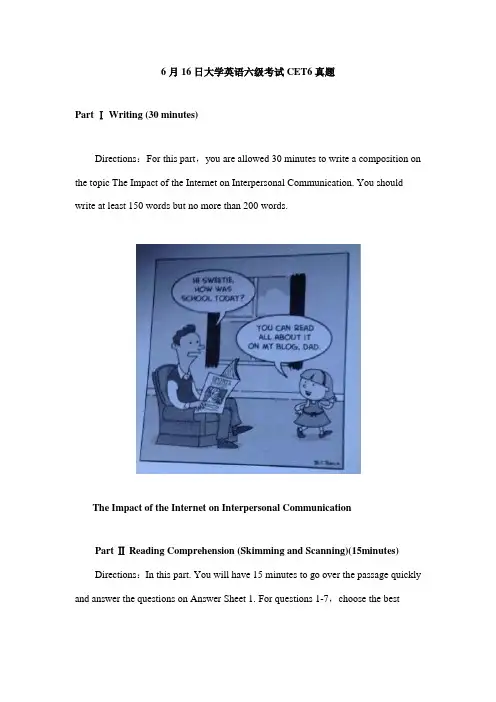
6月16日大学英语六级考试CET6真题Part Ⅰ Writing (30 minutes)Directions:For this part,you are allowed 30 minutes to write a composition on the topic The Impact of the Internet on Interpersonal Communication. You should write at least 150 words but no more than 200 words.The Impact of the Internet on Interpersonal CommunicationPart Ⅱ Reading Comprehension (Skimming and Scanning)(15minutes)Directions:In this part. You will have 15 minutes to go over the passage quickly and answer the questions on Answer Sheet 1. For questions 1-7,choose the bestanswer from the four choices marked A)、B)、C)and D). For questions 8-10,complete the sentences with the information given in the passage.The Three-Year SolutionHartwick College,a small liberal-arts school in upstate New York,makes New York,makes this offer to well prepared students:earn your undergraduate degree in three years instead of four,and save about 543,000—the amount of one year’s tuition and fees. A number of innovative colleges are making the same offer to students anxious about saving time and money. That’s both an opportunity and a warning for the best higher-education system in the world.T he United States has almost all of the world’s best universities. A recent Chinese survey ranks 35 American universities among the top 50,eight among the top 10. Our research universities have been the key to developing the competitive advantages that help Americans produce 25% of all the world’s wealth. In ,623,805 of the world’s brightest students were attracted to American universities.Yet,there are signs of peril (危险)within American higher education. U.S. colleges have to compete in the marketplace. Students may choose among 6,000 public,private,nonprofit,for profit,or religious institutions of higher learning. In addition,almost all of the 532 billion the federal government provides for university research is awarded competitively.But many colleges and universities are stuck in the past. For instance,the idea of the fall-to-spring“school year”hasn’t changed much since before the American Revolution,when we were a summer stretch no longer makes sense. Former George Washington University president Stephen Trachtenberg estimates that a typicalcollege uses its facilities for academic purposes a little more than half the calendar year.“While college facilities sit idle,they continue to generate maintenance expenses that contribute to the high cost of ru nning a college,” he has written.Within academic departments,tenure(终身职位),combined withage-discrimination laws,makes faculty turnover—critical for a university to remain current in changing times—difficult. Instead of protecting speech and encouraging diversity and innovative thinking,the tenure system often stifles(压制)them:younger professors must win the approval of established colleagues for tenure,encouraging like-mindedness and sometimes inhibiting the free flow of ideas.Meanwhile,tuition has soared,leaving graduating students with unprecedented loan debt. Strong campus presidents to manage these problems are becoming harderto find,and to keep. In fact,students now stay on campus almost as long as their presidents. The average amount of time students now take to complete an undergraduate degree has stretched to six years and seven months as students interrupted by work,inconvenienced by unavailable classes,or lured by one more football season find it hard to graduate.Congress has tried to help students with college costs through Pell Grants and other forms of tuition support. But some of their fixes have made the problem worse. The stack of congressional regulations governing federal student grants and loans now stands twice as tall as I do. Filling out these forms consumes 7% of every tuition dollar.For all of these reasons,some colleges like Hartwick are rethinking the old way of doing things and questioning decades-old assumptions about what a college degree means. For instance,why does it have to take four years to earn a diploma?This fall,16 first-year students and four second-year students at Hartwick enrolled in the school’s new three year degree program. According to the college,the plan is designed for high-ability,highly motivated student who wish to save money or to move along more rapidly toward advanced degrees.By eliminating that extra year,there year degree students save 25% in costs. Instead of taking 30 credits a year,these students take 40. During January,Hartwick runs a four week course during which students may earn three to four credits on or off campus,including a number of international sites. Summer courses are not required,but a student may enroll in them—and pay extra. Three year students get first crack at course registration. There are no changes in the number of courses professors teach or in their pay.The three-year degree isn’t a new idea. Geniuses have always breezed through. Judson College,a 350-student institution in Alabama,has offered students athree-year option for 40 years. Students attend “short terms” in May and June to earn the credits required for graduation. Bates College in Maine and Ball State University in Indiana are among other colleges offering three-year options.Changes at the high-school level are also helping to make it easier for many students to earn their undergraduate degrees in less time. One of five students arrives at college today with Advanced Placement (AP) credits amounting to a semester or more of college level work. Many universities,including large schools like the University of Texas,make it easy for these AP students to graduate faster.For students who don’t plan to stop with an undergraduate degree,the three-year plan may have an even greater appeal. Dr. John Sergent,head of Vanderbilt University Medical School’s residency (住院医生) program,enrolled in Vanderbilt’sundergraduate college in 1959. He entered medical school after only three years as did four or five of his classmates.” My first year of medical school counted a s my senior year,which meant I had to take three to four labs a week to get all my sciences in. I basically skipped my senior year,” says Sergent. He still had time to be a student senator and meet his wife.There are,however,drawbacks to moving through school at such a brisk pace. For one,it deprives students of the luxury of time to roam (遨游) intellectually. Compressing everything into three years also leaves less time for growing up,engaging in extracurricular activities,and studying abroad. On crowded campuses it could mean fewer opportunities to get into a prized professor’s class. Iowa’s Waldorf College has graduated several hundred students in its three-year degree program,but it now phasing out the option. Most Waldorf students wanted the full four-year experience—academically,socially,and athletically. And faculty members will be wary of any change that threatens the core curriculum in the name of moving students into the workforce.“Most high governmental officials seem to conceive of education in this light—as a way to ensure economic competitiveness and continued economic growth,” Derek Bok,former president of Harvard,told The Washington Post. “I strongly disagree with this approach.” Another risk:the new campus schedules might eventually produce less revenue for the institution and longer working hours for faculty members.Adopting a three-year option will not come easily to most school. Those that wish to tackle tradition and make American campus more cost-conscious may find it easier to tak e Trachtenberg’s advice:open campuses year-round.“You could run twocomplete colleges,with two complete faculties,”he says.“That’s without cutting the length of students’ vacations,increasing class sizes,or requiring faculty to teach more.”Whether they experiment with three-year degrees,offer year-round classes,challenge the tenure system—or all of the above—universities are slowly realizing that to stay competitive and relevant they must adapt to a rapidly changing world.Expanding the three-year option may be difficult,but it may be less difficult than asking Congress for additional financial help,asking legislators for more state support,or asking students even higher tuition payments. Campuses willing to adopt convenient schedules along with more focused,less-expensive degrees may find that they have a competitive advantage in attracting bright,motivated students. These sorts of innovations can help American universities avoid the perils of success.注意:此某些试题请在答题卡1上作答。
2021年6月大学英语六级仔细阅读练习题附答案及解析(3)
2021年6月大学英语六级仔细阅读练习题附答案及解析(3)Passage OneQuestions 56 to 60 are based on the following passage.Caught in a squeeze between the health needs of aging populations on one hand and the financial crisis on the other, governments everywhere are looking for ways to slow the growth in health-care spending. Increasingly, they are looking to the generic-drugs (普通药物) industry as a savior. In November Japan's finance ministry issued a report complaining that the country's use of generics was less than a third of that in America or Britain. In the same month Canada's competition watchdog criticized the country's pharmacies for failing to pass on the savings made possible by the use of generic drugs. That greed, it reckoned, costs taxpayers nearly C$1 billion a year.Then on November 28th the European Commission issued the preliminary results of its year-long probe into drug giants in the European Union. The report reached a damning~, though provisional, conclusion: the drugs firms use a variety of unfair strategies to protect their expensive drugs by delayingthe entry of cheaper generic opponents. Though this initial report does not carry the force of law (a final report is due early next year), it has caused much controversy. Neelie Kroes, the EU's competition commissioner, says she is ready to take legal action if the evidence allows.One strategy the investigators criticize is the use of the "patent duster( 专利群)". A firm keen to defend its drug due to go off-patent may file dozens or hundreds of new patents, often of dubious merit, to confuse and terrify potential copycats and maintain its monopoly. An unnamed drugs firm once took out 1,300 patents across the EU on a single drug. The report also suggests that out-of-court settlements between makers of patented drags and generics firms may be a strategy used by the former to delay market entry by the latter.According to EU officials, such misdeeds -have delayed the arrival of generic competition and the accompanying savings. On average, rite report estimates, generics arrived seven months after a patented drug lost its protection, though where the drug was a big seller the lag was four months. The report says taxpayers paid about q 3 billion more than they would have-had the generics gone on sale immediately.But hang on a minute, Though many of the charges of badbehavior leveled at the patented-drugs industry by EU investigators may well be true, the report seems to let the generics industry off the hook(钩子) too lightly. After all, if the drugs giants stand accused, in effect, of bribing opponents to delay the launch of cheap generics, shouldn't the companies that accepted those "bribes" also share the blame?56. Why are governments around the world seeking ways to reduce their health-care spending?A) They consider the generic-drugs industry as a savior.B) They are under the double pressure of aging group and financial crisis.C) Health-care spending has accounted too large proportion.D) Health-care spending has cost taxpayers too much income.57. What can we learn from the report issued by the European Commission?A) Drug firm will use just ways to protect their drags.B) Cheaper generic drugs are easy to enter market,C) The report has come to an ultimate conclusion.D) The final report may lead to commissioner's legal action.58. The investigators seriously condemned the drug firms for__________.A) they do not let their opponents to resort to the cometB) they use clusters of patents to protect their productsC) they bribe the cheaper generic opponentsD) trey do not pass on the savings made by use of generic drugs59. On average, the genetics will be delayed to enter the market by __________.A) seven monthsB) three monthsC) four monthsD) eleven months60. Which of the following accords with the author's view?A) Charges on patented-drug industry are anything but true.B) Generics industry is a sheer victim in the competition.C) Only drug giants are to blame.D) Exclusion of generics industry from taking responsibility is questionable.Passage TwoQuestions 61 to 65 are based on the following passage.Yet with economies in free fail, managers also need up-to-date information about what is happening to their businesses, so that they can change course rapidly if necessary. Cisco, an American network-equipment giant, hasinvested over many years in the technology needed to generate such data .Frank Caideroni, the firm's CFO, says that every day its senior executives can track exactly what orders are coming in from sales teams around the world, and identify emerging trends in each region and market segment. And at the end of each month, the firm can get reliable financial results within four hours of closing its books. Most firms have to wait days or even weeks for such certainty.Admittedly, Cisco's financial results have not made happy reading recently because, in common with many other large technology companies, it has seen demand for its products decline in the downturn. In early February it announced that its fiscal second-quarter revenues of $ 9.1 billion were 7.5% lower than the same period in 2021 and that its profit had fallen by 27%, to $1.5 billion.In response to hard times, Cisco plans to cut $1 billion of costs this year by, among other things, making use of its own video-conferencing and other communications technologies to reduce the amount its executives travel. It is also using these facilities to relay information from employees on the ground to its senior managers, and to get instructions from Cisco's leaders back out to its 67,000 staff. A rapid exchangeof information and instructions is especially valuable if the company wants to alter course in stormy times.If everybody in a company can rapidly grasp what they have to do and how it is changing, they are more likely to get the job done. But some firms are reluctant to share their goals with the wider world. Unilever, a big Anglo-Dutch consumer-goods group, has decided against issuing a 2021 financial forecast to investors, arguing that it is difficult to predict what is going to happen, given the dangerous state of the world economy. "We're not just going to provide numbers for the sake of it," explains James Allison, the company's head of investor relations. Other companies that have decided not to provide annual earnings estimates for 2021 include Costco, a big American retailer, and Union Pacific, an American railway company.Some firms, such as Intel, seem to have chosen to take things quarter by quarter. The giant chipmaker(芯片制造商) said in January that it would not issue an official forecast for the first quarter of 2021 after its fourth-quarter 2021 profit decreased by 90%. Several retail chains have also stopped providing monthly sales estimates because they cannot see what the future holds. Retailers, chipmakers and firms inmany other industries may have a long wait before the economic fog finally lifts.61. What can we learn about Cisco from the passage?A) It will keep a record of the orders from sales teams.B) It cuts $1 billion cost by solely relying on its own technologies.C) Unlike other technology companies, its financial reports are encouraging.D) Only employees can use the video-conferencing to pass information.62. According to the author, the staff can perform better by__________.A) getting instructions from their senior managersB) seizing what to do at hand and what to do nextC) having a financial forecast as a goalD) sharing their goals with others63. What is important in the unstable time ff a company wants to change strategies?A) To issue company's financial reports faster.B) To obtain the up-to-date information of company's business.C) To predict what is going to happen in the future.D) To wait until the economic fog finally lifts.64. The reason Unilever plans not to issue financial forecast in 2021 lies in__________.A) its reluctance to share its goal with othersB) its rapid grasp of changes in the marketsC) the unstable economic situationD) its reduction in the cost of prediction65. What can we know about the giant chipmaker, Intel in the passage?A) It did not issue first-quarter forecast for great decrease in January.B) Inters chain store used to report sales estimates by year.C) Only retailers and chipmakers are greatly influenced.D) Intel's profit was greatly decreased in 2021's last quarter.答案解析:56.B)。
2021年6月大学英语六级仔细阅读练习题附答案及解析(4)

2021年6月大学英语六级仔细阅读练习题附答案及解析(4)Passage OneQuestions 56 to 60 are based on the following passage.They're still kids, and although there's a lot that the experts don't yet know about them, one thing they do agree on is that what kids use and expect from their world has changed rapidly. And it's all because of technology.To the psychologists, sociologists, and generational and media experts who study them, their digital gear sets this new group apart, even from their tech-savvy (懂技术的) Millennial elders. They want to be constantly connected and available in a way even their older siblings don't quite get. These differences may appear slight, but they signal an all-encompassing sensibility that some say marks the dawning of a new generation.The contrast between Millennials and this younger group was so evident to psychologist Larry Rosen of California State University that he has declared the birth of a new generation in a new book, Rewired: Understanding the ingeneration and the Way They Learn, out next month. Rosen says the tech-dominatedlife experience of those born since the early 1990s is so different from the Millennials he wrote about in his 2021 book, Me, MySpace and I: Parenting the Net Generation, that they warrant the distinction of a new generation, which he has dubbed the "ingeneration"."The technology is the easiest way to see it, but it's also a mind-set, and the mind-set goes with the little ‘i', which I'm talking to stand for 'individualized'," Rosen says. "Everything is defined and individualized to ‘me'. My music choices are defined to ' me'. What I watch on TV any instant is defined to ‘me'. " He says the iGeneration includes today's teens and middle-school ers, but it's too soon to tell about elementary-school ages and younger.Rosen says the iGeneration believes anything is possible. "If they can think of it, somebody probably has or will invent it," he says. "They expect innovation."They have high expectations that whatever they want or can use "will be able to be tailored to their own needs and wishes and desires."Rosen says portability is key. They are inseparable from their wireless devices, which allow them to text as well as talk, so they can be constantly connected-even in class, where cellphones are supposedly banned.Many researchers are trying t6 determine whether technology somehow causes the brains of young people to be wired differently. "They should be distracted and should perform more poorly than they do," Rosen says. "But findings show teens survive distractions much better than we would predict by their age and their brain development. "Because these kids are more immersed and at younger ages, Rosen says, the educational system has to change significantly."The growth curve on the use of technology with children is exponential(指数的), and we run the risk of being out of step with this generation as far as how they learn and how they think," Rosen says."We have to give them options because they want their world individualized. "56. Compared with their Millennial elders, the iGeneration kidsA.communicate with others by high-tech methods continually B.prefer to live a virtual life than a real oneC.are equipped with more modem digital techniquesD.know more on technology than their elders57. Why did Larry Rosen name the new generation asiGeneration?A.Because this generation is featured by the use of personal high-tech devices.B.Because this generation stresses on an individualized style of life.C.Because it is the author himself who has discovered the new generation.D.Because it's a mind-set generation instead of an age-set one.58. Which of the following is true about the iGeneration according to Rosen?A.This generation is crazy about inventing and creating new things.B.Everything must be adapted to the peculiar need of the generation.C.This generation catches up with the development of technology.D.High-tech such as wireless devices goes with the generation.59. Rosen's findings suggest that technologyA.has an obvious effect on the function of iGeneration's brain developmentB.has greatly affected the iGeneration's behaviors and academic performanceC.has no significantly negative effect on iGeneration's mental and intellectual developmentD.has caused distraction problems on iGeneration which affect their daily performance60. According to the passage, education has to __A.adapt its system to the need of the new generationB.use more technologies to cater for the iGenerationC.risk its system to certain extent for the iGeneration D.be conducted online for iGeneration's individualized needPassage TwoQuestions 61 to 65 are based on the following passage.Small increases in temperature found to add power to storms in the Atlantic.Hurricanes that form in the Atlantic Ocean are expected to gain considerable strength as the global temperature continues to rise, a new study has found.Using modeling data focused on the conditions in which hurricanes form, a group of international researchers based at Beijing Normal University found that for every 1.8°F( 1℃)rise of the Earth's temperature, the number of hurricanes in the Atlantic that are as strong or stronger than Hurricane Katrina will increase twofold to sevenfold.Hurricane strength is directly related to the heat of the water where the storm forms. More water vapor in the air from evaporating ocean water adds fuel to hurricanes that build strength and head toward land.Hurricane Katrina is widely considered the measure for a destructive storm, holding the maximum Category 5 designation for a full 24 hours in late August 2005. It lost strength as it passed over the Florida peninsula, but gained destructive power fight before colliding with New Orleans, killing more than 200 people and causing $ 80 billion in damage.The study points to a gradual increase of Katrina-like events. The warming experienced over the 20th century doubled the number of such debilitating(将人类摧垮的)storms. But the ongoing warming of the planet into the 21st century could increase the frequency of the worst kinds of storms by 700 percent, threatening coastlines along the Atlantic Ocean with muitiple Category 5 storms every year."Our results support the idea that changes in regional sea surface temperatures is the primary cause of hurricanevariability," said Aslak Girnstead, a researcher with the Center for Ice and Climate at the University of Copenhagen. The large impact of small sea-surface temperature increases was more than Girustead and his colleagues had anticipated. The entire study was published in the Proceedings of the National Academy of Sciences.Global temperatures have steadily increased, making the past decade the warmest on record. Earlier this year, climate researchers reported that the Earth's temperatures have risen faster in the last century than at any point since the last ice age, 11,300 years ago. The primary cause, a couseusus of scientists has said, is the rising emissions of greenhouse gases like carbon dioxide and methane.Past hurricanes have supported the study's finding that global temperature rise is linked to more destructive storms. According to the National Center for Atmospheric Research, while the frequency of storms doesn't appear to have increased, the percentage of strong ones has risen sharply over the past few decades. The trend may be similar further back in time, but comprehensive hurricane data doesn't exist.61. According to the team of international researchers based at Beijing Normal University, the rise of the Earth'stemperature is likely to causeA.the coming of ice ageC.more Katrina-like or worse hurricanesB.less intense hurricanesD.more greenhouse gases in the atmosphere62. The ocean water in the region where the storm formsA.is heating the hurricanesB.evaporates and becomes fuelC.heads toward landD.turns into water vapor that makes hurricanes stronger63. Which of the following statement is TRUE about Hurricane Katrina?A.It did not lose its strength as it moved.B.It claimed over 200 people's lives.C.It caused 80 billion dollars loss for Florida peninsula.D.It lasted for full 24 hours.64. What result can regional sea surface temperature changes produce?A.Hurricane changes.C.Global warming.B.Increasing greenhouse gas emissions.D.Destructive hurricanes.65. It can be inferred from the passage thatA.there is no link between greenhouse gas emissions and destructive stormsB.reduction of greenhouse gas emissions may reduce destructive stormsC.the higher percentage of strong ones rose as more hurricanes appearedD.past records on hurricanes included everything needed 答案解析:56.A)。
2021年6月大学英语六级阅读理解真题及答案
2021年6月大学英语六级阅读理解真题及答案Questions 21 to 25 are based on the following passage. “There is a senseless notion that children grow up and leave home when they’re 18, and the truth is far from that,” says sociologist Larry Bumpass of the University of Wisconsin. Today, unexpected numbers of young adults are living with their parents, “There is a major shift in the middle class,” declares sociologist Allan Schnaiberg of Northwester University, whose son, 19, moved back in after an absence of eight months. Analysts cite a variety of reasons for this return to the nest. The marriage age is rising, a condition that makes home and its pleasantness particularly attractive to young people. A high divorce rate and a declining remarriage rate are sending economically pressed and emotionally hurt survivors back to parental shelters. For some, the expense of an away-from-home college education has become so excessively great that many students now attend local schools. Even after graduation, young people find their wings clipped by skyrocketing housing costs. Living at home, says Knighton, a school teacher, continues togive her security and moral support. Her mother agreed, “It’s ridiculous for the kids to pay all that money for rent. It makes sense for kids to stay at home.” But sharing the family home requires adjustments for all. There are the hassles over bathrooms, telephones and privacy (不受干扰的生活). Some families, however, manage the delicate balancing act. But for others, it proves too difficult. Michelle Del Turco, 24, has been home three times-and left three times. “What I considered a social drink, my dad considered an alcohol problem,” she explains. “He never liked anyone I dated (约会), so I either had to hide away or meet them at friends’ house.”Just how long should adult children live with their parents before moving on? Most psychologists feel lengthy homecomings are a mistake. Children, struggling to establish separate identities, can end up with “a sense of inadequacy, defeat and failure.” And aging parents, who should be enjoying some financial and personal freedom, find themselves stuck with responsibilities. Many agree that brief visits, however, can work beneficially.21. According to the author, there was once a trend in the U.S. ________.A) for young adults to leave their parents and liveindependentlyB) for middle class young adults to stay with their parentsC) for married young adults to move back home after a lengthy absenceD) for young adults to get jobs nearby in order to live with their parents22. Which of the following does not account for young adults returning to the nest?A) Young adults find housing costs too high.B) Young adults are psychologically and intellectually immature.C) Young adults seek parental comfort and moral support.D) Quite a number of young adults attend local schools.23. One of the disadvantages of young adults returning to stay with their parents is that ________.A) there will inevitably be inconveniences in every day lifeB) most parents find it difficult to keepC) the young adults tend to be overprotected by their parentsD) public opinion is against young adults staying with their parents24. The word “hassles” in the passage (Line 3, Para. 3) probably means ________.A) agreementsB) worriesC) disadvantagesD) quarrels25. According to the passage what is the best for both parents and children?A) They should adjust themselves to sharing the family expenses.B) Children should leave their parents when they are grown-up.C) Adult children should visit their parents from time to time.D) Parents should support their adult children when they are in trouble.Questions 26 to 30 are based on the following passage.The word conservation has a thrifty (节俭) meaning. To conserve is to save and protect, to leave what we ourselves enjoy in such good condition that others may also share the enjoyment. Our forefathers had no idea that human population would increase faster than the supplies of raw materials; most of them, even until very recently, had the foolish idea that the treasures were “limitless” and “inexhaustible”. Most of the citizens of earlier generations knew little or nothing about the complicated and delicate system that runs all through nature,and which means that, as in a living body, an unhealthy condition of one part will sooner or later be harmful to all the others.Fifty years ago nature study was not part of the school work; scientific forestry was a new idea; timber was still cheap because it could be brought in any quantity from distant woodlands; soil destruction and river floods were not national problems; nobody had yet studied long-terms climatic cycles in relation to proper land use; even the word “conservation” had nothing of the meaning that it has for us today.For the sake of ourselves and those who will come after us, we must now set about repairing the mistakes of our forefathers. Conservation should, therefore, be made a part of everyone’s daily life. To know about the water table (水位) in the ground is just as important to us as a knowledge of the basic arithmetic formulas. We need to know why all watersheds (上游源头森林地带集水区) need the protection of plant life and why the running current of streams and rivers must be made to yield their full benefit to the soil before they finally escape to the sea. We need to be taught the duty of planting trees as well as of cutting them. We need to know the importance of big, mature trees, because living space for most of man’s fellow creatureson this planet is figured not only in square measure of surface but also in cubic volume above the earth. In brief, it should be our goal to restore as much of the original beauty of nature as we can.26. The author’s attitude towards the current situation in the exploitation of natural resources is ________.A) positiveB) neutralC) suspiciousD) critical27. According to the author, the greatest mistake of our forefathers was that ________.A) they had no idea about scientific forestryB) they had little or no sense of environmental protectionC) they were not aware of the significance of nature studyD) they had no idea of how to make good use of raw materials28. It can be inferred from the third paragraph that earlier generations didn’t realize ________.A) the interdependence of water, soil, and living thingsB) the importance of the proper use of landC) the harmfulness of soil destruction and river floodsD) the value of the beauty of nature29. To avoid correcting the mistake of our forefathers, the author suggests that ________.A) we plant more treesB) natural science be taught to everybodyC) environmental education be directed toward everyoneD) we return to nature30. What does the author imply by saying “living space... is figured... also in cubic volume above the earth” (Lines 7-8, Para. 3)?A) Our living space on the earth is getting smaller and smaller.B) Our living space should be measured in cubic volume.C) We need to take some measure to protect space.D) We must preserve good living conditions for both birds and animals.Questions 31 to 35 are based on the following passage. Judging from recent surveys, most experts in sleep behavior agree that there is virtually an epidemic (流行病) of sleepiness in the nation. “I can’t think of a single study that hasn’t found Americans getting less sleep than they ought to,” says Dr. David. Even people who think they are sleepingenough would probably be better off with more rest.The beginning of our sleep-deficit (睡眠不足) crisis can be traced to the invention of the light bulb a century ago. From diary entries and other personal accounts from the 18th and 19th centuries, sleep scientists have reached the conclusion that the average person used to sleep about 9.5 hours a night. “The best sleep habits once were forced on us, when we had nothing to do in the evening down on the farm, and it was dark.” By the 1950s and 1960s, the sleep schedule had been reduced dramatically, to between 7.5 and eight hours, and most people had to wake to an alarm clock. “People cheat on their sleep, and they don’t even realize they’re doing it,” says Dr. David. “They think they’re okay because they can get by on 6.5 hours, when they really need 7.5, eight or even more to feel ideally vigorous.”Perhaps the most merciless robber of sleep, researchers say is the complexity of the day. Whenever pressures from work, family, friends and community mount, many people consider sleep the least expensive item on his programme. “In our society, you’re considered dynamic if you say you only need 5.5 hours’ sleep. If you’re got to get 8.5 hours, people think you lack drive and ambition.”To determine the consequences of sleep deficit, researchers have put subjects through a set of psychological and performance tests requiring them, for instance, to add columns of numbers or recall a passage read to them only minutes earlier. “We’ve found that if you’re in sleep deficit, performance suffers,” says Dr. David. “Short-term memory is weakened, as are abilities to make decisions and to concentrate.”31. People in the 18th and 19th centuries used to sleep about9.5 hours a night because they had ________.A) no drive and ambitionB) no electric lightingC) the best sleep habitsD) nothing to do in the evening32. According to Dr. David, Americans ________.A) are ideally vigorous even under the pressure of lifeB) often neglect the consequences of sleep deficitC) do not know how to relax themselves properlyD) can get by on 6.5 hours of sleep33. Many Americans believe that ________.A) sleep is the first thing that can be sacrificed when one is busyB) they need more sleep to cope with the complexities ofeveryday lifeC) to sleep is something one can do at any time of the dayD) enough sleep promotes people’s drive and ambition34. The word “subjects” (Line 1, Para. 4) refers to ________.A) the performance tests used in the study of sleep deficitB) special branches of knowledge that are being studiedC) people whose behavior or reactions are being studiedD) the psychological consequences of sleep deficit35. It can be concluded from the passage that one should sleep as many hours as is necessary to ________.A) improve one’s memory dramaticallyB) be considered dynamic by other peopleC) maintain one’s daily scheduleD) feel energetic and perform adequatelyQuestions 36 to 40 are based on the following passage.The concept of personal choice in relation to health behaviors is an important one. An estimated 90 percent of all illness may be preventable if individuals would make sound personal health choices based upon current medical knowledge. We all enjoy our freedom of choice and do not like to see it restricted when it is within the legal and moral boundaries of society. Thestructure of American society allows us to make almost all our own personal decisions that may concern our health. If we so desire, we can smoke, drink excessively, refuse to wear seat belts, eat whatever food we want, and live a completely sedentary life-style without any exercise. The freedom to make such personal decisions is a fundamental aspect of our society, although the wisdom of these decisions can be questioned. Personal choices relative to health often cause a difficulty. As one example, a teenager may know the facts relative to smoking cigarettes and health but may be pressured by friends into believing it is the socially accepted thing to do.A multitude of factors, both inherited and environmental, influence the development of health-related behaviors, and it is beyond the scope of this text to discuss all these factors as they may affect any given individual. However, the decision to adopt a particular health-related behavior is usually one of personal choice. There are healthy choices and there are unhealthy choices. In discussing the morals of personal choice, Fries and Crapo drew a comparison. They suggest that to knowingly give oneself over to a behavior that has a statistical probability of shortening life is similar to attempting suicide. Thus, for those individuals who are interested in preservingboth the quality and quantity of life, personal health choices should reflect those behaviors that are associated with a statistical probability of increased vitality and longevity.36. The concept of personal choice concerning health is important because ________.A) personal health choices help cure most illnessB) it helps raise the level of our medical knowledgeC) it is essential to personal freedom in American societyD) wrong decisions could lead to poor health37. To “live a completely sedentary life-style” (Line 7, Para.1) in the passage means ________.A) to “live an inactive life”B) to “live a decent life”C) to “live a life with complete freedom”D) to “live a life of vice”38. Sound personal health choice is often difficult to make because ________.A) current medical knowledge is still insufficientB) there are many factors influencing our decisionsC) few people are willing to trade the quality of lifeD) people are usually influenced by the behavior of their friends39. To knowingly allow oneself to purse unhealthy habits is compared by Fried and Crapo to ________.A) improving the quality of one’s lifeB) limiting one’s personal health choiceC) deliberately ending one’s lifeD) breaking the rules of social behavior40. According to Fries and Crapo sound health choices should be based on ________.A) personal decisionsB) society’s lawsC) statistical evidenceD) friends’ opinions21. A22. B23. A24. D25. C26. D27. B28. A29. C30. D31. B32. B33. A34. C35. D36. D37. A38. B39. C40. C。
2021年6月大学英语六级阅读理解真题及答案_10
2021年6月大学英语六级阅读理解真题及答案Questions 21 to 25 are based on the following passage. When global warming finally came, it stuck with a vengeance (异乎寻常地). In some regions, temperatures rose several degrees in less than a century. Sea levels shot up nearly 400 feet, flooding coastal settlements and forcing people to migrate inland. Deserts spread throughout the world as vegetation shifted drastically in North America, Europe and Asia. After driving many of the animals around them to near extinction, people were forced to abandon their old way of life for a radically new survival strategy that resulted in widespread starvation and disease. The adaptation was farming: the global-warming crisis that gave rise to it happened more than 10,000 years ago.As environmentalists convene in Rio de Janeiro this week to ponder the global climate of the future, earth scientists are in the midst of a revolution in understanding how climate has changed in the past—and how those changes have transformed human existence. Researchers have begun to piece together anilluminating picture of the powerful geological and astronomical forces that have combined to change the planet’s environment from hot to cold, wet to dry and back again over a time period stretching back hundreds of millions of years. Most importantly, scientists are beginning to realize that the climatic changes have had a major impact on the evolution of the human species. New research now suggests that climate shifts have played a key role in nearly every significant turning point in human evolution: from the dawn of primates (灵长目动物) some 65 million years ago to human ancestors rising up to walk on two legs, from the huge expansion of the human brain to the rise of agriculture. Indeed, the human history has not been merely touched by global climate change, some scientists argue, it has in some instances been driven by it. The new research has profound implications for the environmental summit in Rio. Among other things, the findings demonstrate that dramatic climate change is nothing new for planet Earth. The benign (宜人的) global environment that has existed over the past 10,000 years—during which agriculture, writing, cities and most other features of civilization appeared—is a mere bright spot in a much larger pattern of widely varying climate over the ages. In fact, the pattern ofclimate change in the past reveals that Earth’s climate will almost certainly go through dramatic changes in the future —even without the influence of human activity.21. Farming emerged as a survival strategy because man had been obliged ________.A) to give up his former way of lifeB) to leave the coastal areasC) to follow the ever-shifting vegetationD) to abandon his original settlement(A)22. Earth scientists have come to understand that climate ________.A) is going through a fundamental changeB) has been getting warmer for 10,000 yearsC) will eventually change from hot to coldD) has gone through periodical changes(D)23. Scientists believe that human evolution ________.A) has seldom been accompanied by climatic changesB) has exerted little influence on climatic changesC) has largely been effected by climatic changesD) has had a major impact on climatic changes(C)24. Evidence of past climatic changes indicates that ________.A) human activities have accelerated changes of Earth’senvironmentB) Earth’s environment will remain mild despite human interferenceC) Earth’s climate is bound to change significantly in the futureD) Earth’s climate is unlikely to undergo substantial changes in the future(C)25. The message the author wishes to convey in the passage is that ________.A) human civilization remains glorious though it is affected by climatic changesB) mankind is virtually helpless in the face of the dramatic changes of climateC) man has to limit his activities to slow down the global warming processD) human civilization will continue to develop in spite of the changes of natureQuestions 26 to 30 are based on the following passage.Now woman can be too rich or too thin. This saying often attributed to the late Duchess (公爵夫人) of Windsor embodies much of the odd spirit of our times. Being thin is deemed assuch a virtue.The problem with such a view is that some people actually attempt to live by it. I myself have fantasies of slipping into narrow designer clothes. Consequently, I have been on a diet for the better—or worse—part of my life. Being rich wouldn’t be bad either, but that won’t happen unless an unknown relative dies suddenly in some distant land, leaving me millions of dollars.Where did we go off the track? When did eating butter become a sin, and a little bit of extra flesh unappealing, if not repellent? All religions have certain days when people refrain from eating, and excessive eating is one of Christianity’s seven deadly sins. However, until quite recently, most people had a problem getting enough to eat. In some religious groups, wealth was a symbol of probable salvation and high morals, and fatness a sign of wealth and well-being.Today the opposite is true. We have shifted to thinness as our new mark of virtue. The result is that being fat—or even only somewhat overweight—is bad because it implies a lack of moral strength.Our obsession (迷恋) with thinness is also fueled by health concerns. It is true that in this country we have moreoverweight people than ever before, and that, in many cases, being overweight correlates with an increased risk of heart and blood vessel disease. These diseases, however, may have as much to do with our way of life and our high-fat diets as with excess weight. And the associated risk of cancer in the digestive system may be more of a dietary problem—too much fat and a lack of fiber—than a weight problem.The real concern, then, is not that we weigh too much, but that we neither exercise enough nor eat well. Exercise is necessary for strong bones and both heart and lung health. A balanced diet without a lot of fat can also help the body avoid many diseases. We should surely stop paying so much attention to weight. Simply being thin is not enough. It is actually hazardous if those who get (or already are) thin think they are automatically healthy and thus free from paying attention to their overall life-style. Thinness can be pure vainglory (虚荣).26. In the eyes of the author, an odd phenomenon nowadays is that ________.A) the Duchess of Windsor is regarded as a woman of virtueB) looking slim is a symbol of having a large fortuneC) being thin is viewed as a much desired qualityD) religious people are not necessarily virtuous(C)27. Swept by the prevailing trend, the author ________.A) had to go on a diet for the greater part of her lifeB) could still prevent herself from going off the trackC) had to seek help from rich distant relativesD) had to wear highly fashionable clothes(A)28. In human history, people’s views on body weight ________.A) were closely related to their religious beliefsB) changed from time to timeC) varied between the poor and the richD) led to different moral standards(B)29. The author criticizes women’s obsession with thinness ________.A) from an economic and educational perspectiveB) from sociological and medical points of viewC) from a historical and religious standpointD) in the light of moral principles(B)30. What’s the author’s advice to women who are absorbed in the idea of thinness?A) They should be more concerned with their overall lifestyle.B) They should be more watchful for fatal diseases.C) They should gain weight to look healthy.D) They should rid themselves of fantasies about designerclothes.Questions 31 to 35 are based on the following passage.War may be a natural expression of biological instincts and drives toward aggression in the human species. Natural impulses of anger, hostility, and territoriality (守卫地盘的天性) are expressed through acts of violence. These are all qualities that humans share with animals. Aggression is a kind of innate (天生的) survival mechanism, an instinct for self-preservation that allows animals to defend themselves from threats to their existences of human violence are always conditioned by social conventions that give shape to aggressive behavior. In human societies violence has a social function. It is a strategy for creating or destroying forms of social order. Religious traditions have taken a leading role in directing the powers of violence. We will look at the ritual and ethical (道德上的) patterns within which human violence has been directed. The violence within a society is controlled through institutions of law. The more developed a legal system becomes, the more society takes responsibility for the discovery, control, and punishment of violent acts. In most tribal societies the only means to deal with an act of violence isrevenge. Each family group may have the responsibility for personally carrying out judgment and punishment upon the person who committed the offense. But in legal systems, the responsibility for revenge becomes depersonalized and diffused. The society assumes the responsibility for protecting individuals from violence. In cases where they cannot be protected, the society is responsible for imposing punishment. In a state controlled legal system, individuals are removed from the cycle of revenge motivated by acts of violence, and the state assumes responsibility for their protection.The other side of a state legal apparatus is a state military apparatus. While the one protects the individual from violence, the other sacrifices the individual to violence in the interests of the state. In war the state affirms its supreme power over the individuals within its own borders. War is not simply a trial by combating to settle disputes between states; it is the moment when the state makes its most powerful demands upon its people for their commitment allegiance, and supreme sacrifice. Times of war test a community’s deepest religious and ethical commitments.31. Human violence shows evidence of being a learned behavior in that ________.A) it threatens the existing social systemsB) it is influenced by societyC) it has roots in religious conflictsD) it is directed against institutions of law(B)32. The function of legal systems, according to the passage, is ________.A) to control violence within a societyB) to protect the world from chaosC) to free society from the idea of revengeD) to give the government absolute power(A)33. What does the author mean by saying “... in legal systems, the responsibility for revenge becomes depersonalized and diffused” (Lines 4-5, Para. 2)?A) Legal systems greatly reduce the possibilities of physical violence.B) Offenses against individuals are no longer judged on a personal basis.C) Victims of violence find it more difficult to take revenge.D) Punishment is not carried out directly by the individuals involved.(D)34. The word “allegiance” (Line 4, Para. 3) is closest in meaning to ________.A) loyaltyB) objectiveC) survivalD) motive(A)35. What can we learn from the last paragraph?A) Governments tend to abuse their supreme power in times of war.B) In times of war governments may extend their power across national borders.C) In times of war governments impose high religious and ethical standards on their people.D) Governments may sacrifice individuals in the interests of the state in times of war.Questions 36 to 40 are based on the following passage. Researchers who are unfamiliar with the cultural and ethnic groups they are studying must take extra precautions to shed any biases they bring with them from their own culture. For example, they must make sure they construct measures that are meaningful for each of the cultural or ethnic minority groups being studied.In conducting research on cultural and ethnic minority issues,investigators distinguish between the emic approach and the etic approach. In the emic approach, the goal is to describe behavior in one culture or ethnic group in terms that are meaningful and important to the people in that culture or ethnic group, without regard to other cultures or ethnic groups. In the etic approach, the goal is to describe behavior so that generalizations can be made across cultures. If researchers construct a questionnaire in anemic fashion, the concern is only that the questions are meaningful to the particular culture or ethnic group being studied. If, however, the researchers construct a questionnaire in an etic fashion, they want to include questions that reflect concepts familiar to all cultures involved.How might the emic and etic approaches be reflected in the study of family processes? In the emic approach, the researchers might choose to focus only on middle-class White families, without regard for whether the information obtained in the study can be generalized or is appropriate for ethnic minority groups. In a subsequent study, the researchers may decide to adopt an etic approach by studying not only middle-class White families, but also lower-income White families, Black American families, Spanish American families, and Asian Americanfamilies. In studying ethnic minority families, the researchers would likely discover that the extended family is more frequently a support system in ethnic minority families than in White American families. If so, the emic approach would reveal a different pattern of family interaction than would the etic approach, documenting that research with middle-class White families cannot always be generalized to all ethnic groups.36. According to the first paragraph, researchers unfamiliar with the target cultures are inclined to ________.A) be overcautious in constructing meaningful measuresB) view them from their own cultural perspectiveC) guard against interference from their own cultureD) accept readily what is alien to their own culture(B)37. What does the author say about the emic approach and the etic approach?A) They have different research focuses in the study of ethnic issues.B) The former is biased while the latter is objective.C) The former concentrates on the study of culture while the latter on family issues.D) They are both heavily dependent on questionnaires inconducting surveys.(A)38. Compared with the etic approach, the emic approach is apparently more ________.A) culturally interactiveB) culturally biasedC) culture-orientedD) culture-specific(D)39. The etic approach is concerned with ________.A) the general characteristics of minority familiesB) culture-related concepts of individual ethnic groupsC) features shared by various cultures or ethnic groupsD) the economic conditions of different types of families(C)40. Which of the following is true of the ethnic minority families in the ________ U.S. according to the passage?A) Their cultural patterns are usually more adaptable.B) Their cultural concepts are difficult to comprehend.C) They don’t interact with each other so much as White families.D) They have closer family ties than White families.21. A 22. D 23. C 24. C 25. B26. C 27. A 28. B 29. B 30. A31. B 32. A 33. D 34. A 35. D36. B 37. A 38. D 39. C 40. D。
大学英语六级第2套真题及答案解析
2021 年6 月大学英语六级考试真题〔第二套〕特别说明:2021 年 6 月大学英语六级试卷的三套试题有重叠局部,本试卷〔第二套〕只列出与第一、第三套不重复的试题。
具体重叠局部:本卷全部听力题与第一套试卷有重复,本试卷不再列出。
Part I Writing (30 minutes)For this part, you are allowed 30 minutes to write a short essay on e-learning. Try to imagine what will happen when more and more people study online instead of attending school. You are required to write at least 150 words but no more than 200 words.Directions:Part III Reading comprehension (40 minutes)Section ADirections: In this section, there is a passage with ten blanks. You are required to select one word for each blank from a list of choices given in a word bank following the passage. Read the passage through carefully before making your choices. Each choice in the bank is identified by a letter. Please mark the corresponding letter for each item on Answer Sheet 2 with a single line through the center. You may not use any of the words in the bank more than once.The robotics revolution is set to bring humans face to face with an old fear—man-made creations as smart and capable as we are but without a moral compass. As robots take on ever more complex roles, the question naturally 26 : Who will be responsible when they do something wrong? Manufacturers? Users? Software writers? The answer depends on the robot.Robots already save us time, money and energy. In the future, they will improve our health care, social welfare and standard of living. The 27 of computational power and engineering advances will 28 enable lower-cost in- home care for the disabled, 29 use of driverless cars that may reduce drunk- and distracted-driving accidents and countless home and service-industry uses for robots, from street cleaning to food preparation.But there are 30 to be problems. Robot cars will crash. A drone ( 遥控飞行器 ) operator will 31 someone’s privacy. A robotic lawn mower will run over a neighbor’s cat. Juries sympathetic to the 32 of machines will punish entrepreneurs with company-crushing 33 and damages. What should governments do to protect people while 34 space for innovation?Big, complicated systems on which much public safety depends, like driverless cars, should be built, 35 and sold by manufacturers who take responsibility for ensuring safety and are liable for accidents. Governments should set safety requirements and then let insurers price the risk of the robots based on the manufacturer’s driving record, not the passenger’s.注意:此局部试题请在答题卡 2 上作答。
2021年6月大学英语六级阅读理解真题及答案_4
2021年6月大学英语六级阅读理解真题及答案Questions 21 to 25 are based on the following passage.A new era is upon us. Call it what you will: the service economy, the information age, the knowledge society. It all translates to a fundamental change in the way we work. Already we’re partly there. The percentage of people who earn their living by making things has fallen dramatically in the Western World. Today the majority of jobs in America, Europe and Japan (two thirds or more in many of these countries) are in the service industry, and the number is on the rise. More women are in the work force than ever before. There are more part-time jobs. More people are self-employed. But the breadth of the economic transformation can’t be measured by numbers alone, because it also is giving rise to a radical new way of thinking about the nature of work itself. Long-held notions about jobs and careers, the skills needed to succeed, even the relation between individuals and employers—all these are being challenged. We have only to look behind us to get some sense of what may lie ahead. No one looking ahead 20 years possibly could haveforeseen the ways in which a single invention, the chip (集成块), would transform our world thanks to its applications in personal computers, digital communications and factory robots. Tomorrow’s achievements in biotechnology, artificial intelligence or even some still unimagined technology could produce a similar wave of dramatic changes. But one thing is certain: information and knowledge will become even more vital, and the people who possess it, whether they work in manufacturing or services, will have the advantage and produce the wealth. Computer knowledge will become as basic a requirement as the ability to read and write. The ability to solve problems by applying information instead of performing routine tasks will be valued above all else. If you cast your mind ahead 10 years, information services will be predominant. It will be the way you do your job.21. A characteristic of the information age is that ________.A) the service industry is relying more and more on the female work forceB) manufacturing industries are steadily increasingC) people find it harder and harder to earn a living by working in factoriesD) most of the job opportunities can now be found in the serviceindustry22. One of the great changes brought about by the knowledge society is that ________.A) the difference between the employee and the employer has become insignificantB) people’s traditional concepts about work no longer hold trueC) most people have to take part-time jobsD) people have to change their jobs from time to time23. By referring to computers and other inventions, the author means to say that ________.A) people should be able to respond quickly to the advancement of technologyB) future achievements in technology will bring about inconceivable dramatic changesC) the importance of high technology has been overlookedD) computer science will play a leading role in the future information services24. The future will probably belong to those who ________.A) possess and know how to make use of informationB) give full play to their brain potentialC) involve themselves in service industriesD) cast their minds ahead instead of looking back25. Which of the following would be the best title for the passage?A) Computers and the Knowledge SocietyB) Service Industries in Modern SocietyC) Features and Implications of the New EraD) Rapid Advancement of Information TechnologyQuestions 26 to 30 are based on the following passage. Beauty has always been regarded as something praiseworthy. Almost everyone thinks attractive people are happier and healthier, have better marriages and have more respectable occupations. Personal consultants give them better advice for finding jobs. Even judges are softer on attractive defendants (被告). But in the executive circle, beauty can become a liability.While attractiveness is a positive factor for a man on his way up the executive ladder, it is harmful to a woman. Handsome male executives were perceived as having more integrity than plainer men; effort and ability were thought to account for their success.Attractive female executives were considered to have less integrity than unattractive ones; their success was attributednot to ability but to factors such as luck.All unattractive women executives were thought to have more integrity and to be more capable than the attractive female executives. Interestingly, though, the rise of the unattractive overnight successes was attributed more to personal relationships and less to ability than was that of attractive overnight successes.Why are attractive women not thought to be able? An attractive woman is perceived to be more feminine (女性的) and an attractive man more masculine (男性的) than the less attractive ones. Thus, an attractive woman has an advantage in traditionally female jobs, but an attractive woman in a traditionally masculine position appears to lack the “masculine” qualities required.This is true even in politics. “When the only clue is how he or she looks, people treat men and women differently,” says Ann Bowman, who recently published a study on the effects of attractiveness on political candidates. She asked 125 undergraduates to rank two groups of photographs, one of men and one of women, in order of attractiveness. The students were told the photographs were of candidates for political offices. They were asked to rank them again, in the order they would votefor them.The results showed that attractive males utterly defeated unattractive men, but the women who had been ranked most attractive invariably received the fewest votes.26. The word “liability” (Para. 1. Line 4) most probably means “________”.A) misfortuneB) instabilityC) disadvantageD) burden27. In traditionally female jobs, attractiveness ________.A) reinforces the feminine qualities requiredB) makes women look more honest and capableC) is of primary importance to womenD) often enables women to succeed quickly28. Bowman’s experiment reveals that when it comes to politics, attractiveness ________.A) turns out to be an obstacleB) affects men and women alikeC) has as little effect on men as on womenD) is more of an obstacle than a benefit to women29. It can be inferred from the passage that people’s viewson beauty are often ________.A) practicalB) prejudicedC) old-fashionedD) radical30. The author writes this passage to ________.A) discuss the negative aspects of being attractiveB) give advice to job-seekers who are attractiveC) demand equal rights for womenD) emphasize the importance of appearance重点单词查看全部解释unattractive想一想再看adj. 不吸引人注意的;没有魅力的;不美丽的measured['meʒəd]想一想再看adj. 量过的,慎重的,基于标准的,有韵律的动词meinterview['intəvju:]想一想再看n. 接见,会见,面试,面谈vt. 接见,采impression[im'preʃən]想一想再看n. 印象,效果联想记忆X单词impression联想记忆:impress印象+ion→印象;感想 sophisticated[sə'fistikeitid]想一想再看adj. 诡辩的,久经世故的,精密的,老练的,尖端的联想记忆X单词sophisticated联想记忆:sophist诡辩+icate+d→老于世故的;精致复杂的 emphasize['emf əsaiz]想一想再看vt. 强调,着重employee[.emplɔi'i:]想一想再看n. 雇员联想记忆X单词employee联想记忆:employ雇用+ee表名词,“被动或主动的人”→雇员 source[sɔ:s]想一想再看n. 发源地,来源,原始资料rank[ræŋk]想一想再看n. 等级,阶层,排,列v. 分等级,排列,respectable[ri'spektəbl]想一想再看n. 品格高尚的人adj. 值得尊重的,人格联想记忆X单词respectable联想记忆:respect尊敬+able→可敬的Questions 31 to 35 are based on the following passage.The importance and focus of the interview in the work of the print and broadcast journalist is reflected in several booksthat have been written on the topic. Most of these books, as well as several chapters, mainly in, but not limited to, journalism and broadcasting handbooks and reporting texts, stress the “how to” aspects of journalistic interviewing rather than the conceptual aspects of the interview, its context, and implications. Much of the “how to” material is based on personal experiences and general impressions. As we know, in journalism as in other fields, much can be learned from the systematic study of professional practice. Such study brings together evidence from which broad generalized principles can be developed.There is, as has been suggested, a growing body of research literature in journalism and broadcasting, but very little significant attention has been devoted to the study of the interview itself. On the other hand, many general texts as well as numerous research articles on interviewing in fields other than journalism have been written. Many of these books and articles present the theoretical and empirical (经验的) aspects of the interview as well as the training of the interviewers. Unhappily, this plentiful general literature about interviewing pays little attention to the journalistic interview. The fact that the general literature on interviewingdoes not deal with the journalistic interview seems to be surprising for two reasons. First, it seems likely that most people in modern Western societies are more familiar, at least in a positive manner, with journalistic interviewing than with any other form of interviewing. Most of us are probably somewhat familiar with the clinical interview, such as that conducted by physicians and psychologists. In these situations the professional person or interviewer is interested in getting information necessary for the diagnosis (诊断) and treatment of the person seeking help. Another familiar situation is the job interview. However, very few of us have actually been interviewed personally by the mass media, particularly by television. And yet, we have a vivid acquaintance with the journalistic interview by virtue of our roles as readers, listeners, and viewers. Even so, true understanding of the journalistic interview, especially television interviews, requires thoughtful analyses and even study, as this book indicates.31. The main idea of the first paragraph is that ________.A) generalized principles for journalistic interviews are the chief concern for writers on journalismB) importance should be attached to the systematic study ofjournalistic interviewingC) concepts and contextual implications are of secondary importance to journalistic interviewingD) personal experience and general impression should be excluded from journalistic interviews32. Much research has been done on interviews in general ________.A) so the training of journalistic interviewers has likewise been strengthenedB) though the study of the interviewing techniques hasn’t received much attentionC) but journalistic interviewing as a specific field has unfortunately been neglectedD) and there has also been a dramatic growth in the study of journalistic interviewing33. Westerners are familiar with the journalistic interview, ________.A) but most of them wish to stay away from itB) and many of them hope to be interviewed some dayC) and many of them would like to acquire a true understanding of itD) but most of them may not have been interviewed in person34. Who is the interviewee in a clinical interview?A) The patient.B) The physician.C) The journalist.D) The psychologist.35. The text is most likely a part of a ________.A) news articleB) journalistic interviewC) research reportD) preface重点单词查看全部解释unattractive想一想再看adj. 不吸引人注意的;没有魅力的;不美丽的measured['meʒəd]想一想再看adj. 量过的,慎重的,基于标准的,有韵律的动词meinterview['intəvju:]想一想再看n. 接见,会见,面试,面谈vt. 接见,采impression[im'preʃən]想一想再看n. 印象,效果联想记忆X单词impression联想记忆:impress印象+ion→印象;感想 sophisticated[sə'fistikeitid]想一想再看adj. 诡辩的,久经世故的,精密的,老练的,尖端的联想记忆X单词sophisticated联想记忆:sophist诡辩+icate+d→老于世故的;精致复杂的 emphasize['emf əsaiz]想一想再看vt. 强调,着重employee[.emplɔi'i:]想一想再看n. 雇员联想记忆X单词employee联想记忆:employ雇用+ee表名词,“被动或主动的人”→雇员 source[sɔ:s]想一想再看n. 发源地,来源,原始资料rank[ræŋk]想一想再看n. 等级,阶层,排,列v. 分等级,排列,respectable[ri'spektəbl]想一想再看n. 品格高尚的人adj. 值得尊重的,人格联想记忆X单词respectable联想记忆:respect尊敬+able→可敬的Questions 36 to 40 are based on the following passage.The relationship between the home and market economies has gone through two distinct stages. Early industrialization began theprocess of transferring some production processes (e.g. clothmaking, sewing and canning foods) from the home to the marketplace. Although the home economy could still produce these goods, the processes were laborious (费力的) and the market economy was usually more efficient. Soon, the more important second stage was evident-the marketplace began producing goods and services that had never been produced by the home economy, and the home economy was unable to produce them (e.g. Electricity and electrical appliances, the automobile, advanced education, sophisticated medical care). In the second stage, the question of whether the home economy was less efficient in producing these new goods and services was irrelevant; if the family were to enjoy these fruits of industrialization, they would have to be obtained in the marketplace. The traditional ways of taking care of these needs in the home, such as in nursing the sick, became socially unacceptable (and, in most serious cases, probably less successful).Just as the appearance of the automobile made the use of the horse-drawn carriage illegal and then impractical, and the appearance of television changed the radio from a source of entertainment to a source of background music, so most of thefruits of economic growth did not increase the options available to the home economy to either produce the goods or services or purchase them in the market. Growth brought with it increased variety in consumer goods, but not increased flexibility for the home economy in obtaining these goods and services. Instead, economic growth brought with it increased consumer reliance on the marketplace. In order to consume these new goods and services, the family had to enter the marketplace as wage earners and consumers. The neoclassical (新古典主义的) model that views the family as deciding whether to produce goods and services directly or to purchase them in the marketplace is basically a model of the first stage. It cannot accurately be applied to the second (and current) stage. 36. The reason why many production processes were taken over by the marketplace was that ________.A) it was a necessary step in the process of industrializationB) they depended on electricity available only to the market economyC) it was troublesome to produce such goods in the homeD) the marketplace was more efficient with respect to these processes37. It can be seen from the passage that in the second stage________.A) some traditional goods and services were not successful when provided by the home economyB) the market economy provided new goods and services never produced by the home economyC) producing traditional goods at home became socially unacceptableD) whether new goods and services were produced by the home economy became irrelevant38. During the second stage, if the family wanted to consume new goods and services, they had to enter the marketplace ________.A) as wage earnersB) both as manufactures and consumersC) both as workers and purchasersD) as customers39. Economic growth did not make it more flexible for the home economy to obtain the new goods and services because ________.A) the family was not efficient in productionB) it was illegal for the home economy to produce themC) it could not supply them by itselfD) the market for these goods and services was limited40. The neoclassical model is basically a model of the first stage, because at this stage ________.A) the family could rely either on the home economy or on the marketplace for the needed goods and servicesB) many production processes were being transferred to the marketplaceC) consumers relied more and more on the market economyD) the family could decide how to transfer production processes to the marketplace重点单词查看全部解释unattractive想一想再看adj. 不吸引人注意的;没有魅力的;不美丽的measured['meʒəd]想一想再看adj. 量过的,慎重的,基于标准的,有韵律的动词meinterview['intəvju:]想一想再看n. 接见,会见,面试,面谈vt. 接见,采impression[im'preʃən]想一想再看n. 印象,效果联想记忆X单词impression联想记忆:impress印象+ion→印象;感想 sophisticated[sə'fistikeitid]想一想再看adj. 诡辩的,久经世故的,精密的,老练的,尖端的联想记忆X单词sophisticated联想记忆:sophist诡辩+icate+d→老于世故的;精致复杂的 emphasize['emf əsaiz]想一想再看vt. 强调,着重employee[.emplɔi'i:]想一想再看n. 雇员联想记忆X单词employee联想记忆:employ雇用+ee表名词,“被动或主动的人”→雇员 source[sɔ:s]想一想再看n. 发源地,来源,原始资料rank[ræŋk]想一想再看n. 等级,阶层,排,列v. 分等级,排列,respectable[ri'spektəbl]想一想再看n. 品格高尚的人adj. 值得尊重的,人格联想记忆X单词respectable联想记忆:respect尊敬+able→可敬的21. D22. B23. B24. A25. C26. C27. A28. D29. B30. A31. B32. C33. D34. A35. D36. D37. B38. C39. C40. A重点单词查看全部解释unattractive想一想再看adj. 不吸引人注意的;没有魅力的;不美丽的measured['meʒəd]想一想再看adj. 量过的,慎重的,基于标准的,有韵律的动词me interview['intəvju:]想一想再看n. 接见,会见,面试,面谈vt. 接见,采impression[im'preʃən]想一想再看n. 印象,效果联想记忆X单词impression联想记忆:impress印象+ion→印象;感想 sophisticated[sə'fistikeitid]想一想再看adj. 诡辩的,久经世故的,精密的,老练的,尖端的联想记忆X单词sophisticated联想记忆:sophist诡辩+icate+d→老于世故的;精致复杂的 emphasize['emf əsaiz]想一想再看vt. 强调,着重employee[.emplɔi'i:]想一想再看n. 雇员联想记忆X单词employee联想记忆:employ雇用+ee表名词,“被动或主动的人”→雇员 source[sɔ:s]想一想再看n. 发源地,来源,原始资料rank[ræŋk]想一想再看n. 等级,阶层,排,列v. 分等级,排列,respectable[ri'spektəbl]想一想再看n. 品格高尚的人adj. 值得尊重的,人格联想记忆X单词respectable联想记忆:respect尊敬+able→可敬的第21 页共21 页。