
人教版新目标英语七年级下册Unit 1 Can you play the guitar?知识点总结
人教版新目标英语七年级下册Unit 1 Can you play the guitar?
知识点总结
1.情态动词(can,can't, must,mustn't) 助动词(do,does,don't,doesn't),let后面接的动词用原型
2. play+ the/a/an/one's+ 乐器play the guitar 弹吉他play his guitar弹他的吉他
pay +球类/棋类/游戏类play chess 下国际象棋play computer games玩电脑游戏
play with sb./sth.和某人玩/ 玩某物
改错题: Can you play the chess? 把the 去掉
Tom always plays the computer games on weekends. 把the 去掉Lucy can play violin very well. 在play 与violin之间加the
3.join 参加社团、组织、团体join the +社团、组织、团体be in 成为…成员
4.4个说的区别:say+内容say it in English用英语说它
speak+语言speak English说英语speak a little English说一点英语
talk 谈论talk about sth 谈论某事talk with sb 与某人交谈talk to sb跟某人说
tell 告诉,讲述tell sb(not)to do sth告诉某人(不要)做某事tell stories讲故事
5. want(sb)to do sth想(让某人)做某事
help sb. (to) do sth. 帮助某人做某事help sb. with (doing)sth.在某方面帮助某人
like to do sth. 或者like doing sth. 喜欢做某事
need to do sth.需要做某事help oneself to 随便享用with sb’s help= with the help of sb在某人的帮助下
6.4个也的区别:too 肯定句末(前面加逗号)
either否定句末(前面加逗号)
also 1.放在行为动词之前; 2. be /助动词/情态动词之后
as well 口语中(前面不加逗号)
7. be good at+ V-ing=do well in+ V-ing擅长于
be good for 对…有益(be bad for对…有害)
be good to 对…友好(good 可用friendly,nice,kind替换)
be good with和…相处好
8.特殊疑问句的构成:疑问词+一般疑问句
9.How/ what about+V-ing …怎么样?(表建议)
10.感官动词(look, sound, taste, smell, feel)+adj/ like
改错题:It tastes well. 把well 改为good.
11.选择疑问句:回答不能直接用Yes或者No,要从中选择一个回答
Can you play the guitar or the violin?
I can play the guitar.不能用yes或者no来回答
12.students wanted for school show(wanted表示招募,含有被动。
新目标英语7年级下单词表(带音标)
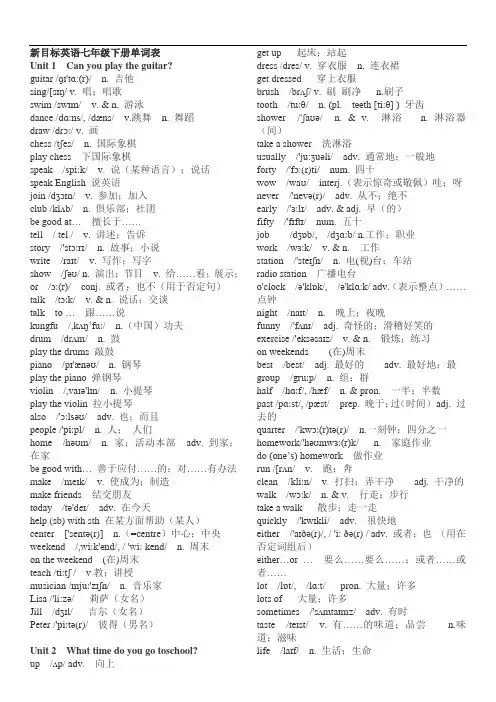
新目标英语七年级下册单词表Unit 1 Can you play the guitar?guitar /ɡɪ'tɑ:(r)/ n. 吉他sing/[sɪŋ/ v. 唱;唱歌swim /swɪm/ v. & n. 游泳dance /dɑːns/, /dæns/ v.跳舞n. 舞蹈draw /drɔː/ v. 画chess /tʃes/ n. 国际象棋play chess 下国际象棋speak /spiːk/ v. 说(某种语言);说话speak English 说英语join /dʒɔɪn/ v. 参加;加入club /klʌb/ n. 俱乐部;社团be good at… 擅长于……tell / tel / v. 讲述;告诉story /'stɔːrɪ/ n. 故事;小说write /raɪt/ v. 写作;写字show /ʃəʊ/ n. 演出;节目v. 给……看;展示;or /ɔː(r)/ conj. 或者;也不(用于否定句)talk /tɔːk/ v. & n. 说话;交谈talk to … 跟……说kungfu /,kʌŋ’fuː/ n.(中国)功夫drum /drʌm/ n. 鼓play the drums 敲鼓piano /pɪ'ænəʊ/ n. 钢琴play the piano 弹钢琴violin /,vaɪə'lɪn/ n. 小提琴play the violin 拉小提琴also /'ɔːlsəʊ/ adv. 也;而且people /'piːpl/ n. 人;人们home /həʊm/ n. 家;活动本部adv. 到家;在家be good with… 善于应付……的;对……有办法make /meɪk/ v. 使成为;制造make friends 结交朋友today /tə'deɪ/ adv. 在今天help (sb) with sth 在某方面帮助(某人)center ['sentə(r)] n.(=centre)中心;中央weekend /,wiːk'end/, / 'wiː kend/ n. 周末on the weekend (在)周末teach /tiːtʃ / v教;讲授musician /mjuː'zɪʃn/ n. 音乐家Lisa /'li:zə/ 莉萨(女名)Jill /dʒɪl/ 吉尔(女名)Peter /'piːtə(r)/ 彼得(男名)Unit 2 What time do you go toschool?up /ʌp/ adv. 向上get up 起床;站起dress /dres/ v. 穿衣服n. 连衣裙get dressed 穿上衣服brush /brʌʃ/ v. 刷刷净n.刷子tooth /tuːθ/ n. (pl. teeth [tiːθ] ) 牙齿shower /'ʃaʊə/ n. & v. 淋浴n. 淋浴器(间)take a shower 洗淋浴usually /'ju:ʒuəli/ adv. 通常地;一般地forty /'fɔ:(r)ti/ num. 四十wow /waʊ/ interj.(表示惊奇或敬佩)哇;呀never /'nevə(r)/ adv. 从不;绝不early /'ɜːlɪ/ adv. & adj. 早(的)fifty /'fɪftɪ/ num. 五十job /dʒɒb/, /dʒɑːb/ n.工作;职业work /wɜːk/ v. & n. 工作station /'steɪʃn/ n. 电(视)台;车站radio station 广播电台o'clock /ə'klɒk/, /ə'klɑ:k/ adv.(表示整点)……点钟night /naɪt/ n. 晚上;夜晚funny /'fʌnɪ/ adj. 奇怪的;滑稽好笑的exercise /'eksəsaɪz/ v. & n. 锻炼;练习on weekends (在)周末best /best/ adj. 最好的adv. 最好地;最group /gruːp/ n. 组;群half /hɑːf/, /hæf/ n. & pron. 一半;半数past /pɑːst/, /pæst/ prep. 晚于;过(时间)adj. 过去的quarter /'kwɔː(r)tə(r)/ n.一刻钟;四分之一homework/'həʊmwɜː(r)k/ n. 家庭作业do (one’s) homework 做作业run /[rʌn/ v. 跑;奔clean /kliːn/ v. 打扫;弄干净adj. 干净的walk /wɔːk/ n. & v. 行走;步行take a walk 散步;走一走quickly /'kwɪkli/ adv. 很快地either /'aɪðə(r)/, / 'iː ðə(r) / adv. 或者;也(用在否定词组后)either…or … 要么……要么……;或者……或者……lot /lɒt/, /lɑ:t/ pron. 大量;许多lots of 大量;许多sometimes /'sʌmtaɪmz/ adv. 有时taste /teɪst/ v. 有……的味道;品尝n.味道;滋味life /laɪf/ n. 生活;生命Rick /rɪk/ 里克(男名)Jim /dʒɪm/ 吉姆(男名)Scott /skɒt/, /skɑ:t/ 斯科特(男名)Tony ['təʊnɪ] 托尼(男名)Unit 3 How do you get to school?train /treɪn/ n. 火车bus /bʌs/ n. 公共汽车;公交车subway /'sʌbweɪ/ n. 地铁take the subway 乘地铁ride /raɪd/ v. 骑n. 旅程bike /baɪ k/ n. 自行车ride a bike 骑自行车sixty /'sɪkstɪ/ num. 六十seventy/'sevntɪ/ num. 七十eighty/'eɪtɪ/ num. 八十ninety/'naɪntɪ/ num. 九十hundred /'hʌndrəd/ num. 一百minute /'mɪnɪt/ n. 分钟far /fɑː/ adv. & adj. 远;远的kilometer /'kɪlə,mitə(r)/ n. 公里new /njuː/ adj. 新的;刚出现的every /'evrɪ/ adj. 每一;每个every day 每天by /baɪ/ prep. (表示方式)乘(交通工具)by bike 骑自行车drive /draɪv/ v. 开车car /kɑː/ n. 小汽车;轿车live /lɪv/ v. 居住;生活stop /stɑ:p/ /stɒp/ n. 车站;v. 停止think of 认为cross /krɒs/ v. 横过;越过river /'rɪvə/ n. 河;江many /'menɪ/ adj. & pron. 许多village /['vɪlɪdʒ/ n. 村庄;村镇between /bɪ'twiːn/ prep. 介于…之间between… and… 在……和……之间bridge /brɪdʒ/ n. 桥boat /bəʊt/ n. 小船ropeway /['rəʊpweɪ/ n.索道year /jɪə/ / jɜː/ n. 年;岁afraid [ə'freɪd] adj. 害怕;惧怕like /laɪk/ prep. 像;leave /liːv/ v. 离开dream /driːm/ n. 梦想;睡梦v. 做梦true /truː/ adj. 真的;符合事实的come true 实现;成为现实Dave /deiv/ 戴夫(男名)Unit 4 Don’t eat in class.rule /ruːl/ n. 规则;规章arrive /ə'raɪv/ v. 到达(be) ontime 准时hallway /'hɔːlweɪ/ n. 走廊;过道hall /hɔːl/ n. 大厅;礼堂dining hall 餐厅listen /'lɪs(ə)n/ v. 听;倾听listen to… 听……fight /faɪt/ v. & n. 打架;战斗sorry /'sɒrɪ/ adj. 抱歉的;难过的;惋惜的outside /aʊt'saɪd; 'aʊtsaɪd/ adv.在外面adj. 外面的wear /weə/ v. 穿;戴important/ɪm'pɔːt(ə)nt/ adj. 重要的bring /brɪŋ/ v. 带来;取来uniform /'juːnɪfɔːm/ n. 校服;制服quiet /'kwaɪət/ adj. 安静的out /aʊt/ adv. 外出go out 外出(娱乐)practice /'præktɪs/ v. & n.练习dish /dɪʃ/ n. 碟;盘do the dishes 清洗餐具before /bɪ'fɔː/ prep. & conj.在… 以前adv.以前make (one’s) bed 铺床dirty /'dɜːtɪ/ adj. 脏的kitchen /'kɪtʃɪn/ n. 厨房more /mɔː/ adj. & pron. 更多的noisy /'nɒɪzɪ/adj. 吵闹的relax /rɪ'læks/v. 放松;休息read /riːd/ v. 读;阅读terrible /'terɪb(ə)l/ adj. 非常讨厌的;可怕的feel /fiːl/ v. 感受;觉的strict /strɪkt/ adj. 严格的;严厉的be strict (with sb) (对某人)要求严格remember /rɪ'membə/ v. 记住;记起follow /'fɒləʊ/ v. 遵循;跟随follow the rules 遵守规则luck /lʌk/ n. 幸运;运气keep /kiːp/ v. 保持;保留hair /heə/ n. 头发;毛发learn /lɜːn/ v. 学习;学会Clark /kla:k/ 克拉克(姓;男名)Amy /eɪmɪ/ 埃米(女名)Molly /'mɒlɪ/莫莉(女名)New York /nju: jɔ:k/ 纽约Unit5 What do you like pandaspanda/'pændə/ n.熊猫zoo/zuː / n.动物园tiger/'taɪ gə(r)/ n.老虎elephant/'elɪ fənt/ n.大象koala/kəʊ 'ɑː lə/ n.树袋熊lion/'laɪən/ n.狮子giraffe/dʒə'rɑː f/ n.长颈鹿animal/'ænɪ ml/ n .动物cute/kjuː t/ adj.可爱的;机灵的lazy/'leɪ zɪ / adj.懒散的;懒惰的smart/smɑː (r)t/ adj 聪明的beautiful/'bjuː tɪ fl/ adj 美丽的;美好的scary/'skeərɪ /adj 吓人的;恐怖的kind/kaɪ nd/n 种类kind of 稍微;有点儿Australia/ɒ 'streɪ lɪə/ n.澳大利亚south/saʊθ/ adj.南方的n.南;南方Africa/'æfrɪ kə/ n.非洲South Africa 南非pet/pet/ n. 宠物leg/leg/ n.腿cat/kæt/ n. 猫sleep/sliː p/ n.睡觉friendly/'frendlɪ / adj .友好的shy/ʃ aɪ / adj.羞怯的;腼腆的save/seɪ v/ v .救;救助symbol/'sɪ mbl/ n.象征flag/flæg/ n. 旗;旗帜forget/fə'get/ v.忘记;遗忘get lost 迷路place/pleɪ s/ n .地点;位置water/'wɔː tə/ n.水danger/'deɪ ndʒə/ n. 危险be in (great) danger 处于(极大)危险之中cut/kʌ t/ v .砍;切down/daʊn/ adv.(坐、躺、倒)下prep. 向下;沿着cut down 砍倒tree/triː / n.树kill/kɪ l/ v.杀死;弄死ivory/'aɪ vərɪ /n.象牙over/'əʊ və/ prep .超过;多于;在… 上方(be) made of 由……制成的Julie/'dʒuː lɪ /朱莉(女名)Becky/'bekɪ /贝姬(女名)Thailand/'taɪ lænd/n.泰国Thai/taɪ /n.泰国(人的);泰语(的) Unit6 I’m watching TVnewspaper /'njuː zpeɪ pə/ n .报纸read a newspaper 看报纸use/juː z/ v.使用;运用soup/suː p/ n.汤make soup 做汤wash/wɒʃ / v.洗movie/'muː vɪ / n.电影go to the movies 看电影just/dʒʌ st/ adv .只是;恰好eat out 出去吃饭house/haʊ s/ n.房子drink/drɪŋk/ v.喝n.饮料tea/tiː / n.茶;茶叶drink tea 喝茶tomorrow/tə'mɒ rəʊ / adv.在明天n.明天;未来pool/puː l/ n.游泳池;水池shop/ʃɒ p/ v.购物n.商店supermarket/'suː pəmɑː kɪ t/n. 超市man/mæn/ n 男人;人race /reɪ s/n.竞赛host/həʊ st/ n.主人;东道主study/'stʌ dɪ / v. &n.学习;研究state/steɪ t/ n 洲theUnited States/juː 'naɪ tɪ d 'steɪ ts/ (of America)美国;美利坚合众国American/ə'merɪ kən/adj.美国的;美洲的n 美国人;美洲人dragon /'drægən/ n.龙Dragon Boat Festival 端午节any/'enɪ / adj.任何的.任一的pron.任何; 任一other/'ʌðə(r)/adj.另外的;其他的pron.另外的人(或物)young/jʌŋ/ adj.幼小的,年轻的child /tʃ aɪ ld/ n.儿童(pl.children /'tʃɪ ldrən/ )miss /mɪ s/ v.怀念. 思念wish /wɪʃ /v.希望delicious/dɪ 'lɪʃəs/ adj.可口的.美味的still /stɪ l/adv. 还.仍然living room /'lɪ vɪŋruː m/ 客厅Steve/stiː v/史蒂夫(男名)Laura/lɔː rə/劳拉(女名Unit7 It's raining!rain/reɪ n/ v.下雨n.雨水windy/'wɪ ndɪ / adj.多风的cloudy/'klaʊ dɪ / adj.多云的sunny/'sʌ nɪ / adj.晴朗的snow/snəʊ / v.下雪;雪weather/'weðə/ n.天气cook/kʊ k/ v.做饭bad /bæd/ adj.坏的;糟的park /pɑ ː k/ n.公园message/'mesɪ dʒ / n.信息;消息take a message 捎个口信;传话him/hɪ m/ pron.他(he 的宾格)could/kʊ d/ v.能;可以back /bæk/ adj.回来;回原处call (sb.) back 回电话problem/'prɒ bləm/ n.困难;难题again /ə'ɡ en; ə'ɡ eɪ n/ adj.再一次;又一次dry/draɪ /adj.干燥的cold/kəʊ ld/ adj.寒冷的;冷的hot /hɒ t/ adj.热的warm /wɔː (r)m/ adj.温暖的visit /'vɪ zɪ t/ v.拜访;参观Canada /'kænədə/ n.加拿大summer/'sʌ mə(r)/ n.夏天;夏季sit/sɪ t/ v.坐juice/dʒuː s/ n.果汁;饮料soon/suː n/ adv.不久;很快vacation /və'keɪʃ n/n.假期on(a)vacation 度假hard /hɑ ː d/ adv.努力地;困难的Europe/'jʊ rəp/ n.欧洲mountain/'maʊ ntən/ n.高山country/'kʌ ntrɪ / n.国;国家skate /skeɪ t/ v.滑冰snowy/'snəʊɪ / adj.下雪的winter/'wɪ ntə/ n.冬天;冬季Russian/'rʌʃ n/ adj.俄罗斯的;俄罗斯人;俄语snowman /'snəʊ mæn/n.雪人rainy /'reɪ nɪ / adj.阴雨的;多雨的Joe/dʒəʊ /乔(男名)Jeff/dʒ ef/ 杰夫(男名)Moscow/'mɒ skəʊ /莫斯科Toronto /tə'rɒ ntəʊ / 多伦多Boston/'bɒ stən/ 波士顿Unit8 Is there a post office near here? post/pəʊ st/ n.邮政office/'ɒ fɪ s/ n. 办公室post office 邮局police /pə'liː s/ n.警察police station /'steɪʃən/警察局hotel/həʊ 'tel/ n.旅店;酒店restaurant/'restrɒ nt/ n.餐馆bank/bæŋk/ n.银行hospital/'hɒ spɪ tl/ n.医院street /striː t/n.大街pay/peɪ /v.付费pay phone 付费电话near /nɪə/prep.在……附近across /ə'krɒ s/adv.过;穿过across from 在……对面front /frʌ nt/n.前面in front of 在……前面behind /bɪ 'haɪ nd/prep.在……后面town /taʊ n/ n.镇;市镇around /ə'raʊ nd/ adv.&prep.到处;大约north /nɔː θ/ n.北;北方adj.北方的along /ə'lɒŋ/ prep.沿着go along the street 沿着(这条街)走turn/tɜː n/ v.转向;翻right/raɪ t/ adv.向右边;n.右边left /left/ adv.向左边n.左边turn right /left 向右、左转crossing/'krɒ sɪŋ/ n.十字路口neighborhood /'neɪ bə(r)hʊ d/ n.街区;街坊spend /spend/ v.花(时间、钱等)spend time 花时间climb /klaɪ m/ v.爬road /rəʊ d/ n.路often/'ɒ fn/ adv.时常;常常air/eə/ n.空气sunshine/'sʌ nʃ aɪ n/n.阳光free/friː / adj.免费的enjoy/ɪ n'dʒɒɪ / v.享受;喜爱enjoy reading 喜欢阅读easily/'iː zɪ lɪ / adv.容易地money/'mʌ nɪ / n.钱Unit9 What does he look like?curly/'kɜː lɪ / adj.卷曲的straight/streɪ t/ adj.直的tall/tɔː l/ adj.高的medium/'miː dɪəm/ adj. 中等的height/haɪ t/ n.身高;高度of medium height 中等身高thin/θɪ n/ adj.瘦的heavy/'hevɪ / adj.重的build/bɪ ld/ n.身材of medium build 中等身材tonight/tə'naɪ t/ adv.&n.今夜little /'lɪ tl/ adj.小的a little 一点,少量cinema /'sɪ nɪ mə/ n.电影院glasses /'glɑ ː sɪ z/ n.眼镜later/'leɪ tə/ adj.以后handsome /'hænsəm/ adj.英俊的actor/'æktə/ n.演员actress/'æktrɪ s/ n.女演员person/'pɜː sn/ n.人nose/nəʊ z/ n.鼻子blonde /blɒ nd/ adj.金黄色的mouth/maʊθ/ n.嘴round/raʊ nd/ adj.圆形的face/feɪ s/ n.脸eye/aɪ / n.眼睛singer/'sɪŋə(r)/ n.歌手artist/'ɑ ː tɪ st/ n.艺术家crime/kraɪ m/ n.犯罪活动criminal/'krɪ mɪ nl/ n.罪犯put/pʊ t/ v.放each/iː tʃ / adj.&pron.每个,各自way/weɪ / n.方式,路线describe /dɪ 'skraɪ b/ v.描述differently/'dɪ fərəntlɪ / adv.不同地another/ə'nʌ ðə/ adj.&pron 另一,又一end/end/ n.结尾,尽头in the end 最后real/riː l/ adj.真正的;真实的jeans/dʒiː nz/ n.牛仔裤Johnny/'dʒɒ nɪ / 约翰尼(男名)Dean/diː n/迪安(姓)Tina/'tiː nə/蒂娜(女名)Jackson/'dʒ æksn/ 杰克逊(姓)Unit10 I'd like some noodles.noodle/'nuː dl/ n.面条mutton/'mʌ tn/ n.羊肉beef/biː f/ n.牛肉cabbage/'kæbɪ dʒ / n.卷心菜;洋白菜potato/pə'teɪ təʊ / n.土豆;马铃薯special/'speʃəl/ n.特色菜;特价品;特别的;特殊的would/wʊ d/ v.(表示意愿)愿意would like 愿意;喜欢yet/jet/ adv.(常用于否定句或疑问句)还;仍然large/lɑ ː dʒ / adj.大号的;大的order/'ɔː də/ n.&v.点菜;命令take one's order 点菜size/saɪ z/ n.大小;尺码bowl/bəʊ l/ n.碗one(large)bowl of 一(大)碗tofu/'təʊfuː / n 豆腐meat/miː t/ n.(可食用的)肉dumpling/'dʌ mplɪŋ/ n.饺子porridge/'pɒ rɪ dʒ / n.粥;面糊onion/'ʌ njən/ n.洋葱fish/fɪʃ / n.鱼;鱼肉pancake/'pænkeɪ k/ n.烙饼;薄饼world/wɜː ld/ n.世界around the world 世界各地answer/'ɑ ː nsə/ n.答案v.回答different/'dɪ fərənt/ adj.不同的cake/keɪ k/ n.蛋糕candle/'kændl/ n.蜡烛age/eɪ dʒ / n.年龄make a wish 许愿blow/bləʊ / v.吹blow out 吹灭if/ɪ f/ conj.如果will/wɪ l/ v.会the UK/,juː 'keɪ/(=the Kingdom/juː 'naɪtɪd 'kɪŋdəm/ n.英国candy/'kændɪ / n.糖果lucky/'lʌ kɪ / adj.幸运的popular/'pɒpjuː lə/ adj.受欢迎的;普遍的get popular 受欢迎;流行cut up 切碎idea/aɪ 'dɪə/ n.想法;主意bring good luck to…给……带来好运Unit11 How was your school trip?milk/mɪ lk/ v.挤奶cow/kaʊ / n.奶牛milk a cow 给奶牛挤奶horse/hɔː (r)s/ n.马ride a horse 骑马feed/fiː d/ v.(fed/fed/)喂养;饲养feed chickens 喂鸡farmer/'fɑ ː (r)mə(r)/ n.农民;农场主quite/kwaɪ t/ adv.相当;安全quite a lot(of…) 许多anything/'enɪθɪŋ/ pron. (常用于否定句或疑问句)任何东西;任何事物grow/grəʊ/ v. (grew/gruː /)种植;生长;发育farm/fɑ ː (r)m/ n.农场; 务农;种田pick/pɪ k/ v.采;摘excellent/'eksələnt/ adj.极好的;优秀的countryside /'kʌ ntrɪ saɪ d/ n.乡村;农村in the countryside 在乡下;在农村yesterday/'jestə(r)dɪ / n.昨天flower/'flaʊə(r)/ n.花worry/'wʌ rɪ / v.担心;担忧luckily/'lʌ kɪ lɪ / adv.幸运地;好运地sun/sʌ n/ n.太阳museum/mjuː 'zɪəm/ n.博物馆fire/'faɪə/ n.火灾fire station 消防站painting/'peɪ ntɪŋ/n.油画;绘画exciting/ɪ k'saɪ tɪŋ/ adj.使人兴奋的;令人激动的lovely/'lʌ vlɪ / adj.可爱的expensive/ɪ k'spensɪ v/ adj.昂贵的cheap/tʃiː p/ adj.廉价的;便宜的slow/sləʊ / adj.缓慢的;迟缓的fast/fɑ ː st/ adv.&adj.快地(的)robot/'rəʊ bɒ t/ n.机器人guide/gaɪ d/ n.导游;向导gift/gɪ ft/ n.礼物;赠品all in all 总的说来everything/'evrɪθɪŋ/ pron.一切;所有事物interested/'ɪ ntrɪ stɪ d/ adj.感兴趣的be interested in 对……感兴趣dark/dɑ ː (r)k/ adj.黑暗的;昏暗的hear /hɪə/v. (heard/hɜː d/)听到;听见Carol /'kærəl/卡罗尔(女名)Unit12 What did you do last weekend? camp/kæmp/ v.扎营;扎帐篷lake/leɪ k/ n.湖,湖泊beach/biː tʃ / n.海滩,沙滩badminton/'bædmɪ ntən/ n.羽毛球运动sheep/ʃiː p/ n.羊,绵羊as/æz/ adv.&pron 作为,当做natural /'nætʃərəl/pron.自然的butterfly/'bʌ tə(r)faɪ / n.蝴蝶visitor /'vɪ zɪ tə(r)/n.游客;访问者tired/taɪəd/ adj.疲倦的stay/steɪ / v.停留stay up late 深夜不留away/ə'weɪ / adv.离开run away 跑开mouse/maʊ s/ n.老鼠baby/'beɪ bɪ / n.幼小的shout/ʃ aʊ t/ v.呼叫,喊叫shout at…冲……大声叫嚷woof/wʊ f/ interj.(狗叫声)汪汪language/'læŋgwɪ dʒ / n.语言fly/flaɪ/ v. (fly/fluː /)飞kite/kaɪ t/ n.风筝fly a kite 放风筝high/haɪ / adj.&adv.高的(地)high school 中学ago/ə'gəʊ / adv.以前India/'ɪ ndɪə/ n.印度tent/tent/ n.帐篷put up 搭起,举起moon/muː n/ n.月亮surprise/sə(r)'praɪ z/ n.&v.惊奇,惊讶get a surpris 吃惊snake/sneɪ k/ n.蛇scared/skeəd/ adj.惊慌的move/muː v/ v.移动shout to…对……大声喊叫start/stɑ ː (r)t/ v.开始,着手jump/dʒʌ mp/ v.跳跃up and down 上上下下wake/weɪ k/ v.(woke/wəʊ k/)弄醒,醒into/'ɪntuː / prep.到……里面forest/'fɒ rɪ st/ n.森林ear/ɪə/ n.耳朵Lucy/'lusɪ /露西(女名)。
人教新目标七年级下册英语市级优质课获奖教案-Unit1Canyouplaythe..
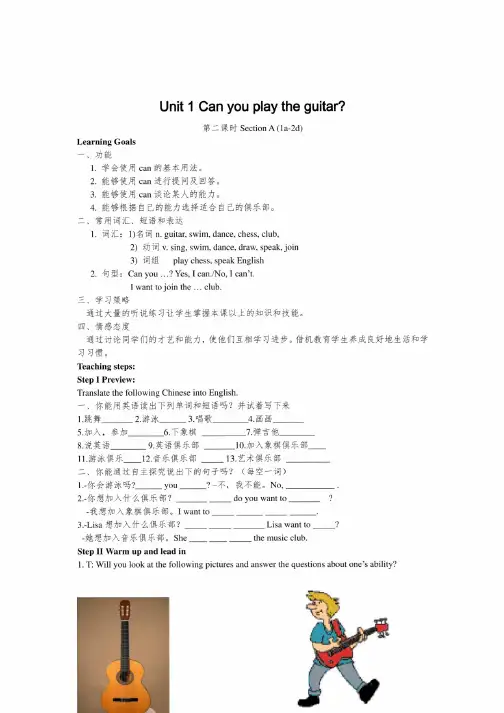
Unit1Can you play the guitar?第二课时Section A(la-2d)Learning Goals一、功能1.学会使用can的基本用法。
2.能够使用can进行提问及回答。
3.能够使用can谈论某人的能力。
4.能够根据自己的能力选择适合自己的俱乐部。
二、常用词汇、短语和表达1.词汇:1)名词n.guitar,swim,dance,chess,club,2)动词v. sing,swim,dance,draw,speak,join3)词组play chess,speak English2.句型:Can you...?Yes,I can./No, I can't.I want to join the...club.三、学习策略通过大量的听说练习让学生掌握本课以上的知识和技能。
四、情感态度通过讨论同学们的才艺和能力,使他们互相学习进步。
借机教育学生养成良好地生活和学习习惯。
Teaching steps:Step I Preview:Translate the following Chinese into English.一、你能用英语读出下列单词和短语吗?并试着写下来I.跳舞2.游泳3.唱歌4.画画5.加入,参加6.下象棋7.弹吉他8.说英语9.英语俱乐部10.加入象棋俱乐部—II.游泳俱乐—12.音乐俱乐部13.艺术俱乐部二、你能通过自主探究说出下的句子吗?(每空一词)1.-你会游泳吗?you?-不,我不能。
No,.2.-你想加入什么俱乐部?do you want to?■我想加入象棋俱乐部。
I want to.3.-Lisa想加入什么俱乐部?Lisa want to?■她想加入音乐俱乐部。
She the music club.Step II Warm up and lead in1.T:Will you look at the following pictures and answer the questions about one's ability?guitar[gl'ta:]play the guitar Can you play the guitar?温暖我心窝:.是谁在唱歌-Can you sing?sing[sin |dance[da:ns]—Can you dance?draw[dro:l-Can youdraw?play chess[tfes]—Can you play chess?speak English[spi:k]Can you speak English?Help them to answer:Yes,I can./No,I can't.(设计意图:实物展示形象、直观地引出本单元的课题。
人教新目标版七年级下册英语课件:Unit 1 Can you play the guitar
Unit 1 Can you play the guitar ?
七年级教研组
What can Mr Jones do?
He can cook. He can dance. He can play soccer.
What can Mrs Jones do?
• 2.--Need I do my homework now?
•
--Yes, you __m_u_s_t__./ No,you_n_e_e_d_n_'_t .
• 作为实意动词,
• need sth
t club do you want to join? B:I want to join the… A: Can you ...? B: Yes, .../No,...
_E_n_g_li_s_h_ Club
S__w_i_m_m__in_g_ Club
M__u_s_ic_ Club
_C_h_e_s_s Club
__A_r_t_ Club
join&join in &take part in & be in
join “加入”,后接团体,组织,俱乐部或人,如join the English club
speak English?
我We需n要ee你d y帮ou助t用o h英el语p w讲it故h 事sto。ry telling
in English.
Itf这还trailieks有可niwdn趣以sitte.h又交ret放很shtein松多mg,,朋aann你 友dd 可 。ryeol以uaxc和inang他.mY们oauk交ec谈amn,any
Talk about abilities
七年级下人教版新目标英语Unit1Canyouplaytheguitar导学案教案1
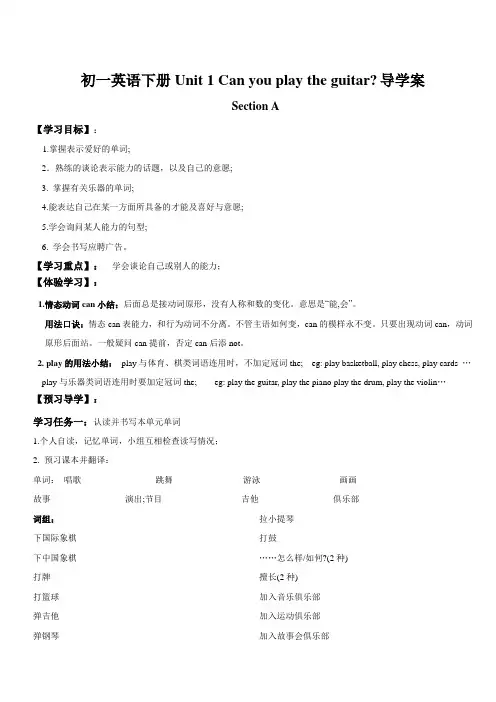
初一英语下册Unit 1 Can you play the guitar?导学案Section A【学习目标】:1.掌握表示爱好的单词;2.熟练的谈论表示能力的话题,以及自己的意愿;3. 掌握有关乐器的单词;4.能表达自己在某一方面所具备的才能及喜好与意愿;5.学会询问某人能力的句型;6. 学会书写应聘广告。
【学习重点】:学会谈论自己或别人的能力;【体验学习】:1.情态动词can小结:后面总是接动词原形,没有人称和数的变化。
意思是“能,会”。
用法口诀:情态can表能力,和行为动词不分离。
不管主语如何变,can的模样永不变。
只要出现动词can,动词原形后面站。
一般疑问can提前,否定can后添not。
2. play的用法小结:play与体育、棋类词语连用时,不加定冠词the; eg: play basketball, play chess, play cards …play与乐器类词语连用时要加定冠词the; eg: play the guitar, play the piano play the drum, play the violin…【预习导学】:学习任务一:认读并书写本单元单词1.个人自读,记忆单词,小组互相检查读写情况;2. 预习课本并翻译:单词:唱歌_____________ 跳舞_____________ 游泳_____________ 画画_____________故事____________ 演出;节目_____________ 吉他_____________ 俱乐部_______________词组:下国际象棋_____________________________________ 下中国象棋_____________________________________ 打牌___________________________________________ 打篮球_________________________________________ 弹吉他_________________________________________ 弹钢琴_________________________________________ 拉小提琴_______________________________________ 打鼓___________________________________________ ……怎么样/如何?(2种) __________________________ 擅长(2种) _____________________________________ 加入音乐俱乐部_________________________________ 加入运动俱乐部_________________________________ 加入故事会俱乐部_______________________________加入英语俱乐部_________________________________ 加入象棋俱乐部_________________________________ 加入美术俱乐部_________________________________ 参加比赛_______________________________________ 参军/入党______________________________________ 听起来不错/有趣/糟糕____________________________ 想做某事_______________________________________ 想让某人(别)做某事______________________________ 为……招聘……_________________________________ 为学校节目招募学生_____________________________ 说英语_________________________________________ 说法语_________________________________________ 讲故事_________________________________________ 学校表演_______________________________________ 跟……说/谈话(2种) _____________________________ 谈论关于……___________________________________ 放学后_________________________________________ 课余,课后的(adj.)________________________________ 在音乐教室里___________________________________ 会(中国)功夫____________________________________ 喜欢音乐_______________________________________ 喜欢画画_______________________________________ 不会唱歌_______________________________________学习任务二:1.掌握Grammar Focus中重点句型及用法;2.独立翻译句子:1)—你会做什么?—我会跳舞但我不会弹钢琴。
七年级英语下册Unit1Canyouplaytheguitar教案新人教新目标
1.教师携带一些易于演奏的乐器,或一些演奏乐器的图片,一边演奏乐器,一边说: I can play the guitar. . . .等;再指着图片说: He/She can play the violin. But I can’t play it.等;然后询问学生: Can you play the guitar? . . . .并引导学生进行简单的回答。
2. Then Check the answers with the class together.
Ss look at the picture in 1a. Then read the words and phrases. Let Ss match the activities with the people.
2. Work on 2b:
Ss listen to the tape again and complete the conversation with the right words.
在听力练习和小对话口语练习的基础上,进行角色对话表演,为开展有实际意义的交际运用活动做铺垫。
Step 7
Pair work (2b)
3.能了解以下语法:情态动词can的用法
want to do sth.的用法
能力
目标
互相询问或谈论自己或对方在某一方面的能力
情感
目标
该部分内容贴近学生的生活,谈论的话题是能力。通过互相询问或谈论自己或对方在某一方面的能力,可以培养学生的一种群体意识。
教学
重点
1.学习询问和谈论彼此的能力和特长;
2.掌握一些弹奏乐器的表达方式。
2.引导学生学习表达活动的动词短语。
2022春七年级英语下册Unit1Canyouplaytheguitar教学设计新版人教新目标版
七年级英语下册教学设计新版人教新目标版:Unit 1 教学设计Title Unit 1 Can you play the guitar?Teaching aimsKnowledgeWhat club do you want to join?I want to join the … club.Can you …?Yes, I can. / No, I can’t.Can you … well?Yes, I can. / No, I can’t.Why do you want to j oin our … club?Because I like … / Because I can …What else can you do?I can …Skills1. Learn to talk about what they cando. Tell others their strong points.2. Through practice, learn to askothers what they can or can’t do.Emotionsand CultureTo find a job is not so easy. The chances onlywork for those who are well prepared.Key wordsEnglish club, music, art, sport, chess, English poem, sing, dance, play the guitar, violin, piano, flute, trumpet, drum, paint, draw, swim, run, pla y chess, Chinese chess, …Important & difficult points What club do you want to join? What else can you do?Why do you want to join our club? We want … to join our club.Solving Task-based learningmethodsTeaching Process1. Review the words and expressions. Ask and answer.2. Want advertisements show3. Students’ example----an interview.4. Interview5. Show the interviews.6. Brief discussion7. Show the results and fill the forms out.8. Homework.TeachingaidsComputer, real object projector.Teaching proceduresTask 1 ReviewStep 1Teacher’s Activity: Lead in. “In our school there’re five clubs: English club, music club, art club, sport club and chess club. Today, these clubs come to our class and want some of you to join them”. “Do you want to join these clubs?”Students’ Activity: Listen to the teacher and answer the questions.Step 2Teacher’s activity: ask students questions:What club do you want to join?Can you…? Can you … well?Students’ ac tivities: answer the questions.Step 3Teacher’s a ctivity: ask students questions:What club do you want to join?Can you…? Can you … well?Why do you want to join the … club?Students’ activities: Answer the questionsStep 4Teacher’s activity: ask students questions:What club do you want to join?Can you…? Can you … well?Why do you want to join the … club?What else can you do?Students’ activities: Answer the questionsTask 2 Want Advertisements ShowTeachers activity: Ask the interviewers to show their want advertisements. Ok, now theinterviews are going to begin. Before the interviews, these clubscome to the dais and show their want advertisements show. Welcome!Students’ activities: The interviewers applaud for the clubs. And the interviewers show their advertisements to the class one by one.Task 3 What can you say in interview? Show an example.Teacher’s activity: “Do you want to join these clubs? Do you know what you can say in your interviews? Ok, I’d like to ask two of the English clubs to show an example to you.” and show the slide.Students’ activities: Volunteers in English club come to the dais and show the words and expressions. The interviewer shows the form they are going to use and fill it out according to their conversation. The other students listen to them carefully and know what to do next.Task 4 InterviewsStep 1Teacher’s activity: “Now what you can say through an interview. You’re going to fill intell the wholeclass to listen to the interviewers and take notes. F ill in the forms they have.Task 8 Show the final resultTeacher’s activity: “Now I’d like to ask one student to come here and show us his orher form. He or she can use this sentence.”(Slide show) … arein … club. Ask one student to come to the real object projector andshow the others his or her form.Students’ activities: Listen to the reporter carefully.Task 9 HomeworkTeacher’s activity: Slide show first. “OK, it is the end of the interviews. After class youstill have two tasks. First, the new club members, you should makea new plan for your clubs and make your forms like this.” Point tothe screen. “Your activities, time, place and the names of yourgroup member s. Second, some of you haven’t found your clubsyet. So after class, you should go to some other clubs and haveinterviews with them. Find yo ur own clubs, OK?”Students’ activi ties: Listen to the teacher. Take notes if possible.Writing on blackboardUnit 1 Can you play the guitar?1. Review. Ask and answer.2. Want advertisements show3. Students’ example----an interview.4. Interview5. Show the interviews6. Brief discussion7. Show the results and fill the forms out.8. Homework.Forms for tasksForm 1 For Engli sh ClubName: ___________Club: ___________1. Can you…?² Speak English² Read in English² Sing English songs² Write English poems² Write English plays2. Can you …well?² Speak English² Read in English² Sing English songs² Write English poems² Write English plays3. Why do you want to join our club? _______________________________________________4. What else can you do?_______________________________________________ Form 2 For Music ClubName: ___________Club: ___________1. Can you … ?² SingForm 3 For Art Club² Make oil painting² Make Chinese painting² Make flower painting² Make fruit painting2. Can you … well?² Paint² Draw² Sketch² Cartoon² Make oil painting² Make Chinese painting² Make flower painting² Make f ruit paintin g3. Why do you want to join our club?_________________________________________ 4. What else can you do?_________________________________________ Form 4 Sport ClubName: ___________Club: ___________1. Can you … ?² Run² Swim² Play basketball² Play baseball² Play volleyball² Play soccer² Play tennis² Play ping pong² Play bowling² Play badminton2. Can you … well?² Run² Swim² Play basketball² Play baseball² Play volleyball² Play soccer² Play tennis² Play ping pong² Play bowling² Play badminton3. Why do you want to join our club?_________________________________________ 4. What else can you do?_________________________________________ Form 5 For Chess ClubName: ___________Club: ___________1. Can you … ?² Play chess² Play Chinese chess² Play I-go² Play black and white chess ² Play flight chess² Play go bangForm for task 9。
人教版新目标七年级英语下册Unit1单元检测卷(含答案详解)
Unit 1 Can you play the guitar短语·典句·考点help sb。
with sth. 在……方面帮助某人【经典例句】Could you help me with my English?你能帮我学英语吗?【考点聚焦】在help sb.with sth。
结构中,with是介词,故后面要跟名词或动名词作宾语。
该结构相当于help sb.do sth.。
【活学活用】8.同义句转换I often help him do his homework.I often help him his homework.be good with..。
与……相处得好;与……合得来【经典例句】He is very good with children.他与孩子们很合得来。
【考点聚焦】1)同义词组:get on well with2)注意与be good..。
的其他词组意思的差别:be good at意为“擅长做某事”;be good for意为“对……有益处”。
句子·剖析·拓展Can you play the guitar?你能弹吉他吗?【剖析】Can you。
..?用来询问对方能否做某事,意思是“你能/会……吗?”,肯定回答用“Yes,I can。
"否定回答用“No,I can’t.”【拓展】can(能、会),may(可以;可能),must(必须)都是情态动词,后面跟动词原形。
其否定结构在后面加上not,can not通常缩写为can’t;mustnot缩写为mustn’t;may not一般不缩写。
Can you play the piano,the trumpet,the drums,or the guitar?你会弹奏钢琴,吹喇叭,敲鼓,或者弹吉他吗?【剖析】此句为简单的选择疑问句,即提问者提供两种或两种以上情况,让对方从中作出选择的句子。
它的基本结构是:一般疑问句+or+一般疑问句(后一部分与前一部分相同的成分常常省略).or连接的是两个并列的成分,要求词性一致。
新目标(Go for it)版七年级英语下册各单元知识点总结
新目标(Go for it)版七年级英语下册各单元知识点总结人教版初一英语下册各单元知识点总结Unit 1 Can you play the guitar?一、 单词与词组表示“参加,加入”,此处指参加社团或组织,成为其中的成员。
Join the army 参军 join the NBA 加入美国篮球协会Join the art/sports/music/English/chess club 参加体育/音乐/英语/象棋俱乐部play soccer/ basketball/volleyball/football/tennis/badminton / 篮球 / 排球 /英式足球,美式橄榄球/网球/羽毛球)Be good at+ sth./doing sth. 擅长做某事Be good with sb 与…相处得好Be good to sb …友好=be friendly toBe good for 对…有好处特指某一次的动作;like doing sth. 强调经常性的爱好。
两者都表示喜讲故事 tell sb. sth. /to do sth. /not to do sth.告诉某人某事/不要做某帮助某人做某事Help yourself/sb. (to sth.)把某物(尤其是指食物,饮料等)拿给自己/某人e.g. Call Mr.Brown at 293-7742意思是“回家”,“到家”。
前面不加介词。
这里的home 是e.g. 1)When do you go home every day?你每天什么时候回家? 2)He drives home after work.他下班的开车回家。
3)She often does some shopping on his way home. 她经常在回家途中买些东西。
2. at home 表示静态概念。
意思是“在家”。
这里的home 是名词,表示具体地点。
人教新目标英语七下unit 1《Can you play the guitar》精讲精练
Unit 1 Can you play the guitar点击要点【经典例句】 He likes playing the guitar.他喜欢弹吉他。
【考点聚焦】guitar为一种乐器,注意play与表示乐器的名词连用时,名词前要加定冠词the。
【活学活用】 1.选择The boys often play guitar inA.the;/B./;theC.the;theD./;/答案:C【巧记提示】 jo+in(里面)【经典例句】I want to join the League.我想入团。
【考点聚焦】 join意为“参加(某个组织成为其成员)”,一般常和介词in连用。
【活学活用】 2.根据释义写单词:become a member of答案:join【巧记提示】 swim(游泳)→swan(天鹅)【经典例句】 Do you like swimming?你喜欢游泳吗?【考点聚焦】常用词组:have a swim游泳;go swimming去游泳【活学活用】 3.用swim的适当形式填空I often go to in the pool(水池).答案:swim,swimming【巧记提示】 chess(国际象棋)→cherr(欢欣)【经典例句】I am good at playing chess.我擅长下象棋。
【考点聚焦】一定注意“下棋”用play chess,而不用play the chess。
【活学活用】4.选择I like to play piano and he likes to playA.the;theB.the;/C./;theD./;/答案:B【巧记提示】 pain(疼痛)+t【经典例句】 The artist paints in water colors.这位画家以水彩画画。
【考点聚焦】 1)派生词:画家画2)注意与draw的区别:paint指用颜料等绘画;而draw指用钢笔、铅笔等画。
[人教新目标版]七年级英语下册Unit1Canyouplaytheguitar语法篇试题含答案
Unit1语法篇____________________________________________________________________________________________________________________________________________________________________学生通过本讲学习,能够掌握本单元的重点语法,并在综合能力上有一定的拓展。
一、情态动词can的基本用法情态动词can有一定的词义,但不能独立存在,它必须与动词原形一起构成谓语。
情态动词can没有人称和数的变化。
其具体用法如下:1.表示"能、会",指脑力或体力方面的"能力"。
例如:I can speak English.我会讲英语。
Jim can swim but I can't.吉姆会游泳,但我不会。
2.表示"可能",常用于否定句或疑问句中,指某种可能性。
例如:Han Mei can't be in the classroom.韩梅不可能在教室里。
Can he come here today,please?请问他今天能到这里来吗?3.表示"可以",常用于口语中,指许可或请求做某事。
例如:Can I have a cup of tea,please?请问我可以喝一杯茶吗?You can go out.你可以出去了?二、情态动词的注意事项1.can的口诀:情态动词can、can、can,动词原形跟后面。
变疑问can提前,变否定not后面加上去。
主语人称单复数,情态动词不能变。
2.情态动词can可以引导肯定句和疑问句。
(1)、肯定句:主语+can+动词原形+其他成分(2)、疑问句:can+主语+动词原形+其他成分3.can引导的肯定句变为疑问句的方法:(一调二改三问号)(1)、can提前,首字母大写。