
【新教材】5.3 Developing ideas 教学设计-外研版高中英语必修第三册
高中英语(外研版)必修三
UNIT-5 What an adventure
Period-3 Developing ideas
教学设计
教材中本课主要内容分为两个部分,即阅读和写作。
阅读部分主要是通过另一个角度讲述了不同的“冒险”体验,即法国作家儒勒·凡尔纳的科幻小说《海底两万里》的节选片选。
本篇文章告诉我们,应该时刻保持对未知事物的探索和追求,过去或当时没有的,未来不一定也没有,而对未知事物探索和追求的态度及思想是要具备的。
在写作部分中,学生将先读到一篇关于介绍潜水的海报,然后引导学生写一篇关于记一次潜水经历的日记。
1.语言技能目标
(1)学生能够借助关键词,在理解文章大意的基础上,找出段落主题句,完成读前、读后问题;(2)用所学的词汇和语言的对课文进行复述;
(3)能够读懂细节信息并能理解阅读中生词含义。
2.语言知识目标
(1)能够正确运用以下单词和短语: league, servant, submarine, charge, captain, ahead, permit, fascinated, chapter, relate, helmet, nut, astonish, ray, consume, distinguish, gradually, surround, wrinkled,, shore, carpet, intensity, vibration, atom, depth, broad, in broad daylight, beneath, resident, male等。
(2)能够理解文章中长难句并准确翻译。
3.文化意识目标
(1)了解关于科幻故事的意义;
(2)了解人们对科幻故事的理解和态度。
4.情感态度目标
正确认识科幻故事的意义,时刻提醒自己要有对未知事物的探索和追求精神。
1.理解文章逻辑关系及架构,理解文章写作意图;
2.引导学生如何对阅读材料进行总结归纳;
3.引导学生谈论阅读科幻故事的收获与感想。
外研版高中英语必修(二)第二单元Developing Ideas阅读课教学设计

外研版新教材必修(二)第二单元Developing Ideas阅读课新标准《英语》必修第二册Unit 2Time for a Change?阅读课教学案例课型:Reading主题语境:人与社会---思考传统节日的演变与传播、增强中华文化认同感内容分析:本节阅读课是外语教学与研究出版社出版的高中英语新教材必修第二册第二单元Developing ideas的文章“Time For a Change?”。
本篇课文主要包括两篇读者的来信,对于年夜饭应该在哪里吃表达了不同观点,进而促进学生思考:传统习俗是否应该改变?文章旨在引发学生深入思考问题,发展批评性思维。
学情分析:本节课为高一上学期内容,内容切近学生生活实际,学生经过了必修第一册的学习,已经初步了解新教材阅读课的要求,逐步培养了相关的阅读技能,但在精准提取有效信息,理解细节信息,对于某一现象进行批评方面,学生还需进一步努力。
教学目标:1.引导学生通过阅读课文,了解两篇来信的主旨大意。
2.引导学生通过上下文,每个段落的主要思想和关键信息,并学习从文章中获取支持性信息点。
3.引导学生通过理解课文内容,了解传统节日的变迁,培养学生敢于发表自己的观点并提出批评。
4. 引导学生通过学习用文章中的结构、单词、句子等来写一篇议论文。
教学重点:1.引导学生通过理解课文内容,加深对主题的理解。
2.引导学生深度挖掘主题内涵,根据语境进行语言输出。
教学难点:利用所学新的表达,即时应用,写一篇议论文。
教学策略:任务型教学策略、P-W-P模式Teaching procedures:Lead-in:Teacher’s activity1. The teacher asks the students to watch the video with the question. What traditions are mentioned to celebrate the Spring Festival?2. The teacher asks the students to answer the question.What traditions are mentioned to celebrate the Spring Festival?Students’ activity1. The students watch the video.2. The students answer the question mentioned above.The purposeTo have the students understand the related topic of this passage.Activity 1Teacher’s activity1. The teacher asks the students to read the whole passage quickly and silently and find the main idea of the passage.2. The teacher asks the students to read the whole passage again the main idea of each paragraph.Students’ activity1. The students read the whole passage quickly and silently and find the main idea of the passage.2. The students read the whole passage again the main idea of each paragraph.The purposeTo have the students grasp the general idea of the passage.Activity 2Teacher’s activity1. The teacher asks the students to read the first part on page 20, and answer the following questions.2. The teacher asks the students to find more supporting details.3. The teacher asks the students to read the second part on page 21, and answer the following questions.4. The teacher asks the students to find more supporting details.Students’ activity1. The students answer the question of the first part on page 20.2. The students find more detailed information to support the answers.3. The students answer the question of the second part on page 21.4. The students find more detailed information to support the answers.The purposeTo examine how many students have grasped the detailed information, and cultivate students’ability to read deeply.Activity 3Teacher’s activity1. The teacher asks the students to answer the questions on the PPT.2. The teacher asks the students to discuss the questions in groups.Students’ activity1. The students try to find out the answers.2. The students share the answers.The purposeTo examine how much students have grasped the detailed information, and cultivate students’ability to read deeply.Activity 4Teacher’s activityThe teacher asks the students to explain their own perspectives.Students’ activityThe students explain their own point of view.The purposeTo have the students develop the ability to think critically.Activity 5Teacher’s activityThe teacher asks students to complete the cloze based on the text.Students’ activityThe students fill in the blanks in the cloze based on the text.The purposeHave the students consolidate the main content of the passage and try the type of New College Entrance Examination.Activity 6Teacher’s activit y1. The teacher asks the students to answer the question.Do you know other changes of traditions related to the Spring Festival? What are they?2. The teacher invites some groups to share their opinions.Students’ activity1. The students answer the questions.2. The students share their thoughts in the class.The purposeTo have the students develop abilities to dig the theme.Activity 7HomeworkTeacher’s activityThe teacher asks students to design a poster with their group to introduce the Chinese Spring Festival.Students’ activityThe students design posters with group members after class and give brief description about it.The purposeTo have the students better understand our main topic in real life.教后反思:本节课的授课地点是莒县文心高中,学生是高一年级,是我名师工作室成员校班级,作为观摩课供老师们研讨学习,本节阅读课受到了老师们的高度评价。
2019新外研版高中英语必修一第四单元Developing ideas教案(整体教学设计)
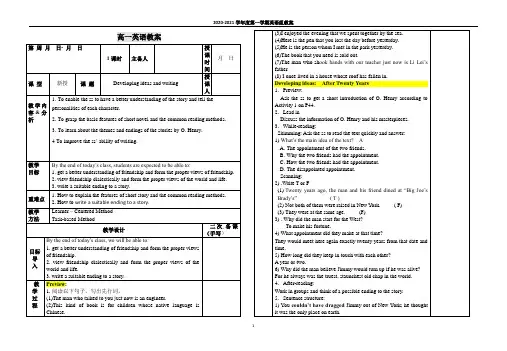
高一英语教案第周月日- 月日1课时主备人授课时间月日课型新授课题Developing ideas and writing 授课人教学内容&分析1.To enable the ss to have a better understanding of the story and tell the personalities of each character.2.To grasp the basic features of short novel and the common reading methods.3.To learn about the themes and endings of the stories by O. Henry.4 To improve the ss’ ability of writing.教学目标By the end of today’s class, students are expected to be able to:1. get a better understanding of friendship and form the proper views of friendship.2. view friendship dialectically and form the proper views of the world and life.3. write a suitable ending to a story.重难点1. How to explain the features of short story and the common reading methods.2. How to write a suitable ending to a story.教学方法Learner – Centered MethodTask-based Method教学设计二次备课(手写)目标导入By the end of today’s class, we will be able to:1. get a better understanding of friendship and form the proper views of friendship.2. view friendship dialectically and form the proper views of the world and life.3. write a suitable ending to a story.教学过程Preview:1.阅读以下句子,勾出先行词。
高中英语Unit5IntothewildPartⅢDevelopingideas教案外研版必修第一册

Part ⅢDeveloping ideasAn Encounter with NatureAs a nature photographer, I have to brave the elements.But despite the wind and the rain, I still enjoy working outside in the wild.One of the best things about this job is (1)that you can observe animals in their natural environment.My favourite place to take photos is Yellowstone National Park.As the world’s first national park, Yellowstone is famous for the variety of its wildlife, but it is probably best known for its bears.These huge, strong animals can live for 30 years.Despite a weight of up to 300 kilograms, they can run at a speed of around 64 kilometres per hour and are also excellent swimmers.Last spring in Yellowstone, I followed a path (2)that took me through a dark forest.(3)When I finally stepped out of the trees, the view was breathtaking.An eagle flew over the snow-capped mountains, (4)which were reflected in the still lake below.(5)While I was concentrating on photographing this amazing scene,I suddenly had a feeling that I was being watched.Slowly, and with the camera still held to my eye, I turned...and froze.Only meters away from me was a bear.(6)With water falling off its thick, brown hair, the bear stared back at me.Time stood still as the bear and I both waited to see (7)who would move first.My legs started shaking.Somehow, I forced my finger to press the button.A second later, the bear turned and ran back into the forest.(8)When I recovered from the shock, I looked at my camera.My most frightening but magical experience was now captured forever in a single image.From time to time I look at the photo as a reminder to show respect to all animals.(9)It is after all we who are the visitors to their world.(1)that引导表语从句,无意义,也不作句子成分。
新外研社高中英语必修三Unit1 Developing ideas教学设计

新外研社高中英语必修三Developing ideas教学设计教学目标:By the end of this period, students will be able to:1.Get the main idea of the text and have a better understanding of “Little White Lies”;2.Understand the structure and stylistic features of an essay and improve your thinking skills as well as language use abilities;3.Learn to analyse and solve problems in real life by using proper evidences to support your ideas.教学重难点:Master the skills of discourse analysis and appreciate the beauty of language.教学方法:P-W-P教学法,Task-based Teaching MethodStep ⅠLead-inLook at the pictures.What would you say if you were student B?Suggested answers:B:Oh,sorry to hear that.But I did no better than you.B:Come on.Actually you did well.I did worse than you.B:Well,I did just so-so.Step ⅠWhile-readingActivity1Read for the main ideaRead the passage and find out the meaning of“white lies”.Suggested answer:White lies are little lies that we tell to protect others from the truth.Activity2Read for detailed informationComplete the diagram with information from the passage.Learning to learnAn essay usually consists of three parts:introduction,main body and conclusion.Start with an introduction that contains the aims and an overview of the essay.The main body of an essay is a series of paragraphs that explore and develop your argument.The conclusion contains a summary of your ideas—do not introduce any new material here!End your essay by linking your conclusion back to the essay title.Suggested answers:IntroductionWe know lying is wrong,so why do we tell white lies?Main bodyThink and shareOh,what a tangled web we weave,When first we practise to deceive!1.What does the “web” in the poem represent?2.What would you do in the situations described in the passage?3.What do you think is the difference between a lie and a white lie?4.How would you feel if you were told a white lie? Share your experience with the class if this has happened to you.Suggested answers:1.It represents a complicated situation,in which once we tell a lie,we have to continue to tell more other lies in order to cover the previous ones.2.Students’ own answers.3.A lie is told to cover the truth in order to benefit yourself,which can be harmful to others.A white lie is told to avoid hurting others,without bad intention.4.Students’ own answers.Step ⅠPost-readingGroup work:Give a talk on the importance of honesty following the steps below.•Explain what honesty is.•Give reasons for the importance of being honest.•Support your reasons with examples.•End with your conclusion.Step ⅠHomeworkLanguage points and translation1.Moreover,how you feel if you discovered that the people closest to you (hide) the truth from you?【翻译】而且,当你发现身边最亲近的人在对你隐瞒真相时,你又会有怎样的感受呢?【解析】本句表示与现在事实相反的情况,所以使用虚拟语气。
外研必修三U5_Developing_ideas_and_Presenting_ideas教学设计
Unit 5 Developing ideas & Presenting ideas 名师教学设计●课时内容:Developing ideas分为两部分第一部分介绍了科幻作家儒勒·凡尔纳(1828~1905),他是19世纪法国著名作家,一生创作了大量优秀的文学作品,代表作有《地心游记》《海底两万里》《八十天环游地球》等。
他的作品对科幻文学流派有着重要的影响,因此他与赫伯特·乔治·威尔斯一道,被称作“科幻小说之父”。
本文节选了《海底两万里》的部分内容。
第二部分Writing about a diving experience是一张关于海底探险的海报,吸引人们探索神秘的海底世界。
Presenting ideas部分要求介绍、展示自己了解的探险故事,培养正确的探险意识。
●课时目标:1.掌握并记忆本课时的重点单词charge,ahead,permit,fascinated,relate,astonish,consume,distinguish,surround,intensity,depth,broad,beneath,resident,短语in broad daylight,intend to do sth.,in charge,be fascinated by,adapt from,look back upon,at a distance,drive away,account for以及句型的用法,并能熟练运用。
2.通过快速阅读、跳读等阅读方式,快速获取主要信息。
3.通过阅读科幻作家儒勒·凡尔纳《海底两万里》的节选内容,解决该部分设置的问题,培养学生分析问题、解决问题的能力。
4.通过了解儒勒·凡尔纳的《海底两万里》,激发学生对新鲜事物的探索精神,培养学生刻苦学习、持之以恒的性格。
●重点难点:重点:学会并掌握重点单词charge,ahead,permit,fascinated,relate,astonish,consume,distinguish,surround,intensity,depth,broad,beneath,resident,短语in broad daylight,intend to do sth.,in charge,be fascinated by,adapt from,look back upon,at a distance,drive away,account for的用法。
外研选择性必修第二册Unit5_Developing_ideas_板块教学设计
教学难点
引导学生学习演讲的组织结构特点及如何使用数据、举例和比较来支持自己的观点;
教学策略
P-W-P模式
Teaching contents
Procedures
Purposes
Teacher’s activity
Students’ activity
1.Teacher asks students to think about the similarities and differences between Macquarie Island and Shennongjia and make notes.
2.Teacher asks students to discuss their answers in groups, decide the key points and prepare for a talk.
2.Some students give answers.
To lead students into the topic ofShennongjia.
Activity 2
1.Teacher asks students tolook at the title of the passage andthink about what it means.
2.Some students give answers.
To enhance students’ understanding ofthe theme of the passageand encourage students to show their own opinions.
Activity 4
外研版高一英语必修第一册(2019版)_Unit3_Developing_ideas_板块教学设计
TinvitesSs to share their storieswith the class.
Ss share their stories with the class.
Provide opportunities for Ss to present their writing and do evaluation.
教学目标
1.学生能够理解课文内容,掌握新闻特写的基本特征和阅读方法;
2.学生能够联系自身实际,加深对单元主题意义的理解,正确认识家人之间的关系;
3.学生能够初步了解回忆类故事的基本内容、文体特征和写作手法,并简单记述一段难忘的家庭往事。
教学重点
1.如何阅读新闻特写,理解语篇内容;
2.如何以回忆类故事的文体,简单记述一段难忘的家庭往事。
Ss discuss the questions in groups and share their opinions in class.
1. Further explore the topic and the unit theme.
2. Improve Ss’ critical thinking and problem-solvingability.
1. Ss look at the words and expressions,and choose the ones that can be applied to their relationship with family members.
2. Ss look at the picture and the title, and predict which words and expressions can be applied to the brothers’ relationship in the feature story.
外研版高中英语选择性必修(一)第五单元 Developing Ideas 阅读课教学设计
外研版高中英语选择性必修(一)第五单元Developing Ideas 阅读课教学设计新标准《英语》选择性必修第一册Unit 5Developing IdeasThe Secret Language of Plants课型:Reading主题语境:人与自然——认识与探索自然内容分析:本节阅读课是外语教学与研究出版社出版的高中英语新教材选择性必修第一册第五单元Developing Ideas板块的阅读课,是根据Developing Ideas板块中阅读课The Secret Language of Plants(Page 56---Page 58)来设计的。
本板块呈现了从另一角度反映单元主题的课文,语篇类型为说明文,以植物界语言的奥秘为题,具体介绍了自然界中不同植物之间不同的交流方式,从而使学生通过了解神奇的自然,不仅增长了自然界知识,而且还激发了其对自然的好奇心。
通过对这一板块的学习,学生能够加深对自然界的理解和认识,进一步走进自然、探索自然、了解自然、欣赏自然,学会自然的和谐共生。
学情分析:本节课为高一下学期学习内容,内容切近学生生活实际,学生经过了必修课程的学习,已经非常了解新教材Developing Ideas阅读课的要求,逐步发展了自己的阅读技能,但是Developing Ideas阅读材料信息量大,内容丰富,学生在怎样恰当地运用阅读策略实现有效“输入”并“输出”上还需下功夫。
教学目标:在本板块学习结束时,学生能够:1.阅读并理解文章内容,通过完成相对应的活动,掌握与本节课主题语境相对应的关键词汇。
2.清楚地叙述文本中介绍的自然界中的植物之间的交流方式。
3.掌握说明文的文体特征,能从文本结构入手,通过对文本段落的分析,在把握结构的基础上掌握主题,加深对单元主题意义的认识,进一步了解自然,形成与自然和谐相处的积极的人生态度。
教学重点:引导学生通过阅读来把握和概括段落大意和推测作者写作意图。
Developing ideas 教案-高中英语外研版(2019)必修第一册
外研社(19)高中英语必修一Unit 2 Exploring English--Developing ideas教案Teaching objectives:1.To help the students understand the text and experience the confusion and misunderstanding in their study.2.To deepen the understanding of the theme of the unit based on the students’ own English learning experiences.3.To develop a learning and thinking mode of paying close attention to slang words as well as their cultural connotation.4.To get to know the contents, stylistic features and writing methods. To briefly describe an experience of misunderstanding some certain English expressions.Evaluation objectives:After the class, the students are expected to be able to:1.Understand the text.2.Get a general of some slang words.3.Know more about the differences between English and Chinese.Teaching key and difficult points:1.Enable the students to understand the text and ask them to compare, analyse and judge the content of the text and deepen the understanding of the theme of the unit.2.Help the students to develop the students’ logical thinking, critical thinking and creative thinking.3.Guide the students to develop the students’ cross-cultural awareness.Teaching methods:Task-based Approach; Cooperative LearningTeaching procedures:Step1:Presentation1.Ask the students to guess the meaning of “big potato”according to the following dialogue.A:You know what, the guy we talked with is a big potato in our company.B:You don’t say.2.Read the following expressions and guess their meanings.(Activity1, Page20)What’s up?Ring a bellSmall potatoesToilet waterAt sixes and sevensGreen figuresPull up one’s socksSuggested answers:What’s up?--What’s going on?Ring a bell--to sound familiarSmall potatoes--something unimportant or insignificantToilet water--a light perfume that does not have a very strong smellAt sixes and sevens--in a confused, badly-organized, or difficult situationGreen figures--natural ability in growing plantsPull up one’s socks--to make an effort to improve your work or behavior because it is not good enough.Step2:Fast readingAsk the students to read the four posts quickly and get to know where the four writers’“puzzles”lie in while learning English.Yancy---Sophie--Julien--Zheng Xu--Step3:Careful readingAsk the students to read the text quickly and finish Activity3 on Page22.Help them solve their puzzles.Suggested answers:a---Sophie’s post b---Zheng Xu’s post c---Yancy’s post d---Julien’s post Step4: Key and difficult pointsRead the text carefully again and help the students understand and analyse some long sentences.1.Here are some of our favorites,to remind us that some of the English we learn in the classroom is rather different from the English in the outside world!本句中的remind 是“提醒”的意思。
外研选择性必修第三册Unit2_Developing_ideas_板块教学设计
引导学生读懂文章,了解故宫博物院钟表修复师王津日复一日、争分夺秒地修复国宝级钟表的事迹和对“样式雷”家族的相关情况,对更多的工匠和其精神有更深的理解。
教学难点
引导学生注重语言在思维层面的内化和输出。
教学策略
交际教学法、任务型教学法
Teaching contents
Procedures
Purposes
Cultivatetheinterest and curiosity about the topic andxt.
Activity 3
1. T asks Ss to read the text carefully again and match the questions to the paragraphs.
教学目标
1学生能够理解课文内容,了解到故宫博物院钟表文物修复的复杂和不易,感受到钟表修复师王津耐得住寂寞,兢兢业业地做着修复工作的工匠精神;
2引导学生联系自身实际,加深对本单元主题意义的理解,启发学生理解工匠精神和“一生做好一件事”的意义;
3引导学生通过完成阅读任务和学习说明文的写作方法,运用所学内容写一篇说明文。
3. T asks Ss to skim the text to grasp the main idea of the text which can help check their predictions.
1. Ss fix their attention to the pictures and the title and then predict what the text is about with the helpof thevideo they justwatched.
Activity 2