
if-的用法
五、if后接否定动词,用于感叹句中,表示沮丧、 惊奇等。
I. Well,if I haven’t left my false teeth at home! 真倒霉,我把假牙丢在家里了!
2. And if he didn’t try to knock me down!(What do you think he did! He tried knock me down!)
G 容易产生歧义时用whether不用if来表示“是
否”。 Please let me know if you need help. 如果你需要帮 助请告诉我。或:请告诉我你是否需要帮助。对 比:Please let me know if you need help.请告诉我 你是否需要帮助。
H 如果宾语从句为否定句时,则只用if不用
八、Whether 和 if的用法区别
(一)引导宾语从句,一般既可用whether也可 用if。但
A or not放在whether之后时,只能用whether不
用if。 I don’t know whether or not he will come. 我不知道他是不是回来。
注1:如果or not放在whether所引导的从句句尾, 则可以用if来替换。
I don’t know whether/if he will come or not. 我不知道他是不是回来。
B 在强调任意选择时,用whether…or,此时不用if
替换whether。
He asked me whether I wanted to go there by train or by bus. 他问我是想乘火车还是坐公共汽车去那里。
meeting.
A. sure; whether B. sure; if
C. certain; whether D. certain; that
1. If you ___C__ to the party, you’ll have a great
time.
A. will go B. went C. go D. going
你猜他想做什么?他想把我撞倒! 六、用于虚拟语气中,if从句中用过去式,表示 不可能实现,大概不会实现或提出作为考虑的假 定条件
1. If you were a bird, you could fly.假使你 是只鸟,你便会飞了。
另外,if从句中用过去完成式,表示过去未实现
的条件(例如由于不可能实现或某人之未能实行)。
weather.
A. If; depends on B. Whether; depends upon
C. Whether; depended on D. If; depended upon
8.It isn’t quite _____ _C_____ he will be present at the
其次, if与only连用。常表示愿望或一个未实现的 条件,尤其用于感叹句中。
1. If only he arrives in time! 他若能及时到达就好了! 2. If only she would marry me! 但愿她能嫁给我! 3. If only she had known about it!(But she didn’t know.) 她那时要是知道(但她不知道)这事就好了!
ruler.(i.e.He does know the rulers.) 他不像不懂规则的样子。(即他懂得规则) 另外as if还可以引导感叹句。
As if I would allow it!(i.e.I would certainly not
allow it!)好像我会答应似的!(我才不会答应哩!)
6. _A____ English is his favourite subject
A. I asked him if B. I asked him that whether
C. I asked him that D. I asked him which
7. _____ they’ll go to the Summer Palace _B___ the
visit?
A. go B. went C. going D. will go
9. If I eat __C__ food, I’ll be very fat.
A. too many B. many too C. too much D. much too
10. I’ll give the book to him if heB___ here next Sunday.
can join in the party tonight or not.
A. whether
B. if C. that D. which
3.— I d like to invite you to a party this
evening. — Thank you, but __D___ I’ll be free I m
A. take B. bring C. carry D. make
4. Weifang is famous ___A___ kites
A. for B. to C. on D. with
5. I ___D_ her the answer if she ____me.
A. can tell, will ask B. will tell, will ask
7.—Do you know when --Sorry, I don’t know.
hWehweinllhceom_A_e_b_abcakckto,mI’orlrlotwel?l
you.
A. comes B. will come C. come D. may come
8. What will you do if you __A___ to the old folk’s home
C 虽引导宾语从句,但为了强调宾语部分,也
可把从句放在句首,此时只用whether不用if。 Whether he will come I am not sure. 他是不是来我拿不准。
D 从句作介词宾语时只用whether不用if。
It depends on whether it will be fine.那 得看是不是晴天。
1. If they had started earlier,they would have arrived in time. 要是他们早些动身,他们便可及时到达了。
第三,在文学体裁中,if有时可省略,然后将主 语与所用的限定动词(尤其是were,had,should) 倒置。
1. Should it (=if it should)be necessary,I will go. 倘若有必要,我会去的。 2. Were I(=if I were) in your place,I would do the same. 如果我处于你的位置,我也会这样干的。
E 作discuss等动词的宾语时,用whether不
用if。
We discussed whether we should close the shop. 我们讨论是不是该关掉商店。
F 句子中有if引导的条件句,如再有表示“是否”
的宾语从句,用whether不用if。
He asked me whether I’d move to New York if I got the job. 他问我如果我得到那份工作是否会搬家到纽约。
whether。
I don’t know if it won't rain tomorrow. 我不知道明天是不是会下雨。
(二)在引导主语从句、表语从句、同位语从句 时一般用whether不用if。
⑴Whether it is true remains a question. (主语从句)那是不是真的还是个问题。
七、if与其它一些介 同样引导从句。
1. It isn’t as if we are rich.(We are not rich.)
我们不像富有的样子。(即我们不富有)
2. It isn’t as if he doesn’t know the
C. would tell, ask D. will tell, asks
6. – What are you going to do tomorrow?
--We’ll go to the library tomorrow if it _D__.
A. isn’t rain B. rain C. won’t rain D. doesn’t rain
⑵The question is whether it is true. (表语从句)问题是是不是真的。
⑶We have a doubt whether it is true. (同位语从句) 我们怀疑那是不是真的。
(三)用在动词不定式之前时用whether不用if。
I don’t know whether to go there at once. 我不知道是不是该立刻去那里。
5. Only when _____ the painting __C___ decide ______the
painting is worth buying.
A. he sees, he can ,whether B. does he see, can he, if
C. he sees, can he ,whether D. sees he, he can,that
2. It will be a long time __D__ Peter _____ his work.
A. since, has finished B. after, finishes
C3..Wwhheant ,wwililllfafitnhiesrh_D__.B_b_efuosrefr,ofimniJshaepsa.n?
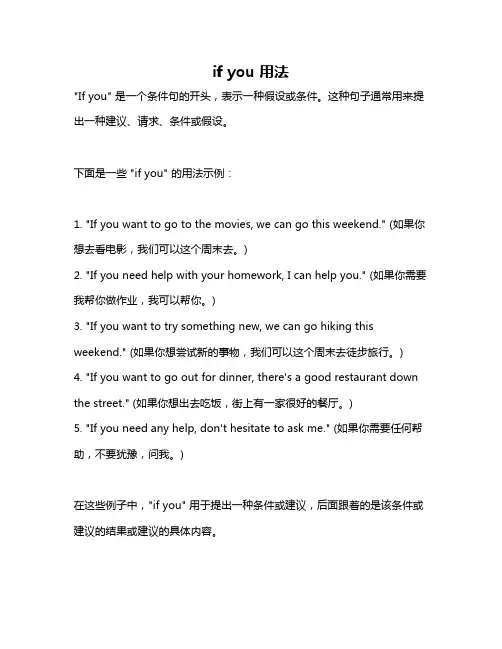
if you 用法
if you 用法
"If you" 是一个条件句的开头,表示一种假设或条件。
这种句子通常用来提出一种建议、请求、条件或假设。
下面是一些 "if you" 的用法示例:
1. "If you want to go to the movies, we can go this weekend." (如果你想去看电影,我们可以这个周末去。
)
2. "If you need help with your homework, I can help you." (如果你需要我帮你做作业,我可以帮你。
)
3. "If you want to try something new, we can go hiking this weekend." (如果你想尝试新的事物,我们可以这个周末去徒步旅行。
)
4. "If you want to go out for dinner, there's a good restaurant down the street." (如果你想出去吃饭,街上有一家很好的餐厅。
)
5. "If you need any help, don't hesitate to ask me." (如果你需要任何帮助,不要犹豫,问我。
)
在这些例子中,"if you" 用于提出一种条件或建议,后面跟着的是该条件或建议的结果或建议的具体内容。
when if的用法

when if的用法
"When" 和 "if" 都是英语中的条件连词,但它们的用法有一些区别。
"When" 的用法:
1. "When" 可以用于表示一个事件发生的时间,例如 "When did you arrive?"(你什么时候到达的?)
2. "When" 也可以用于描述条件,但通常用于描述更具体的条件,例如"When the sun is shining, I like to go to the beach."(当太阳照耀时,我喜欢去海滩。
)
"If" 的用法:
1. "If" 通常用于表示一个条件,并且这个条件可能导致某种结果,例如 "If you want to succeed, you must work hard."(如果你想成功,你必须努力工作。
)
2. "If" 可以用于描述更一般的条件,例如 "If there is a will, there is a way."(有志者事竟成。
)
总结:
"When" 和 "if" 都可以用于描述条件,但 "When" 更侧重于描述时间或情境,而 "If" 更侧重于描述条件和结果。
在具体使用时,可以根据语境选择合适的连词。
英语中if的用法

1. (表示条件)如果,主句用将来时,if从句用现在时表示将来He will come if you invite him.如果你请他,他会来的。
2. (表示虚拟)假如,要是1)时态:可以表示过去,现在和将来的情况。
它的基本特点是时态退后。
a. 同现在事实相反的假设。
句型:主句should( would) +If they were here, they would help you.b. 表示于过去事实相反的假设。
句型:主句should(would) have+ 过去分词If she had worked harder, she would have succeeded.The rice would not have been burnt if you had been more careful.If my lawyer had been here last Saturday, he would have prevented me from going.If he had come , I should / would have told him about it.含义:He did not come , so I did not tell him about it.If he had not been ill and missed many classes, he would have made greater progress. 含义:He was ill and missed many lessons, so he did not make greater progress.c. 表示对将来的假想句型:主句should+were+ would +should+ 动词原形If you succeeded, everything would be all right.If you should succeed, everything would be all right.If you were to succeed, everything would be all right.3. 是否= whether 连接I wonder if she is ill.不知她是否病了。
unless if when until as soon as用法
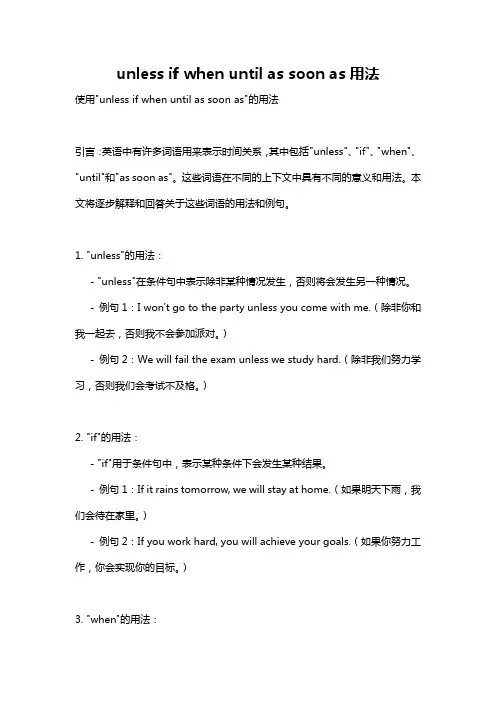
unless if when until as soon as用法使用"unless if when until as soon as"的用法引言:英语中有许多词语用来表示时间关系,其中包括"unless"、"if"、"when"、"until"和"as soon as"。
这些词语在不同的上下文中具有不同的意义和用法。
本文将逐步解释和回答关于这些词语的用法和例句。
1. "unless"的用法:- "unless"在条件句中表示除非某种情况发生,否则将会发生另一种情况。
- 例句1:I won't go to the party unless you come with me.(除非你和我一起去,否则我不会参加派对。
)- 例句2:We will fail the exam unless we study hard.(除非我们努力学习,否则我们会考试不及格。
)2. "if"的用法:- "if"用于条件句中,表示某种条件下会发生某种结果。
- 例句1:If it rains tomorrow, we will stay at home.(如果明天下雨,我们会待在家里。
)- 例句2:If you work hard, you will achieve your goals.(如果你努力工作,你会实现你的目标。
)3. "when"的用法:- "when"表示某个事件或情况发生时,会发生另一个事件或情况。
- 例句1:I will call you when I arrive at the airport.(当我到达机场时,我会给你打电话。
)- 例句2:When the sun sets, it gets dark outside.(太阳落山时,外面会变得黑暗。
初三英语—期末冲刺:if的用法及定语从句
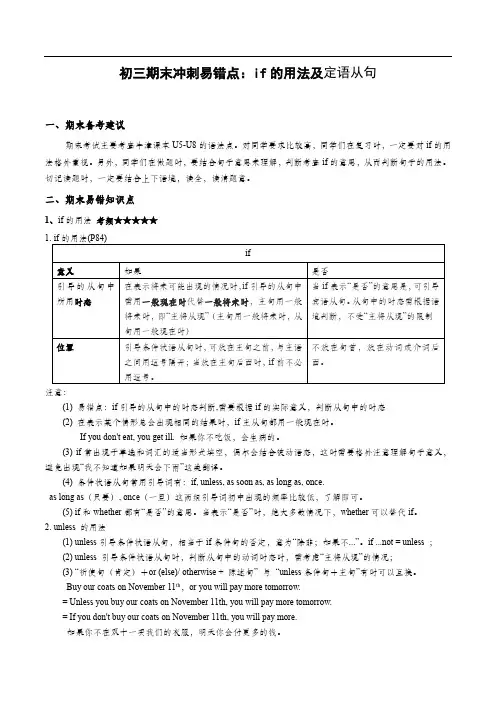
初三期末冲刺易错点:if的用法及定语从句一、期末备考建议期末考试主要考查牛津课本U5-U8的语法点。
对同学要求比较高,同学们在复习时,一定要对if的用法格外重视。
另外,同学们在做题时,要结合句子意思来理解,判断考查if的意思,从而判断句子的用法。
切记读题时,一定要结合上下语境,读全,读清题意。
二、期末易错知识点1、if的用法考频★★★★★注意:(1) 易错点:if引导的从句中的时态判断,需要根据if的实际意义,判断从句中的时态(2) 在表示某个情形总会出现相同的结果时,if主从句都用一般现在时。
If you don't eat, you get ill. 如果你不吃饭,会生病的。
(3) if常出现于单选和词汇的适当形式填空,偶尔会结合被动语态,这时需要格外注意理解句子意义,避免出现“我不知道如果明天会下雨”这类翻译。
(4) 条件状语从句常用引导词有:if, unless, as soon as, as long as, once.as long as(只要), once(一旦)这两组引导词初中出现的频率比较低,了解即可。
(5) if和whether都有“是否”的意思。
当表示“是否”时,绝大多数情况下,whether可以替代if。
2. unless 的用法(1) unless引导条件状语从句,相当于if条件句的否定,意为“除非;如果不...”。
if ...not = unless ;(2) unless 引导条件状语从句时,判断从句中的动词时态时,需考虑“主将从现”的情况;(3) “祈使句(肯定)+or (else)/ otherwise + 陈述句” 与“unless条件句+主句”有时可以互换。
Buy our coats on November 11th,or you will pay more tomorrow.= Unless you buy our coats on November 11th, you will pay more tomorrow.= If you don't buy our coats on November 11th, you will pay more.如果你不在双十一买我们的衣服,明天你会付更多的钱。
if的八种省略结构用法(DEC.27))

含if的八种省略结构类型一:if + 形容词这类结构通常可视为在if与形容词之间省略了“主语+动词be的适当形式”。
如:注:这类省略结构中有的已构成相对固定的搭配,if necessary (如果需要),if possible (如果可能)等。
如:If necessary,ring me at home. 如果必要,可往我家里打电话。
If possible,let me know beforehand. 如果可能,可在事前通知我。
类型二:if + 过去分词其中的过去分词可视为是被省略的被动结构,即在if与形容词之间省略了主语和助动词be。
如:He will come if asked.= He will come if he is asked. 他如被邀就会来。
The medicine is quite effective if taken in time.=The medicine is quite effective if it is taken in time.这药要是能按时服用,效果是很好的。
类型三:if + 不定代词这类省略通常要根据具体的上下文来理解。
如:If anyone,he knows. 如果有人知道,那就是他了。
There are few people nowadays,if any,who remember him. 当今记得他的人,如有的话,也不多了。
He seems to have little,if anything,to do with this. 若要说他和这事有什么相关的话,那也似乎是很少的。
类型四:if + 介词短语这类结构往往要根据具体的语境来理解,但有些经常搭配的惯用结构也值得注意,如if in doubt,if at all,if by any chance等。
如:If in doubt,ask your doctor. He can give you further information.你若有疑问,可以问问医生. 他会向你作进一步的说明。
虚拟语气if的用法
虚拟语气if的用法虚拟语气是英语中一个重要的语法现象,通过使用if引导的虚拟条件句来表达假设、愿望、建议或者表示与现实相反的情况。
以下是虚拟语气if的几种常见用法:1. 表达假设和假设的结果:使用虚拟语气if来表达假设和假设的结果,通常形如“If + 主语+ 动词过去式,主语 + would/could/might/could have + 动词过去分词”。
例句1: If I were rich, I would travel around the world.(假如我很有钱,我会环游世界。
)例句2: If it had rained, we could have stayed at home.(如果下雨的话,我们本来可以待在家里。
)2. 表达愿望:使用虚拟语气if来表达愿望,通常形如“If only + 主语 + 动词过去式”。
例句:If only I could speak fluent French.(要是我能流利地说法语就好了。
)3. 表达建议:使用虚拟语气if来表达建议,通常形如“If I were you, I would + 动词原形”。
例句:If I were you, I would take a break and relax.(如果我是你,我会休息放松一下。
)4. 表达对现在和过去不可能实现的条件:使用虚拟语气if来表达对现在和过去不可能实现的条件,通常形如“If + 主语 + had/could + 动词原形”。
例句1: If I had wings, I could fly in the sky.(如果我有翅膀,我就能在天空中飞翔。
)例句2: If I could play the piano, I would perform at the concert.(如果我会弹钢琴,我将会在音乐会上表演。
)总结起来,虚拟语气if的用法包括表达假设和假设的结果、愿望、建议以及对现在和过去不可能实现的条件。
If引导的条件状语从句的用法
If引导的条件状语从句的用法“If”的具体用法一. “If”引导的宾语从句的用法Step1:从句具备的两个条件:(1)有引导词.(2)引导词后面有完整的句子.Step2:宾语从句的含义:宾语从句在复合句中作主句的(及物动词或介词)的宾语. Step3: 句型结构:主语+及物动词(v t)+引导词+主语+谓语(+其它)主句宾语从句主句谓语动词引导词宾语从句译文:永远不要谴责你不了解的事情.操练句子的八大步骤:第1步:首先搞清每个单词的含义和词性.第2步:语法现象分析.分清句子主要结构和成分. 按照主要句子对应成分进行朗读1遍. 第3步:意群划分.按照意群朗读至少3遍.第4步:单词读准.一定确保把句子当中的每个单词读标准和地道,这是学习英语的重中之重,一定不可忽略,为整体句子朗读做好准备和铺垫.每个单词至少朗读3遍.第5步:按照意群朗读细则:首先听原声录音,一个一个句子读顺,先慢速朗读3遍,然后中速3遍,最后快速3遍,把句子操练熟练后,利用李阳疯狂英语核心理论方法,“三最口腔训练法”和“一口气训练法”.第6步:中英翻译互换训练练习.细则:组织学员进行两两中英互换练习.一个说中文,一个说英文,然后再互换角色. 第7步:复述练习.细则:找两位学员进行现场复述训练和现场翻译训练第8步:默写练习.Step4:“if”引导宾语从句的特点:(1)“if” 有含义,表示“是否”.(2)不可省略. E g: 主语状语谓语引导词宾语从句译文:我只是想知道今晚她是否来参加我的生日宴会.Step5: “If”引导的宾语从句的用法与“whether” 引导的宾语从句的用法的两点区别.(1)若句末没有出现“or not”, 两者可以互换(.2)若句末出现“or not”, 只能用“whether”. E g: (两者皆可)主句引导词宾语从句比较:I don’t know whether my parents can come to the class meeting or not.(只能用“whether”)二. “if”引导真实条件状语从句的用法Step1: 条件状语从句具备4大语法意义(1):状语从句在句中起状语作用,修饰主句的整个句子.(2):状语从句通常有从属连词引导,与主句相接.(3):状语从句放在句首时,常用逗号与主句隔开;若放在句末,其前一般不用逗号.(4):条件状语从句分为从句和主句,引导词后面表示可能的句子为从句,而另外一个表示结果的句子为主句.Step2: “If” 引导真实条件状语从句的特点:(1)从句的谓语动词用一般现在时态.(2)主句的谓语动词用一般将来时态,或者用情态动词:“may/ might+动词原形.3大句式:第1大句式:If + simple present, subject +will/won’t +动词原形.引导词从句主句译文:有闲论是非,无暇爱他人.练习题:1, A: gained B: have gained C: will gain2, get married, you will have more free time.A: didn’t B: don’t C: doesn’t第2大句式:If + simple present, subject +may/might+动词原形.E g: 引导词从句主句Explain: We can also use may and might as consequences, to show that the consequence is less likely.译文:如果你拥有更多的空闲时间,你或许会感到无聊.第3大句式:If + simple present, subject +will+be able to+动词原形或will +have to+动词原形.E g: 引导词从句主句译文:如果你节省一些钱,你就能去旅游. 引导词从句主句译文:如果你去外国旅游,你得获得签证.Explain : We can not say will can or will must. Instead, we say“will be able to+动词原形” and “will have to+动词原形”.三. “if”引导非真实条件状语从句的用法,即虚拟语气.Step1: 虚拟语气的语法意义:“表示说的话不是事实,或者不可能发生,实现的可能性不是很大,只是一种愿望,假设或者猜想,从句和主句的谓语动词用一种特殊形式.(一)..表示对将来情况的一种假设.特点:A: 从句的谓语动词(1)一般过去时态(2)should+动词原形.(3)were to+动词原形. B: 主句的谓语动词用would/could/should/ might +动词原形.从句动词形式主句动词形式译文:如果明天下雨的话,我就待在家里.(二).表示对现在和目前情况的一种假设.特点:A: 从句的谓语动词用一般过去时态,“be”动词一律用“were”. B: 主句的谓语动词用would/could/should/ might /ought to+动词原形.从句动词形式主句动词形式译文:不经历风雨怎么见彩虹.几种特殊句式:第1特殊句式: If I were you, I would +动词原形. 假如我是你的话,我会-------- E g: If I were you, I would talk to my boss first译文:假如我是你的话,我会首先和我的老板谈谈.If I were you, I would change my current job.译文:假如我是你的话,我会换掉我目前的工作.第2特殊句式:What would you do if----------------------------? 假如-----------------你会怎么办? E g: What would you do if you were in my shoes?译文:假如你站在我的立场,你会怎么办?What would you do if you got fired?译文:假如你被炒鱿鱼,你会怎么办?第3特殊句式:What would happen if -----------? 假如/倘若------将会出现何种结果呢? E g: What would happen if we combined animal genes with human genes?译文:如果我们把动物的基因与人的基因交织组合在一起,将会出现什么样的结果呢?What would happen if we lost touch with each other?译文:倘若我们彼此都失去联系,将会变成什么样的结果呢?(三).表示对过去情况的一种假设.特点:A: 从句的谓语动词用过去完成时态即:“had+过去分词”. B: 主句的谓语动词用would/could/should/might/ought to +现在完成时态即“have +过去分词”.E g: If I 从句时态形式主句动词形式译文:要是我早知道你在北京的话,我会带你游览这座城市的. 从句时态形式主句动词形式译文:要是我当时多加小心的话,我会做的更加出色.练习题he had not hurt his leg, John would have won the race (2019全国)A: Since B: If C: Though D: Whenhere last Saturday, he 全国). A: had been; would have prevented B: had been; would preventC: Were; would prevent D: were; would have prevented3. If the workers hadn’t2019北京)A: would have failed B: had failed C: fail D: have failed.4. A: If he 全国)B: Luckily he was sent to the hospital immediately.A: was warned B: had been warned C: would be warned D: is warned(四)虚拟语气中“if”的省略倒装现象特点:省略从句中的“if”,只需把系动词或者助动词提到主语前即可,主句保持不变. 基本句式:“Should/ were/had +主语+部分谓语”.E g: If you were in my position , you would do the same.倒装现象:Were you in my position , you would do the same.E g: If I had been in a good mood then, I would have gone to the movies.倒装现象:Had I been in a good mood then, I would have gone to the movies.练习题:1, I in good health, I with you.(2019福建)A: Am; will go B: Were; would go C: was ; shall go D: were; were going2, for the doctor’s careful treatment, he till last year.(2019山东)A: If is not; can’t live B: Were it not; couldn’t liveC: Had it not been; couldn’t have lived D: If they were not; couldn’t live3. it rain tomorrow , we would have to put off the visit to the memorial.(2019安徽) A: Were B: Should C: Would D: Will4, A: Would you be B: Should you be C: Could you be D: Might you be.(五)“If”引导虚拟语气的错综时间.特点:(1)从句的时间与主句所表示的时间不一致.(2)从句和主句的动作不是发生在同一时间,具体动词形式要根据时间而定.两种特殊情况:(1)若从句表示的是过去,谓语动词用过去完成时态,即:“had +过去分词”,主句表示的是现在,谓语动词用could/would/should+动词原形. 表示的是过去表示的是现在译文:要是他当时吃药的话,他现在感觉更好一些.(2)若从句表示的是现在,谓语动词用一般过去时态;主句表示的是过去,谓语动词用情态动词加现在完成时态,即:“would/ could /should have +过去分词”. 表示的是现在表示的是过去译文:如果我知道他的电话号码的话,我就给他打电话了。
if的使用方法
if的使用方法If的使用方法。
在英语语法中,if是一个非常常用的词,它可以表示条件、假设、可能性等含义。
if的使用方法非常灵活多样,下面我们就来详细讨论一下if的各种用法。
首先,if可以用来表示条件。
比如,我们可以说,“If it rains tomorrow, we will stay at home.” 这句话中的if表示的是一种条件,即如果明天下雨的话,我们就会呆在家里。
在这种情况下,if引导的从句通常使用一般现在时态,而主句则使用将来时态。
其次,if还可以用来表示假设。
比如,我们可以说,“If I were you, I would apologize.” 这里的if引导的从句中使用了虚拟语气,表示的是一种假设,即如果我是你的话,我会道歉。
在这种情况下,if引导的从句中的动词要使用虚拟语气形式。
除了表示条件和假设,if还可以用来表示可能性。
比如,我们可以说,“If she studies hard, she may pass the exam.” 这里的if表示的是一种可能性,即如果她努力学习的话,她可能会通过考试。
在这种情况下,if引导的从句中的动词可以使用一般现在时态,表示一种可能的情况。
此外,if还可以用来表示请求或建议。
比如,我们可以说,“If you have any questions, please feel free to ask.” 这里的if表示的是一种请求,即如果你有任何问题的话,请随时问。
在这种情况下,if引导的从句中的动词可以使用一般现在时态,表示一种请求或建议。
另外,if还可以用来表示对比。
比如,我们可以说,“If it was easy, everyone would d o it.” 这里的if表示的是一种对比,即如果这件事情很容易的话,每个人都会去做。
在这种情况下,if引导的从句中的动词可以使用一般过去时态,表示与现实相反的情况。
总的来说,if的使用方法非常灵活多样,可以表示条件、假设、可能性、请求、建议、对比等不同的含义。
c语言if else语句用法
c语言if else语句用法在C语言中,if-else语句用于根据指定的条件执行代码的不同分支。
语法如下:```if (条件表达式) {//如果条件为真,执行这里的代码块} else {//如果条件为假,执行这里的代码块}```简单来说,if-else语句会先对条件表达式进行求值。
如果条件表达式的值为真(非零),则执行if代码块中的语句;如果条件表达式的值为假(0),则执行else代码块中的语句。
以下是一些相关的注意事项和拓展内容:1.条件表达式必须返回一个布尔值(真或假),通常是关系表达式(例如`<`, `>`, `==`, `!=`等)。
2. if语句中的代码块可以是单个语句,也可以是多个语句的复合语句(使用`{}`括起来的一系列语句)。
3.可以嵌套使用if-else语句,以处理更复杂的条件逻辑。
4.可以使用else if语句来添加更多的条件分支。
例如:```if (score >= 90) {printf("优秀\n");} else if (score >= 80) {printf("良好\n");} else if (score >= 60) {printf("及格\n");printf("不及格\n");}```上述代码根据不同的成绩范围打印不同的提示信息。
5. if-else语句也可以嵌套在其他if-else语句中。
例如:```if (x > 0) {if (y > 0) {printf("x和y都大于0\n");} else {printf("x大于0,但y不大于0\n");}printf("x不大于0\n");}```上述代码根据x和y的值打印不同的提示信息。
总之,if-else语句是C语言中用来控制流程的重要结构,它可以根据不同的条件执行不同的代码分支,从而实现灵活的程序逻辑控制。