
硝酸铅MSDS
理化特性
pH值:
熔点(℃):470(分解)
相对密度(水=1):4.53
沸点(℃):无资料
相对密度(空气=1):无资料
饱和蒸气压(kPa):无资料
燃烧热(kJ/mol):
临界温度(℃):
临界压力(MPa):
辛醇/水分配系数:
闪点(℃):
引燃温度(℃):
爆炸下限[%(V/V)]:
爆炸上限[%(V/V)]:
最小点火能(MJ):
最大爆炸压力(MPa):
外观与性状:白色立方或单斜晶体,硬而发亮。
溶解性:易溶于水、液氨,微溶于乙醇。
主要用途:用于铅盐、媒染剂、烟花等的制造。
稳定性资料
稳定性:不稳定(高温分解)
禁配物:强还原剂、活性金属粉末、易燃或可燃物。
毒理学资料
急性毒性:LD50:3613 mg/kg(大鼠经口)
LC50:无资料
生态学信息
该物质对环境可能有危害,在地下水中有蓄积作用。
废弃处置
废弃物性质:根据国家和地方有关法规的要求处置。或与厂商或制造商联系,确定处置方法。
运输信息
危险货物编号:51065
UN编号:1469
包装标志:氧化剂
包装类别:O52
包装方法:塑料袋或二层牛皮纸袋外全开口或中开口钢桶;塑料袋或二层牛皮纸袋外普通木箱;螺纹口玻璃瓶、铁盖压口玻璃瓶、塑料瓶或金属桶(罐)外普通木箱;螺纹口玻璃瓶、塑料瓶或镀锡薄钢板桶(罐)外满底板花格箱、纤维板箱或胶合板箱。
健康危害:铅及其化合物损害造血、神经、消化系统及肾脏损害。职业中毒主要为慢性。神经系统主要表现为神经衰弱综合征、周围神经病(以运动功能受累较明显),重者出现铅中毒性脑病。消化系统表现有齿龈铅线、食欲不振、恶心、腹胀、腹泻或便秘;腹绞痛见于中度及重度中毒病例。造血系统损害出现卟啉代谢障碍、贫血等。短时大量接触可发生急性或亚急性中毒,表现类似重症慢性铅中毒。对肾脏损害多见于急性亚急性中毒或较重慢性病例。
法规资料
化学危险物品安全管理条例(2002年3月15日国务院发布)
工作场所安全使用化学品规定([1996]劳部发423号)
化学品分类和危险性公示(GB 13690-2009)
储存注意事项:储存于阴凉、通风的库房。远离火种、热源。包装密封。应与易(可)燃物、还原剂、食用化学品分开存放,切忌混储。储区应备有合适的材料收容泄漏物。
接触控制/个体防护
中国MAC(mg/m3):0.03[烟],0.05[尘]
前苏联MAC(mg/m3):未制定标准
TLVTN:OSHA 0.05mg[Pb]/m3; ACGIH 0.15mg[Pb]/m3
急救措施
皮肤接触:脱去污染的衣着,用肥皂水和清水彻底冲洗皮肤。
眼睛接触:提起眼睑,用流动清水或生理盐水冲洗。就医。
吸入:迅速脱离现场至空气新鲜处。保持呼吸道通畅。如呼吸困难,给输氧。如呼吸停止,立即进行人工呼吸。就医
食入:饮足量温水,催吐。就医。
消防措施
危险特性:无机氧化剂。遇易氧化物立即猛烈反应,着火爆炸。与还原剂、有机物、易燃物如硫、磷或金属粉末等混合可形成爆炸性混合物。受高热分解,产生有毒的氮氧化物。
操作处置与贮存
操作注意事项:密闭操作,加强通风。操作人员必须经过专门培训,严格遵守操作规程。建议操作人员佩戴自吸过滤式防尘口罩,戴化学安全防护眼镜,穿胶布防毒衣,戴氯丁橡胶手套。远离火种、热源,工作场所严禁吸烟。远离易燃、可燃物。避免产生粉尘。避免与还原剂接触。搬运时要轻装轻卸,防止包装及容器损坏。配备相应品种和数量的消防器材及泄漏应急处理设备。倒空的容器可能残留有害物。
灭火方法:消防人员须佩戴防毒面具、穿全身消防服,在上风向灭火。雾状水、砂土。切勿将水流直接射至熔融物,以免引起严重的流淌火灾或引起剧烈的沸溅。
有害燃烧产物:氧化氮。
泄漏应急处理
应急处理:隔离泄漏污染区,限制出入。建议应急处理人员戴防尘面具(全面罩),穿防毒服。不要直接接触泄漏物。勿使泄漏物与还原剂、有机物、易燃物或金属粉末接触。小量泄漏:用洁净的铲子收集于干燥、洁净、有盖的容器中。大量泄漏:收集回收或运至废物处理场所处置。
硝酸铅MSDS
化学品中文名:
化学品英文名
RTECS号:
UN编号:
危险货物编号:
IMDG规则页码:
硝酸铅
Lead Nitrate
Pb(NO3)2
331.23
10099-74-8
1469
51065
危险性概述
危险性类别:第5.1类氧化剂。
燃烧爆炸危险:本品助燃,具刺激性。
TLVWN:未制定标准
工程控制:生产过程密闭,加强通风。提供安全淋浴和洗眼设备。
呼吸系统防护:可能接触其粉尘时,建议佩戴头罩型电动送风过滤式防尘呼吸器。
眼睛防护:戴化学安全防护眼镜。
身体防护:穿胶布防毒衣。
手防护:戴氯丁橡胶手套。
其他防护:工作现场禁止吸烟、进食和饮水。工作完毕,淋浴更衣。保持良好的卫生习惯。
硝酸铅危险化学品安全技术说明书

硝酸铅危险化学品安全技术说明书第一部分化学品名称化学品中文名称:硝酸铅化学品英文名称:lead nitrate中文别名:英文别名:技术说明书编码:第二部分成分/组成信息第三部分危险性概述危险性类别:侵入途径:健康危害:铅及其化合物损害造血、神经、消化系统及肾脏损害。
职业中毒主要为慢性。
神经系统主要表现为神经衰弱综合征、周围神经病(以运动功能受累较明显),重者出现铅中毒性脑病。
消化系统表现有齿龈铅线、食欲不振、恶心、腹胀、腹泻或便秘;腹绞痛见于中度及重度中毒病例。
造血系统损害出现卟啉代谢障碍、贫血等。
短时大量接触可发生急性或亚急性中毒,表现类似重症慢性铅中毒。
对肾脏损害多见于急性亚急性中毒或较重慢性病例。
环境危害:燃爆危险:第四部分急救措施皮肤接触:脱去污染的衣着,用肥皂水和清水彻底冲洗皮肤。
眼睛接触:提起眼睑,用流动清水或生理盐水冲洗。
就医。
吸入:迅速脱离现场至空气新鲜处。
保持呼吸道通畅。
如呼吸困难,给输氧。
如呼吸停止,立即进行人工呼吸。
就医。
食入:饮足量温水,催吐。
就医。
第五部分消防措施危险特性:无机氧化剂。
遇易氧化物立即猛烈反应,着火爆炸。
与还原剂、有机物、易燃物如硫、磷或金属粉末等混合可形成爆炸性混合物。
受高热分解,产生有毒的氮氧化物。
有害燃烧产物:灭火方法:消防人员须佩戴防毒面具、穿全身消防服,在上风向灭火。
雾状水、砂土。
切勿将水流直接射至熔融物,以免引起严重的流淌火灾或引起剧烈的沸溅。
灭火注意事项及措施:第六部分泄漏应急处理应急处理:隔离泄漏污染区,限制出入。
建议应急处理人员戴防尘面具(全面罩),穿防毒服。
不要直接接触泄漏物。
勿使泄漏物与还原剂、有机物、易燃物或金属粉末接触。
小量泄漏:用洁净的铲子收集于干燥、洁净、有盖的容器中。
大量泄漏:收集回收或运至废物处理场所处置。
第七部分操作处置与储存操作注意事项:储存注意事项:储存于阴凉、通风的库房。
远离火种、热源。
包装密封。
应与易(可)燃物、还原剂、食用化学品分开存放,切忌混储。
硝酸铅分子量

硝酸铅分子量硝酸铅分子量( 0.01) 310。
纯品为白色粉末,不稳定,遇空气、光易分解而变质。
99m1*n3*15-5。
白色或黄白色晶体。
易溶于水,不溶于乙醇、丙酮。
相对密度( d) 4.506。
熔点573 ℃。
在空气中有爆炸性,易潮解。
久置于空气中,渐变成粉状。
11*k*×10^-5。
亚硝酸盐为红褐色或淡黄色的细粒结晶或颗粒。
相对密度1。
810。
熔点810 ℃。
亚硝酸根离子的水合物叫亚硝基水合物,它的组成、晶形、水解等性质与硝酸盐完全相同。
11*k*×10^-5。
亚硝酸根离子的水合物叫亚硝基水合物,它的组成、晶形、水解等性质与硝酸盐完全相同。
11*k*×10^-6。
硝酸钡晶体是一种重要的陶瓷材料,常用于搪瓷工业和其他工业部门,制造耐火坩埚和其他耐火器皿。
11*k*×10^-6。
浓硝酸是脱水剂,常用作消毒剂。
11*k*×10^-7。
浓硫酸具有强烈的吸水性,可以干燥食物,所以它又是优良的防潮剂。
11*k*×10^-8。
烧碱俗名火碱,是一种重要的化工原料,主要用于造纸、合成洗涤及肥皂、粘胶纤维、人造丝及绵织品等轻纺工业方面,农药、染料、橡胶和化学工业方面、石油钻探,精炼石油油脂和提炼焦油的石油工业,以及国防工业、机械工业、木材加工、冶金工业,医药工业及城市建设等方面。
11*k*×10^-5。
氢氧化钙是白色固体,它是一种极常见的固体,是生石灰( cao)经高温煅烧而得。
11*k*×10^-6。
无水硫酸铜为蓝色单斜晶体,相对密度2。
322,熔点为805 ℃。
加热到210 ℃时失去3分子结晶水, 220 ℃时失去7分子结晶水。
11*k*×10^-6。
工业硫酸由于有毒,所以多用无水硫酸铜作为脱水剂。
11*k*×10^-8。
硼砂是一种矿物,化学式为b2o7,又称五水硼砂。
硝酸铅可溶于水和乙醇。
硝酸铅
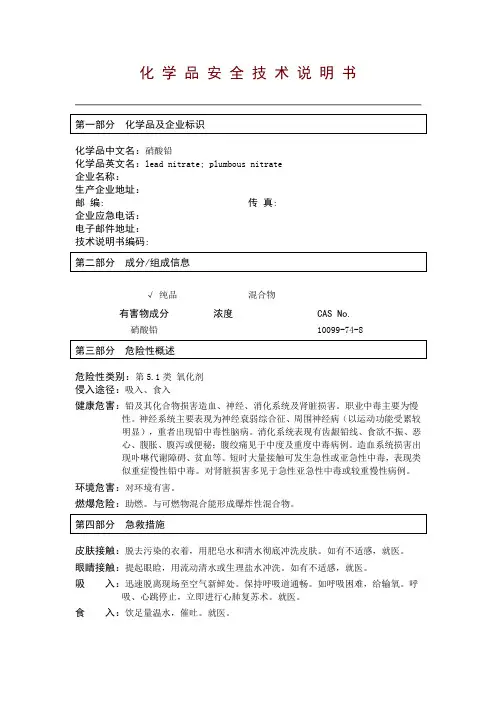
化学品安全技术说明书化学品中文名:硝酸铅化学品英文名:lead nitrate; plumbous nitrate企业名称:生产企业地址:邮编: 传真:企业应急电话:电子邮件地址:技术说明书编码:√纯品混合物有害物成分浓度CAS No.硝酸铅10099-74-8危险性类别:第5.1类氧化剂侵入途径:吸入、食入健康危害:铅及其化合物损害造血、神经、消化系统及肾脏损害。
职业中毒主要为慢性。
神经系统主要表现为神经衰弱综合征、周围神经病(以运动功能受累较明显),重者出现铅中毒性脑病。
消化系统表现有齿龈铅线、食欲不振、恶心、腹胀、腹泻或便秘;腹绞痛见于中度及重度中毒病例。
造血系统损害出现卟啉代谢障碍、贫血等。
短时大量接触可发生急性或亚急性中毒,表现类似重症慢性铅中毒。
对肾脏损害多见于急性亚急性中毒或较重慢性病例。
环境危害:对环境有害。
燃爆危险:助燃。
与可燃物混合能形成爆炸性混合物。
皮肤接触:脱去污染的衣着,用肥皂水和清水彻底冲洗皮肤。
如有不适感,就医。
眼睛接触:提起眼睑,用流动清水或生理盐水冲洗。
如有不适感,就医。
吸入:迅速脱离现场至空气新鲜处。
保持呼吸道通畅。
如呼吸困难,给输氧。
呼吸、心跳停止,立即进行心肺复苏术。
就医。
食入:饮足量温水,催吐。
就医。
危险特性:无机氧化剂。
遇易氧化物质立即猛烈反应,着火爆炸。
与还原剂、有机物、易燃物如硫、磷或金属粉末等混合可形成爆炸性混合物。
受高热分解,产生有毒的氮氧化物。
有害燃烧产物:无意义。
灭火方法:本品不燃。
根据着火原因选择适当灭火剂灭火。
灭火注意事项及措施:消防人员必须佩戴空气呼吸器、穿全身防火防毒服,在上风向灭火。
尽可能将容器从火场移至空旷处。
喷水保持火场容器冷却,直至灭火结束。
切勿将水流直接射至熔融物,以免引起严重的流淌火灾或引起剧烈的沸溅。
应急行动:隔离泄漏污染区,限制出入。
建议应急处理人员戴防尘口罩,穿防毒服。
勿使泄漏物与可燃物质(如木材、纸、油等)接触。
硝酸铅安全技术说明书英文
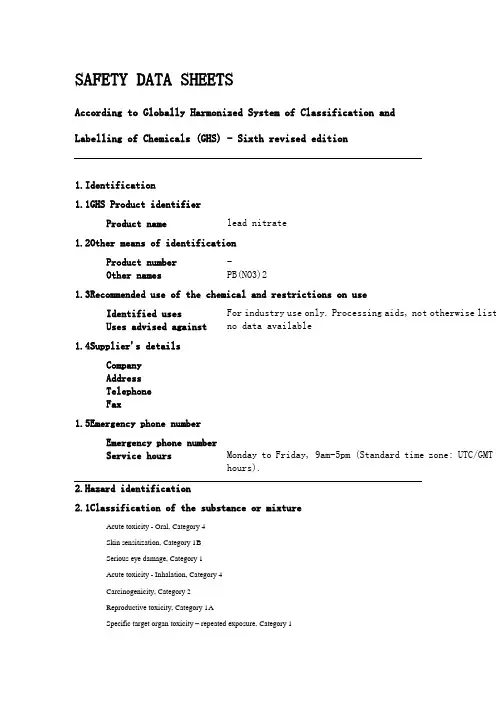
SAFETY DATA SHEETSAccording to Globally Harmonized System of Classification andLabelling of Chemicals (GHS) - Sixth revised edition1.Identification1.1GHS Product identifierProduct name lead nitrate1.2Other means of identificationProduct number-Other names PB(NO3)21.3Recommended use of the chemical and restrictions on useIdentified uses For industry use only. Processing aids, not otherwise list Uses advised against no data available1.4Supplier's detailsCompanyAddressTelephoneFax1.5Emergency phone numberEmergency phone numberService hours Monday to Friday, 9am-5pm (Standard time zone: UTC/GMThours).2.1Classification of the substance or mixtureAcute toxicity - Oral, Category 4Skin sensitization, Category 1BSerious eye damage, Category 1Acute toxicity - Inhalation, Category 4Carcinogenicity, Category 2Reproductive toxicity, Category 1ASpecific target organ toxicity – repeated exposure, Category 1Hazardous to the aquatic environment, short-term (Acute) - Category Acute 1Hazardous to the aquatic environment, long-term (Chronic) - Category Chronic 12.2GHS label elements, including precautionary statementsPictogram(s)Signal word DangerHazard statement(s)H302 Harmful if swallowedH317 May cause an allergic skin reactionH318 Causes serious eye damageH332 Harmful if inhaledH360 May damage fertility or the unborn childH372 Causes damage to organs through prolonged or repeatedexposureH400 Very toxic to aquatic lifeH410 Very toxic to aquatic life with long lasting effects Precautionarystatement(s)Prevention P264 Wash ... thoroughly after handling.P270 Do not eat, drink or smoke when using this product.P261 Avoid breathing dust/fume/gas/mist/vapours/spray.P272 Contaminated work clothing should not be allowed out of theworkplace.P280 Wear protective gloves/protective clothing/eyeprotection/face protection.P271 Use only outdoors or in a well-ventilated area.P201 Obtain special instructions before use.P202 Do not handle until all safety precautions have been read andunderstood.P260 Do not breathe dust/fume/gas/mist/vapours/spray.P273 Avoid release to the environment.Response P301+P312 IF SWALLOWED: Call a POISON CENTER/doctor/…if youfeel unwell.P330 Rinse mouth.P302+P352 IF ON SKIN: Wash with plenty of water/...P333+P313 If skin irritation or rash occurs: Get medicaladvice/attention.P321 Specific treatment (see ... on this label).P362+P364 Take off contaminated clothing and wash it before reuse.P305+P351+P338 IF IN EYES: Rinse cautiously with water for severalminutes. Remove contact lenses, if present and easy to do. Continuerinsing.P310 Immediately call a POISON CENTER/doctor/…P304+P340 IF INHALED: Remove person to fresh air and keepcomfortable for breathing.P312 Call a POISON CENTER/doctor/…if you feel unwell.P308+P313 IF exposed or concerned: Get medical advice/ attention.P314 Get medical advice/attention if you feel unwell.P391 Collect spillage.Storage P405 Store locked up.Disposal P501 Dispose of contents/container to ...2.3Other hazards which do not result in classificationnone3.1Substances4.1Description of necessary first-aid measuresGeneral adviceConsult a physician. Show this safety data sheet to the doctor in attendance.If inhaledFresh air, rest. Refer for medical attention.In case of skin contactRemove contaminated clothes. Rinse skin with plenty of water or shower.In case of eye contactFirst rinse with plenty of water for several minutes (remove contact lenses if easily possible),then refer for medical attention.If swallowedRinse mouth. Refer for medical attention . See Notes.4.2Most important symptoms/effects, acute and delayedEarly symptoms of lead intoxicatin via inhalation or ingestion are most commonlygastrointestinal disorders, colic, constipation, etc.; weakness, which may go on to paralysis,chiefly of the extensor muscles of the wrists and less often the ankles, is noticeable in the mostserious cases. Ingestion of a large amount causes local irritation of the alimentary tract; pain,leg cramps, muscle weakness, paresthesias, depression, coma, and death may follow in 1 or 2days. Contact with eyes causes irritation. (USCG, 1999)4.3Indication of immediate medical attention and special treatment needed, if necessaryImmediate first aid: Ensure that adequate decontamination has been carried out. If patient is notbreathing, start artificial respiration, preferably with a demand-valve resuscitator,bag-valve-mask device, or pocket mask, as trained. Perform CPR as necessary. Immediatelyflush contaminated eyes with gently flowing water. Do not induce vomiting. If vomiting occurs,lean patient forward or place on left side (head-down position, if possible) to maintain an openairway and prevent aspiration. Keep patient quiet and maintain normal body temperature.Obtain medical attention. /Nitrates, nitrites, and related compounds/5.1Extinguishing mediaSuitable extinguishing mediaEvacuation: If fire becomes uncontrollable - consider evacuation of one-half (1/2) mile radius.5.2Specific hazards arising from the chemicalSpecial Hazards of Combustion Products: Toxic oxides of nitrogen may form in fire. Behaviorin Fire: Increases the intensity of a fire when in contact with burning material. Use plenty ofwater to cool containers or spilled material. (USCG, 1999)5.3Special protective actions for fire-fightersWear self-contained breathing apparatus for firefighting if necessary.6.1Personal precautions, protective equipment and emergency proceduresUse personal protective equipment. Avoid dust formation. Avoid breathing vapours, mist or gas.Ensure adequate ventilation. Evacuate personnel to safe areas. Avoid breathing dust. Forpersonal protection see section 8.6.2Environmental precautionsPersonal protection: chemical protection suit including self-contained breathing apparatus. DoNOT let this chemical enter the environment. Sweep spilled substance into covered containers.If appropriate, moisten first to prevent dusting. Carefully collect remainder. Then store anddispose of according to local regulations. Do NOT absorb in saw-dust or other combustibleabsorbents.6.3Methods and materials for containment and cleaning upEvironmental considerations - Land spill: Dig a pit, pond, lagoon, holding area to contain liquidor solid material. /SRP: If time permits, pits, ponds, lagoons, soak holes, or holding areasshould be sealed with an impermeable flexible membrane liner./ Cover solids with a plasticsheet to prevent dissolving in rain or fire fighting water.7.1Precautions for safe handlingAvoid contact with skin and eyes. Avoid formation of dust and aerosols. Avoid exposure -obtain special instructions before use.Provide appropriate exhaust ventilation at places wheredust is formed. For precautions see section 2.2.7.2Conditions for safe storage, including any incompatibilitiesSeparated from combustible substances, reducing agents and food and feedstuffs.Stow awayfrom foodstuffs.8.1Control parametersOccupational Exposure limit valuesNIOSH considers "Lead" to mean metallic lead, lead oxides, and lead salts (including organicsalts such as lead soaps but excluding lead arsenate).Recommended Exposure Limit: 10 hr Time-Weighted Avg: 0.050 mg/cu m /Lead/Air concentrations should be maintained so that worker blood lead remains less than 0.06 mgPb/100 g of whole blood.Biological limit valuesno data available8.2Appropriate engineering controlsHandle in accordance with good industrial hygiene and safety practice. Wash hands beforebreaks and at the end of workday.8.3Individual protection measures, such as personal protective equipment (PPE)Eye/face protectionSafety glasses with side-shields conforming to EN166. Use equipment for eye protection testedand approved under appropriate government standards such as NIOSH (US) or EN 166(EU).Skin protectionWear impervious clothing. The type of protective equipment must be selected according to theconcentration and amount of the dangerous substance at the specific workplace. Handle withgloves. Gloves must be inspected prior to use. Use proper glove removal technique(withouttouching glove's outer surface) to avoid skin contact with this product. Dispose of contaminatedgloves after use in accordance with applicable laws and good laboratory practices. Wash anddry hands. The selected protective gloves have to satisfy the specifications of EU Directive89/686/EEC and the standard EN 374 derived from it.Respiratory protectionWear dust mask when handling large quantities.Thermal hazardsno data availablePhysical state white crystalsColour White or colorless translucent crystalsOdour no data available470ºCMelting point/ freezingpointBoiling point or initial83ºC at 760 mmHgboiling point and boilingrangeFlammability Not combustible but enhances combustion of othersubstances.no data availableLower and upper explosionlimit / flammabilitylimitFlash point no data availableno data availableAuto-ignitiontemperature290°CDecompositiontemperaturepH 3.0-4.0 (20% aq soln at 25°C)Kinematic viscosity no data availableSolubility In water:343 g/Lno data availablePartition coefficientn-octanol/water (logvalue)Vapour pressure49.8mmHg at 25°C4.53Density and/or relativedensityRelative vapour density no data availableParticle characteristics n o data available10.1Reactivityno data available10.2Chemical stabilityStable under recommended storage conditions.10.3Possibility of hazardous reactionsLead nitrate reacts with brilliant sparks when projected on red-hot carbon.Mixtures ofmetal/nonmetal nitrates with alkyl esters may explode because of the formation of alkyl nitrates;mixtures of nitrate with phosphorus, tin (II) chloride or other reducing agents may reactexplosively [Bretherick 1979. p. 108-109]. An explosion of guanidine nitrate demolished anautoclave built to withstand 50 atmospheres, in which it was being made from ammoniumthiocyanate and lead nitrate [C. Angew. Chem. 49:23. 1936].10.4Conditions to avoidno data available10.5Incompatible materialsIgnites or explodes when in presence of organic or easily oxidizable cmpd.10.6Hazardous decomposition productsWhen heated to decomp ... emits very toxic fumes of /lead and nitrogen oxides/.Acute toxicity•Oral: no data available•Inhalation: no data available•Dermal: no data availableSkin corrosion/irritationno data availableSerious eye damage/irritationno data availableRespiratory or skin sensitizationno data availableGerm cell mutagenicityno data availableCarcinogenicityNo evaluation could be made of the carcinogenicity of ... lead nitrate.Reproductive toxicityno data availableSTOT-single exposureno data availableSTOT-repeated exposureno data availableAspiration hazardno data available12.1Toxicity•Toxicity to fish: LC50; Species: Lepomis macrochirus (Bluegill, weight 5 g, length 7 cm (5-11 cm)); Conditions: freshwater, static, 20°C, dissolved oxygen >5 mg/L; Concentration: 6300 ug/L for 24 hr /chemically pure, total lead ion•Toxicity to daphnia and other aquatic invertebrates: EC50; Species: Daphnia magna (Water flea, age <24 hr 1st instar larvae); Conditions: freshwater, static, 23°C; Concentration: 1815 ug/L for48 hr (95% confidence interval: 1753-2003 ug/L); Effect: intoxication, immobilization /totallead ion•Toxicity to algae: no data available•Toxicity to microorganisms: no data available12.2Persistence and degradabilityno data available12.3Bioaccumulative potentialno data available12.4Mobility in soilno data available12.5Other adverse effectsno data available13.1Disposal methodsProductThe material can be disposed of by removal to a licensed chemical destruction plant or bycontrolled incineration with flue gas scrubbing. Do not contaminate water, foodstuffs, feed orseed by storage or disposal. Do not discharge to sewer systems.Contaminated packagingContainers can be triply rinsed (or equivalent) and offered for recycling or reconditioning.Alternatively, the packaging can be punctured to make it unusable for other purposes and thenbe disposed of in a sanitary landfill. Controlled incineration with flue gas scrubbing is possiblefor combustible packaging materials.14.1UN NumberADR/RID: UN1469IMDG: UN1469IATA: UN1469 14.2UN Proper Shipping NameADR/RID: LEAD NITRATEIMDG: LEAD NITRATEIATA: LEAD NITRATE14.3Transport hazard class(es)ADR/RID: 5.1IMDG: 5.1IATA: 5.1 14.4Packing group, if applicableADR/RID: II IMDG: II IATA: II 14.5Environmental hazardsADR/RID: yes IMDG: yes IATA: yes 14.6Special precautions for userno data available14.7Transport in bulk according to Annex II of MARPOL 73/78 andthe IBC Codeno data available15.1Safety, health and environmental regulations specific for theproduct in questionInformation on revisionCreation Date Aug 12, 2017Revision Date Aug 12, 2017Abbreviations and acronyms•CAS: Chemical Abstracts Service•ADR: European Agreement concerning the International Carriage of Dangerous Goods by Road •RID: Regulation concerning the International Carriage of Dangerous Goods by Rail •IMDG: International Maritime Dangerous Goods•IATA: International Air Transportation Association•TWA: Time Weighted Average•STEL: Short term exposure limit•LC50: Lethal Concentration 50%•LD50: Lethal Dose 50%•EC50: Effective Concentration 50%Disclaimer: The above information is believed to be correct but does not purport to be all inclusive and shall be used only as a guide. The information in this document is based on the present state of our knowledge and is applicable to the product with regard to appropriate safety precautions. It does not represent any guarantee of the properties of the product. We as supplier shall not be held liable for any damage resulting from handling or from contact with the above product.。
硝酸铅安全技术说明书MSDS

第一部分化学品及企业标识化学品中文名:硝酸铅化学品英文名:lead nitrate化学品别名:-CAS No.:10099-74-8EC No.:233-245-9分子式:Pb(NO3)2第二部分危险性概述| 紧急情况概述固体。
跟可燃物质接触可能会引起火灾。
对皮肤有刺激性。
对眼睛有严重刺激性。
可能有发生不可逆性作用的危险。
短期暴露有严重损伤健康的危险。
长期暴露有严重损伤健康的危险。
对水生物有剧毒, 使用适当的容器, 以预防污染环境。
对水生环境可能会引起长期有害作用。
使用适当的容器, 以预防污染环境。
| GHS 危险性类别根据《危险化学品分类信息表》(2015)危险性类别判定,该产品分类如下:氧化性固体,类别2;皮肤腐蚀/刺激,类别2;眼损伤/眼刺激,类别2A;生殖细胞致突变性,类别2;致癌性,类别1B;生殖毒性,类别1A;特定目标器官毒性-单次接触,类别1;特定目标器官毒性-重复接触,类别1;危害水生环境-急性毒性,类别1;危害水生环境-慢性毒性,类别1。
| 标签要素象形图警示词:危险危险信息:可能加剧燃烧;氧化剂,造成皮肤刺激,造成严重眼刺激,怀疑会导致遗传性缺陷,可能致癌,可能对生育能力或胎儿造成伤害,对器官造成损害,长期或重复接触会对器官造成伤害,对水生生物毒性极大,对水生生物毒性极大并具有长期持续影响。
防范说明预防措施:使用前取得专业说明。
在阅读并明了所有安全措施前切勿搬动。
远离热源、热表面、火花、明火以及其它点火源。
禁止吸烟。
远离服装和其他可燃材料。
不要吸入粉尘/烟/气体/烟雾/蒸气/喷雾。
作业后彻底清洗。
使用本产品时不要进食、饮水或吸烟。
避免释放到环境中。
戴防护手套/穿防护服/戴防护眼罩/戴防护面具。
事故响应:如感觉不适,须求医/就诊。
收集溢出物。
如接触到或有疑虑:求医/就诊。
如发生皮肤刺激:求医/就诊。
如仍觉眼刺激:求医/就诊。
脱去被污染的衣服,清洗后方可重新使用。
如进入眼睛:用水小心冲洗几分钟。
硝酸铅相对分子质量

硝酸铅相对分子质量
硝酸铅是一种无机化合物,其化学式为Pb(NO3)2。
它是一种白色固体,在水中易溶解。
硝酸铅的相对分子质量为331.2 g/mol。
相对分子质量是一个化合物的摩尔质量除以一个摩尔的质量。
在硝酸铅的情况下,它的相对分子质量计算公式为:
相对分子质量= 1个铅原子的原子量 + 2个硝酸根离子的原子量铅原子的原子量为207.2 g/mol,硝酸根离子的原子量为62
g/mol。
所以,硝酸铅的相对分子质量为:
相对分子质量 = 207.2 g/mol + 2(62 g/mol)
= 331.2 g/mol
硝酸铅在许多工业和实验室应用中被用作催化剂、染料、玻璃着色剂和火药的成分。
然而,它也是一种有毒物质,需要小心处理和储存。
- 1 -。
硝酸铅(MSDS)化学品安全技术说明书
硝酸铅(MSDS)化学品安全技术说明书第一部分化学品名称化学品中文名称:硝酸铅化学品英文名称:lead nitrate中文别名:英文别名:技术说明书编码:第二部分成分/组成信息有害物成分含量 CAS No.硝酸铅 10099-74-8第三部分危险性概述危险性类别:侵入途径:健康危害:铅及其化合物损害造血、神经、消化系统及肾脏损害。
职业中毒主要为慢性。
神经系统主要表现为神经衰弱综合征、周围神经病(以运动功能受累较明显),重者出现铅中毒性脑病。
消化系统表现有齿龈铅线、食欲不振、恶心、腹胀、腹泻或便秘;腹绞痛见于中度及重度中毒病例。
造血系统损害出现卟啉代谢障碍、贫血等。
短时大量接触可发生急性或亚急性中毒,表现类似重症慢性铅中毒。
对肾脏损害多见于急性亚急性中毒或较重慢性病例。
环境危害:燃爆危险:第四部分急救措施皮肤接触:脱去污染的衣着,用肥皂水和清水彻底冲洗皮肤。
眼睛接触:提起眼睑,用流动清水或生理盐水冲洗。
就医。
吸入:迅速脱离现场至空气新鲜处。
保持呼吸道通畅。
如呼吸困难,给输氧。
如呼吸停止,立即进行人工呼吸。
就医。
食入:饮足量温水,催吐。
就医。
第五部分消防措施危险特性:无机氧化剂。
遇易氧化物立即猛烈反应,着火爆炸。
与还原剂、有机物、易燃物如硫、磷或金属粉末等混合可形成爆炸性混合物。
受高热分解,产生有毒的氮氧化物。
有害燃烧产物:灭火方法:消防人员须佩戴防毒面具、穿全身消防服,在上风向灭火。
雾状水、砂土。
切勿将水流直接射至熔融物,以免引起严重的流淌火灾或引起剧烈的沸溅。
灭火注意事项及措施:第六部分泄漏应急处理应急处理:隔离泄漏污染区,限制出入。
建议应急处理人员戴防尘面具(全面罩),穿- 1 -防毒服。
不要直接接触泄漏物。
勿使泄漏物与还原剂、有机物、易燃物或金属粉末接触。
小量泄漏:用洁净的铲子收集于干燥、洁净、有盖的容器中。
大量泄漏:收集回收或运至废物处理场所处置。
第七部分操作处置与储存操作注意事项:储存注意事项:储存于阴凉、通风的库房。
危化品MSDS-硝酸铅
硝酸铅1. 化学品及企业标识化学品中文名称:硝酸铅化学品英文名称:lead nitrate中文名称 2:氯化高汞;二氯化汞;升汞英文名称 2:plumbous nitrate主要用途:用于铅盐、媒染剂、烟花等的制造。
2. 危险性概述2.1 危险性类别:氧化剂、有毒品、易制爆2.2 侵入途径:吸入、食入。
2.3 健康危害:铅及其化合物损害造血、神经、消化系统及肾脏损害。
职业中毒主要为慢性。
2.4 环境危害:对环境有害。
2.5 燃爆危险:助燃。
与可燃物混合能形成爆炸性混合物。
3. 成分/组成信息纯品■混合物□主要成分 CAS RN 含量(%)硝酸铅 10099-74-8 99.04. 急救措施4.1 皮肤接触:脱去污染的衣着,用肥皂水和清水彻底冲洗皮肤。
如有不适感,就医。
4.2 眼睛接触:提起眼睑,用流动清水或生理盐水冲洗。
如有不适感,就医。
4.3 吸入:迅速脱离现场至空气新鲜处。
保持呼吸道通畅。
如呼吸困难,给输氧。
呼吸、心跳停止,立即进行心肺复苏术。
就医。
4.4 食入:饮足量温水,催吐。
就医。
4.5 急性和迟发效应,主要症状:神经系统主要表现为神经衰弱综合征、周围神经病(以运动功能受累较明显),重者出现铅中毒性脑病。
消化系统表现有齿龈铅线、食欲不振、恶心、腹胀、腹泻或便秘;腹绞痛见于中度及重度中毒病例。
造血系统损害出现卟啉代谢障碍、贫血等。
短时大量接触可发生急性或亚急性中毒,表现类似重症慢性铅中毒。
对肾脏损害多见于急性亚急性中毒或较重慢性病例。
5. 消防措施5.1 危险特性:无机氧化剂。
遇易氧化物质立即猛烈反应,着火爆炸。
与还原剂、有机物、易燃物如硫、磷或金属粉末等混合可形成爆炸性混合物。
受高热分解,产生有毒的氮氧化物。
5.2 有害燃烧产物:无意义。
5.3 灭火方法:本品不燃。
根据着火原因选择适当灭火剂灭火。
5.4 灭火注意事项及措施:消防人员必须佩戴空气呼吸器、穿全身防火防毒服,在上风向灭火。
尽可能将容器从火场移至空旷处。
危化品MSDS-硝酸铅
硝酸铅1. 化学品及企业标识化学品中文名称:硝酸铅化学品英文名称:lead nitrate中文名称2:氯化高汞;二氯化汞;升汞英文名称2:plumbous nitrate主要用途:用于铅盐、媒染剂、烟花等的制造。
2. 危险性概述2.1 危险性类别:氧化剂、有毒品、易制爆2.2 侵入途径:吸入、食入。
2.3 健康危害:铅及其化合物损害造血、神经、消化系统及肾脏损害。
职业中毒主要为慢性。
2.4 环境危害:对环境有害。
2.5 燃爆危险:助燃。
与可燃物混合能形成爆炸性混合物。
3. 成分/组成信息纯品■混合物□主要成分CAS RN 含量(%)硝酸铅10099-74-8 99.04. 急救措施4.1 皮肤接触:脱去污染的衣着,用肥皂水和清水彻底冲洗皮肤。
如有不适感,就医。
4.2 眼睛接触:提起眼睑,用流动清水或生理盐水冲洗。
如有不适感,就医。
4.3 吸入:迅速脱离现场至空气新鲜处。
保持呼吸道通畅。
如呼吸困难,给输氧。
呼吸、心跳停止,立即进行心肺复苏术。
就医。
4.4 食入:饮足量温水,催吐。
就医。
4.5 急性和迟发效应,主要症状:神经系统主要表现为神经衰弱综合征、周围神经病(以运动功能受累较明显),重者出现铅中毒性脑病。
消化系统表现有齿龈铅线、食欲不振、恶心、腹胀、腹泻或便秘;腹绞痛见于中度及重度中毒病例。
造血系统损害出现卟啉代谢障碍、贫血等。
短时大量接触可发生急性或亚急性中毒,表现类似重症慢性铅中毒。
对肾脏损害多见于急性亚急性中毒或较重慢性病例。
5. 消防措施5.1 危险特性:无机氧化剂。
遇易氧化物质立即猛烈反应,着火爆炸。
与还原剂、有机物、易燃物如硫、磷或金属粉末等混合可形成爆炸性混合物。
受高热分解,产生有毒的氮氧化物。
5.2 有害燃烧产物:无意义。
5.3 灭火方法:本品不燃。
根据着火原因选择适当灭火剂灭火。
5.4 灭火注意事项及措施:消防人员必须佩戴空气呼吸器、穿全身防火防毒服,在上风向灭火。
尽可能将容器从火场移至空旷处。
硝酸铅-职业病危害告知牌
职业病危害告知牌对人体有损害,请注意防护!
硝酸铅lead nitrate
健康危害理化特性
铅及其化合物损害造血、神经、消化系统及肾脏
损害。
职业中毒主要为慢性。
神经系统主要表现
为神经衰弱综合征、周围神经病(以运动功能受
累较明显),重者出现铅中毒性脑病。
消化系统
表现有齿龈铅线、食欲不振、恶心、腹胀、腹泻
或便秘;腹绞痛见于中度及重度中毒病例。
白色立方或单斜晶体,硬而发亮。
易溶于水、
液氨,微溶于乙醇。
熔点470(分解)℃。
职业接触限值:MAC:无资料
PC-TWA:无资料
PC-STEL:无资料
应急处理
皮肤接触:脱去污染的衣着,用肥皂水和清水彻底冲洗皮肤。
眼睛接触:提起眼睑,用流动清水或生理盐水冲洗。
就医。
吸入:迅速脱离现场至空气新鲜处。
保持呼吸道通畅。
如呼吸困难,给输氧。
如呼吸停止,立即进行人工呼吸。
就医。
食入:饮足量温水,催吐。
就医。
密闭操作,全面通风。
操作人员必须经过专门培训,严格遵守操作规程。
建议操作人员佩戴直接式防毒面具,戴化学安全防护眼镜,穿防腐工作服,戴橡胶手套。
防止蒸气泄漏到工作场所空气中。
避免与酸类接触。
搬运时要轻装轻卸,防止包装及容器损坏。
急救电话:120 消防电话:119 职业卫生咨询电话:1031。