
人教版七年级上册英语各单元知识点讲解
人教版七年级上册英语各单元知识点讲解Starter Unit 1 Good morning.1. Good morning/afternoon/evening. 早上(上午)/下午/晚上好。
答语相同。
在熟人或家人之间可省略good。
熟人之间的问候可加上称呼语,称呼语放在问候语之后且用逗号隔开。
如:Good morning , class!同学们,早上好!△Good night!晚安(晚间告别用语)2. Hello, Frank! 你好,弗兰克。
3. A: How are you? 你(身体)好吗?B: (I’m) fine/Very well/I’m OK, Thank you./thanks. How are you? / And you? 我很好,谢谢。
你呢?A: (I’m)fine/OK, too. 我也很好。
4. thanks = thank you 谢谢5. HB(铅笔芯)硬黑CD光盘BBC英国广播公司Starter Unit 2 What’s this in English?1. What’s this/that? 这/那是什么?It’s a/an + 单数物品(△不说This/That is...)1) What’s this/that? 这/那是什么?2) What’s this/that? 这/那是什么?It’s a ruler. (这/那是)直尺。
It’s an apple. (这/那是)苹果。
2. What’s this/that in English? 这/那用英语怎么说?It’s a/an + 单数物品(△不说This/That is...)What’s this in English? 这用英语怎么说?It’s a jacket. 夹克衫What’s that in English? 那用英语怎么说?It’s an orange. 橘子。
in + 语言:用某种语言in Chinese/English/Japanese用汉/英/日语英语中还可用What’s the English for….?表达同样的含义。
What’s the English for直尺?直尺用英语怎么说?It’s a ruler.是ruler3. a 和an是不定冠词,只用在可数名词单数前面,表示“一”。
a用在以辅音音素开头的单词前;an用在以元音音素开头的单词前。
这里的元音音素和辅音音素是指读音,而不是指字母。
如:a pen /pen/ 一支钢笔(/p/为辅音音素)an orange /’ ɒrindʒ / 一个桔子(/ɒ /为元音音素)4. P停车场;停车位NBA(美国)全国篮球协会kg千克;公斤5. Spell it, please. = Please spell it. 请拼读它。
K – E - Y.Spell “pen”, please. = Please spell pen. 请拼读“pen”。
P – E - N.注:please置于句末时,前面要加逗号。
Starter Unit 3 What color is it?1. What’s this/that? 这/那是什么?It’s V. 这是V。
V是字母,是专有名词,前面不必加冠词,但表示某一类东西,则在其单数名词前加a或an。
1) What’s this/that? 这/那是什么?2) What’s this/that? 这/那是什么?It’s a ruler. (这/那是)直尺。
It’s an apple. (这/那是)苹果。
2. 问颜色:What color1) What color is + 单数名词?2) What color are + 复数名词?It’s /It is + 颜色. They’re/They are + 颜色.如1) What color is the key?(这把)钥匙是什么颜色的?It’s (It is)yellow. (它是)黄色的。
2) What color are the keys? 这些钥匙是什么颜色的?They’re (They are) red.. (它们)是红色的。
3. color 1) n.颜色2) v. 给......着色,把......染成某种颜色color sth + 颜色:把某物涂成……颜色Color the pencil red. 把铅笔涂成红色。
4. It’s black and white. 它是黑白色的。
5. S 小号的M 中号的L 大号的UFO 不明飞行物CCTV 中国中央电视台UN 联合国6. The key is yellow. 钥匙是黄色的。
The是定冠词,表示“这(个),那(个),这些,那些”,在元音音素前读/ ði: /,在辅音音素前读/ ð ə /。
它可以用在名词前,表示特指说话双方都知道的人或物,或上文提到的人或物。
1) The book on the desk is mine. 桌子上的书是我的。
(特指)2) Where is the teacher? 老师在哪?(双方都知道)3) He has a pen, the pen is black. 他有支钢笔,钢笔是黑色的。
(指上文提到的事物)Unit 1 My name’s Gina.1. 介绍自己:My name’s+名字我的名字叫....../ I’m+名字我是......2.询问姓名1)What’s your name? 你叫什么名字?Alan艾伦/ My name’s Alan我的名字叫艾伦/ I’m Alan 我叫艾伦What’s = What is name’s = name is I’m = I am2)What’s his name? 他叫什么名字?His name’s Eric 他的名字叫埃里克。
/ He’s Eric . 他叫埃里克。
( He’s = He is )3)What’s her name?她叫什么名字?Her name’s Mary. 她的名字叫玛丽。
/ She’s Mary. 她叫玛丽。
( She’s = She is )3. Nice to meet you. 见到你很高兴。
(初次见面用语。
)回答Nice to meet you. 或Nice to meet you, too.4. How do you do? 你好!回答:How do you do? 你好!5. Mr ,Mrs ,Miss 和MsMr ['mistə(r)] 先生Miss [mis] 小姐,女士;(年轻未婚女子)Mrs ['misiz] 太太;夫人(用于已婚妇女姓名前)Ms. [miz] 女士1)Mr意为"先生",一般用于男子姓氏或职务前;不管年龄大小;辈分长幼;职务高低;结婚与否,男子都可称为Mr;要注意的是,英美人的姓在名字后面,中国人的姓在名字前面;如果一个英国男子叫John Brown,就称他为Mr Brown,但不能称其为Mr John;如果一个中国男子叫刘诚,就称他为Mr Liu,不能称Mr Cheng;如果一个男子的职务是校长,就可以称他为Mr Headmaster (校长先生);对不相识的男子或上级;长辈或从事某种职务的男子表示尊称时,英;美人通常用sir,意为"先生;阁下;长官",后面不跟姓氏;如:—May I go now,sir?(先生,我可以走了吗?)—Yes,sir.(可以,先生;)电视对话里还可以听到Ma sir,Lin sir 等通俗说法;sir还广泛用于各类信件中,如:Dear sir,My dear sir,Dear sirs,Sirs;2)Mrs意为"夫人,太太",常用于已婚妇女的丈夫的姓氏前;如果一个名叫Mary Jones的女子嫁给了一个名叫Jack White的男子,就称她为Mrs White,但不能称Mrs Jones;一个叫李敏的女子嫁给了一个叫刘俊的男子,就称这个妇女为Mrs Liu,但不能称Mrs Li;3)Miss意为"小姐",复数形式为Misses,用于对未婚女子的称呼;如果一个未婚女子名叫Rose Jones,可以称她为Miss Jones,也可以称她为Miss Rose Jones(罗斯•琼斯小姐);一个中国未婚女子叫李芳,就称她为Miss Li或Miss Li Fang;如果Mr Green家有几位未婚姑娘,可以称她们为the Miss Greens或the Misses Green(格林家的小姐们);Miss还可以单独用于对一般年轻女性的尊称,包括学生对女教师的称呼;如:Good morning,Miss!(老师,早上好!)Just a moment,Miss.(请稍等,小姐;)4)Ms指婚姻状况不明或没必要说出其婚姻状况的“女士”。
如:I'm not Mr King,I'm Ms King.(我不是金先生,我是金女士;)6. Is he Jack? 他是杰克吗?Yes, he is. 是的,他是。
No, he isn’t. His name’s Mike. 不,他不是。
他的名字叫迈克。
7. Are you Helen? 你是海伦吗?Yes, I am.是的,我是。
/ No, I’m not. I’m Gina. 不,我不是。
我是吉娜。
8.英美人的姓名与中国人的姓名顺序相反,名在前,姓在后。
如Jim Green, 名是Jim,姓是Green。
△名字:first name(第一个名字)或given name 姓氏:last name(最后的名字)或family name(家族的名字)全名:full name9. 问电话号码:What’s your/his/her telephone number?It’s + 号码.电话号码的读法:用基数词按顺序读出。
“0”可读Oo或zero.10. is/am/are的用法:I用am, you用are. 1) I am 14, how old are you? 我14岁,你多大了?is连着他/她/它2) He/She is a student.他/她是个学生。
What color is it? 单数用is,复数用are. 3) The key is yellow. 钥匙是黄色的。
4)He and I are students. 他和我都是学生。
11. ID card 身份证12. Three and five is eight. 三加五等于八。
What’s nine and seven? 九加七等于几?Unit 2 This is my sister.1. parent: father or mother 父亲或母亲parents: father and mother父母(双)亲2. 介绍他人1) This / That is...这/那位是......2)These / Those are...这/那些是......This is my friend Jane.这(位)是我的朋友简That is my grandfather. 那(位)是我的祖父。
新版人教版七年级英语上册各单元知识点
新版人教版七年级英语上册各单元知识点Unit 1 introduces greetings and self-introduction, focusing on asking names, ages, and countries. Key phrases include "Hello, I am..." and "What is your name?" Vocabulary features common nouns related to personal information.Unit 2 emphasizes family members and relationships. Words like "father," "mother," "brother," and "sister" are central. Students practice describing their families and using possessive forms.Unit 3 covers hobbies and interests. It introduces verbs related to activities such as "play," "read," and "watch." Sentences like "I like to..." help express preferences.Unit 4 focuses on school subjects and schedules. Vocabulary includes subjects like "Math," "English," and "science." Students learn to talk about their favorite subjects and daily routines using time expressions.Unit 5 discusses food and drinks. Common vocabulary includes "fruit," "vegetables," "water," and "juice." Expressions for ordering and asking about preferences are practiced.Unit 6 covers clothing and shopping. Words related totypes of clothing, colors, and shopping phrases such as "How much is this?" are practiced.Unit 7 highlights daily activities. Verbs like "get up," "go to school," and "do homework" describe routines. Students learn to use the present simple tense.Unit 8 focuses on weather and seasons. Vocabularyincludes terms like "sunny," "rainy," and "cold." Describing the weather and discussing seasonal activities are key skills.。
人教版七年级英语上册各单元知识点
人教版七年级英语上册各单元知识点一、Unit 1 My school在这一单元中,主要涵盖了关于学校的相关词汇和日常用语,如school, classroom, library, canteen,等等。
同时也包括了一些常见的动词和形容词,比如learn, teach, big, small等。
通过这些词汇的学习,学生不仅能够认识、理解学校及其周边环境的相关用语,还能够初步表达和描述一些学校生活中的情景和感受。
二、Unit 2 My day这一单元主要是关于日常生活中的时间和活动安排。
学生将会学到一些有关时间的基本词汇,比如morning, afternoon, evening,还有一些与日常活动相关的动词,比如get up, have breakfast, go to school等。
这些词汇的掌握能够让学生能够描述自己的日常作息安排和活动情况,提高自己的口语表达能力。
三、Unit 3 My friends这一单元主要是关于介绍朋友和人物的描述。
学生将学到一些有关人物外貌和性格的词汇,比如tall, short, young, old, kind, friendly等。
通过学习这些词汇和句型,学生能够更好地描述自己和他人,增强自己的语言表达能力。
四、Unit 4 My family在这一单元中,学生将会学习有关家庭成员的词汇和描述。
比如father, mother, brother, sister,还有一些家庭活动的动词,比如cook, clean, play等。
这些词汇和句型的学习能够让学生更好地表达自己家庭成员的情况,加深对家庭生活的理解。
五、Unit 5 My clothes这一单元主要是关于服装和颜色的表达。
学生将会学习有关衣物和颜色的词汇,比如shirt, dress, red, blue等。
通过学习这些词汇,学生不仅能够打开服装的表达方式,还能够更好地适应不同场合的着装和色彩搭配。
六、Unit 6 My room这一单元主要是关于家居环境和房间布置。
人教版七年级英语上册各单元知识点汇总归纳
人教版七年级英语上册各单元知识点汇总归纳Unit 1: Greetings- Greetings and introductions- Personal information (name, age, nationality)- Asking and answering questions about someone's name, age, and nationality Unit 2: School Life- School facilities and subjects- Classroom objects- School rules and routines- Expressing likes and dislikes- Talking about one's daily school lifeUnit 3: Hobbies- Hobbies and leisure activities- Expressing preferences- Talking about frequency of activities- Asking and answering questions about hobbiesUnit 4: Food and Drinks- Food and drinks vocabulary- Expressing likes and dislikes for food and drinks- Ordering food and drinks- Talking about meals and snacks- Talking about healthy and unhealthy foodUnit 5: Family and Friends- Family members and relationships- Describing family members- Talking about family activities- Describing friends- Talking about friendship- Discussing family and friends using possessive adjectives Unit 6: Animals- Animal vocabulary- Describing animals- Talking about pets and pet care- Talking about animal characteristics and behavior- Discussing animal conservationUnit 7: Numbers- Numbers 0-1000- Counting objects- Talking about prices and money- Telling time- Expressing ageUnit 8: Colors and Shapes- Colors and shapes vocabulary- Describing objects based on colors and shapes- Talking about preferences for colors and shapes- Describing objects based on their sizes and quantities Unit 9: Clothes- Clothing vocabulary- Describing clothes- Talking about clothes for different occasions- Discussing preferences for clothing styles and colors - Talking about shopping for clothes。
人教版七年级英语上册各单元知识点汇总
⼈教版七年级英语上册各单元知识点汇总⼈教版七上各单元知识点汇总(交际⽤语、基础知识、语法等)交际⽤语:1.打招呼⽤语:-Good morning, Eric!(早上好!) -Good morning, Dale!-Good afternoon, Helen!(下午好!)-Good afternoon, Cindy!-Good evening, Alice!(晚上好!)-Good evening, Bob!-Hi/Hello/Hey!喂-Hi/Hello/Hey!喂2. 问候:-How are you ?(你好吗?)-I’m fine/OK/well, thank you/thanks . 我很好,谢谢And you?(=How are you ?)你呢?-I’m OK.我很好。
-How do you do ?(你好!) -How do you do?(你好!)3.询问物体名字:-What’s this in English?这个⽤英语怎么说?-It’s a map/ a ruler/a pen/ a quilt/a key/ an orange/ an apple/an eraser.(回答What’s⽤It’s)注意:an⽤于元⾳⾳素开头的单词前;a⽤于辅⾳⾳素开头的单词前。
第⼀次提及⽤,再次提及⽤the-What’s this/that in English? -It’s a jacket.-Spell it, please.=How do you spell it?(怎样拼写….) -J-A-C-K-E-T.4. 询问物体颜⾊:-What color is it?(问颜⾊⽤What color)- It’s red/ yellow/ green/ blue/ black/ white.(颜⾊前⽆冠词a/an/the)五个元⾳字母:Aa Ee Ii Oo Uu字母读⾳归类:Aa Hh Jj KkBb Cc Dd Ee Gg Pp Tt Vv (Zz)Ff Ll Mm Nn Ss Xx (Zz)Ii YyOoQq Uu WwRrUnit 11.询问⼈名:-What’s your name? -My name is Alan.=I’m Alan.-What’s her name ? -Her name is Mary.=She is Mary.-What’s his name? -His name is Peter.=He is Peter.总结:询问别⼈名字⽤:What’s ……name?名词前要⽤形容词性物主代词2.- Nice to meet you !(见到你很⾼兴)-Nice to meet you, too !(见到你也很⾼兴)3.你是某某吗?-Are you..? –Yes, I am. / No, I’m not.他/她是某某吗?-Is he/ she ...? –Yes, he/she is. / No, he/she isn’t.4. 总结:be(am/ is /are)的⽤法(⼀)基本⽤法:我⽤am,I am. 你⽤are,you are. is跟着he/she/it. this/that ⽤is. these/those/they⽤are单数名词⽤is 复数名词要are1.-I ____ Linda. _____ you Bob? –Yes, I ______.2.This _____ my friend. His name_____ Tom. His telephone number_____ 486-123.3.It _____ a black pen.4.Bob and Mike ____ in China.5.-What color _____ his quilt? –It _____ red.6.He and I______ friends.(⼆)陈述句变⼀般疑问句:变⼀般,be (am/ is /are)往前提Eg. (1)I am Linda.(2)He is Jack.(3)Her name is Rose.(4)This is a blue pen.(三)陈述句变否定句:变否定在be (am/ is /are)后加not.即:am not, is not =isn’t, are not=aren’teg.1.I’m Mike.2.She is Lucy.3.His name’s Bob.4.That is a ruler.5.They are Mike and Bob.(四)对划线部分提问:划线提问的是特殊疑问句=疑问词+⼀般疑问句。
人教版七年级英语上册unit 4 句子讲解及知识点梳理
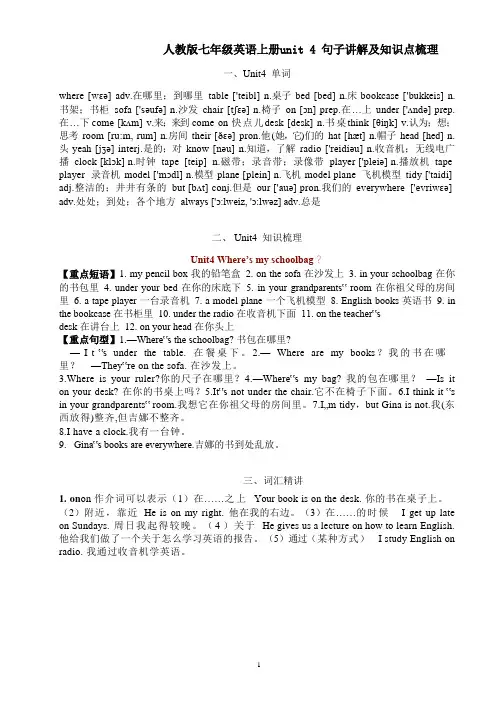
人教版七年级英语上册unit 4 句子讲解及知识点梳理一、Unit4 单词where [wɛə] adv.在哪里;到哪里table ['teibl] n.桌子bed [bed] n.床bookcase ['bukkeis] n. 书架;书柜sofa ['səufə] n.沙发chair [tʃɛə] n.椅子on [ɔn] prep.在…上under ['ʌndə] prep. 在…下come [kʌm] v.来;来到come on 快点儿desk [desk] n.书桌think [θiŋk] v.认为;想;思考room [ru:m, rum] n.房间their [ðɛə] pron.他(她,它)们的hat [hæt] n.帽子head [hed] n. 头yeah [jʒə] interj.是的;对know [nəu] n.知道,了解radio ['reidiəu] n.收音机;无线电广播clock [klɔk] n.时钟tape [teip] n.磁带;录音带;录像带player ['pleiə] n.播放机tape player 录音机model ['mɔdl] n.模型plane [plein] n.飞机model plane 飞机模型tidy ['taidi] adj.整洁的;井井有条的but [bʌt] conj.但是our ['auə] pron.我们的everywhere ['evriwɛə] adv.处处;到处;各个地方always ['ɔ:lweiz, 'ɔ:lwəz] adv.总是二、 Unit4 知识梳理Unit4 Where’s my schoolbag?【重点短语】1. my pencil box 我的铅笔盒 2. on the sofa 在沙发上 3. in your schoolbag 在你的书包里4. under your bed 在你的床底下 5. in your grandparents‟ room 在你祖父母的房间里 6. a tape player 一台录音机7. a model plane 一个飞机模型8. English books 英语书9. in the bookcase 在书柜里10. under the radio 在收音机下面11. on the teacher‟sdesk 在讲台上12. on your head 在你头上【重点句型】1.—Where‟s the schoolbag? 书包在哪里?—I t ‟s under the table. 在餐桌下。
人教版英语各单元知识点汇总
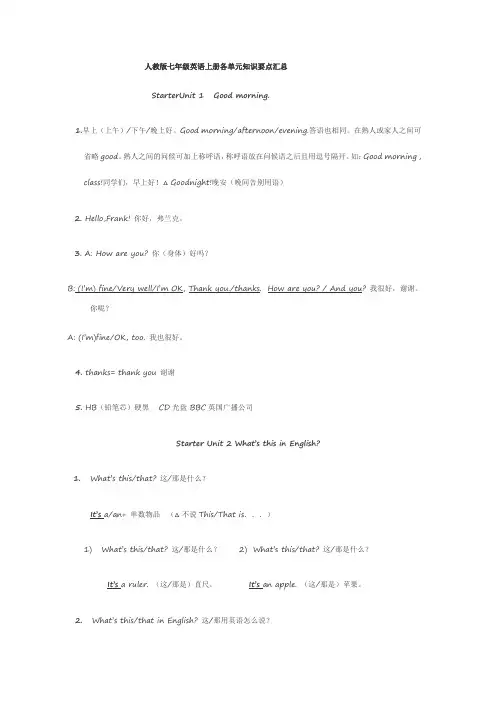
人教版七年级英语上册各单元知识要点汇总StarterUnit 1 Good morning.1.早上(上午)/下午/晚上好。
Goodmorning/afternoon/evening.答语也相同。
在熟人或家人之间可省略good。
熟人之间的问候可加上称呼语,称呼语放在问候语之后且用逗号隔开。
如:Goodmorning , class!同学们,早上好!△Goodnight!晚安(晚间告别用语)2. Hello,Frank! 你好,弗兰克。
3. A: How are you? 你(身体)好吗?B: (I‘m) fine/Very well/I‘m OK, Thank you./thanks. How areyou? / And you? 我很好,谢谢。
你呢?A: (I‘m)fine/OK, too. 我也很好。
4. thanks= thank you 谢谢5. HB(铅笔芯)硬黑CD光盘 BBC英国广播公司Starter Unit 2 What’s this inEnglish?1.What‘s this/that? 这/那是什么?It’s a/an+ 单数物品(△不说This/That is...)1) What‘s this/that? 这/那是什么?2) What‘s this/that? 这/那是什么?It’s aruler. (这/那是)直尺。
It’s an apple. (这/那是)苹果。
2.What‘s this/that in English? 这/那用英语怎么说?It’s a/an + 单数物品(△不说This/That is...)What‘sthis in English? 这用英语怎么说?It‘sa jacket. 夹克衫What‘sthat in English? 那用英语怎么说?It‘san orange. 橘子。
in + 语言:用某种语言 in Chinese/English/Japanese用汉/英/日语英语中还可用What‘s the English for….?表达同样的含义。
人教版英语七年级上册所有单元知识点总结
七年級各單元知識點匯總Unit1 My name’s Gina.重點短語1.your/his/her/my name 你の/他の/她の/我の名詞2.first name 名字3.middle school 中學4.telephone number 電話號碼st name 姓6.in China 在中國重點句型1.—What’s your name? 你叫什麼名字?—Alan 艾倫2.—I’m Jenny. Nice to meet you. 我是珍妮。
見到你很高興。
—Nice to meet you, too.見到你我也很高興。
3.—Good morning! I’m Cindy. 早上好!我是辛迪。
—Hello, Cindy! I’m Dale.你好,辛迪!我是戴爾。
4.—My name’s Linda. Are you Helen? 我是琳達。
你是海倫嗎?5.—What’s her name? 她叫什麼名字?—She’s Jane. 她是簡。
6.—Is he Jack? 他是傑克嗎?—No, he isn’t. His name’s Mike.不,他不是。
他の名字是邁克。
7.What’s your phone number?你の電話號碼是多少?It’s 587-6275. 它是587-6275。
8.My friend is in China.我の朋友在中國。
重點語法1.2.Be動詞の一般現在時形式:am, is, areI用am You 用areIs 用於他他它Unit2 This is my sister.重點短語1.family name 全家福2.have a good day (表示祝願)過得愉快!3. a picture of 一張……の照片4.in the first phone 在第一張照片裏5.family tree 家庭關係圖6.the name of…………の名字重點句型1.That’s my family. Those are my parents. 那是我の家人,那是我の妹妹。
人教版初中英语新教材七年级上starterUnit1知识点归纳总结(复习必背)
Starter Unit 1 Hello! (知识讲解)单元主题人与社会→社会服务与人际沟通→良好的人际关系与人际交往必备单词Section A1.unit/'ju:nɪt/n.单元2.section/'sekʃn/n.部分;地区3.greet/gri:t/v.招呼;问候4.each/i:tʃ/adj.&pron.每个;各自5.other/'ʌðə(r)/pron.另外的人(或物)adj.另外的;其他的6.oh/əu/interj.哦;啊7.everyone/'evriwʌn/pron.每人;所有人Section B1.start/sta:t/v.开始;着手2.conversation/,kɒnvə'seɪʃn/n.谈话;交谈3.spell/spel/v。
用字母拼,拼写4.bell/bel/n.铃(声);钟(声)高频短语1.starter unit过渡单元2.greet your classmates 问候你的同学3.each other互相;彼此4.go to class 去上课常考句型1.问候语:(1)-Hi,Peter!嗨,彼得!-Hello,Fu Xing!你好,付兴!(2)Good morning,Ella and Emma!早上好,埃拉和埃玛!(3)-How are you?你好吗?-I'm fine,thank you.我很好,谢谢你。
/I'm great,thanks.我好极了,谢谢。
(4)-Nice to meet you.见到你很高兴。
-Nice to meet you too.见到你我也很高兴。
2.询问姓名:(1)-What's your name?你叫什么名字?-My name is Peter Brown.我叫彼得·布朗。
(2)May I have your name?我可以知道你的名字吗?(3)-How do you spell your name?你的名字怎么拼写?-P-E-T-E-R,Peter.B-R-O-W-N,Brown.P-E-T-E-R,彼得。
+Unit2+We're+Family知识点2025学年人教版(2024)七年级英语上册+
复习七年级上册Unit 2 We are family.一、知识点讲解:Section A &Section B(一)重点单词:1. mean v. 意思是;打算2. husband n. 丈夫3. bat n. 球棒;球拍4. together adv. 在一起;共同5. spend v. 花(时间、钱等)6. really adv. 非常;确实;真正地7. member n. 成员;会员8. activity n. 活动9. chess n. 国际象棋10. funny adj. 好笑的;奇怪的11. laugh v. 笑;发笑;n. 笑声12. different adj. 不同的13. violin n. 小提琴14. pink adj. & n. 粉红色(的)15. hat n. 帽子16. handsome adj. 英俊的17. knee n. 膝;膝盖18. grandchild n. (外)孙子;(外)孙女19. son n. 儿子20. hike v. & n. 远足;徒步旅行(二)词形变换:1. mean →meaning (名词)2. husband →husbands (复数形式)3. really →real (形容词)4. activity →activities (复数形式)5. funny →fun (名词)6. hat →hats (复数形式)7. knee →knees (复数形式)8. grandchild →grandchildren (复数形式)9. son →sons (复数形式)10. left →right (反义词)11. cap →hat (近义词)12. different →difference (名词)→same (反义词)(三)重点短语:1. think of 认为;想到2. a family photo 一张全家福3. come in 进来4. ping-pong bat 乒乓球拍5. play ping-pong 打乒乓球6. every day 每天7. fishing rod 钓竿8. a lot of/lots of 大量;许多9. play the piano 弹钢琴10. very well 非常好11. Chinese chess 中国象棋12. very much 非常13. play the violin 拉小提琴14. have fun 玩得高兴15. a photo of. . . 一张……的照片16. on the left 在左边17. on the right 在右边18. at night 在夜晚19. in the middle 中间;中部20. next to 紧邻;在……近旁21. go hiking 远足;徒步旅行22. a family tree 家谱23. a little 一点儿24. watch films 看电影25. family members 家庭成员26. help each other 相互帮助27. all of us 我们所有人28. favourite grandchild 最喜爱的孙子/女29. read me a story/read a story to me 给我读一个故事(四)重点句型:1. What do you think of the family? 你觉得这个家庭怎么样?2. He spends a lot of / lots of time fishing. 他花很多时间钓鱼。
人教版七年级英语上册初中知识点归纳总结
Starter Unit1Good Morning! Units1—3【重点单词】good/gud/adj.好的morning/'mɔ:niŋ/n.早晨;上午Good morning!早上好!hi/hai/interj.(用于打招呼)嗨;喂hello/hə'ləu/interj.你好;喂afternoon/,a:ftə'nu:n/n.下午Good afternoon!下午好!evening/'i:vniŋ/n.晚上;傍晚Good evening!晚上好!how/hau/adv.怎样;如何are/a:/v.是you/ju:/pron.你;你们How are you?你好吗?I/ai/pron.我am/æm/v.是fine/fain/adj.健康的;美好的thanks/θæŋks/interj.&n.感谢;谢谢OK/əu'kei/interj.&adv.好;可以what/wɔt/pron.&adj.什么is/iz/v.是this/ðis/pron.这;这个in/in/prep.(表示使用语言、材料等)用;以English/'iŋgliʃ/n.英语adj.英格兰的;英语的in English用英语map/mæp/n.地图cup/kʌp/n.杯子ruler/'ru:lə/n.尺;直尺pen/pen/n.笔;钢笔orange/'ɔrindʒ/n.橙子jacket/'dʒækit/n.夹克衫;短上衣key/ki:/n.钥匙quilt/kwilt/n.被子;床罩it/it/pron.它a/ə/art.(用于单数可数名词前)一(人、事、物) that/ðæt/pron.那;那个spell/spel/v.用字母拼;拼写please/pli:z/interj.(用于客气地请求或吩咐)请color/'kʌlə/n.(=colour)颜色red/red/adj.&n.红色(的)yellow/'jeləu/adj.&n.黄色(的)green/gri:n/adj.&n.绿色(的)blue/blu:/adj.&n.蓝色(的)black/blæk/adj.&n.黑色(的)white/wait/adj.&n.白色(的)purple/'pə:pl/adj.&n.紫色(的)brown/braun/adj.&n.棕色(的);褐色(的)the/ði;ðə/art.指已提到或易领会到的人或事now/nau/adv.现在;目前see/si:/v.理解;明白can/kæn/modal v.能;会say/sei/v.说;讲my/mai/pron.我的知识点:1.短语归纳:good morning早上好good afternoon下午好good evening晚上好name list名单an English name英文名字2.必背典句:(1)Good morning,Alice!早上好,艾丽斯!(2)Good afternoon!下午好!(3)Hi,Bob!你好,鲍勃!(4)Hello,Frank!你好,弗兰克!(5)Good evening晚上好!(6)—How are you?你好吗?—I’m fine,thanks.How are you?我很好,谢谢。