
外研版英语一年级起点三年级下册教案
Unit 1 She’s nice..一、教学目标与要求1、知识与能力目标能够运用句型:This is … He’s / She’s….She’s very …But she’s a bit…能够掌握单词:nice , shy, clever, naughty, talkative, quiet, a bit.能够介绍人物,说出人物的特点。
2、情感态度目标培养学生对同伴友善的态度,了解朋友的特点和能力。
二、教学重点及难点用本课句型描述自己和周围朋友的特点和能力。
自我描述;介绍自己的家人。
三、课前准备教学卡片、人物头像、教学课件四、教学过程Step 1 Warm up1 GreetingHello, boys and girls.Nice to meet you.(用这句话来复习学过的nice这个单词,为后面再次出现这个单词做好铺垫。
)Step 2 Presentations and practice1新授clever(1)由做算数题引出clever(2)进行发音教学 v /v/(3)引导学生不断用I’m clever.进行自我评价以巩固此单词的学习。
2 复习 naughty(1) 由卡通人物Jerry的一段录像引出单词naughty(2) 用句子He’s very naughty. 练习单词。
并板书句型This is …He’s very …(3)出示5幅卡通图片,请学生用新学句型进行描述。
3 复习nice新授a bit(1)由 Snow White 引出nice(2 )T: Who’s nice in our class?Ss show their opinins.eg Wang Hong is nice. etcT: Snow White is nice ,but she’s a bit shy. 引出单词shy,两人进行操练。
在此基础上进一步学习短语“bit shy”操练。
(3)课件出示词组,引导学生自主练说a biteg a bit shy , a bit nice , a bit clever, a bit naughty4 新授talkative和quiet(1)运用句型She’s very …But she’s a bit…描述Snow White.(2)给出3幅卡通图片,小组运用所学句型练习描述卡通人物的性格特征。
(3)出示影视人物的图片,学生自由谈论其特点,教师自然引出单词loud,(4)谈论影视人物引出单词quiet,并进行发音教学qu /kw/ …T: Who’s quiet in our class?S: XX is quiet. (用句子练习单词。
)Step 3 Consolidation and extension1 Game(1)课件出示6幅卡通人物的图片及性格特征,师领读,复习单词(2)再此出示课件,一幅一幅图片出示,请学生根据记忆,说出卡通人物的特征以次练习描述人物的特征。
2 Watch a dialogue(1) 让学生看教学光盘对话并且教师提出一个问题:Panpan has got 3 friends. Who are they?(2) 用单词卡片nice , shy, clever, naughty, talkative, quiet, a bit复习单词,同时给六个学生。
(3) 再观看教学对话,并让学生将单词卡片放到相应的人物头像下面。
(4) 学生根据单词卡片的内容,描述每个人物的特点。
(5) 学生分组集体描述每个人物的特点。
.通过这种方式,使学生学会怎样描述一个人物的特点。
3 Introduce a friend(1) 教师介绍自己的一个朋友做示范。
(2) 学生在小组内介绍自己的朋友。
(3) 反馈。
Step4 SummaryT: I’m very glad to be your teacher. Some of you are a bit quiet. Some of you are a bit naughty. Some of you are a bit talkative. Some of you are a bit shy. But all of you are very nice and clever.Step 5 Homework1 Listen to the dialogue and try to read it .2 Finish the activity book on page 1 and page 2.Step 6 Blackboard designModule 1 People Unit 1 She’s niceThis is …He’s very …She’svery …But she’s a bit…Maomao Xiaoyong Parr otnice cleverlouda bit shy a bit quiet naughtyUnit 2 I’m going to help her.一、教学目标与要求1、知识与能力目标学会helpful, plus, twenty, more等词语,能够运用本课所学介绍自己,描述他人的性格。
2、情感态度目标通过学习,让学生知道“金无足赤,人无完人。
所有的人都是既有不足,也有很多优点。
”二、教学重点及难点简单叙述他人的困难和自己打算提供的帮助。
三、课前准备单词卡片、课件。
四、教学过程Step 1 Warm up1. Enjoy a poem P5. What are these children like?2. Revision: Teacher do the actions and let the Ss say the words.( clever, nice shy, quiet…)Step 2 Presentation and practice1. Describe a student in the class. Let the students guess who she is.Then let the students to describe their friend in the class.2. 出示parrotT: What is parrot like?Ss: He’s loud and he’s very very naughty.T: What’s he like in our story? Let’s watch the video.引出课文。
3. 教授helpfulWho is helpful in our class?4. What’s the matter with the little girl, let’s watch again.Ss: Because this little girl can’t do her Maths.T: Yes, so parrot is going to help her.板书句子I have some math problems. Who can answer.课件呈现数学题:T:What is ten plus ten?What is 7 plus 7?And one more?教授more.5. Let the students ask some math questions, and practice in pairs.6. Sum.Although parrot is loud and naughty, he is helpful.金无足赤,人无完人.7. Listen and repeat.Step 3 Consolidation and extension1. Parrot is going to help other people. Who are they? Let’s take a look.Practice in pairs and then show the performance.2. Play a memory gameFirst, teacher do a demo for children. Then let the students practice in groups.Step 4 SummaryAll of you are nice and help. 所有的人既有不足,也有优点,用放大镜看别人的优点,用望远镜看别人的缺点,取人之长,补己之短。
Step 5 Homework1. Listen to the dialogue and try to read it .2. Finish the activity book on page 3 and page 4Step 6 Blackboard designUnit 2 I’m going to help her.This little girl can’t do her Maths.I’m going to help her.helpful moreUnit 1 It’s very long.一、教学目标与要求1、知识与能力目标Describing things and places. 重点学习一些形容词,如wide, old, high, new, round.学习用这些形容词来描述一些景物或场景如描述River Thames, Big Ben, London Eye等。
2、情感态度目标通过让学生使用形容词描述国外景物,学生不仅学习了如何使用形容词,更开阔了眼界,增长了知识。
同时通过介绍英国重要景点如River Thames, Big Ben, London Eye等,让同学们对国外景物形成一个初步的认识,调动同学们的学习兴趣和热情,达到良好的学习效果。
二、教学重点及难点1、重点单词:wide, old, high, new, round2、重点句型:This river is very wide. And it’s very long.This is Big Ben. It’s very long.3、难点:有关英国重要景点如River Thames, Big Ben, London Eye等知识的了解。
三、课前准备1、课本及活动手册。
2、一些与形容词相关(如:电视塔、长城)的图片及实物(如:新旧玩具、衣服)。
3、一些有关英国伦敦的资料和地图。
4、一个导游用的小喇叭,一顶遮阳帽5、有关英国重要景点的录像展示课件。
6、录音机及配套的磁带。
四、教学过程(中英文相结合)Step 1 Warm up1、教师热情地和学生打招呼,并带领全班做TRP活动“Say as I do, not as I say”。
外研版三年级英语下册教案

外研版三年级下册教案共45课时外研版三年级下册教案共45课时 (1)Module 1 Unit 1 It’s the ABC songs (3)第一课时 (3)第二课时 (4)第三课时 (4)Module 1 Unit 2 My favourite colour is yellow. (5)第一课时 (5)第二课时 (6)第三课时 (6)Module 2 Unit 1 they’re monkeys (7)第一课时 (7)第二课时 (7)Module 2 Unit 2 That man is short. (9)第一课时 (9)第二课时 (9)第三课时 (10)Module 3 unit 1 I like football. (11)第一课时 (11)第二课时 (12)Module3 Unit2 I don’t like riding bikes. (13)第一课时 (13)第二课时 (14)Module 4 Food Unit 1 Do you like meat (15)第一课时 (15)第二课时 (17)Module 4 Unit 2 Does Lingling likes oranges (18)第一课时 (18)第二课时 (19)第三课时 (19)Module 5 Unit 1 She goes to school on Mondays (20)第一课时 (20)第二课时 (21)Module5 Unit 2 Does your mum go to work on Saturdays (22)第一、二课时 (22)第三课时 (23)Module 6 Unit1 What do you do on Sundays (24)第一课时 (24)第二课时 (25)Module 6 Unit 2 What does Lingling have at school (26)第一课时 (26)第二课时 (27)Module7 unit 1 We fly kites in spring. (28)第一课时 (28)第二课时 (29)Module7 Unit 2 It’s warm today (30)第一课时 (30)第二课时 (31)Module8 Unit1 It’s on your desk. (32)第一课时 (32)第二课时 (33)Module8 Unit 2 Daming flies a kite in the park. (34)第一课时 (34)第二课时 (35)Module9 Unit1 I’ve got a new book. (36)第一课时 (36)第二课时 (37)Module 9 Unit 2 Has Amy got a bike (38)第一课时 (38)第二课时 (40)Module10 unit 1 Here is a red hat. (41)第一课时 (41)第二课时 (42)Module10 unit 2 She’s got an orange sweater. (43)第一课时 (43)第二课时 (44)Module 1 Unit 1 It’s the ABC songs.教学目标1.知识技能目标:能听说读写26个英文字母;能正确识别印刷体、手写体大小写字母;2.文化目标:学习语句What’s your favourite song It’s the ABC Song.3.情感、:对学生进行爱国主义教育,培养学生养成良好的学习习惯;教学重难点1.听说读写26个英文字母;2.掌握字母书写规范,正确辨认大小写及印刷体与手写体;3.单词句子:favourite song alphabetWhat’s your favourite songIt’s the ABC Song.教学准备准备头饰,录音机,字母卡片,单词缩写挂图,英、美、中国国旗、奖品等;预习要求我会唱ABC字母歌;我会听、说、读、写新单词;教学过程第一课时2.导入;5分钟3.热身活动:组内复习歌唱上学期所学的歌曲,并交流自己最喜欢的是哪首英文歌曲我最喜欢的歌曲是:_______________________________________4.小组内按照1—4的顺序练习问答句:What’s your favourite song It’s the ABC song.5. 小组成员多种形式展示问答如一人问,三人答;两人问,两人答;齐问齐答;循环问答;也可将句中的单词做替换问答等;6. 听录音,看黑板,学唱字母歌;要求:看着黑板上的字母,第一、二遍安静地听;第三遍在心里跟唱;第四遍小声跟唱,只让自己听见;第五遍大声跟唱,唱出我们的风采;组内练习,大声唱出字母歌;7.比一比:小组内快速按照字母歌的顺序排列26个字母;8. 将全班分为4组,再放歌曲,让每组依次唱其中的一行;第二课时一、写字母1.告诉学生,表中字母有的是大写,有的是小写;告诉学生句子以及特定名词的首字母都要大写,有时为了引起注意,我们也会将词语的全部大写;2. 每人选一个字母,把它写在一张大纸上;然后,唱字母歌,唱道自己所写的字母时,把纸举起来;3. 看课本上的图,仔细观察每一个字母的特征小组讨论4. 大声齐读What’s your favourite song 想一下问号的用法5. 字母录音歌回放,跟唱并指向对应的图画;二、快乐小游戏1找朋友游戏:带头饰的同学走到教室前说出字母之后将头饰传给别的没有头饰的同学Play a game of looking for friends.For example,B:A-B-C.Then say G:F-G-H,J:I-J-K,Q:P-Q-R,W:V-W-X.2听歌曲,默写字母接力赛,发给每组一张四线格纸,每组学生按字母顺序一人写一个,看哪组写得又快又好,获胜者得红旗;第三课时一、我能行;用What’s your favourite_______造句;二、练习1、听一听,读一读唱一唱;英语字母歌2、想一想,连一连;A B C D E F G H I J K L M N O P Q R S T U V W X W ZQ w e r t y u I o p a s d f g h j k l z x c v b n m3、我有慧眼说出它们的区别CG OQ PR B NW M EF NV板书设计Unit1 It’s the ABC Song.What’s your favourite…My favourite…is….Module 1 Unit 2 My favourite colour is yellow.教学目标1.知识技能目标:能听说读写26个英文字母;能正确识别印刷体、手写体大小写字母;2.文化目标:学习语句What’s your favourite colour My favourite colour is…教学重难点1.听说读写26个英文字母;2.掌握字母书写规范,正确辨认大小写及印刷体与手写体,用英文书写自己的名字;3.单词句子:colour letter教学准备字母表预习要求写字母教学过程第一课时一、Warming up: 1. Sing ABC song.二、Revisions:1. Recite the letters together.2. Recite the letters one by one.3. 教师出示字母卡片,学生快速读出字母;4. 教师说出一个字母,学生快速说出后一个字母;5. 快速读出字母;屏幕上一个一个出示字母,每个字母用不同的颜色表示, 每出现一个字母, 问What’s this What colour is it f, a, v, o, u, r, i, t, e, yes, it’s favourite. My favourite colour is red. What’s your favourite colour启发学生用It’s ….来回答问题;三、New lessons:1.教师说:My favourite colour is …. 问学生: What’s your favourite colour 启发学生用It’s ….来回答问题,或者用I love …来回答板书2.学习新单词:love every3.看幻灯片,将单词与相对应的汉语连线,请学生到前面来完成练习,边做边问,What’s your favourite colour Now listen, point and read. twice4. Ask the kids to read the sentences one by one.5. Ask the kids to talk about their favourite colour:My name is …. My favourite colour is ….After talking, teacher says, This is …. Her / His favourite colour is ….第二课时一、Play the game. Look and do.二、Make and do.Make your name card and line up.学写自己的名字,并且介绍自己的名字;三、Homework:1. Listen to the tape 3 times.2. Read the text loudly.3. Prepare Module 2.第三课时Module 1 复习教学目标:让学生进一步熟悉认读单词学会字母A B C教学过程:1 让学生领读单词2 检查单词拼写3检查课文读、背;4 做配套练习册板书设计Unit2What’s your favourite colour…My favourite colour is….Module 2 Unit 1 they’re monkeys教学目标1能听、说、读、写本节课的词语;2能听、说、读本节课的课文内容;3进一步巩固What’s this It’s…/What are they They’re…句型;教学重难点变被动学习为主动学习,在英语学习活动中形成主动开口说英语的习惯,体验用英语进行交际的乐趣;教学准备英语卡片教学过程第一课时一热身/复习Warm-up/Revision教师用动作比划单词,孩子看一看,举出相应的单词卡片;孩子在小组中做游戏;二呈现新课Presentation1、导入:熊猫来跟大家打招呼,欢迎小朋友去zoo参观:Good morning, I’m Jingjing. Nice to meet you.让生也跟熊猫打招呼,复习hello, I’m…,nice to meet you.句型;让生跟着熊猫一起去公园走一走,看一看;2、齐读课题:Module 2 /Unit 1 They’re monkeys3、出示一张有着很多动物的动物园照片,问生都知道他们分别是谁然后展示动物是如何介绍自己的,让生学会注意倾听,学会动物名称;4、让生自学单词,师范读,教读,学生个别读,小组读,掌握其读音;5、Guessing game1孩子们把自己的毛绒玩具都摆到讲台桌上,请一个孩子描述自己的玩具,大家猜一猜;小组比赛的形式进行,哪组在规定的时间里猜到的多,就获胜;2出示一张张的动物图片,遮住大部分部位,让学生猜是什么动物;用英文猜出,在玩游戏的同时掌握单词;第二课时6、Look at this animal. What’s this 幻灯片出示:老虎Yes. It’s tiger. Look at it.板书出示单词:tiger.It’s a tiger..教读OK,there is another animal coming. what’s this狮子、大象,举一反三幻灯片出示猴子图片,look at the animal,What are they they’re monkeys,幻灯片出示熊猫图片,Look ,it’s panda,7、Read the text with partners. Try to recite the dialogue. 展现课件,上面很清晰地打出对话,跟一个学生做一个例子给全班孩子看,然后出示四张图片,请孩子仿照老师的例子跟同桌造对话;图片上会出现一些新的动物单词,拓展学生的单词量;8、趣味操练Practice1将课件中的声音关闭,为其中的人物配音;2让学生拿出事先准备好的玩具;先将学生手中的各个玩具单词说一说,然后教师做示范请一名学生上讲台前,教师指着学生手中的玩具说:Look It’s tiger.之后,请几个能力较强的学生说说手中动物玩具;3让学生以小组为单位,继续练习简单小动物的句子;在此处,教师提示学生注意What’s this It’s…/What are they They’re…句型,教师请每组派两名学生到讲台前表述组里的人或小动物玩具;4做Let’s play 部分的练习;按照课本中所呈现的方式,教师先拿出一个小猪的面具,请一名学生到讲台前戴上面具,扮演“小猪”,让另两名学生问关于“小猪”的话,教师带领学生做游戏,通过游戏的形式让学生连锁记忆,从而复习小动物情况的句子;9、课堂评价Assessment做活动手册练习;10、扩展性活动Add-activities教师把学生带到室外,做传球说物的游戏;将学生分为3—4组,每组围成一个圈,每圈的学生分一个气球,学生听音乐传球活动,当音乐停止时,手中拿到球的学生则抽取问题,问题的内容为:介绍某某人或某某小动物;回答问题的同学用Look It’s…的句子来表述;三表扬总结,结束全课;四Homework: 抄写本节课的单词板书设计Unit1What’s this It’s…What are they They’re…Module 2 Unit 2 That man is short.教学目标1能听、说、读、写本节课的词语;2能听、说、读本节课的课文内容;3学习新单词:tall short small thin big fat教学重难点新单词:tall short small thin big fat教学准备单词卡教学过程第一课时1、热身复习;a.老师热情地和学生打招呼问好,带领学生表演上一模块学过的句型;b.请学生在小组内展示自己画的动物园的图,并相互介绍各种动物的形态,在选派代表在全班进行展示;2、课文导入;老师在黑板上分别画几个大物品和几个小物品,指着他们说: It’s big.或者:It’s small.3、课文教学;a.教师把本科的挂图贴在黑板上,呈现活动1;老师指着挂图中的人问学生:教授新单词:man 引导学生说:That man is tall. That man is short. 接着,老师指着猴子说:Look at the monkey. This monkey is thin. That monkey is fat.b.教授新单词:thin fatc.教师播放录音,请学生边看图边听录音;再放一遍录音,每句话后停顿,请学生模仿跟读,然后,请学生以小组为单位练习朗读课文;第二课时d.完成活动3;请学生仿照活动示例,用恰当的形容词对图中的6个熊进行描述;教师出示挂图,引导学生进行练习;e.完成活动4;学唱Old MacDonald has a zoo播放歌词录音,请学生逐行浏览歌曲并跟读;指出重音;播放歌曲录音,让学生熟悉旋律;让学生跟着唱,并配上相应的动作;f.完成活动5;Fat and thing.学习写活动6的字母;学生认读字母,教师领读,纠正学生的发音;指导学生书写;提醒学生逐以字母的正确顺序; 4、课后作业;听课文录音,背诵课文;第三课时Module2 复习教学目标:让学生进一步熟悉认读单词学会写字母、单词教学过程:1让学生领读单词2 检查单词拼写3检查课文读、背;4做配套练习册板书设计Unit2tall short small thin big fatModule 3 unit 1 I like football.教学目标让学生理解运用“I like …”和“I don’t like …”两个句型;让学生使用这两句话来简单的表达自己的情感;并通过多种练习方式,来实现上述五方面能力的培养;教学重难点“I like …”和“I don’t like …”教学准备单词卡教学过程第一课时一.互致问候:唱英文歌Good morning以学生喜欢的歌曲互致问候,使学生轻松的进入学习状态;二.准备活动:游戏:mime and say.老师带领学生做游戏:mime and say.做游戏:mime and say.通过游戏,让学生初步接触本课的新单词;三.学习单词:basketball football table tennis morning exercises1.a. 教师事先准备好体育运动的小图,将图片部分遮盖起来,只露出其中一部分,然后向学生提问,教师教授新单词,也可以请已经熟练掌握的学生当小老师;b. 老师将单词卡片贴在黑板上,请两个学生到教室前面,老师说单词,请学生快速指出该单词并跟读,几轮练习过后,请学生在小组内开展认读单词的活动;2.游戏少了哪一个出示三个单词,让学生找出少了哪一个找一找少了那个词;四.学习句型学习“I like …”和“I don’t like …”两个句型1. 老师在黑板上画一张快乐的脸和悲伤的脸,老师指着快乐的脸说:“I like football.”老师指着悲伤的脸说:“I don’t like football.”教授“like, don’t like”;请学生反复操练句型;2. 老师把本课的挂图贴在黑板上,播放录音,请学生边听录音边指出相应图画;老师再放录音,学生模仿;老师可事先准备好熊猫的头饰作为表演的道具,使表演更加形象生动;第二课时五.体会句子的整体运用,学习课文;1.听读练习:指导学生自主学习句子;“I like football.”“I don’t like football.”等;自主练习句子;2.用不同方法猜出单词根据喜好说句子;出示足球、篮球、乒乓球,让学生根据喜好来选择“I like football.”“I don’t like football.”等的句子;猜是哪一种运动,拿到球或卡片后说句子;通过趣味化的教学活动让学生在游戏中无意识的学会并反复巩固句子;3.看动作猜句子教师做动作比如用动作表示喜欢足球;学生猜句子;学生做动作,并组织游戏;学生猜句子4、做两人练习,将喜欢的运动涂成绿色;不喜欢的运动涂成红色;演示指导练习一个学生说,一个学生做;给学生一个自由交流的平台,让学生能够自由的谈论喜好;六.课堂小结:公布比赛结果;布置作业;回家后同爸爸妈妈谈论这两个句子;板书设计Unit1I like … basketball\football\table tennis\morning exercises,I don’t like …Module3 Unit2 I don’t like riding bikes.教学目标1.知识目标:1掌握有关运动的词汇:swimming, skipping, riding bikes2知道字母Ee Ff Gg 的写法;3巩固学过的运动词汇:football, basketball, table tennis , morning exercises. 4巩固学过的句型:“I like …I don’t like …”2.能力目标:能够使用句型“I like…/I don’t like…”来表达自己喜欢和不喜欢的运动; 教学重难点1.掌握有关运动的词汇:swimming, skipping2.能够正确运用句型“I like…”和“I don’t like…”能够正确运用句型“I like…”和“I don’t like…”教学准备单词卡教学过程第一课时1.Warming upRevision教师出示运动图片,进行问答;T:Which sport Ss:Football , basketball, table tennis , morning exercises. T:Which sport do you like and don’t like S:…2.New teaching 1教师出示一幅swimming的图片T:I like swimming .2.学生做动作学说新词,并说自己是否喜欢swimming单词skipping , riding bikes的教法同上3. pratice教师说单词,学生做动作表示运动词汇学生谈论喜欢的运动4.课堂作业活动手册5.课文教学播放录音学生跟读学生齐读课文教授字母的写法完成活动手册6.Pratice利用活动手册P13的第二题,学生谈论喜欢的7.Homework1. 抄写单词swimming. Skipping, riding bikes.第二课时Module3 复习教学目标:让学生进一步熟悉认读单词学会字母教学过程:1 让学生领读单词2 检查单词拼写3 检查课文读、背;4做配套练习册板书设计Unit1I like … football, basketball, table tennis , morning exercises I don’t like …Module 4 Food Unit 1 Do you like meat教学目标1. Get the students to master the following words and sentences:meat, rice, noodles, fish, milk.Do you like… Yes, I do. No, I don’t.2. Get the students to use the sentence patterns to ask about likes and dislikes.3. Through activities, the teacher should cultivate the students’ spirit of competition and cooperation.教学重难点The mastery of the new words and sentences.教学准备单词卡教学过程第一课时Step1 Warm-up Activities1. Greetings.2. Sing a song.old Macdonald song3. Have a competition between groups. Step2 Presentation and Practice1. Yes, I do./ No, I don’t.1 Yes, I do.T: 熊猫头饰I’m a…. Look, I’m very fat.with gestures So, I like basketball. Do you like basketball S: Yes…T: Yes, I do. CAI—Yes, I do. 贴卡片Yes, I do.2 No, I don’t.T: Do you like… S: No… T: No, I don’t.Have the students answer the question.CAI—No, I don’t.. 贴卡片No, I don’t.3 Little chant.T: Follow me, Do, do, do. Yes, I do.Don’t, don’t, don’t. No, I don’t.With gestures2. New words—meat, rice, fish, noodles, milk ..1 meat2 T: Do you like meat CAI present meat.S: Yes, I do./ No, I don’t.T: What’ this CAI present noodle. S: It’s noodles.Let many students answer the same question.T: Do you like noodles S…Writing on Bb: noodles.Read after the teacher. High—low voice.T: Point to the bananas.3 pear.T: What color is it Point to the banana S: It’s yellow.T: Any other yellow fruits With gestureS: Pear. T: What’s this What’s that S:…T: Do you like fish Writing on Bb: fishRead after the teacher. Point to…4 milkT: What does Ms Li like Guess with “Do you like…” S: Do you like…T: I like milk. Do you like milk Ss…T: milk, can you read Apple: …T: Anymore S: …T: Do you like milk Writing on Bb: milk.Read after the teacher. Point to…5 riceT: CAI present rice Are they meatSs: No, they aren’t. They’re rice.Writing on Bb: rice.Read after the teacher. Point to…T: rice, rice, do you like rice S: Yes, I do.T: rice, ric e, do you like rice S: No, I don’t.6 Fast reaction.T: Little teacher. Who can try叫一名学生发令,其他学生在下面指;7 Play a game.大脑风暴T: Let’s play a game. Guess, Stop at which picture屏幕上的物体出现后马上消失,让学生猜最后哪张图片不会消失,会停下来;: Do you like…T: Do you like pears接上面的游戏最后梨子停下来; Ss:…T: Make sentence.Right hand: Do you like… Left hand: picture S…贴卡片:Do you likeT: Magic eyes.手持一张图片快速闪过,让学生用Do you like…这个句型和他所看到的单词联合成一个完整的句子;Step3 Consolidation1. Play a game. 猜卡通人物的喜好—屏幕上有各种物体,学生随意选择一种并用句型Do you like…提问;猜对了,课件出示声音: Yes, I do. 反之:No, I don’t.2. Output.1Listen to the tape, point and tick. 2Check the answers. 3Listen and repeat.第二课时Step4 Task1. Chain game.1T: Boys and girls. You did a good job. Now, let’s play a game. First, who wants to play with me2The teacher plays with students.3Let the students play the game.老师手持秒表制造紧张气氛4T: Which group is the winnerStep5 End1. Count the fruits.2. T: Class is over. Bye-bye, boys and girls.板书设计Unit1Do you like… Yes, I do. No, I don’t.Module 4 Unit 2 Does Lingling likes oranges教学目标1、掌握有关水果食物的词汇:2、学会运用句型Does she like…. Yes, she does./No, she doesn’t.教学重难点学会运用句型Does she like…. Yes, she does./No, she doesn’t.教学准备单词卡教学过程第一课时一Revision:请学生展示自己制作的食物类新单词卡片,并把新单词教给全班同学;二Warmer:1.教师事先准备一些水果的实物,出示实物,看学生能否说出这些水果的英文名称;2.教师指着香蕉说:This is a banana.请学生重复句子;3.以相同的方式介绍新单词:pear, orange, apple.4.教师可以编成儿歌的形式,带领学生熟练单词,如:Pear, pear, pear, do you like pears三New lesson:1.教师拿着苹果,对一位女生说:Do you like orange该女生回答:Yes, I do./No, I don’t.接着教师指着该女生,问全班学生:Does she like orange引导全班学生回答Yes, she does./No, she doesn’t.2.教师以同样的方式出示不同的水果,带领学生继续操练句型:Does he/she like…及其回答:Yes, he/she does./No, he/she doesn’t.3.出示挂图,请学生听SB Unit 2活动1的录音;放第一遍录音时,请学生看着图听一听,课文录音针对哪些人物哪些水果提出了哪些4.请学生上前指着挂图提出问题,其他学生试着回答;5.放第二遍录音,请学生边听边指向相应的图片;6.请学生合上书,再放录音,每个问题后停顿,看学生是否记得答案;7.继续放录音,让学生检查自己的回答是否正确;8.二人一组读课文的示范对话,请学生根据活动1中不同人物的喜好进行问答;第二课时9.学生学习Unit 4活动4的韵诗;学生跟录音机逐行朗读韵诗;将全班分为两组,每组读一段韵诗;比如,在读到第一段中的Mm mm时学生可以做揉肚子的动作,读到第二段中的No 时,可以在嘴边扇动手表示很辣;放录音时,请每组说对应的部分;10.学生学习Unit 2活动6的字母;请学生摹写字母单词并默写;Homework:1.听录音,朗读Unit 2活动1的课文,并试着背诵;2.把学过的语言:Does…like…Yes, he/she does. No, he/she doesn’t.编排成韵诗,演唱给教师和全班同学听;第三课时Module4 复习教学目标:让学生进一步熟悉认读单词学会字母教学过程:1 让学生领读单词2检查单词拼写3检查课文读、背;4 做配套练习册板书设计Unit2Does she like…. Yes, she does./No, she doesn’t.Module 5 Unit 1 She goes to school on Mondays教学目标谈论家庭成员的日常活动;初步运用She goes to school on Mondays.理解重点词汇;学生要积极参与各种课堂学习活动;教学重难点掌握基础词汇,全体学生会说会运用She /he goes to school on Mondays. Dose your mum go to work on Saturdays教学过程第一课时1. Warm-upChant.I like cats. Meow-meow I like dogs. Woof-woofI like birds. Tweet-tweet Do you like them tooYes, we do.2. Lead-inA. Look at the picture and think.What does the yellow cat like What does the blue dog likeB. 理解语境:小狗在睡觉,小猫却不停地问小狗问题,结果把小狗惹怒了;C. Listen, point and say.3. Task presentationDoes the blue dog play football on Mondays No, he doesn’t.小蓝狗星期一踢足球了吗不,他没有;那么接下来我们看一下Amy三姐弟他们在星期一都做些什么吧;4. Text learningA. Listen, point and find “goes, does”.B. Listen, point and say. 讲解课文,并板书;C. Read after the tape.5. PracticeA. Listen and say. P28Amy goes to school on Mondays. Tom doesn’t go to school on Mondays.B. Do and say.P286. Task completionExercises.7. Summary and homework.A. Read the text 3 times.B. 向同伴说说自己家人在星期一的活动;第二课时完成unit1 活动3;请学生边看活动3的图片边听录音,并跟读模仿录音,对表现好的学生给予表扬;完成unit1活动4;请学生看图,教师向学生讲解活动要求:第一个学生小声想第二个学生讲述自己在星期一的活动,其他三个学生一次向下一个学生转述第一个学生所说的话,第五个学生要把它听到的句子说给全组听,看看这个句子与原句是否一致;请学生五人一组开展活动,部分小组上前展示;完成unit1练习1;请学生看图,了解练习要求,并尝试说出各幅图中人物的活动,然后播放录音,请学生完整的听一遍,再次播放录音,请学生根据录音选择与之相对应的图片,最后播放录音,请学生两人一组检查答案;完成unit1练习2;请学生看图,并读出例句;完成unit1练习3;请学生看图,写出答案;板书设计Module 5Unit 1 She goes to school on Mondays.Amy goes to school on Mondays.Tom doesn’t go to school on Mondays.Module5 Unit 2 Does your mum go to work on Saturdays 教学目标知识目标:掌握单词和句子Does she/he.”及其回答“Yes, she does/No, she doesn’t.”技能目标:掌握一般疑问句的第三人称单数的句型及回答;情感目标:培养学生的英语学习兴趣;教学重点掌握单词和句子Does she/he.”及其回答“Yes, she does/No, she doesn’t.”教学难点掌握单词和句子Does she/he.”及其回答“Yes, she does/No, she doesn’t.”教学过程:第一、二课时Step1 Warm up.1. Greetings.2. Review words.Step 2 Study new words1. Study new words by the small blackboard2. Read and write the new wordsStep 3 Study sentence patterns1.问学生星期一你去学校吗引出句型“Do you go to school on Mondays”2.“学生回答”引出“Yes, I do./No I don’t.”3.问:“他/她星期一去学校吗”引出句型:Does he/she go to school on Mondays 引出“Yes ,she/he does./No she/he doesn’t.”Step 4 Group discussion1. Two students make a dialogueA:你的妈妈星期六去上班吗B:不,不上班;A:你的爸爸星期六去上班吗B:是的,他上班;2. Stand up and show the dialogue第三课时Step 5 Read the textbook1. Th e teacher led to the student reading book.2. Read together.Step 6 Game1.先找四个同学上讲台做对话;甲生:“Does …like meat”乙生:Yes,he does.丙生:No , he doesn’t. 甲生:…,do you like meat 丁生:yes. I do /No ,I don’t.Step7 Homework1. Write the new words2. Review the text板书设计Unit 2 Does your mum go to work on SaturdaysDo you..Yes, I doNo, I don’t...Does she/he ……Yes, he/she does.No, he/she doesn’t.Module 6 Unit1 What do you do on Sundays教学目标:知识目标:能听懂、会说:go swimming, play football, sleep, ride my bike, watch TV, on Sundays, in the morning, in the afternoon.技能目标:能听懂、会说句子:What do you do .... 及回答I play football/sleep/ride my bike/watch TV on Sundays/in the morning/ in the afternoon.情感目标:敢于用应进行表达;乐于学习英语;教学重难点:能运用What do you do...询问对方做了什么,并回答;教学过程:第一课时Step 1 Warm up:1、Greetings用Good morning/Good afternoon等问候语跟学生打招呼;设计意图:因为本课涉及到morning与afternoon,所以最好能将这两个单词板书,让学生认读;2、Read a chant.3、ReviewA、利用课件复习词组:play football , play basketball, play table tennis, ride my bike, go swimming, watch TVB、复习检查学生Module5课文的背诵情况;学生只要能理解意思能作答即可;C、Play a game:火眼金睛复习句型:I go swimming on Saturdays.并引出Sunday, in the morning, in the afternoon. Step2课文导入:老师出示“幸运52”的图标;问学生由这两个数字能想到什么提示学生一周游7天;问学生把一周分为5天和2天,5天代表从星期一到星期五,这五天你在哪里引出短语“at school”;另外2天代表星期六和星期天;我们还把这两天称作周末,教授单词“weekend”;活动1:老师出示图片,把全班分为两组,一组问,另一组答,练习几遍后,进行调换;活动2:让学生把这些活动按in the morning/ afternoon进行分类:四人一小组,三人猜,一人答,猜对,奖励一个小星星,看谁得的小星星多;练习句型:Do you …in the morning/ in the afternoon Yes, I do. / No, I don’t.活动3:双簧表演:S1: What do you do in the morningS2:做打篮球的动作S3: I play basketball in the morning.学生问老师What do you do in the morning老师做睡觉的动作教授I sleep in the morning. Step 3 learning1、播放录音,让学生熟悉对话内容,并跟读几遍;听录音,跟读课文;2、问学生Which do you like at school or the weekend根据学生的回答分两种情况;大部分学生会回答the weekend;If you like the weekend, what do you do at the weekend 先鼓励学生自己说,再出示图片练习I watch TV/ go swimming /do the morning exercise /skip/play basketball/football/table tennis /run/ride a bike.利用Sunday引出新句型What do you do on Sundays及回答I .....on Sundays 用in the morning/in the afternoon练习新句型;3、同桌之间相互练习;第二课时1、抽学生进行分角色朗读并表演课文;2、Play a game:听短文,做动作3、summary单词的学习句子的学习其他学生总结之后老师在根据板书进行总结4、Homework让学生用所学短语、句型,写写自己周末的活动安排;板书设计。
外研版三年级英语下册教案1

备课人
范荣轩
学科
英语
使用人
范荣轩
上课时间
2016年秋
课题
Module 2
Unit 1 They’re monkeys.
课时
9---10
教学目标
1.To know names of animals in the zoo.
2.Through act dialogue to grasp some sentences : It’s fat.
IV.practice
Practise and act the dialogue.
V.Homework
1. Draw a picture about zoo.
2. Make a dialogue in the zoo.
板书设计:
They are monkeys.
What’s this? It’s a tiger.
IV.practice
Asking and answering what’s your favourite…
V.Homework
Ask your family or friends’favourite toy and colour
板书设计:beartoyfavouritesongcolour
课时评测设计:
2.Lead to sing a song.
II.Presentation:
1.Open to the tape , ask the students to listen and point .
2.Explain the meaning of the word "favourite" "song".
一年级起三年级英语外研版下册英语教学计划
一年级起三年级英语外研版下册英语教学计划全文共2篇示例,供读者参考一年级起三年级英语外研版下册英语教学计划1一、指导思想英语是中小学阶段的一门重要学科,而中小学阶段的教育属基础教育。
基础教育阶段是人的终身教育和终身发展最重要的阶段。
小学英语教学应努力为学生的终身发展奠定坚实的语言基础,从而使学生获得必需的英语语言能力和文化素质。
小学生对新事物有一颗好奇之心,因此需要谨慎对待,注意培养其兴趣爱好,提高其积极性。
二、学情分析经过一个学期的学习,三年级的学生对英语学习依然坚持着浓厚的学习兴趣,他们接受能力、模仿能力很强,对周围事物有着强烈的新鲜感与好奇心,绝大多数小朋友有强烈的求知欲和表示欲。
因此,在教学过程中,要尽可能为他们创设轻松的情境,让他们去感受身边的事物,使课堂更富童趣,并发明一切条件让学生大胆地发表自身的见解,敢于展示自身。
经过一个学期的学习,学生已经适应了英语课堂教学,但由于年龄的特点,注意力容易分散,缺乏观察、发现、判断、总结事物的能力与方法,对自身有时不能严格要求,一些良好的学习习惯尚未定型。
所以在本学期,要继续加强良好的英语学习习惯的养成训练,有步骤、有计划的在教学过程中逐一落实。
另外,低年级学生具有很强的向师性和可塑性的特点,所以在要求学生养成良好习惯的同时,我们自身也要养成良好的教学习惯,为学生做好示范。
三、教材分析本册教材共同分为11个模块,内含一个期末分析模块。
每个模块分两个单元。
一般,第一单元呈现要学习的语言内容,第二单元提供任务型练习,包括一首歌谣和小诗。
歌谣和小诗的学习目的有三点:一是培养学生的语感和节奏感;二是提高学生发音准确性;三是通过这些英语国家儿童所熟知的歌谣介绍一定的西方文化。
本教材要求学生结合词句的基本语义,逐步获得最基本的运用英语的能力。
四、教学目标通过学习本册教材使学生:1.能熟练掌握26个字母,了解相关的分类知识,并用字母知识解决排序等问题。
2.逐渐形成学习英语的兴趣和爱好,形成在真实环境中使用英语进行活动的积极性。
外研版英语三年级下册【三篇】优质教案
外研版英语三年级下册【三篇】优质教案导读:本文外研版英语三年级下册【三篇】优质教案,仅供参考,如果觉得很不错,欢迎点评和分享。
【篇一】Teaching points: Grasp the important words and phrases.一、Warming up: 1. Greeting:T: Hello, boys and girls. Let us recite the seasons. Ok?Ss: Ok.T and Ss: spring, summer, autumn and winter.T: What day is it today?Ss: Today is ……2. Saying a chant:Hello, Meg, hello, Ted.What’s his name? He is Ben.What’s her name? She is Pat.How old is she? She is eight.How old is he? He is nine.3. Singing “Head, shoulders, knees and toes.二、New concept.T: Oh, you are great .Today let us learnModule 6ActivitiesUnit 1 What do you do at the weekend? (Writing and reading)1. T: Do you like playing football?Ss: Yes, I do.T: What do you do at the weekend? (explain in Chinese ) Ss: I play basketball.T: I like reading at the weekend .What about you?Ss: I like swimming.T: You are great.T: And what do you have at school?You can say: I have ……Ss: I have English and Chinese.T: Do you like maths?Ss: Yes, I do. / (No, I don’t.)T: What do you do at 5 o’clock in the morning?I sleep in the morning. What about you?Ss: I sleep too.2. Do exercises: On the board write the following list1) What do you do at the weekend?I………..2) What do you have at school?I have …… and ……3. Listen and say. Play the tape, pause it after each utterance and let the Ss repeat the sentences.4. Show the Ss some books .For example “Maths” “Chinese” “Science”Show the Ss some pictures “football” “sleep” “swimming5. Text 1) Listen and look.2) Answer questions:What do you do at ……o’clock in the morning?What do you have at school?三、Homework: 1) Read the text frequently and recite the text.2) Copy the following sentences 2 times.What do you do at the weekend?What do you have at school? 【篇二】教学重点:words and phrases: half, past, have breakfast / dinner教学难点:What’s the time,please?It’s half pa st six.I have breakfast at half past six.热身复习:老师出示6个动词词组,学生读,并说出每个词组的意思。
三年级英语下册外研版教案

三年级英语下册外研版教案一、教案背景英语教育在中国的小学教育中起着重要的作用。
作为一名三年级英语教师,我们需要根据学科教材来准备教案,以便能够更好地教授学生。
本教案针对的是三年级英语下册的外研版,旨在帮助学生掌握基本的英语词汇、语法和基本对话的能力。
二、教学目标本教案的教学目标主要包括以下几个方面: 1. 帮助学生掌握三年级下册所学的英语单词和句子。
2. 提高学生的英语听力和口语能力。
3. 培养学生对英语学习的兴趣和自信。
三、教学内容本教案的教学内容主要包括三年级英语下册的各个单元,例如: 1. Unit 1: My Family 2. Unit 2: My School Life 3. Unit 3: My Daily Routine 4. Unit 4: My Hobbies 5. …在开始教学之前,老师需要做以下准备: 1. 备好课本、课件和其他教学材料。
2. 确定教学重点和难点,为每个单元准备相应的教学活动。
3. 准备相关的教学游戏和练习,以帮助学生巩固所学的内容。
五、教学过程本教案的教学过程主要包括以下几个步骤: 1. 导入:通过和学生互动,引入本课的主题,并复习前一课的内容。
2. 新知讲解:通过PPT或者黑板上的教学内容,向学生讲解本课的重点内容和语法规则。
3. 听说训练:利用录音或者教师语音模仿,让学生进行听力训练和口语练习。
4. 语法和词汇练习:通过各种练习题目和活动,巩固学生的语法和词汇知识。
5. 写作练习:通过写作练习,让学生运用所学的语法和词汇知识进行书面表达。
6. 温故知新:通过复习前几课的内容,巩固学生对英语知识的理解和掌握。
7. 小结:总结本课的重点内容和学习方法,激发学生对英语学习的兴趣。
8. 作业布置:布置相应的作业,让学生巩固所学的内容。
本教案的教学评估主要通过以下几个方面来进行: 1. 课堂表现:观察学生在听说训练、语法和词汇练习、写作练习等环节的表现情况。
外研版小学三年级英语下册教案全册
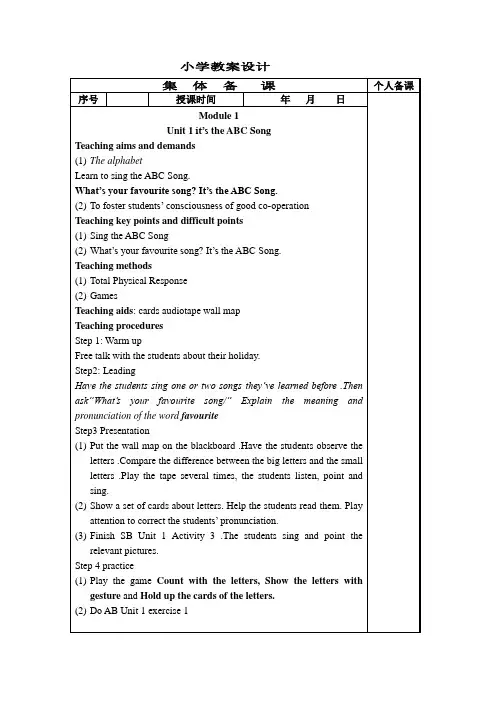
序号
小学教案设计
集体备 授课时间
课 年月 日
names\things car doll ship Computer kite bear game
Xiao wei
Байду номын сангаас
个人备课
Play the game what’s missing? Step 5: Chant Play the tape. Help the students with the chant. Step 6: Homework Ask your family or friends’ favourite toy and colour.
小学教案设计
序号
集体备 授课时间
课 年月 日
Step5: Homework Sing the ABC Song to your family.
个人备课
Unit 2 My favourite toy is a car. Teaching aims and demands (1) My\His\Her favourite toy is a car. (2) Vocabulary: toy car ship doll computer game Teaching Functions: Talk about your favourite objects. Key points: My favourite toy is… Difficult point: His\Her\favourite… Teaching methods: Task-based; Games Teaching procedures: Step 1: warm up Sing the ABC Song and A Rainbow Step2: Leading Have the students draw a picture of the rainbow. Then ask: What’s your favourite colour? Step 3: New Concepts (1) Hold up some markers and choose one of them , Say: My favourite
外研版三年级下册英语Module 2《Unit 1 They're monkeys.》教案
外研版三年级下册英语Module 2《Unit 1 They're monkeys.》教案教材分析:本节课是外研版三年级下册Module 2《Unit 1 They're monkeys.》的第一课,主要通过介绍动物以及动物的单复数形式,培养学生对动物名词的理解和描述能力。
教材中包括了一些新单词和句型,通过听、说、认、读的方式,帮助学生掌握并运用所学知识。
教学目标:知识目标:1. 学生能够听、说、认、读新单词:they,monkey,zoo,tiger,lion,elephant。
2. 学生能够在情景中运用句型“--What’s this?--It’s a/an…”和“--What are they? --They’re…”。
能力目标:1. 学生能够正确区分动物的单复数形式。
2. 学生能够运用所学句型描述动物的单复数形式。
情感、策略和文化目标:1. 培养学生运用英语描述动物的单复数形式的兴趣。
2. 增强学生对动物名词的求知欲。
3. 培养学生向他人介绍事物的自信心。
教学重点:1. 词汇:they, monkey, zoo, tiger, lion, elephant。
2. 重点句型:“What’s this? -It’s a/an…”和“What are they? -They’re…”。
教学难点:名词单复数的正确使用。
学情分析:学生是三年级的学生,已经具备了一定的英语基础。
他们对动物名词可能已经有一定的了解,但对于名词的单复数形式可能仍然存在一些困惑。
因此,本节课的教学需要注重巩固和拓展学生的词汇量,并帮助他们正确运用所学知识。
教学过程:Step 1: Warm-up1. 问候学生并询问他们关于动物的一些常规问题,例如“你最喜欢的动物是什么?”或者“你喜欢去动物园吗?”例如:“What's your favorite animal? Why do you like it?”(你最喜欢的动物是什么?为什么喜欢它?)2. 展示不同动物的图片,并要求学生命名它们。
外研版三年级下册英语教案
外研版三年级下册英语教案外研版三年级下册英语教案一、教材分析本册教材是根据《英语课程标准》编写的,以培养学生的语言能力为核心,以“话题—功能—结构—任务”为编写原则,以中外学者合作为编写模式,内容力求新颖,生词的出现遵循“少而精,多次重复”的原则。
本册共十个模块,供学生在本学年度使用。
二、教学目标1、能听说读写100个单词,并能正确朗读所学故事。
2、能唱一首英语歌曲。
3、能看懂并理解简单的英语小故事。
4、能明确简易英语会话的意思并口头表达出来。
5、能正确拼读单词。
6、能用英语简单描述人物特征和动物特征。
三、教学内容1、复习巩固26个字母和48个音标。
2、掌握本册有关国家、动物、颜色和数字的100个单词。
3、掌握六个基本句子结构和63个日常用语、课堂用语等。
4、初步了解一些简单的英文日常小诗等。
5、会唱英文歌曲一首。
四、教学重点与难点1、掌握本册有关国家、动物、颜色和数字的100个单词。
2、掌握六个基本句子结构和63个日常用语、课堂用语等。
五、教学措施1、认真备课,精心组织课堂教学,充分利用各种教学资源,明确教学目标,体现学生的主体作用。
2、把握好教材的逻辑结构和教学重点,把重点、难点分解成小点,在课堂教学中各个击破,帮助学生理解、掌握。
3、创设语言环境和交际情境,引导学生用英语进行思维,在真实的语境中实践所学知识。
4、在教学中注意培养学生的创新意识和实践能力,指导学生自主学习。
5、对学困生进行耐心指导,帮助他们树立信心,调动他们的学习积极性。
6、适当补充一些课外内容,开阔学生的视野,提高学生综合运用语言的能力。
7、充分关注学生的情感、态度和行为表现,关注他们的形成过程和变化发展。
六、评估与检测1、通过课堂提问、观察、访谈等形式了解学生的学习情况和行为表现。
2、利用作业批改、单元测试等手段检测学生的学习效果和语言能力发展情况。
3、定期进行单元小结和期中、期末评估,及时发现教与学中的问题并加以改进。
外研版三年级英语下册教案
外研版三年级英语下册教案教案标题:外研版三年级英语下册教案教案目标:1. 通过本教案的学习,学生将能够掌握外研版三年级英语下册的课文内容和相关词汇。
2. 学生将能够运用所学知识进行简单的对话和日常生活中的交流。
3. 学生将培养对英语学习的兴趣和积极性。
教学重点:1. 学习并掌握本教材中的词汇和句型。
2. 运用所学知识进行简单的对话和交流。
教学难点:1. 学生能够准确地理解和运用所学词汇和句型。
2. 学生能够流利地进行简单的对话和交流。
教学准备:1. 外研版三年级英语下册教材和教具。
2. 多媒体设备和投影仪。
教学过程:一、导入(5分钟)1. 利用多媒体设备播放一段与本课相关的视频,引起学生的兴趣。
2. 与学生进行简单的对话,询问学生最近的活动和感受。
二、新课呈现(15分钟)1. 展示教材内容,引导学生观察并回答问题。
2. 教师讲解新课内容,引导学生学习新的词汇和句型。
3. 利用图片和实物进行示范,帮助学生理解和记忆新的知识点。
三、合作学习(20分钟)1. 将学生分成小组,进行配对练习。
2. 学生之间进行对话练习,运用所学知识进行交流。
3. 教师巡回指导,纠正学生的发音和语法错误。
四、巩固练习(15分钟)1. 利用教材中的练习题进行个人练习。
2. 教师辅导学生完成练习题,解答学生的问题。
五、拓展活动(10分钟)1. 利用多媒体设备播放一段与本课相关的歌曲或动画片,帮助学生巩固所学知识。
2. 学生进行小组活动,创作一个与本课相关的短剧或故事。
六、总结与反思(5分钟)1. 教师对本节课进行总结,并检查学生的学习情况。
2. 学生进行自我评价和反思,提出对教学内容和方式的建议。
教学延伸:1. 学生可以利用课后时间进行课文的复习和朗读。
2. 学生可以尝试用英语进行日常生活中的交流,提高口语表达能力。
教学评估:1. 教师通过观察学生的课堂表现和练习情况,评估学生的学习情况。
2. 学生进行小测验,检查对本节课的掌握情况。
外研版小学英语三年级下册教案全集(外研版)
小学英语3年级下册教案Module 1 AlphabetUnit 1 it’s the ABC SongTeaching aims and demandsThe alphabetLearn to sing the ABC Song.What’s your favourite song? It’s the ABC Song.To foster students’ consciousness of good co-operationTeaching key points and difficult pointsSing the ABC SongWhat’s your favourite song? It’s the ABC Song.Teaching methodsTotal Physical ResponseGamesTeaching aids: cards audiotape wall mapTeaching proceduresStep 1: Warm upFree talk with the students about their holiday.Step2: LeadingHave the students sing one or two songs they’ve learned before .Then ask”What’s your favourite song/” Explain the meaning and pronunciation of the word favouriteStep3 PresentationPut the wall map on the blackboard .Have the students observe the letters .Compare the difference between the big letters and the small letters .Play the tape several times, the students listen, point and sing.Show a set of cards about letters. Help the students read them. Play attention to correct the students’ pronunciat ion.Finish SB Unit 1 Activity 3 .The students sing and point the relevant pictures. Step 4 practicePlay the game Count with the letters, Show the letters with gesture and Hold up the cards of the letters.Do AB Unit 1 exercise 1Step5: HomeworkSing the ABC Song to your family.Module 1 AlphabetUnit 2 My favourite toy is a car.Teaching aims and demandsMy\His\Her favourite toy is a car.V ocabulary: toy car ship doll computer gameTeaching Functions: Talk about your favourite objects.Key points: My favourite toy is…Difficult point: His\Her\favourite…Teaching methods: Task-based; GamesTeaching procedures:Step 1: warm upSing the ABC Song and A RainbowStep2: LeadingHave the students draw a picture of the rainbow. Then ask: What’s your favouri te colour?Step 3: New ConceptsHold up some markers and choose one of them , Say: My favourite colour is … write it on the blackboard. Have the students introduce their favourite colour by using this structure. Choose three or four students , point to them, say: His\Her favourite colour is…Play the tape, the students listen and circle the new words, guess the meaning of them.Explain toy, computer game, car, ship, and doll by drawing simple figures on the blackboard.Play the tape again. The students listen and repeat.Have the students introduce the contents of the text by using the structure This is…His\Her favourite toy is…Step 4: PracticeHave the students make a survey in groups. Each one would finish the form by asking and answering what’s your favourite…Play the game what’s missing?Do the AB Unit 2 exercise 1 and 2Step 5: ChantPlay the tape. Help the students with the chant. Step 6: HomeworkAsk your family or friends’ favourite toy and colour.Module 2 ZooUnit 1 they’re monkeyTeaching aims and demands:1. Describe animals.2. What’s this? It’s….What’re they? They’re….Teaching key points and difficult points:What’s this? It’s ….What’re they? They’re….Teaching methods:1. Total Physical Response.2. Play games to go over animals.Teaching aids:TV, Tape-recorder, picturesTeaching procedures:Step 1 Warm-up1. S ings a English song “the ABC song”2. Let’s watch TV a bout animals3. Revision (复习):Play a game “Point to animals” Teacher do action and let students guess animals Step 2 Presentation1. 创设情景,呈现任务。