
牛津上海版(试用本)四年级上册英语Module 1 Unit 3 How do you feel 优质课件
情、动作,让对话更精彩。
hungry? biscuits thirsty? water then
A happy day
... How do you feel? I'm/ We're ...
...
Tips: 4人一组, 选择或自
创一个场景,表演对话。 (4级音量)
1. 用上How do you feel, 关心他人。
A ha…ppy day
Today is Sunday. Kitty and Ben go to the park.
happy
new skateboard
back
How do you feel? tired
happy
sad bicycle
Tips: 4人一组, 表演对话 (2级音量)
1. 注意情绪转变,真实合理。
2.Talk more about feelings: Act out your own story. We’ll have a show next class.
3.Know more about feelings: You can read the story book ‘Feelings’ or watch the movie 'Inside out'.头脑特工队
Magical feeling plate
神奇表情盘
happy
How do you feel?
tired
Magical feeling plate
神奇表情盘
How do you feel?
sad
Magical feeling plate
神奇表情盘
excited
AH:oHwowdodyooyuofueefel?el? B:I’m …
2. 注意情绪转变,真实
合理。
3. 可nce
自由表演生活中
... 发生的情绪变化小故事
Life is full of ups and downs .
Be happy every day!
1.Say with feelings: Read the dialogue on P12.
Mum: Are you thirsty, Ben? Ben: Yes, I'm thirsty. Mum: Have some water then. Kitty/Ben: Thank you, Mum.
Mum: Are you hungry? Kitty/Ben: Yes, we are. Mum: Have some biscuits. Kitty/Ben: Thanks, Mum.
Feelings hungry thirsty
Suggestions
...
...
Kitty: I’m happy. I have a new skateboard. Ben: I’m sad. Look at my bicycle.
Kitty/Ben: We're back. Mum: How do you feel? Kitty/Ben: We're tired.
sad
Kitty Ben
Why?
...
Kitty
Ben
happy sad tired hungry thirsty Kitty Ben
Maybe they ...
Feelings
Mum's Suggestions
hungry
Have some biscuits.
thirsty Have some water then.
小学英语牛津上海版四年级上册《Module 1 Getting to know you Unit 3

Materials:
Student’s Book 4A( P15)
Cassette 4A and cassette player
Multimedia: PPT
Procedures
Contents
Methods
Purpose
I.Pre-task preparation
Rhyme.
Daily talk.
1. Say the rhymn on page 16
2.Focus on the phrases and the new words
ice-cream---cream
strawberry---berry---berries
lemon---lege bottle of lemonade
1. If you have a super bicycle, how do you feel?
If you are happy, what do you want to do?
How is the crow?
What can the crow do?
Do you like it?
Introduce the crow
e.g. This is a crow. It’s black. Its wings are big. It can fly.
2.Questions:
How does the crow feel?
时刻以问题贯穿故事阅读,启发学生发现故事的道理
对于有一定难度的描述故事环节,用小组活动形式降低难度,从中发挥学生集体的力量,互相学习
用短文填空的练习检测学生对故事的理解程度,并为写话作业提供帮助
上海牛津版小学英语四年级上册m1u1.3教学ppt课件

/sk /
mask
Martin
Jill has a good friend. He is a boy. He is a student too. His hair is short, very short. He likes making masks. Who is he?
Where is Martin? What ‘s in his hands?
This is my friend. His name is Martin. His hair is short, very short. He likes making masks. He can make them well. His grandma likes his mask. She puts on the mask. It isn’t nice. It’s funny.
put on the dress put on the T-shirt put on the _____
Hi, my name is Jill. I’m ten years old. My I can dance. I like my new school.
He is only six. He is nine. She is ten.
Who is Jill?
Jill is a new student. She has a new teacher. She is Miss Fang.
Miss Fang brings Jill to the class, and says”_______”
I have a new classmate. You can call her Kitty. She is nine. Her student number is fifteen. she can sing . She has a pair of glasses.
牛津沪教版英语四年级上册Unit1_3复习课件
【核心句型】
My name's... 我的名字是……。用来介绍自己的名字。 His/Her name's... 他/她的名字是…… 用来介绍别人的名字。 Nice to meet you. 很高兴认识你。是日常用语,和别人初次见面时常
用。 See you. 再见。是日常用语,常用来与别人道别。
Yes, she can./No, she can’t.
Unit 2 Can you swim?
归纳与拓展
but(但是)表示转折。在一个句子的前半句和后半句中,它一般位于 后半句的开头。
My brother can draw, but he can’t write. 我的弟弟会画画,但是他不会写字。
Tom,this is Jill. Jill,this is Tom.
Nice to meet you,Tom.
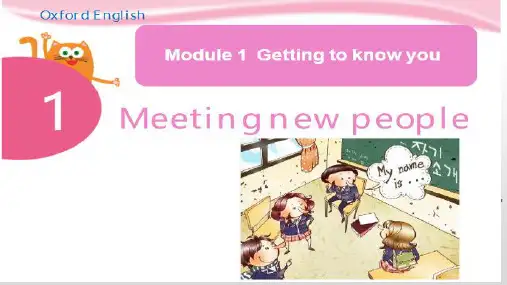
Unit 1 Meeting new people
归纳与拓展
见面问候常用语:
Nice to meet you.很高兴认识你。 Nice to see you.很高兴见到你。
How are you?你好吗?
Hello!/Hi!你好!
How do you do?你好。
告别用语:
Goodbye!再见!
See you. 再见。
See you later. 待会见。
See you tomorrow,明天见。
Unit 1 Meeting new people
本单元栏目
【Make and say】
你学会做人物卡片了吗?把你的同学或朋友的照片贴在卡纸上,在照片 下面写上关键词,然后用This is...His/Her names句型向你的同伴作介绍。你 还可以用家人的照片来制作卡片,向同伴介绍你的家人。读一读下面的例 子:
牛津上海版(试用本)英语四年级上册Module 1 Unit 3 How do you feel课件
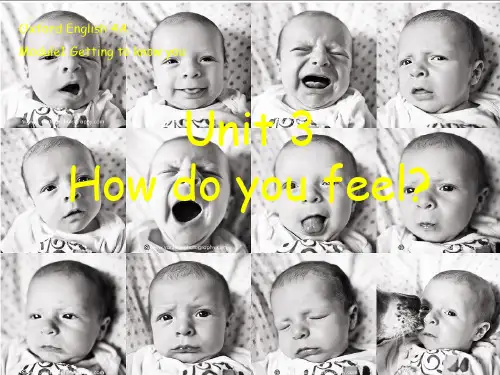
I have many feelings. My feelings change from time to time.
Sometimes I feel kind of happy.
Sometimes I feel very happy.
Sometimes I feel kind of sad.
Kitty & Ben: Thank you. Ginger is Peter’s cat. Now, Sam and Ginger are both thirsty. But Sam drinks Ginger’s water.
Ben: Sorry. Sam is thirsty. He wants some water. Peter: But it’s Ginger’s water. Ben: Thanks, Peter. Sam isn’t thirsty now. He’s happy. Peter: Are you thirsty too, Ginger? Here’s
_a_n_g_r_y__ too. They don’t like _e_a_c_h_ other.
Retell the story
On Sunday afternoon. Kitty, Ben and his dog, Sam go to Peter’s home.
Kitty & Ben: Hi, Peter. Peter: Hi, Kitty. Hi, Ben. Come in, please. Sit down, please.
fu _l _l
Guess! Why Sally is full?
Maybe she eats ____________.
上海秋季牛津英语四年级上册四上M1U3同步讲义教案(含词汇语法练习)
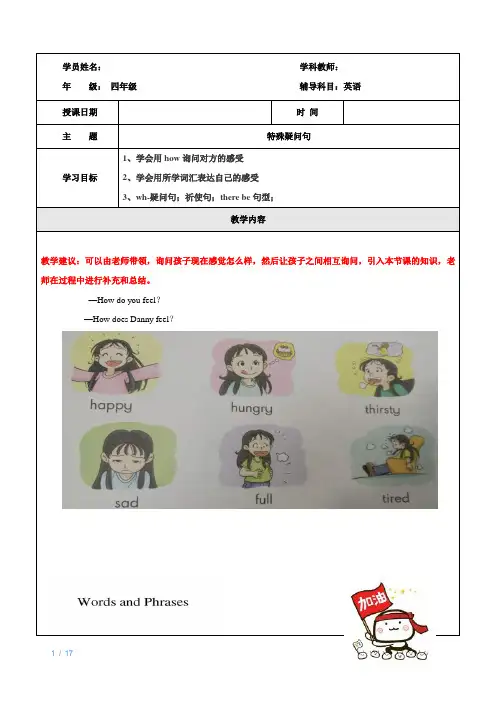
学员姓名:学科教师:年级:四年级辅导科目:英语授课日期时间主题特殊疑问句学习目标1、学会用how询问对方的感受2、学会用所学词汇表达自己的感受3、wh-疑问句;祈使句;there be句型;教学内容教学建议:可以由老师带领,询问孩子现在感觉怎么样,然后让孩子之间相互询问,引入本节课的知识,老师在过程中进行补充和总结。
—How do you feel?—How does Danny feel?13.吃午餐:___________14.吃晚餐:___________15.喝点牛奶:______________16.加油:_______________17.试一试:______________Keys: 词汇1.happy2. hungry 3. thirsty 4. sad 5. full 6.tired 7.new 8.back 9.biscuit 10. then 11. bottle 12. crow 13.dry 14.drink 15. pebble 16. postman 17.put 18.toast 19. water 20. noon 21. lunch 22. rabbit 23think词组:e in2. each other3.have an idea4.look at5.sit down6.some biscuits7. a packet of biscuits8.a piece of 9.pieces of 10. a piece of toast 11.three pieces of toast 12.have breakfast 13have lunch 14.have dinner 15.have some milk 16. come on 17.have a try【知识梳理1】wh-疑问句基本结构是:特殊疑问词+一般疑问句语序常用的疑问词:what, who(whom), whose, which, when, where, how, why等,回答时针对问句中的代词和副词来回答,不用yes或no来回答。
上海牛津版小学英语四年级上册4A新教材M1U3
上海牛津版小学英语【五年制】四年级上册好的开始,是成功的一半,祝您天天进步!来一起学习知识吧Module1 Getting to know youUnit 3 How do you feel? (period1)Topic: feelingsLanguage aims:Using the key words in contexte.g.happy, sad, hungry, full, thirsty, tiredUsing modelled sentences to describe feelingse.g I’m happyUsing wh-questions to find out how people feele.g. How do you feel?Ability aims:Students can describe feelingsEmotional aims:Different situation, different feelingsKey points:How do you feel? I’m …(predicative adjectives)Difficult points:Use the new sentence patters ‘I’m …’ to describe feelingsMaterials:Student’s Book 4A( P13P16)Cassette 4A and cassette playerMultimedia: PPTProcedures Contents Methods PurposeI. Pre-task preparationRhymeQuestions Have the students listen to therecording for ‘listen and enjoy’ onpage 161. What’s the girl’s name?2. What’s the boy’s name?3. How is Susie?How does Susie feel?4. How is Simon?How does Simon feel?利用儿歌引出复习的内容通过教师的问题,让学生体会,了解同一个内容的不同问法II. While-task procedure New wordsand thesentences‘full, tired,angry, afraid’1. Show the words: hungry,thirsty2. Question:How do you feel today?Show the words: happy, sad,full, tired, hungry, thirsty, angry,afraid,hot, coldS1: I am/ I’m _______.结合学生实际生活,利用关键问题了解学生的feelings,同时教学新词3. Read and repeat all the words4. Show the sentence and readHow do you feel?5. Ask and answer:e.g.S1: How do you feel, …?S2: (Frown or mime crying) I’m sad. 小组互动,巩固单词与句型III. Post-task activities brainstorm 1. Ask and answer:T: What do you do whenyou’rehappy/sad/hungry/full/thirsty/tired?S: I am happy. I sing a song.2. T: give you a new book. How doyou feel?S: I have a new book. I’mhappy. I sing a song.通过brainstorm让学生谈论自己在不同的感觉时的不同行为, 拓宽学生的思维IV. Assignment 1. listen and repeat page 14& 162. copy the words and sentences板书:How do you feel? = How are you?I’m ______. (happy---sad, hungry---full, thirsty, tired, angry, afraid, hot, cold)Unit 3 How do you feel? (period 2)Topic: feelingsLanguage aims:Using predicative adjectives to describe feelingse.g. He’s happy.Using wh-questions to find out how people feele.g. How does he/she feel?Using yes/no questions to elicit a positive or negative responsee.g. Are you hungry? Yes, we are. Is he/she hungry? No, he/she isn’t.Ability aims:Students can ask and answer about other person’s feelingEmotional aims:Different situation, different feelingsKey points:How does he/she feeling? He’s/She’s … Are you…? Is he/she…?Difficult points:Use wh-questions and yes/no questions to ask other person’s feelings Materials:Student’s Book 4A( P12&13&16)Cassette 4A and cassette playerMultimedia: PPTProcedures Contents Methods PurposeI. Pre-task preparationRyhmnDaily talk. Listen to the tape about theryhmn on page 16 again andtry to repeat after the tapeAsk students some questionsabout feelingHow do you feel?Are you happy?Is he/she happy?再一次让孩子听16页的儿歌,本课时中尝试跟读借用各类问题复习上节课所学II. While-task procedure Look and say(dialogue)Learn the newsentence1. Show the dialogue on page 12and ask the students somequestions about the pictureWho are they?How does Kitty feel?Is Ben happy, too?How does Ben feel?2. Show the sentences on theblackboard and readHow does he/she feel?He/she is ______.3. Play a gamePlay the game on page 13S1: (show the word card forsad to S2)S2: (frown or mime crying)S1: How does … feel, S3?S3: Is he/she tired?S1: No, he/she isn’t.S3: Is he/ she sad?S1: Yes, he/she is.从图中引出第三人称的问句通过游戏使学生巩固与运用新句型Dialogue 1. Listen to the tape2. Questions:How does Kitty feel?What does she want to do?How does Ben feel?What does he want to do?Are they tired?3. Listen to the dialogue againShow: have some… then---them4. Act out the dialogue5. Read the dialogue together6. Make a new dialogue 表演对话,激发学生兴趣的同时,学习课文并培养听力III. Post-taskactivitiesSurveyExercise 1. Divide the students intogroups of four and have themto a surveyQuestion:How do you feel?What do you want to do?Are you …?2. Ask the students to finish the table about other person’sfeeling3. Give a report about aclassmate according to thesurveye.g. xx is tired. He wants to sit onthe chair. He’s not hungry…1. Finish the exercises onworkbook page 14&152. Then check the answers withthem.用小调查的方式,培养学生运用所学语言交流的能力和记录所获信息的能力IV. Assignment 1. Read P12、13&16 after tape2. Try to recite the dialogue板书:How do you feel? ---- I am happy.How does he/she feel? ---- He/She is happy.Are you happy? Yes, I am. / No, I am not.Is he/she happy? Yes, he/she is. / No, he/she isn’t. then --- themUnit 3 How do you feel? (period 3)Topic: feelingsLanguage aims:Using modelled sentences to describe feelingse.g.Sam is thirstyUsing yes/no questions to elicit a positive or negative responsee.g. Are you thirsty too, Ginger?Using formulaic expressions to express apologye.g. Sorry.Ability aims:Students can describe feelings .Emotional aims:Different situation, different feelingsKey points:Understand the dialogue and act out the dialouge using formulaic expressions Difficult points:act out the dialouge using formulaic expressionsMaterials:Student’s Book 4A( P14, P16)Cassette 4A and cassette playerMultimedia: PPTProcedures Contents Methods PurposeI. Pre-task preparationRhymeDaily talk Read the rhyme on page 16together and try to recite itT--- SHow do you feel?How does he/ she feel?How are you today?Are you hungry?If you’re happy, what do youwant to do?在前两节课的基础上尝试背诵儿歌学习儿歌,热身运动,让学生扮演角色来说儿歌,激发兴趣,为后面学习打基础。
牛津上海版(三起)四年级上册英语Module 1 Unit3 Are you happy 优秀教学设计
I eat two hamburgers. I am ________.
I can't fly a kite. I am __________.
I am__________. I want a big cake.
I am _________. I want some water.
本课导入环节借助一首英文儿歌以及情境填空,在将学生带入英语学习氛围的同时又复习上课所学重点表达feeling的四会单词。在单词学习环节我利用自然拼读规则对单词读音进行归类运用。让孩子们在复习旧知的同时,能拼读出新学词汇。语篇教学方面,我注重了对语篇的整体理解。运用瓶子、小石头、小鸟图片等道具创设情境,让学生在真实语境中感知故事,加深对课文的理解。再示范标准的录音材料,让学生跟读。小组合作环节,让学生先完成教师布置的内容,再选择自己想展示的内容。
Homework:
1. Listen to and read the story on Student’s Book page 12.
2. Tell the story to your friends or parents
在情境中复习重点词汇:happy sad thirsty full hungry tired
3. look 、listen and guess
What is it?
It’s a crow.
This is a _______.
The bird is ______.
He can __________.
While-task procedures:
1.Look and say
Ss watch the picture carefully,and answer the following questions
(三起点)上海牛津英语四年级上册Module1单元全套优质课件
[上海牛津版]四年级上册英语全套优质课件
Module 1
Unit 1 Unit 2 Unit 3
Revision Project
使用说明:点击对应课时,就会跳转到相应 章节内容,方便使用。
Unit 1 Meeting new people
沪教牛津·四年级上册
Lead-in
Hello, I’m Kitty. My name is Kitty.
2. Her name’s Jill.她的名字叫吉尔。 her的意思是“她的”,是形容词性物主代词。
形容词性物主代词就相当于一个形容词,后面 可以接名词。name’s = name is。
3. You can sit here, Jill. 你可以坐在这儿,吉尔。 can是情态动词,意思是“能,会,可能,
No, I can’t.
I can draw.
What can you do?
Language points 1. Can you swim, Alice? 你会游泳吗,艾丽斯?
这是含有情态动词can的一般疑问句,该句型 的基本结构为“Can+主语+动词原形+其它?(你 会……吗?)”。
其肯定回答为“Yes,主语 + can.” 否定回答为“No,主语+can’t.”
可以”,表示能力,后接动词原形,没有人称和 单复数的变化。其常用句型为:主语 + can + 动 词原形 + 其他。
例句:他能踢足球。
He can play football.
4. Nice to meet you. 很高兴见到你。 这是与他人初次见面时,比较正式的打招呼
用语。其答语是“Nice to meet you, too.” 例句:很高兴见到你。我也很高兴见到你。 —Nice to meet you. —Nice to meet you, too.
牛津上海版(三起)英语四年级上册Module 1 Unit 3 Are you happy?课件
tired
tired [ˈtaɪəd] adj. 累的;疲惫的 be tired 累;疲惫 look tired 看起来很疲惫
I am so tired. 我太累了。 We are cold and tired. 我们感到 又冷又累。
hungry
hungry [ˈhʌŋɡri] adj.饥饿的 be hungry I am really hungry. 我真是饿了。
句型:be + 主语+ 形容词?询问对方的感觉 例: Are you happy?
Yes, I am. /No, I'm not. Is she sad? Yes, she is. /No, she isn't.
Grammar
How are you?你感觉怎么样? How are you?可以用于日常打招呼的问好,也可以用 来询问别人的感觉。 How are you? Fine, thanks.你好吗?很好,谢谢。 How are you? I m very sad.你感觉如何?我很难过 也可用 How do you feel?来询问别人的感觉。
Thanks
bottle
bottle [ˈbɒtl] n.瓶子 复数: bottles a milk bottle 奶瓶 The bird can see a bottle. 这只鸟看见一个瓶子。 The bottle is full of water. 这个瓶子装满了水。
drink
drink [drɪŋk] v. 喝 第三人称单数: drinks drink to 为…而干杯;为…祝 酒 drink up 喝干;喝完 Sometimes I drink tea. 有时候我喝点茶。 The British drink a great deal of milk.英国人饮大量的牛奶。
牛津沪教版英语四年级上册Unit1-Unit12全册课件-含教案
S1: What do you have? S2: I have … pairs of …
S1: What are they like? S2: They are …(adj.)
Report to the class … has /… pairs of … They are … (adj.)
She has a dress. It’s red and white. Who is she?
under 在……下面(方)
It's beside the box.
beside 靠近、接近……
There is a ____ on the table. There are ____ on the table.
What’s in the kitchen?
There is/are … in the kitchen.
Bingo game
Do you know these words?
Bingo game
blouse trousers shirt gloves socks sweater
jacket scarf hat
boots
shoes coat
dress shorts T-shirt blouse jeans
A _b_o_w_l , a _b_o_w_l , Beside the fork, Beside the fork.
Where is the basketball?
It's on the box.
on 在……上面
指与物体表面接触
It's in the box.
in 在……内(中)
It's under the box.