
外研版英语七年级下册Module 11 Unit 3 教案
~初中英语精品资源~
Module 11 Body Language
Unit 3 Language in use
一、教学目标
【知识能力目标】
1) 掌握本模块所学单词和短语
2)通过练习,进一步巩固对祈使句的应用
【情感态度目标】
进一步了解不同国家的风土人情,体会文化礼仪差异,了解其他国家的基本礼仪。
二、教学重难点
【教学重点】
能用正确的祈使句给出书面指示语和建议
【教学难点】
能运用所学的知识和通过查资料,运用恰当的语言向他人介绍中国的身势语。
三、教学过程
Step 1 Revision and lead-in
Revise the sentences about body language. Ss should pay attention to the imperative
sentence features.
Step 2 New words
bring的原形和过去式brought。
Step 3 Pair work
1. Ask the students to discuss what we should do and what we shouldn’t do in China.
2. Discuss what we can do and what we can’t do in Britain in pairs, then fill in the
table.
Do’s Don’ts
Britain Stand in line.
Shake hands.
Say “please” and “thank you”.
Open doors for others.
Look at people when you talk.
Be on time. Touch people.
Ask a woman’s age.
Stand too close.
Say anything too personal.
Step 4 Make a list
List several rules visitors should obey in Britain according to what you have learned.
Step 5 Rewrite the sentence
First, let Ss look at the example. Then let Ss follow the example to finish the
following five sentences. The main purpose is to master the imperative sentence.
Step 6 Answer the questions ~初中英语精品资源~
Read the words in the box, then answer the questions using the words and
expressions.
1. How do the British say hello to each other when they first meet?
2. Does body language mean the same meaning in different countries?
3. How do the Russians say hello to each other when they meet?
4. Is it polite to stand close to North Americans?
5. Is it all right to wave goodbye in Greece?
6. How do you usually say goodbye with body language?
Step 7 Module task
1. Work in pairs. As a Chinese, we have our own ways of saying hello and body
language. Please talk about them in pairs.
2. After talking about the ways, you can write the information on your poster.
3. Collect some pictures from the newspaper and magazines and add them to the
poster.
4. Show your poster to the whole class
Step 8 Summary
Let Ss talk about the use of the imperative sentence.
祈使句长表达以下语气:
Go and wash your hands. 快去洗手。(命令)
Be quiet, please. 请安静。(请求)
Be kind to our sister. 要对我们的妹妹友善。 (劝告)
Watch your steps. 走路小心。 (警告)
No littering. 不要乱扔垃圾。 (禁止)
Don’t forget to take an umbrella. 不要忘了带雨伞。 (叮嘱)
在表达请求时,可以加上please;表达比较强烈的语气时,可以用感叹号。
Please close the door. 请把门关上。
Sit down, please. 请坐。
Come to my office. 到我办公室来。
Stop! 停!
Hurry up! 快点!
Please don’t do it. 请不要这么做。
Don’t be late again. 不要再迟到了。
Step 9 Exercises
一、用括号内所给动词的恰当形式填空。
1. It’s an important meeting. _________ (not, be) late.
2. ___________ (not, make) any noise! Your mother is sleeping.
3. __________ (not, speak) with your mouth full of food.
4. _________ (not, talk) and _______ (read) aloud.
5. ___________ (not, leave) your homework for tomorrow, Larry.
6. _______ (look) out! A car is coming.
7. _______ (give) us ten years and just see what our country will be like.
8. _________ (not, let) the baby cry.
Keys: 1. Don’t be 2. Don’t make 3. Don’t speak 4. Don’t talk; read
5. Don’t 6. Look 7. Give 8. Don’t let ~初中英语精品资源~
二、 翻译下列各句。
1. 咱们一起玩吧! 2. 请不要迟到。
3. 回答这个问题。 4. 不要这么吵。
5. 上课安静。 6. 不要随处乱扔垃圾。
7. 不打架不骂人。 8. 有事请假。
9. 友好待人。
keys: 1.Let’s play together. 2. Don’t be late, please.
3. Answer the question. 4. Don’t make such a noise.
5. Be quiet on class. 6. Don’t throw rubbish everywhere.
7. Don’t fight or say rude words. 8. Ask for leave.
9. Be friendly to classmates.
Step 10 Homework
Make a poster about body language in America.
教学反思
2023年外研版七年级英语下册Module11 Unit2 Here are some ways t
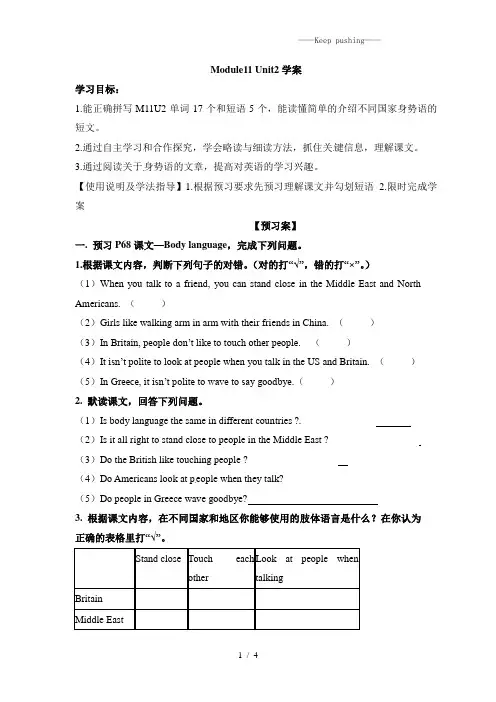
1 / 4 Module11 Unit2学案
学习目标:
1.能正确拼写M11U2单词17个和短语5个,能读懂简单的介绍不同国家身势语的短文。
2.通过自主学习和合作探究,学会略读与细读方法,抓住关键信息,理解课文。
3.通过阅读关于身势语的文章,提高对英语的学习兴趣。
【使用说明及学法指导】1.根据预习要求先预习理解课文并勾划短语 2.限时完成学案
【预习案】
一. 预习P68课文—Body language,完成下列问题。
1.根据课文内容,判断下列句子的对错。(对的打“√”,错的打“×”。)
(1)When you talk to a friend, you can stand close in the Middle East and North
Americans. ( )
(2)Girls like walking arm in arm with their friends in China. ( )
(3)In Britain, people don’t like to touch other people. ( )
(4)It isn’t polite to look at people when you talk in the US and Britain. ( )
(5)In Greece, it isn’t polite to wave to say goodbye.( )
2. 默读课文,回答下列问题。
(1)Is body language the same in different countries ?_______________
(2)Is it all right to stand close to people in the Middle East ?__________________
(3)Do the British like touching people ?__________________ _
外研版七年级英语下册 Module 3 Unit 2教案
课题:Module 3 Making plans
Unit 2 We’re going to cheer the players.
学习目标:掌握重点词及短语forward, look forward to, make friends, cheer, player, hope, win, enjoy oneself /myself
during walk, take a walk, country, second, collect, litter, fun, summer holiday, camp, sightseeing , go sightseeing
学习重点: 1、 学习并能够准确运用fantastic,fan,nobody,myself等本课相关词汇
2、能够初步运用be going to 结构 3、能够读懂有关介绍假期计划的文章
难点:1、描述自己的假期计划
【定向导学·互动展示·当堂反馈】
自学(自研自探) 合学
(合作探究) 展学
(展示质疑)
学 法 指 导 互 动 策 略 展 示 方 案
New words and phrases study
读课文预习下列短语和句子并熟读。
一、New words
1. 迷,支持者_________ 2.球衣,男衬衫________3.为 … 喝彩
________ 4.选手___________ 5. 希望 _________ 6.获胜
_______ 7我自己____________8.在___期间_____________9.迟的_________10.乡下. ________11.第二 _________ 12.收集 ______
13.垃圾__________14.乐趣 __________ 15.营地 ______
16. 澳大利亚的 ________ 17.观光 ______ 18.海滩 ____
外研版英语(新标准)七年级下册Module 1 Lost and found教学设计

Module1 Lost and found
一、 教学内容:Unit 1 Whose bag is this?
二、 课型:Listening and speaking
三、 教学目标:
1、能够正确使用下列单词和词组: crayon, eraser, glove, wallet, watch, whose, first
of all, lose and found box, mine, yours tape, purple, hers, be careful with, from now
on.
2、能够听懂有关失物招领的简短对话;
3、能用名词性物主代词来谈论、寻找失物主人。
4、学习英语文明礼貌的询问和回答方式,拾金不昧的做人原则和助人为乐的优良品质。
四、 教学重难点:
1、能够听懂有关失物招领的简短对话。
2、能够正确使用特殊疑问句“Whose…is this/that? 对物品的所属进行提问及其回答。
五、 教学准备:
本课指导学生通过听力获取信息,培养学生听力技能。课堂上采用多媒体手段辅助教学,在轻松愉快的氛围中,在较真实的语境下,并联系学生生活实际,结合已有的知识和经验,运用所学的语言基础知识自我学习、互相学习,让学生在语言实践中相互启发、生成,体验成功。培养学生的合作精神,发展其思维和想象等能力。在教学过程中,采用多媒体手段辅助教学,利用各种图片和习题任务贯穿整个教学过程。因此,本节课需准备:PPT课件、挂图、录音机、课堂练习表格、奖品。
六、 预习要求:
1、 根据音标自学本课新单词;
2、 查找相关资料,找出你认为本课较重要的语言点和短语。
七、 教学过程:
教学
步骤 教师活动 学生活动 设计意图
Step One
Warming-up (3’)
Lead in
anize the Ss to enjoy and
sing the song “Whose pen is it?”
外研版七年级英语下册 Module 3课后练习(含答案)
Unit3 Making plans
本单元提纲
1.主题功能:能够谈论计划
2.重点单词:picnic, housework, else, fantastic, country, during等。
3.重点短语:look forward to, enjoy oneself, have a picnic, see a movie 等。
4.核心句型:What are you going to do at the weekend, Daming?
Who else is going to be here?等。
语法结构: be going to结构的一般将来时。
重难点精讲
What are you going to do at the weekend, Daming?
大明,你周末打算做什么?
本句是what引导的特殊疑问句。
be going to do sth. 表示“计划做某事,打算做某事”,
表示在主观上打算,准备在近期或将来要做某事。
题一:
翻译:
她明天打算做什么?
她打算去看她的姐姐。
On Sunday morning, I’m going to check my email and do my homework.
在周日的上午,我打算查我的邮件和做家庭作业。
on Sunday morning意为“在周日上午”。
表示在具体某一天的上午,下午和晚上要用介词on。
on Monday afternoon 在周一的下午
on a cold night 在一个寒冷的晚上
check one’s email意思是“查看某人的邮件”,
do one’s homework意思是“做某人的家庭作业”。
题二:
翻译:
今天下午我的妈妈打算查看她的电子邮件。
----When did the earthquake in Lushan happen?
----It happened_____8:02_____the morning of April 20,2013.
外研版英语七年级下Module8 Unit3教案

第1页 共2页 Unit 3 Language in use
Teaching aims:
1. Review the useful words and expressions of this Module.
2. To summarise and consolidate past simple regular verbs.
Teaching points:
1. Grammar: The simple past tense.
2. The useful sentences: She didn’t like the food in the big bowl.
They didn’t notice Goldilocks at first.
Teaching procedures:
Language practice:
Let the students read through the example sentences. Let the students understand the regular past
simple works in all three forms.
Step 1. Complete the sentence with the correct form of the words in box.
Ask the students to do the exercises and then check with a partner.
Collect the answers from the class.
Answers:
1. pointed 2. entered 3. jumped 4. hurried
5. answer 6. return 7. like 8. tried
Step 2. Complete the passage with the correct form of the words in the box
外研版英语七下Module4Unit3教案
Unit 3 Language in use
Teaching aims:
Teach students how to write a passage the life in the future and the grammar of this module.
Teaching important points:
Teach students how to use so to write sentences.
Let students get familiar with the structure will.
Students will use computers. Teachers won’t write on blackboard with chalk.
Homes will be cool in summer. They’ll have long holidays.
Teaching difficult points:
Let students use the structure will.
Teaching method:
Five—step teaching Method and Task—based Teaching Method.
Teaching aids:
Computer, tape-recorder, blackboard
Teaching plan:
Step 1 Revision
Revise the contents of the passage and retell the passage in class.
Step 2. Presentation
Look at the picture and write questions about the future
Will students go to school in the future?
七年级下册英语全册教案外研版
Module 1 School Life
Unit 1 There are fifty students in the class.
Preparation
在黑板上写出单词Festival,要求学生回忆并说出已学过的节日名称,如:New Year,
Christmas Day等,并板书。
组织两人小组活动,内容是在节日时的对话。如下例:
Happy New Year...
Happy New Year...
Do you...?
Yes/No. We...
两人小组活动后,请几对学生上台演示,然后要求大家评价。对演示认真又基本无语言错误的学生给予奖励。
介绍短语Spring Festival, 带读后转入第1小节的学习
1.Look and listen. Then repeat.
1)先不打开书,问学生:春节后,一些同学又见面了,他们很高兴地在一起交谈,他们谈了些什么呢(What are they talking about ?)?
2)要求学生听一遍录音后,回答上面的问题,然后将答案School Life 写在黑板正上方。
3)写出以下问题,要求学生听第二遍录音后回答:
How many students are there in the class?
How long are the lessons?
How does Feifei go to school?
How long does the bus take to get to school ?
学生回答上述问题后翻开书,跟录音读一遍对话。 组织四人小组操练本段对话,然后要求他们演示和评价。
第2、3、4小节的教学可参考“教师用书”的建议进行。
Unit 2 What’s your favourite lesson?
Preparation
1)教师先简单用英语介绍本班的一些情况,然后要求学生分两人小组就School life话题进行对话,也可以给出以下问题要求学生对话:
外研版初中英语七年级下册教案:Module11-Unit1
1 / 4
Book 2 Modulell Body Ianguage
教学内容:Unit 1 They touch noses
、 课型:Listening and speaking
教学目标:
1、 能够正确使用下列单词和词组: kiss, head , smile ,Germa n, British ,Japa nese ,Russia
n hug, India ‘together ,touch ,shake hands with sb, nod onehead, each other
2、 能听懂有关身势语的对话。
3、 在不同国家初次见面时,能用身势问候语进行对话。
4、 注意自己和他人在日常交际中的体态,姿势和面部表情等,学会有礼貌地表达自 己的思想。
四、教学重难点:
1、 能听懂有关在不同国家初次见面和表达问候时的身势语
2、 在不同国家初次见面时,能用身势问候语进行对话。
五、 教学准备:
本课指导学生通过听力获取信息,培养学生听力技能。课堂上采用多媒体手段辅 助教学,在轻松愉快的氛围中,在较真实的语境下,并联系学生生活实际,结合已有 的知识和经验,运用所学的语言基础知识自我学习、 互相学习,让学生在语言实践中 相互启发、生成,体验成功。培养学生的合作精神,发展其思维和想象等能力。在教 学过程中,采用多媒体手段辅助教学,利用各种图片和习题任务贯穿整个教学过程。 因此,本节课需准备:PPT课件、挂图、录音机、课堂练习表格、奖品。
六、 预习要求:
根据音标自学本课新单词;
七、教学过程:
教学 步骤 教师活动 学生活动 设计意图
Step One
Warmin g-up (3') Lead in
1. Greeti ngs
2. Free talk: show Ss a video ,
have Ss talk about What are they
doing?' “ How do you greet foreig
外研版七年级英语下册module3教案
1 Module 3 Making plans Unit 1 What are you going to do at the weekend? 一、教学目标 : 1. 语言知识目标:1) 掌握本单元所学单词及短语:go over, picnic, housework, on, else, nobody, at, nothing, silly, fantastic... 2) 掌握be going to do的用法。2. 情感态度价值观目标:利用所学表达制订计划的句型有礼貌地邀请别人参加某种活动二、教学重难点: 1、利用所给信息谈论周末计划2、“be going to +动词原形”句型的用法三、教学过程Step 1 Warming-up1. Show some pictures of school things. Say what they are. 2. Read the words after the teacher. 3. Introduce the new words. Step 2 Match1. Ask the students to read the word and expressions in Activity 1. 2. Match the words and expressions from Box A with the word and expressions from Box B. 3. Call back the answer from the whole class and check the answer. 4. Match the expressions in Activity 1 with the pictures in Activity 2. 5. Read the expressions together. Step 3 Listen and read. 1. Play the recording and ask the students to listen and read the conversation. 2. Read the conversation again and answer the questions. 1) What’s Daming going to do on Saturday morning?2) What’s Betty going to do on Saturday afternoon?
初中七年级英语教案Unit 3 Language in use-“衡水赛”一等奖 (1)
教者:海口实验中学 蔡颜蔚
课题: 七年级
所用教科书 外研版
所教年级 七年级 课型 语法课
课题 Module10 Spring Festival
1. 教学背景分析:
教学内容分析:
本模块以“谈论中国的传统节日—春节”为话题,这个话题与学生的实际生活联系十分紧密,本节课主要是谈论人们在春节的相关活动。这个话题为学生的语言学习提供了真实的交际情境。对现在进行时这个语法项目展了一系列的听说读写活动。通过英语学习,培养了学生跨文化交际的能力,更在于传承本族文化的培养。
2. 教学目标分析:
① 知识与技能目标
学生能够用现在进行时描述正在发生的事情。
学生了解并掌握现在进行时的语法、句法。
② 过程与方法
学生通过小组探讨和探究性活动了解有关春节的活动,将所学知识运用在现在进行时态的各种句式中。
③ 情感态度、价值观
通过对传统文化节日的弘扬培养学生对民族文化传统的热爱,增强和继承学生对本土文化的传统意识。
3. 教学重点、难点分析:
教学重点:
关于春节的重点词汇、短语和句型。
教学难点:
现在进行时的各种句式应用。
4.教学方法:情景教学法,任务型教学途径。
5.教学用具:多媒体 6. 教学过程设计: 教学环节 教师的活动 学生的活动 设计意图 达成目标
Lead-in 通过图片情境导入春节。 学生们带着问题看图片思考并回答所提出的问题。 通过图片的呈现,充分调动学生的学习热情,顺利引出“春节”这一话题。 通过创设情境,激活学生的思维,将学生带入春节的情景,激发学生的学习兴趣,也为词汇学习作准备。
Brainstorm 通过思维导图来进行头脑风暴,有效地帮助学生进行相关“话题”的短语回忆。 学生们带着问题回答。 通过思维导图来帮助学生们回忆相关“话题”的短语。. 通过思维导图来激活本“话题”的相关短语,为句子的输出做准备。
Presentation 通过呈现图片,引导学生逐步感知现在进行时的特殊疑问句和陈述句。 在老师的引导下逐步感知现在进行时的特殊疑问句和陈述句。