
冀教版七年级英语下册第一单元知识点总结
1. learn about 学习;了解
2. ask sb. a question 问某人一个问题
3. plan a trip around China计划一次环中国的旅行
4. travel on the Silk Road 在丝绸之路上旅行
5. lead the trip 带领这次旅行
6. be excited 激动
7. send sb. sth=send sth. to sb. , send Li Ming an e-mail 给某人发送某物
8. tell sb. sth.=tell sth. to sb. 告诉某人某事
9. be made of... 由……制成的
10. of course 当然
11. go on a trip 去旅行
12. follow me跟我来
13. leave a note留一个便条
14. worry about担忧;忧虑
15. plan for the trip 旅行计划
16. travel along... 沿……旅行
17. How far is it from... to...?
18. history and culture of China中国的历史文化
19. arrive in 到达
20. take a train 乘火车
21. 1114 one thousand one hundred (and) fourteen
22. 6500 six thousand five hundred
23. how long... 问(物体、时间)长度
24. Mother’s Day 母亲节
25. welcome to... 欢迎来到……
26. walk along the wall 沿着城墙走
27. climb up 爬上
28. hit the ancient drum 击古老的鼓
29. ring the ancient bell 鸣古老的钟
30. over=more than 超过;多于
31. enjoy special dishes 享用特色菜肴
32. have a lot of fun 玩得非常开心
33. call sb. sth. 把某人叫做……
34. Let’s go to ...让我们去
35. one of... 其中之一
36. take photos/ pictures 拍照
37. No photos!禁止拍照
38. places of interest 名胜
39. go to the hotel 去宾馆
40. go for a walk 去散步
41. all right 好的,可以,行
42. Let’s go down this street and turn left at the traffic lights.让我们沿着这条街走然后在交通
灯处向左拐。
43. lead sb. to someplace 带领某人去某地
44. the first bridge ovet the Yellow River 黄河上的第一座桥。
45. in front of... 在……(整体)前面;in the front of... 在……(内部)前面
46. a mother with a baby 带孩子的母亲
47. a statue beside the Yellow River 黄河边上的塑像
48. take one’s picture 给某人拍照
49. look right and left 左右看
50. at the second crossing 在第二个十字路口
51. take a tour 旅行
52. be famous as... 作为……而著名
53. be famous for... 因为……而著名
54. the same as... 和……一样
55. ride a camel 骑骆驼
56. on one’s way to...在某人去某地的路上
57. fall off... 从……掉下来
58. be sure 确定
59. be scared 害怕
60. It can’t be true. 它不可能是真的。
61. show sb. sth.= show sth. to sb. 给某人看某物
62. last night 最后一个晚上/昨天晚上
63. fly home 乘飞机回家
64. so much+不可数名词 那么多……
65. so many+可数名词复数 那么多……
66. the Beijing Opera 京剧
67. a few +可数名词复数
68. a little +不可数名词
69. a bit of+不可数名词
70. hold a meeting 举行会议
71. look for 寻找
72. no+单/复数= not any+复数= not a+单数
73. thousands of 几千;成千上万
74. on time按时
75. in time 及时
76. by train/bus/car/airplane 乘火车/公交车/小汽车/飞机
77. play the erhu 拉二胡
78. 365 three hundred and sixty-five
79. 206 two hundred and six
80. 6300 six thousand three hundred
81. go to a movie 去看电影
82. help sb. with sth. 在(某方面)帮助某人 help my mother with the housework帮助妈妈做
家务
83. tomorrow morning 明天上午
84. It’s not safe to ride a horse. 骑马不安全。
85. 课本149页不规则动词过去式写3遍带一个汉语
如: am/is-- was 是
become--became 变成
bend-- bent 弯曲
下面是课本149页不规则动词表
冀教版七年级英语下 第一单元笔记
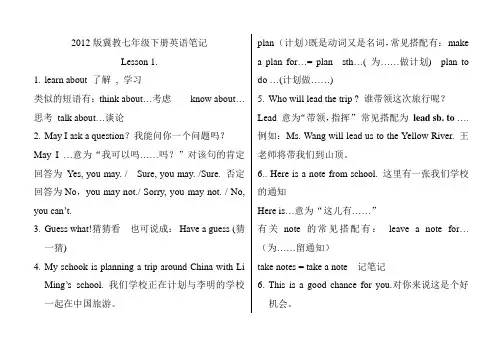
2012版冀教七年级下册英语笔记Lesson 1.1.learn about 了解, 学习类似的短语有:think about…考虑know about…思考talk about…谈论2.May I ask a question?我能问你一个问题吗?May I …意为“我可以吗……吗?”对该句的肯定回答为Yes, you may. / Sure, you may. /Sure. 否定回答为No,you may not./ Sorry, you may not. / No, you can’t.3.Guess what!猜猜看也可说成:Have a guess (猜一猜)4.My schook is planning a trip around China with LiMing’s school. 我们学校正在计划与李明的学校一起在中国旅游。
plan (计划)既是动词又是名词,常见搭配有:make a plan for…= plan sth…( 为……做计划) plan to do …(计划做……)5.Who will lead the trip ? 谁带领这次旅行呢?Lead 意为“带领,指挥”常见搭配为lead sb. to …. 例如:Ms. Wang will lead us to the Yellow River. 王老师将带我们到山顶。
6.. Here is a note from school. 这里有一张我们学校的通知Here is…意为“这儿有……”有关note 的常见搭配有:leave a note for…(为……留通知)take notes = take a note 记笔记6.This is a good chance for you.对你来说这是个好机会。
有关chance 的常见搭配有: a good chance for….(……的好机会)have a chance to do…( 有机会做……)7. I will send Li Ming an E-mail and tell him the good news. 我将给李明发邮件告诉他这个好消息。
七年级下册unit 1重要知识点
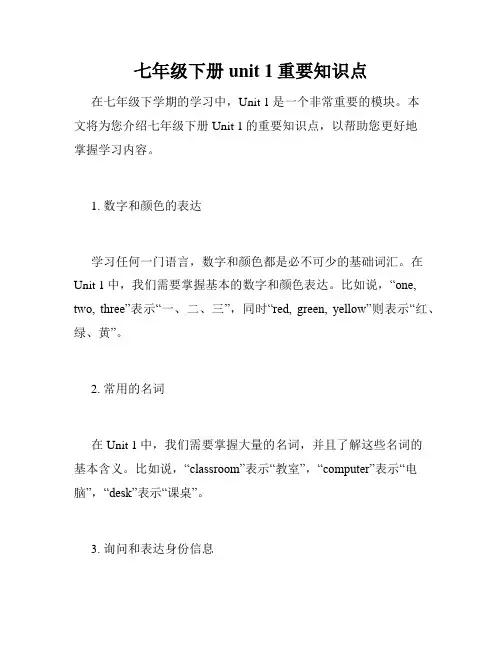
七年级下册unit 1重要知识点在七年级下学期的学习中,Unit 1是一个非常重要的模块。
本文将为您介绍七年级下册Unit 1的重要知识点,以帮助您更好地掌握学习内容。
1. 数字和颜色的表达学习任何一门语言,数字和颜色都是必不可少的基础词汇。
在Unit 1中,我们需要掌握基本的数字和颜色表达。
比如说,“one, two, three”表示“一、二、三”,同时“red, green, yellow”则表示“红、绿、黄”。
2. 常用的名词在Unit 1中,我们需要掌握大量的名词,并且了解这些名词的基本含义。
比如说,“classroom”表示“教室”,“computer”表示“电脑”,“desk”表示“课桌”。
3. 询问和表达身份信息在英语交流中,询问和表达身份信息是常见的交流方式。
在Unit 1中,我们需要掌握询问和表达体育和音乐运动偏好、年龄、国籍、职业等基本身份信息的表达方式。
4. 简单的动词和动词短语在Unit 1中,我们需要掌握一些简单的动词和动词短语,比如说“sing”表示“唱歌”,“dance”表示“跳舞”,“play basketball”表示“打篮球”。
5. 简单的句型和短语在Unit 1中,我们需要掌握一些基本的句型和短语,比如说“Hello, my name is…”表示“你好,我的名字是……”,“What’s your name?”表示“你叫什么名字?”,“Nice to meet you”表示“很高兴遇见你”。
6. 阅读和听力技巧在Unit 1中,我们需要学会阅读和听力的基本技巧。
比如说,我们需要掌握如何从文章中获取信息,如何获取对话和细节信息等阅读技巧,同时,我们还需要学会听取信息和获取细节等听力技巧。
7. 学习策略在学习Unit 1的过程中,我们还需要学会一些学习策略。
比如说,我们需要学会如何管理时间,如何防止拖延,如何独立思考等学习技巧。
总结:Unit 1是七年级下学期的重要模块,我们需要掌握许多基本的词汇、句型、短语、阅读和听力技巧,并学会一些学习策略。
七年级英语冀教版下册Unit1_Lesson2_基础知识过关
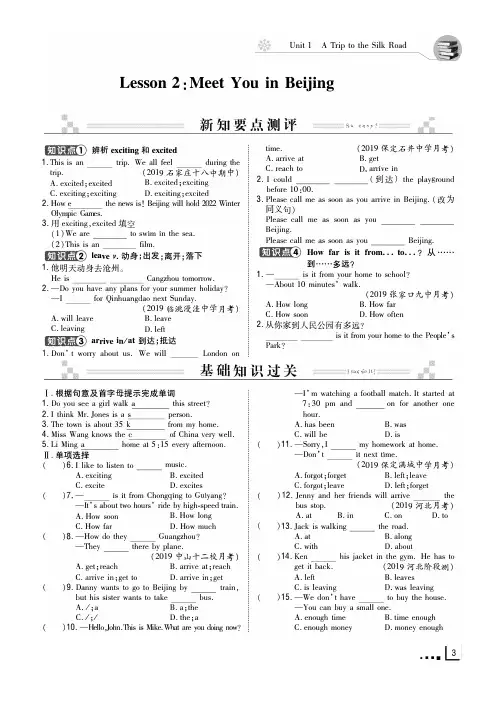
语法专练
单项选择 1.C 2.D
3.D
4. A
5.B
话题写作指导
写作积累 I.话题词汇 (1)trip (2)exciting (3)culture (4)arrive (5)leave (6)甘礼木甘 (7)参观;旅游 (8)作为……而出名/以……而出名 2. 常用句型 (1)went on a trip (2)took a train (3)learn about;along (4)had a
5.Li Ming a
home at 5 : 15 every afternoon.
II单项选择
( )6.I like to listen to
music.
A.exciting
B.excited
C.excite
D.excites
( ) 7. —
1s 1t from Chongqmg to Gmyang?
能力素养提升 I.根据句意及所给提示,在横线上填写一 个正确的单词 I.his 2.safe 3.another 4.fell 5.main
Lesson 7 : What's Your Project about?
新知要点测评 知识点1 1. A 2. I plan to read some books and visit some places of
(l)We are
to swim m the sea.
(2)This is an
film.
"'""""''"'"""''"'心
leave v. 动身;出发;离开;落下
2012版冀教版七年级英语下第一单元笔记
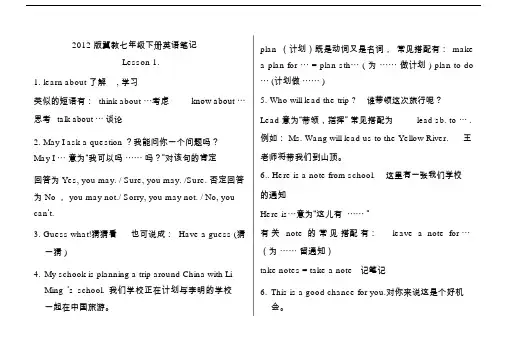
2012 版冀教七年级下册英语笔记Lesson 1.1. learn about 了解, 学习类似的短语有: think about ⋯考虑know about ⋯思考talk about ⋯谈论2. May I ask a question ?我能问你一个问题吗?May I ⋯意为“我可以吗⋯⋯吗?”对该句的肯定回答为 Yes, you may. / Sure, you may. /Sure. 否定回答为 No , you may not./ Sorry, you may not. / No, you can’t.3. Guess what!猜猜看也可说成:Have a guess (猜一猜 )4.My schook is planning a trip around China with LiMing ’s school. 我们学校正在计划与李明的学校一起在中国旅游。
plan (计划)既是动词又是名词,常见搭配有:make a plan for ⋯ = plan sth⋯ ( 为⋯⋯做计划 ) plan to do ⋯ (计划做⋯⋯ )5. Who will lead the trip ?谁带领这次旅行呢?Lead 意为“带领,指挥” 常见搭配为lead sb. to ⋯.例如: Ms. Wang will lead us to the Yellow River.王老师将带我们到山顶。
6.. Here is a note from school.这里有一张我们学校的通知Here is⋯意为“这儿有⋯⋯”有关note 的常见搭配有:leave a note for ⋯(为⋯⋯ 留通知)take notes = take a note记笔记6.This is a good chance for you.对你来说这是个好机会。
有关 chance 的常见搭配有: a good chance for ⋯ .(⋯⋯的好机会) have a chance to do⋯ ( 有机会做⋯⋯ )7.I will send Li Ming an E-mail and tell him the good news. 我将给李明发邮件告诉他这个好消息。
冀教版初中英语七年级下册《Unit 1》复习课件
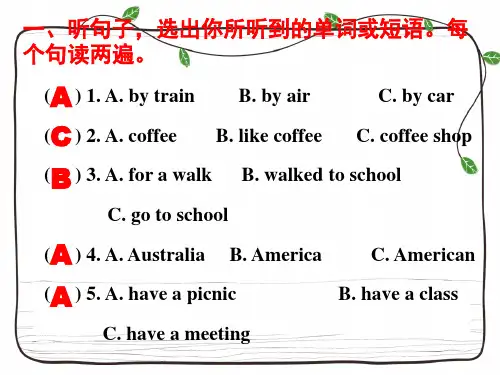
三、重点短语
1. go on a trip to sw. have a good trip
5. The mountain is 8848.13 metres high. How high is the mountain ?
6. The Great Wall is over 2,000 years old.
How old is the Great Wall ?
7. exciting 与excited 主语为人,用excited,同时构成短语be excited 意为
your left.
二、重点动词结构
1. have a chance to do sth. 有机会做某事
I have a chance t__o__s__e_ e(see) the Beijing Opera.
2. enjoy doing sth.
喜欢做某事
My father enjoys _r_e__a_d__i_n__g_ (read) newspaper.
2. How far is it from …to…?
2945 km 1100 km
643 km
1114 km
3. The Silk Road is about 6,500 kilometres long. How long is the Silk Road ?
4. The road is about twenty metres wide. How wide is the road ?
七年级下册英语冀教版第一单元知识点
七年级下册英语冀教版第一单元知识点全文共6篇示例,供读者参考篇1Unit 1: A letter to a pen palHey there! It's me again, your friendly neighborhood English learner. Today, I want to share with you what I've learned from Unit 1 of our new English textbook. It's all about writing letters to pen pals, which sounds super exciting to me!The first thing we learned was the format and style of a friendly letter. It's different from the formal letters we've seen before. A friendly letter starts with the date at the top right corner, followed by a greeting like "Dear [name]" or "Hi [name]". Then comes the body of the letter, where you can write about anything you want to share with your pen pal.Next up, we talked about the content of a letter to a pen pal. Our teacher said it's important to introduce yourself and share some personal details, like your age, hometown, family, hobbies, and interests. This helps your pen pal get to know you better and find common ground.We also learned about asking questions to keep the conversation going. You can ask your pen pal about their life, interests, and opinions on different topics. This shows that you're genuinely interested in them and want to learn more.Another key point was using appropriate language and tone. Since it's a friendly letter, we should use informal language and a conversational tone, just like we're talking to a friend. No need for fancy words or overly formal expressions.Speaking of language, we learned some useful vocabulary and expressions for writing pen pal letters. Words like "interests," "hobbies," "favorite," "opinion," and "recommend" came up a lot. We also learned how to express gratitude, like "Thank you for your letter" or "I appreciate your time."Oh, and let's not forget about organizing our thoughts! A good pen pal letter should have a clear structure, with an introduction, body paragraphs, and a conclusion. This makes it easier for the reader to follow along and understand what we're trying to say.Lastly, our teacher reminded us about the importance of proofreading and editing. We should check for spelling, grammar, and punctuation errors before sending our letters.After all, we want to make a good impression on our new pen pals!Phew, that's a lot of information, but I'm excited to put it into practice and start writing to my pen pal. Who knows, maybe we'll become best friends, even though we live in different parts of the world!Anyway, that's all I've got for now. Let me know if you have any questions or need help with your pen pal letters. Until next time, happy writing!篇2Hello friends! Today I want to share with you what I've learned recently in my English class. We just started a new unit in our textbooks, and it's all about food! Yum, my favorite topic.The first thing we learned was how to talk about different foods and meals. Breakfast, lunch, and dinner are the main meals we eat every day. For breakfast, some common foods are eggs, toast, cereal, pancakes, and fruit. My favorite breakfast is waffles with strawberries and whipped cream! At lunch, people often eat sandwiches, salads, soups, or leftovers from last night's dinner. Dinner is usually the biggest meal with things like meat, vegetables, pasta, rice, and so on.We also learned to describe the taste of foods using adjectives like sweet, sour, salty, spicy, bitter, and delicious. Chocolate is super sweet, while lemons are really sour. I don't like really spicy foods, they make my mouth burn! But generally I think most foods are delicious if they are prepared well.Another useful vocabulary set was words related to preparing food and cooking. You need ingredients like flour, sugar, butter, and eggs to bake things. Utensils like pots, pans, spatulas, and whisks are used for cooking on the stove. And appliances like the oven, microwave, blender, and toaster help make cooking easier. I'm not allowed to use the oven by myself yet, but I can make simple things in the microwave.We spent some time talking about different types of cuisines too. American food has things like hamburgers, hot dogs, fries, and apple pie. Italian cuisine is famous for pizza and pasta dishes. Indian curries with spicy sauces are also really tasty. Chinese food like dumplings, fried rice, and noodles is probably my favorite! The variety of international foods is just endless.Overall, I find this unit on food really interesting and useful. Learning new vocabulary and expressions helps me describe my eating habits and favorite dishes. When I go to restaurants, I can try to figure out what dishes are from reading the descriptions.And who knows, maybe I'll be a famous chef one day and invent my own signature dishes!Cooking is also a fun activity to try at home with some help from parents. Last weekend, my mom showed me how to make chocolate chip cookies from scratch. Following a recipe carefully is important to get it right. First we mixed the dry ingredients like flour and baking soda. Then we creamed together the wet ingredients - butter, sugar, vanilla, and eggs. After combining everything and folding in the chocolate chips, we scooped rounds of dough onto baking sheets and baked them for 10 minutes. The whole house smelled amazing! My cookies turned out a little burnt on the bottom, but they were still delicious when they cooled off.I can't wait to learn more cooking skills and try making different international dishes. Maybe I'll host my own bake sale one day and get my friends to taste test everything! For now though, I've got to focus on my English studies. This food unit is packed with so much good stuff to learn. I'm feeling hungry just thinking about it all...okay, time for a snack break! Let me go grab an apple and I'll talk to you all again soon.篇3My Journey into the 7th Grade English TextbookHi there, friends! It's me, your pal Jessica, back with another exciting adventure into the world of English learning. This time, I'm diving headfirst into the 7th grade English textbook, and let me tell you, it's been quite a ride!Unit 1: Exploring the Great OutdoorsThe first unit of our textbook is all about the great outdoors and the wonders of nature. Can you believe it? We're learning about things like camping, hiking, and even survival skills! Talk about an adventurous start to the school year.One of the most interesting parts of this unit was learning about the different types of camping. Who knew there were so many ways to experience the great outdoors? From tent camping to RV camping, and even glamping (that's glamorous camping, for those of you who didn't know), we covered it all.But it's not just about pitching tents and roasting marshmallows. We also learned about the importance of respecting nature and being responsible campers. That means leaving no trace, following the "leave no trace" principles, and being mindful of our impact on the environment.Speaking of the environment, we delved into some pretty cool vocabulary related to nature and outdoor activities. Words like "wilderness," "panorama," and "pristine" became our new best friends. And let's not forget the exciting verb phrases like "pitch a tent" and "build a campfire" – because what's camping without those essential skills?But wait, there's more! We also explored the world of hiking and the different types of trails you can tackle. From easy,well-marked trails to challenging backcountry treks, we learned about the importance of proper preparation and safety measures. Who knows, maybe one day we'll be tackling the Appalachian Trail or the Pacific Crest Trail!And if you thought camping and hiking were the only things we covered, think again! We also learned about survival skills and what to do in case you ever find yourself in a sticky situation out in the wilderness. Things like building a shelter, finding water sources, and even starting a fire with just a few simple tools. Let's just hope we never have to put those skills to the test!Unit 1 Grammar GoodiesWe dove into the world of modal verbs like "can," "could," "should," and "must." These little guys help us express things likeability, permission, obligation, and advice. Who knew they could be so handy when planning an outdoor adventure?Speaking of adventures, we also learned about the present continuous tense and how to use it to describe ongoing actions. Because let's face it, when you're out in the wilderness, things are always happening – hiking, setting up camp, or even fending off a hungry bear (just kidding, we haven't covered that part yet!).And let's not forget about prepositions of place and movement. These little words help us navigate the great outdoors by describing where things are and how they move. After all, you need to know how to "hike along the trail" or "camp by the lake" if you want to be a true outdoor enthusiast.Unit 1 Wrap-UpPhew, what a journey it's been! From learning about the different types of camping and hiking to mastering survival skills and tackling grammar concepts, Unit 1 of our 7th grade English textbook has been an absolute blast.But don't worry, the adventure doesn't stop here. We've still got plenty more units to explore, each with its own set of exciting topics and language challenges. Who knows what adventures await us in the next unit?Until then, keep practicing your English skills, and don't forget to pack your virtual camping gear – we might need it for our next outdoor escapade!篇4Title: Exploring Unit 1 of the 7th Grade English TextbookHi there! My name is Emily, and I'm a 7th grader at Sunshine Middle School. I've been learning English since I was a little kid, and I have to say, it's been quite a journey! Recently, our class started studying Unit 1 of our new English textbook, and let me tell you, it's been an adventure!The first thing that caught my attention was the unit's title: "Making Friends." As a kid, making friends is such an important part of growing up, and it's fascinating to see how this theme is explored through the lens of the English language. The unit introduces us to various characters, like Lily and her friends, who are navigating the ups and downs of friendship and social interactions.One of the key language points we learned is how to express likes and dislikes. This might seem like a simple concept, but it's actually quite crucial in building relationships and communicating effectively. For example, we learned how to saythings like "I like playing basketball" or "I don't like spicy food." These phrases might seem basic, but they help us connect with others and share our interests and preferences.Another important aspect of the unit is learning how to introduce ourselves and ask questions about others. We practiced dialogues like "What's your name?" and "Where are you from?" These simple phrases open up the door to building new friendships and learning about each other's backgrounds and cultures.Speaking of cultures, the unit also touched on the importance of understanding and respecting different customs and traditions. We learned about various greetings and gestures used in different parts of the world, which was reallyeye-opening. It's amazing how something as simple as a handshake or a bow can have such different meanings across cultures.One of my favorite parts of the unit was learning about idioms and expressions related to friendship. Phrases like "a friend in need is a friend indeed" and "make new friends, but keep the old" really resonated with me. They reminded me of the value of true friendship and the importance of maintaining strong bonds with the people who matter most.One particular grammar point that stuck with me was the use of modal verbs like "can," "should," and "must." These little words pack a big punch when it comes to expressing ideas like ability, permission, and obligation. For example, "You should be a good friend and listen to others" or "Can you help me with my homework?" These modal verbs add nuance and depth to our communication.Another aspect of the unit that I found really interesting was the focus on writing skills. We learned how to write friendly letters and emails, which is a great way to maintain connections with friends and family members who live far away. We practiced using appropriate greetings, closings, and language to convey our thoughts and feelings in a letter format.Throughout the unit, we also engaged in various activities and games to reinforce the concepts we were learning. From role-playing dialogues to vocabulary games, these interactive exercises made the learning process fun and engaging. One of my favorites was the "Friendship Bingo" game, where we had to find classmates who matched different descriptions related to friendship, like "someone who likes the same sports as you" or "someone who has the same favorite book as you."As we progressed through the unit, I couldn't help but reflect on the importance of friendship in our lives. Friendships provide us with support, laughter, and shared experiences that shape who we are. Learning about friendship in the context of the English language not only helped us improve our language skills but also gave us valuable insights into building and maintaining meaningful relationships.Overall, Unit 1 of our 7th grade English textbook was a fantastic introduction to the world of friendship and interpersonal communication. From expressing likes and dislikes to understanding cultural nuances, we covered a wide range of topics that will undoubtedly be useful as we navigate the social landscape of middle school and beyond.I'm grateful for the opportunity to learn about these important concepts in a fun and interactive way. Who knows, maybe someday I'll use the skills I learned in this unit to make friends with someone from another country or culture! The possibilities are endless when you have the power of language at your fingertips.篇5Hi there! It's me again, your friendly neighborhood kid who loves to learn English. Today, I want to share with you all the cool stuff I learned from Unit 1 of my Grade 7 English textbook. Get ready for a fun ride!The first thing we covered was asking and answering questions about personal information. It's like playing a game of 20 Questions, but in English! We learned how to ask things like "What's your name?", "How old are you?", "Where are you from?", and "What's your favorite subject?". I love asking my friends these questions and finding out more about them.Next up, we learned how to introduce ourselves and others. It's like being a TV host, but instead of introducing celebrities, we're introducing our classmates and family members. We practiced saying things like "This is my friend, Alice. She's from Beijing." or "That's my dad. His name is Robert." It's super handy for when we have guests or meet new people.Then, we moved on to talking about our daily routines and habits. I'm sure you all have your own routines, like waking up, brushing your teeth, having breakfast, and going to school. Well, now we can describe all of that in English! We learned phrases like "I get up at 7 o'clock every morning" and "I always do myhomework after school." It's like giving a play-by-play of our day, but in a different language.Speaking of language, we also learned how to talk about the languages we speak or study. For example, I can now say "I'm learning English at school" or "My mom speaks Spanish fluently." It's like having a secret code with your friends who also learn languages.But wait, there's more! We also covered talking about our hobbies and interests. I love telling people that "My favorite hobby is playing basketball" or "I'm really interested in science experiments." It's a great way to find friends who share the same interests as you.And that's not all! We even learned how to describe people's appearances and personalities. So, if I wanted to describe my best friend, I could say something like "She has long, curly hair and a friendly personality." It's like painting a picture with words, but the canvas is your imagination.Last but not least, we learned how to talk about our family members and their occupations. I can now say things like "My dad is a teacher" or "My aunt is a doctor." It's like having a family tree, but instead of just names, you get to know what everyone does for a living.Phew, that was a lot of information, wasn't it? But don't worry, we'll keep practicing and reviewing until it all becomes second nature. Learning a new language is like unlocking a secret world, and I'm so excited to explore it with you.Keep shining, my fellow English learners! Remember, practice makes perfect, and before you know it, we'll be chatting away like native speakers. Until next time, take care and keep on learning!篇6Hello! My name is Emily and I'm a 7th grader. In English class this semester, we're using a new textbook and just started the first unit. It's all about sports and keeping fit. I wanted to share what I've learned so far because I think it's really interesting and important stuff!The first thing we talked about was how physical activity is crucial for maintaining good health. Our teacher explained that regular exercise helps strengthen our hearts, lungs, and muscles. It also boosts our immune systems to help us fight off illnesses. I didn't realize just how many benefits there are from being active!We learned about some of the different types of exercise too. Aerobic activities like running, swimming, and cycling get yourheart pumping and improve cardiovascular fitness. Strength training with weights or resistance bands builds muscle. Flexibility exercises like yoga and stretching prevent injuries and increase your range of motion. Our teacher said it's best to mix different kinds of activities for overall fitness.Another really important point was about following safety precautions when playing sports or exercising. You're supposed to wear protective gear like helmets, kneepads, etc. Warming up beforehand prevents pulled muscles. Staying hydrated is crucial, especially in hot weather. And you have to use proper techniques to avoid injuries. Safety first!One thing I found fascinating was learning about how different cultures have their own unique traditional sports and games. For example, we read about bocce ball which originated in Italy. And sepak takraw is like a cross between volleyball and soccer that's really popular in Southeast Asia. It's so cool to see the creative games people have invented all over the world!We also spent some time discussing nutrition and how the foods we eat impact our energy levels and overall health. Our teacher went over the different food groups and which nutrients our bodies need. Things like whole grains, fruits, veggies, lean proteins, and healthy fats should make up the bulk of our diets.But sugary, fatty, salty, and processed foods aren't good for us, at least not in large amounts.Another key point was developing positive habits and attitudes toward physical activity from a young age. Our teacher stressed how important it is to find activities we genuinely enjoy since we're more likely to stick with them. She said not to get discouraged if we're not naturally athletic - just focus on doing our best and having fun. The goal is simply to get moving regularly!My personal favorite part so far has been learning about some famous athletes and their inspiring stories. We read about people who overcame major obstacles through hard work and perseverance to become champions in their sports. It just goes to show that with enough passion and dedication, you really can make your dreams come true against all odds!Overall, this unit has been eye-opening. I had no clue just how critical exercise, nutrition, and an active lifestyle are for kids my age. Our teacher has really emphasized that developing these healthy habits now will pay off big time down the road. I'm feeling motivated to get out there and try some new physical activities myself. Maybe I'll take up swimming or kickboxing -who knows? All I know is, this stuff is way too important to ignore. Gotta get moving!。
英语七年级下册第一单元知识点
英语七年级下册第一单元知识点第一单元的主要知识点包括:问候语、自我介绍、数字1-100、国籍和语言、家庭成员、职业、日常活动等。
这些内容贯穿了日常生活的方方面面,是我们学习英语的基础,也是我们和外国人交流的基础。
接下来,我将逐一对这些知识点进行介绍和展开。
1. 问候语在日常交流中,问候是人们最基本的交际方式之一。
在英语中,常见的问候语包括:Hello, Hi, Good morning, Good afternoon, Good evening等。
这些问候语用于不同的时间段和场合,是我们与外国人交流时必不可少的部分。
2. 自我介绍自我介绍是我们认识新朋友时必不可少的环节。
在英语中,自我介绍通常包括自己的尊称、芳龄、国籍和语言、家庭成员等。
还需要掌握一些表达个人爱好和特长的词汇和句子,以便更好地向他人展示自己。
3. 数字1-100数字是我们日常生活中不可或缺的一部分。
在英语中,数字的表达方式与中文有所不同,需要我们逐一学习和掌握。
我们还需要了解一些关于时间、日期和价格的表达方式,以便更好地进行交流。
4. 国籍和语言国籍和语言是人们之间相互了解的重要方面。
在英语中,我们需要学习如何表达自己的国籍和语言,同时也需要学会询问他人的国籍和语言。
这不仅有助于增进我们之间的了解,也为日后的学习和工作打下了良好的基础。
5. 家庭成员家庭是每个人生活中最重要的一部分。
在英语中,我们需要学会表达家庭成员的称呼,如父母、兄弟姐妹等。
还需要学习如何询问他人的家庭情况,以便更好地了解彼此。
6. 职业职业是人们日常生活中的重要内容。
在英语中,我们需要学会表达自己的职业,并了解一些常见的职业名称和描述。
还需要学习如何询问他人的职业,以便更好地进行交流。
7. 日常活动日常活动是我们生活中不可或缺的一部分。
在英语中,我们需要学会表达自己的日常活动,如学习、吃饭、运动等。
还需要了解一些关于日常活动的常用词汇和句子,以便更好地进行交流。
冀教版七年级下册英语Unit 1 Lesson 1 A Trip to China 授课课件
知识点 2 …mayIaskyouaquestion?
考点2 【重点】MayI/we...? 我/我们可以……吗? 考向 MayI/we...? 句型是表达请求对方许可的交际用语。
其肯定回答为“Yes, youmay. /Ofcourseyoumay. /Yes, please. /Ofcourse. /Certainly. /Goodidea.”等; 其否定回答为“I’msorry, youcan’t. /I’mafraidnot. /You’dbetternot. /I’msorry, but...”等。 eg:—MayIuseyourpencil? 我可以用你的铅笔吗? —Yes, please. 可以,用吧。
知识点 3 Whowillleadthetrip? 考点3 leadv. 意为“带领”。名词为leader,意为
“领导;首领”。 eg:Mr. Whiteleadsustovisitthebeautifulpark. 怀特先生带领我们参观这个漂亮的公园。 考向 leadto意为“通往;导致” eg:
Thepathgoesthroughthewoodsandleadstothevi
llage. 这条小路穿过树林,通往那村庄。
考点4 trip用作可数名词,意为“旅行”,通常指时 间较短、距离较近的旅行,旅行方式不变,并
且意味着旅行结束后还要回到原来的地方。
考向
trip常见短语:atripto...一次去……的旅行 goonatripto...去……旅行 eg:Haveagoodtrip! 旅途愉快!
backonMarch15. Formoreinformation, pleasecometothemeetingonWednesdayat7p.m. Yourstruly, Mr. BrianFranklin
七年级下册英语第一单元知识总结
七年级下册英语第一单元知识总结
第一单元主要讲述了有关学校和课程的相关知识,以下是该单元的知识总结:
1. 学校相关
(1) 学校设施和建筑: 如主楼、图书馆、操场等。
(2) 学校活动: 如运动会、文艺节、英语俱乐部等。
(3) 学校规章制度: 如校服、迟到、早退等。
2. 课程相关
(1) 学科: 如数学、英语、科学、历史等。
(2) 课程安排: 如每周几节课,每天上几节课等。
(3) 课程内容: 如地理、生物、化学等。
(4) 课程形式: 如听课、讲课、研究性学习等。
3. 语言技能
(1) 询问信息: 如询问姓名、班级、年级等。
(2) 表达意见和想法: 如谈论自己的爱好、喜欢的学科等。
(3) 客套用语: 如感谢、道歉、祝愿等。
(4) 阅读理解: 如从短文中获取信息等。
4. 情景交际
(1) 与老师交流: 如向老师请假、提问等。
(2) 与同学交流: 如介绍自己、表达赞同或不赞同等。
(3) 其他交际: 如与新同学相识、向陌生人寻求帮助等。
以上是七年级下册英语第一单元的主要知识点,通过学习这些知识点,学生可以更好地了解学校和课程相关的知识,同时提高语言技能和情景交际能力。
英语知识点七年级下册冀教版总结
英语知识点七年级下册冀教版总结前言作为一名资深的创作者,我对于中学英语教材的总结充满了热情。
在这篇文章中,我将对冀教版七年级下册英语知识点进行总结,希望能够帮助广大学生更好地掌握这些知识,提高英语学习的效果。
正文语法知识点本册教材中的语法知识点主要包括:1.一般现在时–表示经常性行为或客观事实–句型:主语 + 动词原形2.现在进行时–表示现阶段正在进行的动作–句型:主语 + be动词 + 动词-ing形式3.一般过去时–表示过去发生的动作或存在的状态–句型:主语 + 动词过去式4.祈使句–表示命令、请求、建议等意义–句型:动词原形 + 其他词汇知识点本册教材中的词汇知识点主要包括:1.家庭成员•爸爸(father)•妈妈(mother)•姐姐(sister)•哥哥(brother)2.身体部位•头(head)•肩膀(shoulder)•脚(foot)•手(hand)3.动物•狗(dog)•猫(cat)•鱼(fish)•鸟(bird)句型及对话本册教材中的句型及对话主要包括:1.表示方位的句型:–Where is the library?(图书馆在哪里?)–It’s next to the park.(它在公园旁边。
)2.表示喜好的句型:–What do you like?(你喜欢什么?)–I like swimming.(我喜欢游泳。
)3.询问身体状况的句型:–How are you?(你怎么样?)–I’m fine, thank you.(我很好,谢谢。
)结尾通过对冀教版七年级下册英语知识点的总结,我们可以发现这些知识点涵盖了语法、词汇以及常用句型。
掌握这些知识点,对于提高英语水平和应对考试将会有很大的帮助。
希望广大学生能够认真学习,并在实践中不断巩固所学知识。
祝愿大家在英语学习的道路上取得更大的进步!前言作为一名资深的创作者,我对于中学英语教材的总结充满了热情。
在这篇文章中,我将对冀教版七年级下册英语知识点进行总结,希望能够帮助广大学生更好地掌握这些知识,提高英语学习的效果。