
【人教pep版】五年级下册英语:Unit 5 Part A说课稿
百度文库:教学资料
教学资料---说课稿设计
Unit5 Whose dog is it? Part A 说课稿
一、 说教材
教材内容是人教社出版的PEP新教材五年级下册Unit 5Whose
dog is it?Part A部分,本节课的课型是词汇和会话的整合课.这部分的
内容是新教材新编排的内容.新版《课程标准》告诉我们“现代外语
教育注重语言学习的过程,强调语言学习的实践性,主张学生在语境
中接触、体验和理解真实语言,并在此基础上学习和运用语言.”
本节课出现的形容词性物主代词在以前有学到过my, your, our,
his, her,但没有这么系统地整理出来,总结出来.而新教材这样编排,
肯定是值得研究的.
这一课时围绕Whose dog is it?这一话题展开,通过对话与交流,
学习六个名词性的物主代词mine/ yours/ hers/ his/ ours/ theirs,懂得
以前学过的形容词性的物主代词后面是要加名词的,而这六个名词性
的物主代词不需要,他本身已经代替了这个名词.其次是巩固和运用
三组句型:陈述句It’s my dog,The dog is mine. 特殊疑问句及回答
Whose dog is it?It is mine/ yours/ hers/ his/ ours/ theirs. 一般疑问句
及回答Are these all ours? Yes,they are./No, they aren’t. 学会在真实
的生活和学习的情景中运用,表达真实的意义.
二、结合学情说目标
1. 教学目标:
五年级的学生已经接触学习英语两年,已经学会形容词性物主代
百度文库:教学资料
教学资料---说课稿设计
词my/your/her/his/our/their,名词性的物主代词是今天要学的内容,
所以根据学生的学习情况,我制定了如下教学目标:
(1)知识目标:
能够学会并运用六个物主代词,能够使用句型It’s my dog,The dog
is mine. Whose dog is it?It is mine/ yours/ hers/ his/ ours/ theirs. 询问
Are these all ours? Yes,they are./No, they aren’t.对自己和他人的东西
进行介绍,询问调查.
(2)能力目标:培养学生知识迁移的能力,能联系实际谈论并
分清自己和别人的东西.
(3)情感目标:在创设的情景中培养学生关心他人,乐于助人
的精神.
在新编教材这一单元第一课时,我们要学习六个名词性物主代词
mine/ yours/ hers/ his/ ours/ theirs,要理解并运用这些物主代词就是
一个重点,而会灵活运用句型进行交流就是本节课的难点.
三、立足发展说教法
小学英语教学,应根据小学生的心理、性格、情感特点,创设学
生感兴趣的真实情景,让学生既轻松又高效的进行学习.我采用情景
教学法导入新课,然后采用任务型教学法,设计了一个谜语让学生猜.
然后又进行了一个真实的对话活动,使学生在师生、生生之间的多向
交流中进行真实的运用,让学生在做中学,用中学.课中,我将学生
分为六个小组,把小组评价与本单元的话题情景有机的结合起来.学
百度文库:教学资料
教学资料---说课稿设计
生积极的发言,比赛看哪组表现得最好,并给予小组加分鼓励.有效
的评价能够激励学生学英语的兴趣,树立学生学英语的自信心.一切
活动都以学生为本,逐步深入,达到生本课堂的目标.
四、培养能力说学法在学习方法上,应抓住学生的兴趣所在,主要使
用对比法学习单词.学习和运用句型则运用创设情境法,任务型活动
法和小组合作学习法,学生在真实的情景中学以致用,在自己喜欢的
任务中灵活运用语言.
五、情景互动说过程
本节课有一条主线:dog show----our show-----our talk show,通过
观察zoom和zip他们的dog show,感知了解,输入语言.然后通过穿
件我们自己的our show,模仿运用,内化语言.接着通过学习Chen Jie
和Mike谈论他们的picture show,我们也来谈论我们的show,这样
巩固交流,输出语言.继而实现从学到用.
(一)热身 (Warm-up)
1. Greeting.打招呼拉近与学生之间的距离.
2 .Guess a riddle.
(二)新课呈现 (Presentation)
1.创设情境导入学习6个单词.老师运用实物创设情景,引导学生
用已学的知识进行对话.I like reading books, Do you like books? Do you
have books? Show me your book, let’s see! Whose book is it? 引导学生
百度文库:教学资料
教学资料---说课稿设计
学习并回答,把学生提到的物主代词板书到黑板上.再引导学生自主
预习:这些词组我们可以用什么词代替,变得更简洁?
2.分两个层次由易到难地展开学习,小组问答、男女生问答、二
人问题和锁链式问答等.让学生通过问答,巩固句型,为下一步任务
型教学活动做好准备.
3.创设任务our show.通过学习文本中let’s learn:dog show.创建
我们的show.教师在学生活动时,在各小组巡视,检查学生能否用更
多的名词性物主代词进行交流.任务完成后,各小组展示,不仅展示
了他们的英语表达能力,也展示了他们小组的各具特色的物品.
设计理念:我们采取小组合作的学习方式,在学生中进行真实的
物品展示.评价时以小组为单位进行,意在促进小组成员中形成互帮
互学,共同提高的目的.充分发挥优化组合的整体功能,培养学生的
团结精神.
(三)巩固操练 (Practice)
老师参与到小组展示中去,好奇的开始询问物品的主人是谁?导
入学习句型Whose ..is it??It’s my The..is mine.
设计理念:设疑引出重点句型,学习问答之后导入听录音想答案,
再听填空理解内容,之后跟读学习,多种形式朗读达到创编对话的目
的.分层学习,逐步推进,降低难度,学生容易掌握.
(四)总结评价(Summary)
总结了本节课的内容,系统的归纳了两组代词,梳理了知识.相信学
生们的印象会更加深刻.
五级英语下册 unit5 partA课件 人教PEP(通用)
•
13、乍见翻疑梦,相悲各问年。。2021/5/142021/5/142021/5/142021/5/145/14见青山。。2021年5月14日星期五2021/5/142021/5/142021/5/14
•
15、比不了得就不比,得不到的就不要。。。2021年5月2021/5/142021/5/142021/5/145/14/2021
Look at the monkey. What is it doing?
It’s eating bananas. It’s hungry.
The baby kangaroo is so cute. It’s sleeping.
What about the mother kangaroo? What is she doing?
She’s jumping.
Do you see any elephants? I love elephants.
Yes. Look at there! That elephant is drinking water
with its trunk.
()
()
()
()
Write the answers and the questions. (1) What is the mother kangaroo doing? (2) Sh_e__is__ju__m_p_i_n_g_._________________
下
载
观
看
•
10、阅读一切好书如同和过去最杰出的人谈话。2021/5/142021/5/142021/5/145/14/2021 2:11:08 AM
•
11、越是没有本领的就越加自命不凡。2021/5/142021/5/142021/5/14May-2114-May-21
人教PEP版英语五年级下册Unit 5 Part A let's talk课件

Class practice
— No. It's Zhang Peng'.s
Q5: 对话3
— That picture of Shanghai is beautiful.
?
— It's Binbin's.
Chen Jie: The yellow picture is mine. Are these all ours?
Mike: Yes, they are. Chen Jie: Wow! That picture of Beijing is beautiful.
Mike: Hey ! ChenJie: Oh,it's
dog is this?
. He's
. He's very tired.
Zip: Wow ! What a beautiful painting !
Is it
?
Zoom: No. It's
.
第一次朗读, 回在下顾老完对师成肢第话体 二意语次言朗思帮读。助。
Whose is it? Mike: It’s Zhang Peng’s. Chen Jie: Look! There is a picture of Shanghai, too. Mike: It’s Binbin’s. Chen Jie: Oh, yes! It’s his.
Class practice
人教版PEP小学英语五年级下册Unit 5 教案
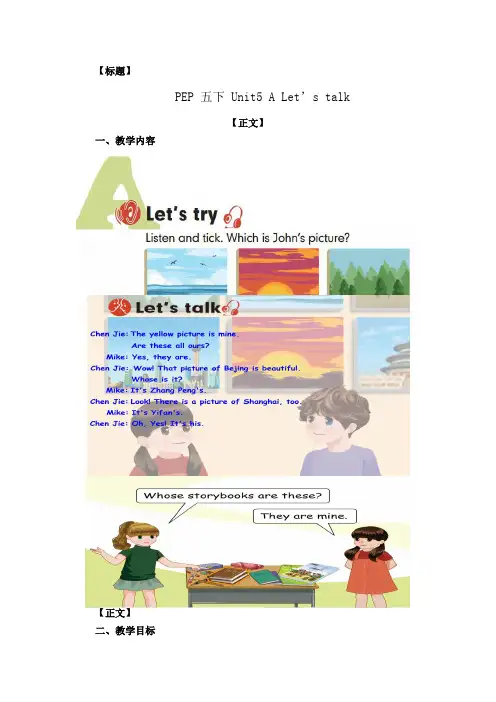
【标题】PEP 五下 Unit5 A Let’s talk【正文】一、教学内容【正文】二、教学目标(一)知识与技能:1.能够听懂、会说、会认读 Let's talk部分的名词性物主代词his,hers,mine和ours.2.能够理解并运用所学句型来谈论物品的归属。
如:Whose ___is it?It's____'s.It's hers/his/mine/ours或复数形式: Whose____are these? They're_____'s.They're hers /his/mine/ ours.3.能够在情境中合理并灵活运用所学知识,相互之间自如问答。
(二)过程与方法:能通过小组活动与探究,理解名词性物主代词的用法与规律。
并在小组活动中完成任务教学,提高学生的语言运用能力。
(三)情感态度与价值观:通过表达物主代词的概念,培养学生热爱周围物品与保管好自己物品的意识。
三、教学重点难点重点:能运用句型及名词性物主代词进行关于物品归属的话题交流。
难点:能初步了解形容词性物主代词和名词性物主代词的区别,并能正确使用,如:his hat=his;her shoes=hers等。
四、教学准备PPT、学习资源包、词条.学生已有知识储备:(PEP4 Unit5已学部分名词性物主代词)1.Are these yours? No,they aren't.2.Is this John's ? No,it isn't, it's Mike's.3.Whose coat is this? It's mine.4.Whose pants are those?They're your father's.五、教学过程Step1.Warm-up and Revision1.Enjoy a song:Whose hat is this?2.Let’s chant and sing.Whose hat is that? It’s my hat.His hat,her hat,your hat,my hat.Whose coat is that? It’s my coat.His coat,her coat,your coat,my coat. 设计意图:开篇用歌曲和chant,激发学生学习兴趣,同时,通过歌曲唤起学生已有的旧知,为本课要学习的内容做一个铺垫。
PEP小学五年级英语下册U5说课稿
Unit 5 Whose dog is it? Part B Let’s try&Let’s talk说课稿Good morning,everyone. I’m so great honor and pleasure to stand here and share my lesson with you. I’m going to talk about PEP Book 6 Unit 5 Part B Let’s try and Let’s talk. If learning is like a voyage on the sea, students are boats and the teaching material should be this beautiful sea. only by raising the sail of teaching strategies, relying on the teaching objects lighthouse guidance, the boat can ride the wind and waves, sailing to the other side of the ideal. Please join me on this voyage.Teaching material, Students, Teaching Objects, ,Teaching Strategies , and Teaching procedures.一、说教材(teaching material)The begin with, I will talk about Teaching Material.This lesson is Part B of Unit 5, it includes two parts: Let’s try and Let’s talk. “Sam is at Chen Jie’s home. They are talking about Fido, Chen Jie’s pet. The key words are: eating, drinking water, sleeping, take...to, and play ...with. The key sentences of this dialogues are” Where is Fido?” “ Is he eating?”And the answers. Help the students understand the present continuous tense in a real situation.二、说学生Students Besides the material, students are the most important part ofa lesson.The students are in Grade 5. They have learned English for about 3 years so far. They have taken more and more interests in English. 1.They are active to share their ideas to each other. 2, They are able to discuss and work in pairs and groups. 3. And they are interested in real and familiar topics. This Unit is about animals. This is an interesting topic for children. So it’s not difficult for them to learn this lesson.三、教学目标(Teaching Objects)The Core competences of English includes 4 dimensions: Language Ability, Thinking Quality, Learning Ability, and Cultural Awareness.According to these, and after studying the teaching material and the facts of the Students, I set up the teaching objective for E words:Enable students to understand , read and role-play the dialogue.Empower students to use the key words and sentences properly.Enhance students abilities of listing, speaking and working in pairs or groups.Enrich students’ understanding about being friendly to animals.四、说教学策略Teaching StrategiesNext, I am talking about Teaching Strategies. It include : Teaching methods and learning methods.1.说教法(teaching methods)In this lesson, I will mainly use “Situational teaching method”and “Task-based teaching method” . Let the Students learn in real situations and in activities. In this lesson,PPT, blackboard and cards will be used.2.说学法(Learning methods)As a teacher , I know “teaching students to fish is better than giving them fish”. So it is more important to Teach the students how to be good language learners.Let the students pass “Observation—Imitation—Practice”to study language.Teach the students how to master dialogues and how to communicate with others.五、教学过程(teaching procedures)Now, we come to the most important part ----Teaching Procedures. I will finish the lesson in4steps.Step 1. Warming-upAfter greeting with the Students, I will begin the lesson by singing the song“walking”and do the actions together with the Students. There are some present participles of the verbs like “walking, sleeping, running ,swimming.”in the song. Then ask “What animals can you see in the video?” Tiger , rabbit, pig ...Purpose(目的意图):To train children’s memory.1.Singing can draw students' attention arouse their interest.and alsolead them to the topic---animals.Step 2. Presentation(1)新授单词和句型Ask Students Do you like animals ? I like animals ,too . With the help of the PPT, I’ll show my pet . Let Students guess,”What’s it?” Maybe a dog? A rabbit? .. It’s a lovely cat. Next I’ll show a picture, “What is he doing?” and help Students say” He is eating .” Then show another picture “Is he eating?” Help them answer,” No, he isn’t. He is drinking. Teach “sleep” as the same way. Help them find and summarize: be ad the present participle of verb show someone is doing something. Then make a chant to practice the new words and sentences. like“doing,doing , what he doing? Eating , eating , he is eating. ...Purpose(目的意图):Using these lovely pictures To rise students learning interest.Help Ss To master new words and sentence patterns in a true situation.Chant can help the Students learn the language easily and naturally.(2)Let’s tryTell Students Chen Jie has a pet too. It’s name is Fido. First , talk about the 3 pictures of this part with Students. “Where is Fido? And What’s he doing”. Play the cassette and do listing exercise. Then check the answer. Then Listen again . “Sam wants to take Fido to the park. But, he can’t. Why? Help Students answer,”Because Fido is sleep.”A moment later, someone is knocking at the door. Guess, who is coming ? Look , It’s Sam.Purpose(目的意图):Through listening test to develop the students listening ability and understanding ability . And it is naturally to lead Ss to learn the nextpart“Let’s talk”.(3)Let’s talkIn this part,I will have some task for the students. First, let the listen to the dialogue. Answer the question”Is Fido sleeping now?”, Students and give the answer quickly.”No, it isn’t.” Then I’ll give them 3 more questions. After watching the video of the text, Students talk with their partner.” Where is Fido now? He’s in the kitchen.What is Fido doing?He’s eating.Can Sam take Fido to the park?Yes, he can.Purpose(目的意图):These tasks help the students understand the dialogue. Solve the meaning of the new words “take ...to”, to train the Students ability to understand the words in the dialogue.After that, Students watch the video and repeat.Pay attention to the pronunciation and intonation.Step 3. Practice1.I will practice the students with a new training method,Dubbing.By using the video, Students dub for Sam, then dub for Chen Jie.Purpose(目的意图):I think dubbing is a new and interesting way to practise the dialogue with correct pronunciation and intonation.2.Work in groups.4Ss in a group. Then have a dubbing show. One student act Fido. So that, Students feel that Fido is a member of the family. Purpose(目的意图):this task can Develop Ss’ ability of cooperation.Step 4. DevelopmentShow the pictures, Where is Fido now? He is in the park. Sam takes Fido to the Park. They are playing in the park.A moment later, Chen Jie is calling Sam. She missed Fido. Listen to the dialogue. Then Students work in pairs. After a few minutes, Students show their dialogue.Purpose(目的意图):To get the structure ready for Ss output.To provide chance to practice target language. Help SS to learn how to communicate with others.Step 5. Show some warm pictures. And say: Animals are our friends, in many People’s eyes, pets are their family members and they are used to describe them with "he" or "she".Purpose(目的意图):Enrich students’understanding about being friendly to animals.Step 6.Homework As for homework, Students need to read and role-play the dialogue. And make the sentences by using the key words and sentences.Purpose(目的意图):1.to consolidate what they have learned in the class. 1.to meet needs of different studentsThe journey of teaching. I am the captain of the teaching journey. Text and students are my helpful buddies. Objectives and activities are my guiding stars. Let’s set off with joyful hearts.。
人教pep英语五年级下册unit5大单元整体教学

人教pep英语五年级下册unit5大单元整体教学全文共6篇示例,供读者参考篇1Unit 5 - Our Beautiful EnvironmentHey there, fellow students! Are you ready to dive into another exciting unit of our English textbook? This time, we're going to explore the wonders of our beautiful environment and learn how to protect it. Get ready for some fun activities, interesting readings, and cool new words!Let's start with the warm-up section. We'll learn some useful expressions related to the environment, like "protect the environment," "reduce pollution," and "save energy." These phrases will help us understand and discuss environmental topics more easily.Next up, we have the listening part. We'll hear a dialogue between two friends talking about their school's environmental protection club. Pay close attention to the details they mention, like the club's activities and the reasons for joining. After listening, we'll practice some comprehension exercises to make sure we understood everything correctly.Then, it's time for the reading section! We'll read a fascinating article about a group of students who started a recycling project at their school. Imagine turning all those empty bottles and cans into something useful! As we read, we'll learn new vocabulary words like "recycle," "waste," and "sustainable." We'll also practice some reading comprehension skills by answering questions about the main idea, details, and vocabulary.But that's not all! In the speaking section, we'll have a chance to roleplay different situations related to environmental protection. For example, we might pretend to be members of the recycling club, trying to convince our classmates to join. Or we could act out a conversation between a parent and a child, discussing ways to save energy at home. These activities will help us practice our speaking skills while also learning important environmental lessons.The writing part is where we'll put our new knowledge into practice. We might write a letter to the school principal, suggesting ideas for making our school more eco-friendly. Or we could create a poster to raise awareness about the importance of reducing waste. Whatever the task, we'll learn how to organize our thoughts and express them clearly in writing.Throughout the unit, we'll also encounter fun activities and games related to the environment. For instance, we might play a memory game to review vocabulary words or participate in an environmental quiz to test our knowledge. These engaging activities will make learning even more enjoyable!But it's not just about the book. We'll also have the opportunity to participate in hands-on projects and field trips. Imagine visiting a local recycling center or organizing a school cleanup event. These real-life experiences will help us understand the importance of environmental protection in a practical way.By the end of this unit, we'll have gained a deeper appreciation for our beautiful environment and the role we can play in protecting it. We'll have improved our English skills in listening, speaking, reading, and writing, all while learning valuable lessons about sustainability and eco-friendliness.So, let's dive in and explore the wonders of Unit 5! Get ready to have fun, learn new things, and become environmental champions. Our planet needs us, and we're ready to make a difference!篇2Unit 5 – Our NeighborsHi there! I'm really excited to tell you all about Unit 5 in our PEP English textbook. This unit is called "Our Neighbors" and it's been a blast learning about different countries and cultures around the world.We started off by reading a fun story called "A Foreigner in China". It's about a French lady named Marie who comes to visit China. She experiences so many new things like trying delicious Chinese food, watching an amazing acrobatics show, and even learning some Mandarin phrases. My favorite part was when Marie got lost in the Forbidden City and had to ask for directions.I can totally relate to getting lost and confused in new places!After the story, we learned a ton of cool vocabulary words related to different countries and cultures. Words like "customs", "traditions", "foreigners", and "tourists". My teacher had us play this awesome game where we acted out the words using movements and expressions. It was hilarious watching my friend Danny pretend to be a confused tourist!Then we moved on to the next part which was all about festivals and celebrations from around the globe. We read about Diwali in India, Brazil's Carnival, the Dragon Boat Festival in China, and so many more. I loved learning the stories and myths behindeach festival. The Dragon Boat Festival story about Qu Yuan was my favorite. We even got to make our own little dragon boats out of paper and see whose boat could float the furthest in the sink!The grammar sections helped us practice using words like "national", "international", and "traditional" correctly in sentences. We did tons of fun activities like unscrambling sentences, writing postcards from different countries, and my teacher even brought in snacks from various cultures for us to try. The Thai mango sticky rice was delicious!For the reading part, we read all sorts of interesting passages about different countries' food, dress, music, and daily life. My best friend Aaron's family is from Korea, so I really enjoyed the reading about Korean culture. We also learned how to look up facts from books and websites to prepare cultural presentations. My group did our presentation on Indian culture and we dressed up in colorful Indian clothes that my teacher brought in!The writing section had us practice words for comparing and describing different customs and traditions. We wrote journal entries, emails to penpals, and even short stories pretending we were visiting a foreign country. I wrote about getting lost in a bigcity and having to ask the locals for help using the phrases we learned. Writing the story was my favorite part!Overall, I think Unit 5 was awesome for helping us appreciate the amazing diversity of cultures around the world. I can't wait to learn about more festivals, stories, and traditions in the next unit. Now if you'll excuse me, I have to go practice my Dragon Boat racing skills!篇3Hooray for Unit 5! My Exciting AdventuresUnit 5 of our PEP English book was so much fun! We learned all about adventures, traveling, and exploring new places. I couldn't wait to dive into the unit and go on exciting journeys through the stories and activities.It all started with the warm-up section. Our teacher showed us pictures of people hiking, camping, and going on safaris. We talked about different kinds of adventures and shared our own dreams of places we'd love to visit someday. I raised my hand and said I want to go on an African safari to see lions, elephants, and giraffes up close!Then we jumped into the first lesson about a family trip to Australia. We read a funny story about a dad who got lost in the Outback and had to be rescued by his kids. I laughed so hard imagining my own dad wandering around the desert looking confused. The story taught us great vocabulary like "outback", "kangaroos", and "bushwalking."Next up was a lesson all about exploring rainforests. We learned how hot, humid, and densely packed with plants and animals they are. Our teacher showed us amazing photos of tall trees, vines, butterflies, and even venomous snakes! We practiced describing rainforest scenes and animals using vivid adjectives. I wrote about a brightly colored bird flitting through the thick green foliage.The middle of the unit focused on outdoor adventures like rock climbing, whitewater rafting, and skiing. Personally, rock climbing looks terrifying to me! But the pictures we saw of people hanging off sheer cliffs were incredible. We did some fun roleplays pretending to go on different adventures and encouraging each other not to give up. "You can do it! Just a little further to the top!"One of my favorite parts was the lesson on the Silk Road, an ancient trade route across Asia and Europe. We imagined beingmerchants transporting precious goods like silk, spices, and jade on the long, treacherous journey. We followed maps, learned about different cultures along the route, and picked vocabulary words we thought explorers would need to know, like "caravan" and "oasis."For the project at the end of the unit, we got to plan our own dream adventure anywhere in the world! I decided to go on an archaeological dig searching for dinosaur bones. I drew illustrations of digging up a huge T-Rex skeleton in the desert and mapped out my expedition across rugged terrain. Presenting my adventure to the class was both exciting and nerve-wracking.All throughout the unit, we played fun games introducing and reviewing the vocabulary and grammar. We raced to put scrambled sentences in the right order, had competitions thinking of more descriptive words than our opponents, and even did some fun travel-themed tongue twisters that kept tripping us up. "A hiker biker hiker took a bike for a hike…"Unit 5 wasn't all just reading, writing, and games though. We also learned invaluable life skills about perseverance, appreciating nature, respecting other cultures, and being prepared for challenges ahead. Our teacher reminded us that thegreatest adventures involve taking risks, stepping out of our comfort zones, and embracing new experiences with courage and curiosity.As we wrapped up the unit, I felt like a real explorer who had journeyed to the farthest corners of the globe and back again. My imagination was fuller, my English richer, and my spirit ready for whatever adventure comes next. Maybe I'll finally get to see those giraffes on an African safari someday! But for now, I've got plenty of other exciting units and journeys awaiting me in this PEP English book. Here's to many more adventures to come!篇4My Awesome English Class: Unit 5Hey there! It's me again, your friendly neighborhood 5th grader. Today I want to tell you all about the latest unit we're covering in English class. It's called "Unit 5: My Cyber Friend" and let me tell you, it's been a blast so far!First up, we learned a bunch of cool new words related to computers and the internet. Words like "web page", "download", "upload", "email", and "password". I feel like suc篇5Unit 5 - A Hobby to ShareHi there! I'm really excited to tell you all about the new unit we just started in our PEP English class. It's called "A Hobby to Share" and it's all about different hobbies that people enjoy. I think this unit is going to be super fun and interesting!We started off by learning some new vocabulary words related to hobbies. Some of the words were familiar to me like "paint", "draw", and "collect". But there were also some new words I didn't know before like "origami", "calligraphy", and "handicraft". Our teacher showed us pictures and real examples to help us understand what each hobby involves.After learning the vocab, we did a fun activity where we had to match different tools and materials to the correct hobby. For example, we matched a paintbrush to painting, colored pencils to drawing, and folded paper to origami. It was a little tricky at first but became easier once we practiced more.Then we listened to a dialogue between two students talking about their hobbies. One student liked doing origami and taught his friend how to make a simple origami shape. The other student was really into collecting stamps and coins. I thought it was neat how they shared their interests with each other. It made me want to learn more about different hobbies too!Next up, we read a short passage about a girl named Lucy who loved handicrafts like sewing, knitting, and making jewelry. The reading talked about the different materials she used and some of the cool things she had made. After reading it, we had to answer some comprehension questions about the main idea, details, and vocabulary words from the passage.One of my favorite parts so far was when our teacher brought in examples of handicrafts made by local artisans. There were beautifully embroidered cloths, woven baskets, handmade pottery, and carved wooden figures. She let us carefully examine everything and taught us about the different techniques used. Seeing all the intricate handmade items really made me appreciate the skills involved in handicrafts.We also learned how to write a short paragraph describing our own hobbies or a hobby we'd like to try someday. I wrote about how I'm interested in learning calligraphy because I love the stylish look of beautifully written words and letters. Some of my classmates wrote about hobbies like skating, playing basketball, coding games, and more. It was fun reading about all the different interests we have.For our unit project, we have to make a short video introducing a hobby to the rest of the class. We can filmourselves doing the hobby, interview someone who's really good at it, or just explain the basics using props and visuals. I'm planning to make my video about photography since I've recently gotten into taking pictures with my mom's old camera. I'll show some of my favorite photos I've taken and explain basic tips like lighting, angles, and editing.Overall, I'm really enjoying this unit so far! It's giving me a chance to explore new potential hobbies while also sharing my own interests. I'm looking forward to watching all my classmates' videos and maybe even picking up a new hobby or two after this unit. Learning about different hobbies is a great way to appreciate the diversity of talents and pastimes people have. I can't wait to see what else we'll do!篇6Unit 5: My HobbiesHello, my dear friends! Today, let's talk about our hobbies. Hobbies are the things we love to do in our free time. They make us happy and help us relax. In Unit 5, we will learn about different hobbies and how to talk about them in English.Lesson 1: What's Your Hobby?In this lesson, we will learn how to ask and answer the question "What's your hobby?" We will also learn some common hobbies like drawing, swimming, singing, and dancing. Let's practice!Teacher: "Hello, everyone! What's your hobby?"Students: "My hobby is drawing."Teacher: "That's great! Who else has a hobby?"Students: "I like swimming!"Teacher: "Good job! What about you?"Students: "I love singing!"Teacher: "Wonderful! And what's your hobby?"Students: "I enjoy dancing!"Teacher: "Fantastic! Now, let's all say our hobbies together. Ready?"Students: "Drawing, swimming, singing, dancing!"Lesson 2: Let's Talk About HobbiesIn this lesson, we will learn how to talk about our hobbies in more detail. We will use sentences like "I like drawing becauseit's fun" or "I enjoy swimming because it keeps me healthy." Let's practice!Teacher: "Now, let's talk about our hobbies in more detail. Who wants to start?"Student 1: "I like drawing because it's fun."Teacher: "Great sentence! Who's next?"Student 2: "I enjoy swimming because it keeps me healthy."Teacher: "Well said! Anyone else?"Student 3: "I love singing because it makes me happy."Teacher: "Excellent! And what about you?"Student 4: "I enjoy dancing because it's a great way to express myself."Teacher: "Fantastic job, everyone! Keep it up!"Lesson 3: My Favorite HobbyIn this lesson, we will learn how to talk about our favorite hobby and explain why we like it the most. We will use sentences like "My favorite hobby is drawing because I can be creative." Let's practice!Teacher: "Now, let's share our favorite hobbies and why we like them the most. Who wants to go first?"Student 1: "My favorite hobby is drawing because I can be creative."Teacher: "Wonderful! Who's next?"Student 2: "My favorite hobby is swimming because I love being in the water."Teacher: "Great choice! Anyone else?"Student 3: "My favorite hobby is singing because I enjoy performing for others."Teacher: "Fantastic! And what about you?"Student 4: "My favorite hobby is dancing because it's so much fun and I can dance with my friends."Teacher: "Amazing answers, everyone! You all did a fantastic job!"ConclusionIn Unit 5, we learned how to talk about our hobbies in English. We practiced asking and answering the question "What's your hobby?" We also learned how to talk about ourhobbies in more detail and shared our favorite hobbies. I hope you had fun learning about hobbies with me!Remember, hobbies are important because they bring us joy and help us relax. What's your favorite hobby? Why do you like it? Keep exploring new hobbies and never stop doing what you love!That's all for today. See you next time for more exciting English lessons! Goodbye, my dear friends!。
五年级英语下册Unit5WhosedogisitPartA第一课时教案2人教PEP
-在对话练习方面,重点是对课本对话的模仿和创编,以及在实际情境中的应用。难点在于如何让学生克服紧张情绪,大胆开口,流畅地进行角色扮演。
教学难点与重点
1.教学重点
-词汇:本节课的核心词汇包括“dog, cat, bird, fish, elephant, tiger”等描述宠物的词汇,以及“whose, is it”等疑问词和短语。这些词汇是学生进行有效交流的基础,需要学生在课堂上熟练掌握。
-句型:重点句型为“Whose...is it?”,学生需要学会使用这一句型来询问物品的归属,并能用“Yes, it is./ No, it isn't.”来回答。
教学资源拓展
1.拓展资源:
-英语故事书:推荐学生阅读一些包含宠物主题的英语故事书,如《The Dog Who Could Fly》或《Charlotte's Web》,通过故事情节的自然渗透,增强学生对宠物词汇的记忆和理解。
-宠物科普视频:鼓励学生观看宠物科普视频,了解不同宠物的习性和特点,这些视频可以是电视节目或教育光盘,有助于提升学生的听力理解能力和扩展知识面。
-对话:通过课本中的对话,学生应能够模仿并创编类似的对话,进行角色扮演,提高口语表达能力。
2.教学难点
-词汇的准确运用:学生往往在词汇的准确运用上存在困难,例如“whose”的用法,以及不同宠物名称的记忆和正确拼写。
-疑问句的构成:疑问句“Whose...is it?”的结构对于学生来说是一个难点,需要明确引导词“whose”的使用,以及如何构成正确的疑问句。
最新人教版PEP小学英语五年级下册全册说课稿
人教版PEP小学英语五年级下册全册说课稿Unit 1 This my daypartB .................................................................. . (1)Unit 2 My FavouriteSeason ................................................................. (3)Unit2《My favourite season》说课稿 ..................................................................... . (8)Unit 2 My FavouriteSeason ................................................................. . (14)Unit3 B Let’s talk(说课稿) .................................................................... (19)Unit3 My birthday 说课稿 ..................................................................... .. (25)26 Unit4 第三课时 ..................................................................... .............................................................pep Unit4 第三课时说课稿 ..................................................................... (29)PEP五年级第四单元说课稿全英文 ..................................................................... (36)PEP Unit 4 what are youdoing .................................................................. .. (38)PEP Unit 5 look at themonkeys ................................................................ (40)Unit 1 This my day partB的Let't learnWhat do you do一, 说教学理念:有了前面两年学习英语的经历,五年级学生了一定的英语水平,更何况这一课时的设计是来源于学生日常生活的实际,因此,这一课时主要是训练学生的口语交际能力,让学生能说,让学生会说,让学生想说,本课时主要通过已学知识点,从日常的生活中入手,激发学生想说的欲望,在由浅到深,循序渐进,运用"脑筋激荡法"引导学生回忆旧有的英语词组,如家务类clean the bedroom运动类 play pingpong 休闲类play chess等二,说教学内容今天我说课的内容是人民教育出版社出版的PEP Primary English Book 6 Unit 1 This my day part B 的Let't learn的学习和创编,主要学习句型 what do you do on the weekend 以及词组climbmountain go shopping play the piano visit grandparents go hiking 引导学生说出play pingpong flykite play basketball go swimming play chess 等,家务类和休闲类的词组三, 说教材本节课是词组教学.它是在学生巩固已学句型"when do you do…(getup go to bed go to school等)引导下学习句型"What do you do onSaturdays "从而引出词组"climb mountain go shopping play the piano visit grandparents go hiking 以通过学生对句型和词组的掌握,引导学生尽可能多的新的词组,如"play pingpong fly kite playbasketball go swimming play chess 等"家务,休闲以及体育类的词组本课时虽然容量大,但难度不大,主要是在文本益友的基础上,强化学生对句型的巩固,并且让学生在轻松愉悦的环境中,集思广义,让学生在小组讨论中,挖掘与文本有关的知识点,让学生插上记忆的翅膀,回忆出三,四年级时,学过的英语知识点,形成总的知识点,碰撞出思维的火花,这样的学习氛围深受学生的喜欢.四, 说教学目标《英语课程标准》指出:激发和培养学生学习英语的兴趣,使学生树立自信心,养成良好的学习习惯和形成有效的学习策略,发展学生自主学习的能力和合作精神是小学英语教学的基本任务.在认真分析教材的基础上,我针对学生实际,将本课时的教学目标及重,难点确定如下:1,知识目标(1) 使学生能听,说,读,写climb mountain go shopping play the piano visit grandparents go hiking等词组.以及在小组讨论下,挖掘出原有的知识play pingpong fly kite play basketball go swimmingplay chess 以及家务类与休闲类词组(2) 理解掌握句型:"What do you do on…… 以及回答"I often……"等句子,并且能运用到日常的生活当中.go shopping2,能力目标:(1) 能听懂Let'chant中的指令并做出相应动作.,如climb mountains回忆旧知识点,或者是部分学生说出更多的新词组 (2) 能根据本新词组,3,情感目标:使学生树立学习英语的自信心. (1) 激发学生学习英语的兴趣,(2) 培养学生的合作交流能力.五, 说教学重点1,学习新词组climb mountain go shopping play the piano visit grandparents go hiking 以及句型"What do you do on…… 以及回答"I often……2,以文本知识为基础,挖掘体育,家务,休闲类词组六, 说教学难点1. 培养学生合作学习的能力.,同时注意培养学生学习英语的兴趣, 树立自信心. 2,单词mountain引导学生分音节模仿读音,掌握拼写,强调字母组合ou 发( ),ai发( ).将单词grandparents分为grant和parents让学生掌握3,在小组讨论的前提下,在学生挖掘已有的知识点和新的词组七, 说教学准备Let'learn ,let'sing 和Let'chant的录音磁带.以及卡片go to bed get up have dinner eat breakfast playsports do morning exercises .以及短语卡片 climb mountains goshopping play the piano visitgrandparents go hiking 以及卡纸八,说教法,学法为了突破这堂课的重,难点,根据小学五年级学生好奇,好胜,内敛,爱面子,表现欲旺盛等生理和心理特点,我主要采取了以任务型教学模式为主,以活动,合作为主线,让学生在教师的指导下,通过感知,体验,实践,参与和合作,游戏感悟等多法并用的方式组织教学.彻底改变传统的"讲授"的教学模式,促进语言实际运用能力的提高.九, 说教学过程Review 复习活动一,复习句子 when do you do……以及已教的单词get up 等教师说:on Saturdays and Sundays, we don't go to school ,It is fun Ok Let's chantWarm up (热身)活动二仔细听Let's chant ,让学生说出在chant中听到的单词或短语教师问:What do we do on the weekend 学生答:I often ………复习巩固词组climb mountain go shopping play the piano visit grandparents go hikingPresentation(新课呈现)活动三:教师呈现课件很多形象生动的图片有 climb mountain go shopping play the piano 也有课外创编的play pingpong fly kite等教师让学生同桌合作一问一答教师问学生,学生来回答:I often play pingpong,fly kite and goshopping 等等活动四:脑筋激荡法小组讨论,除了原由的词组,还有那些也是我们已学的,或者其他同学课外学的.如休闲类, 体育类家务类等,各小组集思广义把讨论的结果记录在小组的卡纸上.活动五:我的地盘我做主各小组汇报讨论的结果,让代表者用句型I often…… on the weekend而讨论的词组则以动作的形式来表现,让全体同学参与竟猜,猜对,把词组书写在黑板和幻灯片上,这样有利于活跃课堂气氛Consolidation and extension活动六 :小记者用句型What do you do on the weekend 收集班级的其他同学和老师的时间安排,从而进行汇报活动七:人口大普查有学生选择自己喜欢的同学进行采访,记录下来,可以是关于他的外貌,年龄以及双休日的安排,让其他同学精猜教师在课件上出示引导性的句子供学生参考1, He /she is……2, He /she has……3, He /she likes………4, He /she often ……………on the weekend5, He /she…………十,教学总结这节课不论是新旧知识的创编,还是游戏的设计,都尽可能紧地抓住学生,吸引学生,让学生积极参与到课堂中来.学生在玩中学,学中用,提高了课堂实效,培养了学生学习的兴趣.充分让学生主体参与,体验感悟,游戏巩固,尽量帮助学生树立学习英语的兴趣Unit 2 My Favourite SeasonB Read and Write一、说教材。
【人教pep版】五年级下册英语 Unit 5 教案(1)
Unit 5 Whose dog is it? Part A 教学导航 教学内容 第一课时 Let’s learn Look, say and complete 第二课时 Let’s try Let’s talk 第三课时 Let’s spell 教学目标 【知识目标】1.能听、说、读、写mine,yours等重点词汇,并能正确理解并运用名词性物主代词。 2.能运用句型就物品归属的问题进行问答。如:—Whose … is this/ are those? —It’s/They are… 3.掌握字母组合ng,nk的发音规律。 【能力目标】能在实际情境中灵活运用名词性物主代词。 【情感目标】培养学生能积极主动参加校内活动,热爱生活,乐观向上的情感。 教学重点 1.掌握Part A重点词汇。如:mine,yours,his等名词性物主代词。 2.掌握Part A重点句型。如:—Whose … is this/ are those? —It’s/They are… 3.掌握名词性物主代词的用法。 教学难点 区别、应用形容词性物主代词和名词性物主代词。 教学准备 磁带、录音机、多媒体、画纸、画笔等。 课时安排 3课时。
教学过程 第一课时 教学过程 批注 一、Warm-up & Revision 1.抢读单词。 教师写出形容词性物主代词,让学生抢读。 2.找主人。 教师搜集几位学生的文具用品,如:文具盒。教师拿起女生S1的物品指着男生S2,问:Is this his pencil box?学生答:No, it isn’t.It’s her pencil box. (学生指着女生S1) 抢读单词、找主人让学生回顾复习形容词性物主代词,为新课讲授打下基础。
二、Presentation & Practice 1.学习Main scene。 (1)教师出示挂图,请学生思考:Whose dog is this?Whose painting is it?Whose rabbits are these?What are the rabbits doing? (2)师生对话。 T:Where are they? Ss:They are in a park. T:Whose dog is this? Ss:Chen Jie. T:Yes.It is Chen Jie’s dog.It’s hers.(教师说这句话时加重语气以引起学生注意,有意识地让学生进行模仿)Whose rabbits are these? Ss:They are Wu Yifan’s rabbits.They are his. T:What are they doing? Ss:They are playing with each other. (3)听录音,学生跟读。 2.学习Let’s learn。 (1)Dog show. 教师展示课前准备好的小狗图片。如:教师展示Mike的德国牧羊犬。 T:Whose dog is it? Ss:It’s Mike’s dog. T:Yes.It’s his dog.It’s his.(强调几遍his并板书) 教师以此种方法教授hers,theirs,mine,ours,yours。 (2)教师讲解。区别名词性物主代词和形容词性物主代词。 名词性物主代词=形容词性物主代词+名词 (3)听录音,学生模仿跟读。 (4)Activity. 教师将收集的同学们的文具用品摆放在讲台上,教师拿起其中一件物品问一位学生。如: T:Whose pencil box is this? S1:It’s Zhang Wei’s pencil box.It’s his pencil box.The pencil box is his. T:Whose pen is this? S2:It’s my pen.The pen is mine. … (5)巩固练习,完成表格。 通过Main scene学习,了解本单元知识点。