
最新高考英语语法讲解大全(推荐)
最新高考英语语法讲解大全(名师剖析必考语法知识点,值得下载背诵)第一讲词性一、名词名词可以分为专有名词和普通名词,专有名词是某个(些)人,地方,机构等专有的名称,如Beijing,China等。
普通名词是一类人或东西或是一个抽象概念的名词,如:book,sadness等。
普通名词又可分为下面四类:1)个体名词:表示某类人或东西中的个体,如:gun2)集体名词:表示若干个个体组成的集合体,如:family3)物质名词:表示无法分为个体的实物,如:air4)抽象名词:表示动作、状态、品质、感情等抽象概念,如:work个体名词和集体名词可以用数目来计算,称为可数名词,物质名词和抽象名词一般无法用数目计算,称为不可数名词。
归纳一下,名词的分类可以下图表示:名词专有名词不可数名词普通名词物质名词抽象名词集体名词可数名词个体名词1.1 名词复数的规则变化情况构成方法读音例词一般情况加-s 清辅音后读/s/ map-maps浊辅音和元音后读/z/ bag-bags /car-cars以-s, -sh, -ch, -x等结尾加-es 读/iz/ bus-buses/ watch-watches以-ce, -se, -ze,等结尾加-s 读/iz/ license-licenses以辅音字母+-y结尾变-y 为-i再加es 读/z/ baby---babies1.2 其它名词复数的规则变化1)以-y结尾的专有名词,或元音字母+-y 结尾的名词变复数时,直接加-s变复数。
如:two Marys the Henrysmonkey---monkeys holiday---holidays2)以-o 结尾的名词,变复数时:a. 加s,如:photo---photos piano---pianosradio---radios zoo---zoos;b. 加es,如:potato--potatoes tomato--tomatoesc. 上述a和b两种方法均可,如zero---zeros / zeroes3)以-f或-fe 结尾的名词变复数时:a. 加s,如:belief---beliefs roof---roofssafe---safes gulf---gulfs;b. 去-f, -fe 加-ves,如:half---halvesknife---knives leaf---leaves wolf---wolveswife---wives life---lives thief---thieves;c. 上述a和b两种方法均可,如handkerchief: handkerchiefs / handkerchieves1.3 名词复数的不规则变化1)child---children foot---feet tooth---teethmouse---mice man---men woman---women注意:由一个词加man 或woman构成的合成词,其复数形式也是-men 和-women,如an Englishman,two Englishmen。
但German不是合成词,故复数形式为Germans;Bowman是姓,其复数是the Bowmans。
2)单复同形,如deer,sheep,fish,Chinese,Japanese,li,jin,yuan,two li,three mu,four jin但除人民币的元、角、分外,美元、英镑、法郎等都有复数形式。
如:a dollar, two dollars; a meter, two meters.3)集体名词,以单数形式出现,但实为复数。
例如:people police cattle 等本身就是复数,不能说a people,a police,a cattle,但可以说a person,a policeman,a head of cattle, the English,the British,the French,the Chinese,the Japanese,the Swiss 等名词,表示国民总称时,作复数用,如The Chinese are industries and brave.中国人民是勤劳勇敢的。
4)以s结尾,仍为单数的名a. maths,politics,physics等学科名词,一般是不可数名词,为单数。
b. news 为不可数名词。
c. the United States,the United Nations 应视为单数。
The United Nations was organized in 1945. 联合国是1945年组建起来的。
d. 以复数形式出现的书名,剧名,报纸,杂志名,也可视为单数。
例如:"The Arabian Nights" is a very interesting story-book.《一千零一夜》是一本非常有趣的故事书。
5)表示由两部分构成的东西,如:glasses (眼镜)trousers,clothes等,若表达具体数目,要借助数量词pair (对,双);suit(套); a pair of glasses; two pairs of trousers等。
6)另外还有一些名词,其复数形式有时可表示特别意思,如:goods货物,waters水域,fishes(各种)鱼。
1.4 不可数名词量的表示1)物质名词a. 当物质名词转化为个体名词时为可数。
比较:Cake is a kind of food.蛋糕是一种食物。
(不可数)These cakes are sweet.这些蛋糕很好吃。
(可数)b. 当物质名词表示该物质的种类时,可数。
例如:This factory produces steel.(不可数)We need various steels.(可数)c. 当物质名词表示份数时,可数。
例如:Our country is famous for tea. 我国因茶叶而闻名。
Two teas, please. 请来两杯茶。
2)抽象名词表示具体的事例时也可数。
例如:four freedoms 四大自由the four modernizations四个现代化物质名词和抽象名词可以借助单位词表一定的数量,如a glass of water 一杯水/ a piece of advice一则建议。
1.5 定语名词的复数名词作定语一般用单数,但也有以下例外。
1) 用复数作定语。
例如:sports meeting 运动会students reading-room 学生阅览室talks table 谈判桌the foreign languages department 外语系2)man, woman, gentleman等作定语时,其单复数以所修饰的名词的单复数而定。
例如:men workers women teachers gentlemen officials3)有些原有s结尾的名词,作定语时,s保留。
例如:goods train (货车)arms produce武器生产customs papers 海关文件clothes brush 衣刷4)数词+名词作定语时,这个名词一般保留单数形式。
例如:two-dozen eggs两打鸡蛋 a ten-mile walk 十英里路two-hundred trees 两百棵树a five-year plan.一个五年计划1.6 不同国籍人的单复数国籍总称(谓语用复数)单数复数中国人the Chinese a Chinese two Chinese瑞士人the Swiss a Swiss two Swiss澳大利亚人the Australians an Australian two Australians俄国人the Russians a Russian two Russians意大利人the Italians an Italian two Italians希腊人the Greek a Greek two Greeks法国人the French a Frenchman two Frenchmen日本人the Japanese a Japanese two Japanese美国人the Americans an American two Americans印度人the Indians an Indian two Indians加拿大人the Canadians a Canadian two Canadians德国人the Germans a Germans two Germans英国人the English an Englishman two Englishmen瑞典人the Swedish a Swede two Swedes1.7 名词的格英语中有些名词可以加\"‘s\"来表示所有关系,带这种词尾的名词形式称为该名词的所有格,如:a teacher’s book。
名词所有格的规则如下:1)单数名词词尾加\"‘s\",复数名词词尾没有s,也要加\"‘s\",如the boy’s bag 男孩的书包,men’sroom 男厕所。
2)若名词已有复数词尾-s ,只加\" ‘ \",如:the workers’ struggle工人的斗争。
3)凡不能加\"‘s\"的名词,都可以用\"名词+of +名词\"的结构来表示所有关系,如:the title of the song歌的名字。
4)在表示店铺或教堂的名字或某人的家时,名词所有格的后面常常不出现它所修饰的名词,如:the b arber’s 理发店。
5)如果两个名词并列,并且分别有’s,则表示“分别有”;只有一个’s,则表示’共有’。
例如:John’s and Mary’s rooms(两间)John and Mary’s room(一间)6)复合名词或短语,’s 加在最后一个词的词尾。
例如:a month or two’s absence 2.二、冠词和数词2.1 不定冠词的用法冠词本身不能单独使用,也没有词义,它用在名词的前面,帮助指明名词的含义。
英语中的冠词有三种,一种是定冠词,另一种是不定冠词,还有一种是零冠词。
不定冠词a (an)与数词one 同源,是\"一个\"的意思。
a用于辅音音素前,一般读作[e],而an则用于元音音素前,一般读做[en]。
1)表示\"一个\",意为one;指某人或某物,意为a certain。
例如:A Mr. Ling is waiting for you. 有位姓凌的先生在等你。
(完整版)江苏高考英语语法专题复习知识点汇总,推荐文档
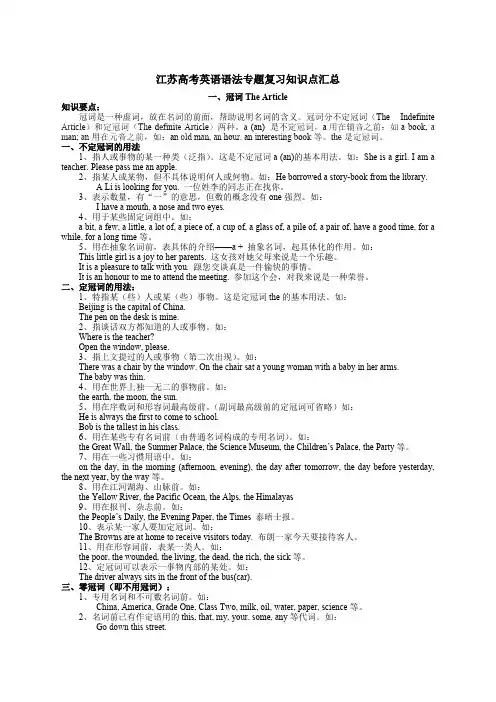
江苏高考英语语法专题复习知识点汇总一、冠词The Article知识要点:冠词是一种虚词,放在名词的前面,帮助说明名词的含义。
冠词分不定冠词(The Indefinite Article)和定冠词(The definite Article)两种。
a (an) 是不定冠词,a用在辅音之前:如a book, a man; an用在元音之前,如:an old man, an hour, an interesting book等。
the是定冠词。
一、不定冠词的用法1、指人或事物的某一种类(泛指)。
这是不定冠词a (an)的基本用法。
如:She is a girl. I am a teacher. Please pass me an apple.2、指某人或某物,但不具体说明何人或何物。
如:He borrowed a story-book from the library.A Li is looking for you. 一位姓李的同志正在找你。
3、表示数量,有“一”的意思,但数的概念没有one强烈。
如:I have a mouth, a nose and two eyes.4、用于某些固定词组中。
如:a bit, a few, a little, a lot of, a piece of, a cup of, a glass of, a pile of, a pair of, have a good time, for a while, for a long time等。
5、用在抽象名词前,表具体的介绍——a + 抽象名词,起具体化的作用。
如:This little girl is a joy to her parents. 这女孩对她父母来说是一个乐趣。
It is a pleasure to talk with you. 跟您交谈真是一件愉快的事情。
It is an honour to me to attend the meeting. 参加这个会,对我来说是一种荣誉。
高考英语语法讲解——主从复合句(附练习题及答案)
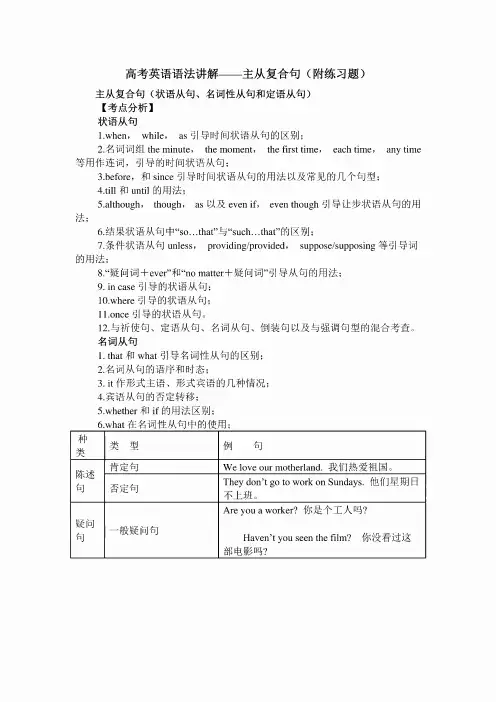
高考英语语法讲解——主从复合句(附练习题)主从复合句(状语从句、名词性从句和定语从句)【考点分析】状语从句1.when,while,as引导时间状语从句的区别;2.名词词组the minute,the moment,the first time,each time,any time 等用作连词,引导的时间状语从句;'3.b efore,和SinCe引导时间状语从句的用法以及常见的几个句型;4.t ill和Until的用法;5.a l t hough,though,as以及even if,even though引导让步状语从句的用法;6.结果状语从句中“so...that"与“such...that”的区别;7.条件状语从句UnIeSS,PrOViding/provided,SUPPOSe/supposing等引导词的用法;、、8.“疑问词+ever"和"no matter+疑问词"引导从句的用法;9.in CaSe引导的状语从句;10.where引导的状语从句;11.once引导的状语从句。
12.与祈使句、定语从句、名词从句、倒装句以及与强调句型的混合考查。
名词从句1.that和What引导名词性从句的区别;2.名词从句的语序和时态;3.it作形式主语、形式宾语的几种情况;4.宾语从句的否定转移;5.whether和if的用法区别;6.what在名词性从句中的使用;种类_类型例句陈述句肯定句We IOVe OUr motherland.我们热爱祖国。
否定句They don,t go to WOrk On Sundays.他们星期日不上班。
____________________________________疑问句一般疑问句Are you a worker?你是个工人吗?HaVen,t you Seen the film?你没看过这部电影吗?__________________________________7. doubt 后的名词性从句的使用;8. W ho / WhOeVer , What / WhateVer 等的用法区别;9. 连接词that 的省略;定语从句!.that 与WhiCh 引导的定语从句的区别;特殊疑问句WhO is the man?这人是谁?When do you WatCh TV?你什么时间看电视?What are they doing now?他们现在正在干什么?____________________________________选择疑问句DO you Want tea Or coffee? Either Will do.你要茶水还是要咖啡?哪种都行。
高考英语语法归纳大全
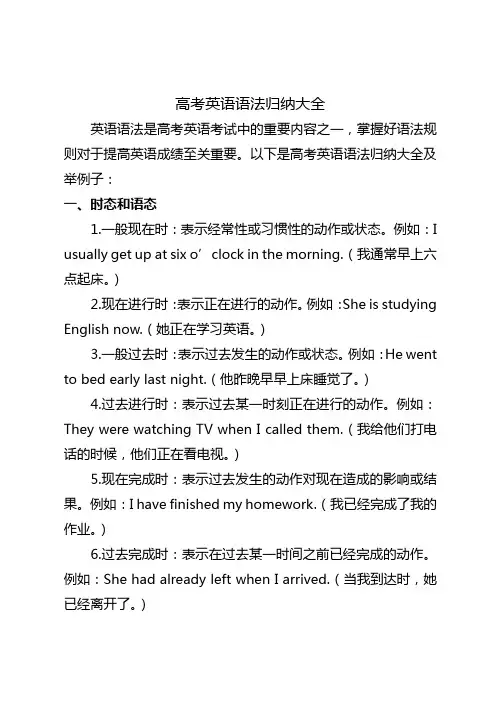
高考英语语法归纳大全英语语法是高考英语考试中的重要内容之一,掌握好语法规则对于提高英语成绩至关重要。
以下是高考英语语法归纳大全及举例子:一、时态和语态1.一般现在时:表示经常性或习惯性的动作或状态。
例如:I usually get up at six o’clock in the morning.(我通常早上六点起床。
)2.现在进行时:表示正在进行的动作。
例如:She is studying English now.(她正在学习英语。
)3.一般过去时:表示过去发生的动作或状态。
例如:He went to bed early last night.(他昨晚早早上床睡觉了。
)4.过去进行时:表示过去某一时刻正在进行的动作。
例如:They were watching TV when I called them.(我给他们打电话的时候,他们正在看电视。
)5.现在完成时:表示过去发生的动作对现在造成的影响或结果。
例如:I have finished my homework.(我已经完成了我的作业。
)6.过去完成时:表示在过去某一时间之前已经完成的动作。
例如:She had already left when I arrived.(当我到达时,她已经离开了。
)7.将来时:表示将要发生的动作或状态。
例如:We will go to the park tomorrow.(我们明天会去公园。
)8.被动语态:表示动作的承受者是主语。
例如:The book was written by him.(这本书是他写的。
)二、从句1.名词性从句:在句子中作主语、宾语、表语等成分的从句。
例如:What he said is true.(他说的是真的。
)2.定语从句:修饰先行词的从句。
例如:The man who is standing there is my father.(站在那里的人是我的父亲。
)3.状语从句:在句子中作时间、地点、原因、条件等状语的从句。
高中英语2025届高考语法难点非限制性定语从句知识讲解
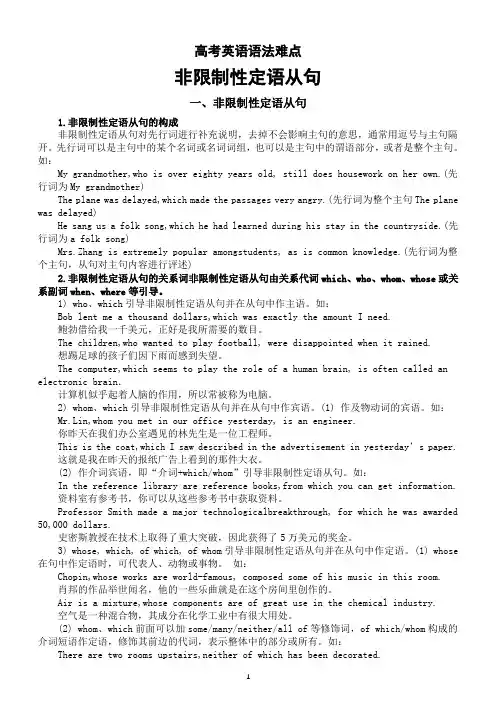
高考英语语法难点非限制性定语从句一、非限制性定语从句1.非限制性定语从句的构成非限制性定语从句对先行词进行补充说明,去掉不会影响主句的意思,通常用逗号与主句隔开。
先行词可以是主句中的某个名词或名词词组,也可以是主句中的谓语部分,或者是整个主句。
如:My grandmother,who is over eighty years old, still does housework on her own.(先行词为My grandmother)The plane was delayed,which made the passages very angry.(先行词为整个主句The plane was delayed)He sang us a folk song,which he had learned during his stay in the countryside.(先行词为a folk song)Mrs.Zhang is extremely popular amongstudents, as is common knowledge.(先行词为整个主句,从句对主句内容进行评述)2.非限制性定语从句的关系词非限制性定语从句由关系代词which、who、whom、whose或关系副词when、where等引导。
1) who、which引导非限制性定语从句并在从句中作主语。
如:Bob lent me a thousand dollars,which was exactly the amount I need.鲍勃借给我一千美元,正好是我所需要的数目。
The children,who wanted to play football, were disappointed when it rained.想踢足球的孩子们因下雨而感到失望。
The computer,which seems to play the role of a human brain, is often called an electronic brain.计算机似乎起着人脑的作用,所以常被称为电脑。
【最新推荐】高考英语语法大全:就近原则讲解-word范文模板 (2页)

【最新推荐】高考英语语法大全:就近原则讲解-word范文模板
本文部分内容来自网络整理,本司不为其真实性负责,如有异议或侵权请及时联系,本司将立即删除!
== 本文为word格式,下载后可方便编辑和修改! ==
高考英语语法大全:就近原则讲解
【导读】小编为大家整理高考英语语法大全:就近原则讲解,希望能对大家的英语学习有所帮助。
【就近原则】
也称邻近原则就近一致原则( Proximity ),即:谓语与靠近的名词、代词(有时不一定是主语)在人称、数上一致。
1.在正式文体中:
1.由下列词语连接的并列主语: there be +句型; or ; either nor ; neitherwhethernot not onlybut also 等。
e . g .
① What he does or what he says does not concern me . 他的行为或言谈都与我无关。
② Neither you nor I am wrong . 你和我都没错。
③ Not you but your father is to blame . 不是你,而是你父亲该受责备。
高考英语常考语法

高考英语常考语法1. 主谓一致在句子中,主语与谓语在人称和数上保持一致。
例如:- She likes apples. (正确,主语she与谓语动词likes在第三人称单数时一致)- She like apples. (错误,主语she与谓语动词like不一致)2. 宾语从句宾语从句是句子中的一个分句,作为主句中的宾语,表示一个完整的意思。
宾语从句通常由“that”引导,也可以由特定的连接词引导,例如who, whom, whoever, whomsoever, which, what, whatever等。
例如:- I think that he is right. (我认为他是正确的。
)- Can you tell me where the library is? (你能告诉我图书馆在哪里吗?)3. 时态在句子中,时态表示一个动作、事件或情况是否发生在过去、现在或将来。
时态分为简单时态、进行时态、完成时态和完成进行时态。
例如:- I am studying English now. (我现在正在学英语。
)- We had finished our work when he arrived. (他到达时我们已经完成了工作。
)4. 并列句并列句是指由并列连词(and, but, or, so, yet等)连接的两个或两个以上简单句子组成的复合句。
并列句的两个分句具有平行结构,即在句子中起同样的语法作用,成分也要相同。
例如:- He likes playing basketball and swimming. (他喜欢打篮球和游泳。
)- She is wealthy, but she is unhappy. (她很富有,但她不快乐。
)5. 从句从句是指一个完整的语句,它可以在一个主句中作为句子的一部分。
从句可以有自己的主语和谓语,通常由从属连词引导,例如when, where, because, although等。
干货高中英语语法归纳总结大全,高考必备
干货高中英语语法归纳总结大全,高考必备1.定语从句引导定语从句的关系代词有that,which,who(宾格whom),所有格whose)和关系副词where when why 等,关系代词或关系副词在定语从句中充当一个成分,关系代词that,which,who,whom等在从句中分别作主语或宾语,whose 在从句中作定语,而关系副词when,where,why等在从句中作状语。
如:①I will never forget the days when/in which we worked together.②I will never forget the days which/that we spent together.解析:在句①中,表示时间的名词the days在从句中充当的是状语,所以用关系副词when来代指,引导定语从句修饰先行词the days;而在句②中,表示时间的名词the days在从句中充当的是动词spent的宾语,所以用关系代词that或which来代指。
同样,表示地点或原因的名词如果在从句中作状语,则用关系副词where 或why 来代指;如果在从句中作动词的宾语,则用which或that来代替。
如:①This is the factory where/in which I worked.(作状语)②This is the factory that/which I visited years ago.(作宾语)注:当先行词为time,reason, place时,引导词可以省略。
①This was the first (when/what) I had serious trouble with my boss.②That is the reason (why) I did it.③This is the place (where) we met yesterday.另外,定语从句中谓语动词的数应与先行词的数相一致。
高考英语复习语法知识专题讲解15---名词性从句(解析版)
高考英语复习语法知识专题讲解专题十专题十五五 名词性从名词性从句句名词性从句的句法功能相当于名词词组,在句中充当主语、宾语、表语、同位语、介词宾语等。
因此名词性从句又分为主语从句、宾语从句、表语从句和同位语从句。
类别功 能 引 导 词 从属连词只起连接作用,不充当句子成分 that, whether, if 连接代词 起连接作用,并充当主语、宾语、表语或定语 who, whom, whose, which, what, whatever, whichever,whoever连接副词 起连接作用,并充当从句状语when, where, how, why 一、主语从句的易错点主语从句的一般结构主语从句+谓语动词+其他 How the book will sell depends on its author. That he is the best student in the class is obvious.it 作形式 主语时的主语从句 It+be/becomes/became+形容词/名词/过去分词+主语从句 It is still a question whether she will come or not. It became clear that Mary did make a mistake. It seems/ appears/ happens 等动词+that 从句 It seems strange that he should have done a thing like that. It happens that he can understand a little about thelanguage. It remains to be+过去分词+主语从句It remains to be seen who will be the victor in the contest.It doesn't matter +how/whether 从句 It doesn't matter whether he is wrong or not.It doesn't matter much whether we go together orseparately.用来表示惊奇、怀疑、惋惜、理应如此等语气时,主语从句谓语动词用(should) do 形式 It is necessary /important / natural /strange 等+that 从句It is necessary that one(should)obey the law.It is suggested /requested /proposed/desired 等+that 从句It is suggested that you (should) attend the openingceremony.二、宾语从句的易错点动词后的宾语从句主语+及物动词+宾语从句I know that he is an honest boy.Can you tell me how I can get to the zoo?I wonder if/whether you have told the news to Li Lei.They asked what Jean was doing now.Do you know who has won Red.Alert game?feel, think, find, consider, make等,常用it作形式宾语,宾语从句后置I find it important that.we should keep calm in danger.You may think it strange that he would live there.I feel it a pity that I haven't been to the get-together.I have made it a rule that I keep diaries.like, dislike, love, hate, enjoy,appreciate等不能直接跟宾语从句,必须用it作形式宾语,后接宾语从句I like it that everyone passed the exam.I hate it when they talk with their mouths full of food.think, believe, suppose, 等词后的宾语从句若是否定的,否定词要转移到主句的谓语动词上I don't think your answers are right.I don't believe that man is killed by Jim, is he?介词后的宾语从句介词后可接宾语从句,但连接词whether 不可换作ifHe often thinks of how he can make his class lively.She worries about whether she's really good enough.非谓语动词之后的宾语从句不定式、v.-ing形式、过去分词后也可以接宾语从句I'd just tried to do what I could for you.I suggest eating what is fresh.宾语从句中的时态主句谓语动词为一般现在时,从句时态根据实际情况而定Do you know when the ancient games began?主句谓语动词是一般过去时,从句的时态一般用适当的过去时态He asked me if I was reading the textbook when he wasin.当宾语从句为客观真理和规律时,则用一般现在时He said that light travels faster than sound.whether与if 引导宾语从句的区别与 or not 连用时,只用 whether I want to know whether or not the train goes to KingStreet."whether+不定式”结构作宾语,相当于一个宾语从句;if无此用法I don't know whether to go there.介词后面的宾语从句中只用whetherI'm not interested in whether he has a lot of money.if引导的条件句中,如果再有表示“是否”的引导词引导宾语从句时,只用 whetherHe asked me whether I'd move to Beijing if I got the job.doubt 在肯定句中,接whether 和if引导的宾语从句;但在否定句中,只用 thatWe don't doubt that he is a brave man.I doubt whether/if Jack could manage a sailing boat.三、表语从句的易错点表语从句常位于连系动词be, look, remain, seem等之后,其连接词还有as if/though,because等主语+系动词+表语从句The trouble is that we are short of money.He looked just as he had looked ten years before. The question is whether they will be able to help us. The problem is who we can get to replace her.I think it is because you are doing too much.The question is which of us should go.because 引导表语从句强调原因,why引导表语从句强调结果It's because you're careless.That is why stone walls are used instead of fences around New England fields.the reason why 从句+be + that 从句The reason why he was absent was that he was ill.what 从句+be+that从句What comforted the young mother was that the babycame to life.It looks/seems as if/though 从句It looks as if it is going to rain.At that time, it seemed as if I couldn't think of the right word anyhow.主句主语是advice, demand, suggestion, order,requirement, idea, request,command等时,表语My advice is that you(should)quit smoking.从句用虚拟语气,即谓语动词用(should)do 形式My suggestion is that we(should)start early tomorrow. Our only request is that this(should)be settled as soon as possible.四、名词性从句其他易错点that与what 在名词性从句中的区别what 充当成分,意为...的事物不可省略;that 不作任何成分,只起连接作用,也无实际意义,有时可以省略I only knew(that)he was studying in a western country,butI didn't know what country he was in.What you need is more practice.That you will win the medal seems unlikely.名词性从句已有疑问引导词时,不再用thatI don't understand what you said just now.(understand 后不再用 that)2021高考英语语法高考英语语法【【名词性从句名词性从句】】易错点对点训练30题I.高考真题诊断·单句语法填空1.Every year, makes the most beautiful kite will win a prize in the Kite Festival.2.She asked me I had returned the books to the library, and I admitted that I hadn't.3.The manager put forward a suggestion we should have an assistant. There is too much work to do.4.As natural architects,the Pueblo Indians figured out exactly thick the adobe walls needed to be to make the cycle work on most days.5.If you swim in a river or lake,be sure to investigate is below the water surface.Often there are rocks or branches hidden in the water.【答案详解】1.whoever解析:句意:每年,无论谁做出最漂亮的风筝都将会在风筝节获奖。
(完整版)高考必考英语语法大全
高考必考英语语法大全虚拟语气在各种从句的应用主语从句的虚拟1. It is + adj. + that sb. (should) do 常见的形容词有:necessary, important, strange, natural It'simportant that he take my advice.2. It is + n. + that sb. (should) do 常见的名词有:a pity, a shame, no wonder, one's wish It's a pitythat he be so silly.3. It is + done + that sb. (should) do 常见的过去分词有:suggested, advised, demanded,requested, required, asked, ordered, proposed, decided, desired, insisted 等。
It's requested that she go home as soon as possible. 宾语从句的虚拟1. 表命令,表建议,表要求的动词,后接宾语从句虚拟。
虚拟的构成为(should) do 。
I advise that he stay at home.2. wish 后接从句,虚拟的构成是往过去推一个时态。
I wish I had watched the football match last night. 注意以下几组词或短语用于虚拟语气中。
1. as if, as thoughHe speaks English as if he were a native speaker.2. otherwise, but, even thoughHe was ill. Otherwise he would have been there.3. with, without, but forWithout your help, I would have died two years ago.But for your help, I would have died two years ago.4. would rather I'd rather you told me yourself.5. It's time thatIt's time that you went to bed.It's time that you should go to bed.表语从句中的虚拟在表语从句中,表示间接的命令,要求、请求、建议、决定等,主句中的主语通常是suggestion, proposal, request, orders, idea 等。
高考英语定语从句语法讲解(打印背诵版)
高考英语定语从句语法讲解(名师剖析高考英语必考知识点,建议下载)在复合句中充当定语的从句叫定语从句。
定语从句的作用相当于形容词,用来修饰主句中的某一名词或代词或整个主句,所以,也称作形容词性从句。
被定语从句修饰的词叫先行词,定语从句一般紧跟在它所修饰的先行词之后。
在先行词和定语从句之间起连接作用的词叫关系词。
关系词有关系代词和关系副词两种。
一、关系代词引导的定语从句引导定语从句的关系代词主要有who, whom, whose, which, that 等。
它们分别代替前面的先行词,并在定语从句中作主语、宾语或定语。
A.who指人,在定语从句中作主语。
What was the name of the man who lent you the money借钱给你的那人叫什么名字?(定语从句修饰先行词the man)He who laughs lst laughs best.谁笑到最后谁笑得最好。
(定语从句修饰先行词he)The chairman of the meeting, who spoke first, sat on my right.会议主席坐在我右边,他先发言。
(定语从句修饰先行词the c hairman)B.whom指人,在定语从句中做宾语。
在口语或非正式文体中,whom 可省略或可用w ho 来代替,但在介词后面以及在非限制性定语从句中只能用whom。
There are some people (whomwho)we like and others (whomwho) we dislike.有些人我们是喜欢的,有些人则是我们讨厌的。
(定语从句分别修饰先行词people, others)The people whomwho I work with are all friendly.和我一起工作的人都很友好。
(定语从句修饰先行词the people)Mr Carter, whom I spoke to on the phone last night, is very interested in or plan.昨晚我在电话里和卡特先生交谈过,他对我们的计划很感兴趣。