
人教新目标版七年级英语上册Unit5Doyouhaveasoccerball?复习教案
Unit 5 Do you have a soccer ball? 复习内容:词汇 活动设计意图: 激发学习兴趣,引出将要复习的内容。
教学步骤 教师行为 学生行为 Step 1 把学生分组,通过做游戏看看哪组学生在一分钟之内写出与活动相关的词汇最多,巩固所学词汇。 Play a game and ask students to write more words about activities. Play the game in groups. 分组进行词汇游戏竞赛。
Step 2 请学生互相交换所写出来的单词,使他们互相学习。 Pairwork: Show the words they wrote down to each Pairwork: Ask students to show the words they wrote down to each other so that they can learn from each other. other and learn from each other. 互相交换所写出来的单词,互相学习。
复习中活动 基础知识测评 词汇测评 复习内容:教材P30 Self Check 3 活动设计意图: 通过练习,检测学生本单元基础知识掌握情况。
教学步骤 教师行为 学生行为 Step 3 布置课本Self Check 3任务,利用PPT演示。 Ask students to finish the task of Activity 3 in Self Check.(见排序编对话练习) Write numbers in the boxes to make the conversation. 独立完成排序编对话,与同桌讨论并核对答案。 ( 5 ) Yes, I do. Do you have a ball? ( 1 ) Let’s play soccer. ( 4 ) That sounds good. Do you have a tennis racket? ( 2 ) No, it’s boring. ( 3 ) Let’s play tennis. ( 6 ) Yes, I do. I have a basketball. ( 7 ) … Step 和同学们一起对照答案。 Check the answers. 4 Check the answers. Key: 5, 1, 4, 2, 3, 6, 7 核对答案。 ( ) Yes, I do. Do you have a ball? ( 1 ) Let’s play soccer. ( ) That sounds good. Do you have a tennis racket? ( ) No, it’s boring. ( ) Let’s play tennis. ( ) Yes, I do. I have a basketball. ( ) … Step 5 让学生朗读并表演对话。 Get students to read and play the conversation. — Let’s play soccer. Read and play. 朗读并表演对话。 — Let’s play soccer. — No, it’s boring. — No, it’s boring. — Let’s play tennis. — That sounds good. Do you have a tennis racket? — Yes, I do. Do you have a ball? — Yes, I do. I have a basketball. — … — Let’s play tennis. — That sounds good. Do you have a tennis racket? — Yes, I do. Do you have a ball? — Yes, I do. I have a basketball. — …
Step 6 向学生布置填空的任务。 Ask students to fill in the blanks in the article. (见动词填空练习) Ed Smith 1) (have) a great sports collection. Fill in the blanks with correct forms of the verbs in the article. 短文填空。用括号中所给动词的适当形式填空。 Ed Smith 1) (He 2) (have) 8 tennis rackets, 9 basketballs, and 7 baseballs. He 3) (have) 3 soccer balls and 5 volleyballs. But he 4) (not play) sports — he only 5) (watch) them on TV! have) a great sports collection. He 2) (have) 8 tennis rackets, 9 basketballs, and 7 baseballs. He 3) (have) 3 soccer balls and 5 volleyballs. But he 4) (not play) sports — he only 5) (watch) them on TV! Step 7 和同学们一起对照答案。 Check the answers. Check the answers. 核对答案。 1. has 2. has 3. has 4. doesn’t play 5. watches Step 8 领读短文。 Get students to read the article after the teacher. Read the article after the teacher. 跟老师朗读短文。 Ed Smith has a great sports collection. He has 8 tennis rackets, 9 basketballs, and 7 baseballs. He has 3 soccer balls and 5 volleyballs. But he doesn’t play sports — he only watches them on TV! Step 9 布置目标语检测练习。 Ask students to translate the sentences into English. 一、根据中文意思和所给英文单词,写出正确的句子。(见基础句型学习评价) 1.咱们去踢足球吧。(play, soccer) __________________ 2.你有棒球吗?(have, baseball) __________________ 3.我的朋友没有电脑游戏。 (not, have, computer game) ___________________ Translate the sentences into English. 根据所给的中英文提示完成句子。 一、根据中文意思和所给英文单词,写出正确的句子。 1.咱们去踢足球吧。(play, soccer) __________________ 2.你有棒球吗?(have, baseball) __________________ 3.我的朋友没有电脑游戏。(not, have, computer game) ___________________ 4.你的儿子喜欢体育吗?(son, like, sports) 4.你的儿子喜欢体育吗?(son, like, sports) ___________________ 5.我收集了很多中国画。(have, a great collection of) ___________________ ___________________ 5.我收集了很多中国画。(have, a great collection of) ___________________
Step 10 利用PPT演示,核对答案。 Check the answers. 核对答案。 一、根据中文意思和所给英文单词,写出正确的句子。 1.咱们去踢足球吧。(play, soccer) Let’s play soccer. 2.你有棒球吗?(have, baseball) Do you have a baseball? 3.我的朋友没有电脑游戏。(not, have, computer game) My friend doesn’t have computer games. 4.你的儿子喜欢体育吗?(son, like, sports) Does your son like sports? 5.我收集了很多中国画。(have, a great collection of) I have a great collection of Chinese paintings. Step 11 布置目标语检测练习。 Ask students to put the sentences in the correct order. ( ) No, I don’t. ( ) OK! Let’s play! ( ) Does your brother have a basketball? ( ) Hello! Peter! Let’s play basketball. ( ) Do you have a basketball? Put the sentences in the correct order. 二、将下列句子重新排列成一段对话。 ( ) No, I don’t. ( ) OK! Let’s play! ( ) Does your brother have a basketball? ( ) Hello! Peter! Let’s play basketball. ( ) Do you have a basketball? ( ) It’s under the bed.
人教新目标版七年级英语上册教案:Unit 5 Do you have

肥乡区常耳寨中学2017-2018学年第一学期七年级英语教案备课教师使用教师授课时间课时 3课题Unit 5 Do you have a soccer ball?课型新教学目标●知识目标1. Master the new words and useful expressions.2. Master the target language.●能力目标1. Be able to master the target language.2. Develop students’ listening and speaking skills.●情感目标Try to educate students to express their feelings properly.重点Key Words and sentences.难点Talk about the activities and the dates 教学用具CAI,a tape player,pictures教学环节说明二次备课复习上节课的单词和重点句子。
新课导入Step 1: Greetings and revision1. Greeting the Ss. Check the homework.2. Review what we’ve learned in Section A.(1) Put up some pictures of balls such as football, basketball, volleyball, baseball, ping-pong ball, tennis on the blackboard. Ask students to have a conversation after the model.S1: Let’s play soccer.S2: I don’t have a soccer ball.S1: Well, let’s play volleyball.S2: That sounds good.(2) After three minutes, ask a few pairs to act out the conversationsusing the pictures on the blackboard.…Step 2: Lead-in(1) Teach the new words, show the students the pictures of Charles Chaplin and ask students, “Who is that? Do you like him? Are the pictures interesting?” Then write the word interesting on the blackboard.(2) Ask students to repeat.(3) Ask two students to act out out relaxing, fun, boring ...Step 3: PresentationTeach activity 1a(1) Point to the five words and ask students to repeat each one.(2) Then point to the five pictures and ask students to match each picture with one of the words.(3) Have them write the letter of the picture on the line next to each word.(4)Then correct the answer.Step 4: Practice1. Teach activity 1b(1) Draw a pictureT: Look at the pictures in 1a for one minute and try to draw your own pictures to describe the words in the box in 1a.(2) Show and guessT: Some of you have finished drawing. Could you please show your pictures to your partner and let him/her have a guess what the picture means?(3) Listen and checkT: Let’s move to activity 1b now. It is a listening exercise. For the first time, I would like you to listen only. For the second time, please listen to the recording again and check the words you hear in 1a.(4) Check the answersT: I think most of you have finished. Let’s che ck the answers together.Answers: checked items: interesting, boring, fun, difficult2. Teach activities 1c(1) ListenT: Listen to the recording again.(2) Listen and writeT: Listen to the recording again and write a word from 1a thatPaul uses to talk about each activity. And then listen to the recording one more time and check the answers by yourselves.(3) Check the answersT: Let’s check the answers together. Who would like to t ell us what you wrote?Answers: 1.interesting 2.difficult 3.boring 4.funStep 5: ConsolidationTeach activity 1d(1) First, read through the sample conversations so that they can know how to do this activity.(2) Talk about the activities in 1c in pairs.(3) Leave students several minutes to do this activity.(4) As they work, move around the room, offering help if necessary.(5) Invite some pairs to act out their conversations for the whole class.小结In this period, we’ve learned how to talk about the events and consolidated the use of when-questions. In this period, we’ve mainly leaned some descriptive words and known how to express our feelings about things. And we’ve also improved our listening and speaking skills through the practice.作业布置1. Remember the months and the ordinal numbers.2. Make a list of people’s birthdays in your family.课后反思.。
七年级英语上册Unit5Doyouhaveasoccerball第2课时教案新版人教新目标版
Unit 5 Do you have a soccer ballThe Second PeriodA(2aSection-2d)I. Teaching aims1.Master the key words: let, us, go, we, late, has,get2. Get students to greet people using the target language.Target language:Do you/they have … ? Does he/she have …?Let’s play soccer.Do you/they have a TV? Yes, I/they do. No, I/they don’t.Does he/she have a soccer ball? Yes, he/she does. No, he/she doesn’t.3. Learn to use the target sentence Let’s to give advice.4. Be able to talk about their own favorite sports and sports they don’t like. II. Key points1. Master the key words and expressions.2. Be able to talk about the ownership by using the target language.3. The general question that Do and Does leads.4. Let’s sentence.Difficult point:1. The usage of the action verb have in simple present tense2. How to ask the ownership of objects.3. The general question that Do and Does leads.III. Teaching aidsMultimedia/A tape recorder/A blackboardIV. Teaching proceduresStep 1 Review1.Get students ready for learning.Greeting (Say hello between the teacher and the Ss)2.ReviewHave a dictation in class.Step 2 Presentation1.Present new words.2.Do 2a.1.LookT: Let’s move to activity 2a now.2.Listen and numbera. T: Now, let’s li sten to the recording for the first time.b. T: Are you ready to do activity 2a?c. T: Please number the pictures from 1 to 4 as you listen.d. T: Listen again and please check you r answers.2.Check the answersT: Do you have t he answers? Let’s chec k them t ogether.Answers: 3, 1, 4, 2Step 3 PracticeDo 2b.1.Listen and matcha. T: Listen to the recording again.b. T: Match the people in activity 2a with the balls.2.Check the answersT: Finished? Let’s check the answers.Answers: 3, 2, 1, 43.Read the conversationa. T: Let’s read the conversations together.b. T: I would like you to read them in pairs.c. T: Who would like to read them for the class?Do 2c1.Look and sayT: Let’s move to the activity 2c. Please lo ok at the pictures in activities 2a and 2b and talk about who has which balls with your partners.2.Task - I have ...a. T: Now, let’s do a task-I have ... Please make a chart like this and write down some things in the chart and ask your friends whether they have them.Exa mple: A: Do you have a hat, Mary?B: Yes, I do.A: Do you have a baseball, Bob?C: No, I don’t. ....b. T: I believe most of you have finished your survey. Please give us a report. I would like to give you an example.Example: I did a survey about the things my friends have. Two students have hats. Bob has a basketball ...Step 4 Consolidation1.Explain some language points.2.Do some exercises.3.Do 2d.Role play the conversation of 2d.Step 5 Summary1. Revie w new words and structures.2. Assign homework:Copy the words in activity 1a and the sentences in grammar box. Read the tape script o f activities 2a and 2b.Teaching refletion:。
人教新目标版七年级英语上册教案:Unit 5 Do you have
肥乡区常耳寨中学2017-2018学年第一学期七年级英语教案备课教师使用教师授课时间课时 1 课题Unit 5Do you have a soccer ball Period 1 Section A (1a~1c]课型新教学目标Be able to talk about activities and express your own feelings about them.重点1.Key words & phrases:do,have,tennis,ball,ping-pong,bat,soccer,soccer ball,volleyball,basketball 2.Key sentences:Do you have a ping-pong bat?Yes,I do.Do you have a ping-pong ball?No,I don't.难点b e able to use the word “have” properly.教学用具pictures,a tape player,objects教学环节Step I Revision and lead-inStep II Learn the new wordsStep III Check upStepIV Cooperative inquiryStepV Practice二次备课复习Show students a ping-pong ball and ask:T:What's this?Ss:It is a ping-pong ball.T:Yes,listen,ping-pong ball(read the word three times).I have a ping-pong ball.Do you have a ping-pong ball?S1:Yes…S2:No…S3:No…T:Well,(Show students a soccer ball.) And what's this?Ss:It's a football.T:Good,it is a football.And we can also call it a soccer ball.Do you have a soccer ball?(Write down the title on the blackboard.)T:Today,let's study Unit 5.新课导入Self-study 1:Self-study the new words:do,have,tennis,ball,ping-pong,bat,soccer,soccer ball,volleyball,basketball.Learn to pronounce them according to the phonetic symbols.You can listen to the tapes to help you pronounce them correctly or ask others for help.课程讲授Self-study 2:Read the conversation in Part 1a and match the words with the things in the picture.Questions for thinking:(1)Do you have a computer?Yes,________ ________.No,________ ________.(2)Make up sentences with the word “have”.我每天都吃橙子。
七年级英语上册 Unit 5 Do youhave a soccer ball(第4课时)Section B阅读课教案 (新版)人教新目标版
Unit 5 Do you have a soccer ball?Period Four (Section B)—阅读课Teaching and learning Goals:1. Review the Plural form of Nouns2.The Present Simple Tense of verbs。
Pay attention to the rules do→ does3.To write something by using the drills they have learnt.4.Reading and writing practice.Teaching and learning steps :Step I ReviewShow some pictures of ball games or feelings ,ask Ss to say “What do you think of basketball....?”to review the words they have learnt in last lesson.设计意图:复习前面学过的内容,温故而知新,通过表述的形式,使老师了解学生运用的情况。
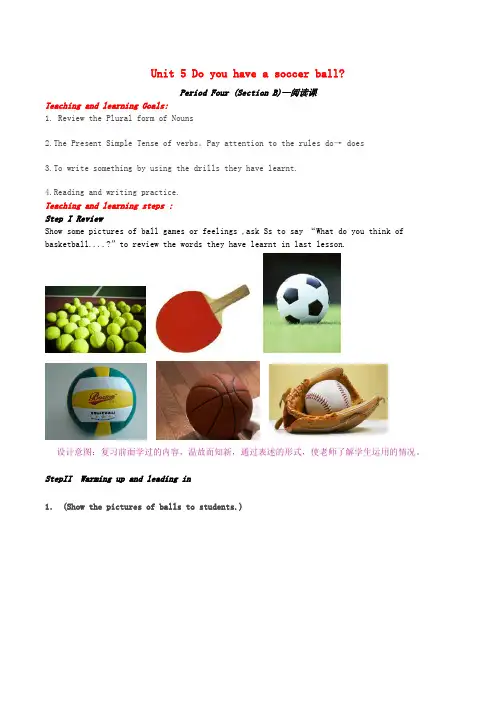
StepII Warming up and leading in1.(Show the pictures of balls to students.)tennis racket s basketball sping-pong ball s and bat sT: I have two tennis rackets, three basketballs and four ping-pong balls and bats.This is my sports collection.(Repeat the collection several times and teach the new word.)T: What about you?(Ask some students to say something about their own collections.)S: I have three…2. T: I don’t have a soccer ball . Do you have a soccer ball ?Ss: Yes, I do./ No, I don’t.T: Let’s look at the three students. Frank Brown, Gina Smith, Wang Wei.Do they have a soccer ball?设计意图:利用学生的切身体会和实际情况引入新课,容易引起学生的关注,同时在复习过程中对名词的复数进行了复习。
七年级英语上册人教版Unit5Doyouhaveasoccerball教案设计

七年级英语上册人教版Unit5Doyouhaveasoccerball教学设计设计Unit 5 Do you have a soccer ball?第一Teaching aims:学会用 have 物件行提与答。
Language goal: tennis racket, bat, soccer ball,Volleyball.Basketball ,television,badminton,ping- pong.Do you have a⋯.?Step 1review.Make conversations about-“questionswhere.” Such as“ Where is the TV?It ’ s on the table” after that ,we can ask“a baseball? So on .in this way ,we can begin our new lesson Do you have a TV? Do yo like that.Step 2.In this period, ask balls as many as possible .such as :volleyball, badminton, pingpong, basketball ,football , soccer ball that students areinterested in. Make sure some of students are good at playing balls and Iam sure they can talk more than teachers .So ,ask them to talkmore ,Don’t care about they speak English or Chinese. It’s very importa to make our class lively. At this moment, ask“ Do you have football ? Help them answer“ Yes, I do or No, I don在不知不’中t,”通答。
七年级英语上册Unit 5单元教案人教新目标版

精品基础教育教学资料,请参考使用,祝你取得好成绩!Unit 5 Do you have a soccer ball?Part 1: Teaching design (第一部分:教学设计)Structures:Present tense to have; Yes/No questions and short answers; Let’s…; Adjectives of qualityVocabulary:TV, ball, basketball, soccer, bat, tennis racket, volleyball, interesting, boring, fu n, difficult, relaxingLearning strategies: Guessing; ClassifyingSECTION AGoals●To learn to use present tense to have; Yes/No questions and short answers;Let’s…; a djectives of quality●To learn to talk about ownership●To learn to make suggestions●To enable the students to describe what he ownsProceduresWarming up by learning about present tense to have; Yes/No questions and short answersHi, everyone. First I like to ask you, “Do you have a brother?” Some of you may say,“Yes, I do.” Bur most of you may say, “No, I don’t.”Let’s try to ask and answer each other questions as are shown in the Grammar focus. Do you have a TV? Yes, I do. No, I don’t.Do they have a computer? Yes, they do. No, they don’t.Does he have a tennis Yes, he does. No, he doesn’t.racket?Yes, she does. No, she doesn’t.Does she have a soccerball?Yes, he does. No, he doesn’t.Doe Chi-Yong have aba seball?Do you have a bookcase? Yes, I do. No, I don’t.Do they have a cassette? Yes, they do. No, they don’t.Does he have a computer? Yes, he does. No, he doesn’t.Does she have a hamburger? Yes, she does. No, she doesn’t.Yes, he does. No, he doesn’t.Doe Chi-Yong have avolleyball?Warming up by greetingHello, everyone!Today we shall take up unit 5. The title of this unit is Do you have a soccer ball? Look, here are some balls on the desk. Can you name them? What’s this?Yes, it’s a basketball.This is my basketball .I have a basketball. Say after me, I have a basketball.Good! Do you have a basketball?Repeat after me, Do you have a basketball? Good! Maybe some students will say, Yes, I, do. Others will say, No, I don’t. Repeat please. Now let’s talk about the other balls. Read the following sentences after me.He has a soccer ball.Does he have a soccer ball? Yes, he does.She has a volleyball.Does she have a volleyball? No, she doesn’t.1a Matching the words with the picturesPlease look at the picture on page 25. What can you see? We can see a tennis racket, a ping-pong ball, a soccer ball, a volley, a basketball, and a TV. Now focus your attention on the word list, number1 is c, tennis racket.Please match the words and picture.1b Listening and circlingYou are great! Now please look at the four items in the list in1b and read them. I’ll play the recording twice. Please listencarefully and circle the words you hear.1c Doing pairworkNow please read the conversation in the box in 1b and practice in pairs. You can use various objects from the illustration to make your own conversations. When you practice, ple ase pay attention to thepronunciation and intonation. I’ll offer vocabulary andpronunciation support if you need.The sample:S1:Do you have a tennis racket? S2: No, I don’t.S1: Do you have a ping-pong bat? S2:Yes, I do.2a Listening and numberingNow let’s go to page 26. Please look at these four pictures and we’ll hear the conversations in the pictures. Listen carefully and number the pictures (1-4). 2b Listening and matchingYou have heard the conversations twice and have got to knowwhat people are talking about in each picture. Listen tothe recording again and write the numbers from thepictures in 2a next to the correct balls.Read the tapescript to darken present tense to have; Yes/No questions and short answers and Let’s structure.2c Doing a pairworkNow look at the picture in 2a and 2b on page 26. Please practice the conversations with your partner.2d Role-playPlease read the conversation in 2d with you partner. Then perform it in the class.Closing down by discussing the main points★Do you have s baseball? --- Yes, I do.★Does he have a tennis racket? ---No, he doesn’t.★Let’s play volleyball. ---That sounds good.3a & 3b Fill the blanksDistinguish the use of do with does. Write the word in the correct place in the chart 3a and work on 3b.3c PairworkLook at the picture of Bob’s room. Make a conversation with your partner to ask the things he has.SECTION BGoals●To learn to use some adjectives to describe sports●To write an short passage about what you ownProcedures1a MatchingWarming up by greetingWelcome back to the English class. I think most of you like sports. Some students like the soccer ball, the others like ping-pong ball, and still others maybe like basketball. Why? Because you have your own likes and dislikes. Today we’ll learn some new words to describe the sports.1a MatchingHere on page 28 are five words in 1a. Let’s see if they canexpress your feeling about sports and other things. Read themloudly and match each picture with one of the words.1b Listening and checkingLook at t he five words again. Next we’ll listen to a conversation. When you hearthe word of them in the conversation, put a checkmark to the left of each word in 1a. I’ll play the recording twice, listen carefully please.1c Listening and writingFrom the conversation above we got to know about the four activities they mentioned. And we know that they have decided to play basketball at last. What does Tony say about each activity? Listen to the conversation again and write in the word on the blank line next to each activity.1d Doing pairworkNow practice the dialogue in pairs. One student plays Paul andthe other one pla ys Jenny, talking about the activities in 2b.You should read the dialogue in 2c first, and then make your own conversation.Sample dialogue:Jenny: Let’s play computer games.Paul: That is too difficult. Hmm…let’s play basketball!Jenny: That sounds fun!Jenny: Let’s play volleyball.Paul: That is too difficult. Hmm…let’s playfootball!Jenny: That sounds fun!2a Findthe sports words in the unit to fill the column.Review the sports words in the unit and write them in the correct column. Practice the phrase: “things I have” and “things I don’t have”.2b&2c Reading and CheckingLook at the picture in 2b and read the passages. Then check the following sentences in 2c .3a Write more questions about sports thingsWrite some questions about sports equipment with the sentence pattern “Do you have…?”3b Pair workExchange the questions and answers with your partner. Then ask questions in pair. 3c WritingWrite an anticle about you and your partner with but.SELF CHECK1 List all the sports you know. Write what you think of them..Review the new words about sports things and feelings.2 Complete the blanks.Practice the grammar and sentense pattern learned in this unit.英语儿歌:Row, row, row your boatRow, row, row your boat, gently down the stream.Merrily, merrily, merrily, merrily, life is but a dream.Part2: Teaching resources (第二部分:教学资源)I. Background readings —— What is sports?■A sport consists of a normal physical activity or skill carried out under a publicly agreed set of rules, and with a recreational purpose: for competition, for self-enjoyment, to attain excellence, for the development of skill, or some combination of these. A sport has physical activity, side by side competition, and a scoring system. The difference of purpose is what characterises sport, combined with the notion of individual (or team) skill or prowess.■What winter sport combines cross-country skiing with rifle marksmanship? Which pro baseball player was known as the Sultan of Swat?■Sports, athletics, racing, hunting, baseball, football, basketball, soccer, hockey, card games, etc.■Any sporting activity. Examples: Baseball, Football, Basketball, and Hockey are the most popular sports games.■Adventure Sports, Aerial Sports, Ancient Sports, Animal Sports, Business, Cheerleading, College Sports, Combat Sports, Competition, Court Sports, Field Sports, Gymnastics, History, Skating, Sports Figures, Strength Sports, TargetSports, Track and Field, Vehicle Sports, Water Sports, Winter Sports■Games that have to do with sports, such as Baseball, Soccer,American football, Boxing, Golf, Basketball, Ice hockey,Tennis, Bowling, Rugby, etc. Backyard Sports series KnockoutKings series NBA Jam series Tecmo Super Bowl series All StarBaseball 2003II. Word studies1. have 和have got英美说“有”句法不同。
Unit 5 Do you have a soccer ball 教案
Unit 5 Do you have a soccer ball?一、单元教材分析本单元主要学习动词have的一般现在时的用法;使用do和does引导的一般疑问句的构成以及简单回答。
本单元围绕“和朋友一起欢度时光”这一话题安排了三个任务:一是列举所学的运动项目,从中挑选出各自喜欢的体育项目,并说明原因,目的是巩固并新学一些体育项目的名词;二是让学生互相询问所爱好的运动,并根据情况发出邀请,学会用have对物品的所属进行提问与回答,掌握用do和does引导的一般疑问句的构成及使用,了解用Let’s提建议的句型;三是写作,把任务一、二的完成情况写成日记,进一步复习、巩固所学的语言目标。
通过本单元的学习,学会用have对物品的所属进行提问与回答;学会用let’s…句型提建议;能够谈论自己喜欢哪些球类运动,不喜欢哪些球类运动及原因;能够谈论怎样和自己的朋友度过一段愉快的时光。
二、单元学情分析本单元的主题是使用have对物品的所属进行提问及回答,以掌握行为动词在一般现在时中的构成和使用;同时引导学生使用所学的句型谈论自己在球类运动中的喜好。
行为动词在一般现在时的肯定句、否定句和一般疑问句中的构成和使用是初中英语教学中非常重要的内容,本单元知识的掌握程度将直接影响今后的英语学习。
学生在以前的学习中已经掌握了be动词在一般现在时中的构成和使用,在学生的头脑中也已经形成了一个模式,这种模式将直接影响学生对本单元知识内容的接受,所以教师在教学中一定要善于引导,以免学生养成不良习惯。
该部分学习内容贴近学生的生活,谈论的主题是符合学生喜爱运动的心理,极易于激发学生学习英语的欲望和兴趣,使他们乐于参与各种英语实践活动。
三、单元教学建议利用教学图片、幻灯片、画纸和蜡笔等来展开课堂Pair work问答式的口语交际活动和小组活动,使用have对物品的所属进行提问及回答。
本单元的教学法建议:语音教学——让学生进行模仿操练;词汇教学——采取演示讲解的方式进行教学,让学生进行情景操练、反复使用;口语教学——采取pair work问答式的口语交际活动互相操练练习;阅读教学——让学生学会抓住主要词汇和句型;听力教学——采取图文配对和对话选择的方式;写作教学——以填空、造词为主;语法教学——总结规律、模仿操练。
推荐七年级英语上册Unit5Doyouhaveasoccerball第5课时教案新版人教新目标版_
Unit 5 Do you have a soccer ball Section B 第5课时(3a~Self Check)
类别 学习重点 重点短语 sports equipment, sports survey
重点句式 1. I don’t have a baseball, but I have a soccer ball. 2. Tom has a baseball, but he doesn’t have a baseball bat.
课前预习
译一译 equipment sports 体育用品
背一背 汤姆有一个棒球,但他没有棒球棒。 Tom has a baseball, but he doesn’t have a baseball bat.
新课导入
就学生感兴趣的话题导入新课。 T: Hi, everyone. Do you have a basketball? S:Yes, I do/ No, I don’t. T: I have a great sports collection. Do you want to know about it ? Then let me tell you something in this class.
新课展示
【完成教材3a~3c的教学任务】 1. 教学3a。学生自主写出几个询问体育用品的问题。 2. 教学3b。学生分小组交流3a中的问题并做调查,进行问答练习。 3. 教学3c。学生根据3a中的信息写一段话,谈谈自己和同伴,尝试在句中使用but。请部分学生大声读出自己的一段话。 典例参考: I don’t have a baseball, but I have a soccer ball. Tom has a baseball, but he doesn’t have a baseball bat. … 【完成教材SelfCheck的教学任务】 1. 学生列出自己知道的运动名称,并用一个形容词描述自己的看法。 2. 学生先补全“2”中的对话,再分小组练习对话。
人教新目标版七年级英语上册Unit5Doyouhaveasoccerball教案2
unit 5 Do you have a soccer ball课题unit 5 D o you have asoccer ball总课时,本单元第2 课时日期课型New 主备人复备人审核人学习目标 1 remember the new words from let to class2 learn the grammar 行为动词的一般疑问句重点难点 Let`s play soccer. That sounds good. 动词的第三人称单数形式教师活动学生活动时间复备标注教学过程1Check the homework.Act out the conversation in Page 25Have a dictation of the new words that learned last class.2Learn the new words:let , let us ==let`s Let`s play ping pong , shall we?play ---play volleyball, sound – It sounds good.many( 可数名词), more (比较级)read and write the new words3 Look at 3a in page 27 fill in the blanks with the words from th e box.check the answers: Let`s , have , soccer. PairworkLet`s play soccer.I don’t have a soccer ball.Well, lets play volleyball.That sounds good.Read, recite and act it out.教学过程 3Introduce yourself to the coach.First name:_______Last name:________Class:____________Sports you play:__________巩固练习教师引导按要求写成单词的正确形式:Have ------三单 let’s----完全形式we----宾格soccer ---复数形式 sport ----复数形式1 让我们玩足球吧。