
2020年考研英语一真题答案及解析
2020年全国硕士研究生入学统一考试英语(一)试题解析Section I Use of English1、【答案】[C] On【解析】本题考查介词的用法。
在具体的某一天之前要用介词on,故本题正确答案为[C]On o2【答案】[A]match【解析】本题考查语义理解。
前文说数百万的英国人将在本周末庆祝本国的一个重大传统节日:周日烧烤节。
故英国人民在这一天应该特别欢乐的,因而也就没有什么烹饪乐趣(culinary pleasure)能与之媲美,故本题正确答案为[A]match 031 答案][B] enjoyment【解析】本题考查语义理解。
由空前this可知本空应填名词,且该名词在前文应该出现过或与前文出现过的名词同义,而前文反复出现的名词为pleasureo并且,填入之后本句大意为这种快乐将会被视为是某种快乐,语义上能够说通,故本题正确答案为[B]enjoyment 041 答案】[D] guaranteed【解析】本题考查语义理解。
前文说这种快乐将被视为是另一种罪悉的欢愉,并且从语法结构来看本句已完整,故本空及空后内容应该是分词短语作后置定语,修饰前文的guilty pleasure0后文说这种欢愉会损害我们的健康,根据情感一致原则可首先排除privileged,再结合上下文语义,可确定本题正确答案为[D]guaranteed,本句意为:这是一种升级的欢愉,并确定无疑地会损害我们的健康。
51 答案][A]issued【解析】本句考查语意搭配。
由结构分析可知,空后名词短语a public waning (公开的警示)为本空的宾语,浏览四个选项可知本题正确答案为[A]issued,填入后意为“发布一则公开的警示”。
61答案】[B]at【解析】本题考查介词搭配的用法。
空前后大意为“在高温下烹饪的食物",a...temperature表示在……温度下,故本题正确答案为[B]at071 答案][D]avoid【解析】本题考查语义理解。
通过分析可知本空与后文的reject为并列的谓语动词,根据情感一致原则可排除[C] finish,再结合语义可知本题正确答案为[D] avoid。
81 答案】[A]partially【解析】本题考查语义理解。
根据上下文语义可知本题正确答案为[A]partially,填入后意为“局部烘烤他们的面包” ,其余选项填入后语义均不通顺,故排除。
91 答案】[D]While【解析】本题考查逻辑关系。
空后语句大意为:研究表明丙烯酰胺(acrylamide)会导致老鼠出现神经损伤,为肯定表述。
而逗号之后却说并没有证据表明它会使人患上癌症,为否定表述,由此可知逗号前后语句为让步转折关系,能表达此逻辑关系的只有[D]While。
101 答案】[C] conclusive请认准店铺,否则会收不到之后的更新【解析】本题考查语义理解,由前后文语义可知本题正确答案为[C]conclusive,填入之后意为“确凿的证据”。
111答案][C]likely【解析】本题考查固定搭配,且考查上下句语义关系。
be likely to为固定搭配,前一句说还没有确定的科学论据,因此该句为“有可能引起癌症”。
12【答案】[A]On the basis of【解析】本题考查固定搭配。
后为principle,且根据上下句的逻辑关系,上句提到还没有确凿证据,但下句语义"应该遵循建议",因此选择on the basis of o131 答案】[B ] advisable【解析】本题考查固定搭配。
It is advisable for sb to do sth,表示"某人应该做某事”。
141 答案][D]After all【解析】本题考查上下句逻辑关系。
上一句“科学论据不充足,但是应该遵循建议”,下一句“在没有科学证据证明两者关系前,就有流传吸烟会导致癌症”,两句之间为“毕竟”让步转折关系。
151 答案】[C] connection【解析】本题考查句内语义理解?在没有证据证明之前就流传吸烟会导致癌症”,根据前半句语义,应该是没有证据证明吸烟与癌症之间有关联。
16【答案】[B]served【解析】本题考查固定搭配0 served up端上桌,上菜,主语为apiece of boiled beef,符合主谓搭配。
17【答案][A]To be fair【解析】本题考查上下句逻辑关系,t。
be fair,公平讲,坦白讲:前一句提出疑问“生活值得吗?”,下一句“FAS 并不是告诉人们完全不能吃烤制食品”,进一步说明FSA的初衷。
181 答案】[B ] entirely【解析】本题考查句间逻辑关系。
该句填副词,后半句but转折,因此可以根据后半句推测前半句语义,后半句“减少其摄入量”,因此前一句应该为“FSA并不是告诉人们完全不吃烤制食品”。
191 答案】[C] campaign【解析】本题考查语义理解?但是其风险 .. .....”,it代词指代“摄入烘焙食品”,而建议人们减少烘焙食品的摄入是FSA给大众所发布的一则警告,因此根据上下文语义,选择campaign020【答案】[D]endup【解析】本题考查固定搭配。
end up with为固定词组,“以.....而告终”,过度恐吓可能导致无人听取。
Section II Reading ComprehensionPart AText 121IW^J[C]increase the economic strength of Britain's towns.【解析】这是一道细节题。
根据题干关键词“Cooper and her colleagues以及“a'town of culture5award”回文定位在第—段"A town of culture award could, it is argued, become an annual event, attracting fonding and creating jobs”(这个奖项会成为年度事件,用以吸引投资,创设新的工作岗位),对比四个选项,选项[C] increase the economic strength of Britain's towns (增强英国小镇的经济实力)与原文表述一致,故为正确答案。
221 答案】[B]a self-deceiving attempt【解析】这是一道细节题。
根据题干关键词"Paragraph 2", "the proposal", "be regarded by some”定位到第二段第一句:Some might see the proposal as a booby prize.由booby prize (笨蛋的奖励)可知,对比四个选项,选项[B]a selfdeceiving attempt (—自欺欺人的尝试)为正确答案。
23【答案】[D]commits to its long-tenn growth【解析】这是一道细节题。
根据题干顺序和题干关键信息"a title holder is successful"定位到第三段第三句"The really successfol holders of such titles are those that do a great deal more than fill hotel bedrooms and bring in high- profile arts events and good press for a year."(该头衔真正意义上的持有者应该是能做得更多更好,而不仅仅是填满酒店的房间、带来引人注目的艺术活动或仅维持一年的良好报道〉得知应该不仅限于一年或者一次短暂的活动。
同时第三段第二句和第五句也反复强调要注意"lasting benefits"和"a remarkable degree of vision" 0对比四个选项.[D]commits to its long-tenn growth.致力于长期发展最合适,故为正确选项。
24【答案】[B]a supporting examplo【解析】论证逻辑题。
首先根据文章题干信息Glasgow可以定位到第三段最后一句。
大写的专有名词Glasgow是一个例子,根据冒号的功能可以得知冒号后的信息是对冒号前信息的解释说明,所以该例子是在支持冒号前it can be done的观点的,故应该选B选项a supporting example 025【答案][C]Favourable【解析】这是一道态度题,做题的关键在于把握感情色彩词,即可快速得出正确答案,根据题干关键词"what is author's attitude towards the proposal"中的"proposal”,可回文定位到第四段第一句”A'town of culture5 could be not just about the arts but about honouring a town5s peculiarities-helping sustain its high street, supporting local facilities and above ............. .....”通过作者所使用的honouring (荣誉的)以及supporting (支持)等词都是积极情感的,对比所给四个选项,选项[C]的Favorable (赞同的)为积极情感词,故选项【C】为正确答案。
Text 226【答案】[A] its content acquisition costs nothing【解析】本题为因果逻辑题,根据题干信息词scientific publishing和a licence to print money定位到文章的第一段第一句。
再根据逻辑提示词because定位到首段的第三句,该句中可以看出科学家进行同行评审的专门研究是免费的,因为処于核心位置的内容的获取和知识生产都同样是免费的,核心词acquisition和答案A的核心词content acquisition 对应,cost nothing 和原文的for free 是同意替换。
27【答案】[D] tlirived mainly on university libraries【解析】本题为事实细节题。
根据题干定位到文章二段和三段,再根据细节提示词Elsevier定位到第三段开头。
2020考研英语一真题及答案(完整版)
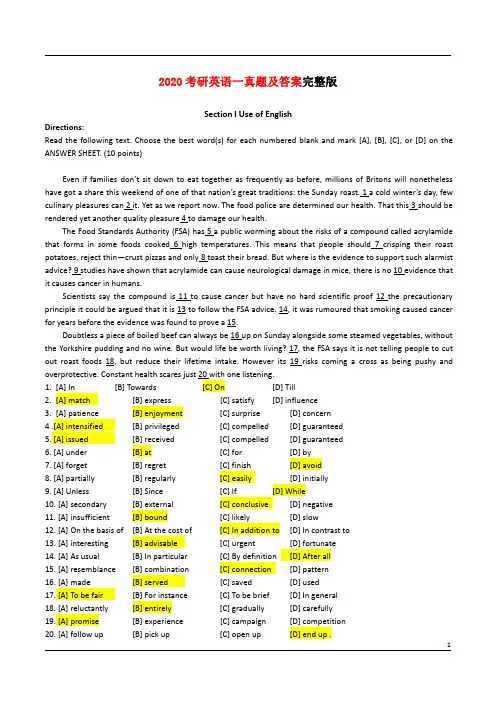
2020考研英语一真题及答案完整版Section I Use of EnglishDirections:Read the following text.Choose the best word(s)for each numbered blank and mark[A],[B],[C],or[D]on the ANSWER SHEET.(10points)Even if families don’t sit down to eat together as frequently as before,millions of Britons will nonetheless have got a share this weekend of one of that nation’s great traditions:the Sunday roast.1a cold winter’s day,few culinary pleasures can2it.Yet as we report now.The food police are determined our health.That this3should be rendered yet another quality pleasure4to damage our health.The Food Standards Authority(FSA)has5a public worming about the risks of a compound called acrylamide that forms in some foods cooked6high temperatures.This means that people should7crisping their roast potatoes,reject thin—crust pizzas and only8toast their bread.But where is the evidence to support such alarmist advice?9studies have shown that acrylamide can cause neurological damage in mice,there is no10evidence that it causes cancer in humans.Scientists say the compound is11to cause cancer but have no hard scientific proof12the precautionary principle it could be argued that it is13to follow the FSA advice.14,it was rumoured that smoking caused cancer for years before the evidence was found to prove a15.Doubtless a piece of boiled beef can always be16up on Sunday alongside some steamed vegetables,without the Yorkshire pudding and no wine.But would life be worth living?17,the FSA says it is not telling people to cut out roast foods18,but reduce their lifetime intake.However its19risks coming a cross as being pushy and overprotective.Constant health scares one listening.1.[A]In[B]Towards[D]Till2.[A]match[B]express[C]satisfy[D]influence3.[A]patience[B]enjoyment[C]surprise[D]concern4.[A]intensified[B]privileged[C]compelled[D]guaranteed5.[A]issued[B]received[C]compelled[D]guaranteed6.[A]under[B]at[C]for[D]by7.[A]forget[B]regret[C]finish[D]avoid8.[A]partially[B]regularly[C]easily[D]initially9.[A]Unless[B]Since[C]If[D]While10.[A]secondary[B]external[C]conclusive[D]negative11.[A]insufficient[B]bound[C]likely[D]slow12.[A]On the basis of[B]At the cost of[C]In addition to[D]In contrast to13.[A]interesting[B]advisable[C]urgent[D]fortunate14.[A]As usual[B]In particular[C]By definition[D]After all15.[A]resemblance[B]combination[C]connection[D]pattern16.[A]made[B]served[C]saved[D]used17.[A]To be fair[B]For instance[C]To be brief[D]In general18.[A]reluctantly[B]entirely[C]gradually[D]carefully19.[A]promise[B]experience[C]campaign[D]competition20.[A]follow up[B]pick up[C]open up[D]end up.Section II Reading ComprehensionPart ADirections:Read the following four texts.Answer the questions below each text by choosing[A],[B],[C],or[D].Mark your answers on the ANSWER SHEET.(40points)Text1A group of labour MPs,among them Yvette Cooper,are bringing in the new year with a call to institute a UK “town of culture”award.The proposal is that it should sit alongside the existing city of culture title,which was held by Hull in2017and has been awarded to Coventry for zoz1.Cooper and her colleagues argue that the success of the crown for Hull,where it brought in£220m of investment and an avalanche of arts,out not to be confined to cities.Britain’town,it is true are not prevented from applying,but they generally lack the resources to put together a bit to beat their bigger competitions.A town of culture award could,it is argued,become an annual event,attracting funding and creating jobs.Some might see the proposal as a boo by prize for the fact that Britain is no longer be able to apply for the much more prestigious title of European capital of culture,a sough-after award bagged by Glasgow in1990and Liverpool in2008.A cynic might speculate that the UK is on the verge of disappearing into an endless fever of self-celebration in its desperation to reinvent itself for the post-Brexit world:after town of culture,who knows that will follow—village of culture?Suburb of culture?Hamlet of culture?It is also wise lo recall that such titles are not a cure-all.A badly run“year of culture”washes in and out of a place like the tide,bringing prominence for a spell but leaving no lasting benefits to the community.The really successful holders of such titles are those that do a great deal more than fill hotel bedrooms and bring in high-profile arts events and good press for a year.They transform the aspirations of the people who live there; they nudge the self-image of the city into a bolder and more optimistic light.It is hard to get right,and requires a remarkable degree of vision,as well as cooperation between city authorities,the private sector,community. groups and cultural organisations.But it can be done:Glasgow’s year as European capital of culture can certainly be seen as one of complex series of factors that have turned the city into the power of art,music and theatre that it remains today.A“town of culture”could be not just about the arts but about honouring a town’s peculiarities—helping sustain its high street,supporting local facilities and above all celebrating its people and turn it into action.21.Cooper and her colleagues argue that a“town of culture”award could_______[A]consolidate the town-city ties in Britain.[B]promote cooperation among Britain’s towns.[C]increase the economic strength of Britain’s towns.[D]focus Britain’s limited resources on cultural events.22.According to Paragraph2,the proposal might be regarded by some as[A]a sensible compromise.[B]a self-deceiving attempt.[C]an eye-catching bonus.[D]an inaccessible target.23.The author suggests that a title holder is successful only if it[A]endeavours to maintain its image.[B]meets the aspirations of its people.[C]brings its local arts to prominence.[D]commits to its long-term growth.24.Glasgow is mentioned in Paragraph3to present[A]a contrasting case.(B]a supporting example.[C]a background story.[D]a related topic.25.What is the author’s attitude towards the proposal?[A]Skeptical.[B]Objective.[C]Favourable.[D]Critical.Text2Scientific publishing has long been a licence to print money.Scientists need journals in which to publish their research,so they will supply the articles without monetary reward.Other scientists perform the specialised work of peer review also for free,because it is a central element in the acquisition of status and the production of scientific knowledge.With the content of papers secured for free,the publisher needs only find a market for its journal.Until this century,university libraries were not very price sensitive.Scientific publishers routinely report profit margins approaching40%on their operations,at a time when the rest of the publishing industry is in an existential crisis.The Dutch giant Elsevier,which claims to publish25%of the scientific papers produced in the world,made profits of more than£900m last year,while UK universities alone spent more than£210m in2016to enable researchers to access their own publicly funded research;both figures seem to rise unstoppably despite increasingly desperate efforts to change them.The most drastic,and thoroughly illegal,reaction has been the emergence of Sci-Hub,a kind of global photocopier for scientific papers,set up in2012,which now claims to offer access to every paywalled article published since 2015.The success of Sci-Hub,which relies on researchers passing on copies they have themselves legally accessed, shows the legal ecosystem has lost legitimacy among is users and must be transformed so that it works for all participants.In Britain the move towards open access publishing has been driven by funding bodies.In some ways it has been very successful.More than half of all British scientific research is now published under open access terms: either freely available from the moment of publication,or paywalled for a year or more so that the publishers can make a profit before being placed on general release.Yet the new system has not worked out any cheaper for the universities.Publishers have responded to the demand that they make their product free to readers by charging their writers fees to cover the costs of preparing an article.These range from around£500to$5,000.A report last year pointed out that the costs both of subscriptions and of these“article preparation costs"had been steadily rising at a rate above inflation.In some ways the scientific publishing model resembles the economy of the social internet:labour is provided free in exchange for the hope of status,while huge profits are made by a few big firms who run the market places.In both cases,we need a rebalancing of power.26.Scientific publishing is seen as“a licence to print money”partly because[A]its funding has enjoyed a steady increase.[B]its marketing strategy has been successful.[C]its payment for peer review is reduced.[D]its content acquisition costs nothing.27.According to Paragraphs2and3,scientific publishers Elsevier have[A]thrived mainly on university libraries.[B]gone through an existential crisis.[C]revived the publishing industry.[D]financed researchers generously.28.How does the author feel about the success of Sci-Hub?[A]Relieved.[B]Puzzled.[C]Concerned.[D]Encouraged.29.It can be learned from Paragraphs5and6that open access terms.[A]allow publishers some room to make money.[B]render publishing much easier for scientists.[C]reduce the cost of publication substantially[D]free universities from financial burdens.30.Which of the following characteristics the scientific publishing model?[A]Trial subscription is offered.[B]Labour triumphs over status.[C]Costs are well controlled.[D]The few feed on the many.Text3Progressives often support diversity mandates as a path to equality and a way to level the playing field.But all too often such policies are an insincere form of virtue-signaling that benefits only the most privileged and does little to help average people.A pair of bills sponsored by Massachusetts state Senator Jason Lewis and House Speaker Pro Tempore Patricia Haddad,to ensure“gender parity”on boards and commissions,provide a case in point.Haddad and Lewis are concerned that more than half the state-government boards are less than40percent female.In order to ensure that elite women have more such opportunities,they have proposed imposing government quotas.If the bills become law,state boards and commissions will be required to set aside50percent of board seats for women by2022.The bills are similar to a measure recently adopted in California,which last year became the first state to require gender quotas for private companies.In signing the measure,California Governor Jerry Brown admitted that the law,which expressly classifies people on the basis of sex,is probably unconstitutional.The US Supreme Court frowns on sex-based classifications unless they are designed to address an “important”policy interest,Because the California law applies to all boards,even where there is no history of prior discrimination,courts are likely to rule that the law violates the constitutional guarantee of“equal protection”.But are such government mandates even necessary?Female participation on corporate boards may not currently mirror the percentage of women in the general population,but so what?The number of women on corporate boards has been steadily increasing without government interference. According to a study by Catalyst,between2010and2015the share of women on the boards of global corporations increased by54percent.Requiring companies to make gender the primary qualification for board membership will inevitably lead to less experienced private sector boards.That is exactly what happened when Norway adopted a nationwide corporate gender quota.Writing in The New Republic,Alice Lee notes that increasing the number of opportunities for board membership without increasing the pool of qualified women to serve on such boards has led to a“golden skirt”phenomenon.where the same elite women scoop up multiple seats on a variety of boards.Next time somebody pushes corporate quotas as a way to promote gender equity,remember that such policies are largely self-serving measures that make their sponsors feel good but do little to help average women.31.The author believes hat the bills sponsored by Lewis and Haddad will_______[A]help little to reduce gender bias.[B]pose a threat to the state government.[C]raise women’s position in politics.[D]greatly broaden career options.32.Which of the following is true of the California measure?[A]It has irritated private business owners.[B]It is welcomed by the Supreme Court.[C]It may go against the Constitution.[D]It will settle the prior controversies.33.The author mentions the study by Catalyst to illustrate_______[A]the harm from arbitrary board decision.[B]the importance of constitutional guarantees.[C]the pressure on women in global corporations.[D]the needlessness of government interventions.34.Norway’s adoption of a nationwide corporate gender quota has led to______[A]the underestimation of elite women’s role.[B]the objection to female participation on bards.[C]the entry of unqualified candidates into the board.[D]the growing tension between Labor and management.35.Which of the following can be inferred from the text?IAI Women’s need in employment should be considered[B]Feasibility should be a prime concern in policymaking.[C]Everyone should try hard to promote social justice.[D]Major social issues should be the focus of legislation.Text4Last Thursday,the French Senate passed a digital services tax,which would impose an entirely new tax on large multinationals that provide digital services to consumers or users in France.Digital services include everything from providing a platform for selling goods and services online to targeting advertising based on user data.and the tax applies to gross revenue from such services.Many French politicians and media outlets have referred to this as a“GAFA tax,"meaning that it is designed to apply primarily to companies such as Google,Apple, Facebook and Amazon—in other words,multinational tech companies based in the United States.The digital services tax now awaits the signature of President Emmanuel Macron,who has expressed support for the measure,and it could go into effect within the next few weeks.But it has already sparked significant controversy,with the Unite States trade representative opening an investigation into whether the tax discriminates against American companies,which in turn could lead to trade sanctions against France.The French tax is not just a unilateral move by one country in need of revenue.Instead,the digital services tax is part of a much larger trend,with countries over the past few years proposing or putting in place an alphabet soup of new international tax provisions.These have included Britain's DPT(diverted profits tax),Australia's MAAL(multinational antiavoidance law),and India's SEP(significant economic presence)test, but a few.At the same time,the European Union,Spain,Britain and several other countries have all seriously contemplated digital services taxes.These unilateral developments differ in their specifics,but they are all designed to tax multinationals on income and revenue that countries believe they should have a right to tax,even if international tax rules do not grant them that right.In other words,they all share a view that the international tax system has failed to keep up with the current economy.In response to these many unilateral measures,the Organization for Economic Cooperation and Development (OECD)is currently working with131countries to reach a consensus by the end of2020on an international solution.Both France and the United States are involved in the organization's work,but France's digital services tax and the American response raise questions about what the future holds for the international tax system.France's planned tax is a clear waning:Unless a broad consensus can be reached on reforming the international tax system.other nations are likely to follow suit,and American companies will face a cascade of different taxes from dozens of nations that will prove burdensome and costly.36.The French Senate has passed a bill to_______[A]regulate digital services platforms.[B]protect French companies'interests.[C]impose a levy on tech multinationals.[D]curb the influence of advertising.37.It can be learned from Paragraph2that the digital services tax_______[A]may trigger countermeasures against France.[B]is apt to arouse criticism at home and abroad.[C]aims to ease international trade tensions.[D]will prompt the tech giants to quit France.38.The countries adopting the unilateral measures share the opinion that_______[A]redistribution of tech giants'revenue must be ensured.[B]the current international tax system needs upgrading[C]tech multinationals'monopoly should be prevented.[D]all countries ought to enjoy equal taxing rights.39.It can be learned from Paragraph5that the OECO's current work_______[A]is being resisted by US companies.[B]needs to be readjusted immediately.[C]is faced with uncertain prospects.[D]needs to involve more countries.40.Which of the following might be the best title for this text?[A]France Is Confronted with Trade Sanctions[B]France leads the charge on Digital Tax[C]France Says"NO"to Tech Multinationals[D]France Demands a Role in the Digital EconomyPart BDirections:Read the following text and answer the questions by choosing the most suitable subheading from the A-G for each of the numbered paragraph(41-45).There are two extra subheadings.Mark your answers on the ANSWER SHEET. (10points)[A]Eye fixations are brief[B]Too much eye contact is instinctively felt to rude[C]Eye contact can be a friendly social signal[D]Personality can affect how a person reacts to eye contact[E]Biological factors behind eye contact are being investigated[F]Most people are not comfortable holding eye contact with strangers[G]Eye contact can also be aggressive.In a social situation,eye contact with another person can show that you are paying attention in a friendly way. But it can also be antagonistic such as when a political candidate turns toward their competitor during a debate and makes eye contact that signals hostility.Here’s what hard science reveals about eye contact:41._______________________We know that a typical infant will instinctively gaze into its mother’s eyes,and she will look back.This mutual gaze is a major part of the attachment between mother and child.In adulthood,looking someone else in a pleasant way can be a complimentary sign of paying attention.It can catch someone’s attention in a crowded room,“Eye contact and smile”can signal availability and confidence,a common-sense notion supported in studies by psychologist Monica Moore.42._______________________Neuroscientist Bonnie Augeung found that the hormone oxytocin increased the amount of eye contact from men toward the interviewer during a brief interview when the direction of their gaze was recorded.This was also found in high-functioning men with some autistic spectrum symptoms,who may tend to avoid eye contact. Specific brain regions that respond during direct gaze are being explored by other researches,using advanced methods of brain scanning.43._______________________With the use of eye-tracking technology,Julia Minson of the Harvard Kennedy School of Government concluded that eye contact can signal very different kinds of messages,depending on the situation.While eye contact may be a sign of connection or trust in friendly situations,it’s more likely to be associated with dominance or intimidation in adversarial situations.“Whether you're a politician or a parent,it might be helpful to keep in mind that trying to maintain eye contact may backfire if you're trying to convince someone who has a different set of beliefs than you,”said Minson.44._______________________When we look at a face or a picture,our eyes pause on one spot at a time,often on the eyes or mouth.These pauses typically occur at about three per second,and the eyes then jump to another spot,until several important points in the image are registered like a series of snapshots.How the whole image is then assembled and perceived is still a mystery although it is the subject of current research.45._______________________In people who score high in a test of neuroticism,a personality dimension associated with self-consciousness and anxiety,eye contact triggered more activity associated with avoidance,according to the Finnish researcher Jari Hietanen and colleagues.“Our findings indicate that people do not only feel different when they are the centre of attention but that their brain reactions also differ.”A more direct finding is that people who scored high for negative emotions like anxiety looked at others for shorter periods of time and reported more comfortable feelings when others did not look directly at them.41.C Eye contact can be a friendly social signalE42.E Biological factors behind eye contact are being investigated43.G Eye contact can also be aggressive44.A Eye fixactions are brief45.D Personality can affect how a person reacts to eye contactPart CDirections:Read the following text carefully and then translate the underlined segments into Chinese.Your translation should be written neatly on the ANSWER SHEET.(10points)Following the explosion of creativity in Florence during the14th century known as the Renaissance,the modern world saw a departure from what it had once known.It turned from God and the authority of the Roman Catholic Church and instead favoured a more humanistic approach to being.Renaissance ideas had spread throughout Europe well into the17th century,with the arts and sciences flourishing extraordinarily among those with a more logical disposition.(46)With the Church’s teachings and ways of thinking eclipsed by the Renaissance, the gap between the Medieval and modem periods had been bridged leading to new and unexplored intellectual territories.During the Renaissance,the great minds of Nicolaus Copernicus,Johannes Kepler and Galileo Galilei demonstrated the power of scientific study and discovery.(47)Before each of their revelations,many thinkers at the time had sustained more ancient ways of thinking,including the geo-centric view that the Earth was at the centre of our universe.Copernicus theorized in1543that all of the planets that we knew of revolved not around the Earth,but the Sun,a system that was later upheld by Galileo at his own expense.Offering up such a theory during a time of high tension between scientific and religious minds was branded as heresy,and any such heretics that continued to spread these lies were to be punished by imprisonment or even death.(48)Despite attempts by the Church to suppress this new generation of logicians and rationalists,more explanations for how the universe functioned were being made at a rate that the people could no longer ignore.It was with these great revelations that a new kind of philosophy founded in reason was born.The Church’s long standing dogma was losing the great battle for truth to rationalists and scientists.This very fact embodied the new ways of thinking that swept through Europe during most of17th century.(49)As many took on the duty of trying to integrate reasoning and scientific philosophies into the world,the Renaissance was over and it was time for a new era—the Age of Reason.The17th and18th centuries were times of radical change and curiosity.Scientific method,reductionism and the questioning of Church ideals was to be encouraged,as were ideas of liberty,tolerance and progress.(50)Such actions to seek knowledge and to understand what information we already knew were captured by the Latin phrase‘sapere aude’or‘dare to know’,after Immanuel Kant used it in his essay“An Answer to the Question:What is Enlightenment?”.It was the purpose and responsibility of great minds to go forth and seek out the truth,which they believed to be founded in knowledge.【参考译文】46.随着教会的教义和思维方式在文艺复兴时期黯然失色,中世纪与现代之间的鸿沟得以弥合,从而出现了新的及尚未开发的知识领域。
2020年考研英语一真题及答案
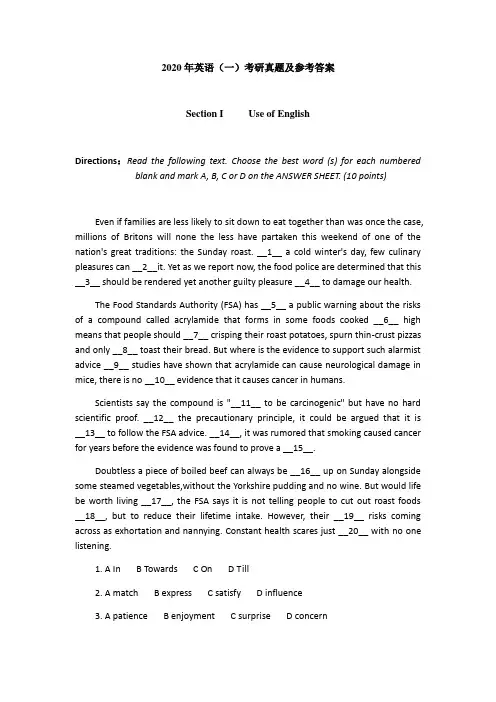
2020年英语(一)考研真题及参考答案Section I Use of EnglishDirections:Read the following text. Choose the best word (s) for each numbered blank and mark A, B, C or D on the ANSWER SHEET. (10 points)Even if families are less likely to sit down to eat together than was once the case, millions of Britons will none the less have partaken this weekend of one of the nation's great traditions: the Sunday roast. __1__ a cold winter's day, few culinary pleasures can __2__it. Yet as we report now, the food police are determined that this __3__ should be rendered yet another guilty pleasure __4__ to damage our health.The Food Standards Authority (FSA) has __5__ a public warning about the risks of a compound called acrylamide that forms in some foods cooked __6__ high means that people should __7__ crisping their roast potatoes, spurn thin-crust pizzas and only __8__ toast their bread. But where is the evidence to support such alarmist advice __9__ studies have shown that acrylamide can cause neurological damage in mice, there is no __10__ evidence that it causes cancer in humans.Scientists say the compound is "__11__ to be carcinogenic" but have no hard scientific proof. __12__ the precautionary principle, it could be argued that it is __13__ to follow the FSA advice. __14__, it was rumored that smoking caused cancer for years before the evidence was found to prove a __15__.Doubtless a piece of boiled beef can always be __16__ up on Sunday alongside some steamed vegetables,without the Yorkshire pudding and no wine. But would life be worth living __17__, the FSA says it is not telling people to cut out roast foods __18__, but to reduce their lifetime intake. However, their __19__ risks coming across as exhortation and nannying. Constant health scares just __20__ with no one listening.1. A In B Towards C On D Till2. A match B express C satisfy D influence3. A patience B enjoyment C surprise D concern4. A intensified B privileged C compelled D guaranteed5. A issued B received C ignored D canceled6. A under B at C for D by7. A forget B regret C finish D avoid8. A partially B regularly C easily D initially9. A Unless B Since C If D While10. A secondary B external C inconclusive D negative11. A insufficient B bound C likely D slow12. A On the basis of B At the cost of C In addition to D In contrast to13. A interesting B advisable C urgent D fortunate14. A As usual B In particular C By definition D After all15. A resemblance B combination C connection D pattern16. A made B served C saved D used17. A To be fair B For instance C To be brief D in general18. A reluctantly B entirely C gradually D carefully19. A promise B experience C campaign D competition20. A follow up B pick up C open up D end upSection ⅡReading ComprehensionPart ADirections:Read the following four texts. Answer the questions below each text by choosing A, B, C or D. Mark your answers on the ANSWER SHEET. (40points)Text 1A group of labour MPs, among them Yvette Cooper, are bringing in the new year with a call to institute a UK "town of culture" award. The proposal is that it should sit alongside the existing city of culture title, which was held by Hull in 2017 and has been awarded to Coventry for Zozl. Cooper and her colleagues argue that the success of the crown for Hull, where it brought in220m of investment and an avalache of arts, out not to be confined to ' town, it is true are not prevented from applying, but they generally lack the resources to put together a bit to beat their bigger competitions. A town of culture award could, it is argued, become an annual event, attracting funding and creating jobs.Some might see the proposal as a boo by prize for the fact that Britain is no longer be able to apply for the much more prestigious title of European capital of culture, a sought-after award bagged by Glasgow in 1990 and Livorpool in 2008. "A cynic might speculate that the UK is on the verge of disappearing into an endless fever of self-celebration in its desperation to reinvent itself for the post-Brexit world: after town of culture, who knows that will follow-village of culture Suburb of culture Hamlet of cultureIt is also wise to recall that such titles are not a cure-all. A badly run "year of culture"washes in and out of a place like the tide, bringing prominence for a spell but leaving no lasting benefits to the community. The really successful holders of such titles are those that do a great deal more than fill hotel bedrooms and bring in high-profile arts events and good press for a year. They transform the aspirations of the people who live there; they nudge the self-image of the city into a bolder and more optimistic light.It is hard to get right, and requires a remarkable degree of vision, as well as cooperation between city authorities, the private sector, community groups and cultural organisations. But it can be done: Glasgow's year as European capital of culture can certainly be seen as one of complex series of factors that have turned the city into the power of art, music and theatre that it remains today.A "town of culture" could be not just about the arts but about honouring a town's peculiarities-helping sustain its high street, supporting local facilities and above all celebrating its people and turn it into action.and her colleague argue that a "town of culture" award would ___.A. consolidate the town city ties in BritainB. promote cooperation among Brain's townsC. increase the economic strength of Brain's townsD. focus Brain's limited resources on cultural events.to paragraph 2, the proposal might be regarded by some as ______.sensible compromiseself-deceiving attempteye-catching bonusinaccessible target23. The author suggests that a title holder is successful only if it ______A. endeavor to maintain its imageB. meets the aspiration of its peopleC. brings its local arts to prominenceD. commits to its long-term growth24. “Glasgow” is mentioned in Paragraph 3 to present ______A. a contrasting caseB. a supporting exampleC. a background storyD. a related topic25. What is the author's attitude towards the proposalA. SkepticalB. ObjectiveC. FavorableD. CriticalText 2Scientific publishing has long been a licence to print money. Scientists need joumals in which to publish their research, so they will supply the articles without monetary reward. Other scientists perform the specialised work of peer review also for free, because it is a central element in the acquisition of status and the production of scientific knowledge.With the content of papers secured for free, the publisher needs only fnd a market for its journal. Until this century, university libraries were not very price sensitive. Scientific publishers routinely report profit margins approaching 40% on their operations, at a time when the rest of the publishing industry is in an existential crisis.The Dutch giant Elsevier, which claims to publish 25% of the scientific papers produced in the world,made profits of more than £900m last year, while UK universities alone spent more than £210m in 2016 toenable researchers to access their own publicly funded research; both figures seem to rise unstoppably despite increasingly desperate efforts to change them.The most drastic, and thoroughly illegal, reaction has been the emergence of Sci-Hub, a kind of global photocopier for scientific papers, set up in 2012, which now claims to offer access to every paywalled article published since 2015. The success of Sci-Hub, which relies on researchers passing on copies they have themselves legally accessed, shows the legal ecosystem has lost legitimacy among its users and must be transformed so that it works for all participants.In Britain the move towards open access publishing has been driven by funding bodies. In some ways it has been very successful. More than half of all British scientific research is now published under open access terms: either freely available from the moment of publication, or paywalled for a year or more so that the publishers can make a profit before being placed on general release.Yet the new system has not worked out any cheaper for the universities. Publishers have responded to the demand that they make their product free to readers by charging their writers fees to cover the costs of preparing an article. These range from around £500 to $5,000. A report last year pointed out that the costs both of subscriptions and of these’’article preparation costs’’ had been steadily rising at a rate above inflation. In some ways the scientific publishing model resembles the economy of the social internet: labour is provided free in exchange for the hope of status, while huge profits are made by a few big firms who run the market places. In both cases, we need a rebalancing of power.26. Scientific publishing is seen as“a licence to print money" partly because___A. its funding has enjoyed a steady increase .B. its marketing strategy has been successful.C. its payment for peer review is reduced.D. its content acquisition costs nothing.27. According to Paragraphs 2 and 3, scientific publishers Elsevier have________A. thrived mainly on university libraries.B. gone through an existential crisis.C. revived the publishing industry.D. financed researchers generously.28. How does the author feel about the success of Sci-HubA. Relieved.B. Puzzled.C. ConcernedD. Encouraged.29. It can be learned from Paragraphs 5 and 6 that open access terms________A. allow publishers some room to make money.B. render publishing much easier for scientists.C. reduce the cost of publication substantially.D. free universities from financial burdens.30. Which of the following characterises the scientific publishing modelA. Trial subscription is offered.B. Labour triumphs over status.C. Costs are well controlled.D. The few feed on the many.Text 3Progressives often support diversity mandates as a path to equality and a way to level the playing field. But all too often such policies are an insincere form of virtue-signaling that benefits only the most privileged and does little to help average people.A pair of bills sponsored by Massachusetts state Senator Jason Lewis and House Speaker Pro Tempore Patricia Haddad, to ensure "gender parity" on boards and commissions, provide a case in point.Haddad and Lewis are concerned that more than half the state-government boards are less than 40 percent female. In order to ensure that elite women have more such opportunities, they have proposed imposing government quotas. If the bills become law, state boards and commissions will be required to set aside 50 percent of board seats for women by 2022.The bills are similar to a measure recently adopted in Califomia, which last year became the first state to require gender quotas for private companies. In signing the measure, California Governor Jerry Brown admitted that the law, which expressly classifies people on the basis of sex, is probably unconstitutional.The US Supreme Court frowns on sex-based classifications unless they are designed to address an "important" policy interest, Because the California law applies to all boards, even where there is no history of prior discrimination, courts are likely to rule that the law violates the constitutional guarantee of "equal protection".But are such government mandates even necessary Female participation on corporate boards may not currently mirror the pereentage of women in the general population, but so whatThe number of women on corporate boards has been steadily increasing without government interference. According to a study by Catalyst, between 2010 and 2015 the share of women on the boards of global corporations increased by 54 percent.Requiring companies to make gender the primary qualification for board membership will inevitably lead to less experienced private sector boards. That is exactly what happened when Norway adopted a nationwide corporate gender quota.Wrting in The New Republic, Alice Lee notes that increasing the number of opportunities for board membership without increasing the pool of qualified women to serve on such boards has led to a"golden skirt "phenomenon, where the same clite women scoop up multiple seats on a variety of boards.Next time somebody pushes corporate quotas as a way to promote gender equity, remember that such policies are largely self-serving measures that make their sponsors feel good but do little to help average women.31. The author believes that the bills sponsored by Lewis and Haddad wills____A. help little to reduce gender bias.B. pose a threat to the state government.C. raise women's position in politics.D. greatly broaden career options.32. Which of the following is true of the California measureA. It has irritated private business owners.B. It is welcomed by the Supreme Court,C. It may go against the Constitution.D. It will settle the prior controversies.33. The author mentions the study by Catalyst to ilustrate____A. the harm from arbitrary board decision.B. the importance of constitutional guaranees.C. the pressure on women in global corporations.D. the needlessness of government interventions.34. Norway's adoption of a nationwide corporate gender quota has led to____A. the underestimation of elite women's role.B. the objection to female participation on boards.C. the entry of unqualified candidates into the board.D. the growing tension between labor and management.35. Which of the following can be inferred from the textA. Women's need in employment should be considered.B. Feasibility should be a prime concern in policymaking.C. Everyone should try hard to promote social justice.D. Major social issues should be the focus of legislation.Text 4Last Thursday, the French Senate passed a digital services tax, which would impose an entirely new taxon large multinationals that provide digital services to consumers or users in France. Digital services include everything from providing a platform for selling goods and services online to targeting advertising based on user data, and the tax applies to gross revenue from such servces. Many French politicians and media outlets have referre d to this as a“GAFA tax," meaning that it is designed to apply primarily to companies such as Google, Apple, Facebook and Amazon- in other words, multiational tech companies based in the United States.The digital services tax now awaits the signature of President Emmanuel Macron, who has expressed support for the measure, and it could go into effect within the next few weeks. But it has already sparked significant controversy, with the Unite Sates trade representative opening an investigation into whether the tax discriminates against American companies, which in turn could lead to trade sanctions against France.The French tax is not just a unilateral move by one country in need of revenue. Instead, the digital services tax is part of a much larger trend, with countries over the past few years proposing or putting in place an alphabet soup of new international tax provisions. These have included Britain's DPT (diverted profits tax), Australia's MAAL (multinational antiavoidance law), and India's SEP (significant economic presence) test, to name but a few. At the same time, the European Union, Spain, Britain and several other countries have all seriously contemplated digital services taxes.These unilateral developments differ in their specifics, but they are all designedto tax multinationals on income and revenue that countries believe they should have a right to tax, even if international tax rules do not grant them that right. In other words, they all share a view that the international tax system has failed to keep ;up with the current economy.In response to these many unilateral measures, the Organization for Economic Cooperation and Development (OECD) is currently working with 131 countries to reach a consensus by the end of 2020 on an international solution. Both France and the United States are involved in the organization' s work, but France's digital services tax and the American response raise questions about what the future holds for the international tax system.France‘s planne d tax is a clear warning: Unless a broad consensus can be reached on reforming the international tax system, other nations are likely to follow suit, and American companies will face a cascade of different taxes from dozens of nations that will prove burdensome and costly.36. The French Senate has passed a bill to_____A. regulate digital services platforms.B. protect French companies' interests .C. impose a levy on tech multinationals.D. curb the influence of advertising.37. It can be learned from Paragraph 2 that the digital services tax _____A. may trigger countermeasures against France.B. is apt to arouse criticism at home and abroad.C. aims to ease international trade tensions.D. will prompt the tech giants to quit France.38. The countries adopting the unilateral measures share the opinion that _____A. redistribution of tech giants' revenue must be ensured.B. the current international tax system needs upgrading.C. tech multinationals' monopoly should be prevented.D. all countries ought to enjoy equal taxing rights.39. It can be learned from Para 5 that the OECO's current work_____A. is being resisted by US companies.B. needs to be readjusted immediately.C. is faced with uncertain prospects.D. needs to in involve more countries.40. Which of the following might be the. best title for this textA. France Is Confronted with Trade SanctionsB. France leads the charge on Digital TaxC. France Says "NO" to Tech MultinationalsD. France Demands a Role in the Digital EconomyPart BDirections:In the following text, some sentences have been removed. For Questions41 -45, choose the most suitable one from the fist A-G to fit into each ofthe numbered blanks. There are two extra choices, which do not fit in anyof the gaps. Mark your answers on ANSWER SHEET. (10 points)A. Eye fixactions are briefB. Too much eye contact is instinetively felt to be rudeC. Eye contact can be a friendly social signalD. Personality can affect how a person reacts to eye contactE. Biological factors behind eye contact are being investigatedF. Most people are not comfortable holding eye contact with strangersG. Eye contact can also be aggressive.In a social situation, eye contact with another person can show that you arepaying attention in a friendly way. But it can also be antagonistic such as when a political candidate tums toward their competitor during a debate and makes eye contact that signals hostility. Here 's what hard science reveals about eye contact:41. ________________We know that a typical infant will instinctively gaze into its mother's eyes, and she will look back . This mutual gaze is a major part of the attachment between mother and child. In adulthood, looking someone else in a pleasant way can be a complimentary sign of paying attention. It can catch someone's attention in a crowded room, "Eye contact and smile" can signal availability and confidence,a common-sense notion supported in studies by psychologist Monica Moore.Neuroscientist Bonnie Augeung found that the hormone oxytocin increased the amount of eye contact from men toward the interviewer during a brief interview when the direction of their gaze was recorded. This was also found in high- functioning men with some autistic spectrum symptoms, who may tend to avoid eye contact. Specific brain regions that respond during direct gaze are being explored by other researches, using advanced methods of brain scanning.With the use of eye-tracking technology, Julia Minson of the Harvard Kennedy School of Government concluded that eye contact can signal very different kinds of messages, depending on the situation While eye contact may be a sign of connection or trust in friendly situations, it's more likely to be associated with dominance OF intimidation in adversarial situations. Whether you're a politician or a parent, it might be helpful to keep 'in mind that trying to maintain eye contact may backfire if you're trying to convince someone who has a different set of beliefs than you," said Minson.When we look at a face or a picture, our eyes pause on one spot at a time, often on the eyes or mouth. These pauses typically occur at about three per second, and the eyes then jump to another spot, until several important points in the image are registered like a series of snapshots. How the whole image is then assembled and perceived is still a mystery although it is the subject of current research.In people who score high in a test of neuroticism, a personality dimension associated with self-consciousness and anxiety, eye contact triggered more activity associated with avoidance, according to the Finnish researcher Jari Hietanen and colleagues. Our findings indicate that people do not only feel different when they are the centre of attention but that their brain reactions also differ-" A more direct finding is that people who scored high for negative emotions like anxiety looked at others for shorter periods of time and reported more comfortable feelings when others did not look directly at them.Section III TranslationDirections:Read the following text carefully and then translate the underlined segments into Chinese. Your translation should be written neatly onthe ANSWER SHEET. (10 points)Following the explosion of creativity in Florence during the 14th century known as the Renaissance, the modern world saw a departure from what it had once known. It turned from God and the authority of the Roman Catholic Church and instead favoured a more humanistic approach to being. Renaissance ideas had spread throughout Europe well into the 17th century, with the arts and sciences flourishing extraordinarily among those with a more logical disposition. (the gap between) the church's teachings and ways of thinking being eclipsed by the Renaissance, the gap between the medieval and modern periods had been bridged, leading to new and unexplored intellectual territories.During the Renaissance, the great minds of Nicolaus Copernicus, Johannes Kepler and Galileo Galilei demonstrated the power of scientific study and discovery.47. Before each of their revelations, many thinkers at the time had sustained more ancient ways of thinking, including the geocentric view that the Earth was at the centre of our universe. Copernicus theorized in 1543 that in actual fact, all of the planets that we knew of revolved not around the Earth, but the Sun, a system that was later upheld by Galileo at his own expense. Offering up such a theory during a time of high tension between scientific and religious minds was branded as heresy,and any such heretics that continued to spread these lies were to be punished by imprisonment or even death. Galileo was excommunicated by the Church and imprisoned for life for his astronomical observations and his support of theheliocentric principle.48. Despite attempts by the Church to strong-arm this new generation of logicians and rationalists, more explanations for how the universe functioned were being made,and at a rate that the people-including the Church -could no longer ignore. It was with these great revelations that a new kind of philosophy founded in reason was born.The Church's long-standing dogma was losing the great battle for truth to rationalists and scientists. This very fact embodied the new ways of thinking that swept through Europe during most of the 17th century. 49. As many took on the duty of trying to integrate reasoning and scientific philosophies into the world. The Renaissance was over and it was time for a new era-the Age of Reason.The 17th and 18th centuries were times of radical change and curiosity. Scientific method,reductionism and the questioning of Church ideals was to be encouraged, as were ideas of liberty, tolerance and progress. 50. Such actions to seek knowledge and to understand what information we already knew were captured by the Latin phrase'sapere aude'or 'dare to know', after Immanuel Kant used it in his essay An Answer to the Question: What is Enlightenment It was the purpose and responsibility of great minds to go forth and seek out the truth, which they believed to be founded in knowledge.Section IV WritingPart ADirections: T he Student Union of your university has assigned you to inform the international students an upcoming singing contest.Write a notice inabout100 words. Write your answer on the ANSWER SHEET. Do not useyour name in the notice.Part B52: Directions:Write an essay of 160-200 words based on the picture below. In your essay, you should:1) Describe the picture briefly;2) Interpret the implied meaning, and3) Give your comments【参考答案】【1-5】CABDA 【6-10】BDADC 【11-15】CABDC 【16-20】BABCD 【21-25】CBDAC 【26-30】DACAD 【31-35】ACDCB 【36-40】CABCB 【41-45】CEGAD【参考译文】46.由于文艺复兴时期教会的教义和思维方式之间的差距被消除,中世纪和现代时期之间的差距得以弥合,导致了新的和未开发的知识领域。
2020年考研英语(一)试题真题及答案解析(考研英语201)
绝密☆启用前2020年全国硕士研究生入学统一考试英语(一)试题及答案解析(科目代码:201)考生注意事项1. 答题前,考生须在试题册指定位置上填写考生姓名和考生编号;在答题卡指定位置上填写报考单位,考生姓名和考生编码,并涂写考生编号信息点。
2. 考生须把试题册上的“试卷条形码”粘贴条取下,粘贴在答题卡的“试卷条形码粘贴位置”框中。
不按规定粘贴条形码而影响试卷结果的,责任由考生自负。
3. 选择题的答案必须涂写在答题卡相应题号的选项上,非选择题的答案必须书写在答题纸指定位置的边框区域内。
超出答题区域写的答案无效;在草稿纸、试题册上答题无效。
4. 填(书)写部分必须使用黑色字迹签字笔或者钢笔书写,字迹工整、笔迹清楚;涂写部分必须使用2B铅笔填涂。
5. 考试结束,将答题卡和试题册按规定交回。
(以下信息考生必须认真填写)2020年考研英语一真题答案及解析Section I Use of EnglishDirections:Read the following text. Choose the best word (s) for each numbered blank and mark A, B, C or D on the ANSWER SHEET. (10 points)Even if families are less likely to sit down to eat together than was once the case, millions of Britons will none the less have partaken this weekend of one of the nation's great traditions: the Sunday roast. __1__ a cold winter's day, few culinary pleasures can __2__it. Yet as we report now, the food police are determined that this __3__ should be rendered yet another guilty pleasure __4__ to damage our health.The Food Standards Authority (FSA) has __5__ a public warning about the risks of a compound called acrylamide that forms in some foods cooked __6__ high temperatures.This means that people should __7__ crisping their roast potatoes, spurn thin-crust pizzas and only __8__ toast their bread. But where is the evidence to support such alarmist advice? __9__ studies have shown that acrylamide can cause neurological damage in mice, there is no __10__ evidence that it causes cancer in humans.Scientists say the compound is "__11__ to be carcinogenic" but have no hard scientific proof. __12__ the precautionary principle, it could be argued that it is __13__ to follow the FSA advice. __14__, it was rumored that smoking caused cancer for years before the evidence was found to prove a __15__.Doubtless a piece of boiled beef can always be __16__ up on Sunday alongside some steamed vegetables,without the Yorkshire pudding and no wine. But would life be worth living? __17__, the FSA says it is not telling people to cut out roast foods __18__, but to reduce their lifetime intake. However, their __19__ risks coming across as exhortation and nannying. Constant health scares just __20__ with no one listening.1. A In B Towards C On D Till2. A match B express C satisfy D influence3. A patience B enjoyment C surprise D concern4. A intensified B privileged C compelled D guaranteed5. A issued B received C ignored D canceled6. A under B at C for D by7. A forget B regret C finish D avoid8. A partially B regularly C easily D initially9. A Unless B Since C If D While10. A secondary B external C inconclusive D negative11. A insufficient B bound C likely D slow12. A On the basis of B At the cost of C In addition to D In contrast to13. A interesting B advisable C urgent D fortunate14. A As usual B In particular C By definition D After all15. A resemblance B combination C connection D pattern16. A made B served C saved D used17. A To be fair B For instance C To be brief D in general18. A reluctantly B entirely C gradually D carefully19. A promise B experience C campaign D competition20. A follow up B pick up C open up D end upSection Ⅱ Rea ding ComprehensionPart ADirections:Read the following four texts. Answer the questions below each text by choosing A, B, C or D. Mark your answers on the ANSWER SHEET. (40 points)Text 121.Copper and her colleague argue that a "town of culture" award would ___.A. consolidate the town city ties in BritainB. promote cooperation among Brain's townsC. increase the economic strength of Brain's townsD. focus Brain's limited resources on cultural events.22.According to paragraph 2, the proposal might be regarded by some as ______..A.a sensible compromiseB.a self-deceiving attemptC.an eye-catching bonusD.an inaccessible target23. The author suggests that a title holder is successful only if it ______A. endeavor to maintain its imageB. meets the aspiration of its peopleC. brings its local arts to prominenceD. commits to its long-term growth24. “Glasgow”is mentioned in Paragraph 3 to present ______A. a contrasting caseB. a supporting exampleC. a background storyD. a related topic25. What is the author's attitude towards the proposal?A. SkepticalB. ObjectiveC. FavorableD. CriticalText 2Scientific publishing has long been a licence to print money. Scientists need joumals in which to publishtheir research, so they will supply the articles without monetary reward. Other scientists perform the specialised work of peer review also for free, because it is a central element in the acquisition of status and the production of scientific knowledge.With the content of papers secured for free, the publisher needs only fnd a market for its journal. Until this century, university libraries were not very price sensitive. Scientific publishers routinely report profit margins approaching 40% on their operations, at a time when the rest of the publishing industry is in an existential crisis.The Dutch giant Elsevier, which claims to publish 25% of the scientific papers produced in the world,made profits of more than £900m last year, while UK universities al one spent more than £210m in 2016 toenable researchers to access their own publicly funded research; both figures seem to rise unstoppably despite increasingly desperate efforts to change them.The most drastic, and thoroughly illegal, reaction has been the emergence of Sci-Hub, a kind of global photocopier for scientific papers, set up in 2012, which now claims to offeraccess to every paywalled article published since 2015. The success of Sci-Hub, which relies on researchers passing on copies they have themselves legally accessed, shows the legal ecosystem has lost legitimacy among its users and must be transformed so that it works for all participants.In Britain the move towards open access publishing has been driven by funding bodies. In some ways it has been very successful. More than half of all British scientific research is now published under open access terms: either freely available from the moment of publication, or paywalled for a year or more so that the publishers can make a profit before being placed on general release.Yet the new system has not worked out any cheaper for the universities. Publishers have responded to the demand that they make their product free to readers by charging their writers fees to cover the costs of preparing an article. These range from around £500 to $5,000. A report last year pointed out that the costs both of subscriptions and of these’’article preparation costs’’had been steadily rising at a rate above inflation. In some ways the scientific publishing model resembles the economy of the social internet: labour is provided free in exchange for the hope of status, while huge profits are made by a few big firms who run the market places. In both cases, we need a rebalancing of power.26. Scientific publishing is seen as“a licence to print money" partly because________[A] its funding has enjoyed a steady increase .[B] its marketing strategy has been successful.[C] its payment for peer review is reduced.[D] its content acquisition costs nothing.27. According to Paragraphs 2 and 3, scientific publishers Elsevier have________[A] thrived mainly on university libraries.[B] gone through an existential crisis.[C] revived the publishing industry.[D] financed researchers generously.28. How does the author feel about the success of Sci-Hub?[A] Relieved.[B] Puzzled.[C] Concerned[D] Encouraged.29. It can be learned from Paragraphs 5 and 6 that open access terms________[A]allow publishers some room to make money.[B] render publishing much easier for scientists.[C] reduce the cost of publication substantially.[D] free universities from financial burdens.30. Which of the following characterises the scientific publishing model?[A] Trial subscription is offered.[B] Labour triumphs over status.[C] Costs are well controlled.D] The few feed on the many.Text 3Progressives often support diversity mandates as a path to equality and a way to level the playing field. But all too often such policies are an insincere form of virtue-signaling thatbenefits only the most privileged and does little to help average people.A pair of bills sponsored by Massachusetts state Senator Jason Lewis and House Speaker Pro Tempore Patricia Haddad, to ensure "gender parity" on boards and commissions, provide a case in point.Haddad and Lewis are concerned that more than half the state-government boards are less than 40 percent female. In order to ensure that elite women have more such opportunities, they have proposed imposing government quotas. If the bills become law, state boards and commissions will be required to set aside 50 percent of board seats for women by 2022.The bills are similar to a measure recently adopted in Califomia, which last year became the first state to require gender quotas for private companies. In signing the measure, California Governor Jerry Brown admitted that the law, which expressly classifies people on the basis of sex, is probably unconstitutional.The US Supreme Court frowns on sex-based classifications unless they are designed to address an "important" policy interest, Because the California law applies to all boards, even where there is no history of prior discrimination, courts are likely to rule that the law violates the constitutional guarantee of "equal protection".But are such government mandates even necessary? Female participation on corporate boards may not currently mirror the pereentage of women in the general population, but so what?The number of women on corporate boards has been steadily increasing without government interference. According to a study by Catalyst, between 2010 and 2015 the share of women on the boards of global corporations increased by 54 percent.Requiring companies to make gender the primary qualification for board membership will inevitably lead to less experienced private sector boards. That is exactly what happened when Norway adopted a nationwide corporate gender quota.Wrting in The New Republic, Alice Lee notes that increasing the number of opportunities for board membership without increasing the pool of qualified women to serve on such boards has led to a"golden skirt "phenomenon, where the same clite women scoop up multiple seats on a variety of boards.Next time somebody pushes corporate quotas as a way to promote gender equity, remember that such policies are largely self-serving measures that make their sponsors feel good but do litle to help average women.31. The author believes that the bills sponsored by Lewis and Haddad wills________[A] help little to reduce gender bias.[B] pose a threat to the state government.[C] raise women's position in politics.[D] greatly broaden career options.32. Which of the following is true of the California measure?[A] It has irritated private business owners.[B] It is welcomed by the Supreme Court,[C] It may go against the Constitution.[D] It will settle the prior controversies.33. The author mentions the study by Catalyst to ilustrate____[A] the harm from arbitrary board decision.[B] the importance of constitutional guaranees.[C] the pressure on women in global corporations.[D] the needlessness of government interventions.34. Norway's adoption of a nationwide corporate gender quota has led to____[A] the underestimation of elite women's role.[B] the objection to female participation on boards.[C] the entry of unqualified candidates into the board.[D] the growing tension between labor and management.35. Which of the following can be inferred from the text?[A] Women's need in employment should be considered.[B] Feasibility should be a prime concern in policymaking.[C] Everyone should try hard to promote social justice.[D] Major social issues should be the focus of legislation.Text 4Last Thursday, the French Senate passed a digital services tax, which would impose an entirely new taxon large multinationals that provide digital services to consumers or users in France. Digital services include everything from providing a platform for selling goods and services online to targeting advertising based on user data, and the tax applies to gross revenue from such servces. Many French politicians and media outlets have referred to this as a“GAFA tax," meaning that it is designed to apply primarily to companies such as Google, Apple, Facebook and Amazon- in other words, multiational tech companies based in the United States.The digital services tax now awaits the signature of President Emmanuel Macron, who has expressed support for the measure, and it could go into effect within the next few weeks. But it has already sparked significant controversy, with the Unite Sates trade representative opening an investigation into whether the tax discriminates against American companies, which in turn could lead to trade sanctions against France.The French tax is not just a unilateral move by one country in need of revenue. Instead, the digital services tax is part of a much larger trend, with countries over the past few years proposing or putting in place an alphabet soup of new international tax provisions. These have included Britain's DPT (diverted profits tax), Australia's MAAL (multinational antiavoidance law), and India's SEP (significant economic presence) test, to name but a few. At the same time, the European Union, Spain, Britain and several other countries have all seriously contemplated digital services taxes.These unilateral developments differ in their specifics, but they are all designed to tax multinationals on income and revenue that countries believe they should have a right to tax, even if international tax rules do not grant them that right. In other words, they all share a view that the international tax system has failed to keep ;up with the current economy.In response to these many unilateral measures, the Organization for Economic Cooperation and Development (OECD) is currently working with 131 countries to reach a consensus by the end of 2020 on an international solution. Both France and the United States are involved in the organization' s work, but France's digital services tax and the American response raise questions about what the future holds for the international tax system. France‘s planned tax is a clear warning: Unless a broad consensus can be reached on reforming the international tax system, other nations are likely to follow suit, and Americancompanies will face a cascade of different taxes from dozens of nations that will prove burdensome and costly.36. The French Senate has passed a bill to_____[A] regulate digital services platforms.[B] protect French companies' interests .[C] impose a levy on tech multinationals.[D] curb the influence of advertising.37. It can be learned from Paragraph 2 that the digital services tax _____[A] may trigger countermeasures against France.[B] is apt to arouse criticism at home and abroad.[C] aims to ease international trade tensions.[D] will prompt the tech giants to quit France.38. The countries adopting the unilateral measures share the opinion that _____[A] redistribution of tech giants' revenue must be ensured.[B] the current international tax system needs upgrading.[C] tech multinationals' monopoly should be prevented.[D] all countries ought to enjoy equal taxing rights.39. It can be learned from Para 5 that the OECO's current work_____[A] is being resisted by US companies.[B] needs to be readjusted immediately.[C] is faced with uncertain prospects.[D] needs to in involve more countries.40. Which of the following might be the. best title for this text?[A] France Is Confronted with Trade Sanctions[B] France leads the charge on Digital Tax[C] France Says "NO" to Tech Multinationals[D] France Demands a Role in the Digital EconomyPart BDirections:In the following text, some sentences have been removed. For Questions 41 -45, choose the most suitable one from the fist A-G to fit into each of the numbered blanks. There are two extra choices, which do not fit in any of the gaps. Mark your answers on ANSWER SHEET. (10 points)[A] Eye fixactions are brief[B] Too much eye contact is instinetively felt to be rude[C] Eye contact can be a friendly social signal[D] Personality can affect how a person reacts to eye contact[E] Biological factors behind eye contact are being investigated[F] Most people are not comfortable holding eye contact with strangers[G] Eye contact can also be aggressive.In a social situation, eye contact with another person can show that you are paying attention in a friendly way. But it can also be antagonistic such as when a political candidate tumstoward their competitor during a debate and makes eye contact that signals hostility. Here 's what hard science reveals about eye contact:41. ________________We know that a typical infant will instinctively gaze into its mother's eyes, and she will look back . This mutual gaze is a major part of the attachment between mother and child. In adulthood, looking someone else in a pleasant way can be a complimentary sign of paying attention. It can catch someone's attention in a crowded room, "Eye contact and smile" can signal availability and confidence,a common-sense notion supported in studies by psychologist Monica Moore.42.Neuroscientist Bonnie Augeung found that the hormone oxytocin increased the amount of eye contact from men toward the interviewer during a brief interview when the direction of their gaze was recorded. This was also found in high- functioning men with some autistic spectrum symptoms, who may tend to avoid eye contact. Specific brain regions that respond during direct gaze are being explored by other researches, using advanced methods of brain scanning.43.__With the use of eye-tracking technology, Julia Minson of the Harvard Kennedy School of Government concluded that eye contact can signal very different kinds of messages, depending on the situation While eye contact may be a sign of connection or trust in friendly situations, it's more likely to be associated with dominance OF intimidation in adversarial situations. Whether you're a politician or a parent, it might be helpful to keep 'in mind that trying to maintain eye contact may backfire if you're trying to convince someone who has a different set of beliefs than you," said Minson.44.___ _____ When we look at a face or a picture, our eyes pause on one spot at a time, often on the eyes or mouth. These pauses typically occur at about three per second, and the eyes then jump to another spot, until several important points in the image are registered like a series of snapshots. How the whole image is then assembled and perceived is still a mystery although it is the subject of current research.45.___ _____In people who score high in a test of neuroticism, a personality dimension associated with self-consciousness and anxiety, eye contact triggered more activity associated with avoidance, according to the Finnish researcher Jari Hietanen and colleagues. Our findings indicate that people do not only feel different when they are the centre of attention but that their brain reactions also differ-" A more direct finding is that people who scored high for negative emotions like anxiety looked at others for shorter periods of time and reported more comfortable feelings when others did not look directly at them.Part C TranslationDirections:Read the following text carefully and then translate the underlined segments into Chinese. Your translation should be written neatly on the ANSWER SHEET. (10 points)Following the explosion of creativity in Florence during the 14th century known as the Renaissance, the modern world saw a departure from what it had once known. It turned from God and the authority of the Roman Catholic Church and instead favoured a more humanistic approach to being. Renaissance ideas had spread throughout Europe well into the 17th century, with the arts and sciences flourishing extraordinarily among those with a more logical disposition. 46.With (the gap between)the church's teachings and ways of thinking being eclipsed by the Renaissance, the gap between the medieval and modern periods had been bridged, leading to new and unexplored intellectual territories.During the Renaissance, the great minds of Nicolaus Copernicus, Johannes Kepler and Galileo Galilei demonstrated the power of scientific study and discovery. 47. Before each of their revelations, many thinkers at the time had sustained more ancient ways of thinking, including the geocentric view that the Earth was at the centre of our universe. Copernicus theorized in 1543 that in actual fact, all of the planets that we knew of revolved not around the Earth, but the Sun, a system that was later upheld by Galileo at his own expense. Offering up such a theory during a time of high tension between scientific and religious minds was branded as heresy,and any such heretics that continued to spread these lies were to be punished by imprisonment or even death. Galileo was excommunicated by the Church and imprisoned for life for his astronomical observations and his support of the heliocentric principle.48. Despite attempts by the Church to strong-arm this new generation of logicians and rationalists, more explanations for how the universe functioned were being made,and at a rate that the people-including the Church -could no longer ignore. It was with these great revelations that a new kind of philosophy founded in reason was born.The Church's long-standing dogma was losing the great battle for truth to rationalists and scientists. This very fact embodied the new ways of thinking that swept through Europe during most of the 17th century. 49. As many took on the duty of trying to integrate reasoning and scientific philosophies into the world. The Renaissance was over and it was time for a new era-the Age of Reason.The 17th and 18th centuries were times of radical change and curiosity. Scientific method,reductionism and the questioning of Church ideals was to be encouraged, as were ideas of liberty, tolerance and progress. 50. Such actions to seek knowledge and to understand what information we already knew were captured by the Latin phrase'sapere aude'or 'dare to know', after Immanuel Kant used it in his essay An Answer to the Question: What is Enlightenment? It was the purpose and responsibility of great minds to go forth and seek out the truth, which they believed to be founded in knowledge.Section IV WritingPart A51.Directions:The Student Union of your university has assigned you to inform theinternational students an upcoming singing contest. Write a notice in about100 words. Write your answe r on the ANSWER SHEET. Do not use your name in the notice.Part B52: Directions:Write an essay of 160-200 words based on the picture below. In your essay, you should:1)Describe the picture briefly;2)Interpret the implied meaning, and3)Give your comments2020年全国硕士研究生入学统一考试英语(一)答案解析Section I Use of English1.【答案】C On【解析】此处考察介词词义辨析。
2020-2021考研英语一真题及答案解析
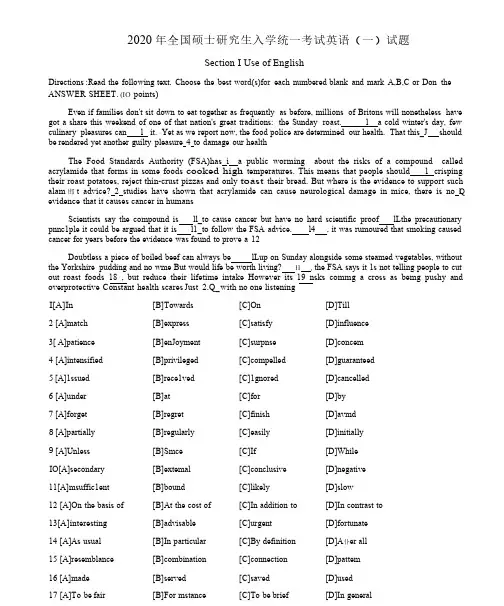
2020年全国硕士研究生入学统一考试英语(一)试题Section I Use of EnglishDirections:Read the following text.Choose the best word(s)for each numbered blank and mark A,B,C or Don the ANSWER SHEET.(IO points)Even if families don't sit down to eat together as frequently as before,millions of Britons will nonetheless have got a share this weekend of one of that nation's great traditions:the Sunday roast.l a cold winter's day,few culinary pleasures can l it.Yet as we report now,the food police are determined our health.That this_J should be rendered yet another guilty pleasure4to damage our healthThe Food Standards Authority(FSA)has i a public worming about the risks of a compound called acrylamide that forms in some foods cooked high temperatures.This means that people should l crisping their roast potatoes,reject thin-crust pizzas and only toast their bread.But where is the evidence to support such alam邯t advice?2studies have shown that acrylamide can cause neurological damage in mice,there is no l Q evidence that it causes cancer in humansScientists say the compound is ll_to cause cancer but have no hard scientific proof lLthe precautionary pnnc1ple it could be argued that it is l1_to follow the FSA advice.l4,it was rumoured that smoking caused cancer for years before the evidence was found to prove a12Doubtless a piece of boiled beef can always be lLup on Sunday alongside some steamed vegetables,without the Yorkshire pudding and no wme But would life be worth living?l1,the FSA says it1s not telling people to cut out roast foods18,but reduce their lifetime intake However its19nsks commg a cross as bemg pushy and overprotective Constant health scares Just2.Q_with no one listeningI[A]In[B]Towards[C]On[D]Till2[A]match[B]express[C]satisfy[D]influence3[A]patience[B]enJoyment[C]surpnse[D]concem4[A]intensified[B]privileged[C]compelled[D]guaranteed5[A]1ssued[B]rece1ved[C]1gnored[D]cancelled6[A]under[B]at[C]for[D]by7[A]forget[B]regret[C]finish[D]avmd8[A]partially[B]regularly[C]easily[D]initially9[A]Unless[B]Smce[C]If[D]WhileIO[A]secondary[B]extemal[C]conclusive[D]negative11[A]msuffic1ent[B]bound[C]likely[D]slow12[A]On the basis of[B]At the cost of[C]In addition to[D]In contrast to13[A]interesting[B]advisable[C]urgent[D]fortunate14[A]As usual[B]In particular[C]By definition[D]A仆er all15[A]resemblance[B]combination[C]connection[D]pattem16[A]made[B]served[C]saved[D]used17[A]To be fair[B]For mstance[C]To be brief[D]In general18.[A]reluctantly19.[A]promise20.[A]follow up [B]entirely[B]expenence[B]pick up[C]gradually[C]campaign[C]open up[D]carefully[D]competition[D]end upPart ASection II Reading ComprehensionDirections:Read the following four texts.Answer the questions below each text by choosing A,B,C or D.Mark your answers on the ANSWER SHEET.(40points)Text1A group of labour MPs,among them Yvette Cooper,are bringing in the new year with a call to institute a UK "town of culture"award.The proposal is that it should sit alongside the existing city of culture title,which was held by Hull in2017and has been awarded to Coventry for2021.Cooper and her colleagues argue that the success of the crown for Hull,where it brought in立20m of investment and an avalanche of arts,ought not to be confined to cities Britain'town,it is true are not prevented from applying,but they generally lack the resources to put together a bid to beat their bigger competitions.A town of culture award could,it is argued,become an annual event,attracting funding and creating jobsSome might see the proposal as a booby prize for the fact that Britain is no longer be able to apply for the much more prestigious title of European capital of culture,a sought-after award bagged by Glasgow in1990and Liverpool in2008.A cynic might speculate that the UK is on the verge of disappearing into an endless fever of self-celebration in its desperation to reinvent itself for the post-Brexit world:after town of culture,who knows that will follow—village of culture?Suburb of culture?Hamlet of culture?It is also wise to recall that such titles are not a cure-all.A badly run"year of culture"washes in and out of a place like the tide,bringing prominence for a spell but leaving no lasting benefits to the con皿unity.The really successful holders of such titles are those that do a great deal more than fill hotel bedrooms and bring in high-profile arts events and good press for a year.They transform the aspirations of the people who live there;they nudge the self-image of the city into a bolder and more optimistic light.It is hard to get right,and requires a remarkable degree of vision,as well as cooperation between city authorities,the private sector,community groups and cultural organisations.But it can be done:Glasgow's year as European capital of culture can certainly be seen as one of complex series of factors that have turned the city into the power of art,music and theatre that it remains today A"town of culture"could be not just about the arts but about honouring a town's peculiarities-helping sustain its high street,supporting local facilities and above all celebrating its people and turn it into action21.Cooper and her colleagues argue that a"town of culture"award could[A]consolidate the town-city ties in Britain[B]promote cooperation among Britain's towns[C]increase the economic strength of Britain's towns[D]focus Britain's limited resources on cultural events22.According to Paragraph2,the proposal might be regarded by some as[A]a sensible compromise [C]an eye-cotching bonus [B]a self-deceiving attempt [D]an inaccessible target23.The author suggests that a title holder is successful only if it[A]endeavours to maintain its image.[B]meets the aspirations of its people[C]brings its local arts to prommence[D]commits to its long-term growth24.Glasgow is mentioned in Paragraph3to present[A]a contrasting case [C]a background story [B]a supporting example [D]a related topic25.What is the author's attitude towards the proposal?[A]Skeptical[B]Objective[C]FavourableText2[D]CriticalScientific publishing has long been a licence to print money.Scientists need journals in which to publish their research,so they will supply the articles without monetary reward.Other scientists perform the specialised work of peer review also for free,because it is a central element in the acquisition of status and the production of scientific knowledgeWith the content of papers secured for free,the publisher needs only find a market for its journal.Until this century,university libraries were not very price sensitive.Scientific publishers routinely report profit margins approaching40%on their operations,at a time when the rest of the publishing industry is in an existential crisis The Dutch giant Elsevier,which claims to publish25%of the scientific papers produced in the world,made profits of more than£900m last year,while UK universities alone spent more than立10m in2016to enable researchers to access their own publicly funded research:both figures seem to rise unstoppably despite increasingly desperate efforts to change themThe most drastic,and thoroughly illegal,reaction has been the emergence of Sci-Hub,a kind of global photocopier for scientific papers,set up in2012,which now claims to offer access to every paywalled article published since2015.The success of Sci-Hub,which relies on researchers passing on copies they have themselves legally accessed,shows the legal ecosystem has lost legitimacy among its users and must be transformed so that it works for all participantsIn Britain the move towards open access publishing has been driven by funding bodies.In some ways it has been very successful.More than half of all British scientific research is now published under open access terms:either freely available from the moment of publication,or paywalled for a year or more so that the publishers can make a profit before being placed on general releaseYet the new system has not worked out any cheaper for the universities.Publishers have responded to the demand that they make their product free to readers by charging their writers fees to cover the costs of preparing an article.These range from around£500to$5,000.A report last year pointed out that the costs both of subscriptions and of these"article preparation costs"had been steadily rising at a rate above inflation.In some ways the scientific publishing model resembles the economy of the social internet:labour is provided free in exchange for the hope of status,while huge profits are made by a few big firms who run the market places.In both cases,we need a rebalancing of power26.Scientific publishing is seen as"a licence to print money"partly because[A]its content acquisition costs nothing [C]its payment for peer review is reduced [B]its marketing strategy has been successful [D]its funding has enjoyed a steady mcrease27.According to Paragraphs2and3,scientific publishers Elsevier have[A]financed researchers generously [C]revived the publishing industry [B]gone through an existential cns1s [D]thrived mainly on university libraries28.How does the author feel about the success of Sci-Hub?[A]Relieved[B]Concerned[C]Puzzled[D]Encouraged29.It can be learned from Paragraphs5and6that open access terms[A]free universities from financial burdens [C]reduce the cost of publication substantially [B]render publishing much easier for scientists [D]allow publishers some room to make money30.Which of the following characterises the scientific publishing model?[A]Trial subscription is offered [C]The few feed on the many [B]Labour triumphs over status [D]Costs are well controlled Text3Progressives often support diversity mandates as a path to equality and a way to level the playing field.But all too often such policies are an insincere form of virtue-signaling that benefits only the most privileged and does little to help average peopleA pair of bills sponsored by Massachusetts state Senator Jason Lewis and House Speaker Pro Tempore Patricia Haddad,to ensure"gender parity"on boards and commissions,provide a case in pointHaddad and Lewis are concerned that more than half the state-government boards are less than40percent female.In order to ensure that elite women have more such opportunities.they have proposed imposing government quotas.If the bills become law,state boards and con皿issions will be required to set aside50percent of board seats for women by2022The bills are similar to a measure recently adopted in California,which last year became the first state to reqmre gender quotas for private companies.In signing the measure.California Governor Jerry Brown admitted that the law, which expressly classifies people on the basis of sex,is probably unconstitutionalThe US Supreme Court frowns on sex-based classifications unless they are designed to address an"important" policy interest,Because the California law applies to all boards,even where there is no history of prior discrimination, courts are likely to rule that the law violates the constitutional guarantee of"equal protection"But are such government mandates even necessary?Female participation on corporate boards may not currently ml订or the percentage of women in the general population.but so what?The number of women on corporate boards has been steadily increasing without government interference According to a study by Catalyst,between20IO and2015the share of women on the boards of global corporations increased by54percentRequiring companies to make gender the primary qualification for board membership will inevitably lead to less experienced private sector boards.That is exactly what happened when Norway adopted a nationwide corporate gender quotaWriting in The New Republic,Alice Lee notes that increasing the number of opportunities for board membership without increasing the pool of qualified women to serve on such boards has led to a"golden skirt"phenomenon, where the same elite women scoop up multiple seats on a variety of boardsNext time somebody pushes corporate quotas as a way to promote gender equity,remember that such policies are largely self-serving measures that make their sponsors feel good but do little to help average women31.The author believes that the bills sponsored by Lewis and Haddad will[A]help little to reduce gender bias [C]raise women's position in politics [B]pose a threat to the state government [D]greatly broaden career options32.Which of the following is true of the California measure?[A]It has irritated private busmess owners [C]It may go against the Constitution [B]It is welcomed by the Supreme Court [D]It will settle the prior controversies33.The author mentions the study by Catalyst to illustrate[A]the harm from arbitrary board decision.[B]the importance of constitutional guarantees[C]the pressure on women in global corporations.[D]the needlessness of government interventions34.Norway's adoption of a nationwide corporate gender quota has led to[A]the underestimation of elite women's role[B]the objection to female participation on boards[C]the entry of unqualified candidates into the board[D]the growing tension between labor and management35.Which of the following can be inferred from the text?[A]Women's need in employment should be considered[B]Feasibility should be a prime concern in policymaking[C]Everyone should try hard to promote social justice[D]Major social issues should be the focus of legislationText4Last Thursday,the French Senate passed a digital services tax,which would impose an entirely new tax on large multinationals that provide digital services to consumers or users in France.Digital services include everything from providing a platform for selling goods and services online to targeting advertising based on user data,and the tax applies to gross revenue from such services.Many French politicians and media outlets have refe订ed to this as a "GAF A tax,"meaning that it is designed to apply primarily to companies such as Google,Apple,Facebook and Amazon—in other words,multinational tech companies based in the United States。
2020考研英语一真题及答案
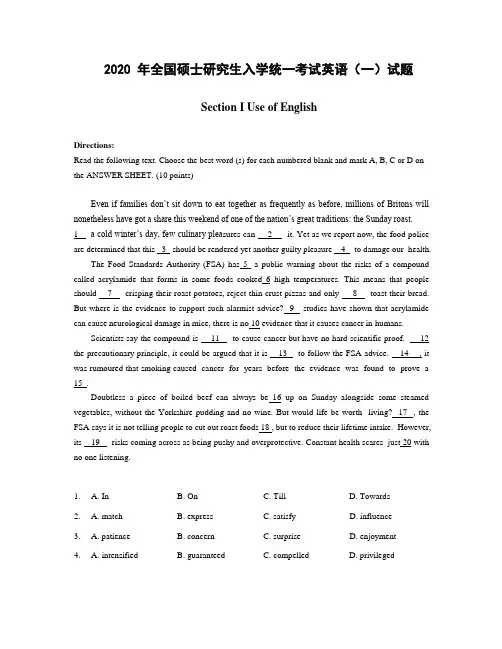
2020 年全国硕士研究生入学统一考试英语(一)试题Section I Use of EnglishDirections:Read the following text. Choose the best word (s) for each numbered blank and mark A, B, C or D on the ANSWER SHEET. (10 points)Even if families don’t sit down to eat together as frequently as before, millions of Britons will nonetheless have got a share this weekend of one of the nation’s great traditions: the Sunday roast.1 a cold winter’s day, few culinary plea sures can2 it. Yet as we report now, the food police are determined that this3 should be rendered yet another guilty pleasure4 to damage our health.The Food Standards Authority (FSA) has 5 a public warning about the risks of a compound called acrylamide that forms in some foods cooked 6 high temperatures. This means that people should 7 crisping their roast potatoes, reject thin-crust pizzas and only 8 toast their bread. But where is the evidence to support such alarmist advice? 9 studies have shown that acrylamide can cause neurological damage in mice, there is no 10 evidence that it causes cancer in humans.Scientists say the compound is 11 to cause cancer but have no hard scientific proof. 12 the precautionary principle, it could be argued that it is 13 to follow the FSA advice. 14 , it was rumoured that smoking caused cancer for years before the evidence was found to prove a 15 .Doubtless a piece of boiled beef can always be 16 up on Sunday alongside some steamed vegetables, without the Yorkshire pudding and no wine. But would life be worth living? 17 , the FSA says it is not telling people to cut out roast foods 18 , but to reduce their lifetime intake. However, its 19 risks coming across as being pushy and overprotective. Constant health scares just 20 with no one listening.1. A. In B. On C. Till D. Towards2. A. match B. express C. satisfy D. influence3. A. patience B. concern C. surprise D. enjoyment4. A. intensified B. guaranteed C. compelled D. privileged5. A. ignored B. received C. issued D. cancelled6. A. under B. by C. for D. at7. A. forget B. avoid C. finish D. regret8. A. easily B. regularly C. partially D. initially9. A. If B. Since C. While D. Unless10. A. conclusive B. external C. secondary D. negative11. A. likely B. bound C. insufficient D. slow12. A. In addition to B. At the cost of C. On the basis of D. In contrast to13. A. interesting B. fortunate C. urgent D. advisable14. A. As usual B. After all C. By definition D. In particular15. A. connection B. combination C. resemblance D. pattern16. A. made B. used C. saved D. served17. A. To be brief B. For instance C. To be fair D. In general18. A. entirely B. gradually C. reluctantly D. carefully19. A. promise B. competition C. experience D. campaign20. A. follow up B. end up C. open up D. pick upSection II Reading ComprehensionPart ADirections:Read the following four texts. Answer the questions after each text by choosing A, B, C or D. Mark your answers on the ANSWER SHEET. (40 points)Text 1A group of Labour MPs, among them Yvette Cooper, are bringing in the new year with a call to institute a UK “town of culture” award. The proposal is that it should sit alongside the existing city of culture title, which was held by Hull in 2017, and has been awarded to Coventry for 2021. Cooper andher colleagues argue that the success of the crown for Hull, where it brought in £220m of investment and an avalanche of arts, ought not to be confined to cities. Britain’s towns, it is true, are not prevented from applying, but they generally lack the resources to put together a bid to beat their bigger competitors. A town of culture award could, it is argued, become an annual event, attracting funding and creating jobs.Some might see the proposal as a booby prize for the fact that Britain is no longer able to apply for the much more prestigious title of European capital of culture, a sought-after award bagged by Glasgow in 1990 and Liverpool in 2008. A cynic might speculate that the UK is on the verge of disappearing into an endless fever of self-celebration in its desperation to reinvent itself for the post-Brexit world: after town of culture, who knows what will follow —village of culture? Suburb of culture? Hamlet of culture?It is also wise to recall that such titles are not a cure-all. A badly run “year of culture” washes in and out of a place like the tide, bringing prominence for a spell but leaving no lasting benefits to the community. The really successful holders of such titles are those that do a great deal more than fill hotel bedrooms and bring in high-profile arts events and good press for a year. They transform the aspirations of the people who live there; they nudge the self-image of the city into a bolder and more optimistic light. It is hard to get right, and requires a remarkable degree of vision, as well as cooperation between city authorities, the private sector, community groups and cultural organisations. But it can be done: Glasgow's year as European capital of culture can certainly be seen as one of a complex series of factors that have turned the city into the powerhouse of art, music and theatre that it remains today.A “town of culture” could be not just about the arts but about honouring a town's peculiarities —helping sustain its high street, supporting local facilities and above all celebrating its people. Jeremy Wright, the culture secretary, should welcome this positive, hope-filled proposal, and turn it into action.21.Cooper and her colleagues argue that a “town of culture” award couldA.consolidate the town-city ties in Britain.B.promote cooperation among Britain’s towns.C.increase the economic strength of Britain’s towns.D.focus Britain's limited resources on cultural events.22.According to Paragraph 2, the proposal might be regarded by some asA.a sensible compromise.B.a self-deceiving attempt.C.an eye-catching bonus.D.an inaccessible target.23.The author suggests that a title holder is successful only if itA.endeavours to maintain its image.B.meets the aspirations of its people.C.brings its local arts to prominence.mits to its long-term growth.24.Glasgow is mentioned in Paragraph 3 to presentA.a contrasting case.B.a supporting example.C.a background story.D.a related topic.25.What is the author’s attitude towards the proposal?A.Skeptical.B.Objective.C.Favourable.D.Critical.Text 2Scientific publishing has long been a licence to print money. Scientists need journals in which to publish their research, so they will supply the articles without monetary reward. Other scientists perform the specialised work of peer review also for free, because it is a central element in the acquisition of status and the production of scientific knowledge.With the content of papers secured for free, the publisher needs only to find a market for its journal. Until this century, university libraries were not very price sensitive. Scientific publishers routinely report profit margins approaching 40% on their operations, at a time when the rest of thepublishing industry is in an existential crisis.The Dutch giant Elsevier, which claims to publish 25% of the scientific papers produced in the world, made profits of more than £900m last year, while UK universities alone spent more than £210m in 2016 to enable researchers to access their own publicly funded research; both figures seem to rise unstoppably despite increasingly desperate efforts to change them.The most drastic, and thoroughly illegal, reaction has been the emergence of Sci-Hub, a kind of global photocopier for scientific papers, set up in 2012, which now claims to offer access to every paywalled article published since 2015. The success of Sci-Hub, which relies on researchers passing on copies they have themselves legally accessed, shows the legal ecosystem has lost legitimacy among its users and must be transformed so that it works for all participants.In Britain the move towards open access publishing has been driven by funding bodies. In some ways it has been very successful. More than half of all British scientific research is now published under open access terms: either freely available from the moment of publication, or paywalled for a year or more so that the publishers can make a profit before being placed on general release.Yet the new system has not worked out any cheaper for the universities. Publishers have responded to the demand that they make their product free to readers by charging their writers fees to cover the costs of preparing an article. These range from around £500 to $5,000. A report last year pointed out that the costs both of subscriptions and of these “article preparation costs" had been steadily rising at a rate above inflation. In some ways the scientific publishing model resembles the economy of the social internet: labour is provided free in exchange for the hope of status, while huge profits are made by a few big firms who run the market places. In both cases, we need a rebalancing of power.26.Scientific publishing is seen as "a licence to print money" partly becauseA.its funding has enjoyed a steady increase.B.its marketing strategy has been successful.C.its payment for peer review is reduced.D.its content acquisition costs nothing.27.According to Paragraphs 2 and 3, scientific publishers like Elsevier haveA.thrived mainly on university libraries.B.gone through an existential crisis.C.revived the publishing industry.D.financed researchers generously.28.How does the author feel about the success of Sci-Hub?A.Relieved.B.Puzzled.C.Concerned.D.Encouraged.29.It can be learned from Paragraphs 5 and 6 that open access termsA.allow publishers some room to make money.B.render publishing much easier for scientists.C.reduce the cost of publication substantially.D.free universities from financial burdens.30.Which of the following characterises the scientific publishing model?A.Trial subscription is offered.bour triumphs over status.C.Costs are well controlled.D.The few feed on the many.Text 3Progressives often support diversity mandates as a path to equality and a way to level the playing field. But all too often such policies are an insincere form of virtue-signaling that benefits only the most privileged and does little to help average people.A pair of bills sponsored by Massachusetts state Senator Jason Lewis and House Speaker Pro Tempore Patricia Haddad, to ensure "gender parity" on boards and commissions, provide a case in point.Haddad and Lewis are concerned that more than half the state-government boards are less than 40 percent female. In order to ensure that elite women have more such opportunities, they have proposed imposing government quotas. If the bills become law, state boards and commissions will berequired to set aside 50 percent of board seats for women by 2022.The bills are similar to a measure recently adopted in California, which last year became the first state to require gender quotas for private companies. In signing the measure, California Governor Jerry Brown admitted that the law, which expressly classifies people on the basis of sex, is probably unconstitutional.The US Supreme Court frowns on sex-based classifications unless they are designed to address an "important" policy interest. Because the California law applies to all boards, even where there is no history of prior discrimination, courts are likely to rule that the law violates the constitutional guarantee of "equal protection."But are such government mandates even necessary? Female participation on corporate boards may not currently mirror the percentage of women in the general population, but so what?The number of women on corporate boards has been steadily increasing without government interference. According to a study by Catalyst, between 2010 and 2015 the share of women on the boards of global corporations increased by 54 percent.Requiring companies to make gender the primary qualification for board membership will inevitably lead to less experienced private sector boards. That is exactly what happened when Norway adopted a nationwide corporate gender quota.Writing in The New Republic, Alice Lee notes that increasing the number of opportunities for board membership without increasing the pool of qualified women to serve on such boards has led to a "golden skirt" phenomenon, where the same elite women scoop up multiple seats on a variety of boards.Next time somebody pushes corporate quotas as a way to promote gender equity, remember that such policies are largely self-serving measures that make their sponsors feel good but do little to help average women.31.The author believes that the bills sponsored by Lewis and Haddad willA.help little to reduce gender bias.B.pose a threat to the state government.C.raise women's position in politics.D.greatly broaden career options.32.Which of the following is true of the California measure?A.It has irritated private business owners.B.It is welcomed by the Supreme Court.C.It may go against the Constitution.D.It will settle the prior controversies.33.The author mentions the study by Catalyst to illustrateA.the harm from arbitrary board decisions.B.the importance of constitutional guarantees.C.the pressure on women in global corporations.D.the needlessness of government interventions.34.Norway's adoption of a nationwide corporate gender quota has led toA.the underestimation of elite women's roleB.the objection to female participation on boards.C.the entry of unqualified candidates into the board.D.the growing tension between labor and management.35.Which of the following can be inferred from the text?A.Women's needs in employment should be considered.B.Feasibility should be a prime concern in policymaking.C.Everyone should try hard to promote social justice.D.Major social issues should be the focus of legislation.Text 4Last Thursday, the French Senate passed a digital services tax, which would impose an entirely new tax on large multinationals that provide digital services to consumers or users in France. Digital services include everything from providing a platform for selling goods and services online to targeting advertising based on user data, and the tax applies to gross revenue from such services. Many French politicians and media outlets have referred to this as a "GAFA tax," meaning that it is designed to apply primarily to companies such as Google, Apple, Facebook and Amazon — in other words, multinational tech companies based in the United States.The digital services tax now awaits the signature of President Emmanuel Macron, who has expressed support for the measure, and it could go into effect within the next few weeks. But it hasalready sparked significant controversy, with the United States trade representative opening an investigation into whether the tax discriminates against American companies, which in turn could lead to trade sanctions against France.The French tax is not just a unilateral move by one country in need of revenue. Instead, the digital services tax is part of a much larger trend, with countries over the past few years proposing or putting in place an alphabet soup of new international tax provisions. These have included Britain's DPT (diverted profits tax), Australia's MAAL (multinational antiavoidance law), and India's SEP (significant economic presence) test, to name but a few. At the same time, the European Union, Spain, Britain and several other countries have all seriously contemplated digital services taxes.These unilateral developments differ in their specifics, but they are all designed to tax multinationals on income and revenue that countries believe they should have a right to tax, even if international tax rules do not grant them that right. In other words, they all share a view that the international tax system has failed to keep up with the current economy.In response to these many unilateral measures, the Organization for Economic Cooperation and Development (OECD) is currently working with 131 countries to reach a consensus by the end of 2020 on an international solution. Both France and the United States are involved in the organization's work, but France's digital services tax and the American response raise questions about what the future holds for the international tax system.France's planned tax is a clear warning: Unless a broad consensus can be reached on reforming the international tax system, other nations are likely to follow suit, and American companies will face a cascade of different taxes from dozens of nations that will prove burdensome and costly.36.The French Senate has passed a bill toA.regulate digital services platforms.B.impose a levy on tech multinationals.C.protect French companies’ interests.D.curb the influence of advertising.37.It can be learned from Paragraph 2 that the digital services taxA.will prompt the tech giants to quit France.B.aims to ease international trade tensions.C.is apt to arouse criticism at home and abroad.D.may trigger countermeasures against France.38.The countries adopting the unilateral measures share the opinion thatA.the current international tax system needs upgrading.B.redistribution of tech giants' revenue must be ensured.C.tech multinationals' monopoly should be prevented.D.all countries ought to enjoy equal taxing rights.39.It can be learned from Paragraph 5 that the OECD's current workA.is being resisted by US companies.B.is faced with uncertain prospects.C.needs to be readjusted immediately.D.needs to involve more countries.40.Which of the following might be the best title for this text?A.France Leads the Charge on Digital TaxB.France Is Confronted with Trade SanctionsC.France Demands a Role in the Digital EconomyD.France Says "NO" to Tech MultinationalsPart BDirections:Read the following text and answer the questions by choosing the most suitable subheading from the list A-G for each of the numbered paragraphs (41-45). There are two extra subheadings which you do not need to use. Mark your answers on the ANSWER SHEET. (10 points)A.Eye fixations are brief.B.Too much eye contact is instinctively felt to be rude.C.Eye contact can be a friendly social signal.D.Personality can affect how a person reacts to eye contact.E.Biological factors behind eye contact are being investigated.F.Most people are not comfortable holding eye contact with strangers.G.Eye contact can be aggressive.In a social situation, eye contact with another person can show that you are paying attention in a friendly way. But it can also be antagonistic, such as when a political candidate turns toward their competitor during a debate and makes eye contact that signals hostility. Here's what hard science reveals about eye contact:41.We know that a typical infant will instinctively gaze into its mother's eyes, and she will look back. This mutual gaze is a major part of the attachment between mother and child. In adulthood, looking at someone else in a pleasant way can be a complimentary sign of paying attention. It can catch someone's attention in a crowded room. "Eye contact and smiles" can signal availability and confidence, a common-sense notion supported in studies by psychologist Monica Moore.42.Neuroscientist Bonnie Auyeung found that the hormone oxytocin increased the amount of eye contact from men toward the interviewer during a brief interview when the direction of their gaze was recorded. This was also found in high-functioning men with some autistic spectrum symptoms, who may tend to avoid eye contact. Specific brain regions that respond during direct gaze are being explored by other researches, using advanced methods of brain scanning.43.With the use of eye-tracking technology, Julia Minson of the Harvard Kennedy School of Government concluded that eye contact can signal very different kinds of messages, depending on the situation. While eye contact may be a sign of connection or trust in friendly situations, it's more likely to be associated with dominance or intimidation in adversarial situations. "Whether you're a politician or a parent, it might be helpful to keep in mind that trying to maintain eye contact may backfire if you're trying to convince someone who has a different set of beliefs than you," said Minson.44.When we look at a face or a picture, our eyes pause on one spot at a time, often on the eyes or mouth. These pauses typically occur at about three per second, and the eyes then jump to another spot, until several important points in the image are registered like a series of snapshots. How the whole image is then assembled and perceived is still a mystery although it is the subject of current research.45.In people who score high in a test of neuroticism, a personality dimension associated with self-consciousness and anxiety, eye contact triggered more activity associated with avoidance, according to the Finnish researcher Jari Hietanen and colleagues. "Our findings indicate that people do not only feel different when they are the centre of attention but that their brain reactions also differ." A more direct finding is that people who scored high for negative emotions like anxiety looked at others for shorter periods of time and reported more comfortable feelings when others did not look directly at them.Part CDirections:Read the following text carefully and then translate the underlined segments into Chinese. Write your answers on the ANSWER SHEET. (10 points)Following the explosion of creativity in Florence during the 14th century known as the Renaissance, the modern world saw a departure from what it had once known. It turned from God and the authority of the Roman Catholic Church and instead favoured a more humanistic approach to being. Renaissance ideas had spread throughout Europe well into the 17th century, with the arts and sciences flourishing extraordinarily among those with a more logical disposition. (46) With the Church's teachings and ways of thinking being eclipsed by the Renaissance, the gap between the Medieval and modern periods had been bridged, leading to new and unexplored intellectual t erritories.During the Renaissance, the great minds of Nicolaus Copernicus, Johannes Kepler and Galileo Galilei demonstrated the power of scientific study and discovery. (47) Before each of their revelations, many thinkers at the time had sustained more ancient ways of thinking, including the geo-centric view that the Earth was at the centre of our universe. Copernicus theorized in 1543 that all of the planets that we knew of revolved not around the Earth, but the Sun, a system that was later upheld by Galileo at his own expense. Offering up such a theory during a time of high tension between scientific and religious minds was branded as heresy, and any such heretics that continued to spread these lies were to be punished by imprisonment or even death.(48) Despite attempts by the Church to suppress this new generation of logicians and rationalists, more explanations for how the universe functioned were being made at a rate that the people could no longer ignore. It was with these great revelations that a new kind of philosophy founded in reason was born.The Church's long-standing dogma was losing the great battle for truth to rationalists and scientists. This very fact embodied the new ways of thinking that swept through Europe during most of the 17th century. (49) As many took on the duty of trying to integrate reasoning and scientific philosophies into the world, the Renaissance was over and it was time for a new era — the Age ofReason.The 17th and I8th centuries were times of radical change and curiosity. Scientific method, reductionism and the questioning of Church ideals was to be encouraged, as were ideas of liberty, tolerance and progress. (50) Such actions to seek knowledge and to understand what information we already knew were captured by the Latin phrase “sapere aude” or “dare to know”, after Immanuel Kant used it in his essay "An Answer to the Question: What is Enlightenment?". It was the purpose and responsibility of great minds to go forth and seek out the truth, which they believed to be founded in knowledge.Section III WritingPart A51.Directions:The student union of your university has assigned you to inform the international students about an upcoming singing contest. White a notice in about 100 words.Write your answer on the ANSWER SHEET.Do not use your own name in the notice. (10 points)Part B52.Directions:Write an essay of 160-200 words based on the pictures below. In your essay, you should1)describe the pictures briefly,2)interpret the implied meaning, and3)give your comments.Write your answer on the ANSWER SHEET. (20 points)习惯2020 年试题答案速查表Section I Use of English (10 points)1. B2. A3. D4. B5. C6. D7. B8. C9. C 10.A11. A 12. C 13. D 14. B 15. A 16. D 17. C 18. A 19. D 20. BSection II Reading Comprehension (60 points)Part A (40 points)Text 121. C 22. B 23. D 24. B 25. CText 226. D 27. A 28. C 29. A 30. DText 331. A 32. C 33. D 34. C 35. BText 436. B 37. D 38. A 39. B 40. APart B (10 points)41. C 42. E 43. G 44. A 45. DPart C (10 points)46.随着教会的教义和思维模式因文艺复兴而暗淡无光,中世纪和现代两个历史时期之间架起了桥梁,进而通向了崭新和未探索过的知识领域。
2020考研英语一真题及解析可编辑.doc

2020年研究生入学统一考试试题(英语一)Section I Use of EnglishDirections:Read the following text. Choose the best word (s) for each numbered blank and mark A, B, C or D on the ANSWER SHEET. (10 points)Even if families don't sit down to eat together as frequently as before, millions of Britons will nonetheless have got a share this weekend of one of that nation's great traditions; the Sunday roast. __1__ a cold winter's day, few culinary pleasures can 2 it. Yet as we report now, the food police are determined our health. That this__3__should be rendered yet another guilty pleasure __4__ to damage our health.The Food Standards Authority (FSA) has __5__ a public warning about the risks of a compound called acrylamide that forms in some foods cooked __6__ high temperatures. This means that people should __7__ crisping their roast potatoes, spurn thin-crust pizzas and only __8__ toast their bread. But where is the evidence to support such alarmist advice? __9__ studies have shown that acrylamide can cause neurological damage in mice, there is no __10__ evidence that it causes cancer in humans.Scientists say the compound is "__11__ to be carcinogenic" but have no hard scientific proof. __12__ the precautionary principle, it could be argued that it is __13__ to follow the FSA advice. __14__, it was rumored that smoking caused cancer for years before the evidence was found to prove a __15__.Doubtless a piece of boiled beef can always be __16__ up on Sunday alongside some steamed vegetables, without the Yorkshire pudding and no wine. But would life be worth living? __17__, the FSA says it is not telling people to cut out roast foods __18__, but to reduce their lifetime intake. However, their __19__ risks coming across as exhortation and nannying. Constant health scares just __20__ with no one listening.1. [A] In [B] Towards [C] On [D] Till2. [A] match [B] express [C] satisfy [D] influence3. [A] patience [B] enjoyment [C] surprise [D] concern4. [A] intensified [B] privileged [C] compelled [D] guaranteed5. [A] issued [B] received [C] ignored [D] canceled6. [A] under [B] at [C] for [D] by7. [A] forget [B] regret [C] finish [D] avoid8. [A] partially [B] regularly [C] easily [D] initially9. [A] Unless [B] Since [C] If [D] While10. [A] secondary [B] external [C] inconclusive [D] negative11. [A] insufficient [B] bound [C] likely [D] slow12. [A] On the basis of [B] At the cost of [C] In addition to [D] In contrast to13. [A] interesting [B] advisable [C] urgent [D] fortunate14. [A] As usual [B] In particular [C] By definition [D] After all15. [A] resemblance [B] combination [C] connection [D] pattern16. [A] made [B] served [C] saved [D] used17. [A] To be fair [B] For instance [C] To be brief [D] in general18. [A] reluctantly [B] entirely [C] gradually [D] carefully19. [A] promise [B] experience [C] campaign [D] competition20. [A] follow up [B] pick up [C] open up [D] end upSection Ⅱ Reading ComprehensionPart ADirections:Read the following four texts. Answer the questions below each text by choosing A, B, C or D. Mark your answers on the ANSWER SHEET. (40 points)Text 1A group of labour MPs, among them Yvette Cooper, are bringing in the new year with a call to institute a UK "town of culture" award. The proposal is that it should sit alongside the existing city of culture title, which was held by Hull in 2017 and has been awarded to Coventry for zoz1. Cooper and her colleagues argue that the success of the crown for Hull, where it brought in £220m of investment and an avalanche of arts, out not to be confined to cities. Britain' town, it is true are not prevented from applying, but they generally lack the resources to put together a bit to beat their bigger competitions. A town of culture award could, it is argued, become an annual event, attracting funding and creating jobs.Some might see the proposal as a boo by prize for the fact that Britain is no longer be able to apply for the much more prestigious title of European capital of culture, a sough-after award bagged by Glasgow in 1990 and Liverpool in 2008. A cynic might speculate that the UK is on the verge of disappearing into an endless fever of self-celebration in its desperation to reinvent itself for the post-Brexit world: after town of culture, who knows that will follow-village of culture? Suburb of culture? Hamlet of culture?It is also wise to recall that such titles are not a cure-all. A badly run "year of culture" washes in and out of a place like the tide, bringing prominence for a spell but leaving no lasting benefits to the community. The really successful holders of such titles are those that do a great deal more than fill hotel bedrooms and bring in high-profile arts events and good press for a year. They transform the aspirations of the people who live there; they nudge the self-image of the city into a bolder and more optimistic light. It is hard to get right, and requires a remarkable degree of vision, as well as cooperation between city authorities, the private sector, community. groups and cultural organisations. But it can be done: Glasgow's year as European capital of culture can certainly be seen as one of complex series of factors that have turned the city into the power of art, music and theatre that it remains today.A "town of culture" could be not just about the arts but about honoring a town's peculiarities-helping sustain its high street, supporting local facilities and above all celebrating its people and turn it into action.21.Copper and her colleague argue that a "town of culture" award would ___.A. consolidate the town city ties in BritainB. promote cooperation among Brain's townsC. increase the economic strength of Brain's townsD. focus Brain's limited resources on cultural events.22.According to paragraph 2, the proposal might be regarded by some as ______..A. a sensible compromiseB. a self-deceiving attemptC. an eye-catching bonusD. an inaccessible target23. The author suggests that a title holder is successful only if it ______A. endeavor to maintain its imageB. meets the aspiration of its peopleC. brings its local arts to prominenceD. commits to its long-term growth24. “Glasgow”is mentioned in Paragraph 3 to present ______A. a contrasting caseB. a supporting exampleC. a background storyD. a related topic25. What is the author's attitude towards the proposal?A. SkepticalB. ObjectiveC. FavorableD. CriticalText 2Scientific publishing has long been a licence to print money. Scientists need joumals in which to publish their research, so they will supply the articles without monetary reward. Other scientists perform the specialised work of peer review also for free, because it is a central element in the acquisition of status and the production of scientific knowledge.With the content of papers secured for free, the publisher needs only find a market for its journal. Until this century, university libraries were not very price sensitive. Scientific publishers routinely report profit margins approaching 40% on their operations, at a time when the rest of the publishing industry is in an existential crisis. The Dutch giant Elsevier, which claims to publish 25% of the scientific papers produced in the world , made profits of more than £900m last year, while UK universities alone spent more than £210m in 2016 to enable researchers to access their own publicly funded research; both figures seem to rise unstoppably despite increasingly desperate efforts to change them.The most drastic, and thoroughly illegal, reaction has been the emergence of Sci-Hub, a kind of global photocopier for scientific papers, set up in 2012, which now claims to offer access to every paywalled article published since 2015. The success of Sci-Hub, which relies on researchers passing on copies they have themselves legally accessed, shows the legal ecosystem has lost legitimacy among its users and must be transformed so that it works for all participants.In Britain the move towards open access publishing has been driven by funding bodies. In some ways it has been very successful. More than half of all British scientific research is now published under open access terms: either freely available from the moment of publication, or paywalled for a year or more so that the publishers can make a profit before being placed on general release.Yet the new system has not worked out any cheaper for the universities. Publishers have responded to the demand that they make their product free to readers by charging their writers fees to cover the costs of preparing an article. These range from around £500 to $5,000. A report last year pointed out that the costs both of subscriptions and of these “article preparation costs” had been steadily rising at a rate above inflation. In some ways the scientific publishing model resembles the economy of the social internet: labour is provided free in exchange for the hope of status, while huge profits are made by a few big firms who run the market places. In both cases, we need a rebalancing of power.26. Scientific publishing is seen as“a licence to print money" partly because________[A] its funding has enjoyed a steady increase .[B] its marketing strategy has been successful.[C] its payment for peer review is reduced.[D] its content acquisition costs nothing.27. According to Paragraphs 2 and 3, scientific publishers Elsevier have________[A] thrived mainly on university libraries.[B] gone through an existential crisis.[C] revived the publishing industry.[D] financed researchers generously.28. How does the author feel about the success of Sci-Hub?[A] Relieved.[B] Puzzled.[C] Concerned[D] Encouraged.29. It can be learned from Paragraphs 5 and 6 that open access terms________[A]allow publishers some room to make money.[B] render publishing much easier for scientists.[C] reduce the cost of publication substantially.[D] free universities from financial burdens.30. Which of the following characteristics the scientific publishing model?[A] Trial subscription is offered.[B] Labour triumphs over status.[C] Costs are well controlled.D] The few feed on the many.Text 3Progressives often support diversity mandates as a path to equality and a way to level the playing field. But all too often such policies are an insincere form of virtue-signaling that benefits only the most privileged and does little to help average people.A pair of bills sponsored by Massachusetts state Senator Jason Lewis and House Speaker Pro Tempore Patricia Haddad, to ensure "gender parity" on boards and commissions, provide a case in point.Haddad and Lewis are concerned that more than half the state-government boards are less than 40 percent female. In order to ensure that elite women have more such opportunities, they have proposed imposing government quotas. If the bills become law, state boards and commissions will be required to set aside 50 percent of board seats for women by 2022.The bills are similar to a measure recently adopted in Califomia, which last year became the first state to require gender quotas for private companies. In signing the measure, California Governor Jerry Brown admitted that the law, which expressly classifies people on the basis of sex, is probably unconstitutional.The US Supreme Court frowns on sex-based classifications unless they are designed to address an "important" policy interest, Because the California law applies to all boards, even where there is no history of prior discrimination, courts are likely to rule that the law violates the constitutional guarantee of "equal protection".But are such government mandates even necessary? Female participation on corporate boards may not currently mirror the percentage of women in the general population, but so what?The number of women on corporate boards has been steadily increasing without government interference. According to a study by Catalyst, between 2010 and 2015 the share of women on the boards of global corporations increased by 54 percent.Requiring companies to make gender the primary qualification for board membership will inevitably lead to less experienced private sector boards. That is exactly what happened when Norway adopted a nationwide corporate gender quota.Writing in The New Republic, Alice Lee notes that increasing the number of opportunities for board membership without increasing the pool of qualified women to serve on such boards has led to a “golden skirt "phenomenon, where the same elite women scoop up multiple seats on a variety of boards.Next time somebody pushes corporate quotas as a way to promote gender equity, remember that such policies are largely self-serving measures that make their sponsors feel good but do little to help average women.31. The author believes that the bills sponsored by Lewis and Haddad wills________[A] help little to reduce gender bias.[B] pose a threat to the state government.[C] raise women's position in politics.[D] greatly broaden career options.32. Which of the following is true of the California measure?[A] It has irritated private business owners.[B] It is welcomed by the Supreme Court,[C] It may go against the Constitution.[D] It will settle the prior controversies.33. The author mentions the study by Catalyst to illustrate____[A] the harm from arbitrary board decision.[B] the importance of constitutional guarantees.[C] the pressure on women in global corporations.[D] the needlessness of government interventions.34. Norway's adoption of a nationwide corporate gender quota has led to____[A] the underestimation of elite women's role.[B] the objection to female participation on boards.[C] the entry of unqualified candidates into the board.[D] the growing tension between labor and management.35. Which of the following can be inferred from the text?[A] Women's need in employment should be considered.[B] Feasibility should be a prime concern in policymaking.[C] Everyone should try hard to promote social justice.[D] Major social issues should be the focus of legislation.Text 4Last Thursday, the French Senate passed a digital services tax, which would impose an entirely new tax on large multinationals that provide digital services to consumers or users in France. Digital services include everything from providing a platform for selling goods and services online to targeting advertising based on user data, and the tax applies to gross revenue from such servces. Many French politicians and media outlets have referred to this as a“GAFA tax," meaning that it is designed to apply primarily to companies such as Google, Apple, Facebook and Amazon- in other words, multinational tech companies based in the United States.The digital services tax now awaits the signature of President Emmanuel Macron, who has expressed support for the measure, and it could go into effect within the next few weeks. But it has already sparked significant controversy, with the Unite Sates trade representative opening an investigation into whether the tax discriminates against American companies, which in turn could lead to trade sanctions against France.The French tax is not just a unilateral move by one country in need of revenue. Instead, the digital services tax is part of a much larger trend, with countries over the past few years proposing or putting in place an alphabet soup of new international tax provisions. These have included Britain's DPT (diverted profits tax), Australia's MAAL (multinational antiavoidance law), and India's SEP (significant economic presence) test, to name but a few. At the same time, the European Union, Spain, Britain and several other countries have all seriously contemplated digital services taxes.These unilateral developments differ in their specifics, but they are all designed to tax multinationals on income and revenue that countries believe they should have a right to tax, even if international tax rules do not grant them that right. In other words, they all share a view that the international tax system has failed to keep up with the current economy.In response to these many unilateral measures, the Organization for Economic Cooperation and Development(OECD) is currently working with 131 countries to reach a consensus by the end of 2020 on an international solution. Both France and the United States are involved in the organization' s work, but France's digital services tax and the American response raise questions about what the future holds for the international tax system.France`s planned tax is a clear warning: Unless a broad consensus can be reached on reforming the international tax system, other nations are likely to follow suit, and American companies will face a cascade of different taxes from dozens of nations that will prove burdensome and costly.36. The French Senate has passed a bill to_____[A] regulate digital services platforms.[B] protect French companies' interests.[C] impose a levy on tech multinationals.[D] curb the influence of advertising.37. It can be learned from Paragraph 2 that the digital services tax _____[A] may trigger countermeasures against France.[B] is apt to arouse criticism at home and abroad.[C] aims to ease international trade tensions.[D] will prompt the tech giants to quit France.38. The countries adopting the unilateral measures share the opinion that _____[A] redistribution of tech giants' revenue must be ensured.[B] the current international tax system needs upgrading.[C] tech multinationals' monopoly should be prevented.[D] all countries ought to enjoy equal taxing rights.39. It can be learned from Para 5 that the OECO's current work_____[A] is being resisted by US companies.[B] needs to be readjusted immediately.[C] is faced with uncertain prospects.[D] needs to in involve more countries.40. Which of the following might be the. best title for this text?[A] France Is Confronted with Trade Sanctions[B] France leads the charge on Digital Tax[C] France Says "NO" to Tech Multinationals[D] France Demands a Role in the Digital EconomyPart BDirections:In the following text, some sentences have been removed. For Questions 41 -45, choose the most suitable one from the fist A-G to fit into each of the numbered blanks. There are two extra choices, which do not fit in any of the gaps. Mark your answers on ANSWER SHEET. (10 points)[A] Eye fixactions are brief[B] Too much eye contact is instinctively felt to be rude[C] Eye contact can be a friendly social signal[D] Personality can affect how a person reacts to eye contact[E] Biological factors behind eye contact are being investigated[F] Most people are not comfortable holding eye contact with strangers[G] Eye contact can also be aggressive.In a social situation, eye contact with another person can show that you are paying attention in a friendly way.But it can also be antagonistic such as when a political candidate tums toward their competitor during a debate and makes eye contact that signals hostility. Here 's what hard science reveals about eye contact:41. ________________We know that a typical infant will instinctively gaze into its mother's eyes, and she will look back . This mutual gaze is a major part of the attachment between mother and child. In adulthood, looking someone else in a pleasant way can be a complimentary sign of paying attention. It can catch someone's attention in a crowded room, "Eye contact and smile" can signal availability and confidence, a common-sense notion supported in studies by psychologist Monica Moore.42.________Neuroscientist Bonnie Augeung found that the hormone oxytocin increased the amount of eye contact from men toward the interviewer during a brief interview when the direction of their gaze was recorded. This was also found in high- functioning men with some autistic spectrum symptoms, who may tend to avoid eye contact. Specific brain regions that respond during direct gaze are being explored by other researches, using advanced methods of brain scanning.43.________With the use of eye-tracking technology, Julia Minson of the Harvard Kennedy School of Government concluded that eye contact can signal very different kinds of messages, depending on the situation While eye contact may be a sign of connection or trust in friendly situations, it's more likely to be associated with dominance OF intimidation in adversarial situations. Whether you're a politician or a parent, it might be helpful to keep 'in mind that trying to maintain eye contact may backfire if you're trying to convince someone who has a different set of beliefs than you," said Minson.44.________When we look at a face or a picture, our eyes pause on one spot at a time, often on the eyes or mouth. These pauses typically occur at about three per second, and the eyes then jump to another spot, until several important points in the image are registered like a series of snapshots. How the whole image is then assembled and perceived is still a mystery although it is the subject of current research.45.________In people who score high in a test of neuroticism, a personality dimension associated with self-consciousness and anxiety, eye contact triggered more activity associated with avoidance, according to the Finnish researcher Jari Hietanen and colleagues. Our findings indicate that people do not only feel different when they are the centre of attention but that their brain reactions also differ-" A more direct finding is that people who scored high for negative emotions like anxiety looked at others for shorter periods of time and reported more comfortable feelings when others did not look directly at them.Part C TranslationDirections:Read the following text carefully and then translate the underlined segments into Chinese. Your translation should be written neatly on the ANSWER SHEET. (10 points)Following the explosion of creativity in Florence during the 14th century known as the Renaissance, the modern world saw a departure from what it had once known. It turned from God and the authority of the Roman Catholic Church and instead favoured a more humanistic approach to being. Renaissance ideas had spread throughout Europe well into the 17th century, with the arts and sciences flourishing extraordinarily among those with a more logical disposition. 46.With (the gap between)the church's teachings and ways of thinking being eclipsed by the Renaissance, the gap between the medieval and modern periods had been bridged, leading to new and unexplored intellectual territories.During the Renaissance, the great minds of Nicolaus Copernicus, Johannes Kepler and Galileo Galilei demonstrated the power of scientific study and discovery. 47. Before each of their revelations, many thinkers at the time had sustained more ancient ways of thinking, including the geocentric view that the Earth was at the centre of our universe. Copernicus theorized in 1543 that in actual fact, all of the planets that we knew of revolved not around the Earth, but the Sun, a system that was later upheld by Galileo at his own expense. Offering up such a theory during a time of high tension between scientific and religious minds was branded as heresy, and any such heretics that continued to spread these lies were to be punished by imprisonment or even death. Galileo was excommunicated by the Church and imprisoned for life for his astronomical observations and his support of the heliocentric principle.48. Despite attempts by the Church to strong-arm this new generation of logicians and rationalists, more explanations for how the universe functioned were being made, and at a rate that the people-including the Church -could no longer ignore. It was with these great revelations that a new kind of philosophy founded in reason was born.The Church's long-standing dogma was losing the great battle for truth to rationalists and scientists. This very fact embodied the new ways of thinking that swept through Europe during most of the 17th century. 49. As many took on the duty of trying to integrate reasoning and scientific philosophies into the world. The Renaissance was over and it was time for a new era-the Age of Reason.The 17th and 18th centuries were times of radical change and curiosity. Scientific method, reductionism and the questioning of Church ideals was to be encouraged, as were ideas of liberty, tolerance and progress. 50. Such actions to seek knowledge and to understand what information we already knew were captured by the Latin phrase 'sapere aude ' or ' dare to know', after Immanuel Kant used it in his essay An Answer to the Question: What is Enlightenment? It was the purpose and responsibility of great minds to go forth and seek out the truth, which they believed to be founded in knowledge.Section IV WritingPart A51.Directions:The Student Union of your university has assigned you to inform theinternational students an upcoming singing contest. Write a notice in about100 words.Write your answer on the ANSWER SHEET.Do not use your name in the notice.Part B52: Directions:Write an essay of 160-200 words based on the picture below. In your essay, you should:1) Describe the picture briefly;2) Interpret the implied meaning, and3) Give your comments2020年研究生入学统一考试试题(英语一)答案及解析Section I Use of EnglishDirections:Read the following text. Choose the best word (s) for each numbered blank and mark A, B, C or D on the ANSWER SHEET. (10 points)今年完形填空的难度较前两年略难,虽然话题不难理解,但不易把握上下文的线索。
2020考研英语一真题及解析可编辑word版本
2020考研英语一真题及解析可编辑2020年研究生入学统一考试试题(英语一)Section I Use of EnglishDirections:Read the following text. Choose the best word (s) for each numbered blank and mark A, B, C or D on the ANSWER SHEET. (10 points)Even if families don't sit down to eat together as frequently as before, millions of Britons will nonetheless have got a share this weekend of one of that nation's great traditions; the Sunday roast. __1__ a cold winter's day, few culinary pleasures can 2 it. Yet as we report now, the food police are determined our health. That this__3__should be rendered yet another guilty pleasure __4__ to damage our health.The Food Standards Authority (FSA) has __5__ a public warning about the risks of a compound called acrylamide that forms in some foods cooked __6__ high temperatures. This means that people should __7__ crisping their roast potatoes, spurn thin-crust pizzas and only __8__ toast their bread. But where is the evidence to support such alarmist advice? __9__ studies have shown that acrylamide can cause neurological damage in mice, there is no __10__ evidence that it causes cancer in humans.Scientists say the compound is "__11__ to be carcinogenic" but have no hard scientific proof. __12__ the precautionary principle, it could be argued that it is __13__ to follow the FSA advice.__14__, it was rumored that smoking caused cancer for years before the evidence was found to prove a __15__.Doubtless a piece of boiled beef can always be __16__ up on Sunday alongside some steamed vegetables, without the Yorkshire pudding and no wine. But would life be worth living? __17__, the FSA says it is not telling people to cut out roast foods __18__, but to reduce their lifetime intake. However, their __19__ risks coming across as exhortation and nannying. Constant health scares just __20__ with no one listening.1. [A] In [B] Towards [C] On [D] Till2. [A] match [B] express [C] satisfy [D] influence3. [A] patience [B] enjoyment [C] surprise [D] concern4. [A] intensified [B] privileged [C] compelled [D] guaranteed5. [A] issued [B] received [C] ignored [D] canceled6. [A] under [B] at [C] for [D] by7. [A] forget [B] regret [C] finish [D] avoid8. [A] partially [B] regularly [C] easily [D] initially9. [A] Unless [B] Since [C] If [D] While10. [A] secondary [B] external [C] inconclusive [D] negative11. [A] insufficient [B] bound [C] likely [D] slow12. [A] On the basis of [B] At the cost of [C] In addition to [D] In contrast to13. [A] interesting [B] advisable [C] urgent [D] fortunate14. [A] As usual [B] In particular [C] By definition [D] After all15. [A] resemblance [B] combination [C] connection [D] pattern16. [A] made [B] served [C] saved [D] used17. [A] To be fair [B] For instance [C] To be brief[D] in general18. [A] reluctantly [B] entirely [C] gradually [D] carefully19. [A] promise [B] experience [C] campaign [D] competition20. [A] follow up [B] pick up [C] open up [D] end upSection Ⅱ Reading ComprehensionPart ADirections:Read the following four texts. Answer the questions below each text by choosing A, B, C or D. Mark your answers on the ANSWER SHEET. (40 points)Text 1A group of labour MPs, among them Yvette Cooper, are bringing in the new year with a call to institute a UK "town of culture" award. The proposal is that it should sit alongside the existing city of culture title, which was held by Hull in 2017 and has been awarded to Coventry for zoz1. Cooper and her colleagues argue that the success of the crown for Hull, where it brought in £220m of investment and an avalanche of arts, out not to be confined to cities. Britain' town, it is true are not prevented from applying, but they generally lack the resources to put together a bit to beat their bigger competitions. A town of culture award could, it is argued, become an annual event, attracting funding and creating jobs.Some might see the proposal as a boo by prize for the fact that Britain is no longer be able to apply for the much more prestigious title of European capital of culture, a sough-after award bagged by Glasgow in 1990 and Liverpool in 2008. A cynic might speculate that the UK is on the verge of disappearing into an endless fever of self-celebration in its desperation to reinvent itself for the post-Brexit world: after town of culture, who knows that will follow-village of culture? Suburb of culture? Hamlet of culture?It is also wise to recall that such titles are not a cure-all. A badly run "year of culture" washes in and out of a place like the tide, bringing prominence for a spell but leaving no lasting benefits to the community. The really successful holders of such titles are those that do a great deal more than fill hotel bedrooms and bring in high-profile arts events and good press for a year. They transformthe aspirations of the people who live there; they nudge the self-image of the city into a bolder and more optimistic light. It is hard to get right, and requires a remarkable degree of vision, as well as cooperation between city authorities, the private sector, community. groups and cultural organisations. But it can be done: Glasgow's year as European capital of culture can certainly be seen as one of complex series of factors that have turned the city into the power of art, music and theatre that it remains today.A "town of culture" could be not just about the arts but about honoring a town's peculiarities-helping sustain its high street, supporting local facilities and above all celebrating its people and turn it into action.21.Copper and her colleague argue that a "town of culture" award would ___.A. consolidate the town city ties in BritainB. promote cooperation among Brain's townsC. increase the economic strength of Brain's townsD. focus Brain's limited resources on cultural events.22.According to paragraph 2, the proposal might be regarded by some as ______..A. a sensible compromiseB. a self-deceiving attemptC. an eye-catching bonusD. an inaccessible target23. The author suggests that a title holder is successful only if it ______A. endeavor to maintain its imageB. meets the aspiration of its peopleC. brings its local arts to prominenceD. commits to its long-term growth24. “Glasgow” is mentioned in Paragraph 3 to present ______A. a contrasting caseB. a supporting exampleC. a background storyD. a related topic25. What is the author's attitude towards the proposal?A. SkepticalB. ObjectiveC. FavorableD. CriticalText 2Scientific publishing has long been a licence to print money. Scientists need joumals in which to publish their research, so they will supply the articles without monetary reward. Other scientists perform the specialised work of peer review also for free, because it is a central element in the acquisition of status and the production of scientific knowledge.With the content of papers secured for free, the publisher needs only find a market for its journal. Until this century, university libraries were not very price sensitive. Scientific publishers routinely report profit margins approaching 40% on their operations, at a time when the rest of the publishing industry is in an existential crisis.The Dutch giant Elsevier, which claims to publish 25% of the scientific papers produced in the world , made profits of more than £900m last year, while UK universities alone spent more than £210m in 2016 to enable researchers to access their own publicly funded research; both figures seem to rise unstoppably despite increasingly desperate efforts to change them.The most drastic, and thoroughly illegal, reaction has been the emergence of Sci-Hub, a kind of global photocopier for scientific papers, set up in 2012, which now claims to offer access to every paywalled article published since 2015. The success of Sci-Hub, which relies on researchers passing on copies they have themselves legally accessed, shows the legal ecosystem has lost legitimacy among its users and must be transformed so that it works for all participants.In Britain the move towards open access publishing has been driven by funding bodies. In some ways it has been very successful. More than half of all British scientific research is now published under open access terms: either freely available from the moment of publication, or paywalled for a year or more so that the publishers can make a profit before being placed on general release.Yet the new system has not worked out any cheaper for the universities. Publishers have responded to the demand that they make their product free to readers by charging their writers fees to cover the costs of preparing an article. These range from around £500 to $5,000. A report last year pointed out that the costs both of subscriptions and of these “article preparation costs” had been steadily rising at a rate above inflation. In some ways the scientific publishing model resembles the economy of the social internet: labour is provided free in exchange for the hope of status, while huge profits are made by a few big firms who run the market places. In both cases, we need a rebalancing of power.26. Scientific publishing is seen as“a licence to print money" partly because________[A] its funding has enjoyed a steady increase .[B] its marketing strategy has been successful.[C] its payment for peer review is reduced.[D] its content acquisition costs nothing.27. According to Paragraphs 2 and 3, scientific publishers Elsevier have________[A] thrived mainly on university libraries.[B] gone through an existential crisis.[C] revived the publishing industry.[D] financed researchers generously.28. How does the author feel about the success of Sci-Hub?[A] Relieved.[B] Puzzled.[C] Concerned[D] Encouraged.29. It can be learned from Paragraphs 5 and 6 that open access terms________[A]allow publishers some room to make money.[B] render publishing much easier for scientists.[C] reduce the cost of publication substantially.[D] free universities from financial burdens.30. Which of the following characteristics the scientific publishing model?[A] Trial subscription is offered.[B] Labour triumphs over status.[C] Costs are well controlled.D] The few feed on the many.Text 3Progressives often support diversity mandates as a path to equality and a way to level the playing field. But all too often such policies are an insincere form of virtue-signaling that benefits only the most privileged and does little to help average people.A pair of bills sponsored by Massachusetts state Senator Jason Lewis and House Speaker Pro Tempore Patricia Haddad, to ensure "gender parity" on boards and commissions, provide a case in point.Haddad and Lewis are concerned that more than half the state-government boards are less than 40 percent female. In order to ensure that elite women have more such opportunities, they have proposed imposing government quotas. If the bills become law, state boards and commissions will be required to set aside 50 percent of board seats for women by 2022.The bills are similar to a measure recently adopted in Califomia, which last year became the first state to require gender quotas for private companies. In signing the measure, California Governor Jerry Brown admitted that the law, which expressly classifies people on the basis of sex, is probably unconstitutional.The US Supreme Court frowns on sex-based classifications unless they are designed to address an "important" policy interest, Because the California law applies to all boards, even where there is no history of prior discrimination, courts are likely to rule that the law violates the constitutional guarantee of "equal protection".But are such government mandates even necessary? Female participation on corporate boards may not currently mirror the percentage of women in the general population, but so what?The number of women on corporate boards has been steadily increasing without government interference. According to a study by Catalyst, between 2010 and 2015 the share of women on the boards of global corporations increased by 54 percent.Requiring companies to make gender the primary qualification for board membership will inevitably lead to less experienced private sector boards. That is exactly what happened when Norway adopted a nationwide corporate gender quota.Writing in The New Republic, Alice Lee notes that increasing the number of opportunities for board membership without increasing the pool of qualified women to serve on such boards has led to a “golden skirt "phenomenon, where the same elite women scoop up multiple seats on a variety of boards.Next time somebody pushes corporate quotas as a way to promote gender equity, remember that such policies are largely self-serving measures that make their sponsors feel good but do little to help average women.31. The author believes that the bills sponsored by Lewis and Haddad wills________[A] help little to reduce gender bias.[B] pose a threat to the state government.[C] raise women's position in politics.[D] greatly broaden career options.32. Which of the following is true of the California measure?[A] It has irritated private business owners.[B] It is welcomed by the Supreme Court,[C] It may go against the Constitution.[D] It will settle the prior controversies.33. The author mentions the study by Catalyst to illustrate____[A] the harm from arbitrary board decision.[B] the importance of constitutional guarantees.[C] the pressure on women in global corporations.[D] the needlessness of government interventions.34. Norway's adoption of a nationwide corporate gender quota has led to____[A] the underestimation of elite women's role.[B] the objection to female participation on boards.[C] the entry of unqualified candidates into the board.[D] the growing tension between labor and management.35. Which of the following can be inferred from the text?[A] Women's need in employment should be considered.[B] Feasibility should be a prime concern in policymaking.[C] Everyone should try hard to promote social justice.[D] Major social issues should be the focus of legislation.Text 4Last Thursday, the French Senate passed a digital services tax, which would impose an entirely new tax on large multinationals that provide digital services to consumers or users in France. Digital services include everything from providing a platform for selling goods and services online to targeting advertising based on user data, and the tax applies to gross revenue from such servces. Many French politicians and media outlets have referred to this as a“GAFA tax," meaning that it isdesigned to apply primarily to companies such as Google, Apple, Facebook and Amazon- in other words, multinational tech companies based in the United States.The digital services tax now awaits the signature of President Emmanuel Macron, who has expressed support for the measure, and it could go into effect within the next few weeks. But it has already sparked significant controversy, with the Unite Sates trade representative opening an investigation into whether the tax discriminates against American companies, which in turn could lead to trade sanctions against France.The French tax is not just a unilateral move by one country in need of revenue. Instead, the digital services tax is part of a much larger trend, with countries over the past few years proposing or putting in place an alphabet soup of new international tax provisions. These have included Britain's DPT (diverted profits tax), Australia's MAAL (multinational antiavoidance law), and India's SEP (significant economic presence) test, to name but a few. At the same time, the European Union, Spain, Britain and several other countries have all seriously contemplated digital services taxes.These unilateral developments differ in their specifics, but they are all designed to tax multinationals on income and revenue that countries believe they should have a right to tax, even if international tax rules do not grant them that right. In other words, they all share a view that the international tax system has failed to keep up with the current economy.In response to these many unilateral measures, the Organization for Economic Cooperation and Development (OECD) is currently working with 131 countries to reach a consensus by the end of 2020 on an international solution. Both France and the United States are involved in the organization' s work, but France's digital services tax and the American response raise questions about what the future holds for the international tax system.France`s planned tax is a clear warning: Unless a broad consensus can be reached on reforming the international tax system, other nations are likely to follow suit, and American companies will face a cascade of different taxes from dozens of nations that will prove burdensome and costly.36. The French Senate has passed a bill to_____[A] regulate digital services platforms.[B] protect French companies' interests.[C] impose a levy on tech multinationals.[D] curb the influence of advertising.37. It can be learned from Paragraph 2 that the digital services tax _____[A] may trigger countermeasures against France.[B] is apt to arouse criticism at home and abroad.[C] aims to ease international trade tensions.[D] will prompt the tech giants to quit France.38. The countries adopting the unilateral measures share the opinion that _____[A] redistribution of tech giants' revenue must be ensured.[B] the current international tax system needs upgrading.[C] tech multinationals' monopoly should be prevented.[D] all countries ought to enjoy equal taxing rights.39. It can be learned from Para 5 that the OECO's current work_____[A] is being resisted by US companies.[B] needs to be readjusted immediately.[C] is faced with uncertain prospects.[D] needs to in involve more countries.40. Which of the following might be the. best title for this text?[A] France Is Confronted with Trade Sanctions[B] France leads the charge on Digital Tax[C] France Says "NO" to Tech Multinationals[D] France Demands a Role in the Digital EconomyPart BDirections:In the following text, some sentences have been removed. For Questions 41 -45, choose the most suitable one from the fist A-G to fit into each of the numbered blanks. There are two extra choices, which do not fit in any of the gaps. Mark your answers on ANSWER SHEET. (10 points)[A] Eye fixactions are brief[B] Too much eye contact is instinctively felt to be rude[C] Eye contact can be a friendly social signal[D] Personality can affect how a person reacts to eye contact[E] Biological factors behind eye contact are being investigated[F] Most people are not comfortable holding eye contact with strangers[G] Eye contact can also be aggressive.In a social situation, eye contact with another person can show that you are paying attention in a friendly way. But it can also be antagonistic such as when a political candidate tums toward their competitor during a debate and makes eye contact that signals hostility. Here 's what hard science reveals about eye contact:41. ________________We know that a typical infant will instinctively gaze into its mother's eyes, and she will look back . This mutual gaze is a major part of the attachment between mother and child. In adulthood, looking someone else in a pleasant way can be a complimentary sign of paying attention. It cancatch someone's attention in a crowded room, "Eye contact and smile" can signal availability and confidence, a common-sense notion supported in studies by psychologist Monica Moore.42.________Neuroscientist Bonnie Augeung found that the hormone oxytocin increased the amount of eye contact from men toward the interviewer during a brief interview when the direction of their gaze was recorded. This was also found in high- functioning men with some autistic spectrum symptoms, who may tend to avoid eye contact. Specific brain regions that respond during direct gaze are being explored by other researches, using advanced methods of brain scanning.43.________With the use of eye-tracking technology, Julia Minson of the Harvard Kennedy School of Government concluded that eye contact can signal very different kinds of messages, depending on the situation While eye contact may be a sign of connection or trust in friendly situations, it's more likely to be associated with dominance OF intimidation in adversarial situations. Whether you're a politician or a parent, it might be helpful to keep 'in mind that trying to maintain eye contact may backfire if you're trying to convince someone who has a different set of beliefs than you," said Minson.44.________When we look at a face or a picture, our eyes pause on one spot at a time, often on the eyes or mouth. These pauses typically occur at about three per second, and the eyes then jump to another spot, until several important points in the image are registered like a series of snapshots. How the whole image is then assembled and perceived is still a mystery although it is the subject of current research.45.________In people who score high in a test of neuroticism, a personality dimension associated with self-consciousness and anxiety, eye contact triggered more activity associated with avoidance, according to the Finnish researcher Jari Hietanen and colleagues. Our findings indicate that people do not only feel different when they are the centre of attention but that their brain reactions also differ-" A more direct finding is that people who scored high for negative emotions like anxiety looked at others for shorter periods of time and reported more comfortable feelings when others did not look directly at them.Part C TranslationDirections:Read the following text carefully and then translate the underlined segments into Chinese. Your translation should be written neatly on the ANSWER SHEET. (10 points)Following the explosion of creativity in Florence during the 14th century known as the Renaissance, the modern world saw a departure from what it had once known. It turned from God and the authority of the Roman Catholic Church and instead favoured a more humanistic approach to being. Renaissance ideas had spread throughout Europe well into the 17th century, with the arts and sciences flourishing extraordinarily among those with a more logical disposition. 46.With (the gapbetween) the church's teachings and ways of thinking being eclipsed by the Renaissance, the gapbetween the medieval and modern periods had been bridged, leading to new and unexplored intellectual territories.During the Renaissance, the great minds of Nicolaus Copernicus, Johannes Kepler and Galileo Galilei demonstrated the power of scientific study and discovery. 47. Before each of their revelations, many thinkers at the time had sustained more ancient ways of thinking, including the geocentric view that the Earth was at the centre of our universe. Copernicus theorized in 1543 that in actual fact, all of the planets that we knew of revolved not around the Earth, but the Sun, a system that was later upheld by Galileo at his own expense. Offering up such a theory during a time of high tension between scientific and religious minds was branded as heresy, and any such heretics that continued to spread these lies were to be punished by imprisonment or even death. Galileo was excommunicated by the Church and imprisoned for life for his astronomical observations and his support of the heliocentric principle.48. Despite attempts by the Church to strong-arm this new generation of logicians and rationalists, more explanations for how the universe functioned were being made, and at a rate that the people-including the Church -could no longer ignore. It was with these great revelations that a new kind of philosophy founded in reason was born.The Church's long-standing dogma was losing the great battle for truth to rationalists and scientists. This very fact embodied the new ways of thinking that swept through Europe during most of the 17th century. 49. As many took on the duty of trying to integrate reasoning and scientific philosophies into the world. The Renaissance was over and it was time for a new era-the Age of Reason.The 17th and 18th centuries were times of radical change and curiosity. Scientific method, reductionism and the questioning of Church ideals was to be encouraged, as were ideas of liberty, tolerance and progress. 50. Such actions to seek knowledge and to understand what information we already knew were captured by the Latin phrase 'sapere aude ' or ' dare to know', after Immanuel Kant used it in his essay An Answer to the Question: What is Enlightenment? It was the purpose and responsibility of great minds to go forth and seek out the truth, which they believed to be founded in knowledge.Section IV WritingPart A51.Directions:The Student Union of your university has assigned you to inform theinternational students an upcoming singing contest. Write a notice in about100 words.Write your answer on the ANSWER SHEET.Do not use your name in the notice.Part B52: Directions:Write an essay of 160-200 words based on the picture below. In your essay, you should:1) Describe the picture briefly;2) Interpret the implied meaning, and3) Give your comments2020年研究生入学统一考试试题(英语一)答案及解析Section I Use of EnglishDirections:Read the following text. Choose the best word (s) for each numbered blank and mark A, B, C or D on the ANSWER SHEET. (10 points)今年完形填空的难度较前两年略难,虽然话题不难理解,但不易把握上下文的线索。
2020年考研英语一新视角下的阅读理解真题及答案分析
2020年考研英语一新视角下的阅读理解真题及答案分析考研英语一新视角下的阅读理解题型在过去几年逐渐增加,要求考生具备更高的阅读理解能力。
本文将选取一道真题,对其进行分析,帮助考生更好地理解和解答该题。
题目:Passage 1The most striking thing about the early history of bridge designs is not their diversity (多样性) but their similarity. Despite all the extraordinary variety of designs, all bridges share the same principle of balance. In physics and engineering, there are three types of stresses: tension (拉力), compression (压力), and shear (剪力). All three type of stresses are present in every bridge design. However, the physical elegance of a well-designed bridge lies in the way it directs and balances these forces.The suspension bridge is the most common form of bridge. The characteristic feature of suspension bridges is that they hang from the ends and the weight of the bridge is directed straight downward. The compression and tension forces can thus be evenly balanced. This design creates a much stronger and more stable bridge structure.Truss bridges are one of the oldest types of modern bridges. A truss bridge is made of steel beams that have been joined together in a certain pattern. The pattern of the truss can vary depending on the location of the bridge, but the principle remains the same: the weights of the traffic on thebridge are directed downward and supported by the truss structure. By distributing the force, truss bridges are able to create a stable structure that can support heavy loads.Arch bridges are another common form of bridge design. These bridges are made of arch-shaped structures that distribute the force of the weights on the bridge. The shape of the arch allows the weight to be directed downwards and supported by the arch structure, creating balance. Arch bridges are often used for short spans because they can support heavy loads without using massive materials.The cantilever bridge is a more modern bridge design. It utilizes large beams that are anchored on one side and extended outwards. This design allows for the force of the weight to be distributed and balanced on both sides of the bridge. Cantilever bridges are often used for long spans and have a unique and recognizable appearance.Questions 1-5Complete the sentences below with words taken from Passage 1.Write ONE WORD ONLY for each answer.1. The design of all bridges is based on the principle of ________.2. Suspension bridges hang from the _______ and the weight of the bridge is directed straight downward.3. Truss bridges are made of steel beams that are joined together ina certain _______.4. Arch bridges distribute the _______ of the weights on the bridge.5. In cantilever bridges, large beams are anchored on one side and _______ outwards.参考答案及解析:1. balance答案出处:第一段第三句,Despite all the extraordinary variety of designs, all bridges share the same principle of balance.(尽管设计各异,所有桥梁都共享平衡的相同原则。
文都考研-2020考研英语一真题及解析【完整版】
2020考研英语一真题及解析完整版来源:文都教育Section I Use of EnglishDirections:Read the following text.Choose the best word(s)for each numbered blank and mark[A],[B],[C], or[D]on the ANSWER SHEET.(10points)Even if families don’t sit down to eat together as frequently as before,millions of Britons will nonetheless have got a share this weekend of one of that nation’s great traditions:the Sunday roast.1a cold winter’s day,few culinary pleasures can2it.Yet as we report now.The food police are determined our health.That this3should be rendered yet another quality pleasure4to damage our health.The Food Standards Authority(FSA)has5a public worming about the risks of a compound called acrylamide that forms in some foods cooked6high temperatures.This means that people should7crisping their roast potatoes,reject thin—crust pizzas and only8toast their bread.But where is the evidence to support such alarmist advice?9studies have shown that acrylamide can cause neurological damage in mice,there is no10evidence that it causes cancer in humans.Scientists say the compound is11to cause cancer but have no hard scientific proof12the precautionary principle it could be argued that it is13to follow the FSA advice.14,it was rumoured that smoking caused cancer for years before the evidence was found to prove a15.Doubtless a piece of boiled beef can always be16up on Sunday alongside some steamed vegetables,without the Yorkshire pudding and no wine.But would life be worth living?17,the FSA says it is not telling people to cut out roast foods18,but reduce their lifetime intake. However its19risks coming a cross as being pushy and overprotective.Constant health scares just 20with one listening.1.[A]In[B]Towards[C]On[D]Till2.[A]match[B]express[C]satisfy[D]influence3.[A]patience[B]enjoyment[C]surprise[D]concern4.[A]intensified[B]privileged[C]compelled[D]guaranteed5.[A]issued[B]received[C]compelled[D]guaranteed6.[A]under[B]at[C]for[D]by7.[A]forget[B]regret[C]finish[D]avoid8.[A]partially[B]regularly[C]easily[D]initially9.[A]Unless[B]Since[C]If[D]While10.[A]secondary[B]external[C]conclusive[D]negative11.[A]insufficient[B]bound[C]likely[D]slow12.[A]On the basis of[B]At the cost of[C]In addition to[D]In contrast to13.[A]interesting[B]advisable[C]urgent[D]fortunate14.[A]As usual[B]In particular[C]By definition[D]After all15.[A]resemblance[B]combination[C]connection[D]pattern16.[A]made[B]served[C]saved[D]used17.[A]To be fair[B]For instance[C]To be brief[D]In general18.[A]reluctantly[B]entirely[C]gradually[D]carefully19.[A]promise[B]experience[C]campaign[D]competition20.[A]follow up[B]pick up[C]open up[D]end up.Section II Reading ComprehensionPart ADirections:Read the following four texts.Answer the questions below each text by choosing[A],[B],[C],or [D].Mark your answers on the ANSWER SHEET.(40points)Text1A group of labour MPs,among them Yvette Cooper,are bringing in the new year with a call to institute a UK“town of culture”award.The proposal is that it should sit alongside the existing city of culture title,which was held by Hull in2017and has been awarded to Coventry for zoz1. Cooper and her colleagues argue that the success of the crown for Hull,where it brought in£220m of investment and an avalanche of arts,out not to be confined to cities.Britain’town,it is true are not prevented from applying,but they generally lack the resources to put together a bit to beat their bigger competitions.A town of culture award could,it is argued,become an annual event, attracting funding and creating jobs.Some might see the proposal as a boo by prize for the fact that Britain is no longer be able to apply for the much more prestigious title of European capital of culture,a sough-after award bagged by Glasgow in1990and Liverpool in2008.A cynic might speculate that the UK is on the verge of disappearing into an endless fever of self-celebration in its desperation to reinvent itself for the post-Brexit world:after town of culture,who knows that will follow—village of culture? Suburb of culture?Hamlet of culture?It is also wise lo recall that such titles are not a cure-all.A badly run“year of culture”washes in and out of a place like the tide,bringing prominence for a spell but leaving no lasting benefits to the community.The really successful holders of such titles are those that do a great deal more than fill hotel bedrooms and bring in high-profile arts events and good press for a year.They transform the aspirations of the people who live there;they nudge the self-image of the city into a bolder and more optimistic light.It is hard to get right,and requires a remarkable degree of vision,as well as cooperation between city authorities,the private sector,community.groups and cultural organisations.But it can be done:Glasgow’s year as European capital of culture can certainly be seen as one of complex series of factors that have turned the city into the power of art,music and theatre that it remains today.A“town of culture”could be not just about the arts but about honouring a town’s peculiarities —helping sustain its high street,supporting local facilities and above all celebrating its people and turn it into action.21.Cooper and her colleagues argue that a“town of culture”award could_______[A]consolidate the town-city ties in Britain.[B]promote cooperation among Britain’s towns.[C]increase the economic strength of Britain’s towns.[D]focus Britain’s limited resources on cultural events.22.According to Paragraph2,the proposal might be regarded by some as[A]a sensible compromise.[B]a self-deceiving attempt.[C]an eye-catching bonus.[D]an inaccessible target.23.The author suggests that a title holder is successful only if it[A]endeavours to maintain its image.[B]meets the aspirations of its people.[C]brings its local arts to prominence.[D]commits to its long-term growth.24.Glasgow is mentioned in Paragraph3to present[A]a contrasting case.(B]a supporting example.[C]a background story.[D]a related topic.25.What is the author’s attitude towards the proposal?[A]Skeptical.[B]Objective.[C]Favourable.[D]Critical.Text2Scientific publishing has long been a licence to print money.Scientists need journals in which to publish their research,so they will supply the articles without monetary reward.Other scientists perform the specialised work of peer review also for free,because it is a central element in the acquisition of status and the production of scientific knowledge.With the content of papers secured for free,the publisher needs only find a market for its journal.Until this century,university libraries were not very price sensitive.Scientific publishers routinely report profit margins approaching40%on their operations,at a time when the rest of the publishing industry is in an existential crisis.The Dutch giant Elsevier,which claims to publish25%of the scientific papers produced in the world,made profits of more than£900m last year,while UK universities alone spent more than£210m in2016to enable researchers to access their own publicly funded research;both figures seem to rise unstoppably despite increasingly desperate efforts to change them.The most drastic,and thoroughly illegal,reaction has been the emergence of Sci-Hub,a kind of global photocopier for scientific papers,set up in2012,which now claims to offer access to every paywalled article published since2015.The success of Sci-Hub,which relies on researchers passing on copies they have themselves legally accessed,shows the legal ecosystem has lost legitimacy among is users and must be transformed so that it works for all participants.In Britain the move towards open access publishing has been driven by funding bodies.In some ways it has been very successful.More than half of all British scientific research is nowpublished under open access terms:either freely available from the moment of publication,or paywalled for a year or more so that the publishers can make a profit before being placed on general release.Yet the new system has not worked out any cheaper for the universities.Publishers have responded to the demand that they make their product free to readers by charging their writers fees to cover the costs of preparing an article.These range from around£500to$5,000.A report last year pointed out that the costs both of subscriptions and of these“article preparation costs"had been steadily rising at a rate above inflation.In some ways the scientific publishing model resembles the economy of the social internet:labour is provided free in exchange for the hope of status,while huge profits are made by a few big firms who run the market places.In both cases, we need a rebalancing of power.26.Scientific publishing is seen as“a licence to print money”partly because[A]its funding has enjoyed a steady increase.[B]its marketing strategy has been successful.[C]its payment for peer review is reduced.[D]its content acquisition costs nothing.27.According to Paragraphs2and3,scientific publishers Elsevier have[A]thrived mainly on university libraries.[B]gone through an existential crisis.[C]revived the publishing industry.[D]financed researchers generously.28.How does the author feel about the success of Sci-Hub?[A]Relieved.[B]Puzzled.[C]Concerned.[D]Encouraged.29.It can be learned from Paragraphs5and6that open access terms.[A]allow publishers some room to make money.[B]render publishing much easier for scientists.[C]reduce the cost of publication substantially[D]free universities from financial burdens.30.Which of the following characteristics the scientific publishing model?[A]Trial subscription is offered.[B]Labour triumphs over status.[C]Costs are well controlled.[D]The few feed on the many.Text3Progressives often support diversity mandates as a path to equality and a way to level the playing field.But all too often such policies are an insincere form of virtue-signaling that benefits only the most privileged and does little to help average people.A pair of bills sponsored by Massachusetts state Senator Jason Lewis and House Speaker Pro Tempore Patricia Haddad,to ensure“gender parity”on boards and commissions,provide a case inpoint.Haddad and Lewis are concerned that more than half the state-government boards are less than40percent female.In order to ensure that elite women have more such opportunities,they have proposed imposing government quotas.If the bills become law,state boards and commissions will be required to set aside50percent of board seats for women by2022.The bills are similar to a measure recently adopted in California,which last year became the first state to require gender quotas for private companies.In signing the measure,California Governor Jerry Brown admitted that the law,which expressly classifies people on the basis of sex, is probably unconstitutional.The US Supreme Court frowns on sex-based classifications unless they are designed to address an“important”policy interest,Because the California law applies to all boards,even where there is no history of prior discrimination,courts are likely to rule that the law violates the constitutional guarantee of“equal protection”.But are such government mandates even necessary?Female participation on corporate boards may not currently mirror the percentage of women in the general population,but so what?The number of women on corporate boards has been steadily increasing without government interference.According to a study by Catalyst,between2010and2015the share of women on the boards of global corporations increased by54percent.Requiring companies to make gender the primary qualification for board membership will inevitably lead to less experienced private sector boards.That is exactly what happened when Norway adopted a nationwide corporate gender quota.Writing in The New Republic,Alice Lee notes that increasing the number of opportunities for board membership without increasing the pool of qualified women to serve on such boards has led to a“golden skirt”phenomenon.where the same elite women scoop up multiple seats on a variety of boards.Next time somebody pushes corporate quotas as a way to promote gender equity,remember that such policies are largely self-serving measures that make their sponsors feel good but do little to help average women.31.The author believes hat the bills sponsored by Lewis and Haddad will_______[A]help little to reduce gender bias.[B]pose a threat to the state government.[C]raise women’s position in politics.[D]greatly broaden career options.32.Which of the following is true of the California measure?[A]It has irritated private business owners.[B]It is welcomed by the Supreme Court.[C]It may go against the Constitution.[D]It will settle the prior controversies.33.The author mentions the study by Catalyst to illustrate_______[A]the harm from arbitrary board decision.[B]the importance of constitutional guarantees.[C]the pressure on women in global corporations.[D]the needlessness of government interventions.34.Norway’s adoption of a nationwide corporate gender quota has led to______[A]the underestimation of elite women’s role.[B]the objection to female participation on bards.[C]the entry of unqualified candidates into the board.[D]the growing tension between Labor and management.35.Which of the following can be inferred from the text?IAI Women’s need in employment should be considered[B]Feasibility should be a prime concern in policymaking.[C]Everyone should try hard to promote social justice.[D]Major social issues should be the focus of legislation.Text4Last Thursday,the French Senate passed a digital services tax,which would impose an entirely new tax on large multinationals that provide digital services to consumers or users in France.Digital services include everything from providing a platform for selling goods and services online to targeting advertising based on user data.and the tax applies to gross revenue from such services.Many French politicians and media outlets have referred to this as a“GAFA tax,"meaning that it is designed to apply primarily to companies such as Google,Apple,Facebook and Amazon—in other words,multinational tech companies based in the United States.The digital services tax now awaits the signature of President Emmanuel Macron,who has expressed support for the measure,and it could go into effect within the next few weeks.But it has already sparked significant controversy,with the Unite States trade representative opening an investigation into whether the tax discriminates against American companies,which in turn could lead to trade sanctions against France.The French tax is not just a unilateral move by one country in need of revenue.Instead,the digital services tax is part of a much larger trend,with countries over the past few years proposing or putting in place an alphabet soup of new international tax provisions.These have included Britain's DPT(diverted profits tax),Australia's MAAL(multinational antiavoidance law),and India's SEP(significant economic presence)test, but a few.At the same time,the European Union,Spain,Britain and several other countries have all seriously contemplated digital services taxes.These unilateral developments differ in their specifics,but they are all designed to tax multinationals on income and revenue that countries believe they should have a right to tax,even if international tax rules do not grant them that right.In other words,they all share a view that the international tax system has failed to keep up with the current economy.In response to these many unilateral measures,the Organization for Economic Cooperation and Development(OECD)is currently working with131countries to reach a consensus by the end of2020on an international solution.Both France and the United States are involved in the organization's work,but France's digital services tax and the American response raise questions about what the future holds for the international tax system.France's planned tax is a clear waning:Unless a broad consensus can be reached on reforming the international tax system.other nations are likely to follow suit,and American companies will face a cascade of different taxes from dozens of nations that will proveburdensome and costly.36.The French Senate has passed a bill to_______[A]regulate digital services platforms.[B]protect French companies'interests.[C]impose a levy on tech multinationals.[D]curb the influence of advertising.37.It can be learned from Paragraph2that the digital services tax_______[A]may trigger countermeasures against France.[B]is apt to arouse criticism at home and abroad.[C]aims to ease international trade tensions.[D]will prompt the tech giants to quit France.38.The countries adopting the unilateral measures share the opinion that_______[A]redistribution of tech giants'revenue must be ensured.[B]the current international tax system needs upgrading[C]tech multinationals'monopoly should be prevented.[D]all countries ought to enjoy equal taxing rights.39.It can be learned from Paragraph5that the OECO's current work_______[A]is being resisted by US companies.[B]needs to be readjusted immediately.[C]is faced with uncertain prospects.[D]needs to involve more countries.40.Which of the following might be the best title for this text?[A]France Is Confronted with Trade Sanctions[B]France leads the charge on Digital Tax[C]France Says"NO"to Tech Multinationals[D]France Demands a Role in the Digital EconomyPart BDirections:Read the following text and answer the questions by choosing the most suitable subheading from the A-G for each of the numbered paragraph(41-45).There are two extra subheadings.Mark your answers on the ANSWER SHEET.(10points)[A]Eye fixations are brief[B]Too much eye contact is instinctively felt to rude[C]Eye contact can be a friendly social signal[D]Personality can affect how a person reacts to eye contact[E]Biological factors behind eye contact are being investigated[F]Most people are not comfortable holding eye contact with strangers[G]Eye contact can also be aggressive.In a social situation,eye contact with another person can show that you are paying attention in a friendly way.But it can also be antagonistic such as when a political candidate turns toward their competitor during a debate and makes eye contact that signals hostility.Here’s what hardscience reveals about eye contact:41._______________________We know that a typical infant will instinctively gaze into its mother’s eyes,and she will look back.This mutual gaze is a major part of the attachment between mother and child.In adulthood, looking someone else in a pleasant way can be a complimentary sign of paying attention.It can catch someone’s attention in a crowded room,“Eye contact and smile”can signal availability and confidence,a common-sense notion supported in studies by psychologist Monica Moore.42._______________________Neuroscientist Bonnie Augeung found that the hormone oxytocin increased the amount of eye contact from men toward the interviewer during a brief interview when the direction of their gaze was recorded.This was also found in high-functioning men with some autistic spectrum symptoms,who may tend to avoid eye contact.Specific brain regions that respond during direct gaze are being explored by other researches,using advanced methods of brain scanning.43._______________________With the use of eye-tracking technology,Julia Minson of the Harvard Kennedy School of Government concluded that eye contact can signal very different kinds of messages,depending on the situation.While eye contact may be a sign of connection or trust in friendly situations,it’s more likely to be associated with dominance or intimidation in adversarial situations.“Whether you're a politician or a parent,it might be helpful to keep in mind that trying to maintain eye contact may backfire if you're trying to convince someone who has a different set of beliefs than you,”said Minson.44._______________________When we look at a face or a picture,our eyes pause on one spot at a time,often on the eyes or mouth.These pauses typically occur at about three per second,and the eyes then jump to another spot,until several important points in the image are registered like a series of snapshots.How the whole image is then assembled and perceived is still a mystery although it is the subject of current research.45._______________________In people who score high in a test of neuroticism,a personality dimension associated with self-consciousness and anxiety,eye contact triggered more activity associated with avoidance, according to the Finnish researcher Jari Hietanen and colleagues.“Our findings indicate that people do not only feel different when they are the centre of attention but that their brain reactions also differ.”A more direct finding is that people who scored high for negative emotions like anxiety looked at others for shorter periods of time and reported more comfortable feelings when others did not look directly at them.41.C Eye contact can be a friendly social signalE42.E Biological factors behind eye contact are being investigated43.G Eye contact can also be aggressive44.A Eye fixactions are brief45.D Personality can affect how a person reacts to eye contactPart CDirections:Read the following text carefully and then translate the underlined segments into Chinese.Your translation should be written neatly on the ANSWER SHEET.(10points)Following the explosion of creativity in Florence during the14th century known as the Renaissance,the modern world saw a departure from what it had once known.It turned from God and the authority of the Roman Catholic Church and instead favoured a more humanistic approach to being.Renaissance ideas had spread throughout Europe well into the17th century,with the arts and sciences flourishing extraordinarily among those with a more logical disposition.(46)With the Church’s teachings and ways of thinking eclipsed by the Renaissance,the gap between the Medieval and modem periods had been bridged leading to new and unexplored intellectual territories.During the Renaissance,the great minds of Nicolaus Copernicus,Johannes Kepler and Galileo Galilei demonstrated the power of scientific study and discovery.(47)Before each of their revelations,many thinkers at the time had sustained more ancient ways of thinking,including the geo-centric view that the Earth was at the centre of our universe.Copernicus theorized in1543 that all of the planets that we knew of revolved not around the Earth,but the Sun,a system that was later upheld by Galileo at his own expense.Offering up such a theory during a time of high tension between scientific and religious minds was branded as heresy,and any such heretics that continued to spread these lies were to be punished by imprisonment or even death.(48)Despite attempts by the Church to suppress this new generation of logicians and rationalists,more explanations for how the universe functioned were being made at a rate that the people could no longer ignore.It was with these great revelations that a new kind of philosophy founded in reason was born.The Church’s long standing dogma was losing the great battle for truth to rationalists and scientists.This very fact embodied the new ways of thinking that swept through Europe during most of17th century.(49)As many took on the duty of trying to integrate reasoning and scientific philosophies into the world,the Renaissance was over and it was time for a new era—the Age of Reason.The17th and18th centuries were times of radical change and curiosity.Scientific method, reductionism and the questioning of Church ideals was to be encouraged,as were ideas of liberty, tolerance and progress.(50)Such actions to seek knowledge and to understand what information we already knew were captured by the Latin phrase‘sapere aude’or‘dare to know’,after Immanuel Kant used it in his essay“An Answer to the Question:What is Enlightenment?”.It was the purpose and responsibility of great minds to go forth and seek out the truth,which they believed to be founded in knowledge.【参考译文】46.随着教会的教义和思维方式在文艺复兴时期黯然失色,中世纪与现代之间的鸿沟得以弥合,从而出现了新的及尚未开发的知识领域。
2020年考研英语(一)真题及答案解析
2020年考研英语(一)真题Section I Use of EnglishDirections:Read the following text. Choose the best word(s) for each numbered blank and mark [A], [B], [C] or [D] on ANSWER SHEET 1. (10 points) Ancient Greek philosopher Aristotle viewed laughter as “a bodily exer cise precious to health.” But _____some claims to the contrary, laughing probably h as little influence on physical filness Laughter does _____short-term changes in the function of the heart and its blood vessels, ____ heart rate and oxygen c onsumption But because hard laughter is difficult to ____, a good laugh is unl ikely to have _____ benefits the way, say, walking or jogging does.____, instead of straining muscles to build them, as exercise does, laughte r apparently accomplishes the ____, studies dat ing back to the 1930’s indicate that laughter. muscles,Such bodily reaction might conceivably help____the effects of psychologic al stress.Anyway,the act of laughing probably does produce other types of ___ ___feedback,that improve an individual’s emotional state. ______one classical th eory of emotion,our feelings are partially rooted _______ physical reactions. It was argued at the end of the 19th century that humans do not cry ______they are sad but they become sad when te tears begin to flow.Although sadness also _______ tears,evidence suggests that emotions can f low _____ muscular responses.In an experiment published in 1988,social psych ologist Fritz.1.[A]among [B]except [C]despite [D]like2.[A]reflect [B]demand [C]indicate [D]produce3.[A]stabilizing [B]boosting [C]impairing [D]determining4.[A]transmit [B]sustain [C]evaluate [D]observe5.[A]measurable [B]manageable [C]affordable [D]renewable6.[A]In turn [B]In fact [C]In addition [D]In brief7.[A]opposite [B]impossible [C]average [D]expected8.[A]hardens [B]weakens [C]tightens [D]relaxes9.[A]aggravate [B]generate [C]moderate [D]enhance10.[A]physical [B]mental [C]subconscious [D]internal11.[A]Except for [B]According to [C]Due to [D]As for12.[A]with [B]on [C]in [D]at13.[A]unless [B]until [C]if [D]because14.[A]exhausts [B]follows [C]precedes [D]suppresses15.[A]into [B]from [C]towards [D]beyond16.[A]fetch [B]bite [C]pick [D]hold17.[A]disappointed [B]excited [C]joyful [D]indifferent18.[A]adapted [B]catered [C]turned [D]reacted19.[A]suggesting [B]requiring [C]mentioning [D]supposing20.[A]Eventually [B]Consequently [C]Similarly [D]ConverselySection II Reading ComprehensionPart ADirections:Read the following four texts. Answer the questions below each text by c hoosing [A], [B], [C] or [D]. Mark your answers on ANSWER SHEET 1. (40 points)Text 1The decision of the New York Philharmonic to hire Alan Gilbert as its ne xt music director has been the talk of the classical-music world ever since the sudden announcement of his appointment in 2009. For the most part, the resp onse has been favorable, to say the least. “Hooray! At last!” wrote Anthony T ommasini, a sober-sided classical-music critic.One of the reasons why the appointment came as such a surprise, howeve r, is that Gilbert is comparatively little known. Even Tommasini, who had adv ocated Gilbert’s appointment in the Times, calls him “an unpretentious musicia n with no air of the formidable conductor about him.” As a description of the next music director of an orchestra that has hitherto been led by musicians li ke Gustav Mahler and Pierre Boulez, that seems likely to have struck at least some Times readers as faint praise.For my part, I have no idea whether Gilbert is a great conductor or even a good one. To be sure, he performs an impressive variety of interesting com positions, but it is not necessary for me to visit Avery Fisher Hall, or anywhe re else, to hear interesting orchestral music. All I have to do is to go to my CD shelf, or boot up my computer and download still more recorded music fr om iTunes.Devoted concertgoers who reply that recordings are no substitute for live performance are missing the point. For the time, attention, and money of the a rt-loving public, classical instrumentalists must compete not only with opera ho uses, dance troupes, theater companies, and museums, but also with the recorde d performances of the great classical musicians of the 20th century. There recor dings are cheap, available everywhere, and very often much higher in artistic quality than today’s live performances; moreover, they can be “consumed” at a time and place of the listener’s choosing. The widespread availability of such r ecordings has thus brought about a crisis in the institution of the traditional cl assical concert.One possible response is for classical performers to program attractive new music that is not yet available on record. Gilbert’s own interest in new music has been widely noted: Alex Ross, a classical-music critic, has described him as a man who is capable of turning the Philharmonic into “a markedly differ ent, more vibrant organization.” But what will be the nature of that difference? Merely expanding the orchestra’s repertoire will not be enough. If Gilbert and the Philharmonic are to succeed, they must first change the relationship betwee n America’s oldest orchestra and the new audience it hops to attract.21. We learn from Para.1 that Gilbert’s appointment has[A]incurred criticism.[B]raised suspicion.[C]received acclaim.[D]aroused curiosity.22. Tommasini regards Gilbert as an artist who is[A]influential.[B]modest.[C]respectable.[D]talented.23. The author believes that the devoted concertgoers[A]ignore the expenses of live performances.[B]reject most kinds of recorded performances.[C]exaggerate the variety of live performances.[D]overestimate the value of live performances.24. According to the text, which of the following is true of recordings?[A]They are often inferior to live concerts in quality.[B]They are easily accessible to the general public.[C]They help improve the quality of music.[D]They have only covered masterpieces.25. Regarding Gilbert’s role in revitalizing the Philharmonic, the author fe els[A]doubtful.[B]enthusiastic.[C]confident.[D]puzzled.Text 2When Liam McGee departed as president of Bank of America in August, his explanation was surprisingly straight up. Rather than cloaking his exit in th e usual vague excuses, he came right out and said he was leaving “to pursue my goal of running a company.” Broadcasting his ambition was “very much m y decision,”McGee says. Within two weeks, he was talking for the first time with the board of Hartford Financial Services Group, which named him CEO a nd chairman on September 29.McGee says leaving without a position lined up gave him time to reflect on what kind of company he wanted to run. It also sent a clear message to th e outside world about his aspirations. And McGee isn’t alone. In recent weeks the No.2 executives at Avon and American Express quit with the explanation that they were looking for a CEO post. As boards scrutinize succession plans in response to shareholder pressure, executives who don’t get the nod also m ay wish to move on. A turbulent business environment also has senior manage rs cautious of letting vague pronouncements cloud their reputations.As the first signs of recovery begin to take hold, deputy chiefs may be m ore willing to make the jump without a net. In the third quarter, CEO turnove r was down 23% from a year ago as nervous boards stuck with the leaders th ey had, according to Liberum Research. As the economy picks up, opportunitie s will abound for aspiring leaders.The decision to quit a senior position to look for a better one is unconve ntional. For years executives and headhunters have adhered to the rule that the most attractive CEO candidates are the ones who must be poached. Says Kor n/Ferry senior partner Dennis Carey:”I can’t think of a single search I’ve done where a board has not instructed me to look at sitting CEOs first.”Those who jumped without a job haven’t always landed in to p positions q uickly. Ellen Marram quit as chief of Tropicana a decade age, saying she want ed to be a CEO. It was a year before she became head of a tiny Internet-base d commodities exchange. Robert Willumstad left Citigroup in 2005 with ambiti ons to be a CEO. He finally took that post at a major financial institution thr ee years later.Many recruiters say the old disgrace is fading for top performers. The fin ancial crisis has made it more acceptable to be between jobs or to leave a ba d one. “The traditional rule was it’s safer to stay where you are, but that’s be en fundamentally inverted,” says one headhunter. “The people who’ve been hur t the worst are those who’ve stayed too long.”26. When McGee announced his departure, his manner can best be describ ed as being[A]arrogant.[B]frank.[C]self-centered.[D]impulsive.27. According to Paragraph 2, senior executives’ quitting may be spurred by[A]their expectation of better financial status.[B]their need to reflect on their private life.[C]their strained relations with the boards.[D]their pursuit of new career goals.28. The word “poached” (Line 3, Paragraph 4) most probably means[A]approved of.[B]attended to.[C]hunted for.[D]guarded against.29. It can be inferred from the last paragraph that[A]top performers used to cling to their posts.[B]loyalty of top performers is getting out-dated.[C]top performers care more about reputations.[D]it’s safer to stick to the traditional rules.30. Which of the following is the best title for the text?[A]CEOs: Where to Go?[B]CEOs: All the Way Up?[C]Top Managers Jump without a Net[D]The Only Way Out for Top PerformersText 3The rough guide to marketing success used to be that you got what you paid for. No longer. While traditional “paid” media –such as television comm ercials and print advertisements –still play a major role, companies today can exploit many alternative forms of media. Consumers passionate about a produ ct may create “owned” media by sending e-mail alerts about products and sale s to customers registered with its Web site. The way consumers now approach the broad range of factors beyond conventional paid media.Paid and owned media are controlled by marketers promoting their own pr oducts. For earned media , such marketers act as the initiator for use rs’ respon ses. But in some cases, one marketer’s owned media become another marketer’s paid media –for instance, when an e-commerce retailer sells ad space on its Web site. We define such sold media as owned media whose traffic is so str ong that other organizations place their content or e-commerce engines within t hat environment. This trend ,which we believe is still in its infancy, effectively began with retailers and travel providers such as airlines and hotels and will no doubt go further. Johnson & Johnson, for example, has created BabyCenter, a stand-alone media property that promotes complementary and even competiti ve products. Besides generating income, the presence of other marketers makes the site seem objective, gives companies opportunities to learn valuable infor mation about the appeal of other companies’ marketing, and may help expand user traffic for all companies concerned.The same dramatic technological changes that have provided marketers wit h more (and more diverse) communications choices have also increased the ris k that passionate consumers will voice their opinions in quicker, more visible, and much more damaging ways. Such hijacked media are the opposite of earn ed media: an asset or campaign becomes hostage to consumers, other stakehold ers, or activists who make negative allegations about a brand or product. Mem bers of social networks, for instance, are learning that they can hijack media t o apply pressure on the businesses that originally created them.If that happens, passionate consumers would try to persuade others to boy cott products, putting the reputation of the target company at risk. In such a c ase, the company’s response may not be sufficiently quick or thoughtful, and t he learning curve has been steep. Toyota Motor, for example, alleviated some of the damage from its recall crisis earlier this year with a relatively quick an d well-orchestrated social-media response campaign, which included efforts to e ngage with consumers directly on sites such as Twitter and the social-news site Digg.31.Consumers may create “earned” media when they are[A] obscssed with online shopping at certain Web sites.[B] inspired by product-promoting e-mails sent to them.[C] eager to help their friends promote quality products.[D] enthusiastic about recommending their favorite products.32. According to Paragraph 2,sold media feature[A] a safe business environment.[B] random competition.[C] strong user traffic.[D] flexibility in organization.33. The author indicates in Paragraph 3 that earned media[A] invite constant conflicts with passionate consumers.[B] can be used to produce negative effects in marketing.[C] may be responsible for fiercer competition.[D] deserve all the negative comments about them.34. Toyota Motor’s experience i s cited as an example of[A] responding effectively to hijacked media.[B] persuading customers into boycotting products.[C] cooperating with supportive consumers.[D] taking advantage of hijacked media.35. Which of the following is the text mainly about ?[A] Alternatives to conventional paid media.[B] Conflict between hijacked and earned media.[C] Dominance of hijacked media.[D] Popularity of owned media.Text 4It’s no surprise that Jennifer Senior’s insightful, provocative magazine cove r story, “I love My Children, I Hate My Life,” is arousing much chatter –not hing gets people talking like the suggestion that child rearing is anything less t han a completely fulfilling, life-enriching experience. Rather than concluding th at children make parents either happy or miserable, Senior suggests we need to redefine happiness: instead of thinking of it as something that can be measure d by moment-to-moment joy, we should consider being happy as a past-tense condition. Even though the day-to-day experience of raising kids can be soul-cr ushingly hard, Senior writes that “the very things that in the moment dampen our moods can later be sources of intense gratification and delight.”The magazine cover showing an attractive mother holding a cute baby is hardly the only Madonna-and-child image on newsstands this week. There are also stories about newly adoptive –and newly single –mom Sandra Bullock, as well as the usual “Jennifer Aniston is pregnant” news. Practically every wee k features at least one celebrity mom, or mom-to-be, smiling on the newsstand s.In a society that so persistently celebrates procreation, is it any wonder th at admitting you regret having children is equivalent to admitting you support kitten-killing ? It doesn’t seem quite fair, then, to comp are the regrets of paren ts to the regrets of the children. Unhappy parents rarely are provoked to wond er if they shouldn’t have had kids, but unhappy childless folks are bothered wi th the message that children are the single most important thing in the world:obviously their misery must be a direct result of the gaping baby-size holes in their lives.Of course, the image of parenthood that celebrity magazines like Us Week ly and People present is hugely unrealistic, especially when the parents are sin gle mothers like Bullock. According to several studies concluding that parents are less happy than childless couples, single parents are the least happy of all. No shock there, considering how much work it is to raise a kid without a pa rtner to lean on; yet to hear Sandra and Britney tell it, raising a kid on their “own” (read: with round-the-clock help) is a piece of cake.It’s hard to imagine that many people are dumb enough to want children just because Reese and Angelina make it look so glamorous: most adults under stand that a baby is not a haircut. But it’s interesting to wonder if the images we see every week of stress-free, happiness-enhancing parenthood aren’t in so me small, subconscious way contributing to our own dissatisfactions with the a ctual experienc e, in the same way that a small part of us hoped getting “ the Rachel” might make us look just a little bit like Jennifer Aniston.36.Jennifer Senior suggests in her article that raising a child can bring[A]temporary delight[B]enjoyment in progress[C]happiness in retrospect[D]lasting reward37.We learn from Paragraph 2 that[A]celebrity moms are a permanent source for gossip.[B]single mothers with babies deserve greater attention.[C]news about pregnant celebrities is entertaining.[D]having children is highly valued by the public.38.It is suggested in Paragraph 3 that childless folks[A]are constantly exposed to criticism.[B]are largely ignored by the media.[C]fail to fulfill their social responsibilities.[D]are less likely to be satisfied with their life.39.According to Paragraph 4, the message conveyed by celebrity magazine s is[A]soothing.[B]ambiguous.[C]compensatory.[D]misleading.40.Which of the following can be inferred from the last paragraph?[A]Having children contributes little to the glamour of celebrity moms.[B]Celebrity moms have influenced our attitude towards child rearing.[C]Having children intensifies our dissatisfaction with life.[D]We sometimes neglect the happiness from child rearing.Part BDirections:The following paragraph are given in a wrong order. For Questions 41-45, you are required to reorganize these paragraphs into a coherent text by choosi ng from the list A-G to filling them into the numbered boxes. Paragraphs E and G have been correctly placed. Mark your answers on ANSWER SHEET1. (10 points)[A] No disciplines have seized on professionalism with as much enthusias m as the humanities. You can, Mr Menand points out, became a lawyer in thr ee years and a medical doctor in four. But the regular time it takes to get a doctoral degree in the humanities is nine years. Not surprisingly, up to half of all doctoral students in English drop out before getting their degrees.[B] His concern is mainly with the humanities: Literature, languages, philo sophy and so on. These are disciplines that are going out of style: 22% of A merican college graduates now major in business compared with only 2% in hi story and 4% in English. However, many leading American universities want t heir undergraduates to have a grounding in the basic canon of ideas that every educated person should posses. But most find it difficult to agree on what a “general education” should look like. At Harvard, Mr Menand notes, “the great books are read because they have been read”-they form a sort of social glue.[C] Equally unsurprisingly, only about half end up with professorships for which they entered graduate school. There are simply too few posts. This is partly because universities continue to produce ever more PhDs. But fewer stu dents want to study humanities subjects: English departments awarded more ba chelor’s degrees in 1970-71 than they did 20 years later. Fewer students requir es fewer teachers. So, at the end of a decade of theses-writing, many humaniti es students leave the profession to do something for which they have not been trained.[D] One reason why it is hard to design and teach such courses is that th ey can cut across the insistence by top American universities that liberal-arts e ducations and professional education should be kept separate, taught in differen t schools. Many students experience both varieties. Although more than half of Harvard undergraduates end up in law, medicine or business, future doctors and lawyers must study a non-specialist liberal-arts degree before embarking on a professional qualification.[E] Besides professionalizing the professions by this separation, top Ameri can universities have professionalised the professor. The growth in public mone y for academic research has speeded the process: federal research grants rose f ourfold between 1960and 1990, but faculty teaching hours fell by half as resea rch took its toll. Professionalism has turned the acquisition of a doctoral degree into a prerequisite for a successful academic career: as late as 1969a third of American professors did not possess one. But the key idea behind profession alisation, argues Mr Menand, is that “the knowledge and skills needed for a p articular specialization are transmissible but not transferable.”So disciplines acqu ire a monopoly not just over the production of knowledge, but also over the p roduction of the producers of knowledge.[F] The key to reforming higher education, concludes Mr Menand, is to al ter the way in which “the producers of knowledge are produced.”Otherwise, ac ademics will continue to think dangerously alike, increasingly detached from th e societies which they study, investigate and criticize.”Academic inquiry, at lea st in some fields, may need to become less exclusionary and more holistic.”Ye t quite how that happens, Mr Menand dose not say.[G] The subtle and intelligent little book T he Marketplace of Ideas: Refor m and Resistance in the American University should be read by every student thinking of applying to take a doctoral degree. They may then decide to go el sewhere. For something curious has been happening in American Universities, and Louis Menand, a professor of English at Harvard University, captured it s killfully.G → 41. →42. → E →43. →44. →45.Part CDirections:Read the following text carefully and then translate the underlined segment s into Chinese. Your translation should be written carefully on ANSWER SHE ET 2. (10 points)With its theme that “Mind is the master weaver,” creating our inner chara cter and outer circumstances, the book As a Man Thinking by James Allen is an in-depth exploration of the central idea of self-help writing.(46) Allen’s contribution was to take an assumption we all share-that beca use we are not robots we therefore control our thoughts-and reveal its erroneou s nature. Because most of us believe that mind is separate from matter, we thi nk that thoughts can be hidden and made powerless; this allows us to think one way and act another. However, Allen believed that the unconscious mind g enerates as much action as the conscious mind, and (47) while we may be abl e to sustain the illusion of control through the conscious mind alone, in reality we are continually faced with a question: “Why cannot I make myself do thi s or achieve that? ”Since desire and will are damaged by the presence of thoughts that do no t accord with desire, Allen concluded : “ We do not attract what we want, bu t what we are.” Achievement happens because you as a person embody the ex ternal achievement; you don’t “ get” success but become it. There is no gap b etween mind and matter.\Part of the fame of Allen’s book is its contention that “Circumstances do not make a person, they reveal him.” (48) This seems a justification for negl ect of those in need, and a rationalization of exploitation, of the superiority of those at the top and the inferiority of those at the bottom.This ,however, would be a knee-jerk reaction to a subtle argument. Each set of circumstances, however bad, offers a unique opportunity for growth. If c ircumstances always determined the life and prospects of people, then humanity would never have progressed. In fat, (49)circumstances seem to be designed t o bring out the best in us and if we feel that we have been “wronged” then we are unlikely to begin a conscious effort to escape from our situation .Neve rtheless, as any biog rapher knows, a person’s early life and its conditions are often the greatest gift to an individual.The sobering aspect of Allen’s book is that we have no one else to blam e for our present condition except ourselves. (50) The upside is the possibilitie s contained in knowing that everything is up to us; where before we were exp erts in the array of limitations, now we become authorities of what is possible.Section ⅢWritingPart A51.Directions:Write a letter to a friend of yours to1) recommend one of your favorite movies and2) give reasons for your recommendationYour should write about 100 words on ANSWER SHEET 2Do not sign your own name at the end of the leter. User“LI MING” in stead.Do not writer the address.(10 points)Part B52. Directions:Write an essay of 160---200 words based on the following drawing. In yo ur essay, you should1) describe the drawing briefly,2) explain it’s intended meaning, and3) give your comments.Your should write neatly on ANSWER SHEET 2. (20 points)2011年考研英语(一)真题参考答案1-5,ACDBA 6-10 CADCB 11-15 BCACA 16-20 BCADB21-25 DBCAA 26-30 CCBDB 31-35 CCBDB 36-40 CBCCC41-45 BDCAE翻译:46、艾伦的贡献在于提供了我们能分担和揭示错误性质的假设--因为我们不是机器人,因此我们能够控制我们的理想。