
译林版四年级英语下册Unit 1-Unit8知识点汇总
译林版四年级英语下册Unit 1知识点汇总
单词
school 学校
subject 课程
Welcome back to … 欢迎回到……
see 看见,看到
timetable 课程表,时间表
Chinese
语文(课)
Maths 数学(课)
Art 美术(课) PE 体育(课)
Music 音乐(课)
Science 科学(课)
fun 乐趣,快乐
go to 去…….
playground 操场
lesson 课
Monday 星期一
afternoon 下午
重点内容
词汇分类
课程:
Chinese语文(课)
Maths数学(课)
Art美术(课)
PE体育(课)
Music音乐(课)
Science/科学(课)
地点:
school 学校
playground 操场
时间:
Monday 星期一
afternoon下午
其他:
see 看见,看到
fun 乐趣,快乐
subject 课程
lesson 课 timetable 课程表;时间表
句型
表达欢迎回到某地的句型:
Welcome back to school.
Welcome back home.
询问对方喜欢什么课程的句型及其答语:
What subjects do you like?
I/We like Chinese.
I/We like Maths.
短语
go to 去…
welcome back to…欢迎回到…
our new timetable 我们的新课程表
惯用表达式
① nice to see you.见到你很高兴。
② What about you?你(们)呢?
知识点精析
1.表达欢迎回到某地的句型——Welcome back (to)…
【课文应用】Welcome back to school, class. 欢迎回到学校,同学们。
【句型结构】 Welcome back (to)+地点( school, home,here...)
【重点解析】 welcome在这里是感叹词,表示“欢迎”
to后接表示地点的名词,如果“地点”是副词,to要省略。
【生活实例】看看 Lingling是怎样迎接从国外参加比赛回来的同学们的:
Langling: Welcome back to China!欢迎回到中国!
2.如何表达见到某人很高兴
【课文应用】 Nice to see you, Miss Li. 见到你很高兴,李老师。
Nice to see you too. 见到你们也很高兴。
“Nice to see you”意为“见到你(们)很高兴”,它的答语可以为“ Nice to see you
too.
例如:一 Nice to see you here,Miss Zhao. 在这里见到你很高兴,赵老师。
一Nice to see you too. 见到你也很高兴。
3.如何询问对方喜欢什么课程
【课文应用】 What subjects do you like, Wang Bing? 你喜欢什么课程,王兵?
I like Chinese and Maths. 我喜欢语文和数学。
【句型结构】问句: What subjects do you like?
答语: I/ We like+课程名称( Chinese, English, Maths,Music…)
【重点解析】问句用于询问对方喜欢什么课程。what subjects意为“什么课程”。
例:-What subjects do you like,Mary?你喜欢什么课程,玛丽?
-I like English. 我喜欢英语。 译林版四年级英语下册Unit 2知识点汇总
单词
after school 放学后
go 去
What day is it today? 今天星期几?
Wednesday 星期三
match 比赛
today 今天
what a pity! 真遗憾!
Saturday 星期六
All right. 好的。 Sunday 星期天
Tuesday 星期二
Thursday 星期四
Friday 星期五
get up 起床
when 什么时候
every 每个
day 天
重点内容
词汇分类
星期:
Wednesday 星期三
Saturday 星期六
Sunday 星期日
Tuesday 星期二
Thursday 星期四
Friday 星期五
其他:
go 去
today 今天
match 比赛
when 什么时候 every 每个
day 天
短语
play table tennis 打乒乓球
football match 一场足球比赛
a swimming lesson 一节游泳课
after school 放学后
on Saturday 在星期六
get up起床
every day每天
惯用表达式
1. What a pity! 真遗憾!
2. All right. 好的。
知识点精析
1. 如何询问今天星期几
[课文应用] What day is it today? 今天星期几?
It's Wednesday. 今天星期三。
[句型结构]
问句: What day is it today? 答语: It's+星期名词(Sunday,Monday,Tuesday...).
[重点解析]
问句用于询问今天星期几。
答语常用“It's+星期名词。”,也可以直接用星期名词回答。
例:What day is it today?今天星期几?
Rose:It's Friday. 今天星期五。
知识拓展
询问今天星期几还可以用“What day is today?",答语可用“Today/It is+星期名词。”。
例如: -What day is today?今天星期几?
-Today is Sunday.今天星期日。
2. 表达自己有某事的句型—I have...
[课文应用] Sorry, I have a football match today. 抱歉,我今天有一场足球比赛。
[句型结构] I have+某事(a Maths lesson,abasketball match... ).
[重点解析] have 意为“有”。因为主语 I 是第一人称单数,所以 have 用原形。
例:-Let's play basketball! 让我们打篮球吧!
-Sorry, I have a piano lesson. 抱歉,我有一节钢琴课。
3.“What a pity!"的用法
[课文应用] What a pity!真遗憾!
pity 意为“遗憾”,“What a pity!”常用来表达对某事感到遗憾、惋惜。
例如: -It's eight o'clock I must go home now.
八点钟了。我现在必须回家了。
-Wha ta pity! 真遗憾!
4. all right的用法
all right 意为“好的;可以;合适的”,其用法如下:
(1)表示赞同对方的建议,意为“行;好的”。
例如: Let's play football. 让我们踢足球吧。All right.好的。
(2)用在be动词(am/is/are)之后,表示健康状况,相当于 fine 或 well,意为“身体好”。
例如:- How are you? 你好吗?
- I'm all right. 我很好。
(3)表示“令人满意的;顺利的”。 例如:His work is all right.他的工作令人满意。
5.“What about...?”的用法
[课文应用] What about Su Yang? 苏洋呢?
英语中“What about..?”是一个常用的句型,what about 后面可以接名词、代词或动词-ing形式。
“What about..?”的用法:
(1)用来询问情况。
例如: I'd like a cup of tea. What about you? 我想要一杯茶。你呢?
(2)向对方提出建议或请求,相当于“Would you like.....
例如: What about (having) some bread?
= Would you like some bread?
(吃)一些面包好吗?
What about playing football now?
= Would you like to play football now?
现在踢足球怎么样?
(3)用来询问天气或身体状况。
例如: What about the weather in your city? 你所在城市的天气怎么样?
What about your mother? 你母亲(身体)好吗?
(4)用来征求对方的看法或意见。
例如: What about this bike?这辆自行车怎么样?
6. 询问某人/物在哪里的句型—Where is/are.... ?
[课文应用] Dad, Dad, where's the cat? 爸爸,爸爸,猫在哪里?
[句型结构] Where is/are+主语(he,my ruler, you, the books... )?
[重点解析] 防此句型是由where开头的特殊疑问句,用于询问某人/物在哪里。
当主语是第三人称单数时,be动词要用is。
例:-Where is my basketball? 我的篮球在哪里?
-It's under the bed. 它在床下面。
[译林版]四年级英语下册分单元知识点练习
![[译林版]四年级英语下册分单元知识点练习](https://360docs-1393072327.cos.ap-beijing.myqcloud.com/06e45bfe3b3567ec112d8a54.webp)
四年级英语下册分单元知识点练习
Unit 1 Our school subjects (1)
班级: 姓名: 学号:
一、英汉互译。
1. 两门学科 2. make a big cake
3. 今天下午 4. all like our teacher
5. 是…的时间了 6. my school subjects
7. 一本美术书 8. skate well
9. 多少节数学课 10.welcome to Suzhou
二、选择题。
( ) 1. How many _______do you have this term(学期)? We have eight.
A. subject B. lesson C. subjects D. lessons
( ) 2. It’s time _______ English. Let’s go to the classroom(教室).
A. at B. for C. in D. on
( ) 3. What lessons do you have this morning? We _______ Chinese, Maths and
(完整word版)译林版英语四年级下册Unit7-8单元知识点
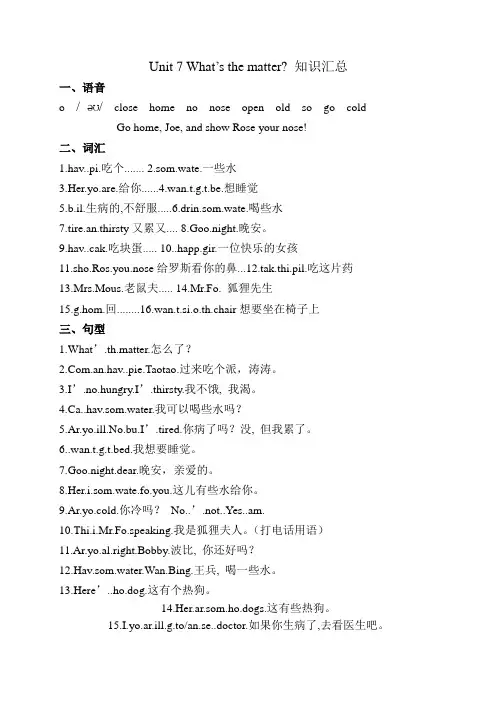
Unit 7 What’s the matter? 知识汇总
一、语音
o / əʊ/ close home no nose open old so go cold
Go home, Joe, and show Rose your nose!
二、词汇
1.hav..pi.吃个....... 2.som.wate.一些水
3.Her.yo.are.给你......4.wan.t.g.t.be.想睡觉
5.b.il.生病的,不舒服.....6.drin.som.wate.喝些水
7.tire.an.thirsty又累又.... 8.Goo.night.晚安。
9.hav..cak.吃块蛋..... 10..happ.gir.一位快乐的女孩
11.sho.Ros.you.nose给罗斯看你的鼻...12.tak.thi.pil.吃这片药
13.Mrs.Mous.老鼠夫..... 14.Mr.Fo. 狐狸先生
15.g.hom.回........16.wan.t.si.o.th.chair想要坐在椅子上
三、句型
1.What’.th.matter.怎么了?
.an.hav..pie.Taotao.过来吃个派,涛涛。
3.I’.no.hungry.I’.thirsty.我不饿, 我渴。
4.Ca..hav.som.water.我可以喝些水吗?
5.Ar.yo.ill.No.bu.I’.tired.你病了吗?没, 但我累了。
6..wan.t.g.t.bed.我想要睡觉。
7.Goo.night.dear.晚安,亲爱的。
8.Her.i.som.wate.fo.you.这儿有些水给你。
9.Ar.yo.cold.你冷吗? No..’.not..Yes..am.
10.Thi.i.Mr.Fo.speaking.我是狐狸夫人。(打电话用语)
11.Ar.yo.al.right.Bobby.波比, 你还好吗?
小学生四年级下半学期英语(译林版)第八单元Unit 8知识归类
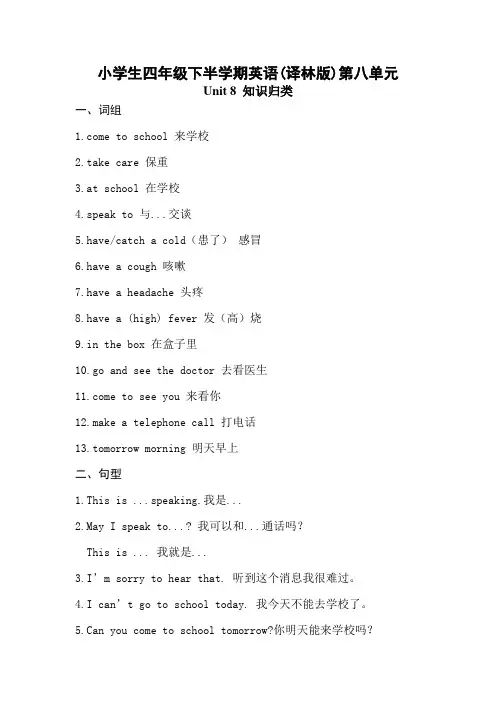
小学生四年级下半学期英语(译林版)第八单元
Unit 8 知识归类
一、词组
e to school 来学校
2.take care 保重
3.at school 在学校
4.speak to 与...交谈
5.have/catch a cold(患了) 感冒
6.have a cough 咳嗽
7.have a headache 头疼
8.have a (high) fever 发(高)烧
9.in the box 在盒子里
10.go and see the doctor 去看医生
e to see you 来看你
12.make a telephone call 打电话
13.tomorrow morning 明天早上
二、句型
1.This is ...speaking.我是...
2.May I speak to...? 我可以和...通话吗?
This is ... 我就是...
3.I’m sorry to hear that. 听到这个消息我很难过。
4.I can’t go to school today. 我今天不能去学校了。
5.Can you come to school tomorrow?你明天能来学校吗? Yes, I can./No, I can’t.
6.What’s the matter?怎么了?=What’s wrong with...?
I have a cold and a fever. 我感冒、发烧了。
She has a headache. 她头痛。
7.See you tomorrow. 明天见。
See you soon. 待会见。
8. Is ... there? ...在吗?
Yes,he/she is./No, he/she isn’t. 是的,他在。/不,他不在。
[精]四年级英语下册1-8单元知识点总结(部编版)
![[精]四年级英语下册1-8单元知识点总结(部编版)](https://360docs-1393072327.cos.ap-beijing.myqcloud.com/e41dacc58662caaedd3383c4bb4cf7ec4afeb688.webp)
[精]四年级英语下册1-8单元知识点总结(部编版)
精四年级英语下册1-8单元知识点总结(部编版)
Unit 1: My School Life
- Vocabulary: school, classroom, teacher, student, desk, chair, book,
pen, pencil, ruler
- Grammar: Present tense of the verb "to be" (am, is, are)
Unit 2: My Family
- Vocabulary: father, mother, grandfather, grandmother, brother,
sister, uncle, aunt
- Grammar: Possessive pronouns (my, your, his, her)
Unit 3: My Hobbies
- Vocabulary: hobby, play, draw, sing, dance, swim
- Grammar: Verb + -ing form (playing, drawing, singing, dancing,
swimming)
Unit 4: My Home
- Vocabulary: living room, bedroom, kitchen, bathroom, garden
- Grammar: This, that, these, those
Unit 5: My Daily Routine
- Vocabulary: get up, have breakfast, go to school, have lunch, do
homework, go to bed
- Grammar: Simple present tense (I get up, she has breakfast, they
四年级下册英语知识讲解及练习 Unit8 How are you知识讲解教案及巩固练习 译林版(附答案)

1 Unit8 How are you?
一.词汇预览
1.may (情态动词)可以 近义词can way路 say说
May I sit here?=can I sit here?我可以做这里吗?
2.cold感冒(n);寒冷的 I have a cold.我感冒了
3.fever发烧(n) have a fever发烧 never从不
4.hear 听到,听见 I can not hear it.
5.cough咳嗽(n) have a cough咳嗽
6.headache头疼(n)
1.问身体状况:
(1)How are you?你好吗?回答:I’m fine,Thank you/ Not so good/ Not bad
(2)What’s the matter?或What’s wrong with …?回答用“I have a …”句型。have表示“患病,得病”,后面接疾病名称,而且前面通常加上a. 如,--What’s
the matter
with her? – She has a terrible headache.
2. How are you?的用法。
(1)身体很好时,如:
--How are you?--I’m fine, thank you. / I’m very well, thank you.
(2)身体情况一般时,如:
--How are you?--Not bad, thank you.
(3)身体不太好时,如:
--How are you?--Not so good. / Not very well.
当你听到别人身体不太好时,应该表达以下同情,以示关心。如:
--How are you?--Not so good. I have a fever.--I’m sorry to hear that.
英语四下Unit8知识点总结
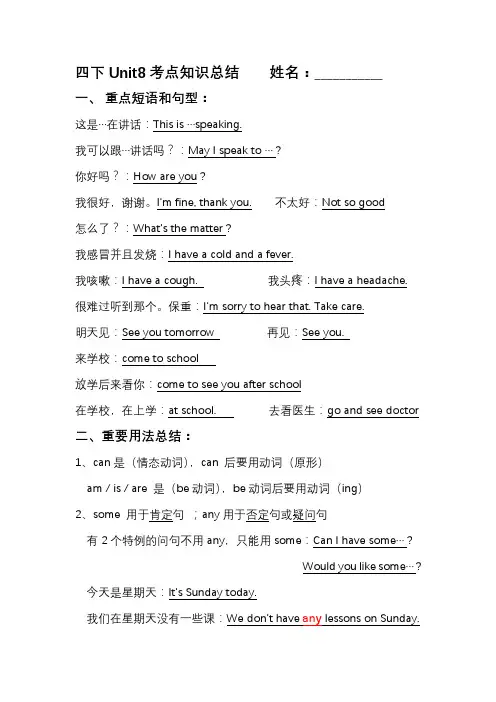
四下Unit8考点知识总结 姓名:___________
一、 重点短语和句型:
这是…在讲话:This is …speaking.
我可以跟…讲话吗?:May I speak to … ?
你好吗?:How are you ?
我很好,谢谢。I’m fine, thank you. 不太好:Not so good
怎么了?:What’s the matter ?
我感冒并且发烧:I have a cold and a fever.
我咳嗽:I have a cough. 我头疼:I have a headache.
很难过听到那个。保重:I’m sorry to hear that. Take care.
明天见:See you tomorrow 再见:See you.
来学校:come to school
放学后来看你:come to see you after school
在学校,在上学:at school. 去看医生:go and see doctor
二、重要用法总结:
1、can是(情态动词),can 后要用动词(原形)
am / is / are 是(be动词),be动词后要用动词(ing)
2、some 用于肯定句 ;any用于否定句或疑问句
有2个特例的问句不用any,只能用some:Can I have some… ?
Would you like some… ?
今天是星期天:It’s Sunday today.
我们在星期天没有一些课:We don’t have any lessons on Sunday.
译林版小学英语 4上 Unit8 知识点
Unit 8 知识点
一、单词: 过关签名:
big大;small小;fat胖;thin瘦;long长;short短;tall高;short矮;eyes眼睛;ears耳朵;hair头发;mouth嘴;nose鼻子;king国王;snowman雪人;his他的
二、词组: 过关签名:
1.her hair她的头发 2、her eyes她的眼睛 3、nose and mouth鼻子和嘴巴
4、our doll我们的洋娃娃 5、his mouth他的嘴巴 6、a big ball一个大球
7、a thin cat一个瘦猫 8、long hair长发 9、short hair短发 10、a big nose一个大鼻子
11.very big 非常大 12.very tall非常高 13.His eyes are big他的眼睛大
三、句型: 过关签名:
1.Her … is big / small / long/ short/tall/fat/thin她的…大/小/长/短/高/胖/瘦。
2.His … and … are big / small / long/ short/tall/fat/thin他的…和…大/小/长/短/高/胖/瘦。
3.You can …你会… 例: You can talk。你会说话。You can jump。你会跳
四、课文翻译: 第八单元 洋娃娃 过关签名:
牛津译林版四年级英语下册第八单元知识点
牛津译林版四年级英语下册第八单元知识点
Unit 8 知识点
一、单词
1 how 怎么
2 may 可以
3 cold 感冒
4 fever 发烧
5 hear 听见
6 care 当心
7 fine 身体好的
8 tomorrow 明天
9 cough 咳嗽
10 headache头疼
11 ache 疼
12 doctor 医生
13 bad 严重的
14 soon 不久
二、词组
1.speak to 和…说话
2. come to school 来学校
3. have a fever 发烧了
4. hear that 听到那个消息
5. take care 保重
6. a cough and a headache 咳嗽和头痛
7. See you tomorrow. 明天见。
8. See you soon. 过会见。
9. not so good不太好
10. at school 在学校
11. on Sunday 在周日 12. don’t have any lessons 没有课
13 the hot dog in the box 盒子里的热狗
14 lunch for the fox狐狸的午餐
see a doctor 看医生
go and see Doctor Wu 去看吴医生
17. after class 下课后
18. have a bad cold 得了重感冒
19. a bad cough严重的咳嗽
20 take some pills 吃些药片
三、句子
2. 我生病了。今天我不能去打乒乓球了。I’m ill. I can’t go and play table
tennis today.
3.他怎么了?他咳嗽和发烧了。What’s the matter with him? He has a cough
四年级下册译林版1~8单词表
四年级下册译林版1~8单词表
Unit 1
school 学校
subject 课程
Welcome bɑck to…… 欢迎回到……
see 看见,看到
timetɑble 课程表,时间表
Chinese 语文(课)
Mɑths 数学(课)
ɑrt 美术(课)
PE 体育(课)
Music 音乐(课)
Science 科学(课)
fun 乐趣,快乐
ɡo to 去…….
plɑyɡround 操场
lesson 课
Mondɑy 星期一
ɑfternoon 下午
Unit 2
ɑfter school 放学后
ɡo 英 去
Whɑt dɑy is it todɑy? 今天星期几?
Wednesdɑy 星期三
mɑtch 比赛
todɑy 今天
whɑt ɑ pity! 真遗憾!
Sɑturdɑy 星期六 ɑll riɡht. 好的。
Sundɑy 星期天
Tuesdɑy 星期二
Thursdɑy 星期四
Fridɑy 星期五
ɡet up 起床
when 什么时候
every 每个
dɑy 天
Unit 3
usuɑlly 通常,常常
ɡo to school 上学
in the morninɡ 在上午
hɑve lunch 吃午饭
in the ɑfternoon 在下午
plɑy footbɑll 踢足球
ɡo home 回家
homework 家庭作业
hɑve dinner 吃晚饭
wɑtch TV 看电视
ɡo to bed 睡觉
in the eveninɡ 在晚上
ɑt niɡht 在夜里
Unit 4
四年级下册英语- unit1 Our school subject 课文知识点详解附基础短语词汇默写单 译林版
译林英语4年级下册 Unit 1 Our school subjects
一、单词
1. school 学校 2. Art 美术(课) 3. Chinese 语文(课) . 4. English 英语(课) 5. Maths 数学(课) 6. Music 音乐(课) 7. PE 体育(课) 8. Science 科学(课) 9. subject 课程、科目 10. lesson 课 11. see 看见,看到 12. Monday 星期一 13. timetable 程表,时间表 14. fun 乐趣,快乐 15. playground 操场 16. afternoon 下午
二、词组
1. our school subjects 我们的学校课程 2. back to school 回到学校 3. see you 见到你 4. our new timetable 我们的新课程表 5. Music and Science 音乐和科学 6. what subjects 什么课程 7. Chinese and Maths 语文和数学 8. like English 喜欢英语 9. go to the playground 去操场 10. go to 去…… 11. English and Art 英语和美术 12. what lessons 什么课 13. have Music and Maths 有音乐课和数学课 14. this morning 今天早上 15. this afternoon 今天下午 16. have PE and Science 有体育课和科学课 17. like PE 喜欢体育课 18. make a cake 做一个蛋糕 19. all like English 都喜欢英语 20. at school 在学校
三、句型
1. Welcome back to school, class. 欢迎回到学校,同学们。 2. Nice to see you. 很高兴见到你。 3. This is our new timetable. 这是我们的新课程表。 4. What subjects do you like? 你喜欢什么课程? 5. I like Chinese and Maths. 我喜欢语文课和数学课。 6. Me too. 我也是。 7. It’s fun. 它很有趣。 8. It’s time for PE. 该是上体育课的时间了。 9. Let’s go to the playground. 让我们去操场吧。 10. What lessons do we have this morning? 今天上午我们有什么课? 11. We have Music and Maths. 我们有音乐课和数学课。 12. It’s Monday. 今天是星期一。 13. But I don’t like that. 但是我不喜欢那个。 14. Don’t skate. 不要滑冰。 15. Come and make a cake. 过来制作一个蛋糕。