
最新人教新目标七年级上册英语start全单元教案
Good morning类别课程标准要求掌握的内容话题Meeting friends字母Aa Bb Cc Dd Ee Ff Gg Hg单词good adj. 好的morning n. 早晨;上午hi interj. (用于打招呼)嗨;喂hello interj. 你好;喂afternoon n. 下午evening n. 晚上;傍晚how adv. 怎样;如何are v. 是you pron. 你;你们I pron. 我am v. 是fine adj. 健康的;美好的thanks interj. & n. 感谢;谢谢OK interj. & adv. 好;可以短语good morning 早上好good afternoon下午好good evening 晚上交际用语1. 问候语Hi/Hello!嗨/你好!Good morning!早上好!Good afternoon!下午好!Good evening!晚上好!2. 询问身体状况及回答—How are you?你好吗?—I’m fine, thanks. /I’m OK. 我很好,谢谢。
/我很好。
语法见面问候语知识目标熟悉见面问候语。
能力目标掌握字母A-H 的发音、顺序和书写规范;能够问候他人或对他人的问候做出应答;尝试在听力中分辨男女声、通过观察图片分辨男名及女名。
情感目标结交新朋友,学会礼貌地与他人交往,培养与他人合作交流的能力。
【课时建议】 本单元建议2课时第1课时(1a~2e )……………………………………………………………………1课时 第2课时(3a~4d )……………………………………………………………………1课时词汇短语:采用归纳记忆法。
基本句子:采用情景交际法和造句法。
语法:见面问候语——实际运用和交际法。
第1课时(1a~2e )类别 学习重点重点字母 Aa, Bb, Cc, Dd, Ee, Ff, Gg, Hh 重点单词 hello, hi, good, morning 重点短语 good morning重点句式1. Good morning ,Helen!2. Hello/Hi, Frank!课前预习写一写1. 好的good2. 早晨morning译一译1. 男孩们的名字boys’ names2. 女孩们的名字girls’ names3. 早上好good morning背一背1. 早上好,海伦!Good morning, Helen!2. 嗨,鲍勃!Hi, Bob!3. 你好,弗兰克!Hello, Frank!新课导入教师展示制作的字母Aa-Hh(注意含四线三格),看学生是否会读,并让会读的学生教读。
教师教英文字母的书写格式。
教师展示一个自制的时钟或利用多媒体课件,导出生词morning。
教师引导学生说:“Good morning. ”。
然后创设不同时间的场景,让学生练习这些交际语言。
新课展示【完成教材1a~2e的教学任务】1. 教师投影英文人名和1a部分的课件,让学生根据课件上的人物将这些英文人名按性别分类,完成1a。
教师投影答案。
2. 教学1b。
教师播放听力,学生反复跟读,学生先齐读,再小组读、个别读。
教师帮助纠音。
3. 教学1c。
学生根据1a,分小组练习对话。
然后教师让学生表演,并作点评,对表演出色的学生进行鼓励。
4. 教学2a。
教师播放录音,学生跟读。
然后,来玩字母识别或记忆游戏。
教师出示一个字母,让学生说出其左邻右舍或大小写,抢先说对的,教师给予表扬。
通过此法加深学生对A—H的记忆。
5. 教师和学生示范来练习打招呼。
T: Hello, S.S: Hello, Mr. Smith. (引导学生说)教师通过此法依次呈现Good morning, Good afternoon, Goo d evening…6. 学生分小组练习。
7. 教师投影本课时的字母(已打乱顺序),让学生重新排序。
8.学生完成2b 部分的练习。
教师投影答案。
9. 学生完成2c、2d 部分的练习。
教师指明答案并点明注意事项。
10. 教学2e 。
教师让学生读这些缩写词,并猜其含义。
教师讲解。
【语法提要】1. hello 同hi 一样,用于朋友、熟人之间非正式的问候。
例句:Hello, Jack! 你好,杰克!2. HB 意为“(铅笔芯)硬黑”,CD 意为“光盘;激光唱片”,BBC 意为“英国广播公司”。
英语中有一些名称是由几个词组成的,人们习惯上把这些词的第一个字母缩写在一起来表示这个名称。
拓展:USA 美国 NBA (美国)全国篮球协会UN 联合国 UK 英国RMB 人民币 CCTV 中国中央电视台活学活练( C )1. —Hello, Lin Hui!— _________, David !A. WhatB. FineC. HelloD. Thank( B )2. _________可以表示“光盘”。
A. HBB. CDC. BBCD. CBA布置作业:教师引导学生课后完成本课时对应练习,并预习下一课时内容。
教学反思本课时利用纸板和多媒体课件相结合的方式教学,加深了学生对新知识的记忆,同时使教学生动有趣,培养了学生对英语学习的兴趣,但学生对个别字母发音有待加强。
第2课时(3a~4d)类别学习重点重点单词afternoon, evening, how, are, you, I, am, OK, fine, thanks 重点短语good afternoon, good evening重点句式1. Good afternoon, Eric!2. Good evening, Bob!3. —How are you?—I’m fine, thanks/I’m OK.课前预习写一写1. 下午afternoon2. 晚上;傍晚evening3. 怎样;如何how4. 健康的;美好的fine 译一译1. 下午好good afternoon2. 晚上好good evening背一背1. 下午好,埃里克!Good afternoon, Eric!2. 晚上好,鲍勃!Good evening, Bob!3. —你好吗?—我很好,谢谢。
—How are you?—I’m fine, thanks.新课导入一个自制的时钟或利用多媒体课件,创设不同时间的场景,让学生练习Good morning…Good afternoon…和Good evening…。
新课展示【完成教材3a~4d的教学任务】1. 教学3a。
首先听录音,为图片编号。
老师利用时钟让学生更清楚“good morning , good afternoon, good evening”的区别。
通过图片的场景,进一步加深对这三个句子的理解。
2. 教学3b。
学生分小组练习并表演3a中的对话。
3. 教学3c。
教师讲授“How are you? ”及其答语“I’m fine, thank. /I’m Ok. ”。
播放录音,让学生跟读,老师注意纠正学生的发音。
4. 学生为自己选择英文名,用“How are you? ”句型及其答语互相问候。
5. 完成4a练习。
教师注意提醒学生英文名字的第一个字母应大写。
6. 教学4b, 4c。
首先听录音,让学生跟读。
然后再让学生朗读,观察字母a, e在开音节和闭音节中的读音规则并进行小结、归纳。
学完了4b后,让学生试着读出4c中第二栏的生词。
老师注意引导学生掌握字母a, e的发音规则。
7. 听录音,跟着老师一起学习4d中的英文歌曲,进一步巩固本单元重点句型。
【语法提要】1. How are you? 你好吗?“How are you?”是相互熟悉的人之间见面时常用的寒暄用语,其答语是:Fine,thank you!/Very well. /I’m OK. /I’m all right,thanks. 意为“我很好,谢谢”。
并常加上一句对对方的问候:And you? 意为“你呢?”。
这时可以回答I’m fine, too. Thank you. /Fine, too. Thanks. / Not bad. Thank you. 意为“我很好。
谢谢”。
使用这句话并不是想深入交谈某人的身体状况,只是一种礼貌的问候方式。
例句:—How are you, Mike? 你好吗,迈克?—I’m fine, thanks. And you? 我很好,谢谢。
你好吗?—I’m fine, too. 我也很好。
2. fine作形容词,意为“健康的;美好的”。
常用来指身体状况好、天气状况好等。
“I’m fine. ”相当于I’m OK. /I’m very well. /I’m all right。
例句:—Are you OK, Tom? 你好吗,汤姆?—I’m fine. 我很好。
活学活练(A )1. —_________?—I’m fine. Thank you.A. How are youB. How old are youC. How do you do(B )2. —How are you?—_________,thank you.A. I fineB. I’m OKC. HelloD. Good morning布置作业:教师引导学生课后完成本课时对应练习,并预习下一课时内容。
教学反思本课时先学字母,后学单词和句型,遵循了先易后难的学习原则。
在重点句型的教学中,引入了生活中学生所熟悉的物品,使学生易于接受。
英文缩略词也是本课学习重点,应予以重视。
教学过程中老师的疑问:教师点评和总结:What’s this in English?类别课程标准要求掌握的内容话题Things around you字母Ii Jj Kk Ll Mm Nn Oo Pp Qq Rr 单词what pron. & adj. 什么is v. 是this pron. 这;这个in prep. (表示使用语言、材料等)用;以English n. 英语adj. 英格兰的;英语的map n. 地图cup n. 杯子ruler n. 尺;直尺pen n. 笔;钢笔orange n. 橙子jacket n. 夹克衫;短上衣key n. 钥匙it pron. 它that pron. 那;那个spell v. 用字母拼;拼写please interj. (用于客气地请求或吩咐)请a/an art. (用于单数可数名词前,表示未曾提到的)一(人、事、物)短语in English用英语an orange一个橙子 a jacket一件夹克衫交际用语1. 辨认物品—What’s this in English? 这用英语怎么说?—It’s a map. 它是一张地图。
StarterUnit1Period4教案:2021-2022学年人教版七年级上册英语
4.实践活动的设置:本节课的实践活动取得了较好的效果,学生们在角色扮演和小组讨论中充分发挥了自己的主观能动性。但在活动过程中,我也发现了一些问题,如部分学生在讨论时容易偏离主题。针对这一问题,我将在下一次实践活动中明确讨论主题,加强对学生的引导。
Starter Unit1 Period4教案:2021-2022学年人教版七年级上册英语
一、教学内容
《Starter Unit1 Period4教案:2021-2022学年人教版七年级上册英语》涉及以下教学内容:
1.教材章节:Starter Unit 1 My name's Gina.
2.语言点:
(二)新课讲授(用时10分钟)
1.理论介绍:首先,我们要了解英语中基本的问候语和自我介绍的概念。这些表达方式是日常交流的基础,它们帮助我们建立友好关系,展示礼貌和尊重。
2.案例分析:接下来,我们来看一个具体的对话案例。这个案例展示了如何在不同的时间使用不同的问候语,以及如何进行自我介绍。
3.重点难点解析:在讲授过程中,我会特别强调“am, is, are”的用法和不同称呼语(Miss, Mr., Mrs.)的选择。对于这些难点,我会通过对比和实际例句来帮助大家理解。
(2)日常交际用语:自我介绍、询问对方姓名、礼貌用语等是本节课的核心内容。教师应着重训练学生在实际情境中运用这些交际用语,提高学生的口语表达能力。
(3)基本语法:本节课的重点语法为使用be动词(am, is, are)进行自我介绍和询问。教师需详细讲解并举例,使学生能够正确运用这一语法结构。
最新人教新目标七年级starter unit1-unit3教案
Unit 1 Good morning!Mainly prepared by: Shen Lei Date: Aug.29th-30thI. Teaching Contents: Unit 1 Good morning!II: Analysis of the Teaching Material1.Status and FunctionThe topic of this unit is about meeting friends, and the students will learn to practice some English names, common English greetings and the letters Aa-Hh. 2.Teaching Aims and Demands(1)Knowledge Objectsa.To master the letters A-H.b.To master the common English greetings.(2)Ability ObjectsTo improve students’ ability of listening, speaking and writing.3.Teaching Difficult PointsTo master the key vocabulary and the target language presented in this unit.4.Teaching focuses(1)To learn how to read and write the letters Aa-Hh.(2)To learn how to greet in English.(3)To do listening exercises.III. Language FunctionTalk about how to greet people.IV. Target LanguageGood morning, good afternoon, good evening, hi, helloHow are you? I’m fine, thanks.Letters Aa-Hh.V. V ocabularyAa, Bb, Cc, Dd, Ee, Ff, Gg, Hhgood, morning, afternoon, evening, hi, hello, fine, OK, thanksVI. Teaching TimeFive periodsPOSTSCRIPT:(课后记)Unit 2 What’s this in English?Mainly prepared by: Shen Lei Date: Sep 6th-8thI. Teaching Contents: Unit 2 What’s this in English?II: Analysis of the Teaching Material1.Status and FunctionIn this unit students learn to ask how to say and spell words in English and the letters Ii-Rr. The topic of this unit is about things around people, and the students can learn how to identify things.Teaching Aims and Demandsa)Knowledge Objects(1) To master the letters I-R;(2) To master how to identify things and spell words;(3) To learn “what” question.b)Ability ObjectsTo improve students’ ability of listening, speaking and writing.2.Teaching Difficult Points(1) To master the key vocabulary and the target language presented in this unit;(2) Pronunciation of letters A, E, I, O;(3) Listening and speaking practice.3.Teaching focuses(1)To learn how to read and write the letters Ii-Rr;(2)To learn “what” question;(3)To learn to ask how to say and spell words.III. Language FunctionTalk about how to identify things and spell words IV. Target LanguageWhat’s this in English?It’s a key.Spell it, please.K-E-Y.V. V ocabularyIi, Jj, Kk, Ll, Mm, Nn, Oo, Pp, Qq, Rrjacket, key, map, orange, pen, quilt, ruler, spell VI. Teaching TimeFive periodsPOSTSCRIPT:(课后记)单元教学测评一、将26个字母按发音分类(写出与所给字母含有相同音素的其他字母)Aa ____________________________________________________________________ Ee ____________________________________________________________________ Ii _____________________________________________________________________ Oo ___________________________________________________________________Uu ____________________________________________________________________Ff ____________________________________________________________________Rr ____________________________________________________________________ 二、从A、B、C、D中选出含有相同音素的选项号中的要求写出以下单词的适当形式( )1.A.a f B.b p C.d j D.i r( )2.A.b i B.d r C.g p D.j p( )3.A.h l B.e u C.h m D.n x( )4.A.m w B.s r C.c f D.z l( )5.A.h z B.s v C.v h D.f s三、按括号内所给要求写出适当形式1.White ____________ (反义词) 2. color(n.)_________ (动词)3.boy ____________ (反义词) 4.Mr ___________(对应词)5.father __________ (对应词)四、单项选择( )1.It’s ___________ black.It’s ________ black ruler.A. /; / B.a;/C./;a D.a;a( )2. ---________ is that quilt? —It’s black.A. Which color B.How color C.What color D.What’s color( )3.一Who is that girl? 一The ______ in the blue jacket?一Yes.-- It’s Zhang Lei.A.one B.an C.a D./( )4.What’s that _____ English?A.at B.to C.in D.on( )5.一What color is her jacket? 一It’s _______.A.an orange B.orange C.the orange D.a orange五、句子配对A B1.What’s this in English? A.The one in blue.2.Is this a book? B.He’s my father.3.Who’s that man? C.It’s orange.4.What color is that orange? D.Yes.it is.5.How are you? E.It’s a map.6.Which boy is your brother? F.No, it’s yellow.7.What is this? G.It’s an orange.8.Is that jacket black? H.Fine,thank you.六、改错(下列各句均有一处错误,找出并改正)1.What color is that ruler? It's a red.A B C D2.This is her blue color bike.A B C D3.M r. Green is in the China now.A B C D4.Can you spell a pen, please?A B C D5.What’s color is this?A B C D七、阅读短文,判断正误:正确的写“T”错误的写“F”Jane White is an American girl.She is a student.She is fifteen.Her father is Mr.White.Her mother is Mrs.White.Bob is her brother.He is a student.t∞.He is in a black jacket.Jane is in a red jacket.She is a nice girl.( )1.Jane White is English.( )2.She is a student.( )3.Mr. White is her mother.( )4.Jane is fourteen.( )5.Jane is Mrs. White’s daughter.( )6.Bob is Jane’s brother.( )7. Jane is Bob’s brother.( )8. Bob is a teacher.( )9. Jane is in red and Bob is in black.( )10. Jane is a nice girl.参考答案一、AHJK EBCDGPVZ IY O UW FLMNSXZ R二、1-5 BCDDD三、1. black 2. color 3. girl 4. Mrs 5. mother /mom /mum四、1-5 CCACB五、1-8 GDBCHAEF六、1. D red 2. D 去掉3. C China 4. C pen 5. A What七、1-5 FTFFT 6-10 TFFTT。
【新版】人教版新目标七年级上start_Unit3教案
(此文档为word格式,下载后可以任意修改,直接打印使用!)Starter Unit 3 What color is it?Period 1 1a-2e【导学目标】Ⅰ. Teaching Aims and Demands1. Learn the letters Ss-Zz.2. Learn to ask the name of something, and ask what color it is.3. To improve listening.Ⅱ. Teaching Key Points1.How to read and write the letters Ss-Zz.2.Important sentence patterns:A: What’s this? B: It’s V.A: What color is it? B: It’s black and white.Ⅲ. Teaching Difficult PointsHow to use the sentence patterns freely.【导学过程】Step 1. Lead in(5mins)Students sing the song, or the teacher asks some questions to review what they have learnt in last class.Step 2. 1a (4mins)1.Show some pictures on the screen. Then ask students to answer the questions what color it is. Pay attention to their pronunciations. The teacher should correct their mistakes immediately.2.Read these new words.3.Finish 1a.Step 3. 1b (3mins)Students can read after the tape for several times. The teacher can also give them time to read by themselves.Step 4. 1c (4mins)1.Watch a video,let the students know how to do it.2.Ask them to talk about the pictures on the screen together.3.Then practice with his/ her partner or they can practice in groups. When they practice, they can change the roles.Step 5. 2a (4mins)1. The teacher can play the tape for several times.2. Ask the students to pay attention to the pronunciation and the intonation. Try to imitate.Step 6. 2b (4mins)1. Before listening, the teacher can introduce some listening skills to the students.2. Listen and number the letters you hear.Step 7. 2c (8mins)1. Ask students to look at the letters in 2c and pay attention to the orders of the writing. Then the teacher writes the letters on the blackboard.Try to write beautifully.2. All the big letters are written in the first and the second line.3. Write every letter in right order and try to write beautifully.4. Write from memory. Ask two students to write on the blackboard.The teacher can ask again:Among the 8 letters, which are vowels and which are consonants?Continuation: Classify the small letters according to the writing and classify the big letters according to the phonetic symbols.Step 8. 2d (2mins)1.Write the small letters for the big letters or write the big letters for the small letters.2.Play a game:Find the letters from the pictures.Step 9. 2e (3mins)Show “S/M/L,UFO,CCTV” and ask the students to read them first, and then guess what they stand for. If they have difficulties, the teacher can give them some help. Step 10. Summary (2mins)Help the students to summarize by themselves:1. New words.2. Sentence patterns:--What’s this/ that in English?--It’s a/ an……3. The use of “a/ an”.Step 11. Exercises (6mins)【探究归纳】1.color n. 意为“色,颜色”。
Starter+Unit+1Section+A+1a-2d+教案-2025学年人教版英语七年级上册
人教版七年级上册Starter Unit 1 Hello Section A 1a-2d 教案一、教学目标知识与能力目标:学生能够掌握并正确书写字母A-H。
学生能够学会并使用日常问候语如“Hello”, “Hi”, “Good morning”等,并能正确回应他人的问候。
学生能够介绍自己的名字并询问他人的名字,如“My name is...”, “What’s your name?”。
情感态度与价值观目标:培养学生礼貌待人的品质,学会与同学友好相处。
激发学生对英语学习的兴趣,提高开口说英语的自信心二、学情分析七年级学生刚进入初中阶段,对英语学习充满好奇心,但部分学生可能由于性格内向或英语基础薄弱,在口语表达方面存在困难。
学生在小学阶段已经基本掌握了简单的日常英语问候语和自我介绍,为本节课的学习奠定了基础三、教学重难点教学重点:掌握字母A-H的书写和发音。
学会使用日常问候语和自我介绍的表达方式教学难点:在实际情境中灵活运用所学的问候语和自我介绍四、教学准备教师准备:教案、课件、学习任务单、评价量表学生准备:课本、学习工具五、教学过程1. 导入(5分钟)活动:通过播放英语歌曲《Hello, Hello, Hello》或进行简单的英语问候语游戏,激发学生的学习兴趣,营造轻松的学习氛围目的:引导学生进入英语学习状态,复习之前学过的日常问候语2. 新课呈现(20分钟)活动1:展示1a的图片,引导学生观察并学习图中人物之间的对话,学习打招呼的不同方式重点句型:Hello! Hi! Good morning!活动2:播放听力材料,让学生跟读并模仿正确的发音活动3:分组进行角色扮演,模拟1a和2c中的对话情景,练习问候和自我介绍3. 巩固练习(15分钟)活动1:完成课本上的练习题,如填空、选择或连线等,巩固学生对新学内容的掌握活动2:设计“自我介绍”任务,让学生在小组内展示自己,锻炼他们的胆量和口语表达能力4. 课堂总结(5分钟)内容:回顾本节课所学的日常问候语、自我介绍的表达方式以及字母A-H 的书写和发音目的:帮助学生形成完整的知识体系,强调重点和难点六、板书设计Starter Unit 1 HelloSection A 1a-2d1. Greetings:- Hello!- Hi!- Good morning!2. Self-introduction:- My name is...- What’s your name?3. Letters A-H七、作业布置完成课本上的相关练习题准备一份英文自我介绍,下节课进行展示。
英语人教版(2024)版七年级初一上册StartUnit 2 Keep Tidy!Section A
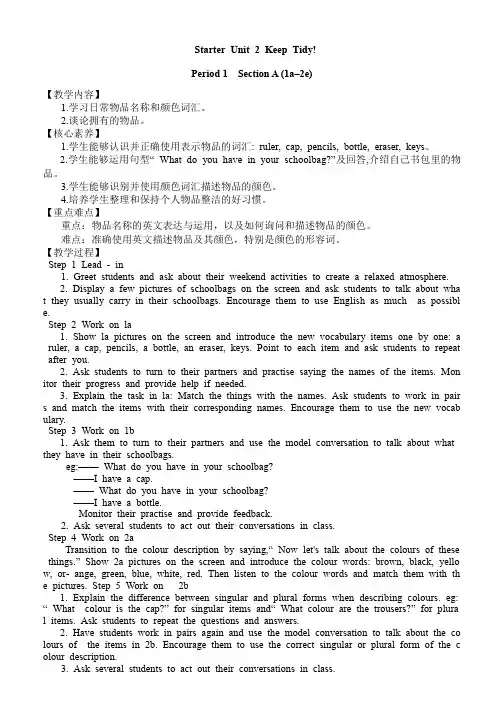
Starter Unit 2 Keep Tidy!Period 1 Section A (1a–2e)【教学内容】1.学习日常物品名称和颜色词汇。
2.谈论拥有的物品。
【核心素养】1.学生能够认识并正确使用表示物品的词汇: ruler, cap, pencils, bottle, eraser, keys。
2.学生能够运用句型“ What do you have in your schoolbag?”及回答,介绍自己书包里的物品。
3.学生能够识别并使用颜色词汇描述物品的颜色。
4.培养学生整理和保持个人物品整洁的好习惯。
【重点难点】重点:物品名称的英文表达与运用,以及如何询问和描述物品的颜色。
难点:准确使用英文描述物品及其颜色,特别是颜色的形容词。
【教学过程】Step 1 Lead -in1. Greet students and ask about their weekend activities to create a relaxed atmosphere.2. Display a few pictures of schoolbags on the screen and ask students to talk about wha t they usually carry in their schoolbags. Encourage them to use English as much as possibl e.Step 2 Work on la1. Show la pictures on the screen and introduce the new vocabulary items one by one: a ruler, a cap, pencils, a bottle, an eraser, keys. Point to each item and ask students to repeat after you.2. Ask students to turn to their partners and practise saying the names of the items. Mon itor their progress and provide help if needed.3. Explain the task in la: Match the things with the names. Ask students to work in pair s and match the items with their corresponding names. Encourage them to use the new vocab ulary.Step 3 Work on 1b1. Ask them to turn to their partners and use the model conversation to talk about what they have in their schoolbags.eg:—— What do you have in your schoolbag?——I have a cap.—— What do you have in your schoolbag?——I have a bottle.Monitor their practise and provide feedback.2. Ask several students to act out their conversations in class.Step 4 Work on 2aTransition to the colour description by saying,“ Now let's talk about the colours of these things.” Show 2a pictures on the screen and introduce the colour words: brown, black, yello w, or-ange, green, blue, white, red. Then listen to the colour words and match them with the pictures. Step 5 Work on 2b1. Explain the difference between singular and plural forms when describing colours. eg:“ What colour is the cap?” for singular items and“ What colour are the trousers?” for plura l items. Ask students to repeat the questions and answers.2. Have students work in pairs again and use the model conversation to talk about the co lours of the items in 2b. Encourage them to use the correct singular or plural form of the c olour description.3. Ask several students to act out their conversations in class.Step 6 Work on 2c & 2d1. Explain the task in 2c:“ Now we' re going to listen to a recording and colour the things accord-ing to what we hear.” Play the recording for the students and ask them to colo ur the items in their textbooks.2. After the first listening, play the recording again for 2d and ask students to complete the sent-ences about the colours of the items mentioned in the conversation. Monitor their p rogress and provi-de assistance if needed.3. Check the answers with the whole class, pointing out any common mistakes and emp hasizing the correct usage of singular and plural forms of colour description. The answers ar e:(1) Teng Fei’s schoolbag is blue.(2) Yaming's bicycle is black and orange.(3) Peter's shoes are red.Step 7 Work on 2e1. Transition to the production stage by saying,“ Now it's your time to talk about somet hing new you have. Let's share with our partners.” Ask students to bring out a new thing th ey have with them and prepare to talk about it.2. Model a conversation using the target language, such as: “I have a new pencil case. What colour is it? It's blue.”3. Ask students to repeat the conversation and then practise in pairs. Encourage them to use the correct form of colour description and describe their items in detail.4. Monitor their conversations and provide feedback on their language use and pronunc iation. Encourage them to use the new vocabulary and sentence structures they have learne d.5. Ask several students to act out their conversations in class.Step 8 Summary and HomeworkSummarize the key points of the lesson, emphasizing the new vocabulary, sentence str uctures, and colour description. Encourage students to use the language they have learned in their daily lives.Assign homework: Ask students to draw a picture of their schoolbag or another item they have and label the items with their names and colours using the target languag e. This will help them consolidate their learning and prepare for the next lesson.【随堂作业】根据汉语提示或用括号中所给单词的适当形式填空。
新人教版新目标七年级英语上册全册教案

新人教版新目标七年级英语上全册教案设计Starter Unit 1 Good morning !Starter Unit 1是Go for it!预备篇三个单元的第一单元.预备篇是为了使那些没有英语基础的学生更好地使用本套教材而编写的.它的主要内容为26个字母和最基本的英语日常用语。
本单元的教学内容为:1.学习Aa -—- Hh八个字母.2.学习八个人名。
Alice,Bob, Cindy, Dale, Eric,Frank, Grace,Helen3.学习打招呼的用语:Hello!/ Good morning!/ Good afternoon!/ Good evening!4.学会问候熟识的朋友和应答:—— How are you?—- I’m fine,thanks. How are you?——I’m OK教学重点:Aa —-- Hh的字母教学。
Hello! Good morning. Good afternoon. Good evening.—- How are you?-- I’m fine, thanks. How are you?-- I’m OK.教学难点:课本中英语人名的学习和大、小写字母的学习及书写。
单元课时:5个课时第一课时:完成Section A 1a, 1b第二课时;完成Section A 2a,2b,2c, 2d,3,4a第三课时:完成Section A 4b, 4c, Section B 1,2a,2b第四课时:完成Section B 3a, 3b,4, 5第五课时:完成Self Check and Just for Fun教学目标A.语言知识目标1.词汇: Letters Aa ——— Hh八个人名Alice,Bob, Cindy, Dale,Eric,Frank, Grace,Helen 2.句型:Good morning。
Good afternoon. Good evening。
人教版(新目标)初中英语七年级上全册教案
人教版(新目标)初中七上Starter Unit 1 Good morning!教案Period OneTeaching aims:1. Greetings:Hello! / Good morning! / Good afternoon! / Good evening!2. Know eight English name: Alice, Bob, Cindy, Dale, Eric, Frank, Grace, HelenTeaching importance and difficulty:1.Words:Alice, Bob, Cindy, Dale, Eric, Frank, Grace, Helen2.Sentence:Hello! Good morning!Teaching procedure:Step 1. Warming-up1. Music:Good morning, it will raise students interesting.2. Teacher introduce myself. Example: Say Hello! / Good morning! Let student answer by Hello! / Good morning!Step 2. Play a game.Play the game like this: Teacher says a letter, for example C, then ask which is before and after C. The one who says B, D first is the winner. The winner can get a chance to choose an English name first.(Teacher prepare many English name at the first)Step 3. Presentation.Show the clock and let the students guess what they will say. This way could motivate students to think by themselves and know how to use good morning.Step4. Work on 1a.See 1a and figure out boy’ s name and girls name. Be good at sharping observation.Step5. Work on 1b. Listen and repeat.Listen the type and could speak three conversation.Step6. Work on 1c.Practice the 1a three conversations and teacher move around the class in order to help the students. And teacher encourage students to practice the conversation by using their names.Step7.Homework1.Be familiar with boy’s name and girls’ name。
人教版七年级英语上册StartUnit2SectionAWhatdoyouhave教学设计
5.激励性评价:注重过程性评价,及时给予学生积极反馈,增强学生的自信心。在评价时,关注学生的努力程度和进步,而非仅限于结果。
6.课后拓展:布置与课堂内容相关的课后任务,如制作物品分类手册、录制日常交流视频等,使学生在课后能够继续巩固所学知识。
教师在布置作业时,要关注学生的个体差异,允许学生根据自己的实际情况选择作业难度。同时,鼓励学生在完成作业的过程中,积极思考、主动探究,养成良好的学习习惯。在作业批改和反馈环节,教师应注重激励性评价,关注学生的努力和进步,以提高学生的学习兴趣和自信心。
难点:名词的可数与不可数概念及其在句子中的正确使用,以及在实际交流中灵活运用所学句型和词汇进行问答。
2.重点:培养学生的听说能力,特别是在日常情境中的实际应用。
难点:学生在交流过程中能够克服紧张情绪,自信地使用英语进行表达。
(二பைடு நூலகம்教学设想
1.利用多媒体和实物教学:通过展示图片、实物和视频,让学生直观地学习物品词汇,增强记忆。同时,结合实际操作,如让学生拿出自己的文具进行互动,提高学习兴趣和实际应用能力。
3.听说能力:学生的听说能力相对较弱,尤其在面对日常交流场景时,可能存在紧张、焦虑等情绪,影响交流效果。
4.学习动机:学生对英语学习的兴趣和动机存在差异,部分学生对英语学习缺乏自信,需要教师关注和引导。
5.团队协作:七年级学生团队协作能力逐渐增强,但部分学生仍需培养在小组活动中承担责任、积极参与的能力。
3.教师布置课后作业,要求学生运用所学知识进行实际操作,如制作物品分类手册、录制日常交流视频等。
4.教师强调本节课的情感态度与价值观,教育学生学会关爱他人、尊重他人,养成良好的学习习惯。
2024年新人教版七年级英语Starter Unit 1 Hello Section B (教案)
这两个语篇分别对应了两个主题图,为两个语篇配图说明。第一篇对话一共三轮对话,分别从打招呼、询问姓名、拼写姓名、问候等方面进行了问候;第二篇对话一共有三轮对话,分别从问候、告别方面开展课交际;两个语篇基本以问答的形式构成。
4.语言特点
在进行问候的时候,作者使用较为委婉询问姓名的方式,如“May I have your name”,在询问如何拼写姓名时,使用了特殊疑问句“How do you spell your name”;在表示亲密昵称时,分别以称呼名字来称呼对方,如“call me Emma/Yaming”;在表示告别时,使用“that’s the bell, let’s go to class”,非常符合生活实际;在表示初次见面时,使用“Nice to meet you”来表示问候等。
问答、提问、简答
自评、师评
目标2
基于准确得体使用开场语和告别句等与人互致问候与简单交流,知道关注英语姓名构成的方式,与中文姓名做适当的比较;
问答、表演
互评、师评
目标3
规范、准确、得体地书写出与陌生人和熟人打招呼的对话。
写作、分享
自评、互评、
师评
教学过程
教学目标
教师活动
学生活动
学习评价
1.获取对话中的交际用语的问答,梳理、概括日常交际用语的用法,借助可视化图形呈现结构化知识;
1.学生在教师的引导下,回忆所学的礼貌交谈的表达方式,并在教材的任务题中选出正确答案。
2.学生观察主题图,预测两组对话人物的关系,了解对话背景;阅读对话后,画线出打招呼的方式,并在教师的指导下举手回答问题。
3.学生再次阅读文章,找到交际用语的回答,完成匹配后在班级分享。
4.学生在任务单上列出情景交际打招呼的用语,并在画出思维导图。
七级英语上册《starterUnitteachingplan》教案人教新目标版
七年级英语上册《 starter Unit 1 teaching plan》教课方案人教新目标版课程目标一、知识和能力目标本单元要修业生掌握英文字母A— H,能认读其印刷体和手写体字母的大小写等四种形式。
书写 ( 大写和小写,笔顺,笔画) 基本切合要求。
能看, 听,说本单元所列的平常交际用语,重点学会打招呼,并做到语音语调正确。
注意一些字母及平常交际用语的发音,提示学生不要将C/ si :/发成/sei:/。
H /e?/ 发成 /e ?/ ,也不要将Good morning /'/说成/?'/等。
二、过程和方法目标教师要尽量用英语组织教课方案。
充分利用课堂的 40 分钟,不讲或少讲汉语,尽量给学生创立英语情况。
教师可以用手势,表情,动作等表示,帮助学生听懂课堂用语和平常交际用语,第一次介绍某个用语时,说英语,加译文及手势,今后可酌情省去译文,最后只说英语,渐渐让学生听懂。
三、感神态度和价值观目标万事开头难,第一利用这个单元培养学生们对英语的兴趣,因为兴趣是最好的老师。
课时安排:两个课时Period 1Teachingkeypoints:Greeting words & Letters A-HTeachingdifficulties:the pronunciations of C & HLearning Methods:Yangsi Learning Mode, Cooperative LearningTeaching Methods:1 / 7Yangsi Teaching Mode, Situational Approach, Task-based Teaching Approach, theteaching mode of Two-way InteractionTeachingprocedures:Step 1IntroductionBegin by greeting the class with a smile and good morning!Now intr oduce the words “teacher ”and“class ”by using gestures Repeat this several times and have the class repeat after you Students Can answeras a whole group As rows and a s individuals Repeat“I am your teacher andyou are the class”several timesNow introduce the class to the instructions Class please sit down and class please stand up by using actions and gestures They can practice this several timesStep 2Lead — inYou may want t0 leave the class again to introduce the usual Good morningroutine Say Good morning class Help students respond with Good morning Point to yourself and say I ’m Miss Mr Have them repeat Explain the terms Miss and Mr in ChineseRepeat this a few times with rows and individuals or try a“back -chain ”dr illMiss Mr(Ss repeat)Mor ning Miss M r(S s repeat)Good morning Miss Mr(Ss repeat)Step 3PracticeSay Stand up please!(Ss stand up)Leave the classroom return and say Good morning class!Help the students respond withGood morning Miss Mr Say Sit down please Now let ’s start the lesson2 / 7Step 4Presentation and activityNow point to yourself and say My name is Miss Mr.I am your teacher Find a student you know and say your name is(Beth)Then ask What is your name?Help them respond with My name is.When the student answers, respond with Hel lo Niceto meet you!Repeat thi s activity several times first withstudents you know and then with others Help them to respond with Nice tomeet you too Explain the Wo rd “too ’’ in ChineseStep 5PracticeGet the students to practice the f0llowing d ialogue in pairsS1Good morningS2Good morning I ’m(Ben) What’s your name?Sl My name is(Dale)Nice to meet you!S2 Nice to meet you tooCall out sev eral pairsof students to give their performance Praise their efforts as much as possible Help the slower students with patienceStep 6PresentationDo activity1a Look at the picture Find the small letters for these big lettersFirst present letters a-h and get the students to repeat these letters Call the students toattention the letter C si not sei H /e ?/ not /e?/Step 7Listening and writingGet the students to listen to the tape and finish the task list on the book Make sure all the students know what they should doHave the students watch the teacher writing the l etters on the blackboard,then ask them to follow the teacher and write down these letters on their exercise—books Let the students knowthe diffences between the big lettersand the small letters3 / 7Step 8 : Games timeLet the students do some letters games to enjoy your lesson,the following is theinstruction.抢读字母游戏:教师将全班分成若干小组,尔后逐个出示字母卡片,学生们举手抢答。