
外研版(三起)-英语-六年级下册--外研版三起Module 6 Unit 2教材同步讲解
Unit 2:The name of the spaceship is Shenzhou V.(第二单元:宇宙飞船的名字是神舟五号。
)(教材35~37页)1.Look,listen and say.看一看,听一听并说一说。
(教材第35页)课文英汉互译Look at our spaceship. It took us to the earth看看我们的宇宙飞船。
它带我们到地球。
And brought back our presents.并且带回我们的礼物。
新词速记Brought/brɔːt/v.(动词)(bring的过去式)拿来,带来短语:bring in带来,引进bring down使降落,移入下页例句:We brought them in on our plans.我们让他们参与我们的计划。
The pilot brought the plane down gently.飞行员使飞机徐徐降落。
重难点精析一、take的用法1.It took us to the earth.它带我们到地球。
【点拨】take的用法:表示“携带,带领”。
例如:We usually take the children to school by car.我们通常是开车把孩子们送到学校。
表示“选择,购买”。
例如:We are going to take a farm in that country.我们打算在那个国家买一个农场。
表示“接受,收到”。
例如:She takes my advice.她接受我的劝告。
表示“握,拿,抱”。
例如:She took the child in her arms.她把孩子抱在怀里。
表示“需要……时间,费时”。
例如:It takes about an hour to get there.到那里大概需要一个小时的时间。
【知识拓展】(l)take back表示“收回(所说的话),认错”。
例如:I take back what I said.我收回我说过的话。
(2)take in表示“接纳,接待,收容”。
例如:He had nowhere to live,so we took him in他没有地方住,所以我们收留了他。
(3)take off表示“起飞”。
例如:The plane took off an hour ago.飞机在一个小时前起飞了。
【即学即用】It's going to rain. You should with you.A. take an umbrellaB.bring an umbrellaC.take to an umbrella二、bring的用法2.And brought back our presents.并且带回我们的礼物。
【点拨】bring表示“带来,领来,取来”,活动方向常常是从别处朝向说话者或被提到的人。
例如:Bring your friend to the party.带你的朋友来聚会。
词语辨析take,bringtake表示“拿走,取走”,活动方向常常是离开说话者或被提到的人,或者某个具体的位置,与bring所指方向相反。
例如:Take the letter to the post office.把这封信送到邮局去。
【即学即用】I that book to you.A. broughtB. tookC. carried答案速查1.A 2.A2.Listen and read.听一听并读一读。
(教材第35页)课文英汉互译Daming and Simon made a model① of a Chinese spaceship. The name of the spaceshipis Shenzhou V . In 2003, it took a Chinese taikonaut into space for the first② time. It took the national ③ flag of China and some seed④too.大明和西蒙制作了一个中国的宇宙飞船模型。
宇宙飞船的名字是神舟五号。
在2003年,它首次带着一个中国宇航员进入太空。
它也带着中国国旗和一些种子。
新词速记①model/'mɒdl /n.(名词)模型短语:make a model制作模型例句:The little boy enjoys making ship models.这个小男孩喜欢做轮船模型。
②firs t /fɜ:st/adj.(形容词)最初(的).第一次(的)基数词:one反义词:last最后(的),末尾(的)短语:first of all首先first time第一次例句:He stands first in his class.他在班上名列第一。
When did you first come over to China?你第一次来中国是什么时候?③national/'næʃ(ə)n(ə)l/adj.(形容词)国家的,民族的短语:national holiday国庆假期national dress民族服装例句:The rose is the national flower of England.玫瑰花是英国国花。
our newspaper is a national newspaper.我们的报纸是全国性的报纸。
④seed/si:d/n.(名词)种子短语:seed coat种皮grow seeds育种例句:Its seeds are very small.它的种子非常小。
He's been top seed for the past two years.他在过去两年中一直是头号种子选手。
巧记:see(看见)+字母d→seed(种子)【即学即用】根据汉语提示完成句子1. Liu Tao made a (模型)car yesterday.2.He was the (第一)to be there.3.He was wearing his (民族的)dress.4.Do not eat the (种子).答案速查1.model 2.first 3.national 4.seeds重难点精析first的用法In 2003.it took a Chinese taikonaut into space for the first time.在2003年,它首次带着一个中国宇航员进入太空。
【点拨】first用作形容词时,意为“最初(的),第一次(的)”,一般修饰可数名词单数。
例如:He was the first student who arrived at the classroom.他是第一个到达教室的学生。
【知识拓展】'first可以用来表示顺序,意为“先……”,暗示接下去还有其他动作或事件要发生,因此其后往往接then,next,last等词。
例如:First boil some water,then warm the teapot.先烧开水,然后使茶壶变暖。
at first意为“起初,开始”,主要用于强调前后对照,暗示接下去的动作与前面的动作不同甚至相反。
例如:The work was hard at first,but I got used to it.起初这项工作很难,但是我习惯了。
【文化背景】中国宇宙飞船发展史从1999年神舟一号无人飞船首访太空到神舟四号完成了四次无人飞行,中国载人航天工程不断突破。
2003年神舟五号乘载杨利伟太空遨游圆满成功;2005年神舟六号乘载费俊龙、聂海胜再次遨游太空。
2007年又圆满完成了首次月球探测工程重大航天科技项目。
2008年9月25日,神舟七号再次升空。
和“神六”相比,“神七”将创中国航天四项纪录:搭乘太空人最多(三名),飞行时间最长(五天),首次进行出舱行走,放飞伴星小卫星。
从长远意义来讲,“神七”将成为奠定中国空间站技术基础的重要一步。
以下是中国宇宙飞船的发展史:1999年11月20日6时30分,中国第一艘不载人的试验飞船——神舟一号,从酒泉卫星发射中心发射升空。
经过21小时的飞行,在完成预定的科学试验后,在内蒙古中部地区成功着陆,中国人成功实现了天地往返的重大突破,揭开了中国载人航天技术发展崭新的一页。
2001年1月10日,神舟二号飞船发射升空,在轨飞行七天后返回地面,对工程总体和各系统从发射到运行、返回、留轨的全过程进行了全面考核,进一步检验总体技术方案和各系统技术方案的正确性和匹配性。
2002年3月25日,神舟三号飞船发射升空,轨道舱在太空留轨运行180多天,工作正常,预定试验目标全部达到,试验获得圆满成功。
2002年12月30日,神舟四号飞船在低温严寒条件下发射成功;2003年1月5日,飞船安全返回并完成所有预定试验内容,突破了我国低温发射的历史纪录。
2003年10月l5日9时,中国成功发射第一艘载人飞船——神舟五号,经过21个小时23分钟的太空行程成功着陆,标志着中国已成为世界上继前苏联和美国之后第三个能够独立开展载人航天活动的国家。
2005年10月12日9时,我国自主研制的神舟六号载人飞船在酒泉卫星发射中心发射升空,第一次进行了真正有人参与的空间科学试验,考核了载人航天空间环境控制技术,多人多天航天生命保障技术,以及整个系统的支持能力。
经过115个小时的太空邀游成功降落主着陆场,两名航天员自主走下返回舱回到地面,标志着神舟六号飞船成功完成预定任务。
2008年9月25日,神舟七号发射升空后在距地球341公里高度的绕地轨道飞行68个小时。
由3名航天员组成飞行乘组,3名航天员担任候补。
乘载的三名航天员分别为翟志刚、刘伯明、景海鹏,其中翟志刚执行出舱任务。
【即学即用】用所给词的适当形式填空It was the (one) time they had ever met.答案速查first3.Look,read and complete.看一看,读一读并完成句子。
(教材第36页)课文英汉互译1. The earth goes around the .1地球围绕运行。
2. You travel to space in a2你在里去太空旅行。
3. She bought an interesting about space travel.3她买了一本关于太空旅行的很有趣的4. Shenzhou V took the national flag of into space4神舟五号带着国旗进入太空。
5. Simon gave Daming a birthday5.西蒙给了大明一个生日。
'答案1 1. sun 2. spaceship 3. book 4. China 5. present4.Listen and say.Then chant.听一听并说一说。
外研版(三起)-英语-六年级下册-Module6 Unit2 模块测试卷

Module6 模块测试卷听力部分一、听录音,选出与听到的单词同类的一项。
( ) 1. A. basketball B. desk C. bike D. box( ) 2. A. bell B. sun C. phone D. ring( ) 3. A. US B. Chinese C. English D. Japanese( ) 4. A. gave B. buy C. fly D. win( ) 5. A. hen B. cow C. rabbit D. interested 二、听录音,选择相应的答句。
( ) 1. A. Her father. B. At home.( ) 2. A. He is cleaning the floor. B. He is at home.( ) 3. A. Yes, they are. B. Yes, I will.( ) 4. A. We are going to have a picnic. B. I am walking in the park.( ) 5. A. Two colas, please. B. It’s $ 4.50.三、听录音,补全短文。
During this summer holiday, Daming ___(1)____ to America to ___(2)____ his cousin. Today he ___(3)____ back to China. He’s ___(4)____ his mum now. He ___(5)____ a book to her. She is ___(6)____ in that book. Daming ___(7)____ to have a baseball game, so he ___(8)____ many things for ___(9)____ baseball. These baseball ___(10)____ are for his friends. I think they will have a good time!四、听录音,判断下列句子是(√)否(×)与短文相符。
六年级下册Module6 Unit 2 The name of the spaceship is ShenzhouV 外研版三起(含答案及解析)

六年级下册Module6 Unit 2 The name of the spaceship is ShenzhouV 外研版三起(含答案及解析)一、单选题(共10题)1.This Chinese spaceship took a woman ___space. ()A.intoB.ofC.in2.I bought you this America. ()A.inB.forC.from3.My brother ________ a model of a ship for me yesterday.A.makeB.madeC.making4.It took China's first_________into space. ()A.peopleB.menC.woman5.The moon ________ around the earth.A.goesB.goC.went6.Our teacher told us ________ interesting story last week.A.aB.anC./7.Her mother bought a new dress ____her the day before yesterday ()A.forB.atC.to8.________ 2001, I went to the West Lake with my parents.A.InB.OnC.At9.Shenzhou V took a Chinese taikonaut ________ space for the first time.A.inB.intoC.for10.She bought a doll_______me. ()A.forB.toC.into二、填空题(共5题)11.—Did you buy me a cake?—No, I ________(buy) you a dog.12.The earth ________(go) around the sun.13.Li Fang ________(visit) Hangzhou last summer.14.I ________(eat) a hamburger just now.15.I often ________(go) to school on foot.三、阅读理解(共1题)16.短文阅读。
六年级上册英语-Module 6 Unit 2 I've got a stamp from Chin

六年级上册英语-Module 6 Unit 2 I’ve got a stamp fromChina.外研版(三起)本篇文章主要介绍的是六年级上册英语外研版-Module 6 Unit 2的内容。
这个单元主要介绍了收集邮票这一主题,孩子们通过学习,可以更好地了解到收集邮票的乐趣与意义。
课文内容这个单元的主题是“我有一张来自中国的邮票”,主要是讲述了孩子们在收集邮票中的经历。
教材中介绍了邮票的样子以及来自不同国家的邮票,同时还介绍了邮票的主题,其中不乏动物、名人、音乐等。
在学习邮票的同时,孩子们还可以通过这个单元学习一些国家的发展历程和文化习俗。
在教材中还有一些与邮票收藏相关的词汇,例如邮局、邮递员等。
学习目标通过本单元的学习,学生可以:1.学习和了解邮票收藏的乐趣和意义;2.学习识别不同的邮票和邮票的来源国家;3.学习邮票的主题,以及不同的发展历程和文化习俗;4.通过学习与邮票收藏相关的词汇,增加词汇量。
练习内容在学习了本单元的内容之后,教材中还有一些练习题,帮助学生更好地掌握所学知识。
这些练习题包括选出正确的词语组合、填写单词、说出来自不同国家的邮票等等。
通过这些练习,学生可以巩固所学的知识,并且提高英语的听、说、读、写的能力。
词汇表以下是本单元中出现的一些词汇:•stamp:邮票•collect:收集•post office:邮局•postage stamp:邮票•envelope:信封•letter:信件•mail:邮寄•air mail:航空邮件•postcard:明信片总结在学习了本单元的内容之后,学生可以更好地了解到邮票收藏的乐趣与意义,同时也了解了一些国家的发展历程和文化习俗。
通过学习与邮票收藏相关的词汇,可能还会增加学生的词汇量。
学生通过解答教材中的练习题,可以巩固所学的知识,并提高英语的听、说、读、写能力。
外研版(三起)六年级下册英语Module2 单元试题(含答案)
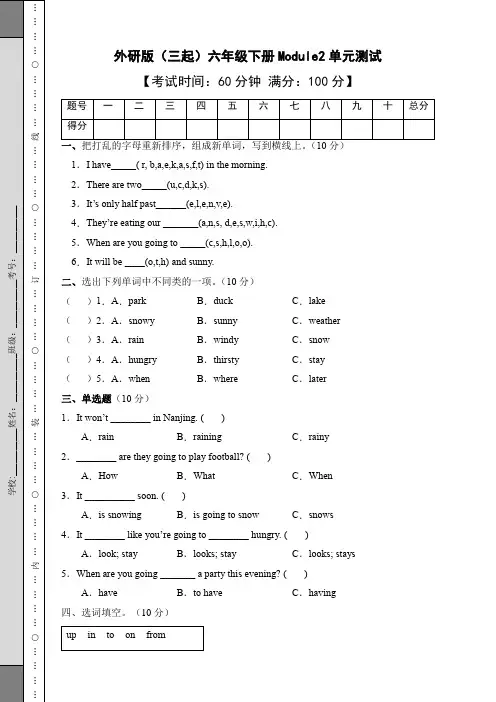
【考试时间:60分钟满分:100分】题号一二三四五六七八九十总分得分1.I have_____( r, b,a,e,k,a,s,f,t) in the morning.2.There are two_____(u,c,d,k,s).3.It’s only half past______(e,l,e,n,v,e).4.They’re eating our _______(a,n,s, d,e,s,w,i,h,c).5.When are you going to _____(c,s,h,l,o,o).6.It will be ____(o,t,h) and sunny.二、选出下列单词中不同类的一项。
(10分)()1.A.park B.duck C.lake()2.A.snowy B.sunny C.weather()3.A.rain B.windy C.snow()4.A.hungry B.thirsty C.stay()5.A.when B.where C.later三、单选题(10分)1.It won’t ________ in Nanjing. ()A.rain B.raining C.rainy2.________ are they going to play football? ()A.How B.What C.When3.It __________ soon. ()A.is snowing B.is going to snow C.snows4.It ________ like you’re going to ________ hungry. ()A.look; stay B.looks; stay C.looks; stays5.When are you going _______ a party this evening? ()A.have B.to have C.having四、选词填空。
M6 Unit2 I've got a stamp from China六年级英语上册(外研版三起)
Let’s learn I’ve got two kites.
I’ve got a Japanese kite.
√
I’ve got a Chinese kite.
I’ve got a Japanese kite and a
Chinese kite.
√
Let’s read
Sam: Have you got a knife and fork or chopsticks?
Read the text by yourselves. Underline the sentences with “and” or “but” then ask in pairs.
I have got ... √
I haven't got ... ×
I have got ... and ...
√
√
I have got ..., but I haven't ...
√
×
√√
√×
I have got ... and ... I have got ..., but I haven't ...
√×
√×
Sing a chant
I’ve got a book and I can read it. He has got a pen and he can use it. She has got a bike and she can ride it. I’ve got a book, _b_u_t I can’t read it. He has got a pen, _b_u_t he can’t use it. She has got a bike, _b_u_t she can’t ride it.
2024六年级英语下册ReviewModuleUnit2基础默写课件外研版三起
4. 他正在睡觉,但是婴儿开始哭了。 __H__e_i_s_s_l_ee_p_i_n_g_,_b_u_t__th_e__b_a_b_y_s_t_a_r_ts__to__c_r_y_. ____
5. — 九点钟他们打算做什么? _—___W__h_a_t_a_r_e_t_h_e_y__g_o_in_g__to__d_o_a_t__n_in_e__o_'c_l_o_c_k_?__ — 他们打算去游泳。 _—__T__h_e_y_'r_e_g_o_i_n_g__to__s_w_i_m_.___________________
三、句子过关。( 汉译英) 1. 他们正在踢足球,但是开始下雨了。 _T_h_e_y_'_r_e_p_l_a_y_in_g__f_o_o_tb_a_l_l,_b__u_t_it__st_a_r_t_s _to__r_a_in__. ____ 2. 她正在做饭,但是电话响了起来。 _S_h_e__is_c_o_o_k_i_n_g_,_b_u_t_t_h_e__p_h_o_n_e_s_t_a_r_ts__to__r_in_g_.______ 3. 她在拉二胡,但狗开始叫了起来。 _S_h_e__is_p_l_a_y_i_n_g_t_h_e_e_r_h_u_,_b_u_t__th_e__d_o_g_s_t_a_r_ts__to__b_a_r_k_.
2. 拉二胡
play the erhu
3. wear a T-shirt 穿一件T恤衫
4. on holiday
在度假
5. have breakfast 吃早餐
6. ride our bikes 骑我们的自行车 7. have a picnic 去野餐 8. take a ride on a big ship 乘坐一艘大船 9. have a rest 休息一会儿
外研版(三起)-英语-六年级上册- Module 6 Unit 2 教材同步讲解 教案(词汇)
Module 6Unit 2 I've got a stamp from China.我有一枚来自中国的邮票。
Look,listen and say.看一看,听一听,说一说。
(教材第35页)课文全译I’ve got a kite from China.我有一只来自中国的风筝。
I’ve got some stamps from China.我有一些来自中国的邮票。
And you’ve got some food from China! 你有一些来自中国的食物! Listen and read.听一听,读一读。
(教材第35页)情景详解英语描述:Sam and Lingling are asking and answering some questions.汉语描述:萨姆和玲玲正在问答一些问题。
词汇全解必会knife /naif/ n.(名词)餐刀;刀子字母i在knife中发/ai/。
kniveslife/laif/生活a knife and fork一副刀叉fork餐叉Please pass me a knife.请递给我一把餐刀。
fork /fɔ:k/ n.(名词)餐叉;叉字母组合or在fork中发/ɔ:/。
pork猪肉chopsticks筷子,knife餐刀I can use a fork.我会用餐叉。
for(为了)+k=fork(餐叉;叉)chopsticks /'tʃɔpstiks/ n.(名词)(常复)筷子字母o在chopsticks中发/ɔ/。
a pair of chopsticks一双筷子fork餐叉,spoon勺子,bowl碗,knife餐刀,plate盘子Do you use chopsticks in England?你们在英国使用筷子吗? Japanese /͵dʒæpə'ni:z/ adj.(形容词)日本的Japanese日语Japan/dʒə'pæn/日本I don’t like eating Japanese food.我不喜欢吃日本的食物。
外研版(一起)英语六年级下册Module 6 Unit 2 The name of the spac
WEEK SIX 第六周Unit 2The name of the spaceship is Shenzhou V.基础闯关三、选词填空,补全短文。
Daming and Simon ________(make/made)a model of a Chinese spaceship yesterday. The spaceship ________(is/are)very beautiful. They like ________(it/them)very much. And they like ________(read/reading)books, too. They are very ________(interested/interesting)in space travel. They will go into space one day.四、单项选择。
()1. The spaceship ________ some seeds into space in 2003.A. tookB. takeC. takes()2. The name ________ the tall boy is Sam.A. ofB. aboutC. in()3. He ________ a model ship for me yesterday.A. makeB. makesC. made4. What did you ________ for your last birthday. Tim?A. getsB. getC. got()5. Here is a present ________ y ou.A. atB. fromC. for五、选出合适的句子补全对话。
A. He bought a basketball for me.B. Let's go.C. Who bought it for you?D. It's about space.A: This book looks very interesting.B: What's it about?A: 1. ________B: 2. ________A: My mum bought it for me. It's a present.B: Great! What did your dad buy for you?A: 3. ________B: Then we can play basketball together.A: That's right. 4. ________能力提升六、按要求改写句子。
Module 6 Unit 2 I've got a stamp from China教学设计
Module 6 Unit 2 I've got a stamp from China教学设计一、教材分析:本节课是外研版(三起)小学英语六年级上册的第六模块的第二单元,主要围绕"邮票"这个话题展开。
通过本单元的学习,学生将学习如何描述自己拥有的邮票,并了解不同国家的邮票。
教材中包含了听说读写的综合训练,培养学生的听说能力和语言表达能力。
二、教学目标:1. 听:能听懂老师和同学对邮票的描述,并获取相关信息。
2. 说:能用简单的句子描述自己拥有的邮票,并能就邮票的国家、图案等进行简单交流。
3. 读:能读懂与邮票相关的简短对话和句子。
4. 写:能写出简单的句子描述自己拥有的邮票。
三、教学重点和教学难点:教学重点:培养学生的听说读写能力,学会描述自己拥有的邮票。
教学难点:学生能够用简单的句子进行口头和书面表达。
四、学情分析:学生是小学六年级的学生,已经具备了一定的英语基础,能够进行简单的英语交流。
他们对于认识不同国家的文化和事物有一定的兴趣。
然而,他们的词汇量较为有限,口语表达能力相对较弱。
因此,在教学过程中需要注重培养学生的听说能力和语言表达能力。
五、教学过程:Step 1: Warm-up- Greet the students and review the previous lesson briefly.-Show some pictures of stamps from different countries and ask the students if they know what they are.- Teacher: "What are these? Have you seen them before?"- Students: "They are stamps!"-Teacher: "That's right! Today, we are going to talk about stamps. Have you ever seen or collected stamps before?"Step 2: Presentation- Present new vocabulary using flashcards or visual aids: stamp, country, picture, collector.-Teacher: "This is a stamp. It's a small piece of paper with a special design on it. It usually comes from a different country. The design on the stamp is called a picture. People who collect stamps are called collectors."-Show real stamps or pictures of stamps to introduce the concept of stamps and their different designs.- Teacher: "Look at this stamp from China. It has a picture of the Great Wall. Can you see it?"- Allow students to observe and discuss the different stamps. Step 3: Practice- Divide the students into pairs or small groups.- Have them take turns asking and answering questions about their stamps using the target language.- Student A: "Have you got any stamps?"- Student B: "Yes, I've got a stamp from China. It has a picture of the Great Wall."-Student A: "That's interesting! What other stamps have you got?"-Circulate around the classroom, providing assistance and feedback as needed.- Encourage students to ask follow-up questions to gather more information about their classmates' stamps.- Teacher: "Now, let's practice in pairs. Ask your partner about their stamps and share information with each other."Step 4: Listening and Speaking- Play an audio recording of a conversation about stamps.-Teacher: "Listen to this conversation about stamps. Pay attention to the questions and answers."- Play the recording once.-Teacher: "Now, answer these questions based on the conversation."-Ask comprehension questions about the conversation and have students answer individually or in pairs.-Play the recording again and have the students repeat the sentences to practice their pronunciation.-Pair the students and have them role-play the conversation using their own stamps.-Teacher: "Now, work with a partner and role-play the conversation using the information about your stamps."Step 5: Reading and Writing- Distribute worksheets with short passages about stamps from different countries.-Teacher: "Read the passages silently and answer the questions."-Students read the passages and answer comprehension questions individually.- Ask a few students to share their answers with the class.- Teacher: "Now, imagine you could have any stamp you want.Write a short paragraph describing the stamp you would like to have. Include the country and the picture on it."-Students write a short paragraph describing their desired stamp.-Monitor the students' writing and provide assistance as needed.Step 6: Wrap-up- Review the key vocabulary and phrases learned in the lesson. - Teacher: "Let's review the vocabulary we learned today. Who can tell me what a stamp is?"- Call on different students to provide the definitions.- Ask some students to share their descriptions of the stamps they would like to have.-Teacher: "Now, let's hear from a few students. What stamp would you like to have and why?"六、板书设计:Unit 2 I've got a stamp from China.Vocabulary: stamp, country, picture, collectorKey Sentences:- Have you got any stamps?- Yes, I've got a stamp from China. It has a picture of the GreatWall.七、教学反思:在本节课的教学过程中,学生通过多种形式的教学活动,如图片展示、对话模仿、听力练习、阅读写作等,积极参与了课堂活动。
(新)外研版三下 Module 6 Unit 2-2词汇课件(一等奖)
Module 6
Unit 2 What does Lingling have at school?
Part 2
词汇详解
v. (动词) (have的第三
人称单数 形式)做;进
行,从事
【形近词】his 他的 hat 帽子 【例句】Tim has Chinese in the morning.
favourite
song
TV
Let’s watch
2 Listen, point and find “a, b, c…”
It’s the ABC song.
What’s your favourite song, Ms Smart?
Grammar
What’s your favourite song, Ms Smart? 你最喜欢的歌曲是什么,斯玛特女士? “What’s your favourite+事物类别?” 用于询问对方最喜欢的事物。 favourite此时作形容词,意为“最喜 欢的”,后面接名词。
杰克,你最喜欢的歌曲是什么? 它是《小苹果》。
同学们,在26个字母中有5个字母是特 别的,你知道这些字母是什么吗?
元音字母
26个字母
5个元音字母
21个辅音字母
Let’s match
I can fill A_a_ -_B_ b- Cc- D_d_ - Ee- F_f_ -G_g_, Hh-_I_ i- Jj- Kk__ - LMl-__ m- Nn, OoP-__ p- Qq __, RrSs- T_t_, Uu- V_v_ -W__ w- Xx- Y_y_ - Z_z_.
蒂姆上午上语文课。 【口诀记忆】have/ha Nhomakorabea意义多,