
高考英语语法复习——情态动词和虚拟语气
6
may的主要用法如下: 1. may在肯定句中表达许可,在疑问句中用于征 求意见。 2. may 在肯定句中表达可能性,即“或许;也 许”;may not 表达“也许不……” 3. may在目的状语从句中表达目的。 4. may在May sb. do sth.句式中表达祝愿。
是”等意义; 4.在if,when,until等连词引导的表示时间
5
或条件的从句中要用一般时表将来,但在if 从句中 有时为了表示意愿也可用will,有“愿意”的意思。
would 的主要用法有: 1. will 的过去式,表示对过去时间的意志、意愿、 决心; 2. 表示请求或个人的想法、看法,使语气婉转;
4
2. 表义务,可用于各种句式,通常指将来; 3. 表推测,暗含很大的可能; 4. 在从句中,表虚拟语气; 5. should也可表惋惜、忧虑、欢乐、惊讶等感 情色彩; 6. 在间接引语中,表达shall的过去式。
5 will/would有哪些用法?
翻译下列句子,体会情态动词will/would的用法 1. We will fight on until final victory is won.
3
can的主要用法有: 1. 表能力,翻译为“能够/会”。 2. 表可能性,翻译为“可能/会”。 3. 表许可,翻译为“可以”,用于否定句,表示 不允许,翻译为“不可以/不能”。 4. 表示偶然发生的可能性,翻译为“有时会”。 5. 用于否定句,表推测,翻译为“不可能”。
3
could的主要用法有: 1. can的过去式 could表过去的能力。 2. could 表委婉,礼貌语气,不是真正的过去时态。 3. could表示有可能,但可能性不如“can”大。
注意:need,dare也可用作实义动词。
2 情态动词用法上有何共同特征?
把下列句子变为否定句,疑问句(每空一词) 1. He shall join the army next autumn. 否定句:He___s_h_a_l_l ___ _____n_o_t ___ _______j_o_in_ the army next autumn. 疑问句:__S_h_a_l_l____ ___h_e______ _____jo_i_n___ the army next autumn?
2
情态动词用法的共同特征: 1.肯定句中放在谓语动词之前:主语+情态动词 +动词原形。 2. 情态动词无人称和数的变化。 3. 大部分情态动词有现在式和过去式两种形式。 4. 否定式构成是在情态动词后面直接加“not”。 5. 疑问句将情态动词直接提到主语前。
3 can/could有哪些用法?
翻译下列句子,体会情态动词can/could的用法 1. Take care while fishing! You know not all the children can swim. 钓鱼时小心些!你知道不是所有孩子都会游泳。 2. I think the work can be completed ahead of time. 我认为这项工作能提前完成。
5
3. 表示过去习惯性的动作,着重动作的重复,有 “总是、总会”等意思;
4. 表示虚拟。
6 may/might有哪些用法?
翻译下列句子,体会情态动词may/might的用法
1. (1) You may go home now. (2) — May I borrow your towel?
— Yes,you may./No, you can't(mustn't). 1. (1)你现在可以回家。 (2) ——我可以借用你的毛巾吗?
假如你愿意看这篇文章,你就会认识到你错了
5
5. I told him not to go, but he would not listen to me.
我要他不要去,但是他不愿听我的意见。
6. Would you please take a seat? 请就座,好吗?
5
7. On Sundays he would come to our village and work with us.
为了要还债他把房子卖掉了。
7. — Might I go now? — Yes,you may./No,you can't(mustn't).
——我现在可以走吗?——是的,你可以走。/ 不,你不能/决不可走。
6
8. This approach might work and please try it.
4 shall/should有哪些用法?
翻译下列句子,体会情态动词shall/should的用法 1. I shall go on a holiday with my parents next autumn.
我明年秋季将同父母去度假。 2. (1)You shall do as you see me do. (2)He shall be punished if he disobeys.
8. Ifessage. 他若来访,就将我的消息给他。
4
9. I'm sorry that you should think so badly of me. 你竟把我想得这样坏,我感到遗憾。
10. He said I should call him Doctor Smith instead of Mr. Smith.
他说我应该叫他史密斯博士而不是史密斯先生。
4
shall 的主要用法有: 1.用于第一人称代替will,表将来或意愿; 2.用于第二、三人称,shall表义务; 3.用于第二、三人称,表许诺; 4.用于第一、三人称疑问句,表征询意见。 should的主要用法有: 1. 用于第一人称疑问句,表征询意见;
你有必要及时通知我任何最新信息。句中无情 态动词。
3. She doesn't dare go out alone at night. 晚上她不敢单独外出。句中无情态动词。
4. When asked why she was so kind, she would just smile.每当问到她如此善良的原因时,她只是微笑。
在大多数星期天,他会到我们村子里来与我们一 道干活。
8. If you had come earlier, you would have seen him.
假如你早点来,你就会见到他。
5
will 的主要用法有: 1.表示意志、意愿; 2.在疑问句中用于第二人称,表示请求或询问
对方的意思; 3.表示习惯、经常性、倾向性,有“惯于、总
would是情态动词。
1
除了 can,would以外,英语中还有很多情态动 词 。 常 见 情 态 动 词 有 : must , can(could) , may(might) , ought to , need , dare shall(should) , will(would) have (had) to,used to, had better,would rather。
2
3. I dare say he is innocent. 否定句:I ______d_a_re__ _______n_o_t_ _____s_a_y___ he is innocent. 疑问句:____D__a_re___ _____I_____ ___s_a_y_____ he is innocent?
2
4. You need give a further explanation of your design.
否定句: You ____n_e_ed____ ___n_o_t_____ ___g_i_v_e____ a further explanation of your design.
疑问句: ___N_e_e_d____ _____y_o_u___ _____g_i_v_e__ a further explanation of your design?
你照我的样子办。 他若不服从就要受到处罚。
4
3. (1)You shall have my answer tomorrow. (2)She shall get her share.
(1)你明天可以得到我的答复。 (2)她可以得到她的一份。 4. (1)Shall I get you some coffee, Miss Fleure? (2)What shall he do next? (1)费勒小姐,我给您来点咖啡好吗? (2)他下一步干什么呢?
我们要一直战斗到胜利为止。 2. Will you help me with my work?
在我工作方面帮助我好吗?
5
3. Every morning he will have a walk along this river.
每天早上他都会沿着河流散步。 4. If you will read this article,you will realize you are wrong.
2
2. We shall have a gettogether this weekend. 否定句:We____s_h_a_ll___ ____n_o_t____ ____h_a_v_e___ a gettogether this weekend. 疑问句:____S_h_a_ll___ ____w__e____ _____h_a_v_e__ a gettogether this weekend?
2
3. You can't take the book out of the room. 你不可以将这本书拿出室外。 4. It can be quite windy there, especially in Spring. 那里有时容易刮风,特别在春季。
2
高中英语语法复习之情态动词虚拟语气

情态动词定义: 情态动词是一种本身有一定的词义,但要与动词原形及其被动语态一起使用,给谓语动词增添情态色彩,表示说话人对有关行为或事物的态度和看法,认为其可能、应该或必要等.情态动词后面加动词原形情态动词有四类:①只做情态动词:must,can(could),may(might),ought to②可做情态动词又可做实义动词:need,dare③可做情态动词又可做助动词:shall(should),will(would)④具有情态动词特征:have(had,has) to,used to位置:情态动词在句中放在谓语动词之前, 谓语动词前若有助动词,则在助动词之前,疑问句中, 情态动词则在主语之前。
特点:情态动词无人称和数的变化, 情态动词后面跟的动词需用原形,否定式构成是在情态动词后面加"not"。
个别情态动词有现在式和过去式两种形式, 过去式用来表达更加客气, 委婉的语气, 时态性不强, 可用于过去,现在或将来。
情态动词属非及物动词,故没有被动语态。
除此之外,情态助动词还有如下词法和句法特征:1)除ought和used以外,其他情态动词后面只能接不带to的不定式。
如果我们把ought to和used to 看做是固定词组的话,那么,所有情态动词无一例外地只能接不带to的不定式。
2)情态助动词在限定动词词组总是位居第一。
3)情态助动词用于第三人称单数现在时的时候,没有词形变化,即其词尾无-s形式。
4)情态动词没有非限定形式,即没有不定式和分词形式,也没有相应的动名词。
5)情态助动词的“时”的形式并不是时间区别的主要标志。
在不少场合,情态助动词的现在时和过去时形式都可以表示现在、过去或将来时间。
6)情态助动词之间是相互排斥的,即在一个限定动词词组中只能出现一个情态助动词,但有时却可以与have和be基本助动词连用。
用法首先它是动词,而且不同于行为动词,行为动词表示的是可以通过行为来表达的动作(如写,读,跑),而情态动词只是表达的一种想法(如能,也许,敢)。
高三英语高考语法知识点归纳总结情态动词和虚拟语气情态动词

八、情态动词和虚拟语气情态动词I.情态动词基本用法情态动词用法否定式疑问式简答式can 能力(体力,智力,技能)允许或许可(口语中常用)可能性(表猜测,用于否定句或疑问句中)can not / cannot /can’tdoCan…do…?Yes,…can.No,…can’t.could couldn’t domay 可以(问句中表示请求)可能,或许(表推测)祝愿(用于倒装句中)may not doMay…do…?Yes,…may.No,…mustn’t/can’t.might might not do Might…do…?Yes,…might No,…might not.must 必须,应该(表主观要求)肯定,想必(肯定句中表推测)must not/mustn’t do Must…do…? to.Yes,…must.No,…needn’t/don’t havehave to 只好,不得不(客观的必须,有时态和人称的变化)don’t have to do Do…have to do…?Yes,…do.No,…don’t.ought to 应当(表示义务责任,口语中多用should)ought not to/oughtn’t todoOught…to do…?Yes,…ought.No,…oughtn’t.shall 用于一三人称征求对方意见用于二三人称表示许诺、命令、警告、威胁等shall not/shan’t do Shall…do…?Yes,…shall.No,…shan’t.should 应当,应该(表义务责任)本该(含有责备意味)should not/sh ouldn’t do Should…do…?will 意愿,决心请求,建议,用在问句中would比较委婉will not/won’t doWill/Would…do…?Yes,…will.No,…won’t.would would not/wouldn’t dodare 敢(常用于否定句和疑问句中)dare not/daren’t do Dare…do…?Yes,…dare. No,…daren’t.need 需要,必须(常用于否定句和疑问句中)need not/needn’t do Need…do…?Yes,…must. No,…needn’t.used to 过去常常(现在已不再)used not/usedn’t/usen’tto dodidn’t use to doUsed…to do…?Did…use to do…?Yes,…used.No,…use(d)n’t.Yes,…did.No,…didn’t. II.情态动词的重点知识表示“能力、许可”的can和may 表示能力的情态动词用can/couldA computer_____think for itself; it must be told what to do.A.can’tB.must n’tC.may notD.might not表示许可时用may/might ,can/could 都可以,但在问句中用could…?或might…?以使口气委婉客气,其回答一定要用can或may,以使回答口气明确(must表示一定,必须,mustn’t表示禁止,不许可)。
高三复习+ 英语语法+情态动词和虚拟语气
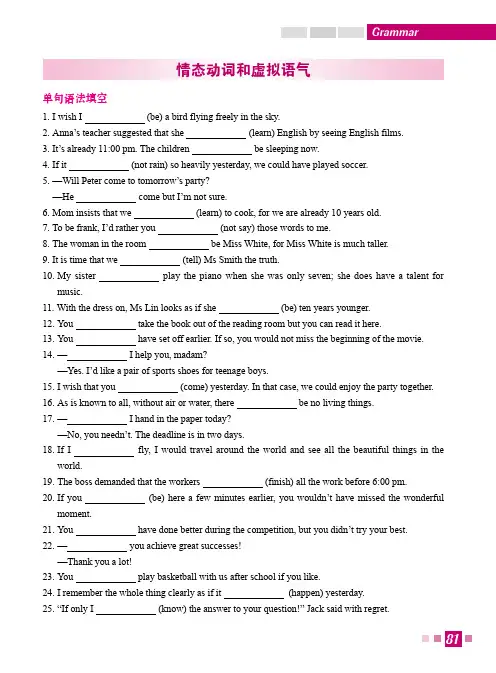
情态动词和虚拟语气单句语法填空1.I wish I (be) a bird flying freely in the sky.2.A nna’s teacher suggested that she (learn) English by seeing English films.3.I t’s already 11:00 pm. The children be sleeping now.4.I f it (not rain) so heavily yesterday, we could have played soccer.5.—Will Peter come to tomorrow’s party?—He come but I’m not sure.6.M om insists that we (learn) to cook, for we are already 10 years old.7.T o be frank,I’d rather you (not say) those words to me.8.T he woman in the room be Miss White, for Miss White is much taller.9.I t is time that we (tell) Ms Smith the truth.10.M y sister play the piano when she was only seven; she does have a talent formusic.11.W ith the dress on, Ms Lin looks as if she (be) ten years younger.12.Y ou take the book out of the reading room but you can read it here.13.Y ou have set off earlier. If so, you would not miss the beginning of the movie.14.— I help you, madam?—Yes. I’d like a pair of sports shoes for teenage boys.15.I wish that you (come) yesterday. In that case, we could enjoy the party together.16.A s is known to all, without air or water, there be no living things.17.— I hand in the paper today?—No, you needn’t. The deadline is in two days.18.I f I fly, I would travel around the world and see all the beautiful things in theworld.19.T he boss demanded that the workers (finish) all the work before 6:00 pm.20.I f you (be) here a few minutes earlier,you wouldn’t have missed the wonderfulmoment.21.Y ou have done better during the competition, but you didn’t try your best.22.— you achieve great successes!—Thank you a lot!23.Y ou play basketball with us after school if you like.24.I remember the whole thing clearly as if it (happen) yesterday.25.“If only I (know) the answer to your question!” Jack said with regret.81参考答案1. were2. (should) learn3. must/should4. hadn’t rained5. may/might6. (should) learn7. hadn’t said8. can’t9. told/should tell10. could 11. were12. can’t/mustn’t13. should/ought to14. Can/May15. had come 16. would17. Must18. could19. (should) finish20. had been 21. could22. May23. can/could24. happened25. knew。
高考英语复习知识点:情态动词和虚拟语气及英语作文结尾万能公式
高考英语复习知识点:情态动词和虚拟语气及英语作文结尾万能公式高考英语复习知识点:情态动词和虚拟语气虚拟语气在高考命题中不是重点,但是难点。
考点常集中在含蓄条件句以及主语、宾语从句等特定句型中虚拟语气的使用上,因此考生应熟练掌握含蓄条件句中主从句的时态要求以及一些典型句型中虚拟语气的具体形式。
虚拟语气考点透析考点一、虚拟语气的基本用法1.与现在事实相反的虚拟语气,基本结构为:主语+动词的一般过去时(be动词用were)+其他成分+if+should/would/could...+动词原形+其他成分。
例如:①If it were not for the fact that she ______ sing,I would invite her to the party.A.couldntB.shouldntC.cantD.might not解析句意为:如果不是因为她不会唱歌的事实,我会邀请她来参加那次聚会的。
that从句为同位语从句,描述的是事实,用陈述语气。
正确答案为C。
2.与过去事实相反的虚拟语气,基本结构为:主语+动词的过去完成时+其他成分+if+should/would/could...+have done+其他成分。
例如:If the weather had been better,we could have had a picnic.But it ______ all day.A.rainedB.rainsC.has rainedD.is raining解析句意为:如果天气好的话,我们是能够去野餐的,但是下了一天的雨。
句子前半部分陈述的是与过去事实相反的事情,所以用了虚拟语气。
下了一天的雨是事实,所以用陈述语气。
因为是发生在过去的事实,所以正确答案为A。
3.与将来事实相反的虚拟语气,基本结构为:主语+动词的一般过去时/should do/were to do+其他成分+if+should/would/could...+动词原形+其他成分。
03+专题三+动词+第3讲+情态动词和虚拟语气+课件-2024届高三英语一轮复习

情态动词
用法
must
表示义务、必要性等, 意为“必须”,其否定式 mustn't 意为“禁止”
续表
例句 You must finish the task before the deadline.你必须在 截止日期前完成这个任务。 You mustn't play football in the street.你绝对不能在街上 踢 足球。
必备知识
考点1 情态动词
1.情态动词的基本用法
情态动词
用法
例句 (外研选必二 Unit 1)At a
glance I can distinguish
can/could
表示能力,意为“能,会” China from Arizona. 我一眼就能分辨中国和亚利桑 那。
续表
情态动词
用法
例句
表示推测,意为“可能”, That can't be Mary—she is
要我告诉布雷特明天放学后直
接过来吗?
One of our rules is that every
student shall wear the school
uniform while at school.我们
的规定之一就是每名学生在校
期间都必须穿校服。
情态动词
用法
表示劝告或建议,意为 “应该” should
做而实际上 yesterday.
做了
你昨天考试本不应该作弊
后悔、
的。
遗憾或
You needn't have told
责备
本来没必要 him that.你本来用不着告
needn't have done
高考英语语法复习情态动词和虚拟语气

4
5. Should I open the window? 我可以开窗户吗? 6. You shouldn't be sitting in the sun. 你不应该坐在阳光下。
4
7. It's 4:30. They should be in New York by now. 现在是4点半,他们应该到达纽约了。 8. If he should drop in, give him my message. 他若来访,就将我的消息给他。
(2)He shall be punished if he disobeys. 你照我的样子办。
他若不服从就要受到处罚。
4
3. (1)You shall have my answer tomorrow. (2)She shall get her share. (1)你明天可以得到我的答复。
(2)她可以得到她的一份。 4. (1)Shall I get you some coffee, Miss Fleure?
除了 can , would 以外,英语中还有很多情态动 词 。 常 见 情 态 动 词 有 : must , can(could) , may(might) , ought to , need , dare shall(should) , will(would) have (had) to,used to, had better,would rather。 注意:need,dare也可用作实义动词。
6
4. May you succeed.
祝你成功。
5. (1)You may well say so.
高中英语语法总结:情态动词和虚拟语气
高中英语语法总结:情态动词和虚拟语气考向1 情态动词一、 can, could与be able to1. 表示能力(体力、知识、技能)。
☞Can you lift this heavy box?(体力)☞Mary can speak three languages.(知识)☞Can you skate?(技能)此时可用be able to代替。
can只有一般现在时和一般过去式;而be able to则有更多的时态。
☞I’ll not be able to come this afternoon.当表示"经过努力才得以做成功某事"时应用be able to,不能用can。
如:☞He was able to go to the party yesterday evening in spite of the heavy rain.2. 表示请求和允许。
☞—Can I go now?—Yes, you can. / No, you can’t. 此时可与may互换。
在疑问句中还可用could, might代替,不是过去式,只是语气更委婉,不能用于肯定句和答语中。
☞—Could I come to see you tomorrow?—Yes, you can. (No, I’m afraid not.)3. 表示客观可能性(客观原因形成的能力)。
☞They’ve changed the timetable, so we can go by bus instead. This hall can hold 500 people at least.4. 表示推测(惊讶、怀疑、不相信的态度),用于疑问句、否定句和感叹句中。
☞Can this be true?☞This can’t be done by him. How can this be true?二、 may, might1. 表示请求和允许。
might比 may语气更委婉,而不是过去式。
高考英语复习语法专项提升专题八情态动词和虚拟语气市赛课公开课一等奖省名师优质课获奖课件
Should I be free tomorrow, I would come. 假如我明天有空,我会来。
Had you taken my advice, you wouldn’t have failed in the examination. 假如你听了我提议,你就不会考试不及格了。
10/64
3.may, might用于必定句中能够用来表示推测,意为“可能”; 用于否定句中也能够表示推测, may not 意为“可能不”,表示 一个不太确定语气。
The traffic is heavy these days. I might arrive a bit late, so could you save me a place? 最近这些天交通拥挤,我有可能迟到一会儿,所以请你给我留 个位子好吗?
How could you do such a silly thing? 你怎么能做那样蠢事呢? (2)cannot...too/enough 表示“不论……也不过分”, “越……越好”。
You can’t be too careful while driving. 开车时越小心越好。
7/64
6.“may as well+动词原形”意为“最好, 不妨, 倒不如”。 You may as well do it at once.
情态动词+have done
1.could have done用于必定句, 表示原来能够做, 而实际上 未做, 用疑问或否定形式对过去发生行为表示推测, can’t have done 多用于语气强烈否定, 意为“不可能做 过”。
The accident could have been avoided. 这场事故原来是能够防止。
高中英语情态动词用法和虚拟语气语法知识
高中英语情态动词用法和虚拟语气语法知识一、can和could1、can的用法(1)表示体力和脑力方面的能力。
(2)表示对现在的动作或状态进行主观的猜测,主要用在否定句和疑问句中。
(3)表示可能性,理论上的可能性,意为“有时候可能会”,可用于肯定句。
(4)表示允许,意思与may接近。
(5)表示说话人的推测、怀疑、惊异、猜测或不肯定等,主要用于否定句、疑问句或感叹句中。
(6)can的特殊句型cannot…too / enough表示“无论怎么。
也不过分”。
“越……越好”。
cannot but+ do sth.表示“不得不,只好”。
2、could的用法(1)表示能力,指的是过去时间。
(2)表示允许,指的是过去时间。
(3)表示可能,可以指过去时间,也可以指现在时间,表示语气缓和。
(4)委婉客气地提出问题或陈述看法,指的是现在时间。
主要用于疑问句,回答时用can。
3、can与could的区别can表推测时只用于否定句和疑问句(could无此限制)。
couldn't的可能性比can't小。
4、can与be able to的区别(1)现在时:无区别,但后者不常用。
(2)完成时;can没有完成时,此时要用have(has,had)been able to。
(3)将来时:can没有将来时,要用will be able to。
(4)过去时:could表示一般能力,was/were able to 表示在具体场合通过努力成功做成某事的能力。
二、may 和might1、may的用法(1)表示询问或说明一件事可不可以做。
(2)表示一件事或许会发生或某种情况可能会存在,通常用在肯定句和否定句中。
注意:表示可能性时,can't语气强,表示“不可能”,may not语气弱,表示“可能不”。
2、might的用法(1)表示询问或允许,指的是过去时间。
(2)表示可能发生的事,可以指过去时间,也可以指现在时间,语气更加不肯定,可能性比may小一些。
超实用高考英语一轮复习:语法专题:情态动词和虚拟语气 课件
语前,构成倒装
你要是见到玛丽,会认不出她的。
当主句和从句时间不一致时,主
错综时间
If you had taken my advice then, you wouldn't be in trouble now.
句和从句要根据各自所指的具
条件句
要是你当时听我的劝,你现在就不会有麻烦了。
体时间选用适当的时态
1. 用于非真实条件句 (2)其他用法
用法
说明
示例
The dish would have been better with a bit less salt.
ቤተ መጻሕፍቲ ባይዱ
有时,假设的条件不通过条件状 少放些盐,这道菜会更可口的。
含蓄 语从句表达,而是隐含在某些词 Under such circumstances I would probably have done the same.
表示征求对方的意见或请求指 咱们晚上见好吗?
示
You shall not smoke.不准抽烟。(警告) shall
用于第二、第三人称的陈述句, There shall be no talking during the test.
表示允诺、规定、命令、警告 考试过程中不允许交谈。(规定)
等
You shall have a new computer if you do well in the exam.
Beijing may/might well be changing faster than any other city on earth.北京的变化可能比世界上其他任何一个城市都快。
may/might as well倒不如,不妨
It is very late, so you may/might as well go to bed. 很晚了,所以你还是去睡吧。