
介词的用法总结
百度文库 1 介词的用法 1.表示地点位置的介词 1)at ,in, on, to,for at (1)表示在小地方; (2)表示“在……附近,旁边” in (1)表示 在大地方; (2)表示“在…范围之内”。 on 表示毗邻,接壤,“在……上面”。 to 表示在……范围外,不强调是否接壤;或“到……” 2)above, over, on 在……上 above 指在……上方,不强调是否垂直,与 below相对; over指垂直的上方,与under相对,但over与物体有一定的空间,不直接接触。 on表示某物体上面并与之接触。 The bird is flying above my head. There is a bridge over the river. He put his watch on the desk. 3)below, under 在……下面 under表示在…正下方 below表示在……下,不一定在正下方 There is a cat under the table. Please write your name below the line. 4)in front [frant]of, in the front of在……前面 in front of…意思是“在……前面”,指甲物在乙物之前,两者互不包括;其反义词是behind(在……的后面)。 There are some flowers in front of the house.(房子前面有些花卉。) in the front of 意思是“在…..的前部”,即甲物在乙物的内部.反义词是at the back of…(在……范围内的后部)。 There is a blackboard in the front of our classroom. 我们的教室前边有一块黑板。 Our teacher stands in the front of the classroom. 我们的老师站在教室前.(老师在教室里) 5)beside,behind beside 表示在……旁边 behind 表示在……后面 2.表示时间的介词
1)in , on,at 在……时 in表示较长时间,如世纪、朝代、时代、年、季节、月及一般(非特指)的早、中、晚等。 如 in the 20th century, in the 1950s, in 1989, in summer, in January, in the morning, in one’s life , in one’s thirties等。 on表示具体某一天及其早、中、晚。 如on May 1st, on Monday, on New Year’s Day, on a cold night in January, on a fine morning, on Sunday afternoon等。 at表示某一时刻或较短暂的时间,或泛指,等。 如at 3:20, at this time of year, at the beginning of, at the end of …, at the age of …, at Christmas, at night, at noon, at this moment等。 注意:在last, next, this, that, some, every 等词之前一律不用介词。如:We meet every day. 百度文库 2 2)in, after 在……之后 “in +段时间”表示将来的一段时间以后; “after+段时间”表示过去的一段时间以后; “after+将来的时间点”表示将来的某一时刻以后。 3)from, since 自从…… from仅说明什么时候开始,不说明某动作或情况持续多久; since表示某动作或情况持续至说话时刻,通常与完成时连用。since表示"自(某具体时间)以来",常用作完成谓语的。 since liberation(1980)自从解放(1980年)以来 They have been close friends since childhood. 他们从小就是好朋友。 (1)since the war是指"自从战争结束以来",若指"自从战争开始以来",须说"since the beginning of the war"。 (2)不要将since与after混淆。 比较:He has worked here since 1965.(指一段时间,强调时间段)自从1965年以来,他一直在这儿工作。 He began to work here after 1965. (指一点时间,强调时间点)从1965年以后,他开始在这儿工作。 4)after, behind 在……之后 after主要用于表示时间; behind主要用于表示位置。 时间名词前介词用法口诀 年前周前要用in 具体日子要用on 遇到几号也用on 上午下午得是in 要说某日上下午 用on换in记清楚 午夜黄昏用at 黎明用它也不错 at用在时分前 说“差”可要用上to 说"过''要用past 3.表示运动方向的介词:
across, through 通过,穿过 across表示横过,即从物体表面通过,与on有关,为二维 through穿过,即从物体内部穿过,与in有关,为三维。 4.表示“在……之间”的介词:
表示“在……之间”的介词在英语中属于介词,如in front of ,behind ,on, in, near, under, up between, among between指在两个人或两个事物之间; among指在三个或三个以上的人或事物之间。 5.表示其他意义的介词
1)on ,about 关于 on 表示这本书,这篇文章或演说是严肃的,或学术性的,可供专门研究这一问题的人阅读; about表示内容较为普通,不那么正式。 2)by, with, in 表示方法、手段、工具 by 以……方法、手段或泛指某种交通工具; with 表示用 …工具、手段,一般接具体的工具和手段; in 表示用…方式,用…语言(语调、笔墨、颜色)等; 3)except, besides 除了 百度文库 3 except 除……之外,不包括在内; besides 除……之外,包括在内。 Except for Mr. Wang, we went to see the film.(王先生没去) Besides Mr. Wang, we also went to see the film.(王先生也去了) 其它常用介词
介词在英语词汇中所占比例很小,但它们的用法却非常灵活,复杂。下列为常用介词及含义: 1)about 关于,附近,大约,周围,随身. I have bought a book about Shakespearean.我买了一本有关的书。 There are about fifteen trees in the picture.大约有十五棵树在图片里。 2)above 在....上,高出,以上,超过,在...上游. The plane is flying above the clouds.飞机在云上飞行。 I think the man is above sixty years old.我想那人有六十多岁了。 3)across 横过,对面,交叉,在...的对面. Can you swim across the river?你能游过河吗? We live across the street.我们住在街的对面。 4)after 在...后面,依照. He went home after school.他放学后就回家了。 Read after me, please.请跟我朗读。 5)against 撞到,靠着,反对,违背, The car hit against the tree.汽车撞了树。 He is standing against the wall.他靠墙站着。 6)along 沿着,顺着. They are walking along the river.他们沿着河行走。 7)among 在...当中.(三者或三者以上) He is the tallest among them.他是他们当中个子最高的。 8)around 在...的周围,在...那一边. They sat around the table talking the news.他们绕桌而坐谈论新闻。 There is a drugstore around the corner.拐角处有一家药店。 9)as 作为. He doesn't like people treat him as a child.他不喜欢人们把他当小孩子对待。 10)at 在...时刻,在...点钟,在...岁时, 向,在...之中,按...速度,值(卖)...钱, 在...(强调地点) He always gets up at six in the morning.他时常早上六点钟起床。 He shot at the bird but missed it.他向鸟射击,但是没射中。 The car goes at eighty miles an hour.汽车以每小时八十公里的速度行驶。 11)before 在...的前面(位置),在...之前(时间) He took a picture before the car.他在汽车前照了张照片。 He can't finish his work before supper.晚饭前他完不成工作。 12)behind 在...的后面(位置), 落后于,不如4)after 在...后面,依照, Are there any brooms behind the door.门后有扫帚吗? All of us are behind him in mathematics.我们数学都不如他。 13)below 在...之下,低于, There are four lights below the ceiling.天花板下面有四盏灯。 The murderer run away below the police's eyes.杀人犯从警察眼皮底下跑了。 14)beside 在...的旁边,在...之外,与...相比.
40个英语介词用法总结
40个英语介词用法总结40个英语介词用法总结1. in: 表示在某个地方或时间内,例如:in the park, in the morning2. on: 表示在某个表面或时间点上,例如:on the table, on Monday3. at: 表示在某个地点或时刻,例如:at the cinema, at 9 o'clock4. by: 表示通过某种方式或在某个时间之前,例如:by car, by tomorrow5. for: 表示为了某个目的或一段时间,例如:for a party, for a week6. with: 表示伴随或使用某物,例如:with friends, with a pen7. to: 表示移动到某个地方或给予某人,例如:go to school, give it to me8. from: 表示起始点或来源,例如:from home, from China9. into: 表示进入某个地点或状态的转变,例如:jump into the water, turn into a butterfly10. out: 表示从某地点离开或移动到室外,例如:go out, look out of the window11. up: 表示向上移动或增加,例如:climb up the stairs,wake up12. down: 表示向下移动或减少,例如:walk down the hill, calm down13. about: 表示关于某事或在某个范围内,例如:talk about the movie, wander about the city14. off: 表示离开或关闭,例如:get off the bus, turnoff the lights15. on: 表示打开或激活,例如:turn on the TV, switch on the computer16. over: 表示越过或在某地上方,例如:jump over the fence, fly over the city17. under: 表示在某物下面或被控制或影响,例如:hide under the bed, live under his rules18. with: 表示具有某种特征或和某人一起做某事,例如:a man with blue eyes, dance with me19. without: 表示没有某物或在缺乏某物的情况下,例如:go without food, live without regret20. by: 表示通过某种方式,例如:learn by doing, go by bus21. through: 表示穿过某物或完成某事,例如:walk through the door, go through the documents22. across: 表示横穿某物或在某个范围内,例如:swimacross the river, all across the world23. between: 表示在两个事物之间或在某个时间段,例如:choose between two options, between 9 and 10 o'clock24. among: 表示在三个或三个以上事物之间或在某群人中,例如:share among friends, discuss among colleagues25. around: 表示在周围或在某个时间点附近,例如:walk around the park, around midnight26. through: 表示通过某事物或在某段时间内,例如:read through the book, work through the night27. against: 表示反对或靠在某物上,例如:fight against injustice, lean against the wall28. for: 表示代表或支持某人或某事,例如:vote for a candidate, fight for freedom29. towards: 表示朝向某个方向或对某人有好感,例如:walk towards the beach, feel towards someone30. within: 表示在某个时间或范围内,例如:arrive within an hour, within the city limits31. beyond: 表示超出某个界限或超过某个程度,例如:beyond expectations, beyond the horizon32. along: 表示沿着某个路线或伴随某人一起,例如:walk along the street, sing along with the song33. above: 表示在某物之上或高于某个程度,例如:flyabove the clouds, above average34. below: 表示在某物之下或低于某个程度,例如:swim below the surface, below freezing35. beside: 表示在某物旁边或和某人一起,例如:sit beside me, beside the lake36. near: 表示在某物附近或接近某个时间,例如:live near the beach, near the end37. past: 表示经过某个地点或在某个时间之后,例如:walk past the store, past midnight38. around: 表示在周围或大约某个数量,例如:look around the room, around 20 people39. after: 表示在某个时间之后或追求某人或某事,例如:after dinner, run after the dog40. before: 表示在某个时间之前或在某个事件之前,例如:before sunrise, before the meeting这些介词是英语中常用的一些基本介词,它们在表达地点、时间、方式等方面起到了重要的作用。
介词和介词短语的常见用法总结
介词和介词短语的常见用法总结介词是一种在句子中连接名词、代词、动词或其他词类的虚词。
介词短语是由一个介词与其它词类构成的短语。
介词和介词短语在英语中有广泛的应用,常用于表示时间、地点、目的、原因和方式等。
以下总结了一些常见的介词和介词短语的用法。
表示时间- at:表示具体的时刻或特定的时间点。
例如:at 7 o'clock, at midnight.- in:表示一段时间或大范围的时间内。
例如:in the morning,in summer.- on:表示特定的日期或具体的某一天。
例如:on Monday, on my birthday.表示地点- in:表示在某个范围、区域或地点内部。
例如:in the park, in London.- on:表示在某个表面或位置上。
例如:on the table, on the wall.- at:表示在某个具体的地方或位置。
例如:at home, at the bus stop.表示目的- for:表示为了某个目的或目标。
例如:for studying, for fun.- to:表示朝向某个目标或方向。
例如:to the park, to the station.表示原因- because of:表示由于某个原因。
例如:because of the rain, because of her illness.- due to:表示由于某个特定的原因。
例如:due to budget constraints, due to his absence.表示方式- by:表示通过某种方式或方法。
例如:by car, by email.- with:表示使用某种工具或伴随的状态。
例如:with a pen, with a smile.以上是一些常见的介词和介词短语的用法总结。
在实际使用中,要根据具体的语境和表达需要来选择合适的介词和介词短语。
超全的英语介词用法归纳总结
超全的英语介词用法归纳总结常用介词基本用法辨析表示方位的介词: in, to, on1.i.表示在某地范围之内。
Shangha.is/lie.i.th.eas.o.China.上海在中国的东部。
2.t.表示在某地范围之外。
Japa.is/lie.t.th.eas.o.China.日本位于中国的东面。
3.o.表示与某地相邻或接壤。
Mongoli.is/lie.o.th.nort.o.China.蒙古国位于中国北边。
表示计量的介词: at, for, by1.a.表示“以……速度”“以……价格”。
I.flie.a.abou.90.kilometer.a.hour.它以每小时900公里的速度飞行。
.sol.m.ca.a..hig.price.我以高价出售了我的汽车。
2.fo.表示“用……交换,以……为代价”。
H.sol.hi.ca.fo.50.dollars.他以五百元把车卖了。
注意: at表示单价(price) , for表示总钱数。
3.b.表示“以……计”, 后跟度量单位。
The.pai.hi.b.th.month.他们按月给他计酬。
Her.egg.ar.sol.b.weight.在这里鸡蛋是按重量卖的。
表示材料的介词: of, from, in1.o.成品仍可看出原料。
Thi.bo.i.mad.o.paper.这个盒子是纸做的。
2.fro.成品已看不出原料。
Win.i.mad.fro.grapes.葡萄酒是葡萄酿成的。
3.i.表示用某种材料或语言。
Pleas.fil.i.th.for.i.penci.first.请先用铅笔填写这个表格。
The.tal.i.English.他们用英语交谈。
表示工具或手段的介词: by, with, on1.b.用某种方式, 多用于交通。
.wen.ther.b.bus.我坐公共汽车去那儿。
2.with表示“用某种工具”。
H.brok.th.windo.wit..stone.他用石头把玻璃砸坏了。
介词的用法和意思总结
介词的用法和意思总结一、引言在英语中,介词是非常重要的一部分语法,它能帮助我们表达时间、地点、方向和方式等概念。
然而,由于介词的灵活性和多义性,学习和使用介词对许多学习者来说可能是一个挑战。
本文将总结常见的英语介词及其基本用法和意思,希望能为学习者提供帮助。
二、表示位置或方向的介词1. In:表示“在”的位置或范围内。
例如:- The book is in the cupboard.- She lives in New York.2. On:表示位于平面上物体的表面或接触。
例如:- The cup is on the table.- He put his hat on the chair.3. At:表示靠近某物或某地。
例如:- They meet at the cinema.- I'll wait for you at the bus stop.4. Under:表示在某物下面或处于较低位置。
例如:- The cat is under the table.- The box is under the bed.5. Above:表示在某物之上或较高位置。
例如:- The bird is flying above the tree.- Hang the picture above the sofa.三、表示时间的介词1. On:表示特定日期或星期几。
例如:- My birthday is on May 5th.- We have a meeting on Monday.2. At:表示具体的时刻。
例如:- The train will arrive at 9 o'clock.- I go to bed at midnight.3. In:表示时间段或月份。
例如:- I will visit my parents in summer.- She was born in January.四、表示原因和目的的介词1. For:表示动作发生的原因或目的。
英语介词的用法总结(完整版)
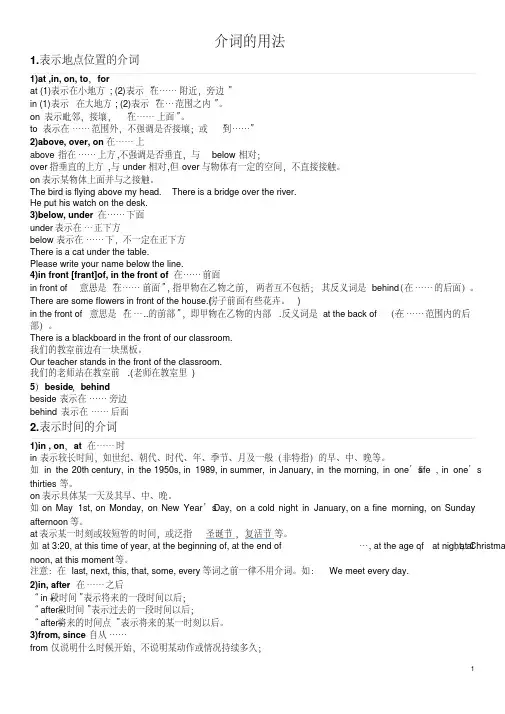
介词的用法1.表示地点位置的介词1)at ,in, on, to,forat (1)表示在小地方; (2)表示“在……附近,旁边”in (1)表示在大地方; (2)表示“在…范围之内”。
on 表示毗邻,接壤,“在……上面”。
to 表示在……范围外,不强调是否接壤;或“到……”2)above, over, on 在……上above 指在……上方,不强调是否垂直,与below相对;over指垂直的上方,与under相对,但over与物体有一定的空间,不直接接触。
on表示某物体上面并与之接触。
The bird is flying above my head. There is a bridge over the river.He put his watch on the desk.3)below, under 在……下面under表示在…正下方below表示在……下,不一定在正下方There is a cat under the table.Please write your name below the line.4)in front [frant]of, in the front of在……前面意思是“在……前面”,指甲物在乙物之前,两者互不包括;其反义词是behind(在……的后面)。
in front of…There are some flowers in front of the house.(房子前面有些花卉。
)in the front of 意思是“在…..的前部”,即甲物在乙物的内部.反义词是at the back of…(在……范围内的后部)。
There is a blackboard in the front of our classroom.我们的教室前边有一块黑板。
Our teacher stands in the front of the classroom.我们的老师站在教室前.(老师在教室里)5)beside,behindbeside 表示在……旁边behind 表示在……后面2.表示时间的介词1)in , on,at 在……时in表示较长时间,如世纪、朝代、时代、年、季节、月及一般(非特指)的早、中、晚等。
现代汉语介词的用法总结

现代汉语介词的用法总结一级标题:现代汉语介词的用法总结引言:现代汉语是一个丰富多样、文化底蕴深厚的语言体系。
在其中,介词是一种起到连接作用的虚词,它能够帮助我们表达位置、时间、方式等概念。
本文将总结现代汉语介词的常见用法,并提供准确且实用的例句,以助于理解和掌握这一重要语法成分。
二级标题1:表示位置的介词1. 在介词“在”可以表示静态或动态的位置关系,常用于描述某物所处的地点或范围。
例句:他在图书馆里看书。
我在公司工作。
小猫躲在桌子下面。
2. 上、下、前、后这些介词表示了相对于某个参照物的垂直和水平方向上的位置关系。
例句:他爬上了山顶。
孩子们从楼梯下来了。
我站在门口等你。
3. 中间、旁边、左右这些介词用来加强对待速和空间位置之间关系的描述,常与名词连用,表示两者之间紧密相关或相邻。
例句:他坐在我中间。
书架的旁边放着一些杂志。
左右两个选项都是正确的。
二级标题2:表示时间的介词1. 在介词“在”可以用来表示某个事件或动作发生的时间点、持续的时间或某个阶段内。
例句:我们在七点钟吃早饭。
我在一个小时内完成了作业。
他在这段时间里遇到了很多挑战。
2. 从…到…这个结构常常用于描述一个行动或事件发生的起始和结束时间。
例句:我们每天上学从八点开始到十二点结束。
公司工作日从星期一到星期五。
3. 在…之前/之后这些介词通过与名词、时态结合,表达事件或行动相对于特定时间点之前或之后发生的关系。
例句:我昨天晚上睡觉之前看了一会儿电视。
我们等待了半个小时,直到老师来之后才开始上课。
二级标题3:表示方式和原因的介词1. 以…方式/方法这个结构常用于描述某种行为或做某事时的方法或方式。
例句:她以微笑的方式回答了我的问题。
我们应该用积极努力的方法面对困难。
2. 因为/由于这些介词用来表达造成某事发生的原因。
例句:他没来是因为生病了。
由于下雨,比赛被取消了。
三级标题:总结与展望通过本文对现代汉语介词的用法进行总结,我们可以看到,介词在汉语中起着连接各种概念的重要作用。
介词短语的四个用法总结
介词短语的四个用法总结介词短语通常有以下四种用法:1. 表示位置或方向例如:在桌子上、向前走、离开城市等。
2. 表示时间例如:在夜晚、过了几分钟、在一小时之前等。
3. 表示原因或目的例如:为了学习、因为下雨、由于工作等。
4. 表示方式或状态例如:用铅笔写、以高声说、处于困境中等。
5. 表示属于关系例如:属于我、关于电影、有关健康等。
6. 表示伴随关系例如:和朋友一起、随着音乐、跟他聊天等。
7. 表示比较关系例如:和我一样、比他早、看起来像等。
8. 表示目标或动作对象例如:向公园走、投入工作、看着她等。
9. 表示条件或假设例如:如果有时间、在这种情况下、如果天晴等。
10. 表示结果或影响例如:以致失败、导致问题、因此满意等。
11. 表示中间步骤或手段例如:通过努力、经过训练、通过观察等。
12. 表示对比例如:与其它人不同、与过去相比、与预期相反等。
13. 表示来源例如:来自中国、从书中学习、从别人那里听说等。
14. 表示目的地或终点例如:到达学校、去往机场、返回家等。
15. 表示加强或弱化例如:非常快、有点疲劳、非常确定等。
16. 表示范围或程度例如:在全球范围内、在最高程度上、在某种程度上等。
17. 表示方式或手段例如:用手工制作、以书面形式、用英语交流等。
18. 表示条件或限制例如:除非同意、遵守规定、不包括等。
19. 表示服务或帮助例如:为学生提供、帮助老人、为他工作等。
20. 表示顺序或步骤例如:首先、接着、最后等。
所有介词的用法归纳
所有介词的用法归纳介词是一类功能词,用于连接名词、代词、动词、形容词等成分之间的关系。
以下是一些常见的介词及其用法的归纳:1.位置或方向:at(在),in(在),on(在),under(在...下面),over(在...上面),above(在...之上),below(在...之下),beside(在...旁边),between(在...之间),among(在...中间)例如:He is sitting at the desk.(他坐在桌子旁边。
)The book is on the table.(书在桌子上。
)The cat is under the chair.(猫在椅子下面。
)2.时间:at(在...时刻),in(在...期间),on(在...那天/那个时间)例如:I will meet you at 10 o'clock.(我会在10点钟见你。
)I will go on vacation in August.(我会在八月度假。
)I have a meeting on Monday.(我星期一有个会议。
)3.归属或所有:of(的),from(来自),to(属于)例如:The color of the car is red.(这辆车的颜色是红色。
)The gift is from my sister.(这个礼物是我姐姐送的。
)The keys belong to Tom.(这些钥匙是汤姆的。
)4.原因:because of(因为), due to(由于)例如:She couldn't come to the party because of her illness.(她因为生病无法去参加派对。
)The flight was canceled due to bad weather.(航班因为天气原因被取消了。
)5.目的:to(为了),for(为了)例如:He studies hard to pass the exam.(他努力学习为了通过考试。
介词短语用法总结
介词短语用法总结介词短语在英语语法中起着重要的作用,它们用来表示时间、地点、原因、目的、方式等,丰富了句子的表达方式。
在本文中,我们将总结一些常见的介词短语用法,并给出一些例句来帮助理解。
一、时间1. at:在某个具体的时间点例如:We have a meeting at 9 o'clock in the morning.2. in:在一段时间之内例如:She will travel to Europe in the summer.3. on:在某一天或日期例如:I was born on July 10th.4. during:在某一段时间内例如:She visited her grandparents during the holidays.二、地点1. at:在具体的点或地方例如:He is waiting at the bus stop.2. in:在某个区域或地方内例如:She lives in a small town.3. on:在某个表面或平面上例如:The book is on the table.4. by:在某物旁边或附近例如:The car is parked by the road.三、原因1. because of:因为某种原因例如:The game was canceled because of the bad weather.2. due to:由于例如:The flight was delayed due to technical problems.3. owing to:由于例如:Owing to his hard work, he was promoted.四、目的1. for:为了例如:He bought a new laptop for his work.2. to:表示动作的方向或目的地例如:We went to the park to have a picnic.五、方式1. by:用(某种方式)例如:They communicate by email.2. with:用(某种工具或手段)例如:She wrote the letter with a pen.3. in:用(某种语言或方法)例如:He explained the concept in simple terms.总结:介词短语用法多种多样,根据具体的语境和句子结构来选择合适的介词。
语文介词的用法归纳详细
语文介词的用法归纳详细一、介词的概念和作用介词是汉语中的一类虚词,主要用来表示人、事、物之间的关系。
它通常出现在名词、代词或动词前面,起到修饰、限定或衔接不同成分的作用。
介词在句子中具有重要的地位和作用,正确运用介词能够使表达更加准确、流畅,并且能够改变句子成分之间的逻辑关系。
二、表示地点关系的介词1. 在:表示某个位置或范围内。
例句:他们在公园里玩得很开心。
2. 在...里/中:表示所处的位置。
例句:她住在这座小房子里。
3. 在...旁边/对面/后面等:表示相对位置。
例句:请站在我旁边。
三、表示时间关系的介词1. 在:表示特定时间点上。
例句:我们明天去看电影,在下午三点钟。
2. 在...之前/之后:表示事件发生顺序上的先后关系。
例句:她昨天见了朋友,在回家之前去了超市购物。
3. 自从...以来:表示从过去某个时间点开始一直延续至今。
例句:自从毕业以来,他一直在这家公司工作。
四、表示原因关系的介词1. 因为:表示某种原因或理由。
例句:他生病了,因为吃了不新鲜的食物。
2. 由于/由:表示事物发展或结果的起因。
例句:由于恶劣天气,航班被取消了。
五、表示目的关系的介词1. 为了:表示达到某个目的或目标。
例句:她每天学习很努力,为了考取好成绩。
2. 以免/避免:表示防止某种坏事情发生。
例句:请记得关闭水龙头,以免浪费资源。
六、表示方式关系的介词1. 用/以/通过:表示使用某种手段或方法。
例句:他用钥匙打开了门。
2. 按照/根据:表示按照某种标准或依据进行行动。
例句:请按照老师给出的要求完成作业。
七、表示比较关系的介词1. 和/与/跟:表示相同之间或者并列关系。
例句:她和妹妹长得很像。
2. 比:用于两者之间进行比较。
例句:她的成绩比小明好。
八、表示其他关系的介词1. 对于/对:表示对象或对待方式。
例句:对于这个问题,我有不同的意见。
2. 关于/在:表示涉及范围或讨论的事物。
例句:他写了一篇关于环境保护的文章。