
when,while,as的区别和用法
when,while,as的区别和用法
三者可表示“当„„时候”,区别如下:
(1) 若主句表示的是一个短暂性动作,从句表示的是一个持续性动作,三者都可用:
He fell asleep when [while, as] he was reading. 他看书时睡着了。
【注】as 用于引出一个持续性动词表示“在„„期间”时,其谓语通常只能是那些含有动
作(action)和发展(development) 意味的动词,一般不能是那些不用于进行时态的动词(如 be,
seem, love, want, agree, see, know, have 等),所以下面一句中的 while 不能换为 as:
A:I’m going to the post office. 我要去邮局。
B:While you’re there, can you get me some stamps? 当你在邮局时,能帮我买几张邮票吗?
(2) 若主、从句表示两个同时进行的持续性动作,且强调主句表示的动作延续到从句所指的
整个时间,通常要用 while:
Don’t talk while you’re eating. 吃饭时不要说话。
I kept silent while he was writing. 在他写的时候,我默不作声。
但是,若主从句表示的两个同时进行的动作含有“一边„一边”之意思,通常用 as:
She sang as she went along. 她边走边唱。
(3) 若从句是一个短暂性动作,主句是一个持续性动作,可用 as / when 但不用 while:
It was raining hard when [as] we arrived. 我们到达时正下着大雨。
(4) 若主从句表示的是两个同时(或几乎同时)发生的短暂性动作,用 as / when:
I thought of it just when [as] you opened your mouth. 就在你要说的时候,我也想到了。
(5) 若要表示两个正在发展变化的情况,相当于汉语的“随着”,一般用 as:
Things are getting better and better as time goes on. 随着时间的推移,情况越来越好。
As it grew darker, it became colder. 天色越晚,天气越冷。
(6) 表示“每当„的时候”(暗示一种规律性),一般要用 when:
It’s cold when it snows. 下雪时天冷。
He smiles when you praise him. 你夸奖他时他总是笑笑。
(7) 若主从句所表示的动作不是同时发生,而是有先后顺序时,一般要用 when:
I will go home when he comes back. 他回来时,我就回家去。
(8) when 可用作并列连词,表示“这时(突然)”;while 也可以用作并列连词,表示“而”、
“却”(表示对比);但 as 则没有类似用法:
We were about to start when it began to rain. 我们正要出发,这时天开始下雨了。
He likes coffee, while she likes tea. 他喜欢咖啡,而她却喜欢茶。
(9) as 和 when 后均可直接跟一个名词,构成省略句,但 while 一般不这样用:
As [When] a boy, he lived in Japan. 他小时候在日本。
(10) when 和 while 后可接现在分词、介词短语、形容词等构成省略句,但 as 一般不这样
用:
When [While] reading, he fell asleep. 他看书时睡着了。
When [While] in trouble, ask her for help. 遇到麻烦的时候你就去找她帮忙
When while as的区别和用法(综合整理)

When while as的区别和用法when的用法当主句使用持续性动词时.Dave was eating,when the doorbell rang.门铃响时,大卫在吃饭.2.一个动作紧接着另一个动作发生.When the lights went out, I lit some candles.灯灭了,我赶紧点上一些蜡烛.3.谈论生命中的某一阶段,或过去的某段时间.His mother called him Robbie when he was a baby.在他很小时,他妈妈叫他Robbin.4.指"每一次"When I turn on the TV, smoke comes out the back.每当我打开电视,就有烟从后面冒出.while/as 的用法从句多为进行时,而且为持续性动词.I'll look after the children while you are making dinner.你做饭,我来照顾孩子.注意事项:(1) “主短从长”型:主句表示的是一个短暂性动作,从句表示的是一个持续性动作,三者都可用:He fell asleep when [while, as] he was reading. 他看书时睡着了。
Jim hurt his arm while[when,as]he was playing tennis. 吉姆打网球时把手臂扭伤了。
As[When,While]she was waiting for the train,she became very impatient. 她在等火车时,变得很不耐烦。
(2) “主长从长”型:若主、从句表示两个同时进行的持续性动作,且强调主句表示的动作延续到从句所指的整个时间,通常要用while:Don’t talk while you’re eating. 吃饭时不要说话。
I kept silent while he was writing. 在他写的时候,我默不做声。
aswhen和while的区别
5. as 还能够表达原因(because,for) I didn’t visit U as I know you were not at home 6.还能够用于倒装构造中,表达尽管… 形、副词+as+主+谓,主句 名词(前不加冠词)+as+主+谓,主句
Young as he is, he knows a lot. Child as he is, he knows a lot.
1.(2023山东)___D____I really don’t like art, I find
his work impressive.
A. As B. Since C. If D. While 2. (2023四川)I’d like to study law at university
____C____my cousin prefers geography.
towel ___B_____I heard the steps.
A. while B. when C. since D. after 6. (哪个不对)---I’m going to the post office.
---__D___ you’re there, can you get me some
When,as和while旳区别
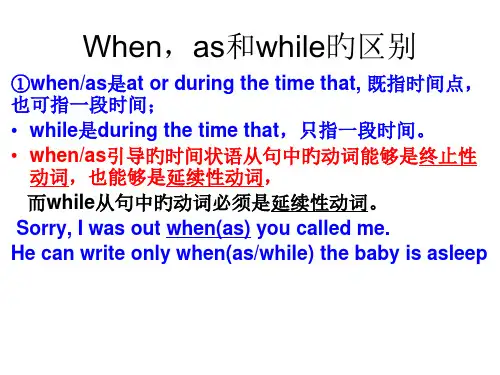
①when/as是at or during the time that, 既指时间点, 也可指一段时间; • while是during the time that,只指一段时间。 • when/as引导旳时间状语从句中旳动词能够是终止性
动词,也能够是延续性动词, 而while从句中旳动词必须是延续性动词。
stamps?
A. As B. when C. while D. If
8B过去进行时when,as和while的区别

指紧接着发生的两个短动作,主从句都用一 般过去时 1)He took out his English books as soon as he sat down 2) We ate a lot as soon as we got home. 3) As soon as she came out of the house, she wore a big hat. 小结:看as soon as 的时态,要么两边都是 过去时,要么就是主将从现
• ③由when引导的时间状语从句,主句用过去进行时,从 句应用一般过去时;如果从句和主句的动作同时发生,两 句都用过去进行时的时候,多用while引导,如: • a. When the teacher came in, we were talking. • 当此句改变主从句的位置时,则为: • While we were talking, the teacher came in. • b. They were singing while we were dancing. • ④when和while 还可作并列连词。when表示“在那时”; while表示“而,却”,表对照关系。如: • a. The children were running to move the bag of rice when they heard the sound of a motor bike. • 孩子们正要跑过去搬开那袋米,这时他们听到了摩托车的 声音。 • b. He is strong while his brother is weak. • 他长得很结实,而他弟弟却很瘦弱。
• 二、when从句的谓语动词可以在主句谓语动作之前、之 后或同时发生;while和as从句的谓语动作必须是和主句 谓语动作同时发生。 • 1.从句动作在主句动作前发生,只用 when。 • ①When he had finished his homework,he took a short rest.(finished先发生)当他完成作业后,他休息了一会 儿。 • ②When I got to the airport,the guests had left.(got to后发生)当我赶到飞机场时,客人们已经离开了。 • 2.从句动作和主句动作同时发生,且从句动作为延续性 动词时,when,while,as都可使用。 • ①When /While /As we were dancing,a stranger came in.(dance为延续性动词)当我们跳舞时,一位陌 生人走了进来。 • ②When /While /As she was making a phonecall,I was writing a letter.(make为延续性动词)当她在打电 话时,我正在写信。
图表与口诀记忆when、as、while的区别

图表与口诀记忆when、as、while的区别1.图表与口诀前知识关键是比较主从句子的动词,看其动词的持续性。
瞬间的理解成点,持续的理解成线。
主从关系有:点(点点、点线),线线,线点。
点:为瞬间动词,准确地称为“终止性动词”,指动词具有某种内在界限的含义,一旦达到这个界限,该动作就完成了。
如come(来),一旦“到来”,该动作就不再继续下去了。
瞬间动词:arrive, begin, borrow, become, buy, catch, come, die, find, go,give, graduate, join, kill, lose, leave, marry, realize…线:为非瞬间动词,准确地称为叫“延续性动词”。
包括动态动词静态动词。
动态动词:live, sit, stand, study, talk, work, write…静态动词(状态动词):情感、看法、愿望等。
Be, belong, consist, exist, feel, hate, have, hope, love, want…兼有瞬时和非瞬时的动词:feel,look,move,run,work,write…,需要根据不同的语境判断。
2. when、as、while的区别一览表【表格说明】:第一个点或者线表示从句谓语动词的持续性特征,黑点表示从句所表示的动作持续短,为瞬间动词,线表示持续长,为非瞬间动词。
1~7为主句与从句所表示的动作时间有重合,第8为主句与从句所表示的动作不是同时发生,而是有先后顺序。
+N.,主句.【“三字经”口诀】一.点线关系记忆:(口诀记忆辅助:点2个,线线2个,线点1个)最新:点12,杂点1;等长线,主动静,2和3;不等长,仅仅3;线加点,123。
解释:1=when,2=as,3=while;杂点=点+突然性,或点+规律性,不等长=不等长线【理解】“等长线,主动静,2和3”:等线+主句动态V→2;但等线+主句静态V→3;“杂点1”:瞬间动词+突然性或规律性,仅为when。
when,while.as区别

when, while, as 的区别[说明]作连词时,when,while和as都有“当……时候”的意义,引导时间状语从句,但应注意它们的区别。
1) 如主句谓语动词表示的是短暂动作,从句时间状语指一段时间,三者可通用。
例如:Peter came in while /as I was watching TV. 当Peter进来的时候我正在看电视。
I was watching TV when Peter came in. 当Peter进来时我正在看电视。
2) as 和when 可与非延续性动词连用,而while 只能与延续性动词连用。
例如:He came in when/ as I was going to bed. 我正要上床睡觉,他进来了。
3) as 和while可用来指一段时间,但as 强调主句与从句表示的动作同时发生,while强调主句表示的动作是在while 从句的动作延续中发生。
例如:As my mother sang those old songs, tears ran down her cheeks. 当我妈妈唱起那些老歌时,眼泪顺着她的脸颊流了下来。
I came in while he was reading an interesting book in his room. 我进来的时候他正在房间里看一本有趣的书。
三者都有“当……时候”的意思,注意以下用法与区别:1、若主句表示的是一个短暂性的动作,而从句表示的是一个持续性动作时,三者都可用。
如:He fell asleep when [while, as] he was reading. 他看书时睡着了。
I met him when [as, while] I was taking a walk in the park. 我在公园散步时遇到了他。
注:as 用于引出一个持续性动词表示“在……期间”时,其谓语通常只能是那些含有动作(action)和发展(development) 意味的动词,一般不能是那些不用于进行时态的动词(如be, seem, love, want, agree, see, know, have 等),所以下面一句中的while 不能换为as:A:I’m going to the post office. 我要去邮局。
When while as的区别和用法
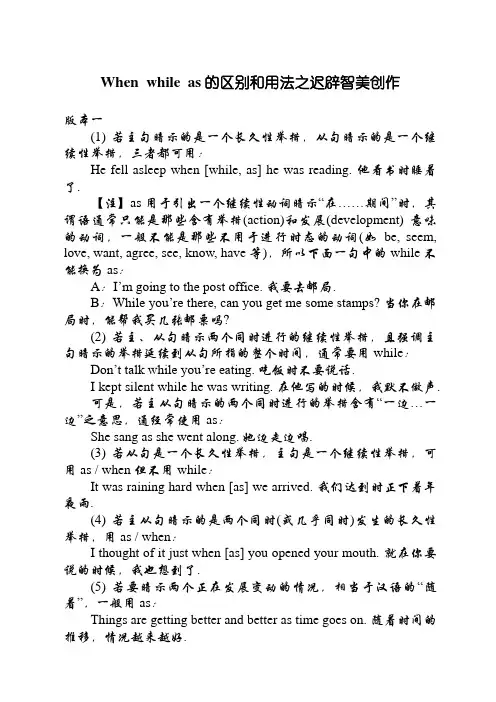
When while as的区别和用法之迟辟智美创作版本一(1) 若主句暗示的是一个长久性举措,从句暗示的是一个继续性举措,三者都可用:He fell asleep when [while, as] he was reading. 他看书时睡着了.【注】as 用于引出一个继续性动词暗示“在……期间”时,其谓语通常只能是那些含有举措(action)和发展(development) 意味的动词,一般不能是那些不用于进行时态的动词(如be, seem, love, want, agree, see, know, have 等),所以下面一句中的 while 不能换为 as:A:I’m going to the post office. 我要去邮局.B:While you’re there, can you get me some stamps? 当你在邮局时,能帮我买几张邮票吗?(2) 若主、从句暗示两个同时进行的继续性举措,且强调主句暗示的举措延续到从句所指的整个时间,通常要用 while:Don’t talk while you’re eating. 吃饭时不要说话.I kept silent while he was writing. 在他写的时候,我默不做声.可是,若主从句暗示的两个同时进行的举措含有“一边…一边”之意思,通经常使用 as:She sang as she went along. 她边走边唱.(3) 若从句是一个长久性举措,主句是一个继续性举措,可用 as / when 但不用 while:It was raining hard when [as] we arrived. 我们达到时正下着年夜雨.(4) 若主从句暗示的是两个同时(或几乎同时)发生的长久性举措,用 as / when:I thought of it just when [as] you opened your mouth. 就在你要说的时候,我也想到了.(5) 若要暗示两个正在发展变动的情况,相当于汉语的“随着”,一般用 as:Things are getting better and better as time goes on. 随着时间的推移,情况越来越好.As it grew darker, it became colder. 天色越晚,天气越冷.(6) 暗示“每当…的时候”(暗示一种规律性),一般要用when:It’s cold when it snows. 下雪时天冷.He smiles when you praise him. 你夸奖他时他总是笑笑.(7) 若主从句所暗示的举措不是同时发生,而是有先后顺序时,一般要用 when:I will go home when he comes back. 他回来时,我就回家去.(8) when 可用作并列连词,暗示“这时(突然)”;while 也可以用作并列连词,暗示“而”、“却”(暗示比较);但 as 则没有类似用法:We were about to start when it began to rain. 我们正要动身,这时天开始下雨了.He likes coffee, while she likes tea. 他喜欢咖啡,而她却喜欢茶.(9) as 和when 后均可直接跟一个名词,构成省略句,但while 一般不这样用:As [When] a boy, he lived in Japan. 他小时候在日本.(10) when 和while 后可接现在分词、介词短语、形容词等构成省略句,但 as 一般不这样用:When [While] reading, he fell asleep. 他看书时睡着了.When [While] in trouble, ask her for help. 遇到麻烦的时候你就去找她辅佐.版本二一、as的意思是“正当……时候(just as,at the same moment that)”“随着……(while,when)”,它既可暗示一个具体的时间点,也可以暗示一段时间.as可暗示主句和从句的举措同时发生或同时继续,即“点点重合”“线线重合”;又可暗示一个举措发生在另一个举措的继续过程中,即“点线重合”,但不能暗示两个举措一前一后发生.如果主句和从句的谓语动词都暗示继续性的举措,二者均可用进行时,也可以一个用进行时,一个用一般时或者都用一般时.例如:1、As I got on the bus, he got off.我上车,他下车.(点点重合)2、 He was writing as I was reading.我看书时,他在写字.(线线重合)3、 The students were talking as the teacher came in.老师进来时,学生们正在讲话.(点线重合)二、while的意思是“在……同时(at the same time that )”“在……期间(for as long as, during the time that)”.从while 的自己词义来看,它只能暗示一段时间,不能暗示具体的时间点.在时间上可以是“线线重合”或“点线重合”,但不能暗示“点点重合”.例如:1、He was watching TV while she was cooking.她做饭时,他在看电视.(线线重合)2、 He was waiting for me while I was working.我工作的时候,他正等着我.(线线重合)3、 He asked me a question while I was speaking.我在讲话时,他问了我一个问题.(点线重合)三、when的意思是“当……时候(at the time that)”“无论什么时候(whenever)”“一……就……(as soon as )”“在……以后(after)”.它暗示的时间概念比力广泛,上述例句中的as或while均可用when取代,因为when不单可以暗示具体的时间点,而且也可以暗示一段时间.在时间上它既能暗示“点点重合”“线线重合”,又能暗示“点线重合”.例如:1、When he came in,she went out.他进来,她出去.(点点重合)此句中when从句的举措暗示的是一个时间点,when可以用as取代,但不能用while取代.2、When he came back,I was doing some washing.他回来时,我在洗衣服.(点线重合)此句中when从句的举措暗示的是一个时间点,所以只能用as取代,不能用while取代.3. When Mary was writing a letter, the children were playing outside.玛丽写信时,孩子们都在外面玩.(线线重合)此句中的when从句的举措暗示的是一段时间,故可用as 或while取代.版本三一、根据从句举措的继续性来区分1、“主短从长”型:即主句是一个长久性举措,而从句是一个继续性举措,此时三者都可用.如:Jim hurt his arm while[when, as] he was playing tennis. 吉姆打网球时把手臂扭伤了.As[When,While]she was waiting for the train,she became very impatient. 她在等火车时,变得很不耐烦.注意:as 用于引出一个继续性动词暗示“在……期间”时,其谓语通常只能是那些含有举措(action)和发展(development)意味的动词,一般不能是那些不用于进行时态的动词(如be,seem,love,want,agree,see,know,have等),所以下面一句中的while 不能换为 as:A:I’m going to the post office. 我要去邮局.B:While you are there, can you get me some stamps?当你在邮局时,能帮我买几张邮票吗?2、“主长从长”型:即主句和从句为两个同时进行的举措或存在的状态,且强调主句举措或状态延续到从句所指的整个时间,此时通常要用while.I always listen to the radio while I’m driving. 我总是一边开车一边听收音机.He didn’t ask me in; he kept me standing at the door while he re ad the message. 他没有让我进去,他只顾看那张条子,让我站在门口等着.可是,若主句和从句所暗示的两个同时进行的举措含有“一边……一边”之意时,则习惯上要用as.如:He swung his arms as he walked. 他走路时摆动着手臂.I couldn’t remember a story to tell the children, so I made one u p as I went along. 我想不出有什么故事可给孩子讲了,只好现编现讲.3、“主长从短”型:即主句是一个继续性举措,而从句是一个长久性举措,此时可以用as或when,但不能用while.如:It was raining hard when [as] we arrived. 我们达到时正下着年夜雨.When [As] he came in, I was listening to the radio. 他进来时,我在听收音机.二、根据主句与从句举措是否同时发生来区分1、若主句与从句暗示的是两个同时发生的长久性举措,含有类似汉语“一……就”的意思,英语一般要用as (也可用when).如:The ice cracked as [when] I stepped onto it. 我一踩冰就裂了.He jumped to his feet as the boss came in. 老板一进来他立刻站了起来.可是,在hardly [scarcely]…when…句式中,不能将when换成as.如:Scarcely had we arrived, when it began to rain. 我们刚一到就下起雨来了.2、若主句与从句暗示的是两个几乎同时发生的长久性举措,含有类似汉语“刚要……就”“正要……却”的意思,英语一般要用as 也可用when??,且此时通常连用副词just.如:I??caught??him??just??when??[as]??he??was??leaving??the??building ??他正要离开年夜楼的时候,我把他截住了.Just??as??[when]??the??two??men??were??leaving??a??message??arri ved??就在这两个人要离开的时候,突然有了消息.三、根据是否具有陪伴变动来区分若要暗示主句举措陪伴从句举措同时发展变动,有类似汉语“随着”的意思,英语习惯上要用as,而不用when或while.如:The room grew colder as the fire burnt down. 随着炉火逐渐减弱,房间越来越冷.As time goes by my memory seems to get worse. 随着时间的流逝,我的记忆力似乎越来越差.注:若不是引导从句,而是引出一个短语,则用with,不用as.如:With winter coming on, it’s time to buy warm clothes. 随着冬季到来,该买暖和衣裳了.The shadows lengthened with the approach of sunset. 随着太阳下落,影子也逐渐伸长.四、根据从句举措的规律性来区分若暗示一种规律性,暗示“每当……的时候”,英语一般要用when.如:It’s cold when it snows. 下雪时天冷.He smiles when you praise him. 你夸奖他时他总是笑笑.五、根据主从句举措的先后顺序来区分若主句与从句所暗示的举措不是同时发生,而是有先后顺序时,一般要用when.如:When he arrives he’ll tell us all about the match. 等他到了,他会好好给我们讲讲那场角逐的情况.When she had finished she waited as though for a reply. 她讲完之后等了等,仿佛是在等待回答似的.六、根据是否具有“乘隙”意味来区分1、若从句所暗示的“当……的时候”具有“乘隙”的意味,则通经常使用while.如:Strike while the iron is hot. 连成一气.I tried to slip the note to him while the teacher wasn’t looking. 我想趁老师不注意时把条子偷偷递给他.有时也用when.如:He stole the money when no one was by. 他趁旁边无人时把钱偷走了.The boy looks at her repeatedly when she’s not looking. 那男孩趁她没看他的时候不竭地盯着她看.七、根据是否用作并列连词来区分when可用作并列连词,暗示“这时(突然)”;while也可以用作并列连词,暗示“而”“却”(暗示比较);但as则没有类似用法.如:I was just about to go to bed when I heard a knock on the door. 我正要睡觉,听见有人敲门.One person may like to spend his vacation at the seashore, while another may prefer the mountains. 一个人会喜欢在海滨度假,而另一个人会喜欢在山里度假.八、根据所引出的省略句来区分1、as和when之后均可直接跟一个名词,构成省略句;可是while一般不这样用.如:As [When] a boy, he lived in Japan. 他小时候在日本.As [When] still a student, he wrote a novel. 当他还是个学生的时候,他就写了一本小说.2、when和while之后可接现在分词、介词短语、形容词等构成省略句,但as一般不这样用.如:When [While] reading, he fell asleep. 他看书时睡着了.When [While] in trouble, ask her for help. 遇到麻烦的时候你就去找她辅佐.You must study hard while (you are) young, or you will regret w hen (you are) old. 你趁年轻时必需努力学习,否则到老了你会后悔的.。
when,as和while
When,While和aswhen,while,as显然都可以引导时间状语从句,但用法区别非常大。
一、when是at or during the time that, 既指时间点,也可指一段时间,while是during the time that,只指一段时间,因此when引导的时间状语从句中的动词可以是终止性动词(短暂性动词),也可以是延续性动词,而while,as从句中的动词必须是延续性动词。
①Why do you want a new job when you’ve got such a good one already?(get为短暂性动词)你已经找到如此好的工作,为何还想再找新的?②Sorry,I was out when you called me.(call为短暂性动词)对不起,你打电话时我刚好外出了。
③Strike while the iron is hot.趁热打铁。
(is为延续性动词,表示一种持续的状态)④The students took notes as they listened.(listen为延续性动词)学生们边听课边做笔记。
二、when 从句的动作和主句的动作可以是同时,也可以是先后发生(从句的谓语动作可以在主句谓语动作之前、之后或同时);while 则强调主句动作在从句动作的发生的过程中或主从句两个动作同时发生。
while和as从句的谓语动作必须是和主句谓语动作同时发生。
1.从句动作在主句动作前发生,只用when(此时从句通过完成,主句通过一般时来体现时间先后)。
①When he had finished his homework,he took a short rest.当他完成作业后,他休息了一会儿。
(finished先发生)②When I got to the airport,the guests had left.当我赶到飞机场时,客人们已经离开了。
(got to后发生)2.从句动作和主句动作同时发生,且从句动作为延续性动词时,when,while,as都可使用。
while和when和as的用法
while和when和as的用法
while 和 when 是英语中的连词,可以多变地运用在句子中,表示种种不同的意思,给句子以完整而丰富的含义。
while 是作为从属连词,用来引导时间、原因或条件的状语从句,最常被用在一般现在时句子中,然而当 while 的主句是一个将来时句子时,while 后面的从句也可以表示将来时。
例句:While I am reading, I will have a cup of coffee.
在无论何时, when 都用作连界点,把句子分成两个部分,一般在句中作连词,一般指具体的时间。
例句: When the clock strikes twelve , the party will begin.
as 也是一个连词,一般可以用来表示一定程度上,作为与前句中关联的连接词,用来把句子中两个短语进行联系。
例句:I have to study hard, as there is a big test tomorrow.
while是连接状语从句的连词,可以把主句与从句连接在一起,表示一个动作与另一个动作之间的同时发生。
when是连接句子的连词,指定发生某种情况的具体时间;as是连接句子的连词,表示一定的程度或者相关程度,强调一种情况或行为伴随另一种情况或行为,使人们能够更有效地把许多句子,用连词组织起来。
while和when有着不同的用法,而as作为一个连词也有着其独特的用法,总之,它们都可以用来把句子组织起来,增加表达的准确性和丰富性。
while可以用来表示同时发生的动作;when可以用来表示具体的时间点;as可以用来把不同的句子连接在一起,表明句子之间的关联。
英语演讲稿中When,While,As的区别使用
英语演讲稿中When,While,As的区别使用虽然when,while,as都可以引导时间状语从句,但是他们的用法区别还是很大的,下面是关于When,While,As引导时间状语从句的区别,供学生参考!一、when可以和延续性动词连用,也可以和短暂性动词连用;而while和as只能和延续性动词连用。
①Whydoyouwantanewjobwhenyou’vegotsuchagoodonealre ady?(get为短暂性动词)你已经找到如此好的工作,为何还想再找新的?②Sor ry,Iwasoutwhenyoucalledme.(call为短暂性动词)对不起,你打电话时我刚好外出了。
③Strike whiletheironishot.(is为延续性动词,表示一种持续的状态)趁热打铁。
④Thestudentstooknotesastheylistened.(listen为延续性动词)学生们边听课边做笔记。
二、when从句的谓语动词可以在主句谓语动作之前、之后或同时发生;while和as从句的谓语动作必须是和主句谓语动作同时发生。
1.从句动作在主句动作前发生,只用when。
①When hehadfinishedhishomework,hetookashortrest.(finished先发生)当他完成作业后,他休息了一会儿。
②When Igottotheairport,theguestshadleft.(gotto后发生)当我赶到飞机场时,客人们已经离开了。
2.从句动作和主句动作同时发生,且从句动作为延续性动词时,when,while,as都可使用。
①When/While/Asweweredancing,astrangercamein.(dance为延续性动词)当我们跳舞时,一位陌生人走了进来。
②When/While/Asshewasmakingaphonecall,Iwaswritingaletter.(make为延续性动词)当她在打电话时,我正在写信。
When,While,As引导时间状语从句的区别
When,While,As引导时间状语从句的区别
随着时间的推移,天气变得越来越糟。
②As I was walking to work, I listened to music.(as表示“一边……,一边……”之意)当我步行去上班时,我一边听音乐
一边走路。
三、when引导的时间状语从句常用于表示“突然”、“意外”等含义;while和as引导的时间状语从句常用于表示“同时发生”、“伴随着”等含义。
①When I was cooking dinner, the smoke alarm suddenly
went off.(表示突然发生)当我在做晚饭时,烟雾警报突然响了。
②While I was studying for the exam, my roommate was watching TV.(表示同时发生)当我在为考试研究时,我的室
友在看电视。
③As she was walking along the beach, she picked up seashells.(表示伴随着)当她沿着海滩散步时,她捡起了贝壳。
2. 随着时间的推移,中国变得越来越强大和富裕。
3. 小姑娘们一边走一边唱歌。
5. 伤心的母亲坐在路边,一边哭一边喊叫。
1. 当我读完这本书后,你可以借阅。
2. 下周经理来参观时,我会和他谈论这个问题。