
2014年高考英语试题(北京卷)word+答案
2014 年普通高等学校招生全国统一考试英语(北京卷)第一部分:听力理解(共三节:30 分)第一节(共 5 小题;每小题 1.5 分,共7.5 分)听下面 5 段对话,每段对话有一道小题,从每题所给的A、B、C 三个选项中选出最佳选项,听完每段对话后,你将有10 秒钟的时间来回答有关小题和阅读下一小题。
每段对话你将听一遍。
01.What juice does the man order?A.Lemon.B. AppleC. Orange02.What subject does the man like best?A.History.B. Biology.C. Chemistry.03.Where is the woman from?A.Britian.B. Russia.C. America.04.What kind of student bus pass does the woman want?A.Weekly.B. Monthly.C. Yearly.05.What are the two speakers going to buy for Mary’s birthday?A. A bicycle.B. A pen.C. A book.第二节(共10 小题;每小题 1.5 分,共15 分)听下面 4 段对话或独白。
每段对话或独白后有几道小题,从每题所给的A、B、C 三个选项中选出最佳选项。
听每段对话或独白前,你将有 5 秒钟的时间阅读每小题。
听完后,每小题将给出 5 秒钟的作答时间。
每段对话或独白你将听两遍。
听第 6 段材料,回答第6 至7 题。
06.What is wrong with the woman?A.She has a cough.B. She has a headache.C. She has a fever.07.How long is the medicine for?A.One day.B. Two days.C. Three days.听第7 段材料,回答第8 至9 题。
08.What does the woman need?A.Some ink.B. A printer.C. Some paper.09.What problem does the man have?A.He can’t send a text message.B.He can’t hear the womman clearly.C.He can’t be back to the office soon.听第8 段材料,回答第10 至12 题。
10.What does the woman plan to do at first?A.To stay at home.B. To eat out.C. To see a film.11.When will the two speakers meet?A.At 11:00 am.B. At 2:00 pm.C. At 4:00 pm.12.What is the man trying to do?A.To introduce a new pizza to the woman.B.To remind the woman to relax herself.C.To invite the woman to see a movie.听第9 段材料,回答第13 至15 题。
13.When did the family visit the Design Museum?A.On Friday.B. On Saturday.C. On Sunday.14.How did the family go to Hyde Park?A.On foot.B. By taxi.C. By train.15.What is the speaker mainly talking about?A.Amazing attractions in London.B. A four-day trip to London.C. A dream about London.第三节(共 5 小题;每小题 1.5 分,共7.5 分)听下面一段对话,完成第16 至20 五道小题,每小题仅填写一个词,听对话前,你将有20 秒钟的时间阅读试题,听完后你将有60 秒钟的作答时间。
这段对话你将听两遍。
第二部分:知识运用(共两节,45 分)第一节单项填空(共15 小题;每小题 1 分,共15 分)从每题所给的ABCD 四个选项中,选出可以填入空白处的最佳选项,并在答题卡上将该项涂黑。
21. Some animals carry seeds from one place to another, ________ plants can spread to new places.A. soB. orC. forD. but22. ---Hi, let’s go skating.--- Sorry, I am busy right now. I ________in an application form for a new job.A.FillB. have filledC. am fillingD. will fill23. Jane is in a hurry because the train to the airport leaves ______half an hour.A. byB. inC. forD. until24. ________carefully if any change occurs when doing experiments in the lab.A. ObserveB. To observeC. ObservedD. Observing25. Last night, there were millions of people ________the opening ceremony live on TV.A. watchB. to watchC. watchedD. watching26. I borrowed the book Sherlock Holmes from the library last week, _______my classmates recommended to me.A. whoB. whichC. whenD. where27. _________I have a word with you? It won’t take long.A. CanB. MustC. ShallD. Should28. There are still many problems _______before we are ready for a long stay on the Moon.A. solvingB. solvedC. being solvedD. to be solved29. __________the forest park is far away, a lot of tourists visit it every year.A. AsB. WhenC. Even thoughD. In case30. The best moment for the football star was ______ he scored the winning goal.A. whereB. whenC. howD. why31. ---What time is it?--- I have no idea. But just a minute, I _______it for you.A.CheckB. checkedC. will checkD. would check32. I found the lecture hard to follow because it _______ when I arrived.A. startedB. was startingC. would startD. had started33. Some people believe ______ has happened before or is happening now will repeat itself in the future.A. whateverB. wheneverC. whereverD. however34. We _______back in the hotel now if you didn’t lose the map.A. areB. wereC. will beD. would be35. The film star wears sunglasses. Therefore, he can go shopping without _________.A. recognizingB. being recognizedC. having recognizedD. having been recognized第二节完形填空(共20 小题;每小题 1.5 分,共30 分)阅读下面短文,掌握其大意,从每题所给的A、B、C、D 四个选项中,选出最佳选项,并在答题卡上讲该项涂黑。
The Fitting-in of Suzy KhanThe first time I saw Suzy Khan, I knew I had to help her. She was really small for her age of 12. The boys in my class often ____36___ about her and laughed their heads off. She would open a book, pretending to read, with tears dropping on the open page.All I knew was that she was an orphan (孤儿) from Africa. She had just been adopted by a family in town who ___37___ that best way for her to learn American ways of life was to be with American kids. I looked down at this ___38___ girl and promised myself that somehow I would help her.But how could I help her __39__ in with us? There had to be a ___40___.One day, when I went into the classroom, I saw that Suzy had ___41__ her geography book to a picture of a train, and in her notebook, she had made a(n) ___42___ copy.I was surprised and thought that she could do something in the coming ____43___ show. So, I took her to see the art teacher, Miss Parker, and showed her what Suzy had ___44__. “Why, it’s wonderful,” said Miss Parker, who then showed us a poster she had painted ___45___ the talent show. “I need more of these, but I just don’t have enough ___46___. Could you help me, Suzy?On the day of the talent show, Suzy’s ___47___were everywhere --- all over the hall and all over the school, each one different.“And finally,” said Mr. Brown, the schoolmaster, at the end of the show, “we have a(n) ___48___award, I’m sure you’ve all noticed the wonderful posters.” Everyone nodded. “One of our own students __49__ them.”I could hear everyone whispering. “Who in our school could draw __50___ well?”Mr. Brown waited a while before saying, “__51___ this student worked so hard on the posters, she deserves a ___52___, too. Our mystery(神秘) artist is our new student---Suzy Khan!”Mr. Brown thanked her for all the wonderful posters and gave her a professional artist’s set. “Thank you,”she cried.I ___53___, at that time when I was looking at her excited face, she’d probably never ___54___ anything in her whole life.Everyone started to ___55___their hands. Suzy khan gave them a shy smile and the applause was deafening,I knew then Suzy was going to be all right.36. A. joked B. cared C. forgot D. worried37. A. reported B. decided C. complained D. questioned38. A. rich B. proud C. tiny D. popular39. A. come B. fall C. fit D. tie40. A. manner B. pattern C. choice D. way41. A. read B. taken C. opened D. put42. A. free B. perfect C. final D. extra43. A. art B. talk C. quiz D. talent44. A. colored B. written C. carved D. drawn45. A. at B. after C. for D. around46. A. room B. time C. paper D. interest47. A. gifts B. books C. photos D. posters48. A. special B. academic C. national D. royal49. A. painted B. found C. printed D. collected50. A. very B. that C. quite D. too51. A. If B. Though C. Unless D. Since52. A. prize B. rank C. rest D. place53. A. replied B. realized C. remembered D. regretted54. A. offered B. valued C. owned D. controlled55. A. clap B. wave C. raise D. shake第三部分:阅读理解(共两节,20 分)第一节(共15 小题;每小题 2 分,共30 分)阅读下列短文:从每题所给的A、B、C、D 四个选项中,选出最佳选项,将正确的选项涂在答题卡上。
(完整word版)2014年北京高考英语试题及答案详解,推荐文档

2014年普通高等学校招生全国统一考试及答案英语(北京卷)第二部分:知识运用(共两节,45分)第一节单项填空(共15小题;每小题1分,共15分)从每题所给的A、B、C、D四个选项中,选出可以填入空白处的最佳选项,并在答题卡上将该项涂黑。
例:It’s so nice to hear from her again. , we last met more than thirty years ago.A. What’s moreB. That’s to sayC. In other wordsD. Believe it or not答案是D。
21. Some animals carry seeds from one place to another, ______ plants can spread to new places.A. soB. orC. forD. but22. —Hi, let’s go skating. —Sorry, I’m busy right now. I _______ in an application form for a new job.A. fillB. have filledC. am fillingD. will fill23. Jane is in a hurry because the train to the airport leaves _______ half an hour.A. byB. inC. forD. until24. __ carefully if any change occurs when doing experiments in the lab..A. ObserveB. To observeC. ObservedD. Observing25. Last night, there were millions of people _______ the opening ceremony live on TV.A.watchB. to watchC. watchedD. watching26. I borrow the book Sherlock Holmes from the library last week, ______ my classmates recommended to me..A.whoB. whichC. whenD. Where27.________ I have a word with you? It won’t take long.A. CanB. MustC. ShallD. Should28. There are still many problems ______ before we are ready for a long stay on the Moon.A. solvingB. solvedC. being solvedD.to be solved29._______ the forest park is far away, a lot of tourists visit it every year.A. AsB. WhenC. Even thoughD. In case30. The best moment for the football star was _______ he scored the winning goal.A. whereB. whenC. howD. why31.—What time is it? —I have no idea. But just a minute, I ______ it for you.A. checkB. checkedC. will checkD. would check32. I found the lecture hard to follow because it _______ when I arrived.A. startedB. was startingC. would startD. had started33.Some people believe _______ has happened before or is happening now will repeat itself in the future.A. whateverB. whenever.C. whereeverD. however34. We __________ back in the hotel now if you didn’t lose the map.A. areB. wereC. will beD. would be35.The film star wears sunglasses. Therefore, he can go shopping without ______..A. recognizingB. being recognizedC. having recognizedD. having been recognized第二节完形填空(共20小题;每小题1.5分,共30分)阅读下面短文,掌握其大意,从每题所给的A、B、C、D四个选项中,选出最佳选项,并在答题卡上将该项涂黑。
2014年高考英语试卷(北京卷)

2014 年普通高等学校招生全国统一考试英语(北京卷)第二部分:知识运用(共两节,45 分)第一节单项填空(共15 小题;每小题1 分,共15 分)21. Some animals carry seeds from one place to another, ______ plants can spread to new places.A. soB. orC. forD. but22. ---Hi, let’s go skating.--- Sorry, I’m busy right now. I _______ in an application form for a new job.A. fillB. have filledC. am fillingD. will fill23. Jane is in a hurry because the train to the airport leaves _______ half an hour.A. byB. inC. forD. until24. _______carefully if any change occurs when doing experiments in the lab..A. ObserveB. To observeC. ObservedD. Observing25. Last night, there were millions of people _______ the opening ceremony live on TV.A. watchB. to watchC. watchedD. watching26. I borrow the book Sherlock Holmes from the library last week, ______ my classmates recommended to me..A. whoB. whichC. whenD. where27.________ I have a word with you? It won’t take long.A. CanB. MustC. ShallD. Should28. There are still many problems ______ before we are ready for a long stay on the Moon.A. solvingB. solvedC. being solvedD.to be solved29._______ the forest park is far away, a lot of tourists visit it every year.A. AsB. WhenC. Even thoughD. In case30. The best moment for the football star was _______ he scored the winning goal.A. whereB. whenC. howD. why31.--- What time is it?--- I have no idea. But just a minute, I ______ it for you.A. checkB. checkedC. will checkD. would check32. I found the lecture hard to follow because it _______ when I arrived.A. startedB. was startingC. would startD. had started33.Some people believe _______ has happened before or is happening now will repeat itself in the future.A. whateverB. whenever.C. whereverD. however34. We __________ back in the hotel now if you didn’t lose the map.A. areB. wereC. will beD. would be35.The film star wears sunglasses. Therefore, he can go shopping without ______..A. recognizingB. being recognizedC. having recognizedD. having been recognized第二节完形填空(共20 小题;每小题1.5 分,共30 分)The Fitting-in of Suzy KhanThe first time I saw Suzy Khan, I knew I had to help her. She was really small for her age of 12. The boys in my class often 36 about her and laughed their heads off. She would open a book, pretending to read, with tears dropping on the open page.All I knew was that she was an orphan (孤儿) from Africa. She had just been adopted by a family in town who 37 that the best way for her to learn American ways of life was to be with American kids. I looked down at this 38 girl and promised myself that somehow I would help her.But how could I help her 39 in with us? There had to be a 40 .One day, when I went into the classroom, I saw that Suzy had 41 her geography book to a picture of a train, and in her notebook, she had made a(n) 42 copy.I was surprised and thought that she could do something in the coming 43 show. So, I took her to see the art teacher, Miss Parker, and showed her what Suzy had 44 . “Why, it’s wonderful,” said Miss Parker, who then showed us a poster she had painted 45 the talent show. “I need more of these, but I just don’t have enough 46 . Could you help me, Suzy?”On the day of the talent show, Suzy’s 47 were everywhere ---- all over the hall and all over the school, each one different.“And finally,” said Mr. Brown, the schoolmaster, at the end of the show, “we have a (n) award. I’m sure you’ve all noticed the wonderful posters.” Everyone nodded. “One of our own students 49 them.”I could hear everyone whispering. “Who in our school could draw 50 well?”Mr. Brown waited a while before saying, “51 this student worked so hard on the posters, she deserves a 52 , too. Our mystery(神秘) artist is our new student ---- Suzy Khan!”Mr. Brown thanked her for all the wonderful posters and gave her a professional artist’s set. “Thank you,” she cried.I 53 , at that time when I was looking at her excited face, she’d probably never 54 anything in her whole life.Everyone started to 55 their hands. Suzy Khan gave them a shy smile and the applause was deafening. I knew then Suzy was going to be all right.36. A. joked B. cared C. forgot D. worried37. A. reported B. decided C. complained D. questioned38. A. rich B. proud C. tiny D. popular39. A. come B fall C. fit D. tie40. A. manner B. pattern C. choice D. way41. A. read B. taken C. opened D. put42. A. free B. perfect C. final D. extra43. A. art B. talk C. quiz D. talent44. A. colored B. written C. carved D. drawn45. A. at B. after C. for D. around46. A. room B. time C. paper D. interest47. A. gifts B. books C. photos D. posters48. A. special B. academic C. national D. royal49. A. painted B. found C. printed D. collected50. A. very B. that C. quite D. too51. A. If B. Though C. Unless D. Since52. A. prize B. rank C. rest D. place53. A. replied B. realized C. remembered D. regretted54. A. offered B. valued C. owned D. controlled55. A. clap B. wave C. raise D. shake第三部分:阅读理解(共两节,20 分)第一节(共15 小题;每小题2 分,共30 分)ASea Life Melbourne Aquarium (水族馆)The all-new Sea Life Melbourne Aquarium, situated in the heart of Melbourne’s CBD, is one of Victoria’s leading visitor attractions and an unforgettable outing for the whole family. Having 12 amazing zones of discovery, Sea Life Melbourne Aquarium is the very place that you cannot miss when you visit the city.* Opening TimesSea Life Melbourne Aquarium is open from 9:30 am until 6:00 pm every day of the year, including public holidays. Last admission is at 5:00 pm, one hour before closing.* Location ( 位置)Sea Life Melbourne Aquarium is located on the corner of Flinders Street and King Street, Melbourne. It is situated on the Yarra River, opposite Crown Entertainment Complex.* Getting to Sea Life Melbourne AquariumTrainSea Life Melbourne Aquarium is a short walk from either Flinders Street or Southern Cross train stations.TramThe Sea Life Melbourne Aquarium tram stop is located on the free City Circle Tram route (公交线路) and also routes 70 and 75. City Circle trams run every 10 minutes in both directions.Shuttle BusThe Melbourne City Tourist Shuttle is a free bus service, stopping at key tourist attractions in and around the City. Running daily, every 15 minutes from 10:00 am to 4:00 pm.Car ParkingWhile there is no public car parking at Sea Life Melbourne Aquarium, there are several public car parking lots available only a short walk away.* Wheelchair AccessSea Life Melbourne Aquarium provides people in wheelchairs with full access to all 12 zones. Each floor also has wheelchair accessible toilets.* TermsTickets will be emailed to you immediately after purchase or you can download and print your ticket once payment has been accepted. Please print out all tickets purchased and present at the front entrance of Sea Life Melbourne Aquarium. No ticket, no entry!56. Sea Life Melbourne Aquarium _________ .A. is located at the center of the CBD in the cityB. has 12 most attractive places in MelbourneC. admits visitors from 9:30 am until 6:00 pmD. is beside Crown Entertainment Complex57. Getting to Sea Life Melbourne Aquarium, visitors can take ________.A. trains from Southern Cross train stationB. shuttle buses around the train stationC. boats across the Yarra RiverD. either tram route 70 or 7558. Sea Life Melbourne Aquarium offers visitors ________.A. free car parkingB. wheelchair accessC. Internet connectionD. transportation service59. Tickets to Sea Life Melbourne Aquarium ________ .A. are free to all visitorsB. can be purchased by emailC. are checked at the entranceD. can be printed at the ticket officeBThe Brown BearMy wife Laura and I were on the beach, with three of our children, taking pictures of shore birds near our home in Alaska when we spotted a bear. The bear was thin and small, moving aimlessly.Just a few minutes later, I heard my daughter shouting, “Dad! The bear is right behind us!” An aggressive bear will usually rush forward to frighten away its enemy but would suddenly stop at the last minute. This one was silent and its ears pinned back---- the sign (迹象) of an animal that is going in for the kill. And it was a cold April day. The bear behaved abnormally, probably because of hunger.I held my camera tripod (三脚架) in both hands to form a barrier as the bear rushed into me. Its huge head was level with my chest and shoulders, and the tripod stuck across its mouth. It bit down and I found myself supporting its weight. I knew I would not be able to hold it for long.Even so, this was a fight I had to win: I was all that stood between the bear and my family, who would stand little chance of running faster than a brown bear.The bear hit at the camera, cutting it off the tripod. I raised my left arm to protect my face; the beast held tightly on the tripod and pressed it into my side. My arm could not move, and I sensed that my bones were going to break.Drawing back my free hand, I struck the bear as hard as I could for five to six times. The bear opened its mouth and I grasped its fur, trying to push it away. I was actually wrestling (扭打) with the bear at this point. Then, as suddenly as it had begun, the fight ended. The bear moved back toward the forest, before returning for another attack---the first time I felt panic.Apparently satisfied that we caused no further threat, the bear moved off, destroying a fence as it went. My arm was injured, but the outcome for us could hardly have been better. I’m proud that my family reminded clear-headed when panic could have led to a very different outcome.60. The brown bear approached the family in order to _______.A. catch shore birdsB. start an attackC. protect the childrenD. set up a barrier for itself61. The bear finally went away after it _______.A. felt safeB. got injuredC. found some foodD. took away the camera62. The writer and his family survived mainly due to their ______ .A. prideB. patienceC. calmnessD. cautiousnessCChoosing the Right Resolution (决定)Millions of Americans began 2014 with the same resolution they started 2013 with, a goal of losing weight. However, setting weight loss as a goal is a mistake.To reach our goal of losing weight --- the output, we need to control what we eat --- the input ( 输入). That is, we tend to care about the output but not to control the input. This is a bad way to construct goals. The alternative is to focus your resolution on the input. Instead of resolving to lose weight, try an actionable resolution: “I’ll stop having desert for lunch,” or “I’ll walk every day for 20 minutes.” Creating a goal that focuses on a well-specified input will likely be more effective than concentrating on the outcome.Recently a new science behind incentives (激励) , including in education, has been discussed. For example, researcher Roland Fryer wanted to see what works best in motivating children to do better in school. In some cases, he gave students incentives based on input, like reading certain books, while in others, the incentives were based on output, like results on exams. His main finding was thatincentives increased achievement when based on input but had no effect on output. Fryer’s conclusion was that the incentives for inputs might be more effective because students do not know how to do better on an exam, aside from general rules like “study harder.” Reading certain books, on the other hand, is a well-set task over which they have much more control.As long as you have direct control over your goal, you have a much higher chance of success. And it’s easier to start again if you fail, because you know exactly what you need to do.If you want to cut down on your spending, a good goal would be making morning coffee at home instead of going to a cafe, for example. This is a well-specified action-based goal for which you can measure your success easily. Spending less money isn’t a goal because it’s too general. Similarly, if you want to spend more time with your family, don’t stop with this general wish. Think about an actionable habit that you could adopt and stick to, like a family movie night every Wednesday.In the long run, these new goals could become a habit.63. The writer thinks that setting weight loss as a goal is a mistake because _______ .A. it is hard to achieve for most AmericansB. it is focused too much on the resultC. it is dependent on too many thingsD. it is based on actionable decisions64. In Roland Fryer’s research, some students did better than the others because ______ .A. they obeyed all the general rulesB. they paid more attention to examsC. they were motivated by their classmatesD. they were rewarded for reading some books65. According to the writer, which of the following statements is a good goal?A. “I’ll give up dessert.”B. “I’ll study harder.”C. “I’ll cut down my expenses”D. “I’ll spend more time with my family”66. The writer strongly believes that we should ________ .A. develop good habits and focus on the outcomeB. be optimistic about final goals and stick to themC. pick specific actions that can be turned into good habitsD. set ambitious goals that can balance the input and outputDMultitaskingWhat is the first thing you notice when you walk into a shop? The products displayed (展示) at the entrance? Or the soft background music?But have you ever noticed the smell? Unless it is bad, the answer is likely to be no. But while a shop’s scent may not be outstanding compared with sights and sounds, it is certainly there. And it is proving to be an increasing powerful tool in encouraging people to purchase.A brand store has become famous for its distinctive scent which floats through the fairly dark hall and out to the entrance, via scent machines. A smell may be attractive but it may not just be used for freshening air. One sports goods company once reported that when it first introduced scent into its stores, customers’ intension to purchase increased by 80 percent.When it comes to the best shopping streets in Pairs, scent is just as important to a brand’s success as the quality of its window displays and goods on sale. That is mainly because shopping is a very different experience to what it used to be.Some years ago, the focus for brand name shopping was on a few people with sales assistants’disproving attitude and don’t-touch-what-you-can’t-afford displays. Now the rise of electronic commerce (e-commerce) has opened up famous brands to a wider audience. But while e-shops can use sights and sounds, only bricks-and-mortar stores (实体店) can offer a full experience from the minute customers step through the door to the moment they leave. Another brand store seeks to be much more than a shop, but rather a destination. And scent is just one way to achieve this.Now a famous store uses complex man-made smell to make sure that the soft scent of baby powder floats through the kid department, and coconut (椰子) scent in the swimsuit section. A department store has even opened a new lab, inviting customers on a journey into the store’s windows to smell books, pots and drawers, in search of their perfect scent.67. According to the passage, what is an increasingly powerful tool in the success of some brand stores?A. Friendly assistant.B. Unique scents.C. Soft background musicD. Attractive window display.68. E-shops are mentioned in the passage to _______ .A. show the advantages of bricks-and-mortar storesB. urge shop assistants to change their attitudeC. push stores to use sights and soundsD. introduce the rise of e-commerce69. The underlined word “destination” in Paragraph 5 means _______ .A. a platform that exhibits goodsB. a spot where travelers like to stayC. a place where customers love to goD. a target that a store expects to meet70. The main purpose of the passage is to ______ .A. compare and evaluateB. examine and assessC. argue and discussD. inform and explain第二节(共 5 小题;每小题 2 分。
2014年高考真题(英语)北京卷 纯Word版解析可编辑
2014·北京卷第二部分:知识运用(共两节,45分)第一节单项填空(共15小题;每小题1分,共15分)从每题所给的A、B、C、D四个选项中,选出可以填入空白处的最佳选项。
21.[2014·北京卷] Some animals carry seeds from one place to another,________ plants can spread to new places.A.so B.orC.for D.but21.A考查连词。
本题前半部分讲“有些动物把种子从一个地方带到另外一个地方”,所以导致“植物传播”。
此为表示因果关系的并列句,故选A。
22.[2014·北京卷] —Hi, let's go skating.—Sorry, I'm busy right now. I ________ in an application form for a new job.A.fill B.have filledC.am filling D.will fill22.C考查动词的时态。
根据上下文可知,回答人“正忙着”,所以是“正在填写申请表格”,用现在进行时,选C。
23.[2014·北京卷] Jane is in a hurry because the train to the airport leaves ________ half an hour.A.by B.inC.for D.until23.B考查介词。
表示某段时间后将发生某事,一般用介词in。
所以选B。
24.[2014·北京卷] ________ carefully if any change occurs when doing experiments in the lab.A.Observe B.To observeC.Observed D.Observing24.A考查非谓语动词。
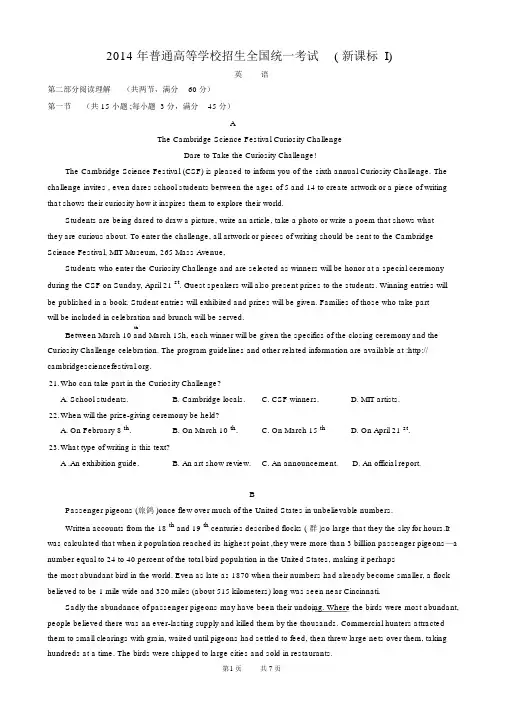
2014年高考英语真题-新课标I卷(含答案)
2014 年普通高等学校招生全国统一考试( 新课标 I)英语第二部分阅读理解(共两节,满分60 分)第一节(共 15 小题 ;每小题 3 分,满分45 分)AThe Cambridge Science Festival Curiosity ChallengeDare to Take the Curiosity Challenge!The Cambridge Science Festival (CSF) is pleased to inform you of the sixth annual Curiosity Challenge. The challenge invites , even dares school students between the ages of 5 and 14 to create artwork or a piece of writing that shows their curiosity how it inspires them to explore their world.Students are being dared to draw a picture, write an article, take a photo or write a poem that shows whatthey are curious about. To enter the challenge, all artwork or pieces of writing should be sent to the Cambridge Science Festival, MIT Museum, 265 Mass Avenue,Students who enter the Curiosity Challenge and are selected as winners will be honor at a special ceremony during the CSF on Sunday, April 21 st. Guest speakers will also present prizes to the students. Winning entries willbe published in a book. Student entries will exhibited and prizes will be given. Families of those who take partwill be included in celebration and brunch will be served.thBetween March 10 and March 15h, each winner will be given the specifics of the closing ceremony and the Curiosity Challenge celebration. The program guidelines and other related information are available at :http:// .21.Who can take part in the Curiosity Challenge?A. School students.B. Cambridge locals.C. CSF winners.D. MIT artists.22.When will the prize-giving ceremony be held?A. On February 8 th.B. On March 10 th.C. On March 15 thD. On April 21 st.23.What type of writing is this text?A .An exhibition guide. B. An art show review. C. An announcement. D. An official report.BPassenger pigeons (旅鸽 )once flew over much of the United States in unbelievable numbers.Written accounts from the 18 th and 19 th centuries described flocks ( 群 )so large that they the sky for hours.It was calculated that when it population reached its highest point ,they were more than 3 billlion passenger pigeons—a number equal to 24 to 40 percent of the total bird population in the United States, making it perhapsthe most abundant bird in the world. Even as late as 1870 when their numbers had already become smaller, a flock believed to be 1 mile wide and 320 miles (about 515 kilometers) long was seen near Cincinnati.Sadly the abundance of passenger pigeons may have been their undoing. Where the birds were most abundant, people believed there was an ever-lasting supply and killed them by the thousands. Commercial hunters attracted them to small clearings with grain, waited until pigeons had settled to feed, then threw large nets over them, taking hundreds at a time. The birds were shipped to large cities and sold in restaurants.By the closing decades of the 19th century ,the hardwood forests where passenger pigeons nested had beendamaged by American ’ s need for wood, which scattered驱散( ) the flocks and forced the birds to go farther north, where cold temperatures and storms contributed to their decline. Soon the great flocks were gone, never to be seen again.In 1897, the state of Michigan passed a law prohibiting the killing of passenger pigeons but by then, no sizable flocks had been seen in the state for 10 years. The last confirmed wi pigeon in the United States was shot by a boy in Pike County, Ohio, in 1900. For a time , a few birds survived under humancare. The last of them, known affectionately as Martha, died at the Cincinnati Zoological Garden on September 1, 1914.24. In the 18 th and early 19teh centuries, passenger pigeons____.A. were the biggest bird in the worldB. lived mainly in the south of AmericaC. did great harm to the natural environmentD. were the largest bird population in the Us25.The underlined word― undoing‖ probably refers to the pigeons’ ____.A. escapeB. ruinC. liberationD. evolution26.What was the main reason for people to kill passenger pigeons?A. To seek pleasure.B. To save other birds.C. To make money.D. To protect crops.27.What can we infer about the law passed in Michigan?A. It was ignored by the public.B. It was declared too late.C. It was unfair.D. It was strict.CA typical lion tamer(驯兽师) in people ’s mind is an entertainer holding a whip(鞭 ) at a chair. The whip gets all of the attention, but it ’s mostly for show. In reality, it ’the chair that does the important work. When a lion tamer holds a chair n front of the lion ’s face, the lion tries to focus on all four legs of the chair at the same time. With its focus divided, the lion becomes confused and is unsure about what to do next. When faced with so many options, the lion chooses to freeze and wait instead of attacking the man holding the chair.How often do you find yourself in the same position as the lion? How often do you have something you want to achieve (e.g. lose weight., start a business, travel more) — only to end up confused by all of the options in front of you and never make progress?This upsets me to no end because while all the experts are busy debating about which option is been the people who want to improve their lives are left confused by all of the conflicting information. The end result isthat we feel like we cant ’focus or that we ’re focused on the wrong things, and so we take less action, make less progress, and stay the same when we could be improving.It doesn ’t have to be that way. Anytime you find the world waving a chair in your face, remember this: All you need to do is focus on one thing,. You just need to get started. Starting before you feel ready is one of the habits of successful people. If you have somewhere you want to go, something you want to accomplish, someone you want to become ⋯ take immediate action. If you ’re clear about where you want to go, the rest of the world will either help you get there or get out of the way.28. Why does the lion tamer use a chair?A. To trick the lion.B. To show off his skills.C. To get ready for a fight.D. To entertain the audience.29.In what sense are people similar to a lion facing a chair?A. They feel puzzled over choices.B. They hold on to the wrong things.C. They find it hard to make changes.D. They have to do something for show30.What is the author ’s attitude towards the expert mentioned in Paragraph3?A. Tolerant.B. Doubtful.C. Respectful.D. Supportive.31.When the world is―waving a chair in your face‖, you’re advised to _____A. wait for a better chanceB. break your old habitsC. make a quick decisionD. ask for clear guidanceD.As more and more people speak the global languages of English, Chinese, Spanish, and Arabic, other languages are rapidly disappearing. In fact, half of the 6,000-7,000 languages spoken around the world today will likely die out by the next century, according to the United Nations Educational , Scientific and Cultural Organization (UNESCO).In an effort to prevent language loss, scholars from a number of organizations _UNESCO and National Geographic among them — have for many years been documenting dying languages and the cultures they reflect.Mark Turin, a scientist at the Macmillan Centre Yale University, who specializes in the languages and oral traditions of the Himalayas, is following in that tradition. His recently published book, A Grammar of Thangmiwith an Ethnolinguistic Introduction to the Speakers and Their Culture, grows out of his experience living, working, and raising a family in a village in Nepal.Documenting the Thangmi language and culture is just a starting point for Turin, who seeks to includeother languages and oral traditions across the Himalayan reaches of India , Nepal, Bhutan, and China . But he is not content to simply record these voices before they disappear without record.At the University of Cambridge Turin discovered a wealth of important materials-including photographs, films, tape recordings, and field notes—which had remained unstudied and were badly in need of care andprotection.Now, through the two organizations that he has founded–the Digital Himalaya Project and the World Oral Literature Project __Turin has started a campaign to make such documents, for the world available not just to scholars but to the younger generations of communities from whom the materials were originally collected. Thanks to digital technology and the widely available Internet, Turin notes, the endangered languages can be saved and reconnected with speech communities.32. Many scholars are making efforts to ______.A. promote global languagesB. rescue disappearing languagesC. search for language communitiesD. set up language research organizations.33. What does ―that tradition ’in Paragraph 3 refer to ?A. Having full records of the languagesB. Writing books on language teaching.C. Telling stories about language usersD. Living with the native speaker.34.What is Turin ’s book based on?A. The cultual studiesB. The documents available at Yale.C. His language research in Bhutan.D. His personal experience in Nepal.35.Which of the following best describe Turin’s work?A. Write, sell and donate.B. Record, repair and reward.C. Collect, protect and reconnect.D. Design, experiment and report.第二节(共 5 小题;每小题 3 分,满分 15分)根据短文内容,从短文后的选项中选出能填入空白处的最佳选项。
2014年高考真题——英语(新课标II)word版含答案

2014年普通高等学校招生全国统一考试新课标II卷英语本试卷分第I卷(选择题)和第II卷(非选择题)两部分。
考试结束后,将本试卷和答案卡一并交回。
注意事项:1.答第I卷前考生务必将自己的姓名、准考证号填写在答题卡上。
2.选出每小题答案前,用2B铅笔把答题卡上对应题目的答案标号涂黑。
如需改动,用橡皮擦干净后,再选涂其他答案标号框,不能答在本试卷上,否则无效。
第一部分听力(共两节,满分30分)做题时,先将答案标在试卷上。
录音内容结束后,你将有两分钟的时间将试卷上的答案转涂到答题卡上。
第一节(共5个小题:每小题1.5分,满分7.5分)听下面5段对话。
每段对话后有一道小题,从每题所给的A B C三个选项中选出最佳选项,并标在试卷的相应位置。
听完每段对话后,你都有10秒钟的时间来回答有关小题和阅读下一小题。
每段对话仅读一遍。
例:How much is the shirt?A. £19.15B.£9.18C. £9.15答案是C1.What does the woman want to do?A.Find a placeB.Buy a mapC.Get an address2.What will the man do for the woman?A.Repair her carB.Give her a rideC.Pick up her aunt3.Who might Mr.Peterson be?A.A new professor.B.A departmet head.C.A company director4.What does the man think of the book?A.Quite difflcultB.Very interestingC.Too simple5. What are the speakers talking about?A.WeatherB.ClothesC.News第二节(共15小题:每小题1.5分,满分22.5分)听下面5段对话或对白,每段对话或对白后有几个小题,从题中所给的A、B、C三个选项中选出最佳选项,并标在试卷的相应位置,听每段对话或独白前,你将有时间阅读各个小题。
2014年北京高考英语参考答案

绝密★考试结束前2014年普通高等学校招生全国统一考试英语(北京卷)参考答案第一部分:听力理解(共三节,30分)第一节(共5小题;每小题1.5分,共7.5分)1.C 2.A 3.B 4.B 5.C第二节(共10小题;每小题1.5分,共15分)6.C 7.A 8.C 9.B 10.A 11.A 12.C 13.A 14.B 15.B第三节(共5小题;每小题1.5分,共7.5分)每小题1.5分。
如出现拼写错误不计分;出现大小写、单复数错误扣0.5分;如每小题超过一个词不计分。
16.Dance 17.middle 18.Hinde 19.104 20.post第二部分:知识运用(共两节,45分)第一节单项填空(共15小题;每小题1分,共15分)21.A 22.C 23.B 24.A 25.D 26.B 27.A 28.D 29.C 30.B 31.C 32.D 33.A 34.D 35.B第二节完形填空(共20小题;每小题1.5分,共30分)36.A 37.B 38.C 39.C 40.D 41.C 42.B 43.D 44.D 45.C 46.B 47.D 48.A 49.A 50.B 51.D 52.A 53.B 54.C 55.A第三部分:阅读理解(共两节,40分)第一节(共15小题;每小题2分,共30分)56.A 57.D 58.B 59.C 60.B 61.A 62.C 63.B 64.D 65.A 66.C 67.B 68.A 69.C 70.D第二节(共5小题;每小题2分,共10分)71.G 72.D 73.F 74.B 75.A英语(北京卷)参考答案第 1 页(共 2 页)第四部分:书面表达(共两节,35分)第一节(15分)One possible version:Dear Chris,How is it going?I remember we planned to visit Yunnan in July. But now, because my left foot was injured, I cannot go with you as planned.I’m sorry about it. Can I suggest that we put it off until early August? I wish you could understand. I’m looking forward to hearing from you soon.Yours,Joe第二节(20分)一、内容要点:1.点明问题;2.讨论问题;3.提交建议;4.看到变化。
2014年高考英语北京卷含答案
绝密★启用前2014年普通高等学校招生全国统一考试英语(北京卷)第一部分:听力理解(共三节,30 分)第一节(共5小题;每小题1.5分,共7.5分)听下面5段对话,每段对话有一道小题,从每题所给的A、B、C三个选项中选出最佳选项,听完每段对话后,你将有10秒钟的时间来回答有关小题和阅读下一小题。
每段对话你将听一遍。
【C】1. What juice does the man order?A. Lemon.B. Apple.C. Orange.【A】2. What subject does the man like best?A. History.B. Biology.C. Chemistry.【B】3. Where is the woman from?A. Britain.B. Russia.C. America.【B】4. What kind of student bus pass does the woman want?A. Weekly.B. Monthly.C. Yearly.【C】5. What are the two speakers going to buy for Mary’s birthday?A. A bicycle.B. A pen.C. A book.第二节(共10小题;每小题1.5分,共15分)听下面4段对话或独白。
每段对话或独白后有几道小题,从每题所给的A、B、C三个选项中选出最佳选项。
听每段对话或独白前,你将有5秒钟的时间阅读每小题。
听完后,每小题将给出5秒钟的作答时间。
每段对话或独白你将听两遍。
听第6段材料,回答第6至7题。
【C】6. What’s wrong with the woman?A. She has a cough.B. She has a headache.C. She has a fever.【A】7. How long is the medicine for?A. One day.B. Two days.C. Three days.听第7段材料,回答第8至9题。
[五年高考]2014年-2015-2016-2017-2018年北京市英语卷高考试题真题卷(含详细答案)
高考试题汇总目录(精心整理)2018年北京卷高考试题word版(含详细答案)2017年北京卷高考试题word版(含详细答案)2016年北京卷高考试题word版(含详细答案)2015年北京卷高考试题word版(含详细答案)2014年北京卷高考试题word版(含详细答案)绝密★启用前2018年普通高等学校招生全国统一考试英语(北京卷)(考试时间:100分钟试卷满分:120分)考生务必将答案答在答题卡上,在试卷上作答无效。
考试结束后,将本试卷和答题卡一并交回。
第一部分:知识运用(共两节,45分)第一节单项填空(共15小题;每小题1分,共15分)从每题所给的A、B、C、D四个选项中,选出可以填入空白处的最佳选项,并在答题卡上将该项涂黑。
例:It’s so nice to hear from her again. _________, we last met more than thirty years ago.A. What’s moreB. That’s to sayC. In other wordsD. Believe it or not答案是D。
1. —Hi, I’m Peter. Are you new here? I haven’t seen you around?—Hello, Peter. I’m Bob. I just _________ on Monday.A. startB. have startedC. startedD. had started2. _________ we don’t stop climate change, many animals and plants in the world will be gone.A. AlthoughB. WhileC. IfD. Until3. _________ along the old Silk Road is an interesting and rewarding experienceA. TravelB. TravelingC. Having traveledD. Traveled4. Susan had quit her well-paid job and _________ as a volunteer in the neighborhood when I visited her last year.A. is workingB. was workingC. has workedD. had worked5. She and her family bicycle to work, _________ helps them keep fit.A. whichB. whoC.asD. that6. During the Mid-Autumn Festival, family members often gather together _________ a meal, admire the moon and enjoy moon cakes.A. shareB. to shareC. having sharedD. shared7. China’s high-speed railways _________ from 9,000 to 25,000 kilometers in the past few years.A. are growingB. have grownC. will growD. had grown8. In any unsafe situation, simply _________ the button and a highly-trained agent will get you the help you need.A. pressB. to pressC. pressingD. pressed9. A rescue worker risked his life saving two tourists who _________ in the mountains for two days.A. are trappingB. have been trappedC. were trappingD. had been trapped10. Ordinary soap, _________ correctly, can deal with bacteria effectively.A. usedB. to useC. usingD. use11. Without his support, we wouldn’t be _________ we are now.A. howB. whenC. whereD. why12. In today’s information age, the loss of data _________ cause serious problems for a company.A. needB. shouldC. canD. must13. They might have found a better hotel if they _________ a few more kilometers.A. droveB. would driveC. were to driveD. had driven14. —Good morning, Mr. Lee’s office.—Good morning. I’d like to make an appointment _________ next Wednesday afternoon.A. forB. onC. inD. at15. This is _________ my father has taught me—to always face difficulties and hope for the best.A. howB. whichC. thatD. what第二节完形填空(共20小题;每小题1.5分,共30分)阅读下面短文,掌握其大意,从每题所给的A、B、C、D四个选项中,选出最佳选项,并在答题卡上将该项涂黑。
2014年北京市高考英语试卷(含解析版)
2014年北京市高考英语试卷本试卷共16页,共150分。
考试时间为120分钟。
第一部分:听力理解(共三节:30 分)第一节(共 5 小题;每小题 1.5 分,共7.5 分)听下面 5 段对话,每段对话有一道小题,从每题所给的A、B、C 三个选项中选出最佳选项,听完每段对话后,你将有10 秒钟的时间来回答有关小题和阅读下一小题。
每段对话你将听一遍。
例:What is the man going to rend?A. A newspaperB. A magazineC. A book答案是 A1. What juice does the man order?A. LemonB. AppleC. Orange2. What subject does the man like best?A. History.B. Biology.C. Chemistry.3. Where is the woman from?A. Britain.B. Russia.C. America.4. What kind of student bus pass does the woman want?A. Weekly.B. Monthly.C. Yearly.5. What are the two speakers going to b uy for Mary’s birthday?A. A bicycle.B. A pen.C. A book.第二节(共10 小题;每小题 1.5 分,共15 分)听下面 4 段对话或独白。
每段对话或独白后有几道小题,从每题所给的A、B、C 三个选项中选出最佳选项。
听每段对话或独白前,你将有 5 秒钟的时间阅读每小题。
听完后,每小题将给出 5 秒钟的作答时间。
每段对话或独白你将听两遍。
听第 6 段材料,回答第 6 至7 题。
6. What’s wrong with the woman ?A. She has a cough.B. She has a headache.C. She has a fever.7. How long is the medicine for? A. One day. B. Two days. C. Three days.听第7 段材料,回答第8 至9 题。
2014年高考英语试题单项选择解析(北京卷)
2014年高考英语试题单项选择解析(北京卷)21. Some animals carry seeds from one place to another, ______ plants can spread to new places.A. soB. orC. forD. but【答案】A【解析】考查连词。
句意:有些动物把种子从一个地方带到另外一个地方,于是植物就传播到了新的地方。
so于是,表示上下文因果关系。
根据句意可知A正确。
22.—Hi, let’s go skating.—Sorry, I’m busy right now. I ______ in an application form for a new job.A. fillB. have filledC. am fillingD. will fill【答案】C【解析】考查动词时态。
句意:—喂,我们去滑冰吧!—对不起,我现在很忙,正在填写一份新工作的申请表。
现在进行时是表示说话之时或现阶段正在或一直进行或发生的动作。
其形式为:be+动词的ing(现在分词)。
根据句意可知,空格处表示说话时正在发生的动作,所以用现在进行时。
故C正确。
23. Jane is in a hurry because the train to the airport leaves ______ half an hour.A. byB. inC. forD. until【答案】B【解析】考查介词。
句意:Jane很匆忙,因为去机场的火车半小时后就要离站了。
In表示“一段时间以后”,它引导的时间状语与将要发生的动作连用。
根据句意可知B正确。
24. ______ carefully if any change occurs when doing experiments in the lab.A. ObserveB. To observeC. ObservedD. Observing【答案】A【解析】考查祈使句。