
新人教版九年级上册英语Unit 3单元测试卷(含听力材料及答案解析)
Unit 3达标测试卷时间:100分钟满分:120分第Ⅰ卷听力部分(20分)一、听句子,选出与所听句子内容相符的图片(每小题1分,共5分)1.A B C2.A B C3.A B C4.A B C5.A B C二、听小对话和问题,选出正确的答案(每小题1分,共5分)6.A.Cleaning the floor.B.Washing the clothes.C.Reading the book.7.A.On Sixth Street. B.On Fifth Street.C.On Seventh Street.8.A.Go to a special mall.B.Buy a present for his mother.C.Go to school.9.A.Go back to get his umbrella.B.Leave without his umbrella.C.Buy a new umbrella.10.A.By bus.B.On foot.C.By car.三、听下面两段长对话,选择正确的答案(每小题1分,共5分)听第一段对话,回答第11~12小题。
11.Where does the conversation probably happen?A.In a factory. B.In a supermarket. C.In a park. 12.Which floor is the restroom on?A.The first floor. B.The second floor. C.The third floor.听第二段对话,回答第13~15小题。
13.What are they discussing?A.A training program. B.A train timetable.C.Where to stay in New York.14.When does the conversation probably happen?A.On Sunday. B.On Mid-Autumn Day.C.On Friday.15.How long does it take the man to travel to New York by train?A.Two hours and twelve minutes.B.One hour and fifty-seven minutes.C.Four hours and nine minutes.四、听短文及问题,选择正确的答案(每小题1分,共5分) 16.A.In Yueyang.B.In Xiangtan.C.In Changsha.17.A.On foot. B.By bus.C.By bike.18.A.At 5:30. B.At 6:30. C.At 7:30. 19.A.Li Ming. B.Li Ming's mother.C.Li Ming's aunt.20.A.Only one. B.Two. C.Three.第Ⅱ卷笔试部分(100分)五、单项选择(每小题1分,共15分)21.—Could you tell me________ ?—Talking about festivals.A.how they are playing B.what they are doingC.where they are going D.why they are practicing22.—Excuse me.Could you tell me the way ________ the nearest supermarket?—Go down the street and turn left.Then you'll see it.A.to B.of C.in D.at23.—Excuse me.May I know your________?—Sure.It's No.3 Bridge Street.A.house B.address C.way D.name 24.Many students are looking forward to ________ a good time after the final exam.A.have B.had C.having D.has25.She sang a song I believe I can fly in Yangzhou English Classics Reading Contest.I have never heard a ________voice than that before.A.good B.well C.better D.best26.—How do you like the movie you watched last night?—It was so ________and made me________.A.frightening;frighteningB.frightening;frightenedC.frightened;frighteningD.frightened;frightened27.________,the Internet was only used by the government. But now it's widely used in every field.A.As usual B.At firstC.After all D.So far28.Li Ming has no ________ but to leave.A.choice B.support C.mixture D.honour29.—When shall we go?—It hasn't been decided yet.It ________ the weather.A.begins with B.leads toC.depends on D.thinks of30.—Daddy,can you come home for supper with us this weekend?—________,but I might be a little late.A.I'm busy B.Hard to sayC.Of course D.Never mind31.—Can you tell me ________ to London?—Sure.Next month.A.when you will travel B.when will you travelC.when you travelled D.when did you travel32.—Excuse me, do you know ________?—Sure, there is a bookstore down the street near here.A.where can I get some postcardsB.where I can get some postcardsC.how can I get some postcardsD.when I can get some postcards33.Tom knew nothing ________ his friend told him.A.because B.until C.since D.if34.I'm not sure________.A.where does he workB.what's his fatherC.how can I help youD.when the meeting will begin35.(N) A direct order like “Daisy,pass me the book.”sounds rude.We'd better say:“________”A.Daisy,could you please pass me the book?B.Daisy,I wonder if can you pass me the book.C.Daisy,give me the book!D.Daisy,I wonder you can pass me the book.六、完形填空(每小题1分,共15分)(词数:约260;建议用时:7分钟)Most of us have three meals a day.We take food for granted (想当然).And we don't think about it.________(36) experts argue a food crisis(危机)is coming.This crisis is going to make us ________(37) the way we think about food.Food is in great need ________(38) a growing of world population.By 1960, the population was three billion.It doubled to six billion by 1999.By 2050, this planet will need to ________(39) at least nine billion people.As a result, the food prices get higher and higher.So, what can a ________(40), crowed world do? One suggestion is to eat________(41)meat.Meat uses more natural resources (资源)than grains(谷物).It requires more ________(42)to produce one pound of meat than to produce one pound of grain.It also requires between 5 and 10 times more________(43)than vegetables.So, eating less meat will ________(44) more land for farming, and it will save water.To eat less meat, people will need to change their eating habits.That will not be________(45).Americans, for example, have ________(46) loved meat.In general, they eat twice as much meat as people in other countries.At the same time, in developing countries like China and Brazil, sales of meat have doubled in the last 20 years.________(47)will double again by 2050.Growing need of meat will ________(48)to put pressure on natural resources.World population is increasing, resources are becoming fewer, and food prices are rising.Therefore, we need to rethink ________(49) we eat every day.For meat lovers, we don't need to give up meat ________(50).But we need to eat more grains and less meat.36.A.And B.But C.Or D.Until37.A.change B.find C.get D.tell38.A.instead of B.thanks toC.because of D.as for39.A.help B.have C.feed D.meet40.A.busy B.tired C.thirsty D.hungry41.A.less B.more C.much D.little42.A.time B.land C.people D.place43.A.air B.meat C.money D.water44.A.provide B.produce C.waste D.need45.A.important B.hard C.easy D.necessary46.A.never B.seldom C.hardly D.always47.A.It B.They C.We D.That48.A.continue B.stop C.have D.start49.A.how B.when C.what D.where50.A.quickly B.completely C.finally D.especially七、阅读理解(每小题2分,共30分)A(词数:约230;建议用时:7分钟)The police find most criminals (罪犯) because somebody tells them who the criminals are.They find other criminals by using science and their computers.When there is a bank robbery (抢劫),the police first look through their computers for the names of the bank robbers that they know about.Then they go and talk to any of these robbers who are not in prison (监狱).They ask them where they were when the robbery happened.If any of these people cannot give a good answer,the police will often use science to find out if one of them is the robber.Many criminals leave something of themselves at the places of the crimes like a fingerprint or a hair.Or they take something away on their shoes or clothes,like dirt or animal hair.If they leave behind some of their blood or their hair or a piece of skin,it will have their DNA inside it.Everyone's DNA is different and their fingerprints are also different.So,if a criminal cuts himself during a robbery or leaves his hair,or even a small piece of skin,scientists can find out what his DNA is.The police can then ask the person they think is the robber to give them his hair or some blood and see if it has the same DNA.Many criminals are in prison today because of this kind of evidences.根据短文内容判断正(T)误(F)。
Unit 3【单元卷 测试卷】(解析版) -人教版九年级英语全册
Unit 3 Could you please tell me where the restrooms are?【测试卷(能力提升)】(满分:120分时间:100分钟)第一部分听力(共两节,满分20分)第一节(共5小题;每小题1分,满分5分)听下面5段对话。
每段对话后有一个小题,从题中所给的A、B、C三个选项中选出最佳选项。
听完每段对话后,你都有10秒钟的时间来回答有关小题和阅读下一小题。
每段对话仅读一遍。
1.How do people in the city go to work?A.By bike.B.By subway.C.By bus.【答案】B【原文】W: People in our city often go to work by subway, because it is fastest and it has no traffic problems. M: I agree with you, and most of the students also go to school by subway2.Where is the man going?A.A hotel.B.A bank.C.A school.【答案】A【原文】M: Excuse me. Could you please tell me the way to the nearest hotel?W: Sure. Just go straight and you can see one. It’s next to a bank.3.How is the new forest library according to the man?A.Great.B.Big.C.Small.【答案】A【原文】A: How is the new forest library?B: Very good, you can read books under a big old tree.4.Where does the conversation probably take place?A.In a bank.B.On a bus.C.In a library.【答案】B【原文】W: Excuse me, is this bus going to the National Library?M: No. Please get off at the next stop, and take the No. 5 bus.5.How does the girl go to school sometimes?A.On foot.B.By bus.C.By bike.【答案】B【原文】M: How do you go to school every day, Amy?W: I usually go to school by bike. Sometimes I will take a bus instead of riding a bike when it rains.第二节(共10小题;每小题1分,满分10分)听下面5段对话。
人教版九年级英语上册UNIT 3 综合测试卷含答案

人教版九年级英语上册UNIT 3 综合测试卷第一部分听力(四大题,20分)一、短对话理解(共5小题;每小题1分,满分5分)1. Where are the two speakers?A. B. C.2. What is Jack going to buy?A. B. C.3. Where will they probably go first?A. To the History Museum.B. To the Science Museum.C. To the Art Museum.4. What is the boy doing now?A. Writing a letter.B. Writing a report.C. Giving a speech.5. What does the woman mean?A. She is new here.B. She'll help call the police.C. She's too busy to help him.二、长对话理解(共5小题;每小题1分,满分5分)听下面一段对话,回答第6、7小题。
6. What does the woman want to buy?A. Some envelopes.B. Some stamps.C. Some magazines.7. How long will it take the woman to get to the post office?A. About 3 minutes.B. About 17 minutes.C. About 20 minutes.听下面一段对话,回答第8至10小题。
8. What can we know about Sam?A. He's lazy.B. He's impolite.C. He's careless.9. Where may Sam find his glasses?A. In the bathroom.B. In the living room.C. In the bedroom.10. What's the relationship between the speakers?A. Teacher and student.B. Mother and son.C. Husband and wife.三、短文理解(共5小题;每小题1分,满分5分)11. Where is David from?A. England.B. America.C. Australia.12. How many times has David been to Beijing so far?A. Once.B. Twice.C. Three times.13. Whom did David go to Wangfujing Street with?A. His mother.B. His father.C. His sister.14. When will David watch a football game?A. This evening.B. Tomorrow morning.C. Tomorrow evening.15. What does David think of Beijing?A. It has changed a lot.B. It's the same as before.C. It is not crowded.四、信息转换(共5小题;每小题1分,满分5分)第二部分语言知识运用(三大题,35分)五、单项填空(共10小题;每小题1分,满分10分)21. —I want to send this postcard to Tony. Do you know his ____?—Yes. He lives at No. 108, Bridge Street.A. abilityB. mistakeC. addressD. culture22. —____ will you share your summer holiday experiences with?—Of course, my classmates.A. WhatB. WhomC. WhoseD. Which23. —Have you got any ideas of what I should do to keep healthy?—Yes. I ____ light exercise like yoga. It can be good for you.A. suggestB. achieveC. provideD. develop24. —Is that the ____ spelling?—I don't know. Let me look it up in the dictionary.A. strangeB. simpleC. unusualD. correct25. Helen ____ refused the invitation to the concert because she needed to spend moretime on her homework.A. quietlyB. cheaplyC. politelyD. hardly26. This morning we saw some children dancing and singing when we ____ the park.A. passed byB. cleared outC. dressed upD. turned on27. The little girl often sits ____ her mother and listens to her mother tellinginteresting stories.A. aboveB. besideC. betweenD. below28. —Our computer is working again!—Yes. Our IT teacher ____ it. It took him about an hour.A. will fixB. is fixingC. has fixedD. was fixing29. —I wonder ____.—I'm not sure. Maybe next week.A. where they will goB. who will give us a talkC. how he will get thereD. when she will have a party30. —____,sir. Is the school library open the whole week?—I'm afraid not. Only from Monday to Friday.A. Pardon meB. Come onC. My pleasureD. No problem六、完形填空(共20小题;每小题1分,满分20分)AOnce upon a time, a young man told people that his neighbor Mr Smith often stole things. As a result, people in the neighborhood thought __31__ of Mr Smith and they stayed away from him.One day, when an old man lost a pet dog, everyone in the neighborhood thought Mr Smith had __32__ it. The old man called the police and the police __33__ Mr Smith. However, it turned out that Mr Smith had never stolen __34__.When Mr Smith came out of the police station, he felt very __35__. Days later, he sued(起诉) the young man. The young man said to the judge, “They were just __36__. ” The judge said, “Write all the things you said about Mr Smith on a piece of paper. Cut it up and throw the pieces of paper out on your way home. Tomorrow, __37__. ”The next day, as soon as the young man arrived, the judge said, “Go out and __38__ all the pieces of paper that you threw out yesterday. ”The young man cried, “That's __39__. Wind has blown them everywhere. ”The judge then said, “The same way, simple words may destroy the honor of a man to such an extent that one is not able to __40__ it. ” Hearing this, the young man finally realized his mistake.31. A. truly B. clearlyC. badlyD. directly32. A. shown B. stolenC. spokenD. shaken33. A. caught B. thoughtC. foughtD. brought34. A. everything B. somethingC. nothingD. anything35. A. angry B. lonelyC. lovelyD. hungry36. A. rules B. ideasC. wordsD. songs37. A. come back B. stay upC. hand outD. run away38. A. connect B. collectC. controlD. compare39. A. important B. amazingC. impoliteD. impossible40. A. request B. hitC. fixD. cutBHow to make a telephone call politely? __41__ you have a conversation with a friend or talk to someone for business reasons, there are some ways to be polite.Greet the other person politely.If you know the person you're calling, you can __42__ with “Hello! This is… How are you doing today?” If you don't know the person, __43__ yourself before starting a conversation.Speak in your normal voice.If you talk too __44__,the person may feel uncomfortable. If you talk too quietly, it may be __45__ to hear you. If you're worried about your __46__,you may ask “Excuse me, can you hear me?”Don't make noises while talking on the phone.One of the most __47__ things while you are speaking on the phone is eating or drinking. It's impolite to let the other person hear these sounds. You can either __48__ the telephone conversation to finish, or ask if you may call him/her back after you finish eating.Say thank you and goodbye at the end of a call.Since there are no facial(面部的)__49__,it can often be difficult to know when t he conversation will end. By saying “Thanks for calling. Goodbye!”,you make it __50__ that the phone conversation is over.41. A. Which B. WhetherC. UntilD. Why42. A. start B. helpC. agreeD. talk43. A. understand B. remindC. introduceD. discover44. A. lonely B. quietlyC. aloneD. loudly45. A. easy B. hardC. happyD. angry46. A. study B. lifeC. workD. voice47. A. impolite B. necessaryC. famousD. convenient48. A. pick up B. wait forC. put awayD. turn down49. A. attentions B. decisionsC. questionsD. expressions50. A. common B. secretC. clearD. special七、补全对话(有两项多余)(共5小题;每小题1分,满分5分)A: Excuse me, sir. 51. ________B: Certainly. Go along this street. Turn left into Xinhua Road, and the hospital is on your right.A: 52. ________B: It's about forty minutes on foot.A: 53. ________ Can I take a bus?B: Yes, you can. 54. ________A: Is there a bus stop near here?B: Yes. It's over there. Look! 55. ________A: Thank you very much.B: You're welcome.第三部分阅读(共两节,40分)八、阅读理解(共20小题;每小题2分,满分40分)第一节:AThe apartment is at 88 Renmin Road. It is only a few minutes' walk 56. The two bedrooms of the apartment face ____.A. eastB. westC. northD. south57. The apartment does NOT have ____.A. central heatingB. under-floor heatingC. Internet availableD. 24-hour hot water58. If you are interested in this apartment, you can contact Mrs Li ____.A. by websiteB. by letterC. by phoneD. by e-mailBHangzhou's West Lake is beautiful and it makes a lot of people feel excited.The city is the best place for active families, with bikeways, parks and places of interest. Visitors can live at Four Seasons Hotel. The hotel is designed in traditional Chinese style. It has old buildings with windows made of dark wood and Chinese gardens for people to relax.Outside the hotel, you can take part in many family-friendly activities. The parks around the West Lake are perfect for visiting by bicycle or on foot. You can also go fishing and boating. The hotel is a five-minute walk from these beautiful parks. Children will love visiting the meandering walkways, old buildings and bridges, while adults can watch locals practice tai chi or drink tea at a nearby teahouse.Within the area is Zhongshan Park that was once the holiday home of Emperor Qianlong. There are also some gardens on several islands. You can also rent bicycles from the hotel and go bike riding around the lake.The visit to the West Lake is not complete without walking a few kilometers each on the famous Su and Bai Causeways(堤). The two causeways were named after two famous Chinese poets, Su Dongpo and Bai Juyi. Take a walk in the early morning, ride a bike or climb into a boat for a personal ride around the lake. Look for the stone carvings(石刻) left by Emperor Qianlong and these stone carvings tell you about the ten beautiful sights of Hangzhou. To avoid(避免) a large crowd, try to time your visit on a weekday.59. What can you see at Four Seasons Hotel?A. Windows with light wood.B. Chinese gardens.C. English gardens and parks.D. Buildings in different styles.60. Which activity is not mentioned in the passage?61. What does the underlined word “meandering”mean?A. 蜿蜒的B. 陡峭的C. 可爱的D. 危险的62. Who left the stone carvings for the West Lake?A. The poet Su Dongpo.B. The poet Bai Juyi.C. Emperor Qianlong.D. The visitors.CEdinburgh is the capital of Scotland. It is in the southeast of Scotland. It is about 45 miles away from Glasgow, 15 miles from Livingston and 100 miles from Carlisle and Aberdeen.During the Middle Ages, a small fort called Dun Eiden was built by the Gododdins. In the 7th century, the Angles invaded the fort. The Angles took the name “Eiden” and joined it to “burh”,an old English word meaning “fort”,and created the name of Edinburgh. It has been the capital of Scotland since 1437.If you come to Edinburgh by train from the south, the first thing you will see is Edinburgh Castle. It stands high over the city.Edinburgh is a city full of hills but it is a good city to visit on foot. After the castle, you can visit more of the Old Town. Go down the Royal Mile to Holyroodhouse. It is hundreds of years old. You can also go to the shops on the Royal Mile or on Princess Street in the New Town. There is also the National Gallery ofScotland, with pictures from Scotland and from many other places.In August, you can come to the Edinburgh International Festival. It's the biggest art festival in the world with hundreds of different things to do and see.63. What is Paragraph 2 mainly about?A. Where Edinburgh is.B. How Edinburgh got its name.C. How the Angles invaded the fort.D. When Edinburgh became famous.64. What does the underlined word “It” in Paragraph 4 r efer to?A. Edinburgh Castle.B. Princess Street.C. Holyroodhouse.D. The Royal Mile.65. In which part of a magazine can we read the text?A. Language.B. Nature.C. Environment.D. Travel.DAsking for directions is the first thing we need to do when we get to a different country. Knowing how to ask for help can make our life much easier! Here are some tips for you.(续表)66. What is a must when you ask for directions?A. Knowing where you are.B. Asking the right person.C. Making yourself understood.D. Greeting the person politely.67. Using the word “nearest” can help you ____.A. miss wrong placesB. find the place quicklyC. find a better placeD. learn about more places68. Which of the following can be put in “__▲__”?A. Learn more about the National StadiumB. Know when to find important landmarksC. Try to know some important landmarksD. Don't be afraid of asking about landmarks69. What is the text mainly about?A. How to ask for directions abroad.B. How to give polite greetings abroad.C. Some examples of how landmarks are used.D. Some polite expressions about asking for help.EHave you ever wondered how you can politely ask a question in English? How should you ask your teacher for a day off? Using an indirect(间接的) question is one great way to do this.When to Use Indirect QuestionsWhen you ask a direct question, you ask directly, “Where is the bus stop?” Direct questions are fine when you are talking to your friends, family members or people you know well. But how should you ask if you are in a more formal(正式的)situation or if you are asking someone you're not really close to? What if you are in a party or a work convention(会议)? In these situations, it's politer to use an indirect question.How to Form(构成)Indirect QuestionsIndirect questions are questions with extra words and phrases(短语)to make your question softer:Is it possible…?Do you know…?I was wondering…Can/Could you tell me…?“Can” is a little more casual,__while “Could” is politer.When you use these extra phrases, the rest of your sentence will return to the normal word order(顺序)of a declarative sentence(陈述句).Other Ways to Ask Indirect QuestionsA good word to use in an indirect question is “if ”. You could say, “Do you know if there is a bookstore here?” People can answer these “if” questions with a simple yes or no!You can also use your polite phrase followed by a question word—who, what,where, when, why or how.70. How does the writer develop the text?A. By listing(列举) numbers.B. By giving examples.C. By answering questions.D. By explaining reasons.71. In which situation can you ask direct questions?A. When you are asking a stranger.B. When you are talking to your brother.C. When you are in a party.D. When you are at an important meeting.72. What's the purpose of the text?A. To ask for some help.B. To give teachers some advice.C. To teach students how to learn English.D. To tell us something about indirect questions.第二节:阅读下面的短文,并用英语回答问题(请注意每小题后面的词数要求)。
人教版九年级英语上册单元试卷:Unit 3 测试(含答案)

人教版英语九年级上册Unit 3 测试卷限时:60分钟满分:100分一、单项选择(每小题1.5分, 共15分)1. Jenny didn't go to bed ________ her mother came home last night.A. as soon asB. ifC. whileD. until2. ________ is the girl ________ our English teacher?A. Who; besideB. Whom; besidesC. Where; besideD. Where; besides3. He has a collection of ________. He can not only enjoy them but also use them to mail letters.A. stampsB. novelsC. instrumentsD. magazines4. —Could you tell me where the supermarket is?—Sure. The supermarket is ________ the bookstore ________ the post office. You can find it easily.A. between; andB. both; andC. either; orD. neither; nor5. Just go straight and then turn ________. The hotel is ________.A. left; leftB. left; on the leftC. on the left; leftD. on the left; to the left6. Could you please tell me where ________ the post office?A. to findB. can I findC. findingD. find7. I have to say it is not ________ for me to see you now, because I am very busy with my work.A. impoliteB. safeC. inexpensiveD. convenient8. —I think He Wei is a ________ boy.—I agree with you. He always speaks ________ to others.A. polite; politelyB. polite; politeC. politely; politelyD. politely; polite9. Excuse me, would you mind ________ me how I get to the library?A. tellB. tellsC. to tellD. telling10. —What did Lucy ask you just now?—She asked me________.A. if I will come to the partyB. that he would help me to clean the roomC. who was I waiting forD. whether there was a restaurant near here二、【荣德原创】完形填空(每小题1.5分, 共15分)A new model of self-driving city buses, the first to be only electric-powered, has left the production line and has finished the first testing at a factory in Hubei Province.The Provincial Economy and Information Technology Commission said on Monday, “The buses were developed by ________11Hubei-based automaker Dongfeng Xiangyang Touring Car Co., Ltd. and Beijing Institute of Technology.”“After successful________12 at the factory, the ________13 buses have been sent to Shenzhen, Guangdong Province where they will be tested in the ________14. The buses are expected to be________15in unconfirmed areas at the end of November, ” said the commission.The buses can carry 25 passengers and run at a maximum(最大限度的) ________16 of 40 km per hour. They have the ability to change ________17 manual (手动的) driver operation and self-driving.They have energy-saving features and ________18 quality parts. A single charge allows them to ________19 for up to 150 km. The motor and key parts are expected to ________20 for over 1.2 million km without failure.11. A. neither B. both C. either D. all12. A. testing B. working C. producing D. making13. A. first B. second C. third D. last14. A. factory B. workplace C. street D. station15. A. put into use B. come into useC. put on useD. come to use16. A. time B. speed C. distance D. power17. A. among B. between C. into D. from18. A. low B. short C. high D. tall19. A. run B. walk C. go D. come20. A. refuse B. answer C. suggest D. last三、【荣德原创】阅读理解(每小题3分, 共15分)In Xi'an, there are special sidewalks for the phubbers (低头族). Different people have different opinions on it.21. The underlined word “one” refers to “________”.A. sidewalkB. phoneC. an accidentD. a person looking down at the phone22. What does the underlined phrase “get injured” mean in Chinese?A. 补偿B. 受伤C. 损失D. 逃避23. According to Sun Run, we should encourage people ________.A. to walk on the special sidewalkB. not to use mobile phones in lifeC. to spend more time on workD. to play with the phone less and enjoy life more24. Who think(s) it a good idea to have such a sidewalk for the phubbers?①Li Minyi②Huang Xi③Chen Yecheng④Sun RunA. ①③B. ③④C. ①③④D. ①②③④25. What is the best title for the passage?A. Don't be a phubberB. Good service in Xi'anC. Special walkways for the phubbersD. Should we look down at our phone while walking?四、词汇运用(每小题1分, 共10分)A)根据句意及首字母提示填空26. Can you tell me your email a ?27. The teacher asked us to circle the c answers.28. The story tells us that we should be p when we ask for help.29. “I have only one r .I hope you can take good care of yourselves, ” theold man said.30. When we ask him questions, he never gives us a d answer. He alwaysgives us some suggestions.B)从方框中选择合适的单词并用其正确形式填空31. The hospital lies in the ________ of the city.32. The young lady went off in the ________ of the railway station.33. Knowing how to use proper language can help you become ________ at English.34. Good ________ are usually good storytellers.35. ________ did he expect to answer his phone?五、【荣德原创】短文填空(每小题1.5分, 共15分)根据上下文及首字母提示写单词, 使短文内容完整、通顺It's very common for us to ask for help in our daily life. Asking for advice in writing is d 36 from a face-to-face conversation because it means that you need to think about things carefully, provide all necessary i 37 and ask appropriate (适当的) questions.If the person doesn't know w 38 you are, you need to introduce yourself at the beginning of the letter. After that, you may want to get straight to the point. You should begin by e 39 the purpose(目的)of your letter. There're lots of expressions with which you can begin a letter p 40, such as “I'm writing to ask if you could help me with...” or “I w 41 if you could help me with...”. Sometimes, you come up with three or five questions. You should write them out. But please don't write too many questions that would take hours to answer. You'll have a better chance(机会) of getting a r 42. If you're asking for advice for a p 43 or a situation that you have been trying to solve on your own but haven't been able to, then you should explain the r 44. Thiscan show that you're not being l 45 and that you really need some help. 六、书面表达(30分)假如你校有几位来自美国的交换生, 他们打算周末步行去城市公园。
人教版九年级全册英语 Unit 3 单元测试卷(Word版,含答案)
人教版九年级全册英语 Unit 3 单元测试卷一、听力理解(20小题,每小题1分,共20分)第一节听下面5段对话。
每段对话后有一个小题,从题中所给的A、B、C三个选项中选出最佳答案。
每段对话读两遍。
( )1.How far is it from the girl’s school to the East Town?A.About half an hour’s walk.B.About an hour’s bus ride.C.About one and a half hours’ bus ride.( )2.When does the shop close every day?A.At 3:00 p.m.B.At 9:00 p.m.C.At 8:00 p.m.( )3.How will the girl go to the museum?A.By bus.B.By taxi.C.By bike.( )4.Who may the girl turn to for help?A.The policeman.B.The man.C.Nobody.( )5.Where is Lisa going to visit for the coming summer holiday?A. B. C.第二节听下面几段对话或独白。
每段对话或独白后有几个小题,从题中所给的A、B、C三个选项中选出最佳答案。
每段对话或独白读两遍。
听下面一段对话,回答第6至第7两个小题。
( )6.Where is the man going?A.To the post office.B.To the bookstore.C.To the cinema.( )7.How will the man go there?A.On foot.B.By bus.C.By car.听下面一段对话,回答第8至第9两个小题。
( )8.Where is the supermarket?A.On the first floor.B.On the second floor.C.Across from the bookstore.( )9.What can we know from the conversation?A.The shopping center closes at 9:30 p.m. on weekdaysB.The girl will go to the shopping center tomorrow.C.The shopping center closes at 10:30 p.m. today.听下面一段独白,回答第10至第12三个小题。
人教版九年级英语上册第三单元检测试卷及答案解析
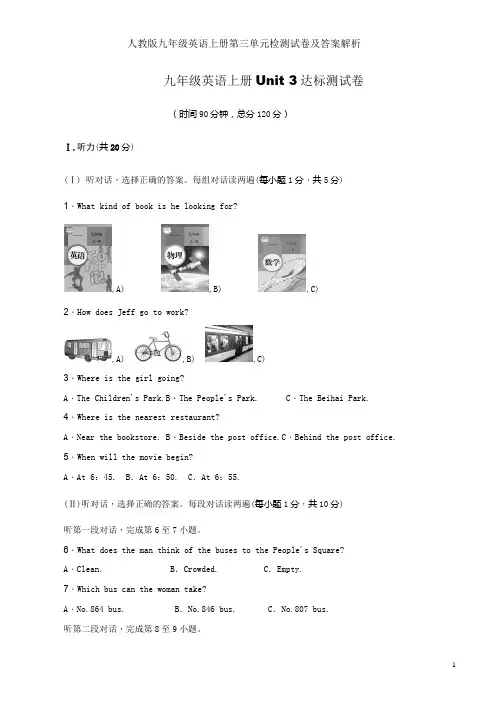
九年级英语上册Unit 3达标测试卷(时间90分钟,总分120分)Ⅰ.听力(共20分)(Ⅰ) 听对话,选择正确的答案。
每组对话读两遍(每小题1分,共5分)1.What kind of book is he looking for?,A) ,B) ,C)2.How does Jeff go to work?,A) ,B) ,C)3.Where is the girl going?A.The Children's Park.B.The People's Park. C.The Beihai Park. 4.Where is the nearest restaurant?A.Near the bookstore. B.Beside the post office.C.Behind the post office. 5.When will the movie begin?A.At 6:45. B.At 6:50. C.At 6:55.(Ⅱ)听对话,选择正确的答案。
每段对话读两遍(每小题1分,共10分)听第一段对话,完成第6至7小题。
6.What does the man think of the buses to the People's Square? A.Clean. B.Crowded. C.Empty.7.Which bus can the woman take?A.No.864 bus. B.No.846 bus. C.No.807 bus.听第二段对话,完成第8至9小题。
8.What's wrong with the woman?A.She had a toothache.B.She had a headache.C.She had a sore throat. 9.What is the relationship between the woman and the man?A.Mother and son. B.Teacher and student. C.Friends.听第三段对话,完成第10至12小题。
人教版九年级英语unit3听力材料和参考答案
人教版九年级英语unit3听力材料和参考答案九年级上册第3单元听力测试材料第一节听短对话, 选出最佳答案。
每段对话只读两遍1.W:I can’t s ee any dictionaries.Could you please tell me where they are?M:Sure,they’re on the second floor.Question. What’s the girl looking for?2.W:I often hang o ut with my friends and after that we can eat at Qiu’s Restaurant.It’s really a good place to eat outside.M:Yes.Its food is delicious and cheap.Question. How does the man like the food at Qiu’s restaurant?3.W:Mr.Wang walks to work every day.Does he live near the TV station?M:Yes.His home is just next to the TV station.Question. Where does Mr.Wang live?4.W:I really don’t know where we can go.We must get some information about the town.M:You’re right.We sh ould buy a map.Question. What are they going to buy?5.W:Excuse me,could you tell me where the drugstore is?M:It’s between the clothes store and the shoe store.Question. Where’s the shoe store?6.W:Can I help you?M:Yes.I need a stamp.I want to send a letter.Question. What does the man want to do?7.M:Let’s go out to have lunch.W:Sounds good!What would you like to eat?M:I’d like noodles.Question. What does the man want to eat for lunch?8:W:Wow!How fascinating these oak bowls are?M:I’ve been collec ting them for 11 years.Question. How long has the man been collecting oak bowls?第二节听下面的5段长对话或独白,选择正确的答案。
2024年人教版九年级上册英语Unit 3综合检测试卷及答案
Unit 3 综合素质评价(限时:120分钟满分:120分)第一部分(听力共30 分)I. 听选答案(共15 小题,计20 分)第一节:听下面10 段对话,每段对话后有一个问题,读两遍。
请根据每段对话的内容和后面的问题,从所给的三个选项中选出最恰当的一项。
(共10 小题,计10 分)1. A. Behind the library.B. Across from the dining hall.C. Beside the dining hall.2. A. For 45 minutes. B. For 15 minutes.C. For 30 minutes.3. A. On Center Street. B. On River Street.C. On Main Street.4. A. About 10 minutes. B. About 15 minutes.C. About 20 minutes.5. A. At the mall on Golden Street.B. At the mall on Zhongshan Street.C. At the mall on Garden Street.6. A. On foot. B. By bus. C. By train.7. A. Go with the man. B. Go to the hospital.C. Ask the policeman for help.8. A. For 3 years. B. For 2 years. C. For 5 years.9. A. At 9:20. B. At 9:50. C. At 9:40.10. A. 42 yuan. B. 35 yuan. C. 30 yuan.第二节:听下面两段对话,每段对话后有几道小题,请根据每段对话的内容,从所给的问题和三个选项中选出最恰当的一项。
每段对话读两遍。
人教版九年级英语上册Unit 3 达标测试卷含答案
人教版九年级英语上册Unit 3 达标测试卷第一部分听力l. 听句子,选出句子中所包含的信息(共5小题;每小题1分,满分5分)( ) 1. A. brush B. rush C. cash( ) 2. A. pass by B. pass down C. pass on( ) 3. A. an inexpensive car B. a convenient toolC. a fascinating movie( ) 4. A. You don’t need to ask a question correctly.B. Your questions are not correct at all.C. Asking a question correctly is not enough.( ) 5. A. We shouldn’t listen to some music after dinner.B. Why do you listen to music after dinner?C. Shall we listen to some music after dinner?ll. 听句子,选出该句的最佳答语(共5小题;每小题1分,满分5分)( ) 6. A. Sure. B. Thank you.C. Nothing.( ) 7. A. At 10 o’clock a.m. B. The Beijing Duck.C. In the bag.( ) 8. A. A book. B. English.C. To England.( ) 9. A. A movie theatre. B. On the table.C. Chinese food.( ) 10. A. Have some water after some exercise.B. Go down the street, and you will see it.C. Read the passage and think it over.lll.听对话和问题,选择正确答案(共8小题;每小题1分,满分8 分)( ) 11. What’s Bob doing?( ) 12. Where will the girl go?( ) 13. Why will they go to the Palace Museum?A. Because they feel bored.B. Because they are doing a research.C. Because there is a great show there.( ) 14. How will they go there?A. By bus.B. By bike.C. By underground.( ) 15. When will they meet?A. At 8:00 a.m.B. At 9:00 a.m.C. At 3 p.m.( ) 16. Where will the man go?A.To the train station.B. To the mountains.C. To the swimming pool.( ) 17. How far is it from here?A.About 30 minutes' ride.B. About 30minutes’ walk.C. About 20 kilometres.( ) 18. Which bus can take him there?A. Bus No. 1.B. Bus No. 6.C. Bus No. ll.IV.听短文和问题,选择正确答案(共7小题;每小题1分,满分7 分)( ) 19. What transportation will the man take?A. The train and the underground.B. The plane and the sightseeing (观光) bus.C. The train and the sightseeing bus.( ) 20. Which meal doesn’t the tour include?A. Breakfast.B. Lunch.C. Supper.( ) 21. How much will the man pay?A.1,000 yuan.B. 2,000 yuan.C. 3,000 yuan.( ) 22. How did Helen go to the new clothes store?A. By bike.B. By car.C. By bus.( ) 23. Who did Helen and her friend ask for help?A. A driver.B. A policeman.C. A woman.( ) 24. Where is the new clothes store?A. Between the flower store and the post office.B. Between the post office and the bookstore.C. Between the bank and the fruit store.( ) 25. What did Helen buy for her father?A. A sweater.B. A tie.C. A shirt.V.听短文填空(共5小题;每小题1分,满分5分)第二部分语言运用VI. 完形填空(共15小题;每小题1分,满分15分)A movie actor went to visit a friend in another town. He walked around the town for a long time trying to find his friend’s address, but he could not find it. Soon he was 31_________ .He decided to ask for directions. There was no one in the 32_________ but he could see a shop on the corner. He walked towards it.The shop was very 33_________ . It sold only newspapers and cigarettes (烟). There was a 34 _________in the window. It 35_________ , “Business For Sale. Inquire Within (欲知详情,请进).”The movie actor went into the shop. There was an old man sitting 36_________the counter (柜台). He looked at the movie actor very carefully.Then he said, “You’re the man who’s going to 37_________ this shop.”The movie actor laughed. “No,” he said. “I’m lost. Can you tell me how to 38_________to Third Street?”The old man stood up and walked to the 39_________ . He pointed to the street.“Go down the street to the traffic lights, and then turn right. 40 _________the next left. Third Street is the first street on the right.”“Thank you very much,” the actor said and walked away.A few feet from the shop, he 41 _________walking. He was a very vain (自负的)man and he thought, “The old man looked at me very carefully. He knows who I am. Perhaps he wants my autograph (签名).”He 42_________ and walked back to the shop. The old man was43_________ sitting behind the counter.“You know who I am, don’t you?” he said to him.“Yeah,” the old man said. “I told you. You’re the man who’s going to buy this shop.” “No, no,” the movie actor said. “I’m a movie actor. Did you see my last 44_________?”“Yeah, I saw it,” the old man said. “And believe me, if you’re 45_________ , you will be the one to buy my shop.”( ) 31. A. forgot B. foundC. metD. lost ( ) 32. A. house B. townC. streetD. park ( ) 33. A. big B. smallC. tallD. long ( ) 34. A. map B. noticeC. newspaperD. postcard ( ) 35. A. said B. wroteC. toldD. saw ( ) 36. A. over B. betweenC. acrossD. behind ( ) 37. A. sell B. joinC. buyD. leave ( ) 38. A. reach B. getC. arriveD. move ( ) 39. A. door B. chairC. bedD. bookcase ( ) 40. A. Climb B. CrossC. TurnD. Take ( ) 41. A. stopped B. keptC. enjoyedD. finished ( ) 42. A. jumped B. slowedC. ranD. turned ( ) 43. A. even B. stillC. yetD. often ( ) 44. A. office B. moneyC. movieD. age ( ) 45. A. strict B. lazyC. smartD. tiredVll. 短文填空(共10小题;每小题1分,满分10分)阅读下面短文,在空白处填入一个适当的单词(有提示词的,填入所给单词的正确形式)。
人教版九年级英语上册Unit3 单元检测卷(附答案)
Unit3单元检测卷听力部分一.听力(本题有15小题,第一节每小题1分,第二、三节每小题2分,共计25分)第一节听对话,选图片1.________2.________3.________4.________5._________第二节,听对话,选答案( )6.When will the film begin?A.At 7:05pmB.At 7:25pmC.At 7:45pm( )7.Where did the woman find her dog?A.Across from Middle SchoolB.At a street cornerC.Between two shopping centers ( )8.Why does the woman want to open the window?A.It is too hotB.It’s too noisy insideC.She can’t stand the air in the room.( )9.How long will it take the woman to walk to the bank?A.5 minutesB.10 minutesC.15 minutes( )10.What can we infer from the dialogue?A.The weather at that moment was pleasant.B.The man won’t go on a picnic in bad weather.C.Both of the speakers like going out for a picnic.第三节听长对话,回答问题。
Dialogue One( )11.When did the boy get up that morning? A.At ten to eight B.About eight C.At ten ( )12.Which of the following couldn’t work that morning?A. The school busB.The taxiC.The clockDialogue Two( )13.What does the man think of his card?A.SweetB.SpecialC.Colorful( )14.Who will the woman send the birthday card to?A.Her friendB.Her motherC.Her teacher( )15.Why do the speaker go to the mall?A.To go shoppingB.To make a surveyC.To have a drink笔试部分二.完型填空(15分)Some students cheat ( 作弊) because they're busy or lazy and they want to get good grades without __16___ the time studying. Other students might feel that they can't __17__ the test without cheating. Even when there seems to be a "good reason" for cheating, it isn't a good _18_.A student who thinks cheating is the only way to pass a test __19__ to talk with the teacher and his or her parents , so they can find some better ways together. Talking about these problems and _20__ them out will help feel better than cheating.If a student is _21__ while cheating, the teacher may give a "_22__" on the test, send him or her to the head teacher's _23__, and call his or her parents. Worse than the __24__ grade may be the feeling of having disappointed those people, ___25_ parents and teachers. A parent may worry that you are not an ___26__ person and a teacher might watch you more __27_ the next time you're taking a test.There are plenty of reasons why a kid shouldn't cheat, but some students have already cheated. If that's you, it's __28_ too late to stop cheating. Cheating can become a __29__, but a student is always able to act better and make better _30____. It might help to talk the problem over with a parent, teacher or friend.( )16. A. taking B. spending C. costing D. using( )17. A. write B. exercise C. pass D. expect( )18. A. idea B. plan C. custom D. story( )19.A.decides B. hopes C. refuses D. needs( )20. A. breaking B. dreaming C. missing D. working( )21. A. caught B. offered C. appeared D. suggested( )22. A. prize B. result C. zero D. treat( )23. A. office B. school C. seat D. conversation( )24. A. natural B. dangerous C. anxious D. bad( )25. A. and B. besides C. like D. among( )26. A. outside B. advantageous C. interesting D. honest( )27. A. closely B. bravely C. certainly D. hardly( )28. A. always B. never C. once D. neither( )29. A. menu B. medicine C. habit D. match( )30. A. education B. decisions C. challenges D. risks三.阅读理解(30分) (A)To realize the value of one year, ask a student who has failed a final exam.To realize the value of one month, ask a mother who has given birth to a premature(早产的) baby.To realize the value of one week, ask an editor of a weekly newspaper.To realize the value of one hour, ask the lovers who are waiting to meet.To realize the value of one minute, ask a person who has missed the train , bus or plane.To realize the value of one second, ask a person who has survived an accident.To realize the value of one millisecond(毫秒), ask the person who has won a silver medal in the Olympic. Time waits for no one. Treasure(珍惜) every moment you have.( )31.What is the passage most likely to be?A.A songB.An advertisementC. A reportD.A poem(诗歌)( )32.What does the underlined word “survived” mean in the passage?A.发生B.幸存C.丧生D.目击( )33.The passage tells us to ________.A.wait for timeB.make good use of timeC.realize the value of timeD.treasure every moment we have(B)Lots of young people like reading magazines in their free time for fun. Of so many different magazines, Reader’s Digest(读者文摘) is famous and popular.Reader’s Digest is a monthly magazine. Before the 1980s, it belonged to a privately held company, which was started in 1922 by Lila Bell Wallace and Dewitt Wallace. This magazine is small and easy to carry, it’s just half the size of most American magazines, which caused a phrase in 2005, ―America in your pocket‖. It is the best selling magazine in the USA. At present, its circulation(发行) in the USA has reached 10 million copies and the number of the readers there is 38 million. Outside the USA, another 40 million people throughout more than 70 countries also read this magazine in 21 languages.This magazine’s focus is not news but more of cultural views because the editors think peopl e now can get timely news from somewhere else such as TV and newspaper. They hope this magazine can give readers something that is about special personal experiences, or something the readers can share with their families. In different countries, this magazine provides a window to the world for the local readers. Some parts of the magazine are about the local customs(习俗)and interests of the loc al readers. The other parts give the local readers information from all over the world.This magazine actually used to be a public business until the Wallace died in the 1980s. Because they had no children, there was no one to take over the company. Sixteen years ago, this company went public and became a public company.( )34.How often does Reader’s Digest come out in the USA?A.once a yearB. once a monthC. once a weekD. once a day( )35.Which of the following is NOT the focus of Reader’s Digest?A.Timely newsB.Personal experiencesC.Cultural viewsD. Local customs( )36.Which of the following is TRUE?A.Reader’s Digest is the name of a newspaperB.Reader’s Digest is big and not easy to carryC.Reader’s Digest can open people’s eyesD.Reader’s Digest is still a family business today( C )It was a cold winter afternoon before Christmas. My parents and I sat on the bench in Washington, D.C.’s Union Station, waiting for the train. Inside the waiting hall were many people.A boy sat nearby. His worn jacket, pale face, dirty hands all seemed to tell me that he was homeless.“He must be cold and hungry. Maybe I should help him,” I said to myself. Just at that moment, a well-dressed young couple walked towards him.“Excuse me,” the man bent down. “My wife and I boughttwo meal boxes but one was enough for us. We hate to waste good food. Can you help us out and put this to use?” he handed the boy a meal box.The boy thanked them and opened the box with joy and care. Suddenly he stopped. In the direction to which he looked, I saw an old man in rags-in a worn sweater, worn trousers and open shoes, entering the hall.Putting the meal box aside, the boy stood and helped the old to his seat. He took off his jacket and covered it on the old man’s shou lders, saying, “A gentleman brought me this warm meal but I just finished eating. I hate to waste good food. Can you help me out?” He placed the still-warm meal box in the old man’s hands without waiting for an answer.“Sure, son, but if only you share that sandwich with me. It’s too much for a man at my age. ”We were all touched. Dad went away and soon returned with cups of hot chocolate and a big pizza. Mum and dad went up to those rags, “Excuse me…”I rushed into a KFC and took out my pocket money. It was so cold that afternoon but I felt much warmer than I had ever thought possible.( )37.Who gave the boy a meal box?A. The young woman.B. The old man.C. The young man.D. Mum and Dad.( )38.Why didn’t the boy have the meal?A. He was not hungry.B. He wanted to help the old man.C. He didn’t like the food.D. He saw a sandwich in the meal box.( )39.What did the writer most probably do at the end of the story?A. He bought some food for the homeless.B. He told his story to the people in the KFC.C. He gave his pocket money to the homeless.D. He asked the other passengers to help the homeless.( )40.What’s the best title for the passage?A. A poor boyB. A worn jacketC. A big pizzaD. A warm meal box( D )You are surfing the Internet now, aren’t you? Everybody knows the Internet we’re surfing is called World Wide Web—that is WWW. But do you know who invented the Internet ? Most people think it may be Bill Gates. No, it’s not the chairman of Microsoft Company. At the end of 1990, the Wide Web was born. For this event we have one man to thank, Tim Berners Lee, the father of the Web.Berners Lee was born on June 8,1955 in London, England. His parents, both computer designers, encouraged him to think and work creatively as he grew up. He was an excellent student and naturally took an interest in computers and science.After graduating from Oxford University, Tim went to work at a science research center in Switzerland. There he developed some of the different systems that would later become the Web. The first was HTML, the computer language used to make web pages. The second was an address system that let computers anywhere find each other and send and receive information. In 1990, while still at the science center in Switzerland , he put them together to make the first Internet browser . It could run on any computer and allowed people to create website to share their information with the rest of the world.Tim knew that the more people used the Web, the more useful it would be. He wasn’t interested in money but knowledge, so he gave out his invention for free to anyone who was interested. Many were interested and the growth of the Internet began.Today Tim works as a professor at the MIT in America , researching new and interesting ways to use the Web. He has received many awards from governments and organizations for his efforts. He is still notvery interested in money. That is why he is so admired by his students and workmates. It may also be one of the reasons that few people outside the world of technology know his name.( )41.Where does Berners Lee live today?A.EnglandB.SwitzerlandC.AmericaD.Canana( )42.What can we learn about Berners Lee from the passage?A.He was encouraged to be creativeB.He didn’t do well at schoolC.He is a very poor businessmanD.He is well-known all over the world( )43. What’s the meaning of the word “browser”?A.退出键B.浏览器C.显示器D.调制解调器( )44.Which of the following statements is true according to the passage?A.The address system was used to make web pages.B.The World Wide Web was created in Switzerland.C.The first web browser was very expensive to buy.D.Many people could use the Internet before 1990.( )45.What is the passage mainly about?A.The events took place in 1990B. The history of the InternetC.The invention of the Internet browserD.The man who created the WWW四.单词运用(15分)47.Could you please tell me what her _________is? I want to see her.48.He usually studies about ten ________in the school, so he is very busy.49.On National Day I went to Mount Tai ,and I found the beauty there was so ________.50.As teenagers, we should speak to the old _________.B.根据中文提示完成所缺单词(10%)It might seem more difficult to speak politely than __51__(直接地).However, it is important to learn how to use the right __52__(语言) in different situations. This will help you __53__(交流)better with other people.Good ___54___(说话者) will change the way they speak in different situations. What they say might depend on ___55___(谁)they are speaking to or how well they know each other. For example, it’s all right to ask direct questions to your classmates. But it’s __56____(不礼貌) to say to your teachers like that. Sometimes we even need to spend time leading in to a ___57_____ (请求)when we first say to a stranger, such as “Excuse me, I __58___(想知道) if you can help me?”or “I’m sorry to __59_____(打扰) you, but….”before asking for help.We all know it’s not enough to just ask a question ___60____(正确的), we also need to learn how to be polite when we ask for help.51_______ 52._______ 53._________ 54._________ 55.________56._______ 57._________ 58._________ 59.__________ 60.-________五.语法填空(10分)It was the last day of school and I__61__( plan) to travel to my friend's hometown. I hadn't seen him for years and this was a good ___62____(decide) to meet him again.I was busy at school so it was rather late when I came back home. It was already 10 o'clock ____63____night. Time was running out. After a hurried meal I left. ___64___ (lucky)I found a taxi verysoon. Asking the driver to drive me fast to the station, I relaxed for a while, imagining what my friend looked like now. I was soon at the station and was sure that I would be able __65___(catch) the train. Unfortunately, I fell on the way and lost some time. To my complete ___66____(surprised) , when I reached the platform, I saw that the train had just left! It was the last train ,so I had to return home.My mother was glad to see me back as she had a feeling about my trip. But I was unhappy. I tried to relax and went to bed ___67___ I had a bad sleep. The next morning I was very tired. A s I was having breakfast, the newspaper arrived. I read over the __68____(page) and was shocked to find that the train I missed had __69____accident. How __70___(thank)I was that I missed the train!61_______ 62._______ 63._________ 64._________ 65.________66._______ 67._________ 68._________ 69.__________ 70.-________六.任务型阅读(5分)(共5小题,每小题1分,共5分)( )72:All Jeff’s hard work is paying off. He’s ____________on the rest of his competitors.( )73: After being in the used car business for 40 years, Simon finally ________.( )74:Sarah was _______ after losing her job and her apartment.请选择以上其中一个你喜爱的俚语造一个句子。
人教版初中英语九年级Unit3单元测试试卷-含答案01
Unit 3 Could you please tell me where the restrooms are? 单元测试第一卷听力部分(15分)Ⅰ.听句子,选择与所听句子相符合的图片(5分)1.A B C2.A B C3.A B C4.A B C5.A B C Ⅱ.听两段较长对话,选择最佳答案(5分)6. A. By bus. B. On foot. C. By taxi.7. A. 5 minutes. B. 10 minutes. C. 15 minutes.8. A. Yes, it is. B. No, it isn’t. C. It is very nice.9. A. Because people can buy many wonderful things there.B. Because people can have great snacks there.C. Because people can see movies there.10. A. Hamburgers. B. Sandwiches. C. Pizzas.Ⅲ.听短文。
根据短文内容,找出与图中每个题号所在位置相对应的地点,并将其标号填写在题号后的横线上(5分)A. Town CinemaB. Old Town SchoolC. Bus StopD. Old John HotelE. Flower Shop11. ________ 12. ________ 13. ________ 14. ________ 15. ________第二卷笔试部分(85分)Ⅳ.单项选择(10分)16.—Where can I buy a dictionary, sir?—Well, go along the main road and turn left at the third crossing. The ________ is on your right.A. marketB. washroomC. bankD. bookstore17. Have you ever heard of the old saying “________ or west, home is best”?A. EastB. WestC. SouthD. North18.—Do you know where I can get a T-shirt for my daughter?—I ________ Set the Fashion. It’s very personal for teenagers.A. suggestB. wantC. preferD. admire19.—What’s today’s talk about?— It’s about how to be polite when we ________.A. make requestsB. excuse meC. spend timeD. pardon me20. My office is not far from here, so it’s very ________ for me to go to work.A. directB. fascinatingC. convenientD. interesting21.—Could you tell me how to get to Xuzhou Railway Station, please?—________.A. No, I couldn’tB. Don’t ask meC. Thank you all the sameD. Certainly. You can take the No. 1 bus22. Will you please tell us ________ before you came to our city?A. where do you workB. where did you workC. where you workedD. you worked where23. He ________ less time reading stories about film stars than before.A. takesB. spendsC. costsD. pays24. You might feel it more difficult to speak ________ than to be ________.A. polite; directB. politely; directlyC. polite; directlyD. politely; direct25.—Peter, is there anything else you want to know about China?—Yes, I am still wondering ________.A. how is the Chinese paper cutting madeB. how was the Great Wall built in ancient timesC. why the Chinese people like to play the dragon danceD. why do the Chinese people eat zongzi at Dragon Boat FestivalⅤ.完形填空(10分)My name is Richard Hong. I’m from a city called Shantou in Guangdong Province, which lies in Southern China.I came to England when I was 18. I studied English for one year, and then 26 to University of Durham. In my second year of university I went to Tokyo as an exchange student. After 27 England, I continued to learn the language until I 28 in 2007. Now I’m working for a company in London, and I’m 29 my job. It’s good.This blog started while I was in Japan. I wanted to share some photos and 30 experiences in Japan, but then I realized I liked 31 things even when I didn’t have photos to share or places to travel, 32 I continued to write until now. English is not my native language; maybe that’s the 33 reason I have this blog—to keep myself thinking and writing in English. Sometimes I also write about China. 34 a Chinese kid outside China for the last few years, I 35 lots of interesting things. Also I write about IT and computer things like many other people.26. A. flew B. went C. took D. carried27. A. leaving for B. living in C. coming back D. returning to28. A. graduated B. started C. stayed D. arrived29. A. hating B. finding C. enjoying D. losing30. A. fighting B. Shopping C. traveling D. riding31. A. writing B. reading C. eating D. buying32. A. although B. but C. or D. so33. A. biggest B. only C. worst D. successful答卷时应注意事项1、拿到试卷,要认真仔细的先填好自己的考生信息。