
2013年6月大学英语四级考试(第二套)听力真题+答案
art III Listening Comprehension (30minutes)Section ADirections:In this section,you will hear 8 shortconversations and 2 long c onversations.At the endof each conversation,one or more questions will beasked about what was said.Both the conversation and the questions wil l be spoken onlyonce.After each question there will be a pause.During the pause,you must read the four choicesmarked A),B),C)and D),and decide which is the best answer,Then mark the corresponding letteron Answer S heet 1 with a single line through the centre.注意:此部分试题请在答题卡1上作答。
11.A)Children should be taught to be more careful.B)Children shouldn't drink so much orange juice.C) There is no need for the man to make such a fuss.D) Timmy should learn to do things in the right way.12.A) Fitness training.B) The newjob offer.C)Computer programming.D)Directorship of the club.13.A) Heneeds to buy a new sweater.B) He hasgot to save on fuel bills.C) The fuel price has skyrocketed.D) The heating system doesn't work.14.A)Committing theft.B) Taking pictures.C) Window shopping.D) Posing for the camera.15.A) She is taking some medicine.B) She has not seen a doctor yet.C) She does not trust the man's advice.D) She has almost recovered from the cough.16.A) Pamela's report is not finished as scheduled.B) Pamela has a habit of doing things in a hurry.C) Pamela is not good at writing research papers.D)Pamela's mistakes could have been avoided.17.A) In theleft-luggage office.B) At thehotel reception.C) In ahotel room.D) At anairport.18.A) She was an excellent student at college.B) She works in the entertainment business.C) She is fond of telling stories in her speech.D) She is good at conveying her message.Questions 19 to 21 are based on the conversation you have just heard .19.A)Arranging the woman's appointment with Mr. Romero.B) Fixing the time for the designer's latest fashion show.C) Talking about an important gathering on Tuesday.D)Preparing for the filming on Monday morning.20.A) Hertravel to Japan.B) The awards ceremony.C) The proper hairstyle for her new role.D) When to start the makeup session.21.A) He is Mr. Romero's agent.B) He is an entertainment journalist.C) He is the woman's assistant.D) He is a famous movie star.Questions 22 to 25 are based on the conversation you have just heard .22.A) Make an appointment for an interview.B) Send in an application letter.C) Fill in an application form.D) Make abrief self-introduction on the phone.23.A) Someone having a college degree in advertising.B) Someone experienced in business management.C) Someone ready to take on more responsibilities.D) Someone willing to work beyond regular hours.24.A) Travel opportunities.B)Handsome pay.C)Prospects for promotion.D)Flexible working hours.25.A) It depends on the working hours.B) It is about 500 pounds a week.C) It will be set by the Human Resources.D) It is to be negotiated.Section BDirections: In this section, you will hear 3 shortpassages. At the end of ea ch passage, you will hearsome questions. Both the passage and thequestio ns will be spoken only once. After you hear aquestion, you must choose t he best answer from thefour choices marked A), B), C) and D). Then mar k the corresponding letter on Answer Sheet 1with a single line through th e centre.注意:此部分试题请在答题卡1上作答。
Passage OneQuestions26 to 29 are based on the conversation you have just heard.26.A) To givecustomers a wider range of choices.B) To makeshoppers see as many items as possible.C) Tosupply as many varieties of goods as it can.D) To savespace for more profitable products.27.A) On thetop shelves.B) On thebottom shelves.C) Oneasily accessible shelves.D) Onclearly marked shelves.28.A) Many ofthem buy things on impulse.B) A fewof them are fathers with babies.C) Amajority of them are young couples.D) Over60% of them make shopping lists.29.A) Salesassistants promoting high margin goods.B) Salesassistants following customers around.C)Customers competing for good bargains.D)Customers losing all sense of time.Passage TwoQuestions 30 to 32 are based on the passage you have just heard.30.A)Teaching mathematics at a school.B) Doingresearch in an institute.C)Studying for a college degree.D) Workingin a hi-tech company.31.A) Hestudied the designs of various clocks.B) He didexperiments on different materials.C) Hebought an alarm clock with a pig face.D) Heasked different people for their opinions.32.A) Itsautomatic mechanism.B) Itsmanufacturing process.C) Its wayof waking people up.D) Itsfunny-looking pig face.Passage ThreeQuestions33 to 35 are based on the passage you have just heard.33.A) It isoften caused by a change of circumstances.B) Itactually doesn't require any special treatment.C) Itusually appears all of a sudden.D) Itgenerally lasts for several years.34.A) Theycannot mix well with others.B) Theyirrationally annoy their friends.C) Theydepend heavily on family members.D) Theyblame others for ignoring their needs.35.A) Theylack consistent support from peers.B) Theydoubt their own popularity.C) Theywere born psychologically weak.D) They focus too much on themselves.Section CDirections: In this section, you will hear apassage three times. When the p assage is read forthe first time,you should listen carefully for itsgeneral idea.When the passage is read for the second time,you are required to fill in the blankswith the exact words you have just he ard. Finally,when the passage is read for the thirdtime,you should check what you have written.注意:此部分试题请在答题卡1上作答。
2013年6月份英语四级题目和答案

Part III Listening ComprehensionSection ADirections: In this section, you will hear 8 short conversations and2 long conversations. At the end of each conversation, one or more questions will be asked about what was said. Both the conversation and the questions will be spoken only once. After each question there will be a pause. During the pause, you must read the four choices marked A), B), C) and D), and decide which is the best answer. Then mark the corresponding letter on Answer Sheet 2 with a single line through the center.11.W: What are you doing in here, Sir? Didn't you see the private sign over there?M: I'm sorry. I didn't notice it when I came in. I'm looking for the manager's office.Q: What do we learn from the conversation?12.W: Mike, what's the problem? You've known from month the report is due today.M: I know, but I'm afraid I need another few days. The data is hard to interpret than I expected.Q: What does the man mean?13.W: Excuse me, Tony. Has my parcel from New York arrived?M: Unfortunately, it's been delayed due to the bad weather.Q: What is the woman waiting for?14.W: Pam said we won't have the psychology test until the end of next week.M: Ellen, you should know better than to take Pam's words for anything.Q: What doesthe man imply about Pam?15.W: Tom, would you please watch my suitcase for a minute? I need to go make a quick phone call. M: Yeah, sure. Take your time. Our train doesn’t leave for another twenty minutes.Q: What does the man mean?16.M: Frankly, Mary is not what I'd called easy-going.W: I see. People in our neighborhood find it hard to believe she's my twin sister.Q: What does the woman imply?17.M: How soon do you think this can be cleaned?W: We have same day service, sir. You can pick up your suit after five o'clock.Q: Where does the conversation most probably take place?18.W: I really enjoy that piece you just play on the piano. I bet you get a lot of requests for it.M: You said it. People just can't get enough of it.Q: What do we learn from the conversation?Section BQuestions 19-22 are based on the conversation you have just heard.W: Good afternoon, Mr. Jones. I am Teresa Chen, and I’ll be interviewing you. How are you today? M: I am fine, thank you. And you, Miss Chen?W: Good, Thanks. Can you tell me something about your experience in this kind of work?M: Well, for several years, I managed a department for the Brownstone Company in Detroit, Michigan. Now I work part time because I also go to school at night. I’m getting a business degree.W: Oh, how interesting. Tell me, why do you want to leave your present job?M: I’ll finish school in a few months, and I’d like a full-time position with more responsibility.W: And why would you like to work for our company?M: Because I know your company’s work and I like it.W: Could you please tell me about your special skills and interests?M: Of course, I’m good at computers and I can speak Spanish. I used to take classes in Spanish at the local college. And I like travelling a lot.W: Can you give me any references?M: Yes, certainly. You can talk to Mr. McCaw, my boss, at the Brownstone Company. I could also give you the names and numbers of several of my teachers.W: All right, Mr. Jones, and would you like to ask me any questions?M: Yes, I wonder when I’ll be informed about my application for the job.W: Well, we’ll let you know as soon as possible. Let’s stay in touch. Thank you very much for coming this afternoon.M: Thank you.Questions 19-22 are based on the conversation you have just heard.19. What does the man say about his working experience?20. Why does the man want to leave his present job?21. What is the man interested in?22. What question did the man ask the woman?Questions 23-25 are based on the conversation you have just heard.M: Lisa, Lisa! Over here, darling! It's wonderful to see you. Oh, Lisa, you look marvelous.W: Oh, Paul, you look tired. Two months away in the capital? Paul, I think you've been working too hard.M: I'm fine. The city is very hot this time of the year. It's good to get back to some fresh air. You know, Lisa, what they say about pregnant women really is true.W: What's that Paul?M: They say they look beautiful.W: Well, I had a lot of tension while you've been studying hard on your course in D.C.M: Oh?W: Oh, don't worry, all from a man over 50. Father has told all his business friends the good news about the baby. And the phone hasn't stopped ringing.M: Oh, look, darling. There's a taxi.W: Paul, tell me about the special project you mentioned on the phone. You sounded very excited about it!M: You know, I've learned a lot from the project. I'm surprised that was still in business.W: That's because we have a wonderful sales manager ——you!M: Thanks. But that's not the problem at all. Lisa, our little company, and it is little compared to the giants in the city. Our little company's in danger. We are out of date.We need to expand. If we don't, we will be swallowed up by one of the giants.Questions 23-25 are based on the conversation you have just heard.23. What do we learn about Lisa?24. What do we learn about the man from the conversation?25. What does the man say about his company?Section CPassage 1Questions 26 to 29 are based on the passage you have just heard.Farmington, Utah, is a more pleasant community since a local girls' 4-H club improved Main Street. Six 4-H girls worked to clean the 72 foot curbside that was covered with weeds, rocks and trash. Each member volunteered to clean up and to dig in plot, five flats of flowers. They also took terms in watering, weeding and maintaining the plot. Participation in this project helped the girls developed a new attitude towards their parents of their own homes; they've learned how to work with tools, and improve their work habits. One mother said that before her daughter was involved in this project, she would not even pour a weed. The experience on Main Street stimulated self-improvement, and encouraged members to take pride in their home grounds and the total community. City officials cooperated with the 4-H members in planting trees, building cooking facilities, pick-me tables, swings and public rest rooms. The 4-H girls planted trees and took care of them during the early stages of growth. The total park project needed more plantings in the following years. Members of the 4-H club agreed to follow the project through to completion, because they receive satisfaction from the results of constructive work. The project is a growing one and is spread from the park to the school and the shopping center. Trees and flowers have all been planted in the shopping center, making the atmosphere pleasant.Questions 26 to 29 are based on the passage you have just heard.26. What do we learn about Main Street in Farmington?27. What do the 4-H club members do about the curbside?28. What have the 4-H girls learned from the project?29. Why do the 4-H girls agree to follow the park project through to complete.Question 30 to 32 are based on the passage you have just heard.Passage 2According to a survey on reading conducted in 2001 by the U.S. National Education Association (NEA), young Americans say reading is important, more important than computers and science. Over 50% of the 12 to 18 years old interviewed say they enjoy reading a lot. 79% find it stimulating and interesting. And 87% think it is relaxing. About 68% of those surveyed disagreed with the opinion that reading is boring or old-fashioned.Over half teenagers interviewed said they read more than ten books a year. The results also show that middle school students read more books than high schoolers. Over 66% of teens like to read fiction, such as novels and stories. Over 26% are interested in non-fiction, such history books.64% of students listed reading stories about people my own age. That's a favorite topic. Mysteries and detective stories came second on the list at 53%. Just under 50% said they were interested in reading about their own culture in tradition. Of the teenagers who participated in the survey, 49% said that libraries are where they get most of their books. However, many complain that theirschool libraries do not have enough up-to-date interesting books and magazines. Even though many teenagers in the US enjoy reading, they still have other interests. When asked which activity would be the most difficult to give up for a week, 48% said listening to music. TV would be difficult to give up for 25% of those surveyed.Question 30 to 32 are based on the passage you have just heard.30. What does the survey on teenager reading show?31. What books are most popular among teenagers according to the survey?32. What activity do teenagers find the most difficult to give up for a week?Questions 33-35 are based on the passage you have just heard.Passage 3Thank you for coming, everyone. Today’s presentation will show how we see the development of the motor car in the short to medium term, and that is why we have invited all of you here today. Let’s start with power. It’s clear that petrol-driven engines have no future. Already there are many alternative fuel vehicles on the market, powered by anything from solar power to natural gas. Some independent thinkers have even produced cars that run on vegetable oil. But as we all know, of all these alternative fuel vehicles, the most practical are electric vehicles. Sure, in the past electric vehicles have their problems, namely, a limited driving range, and very few recharging points, which limited their use. Now, however, recent developments in electric vehicle technology mean they can match conventional petrol engines in terms of performance and safety. Let’s not forget that electric vehicles ar e cleaner. Plus, importantly, the power source is rechargeable, so this does not involve using any valuable resources. Moving on to communications, very soon, cars will be linked to GPS satellites, so they’ll do all the driving for you. What controls remain for the users will be audio-based, so, for example, you’ll just have to say “a bit warmer”, and the air conditioning will adjust automatically. You’ll also be able to receive email, music and movies, all via an internet link. So just type in the destination you want, sit back, sleep, watch your movie, whatever.Questions 33-35 are based on the passage you have just heard.33. What is the presentation mainly about?34. What used to restrict the use of electric vehicles?35. What does the speaker say about electric vehicles of today?2013年6月大学英语四级考试Part III Listening Comprehension长对话答案+解析Conversation 1【听力原文】W: Good afternoon, Mr. Jones. I am Teresa Chen, and I’ll be interviewing you. How are you today?M: I am fine, thank you. And you, Miss Chen?Good, Thanks.W: Can you tell me something about your experiences in this kind of work?M: Well, for several years, I managed a department for the Brownstone Company in Detroit, Michigan. Now I work part time because I also go to school at ni ght. I’m getting a business degree.W: Oh, how interesting. Tell me, why do you want to leave your present job?M: I’ll finish school in a few months, and I’d like a full-time position with more responsibility.W: And why would you like to work for our company?M: Because I know your company’s work, and I like it.W: Could you please tell me about your special skills and interests?M: Of course, I’m good at computers and I can speak Spanish. I used to take classes in Spanish at the local college. And I like travelling a lot.W: Can you give me any references?M: Yes, certainly. You can talk to Mr. McCaw, my boss, at the Brownstone Company. I could also give you the names and numbers of several of my teachers.W: All right, Mr. Jones, and would you like to ask me any questions?M: Yes, I wonder when I’ll be informed about my application for the job?W: Well, we’ll let you know as soon as possible. Let’s stay in touch. Thank you very much for coming this afternoon.M: Thank you.Questions 19-22 are based on the conversation you have just heard.19. What does the man say about his working experience?20. Why does the man want to leave his present job?21. What is the man interested in?22. What question did the man ask the woman?【总评】这是一篇以面试为场景的听力对话。
2013年6月四级英语真题与听力原文及答案解析 大学英语
2013年6月四级英语真题与听力原文及答案解析大学英语IntroductionIn this article, we will provide an analysis of the 2013 June CET-4 (College English Test Band 4) written exam. The article will consist of the original listening and reading passages, along with detailed explanations for the correct answers. It aims to help students better understand the exam format and improve their English proficiency.Reading Passage 1[Passage 1]Questions 1-4:1. B2. A3. D4. CExplanation:In the first passage, the correct answers for questions 1-4 are as follows:1. The ability to form general ideas.- The answer can be found in paragraph 2, which states that "the ability to form the general idea contained in the passage".2. The idea that reading interests develop rather smoothly.- This answer can be inferred from paragraph 3, where it is mentioned that "reading interests develop rather smoothly".3. Their ability to be leaders.- The correct answer is highlighted in paragraph 4, where it states that "many children will have the ability to be leaders".4. Building a reading habit from a young age.- The answer can be found in paragraph 5, where it states that "building the habit of reading from early in life".Reading Passage 2[Passage 2]Questions 5-8:5. C6. B7. A8. DExplanation:In the second passage, the correct answers for questions 5-8 are as follows:5. Whether teachers select textbooks.- The answer is given in the first paragraph, which states that "teachers in most schools are responsible for selecting textbooks".6. There are guidelines for textbook selection.- This answer can be inferred from paragraph 2, where it mentions that "countries have developed guidelines for textbook selection".7. Feedback from students.- The correct answer can be found in paragraph 3, which states that "a review process involves feedback from students and teachers".8. The effectiveness of textbooks.- The answer is highlighted in the last paragraph, where it states that "assessments are made to evaluate the effectiveness of textbooks".Listening Passage 1[Listening Passage 1]Questions 9-12:9. C10. B11. A12. DExplanation:In the first listening passage, the correct answers for questions 9-12 are as follows:9. The professor's name.- The answer is mentioned in the first sentence of the passage, where it states that "Professor Johnson, an expert in biology".10. The significance of the discovery.- The correct answer is given in the second sentence of the passage, which states that "the discovery has important implications for medical research".11. The target audience of the lecture.- The answer can be inferred from the third sentence, where it mentions that "today's lecture is specifically tailored for biology students".12. The location of the discovery.- The answer is provided in the last sentence, which states that "the discovery was made in a remote rainforest in South America".ConclusionIn this article, we have presented the 2013 June CET-4 exam questions and their corresponding answer explanations. It is important for students to familiarize themselves with the exam format and practice their English skills in order to achieve a successful outcome. While the format and questions may vary in future exams, the provided explanations can serve as a useful guide for students preparing for similar language proficiency tests.Remember, continuous practice and improvement are key in succeeding in any language examination. Good luck with your studies!。
2013年6月英语四级考试真题以及答案(第2套)
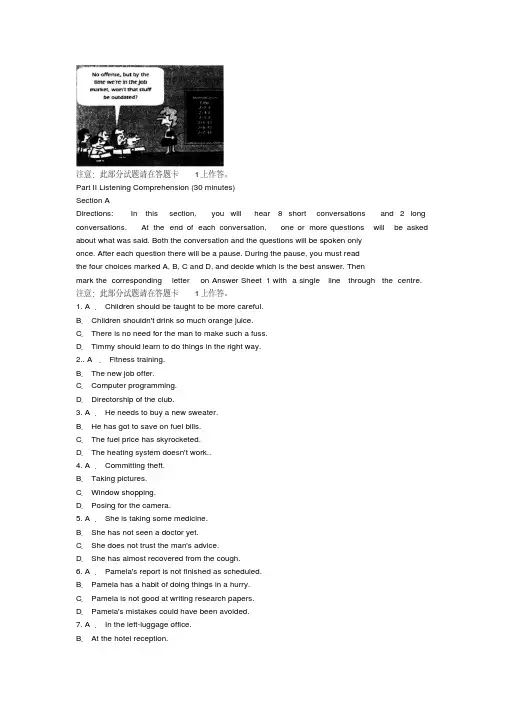
注意:此部分试题请在答题卡1上作答。
Part II Listening Comprehension (30 minutes)Section ADirections: In this section, you will hear 8 short conversations and 2 long conversations. At the end of each conversation, one or more questions will be asked about what was said. Both the conversation and the questions will be spoken onlyonce. After each question there will be a pause. During the pause, you must readthe four choices marked A, B, C and D, and decide which is the best answer. Thenmark the corresponding letter on Answer Sheet 1 with a single line through the centre. 注意:此部分试题请在答题卡1上作答。
1. A. Children should be taught to be more careful.B. Children shouldn't drink so much orange juice.C. There is no need for the man to make such a fuss.D. Timmy should learn to do things in the right way.2.. A. Fitness training.B. The new job offer.C. Computer programming.D. Directorship of the club.3. A. He needs to buy a new sweater.B. He has got to save on fuel bills.C. The fuel price has skyrocketed.D. The heating system doesn't work..4. A. Committing theft.B. Taking pictures.C. Window shopping.D. Posing for the camera.5. A. She is taking some medicine.B. She has not seen a doctor yet.C. She does not trust the man's advice.D. She has almost recovered from the cough.6. A. Pamela's report is not finished as scheduled.B. Pamela has a habit of doing things in a hurry.C. Pamela is not good at writing research papers.D. Pamela's mistakes could have been avoided.7. A. In the left-luggage office.B. At the hotel reception.-C. In a hotel room.D. At an airport.8. A. She was an excellent student at college.B. She works in the entertainment business.C. She is fond of telling stories in her speech.D. She is good at conveying her message.Questions 9 to 11 are based on the conversation you have just heard.9. A. Arranging the woman's appointment with Mr. Romero.B. Fixing the time for the designer's latest fashion show.C. Talking about an important gathering on Tuesday.D. Preparing for the filming on Monday morning.10. A. Her travel to Japan.B. The awards ceremony.C. The proper hairstyle for her new role.D. When to start the makeup session.11. A. He is Mr. Romero's agent.B. He is an entertainment journalist.C. He is the woman's assistant.D. He is a famous movie star.Questions 12 to 15 are based on the conversation you have just heard.12. A. Make an appointment for an interview.B. Send in an application letter.C. Fill in an application form.D. Make a brief self-introduction on the phone.13. A. Someone having a college degree in advertising.B. Someone experienced in business management.C. Someone ready to take on more responsibilities.D. Someone willing to work beyond regular hours.14. A. Travel opportunities.B. Handsome pay.C. Prospects for promotion.D. Flexible working hours.15. A. It depends on the working hours.B. It is about 500 pounds a week.C. It will be set by the Human Resources.D. It is to be negotiated.Section BDirections: In this section, you will hear 3 short passages. At the end of eachpassage, you will hear some questions. Both the passage and the questions will bespoken only once. After you hear a question you must choose the best answer fromthe four choices marked A, B, C and D. Then mark the corresponding letter on Answer-Sheet 1 with a single line through the centre.注意:此部分试题请在答题卡1上作答。
2013年6月大学英语四级听力试题-推荐下载
2013年6月四级英语真题与听力原文及答案解析 大学英语

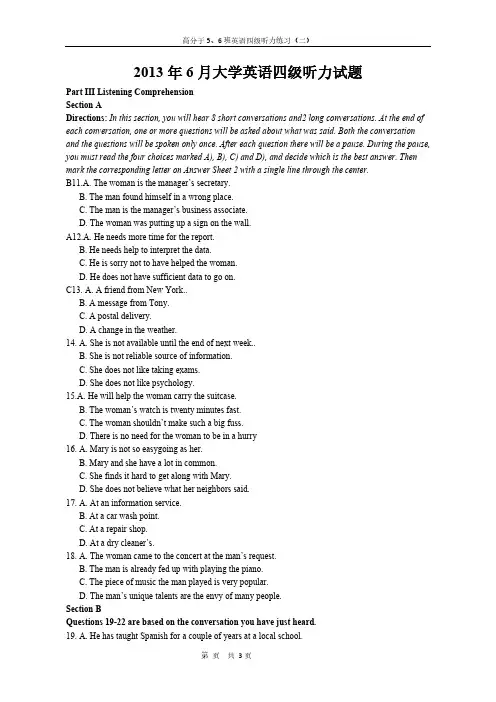
2013年6月大学英语四级考试真题(标准卷)Total score: 710 Total time allowed: 125 minutes特注:2013年6月大学四级考试采用多题多卷形式,本试卷含两套写作题,考生可以任选其一。
Part I Writing (多题多卷写作题1) (30 minutes)Directions:For this part, you are allowed 30 minutes to write a short essay. You should start your essay with a brief description of the picture and then express your views on the importance of doing small things before undertaking something big. You should write at least 120 words but no more than 180 words.Part I Writing (多题多卷写作题2) (30 minutes)Directions:For this part, you are allowed 30 minutes to write a short essay. You should start your essay with a brief description of the picture and then expressyour views on the importance of reading literature. You should write at least 120 words but no more than 180 words.Part II ReadingComprehension (Skimming and Scanning) (15 minutes)Directions:In this part, you will have 15 minutes to go over the passage quickly and answer the questions on Answer Sheet 1. For questions 1-7, choose the best answer from the four choices marked A), B), C) and D). For questions 8-10, complete the sentences with the information given in the passage.Can Digital Textbook Truly Replace the Print Kind?The shortcomings of traditional print edition textbooks are obvious: For starters they’re heavy, with the average physics textbook weighing 3.6 pounds. They’re also expensive, especially when you factor in the average college student’s limited budget, typically costing hundre ds of dollars every semester.But the worst part is that print version of textbooks are constantly undergoing revisions. Many professors require that their students use only the latest versions in the classroom, essentially rendering older texts unusable. For students, it means they’re basically stuck with a four pound paper-weight that they can’t sell back.Which is why digital textbooks, if they live up to their promise, could help ease many of these shortcomings. But till now, they’ve been something li ke a mirage (幻影)in the distance, more like a hazy(模糊的)dream than an actual reality. Imagine the promise: Carrying all your textbooks in a 1.3 pound iPad? It sounds almost too good to be true.But there are a few pilot schools already making the transition(过渡)over to digital books. Universities like Cornell and Brown have jumped onboard. And one medical program at the University of California, Irvine, gave their entire class iPads with which to download textbooks just last year.But not all were eager to jump aboard.“People were tired of using the iPad textbook besides using it for reading,” says Kalpit Shah, who will be going into his second year at Irvine’s medical program this fall. “They weren’t using it as a source of communication because they couldn’t read or write in it. So a third of the people in my program were using the iPad in class to take notes, the other third were using laptops and the last third were using paper and pencil.”The reason it hasn’t caught on yet, he tells me, is that the functionality of e-edition textbooks is incredibly limited, and some students just aren’t motivated to learn new study behavior.But a new application called Inkling might change all that. The company just released an updated version last week, and it’ll be utilized in over 50 undergraduate and graduate classrooms this coming school year.“Digital textbooks are not going to catch on,” says Inkling CEO Matt Maclnnis as he’s giving me a demo(演示)over coffee. “What I mean by that is the current perspective of the digital t extbook is it’s an exact copy of the print book. There’s Course Smart, etc., these guys who take any image of the page and put it on a screen. If that’s how we’re defining digital textbooks, there’s no hope of that becoming a mainstream product.”He calls Inkling a platform for publishers to build rich multimedia content from the ground up, with a heavy emphasis on real-world functionality. The traditional textbook merely serves as a skeleton.At first glance Inkling is an impressive experience. After swiping(敲击)into the iPad app (应用软件), which you can get for free here, he opens up a few different types of textbooks.Up first is a chemistry book. The boot time is pretty fast, and he navigates through (浏览) a few chapters before swiping into a fully rendered 3D molecule that can be spun around to view its various building blocks. “Publishers give us all of the source media, artwork, videos,” he says, “We help them think through how to actually build something for this platform.”Next he pulls up a music composition textbook, complete with playable demos. It’s a learning experience that attacks you from multiple sensory directions. It’s clear why this would be something a music major would love.But the most exciting part about Inkling, to me, is its notation(批注)system. Here’s how it works!When you purchase a used print book, it comes with its previous owner’s highlights and notes in the margins. It uses the experience of someone who already went through the class to help improve your reading (how much you trust each notation is obviously up to you).But with lnkling, you can highlight a piece of content and make notes. Here’s where things get interesting, though: If a particularly important passage is highlighted by multiple lnkling users, that information is stored on the cloud and is available for anyone reading the same textbook to come across. That means users have access to notes from not only their classmates and Facebook friends, but anyone who purchased the book across the country. The best comments arethen sorted democratically by a voting system, meaning that your social learning experience is shared with the best and brightest thinkers.As a bonus, professors can even chime in (插话) on discussions. They’ll be able to answer the questions of students who are in their class directly via the interactive book.Of course, Inkling addresses several of the other shortcomings in traditional print as well. Textbook versions are constanly updated, motivating publishers by minimizing production costs (the big ones like McGraw-Hill are already onboard). Furthermore, students will be able to purchase sections of the text instead of buying the whole thing, with individual chapters costing as little as $2.99.There are, however, challenges.“It takes efforts to build each book,” Maclnnis tells me. And it’s clear why.Each interactive textbook is a media-heavy experience built from the ground up, and you can tell that it takes a respectable amount of manpower to put together each one.For now the app is also iPad-exclusive, and though a few of these educational institutions are giving the hardware away for free, for other students who don’t have such a luxury it’s an added layer of cost — and an expensive one at that.But this much is clear. The traditional textbook model is and has been broken for quite some time. Whether digitally interactive ones like Inkling actually take off or not remains to be seen, and we probably won’t have a definite answer for the next few years.However the solution to any problem begins with a step in a direction. And at least for now, that hazy mirage in the distance? A little more tangible (可触摸的), a little less of a dream.1. The biggest problem with traditional print textbooks is that _____.A) A) they are not reused once a new edition comes outB) they cost hundreds of dollars every semesterC) they are too heavy to carry aroundD) they take a longer time to revise2. What does the author say about digital textbooks?A) It’s not likely they will replace traditional textbooks.B) They haven’t fixed all the shortcomings of print books.C) Very few of them are available in the market.D) Many people still have difficulty using them.3. According to Kalpit Shah, some students still use paper and pencil because _____.A) they find it troublesome to take notes with an iPadB) they are unwilling to change their study behaviorC) they have get tired of reading on the iPadD) they are not used to reading on the screen4. Inkling CEO Matt Maclnnis explains that the problem with Course Smart’s current digital textbooks is that _____.A) they have to be revised repeatedlyB) they are inconvenient to use in classC) they are different from most mainstream productsD) they are no more than print versions put on a screen5. Matt Maclnnis describes the updated version of lnkling as _____.A) a good example of the mainstream productsB) a marvelous product of many creative ideasC) a platform for building multimedia contentD) a mere skeleton of traditional textbooks6. The author is most excited about lnkling’s notation system because one can _____. A) share his learning experience with the best and brightest thinkersB) participate in discussions with classmates and Facebook friendsC) vote for the best learners democraticallyD) store information on the cloud7. One additional advantage of the interactive digital textbook is that _____.A) students can switch to different discussions at any pointB) students can download relevant critical commentsC) professors can join in students’ online discussionsD) professors can give prom pt feedback to students’ homework8. One of the challenges to build an interactive digital textbook from the ground up is that is takes a great deal of _____.9. One problem for students to replace traditional textbooks with interactive digital ones is the high ______ of the hardware.10. According to the author, whether digital textbooks will catch on still _____. Part III Listening Comprehension (35 minutes)Section ADirections:In this section, you will hear 8 short conversations and 2 long conversations. At the end of each conversation, one or more questions will be asked about what was said. Both the conversation and the questions will be spoken only once. After each question there will be a pause. During the pause, you must read the four choices marked A), B), C) and D), and decide which is the best answer. Then mark the corresponding letter on Answer Sheet 2 with a single line through the centre.11. A) Children should be taught to be more careful.B) Children shouldn’t drink so much orang e juice.C) There is no need for the man to make such a fuss.D) Timmy should learn to do things in the right way.12. A) Fitness training. B) The new job offer.C) Computer programming. D) Directorship of the club.13. A) He needs to buy a new sweater. B) He has got to save on fuel bills.C) The fuel price has skyrocketed. D) The heating system doesn’t work.14. A) Committing theft. B) Taking pictures.C) Window shopping. D) Posing for the camera.15. A) She is taking some medicine. B) She has not seen a doctor yet.C) She does not trust the man’s advice. D) She has almost recovered from the cough.16. A) Pamela’s report is not finished as scheduled.B) Pamela has a habit of doing things in a hurry.C) Pamela is not good at writing research papers.D) Pamela’s mistakes could have been avoided.17. A) In the left-luggage office. B) At the hotel reception.C) In a hotel room. D) At an airport.18. A) She was an excellent student at college. B) She works in the entertainment business.C) She is fond of telling stories in her speech. D) She is good at conveying her message.Questions 19 to 21 are based on the conversation you have just heard.19. A) Arranging the woman’s appointment with Mr. Romero.B) Fixing the time for the designer’s latest fashion show.C) Talking about an important gathering on Tuesday.D) Preparing for the filming on Monday morning.20. A) Her travel to Japan.B) The awards ceremony.C) The proper hairstyle for her new role.D) When to start the makeup session.21. A) He is Mr. Romero’s agent.B) He is an entertainment journalist.C) He is the woman’s assistant.D) He is a famous movie star.Questions 22 to 25 are based on the conversation you have just heard.22. A) Make an appointment for an interview.B) Send in an application letter.C) Fill in an application form.D) Make a brief self-introduction on the phone.23. A) Someone having a college degree in advertising.B) Someone experienced in business management.C) Someone ready to take on more responsibilities.D) Someone willing to work beyond regular hours.24. A) Travel opportunities.B) Handsome pay.C) Prospects for promotion.D) Flexible working hours.25. A) It depends on the working hours.B) It’s about 500 pound a week.C) It will be set by the Human Resources.D) It is to be negotiated.Section BDirections:In this section you will hear 3 short passages. At the end of each passage, you will hear some questions. Both the passage and the questions will be spoken only once. After you hear a question, you must choose the best answer from the four choices marked A), B), C) and D). Then mark the corresponding letter on Answer Sheet 2 with a single line through the centre.Passage OneQuestions 26 to 29 are based on the passage you have just heard.26. A) To give customers a wider range of choices.B) To make shoppers see as many items as possible.C) To supply as many varieties of goods as it can.D) To give space for more profitable products.27. A) On the top shelves.B) On the bottom shelves.C) On easily accessible shelves.D) On clearly marked shelves.28. A) Many of them buy things on impulse.B) A few of them are fathers with babies.C) A majority of them are young couples.D) Over 60% of them make shopping lists.29. A) Sales assistants promoting high margin goods.B) Sales assistants following customers around.C) Customers competing for good bargains.D) Customers losing all sense of time.Passage TwoQuestions 30 to 32 are based on the passage you have just heard.30. A) Teaching mathematics at a school.B) Doing research in an institute.C) Studying for a college degree.D) Working in a high-tech company.31. A) He studied the designs of various choices.B) He did experiments to different materials.C) He bought an alarm clock with a pig face.D) He asked different people for their opinions.32. A) Its automatic mechanism.B) Its manufacturing pattern.C) Its way of waking people up.D) Its funny-looking pig face.Questions 33 to 35 are based on the passage you have just heard.33. A) It’s often caused by a change of circumstances.B) It usually doesn’t require any special attention.C) It usually appears all of a sudden.D) It usually lasts for several years.34. A) They can’t mix well with others.B) They emotionally receive their friends.C) They depend severely on family members.D) They share similar interests with friends.35. A) They lack consistent support from peers.B) They doubt their own popularity.C) They were born psychologically weak.D) They focus too much attention on themselves.Section CDirections:In this section, you will hear a passage three times. When the passage is read for the first time, you should listen carefully for its general idea. When the passage is read for the second time, you are required to fill in the blanks numbered from 36 to 43 with the exact words you have just heard. For blanks numbered from 44 to 46 you are required to fill in the missing information. For these blanks you can either use the exact words you have just heard or write down the main points in your own words. Finally when the passage is read for the third time, you should check what you have written.There was a time when any personal information that was gathered about us was typed on a piece of paper and (36) ________ away in a file cabinet. It could remain there for years and, often (37) ________, never reach the outside world.Things have done a complete about-face since then. (38) ________ for the change has been the astonishingly (39) ________ development in recent years of the computer. Today, any data that is(40) ________ about us in one place or another —and for one reason or another — can be stored in a computer bank. It can then be easily passed to other computer banks. They are owned by (41) ________ and by private businesses and corporations, lending (42) ________, direct mailing and telemarketing firms, credit bureaus, credit card companies, and government (43) ________ at the local, state, and federal level.A growing number of Americans are seeing the accumulation and distribution of computerized date as a frightening invasion of their privacy. (44) ____________________________________________________________________ as the computer becomes increasingly efficient, easier to operate, and less costly to purchase and maintain. In 1970, a national survey showed that (45) ___________________________________________________ _________________. Seven years later, 47 percent expressed the same worry. (46) ____________ ________________________________________________________.Part IV Reading Comprehension (Reading in Depth) (25 minutes) Section ADirections:In this section, there is a passage with ten blanks. You are required to select one word for each blank from a list of choices given in a word bank following the passage. Read the passage through carefully before making your choices. Each choice in the bank is identified by a letter. Please mark the corresponding letter for each item on Answer Sheet 2 with a single line through the centre. You may not use any of the words in the bank more than once.Questions 47 to 56 are based on the following passage.Walking, if you do it vigorously enough, is the overall best exercise for regular physical activity. It requires no equipment, everyone knows how to do it and it carries the 47 risk of injury. The human body is designed to walk. You can walk in parks or along a river or in your neighborhood. To get 48 benefit from walking, aim for 45 minutes a day, an average of five days a week.Strength training is another important 49 of physical activity. Its purpose is to build and 50 bone and muscle mass, both of which shrink with age. In general, you will want to do strength training two or three days a week, 51 recovery days between sessions.Finally, flexibility and balance training are 52 important as the body ages. Aches and pains are high on the list of complaints in old age. The result of constant muscle tension and stiffness of joints, many of them are 53 , and simple flexibility training can 54 these by making muscles stronger and keeping joints lubricated (润滑). Some of this you do whenever you stretch. If you watch dogs and cats, you’ll get an idea of how natural it is. The general55 is simple: whenever the body has been in one position for a while, it is good to56 stretch it in an opposite position.A) allowing F) helping K) preventB) avoidable G) increasingly L) principleC) briefly H) lowest M) provokeD) component I) maintain N) seriouslyE) determined J) maximum O) topicSection BDirections: There are 2 passages in this section. Each passage is followed by some questions or unfinished statements. For each of them there are four choices marked A), B), C) and D). You should decide on the best choice and mark the corresponding letter on Answer Sheet 2 with a single line through the centre.Passage OneQuestions 57 to 61 are based on the following passage.Junk food is everywhere. We’re eating way too much of it. Most of us know what we’re doing and yet w e do it anyway.So here’s a suggestion offered by two researchers at the Rand Corporation: Why not take a lesson from alcohol control policies and apply them to where food is sold and how it’s displayed?“Many policy measures to control obesity(肥胖症)assume that people consciously and rationally choose what and how much they eat and therefore focus on providing information and more access to healthier foods,” note the two researchers.“In contrast,” the researchers continue, “many regulations that don’t assume people make rational choices have been successfully applied to control alcohol, a substance — like food — of which immoderate consumption leads to serious health problems.”The research references studies of people’s behavior with food and alcohol and results of alcohol restrictions, and then lists five regulations that the researchers think might be promising if applied to junk foods. Among them: Density restrictions: licenses to sell alcohol aren’t handed out unplanned to all comers but are allotted(分配)based on the number of places in an area that already sell alcohol. These make alcohol less easy to get and reduce the number of psychological cues to drink.Similarly, the researchers say, being presented with junk food stimulates our desire to eat it. So why not limit the density of food outlets, particularly ones that sell food rich in empty calories? And why not limit sale of food in places that aren’t primarily food stores?Display and sales restrictions: California has a rule prohibiting alcohol displays near the cash registers in gas stations, and in most places you can’t buy alcohol at drive-through facilities. At supermarkets, food companies pay to have their wares in places where they’re easily seen. One could remove junk food to the back of the store and ban them from the shelves at checkout lines. The other measures include restricting portion sizes, taxing and prohibiting special price deals for junk foods, and placing warning labels on the products.57. What does the author say about junk food?A) People should be educated not to eat too much.B) It is widely consumed despite its ill reputation.C) Its temptation is too strong for people to resist.D) It causes more harm than is generally realized.58. What do the Rand researchers think of many of the policy measures to control obesity?A) They should be implemented effectively.B) They provide misleading information.C) They are based on wrong assumptions.D) They help people make rational choices.59. Why do policymakers of alcohol control place density restrictions?A) Few people are able to resist alcohol’s temptations.B) There are already too many stores selling alcohol.C) Drinking strong alcohol can cause social problems.D) Easy access leads to customers’ over-consumption.60. What is the purpose of California’s rule about alcohol display in gas stations?A) To effectively limit the density of alcohol outlets.B) To help drivers to give up the habit of drinking.C) To prevent possible traffic jams in nearby areas.D) To get alcohol out of drivers’ immediate sight.61. What is the general guideline the Rand researchers suggest about junk food control?A) Guiding people to make rational choices about food.B) Enhancing people’s awareness of their own health.C) Borrowing ideas from alcohol control measures.D) Resorting to economic, legal and psychological means.Passage TwoQuestions 62 to 66 are based on the following passage.Kodak’s decision to file for bankruptcy(破产)protection is a sad, though not unexpected, turning point for a leading American corporation that pioneered consumer photography and dominated the film market for decades, but ultimately failed to adapt to the digital revolution.Although many attribute Kodak’s downfall to “complacency(自满) ,” that explanation doesn’t acknow-ledge the lengths to which the company went to reinvent itself. Decades ago, Kodak anticipated that digital photography would overtake film — and in fact, Kodak invented the first digital camera in 1975 — but in a fateful decision, the company chose to shelf its new discovery to focus on its traditional film business.It wasn’t that Kodak was blind to the future, said Rebecca Henderson, a professor at Harvard Business School, but rather that it failed to execute on a strategy to confront it. By the time the company realized its mistake, it was too late.Kodak is an example of a firm that was very much aware that they had to adapt, and spent a lot of money trying to do so, but ultimately failed. Large companies have a difficult time switching into new markets because there is atemptation to put existing assets into the new businesses.Although Kodak anticipated the inevitable rise of digital photography, its corporate(企业的)culture was too rooted in the successes of the past for it to make the clean break necessary to fully embrace the future. They were a company stuck in time. Their history was so important to them. Now their history has become a liability.Kodak’s do wnfall over the last several decades was dramatic. In 1976, the company commanded 90% of the market for photographic film and 85% of the market for cameras. But the 1980s brought new competition from Japanese film company Fuji Photo, which undermined Kodak by offering lower prices for film and photo supplies. Kodak’s decision not to pursue the role of official film for the 1984 Los Angeles Olympics was a major miscalculation. The bid went instead to Fuji, which exploited its sponsorship to win a permanent foothold in the marketplace.62. What do we learn about Kodak?A) It went bankrupt all of a sudden.B) It is approaching its downfall.C) It initiated the digital revolution in the film industry.D) It is playing a dominant role in the film market.63. Why does the author mention Kodak’s invention of the first digital camera?A) To show its early attempt to reinvent itself.B) To show its effort to overcome complacency.C) To show its quick adaptation to the digital revolution.D) To show its will to compete with Japan’s Fuji photo.64. Why do large companies have difficulty switching to new markets?A) They find it costly to give up their existing assets.B) They tend to be slow in confronting new challenges.C) They are unwilling to invest in new technology.D) They are deeply stuck in their glorious past.65. What does the author say Kodak’s history has become?A) A burden.B) A mirror.C) A joke.D) A challenge.66. What was Kodak’s fatal mistake?A) Its blind faith in traditional photography.B) Its failure to see Fuji photo’s emergence.C) Its refusal to sponsor the 1984 Olympics.D) Its overconfidence in its corporate culture.Part V Cloze (15 minutes)Directions:There are 20 blanks in the following passage. For each blank there are four choices marked A), B), C) and D). You should choose the ONE that best fits into the passage. Then mark the corresponding letter on Answer Sheet 2 with a single line through the centre.Whether you think you need daytime rest or not, picking up a nap(午睡)habit is a smart, healthy move. The Mayo Clinic says naps 67 relaxation, better mood and alertness, and a sharper working 68 . A 2008 British study found that compared to getting more nighttime sleep, a mid-day nap was the best way to cope 69 the mid-afternoon sleepiness.According to the Harvard Health Letter, several studies have shown that people 70 new information better when they take a nap shortly after learning it. And, most 71 , a 2007 study of nearly 24,000 Greek adults in the Archives of Internal Medicine found that people who napped 72 had a 37 percent reduced risk of dying 73 heart disease compared to people who didn’t nap.Of course, napping isn’t74 for everyone. If you’re suffering from inability to sleep, naps that are too long or taken too late in the day can 75 with your ability to fall or stay asleep at night.But for most, naps can make you feel sharper and happier. Naps provide different benefits 76 on how long they are. A 20-minute nap will boost alertness and concentration; a 90-minute snooze(小睡)can 77 creativity.According to , you 78 a natural dip in body temperature 79 1 p.m. and 3 p.m. A short nap at this time can boost alertness 80 several hours and, for most people, shouldn’t81 being able to fall asleep at night.Pick a dark, cozy place that’s not too warm or too chilly. 82 snapping on the couch instead of in bed, so you’re less83 to snooze for too long.Surprisingly, the best place to take a nap may be a hammock(吊床)if you have one. A Swiss study 84 last year found that people fell asleep faster and had deeper sleep when they napped in a hammock than in a bed. That same rocking 85 that puts babies to sleep works 86 for grown-ups, too.67. A) enforce B) promote C) operate D) support68. A) feeling B) frame C) sense D) mind69. A) with B) aside C) about D) upon70. A) remark B) consider C) remember D) concern71. A) reportedly B) incredibly C) constantly D) frankly72. A) regularly B) enormously C) heavily D) strongly73. A) off B) under C) against D) from74. A) exact B) correct C) right D) precise75. A) influence B) eliminate C) compete D) interfere76. A) focusing B) depending C) relying D) basing77. A) enlarge B) engage C) enhance D) enlighten。
2013年6月四级英语真题与听力原文及答案解析完整版

11. A) Children should be taught to be more careful.B) Children shouldn’t drink so much orange juice.C) There is no need for the man to make such a fuss.D) Timmy should learn to do things in the right way.12. A) Fitness training. B) The new job offer.C) Computer programming. D) Directorship of the club.13. A) He needs to buy a new sweater. B) He has got to save on fuel bills.C) The fuel price has skyrocketed. D) The heating system doesn’t work.14. A) Committing theft. B) Taking pictures.C) Window shopping. D) Posing for the camera.15. A) She is taking some medicine. B) She has not seen a doctor yet.C) She does not trust the man’s advice. D) She has alm ost recovered from the cough.16. A) Pamela’s report is not finished as scheduled.B) Pamela has a habit of doing things in a hurry.C) Pamela is not good at writing research papers.D) Pamela’s mistakes could have been avoided.17. A) In the left-luggage office. B) At the hotel reception.C) In a hotel room. D) At an airport.18. A) She was an excellent student at college. B) She works in the entertainment business.C) She is fond of telling stories in her speech. D) She is good at conveying her message.Passage OneQuestions 26 to 29 are based on the passage you have just heard.26. A) To give customers a wider range of choices.B) To make shoppers see as many items as possible.C) To supply as many varieties of goods as it can.D) To give space for more profitable products.27. A) On the top shelves.B) On the bottom shelves.C) On easily accessible shelves.D) On clearly marked shelves.28. A) Many of them buy things on impulse.B) A few of them are fathers with babies.C) A majority of them are young couples.D) Over 60% of them make shopping lists.29. A) Sales assistants promoting high margin goods.B) Sales assistants following customers around.C) Customers competing for good bargains.D) Customers losing all sense of time.Passage TwoQuestions 30 to 32 are based on the passage you have just heard.30. A) Teaching mathematics at a school.B) Doing research in an institute.C) Studying for a college degree.D) Working in a high-tech company.31. A) He studied the designs of various choices.B) He did experiments to different materials.C) He bought an alarm clock with a pig face.D) He asked different people for their opinions.32. A) Its automatic mechanism.B) Its manufacturing pattern.C) Its way of waking people up.D) Its funny-looking pig face.Questions 33 to 35 are based on the passage you have just heard.33. A) It’s often caused by a change of circumstances.B) It usually doesn’t require any special at tention.C) It usually appears all of a sudden.D) It usually lasts for several years.34. A) They can’t mix well with others.B) They emotionally receive their friends.C) They depend severely on family members.D) They share similar interests with friends.35. A) They lack consistent support from peers.B) They doubt their own popularity.C) They were born psychologically weak.D) They focus too much attention on themselves.Section CThere was a time when any personal information that was gathered about us was typed on a piece of paper and (36) ________ away in a file cabinet. It could remain there for years and, often (37) ________, never reach the outside world.Things have done a complete about-face since then. (38) ________ for the change has been the astonishingly (39) ________ development in recent years of the computer. Today, any data that is(40) ________ about us in one place or another — and for one reason or another — can be stored in a computer bank. It can then be easily passed to other computer banks. They are owned by (41) ________ and by private businesses and corporations, lending (42) ________, direct mailing and telemarketing firms, credit bureaus, credit card companies, and government (43) ________ at the local, state, and federal level.A growing number of Americans are seeing the accumulation and distribution of computerized date as a frightening invasion of their privacy. (44) ____________________________________________________________________ as the computer becomes increasingly efficient, easier to operate, and less costly to purchase and maintain. In 1970, a national survey showed that (45) ___________________________________________________ _________________. Seven years later, 47 percent expressed the same worry. (46) ____________________________________________________________________.Part III Listening Comprehension11.W: What are you doing in here, Sir? Didn't you see the private sign over there?M: I'm sorry. I didn't notice it when I came in. I'm looking for the manager's office.Q: What do we learn from the conversation?12.W: Mike, what's the problem? You've known from month the report is due today.M: I know, but I'm afraid I need another few days. The data is hard to interpret than I expected.Q: What does the man mean?13.W: Excuse me, Tony. Has my parcel from New York arrived?M: Unfortunately, it's been delayed due to the bad weather.Q: What is the woman waiting for?14.W: Pam said we won't have the psychology test until the end of next week.M: Ellen, you should know better than to take Pam's words for anything.Q: What doesthe man imply about Pam?15W: Tom, would you please watch my suitcase for a minute? I need to go make a quick phone call.M: Yeah, sure. Take your time. Our train doesn’t leave for another twenty minutes.Q: What does the man mean?16M: Frankly, Mary is not what I'd called easy-going.W: I see. People in our neighborhood find it hard to believe she's my twin sister.Q: What does the woman imply?17M: How soon do you think this can be cleaned?W: We have same day service, sir. You can pick up your suit after five o'clock.Q: Where does the conversation most probably take place?18W: I really enjoy that piece you just play on the piano. I bet you get a lot of requests for it.M: You said it. People just can't get enough of it.Q: What do we learn from the conversation?Passage 1Questions 26 to 29 are based on the passage you have just heard.Farmington, Utah, is a more pleasant community since a local girls' 4-H club improved Main Street. Six 4-H girls worked to clean the 72 foot curbside that was covered with weeds, rocks and trash. Each member volunteered to clean up and to dig in plot, five flats of flowers. They also took terms in watering, weeding and maintaining the plot. Participation in this project helped the girls developed a new attitude towards their parents of their own homes; they've learned how to work with tools, and improve their work habits. One mother said that before her daughter was involved in this project, she would not even pour a weed. The experience on Main Street stimulated self-improvement, and encouraged members to take pride in their home grounds and the total community. City officials cooperated with the 4-H members in planting trees, building cooking facilities, pick-me tables, swings and public rest rooms. The 4-H girls planted trees and took care of them during the early stages of growth. The total park project needed more plantings inthe following years. Members of the 4-H club agreed to follow the project through to completion, because they receive satisfaction from the results of constructive work. The project is a growing one and is spread from the park to the school and the shopping center. Trees and flowers have all been planted in the shopping center, making the atmosphere pleasant.Questions 26 to 29 are based on the passage you have just heard.26. What do we learn about Main Street in Farmington?27. What do the 4-H club members do about the curbside?28. What have the 4-H girls learned from the project?29. Why do the 4-H girls agree to follow the park project through to complete.Question 30 to 32 are based on the passage you have just heard.Passage 2According to a survey on reading conducted in 2001 by the U.S. National Education Association (NEA), young Americans say reading is important, more important than computers and science. Over 50% of the 12 to 18 years old interviewed say they enjoy reading a lot. 79% find it stimulating and interesting. And 87% think it is relaxing. About 68% of those surveyed disagreed with the opinion that reading is boring or old-fashioned.Over half teenagers interviewed said they read more than ten books a year. The results also show that middle school students read more books than high schoolers. Over 66% of teens like to read fiction, such as novels and stories. Over 26% are interested innon-fiction, such history books.64% of students listed reading stories about people my own age. That's a favorite topic. Mysteries and detective stories came second on the list at 53%. Just under 50% said they were interested in reading about their own culture in tradition. Of the teenagers who participated in the survey, 49% said that libraries are where they get most of their books. However, many complain that their school libraries do not have enough up-to-date interesting books and magazines. Even though many teenagers in the US enjoy reading, they still have other interests. When asked which activity would be the most difficult to give up for a week, 48% said listening to music. TV would be difficult to give up for 25% of those surveyed.Question 30 to 32 are based on the passage you have just heard.30. What does the survey on teenager reading show?31. What books are most popular among teenagers according to the survey?32. What activity do teenagers find the most difficult to give up for a week?Passage 2【总评】本篇文章以阅读调查报告为话题,贴近生活,容易理解。
2013年全国英语四级考试听力真题、答案及原文(6月)
2013年全国英语四级考试听力真题、答案及原文(6月)听力试题11. A) The woman is the manager's secretary. B) The man found himself in a wrong place. C) The man is the manager's business associate. D) The woman was putting up a sign on the wall. 12. A) He needs more time for the report. B) He needs help to interpret the data. C) He is sorry not to have helped the woman. D) He does not have sufficient data to go on. 13. A) A friend from New York. B) A message from Tony. C) A postal delivery. D) A change in the weather. 14. A) She is not available until the end of next week. B) She is not a reliable source of information. C) She does not like taking exams. D) She does not like psychology. 15. A) He will help the woman carry the suitcase. B) The woman's watch is twenty minutes fast. C) The woman shouldn't make such a big fuss. D) There is no need for the woman to be in a hurry. 16. A) Mary is not so easygoing as her. B) Mary and she have a lot in common. C) She finds it hard to get along with Mary. D) She does not believe what her neighbors said. 17. A) At an information service. B) At a car wash point. C) At a repair shop. D) At a dry cleaner's. 18. A) The woman came to the concert at the man's request. B) The man is already fed up with playing the piano. C) The piece of music the man played is very popular. D) The man's unique talents are the envy of many people. Questions 19 to 22 are based on the conversation you have just heard. 19. A) He has taught Spanish for a couple of years at a local school. B) He worked at the Brownstone Company for several years. C) He owned a small retail business in Michigan years ago. D) He has been working part-time in a school near Detroit. 20. A) He prefers a full-time job with more responsibility. B) He is eager to find a job with an increased salary. C) He likes to work in a company close to home. D) He would rather get a less demanding job. 21. A) Sports. B) Travel. C) Foreign languages. D) Computer games 22. A) When he is supposed to start work. B) What responsibilities he would have. C) When he will be informed about his application. D) What career opportunities her company can offer. Questions 23 to 25 are based on the conversation you have just heard. 23. A) She is pregnant. B) She is over 50. C) She has just finished her project. D) She is a good saleswoman. 24. A) He takes good care of Lisa. B) He is the CEO of a giant company. C) He is good at business management. D) He works as a sales manager. 25. A) It is in urgent need of further development. B) It produces goods popular among local people. C) It has been losing market share in recent years. D) It is well positioned to compete with the giants. Section B Directions: In this section, you will hear 3 short passages. At the end of each passage, you willhear some questions. Both the passage and the questions will be spoken only once. After youhear a question, you must choose the best answer from the four choices marked A), B), C) andD). Then mark the corresponding letter on Answer Sheet 2 with a single line through thecentre. 注意:此部分试题请在答题卡2上作答。
2013年6月四级听力(第2套)
[01:45.84]College English Test (Band 4)Part ⅢListening ComprehensionSection ADirections: In this section, you will hear 8 short conversations and 2 long conversations. At the end of each conversation, one or more questions will be asked about what was said. Both the conversation and the questions will be spoken only once. After each question there will be a pause. During the pause, you must read the four choices marked A), B), C), and D), and decide which is the best answer. Then mark the corresponding letter on Answer Sheet 2with a single line through the centre. Now let’s begin with the 8 short conversations.Now let’s begin with the 8 short conversations.[02:39.49]11. M: I don’t know what to do with Timmy. This morning I found orange juice spilled all over the kitchen floor.W: Don’t be so hard on him. He’s only four.Q: What does the woman mean?[03:10.96]12. W: Excuse me, sir. I would like to know about the fitness training program in your club.M: I’ll have you speak with the director in charge of new accounts.Q: What is the woman interested in?[03:42.22]13. W: It’s really cold in this apartment. Can we turn up the heat a little bit?M: Sorry. I’ve run out of money and can hardly pay the fuel bill. Maybe you’d better put on a sweater.Q: What does the man mean?[04:15.63]14. M: I’m sorry, Miss. But you have to come with me to the security office. The video cameras in our shop have recorded everything you did.W: No. No. I...I didn’t do anything.I’ll call the police if you dare insult me.Q: What does the man think the woman was doing?[04:53.36]15. M: I think you ought to see a doctor right away about that cough.W: Well, I’ll wait a few more days.I’m sure I’ll get over it soon.Q: What do we learn about the woman?[05:25.64]16. M: I’ve hear d that Pamela made quite a few mistakes in her lab report.W: Well, she wouldn’t have if she hadn’t been in such a hurry to get it done.Q: What does the woman imply?[05:58.07]17. M: We’d better check out before 12 o’clock, Marry. And now there are only thirty minutes left.W: Let’s hurry up. You go pay the bill and I’ll call the reception to have our luggage taken downstairs.Q: Where did this conversation most probably take place?[06:35.06]18. W: Have you ever heard this speaker before?M: Yeah. She’s excellent. She gets her point across and it’s entertaining at the same time.Q: What does the man say about the speaker?[07:06.96]Now you will hear the two long conversations.[07:11.36]Conversation OneM: What should I do about Mr. Romero? Remember? He said it was important and couldn’t wait. I think he may want you for that new movie he’s directing.W: That’s absolutely correct. Now, we have to fit him in somewhere. Mmm, what does Monday morning look like?M: That doesn’t look so good. You have a make-up session starting at 6:00. Then filming starts at 8:00 and that’s going to take the whole morning.W: Well, what’s after that?M: You have lunch with your agent to discuss the awards ceremony and you’ll have to meet him at one o’clock at the restaurant.W: Oh, terrific. Listen, I cannot miss that. But I still have to make time for Mr. Romero.M: Well, now, don’t forget you’ve got a three-o’clock appointment with your fashion designer. W: That’s right.You know he’s showing the latest fashions from Japan?You know that loose-fitting look? Those clothes are on show in this year.M: At 4:30, you have an appointment with your hairdresser. Then at 7:00, you have dinner with a journalist. Now remember, be nice to that guy.W: Do I have to? That won’t be easy and it’s likely to run late. How does Tuesday look?M: Well, you have to spend the whole morning at the photographer’s.They’ll take you photos to publicize your new movie.W: What about the afternoon? Am I free then?M: Let me see… Yes, you are free after 3:30.W: Then you can set up a meeting with Mr. Romero at 4:00.M: Ok. I’ll get on it right away.[09:03.86]Questions 19 to 21 are based on the conversation you have just heard.19. What are the speakers doing?20. What is the woman going to discuss with her agent over lunch on Monday?21. What do we learn from the conversation about the man?[10:16.28]Conversation TwoM: I’m phoning up about this job you advertise in this paper. This...er...young sales manager? W: Oh, yes.M: I’d like to apply for it. Would you send me an application form?W: No. You simply send in a written application, a letter.M: Can you tell me a bit more about the job?W: Well, we are very looking for someone who isn’t too concerned about working fairly long hours.M: What do you mean by long hours?W: This is a job which does, as the advertisement says, have travel possibilities, and very often, one would be away at weekends, for instance.M: Oh, I thought you meant working in the evenings and working overtime.W: Well, it could also mean working in the evenings. But for a managerial post, I’m afraid we don’t pay overtime. Mmm, that’s for other grades.M: Oh. What kind of money are you paying then?W: Well, this is to be negotiated. Oh, it depends partly on your experience and education. Perhaps you can tell me briefly what that is?M: I’ve just left school and got A level in geography.W: Oh, I see.M: And it’s the travel that appeals to me.That’s why I’m inquiring about the job.W: Yes, I see. What sort of salary were you thinking in terms of?M: Starting off, I thought it would be something like £500 a week?W: Well, send in a written application and then we’ll consider your case along with all the other applicants.M: Alright. Many thanks. Good bye.W: Bye.[12:02.82]Questions 22 to 25 are based on the conversation you have just heard.22. What does the woman say an applicant should do first to apply for the job?23. What kind of a person is the company looking for?24. What does the man like most about the job?25.What does the woman say about the salary if the man is accepted by the company?[13:39.79]Section BDirections:In this section, you will hear 3 short passages. At the end of each passage, you will hear some questions. Both the passage and the questions will be spoken only once. After you hear a question, you must choose the best answer from the four choices marked A), B), C) and D).Then mark the corresponding letter on Answer Sheet 2 with a single line through the centre.[14:12.34]Passage OneA typical large supermarket offers around 17 000 to 20 000 items for sale and it wants to make sure that customers see as many of them as possible. That’s why you’ll normally find the central goods like bread, vegetables and meat in completely different parts of the store. Products with a high profit margin are always placed on shelves within easy reach of the customer, while lower margin items like sugar or flower are on the top or bottom shelves. Many people make shopping list before they visit supermarkets. But even so, around 60% of all supermarket purchases are the result of decisions that are taken in the store. For this reason, supermarkets try to attract their customers by placing certain kinds of product next to each other.In the UK, beer will often be found next to items for babies because research shows that fathers of babies buy them on their way home from work and will buy beer at the same time. Research has also shown that this kind of impulse buy happens more frequently when no sales assistants are nearby. Supermarkets have made selling such a fine art that their customers often lose all sense of time. When interviewed, customers normally guess t hey’ve only spent half an hour in the supermarket even when they have been there for over 45 minutes. But that shouldn’t be too surprising. Any really profitable supermarket knows that it should keep its clocks well hidden. [16:06.68]Questions 26 to 29 are based on the passage you have just heard.26. Why are central goods displayed in totally different parts of the supermarket?27. Where are goods with a high profit margin usually found?28. What does the speaker say about supermarket goers?29. What shouldn’t be too surprising according to the speaker?[17:42.51]Passage TwoWhen Matty Sallin was working on a degree in art and technology at university, he got an interesting assignment in electronics class: Create something for the household. He decided to create an alarm clock. "Everybody has to use an alarm clock of some kind every day, and it’s extremely unpleasant!" he says. He asked different people what they'd like to wake up to instead of a noisy alarm. A lot of them said, "The smell of bacon." So Sallin invented a new kind of alarm clock: a wooden box with a pig face and a digital clock that uses the smell of cooking bacon rather than sound to wake someone up.He explains, "There's no danger of burning, because I built it carefully. It uses light bulbs instead of a flame for cooking and turns off automatically after ten minutes." Just a few easy steps are required to set the "alarm." "What you do is put in a couple of frozen strips the night before," says Sallin. Bacon is preserved, so there is no danger of its spoiling overnight. " If you set the alarm for 8:00, it will turn on at 7:50 and slow cook for ten minutes under the bulbs," he says. Then the bulbs turn off and a fan blows the smell out through the nose of the pig. "So instead of an alarm, you smell yourself awake," says Sallin. "Then you can open the door on the side and pull the bacon out and eat it."[19:31.91]Questions 30 to 32 are based on the passage you have just heard.30. What was Matty Sallin doing when he created an alarm clock?31. What did Matty Sallin do before making the new type of alarm clock?32. What makes the newly invented alarm clock so unique?[20:47.16]Passage ThreeMost people feel lonely sometimes, but it usually only lasts between a few minutes and a few hours. For some people, though, loneliness can last for years. Psychologists are studying this complex phenomenon and have identified three different types of loneliness. The first kind of loneliness is temporary. It usually disappears quickly and does not require any special attention. The second kind, situational loneliness, is a natural result of a particular situation, for example, a divorce or moving to a new place.Although this kind of loneliness can cause physical problems it usually does not last for more than a year. Unlike the second type, the third kind of loneliness usually lasts more than two years and has no specific cause. People who experience habitual loneliness have problems socializing and becoming close to others.Unfortunately, many of them think there is little or nothing they can do about it. Psychologists agree that one important factor in loneliness is a person's social contacts, for example, friends, family members, etc. We depend on various people for different reasons.For instance, our families give us emotional support and our friends share similar interests and activities. However, psychologists have found that the number of social contacts we have is not the only reason for loneliness. It is more important how many social contacts we think or expect we should have. In other words, though lonely people may have many social contacts, theysometimes feel they should have more. They question their own popularity.[22:45.98]Questions 33 to 35 are based on the passage you have just heard.33. What does the speaker say about situational loneliness?34. What problem will people have if they experience habitual loneliness?35. Why do some people suffer loneliness according to psychologists?[24:00.71]Section CDirections:In this section, you will hear a passage three times. When the passage is read for the first time, you should listen carefully for its general idea. When the passage is read for the second time, you are required to fill in the blanks numbered from 36 to 43 with the exact words you have just heard. For blanks numbered from 44 to 46 you are required to fill in the missing information. For these blanks, you can either use the exact words you have just heard or write down the main points in your own words. Finally, when the passage is read for the third time, you should check what you have written.[24:49.83]Now listen to the passage.There was a time when any personal information that was gathered about us was typed on a piece of paper and locked away in a file cabinet. It could remain there for years and, often forgotten, never reach the outside world.Things have done a complete about-face since then.Responsible for the change has been the astonishingly swift development in recent years of the computer. Today, any data that is collected about us in one place or another— and for one reason or another—can be stored in a computer bank. It can then be easily passed to other computer banks. They are owned by individuals and by private businesses and corporations, leading institutions, direct mailing and telemarketing firms, credit bureaus, credit card companies, and government agencies at the local, state, and federal level.A growing number of Americans are seeing the accumulation and distribution of computerized data as a frightening invasion of their privacy. Surveys show that the number of worried Americans has been steadily growing over the years as the computer becomes increasingly efficient, easier to operate, and less costly to purchase and maintain. In 1970, a national survey showed that 37 percent of the people questioned felt their privacy was being invaded. Seven years later, 47 percent expressed the same worry. A recent survey by a credit bureau revealed that the number of alarmed citizens had soared up to 76 percent.。
二套 2013年6月大学英语四级听力试题
2013年6月大学英语四级听力试题Part III Listening ComprehensionSection ADirections: In this section, you will hear 8 short conversations and 2 long conversations. At the end of each conversation, one or more questions will be asked about what was said. Both the conversation and the questions will be spoken only once. After each question there will be a pause. During the pause, you must read the four choices marked A), B), C) and D), and decide which is the best answer. Then mark the corresponding letter on Answer Sheet 2 with a single line through the center.11.A. The woman is the manager’s secretary.B. The man found himself in a wrong place.C. The man is the manager’s business associate.D. The woman was putting up a sign on the wall.12.A. He needs more time for the report.B. He needs help to interpret the data.C. He is sorry not to have helped the woman.D. He does not have sufficient data to go on.13. A. A friend from New York.B. A message from Tony.C. A postal delivery.D. A change in the weather.14. A. She is not available until the end of next week.B. She is not reliable source of information.C. She does not like taking exams.D. She does not like psychology.15.A. He will help the woman carry the suitcase.B. The woman’s watch is twenty minutes fa st.C. The woman shouldn’t make such a big fuss.D. There is no need for the woman to be in a hurry16. A. Mary is not so easygoing as her.B. Mary and she have a lot in common.C. She finds it hard to get along with Mary.D. She does not believe what her neighbors said.17. A. At an information service.B. At a car wash point.C. At a repair shop.D. At a dry cleaner’s.18. A. The woman came to the concert at the man’s request.B. The man is already fed up with playing the piano.C. The piece of music the man played is very popular.D. The man’s unique talents are the envy of many people.Section BQuestions 19-22 are based on the conversation you have just heard.19. A. He has taught Spanish for a couple of years at a local school.B. He worked at the Brownstone Company for several years.C. He owned a small retail business in Michigan years ago.D. He has been working part-time in a school near Detroit.20. A. He prefers a full-time job with more responsibility.B. He is eager to find a job with more responsibility.C. He likes to work in a company close to home.D. He would rather get a less demanding job.21. A. Sports. B. Travel.C. Foreign languages.D. Computer games.22. A. When he is supposed to start workB. What responsibilities he would have.C. When he will be informed about his application.D. What career opportunities her company can高分子5、6班英语四级听力练习(二)offer.Questions 23-25 are based on the conversation you have just heard.23. A. She is pregnant.B. She is over 50.C. She has just finished her project.D. She works as a sales manager.24. A. He takes good care of Lisa.B. He is the CEO of a giant company.C. He is good at business management.D. He works as a sales manager.25. A. It is in urgent need of further development.B. It produces goods popular among local people.C. It has been losing market share in recent years.D. It is well positioned to compete with the giants. Questions 26 to 29 are based on the passage you have just heard.26. A. It is lined with tall trees.B. It was widened recently.C. It has high buildings on both sides.D. It used to be dirty and disorderly.27. A. They repaved it with rocks.B. They built public restrooms on it.C. They beautified it with plants.D. They set up cooking facilities near it.28. A. What makes life enjoyable.B. How to work with tools.C. What a community means.D. How to improve health.29. A. They were obliged to fulfill the signed contract. 第- 3 - 页共3页B. They were encouraged by the city officials’ praise.C. They wanted to prove they were as capable as boys.D. They derived happiness from the constructive work.Question 30 to 32 are based on the passage you have just heard.30. A. The majority of them think it less important than computers.B. Many of them consider it boring and old-fashioned.C. The majority of the find it interesting.D. Few of them read more than ten books a year.31. A. Novels and stories.B. Mysteries and detective stories.C. History and science books.D. Books on culture and tradition.32. A. Watching TV. B. Listening to music.C. Reading magazines.D. Playing computer games. Questions 33-35 are based on the passage you have just heard.33. A. Advice on the purchase of cars.B. Information about the new green-fuel vehicles.C. Trends for the development of the motor car.D. Solutions to global fuel shortage.34. A. Limited driving range.B. Huge recharging expenses.C. The short life of batteries.D. The unaffordable high price.35. A. They need to be further improved.B. They can easily switch to natural gas.高分子5、6班英语四级听力练习(二)C. They are more cost-effective than vehicles powered by solar energy.D. They can match conventional motor cars in performance and safety.Section C Compound DictationMy favorite TV show? “The Twilight Zone.” I 36) especially like the episode called ―The Printer’s Devil. It’s about a newspaper editor who’s bein g driven out of business by a big newspaper syndicate –you know, a group of papers 37) owned by the same people.He is about to 38) commit suicide when he is interrupted by an old man who says his name is Smith. The editor is not only offered 5,000 dollars to pay off his newspaper’s 39) debts, but this Smith character also offers his services for free. It turns out that the guy 40) operates the printing machine with amazing speed, and soon he is turning out newspapers with 41) shocking headlines. The small paper is successful again. The editor is amazed at how quickly Smith gets his stories – only minutes after they happen – but soon he is 42) presented with a contract to sign. Mr. Smith, it seems, is really the devil! The editor is frightened by this news, but he is more 43) frightened by the idea of losing his newspaper, so he agrees to sign. But soon Smith is reporting the news even before it happens –and it’s all terrible –one 44) disaster after another. Anyway, there is a little more to tell, but I don’t want to ruin the story for you. I really like these old episodes of the Twilight Zone, because the stories are 45) fascinating. They are not realistic. But then again, in a 第- 5 - 页共3页way they are, because they deal with human nature.。
2013年6月大学英语四级考试(第二套)听力真题+答案
art III Listening Comprehension (30minutes)Section ADirections:In this section,you will hear 8 shortconversations and 2 long c onversations.At the endof each conversation,one or more questions will beasked about what was said.Both the conversation and the questions wil l be spoken onlyonce.After each question there will be a pause.During the pause,you must read the four choicesmarked A),B),C)and D),and decide which is the best answer,Then mark the corresponding letteron Answer S heet 1 with a single line through the centre.注意:此部分试题请在答题卡1上作答。
11.A)Children should be taught to be more careful.B)Children shouldn't drink so much orange juice.C) There is no need for the man to make such a fuss.D) Timmy should learn to do things in the right way.12.A) Fitness training.B) The newjob offer.C)Computer programming.D)Directorship of the club.13.A) Heneeds to buy a new sweater.B) He hasgot to save on fuel bills.C) The fuel price has skyrocketed.D) The heating system doesn't work.14.A)Committing theft.B) Taking pictures.C) Window shopping.D) Posing for the camera.15.A) She is taking some medicine.B) She has not seen a doctor yet.C) She does not trust the man's advice.D) She has almost recovered from the cough.16.A) Pamela's report is not finished as scheduled.B) Pamela has a habit of doing things in a hurry.C) Pamela is not good at writing research papers.D)Pamela's mistakes could have been avoided.17.A) In theleft-luggage office.B) At thehotel reception.C) In ahotel room.D) At anairport.18.A) She was an excellent student at college.B) She works in the entertainment business.C) She is fond of telling stories in her speech.D) She is good at conveying her message.Questions 19 to 21 are based on the conversation you have just heard .19.A)Arranging the woman's appointment with Mr. Romero.B) Fixing the time for the designer's latest fashion show.C) Talking about an important gathering on Tuesday.D)Preparing for the filming on Monday morning.20.A) Hertravel to Japan.B) The awards ceremony.C) The proper hairstyle for her new role.D) When to start the makeup session.21.A) He is Mr. Romero's agent.B) He is an entertainment journalist.C) He is the woman's assistant.D) He is a famous movie star.Questions 22 to 25 are based on the conversation you have just heard .22.A) Make an appointment for an interview.B) Send in an application letter.C) Fill in an application form.D) Make abrief self-introduction on the phone.23.A) Someone having a college degree in advertising.B) Someone experienced in business management.C) Someone ready to take on more responsibilities.D) Someone willing to work beyond regular hours.24.A) Travel opportunities.B)Handsome pay.C)Prospects for promotion.D)Flexible working hours.25.A) It depends on the working hours.B) It is about 500 pounds a week.C) It will be set by the Human Resources.D) It is to be negotiated.Section BDirections: In this section, you will hear 3 shortpassages. At the end of ea ch passage, you will hearsome questions. Both the passage and thequestio ns will be spoken only once. After you hear aquestion, you must choose t he best answer from thefour choices marked A), B), C) and D). Then mar k the corresponding letter on Answer Sheet 1with a single line through th e centre.注意:此部分试题请在答题卡1上作答。