
九年级英语外研版模块1-4复习
3. – Please drive ______ when you pass a school. – OK. A. nearly B. early C. slowly D. really 4. The little elephant is afraid to go alone. He always walks _______his mother. A. beside B. behind C. below D. under
1. I have ______ my watch everywhere. But I cannot find it. A. look at B. looked up C. looked for 2. The Xiamen-Shenzhen high speed railroad will run ______ eight cities. A. across B. through C. over
1. Henry will give us a report as soon as he _______. A. arrives B. arrived C. is arriving D. will arrive
2. – Linda, I called you this morning, but nobody answered the phone. – I’m sorry. I ___ football with my friends then. A. play B. played C. am playing D. was playing 3. Mr. Green, a famous writer, ____ our school next week. A. visited B. visits C. was visiting D. will visit
8. — Have you had your breakfast yet? —Yes. Mom ____ it for me. A. was cooking B. is cooking C. will cook D. cooked 9. Miss Lin ______ a lot of work for the poor area since 2010. A. does B. did C. has done D. will do
4. My grandmother ____ in Yangzhou. She was born there and has never lived anywhere else. A. lived B. lives C. was living D. will live 5. A number of tourists ____ Yangzhou many times because it is such a beautiful city. A. have been to B. has been to C. has gone to Der spoke as_______ as she could to make the visitors understand her. A. clearly B. more clearly C. most clearly D. the most clearly 6. 他们正在建一条隧道,它将穿过这座山。 They are building a tunnel and it will go through the mountain. ___________
6. Sally took a photo of her friends while they ____ computer games. A. play B. are playing C. have played D. were playing 7. – Millie, where is Miss Li? – She ______ a speech on Chinese art to the first-year students in the hall. A. gives B. gave C. is giving D. has given
最新外研版英语九年级下册Modules 1- 4知识点总结
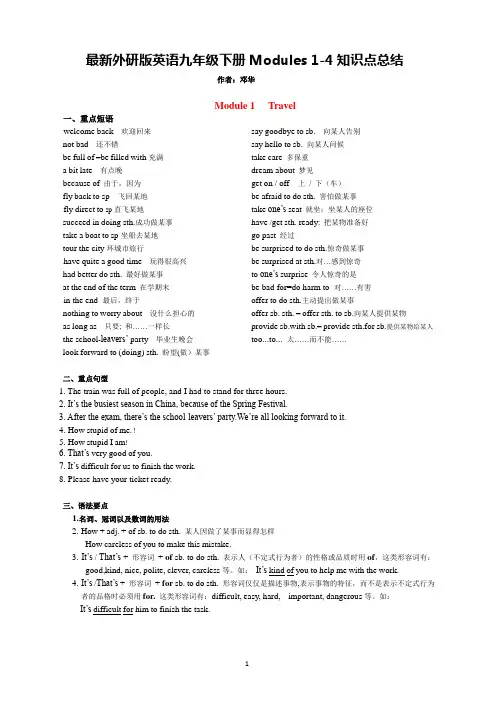
最新外研版英语九年级下册Modules 1-4知识点总结作者:邓华Module 1Travel一、重点短语welcome back欢迎回来not bad还不错be full of =be filled with充满a bit late有点晚because of由于,因为fly back to sp 飞回某地fly direct to sp直飞某地succeed in doing sth.成功做某事take a boat to sp坐船去某地tour the city环城市旅行have quite a good time玩得很高兴had better do sth.最好做某事at the end of the term在学期末in the end 最后,终于nothing to worry about没什么担心的as long as只要; 和……一样长the school-leavers’party毕业生晚会look forward to(doing)sth.盼望(做)某事say goodbye to sb.向某人告别say hello to sb.向某人问候take care多保重dream about梦见get on /off 上/ 下(车)be afraid to do sth.害怕做某事take one’s seat就坐;坐某人的座位have /get sth.ready: 把某物准备好go past经过be surprised to do sth.惊奇做某事be surprised at sth.对…感到惊奇to one’s surprise令人惊奇的是be bad for=do harm to 对……有害offer to do sth.主动提出做某事offer sb.sth. = offer sth.to sb.向某人提供某物provide sb.with sb.= provide sth.for sb.提供某物给某人too...to... 太……而不能……二、重点句型1. The train was full of people, and I had to stand for three hours.2. It’s the busiest season in China, because of the Spring Festival.3. After the exam, there’s the school-leavers’ party.We’re all looking forward to it.4. How stupid of me.!5. How stupid I am!6. That’s very good of you.7. It’s difficult for us to finish the work.8. Please have your ticket ready.三、语法要点1.名词、冠词以及数词的用法2. How+adj.+of sb.to do sth.某人因做了某事而显得怎样How careless of you to make this mistake.3. It’s / That’s+形容词+of sb.to do sth.表示人(不定式行为者)的性格或品质时用of,这类形容词有:good,kind,nice,polite,clever,careless等。
外研版中考第二轮复习九年级下学期Module1 - 4 精讲精练 (有答案)
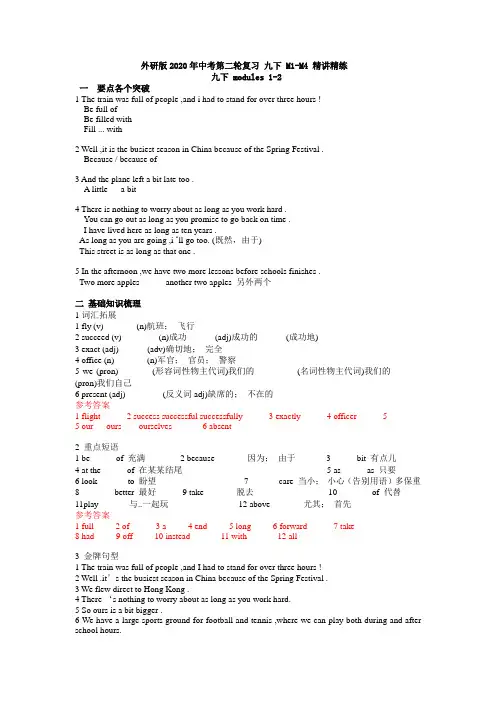
外研版2020年中考第二轮复习九下 M1-M4 精讲精练九下 modules 1-2一要点各个突破1 The train was full of people ,and i had to stand for over three hours !Be full ofBe filled withFill ... with2 Well ,it is the busiest season in China because of the Spring Festival .Because / because of3 And the plane left a bit late too .A little a bit4 There is nothing to worry about as long as you work hard .You can go out as long as you promise to go back on time .I have lived here as long as ten years .As long as you are going ,i ‘ll go too. (既然,由于)This street is as long as that one .5 In the afternoon ,we have two more lessons before schools finishes .Two more apples another two apples 另外两个二基础知识梳理1词汇拓展1 fly (v)_______ (n)航班;飞行2 succeed (v)________ (n)成功______ (adj)成功的______ (成功地)3 exact (adj)______ (adv)确切地;完全4 office (n)_______ (n)军官;官员;警察5 we (pron)_______ (形容词性物主代词)我们的_________ (名词性物主代词)我们的_______ (pron)我们自己6 present (adj)________ (反义词adj)缺席的;不在的参考答案1 flight2 success successful successfully3 exactly4 officer 55 our ours ourselves6 absent2 重点短语1 be _____ of 充满2 because ______ 因为;由于3 _____ bit 有点儿4 at the _____ of 在某某结尾5 as _____ as 只要6 look ______ to 盼望7 ______ care 当小;小心(告别用语)多保重8 _______ better 最好9 take ______ 脱去10 _______ of 代替11play______ 与..一起玩12 above ______ 尤其;首先参考答案1 full2 of3 a4 end5 long6 forward7 take8 had 9 off 10 instead 11 with 12 all3 金牌句型1 The train was full of people ,and I had to stand for over three hours !2 Well .it’s the busiest season in China because of the Spring Festival .3 We flew direct to Hong Kong .4 There ‘s nothing to worry about as long as you work hard.5 So ours is a bit bigger .6 We have a large sports ground for football and tennis ,where we can play both during and after school hours.浙江名师预测基础知识过关一词汇应用。
外研版英语九年级上册m1到m4单元重点短语或语法

外研版英语九年级上册m1到m4单元重点短语或语法全文共6篇示例,供读者参考篇1Title: Mastering English with Fun and Games!Hey there, kids! Are you ready to embark on an exciting adventure through the world of English? In this article, we'll explore some cool phrases and grammar rules that will help you become a language master. Get ready to have a blast while learning!Unit M1: Let's Start with Greetings!One of the first things you'll learn in English is how to greet people. It's like giving a friendly high-five with words! Here are some common greetings:"Hello!" - This is a classic way to say hi to someone."Good morning/afternoon/evening." - Use these greetings based on the time of day."How are you?" - Ask this to find out how someone is feeling.Now, let's talk about the present continuous tense. It's like describing an action that's happening right now. For example:"I am studying English." (I'm studying English.)"She is playing football." (She's playing football.)Just add "is" or "are" before the verb and add "-ing" at the end. Easy peasy, right?Unit M2: Talking About the PastTime to travel back in history! The past simple tense is your ticket to discussing events that have already happened. Here's how it works:"I went to the park yesterday." (Regular verbs like "go" have an "-ed" ending in the past tense.)"She played basketball last week." (For irregular verbs like "play," you'll need to learn the past form separately.)Remember to use expressions like "yesterday," "last week," or "in 2020" to indicate when the action took place.Unit M3: Future Adventures Await!Now, let's look ahead to the future! The future simple tense is all about discussing plans and predictions. Here's how it goes:"I will go to the beach tomorrow." (Use "will" before the verb to talk about the future.)"She will not (won't) eat vegetables." (Add "not" or use a contraction like "won't" to make a negative statement.)You can also ask questions in the future tense:"Will you come to my birthday party?" (Put "will" before the subject to form a question.)Unit M4: Describing People and ThingsAdjectives are like colorful words that add extra details to nouns (people, places, or things). Check out these examples:"She is a kind girl.""That is a tall building.""I like the red shirt."You can also compare things using comparative and superlative adjectives:"My brother is taller than me." (Comparative adjectives, like "taller," compare two things.)"That is the biggest tree in the park." (Superlative adjectives, like "biggest," compare three or more things.)Phew! That was a lot of information, but don't worry; practice makes perfect. Keep playing with these phrases and grammar rules, and you'll be a language pro in no time!Remember, learning English should be fun, so let's turn it into a game. Why don't you try making up silly sentences using the new phrases and grammar you've learned? Or, you could challenge your friends to a grammar competition and see who can come up with the most creative examples.The world of English is vast and exciting, filled with endless possibilities for communication and self-expression. Embrace the journey, have fun, and never stop exploring!篇2Title: The Grammar Gizmos - A Fun Way to Learn English!Hey there, fellow grammar gizmo lovers! Are you ready to dive into the wild and wacky world of English grammar? Hold on tight because we're about to blast off on a linguistic adventure that will make your brain cells dance with joy!First up, let's tackle those pesky little things called phrases. You know, those groups of words that kind of hang out together and do cool stuff? Yeah, those guys! In Unit M1, we learned allabout noun phrases. These bad boys help us identify people, places, and things in our sentences. For example, "the big red balloon" is a noun phrase that tells us exactly what kind of balloon we're talking about.But wait, there's more! Unit M2 introduced us to verb phrases, which are like the action heroes of our sentences. They tell us what's happening and who's doing it. "Has been studying" is a verb phrase that lets us know someone has been hitting the books hard!Now, let's move on to Unit M3 and the world of prepositions. These little words might seem small, but they pack a mighty punch! They help us understand the relationships between different parts of a sentence. For instance, "under the table" tells us exactly where something is located.Last but not least, we have Unit M4, where we learned about clauses. These bad boys are like mini-sentences that can either stand on their own or team up with other clauses to form more complex sentences. "Because it was raining" is a dependent clause that needs a little help from its independent clause buddy to make a complete sentence.But wait, there's even more grammar goodness to explore! In these units, we also learned about some super cool grammar concepts like:Tenses (past, present, and future) - These help us talk about when things happened, are happening, or will happen.Passive voice - This is when the subject of a sentence is acted upon, rather than doing the action itself.Conditional sentences - These allow us to talk about hypothetical situations and their consequences.Relative clauses - These little guys help us provide extra information about nouns in our sentences.Phew! That was a lot of grammar gizmo action, wasn't it? But don't worry, we're not done yet! There are still plenty of linguistic adventures waiting for us in the upcoming units.So, my fellow grammar gizmo lovers, keep practicing, keep exploring, and never stop learning. Because the more you know about English grammar, the better you'll be able to communicate with people from all around the world. And who knows, maybe one day you'll become a grammar gizmo master!篇3Hey there! It's me again, your friendly neighborhood English learner. I know, I know, you're probably thinking "Ugh, not another lecture on grammar and vocab!" But trust me, this one's gonna be different. I'm gonna make it fun and easy to understand, just like a game!First up, let's talk about Unit M1. Remember all those cool expressions with "make" and "do"? Like "make a phone call" or "do the laundry"? Those are called phrasal verbs, and they're super useful for describing everyday actions. But be careful, because some of them have multiple meanings! For example, "make up" can mean "invent a story" or "apply makeup". Tricky, right?Now, let's move on to Unit M2. This one's all about comparisons and giving opinions. You know how your mom always says "Don't compare yourself to others"? Well, in English, we do it all the time! We use words like "as... as", "not as... as", "more... than", and "less... than" to compare things. And when we want to give our opinion, we use phrases like "I think...", "In my opinion...", or "From my point of view...". Easy peasy, right?Okay, get ready for Unit M3. This one's a bit more challenging, but I know you can handle it. We're talking about the future tense, baby! You know, like "I will study hard" or "Sheis going to become a doctor". But wait, there's more! We also learned about phrases like "be about to" and "be due to" for talking about the near future. And let's not forget those funky future continuous structures like "I will be studying" or "They will be playing football". Phew, that's a lot to remember, but I know you've got this!Last but not least, Unit M4. This one's all about the past tense, and let me tell you, it's a doozy! We've got the simple past tense, like "I went to the park", the past continuous, like "She was watching TV", and the past perfect, like "They had already eaten dinner". And that's not even counting all the irregular verb forms we had to memorize! But hey, at least we learned some cool idioms and slang expressions, like "once upon a time" and "a piece of cake".Phew, that was a lot of information, wasn't it? But you know what they say, practice makes perfect. So keep practicing those phrases and grammar points, and before you know it, you'll be speaking English like a pro!Oh, and one last thing: remember to have fun with it! Learning a new language is all about exploring new cultures and ways of thinking. So don't just memorize the rules, try tounderstand the logic behind them. And most importantly, don't be afraid to make mistakes. That's how we learn and grow.Alright, that's all for now, folks. Keep up the good work, and I'll see you next time for another thrilling installment of "Grammar Adventures with [Your Name]"!篇4Title: Mastering English Expressions and Grammar: A Fun Journey through Units M1-M4Hey there, fellow learners! Are you ready to embark on an exciting adventure through the world of English expressions and grammar? In this article, we'll explore the key phrases and grammar points from Units M1 to M4 in your Grade 9 English textbook. Buckle up and get ready for some language fun!Unit M1: Introducing OurselvesIn this unit, we learned how to introduce ourselves and share information about our hobbies, interests, and aspirations. One of the most important phrases we encountered was "What's your name?" This simple question allows us to start a conversation and get to know someone new. We also learned how to respond with "My name is..." or "I'm..."Additionally, we explored the use of subject pronouns like "I," "you," "he," "she," "it," "we," and "they." These little words help us identify who or what we're talking about in a sentence. For example, "I like playing basketball" or "They are my friends."Unit M2: Talking about AbilitiesUnit M2 taught us how to express our abilities and skills using phrases like "can" and "be able to." We learned to say things like "I can speak English fluently" or "She is able to play the piano beautifully." These expressions allow us to showcase our talents and appreciate the abilities of others.We also delved into the world of adverbs, which are words that describe how something is done. Words like "quickly," "slowly," "carefully," and "loudly" help us paint a vivid picture of actions and events.Unit M3: Describing People and ThingsIn Unit M3, we focused on describing people and objects using adjectives. We learned how to use words like "tall," "short," "big," "small," "beautiful," and "ugly" to provide detailed descriptions. For example, "My friend is a tall, friendly girl with long hair."Additionally, we explored the use of comparatives and superlatives to compare different people or things. Phrases like "taller than," "shorter than," "the tallest," and "the shortest" help us express how things measure up against each other.Unit M4: Expressing Likes and DislikesUnit M4 taught us how to express our likes and dislikes using phrases like "I like..." and "I don't like..." We learned to talk about our preferences for different activities, foods, and hobbies. For instance, "I like playing video games, but I don't like doing homework."We also discovered the importance of using contractions like "don't," "can't," and "won't" to make our speech more natural and conversational. These shortened forms of words add a touch of informality and make our language sound more like how we actually speak.Phew, that was quite a journey! We covered a lot of ground, from introducing ourselves to expressing our abilities, describing people and things, and sharing our likes and dislikes. Along the way, we encountered various grammar concepts and useful phrases that will help us communicate more effectively in English.Remember, practice makes perfect, so keep practicing these expressions and grammar points whenever you can. The more you use them, the more natural and confident you'll become in your English communication skills. Happy learning, and keep exploring the wonderful world of the English language!篇5Hey there, friends! Are you ready to dive into the world of English with me? Today, we're going to explore some really cool phrases and grammar rules from the first few units of our English textbook. Don't worry, I'll make it fun and easy to understand!Let's start with Unit M1, shall we? One of the most important things we learned is how to use the verb "be" correctly. We use "is" for singular subjects like "he," "she," or "it," and "are" for plural subjects like "we," "you," and "they." For example, "She is a student," and "They are my friends."Another handy phrase from this unit is "there is/there are." We use "there is" to introduce a singular noun, like "There is a book on the table." And we use "there are" to introduce plural nouns, like "There are many flowers in the garden."Moving on to Unit M2, we learned how to ask and answer questions using "what," "where," "who," "why," and "how." Forinstance, "What is your name?" or "Where do you live?" These question words are super useful for getting information from others.Oh, and let's not forget about the present continuous tense! We use it to talk about actions happening right now. To form the present continuous, we use the verb "be" plus the present participle (verb + -ing). Like "I am reading a book" or "They are playing soccer."Unit M3 introduced us to the simple past tense. We use it to talk about completed actions in the past. For regular verbs, we add "-ed" to the base form (like "walked" or "played"). For irregular verbs, we have to memorize the past tense forms (like "went" or "saw").Another cool thing we learned in Unit M3 is how to use "could" to express ability or possibility in the past. For example, "When I was young, I could run really fast" or "They could not solve the puzzle."Finally, in Unit M4, we dove into the world of comparatives and superlatives. We use them to compare people, animals, or things. For short adjectives, we add "-er" for comparatives and "-est" for superlatives (like "taller" and "tallest"). For longeradjectives, we use "more" and "most" (like "more beautiful" and "most beautiful").Phew, that was a lot of grammar, huh? But don't worry, practice makes perfect! Keep using these phrases and rules in your conversations and writing, and they'll become second nature. Remember, learning English is a journey, and every step counts.If you ever feel stuck or confused, don't hesitate to ask your teacher or classmates for help. We're all in this together, and teamwork makes the dream work!Keep up the great work, my friends, and let's continue exploring the wonderful world of English together!篇6Hey there, friends! It's me, your friendly neighborhood English learner, ready to share some super important stuff I've picked up from my English textbook. Now, I know what you're thinking - "Ugh, not another lecture on grammar!" But trust me, this is going to be way more fun than a boring old grammar lesson!Let's start with Unit M1, shall we? One of the first things we learned was how to use "used to" to talk about past habits or situations that no longer exist. For example, "I used to love playing with toy cars when I was little, but now I prefer video games." Isn't that cool? It's like a time machine for our language!Speaking of time, we also learned about the present perfect tense, which is super handy for talking about experiences we've had up to now. Like, "I have visited my grandparents in the countryside many times." It's like a secret code for sharing our adventures!Unit M2 was all about comparing things, and let me tell you, it's a game-changer! We learned how to use phrases like "not as... as" and "the same as" to point out similarities and differences. For instance, "My little brother isn't as tall as me, but he's the same age." Mind-blowing, right?But wait, there's more! We also learned about the past perfect tense, which is like a time travel machine for our stories. "When I arrived at the party, everyone had already left." It's like a secret language that lets us jump back and forth in time!Moving on to Unit M3, we dove into the world of hypothetical situations and wishes. We learned how to use "if" clauses and phrases like "I wish" to talk about imaginaryscenarios. Like, "If I could fly, I would visit all the amazing places in the world." Isn't that just the coolest?And let's not forget about the future perfect tense, which allows us to talk about things that will be completed by a certain time in the future. "By the time I graduate from high school, I will have studied English for ten years." It's like a crystal ball for our language skills!Last but not least, Unit M4 introduced us to the wonderful world of reported speech. We learned how to use phrases like "he said that" and "she told me" to share what others have said or thought. Like, "My mom told me that I should always try my best in school." It's like a secret code for passing on messages!And let's not forget about the perfect modals, which help us talk about things we should have or could have done differently. "I could have studied harder for that test." It's like a time machine that lets us go back and fix our mistakes!Phew, that was a lot of grammar goodness, but I promise it was worth it! Now you've got a whole arsenal of language tools at your disposal, ready to take your English skills to new heights. So, what are you waiting for? Let's put these bad boys to use and start speaking like true English masters!。
2024年中考外研版英语总复习课件九年级下册Module1—Module4
2.tie (1)n.领带;领结 the red tie红领巾 (2)v.系;捆;扎(用带、绳、线等) (3)固定搭配:tie up系紧;拴牢
①Shirts and __t_ie_s____ have been a symbol of politeness in Britain for centuries.(tie) ②Jack’s mother was __ty_i_n_g___ the shoes for him when the telephone rang.(tie)
①Mrs.White __s_t_u_ck___ the fork into the beef to see if it was
well cooked.(stick)
②It was very cold.He picked up __s_t_ic_k_s__ to make a fire,but
sadly the house caught fire.(stick)
5.see sb. doing sth.用法与拓展 (1)see sb.doing sth.“看见某人正在做某事” (2)see sb. do sth.“看见某人做某事”,强调看见了动作的全 过程。 (3)相同用法还有:hear,notice,watch,feel等感官动词。
【典题精练】
★—Do you often see Tony ___A_____ football in the park?
2.double用法 v.“(使)加倍”,用作及物动词时接名词或代词作宾语;作不 及物动词时常与as,for等介词连用。 adj.“两倍的;双人的”,后接n./pron./num. adv.“双重地;重叠地”n.“两倍;两倍数量”
【典题精练】 ①Officials announced that the number of volunteers helping with rescue(救援) work in Hebei would be _d_o_u_b_l_e_d_.(double) ②It has the __d_o_u_b_le__(双重的) advantage of being both easy and cheap.
外研版九年级中考知识点

外研版九年级中考知识点外研版九年级英语是我国中学英语教材中的一种经典版本,包含了丰富的中考知识点。
下面将按照四个模块进行介绍。
第一模块:语法知识点在外研版九年级英语教材中,语法是非常重要的一个知识点,包括时态、语态、虚拟语气等。
首先是时态,外研版九年级中考考察的时态有一般现在时、一般过去时、一般将来时等。
其次是语态,外研版九年级中考考察的语态有被动语态和主动语态。
最后是虚拟语气,外研版九年级中考考察的虚拟语气有与现在事实相反的虚拟条件句和与过去事实相反的虚拟条件句。
第二模块:阅读技巧外研版九年级英语教材注重培养学生的阅读理解能力。
中考中,阅读理解是一个非常重要的考点。
在外研版九年级中考中,阅读理解题的类型多种多样,包括选择题、填空题、判断题等。
学生需要通过阅读材料,理解文章的大意和细节,并根据文章进行推理和判断。
第三模块:写作技巧外研版九年级英语教材注重培养学生的写作能力。
中考中,写作是一个重要的考点。
在外研版九年级中考中,写作题目多样,要求学生运用自己学过的语法知识点,写出连贯的句子和段落。
同时,学生需要注意写作的结构和组织,包括开头、中间和结尾等。
第四模块:听力技巧外研版九年级英语教材注重培养学生的听力理解能力。
中考中,听力理解是一个重要的考点。
在外研版九年级中考中,听力题的形式多样,包括听对话回答问题、听短文回答问题等。
学生需要通过听力材料,理解对话或短文的意思,并根据听到的信息回答问题。
总结:外研版九年级英语教材中的中考知识点主要包括语法知识点、阅读技巧、写作技巧和听力技巧。
学生在备考中需要掌握这些知识点,并通过练习来提高自己的英语能力。
希望同学们能够认真复习,取得好成绩!。
精讲21.九年级下册 Modules 1~4---中考英语复习教材核心词汇知识点精讲精练(外研版)
【句式填写】 1. 但是飞行员su成c功ce地ed按e时着陆了。 But the pilodt _________in__la_n_d__i_n_g_ on time. 2. 但现在w, 我e’们最好回去工作。 But nowd, _____b_e_t_t_e_r_ get back to work. 3. 只要你努力, 没有什么好担心的。 There’s nothtiongw_o_r_r_y____ abaosulot n__ga__s__ __ you work hard. 4. 请大家准备好车票。 Pleaseh_a_v_e__y_o__u_r_t_ic__k_e_t_sr_e__a_d_y.
16. 结婚 17. 注意 18. 动身; 出发 19. 离开 20. 独自地 21. 一口气; 一下子 22. 攀岩 23. 小心
g__e_t__m__a_r_r_i_ed pay atte_n__ti_o__n__t_o_____ s_e_t__o_f_f gooonffon_e_’__s_ __o_w__n_______ in__o__n_e__g_ o rock clim__b__in__g______ be caref_u_l__o_f______
27. 边; 边缘n.
e____
28. 挨饿; 饿死v.
starve ______
29. 岩; 岩石n.
rs_ot_co_k_n
30. 石头n.
e_____
31. 无困难的; 顺利的; 光滑的; 平s坦m的ooatdj.
_h______
32. 直的; 笔直的adj. 33. 帐篷n. 34. 枪n. 35. 软的; 柔软的adj. 36. 静止的; 不动的adj. 仍然adv. 37. 血; 血液n.
外研版九年级英语1-4模块复习及习题
Module1--2中考突破 1. 单项选择强化训练(study )语法专练---时态1.W e _______ swimming in the river every day in summer. (go)2. It ______ you are right. (seem)3. Look, the children ______ basketball on the playground. (play)4. He ______ to the radio when I came in. (listen)5. It is very cold. I think it ______. (rain)6. "I need some paper." "I _____ some for you." (bring)7. I can’t find my pen. Who ______ it? (take)8. He said that he ______ back in five minutes. (come) 9. I didn’t meet him. He ______ when I got there. (leave) 10. I ______ my bike, so I have to walk to school. (lose) 11. He ______ down and began to read his newspaper. (sit) 12. He is not here. He ______ to the post office. (go)13. He is very hungry . He ______ anything for three days. (not eat)14. I ______ with you if I have time. (go)15. W e will go to the cinema if it ______ tomorrow . (rain) 16. I will tell her the news when she ______ to see me next week. (come)17. "When ______ you ______ the car?" "In 1998." (buy) 18. W e ______ good friends since we met at school. (be) 19. What ______ you ______ at five yesterday afternoon? (do)20. The bike is nice. How much _____ it _____? (cost)Module3--4中考突破短文改错语法专练---宾语从句I.从下列A、B、C、D中选择一个正确选项填空。
外研版英语九年级上册知识点总结(精华版)
九年级英语上册知识点总结Module1 Wonders of the world一、重点短语1.wonders of the world世界奇观2.natural wonders自然奇观3.join in = take part in参加;加入(活动)4.agree with sb.同意某人的看法5. agree to do sth.同意做某事6.in one’s opinion依某人看来;按某人的意见7.more than = over多于,超过8. millions of数百万的;数以百万计的9.produce electricity供电10.would like to do sth. = want to do sth.想做某事11.get out of...从....出来12.become grey变成灰色13.look across眺望, 向对面看14.look down to俯视;向下看15.go down下去;下沉;坠落16.look over从(某物上面)看过去:仔细检查17. go through穿过,经历,经受,浏览18.at the bottom of在.....的底部19.on both sides在两边20.in height高度;在高度上21. do an interview with sb.采访某人22.draw a picture of画一副......的图画23.fall away突然向下倾斜24.wait for等候25.dozens of许多26.be famous for以.......而闻名二、固定结构1. sb./sth agrees with sth.某人/某物适应(食物、气候)/符合某物,I don't think the food here agrees with me. 我觉得这里的食物不对我的胃口His explanation agrees with the facts of the situation.他的解释与实情相符。
2025年外研版中考英语总复习教材知识点梳理第22讲九年级(下) Modules 1~4
secret of success. —OK, I will. 3. To keep the robot working __s_m_o_o_t_h_l_y_(smooth), you need to
Module 3 1. wealth n.财富
→ _w_e_a_lt_h_y____ (adj.)富有的 2. postman n. 邮递员
→ _p_o_s_tm__e_n___ (复数) 3. educate v.教育;教导
→ _e_d_u_c_a_t_io_n__ (n.)教育 → e_d_u_c_a_t_io_n_a_l_(adj.)教育的;有教育意义的
2 考点通关
一、根据句意填写单词 1. We have to put ___o_f_f_____ the school trip because
___o_f______ the terrible weather. 2. My sister wanted to set ____o_ff_____ early in order to catch
重点短语补充 1. _b_e_c_a_u_s_e_o_f___________ 因为;由于 2. _a_s_l_o_n_g_a_s____________ 只要 3. _t_a_k_e_c_a_r_e____________ (告别用语)多保重 4. _t_a_k_e_o_f_f_____________ 脱去 5. _u_s_e_d__to______________ 过去常常…… 6. _s_p_a_r_e_t_im__e___________ 业余时间;闲暇
外研版中考第二轮复习九年级上学期modules1-4精讲精练 (有答案)
外研版2020年中考第二轮复习九上M1-M4 精讲精练九上modules 1-2一要点各个突破1 It ‘s about 1700meters wide and 100 meters high .英语中长宽高的表达:基数词+表示量的名词+形容词基数词+名词单数+形容词合成形容词作定语She has a two-year-old son .2 if someone asks you whether the Grand Canyon is the greatest wonder of the natural world .只用whether 不用if 的几种情况:I am thinking of whether we should go swimming .Please tell me whether we to go or stay .We are discussing whether we will have a picnic tomorrow .I don’t know whether we will come back tomorrow or not .Whether he is a doctor or not ,i can’t say .3 as soon asAs soon as i get home ,i will call you .Please call me as soon as you get home .You may take a rest as soon as you finish your homework.4 plenty of只能修饰不可数名词的词:much a great deal of只能修饰可数名词的词:many ,a number of ,numbers of两者均可:plenty of , a lot of ,lots of二基础知识梳理1词汇拓展1 east (n /adj)________ (adj)在东边的;来自东边的2 electric (adj)__________ (n)电3 below (prep)__________ (反义词prep)在上面;在......以上4 found (v)_________ (过去式)_________ (过去分词)创立;创建5 four (num)________ (num)第四6 nine (num.)________ (num.)第九7 twelve (num.)________ (num)第十二8 speak (v)___________ (n)演说,讲演9 follow (v)__________ (adj)接着的;接下来的10 lay (v)________ (过去式)_________ (过去分词)摆放(餐桌)参考答案1 eastern2 electricity3 above4 founded founded5 fourth6 ninth7 twelfth8 speech9 following 10 laid laid2 重点短语1 _______ with 同意;赞同2 in one’s __________ 按某人的意见;据某人看来3 __________ through 穿过4 look _________ 从......上方看过去5 __________ away 突然向下倾斜6 look _________ 向下看7 on ______ of 在...上面;盖住8 ________ then 从那以后9 all _______ of 各种各样的10 take a _______ 去度假11 ________ fun 玩得高兴;有乐趣12 as ______ as 一...就...13 ________ the table 摆放餐桌参考答案1 agree2 opinion3 go4 over5 fall6 down7 top 8 since 9 kinds 10 vacation 11 have12 soon 13 lay3 金牌句型1 Hmm ,I’ve never seen it ,so i’m not sure i agree with you .2 I looked to the east --- the sky was becoming grey .3 Am I going the right way ?4 You will get there in five minutes .5 While we’re staying wit h our friends ,we are going to spend one day in Qingdao.6 And my family always go somewhere interesting as soon as the holiday begins.7 .. Before we begin dinner ,my father gives thanks for the food .8 when it is all over ,everyone helps wash the dishes .浙江名师预测基础知识过关一词汇应用。