
2013年12月全国大学英语四级考试真题
2013年12月全国大学英语四级考试试卷 Part Ⅰ Writing (30 minutes) Directions: For this part, you are allowed 30 minutes to write a short essay entitled What Electives to Choose. You should write at least 120 words but no more than 180 words following the outline given below in Chinese: 1. 各大学开设了各种各样的选修课; 2. 学生因为各种原因选择了不同的选修课; 3. 以你自己为例…… What Electives to Choose
Part Ⅱ Listening Comprehension (30 minutes) Section A Directions: In this section, you will hear 8 short conversations and 2 long conversations. At the end of each conversation, one or more questions will be asked about what was said. Both the conversation and the questions will be spoken only once. After each question there will be a pause. During the pause, you must read the four choices marked A),B),C) and D),and decide which is the best answer. Then mark the corresponding letter on Answer Sheet 1 with a single line through the centre. 1. A) She used to be in poor health. C) She was somewhat overweight. B) She was popular among boys. D) She didn’t do well at high school. 2. A) At the airport. C) In a booking office. B) In a restaurant. D) At the hotel reception. 3. A) Teaching her son by herself. C) Asking the teacher for extra help. B) Having confidence in her son. D) Telling her son not to worry. 4. A) Have a short break. C) Continue her work outdoors. B) Take two weeks off. D) Go on vacation with the man. 5. A) He is taking care of this twin brother. C) He is worried about Rod’s health. B) He has been feeling ill all week. D) He has been in perfect condition. 6. A) She sold all her furniture before she moved house. B) She still keeps some old furniture in her new house. C) She plans to put all her old furniture in the basement. D) She brought a new set of furniture from Italy last month. 7. A) The woman wondered why the man didn’t return the book. B) The woman doesn’t seem to know what the book is about. C) The woman doesn’t find the book useful any more. D) The woman forgot lending the book to the man. 8. A) Most of the man’s friends are athletes. C) The man doesn’t look like a sportsman. B) Few people share the woman’s opinion. D) The woman doubts the man’s athletic ability. Questions 9 to 12 are based on the conversation you have just heard. 9. A) She has packed it in one of her bags. C) She has probably left it in a taxi. B) She is going to get it at the airport. D) She is afraid that she has lost it. 10. A) It ends in winter, C) It will last one week. B) It will cost her a lot. D) It depends on the weather. 11. A) The plane is taking off soon. C) There might be a traffic jam. B) The taxi is waiting for them. D) There is a lot of stuff to pack. 12. A) At home. C) At the airport. B) In the man’s car. D) By the side of a taxi. Questions 13 to 15 are based on the conversation you have just heard. 13. A) She is thirsty for promotion. C) She is tired of her present work. B) She wants a much higher salary. D) She wants to save travel expenses. 14. A) Translator. C) Language instructor. B) Travel agent. D) Environmental engineer. 15. A) Lively personality and inquiring mind. C) Devotion and work efficiency. B) Communication skills and team spirit. D) Education and experience. Section B Directions: In this section, you will hear3 short passages. At the end of each passage, you will hear some questions. Both the passage and the questions will be spoken only once. After you hear a question, you must choose the best answer from the four choices marked A),B),C) and D). Then mark the corresponding letter on Answer Sheet 1with a single line through the centre. Passage One Questions 16 to 19 are based on the passage you have just heard. 16. A) They care a lot about children. B) They need looking after in their old age. C) They want to enrich their life experience. D) They want children to keep them company. 17. A) They are usually adopted from distant places. B) Their birth information is usually kept secret. C) Their birth parents often try to conceal their birth information. D) Their adoptive parents don’t want them to know their birth parents. 18. A) They generally hold bad feelings towards their birth parents. B) They do not want to hurt the feelings of their adoptive parents. C) They have mixed feelings about finding their natural parents. D) They are fully aware of the expenses involved in the search. 19. A) Early adoption makes for closer parent-child relationship. B) Most people prefer to adopt children from overseas. C) Understanding is the key to successful adoption. D) Adoption has much to do with love. Passage Two Questions 20 to 22 are based on the passage you have just heard. 20. A) He suffered from mental illness. B) He bought The Washington Post. C) He turned a failing newspaper into a success. D) He was once a reporter for a major newspaper. 21. A) She was the first woman to lead a big U. S. publishing company. B) She got her first job as a teacher at the University of Chicago. C) She committed suicide because of her mental disorder. D) She took over her father’s position when he died. 22. A) People came to see the role of women in the business world. B) Katharine played a major part in reshaping Americans’ mind. C) American media would be quite different without Katharine. D) Katharine had exerted an important influence on the world. Passage Three Questions 23 to 25 are based on the passage you have just beard. 23. A) It’ll enable them to enjoy the best medical care. B) It’ll allow them to receive flee medical treatment. C) It’ll protect them from possible financial crises. D) It’ll prevent the doctors from overcharging them. 24. A) They can’t immediately get back the money paid for their medical cost.
2013年12月大学英语四级考试真题答案解析2套

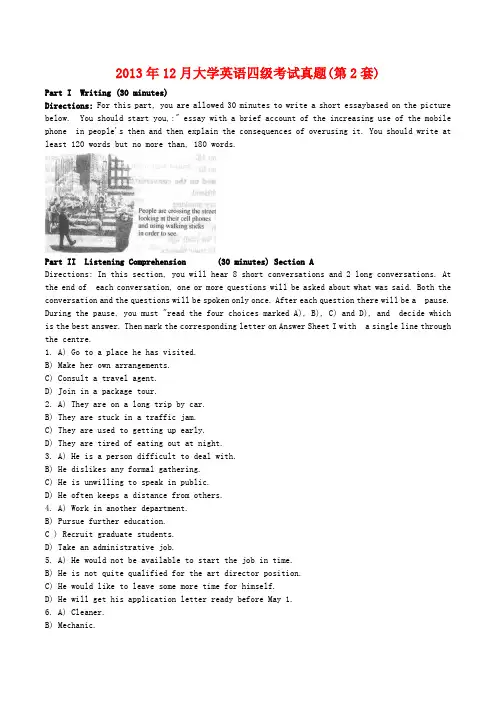
2013年12月大学英语四级(第二套)考试真题答案解析写作导航: On the Overuse of the Mobile Phone第1段:描述图片,概述生活中出现过度使用手机的现象Having a cell phone in hand and at the ready, growing increasing dependent on their mobile phones第2段:详细介绍过度使用手机产生的不良后果trigger many health problemsan Immediate threat to their Iife, health and pro property less chance offace-to-face interactions第3段:进行总结,并提出建议use them appropriately and rationally参考范文On the Overuse of the Mobile Phone 【1】As is shown in the picture, having a mobile phone in hand and at the ready is the default mode while walking on the streets. 【2】What this cartoon symbolically reveals is that people nowadays, especially young people, are growing increasingly dependent on their mobile phones.1【3】It is true that the mobile phone has brought great convenience to people's life. However, just as is illustrated in the picture, the overuse of it may lead to several bad consequences. 【4】To begin with, there is evidence that long-term exposure to electromagnetic radiation may trigger many health problems, such as insomnia, headaches and even cancers.【5】In addition, when people immerse themselves in the mobile phone, they tend to pay less attention to their surroundings, posing an immediate threat to their life, health and property.【6】Last but not least, excessive use of mobile phones means much less chance offace-to-face interactions with the people who populate their real lives.【7】In conclusion, while mobile phones have contributed a lot to making our life more convenient, we should use them appropriately and rationally.【1】开门见山,对图片进行简单描述。
2013年12月英语四级真题及答案 (2)

2013年12月英语四级真题及答案一、听力部分Section AA)Move the furniture.B)It is time to pay the rent.C)At the town hall.A)Go abroad.B)He has to do some tasks.A)The woman learned a lot from the trip.C)She prefers reading in silence.A)She doesn’t know where her purse is.B)He’s not sure where his rent check is.C)At a university.Section BB)It is a difficult maze.C)They are almost all identical.A)By writing messages on the walls.C)To confuse predators.D)They could feel it in their bodies.C)They did not notice any difference.B)They use landmarks to find food.C)Birds were attracted to the sound.A)They can guide the whales’ migration.D)She receives the most love from her children. Section CA)The world is full of wonders.C)The photographer’s perseverance.B)It is his most valuable treasure.C)By planning ahead.A)It can make the world a better place.二、阅读部分Passage OneA)To arrange interviews with important people.B)Their personal qualities may have beenoverlooked.D)To discover your own strong points.D) A wide range of skills.C)Set clear goals.Passage TwoB)Expectations for women’s appearances.D)Advertising is everywhere in people’s dailylives.A)How to manipulate women’s insecurities.C)Changing people’s perception of beauty.B)They are knowledgeable about a variety oftopics.Passage ThreeA)They were the first private schools in Britain.D)Those from wealthy families aspired to begentlemen.C)Discipline their bodies and minds.D)English gentlemen could set a good example.D)Influenced by their economic background. Passage FourA)It is often the small things that matter most.B)Men and women respond differently to stress.C)Tenderness is essential for a happyrelationship.D)Show affection and empathy.B)Prolonged stress can weaken the immunesystem.三、写作部分短文写作Directions: For this part, you are allowed thirty minutes to write a composition based on the picture below. You should write at least 120 words, and base your composition on the outline (given in Chinese) below:写作要点:1. 描述图片内容:一辆大货车卡住了一个过道,不能向前行; 2. 分析产生的原因:大货车太大,通道太窄,驾驶员没有及时发现状况; 3. 谈谈你的看法:如何避免这种情况:修建更宽敞的通道、提高驾驶员的观察技巧等。
2013年12月英语四级真题及答案 (3)
2013年12月英语四级真题及答案阅读理解(共两节,满分40分)第一节1. A. 考点:文章第一段提到:波多黎各遭受的破坏震撼了整个地区。
因此,根据后面提供的信息,可以推断出这次飓风对整个加勒比地区造成了广泛的破坏。
B选项只提到了波多黎各遭受的破坏,没有涉及整个加勒比地区。
2. D. 考点:文章第二段末尾提到“We love getting movie recommendations”. 因此,可以推断出他们喜欢得到关于电影的建议。
3. B. 考点:根据第一段“When it comes to the growth of cities, the 21st century is largely a story of the developing world”我们可以推断出,发展中国家的城市增长更快。
4. C. 考点:根据第二段“Those who live in cities complain of traffic jams and crowded subway cars”可以推断出,城市居民经常抱怨交通拥堵和拥挤的地铁。
5. D. 考点:根据文章第三段“In city after city, the urban population today is much larger than it has ever been in history”可以推断出城市人口比历史上任何时候都要多。
6. A. 考点:根据文章第四段“Bu this does not mean that there is no way to slow the growth of cities”可以推断出,存在减缓城市增长的方法。
7. B. 考点:根据文章最后一段“For all the challenges cities fac e, they remain attractive places to live”可以推断出,尽管城市面临很多挑战,但人们仍然愿意居住在城市。
2013年12月英语四级听力真题及答案

2013年12月英语四级听力真题及答案听力2013年12月大学英语四级考试真题(第1套)Part II Listening Comprehension (30 minutes)Section ADirections: In this section, you will hear 8 short conversations and 2 long conversations. At the end of each conversation, one or more questions will be asked about what was said. Both the conversation and the questions will be spoken only once. After each question there will be a pause. During the pause, you must read the four choices marked A), B), C) and D), and decide which is the best answer. Then mark the corresponding letter on Answer Sheet I with a single line through the centre.1. A) The woman is now working in aC) He spends his spare time doing repairs.D) He is always ready to offer help to others.6. A) Sam has a big family to support.B) Sam is not interested in traveling.C) The pay offer by the travel agency is too low.D) The work hours in the travel agency are too long.7. A) International trade.B) Product development.C) Financial consulting.D) Domestic retailing.8. A) Go on a business trip.B) Look for a job in Miami.C) Make a ticket reservation.D) Take a vacation.Questions 9 to 11 are based on the conversation you have just heard.9. A) It is located on Route 18.B) It has an interesting museum.C) It is a beautiful little town,D). It lies seven miles east of Newton.10. A) They are in opposite directions.B) They are fifty-five miles apart.C) They are quite close to each other.D) They are a long drive from Norwalk.11. A) They are connected by Route 7.B) They are crowded with tourists.C) They have lots of old houses.D) They have many rarr plants.Questions 12 to 15 are based on the conversation you have just heard.12. A) Bring him up to date on the current situation in Milan.B) Inform him of the arrangements for his trip in Italy.C) Fetch the documents signed by Mr Gartner,D) Accompany Mr Gartner to the Linate airport.13. A) About 8:30.B) About 6:30.C) About 5:30.D) About 4:15.14. A) Mr Gartner from Milan.B) Gianni Riva at Megastar.C) The company's sales representative.D) Gavin from the Chamber of Commerce,15. A) Travel agent.B) Business manager.C) Secretary.D) Saleswoman,Section BDirections: In this section, you will hear 3 short passages. At the end of each passage, you will hear some questions. Both the passage and the questions will be spoken only once, After you hear a question, you must choose the best answer from the four choices marked A), B), C) and D ). Then mark the corresponding letter on Answer Sheet I with a single line through the centre. Passage OneQuestions 16 to 19 are based on the passageyou have just heard.16. A) She had a desire to help others.B) She wanted to find out more about it.C) She needed some overseas experience.D) She was interested in farming.17. A) Carry out a cultural exchange program.B) Work on an agricultural project.C) Learn Portuguese.D) Teach English.18. A) She found it difficult to secure a job in her own country.B) She wanted to renew her contact with the Peace Corps.C) She was invited to work as an English teacher.D) She could not get the country out of her mind.19. A) By teaching additional English classes.B) By writing stories for American newspapers.C) By working part time for the Peace Corps.D) By doing odd jobs for local institutions.Passage TwoQuestions 20 to 22 are based on the passage you have just heard.20. A) Time spent exercising.B) Time spent working.C) Time spent on leisure activities.D) Time spent with friends and family.21. A) Reading.B) Surfing the Web.C) Eating out.D) Watching TV.22. A) Driving.B) Gardening.C) Going to the pub.D) Visiting friends.Passage ThreeQuestions 23 to 25 are based on the passage you have just heard.23. A) The car driver was trying to avoid hitting a rabbit.B) The car driver was partly responsible for the accident,C) McLaughlin was talking to his manager while driving.D) McLaughlin's carelessness resulted in the collision.24. A) He crashed into a car parked there.B) He knocked down several mailboxes.C) He tore down the company's main gate.D) He did serious damage to a loaded truck.25. A) He will lose his job.B) He will have to pay damages.C) He will be fined heavily.D) He will receive retraining.答案Part II Listening ComprehensionSection A1.M:After Mgh school,I'd like to go to coHege and major in business administration.W:But I'd rather spend my college daysfunding out how children learn.Q:What do we learn from the conversation?D)。
2013年12月大学英语四级考试阅读理解真题及答案详解(全套)

2013年12月大学英语四级考试阅读理解真题及答案(全套)幸福就好我亦安2013年12月大学英语四级考试阅读理解真题(一)【阅读】Sectio n CDirectio ns : There are 2 passages in this sect ion. Each passage is followed by some questi ons or unfini shed stateme nts. For each of them there are four choices marked A), B), C) and D). You should decide on the best choice and mark the corresp onding letter on An swer Sheet 2 with a sin gle line through the cen tre.Passage OneQuesti ons 56 to 60 are based on the follow ing passage.In recent years, a growing body of research has shown that our appetite and food in take are in flue need by a large nu mber of factors besides our biological n eed forenergy, including our eating environment and our perception of the food in front of us.Studies have show n, for in sta nee, that eati ng in front of the TV (or a similardistract ion) can in crease both hun ger and the amount of food con sumed. Even simplevisual cues, like plate size and light ing, have bee n show n to affect portion size and con sumpti on.A new study suggested that our short-term memoryalso mayplay a role in appetite. Several hours after a meal, people's hunger levels were predicted not by how much they ' d eaten but rather by how much food they'd seen in front of them —in other words, how much they remembered eati ng.This disparity (盖弃) suggests the memory of our previous meal may have a bigger in flue nee on our appetite tha n the actual size of the meal, says Jeffrey M. Brun strom, a professor of experime ntal psychology at the Uni versity of Bristol."Hun ger isn't con trolled solely by the physical characteristics of a recent meal. Wehave identified an independent role for memory for that meal," Brunstrom says."This shows that the relati on ship betwee n hun ger and food in take is more complex than we thought."These findings echo earlier research that suggests our percepti on of food can sometimes trick our body' s response to the food itself. In a 2011 study, for instanee, people who drank the same3S0-calorie (卡路里)milkshake on two separate occasions produced different levels of hunger-related hormones (荷尔蒙),depending on whetherthe shake' s label said it contained 620 or 140 calories. Moreover, the participants reported feeling more full when they thought they'd consumed a higher-calorie shake.What does this mean for our eat ing habits? Although it hardly seems practical to trick ourselves into eati ng less, the new findings do highlight the ben efits offocus ing on our food and avoidi ng TV and multitask ing while eat ing.The so-called min dful-eat ing strategies can fight distract ions and help us con trol our appetite, Brun strom says.注意:此部分试题请在答题卡2上作答。
2013年12月英语四级真题及答案(第二套)(word版)
2013年12月大学英语四级考试真题(第2套)Part I Writing (30 minutes)Directions: For this part, you are allowed 30 minutes to write a short essaybased on the picture below. You should start you,:" essay with a brief account of the increasing use of the mobile phone in people's then and then explain the consequences of overusing it. You should write at least 120 words but no more than, 180 words.Part II Listening Comprehension (30 minutes) Section ADirections: In this section, you will hear 8 short conversations and 2 long conversations. At the end of each conversation, one or more questions will be asked about what was said. Both the conversation and the questions will be spoken only once. After each question there will be a pause. During the pause, you must "read the four choices marked A), B), C) and D), and decide which is the best answer. Then mark the corresponding letter on Answer Sheet I with a single line through the centre.1. A) Go to a place he has visited.B) Make her own arrangements.C) Consult a travel agent.D) Join in a package tour.2. A) They are on a long trip by car.B) They are stuck in a traffic jam.C) They are used to getting up early.D) They are tired of eating out at night.3. A) He is a person difficult to deal with.B) He dislikes any formal gathering.C) He is unwilling to speak in public.D) He often keeps a distance from others.4. A) Work in another department.B) Pursue further education.C ) Recruit graduate students.D) Take an administrative job.5. A) He would not be available to start the job in time.B) He is not quite qualified for the art director position.C) He would like to leave some more time for himself.D) He will get his application letter ready before May 1.6. A) Cleaner.B) Mechanic.C) Porter.D) Salesman.7. A) Request one or two roommates to do the cleaning.B) Help Laura with her term paper due this weekend.C) Get Laura to clean the apartment herself this time.D) Ask Laura to put off the cleaning until another week.8. A) A problem caused by the constryction.B) An accident that occurred on the bridge.C) The building project they are working on.D) The public transportation conditions.Question 9 to 11 are based on the conversation you have just heard.9. A) To look for a job as a salesperson.B) To have a talk with Miss Thompson.C) To place an order for some products.D) To complain about a faulty appliance.10. A) The person in charge is not in the office.B) The supplies are out of stock for the moment.C) They failed to reach an agreement on the price.D) The company is re-cataloguing the items.11. A) 0743, 12536 extension 15.B) 0734, 21653 extension 51.C) 0734, 38750 extension 15.D) 0743, 62135 extension 51.Questions 12 to 15rose based on the convermttion you have just heard.12. A) Since he found a girlfriend.B) Since he took to heavy smoking,C) Since he began to exercise regularly.D) Since he started to live on his own.13. A) He is getting too, fat.B) He smokes too much.C) He doesn't eat vegetables.D) He doesn't look well at all.14. A) They are ovenveight for their age.B) They are respectful to their parents.C) They are still in their early twenties.D) They dislike doing physical exercise.15. A) To quit smoking,B) To reduce his weight.C) To find a girlfriend.D) To follow her advice.Section BDircctions:In this section, you will hear 3 short passages. At the end of each passage, you will hear some questions. Both the passage and the questions will be spoken only once. After you hear a question, you must choose the best answer from the four choices marked A ), B), C) and D ).Then mark the corresponding letter on Answer Sheet I with a single line through the centre..Passage OneQuestions 16 to 19 are based on the passage you have just heard.16. A) They have destroyed several small towns.B) They will soon spread to San Francisco.C) They have injured many residents.D) They are burning out of control.17. A) They have been hospitalizeded.B) They have got skin problems.C) They were choked by the thick smoke.D) They were poisoned by the burning chemical.18. A) It failed because of a sudden rocket explosion. B) Ithas been re, scheduled for a midday takeoff.C) It has been canceled due to technical problems.D) It was delayed for eleven hours and thirty minutes.19. A) They made frequent long, distance calls to each other.B) They illegally used government computers in New Jersey.C) They were found to be smarter than computer specially.D) They were arrested for stealing government information. Passage TwoQuestions 20 to 22 are basd on the passage you have just heard.20. A) Peaceful.B) Considerate.C) Generous.D) Cooperative.21. A) Someone dumped the clothes left in the washer and dryer.B) Someone broke the washer and dryer by overloading them.C) Mindy Lance's laundry blocked the way to the laundry room.D) Mindy Lance threatened to take revenge on her neighbors.22. A) Asking the neighborhood committee for help.B) Limiting the amount of laundry for each wash.C) Informing the building manager of the matter.D) Installing a few more washers and dryers.Passage ThreeQuestions 23 to 25 are based on the passage you have just heard.23. A) She is both a popular and highly respected author,B) She is the most love African novelist of a J1 times.C) She is the most influential author since the 1930's.D) She is the first writer to focus on the fate of slaves.24. A) The Book Critics Circle Award.B) The Nobel Prize for literature.C) The Pulitzer Prize for fiction.D) The National Book Award.25. A) She is a relative of Morrison's.B) She is a slave from Africa.C) She is a skirled storyteller.D) She is a black woman,Section CDirections: In this section, you will hear a passage three times. When the passage is read forthe first time, you should listen carefully for its general idea. When the passage is read forthe second time, you are required to fill in the blanks with the exact words you have just heard.Finally, when the passage is read for the third time, you should check what you have written.Many college students today own personal computers that cost anywhere from $1,000 to perhaps $ 5,000or more. 26 , it is not uncommon for them to purchase 27 costing another several hundreddollars, Twenty years ago, computers were 28 , but they were very large and extremely expensive.Few, if any, 29 purchased computers for home use..Over the years the price of the "guts" ofa computer-its memory-has declined to less than a thousandth of the price per unit of memory thatprevailed twenty years ago. This is the main reason why computers cost so much less today thanthey used to. Moreover, 30 improvements have made it possible to 31 memory circuitry thatis small enou~ to fit into the portble personal computers that many of us own and use. 32 ,as the price of computation has declined the average consumer and business have spent more on purchasing computers. 33 , improved agricultural technology, hybrid (杂交) seeds, 34animal breeding, and so on have vastly increased the amount of output a typical farmer can produce.The prices of goods such as meats and grains have fallen sharply relative to the prices of mostother goods and services. As agricultural prices have fallen, many households have decreased theirtotal expenses on food. Even though the 35of a product purchased generally increase when its price falls, total expenses on it may decline.Part Ⅱ Reading Comprehension (40 minutes)Section ADirections: In this section, there is a passage with ten blanks. You are required to select oneword foreach blank from a list of choices given in a word bank following the passage. Read thepassage through carefully before making your choices. Each choice in the bank is identifed bya letter. Please mark the corresponding letter for each item on Answer Sheet 2 with a singleline through the centre. Fou may not use any of the words in the bank more than once.Questions 36 to 45 are based on the following passage.To get a sense of how women have progressed in science, take a quick tour of the physics departmentat the University of California, Berkeley. This is a storied place, the 36 of some of the mostimportant discoveries in modern science--starting with Ernest Lawrence's invention of thecyclotron (回旋加速器) in1931. A generation ago, female faces were 37 and, even today, visitorswalking through the first floor of LeConte Hall will see a full corridor of exhibits 38 themany distinguished physicists who made history here, 39 all of them white males. But climb up to the third floor and you'll see a 40 display. There, among the photos of currentfaculty members and students, are portraits of the 41 head of the department, Marjorie Shapiro,and four other women whose research 42 everything from the mechanics of the universe to thesmallest particles of matter. A sixth woman was hired just two weeks ago. Although they're stillonly about 10 percent of the physics faculty, women are clearly a presence here. And the real43 may be in the smaller photos to the right: graduate and undergraduate students, about 20percent of them female. Every year Berkeley sends its fresh female physics PhDs to the country'stop universities. That makes Shapiro optimistic, but also 44 "I believe things are getting better," she says, "but they're not getting better as 45 as I would like.A) circumstanceB) confidenceC) coversD) currentE) dealsF) differentG) exposingH) fastI) honoringJ) hopeK) presentlyL) rareM) realisticN) siteO) virtuallySection BDirections: In this section, you are going to read a passage with ten statements attached to it. Each statement contains information gi.ven in one of the paragraphs. Identify the paragraph from which the information is derived. You may choose a paragraph more than once. Each paragraphis marked with a letter. Answer the questions by marking the corresponding letter on Answer Sheet 2.Is College a Worthy Investment?A) Why are we spending so much money on college? Andwhy are we so unhappy about it? We all seemto agree that a college education is wonderful, and yet strangely we worry when we see families investing so much in this supposedly essential good. Maybe it's time to ask a question that seems almost sacrilegious (大不敬) : is all this investment in college education really worth it?B) The answer. I fear, is no. For an increasing number of kids, the extra time and money spent pursuing a college diploma will leave them worse off than they were before they set foot on campus. C) For my entire adult life, a good education has been the most important thing for middle-class households. My parents spent more educating my sister and me than they spent on their house, and they're not the only ones.., and, of course, for an increasing number of families, most of the cost of their house is actually the cost of living in a good school district. Questioning the value of a college education seems a bit like questioning the value of happiness, or tim. D) The average price of all goods and services has risen about 50 percent. But the price of a college education has nearly doubled in that time. Is the education that today's students are getting twice as good? Are new workers twice as smart? Have they become somehow massively more expensive to educate?E ) Perhaps a bit. Richard Vedder, an Ohio University economics professor, says, "I look at the data, and I see college costs rising faster than inflation up to the mid-1980s by 1 percenta year. Now I see them rising 3to 4 percent a year over inflation. What has happened? The federal government has started dropping money out of airplanes. " Aid has increased, subsidized (补贴的) loans have become available, and "the universities have gotten the money. " Economist Bryan Caplan, who is writing a book about education, agrees: "It's a giant waste of resources that will continue as long as the subsidies continue. "F) Promotional literature for colleges and student loans often speaks of debt as an "investment in yourself. " But an investment is supposed to generate income to pay off the loans. More than haft of all recent graduates are tmemployed or in jobs that do not require a degree, and the amount of student- loan debt carried by households has increased more than five times since 1999. These graduates were told that a diploma was all they needed to succeed, but it won't even get them out of the spare bedroom at Mom and Dad's. For many, the most visible result of their four years is the loan payments, which now average hundreds of dollars a month on loan balances in the tens of thousands.G) It's true about the money--sort of. College graduates now make 80 percent more than people who have only a high-school diploma, and though there are no precise estimates, the wage premium (高出的部分) for an outstanding school seems to be even higher. But that's not true of every student. It's very easy to spend four years majoring in English literature and come out no more employable than you were before you went in. Conversely, chemical engineers straight out of school can easily make almost four times the wages of an entry-level high-sch0ol graduate.H) James Heckman, the Nobel Prize-winning economist, has examined how the returns on education break down for individuals with different backgrounds and levels of ability. "Even with these high prices, you're still finding a high return for individuals who are bright and motivated," he says. On the other hand, "if you're not college ready, then the answer is no, it's not worth it. " Experts tend to agree that for the average student, college is still worth it today, but they also agree that the rapid increase in price is eating up more and more of the potential return. For borderline students, tuition ( 学费) rise can push those returns into negative territory.I) Everyone seems to agree that the government, and parents, should be rethinking how we invest in higher education-and that employers need to rethink the increasing use of college degrees as crude screening tools for jobs that don't really require college skills, "Employers seeing a surplus of college graduates and looking to fill jobs are just adding that requirement," says Vedder. "In fact, a college degree becomes a job requirement for becoming a bar-tender. " J) We have started to see some change on the fmance side. A law passed in 2007 allows many students to cap their loan payment at 10 percent of their income and forgives any balance after 25 years. Bnt of course, that doesn't control the cost of education; it just shifts it to taxpayers. It also encourages gradimtes to choose lower-paying careers, which reduces the financial return to education still further. "You're subsidizing people to become priests and poets and so forth," says Heckman. "You may think that's a good thing, or you may not. " Either way it will be expensive for the government.K) What might be a lot cheaper is putting more kids to work. Caplan notes that work also btfilds valuable skills--probably more valuable for kids who don't naturally love sitting in a classroom. Heckman agrees wholeheartedly:" People are different, and those abilities can be shaped. That's what we've learned, and public policy should recognize that. "L) Heckman would like to see more apprenticeship-style (学徒式) programs, where kids can learn in the workplace learn not just specific job skills, but the kind of "soft skills," like getting to work on time and getting along with a team, that are crucial for career success, "It's abouthaving mentors (指导者) and having workplace-based education," he says. "Time and again I've seen examples of this kind of program working. "M) Ah, but how do we get there from here? With better public policy, hopefully, but also by making better individual decisions. "Historically markets have been able to handle these things," says Vedder, "and I think eventually markets will handle this one. ff it doesn't improve soon, people are going to wake up and ask, 'Why am I going to college?'"46. Caplan suggests that kids who don't love school go to work,47. An increasing number of families spertd more money on houses in a good school district,48. Subsidized loans to college students are a huge waste of money, according to one economist.49. More and more kids find they fare worse with a college diploma,50. For those who are not prepared for higher education, going to College is not worth it.51. Over the years the cost of a college education has increased almost by 100%.52. A law passed recently allows many students to pay no more than one tenth of their income for their college loans.53. Middle-class Americans have highly valued a good education.54. More kids should be encouraged to participate in.programs where they can learn not only job skills but also social skills.55. Over fifty percent of recent college graduates remain unemployed or unable to fred a suitable job.Section CDirections: There are 2 passages in this section. Each passage is followed by some questions or unfinished statements. For each of them there are four Choices marked A), B), C) and D ). You should decide, on the best choice and mark the corresponding batter on Answer Sheet 2 with a single line through the centre.Passage OneQuestions 56 to 60 are based on the following passage.A recent global survey of 2,000 high-net-worth individUalS found that 60% were not planning on a traditional retirement. Among US participants, 75% expected to continue working in some capacity even after stepping away from full-time jobs. "Manyof these people made their wealth by doing sometting they're passionate (有激情的) about,”.says Daniel Egan, head of behavioral finance for Barclays Wealth Americas. " Given the.. choice, they prefer to continue workirtg, " Barclays calls these people"nevertirees."Unlike many Americans compelled into early retirement by company restrictiolls, the average nevertiree often has no one forcing his hand. tf 106-year-old investor Irving Kahn, head of his own family firm, wants to keep coming to work every day, who's going to stop him? Seventy-eight-year-old Supreme Court Justice Ruth Bader Ginsburg's job security is guaranteed in the Constitution.It may seem that these elderly people are trying to cheat death. In fact, they are. And it's working. Howard Friedman, a professor at UC Riverside, found in his research that those who work hardest and are successful in their careers often live the longest lives. "People are generally being given bad advice to slow down, take it easy, stop worrying, and retire to Florida,, he says. He described one study participant, still working at the age of 100, who was. recently disappointed to see his son retire."We're beginning to see a change in how people view retirement," says George LeeSon, codirector of the Institute of Population Ageing at Oxford. Where once ret~rement was seen as a brief reward after a long struggle through some miserable job, it is now akin (近似) to being cast aside, What Leeson terms "the Warren Buffett effect" is becoming more broadly appealing as individuals come to "view retirement as not simply being linked to economic productivity but also about contribution, "Observers are split on whether this is a wholly good thing, On the one hand, companies and financial firms can benefit from the wisdom of a resilient ( 坚韧的 ) chief, On the other, the new generation can find it more difficult to advance--an argument that typically holds little sway to a nevertiree.56. What do we learn about the so-called "nevertiree$" ?A) They are passionate about making a fortune.B) They have no choice but to continue working.C) They love what they do and choose not to retire.D) They will not retire unless they are compelled to.57. What do Irving Kahn and Ruth Bader Ginsburg have in common?A) Neither of them is subject to forced retirement.B) Neither of them desires reward for their work.C) Both cling to their positions despite oppositionD) Both are capable of coping with heavy workloads.58, What is the finding of Howard Friedman's research?A) The harder you work, the bigger your fortune will be.B) The earlier you retire, the healthier you will be.C) Elderly people have to slow down to live longer.D) Working at an advanced age lengthens people's life.59. What is the traditional view of retirement according to the passage?A) It means a burden to the younger generation.B) It is a symbol of a mature and civilized society.C) It is a compensation for one's life-long hard Work.D) It helps increase a nation's economic productivity.60. What do critics say about "nevetfirees" ?A) They are an obstacle to a company's development,B) They lack the creativity of the younger generation.C) They cannot work as efficiently as they used to.D) They prevent young people from getting ahead.Passage TwoQuesUons 61 to 65 are based on the following paassage,When we talk about Americans barely into adulthood who are saddled with uttbearable levels of debt, the conversation is almost always about student loan debt. But there's a growing body of evidence suggesting that today's young adults are also drowning in credit-card debt-and that many of them will take this debt to their graves.More than 20% overspent their income by more than $100 every single month. Since they haven't built up their credit histories yet, it's a safe bet that theae young adults are paying relatively high interest rates on the resulting credit card debt.Although many young people blame "Socializing" a~ a barrier to saving money, most of them aren'tknocking back $ 20 drinks in trendy ( 时尚的) lounges. They're struggling with much more daily financial demands.To a disturbingly large extent, the young and the broke are relying on credit cards to make it until their next payday. This obviously isn't sustainable in the long run, and it's going -to put a huge drag on, their spending power even after they reach their peak earning years, becattse they'll sttll be paying intereston that bottle Of orange juice or box of spaghetti (意式面条) they bOUght a decade earlier.A new study out of Ohio State University found that young adults are accumulating credit card debt at a more rapid rate than other age groups, and that they're slower at paying it off, "If what we found continues to hold true, we may have more elderly people with substantial financial problems in the future," warns Lucia Duma, professor of economics at Ohio State, "If our persist, we may befaced with a financial crisis among elderly ,people who can't pay off their credit cards, " Dunn says a lot of these young people are never going to get out from under their credit card debt."Many people are borrowing on credit cards so heavily that payoff rates at these levels are not sufficient to recover their credit card debt by the end of their life, which could have loss implications for the credit card issuing banks. "61. Wilt is the main idea of the first paragraph?A) Many young Americans will never be able to pay off their debts.B) Credit cards play an increasingly important role in college life.C) Credit cards are doing more harm than student loans.D) The American credit card system is under criticism.62. Why do young people have to pay a higher interest on their credit card debt?A) They tend to forget about the deadlines.B) They haven't developed a credit history,C) They are often unable to pay back in time. -D) They are inexperienced in managing money.63. What is said to be the consequence of young adults relying on credit cards to make ends meet?A) It will place an unnecessary burden on society.B) It will give them no motivation to work hard.C) It will exert psychological pressure on them.D) It will affect their future spending power.64. What will happen to young adults if their credit card debt keeps accumulating according to Lucia Dunn?A) They will have to pay an increasingly higher interest rate.B) They may experience a financial crisis in their old age.C) Their quality of life will be affected.D) Their credit cards may be cancelled.65. What does Lucia Dunn think might be a risk for the credit card issuing banks?A) They go bankrupt as a result of over-lending.B) They lose large numbers of their regular clients.C) Their clients leave their debts unpaid upon death.D) Their interest rates have to be reduced now and then.Part IV Translation (30 minutes)Directions: For this part, you are allowed 30 minutes to translate a passage from Chinese into English. You should write your answer on Answer Sheet 2,中国结(the Chinese knot)最初是由手工艺人发明的,经过数百年不断的改进,已经成为一种优雅多彩的艺术和工艺。
2013年12月英语四级真题及答案(第三套)(word版)
2013年12月大学英语四级考试真题(第3套)Part I Writing (30 minutes)Direction: For this part, you. are allowed 30 minutes to urine a short essay based on the picturebelow. You should start your essay with a brief account of the impact of the Internet on the way people communicate and them explain whether electronic communication van repine face-to-face contact. You should write at least 120 words but no more than 180 words.Part H Listening Comprehension (30 minutes) Section ADirections: In this section, you will hear 8 short conversations and 2 long conversation. At theend of each conversation, one or more questions will be asked about what was said. Both the conversation and the questions will be spoken only once After each question there will be a pause.During the pause, you must read the four choices marked A), B), C) and D), and decide which isthe best answer. Then mark the corresponding letter on Answer SHeet I with a single, line throughthe. centre.1. A) Plan his budget carefully.B) Give her more information.C) Ask someone else for advice.D) Buy a gift for his girlfriend.2. A) She'll have some chocolate cake.B) She'll take a look at the menu.C ) She'll go without dessert.D ) She'll prepare the dinner.3. A) The man can speak a foreign language.B) The woman hopes to improve her English.C) The woman knows many different languages.D) The man wishes to visit many more countries.4. A) Go to the library.B) Meet the woman.C) See Prof. Smith.D) Have a drink in the bar.5. A) She isn't sure. when Prof. Bloom will be back.B) The man shouldn't be late for his class.C) The man can come back sometime later.D) She can pass on the message for the man.6. A) He has a strange personality.B) He's got emotional problems.C ) His illness is beyond cure.D ) His behavior is hard to explain.7. A) The tickets are more expensive than expected.B) The tickets are sold in advance at half price.C) It's difficult to buy the tickets on the spot.D) It's better to buy the tickets beforehand.8. A) He turned suddenly and ran into a tree.B)He was hit by a fallen box from a track.C) He drove too fast and crashed into a truck.D) He was trying to overtake the truck ahead of him.Questions 9 to 11 are based on the conversation you have just heard.9. A) To go boating on the St. Lawrence River.B) To go sightseeing in Quebec Province.C) To call on a friend in Quebec City.D) To attend a wedding in Montreal.10. A) Study the map of Quebec Province.B) Find more about Quebec City.C) Brash up on her French.D) Learn more about the local customs.11. A) It's most beautiful in summer.B) It has many historical buildings.C) It was greatly expanded in the 18th century.D) It's the only French-speaking city in Canada. Questions 12 to 15 are based on the conversation you have just heard.12. A) It was about a little animal,B) It took her six years to write.C) It was adapted from a fairy tale.D) It was about a little girl and her pet.13. A) She knows how to write best-selling novels.B) She can earn a lot of money by writing for adults.C) She is able to win enough support from publishers.D) She can make a living by doing what she likes.14. A) The characters.B) The readers.C) Her ideas.D) Her life experiences.15. A) She doesn't really know where they originated.B) She mainly drew on stories of ancient saints,C) They popped out,of her childhood dreams.D) They grew out of her long hours of thinking.Section BDirections:In this section, you will hear 3 short passages. At the end of each passage, you will hear same questions, Both the passage and the questions will be spoken only once. After you hear a question, you must choose the best answer from the four choices marked A), B), C) and D ). Then mark the corresponding letter on Answer Sheet 1 with a single line through the centre. Passage OneQuestions 16 to 18 are based on the passage you have just heard.16. A) Monitor students' sleep patterns.B) Help students concentrate in class.C) Record students' weekly, performance.D) Ask students to complete a sleep report.17. A) Declining health.B) Lack of attention.C) Loss of motivation.D) Improper behavior.18. A) They should make sure their children are always punctual for school.B) They should ensure their children grow up in a healthy environment.C) They should help their children accomplish high-quality work.D) They should see to it that their children have adequate sleep.Passage TwoQuestions 19 to 22 are based on the passage you have just heard.19. A) She stopped being a homemaker.B) She became a famous educator.C) She became a public figure.D) She quit driving altogether20. A) A motorist's speeding.B) Her running a stop sign.C) Her lack of driving experience.D) A motorist's failure to concentrate.21. A) Nervous and unsure of hemelf.B) Calm and confident of herself.C) Courageous and forceful.D) Distracted and reluctant.22. A) More strict training of women drivers.B) Restrictions on cell phone use while driving.C) Improved traffic conditions m cities.D) New regulations to ensure children's safety.Passage ThreeQuestions 23 to 25 are based on the passage you have just heard.23. A) They haven't devoted as much energy to medicine as to space travel.B) There are too many kinds of cold viruses for them to identify.C) It is not economical to find a cure for each type of cold.D) They believe people can recover without treatment.24. A) They reveal the seriousness of the problem.B) They indicate how fast the virus spreads.C) They tell us what kind of medicine to take.D) They show our body is fighting the virus.25. A) It actually does more harm than good.B) It causes damage to some organs of our body.C) It works better when combined with other remedies.D) It helps us to recover much sooner.Section CDirections: In this section, you will hear a passage three times. When the passage is read for the first time, you should listen carefully for its general idea. When the passage is read for the second time, you are required to fill in the blanks with the exact words you have just heard. Finally, when the passage is read for the third time, you should check what you have written. You probably have noticed that people express similar ideas in different ways, depending on the situation they are in. This is very 26 All languages have two general levels of usage : a formal level and an informal level. English is no 27 . The difference in these two levels is the situation in which you use a 28 level. Formal language is the ldnd of language you find in textbooks, 29 , and in business letters. You would also use formal English in compositions and 30 that you write in school. Informal language is used in conversation with colleagues, family members and friends, and when we write 31 notes or letters to close friends.Formal language is different from informal language 32 . First, formal language tends to be more polite. What we may find interesting is that it usually takes more words to be polite. For example, I might say to a friend or a family member, "Close the door, please. " but to a 33 ,I probably would say,"Would you mind closing the door?"Another difference between formal and informal language is some of the 34 There are bound to be some words and phrases that 35 formal language and others that are informal. Let's say thatI really like soccer. If I'm talking to my friend, I might say "I'm just crazy about soccer !" But if I were talldng to my boss, I would probably say "I really enjoy soccer. "Part Ⅲ Reading Comprehension (40 minutes)Section ADirections: In this section, there is a passage with ten blanks. You arerequired to select one word for each blank from a list of choices given in a word bank following the passage. Read the passage through carefully before making your choices. Each choice in the bank is identified bya letter. Please mark the corresponding letter for each item on Answer Sheet 2 with a single line through the centre. You may not use any of the words in the bank more than once. Questions 36 to 45 are based on the following passage.The mobile phone is a m~gic device widely used these days. Although it has been nearly 30 years since the first commercial mobile-phone network was launched, advertisers have yet to figure out how to get their 36 out to mobile-phone users in a big way. There are 2.2 billion cell-phone users worldwide, a 37 that is growing by about 25% each year. Yet spending on ads carried over cell-phone networks l’t year 38 t o just $ 1.5 billion worldwide, a fraction of the $ 424 billion global ad market.But as the number of eyeballs glued to 39 screens multiplies, so too does the mobile phone's value as a pocket billboard (广告的). Consumers are 40 using their phones for things other than voice calls, such as text messaging, downloading songs and games, and 41 the Internet.By 2010,70 million Asians are expected to be watching videos and TV programs on mobile phones. All of these activities give advertisem 42 options for reaching audiences. During soccer's World Cup last summer, for example, Adidas used real-time scores and games to 43 thousands of fans to a website set up for mobile-phone access. "Our target audience was males aged 17 to 25 ," says Marcus Spurrell, Adidas regional manager for Asia. "Their mobiles are always on, always in their pocket--you just can't 44. cell phones as an advertising tool. " Mobile-phone marketing has become as 45 a platform as TV, online or print.A) accessingB) amountedC) approachingD) attractE) casualF) charactexsG) freshH) ignoreI) increasinglyJ) messagesK) patientlyL) tinyM) totalN) violatedO) vitalSection BDirections: In this section, you are going to read a passage with ten statements attached to it. Each statement contains information given in one of the paraffraphs. Identify the paragraph from which the information is derived. You .may choose a paragraph more than once. Each paragraph is marked with a letter. Answer the questions by marking the corresponding letter on Answer Sheet2.A Mess on the Ladder of SuccessA) Throughout American history there has almost always been at least one central economic narrative that gave the ambitious or unsatisfied reason to pack up and seek their fortune elsewhere. For the first 300 or so years of European settlement, the story was about moving outward: getting immigrants to the continent and then to the frontier to clear the prairies ( 大草原 ), drain the wetlands and build new cities.B) By the end of the 19th century, as the frontier vanished, the US had a mild panic attack. What would this energetic, enterprising country be without new lands to conquer? Some people, such as Teddy Roosevelt, decided to keep on conquering ( Cuba, the Philippines, etc. ), but eventually, in industrialization, the US found a new narrative of economic mobility at home. From the 1890s to the1960s, people moved from farm to city, first in the North and then in the South. In fact, by the 1950s, there was enough prosperity and white-collar work that many began to move to the suburbs. As the population aged, there was also a shift from the cold Rust Belt to the comforts of the Sun Belt, We think of this as an old person's migration, but it created many jobs for the young in coustruction and health care, not to mention tourism, retail and restaurants.C) For the last 20 years-from the end of the cold war through two burst bubbles in a single decade--the US has been casting about for its next economic narrative. And now it is experienc.ing another period of panic, which is bad news for much of the workforce but particularly for its youngest members.D) The US has always been a remarkably mobile country, but new data from the Census Bureau indicate that mobility has reached its lowest level in recorded history. Sure, some people are stuck in homes valued at less than their mortgages (抵押贷款), but many young people,-who don't own homes and don't yet have famih'es--are staying put, too. This suggests, among other things, that people aren't packing up for new economic opportmtities the way they used to. Rather than dividing the country into the 1 percenters versus ( 与……相对) everyone else, the split in our economy is really between two other classes: the mobile and immobile.E) Part of the problem is that the country's largest industries are in decline. In the past, it was perfectly clear where young people should go for work (Chicago in the 1870s, Detroit in the 1910s, Houston in the 1970s) and, more or less, what they'd be doing when they got there ( killing cattle, building cars,~ selling oil). And these industries were large enough to offer jobs to each class of worker, from unskilled laborer to manager or engineer. Today, the few bright spots in our economy are relatively small (though some promise future growth) and decentralized. There are great jobs in Silicon Valley, in the biotech research capitals of Boston and Raleigh-Durham and in advanced manufacturing plants along the southern 1-85 corridor. These companies recruit all over the country and the globe for workers with specific abilities. (You don't need to be the next Mark Zuckerberg, founder of Facebook, to get a job in one of the microhubs (微中心), by the way. But you will almost certainly need at least a B, A. in computer science or a year or two at a technical school. ) This newer, select job market is national, and it offers members of the mobile class competitive salaries and higher bargaining power.F) Many members of the immobile class, on the other hand, live in the America of the gloomy headlines. If you have no specialized skills, there's little reason to uproot to another state and be the last in line for a low-paying job at a new auto plant or a green-energy startup. The surprise in the census (普查) data, however, is that the immobile workforce is not limited to unskilled workers. In fact, many have a college degree.G) Until now, a B.A. in any subject was a near-guarantee of at least middle-class wages. But today, a quarter of college graduates make less than the typical worker without a bachelor's degree. David Autor, a prominent labor economist at M. I. T., recently told me that a college degree alone is no longer a guarantor of a good job. While graduates from top universities are still likely to get a good job no matter what their major is, he said, graduates from less-famous schools are going to be judged on what they know. To compete for jobs on a national level, they should be armed with the skills that emerging industries need, whether technical or not.H) Those without such specialized skills--like poetry, or even history, majors--are already competing with their neighbors for the same sorts of second-rate, poorer-paying local jobs like low-level management or big-box retail sales. And with the low-skilled labor market atomized into thousands of microeconomies, immobile workers are less able to demand better wages or conditious or to acquire valuable skills.I) So what, exactly, should the ambitious young worker of today be learning? Unfortunately, it's hard to say, since the US doesn't have one clear national project. There are plenty of emerging, smaller industries, but which ones are the most promising? (Nanotechnology's (纳米技术) momentof remarkable growth seems to have been 5 years into the future for something like 20 years now. ) It's not clear exactly what skills are most needed or if they will even be valuable in a decade. J) What is clear is that all sorts of government issues education, health-insurance portability, worker retraining--are no longer just bonuses to already prosperous lives but existential requirements. It's in all of our interests to make sure that as many people as possible are able to move toward opportunity, and, America's ability to invest people and money in exciting new ideas is still greater than that of most other wealthy countries. (As recently as five years ago, US migration was twice the rate of European Union states. ) That, at least, is some comfort ata time when our national economy seems to be searching for its next story line.46. Unlike in the past, a college degree alone does not guarantee a good job for its holder.47. The census data is surprising in that college graduates are also among the immobile workforce.48. New figures released by the government show that Americans today are less mobile than ever before.49. The migration of old people from cold to warm places made many jobs available to the young.50. America is better at innovation than most other rich nations.51. Early American history is one of moving outward.52. Young people don't know what to learn because it is hard to predict what skills are most needed or valued ten years from now.53. Computer or other technical skills are needed to get a well-paying job in high-tech, or advanced manufacturing.54. When the frontier vanished about a century ago, America found new economic mobility in industrialization.55. America today can be divided into two classes., those who move and those who don't. Section CDirections: There are 2 passages in this section. Each passage is followed by some questions or unfinished statements. For each of them there are four choices marked A ) , B), C) and D ). You should decide on the best choice and mark the corresponding letter on Answer Sheet 2 with a single line through the centre.Passage OneQuestions 56 to 60 are based on the following passage.A new study shows a large gender gap on economic policy among the nation's professional economists, a divide similar to the gender divide found in the general public."As a group, we are pro-market," says Ann Marl May, co-author of the study and a University of Nebraska economist. "But women are more likely to accept government regulation and involvement in economic activity than our male colleagues. ""It's very puzzling," says free market economist Veronique de Rugy of the Mercatus Center at George Mason University. "Not a .day goes by that I don't ask myself why there are so few women economists on the free market side. "A native of France, de Rugy supported government intervention (干预) early in her life but changed her mind after studying economics. "We want many of the same things as liberals--less poverty, more health care--but have radically different ideas on how to achieve it. "IAberal economist Dean Baker, co-founder of the Center for Economic Policy and Research, says male economists have been on the inside of the profession, confirming each other's antiregulation views. Women, as outsiders, "are more likely to think independently or at least see people outsideof the economics profession as forming their peer group," he says.The gender balance in economics is changing. One-third of economics doctorates (博士学位) now go to women. "More diversity is needed at the table when pubflc policy is discussed," May says. Economists do agree on some things. Female economists agree with men that Europe has too much regulation and that Wal-mart is good for society. Male economists agree with their, female colleagues that military spending is too high.The genders are most divorced from each other on the question of equality for women. Male economists overwhelmingly think the wage gap between men and women is largely the result of indi~fluals' skills, experience and voluntary choices. Female economists overwhelmingly disagree by a margin of 4-to-1.The biggest disagreement: 76% of women say faculty opportunities in economics favor men. Male economists point the opposite way: 80% say women are favored or the process is neutral.56. What is the finding of the new study?A) The gender divide is a big concern of the general public.B) Men and women understand economics quite differently.C) The gap between male and female economists needs to be closed.D) Male and female economists disagree widely on economic policy,57. What does Ann Mari May say about female economists?A) They are strongly against male domination in the economics profession.B) They tend to support government intervention in economic activity.C) They usually play an active role in public policy-making.D) They are mostly strong advocates of free market economy.58. What do we learn about economist Veronique de Rugy?A) She represents most female economists' standpoint.B) She devotes herself to eliminating women's poverty.C) Her study of economics changed her view on government's role in economic activitieslD) Her academic background helped her get into the inner circle of the economics profession.59. What does Ann Marl May imply about public policy, making?A) More female economists should get involved.B) It should do justice to female economists' studies.C) More attention should be paid to women's rights.D) It should aim at sustainable development.60. On what issue do male and female economists differ most?A) Government regulation.B) Job creation.C) Military spending.D) Gender equality.Passage TwoQuestions 61 to 65 are based on the following pa~age.The number of postgraduate students travelling from non-EU countries to study at UK universities has fallen for the first time in 16 years, fuelling fears that the government's immigration crackdown is discouraging thousands of the brightest students from continuing their studies in Brid.Jo Beall, British Council director of education and society, said the fall would cause alarm amongUK vice-chancellors (大学行政主管). "The sector was expecting a decline in growth, but the actual reduction in postgraduate numbers is of real concern as international-students make up the m~ority of numbers in many postgraduate courses and research teams in science, technology, engineering and mathematics. " "Attracting the brightest and most ambitious postgraduate and research students is critical if the UK is to maintain its quality reputation for research," Beall said. Universities get a third of their tuition (学费) fee revenue from non-EU students. There is growing fear among vice-chancellors that this revenue-as well as the cultural, academic and economic benefit international students bring--is being put at risk.Tim Westlake, director for the student experience at Manchester University, said students whose families relied on them working in the UK after their studies to gain experience and repay the fees werestarting to look elsewhere.Last month the home secretary, Theresa May, announced that embassy staff would interview more than 100,000 applicants in an attempt to prevent bogus (假冒的) ones entering the country. She also said immigrants were responsible for pushing up UK house prices. The comments followed the introduction of new limitations on students' right to work during and after their studies. Beall said:" Government statistics for the first time provide real evidence that the changes to UK visa regulations may have discouraged many students from applying to the UK, and in particular postgraduate students Who are so important to the UKs research output. The UK enjoys an eXcellent reputation around the world for the high quality of our education system, so the government needs to ensure that institutions have all the support they need to attract international students who make a tremendous academic, cultural and economic contribution to the UK. "61. What has caused the decline of the number of non-EU postgraduates in the UK?A) The increase in tuition and fees.B) The ever-rising living expenses.C) Changed immigration policies.D) Universities' tightened budgets62. What is UK vice-chancellors' biggest concern?A) How to obtain financial support from the government.B) How to keep the academic reputation of their institutions.C) How to prevent bogus applicants entering their universities.D) How to stimulate the creativity of their research teams.63. Why do UK universities try to attract postgraduate students from outside the EU?A) A substantial part of their revenue comes from non-EU students' tuition and fees. B) Non-EU postgraduate students are usually highly motivated.C) The number of UK postgraduate students has fallen sharply.D) Some of the postgraduate progrmnmes are specially designed for non-EU students.64. What were the expectations of some non-EU students' families?A) Their children could enjoy the UKs cultural benefits.B) Their children could find well-paying jobs upon their return.C) Their children could become established academically.D) Their children could work in the UK after graduation.65. What does Beall suggest the UK government should do?A) Allow promising international students to work in research teams.B) Revise UK visa regulations to accommodate non-EU students.C) Give universities adequate support to attract non-EU students.D) Try to address the needs of international students in the UK.Part IV Translation (30 minutes)Directions: For this part, you are allowed 30 'minutes to translate a passage from Chinese into English.You should write your answer on Answer Sheet 2.“你要茶还是要咖啡?”是用餐人常被问到的问题。
2013年12月英语四级考试真题及答案(第二套)
2013年12月英语四级考试真题及答案(第二套)Part I Writing (30 minutes)Directions: For this part, you are allowed 30 minutes to write a short essay. You should start your essay with a brief account of the increasing use of the mobile phone in people's life and then explain the consequences of overusing it. You should write at least 120 words but no more than 180 words.注意:此部分试题在答题卡1上。
______________________________________________________________________________ ______________________________________________________________________________ ______________________________________________________________________________PartⅡListening Comprehension(30 minutes)Section ADirections:In this section, you will hear 8 short conversations and 2 long conversations. At the end of each conversation, one or more questions will be asked about what was said. Both the conversation and the questions will be spoken only once. After each question there will be a pause.During the pause, you must read the four choices marked A), B), C) and D), and decide which is the best answer. Then mark the corresponding letter on Answer Sheet 1with a single line through the centre.注意:此部分试题请在答题卡1上作答。
2013年12月大学英语四级考试真题及答案(第一套)
2013年12月大学英语四级考试真题及答案(第一套)2013年12月大学英语四级考试真题(第一套)Part I Writing (30 minutes)Directions: For this part, you are allowed 30 minutes to write a short essay based on the picture below. You should start your essay with a brief account of the impact of the Internet on the way people communicate and then explain whether electronic communication can replace face-to-face contact. You should write at least 120 words but no more than 180 words.“Dear Andy — How are you? Your mother and I are fine. We both miss you and hope you are doing well. We look forward to seeing you again the next time your computer crashes and you come downstairs for something to eat. Love, Mom and Dad.”Part II Listening Comprehension (30 minutes)Section ADirections: In this section, you will hear 8 short conversations and 2 long conversations. At the end of each conversation, one or more questions will be asked about what was said. Both the conversation and the questions will be spoken only once. After each question there will be a pause. During the pause, you must read the four choices marked A), B), C)and D), and decide which is the best answer. Then mark the corresponding letter on Answer Sheet 1 with a single line through the centre.1. A)The woman is now working in a kindergarten.B)The man will soon start a business of his own.C)The man would like to be a high school teacher.D)The woman is going to major in child education.2. A)The furniture has to be rearranged.B)The sound equipment has to be set up.C)The conference room has to be cleaned.D)The video machine has to be checked.3. A)She is exhausted. C)She cannot finish work in time.B)She is near-sighted. D)She cannot go straight home.4. A)The woman is too particular about food.B)He would rather have a meal an hour later.C)The woman should order her food quickly.D)He usually prefers ice-cream to sandwiches.5. A)He is not a good mechanic. C)He spends his spare time doing repairs.B)He doesn’t keep his pro mises. D)He is always ready to offer help to others.6. A)Sam has a big family to support.B)Sam is not interested in traveling.C)The pay offer by the travel agency is too low.D)The work hours in the travel agency are too long.7. A)International trade. C)Financial consulting.B)Product development. D)Domestic retailing.8. A)Go on a business trip. C)Make a ticket reservation.B)Look for a job in Miami. D)Take a vacation.Questions 9 to 11 are based on the conversation you have just heard.9. A)It is located on Route 18. C)It is a beautiful little town.B)It has an interesting museum. D)It lies seven miles east of Newton.10. A)They are in opposite directions. C)They are quite close to each other.B)They are fifty-five miles apart. D)They are a long drive from Norwalk.11. A)They are connected by Route 7. C)They have lots ofold houses.B)They are crowded with tourists. D)They have many rare plants.Questions 12 to 15 are based on the conversation you have just heard.12. A)Bring him up to date on the current situation in Milan.B)Inform him of the arrangements for his trip in Italy.C)Fetch the documents signed by Mr Gartner.D)Accompany Mr Gartner to the Linate airport.13. A)About 8:30. C)About 5:30.B)About 6:30. D)About 4:15.14. A)Mr Gartner from Milan. C)The company’s sales representative.B)Gianni Riva at Megastar. D)Gavin from the Chamber of Commerce.15. A)Travel agent. C)Secretary.B)Business manager. D)Saleswoman.Section BDirections: In this section, you will hear 3 short passages. At the end of each passage, you will hear some questions. Both the passage and the questions will be spoken only once. After you hear a question, you must choose the best answer from the four choices marked A), B), C)and D). Then mark the corresponding letter on Answer Sheet 1 with a single line through the centre.Passage OneQuestions 16 to 19 are based on the passage you have just heard.16. A)She had a desire to help others. C)She needed some overseas experience.B)She wanted to find out more about it. D)She was interested in farming.17. A)Carry out a cultural exchange program. C)Learn Portuguese.B)Work on an agricultural project. D)Teach English.18. A)She found it difficult to secure a job in her own country.B)She wanted to renew her contact with the Peace Corps.C)She was invited to work as an English teacher.D)She could not get the country out of her mind.19. A)By teaching additional English classes.B)By writing stories for American newspapers.C)By working part time for the Peace Corps.D)By doing odd jobs for local institutions.Passage TwoQuestions 20 to 22 are based on the passage you have just heard.20. A)Time spent exercising. C)Time spent on leisure activities.B)Time spent working. D)Time spent with friends and family.21. A)Reading. C)Eating out.B)Surfing the Web. D)Watching TV.22. A)Driving. C)Going to the pub.B)Gardening. D)Visiting friends.Passage ThreeQuestions 23 to 25 are based on the passage you have just heard.23. A)The car driver was trying to avoid hitting a rabbit.B)The car driver was partly responsible for the accident.C)McLaughlin was talking to his manager while driving.D)McLaughlin’s carelessness resulted in the collision.24. A)He crashed into a car parked there. C)He tore down the company’s main gate.B)He knocked down several mailboxes. D)He did serious damage to a loaded truck.25. A)He will lose his job. C)He will be fined heavily.B)He will have to pay damages. D)He will receive retraining.Section CDirections: In this section, you will hear a passage three times. When the passage is read for the first time, you should listen carefully for its general idea. When the passage is read for the second time, you are required to fill in the blanks with the exact words you have just heard. Finally, when the passage is read for the third time, you should check what you have written.When Captain Cook asked the chiefs in Tahiti why they always ate (26)__________, they replied, “Because it is right.”If we ask Americans why they eat with knives and forks, or why their men wear pants (27)__________ skirts, or why they may be married to only one person ata time, we are likely to get (28)__________ and very uninformative answers: “Because it’s right.”“Because that’s the way it’s done.”“Because it’s the (29)__________.”Or even “I don’t know.”The reason for these and countless other patterns of social behavior is that they are (30)__________ by social norms—shared rules or guidelines which prescribe the behavior that is appropriate in a given situation. Norms (31)__________ how people “ought”to behave under particular circumstances in a particular society. We conform (遵守)tonorms so readily that we are hardly aware they (32)__________. In fact, we are much more likely to notice (33)__________ from norms than conformity to them. You would not be surprised if a stranger tried to shake hands when you were introduced, but you might be a little (34)__________ if they bowed, started to stroke you, or kissed you on both (35)__________. Yet each of these other forms of greeting is appropriate in other parts of the world. When we visit another society whose norms are different, we quickly become aware that things we do this way, they do that way.Part III Reading Comprehension (40 minutes)Section ADirections: In this section, there is a passage with ten blanks. You are required to select one word for each blank from a list of choices given in a word bank following the passage. Read the passage through carefully before making your choices. Each choice in the bank is identified by a letter. Please mark the corresponding letter for each item on Answer Sheet 2 with a single line through the centre. You may not use any of the words in the bank more than once.Questions 36 to 45 are based on the following passage.To get a sense of how women have progressed in science, take a quick tour of the physics department at the University of California, Berkeley. This is a storied place, the ___36___ of some of the most important discoveries in modern science—starting with Ernest Lawrence’s invention of the cyclo tron (回旋加速器)in 1931. A generation ago, female faces were ___37___ and, even today, visitors walking through the first floor of LeConte Hall will see a full corridor of exhibits ___38___ the many distinguished physicists who made history here, ___39___ all of them white males.But climb up to the third floor and you’ll see a ___40___ display. There, among the photos of current faculty members and students, are portraits of the ___41___ head of the department, Marjorie Shapiro, and four other women whose research ___42___ everything from the mechanics of the universe to the smallest particles of matter. A sixth woman was hired just two weeks ago. Although they’re still only about 10 percent of the physics faculty, women are clearly a presence here. And the real ___43___ may be in the smaller photos to the right: graduate and undergraduate students, about 20 percent of them female. Every year Berkeley sends its fresh female physics PhDs to the country’s top universities. That makes Shapiro optimistic, but also ___44___. “I believe things are getting better,”she says, “but they’re not getting better as ___45___ as I would like.”A)circumstance I)honoringB)confidence J)hopeC)covers K)presentlyD)current L)rareE)deals M)realisticF)different N)siteG)exposing O)virtuallyH)fastSection BDirections: In this section, you are going to read a passage with ten statements attached to it. Each statement contains information given in one of the paragraphs. Identify the paragraph from which the information is derived. You may choose a paragraph more than once. Each paragraph is marked with a letter. Answer the questions by marking the corresponding letter on Answer Sheet 2.Is College a Worthy Investment?A) Why are we spending so much money on college? And why are we so unhappy about it? We all seem to agree that a college education is wonderful, and yet strangely we worry when we see families investing so much in this supposedly essential good. Maybe it’s time to ask a question that seems almost sacrilegious (大不敬的): is all this investment in college education really worth it?B) The answer, I fear, is no. For an increasing number of kids, the extra time and money spent pursuing a college diploma will leave them worse off than they were before they set foot on campus.C) For my entire adult life, a good education has been the most important thing for middle-class households. My parents spent more educating my sister and me than they spent on their house, and they’re not the only ones... and, of course, for an increasing number of families, most of the cost of their house is actually the cost of living in a good school district. Questioning the value of a college education seems a bit like questioning the value of happiness, or fun.D)The average price of all goods and services has risen about 50 percent. But the price of a college education has nearly doubled in that time. Is the education that today’s students are getting twice as good? Are new workers twice as smart? Have they become somehow massively more expensive to educate?E)Perhaps a bit. Richard Vedder, an Ohio University economics professor, says, “I look at the data, and I see college costs rising faster than inflation up to the mid-1980s by 1 percent a year. Now I see them rising 3 to 4 percent a year over inflation. What has happened? The federal government has starteddropping money out of airplanes.”Aid has increased, subsidized (补贴的)loans have become available, and “the universities have gotten the money.”Economist Bryan Caplan, who is writing a book about educ ation, agrees: “It’s a giant waste of resources that will continue as long as the subsidies continue.”F)Promotional literature for colleges and student loans often speaks of debt as an “investment in yourself.”But an investment is supposed to generate income to pay off the loans. More than half of all recent graduates are unemployed or in jobs that do not require a degree, and the amount of student-loan debt carried by households has increased more than five times since 1999. These graduates were told that a diploma was all they needed to succeed, but it won’t even get them out of the spare bedroom at Mom and Dad’s. For many, the most visible result of their four years is the loan payments, which now average hundreds of dollars a month on loan balances in the tens of thousands.G)It’s true about the money—sort of. College graduates now make 80 percent more than people who have only a high-school diploma, and though there are no precise estimates, the wage premium (高出的部分)for an outstanding school seems to be even higher. But that’s not true of every student. It’s very easy to spend four years majoring in English literature and come out no more employable than you were before you went in. Conversely, chemical engineers straight out of school can easily make almost four times the wages of an entry-level high-school graduate. H)James Heckman, the Nobel Prize-winning economist, has examined how the returns on education break down for individuals with different backgrounds and levels of ability. “Even with these high prices, you’re still finding a highreturn for individuals who are bright and motivated,”he says. On the other hand, “if you’re not college ready, then the answer is no, it’s not worth it.”Experts tend to agree that for the average student, college is still worth it today, but they also agree that the rapid increase in price is eating up more and more of the potential return. For borderline students, tuition (学费)rise can push those returns into negative territory.I)Everyone seems to agree that the government, and parents, should be rethinking how we invest in higher education—and that employers need to rethink the increasing use of college degrees as crude screening tools for jobs that don’t really require college skills. “Employers seeing a surplus of college graduates and looking to fill jobs are just adding that requirement,”says Vedder. “In fact, a college degree becomes a job requirement for becoming a bar-tender.”J)We have started to see some change on the finance side. A law passed in 2007 allows many students to cap their loan payment at 10 percent of their income and forgives any balance after 25 years. But of course, that doesn’t control the cost of education; it just shifts it to taxpayers. It also encourages graduates to choose lower-paying careers, which reduces the financial return to education still further. “You’re subsidizing people to become priests and poets and so forth,”says Heckman. “You may think that’s a good thing, or you may not.”Either way it will be expensive for the government.K) What might be a lot cheaper is putting more kids to work. Caplan notes that work also builds valuable skills—probably more valuable for kids who don’t naturally love sitting in a classroom. Heckman agrees wholeheartedly: “People are different, and thos e abilities can be shaped. That’s what we’velearned, and public policy should recognize that.”L)Heckman would like to see more apprenticeship-style (学徒式)programs, where kids can learn in the workplace—learn not just specific job skills, but the kind of “soft skills,”like getting to work on time and getting along with a team, that are crucial for career success. “It’s about having mentors (指导者)and having workplace-based education,”he says. “Time and again I’ve seen examples of this kind of program working.”M)Ah, but how do we get there from here? With better public policy, hopefully, but also by making better individual decisions.”Historically markets have been able to handle these things,”says Vedder, “and I think eventually markets will handle this one. If it doesn’t improve soon, people are going to wake up and ask,‘Why am I going to college?’”46. Caplan suggests that kids who don’t love school go to work.47. An increasing number of families spend more money on houses in a good school district.48. Subsidized loans to college students are a huge waste of money, according to one economist.49. More and more kids find they fare worse with a college diploma.50. For those who are not prepared for higher education, going to college is not worth it.51. Over the years the cost of a college education has increased almost by 100%.52. A law passed recently allows many students to pay no more than one tenth of their income for their college loans.53. Middle-class Americans have highly valued a good education.54. More kids should be encouraged to participate in programs where they can learn not only job skills but also social skills.55. Over fifty percent of recent college graduates remain unemployed or unable to find a suitable job.Section CDirections: There are 2 passages in this section. Each passage is followed by some questions or unfinished statements. For each of them there are four choices marked A), B), C)and D). You should decide on the best choice and mark the corresponding letter on Answer Sheet 2 with a single line through the centre.Passage OneQuestions 56 to 60 are based on the following passage.A recent global survey of 2,000 high-net-worth individuals found that 60% were not planning on a traditional retirement. Among U.S. participants, 75% expected to continue working in some capacity even after stepping away from full-time jobs. “Many of these people made their wealth by doing something they’re passionate (有激情的)about,”says Daniel Egan, head of behavioral finance for Barclays Wealth America s. “Given the choice, they prefer to continue working.”Barclays calls these people “nevertirees.”Unlike many Americans compelled into early retirement by company restrictions, the average nevertiree often has no one forcing his hand. If 106-year-old investor Irving Kahn, head of his own family firm, wants to keep coming to work every day, who’s going to stop him? Seventy-eight-year-old Supreme Court Justice Ruth Bader Ginsburg’s job security is guaranteed in the Constitution.It may seem that these elderly people are trying to cheatdeath. In fact, they are. And it’s working. Howard Friedman, a professor at UC Riverside, found in his research that those who work hardest and are successful in their careers often live the longest lives. “People are generally being given bad advice to slow down, take it easy, stop worrying, and retire to Florida,” he says. He described one study participant, still working at the age of 100, who was recently disappointed to see his son retire.“We’re beginning to see a change in how people view retirement,”says George Leeson, co-director of the Institute of Population Ageing at Oxford. Where once retirement was seen as a brief reward after a long struggle through some miserable job, it is now akin (近似)to being cast aside. What Leeson terms “the Warren Buffett effect”is becoming more broadly appealing as individuals come to “view retirement as not simply being linked to economic productivity but also about contribution.”Observers are split on whether this is a wholly good thing. On the one hand, companies and financial firms can benefit from the wisdom of a resilient (坚韧的)chief. On the other, the new generation can find it more difficult to advance—an argument that typically holds little sway to anevertiree.56. What do we learn about the so-called”nevertirees”?A)They are passionate about making a fortune.B)They have no choice but to continue working.C)They love what they do and choose not to retire.D)They will not retire unless they are compelled to.57. What do Irving Kahn and Ruth Bader Ginsburg have in common?A)Neither of them is subject to forced retirement.B)Neither of them desires reward for their work.C)Both cling to their positions despite opposition.D)Both are capable of coping with heavy workloads.58. What is the finding of Howard Friedman’s research?A)The harder you work, the bigger your fortune will be.B)The earlier you retire, the healthier you will be.C)Elderly people have to slow down to live longer.D)Working at an advanced age lengthens people’s life.59. What is the traditional view of retirement according to the passage?A)It means a burden to the younger generation.B)It is a symbol of a mature and civilized society.C)It is a compensation for one’s life-long hard work.D)It helps increase a nation’s economic productivity.60. What do critics say about “nevertirees”?A)They are an obstacle to a company’s development.B)They lack the creativity of the younger generation.C)They cannot work as efficiently as they used to.D)They prevent young people from getting ahead.Passage TwoQuestions 61 to 65 are based on the following passage.When we talk about Americans barely into adulthood who are saddled with unbearable levels of debt, the conversation is almost always about student loan debt. But there’s a growing body of evidence suggesting that today’s young adults are also drowning in credit-card debt—and that many of them will take this debt to their graves.More than 20% overspent their income by more than $100 every single month. Since they haven’t bui lt up their credit histories yet, it’s a safe bet that these young adults are payingrelatively high interest rates on the resulting credit card debt.Although many young people blame “socializing”as a barrier to saving money, most of them aren’t knocking back $20 drinks in trendy (时尚的)lounges. They’re struggling with much more daily financial demands.To a disturbingly large extent, the young and the broke are relying on credit cards to make it until their next payday. This obviously isn’t sustainable in the long run, and it’s going to put a huge drag on their spending power even after they reach their peak earning years, because they’ll still be paying interest on that bottle of orange juice or box of spaghetti (意式面条)they boughta decade earlier.A new study out of Ohio State University found that young adults are accumulating credit card debt at a more rapid rate than other age groups, and that they’re slower at paying it off. “If what we found continues to hold true, we may have more elderly people with s ubstantial financial problems in the future,”warns Lucia Dunn, professor of economics at Ohio State. “If our findings persist, we may be faced with a financial crisis among elderly people who can’t pay off their credit cards.”Dunn says a lot of these young people are never going to get out from under their credit card debt. “Many people are borrowing on credit cards so heavily that payoff rates at these levels are not sufficient to recover their credit card debt by the end of their life, which could have loss implications for the credit card issuing banks.”61. What is the main idea of the first paragraph?A)Many young Americans will never be able to pay off their debts.B)Credit cards play an increasingly important role in college life.C)Credit cards are doing more harm than student loans.D)The American credit card system is under criticism.62. Why do young people have to pay a higher interest on their credit card debt?A)They tend to forget about the deadlines.B)They haven’t developed a credit history.C)They are often unable to pay back in time.D)They are inexperienced in managing money.63. What is said to be the consequence of young adults relying on credit cards to make ends meet?A)It will place an unnecessary burden on society.B)It will give them no motivation to work hard.C)It will exert psychological pressure on them.D)It will affect their future spending power.64. What will happen to young adults if their credit card debt keeps accumulating according to Lucia Dunn?A)They will have to pay an increasingly higher interest rate.B)They may experience a financial crisis in their old age.C)Their quality of life will be affected.D)Their credit cards may be cancelled.65. What does Lucia Dunn think might be a risk for the credit card issuing banks?A)They go bankrupt as a result of over-lending.B)They lose large numbers of their regular clients.C)Their clients leave their debts unpaid upon death.D)Their interest rates have to be reduced now and then.Part IV Translation (30 minutes)Directions: For this part, you are allowed 30 minutes to translate a passage from Chineseinto English. You should write your answer on Answer Sheet 2.许多人喜欢中餐。
2013年12月四级考试真题(第一套)
2013年12月四级考试真题(第一套)Part I Writing (30 minutes)Directions: For this part, you are allowed 30 minutes to write a short essay based on the picture below. You should start your essay with a brief account of the impact of the Internet on the way people communicate and then explain whether electronic communication can replace face-to-face contract. You should write at least 120 words but no more than 180 words._____________________________________________________________________________________________ _____________________________________________________________________________________________ _____________________________________________________________________________________________ _____________________________________________________________________________________________ _____________________________________________________________________________________________ _____________________________________________________________________________________________ _____________________________________________________________________________________________ _____________________________________________________________________________________________ _____________________________________________________________________________________________ _____________________________________________________________________________________________ _____________________________________________________________________________________________ __________________________________________________________________________________Part II Listening Comprehension (30 minutes) Section ADirections: In this section, you will hear 8 short conversations and 2 long conversations. At the end of each conversation, one or more questions will be asked about what was said. Both the conversation and thequestions will be spoken only once. After each question there will be a pause. During the pause, youmust read the four choices marked A), B), C) and D), and decide which is the best answer. Then mark thecorresponding letter on Answer Sheet 1 with a single line through the centre.1. A) Go to a place he has visited. C) Consult a travel agent.B) Make her own arrangements. D) Join in a package tour.2. A) They are on a long trip by car. C) They are used to getting up early.B) They are stuck in a traffic jam. D) They are tired of eating out at night.3. A) He is a person difficult to deal with. C) He is unwilling to speak in public.B) He dislikes any formal gathering. D) He often keeps a distance from others.4. A) Work in another department. C) Recruit graduate students.B) Pursue further education. D) Take an administrative job.5. A) He would not be available to start the job in time.B) He is not quite qualified for the art director position.C) He would like to leave some more time for himself.D) He will get his application letter ready before May 1.6. A) Cleaner. B) Mechanic. C) Porter. D) Salesman.7. A) Request one or two roommates to do the cleaning.B) Help Laura with her term paper due this weekend.C) Get Laura to clean the department herself this time.D) Ask Laura to put off the cleaning until another week.8. A) A problem caused by the construction. C) The building project they are working on.B) An accident that occurred on the bridge. D) The public transportation conditions.Questions 9 to 11 are based on the conversation you have just heard.9. A) To look a job as a salesperson. C) To place an order for some products.B) To have a talk with Miss Thompson. D) To complain about a faulty appliance.10. A) The person in charge is not in the office. C) They failed to reach an agreement on the price.B) The supplies are out of stock for the moment. D) The company is re-cataloguing the items.11. A) 0743, 12536 extension 15. C) 0734, 38750 extension 15.B) 0734, 21653 extension 51. D) 0743, 62135 extension 51.Questions 12 to 15 are based on the conversation you have just heard.12. A) Since he found a girlfriend. C) Since he began to exercise regularly.B) Since he took to heavy smoking. D) Since he started to live on his own.13. A) He is getting to fat. C) He doesn‟t eat vegetables.B) He smokes too much. D) He doesn‟t look well at all.14. A) They are overweight for their age. C) They are still in their early twenties.B) They are respectful to their parents. D) They dislike doing physical exercise.15. A) To quit smoking. C) To find a girlfriend.B) To reduce his weight. D) To follow her advice.Section BDirections: In this section, you will hear 3 short passages. At the end of each passage, you will hear some questions.Both the passage and the questions will be spoken only once. After you hear a question, you must choosethe best answer from the four choices marked A), B), C) and D). Then mark the corresponding letter onAnswer Sheet 1 with a single line through the centre.Passage OneQuestions 16 to 19 are based on the passage you have just heard.16. A) They have destroyed several small towns. C) They have injured many residents.B) They will soon spread to San Francisco. D) They are burning out of control.17. A) They have been hospitalized. C) They were choked by the thick smoke.B) They have got skin problems. D) They were poisoned by the burning chemicals.18. A) It failed because of a sudden rocket explosion.B) It has been re-scheduled for a midday takeoff.C) It has been canceled due to technical problems.D) It was delayed for eleven hours and thirty minutes.19. A) They made frequent long-distance calls to each other.B) They illegally used government computers in New Jersey.C) They were found to be smarter than computer specialists.D) They were arrested for stealing government information.Passage TwoQuestions 20 to 22 are based on the passage you have just heard.20. A) Peaceful. B) Considerate. C) Generous. D) Cooperative.21. A) Someone dumped the clothes left in the washer and dryer.B) Someone broke the washer and dryer by overloading them.C) Mindy Lance‟s laundry bloc ked the way to the laundry room.D) Mindy Lance threatened to take revenge on her neighbors.22. A) Asking the neighborhood committee for help.B) Limiting the amount of laundry for each wash.C) Informing the building manager of the matter.D) Installing a few more washers and dryers.Passage ThreeQuestions 23 to 25 are based on the passage you have just heard.23. A) She is both a popular and a highly respected author.B) She is the most loved African novelist all times.C) She is the most influential author since the 1930‟s.D) She is the first writer to focus on the fate of the slaves.24. A) The Book Critics Circle Award. C) The Pulitzer Prize for fiction.B) The Nobel Prize for literature. D) The National Book Award.25. A) She is a relative of Morrison‟s. C) She is a skilled storyteller.B) She is a slave from Africa. D) She is a black woman.Section CDirections: In this section, you will hear a passage three times. When the passage is read for the first time, you should listen carefully for its general idea. When the passage is read for the second time, you arerequired to fill in the blanks with the exact words you have just heard. Finally, when the passage is readfor the third time, you should check what you have written.Many college students today own personal computers that cost anywhere from $1,000 to perhaps $5,000 or more. (26) ________, it is not uncommon for them to purchase (27) ________ costing another several hundred dollars. Twenty years ago, computers were (28) ________, but they were very large and extremely expensive. Few, if any, (29) ________ purchased computers for home use. Over the years, the price of the “guts” of a computer— its memory — has declined to less than a thousandth of the price per unit of memory that prevailed twenty years ago. This is the main reason why computers cost so much less today than they used to. Moreover, (30) ________ improvements have made it possible to (31) ________ memory circuitry that is small enough to fit into the portable personal computers that many of us own and use. (32) ________, as the price of computation has declined the average consumer and business have spent more on purchasing computers.(33) ________, improved agricultural technology, hybrid (杂交) seed, (34) ________ animal breeding, and so on have vastly increased the amount of output a typical farmer can produce. The prices of goods such as meats and grains have fallen sharply relative to the prices of most other goods and services. As agricultural prices have fallen, many households have decreased their total expense on food. Even though the (35) ________ of a product purchased generally increases when its price falls, total expenses on it may decline.Part III Reading Comprehension (40 minutes)Section ADirections:In this section, there is a passage with ten blanks. You are required to select one word for each blank from a list of choices given in a word bank following the passage. Read the passage through carefullybefore making your choices. Each choice in the bank is identified by a letter. Please mark thecorresponding letter for each item on Answer Sheet 2 with a single line through the centre. You maynot use any of the words in the bank more than once.Questions 36 to 45 are based on the following passage.To get a sense of how women have progressed in science, take a quick tour of the physics department at the University of California, Berkeley. This is a storied place, the 36 of some of the most important discoveries in modern science — starting with Ernest Lawrence‟s invention of the cyclotron(回旋加速器) in 1931. A generation ago, female faces were 37 and, even today, visitors walking through the first floor of LeConte Hall will see a full corridor of exhibits 38 the many distinguished physicists who made history here, 39 all of them white males.But clime up to the third floor and you‟ll see a 40 display. There, among the photos of current faculty members and students, are portraits of the 41 head of the department, Marjorie Shapiro, and four other women whose research 42 everything from the mechanics of the universe to the smallest particles of matter. A sixth woman was hired just two weeks ago. Although they‟re still only about 10 percent of the physics faculty, women are clearly a presence here. And the real 43 may be in the smaller photos to the right: graduate and undergraduate students, about 20 percent of them female. Every year Berkeley sends its fresh female physics PhDs to the country‟s top universities. That makes Shapiro optimistic, but also 44 . “I believe things are getting better,” she says, “but they‟re not getting better as 45 as I would like.”Section BDirections: In this section, you are going to read a passage with ten statements attached to it. Each statement contains information given in one of the paragraphs. Identify the paragraph from which the information is derived. You may choose a paragraph more than once. Each paragraph is marked with a letter. Answer the questions by marking the corresponding letter on Answer Sheet 2.Is College a Worthy Investment?A) Why are we spending so much money on college? And why are we so unhappy about it? We all seem to agreethat a college education is wonderful, and yet strangely we worry when we see families investing so much in this supposedly essential good. Maybe it‟s time to ask a question that seems almost sacrilegious (大不敬的): is all this investment in college education really worth it?B) The answer, I fear, is no. For an increasing number of kids, the extra time and money spent pursuing a collegediploma will leave them worse off than they were before they set foot on campus.C) For my entire adult life, a good education has been the most important thing for middle-class households. Myparents spent more educating my sister and me than they spent on their house, and they‟re not the only ones…and, of course, for an increasing number of families, most of the cost of their house is actually the cost of living in a good school district. Questioning the value of a college education seems a bit like questioning the value of happiness, or fun.D) The average price of all goods and services has risen about 50 percent. But the price of a college education hasnearly doubled in that time. Is the education that today‟s students are getting twice as good? Are new workers twice as smart? Have they become somehow massively more expensive to educate?E) Perhaps a bit. Richard Vedder, an Ohio University economics professor, says, “I look at the data, and I see collegecosts rising faster than inflation up to the mid-1980s by 1 percent a year. Now I see them rising 3 to 4 percent a year over inflation. What has happened? The federal government has started dropping money out of airplanes.”Aid has increased, subsidized(补贴的) loans have become available, and “the universities have gotten the money.” Economist Bryan Caplan, who is writing a book about education, agrees: “It‟s a giant waste of resources that will continue as long as the subsidies continue.”F) Promotional literature for colleges and student loans often speaks of debt as an “investment in yourself.” But aninvestment is supposed to generate income to pay off the loans. More than half of all recent graduates are unemployed or in jobs that do not require a degree, and the amount of student-loan debt carried by households has increased more than five times since 1999. These graduates were told that a diploma was all they needed to succeed, but it won‟t even get them out of the spare bedroom at Mom and Dad‟s. For many, the most visible result of their four years is the loan payments, which now average hundreds of dollars a month on loan balances in the tens of thousands.G) It‟s true about the money — sort of. College graduates now make 80 percent more than people who have only ahigh-school diploma, and though there are no precise estimates, the wage premium(高出的部分) for an outstanding school seems to be even higher. But that‟s not true of every student. It‟s very easy to spend four years majoring in English literature and come out no more employable than your were before you went in. Conversely, chemical engineers straight out of school can easily make almost four times the wages of an entry-level high-school graduate.H) James Heckman, the Nobel Prize-winning economist, has examined how the returns on education break down forindividuals with different backgrounds and levels of ability. “Even with these high prices, you‟re still finding a high return for individuals who are bright and motivated,”he says. On the other hand, “if you‟re not college ready, then the answer is no, it‟s not with it.” Experts tend to agree that for the average student, college is still worth it today, but they also agree that the rapid increase in price is eating up more and more of the potential return. For borderline students, tuition (学费) rise can push those returns into negative territory.I) Everyone seems to agree that the government, and parents, should be rethinking how we invest in highereducation—and that employers need to rethink the increasing use of college degrees as crude screening tools for jobs that don‟t really require college skills. “Employers seeing a surplus of college gradates and looking to fill jobs are just adding that requirement,” says Vedder. “In fact, a college degree becomes a job requirement for becoming a bar-tender.”J) We have started to see some change on the finance side. A law passed in 2007 allows many students to cap their loan payment at 10 percent of their income and forgives any balance after 25 years. But of course, that doesn‟t control the cost of education; it just shifts it to taxpayers. It also encourages graduates to choose lower-paying careers, which reduces the financial return to education still further. “You‟re subsidizing people to become priests and poets and so forth,” says Heckman. “You may think that‟s a good thing, or you may not.” Either way it will be expensive for the government.K) What might be a lot cheaper is putting more kids to work. Caplan notes that work also builds valuable skills —probably more valuable for kids who don‟t naturally love sitting in a classroom. Heckman agrees wholeheartedly: “People are different, and those abilities can be shaped. That‟s what we‟ve learned, and public policy should recognize that.”L) Heckman would like to see more apprenticeship-style (学徒式) programs, where kids can learn in the workplace —learn not just specific job skills, but the kind of “soft skills,” like getting to work on time and getting along with a team, that are crucial for career success. “It‟s about having mentors (指导者) and having workplace-based education,” he says. “Time and again I‟ve seen examples of this kind of program working.”M) Ah, but how do we get there from here? With better public policy, hopefully, but also by making better individual decisions. “ Historically markets have been to handle these things,” says Vedder, “and I think eventually markets will handle this one. If it doesn‟t improve soon, people are going to wake up and ask, …why am I going to college?‟”46. Caplan suggests that kids who don‟t love school go to work.47. An increasing number of families spend more money on houses in a good school district.48. Subsidized loans to college students are a huge waste of money, according to one economist.49. More and more kids find they fare worse with a college diploma.50. For those who are not prepared for higher education, going to college is not worth it.51. Over the years the cost of a college education has increased almost by 100%.52. A law passed recently allows many students to pay no more than one tenth of their income for their college loans.53. Middle-class Americans have highly valued a good education.54. More kids should be encouraged to participate in programs where they can learn not only job skills but alsosocial skills.55. Over fifty percent of recent college graduates remain unemployed or unable to find a suitable job.Section CDirections:There are 2 passages in this section. Each passage is followed by some questions or unfinished statements. For each of them there are four choices marked A), B), C) and D). You should decide on the best choice and mark the corresponding letter on Answer Sheet 2 with a single line through the centre.Passage OneQuestions 56 to 60 are based on the following passage.A recent global survey of 2,000 high-net-worth individuals found about 60% were not planning on a traditional retirement. Among U.S. participants, 75% expected to continue working in some capacity even after stepping away from full-time jobs. “Many of these people made their wealth by doing something they‟re passionate (有激情的) about,” says Daniel Egan, head of behavioral finance for Barclay s Wealth Americas. “Given the choice, they prefer to continue working.” Barclays calls these people “nevertirees”.Unlike many Americans compelled into early retirement by company restrictions, the average nevertiree often has no one forcing his hand. If 106-year-old investor Irving Kahn, head of his own family firm, wants to keep coming to work every day, who‟s going to stop him? Seventy-eight-year-old Supreme Court Justice Ruth Bader Ginsburg‟s job security is guaranteed in the Constitution.It may seem that these elderly people are trying to cheat death. In fact, they are. And it‟s working. Howard Friedman, a professor at UC Riverside, found in his research that those who work hardest and are successful in their careers often live the longest lives. “People are generally being given bad advice to slow down, take it easy, stop worrying, and retire to Florida,” he says. He described one study participant, still working at the age of 100, who was recently disappointed to see his son retire.“We‟re beginning to see a change in how people view retirement,”says George Leeson, co-director of the Institute of Population Ageing at Oxford. Where once retirement was seen as a brief reward after a long struggle through some miserable job, it is now akin (近似) to being cast aside. What Leeson terms “the Warren Buffett effect”is becoming more broadly appealing as individuals come to “view retirement as not simply being linked to economic productivity but also about contribution.”Observers are split on whether this is a wholly good thing. On the one hand, companies and financial firms can benefit from the wisdom of a resilient (坚韧的) chief. On the other, the new generation can find it more difficult to advance — an argument that typically holds little sway to a nevertiree.56. What do we learn about the so-called “nevertirees”?A) They are passionate about making a fortune.B) They have no choice but to continue working.C) They love what they do and choose not to retire.D) They will not retire unless they are compelled to.57. What do Irving Kahn and Ruth Bader Ginsburg have in common?A) Neither of them is subject to forced retirement.B) Neither of them desires reward for their work.C) Both cling to their positions despite opposition.D) Both are capable of coping with heavy workloads.58. What is the finding of Howard Friedman‟s research?A) The harder you work, the bigger your fortune will be.B) The earlier you retire, the healthier you will be.C) Elderly people have to slow down to live longer.D) Working at an advanced age lengthens people‟s life.59. What is the traditional view of retirement according to the passage?A) It means a burden to the younger generation.B) It is a symbol of a mature and civilized society.C) It is a compensation for one‟s life-long hard work.D) It helps increase a nation‟s economic productivity.60. What do critics say about “nevertirees”?A) They are an obstacle to a company‟s development.B) They lack the creativity of the younger generation.C) They cannot work as efficiently as they used to.D) They prevent young people from getting ahead.Passage TwoQuestions 61 to 65 are based on the following passage.When we talk about Americans barely into adulthood who are saddled with unbearable levels of debt, the conversation is almost always about student loan debt. But there‟s a growing body of evidence suggesting that today‟s young adults are also drowning in credit-card debt —and that many of them will take this debt to their graves.More than 20% overspent their income by more than $100 every single month. Since they haven‟t built up their credit histories yet, it‟s a safe bet that these young adults are paying relatively high interest rates on the resulting credit card debt.Although many young people blame “socializing” as a barrier to saving money, most of them aren‟t knocking back $20 drinks in trendy (时尚的) lounges. They‟re struggling with much more daily financial demands.To a disturbingly large extent, the young and the broke are relying on credit cards to make it until their next payday. This obviously isn‟t sustainable in the long run, and it‟s going to put a huge drag on their spending power even after they reach their peak earning years, because they‟ll still be paying interest on that bottle of orange juice or box of spaghetti (意式面条) they bought a decade earlier.A new study out of Ohio State University found that young adults are accumulating credit card debt at a more rapid rate than other age groups, and that they‟re slower at paying it off. “If what we found continues to hold true, we may have more elderly people with substantial financial problems in the future,” warns Lucia Dunn, professor of economics at Ohio State. “If our findings persist, we may be faced with a financial crisis among elderly people who can‟t pay off their credit cards.”Dunn says a lot of these young people are never going to get out from under their credit card debt. “Many people are borrowing on credit cards so heavily that payoff rates at these levels are not sufficient to recover their credit card debt by the end of their life, which could have loss implications for the credit card issuing banks.”61. What is the main idea of the first paragraph?A) Many young Americans will never be able to pay off their debts.B) Credit cards play an increasingly important role in college life.C) Credit cards are doing more harm than students loans.D) The American credit card system is under criticism.62. Why do young people have to pay a higher interest on their credit card debt?A) They tend to forget about the deadlines.B) They haven‟t developed a credit history.C) They are often unable to pay back in time.D) They are inexperienced in managing money.63. What is said to be the consequence of young adults relying on credit cards to make ends meet?A) It will place an unnecessary burden on society.B) It will give them no motivation to work hard.C) It will exert psychological pressure on them.D) It will affect their future spending power.64. What will happen to young adults if their credit card debt keeps accumulating according to Lucia Dunn?A) They will have to pay an increasingly higher interest rate.B) They may experience a financial crisis in their old age.C) Their quality of life will be affected.D) Their credit cards may be cancelled.65. What does Lucia Dunn think might be a risk for the credit card issuing banks?A) They go bankrupt as a result of over-lending.B) They lose large numbers of their regular clients.C) Their clients leave their debts unpaid upon death.D) Their interest rates have to be reduced now and then.Part IV Translation (30 minutes)Directions:For this part, you are allowed 30 minutes to translate a passage from Chinese into English. You should write your answer on Answer Sheet 2.“要茶还是要咖啡?”是用餐人常被问到的问题。