
人教版新目标英语 八年级上册unit2 What’s the matter 教案
1 Unit 2 What’s the matter? 教案 Period One (Section A:1a-1c) Teaching aims: 1.Knowledge aims: 1)Ss can use the following words: head , ear, eye, mouth, nose, throat , neck, back, hand, arm, leg, tooth-teeth, foot-feet , matter, have a cold, stomachache, , backache, headache, toothache 2)Ss can use the following sentence patterns: What’s the matter? I have a stomach./I have a sore back./I have a cold. He/She has a sore throat. 2.Ability aims: Learn how to talk about health problems 3.Emotion aims: Let the Ss know keeping healthy is important Important & difficult points: Learn how to talk about health, use have to talk about health problems Teaching aids: recorder, computer Teaching design: Teaching steps Suggestions Step 1 Warming-up Sing an English song: If you’re happy and you know it, clap your hands. Step 2 Word study 1. T: Are you happy? S: Yes, we are. T: When we’re happy, we can clap our hands and stamp our feet. Hands and feet are parts of our body, do you know other parts of our body in English? 2. Teach the parts of the body one by one by touching it. While teaching one, let them touch or show it. 3.Present a picture of a baby and Yao Ming. let the Ss say the parts of the body. 4.Work on Section A 1a 5. Play a game: Touch the parts of your body 1) Let the whole class touch the parts of their body when teacher say: Touch your… 2)Ask eight Ss to come to the front and do as the teacher tells them: Touch your…if one does wrong, let him or her go back, the last one who in the front is the winner. Step 3 Presentation and practise 1. T: Are you happy? Ss: Yes, we are. T: When there’s something wrong with your body, are you still happy? Ss: No. T: Look at the picture, is he happy? Ss: No, he isn’t. T: Why?(Help the Ss to answer: He has a stomachache.) 2.Present other pictures, talk about health problems of the persons in the pictures. What’s the matter? He/She has a headache/ toothache /a sore back/ a sore throat/a cold and a cough. 3. Let the Ss practice in pairs 4. T: Suppose there is something wrong with your body, please use gestures to show it .You may say: I have a headache. I have a sore throat. Make a model dialogue with two Ss. T: What’s the matter? S: I have a headache. T: Oh, that’s too bad. I’m sorry to hear that. Let the Ss practice in pairs. 2
Step 4 Chant Head, head, I have a headache. I have a headache, Stomach, stomach, I have a stomachache. I have a stomachache, Ear, ear, I have an earache. I have an earache, Tooth, tooth, I have a toothache. I have a toothache. Back, back, I have a sore back. I have a sore back, Throat, throat, I have a sore throat. I have a sore throat. Oh, dear! Do more exercise, please and keep healthy! Step 5 listen and say 1. Work on Section A 1b, listen and number the names 1-5. 2. Talk about the health problems of the persons in the picture. Eg: Nancy has a toothache, Sarah has a cold,… Homework: 1. Listen to the tape of 1b and repeat. 2. Copy the new words in Period1. 3. Finish the exercises in this period. 通过唱歌来活跃气氛,让学生很快融入到英语学习的氛围中,,同时为下面引出身体各部位名称的教学作铺垫 用自身来教学新的单词,直观、形象生动 利用明星的图片可以激发学生的兴趣,有利于单词的巩固记忆。 利用游戏来巩固使用刚学过的单词,让学生的感官充分地动起来,通过听输入信息,又通过动作来输出信息。 以happy这个单词自然地引出the man who’s not happy because he has a stomachache.为下面引出其他人的种种不适做铺垫。 用形象生动的图片来引出本课要掌握的句型,有利于学生对新知识的掌握。 以同桌两两对话的形式来操练句型,巩固新句型的使用。 从第三人称过渡到第一人称,对学生来说是轻车熟路了。再加上两句话来表达自己对他人生病的情感,也就很容易掌握了。 结合本单元内容设计的chant,有利于学生巩固句型。在练习时,教师可让学生操练的速度由慢到快,使学生熟练掌握句型。同时chant节奏明快,朗朗上口,有助于形成良好的学习氛围。 培养学生的听说能力。 Period 2 (SectionA 2a-2c) Teaching Aims: Knowledge aims: 1. Review the names of each part of the body and the names of the illness. 2. Continue to learn the names of the illness: toothache, fever and headache. Ability aims: 1. Learn some advice to keep healthy. 2. Learn to give others some advice according to their matters. Emotion aims: 1. Learn to live in a healthy way. 2. Learn to take care of others and themselves. Teaching Key Points & Difficult Points: 1. How to teach the Ss to learn the names of the illness: toothache, fever and headache. 2. How to give others some advice according to their matters. 3. Learn how to take care of themselves and others. Teaching design: Suggestions Teaching Steps: Step1. Warming up Enjoy and sing an English song: Head and shoulders knees and toes Head and shoulder knees and toes Knees and toes, knees and toes,
初中八年级上册英语教案设计:Unit 2 What’s the matter
初中八年级上册英语教案:Unit 2 What’s the matter精选教案/试卷/文档/模板/课件合集初中八年级上册英语教案:Unit 2 What’s the matterUnit 2 What’s the matter?Teaching aims and demandsWhat’s the matter?I have a headache.You should drink some tea.That sounds a like a good idea.I have a sore back.III. Teaching importance and diffculty:Talk about your health.Make suggestions.IV. Teaching ways:Revision, Learning, Practice and Reading.V. Teaching tools:Tape-recorder and Lattern.V. Teaching time:Six periodsVI. Teaching procedure:Period 1I. Teaching Aims and Demands1. Knowledge Objects.Body names.Illness.What’s the matter?I have a cold.2. Ability Objects.Listening skill.Recognizing skill.3. Moral Objects.Exercise every day and keep healthy and strong. II. Teaching Importance and DifficultyWhat’s the matter?I have a cold.III. Teaching MethodsRecognizing method.Listening method.Discover method.Pairwork.IV. Teaching AidsA tape recorder.A doll for teaching the names of the body.A Projector.V. Teaching ProceduresStep I Greet the class and check the homework.Step II Section A 1aBring out a doll. Teach the words of body parts.Read the words to students and ask them to repeat.Now open your books and turn to page 7. Please look at the picture, I’ll ask a student to read the list of thirteen names of body parts.Step III 1bAct out an illness. Then show the other new words on the blackboard. Read the new words to students and ask them to repeat. Make sure every student knows the meaning and can read them.Step IV PairworkTeach students more words of illness. For example,Have a cold have a feverHeadache stomachacheHeadache toothacheHave a sore back have a sore throatStep V An activityPlay the game Simon says with students. First have students line up in rows .Ask students to touch different parts of their bodies.Step VI An activityNow please turn to page 106. There is a picture of a head with no eyes, nose, mouth or ears. Please draw them in the correct paces andsay their names in English. Then show your pictures. Who draws the best?Step VII HomeworkWrite down the new words in your exercise book and read them for several timesStep VIII Blackboard DesignUnit 2 What’s the matter?tooth ——teeth(pl.)foot ——feet(pl.)toothachestom-ach-acheeyes nose mouth earsPeriod 2I. Teaching Aims and Demands1. Knowledge ObjectsNew words.Some advice.Grammar Focus.2. Ability ObjectsListening skill.Reading skill.Writing skill.Communicative competence.3. Moral ObjectTo be a doctor and serve the people heart and soul.II. Teaching Importance and DifficultyWhat’s the matter?I have a toothache.Maybe you should see a dentist.That’s a good idea.III. Teaching MethodsListening method.Reading and writing methods.Pairwork.IV. Teaching AidsA tpae recorderA projector.IV. Teaching ProceduresStep I Greet the class and check the homework.Step II Show the new words on the screen.Read the new words to students and ask them to repeat.Step III 2aNow open your books and turn to page 8.First read the eight items to students and ask them to repeat.ToothacheSore throatStomachacheFeverLie down and restHot tea with honeySee a dentistDrink lots of waterStep IV 2bFirst look at the four pictures. Each picture illustrates of the conversations. Now we’ll listen to the conversations again. This time listen for the missing words. Write the missing words on the blackboard.Step V 2c PairworkFirst I’ll have two students read the dialogue in the box. OK. You two please.Sa: What’s the matter?Sb: I have a toothache.Sa: Maybe you should see a dentist.Sb: That’s a good idea.Ask students to work in pairs.Step VI Grammar FocusI have a headache.He has a stomachache.She has a toothache.You should go to bed.He shouldn’t eat anything for 24 hours.She should see a dentist.Step VII HomeworkThis class we’ve leant some advice to people in advertisements for cold medicines , pain medicines and other medicines. Please recover the name and picture of the medicines in the advertisement and leave only the person. Next class we’ll play a game.Step VIII Blackboard DesignUnit 2 What’s the matter?Problems AdvicePeriod 3I. Teaching Aims and Demands1. Knowledge ObjectsReading and writing materials.Oral Practice.2. Ability ObjectsReading skill.Writhing skill.Communicative competence.3. Moral ObjectGive good advice when someone needs your help.II. Teaching Importance and DifficultyReading practice.Oral practice.III. Teaching MethodsReading and writing methods.Pairwork.Groupwork.IV. Teaching AidsWorkbook exercises.V. Teaching ProcudruesStep I Greet the class as usual and check the homework.Step II 3aNow open your books at page 9.Now look at the conversation on the left.A: What’s the matter?B: I’m not feeling well. I have a 1 .A:When did it start?B: About 2 ago.A: Oh, that’s too bad. You should 3 .Step III 3b PairworkNow let students look at the picture. Have students ask and answer what’s the matter with the people in the picture.Write the answer on the blackboard. For example,What’s the matter?He has a toothache.She has a sore throat.He has a sore back.She has a stomachache.Step IV 4 GroupworkFirst look at the dialogue on the left. Read it to the class.What’s the matter?Do you have a sore throat?No, I don’t.Do you have a sore throat?No, I don’t.Do you have a cold?Yes, I do.You should drink some hot tea.Step V An Optional ActivityWrite the names of several illness on the board. Then ask students to explain in simple English what advice their parents or grandparents give for each illness.Step VI SummaryThis class we’ve learnt some advice and done some reading,writing and oral practice. I hope you can give your classmates of friends good suggestion when they need your help.Step VII HomeworkFinish off the exercises of workbook.Step VIII BlackboardUnit 2 What’s the matter?What’s the matter?He has a toothache.… a sore back.…a sore throat.…a stomachache.Period 4I. Teaching Aims and Demands1. Knowledge ObjectsKey vocabulary.Reading practice.Oral practice.2. Ability ObjectsListening skill.Reading skill.Writhing skill.Practice skill.Communicative competence.3. Moral ObjectAsk for help when you have problem.II. Teaching Importance and DifficultyKey vocabulary.Reading practice.Oral practice.III. Teaching MethodsReading and writing methods.Understanding method.Pairwork.Listening method.IV. Teaching AidsA tape recorder.V. Teaching ProcudruesStep I Greet the class as usual and check the homework.Step II Section B 1aNow open your books at page 10. First I’ll read the words to you. TiredHungryThirstyStressed outStep III 1bNow read the four sentences after me.Eat an apple.Drink some water.Listen to music.Step IV 2aFirst let students look at the chart. Then tell students they’ll listen to the recording. There are four conversations.Write the problems in the blanks after each person’s name.Play the recording the first time. Students only listen. Then play the recording a second time.Step V 2bAsk one or two to write their answers on the blackboard. Then correct the answers with the whole class.Gina: should go to bed earlyShouldn’t go to the party tonightTony: should listen to musicShouldn’t studyAlan: should eat an appleShouldn’t play soccer before dinnerStep VI 2c PairworkAsk two students to read the conversation in speech bubble.What’s the matter with Gina?She’s tired.Well, she should go to bed early. She shouldn’t go to the party.Step VII HomeworkAfter class you can talk to an expert about a particular problem. For exaple, what should I do when I have problems with my little brother?Step VIII Blackboard DesignUnit 2 What’s the matterGina: should do …Shouldn’t do …Tony: …Julie: …Alan: …Period 5I. Teaching Aims and Demands1. Knowledge ObjectsKey vocabulary.Reading material.Group work.2. Ability ObjectsReading skill.Writhing skill.Communicative competence.3. Moral ObjectGreat Chinese culture.II. Teaching Importance and DifficultyKey vocabulary.Reading practice.Writing exercise.Groupwork.III. Teaching MethodsReading and writing methods.Groupwork.Communicative approach.IV. Teaching AidsA projector.V. Teaching ProcudruesStep I Greet the class as usual and check the homework.Step II New wordsOpen your books and turn to page 118. We’ll leant the new words of page 11.Show a picture on the blackboard. Explain yin and yang in Chinese.Step III 3aRead the article to the class.Now let students read the article and and underline each thing they should do.Step IV 3bRead the paragraph to the class, saying blank each time when come to a blankline.Are you tired?Eveyone gets tired sometimes. When you’re tired, you shouldn’t 1 . You should2 for a few nights and you should3 to stay healthy. You should also eat4 and other healthy foods. You shouldn’t5 when you are tired.Step V 3cFirst read the instructions.And then ask students to say some things to do when they have a cold.Then ask some students to read their paragraphs to the class.Step VI 4 GroupworkAsk students to write the names on the blackboard. Then let them raise their hands voting for Dr. Know.Step VII HomeworkNow, Homework. Write down the sentences about when you’retired in your exercise book.Step VIII Blackboard DesignUnit 2 What’s the matterStuents’ names Best advice is Dr. Know.Period 6I. Teaching Aims and Demands1. Knowledge ObjectsVocabulary in this unit.Writing practice.Just for Fun.2. Ability ObjectsReading skill.Writhing skill.Communicative competence.3. Moral ObjectGive your help to who needs one.II. Teaching Importance and DifficultyVocabulary in this unit.Writing practice.III. Teaching MethodsReading and writing methods.Self check method.IV. Teaching AidsA projector.V. Teaching ProcudruesStep I Greet the class as usual and check the homework.Step II Show the new words on the blackboard.Step III Self Check 1First ask students to fill in the blanks with the word given. Then check the answers.Then ask students to make their own sentences with the words.Step IV 2This is a letter from Sally. First I’ll read the letter to you.This activity provides writing individually. Then ask some of them to read their advice to the class.Step V Just for Fun!Ask the students to repeat.T: What’s the matter with the snowman, do you know?S: He’s stressed out.T: Why is he stressed out? Well, because of the sun. He’s melting.T: Can the boy help him? What does he do?S: Yes. He puts him into the fridge.T: OH, great! You ‘re quite right. Is the snowman stressed out now?S: No, he isn’t.Step VI WorkbookStep VII SummaryThis class we’ve reviewed key vocabulary in this unit. And we’ve read a letter from Sally and written back to give her some advice. Also we’ve read the problem of the snowman. I hope other all of you can help other people who need your help.Step VIII HomeworkFinish off the workbook exercises.Step IX Blackboard DesignUnit What’s the matter?Sally’s Problem Advice… …snowman sun meltfridge save。
人教新目标版英语八上《Unit 2 What’s the matter》word教案
基础练习
一、根据汉语提示完成句子
1. Tom ____________(患感冒). He must have a good rest.
2. You should see a ______________(牙医) if you have a toothache
3. What’s the matter with you? I ____________(发烧).
A. I’m sorry to hear that B. That’s all right
C. She has to stay in bed. C. Don’t worry.
3. Kate has a ______ and she can’t speak a word.
A. cold B. backache C. sore throat D. headache
牛栏江一中“40+5三步五过程”学案、导学案
八年级科目英语
课题
Unit 2 What’s the matter
第一课时
课型
新授
主备
教师
包定芳
教学资源
选用
教材
二次备课教师
教学目标
1.通过词汇表,正确认读身体部分单词;
2.通过句型练习,学会并能灵活运用陈述病情的对话;
--What’s the matter?
4. Could you please give me some ___________(建议) on vacation sports?
拓展练习
四、下面是五个人的苦恼,根据他们的叙述给出合理的建议,同学之间互相练习。
1. I have a bad coldYou should/shouldn’t ______________________________.
初中八年级上册英语教案:Unit 2 What’s the matter
初中八年级上册英语教案:Unit 2 What’s the matter Unit 2 What’s the matter?Teaching aims and demandsWhat’s the matter?I have a headache.You should drink some tea.That sounds a like a good idea.I have a sore back.III. Teaching importance and diffculty:Talk about your health.Make suggestions.IV. Teaching ways:Revision, Learning, Practice and Reading.V. Teaching tools:Tape-recorder and Lattern.V. Teaching time:Si_ periodsVI. Teaching procedure:Period 1I. Teaching Aims and Demands1. Knowledge Objects.Body names.Illness.What’s the matter?I have a cold.2. Ability Objects.Listening skill.Recognizing skill.3. Moral Objects.E_ercise every day and keep healthy and strong.II. Teaching Importance and DifficultyWhat’s the matter?I have a cold.III. Teaching MethodsRecognizing method.Listening method.Discover method.Pairwork.IV. Teaching AidsA tape recorder.A doll for teaching the names of the body.A Projector.V. Teaching ProceduresStep I Greet the class and check the homework.Step II Section A 1aBring out a doll. Teach the words of body parts.Read the words to students and ask them to repeat.Now open your books and turn to page 7. Please look at the picture, I’ll ask a student to read the list of thirteen names of body parts. Step III 1bAct out an illness. Then show the other new words on the blackboard. Read the new words to students and ask them to repeat. Make sure every student knows the meaning and can read them.Step IV PairworkTeach students more words of illness. For e_ample,Have a cold have a feverHeadache stomachacheHeadache toothacheHave a sore back have a sore throatStep V An activityPlay the game Simon says with students. First have students line up in rows .Ask students to touch different parts of their bodies.Step VI An activityNow please turn to page 1_. There is a picture of a head with no eyes, nose, mouth or ears. Please draw them in the correct paces and say their names in English. Then show your pictures. Who draws the best?Step VII HomeworkWrite down the new words in your e_ercise book and read them for several timesStep VIII Blackboard DesignUnit 2 What’s the matter?tooth ——teeth(pl.)foot ——feet(pl.)toothachestom-ach-acheeyes nose mouth earsPeriod 2I. Teaching Aims and Demands1. Knowledge ObjectsNew words.Some advice.Grammar Focus.2. Ability ObjectsListening skill.Reading skill.Writing skill.Communicative competence.3. Moral ObjectTo be a tor and serve the people heart and soul.II. Teaching Importance and DifficultyWhat’s the matter?I have a toothache.Maybe you should see a dentist.That’s a good idea.III. Teaching MethodsListening method.Reading and writing methods.Pairwork.IV. Teaching AidsA tpae recorderA projector.IV. Teaching ProceduresStep I Greet the class and check the homework.Step II Show the new words on the screen.Read the new words to students and ask them to repeat.Step III 2aNow open your books and turn to page 8.First read the eight items to students and ask them to repeat.ToothacheSore throatStomachacheFeverLie down and restHot tea with honeySee a dentistDrink lots of waterStep IV 2bFirst look at the four pictures. Each picture illustrates of the conversations. Now we’ll listen to the conversations again. This time listen for the missing words. Write the missing words on the blackboard. Step V 2c PairworkFirst I’ll have two students read the dialogue in the bo_. OK. You two please.Sa: What’s the matter?Sb: I have a toothache.Sa: Maybe you should see a dentist.Sb: That’s a good idea.Ask students to work in pairs.Step VI Grammar FocusI have a headache.He has a stomachache.She has a toothache.You should go to bed.He shouldn’t eat anything for 24 hours.She should see a dentist.Step VII HomeworkThis class we’ve leant some advice to people in advertisements for cold medicines , pain medicines and other medicines. Please recover the name and picture of the medicines in the advertisement and leave only the person. Ne_t class we’ll play a game.Step VIII Blackboard DesignUnit 2 What’s the matter?Problems AdvicePeriod 3I. Teaching Aims and Demands1. Knowledge ObjectsReading and writing materials.Oral Practice.2. Ability ObjectsReading skill.Writhing skill.Communicative competence.3. Moral ObjectGive good advice when someone needs your help.II. Teaching Importance and DifficultyReading practice.Oral practice.III. Teaching MethodsReading and writing methods.Pairwork.Groupwork.IV. Teaching AidsWorkbook e_ercises.V. Teaching ProcudruesStep I Greet the class as usual and check the homework.Step II 3aNow open your books at page 9.Now look at the conversation on the left. A: What’s the matter?B: I’m not feeling well. I have a 1 .A:When did it start?B: About 2 ago.A: Oh, that’s too bad. You should 3 .Step III 3b PairworkNow let students look at the picture. Have students ask and answer what’s the matter with the people in the picture.Write the answer on the blackboard. For e_ample,What’s the matter?He has a toothache.She has a sore throat.He has a sore back.She has a stomachache.Step IV 4 GroupworkFirst look at the dialogue on the left. Read it to the class.What’s the matter?Do you have a sore throat?No, I don’t.Do you have a sore throat?No, I don’t.Do you have a cold?Yes, I do.You should drink some hot tea.Step V An Optional ActivityWrite the names of several illness on the board. Then ask students to e_plain in simple English what advice their parents or grandparents give for each illness.Step VI SummaryThis class we’ve learnt some advice and done some reading,writing and oral practice. I hope you can give your classmates of friends good suggestion when they need your help.Step VII HomeworkFinish off the e_ercises of workbook.Step VIII BlackboardUnit 2 What’s the matter?What’s the matter?He has a toothache.… a sore back.…a sore throat.…a stomachache.Period 4I. Teaching Aims and Demands1. Knowledge ObjectsKey vocabulary.Reading practice.Oral practice.2. Ability ObjectsListening skill.Reading skill.Writhing skill.Practice skill.Communicative competence.3. Moral ObjectAsk for help when you have problem.II. Teaching Importance and Difficulty Key vocabulary.Reading practice.Oral practice.III. Teaching MethodsReading and writing methods.Understanding method.Pairwork.Listening method.IV. Teaching AidsA tape recorder.V. Teaching ProcudruesStep I Greet the class as usual and check the homework.Step II Section B 1aNow open your books at page _. First I’ll read the words to you. TiredHungryThirstyStressed outStep III 1bNow read the four sentences after me.Eat an apple.Drink some water.Listen to music.Step IV 2aFirst let students look at the chart. Then tell students they’ll listen to the recording. There are four conversations.Write the problems in the blanks after each person’s name.Play the recording the first time. Students only listen. Then play the recording a second time.Step V 2bAsk one or two to write their answers on the blackboard. Then correct the answers with the whole class.Gina: should go to bed earlyShouldn’t go to the party tonightTony: should listen to musicShouldn’t studyAlan: should eat an appleShouldn’t play soccer before dinnerStep VI 2c PairworkAsk two students to read the conversation in speech bubble.What’s the matter with Gina?She’s tired.Well, she should go to bed early. She shouldn’t go to the party. Step VII HomeworkAfter class you can talk to an e_pert about a particular problem. For e_aple, what should I do when I have problems with my little brother? Step VIII Blackboard DesignUnit 2 What’s the matterGina: should do …Shouldn’t do …Tony: …Julie: …Alan: …Period 5I. Teaching Aims and Demands1. Knowledge ObjectsKey vocabulary.Reading material.Group work.2. Ability ObjectsReading skill.Writhing skill.Communicative competence.3. Moral ObjectGreat Chinese culture.II. Teaching Importance and DifficultyKey vocabulary.Reading practice.Writing e_ercise.Groupwork.III. Teaching MethodsReading and writing methods.Groupwork.Communicative approach.IV. Teaching AidsA projector.V. Teaching ProcudruesStep I Greet the class as usual and check the homework.Step II New wordsOpen your books and turn to page _8. We’ll leant the new words of page _.Show a picture on the blackboard. E_plain yin and yang in Chinese. Step III 3aRead the article to the class.Now let students read the article and and underline each thing they should do.Step IV 3bRead the paragraph to the class, saying blank each time when come to a blankline.Are you tired?Eveyone gets tired sometimes. When you’re tired, you shouldn’t 1 . You should2 for a few nights and you should3 to stay healthy. You should also eat4 and other healthy foods. You shouldn’t5 when you are tired.Step V 3cFirst read the instructions.And then ask students to say some things to do when they have a cold.Then ask some students to read their paragraphs to the class.Step VI 4 GroupworkAsk students to write the names on the blackboard. Then let them raise their hands voting for Dr. Know.Step VII HomeworkNow, Homework. Write down the sentences about when you’re tired in your e_ercise book.Step VIII Blackboard DesignUnit 2 What’s the matterStuents’ names Best advice is Dr. Know.Period 6I. Teaching Aims and Demands1. Knowledge ObjectsVocabulary in this unit.Writing practice.Just for Fun.2. Ability ObjectsReading skill.Writhing skill.Communicative competence.3. Moral ObjectGive your help to who needs one.II. Teaching Importance and DifficultyVocabulary in this unit.Writing practice.III. Teaching MethodsReading and writing methods.Self check method.IV. Teaching AidsA projector.V. Teaching ProcudruesStep I Greet the class as usual and check the homework.Step II Show the new words on the blackboard.Step III Self Check 1First ask students to fill in the blanks with the word given. Then check the answers.Then ask students to make their own sentences with the words.Step IV 2This is a letter from Sally. First I’ll read the letter to you. This activity provides writing individually. Then ask some of them to read their advice to the class.Step V Just for Fun!Ask the students to repeat.T: What’s the matter with the snowman, do you know?S: He’s stressed out.T: Why is he stressed out? Well, because of the sun. He’s melting. T: Can the boy help him? What does he do?S: Yes. He puts him into the fridge.T: OH, great! You ‘re quite right. Is the snowman stressed out now? S: No, he isn’t.Step VI WorkbookStep VII SummaryThis class we’ve reviewed key vocabulary in this unit. And we’ve read a letter from Sally and written back to give her some advice. Also we’ve read the problem of the snowman. I hope other all of you can help other people who need your help.Step VIII HomeworkFinish off the workbook e_ercises.Step I_ Blackboard DesignUnit What’s the matter?Sally’s Problem Advice… …snowman sun meltfridge save初中八年级上册英语教案:Unit 2 What’s the matter.。
人教版新目标八年级上册 Unit2 What’s the matter 说课稿

人教版新目标八年级上册Unit2 What’s the matter
说课稿
八年级英语上册说课稿
Unit2What’sthematter?第一课时
一、教材分析
1、教材的内容和地位
本节课采用人教版新目标八年级上册Unit2What’sthematter第一节。
而本单元主要学习谈论健康状况。
学习询问人们的健康状况以及如何针对不同健康问题提出意见和建议并倡导人们养成健康饮食及生活习惯。
教育学生注意饮食健康,关心他人。
包括人体部位名称、各种疾病表示法以及怎样给人提出建议和意见。
语法学习情态动词should、shouldn’t的使用和询问、描述健康状况以及回答的句子。
而本节是本单元的重点,主要学习人体各个部位名称及询问对方的身体状况,使学生学会关心他人。
2、教学目标:
根据教学大纲和学生的实际情况,我制定如下教学目标:
(1).知识目标:
A.识记人体各个部位的名称及如何谈论身体健康状况
B.运用”What’sthematter…?”“Ihave/get…”句型在日常生活中进行对话
(2).能力目标:
培养学生能运用所学语言简单的描述自己的健康状况及如何询问对方的身体健康状况。
提高听、说、读、写的综合能力。
(3)情感、态度和价值观:。
初中八年级上册英语教案:Unit 2 What’s the matter
初中八年级上册英语教案:Unit 2 What’s the matterUnit 2 What’s the matter?Teaching aims and demandsWhat’s the matter?I have a headache.You should drink some tea.That sounds a like a good idea.I have a sore back.III. Teaching importance and diffculty:Talk about your health.Make suggestions.IV. Teaching ways:Revision, Learning, Practice and Reading.V. Teaching tools:Tape-recorder and Lattern.V. Teaching time:Six periodsVI. Teaching procedure:Period 1I. Teaching Aims and Demands1. Knowledge Objects.Body names.Illness.What’s the matter?I have a cold.2. Ability Objects.Listening skill.Recognizing skill.3. Moral Objects.Exercise every day and keep healthy and strong.II. Teaching Importance and DifficultyWhat’s the matter?I have a cold.III. Teaching MethodsRecognizing method.Listening method.Discover method.Pairwork.IV. Teaching AidsA tape recorder.A doll for teaching the names of the body.A Projector.V. Teaching ProceduresStep I Greet the class and check the homework.Step II Section A 1aBring out a doll. Teach the words of body parts.Read the words to students and ask them to repeat.Now open your books and turn to page 7. Please look at the picture, I’ll ask a student to read the list of thirteen names of body parts.Step III 1bAct out an illness. Then show the other new words on the blackboard. Read the new words to students and ask them to repeat. Make sure every student knows the meaning and can read them.Step IV PairworkTeach students more words of illness. For example,Have a cold have a feverHeadache stomachacheHeadache toothacheHave a sore back have a sore throatStep V An activityPlay the game Simon says with students. First have students line up in rows .Ask students to touch different parts of their bodies.Step VI An activityNow please turn to page 106. There is a picture of a head with no eyes, nose, mouth or ears. Please draw them in the correct paces and say their names in English. Then show your pictures. Who draws the best?Step VII HomeworkWrite down the new words in your exercise book and read them for several timesStep VIII Blackboard DesignUnit 2 What’s the matter?tooth ——teeth(pl.)foot ——feet(pl.)toothachestom-ach-acheeyes nose mouth earsPeriod 2I. Teaching Aims and Demands1. Knowledge ObjectsNew words.Some advice.Grammar Focus.2. Ability ObjectsListening skill.Reading skill.Writing skill.Communicative competence.3. Moral ObjectTo be a doctor and serve the people heart and soul.II. Teaching Importance and DifficultyWhat’s the matter?I have a toothache.Maybe you should see a dentist.That’s a good idea.III. Teaching MethodsListening method.Reading and writing methods.Pairwork.IV. Teaching AidsA tpae recorderA projector.IV. Teaching ProceduresStep I Greet the class and check the homework.Step II Show the new words on the screen.Read the new words to students and ask them to repeat.Step III 2aNow open your books and turn to page 8.First read the eight items to students and ask them to repeat.ToothacheSore throatStomachacheFeverLie down and restHot tea with honeySee a dentistDrink lots of waterStep IV 2bFirst look at the four pictures. Each picture illustrates of the conversations. Now we’ll listen to the conversations again. This time listen for the missing words. Write the missing words on the blackboard.Step V 2c PairworkFirst I’ll have two students read the dialogue in the box. OK. You two please.Sa: What’s the matter?Sb: I have a toothache.Sa: Maybe you should see a dentist.Sb: That’s a good idea.Ask students to work in pairs.Step VI Grammar FocusI have a headache.He has a stomachache.She has a toothache.You should go to bed.He shouldn’t eat anything for 24 hours.She should see a dentist.Step VII HomeworkThis class we’ve leant some advice to people in advertisements for cold medicines , pain medicines and other medicines. Please recover the name and picture of the medicines in the advertisement and leave only the person. Next class we’ll play a game.Step VIII Blackboard DesignUnit 2 What’s the matter?Problems AdvicePeriod 3I. Teaching Aims and Demands1. Knowledge ObjectsReading and writing materials.Oral Practice.2. Ability ObjectsReading skill.Writhing skill.Communicative competence.3. Moral ObjectGive good advice when someone needs your help.II. Teaching Importance and DifficultyReading practice.Oral practice.III. Teaching MethodsReading and writing methods.Pairwork.Groupwork.IV. Teaching AidsWorkbook exercises.V. Teaching ProcudruesStep I Greet the class as usual and check the homework.Step II 3aNow open your books at page 9.Now look at the conversation on the left. A: What’s the matter?B: I’m not feeling well. I have a 1 .A:When did it start?B: About 2 ago.A: Oh, that’s too bad. You should 3 .Step III 3b PairworkNow let students look at the picture. Have students ask and answer what’s the matter with the people in the picture.Write the answer on the blackboard. For example,What’s the matter?He has a toothache.She has a sore throat.He has a sore back.She has a stomachache.Step IV 4 GroupworkFirst look at the dialogue on the left. Read it to the class.What’s the matter?Do you have a sore throat?No, I don’t.Do you have a sore throat?No, I don’t.Do you have a cold?Yes, I do.You should drink some hot tea.Step V An Optional ActivityWrite the names of several illness on the board. Then ask students to explain in simple English what advice their parents or grandparents give for each illness.Step VI SummaryThis class we’ve learnt some advice and done some reading,writing and oral practice. I hope you can give your classmates of friends good suggestionwhen they need your help.Step VII HomeworkFinish off the exercises of workbook.Step VIII BlackboardUnit 2 What’s the matter?What’s the matter?He has a toothache.… a sore back.…a sore throat.…a stomachache.Period 4I. Teaching Aims and Demands1. Knowledge ObjectsKey vocabulary.Reading practice.Oral practice.2. Ability ObjectsListening skill.Reading skill.Writhing skill.Practice skill.Communicative competence.3. Moral ObjectAsk for help when you have problem.II. Teaching Importance and DifficultyKey vocabulary.Reading practice.Oral practice.III. Teaching MethodsReading and writing methods.Understanding method.Pairwork.Listening method.IV. Teaching AidsA tape recorder.V. Teaching ProcudruesStep I Greet the class as usual and check the homework.Step II Section B 1aNow open your books at page 10. First I’ll read the words to you.TiredHungryThirstyStressed outStep III 1bNow read the four sentences after me.Eat an apple.Drink some water.Listen to music.Step IV 2aFirst let students look at the chart. Then tell students they’ll listen to the recording. There are four conversations.Write the problems in the blanks after each person’s name.Play the recording the first time. Students only listen. Then play the recording a second time.Step V 2bAsk one or two to write their answers on the blackboard. Then correct the answers with thewhole class.Gina: should go to bed earlyShouldn’t go to the party tonightTony: should listen to musicShouldn’t studyAlan: should eat an appleShouldn’t play soccer before dinnerStep VI 2c PairworkAsk two students to read the conversation in speech bubble.What’s the matter with Gina?She’s tired.Well, she should go to bed early. She shouldn’t go to the party.Step VII HomeworkAfter class you can talk to an expert about a particular problem. For exaple, what should I do when I have problems with my little brother?Step VIII Blackboard DesignUnit 2 What’s the matterGina: should do …Shouldn’t do …Tony: …Julie: …Alan: …Period 5I. Teaching Aims and Demands1. Knowledge ObjectsKey vocabulary.Reading material.Group work.2. Ability ObjectsReading skill.Writhing skill.Communicative competence.3. Moral ObjectGreat Chinese culture.II. Teaching Importance and DifficultyKey vocabulary.Reading practice.Writing exercise.Groupwork.III. Teaching MethodsReading and writing methods.Groupwork.Communicative approach.IV. Teaching AidsA projector.V. Teaching ProcudruesStep I Greet the class as usual and check the homework.Step II New wordsOpen your books and turn to page 118. We’ll leant the new words of page 11. Show a picture on the blackboard. Explain yin and yang in Chinese.Step III 3aRead the article to the class.Now let students read the article and and underline each thing they should do. Step IV 3bRead the paragraph to the class, saying blank each time when come to a blankline. Are you tired?Eveyone gets tired sometimes. When you’re tired, you shouldn’t 1 . You should2 for a few nights and you should3 to stay healthy. You should also eat4 and other healthy foods. You shouldn’t5 when you are tired.Step V 3cFirst read the instructions.And then ask students to say some things to do when they have a cold.Then ask some students to read their paragraphs to the class.Step VI 4 GroupworkAsk students to write the names on the blackboard. Then let them raise their hands voting for Dr. Know.Step VII HomeworkNow, Homework. Write down the sentences about when you’re tired in your exercise book.Step VIII Blackboard DesignUnit 2 What’s the matterStuents’names Best advice is Dr. Know.Period 6I. Teaching Aims and Demands1. Knowledge ObjectsV ocabulary in this unit.Writing practice.Just for Fun.2. Ability ObjectsReading skill.Writhing skill.Communicative competence.3. Moral ObjectGive your help to who needs one.II. Teaching Importance and DifficultyV ocabulary in this unit.Writing practice.III. Teaching MethodsReading and writing methods.Self check method.IV. Teaching AidsA projector.V. Teaching ProcudruesStep I Greet the class as usual and check the homework.Step II Show the new words on the blackboard.Step III Self Check 1First ask students to fill in the blanks with the word given. Then check the answers.Then ask students to make their own sentences with the words.Step IV 2This is a letter from Sally. First I’ll read the letter to you.This activity provides writing individually. Then ask some of them to read their advice to the class.Step V Just for Fun!Ask the students to repeat.T: What’s the matter with the snowman, do you know?S: He’s stressed out.T: Why is he stressed out? Well, because of the sun. He’s melting.T: Can the boy help him? What does he do?S: Yes. He puts him into the fridge.T: OH, great! You ‘re quite right. Is the snowman stressed out now?S: No, he isn’t.Step VI WorkbookStep VII SummaryThis class we’ve reviewed key vocabulary in this unit. And we’ve read a letter from Sally and written back to give her some advice. Also we’ve read the problem of the snowman. I hope other all of you can help other people who need your help.Step VIII HomeworkFinish off the workbook exercises.Step IX Blackboard DesignUnit What’s the matter?Sally’s Problem Advice… …snowman sun meltfridge save。
八年级英语上册 Unit 2What’s the matter示范教案3 人教新目标版
III..Listening and writing
_____________ did the movie ____________?
. 3.You should have some hot water. (用he改写句子)
He ______________ some hot water.
. 4. You should eat some food now. (改为否定句)
You _____________ eat _____________ now.
. 5. I’m feeling terrible. (同义句转换)
I’m ______________ feeling ______.
板书
设计
When you fall ill,you {should…
shouldn’t …
教学内容及教师活动
学生活动
设 计 意 图
2.Look at the four pictures. The person in each of the pictures is giving advice. What advice is the person giving? Let’s discuss the pictures.
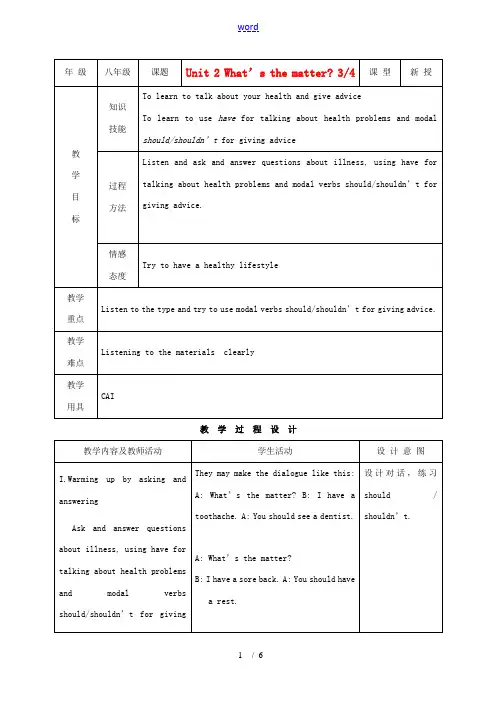
年 级
八年级
课题
Unit 2 What’s the matter? 3/4
课 型
新 授
教
学
目
人教版八年级英语上册Unit 2 What’s the matter?说课稿
人教版八年级英语上册Unit2What’s the matter?说课稿乐安二中聂冬兰一、说教材1、新目标英语教材概述《英语课程标准》把“培养学生学习英语的兴趣,树立自信心,培养良好学习习惯和形成有效策略,发展自主学习和合作精神”放在了首位。
它采用任务型语言教学模式。
语言教育理念是:强调“语言应用”,培养“创新、实践能力”,发展“学习策略”。
2、单元分析本课是新目标英语八年级上册第2单元,教材以What’s the matter? 为中心话题,围绕着描述“健康”展开。
本课主要学习如何表述身体种种不适,以及如何给予恰当建议,使学生学会健康的生活方式。
该内容与学生的实际生活密切相关,容易唤起学生的学习兴趣,这对于提高学生的综合能力很有帮助。
3、教学目标语言目标:What’s the matter?You should drink some tea.That’s too bad.I hope you feel better soon.重点难点:1、掌握情态动词should 和shouldn’t的用法。
2、掌握疾病名称的说法, 如sore, stomachache, toothache, fever, headache, have a cold, 及其它相关词语。
能力目标:1、通过小组活动,培养学生的合作精神。
2、通过本单元的学习,让学生对健康生活有更深入的了解。
二、说学生参加这次上课的学生目前就读八年级。
他们通过初一的学习,已经掌握了一定量的词汇和交际口语,已经具备了一定的听说读写能力。
该班的同学很活跃,很容易实行一些任务。
三、说教法结合教材和学生的特点,在本节课的教学方法设计中,我主要是依据《英语课程标准》的精神,在教学过程中从学生的学习兴趣、生活经验和认知水平出发,科学安排教学内容,合理设计教学任务,采用任务型教学方法,利用教学图片、多媒体课件等来展开课堂教学。
通过音乐、游戏等途径,让学生亲身体验、大胆实践、积极参与、共同合作和交流,帮助学生在任务型的教学途径下,发展综合语言运用能力。
Unit2What’sthematter?教案教学设计(新课标版英语八年级)
Unit2What’sthematter?教案教学设计(新课标版英语八年级)Unit 2 What’s the matter?Section A一、教师寄语Reading is to the mind what exercise is to the body. 读书养心,锻炼健身。
二、学习目标知识目标:Words: matter; have; cold; stomachache; sore; back; arm; ear; eye; foot; hand; head; leg; mouth; neck; nose; stomach; tooth; throat; toothache; fever; rest; honey; dentist; should; headache; shouldn’tPhrases: have a cold have a sore throat have a fever see a dentistSentences:1. What’s the matter? I have a cold.2. I have a headache/stomachache/toothache/sore back/sore throat.3. You should go to bed/drink some water.能力目标: Enable the students to talk about health problems and give advice with the language points.情感目标: Help the students learn how to talk about health problems and give advice on that with the language points.三、教学重、难点Talk about your health.and give advice.四、学习过程1预习导学或自测Ⅰ.Students look at the pictures on the blackboard and learnthe new words about the parts of the body.1. b______2. n_____3. he_____4. ha_____5. ea_____6. ey_____7. f______ 8. m_____ 9. ne_____10. a______ 11. s_______ 12. l_____2.自主学习1.看医生/牙医2.感冒3.患牙痛4.患头痛5.发烧6.躺下休息7.喝大量水 8.喝热蜂蜜茶9.有压力 10.保持健康3.合作探究 .完成表格后对话。
八年级英语上册《Unit 2 What’s the matter》教案
八年级英语上册(Go for it !)Unit 2 What’s the matter ?主备人:时间:执教人:教学目标:(一)知识目标:熟练掌握重点词汇:matter, have a cold, stomachache, sore, back, arm, eye, foot, hand , head, leg, mouth, neck, nose, stomach, and so on.句型:学会用What’s the matter? I have a cold. I have a stomachache. I have a sore back. I have a sore throat来谈论身体情况。
(二)能力目标:Enable the students to talk about health problems and give advice with the language points.(三)情感目标:学习关心他人和照顾自己的健康教学重点:1.词汇:matter, have a cold, stomachache, sore, back, arm, eye, foot, hand , head, leg, mouth, neck, nose, stomach, tooth fever, toothache, rest, honey, dentist, should, headache, shouldn’t, ago, so, illness, advice. thirsty, stress, (be)stressed out, early, problem listen to music, traditional, believe, balance, weak, angry, tofu, medicine, western, everybody, get, few, a few, stay, important, balanced, diet, moment, at the moment, until, dear, host family, hear .2.句型:What’s the matter? I have a cold. I have a stomachache.I have a sore back. I have a sore throat. I’m not feeling well.I hope you feel better soon.---What’s the matter with Gina? -----She’s tired. ……Drink some water. /Go to bed early3. 语法:情态动词should的用法1)should 常用来表示劝告、建议、认为某人应该做某事。
最新人教版八年级上册英语精品示范教案:Unit 2 What’s the matter
板书
设计
Unit 2
Fever---- drink lots of water
Sour throat---hot tea with honey
Stomachache---lie down and rest
Toothache—see a dentist
教学
反思
They make conversations according to the listening matiarals.
A:What’s the matter?B:I have a sore throat.
A:Maybe you should drink some hot tea with honey.
II. Presentation.
1.Tell them keeping healthy is very important.So the content today is being healthy.
2.look at the picture and read the name of the body parts.And look at the picture of the students numbered 1 through 5.
(Ten minutes later...)