
unit2healthy eating 教学设计
教学设计: 《普通高中课程标准实验教科书 英语》Model 3 Unit2 Healthy eating 张富民 (大厂第一回民中学) 教学内容:语言的运用(Using language)中的Listening ,Reading, Speaking and writing
一、设计思路: 1.指导思想及依据: 本部分教学内容是围绕中心话题进行听说读写的综合性练习。通过本单元话题学习,要实现语言知识、语言技能、学习策略、和价值观四个方面的有机结合。 ⑴ 在英语教学中要努力使基础知识转化为言语技能,并发展成用英语进行交际的能力。 ⑵ 注重提高学生用英语获取信息、处理信息、分析问题和解决问题的能力,以及用英语进行思维和表达的能力。 ⑶ 发展学生的自主学习能力和合作精神。 ⑷ 根据学生的个性特征和发展需求,为他们提供充分展现的空间,拓宽视野,增强社会责任感,培养创新精神和实践能力,发展与人沟通和与人合作的能力。
二、教材分析与学情分析 1.教材内容分析及教材处理: 本单元的中心话题是“健康饮食”,探讨各种食物对人体的作用,让学生了解饮食与健康方面的有关知识并且能根据所学知识审视自己、审视食物,提高自己饮食方面的意识,日常生活中少吃汉堡、薯条等高热量低营养食品,多吃水果、蔬菜和谷物,远离肥胖和亚健康状态。丰富饮食文化。为了围绕此中心话题开展听、说、读、写活动,本单元安排了八个部分:热身(Warming Up)、读前(Pre-reading)、阅读(Reading)、理解(Comprehending)、语 言学习(Learning about language)、语言运用(Using language)、小结(Summing Up) 和学习建议(Learning Tip)
其中语言运用(Using language) 部分的目的是让学生运用本课所学的语言知识与课文内容分进行听、说、读、写的综合训练。包括三项活动: ⑴.听(Listening) ⑵读与讨论 (Reading and discussion)⑶.说与写 (Speaking and writing表面是一些单项技能训练,比如Speaking或Writing,但其实是两项或三项技能的综合训练。Speaking的技能训练提供新课程标准所要求的意念项目,让学生分组讨论,改变了初中阶段给学生安排好示范性对话的做法,用专题会话(Themed conversation)的形式所设语言材料及创设的诸多情景,一方面,扩大了相关话题的信息输入,拓宽了学生的视野。另一方面也为学生提供了综合运用语言的空间。培养学生的实践能力和创新精神。 听力材料 是主体阅读文章的继续。王鹏去图书馆查找资料,在图书馆遇到饮食专家,于是王鹏向饮食专家请教有关膳食平衡的问题,发现他和雍慧的饭店提供的食物都存在片面性,从中学到了许多有关健康饮食的知识,了解了营养不均衡的饮食对身体的危害。通过听,学生了解到哪些是能量食品(energy-giving foods),哪些是健身食品(body-building foods),哪些是保健食品(protective foods),还有两家餐馆所提供食物的营养和作用。 本部分有四个练习: 练习①:让学生练习三个表示疾病的英文单词的发音,并弄清楚它们所代表的疾病,为听力的理解扫除难词障碍。 练习②:要求学生听录音,把方框中的疾病名称和病因连起来。 练习③:要求学生写出听力录音的大意。 练习④:要求学生在听录音,鳔胶王鹏和雍慧餐馆提供的食物中存在的问题以及各自所需补充的食物。 读与讨论 (Reading and discussing) 是阅读部分继续讲故事。经过一段时间的磨合,王鹏和雍慧将菜单合并,决定合作,提供给顾客既有能量又有纤维的均衡饮食。富有戏剧性的是最后两人结了婚,过上了幸福的生活。在阅读中不仅让学生感受到故事的趣味性,还教会了他们如何改变饮食习惯,改善饮食结构,丰富饮食文化。阅读后设计了三个练习: 练习①:是让学生两人一组就阅读内容来讨论两个问题 练习②:精读后的选择题,加深对文章的理解。 练习③:是再次让学生阅读,并在said的所有替换表达词下面划线。这个练习通过动手、动脑,丰富扩大学生的词汇量 说与写 (Speaking and writing) 说和写部分结合生活实际,让学生两人一组研究中餐并设计食谱,使学生将书本所学的知识运用到实际生活中,锻炼其口语和书面表达能力。
总之,课堂教学围绕学生的生活体验展开,旨在引导学生通过学习进一步反省自己的饮食习惯,改善饮食结构,在交流中,学生有机会将书本所学到的知识与生活实践相结合,锻炼其听力与写作能力。
2.教具:图片、录音、电脑、幻灯、黑板 3.教学目标 (1)学生能听懂文章大意,识别语段中重要信息并进行简单的推断。 (2)学生能根据“均衡饮食”这一话题展开讨论,提出合理的建议和要求。 (3)侧重培养学生的听说能力,兼顾读写能力。 (4)学生能通过了解王鹏热爱钻研,善于通过多渠道资源查找所需信息和材料的事实来提高资源策略的意识. 4.教学重点 (1)指导学生合理利用和重组信息,引导学生归纳文章大意及做出简单推测。 (2)指导学生归纳总结有关建议的固定句型结构,并在具体的语境中进行应用。 (3)指导学生结合他们自己饮食文化知识和听力文章内容,帮助同伴改善饮食结构。 5. 教学难点 (1)激发学生的学习热情,让学生学会自己动手收集信息、处理信息,用所学语言去实 (2)使学生在运用语言的过程中感悟语言,在趣味盎然的故事情节中轻松学习健康饮食的知识,领悟膳食平衡对身体健康的作用,养成热爱钻研的好习惯,体会现代人对饮食的关注和对时尚的追求 6.学情分析 尽管初中阶段、甚至小学阶段就开始了英语学习,部分学生到高中阶段时英语基础还是不够扎实,且学生们来自不同的学校。学生英语学习情况参差不齐。因此在设计本课内容时要尽量兼顾到各个层次的学生的不同情况。 听力方面:分为听前、听中和听后三个阶段,每个阶段各有侧重。如:听前介绍和提出任务;听中放三遍录音;听后核对答案。并要求学生在听力训练过程中对自己有一个自我评价,根据自身的强项和弱项,有针对性的训练。 口语方面:结合学生实际,尽可能给学生提供多种选择,设计的内容有梯度和层次,话题是学生熟悉的,并以结对或小组的形式进行讨论与交流,让学生有自信,大胆开口说话。如复述环节的设置。 阅读方面:则采取略读找关键词、寻读获取文章的细节内容、预测活动发挥学生处理信息的能力等多种形式和步骤,旨在使不同层次学生较好地把握文章的逻辑脉络。 写作方面:教师采用一种平等交流的态度,根据不同情况用不同方法对学生进行指导,评价方式,无论是分数还是评语,都是旨在发挥评价的积极作用,消除学生对写作的畏难情绪。
三、教学方法与手段 1. Listening-and answering activity to help the students go through the listening material. 2. Individual, pair or group work to make every student work in class. 3. Discussion after reading to make students understand what they’ve learned better. 4. Careful reading to get the detailed information in the text. 5. Cooperative learning
四、教学过程 1.教学过程采用任务型教学的理念。首先通过对阅读课文的复习引入本课的听力内容,在充分理解听力材料的基础上完成半封闭性任务“选择最佳菜单”(which one is more balanced),及开放性任务“我是饮食专家”(I am an expert on diets), 归纳有关建议的常用句型结构,在此基础上完成写作任务一篇短文(an advertisement for your restaurant),设计的任务由浅入深,环环相扣,在整个教学过程中始终关注“均衡饮食”这条主线,引导学生达成教学目标。最后作业的布置紧紧围绕本部分主题“平衡膳食的重要性”,制定家庭食谱是一个开放性的任务。 2.教学过程 Step1.Revision: Dictate the following phrases and sentences: ①enery-giving food ②body-building food ③protective food ④a balanced diet ⑤feel frustrated ⑥hurry by ⑦be amazed at sth. ⑧be amazed to do sth. ⑨ Nothing could be better. ⑩ feel fit/ healthy 设计思路:该活动的目的在于复习巩固语言知识,短语听写优于单词的听写,因为它们以语块(language chunk)的形式出现的,对语块的学习有利于用英语思维并提高语言表达的流利性。 教学效果:学生情况不一。 教学反思:对在阅读中出现的重点短语、句子还应该强化学生的记忆,加强细节的把握,以弥补此处的不足。 Step 2: Lead-in Discuss and predict the possible answers to the questions: 组织学生进行听前热身,通过两个问题让学生回顾一下刚刚学过的阅读课文中关于饮食不均衡所造成的健康问题。提出问题让学生展开讨论: (1)What do you think will happen to the customers if they keep eating in Yonghui's restaurant? (2)Besides the library, what will Wang Peng possibly turn to for advice on his new menu? 设计思路:对阅读课文进行复习,引发学生对新课的兴趣,启动他们对于饮食与健康之间关系的相关思考,同时以这种方式提醒学生关注王鹏解决问题的策略与思路, 引入部分为接下来的听力内容作好铺垫。 Step 3: Pre-listening Brainstorming Q: What illnesses can unbalanced diets cause except those healthy problems mentioned in the previous reading? (除了前文中提到的健康问题以外,饮食不均衡还会导致哪些疾病?) (1)Discuss in groups of four to make a list of all the illnesses resulting from an unbalanced diet. They may not know any or just one or two, but this doesn’t matter. The important thing is that they realize that there is a connection between good health and what they eat. (2) Introduction to new words Show them pictures of scurvy, rickets, and obesity and ask them to practice the pronunciation.
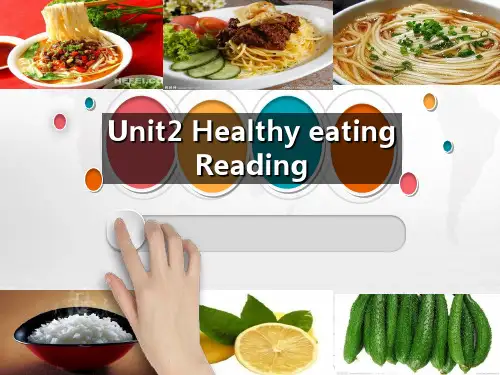
高中英语_Unit2 Healthy eating教学课件设计
energy-giving food
(Food that provides energy )
rice
chocolate
noodles
potatoes
oils
bread
Body-building food
(Food that helps grow bones and muscles )
meat
eggs milk
Unit2 Healthy eating Reading
StepⅠ Leading-in
Enjoy the short videos
StepⅠ Leading-in
Enjoy the short videos
Step Ⅱ Warming up A picking game
Pick the food you like best.
Wang Peng felt frustrated because he found his customers had come to other places to eat
Part 3 (Para. 4-5)
Wang Peng found the reason why Yonghui’s restaurant was more attractive.
Step Ⅲ pre-reading by the title and pictures.
Where? Who? What?
Step Ⅳ While-reading 1.Skimming for Main Idea.
Task 1: Divide the whole passage into three
Wang Peng’s restaurant food
高中英语Unit 2 Healthy eating 单元学案教案
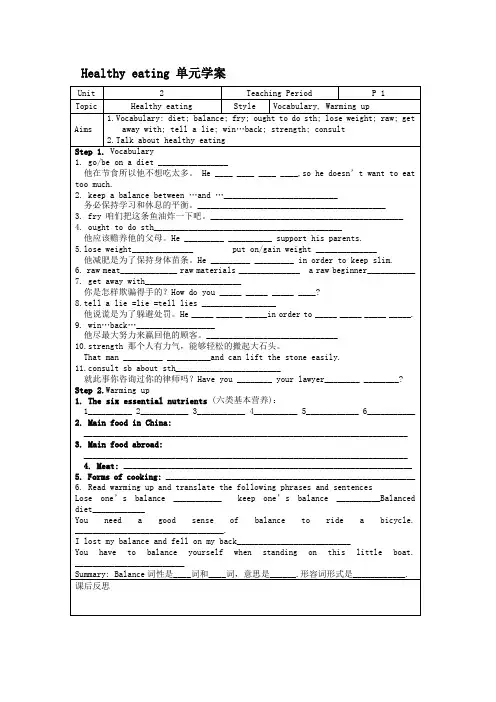
Healthy eating 单元学案Step 1. Words and expressions1. P12 Exx1,22. P12 Ex3 Pronunciation/the odd one1 ea [i:] ear [e] (fat and fruit) 3 u [] u[u] meat and energy-giving food3 (vegetable and meat4 e [e] e[] vegetable and fruitStep 2. SpeakingSample dialogue for P12 Ex4S1: What’s your favourite food? I’m really fond of roast duck.Period 1Step 1.1 节食 is on a diet2. 保持……和……之间的平衡 Make sure to keep the balance between study and rest.3. Let’s fry the fish.4.应该做某事 ought to5. 减肥增肥 lost weight6.生肉原材料生手7.(做坏事)不受处罚 get away with cheating8. 说谎 told a lie; get away with punishment9. 赢回 He tries his best to win his customers back.10.has strength 11.咨询某人某事 consult about this(it)1. The six essential nutrients (六类基本营养):protein(蛋白质) carbohydrates(淀粉) fat (脂肪) vitamins(维他命) minerals (矿物质) water2. Main food in China:rice, grain, wheat, corn, tofu, boiled/steamed dumplings(蒸饺/水饺), steamed buns (馒头), fried bread stick(油条), preserved egg(皮蛋), salted egg(咸蛋), rice porridge(稀饭), plain white rice(白饭), glutinous rice(糯米饭), fried rice with egg(蛋炒饭), wonton and noodles(馄炖面), sliced noodles(刀削面), spicy hot noodles(麻辣面)3. Main food abroad:bread, butter, cheese, hamburger, sandwich, salad, steak, French fries/chips4. Meat: pork, beef, mutton, chicken, fish, duck, lamb5. Forms of cooking: steam, fly, boil, braise(炖,焖), barbecue(烧烤)Step 2. 失去平衡保持平衡平衡膳食你需要一个很好的平衡感骑自行车。
人教版必修三Unit2Healthyeating(重点词汇短语与句型)教案
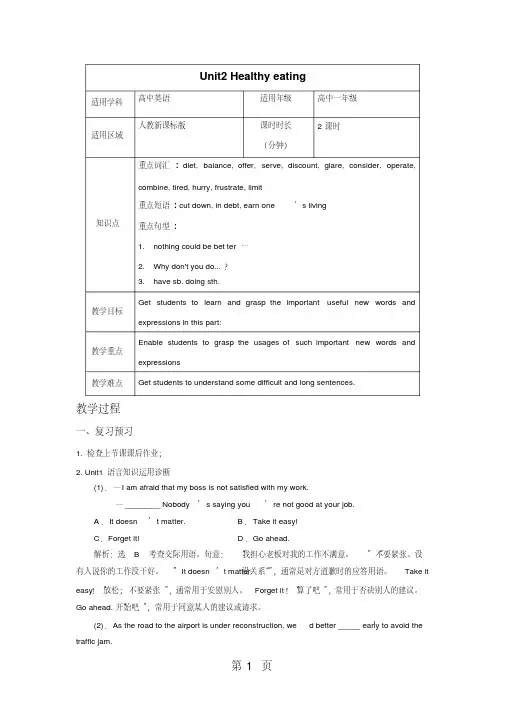
Unit2 Healthy eating适用学科高中英语适用年级高中一年级适用区域人教新课标版课时时长(分钟)2课时知识点重点词汇: diet, balance, offer, serve, discount, glare, consider, operate, combine, tired, hurry, frustrate, limit重点短语: cut down, in debt, earn one’s living重点句型:1.nothing could be bet ter… 2.Why don't you do...?3.have sb. doing sth.教学目标Get students to learn and grasp the important useful new words andexpressions in this part:教学重点Enable students to grasp the usages of such important new words andexpressions教学难点Get students to understand some difficult and long sentences.教学过程一、复习预习1. 检查上节课课后作业;2. Unit1语言知识运用诊断(1).—I am afraid that my boss is not satisfied with my work.—________ Nobody’s saying you’re not good at your job.A.It doesn’t matter.B.Take it easy!C.Forget it! D.Go ahead.解析:选B考查交际用语。
句意:“我担心老板对我的工作不满意。
”“不要紧张。
没有人说你的工作没干好。
”It doesn’t matter.“没关系”,通常是对方道歉时的应答用语。
高考英语复习Unit2Healthyeating教案

Unit 2 Healthy eating一、课前基础自查(一)分类记单词——省时高效(二)练中记短语——记牢用活(三)仿写明句式——以用为本二、课堂重点深化1.balance n .天平;平衡vt .平衡;权衡 [自主体验] 单句语法填空①Before making the final decision, you'd better balance the advantages against the disadvantages.②You'd better keep a balanced (balance) diet for the benefit of your health.补全句子③When the boy was running after his brother, he lost_his_balance and had a bad fall.当小男孩跑着追哥哥时,他失去平衡重重地跌了一跤。
[系统归纳]佳句时时写④你太努力工作了,你最好在工作和休闲之间保持平衡。
You are working too hard.You'd better keep_a_balance_between_work_and_relaxation.僻义牢牢记⑤I must check my bank balance before I decide to buy the car.余额2.lie v.说谎;躺下;位于n.谎言;谎话[自主体验]单句语法填空①My mother won't have me lying (lie) to her no matter what happens.②The town lies (lie) on the coast with amazing scenery, which attracts many visitors every year.③He didn't finish his homework last night so he told lies (lie).④The survivors lay (lie) on the beach, exhausted and shocked.[系统归纳]易错对对碰(lie/lay)⑤The boy lying on the ground lied to his mother that the cock had laid an egg.⑥The living room is clean and tidy, with a dinning table already laid for a meal.佳句时时写⑦毫无疑问,这个候选人的优势在于他能用英语和外国人交流。
healthy eating教学设计

Teaching PlanBook 3 Unit 2 Healthy eatingReading: Come and eat here (Ⅰ)◆Teaching objectivesA. Knowledge objectives1. Get students to learn the useful new words and expressions in this part: cucumber, eggplant, pepper, mushroom, peach, lemon, spaghetti, diet, curiosity, customer, discount, ought to, lose weight, get away with, tell a lie, win…back.2. Let students have a better understanding of the reading passage.B. Ability objectives1. Develop students’ reading ability and let them learn different reading skills.2. Guide students to choose the correct answers of the multiple choices.C. Affective objectives1. Stimulate students to form a healthy eating habit and let students know the importance of health.2. Develop students’ sense of cooperative learning.◆Important points1. Let students have a good understanding of the passage.2. Get students to learn different reading skills.◆Difficult pointsGive students some guidance about how to choose the correct answers of the multiple choices according to some key words and key sentences.◆Teaching proceduresStep1Warming upDo you know the name of the food?Step2 Pre-readingLet’s enjoy a video about healthy eating.Step3 Reading①Skimming:Go through the passage and find out some information.1.Who were mentioned in the text?2.Where did the story happen?3.What’s the main idea of the passage?A.Yong Hui opened a small restaurant near Wang Peng’s restaurant.B.Wang Peng visited Yong Hui’s restaurant with curiosity.C.Wang Peng found out the reason why he lost his customers andwanted to win them back.D.Wang Peng was unhappy because people came to Yong Hui’srestaurant.②Scanning:True or False ?1.The food in Yong Hui’s restaurant cost more than that in Wang Peng’srestaurant. ( )2.Yong Hui’s menu gave customers more energy-giving food. ( )③Careful reading: Choose the correct answer.1.When Wang Peng thought “Nothing could be better”, he meant .A.his food and drinks were the bestB.his food and drinks were the worstC.his food should have been improvedD.he could do nothing with his food and drinks2. Why did Wang Peng go into the newly-opened restaurant?A.Because he was angry.B.Because he was curious.C.Because he wanted to blame its owner.D.Because he wanted to ask for advice.3. According to the passage, we can infer that .A.Wang Peng felt frustrated because his restaurant wasn’t full ofpeople.B.Wang P eng was amazed at the menu and prices in Yong Hui’srestaurant.C.Yong Hui’s menu gave customers more energy-giving food.D. Wang Peng found out Yong Hui’s restaurant served more fat than his.。
Unit 2 Healthy eating 教案1
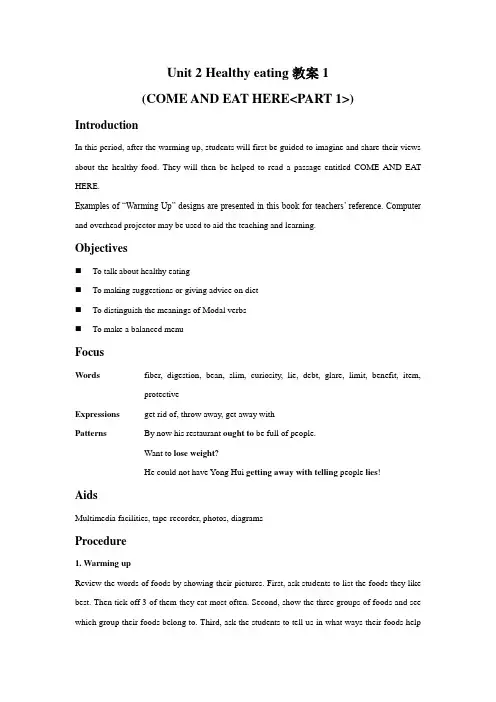
Unit 2 Healthy eating教案1(COME AND EAT HERE<PART 1>) IntroductionIn this period, after the warming up, students will first be guided to imagine and share their views about the healthy food. They will then be helped to read a passage entitled COME AND EAT HERE.Examples of “Warming Up” designs are presented in this book for teachers’ reference. Computer and overhead projector may be used to aid the teaching and learning.Objectives⏹To talk about healthy eating⏹To making suggestions or giving advice on diet⏹To distinguish the meanings of Modal verbs⏹To make a balanced menuFocusWords fiber, digestion, bean, slim, curiosity, lie, debt, glare, limit, benefit, item, protectiveExpressions get rid of, throw away, get away withPatterns By now his restaurant ought to be full of people.Want to lose weight?He could not have Yong Hui getting away with telling people lies!AidsMultimedia facilities, tape-recorder, photos, diagramsProcedure1. Warming upReview the words of foods by showing their pictures. First, ask students to list the foods they like best. Then tick off 3 of them they eat most often. Second, show the three groups of foods and see which group their foods belong to. Third, ask the students to tell us in what ways their foods helpthem grow.II. Pre-reading by talking and sharingGet the students to discuss the questions with their partners in this part. Then ask them to report their work. This part will help the students understand the text.T: Please look at the slide show and discuss the questions with your partners. Then I’ll ask you to report your work. Are you clear?Which food contains more…Examples of foods AnswerSugar Chocolate or grapesCakes or bananas Chocolate CakesFat Cream or riceChocolate or chicken Cream ChocolateFiber Peas or nutsPork or cabbage Nuts Cabbageprotein Potato crisps or hamEggs or cream Ham eggsIII. Fast readingGet the students to comprehend the passage quickly and accurately and meanwhile help the students to form a good habit of reading. Give the students a couple of minutes to look through the whole passage. Tell the students to read the text silently and then ask for the main idea of the text on the slide show with their partners.IV. Careful readingRead the text carefully and finish the following tasks.Task 1 Divide the whole passage into three parts, and give the general idea of each part.Task 2 True or False?ually Wang Pengwei’s restaurant was full of people.2.He provided a balanced diet in his menu.3.Yong Hui served a balanced diet.4.Yong Hui could make people thin in two weeks by giving them a good diet.5.Wang Pengwei’s customers often became fat after eating in his restaurant.6.Yong Hui’s menu gave them energy foods.7.Wan g Pengwei’s menu gave them food containing fibre.8.Wang Pengwei admire d Yong Hui’s restaurant when he saw the menu.9.Wang Pengwei decided to copy Yong Hui’s menu.Task 3 Find out the information of the two restaurants.V. Reading and translatingNext you are going to read the text COME AND EAT HERE and translate it into Chinese.VI. ListeningListen to the tape and pay attention to your pronunciation and intonation.VII. speakingIn pairs make up a dialogue about food you like or dislike using the expressions below and as many food, fruit or vegetables as possible and state your reasons.Useful expressions about likes and dislikesMy favorite food/fruit/meat is…VIII. Closing down by discussion1. What do you think Wang Peng will provide to win his customers back?2. How do you think the story will end?。
healthy eating 教学设计
A Teaching Plan for Unit 2: Healthy eatingI.Analysis of the teaching contents1.status, functions and charactersHealthy eating is the second unit in Book 3 of senior middle school, the People’s Education Press. It is a multi-purpose text which aims at developing students’ integrated skills. This unit’s grammar focus is modal verbs. Students of senior middle school have learned some basic knowledge of model verbs. By learning this class, students will have a systemic understanding of model verbs.Healthy eating is a heated issue nowadays. Many brands were reported to have added food additives in their products and made foods poisonous. Thus it is very important for students to learn about healthy eating. This unit is close to our real life and its materials are quite interesting, making students enjoy their learning.2、important points of teachingHelping students to learn how to use model verbs and find out what are the differences between them.3、difficult points of teachingCultivating students’ sense of self-learning.Help students to turn what they’ve learned into their ability.Ⅱ. Teaching objectivesBased on the requirements of the New Curriculum Criterion and the present knowledge of senior students, I set these goals for this lesson:1、Knowledge aimsLearn the new words and expressions of this unit.Review the model verbs and learn the new grammar item: ought to.2、Competence aimsDevelop students’ ability to use the useful new words and expressions in this unit.Enable students to use the new grammar item: ought to.Develop students’ ability of self-learning.3、Emotion aimsStimulate students’ sense of having a balanced diet.Encourage students to learn more about current affairs and learn to deliver their ideas about things.Strengthen students’ sense of group cooperation.Ⅲ. Analysis of the characteristics of the learners(学情分析):It is reported that in china, there are now more than 12 million overweight children, and an unhealthy eating is the main reason. Having a balanced diet is quite important for students. Thus a class of healthy eating will surely be interesting for them.Senior school students are capable of using different kind of methods such as internet、library to help with their learning. So the teacher’s most important job is to guide the students of self-learning. Students have already learned some knowledgeabout model verbs. It only needs a more detailed compare between these model verbs. An exercise after the reading will be a good way.Ⅳ. Teaching methodology(教学策略):A: TBLT (Task-Based Language Teaching)B: introductory mode of teaching (引导式教学) and project problem method(创设问题情境)V. Learning strategy(学习策略):A:Warming up—learning new words and expressions, and practicing speaking.B: Reading—practicing the skills of skimming, scanning and summarizing.C: After reading—rewriting the story, and practicing writing, speaking, cooperating.Ⅵ. Teaching aids: Multi-media, black board, learning planⅦ. Teaching procedures:Period 1 Warming up, pre-reading and readingStepⅠ Warming-upReview the words of foods by showing some pictures. Ask students to list the foods they like best and then to tell us in what ways their foods help them grow. Step Ⅱ Pre-readingGet the students to discuss the questions with their partners in this part. Then ask them to report their work.Design purpose:通过ppt展示相关图片,把学生注意力拉到课堂上来并通过一些与饮食相关的话题为阅读部分做铺垫。
高中英语 Unit 2《Healthy eating》教案2 新人教版必修3
Unit 2 Healthy eating Part 1 Teaching Design 第一部分 教学设计 Period 2 A sample lesson plan for Learning about Language (Modal verbs: ought to / ought not to / have to / don’t have to / mustn’t / needn’t) Introduction In this period students will be first helped by the teacher to warm up by having a dictation. Then they go on to discover useful words and expressions and learn about grammar. Some ready used materials for Modal verbs: ought to / ought not to / have to / don’t have to / mustn’t / needn’t will be offered.
Objectives To learn about Modal verbs: ought to / ought not to / have to / don’t have to / mustn’t / needn’t To discover and learn to use some useful words and expressions To discover and learn to use some useful structures Procedures 1. Warming up by reading aloud the text COME AND EAT HERE (1) We promote reading aloud to students and by students in order to encourage a love of English books and a desire to become a fluent English speaker. So Read aloud the text before we learn about the grammar. 2. Discovering useful words and expressions In pairs do the exercises on page 12. You must finish them in 5 minutes. 3. Reading and identifying Read the text COME AND EAT HERE (1), discovering all the sentences which contain any of the modal verbs: ought to / ought not to / have to / don’t have to / mustn’t / needn’t. 4. Consolidating by doing exercises To consolidate your understanding you will be given 10 minutes to
healthy-eating-教学设计
unit 2 Healthy eating教学设计(一)教材分析这是一篇介绍“饮食习惯”的文章,包括传统饮食习惯的改变日常饮食选择,旨在让学生明白健康的饮食习惯的养成是拥有健康体魄的前提。
且大部分学生对饮食与健康的关系(如人体每天必须摄入的六种基本营养成分的来源、健康饮食的重要性、什么是绿色食品等)了解较少。
因此,本文的学习难度较大。
(二)教学目标根据新颁布的普通高中《英语课程标准(实验稿)》关于阅读课主要教学目标的具体描述,结合本课教学内容,具体从语言知识、语言技能、情感态度和文化意识三个方面制定如下教学目标。
1. 语言知识目标:a)使学生了解protein, calcium等基本营养成分的来源和主要功能,健康的饮食习惯是健康的保证,以及素食主义等信息。
b)学习掌握有关营养成分与食物的词汇,如:protein、calcium 、carbo hydrate 、fibre、 mineral、 vitamin 、vegetarian & vegan、 green food and clean food 、eco-food and organic food等,以及 keep up with ,The same goes for…以及as 和only 引导的倒装句的用法。
2. 语言技能目标:a)使学生学会克服生词障碍,通过略读,寻找文章的主题句,理清文章的总体框架与脉络;通过查读,捕捉文章的重要细节,理解作者的写作意图。
b) 使学生学会运用各种猜词技巧,猜测部分生词在具体的语言环境的含义。
c) 使学生能够运用所学知识,用英语为自己所熟悉的一个人设计一份“h ealthy diet”,并阐明设计的依据。
3.情感态度与文化意识目标:a)使学生学会审视自己、审视食物,提高养成健康饮食习惯的意识。
b)使学生学会关心他人,体贴他人,并养成较强的合作意识。
(三)教学重点和难点:1.重点1)让学生认识到饮食对健康的重要影响。