
新冀教版英语七年级下册第四单元知识点总结
新冀教版英语七年级下册第四单元知识点总结 重点短语: come over过来;来访 do well in 在...方面做得好 make friends /make friends with 交朋友 at the same time 同时 enjoy doing ...喜欢做... stay in shap 保持体型 add up把...加起来 in one’s free time在某人的闲暇时间 play an instrument 弹奏乐器 go on a trip旅游 for example 例如 have lunch吃午饭 in a hurry急于 surf the internet网上冲浪 help... with...帮助某人某事 help sb (to) do sth 帮助某人做某事 on the phone用电话交谈 have a great /good weekend周末玩的愉快 take care of 照顾;照料 have fun doing 玩的愉快;过得愉快 on weeks 在周末 would love to do sth 想要做某事 take a bus take +a/the 交通工具
要点全解: 1. What day is it today? 今天是星期几?可用What day is today?回答时用“It is ... today.”注意What day was it yesterday?的回答。 2. Would you like to come over for dinner tonight?明天你要过来吃晚饭吗? Come over :顺便来访;过来 3. I have volleyball practice tomorrow.明天我有排球训练。 Practice名词,意为练习,指经常性或系统性的重复练习,在美式英语中也可作动词。 Why don’t you join a language club to practice speaking English? Practice doing 4. How about ...? =what about...? 意为“....怎么样?”其后可跟名词,代词和动名词。 How about going home now? 现在回家怎么样? 5.I usually volunteer at the Old Age Home on Thursdays.在星期四我通常在老年之家自愿帮助老人。 Volunteer 意为:自愿帮助 They volunteer to repair the house for the old man. 他们主动帮助老人修缮房子。 Many doctors volunteer to work here on Sunday.很多医生星期天自愿来这里工作。 Volunteer为名词,意为:志愿者 6. We are both busy all week.我们两个整个星期都很忙碌。 Both 代词,意为:二者。放在系动词,情态动词,助动词后或行为动词前。 We can both swim. We both want to go to the party. 7. Do you want to improve your thinking skill?你想提高你的思维技能吗? Want 及物动词,意为:要;想要 = would like Want +名词、代词 。意为想要,想得到 I want a new computer. Want to do sth 想要做某事 Somebody wants to see you. Want sb to do sth 想要某人做某事 I want you to gho along with me. 8. Do you want to make new friends ? 你想交新朋友吗? Make friends 结交朋友 与某人交朋友 需用 : make friends with I like making friends. I want to make friends with you. 9.You will learn and have fun at the same time. 你将在学习的同时玩的愉快。 At the same time 同时 He often eats and watches TV at the same time. 他经常吃饭的同时看电视。 10. Acting is fun and useful.表演既有趣又有用。 动名词acting 在句中做主语。动名词做主语,往往表示经常性,习惯性的动作。 Swimming is a dood sport in summer. Going to bed early and getting up early is a good habit.早睡早起是一个好习惯。 注意:单个动名词做主语,谓语动词用单数;由and连接的两个或两个以上的动名词做主语,谓语动词多用复数。 Listening ,speaking, reading and writing are four skills for English study. 11. Then add up your score and find out your club type!然后把你的得分加起来,并弄清楚你的俱乐部类型。 Add up 意为把...加起来 They add up all the figures. 他们把所有的数字都加起来。 Find out 弄清楚 查明 Please find out when the train leaves.请查明火车何时离开。 Find out find look for Find out 指通过理解思考询问等弄清楚查明 一件事情,宾语常是某种情况或事实。 Did you find out why he was late? Find 找到发现,强调找的结果。其宾语常常是某个丢失的东西或人。 ---Did you find LiMing yesterday? 你昨天找到黎明了吗? --- No, we lokked for him everywhere , but didn’t find him. Look for 意为寻找,是有目的的找,强调寻找这一动作。 ----What are you looking for? ---- I’m looking for my bike. 12. I must do something active inside. 我必须在室内做些有活力的事情。 Must 情态动词,意为必须,应当 I must work hard at my lessons. 13. I can’t go anywhere without them. 没有他们我不能去任何地方。 Without 介词,意为没有;不用 ,without 后跟动词室要用动名词形式,其反义词为with. A man can’t live without water. 没有水,人就不能活。 14. Do you need anything from the supermarket?你需要从超市买东西吗? Need 实义动词,意为需要。 跟名词代词作宾语。 I need your help. 需要做某事 need to do sth You need to go there at once. 你们需要马上去那儿。 Need doing sth 意为“需要做某事”,是主动形式表示被动含义。主语通常是物。 The flowers need watering.
习题: 1. What about _____ a rest? ---OK! Let’s go for a walk.
A.to have B. had C. Have D.having 2.______ of his parents work in a city, so he lives with his grandfather in a village. A.Neither B.None C. Both 3.Tony wants _____ a job as a language teacher in China. A. to find B. finding C. find 4.Drivers _____ wear the safety belt when driving. This is the traffic rule. A. can B. may C. will D.must 5. No one can be successful _____ hard work. A.through B.for C.with D.without 6.--- Mom ,must I clean my room now? --- No,you ____ . You can do it tomorrow. A. can’t B. needn’t C. mustn’t D.shouldn’t 7.I want to ____ friends with you. A. teach B. play C. make D. do 8.--- _______ do they come to school? ---They_______the bus. A. How; by B. What; take C. How;take D. What; by 9.Let’s practice_____ the guitar. A. play B. playing C. to play D. played 10.Does she do well ____ art? A. in B. at C. of D. for 11.Do you enjoy _____? A.dancing B. dance C. to dance D. danced 12.I can’t do my homework _____ your help? A. of B. with C. without D. for 13.Can you help me _____ my homework? A. with B. at C. for D.on
七年级英语下册Unit 4单词表冀教版
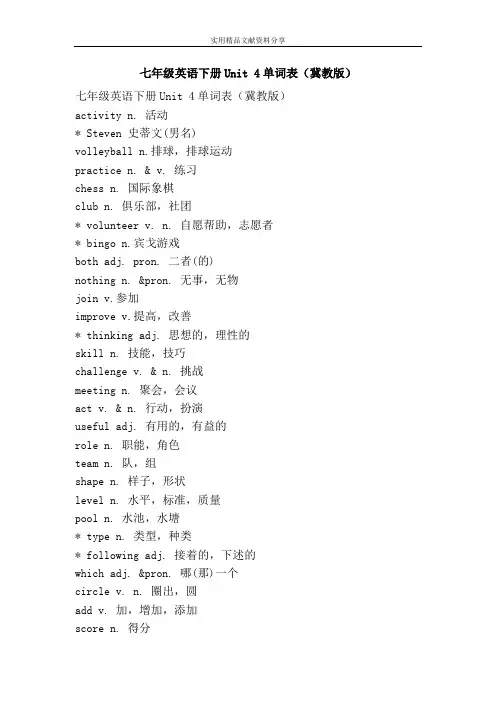
七年级英语下册Unit 4单词表(冀教版)七年级英语下册Unit 4单词表(冀教版)activity n. 活动* Steven 史蒂文(男名)volleyball n.排球,排球运动practice n. & v. 练习chess n. 国际象棋club n. 俱乐部,社团* volunteer v. n. 自愿帮助,志愿者* bingo n.宾戈游戏both adj. pron. 二者(的)nothing n. &pron. 无事,无物join v.参加improve v.提高,改善* thinking adj. 思想的,理性的skill n. 技能,技巧challenge v. & n. 挑战meeting n. 聚会,会议act v. & n. 行动,扮演useful adj. 有用的,有益的role n. 职能,角色team n. 队,组shape n. 样子,形状level n. 水平,标准,质量pool n. 水池,水塘* type n. 类型,种类* following adj. 接着的,下述的which adj. &pron. 哪(那)一个circle v. n. 圈出,圆add v. 加,增加,添加score n. 得分relax v. 放松,休息free adj. 空闲的,自由的mind n. 头脑,思想active adj. 积极的,活跃的* quietly adv. 安静地,平静地must v. aux 必须,应当without prep. 没有,不用bored adj. 无聊的,无趣的example n. 例如,范例hurry n. & v. 赶紧,匆忙somewhere adv. 在某处* actually adv. 的确,真实地* cooking n. 烹调* surf v. 冲浪Internet n. 因特网,互联网housework n. 家务劳动phone n. v. 电话,打电话* bookworm n. 书迷,书虫anything pron. 任何事物,某事* grocery n. 杂货expensive adj. 昂贵的* yummy adj. 好吃的,美味的everybody pron. 每人,人人come over 过来,来访do well in 在…方面做得好make friends 交朋友at the same time 同时enjoy doing 享受……,喜欢……. stay in shape 保持体型add up 把……加起来in one's free time 在某人的闲暇时间play an instrument 弹奏乐器go on a trip 旅游,游玩for example 例如have lunch 吃午饭in a hurry to do 匆忙做……surf the Internet 网上冲浪,浏览因特网he lp …with 帮助……做……I would love …我想……on the phone 在通电话have a great /good weekend 周末玩得愉快take a bus 乘公共汽车It's …away from … 从……到…..有多长时间(或多远距离)。
2020七年级英语下册 Unit 4 After-School Activities词句精讲精练 (新版)冀教版

Unit 4 After-School Activities词句精讲精练词汇精讲1. both(1)代词,意为“两者,双方,两人”。
例如:Both of the flowers are very beautiful. = The flowers are both very beautiful.这两朵花都很漂亮。
(2)形容词,意为“两者的,双方的”。
例如:She wants both dictionaries. 这两本字典她都想要。
Both the answers are wrong. 这两个答案都是错的。
(3)副词,意为“两者,两者都是”,常用于行为动词之前,be动词、助动词、情态动词之后。
例如:They can both dance. 他们俩都会跳舞。
【拓展】(1)both…and意为“……和……都,既……又……”,用于连接两个并列成分,连接并列主语时,谓语动词应该用复数形式。
例如:Both you and your sister like it very much. 你和你姐姐都非常喜欢它。
(2)both与either都用于两者之间,但是both意为“两者都”,either意为“两者之一”。
例如:Either of the two boys went to the university at last.最后这两个男孩中的一个上了大学。
2.joinjoin作动词,意为“参加,加入”。
宾语有以下几种形式:(1)join + 表示团体或组织的名词,join意为“加入(某团体),成为……(成员)”。
例如:Yao Ming joined the NBA. 姚明加入了NBA。
(2)join + 指人的名词或代词,join意为“加入……之中”。
例如:Will you join us for lunch? 和我们一起吃午饭好吗?(3) join + in + 活动类名词,join in意为“参加(活动)”。
七年级下册英语第四单元知识点笔记

七年级下册英语第四单元知识点笔记In Unit 4 of the seventh grade English textbook, students will learn about different types of holidays and celebrations around the world. This unit covers a wide range of topics, including traditional festivals, cultural customs, and special events that are celebrated in various countries. 。
One of the key points in this unit is understanding the significance of holidays and celebrations in different cultures. Students will learn about the history and traditions behind holidays such as Chinese New Year, Diwali, Thanksgiving, and Halloween. By studying these celebrations, students can gain a deeper appreciation for the diversity of cultures and traditions around the world.Another important topic in this unit is learning how to talk about past events and experiences. Students will practice using past tense verbs to describe things that have happened in the past. They will also learn how to ask and answer questions about past events, such as "What did you do last weekend?" or "Where did you go on vacation last year?"In addition to learning about holidays and past events, students will also explore the concept of giving and receiving gifts. They will learn how to express gratitude and appreciation when receiving a gift, as well as how to politely decline a gift if necessary. This unit will help students understand the importance of showing gratitude and generosity in different social situations.Furthermore, students will be introduced to the topic of making plans for future events. They will learn how to use future tense verbs to talk about things that will happen in the future, such as upcoming holidays, vacations, or special occasions. By practicing making plans and discussing future events, students can improve their communication skills and expand their vocabulary.Overall, Unit 4 of the seventh grade English textbook provides students with a comprehensive overview of holidays, celebrations, and cultural customs from around theworld. By studying this unit, students can enhance their understanding of different cultures, improve their language skills, and develop a greater appreciation for the diversity of human experiences.。
七下第四单元英语归纳总结
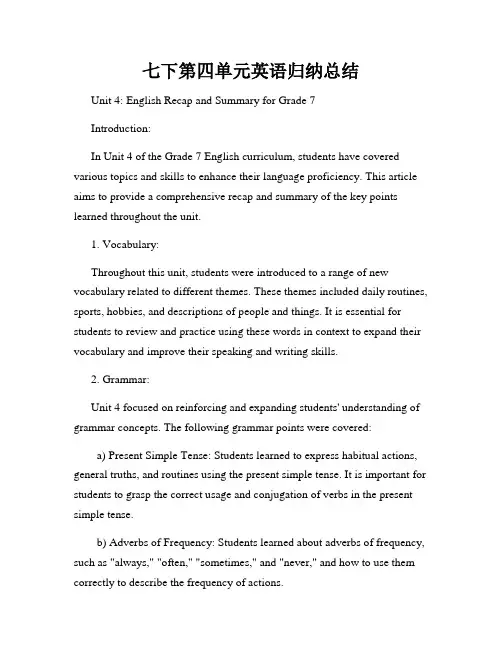
七下第四单元英语归纳总结Unit 4: English Recap and Summary for Grade 7Introduction:In Unit 4 of the Grade 7 English curriculum, students have covered various topics and skills to enhance their language proficiency. This article aims to provide a comprehensive recap and summary of the key points learned throughout the unit.1. Vocabulary:Throughout this unit, students were introduced to a range of new vocabulary related to different themes. These themes included daily routines, sports, hobbies, and descriptions of people and things. It is essential for students to review and practice using these words in context to expand their vocabulary and improve their speaking and writing skills.2. Grammar:Unit 4 focused on reinforcing and expanding students' understanding of grammar concepts. The following grammar points were covered:a) Present Simple Tense: Students learned to express habitual actions, general truths, and routines using the present simple tense. It is important for students to grasp the correct usage and conjugation of verbs in the present simple tense.b) Adverbs of Frequency: Students learned about adverbs of frequency, such as "always," "often," "sometimes," and "never," and how to use them correctly to describe the frequency of actions.c) Comparative and Superlative Adjectives: Students were introduced to comparative and superlative forms of adjectives and practiced using them to compare people and things. Understanding the rules for forming comparatives and superlatives is crucial for accurate language usage.d) Possessive Pronouns: This unit introduced possessive pronouns like "mine," "yours," "his," "hers," "ours," and "theirs." Students practiced using these pronouns to indicate ownership.e) Prepositions of Time: Students learned common prepositions of time, including "in," "on," and "at." It is important for students to use these prepositions correctly when talking about specific time periods.3. Reading Comprehension:Throughout the unit, students have read a variety of texts, including passages related to daily routines, sports, and hobbies. They practiced using different reading strategies, such as skimming, scanning, and making inferences, to understand the main ideas, identify supporting details, and extract information from the text. Students should continue to develop their reading comprehension skills by actively engaging with a wide range of texts.4. Writing Skills:In Unit 4, students worked on improving their writing skills by focusing on paragraph construction and coherence. They learned how to organize their ideas logically, write topic sentences, and provide supporting details. Students should practice writing short paragraphs on various topics to further enhance their writing abilities.5. Speaking and Listening:Throughout the unit, students engaged in various speaking and listening activities to develop their oral communication skills. They practiced asking and answering questions, participating in dialogues, and describing people and things. Active participation in classroom discussions and partnering with classmates for spoken activities can help improve their fluency and accuracy in spoken English.Conclusion:Unit 4 of the Grade 7 English curriculum provided students with a foundation for developing their language skills further. By reviewing vocabulary, understanding grammar concepts, strengthening reading comprehension abilities, practicing writing skills, and engaging in speaking and listening activities, students can continue to progress in their language learning journey. Consistent practice and application of these skills will lead to increased fluency and proficiency in the English language.。
七年级英语下册Unit 4单词表(冀教版)
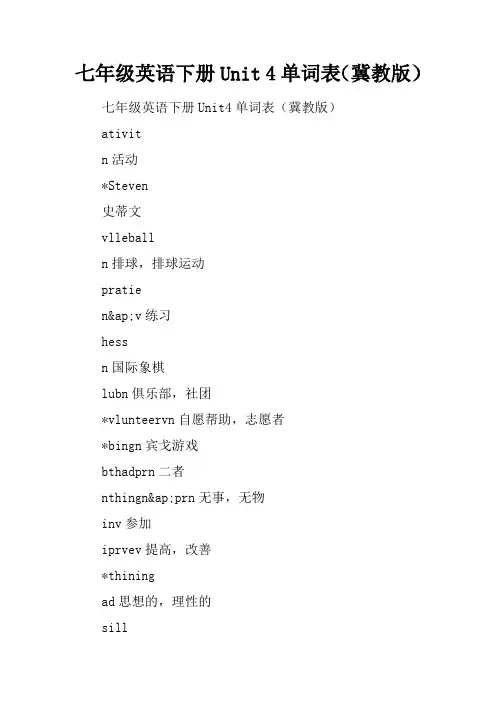
七年级英语下册Unit 4单词表(冀教版)七年级英语下册Unit4单词表(冀教版)ativitn活动*Steven史蒂文vlleballn排球,排球运动pratien≈v练习hessn国际象棋lubn俱乐部,社团*vlunteervn自愿帮助,志愿者*bingn宾戈游戏bthadprn二者nthingn≈prn无事,无物inv参加iprvev提高,改善*thiningad思想的,理性的silln技能,技巧hallengev≈n挑战eetingn聚会,会议atv≈n行动,扮演usefulad有用的,有益的rlen职能,角色tean队,组shapen样子,形状leveln水平,标准,质量pln水池,水塘*tpen类型,种类*fllingad接着的,下述的hihad≈prn哪一个irlevn圈出,圆addv加,增加,添加sren得分relaxv放松,休息freead空闲的,自由的indn头脑,思想ativead积极的,活跃的*quietladv安静地,平静地ustvaux必须,应当ithutprep没有,不用bredad无聊的,无趣的exaplen例如,范例hurrn≈v赶紧,匆忙sehereadv在某处*atualladv的确,真实地*ingn烹调*surfv冲浪Internetn因特网,互联网husern家务劳动phnenv电话,打电话*brn书迷,书虫anthingprn任何事物,某事*grern杂货expensivead昂贵的*uad好吃的,美味的everbdprn每人,人人ever过来,来访dellin在…方面做得好aefriends交朋友atthesaetie同时ending享受……,喜欢……stainshape保持体型addup把……加起来inne'sfreetie在某人的闲暇时间plaaninstruent弹奏乐器gnatrip旅游,游玩frexaple例如havelunh吃午饭inahurrtd匆忙做……surftheInternet网上冲浪,浏览因特网help…ith帮助……做……Iuldlve…我想……nthephne在通电话haveagreat/gdeeend 周末玩得愉快taeabus乘公共汽车It's…aafr…从……到…有多长时间。
冀教版七年级下英语知识点总结

一、语法知识点:1.一般现在时:表示经常性或习惯性的动作,以及现在的状态。
2.现在进行时:表示现在正在进行的动作。
3.一般过去时:表示过去发生的动作。
4.过去进行时:表示过去其中一时刻正在进行的动作。
5.一般将来时:表示将要发生的动作。
6.祈使句:用于表示命令、请求、建议等。
7.动词不定式:用于表示目的、目标等。
8.介词:用于表示时间、地点、原因等。
9.名词所有格:用于表示物属于人。
10.形容词的比较级和最高级:用于表示两者、三者或多个人或物之间的程度或大小的比较。
二、词汇知识点:1.基本的日常单词词汇。
2.常用的动词、形容词和副词。
3.一些常见的短语和固定搭配。
4.名词和代词的单复数形式。
三、句型知识点:1.肯定句:主语+谓语+宾语。
2.否定句:主语+谓语+not+宾语。
3.一般疑问句:谓语+主语+宾语?4.特殊疑问句:疑问词+一般疑问句。
5.选择疑问句:是否+一般疑问句。
四、阅读技巧:1.理解文章中的主题和中心思想。
2.根据上下文推测词义。
3.找出文章的中心句和关键句。
4.根据文章内容回答问题。
五、写作技巧:1.写人物介绍:介绍人物的外貌、性格、爱好、家庭等信息。
2.写日记:描述一天的活动、感受和想法。
3.写邀请函:用适当的语言邀请他人参加一些活动。
4.写快乐时刻:写自己或他人的快乐时刻,包括时间、地点、人物、事件等。
六、口语表达:1.自我介绍:介绍自己的姓名、年龄、家庭等基本信息。
2.问路:询问一些地方的具体位置和指示怎样到达。
3.购物:询问物品的价格和购买方式等。
4.餐厅用餐:询问菜单、点菜、服务等。
5.看医生:描述自己的身体状况、症状等。
初一英语下册Unit4 知识点归纳
初一英语下册Unit4 知识点归纳初一英语下册Unit4知识点归纳前预习资料学习目标:1知识目标1)词汇:dtr,reprter,plieffier,aiter,banler,salesassistant,d angerus2)句型:—hatdeshed?—Heisaaiter—hatduanttbe?—Ianttbeanatr—heredesher?—Hersataban2能力目标:谈论有关职业的话题为将来踏入社会求职打下基础3情感目标:热爱学习,以便将来在各自不同的岗位上为建设祖国做出贡献。
重点、难点1重点1)--hatdud?--Iaareprter2)--hatdeshed?--Heisastudent3)--hatduanttbe?--Ianttbeanatr4)--hatdesheanttbe?--Heantstbeabanler2难点一般现在时态的概念和用法:当主语用第三人称单数时,谓语动词的相应变化。
后复习资料一短语:1anttdsth想要作某事2givesbsth=givesthtsb给某人某物/把某物给某人3helpsbdsth帮助某人作某事Eg:Iantthelptherdsehuserathe4helpsbithsth帮助某人谋事Eg:Iantthelptherithsehuseratheintheda在白天6atnight在晚上7talith/tsb和----谈话8bebusdingsth忙于做某事Eg:Heisbuslisteningttheteaher9inahspital在医院10r/studhard努力工11EveningNespaper晚报二重点句式及注意事项:1询问职业的特殊疑问词是hat;有三种主要句式①hat+is/are+sb?Eghatisurther?②hat+des/d+sb+d?Eghatdeshisbrtherd?③hat+is/are+名词所有格/形容词性物主代词+b?Eghatisurb?2Peplegiveetheirnergettheirnefre3SetiesIrinthedaandsetiesatnight4IlietalingtpepleIrlateI’verbushenpepleguttdinners6heredesursisterr?7thenehaveabfruasaaiter8Duanttrfraagazine?Theneandrfrusasareprter9Dulietreveningsandeeends?10eareaninternatinalshlfrhildrenf-12三本单元中的名词复数。
七年级下册英语第四单元b知识点
七年级下册英语第四单元b知识点七年级下册英语第四单元B知识点涉及到日常生活中的各种场景和话题,包括谈论饮食、购物、时间、天气、交通和文娱等方面。
以下将分别对这些知识点进行介绍。
1. 谈论饮食在这一部分中,我们将学会如何询问、介绍和点餐。
例如:- What do you usually have for breakfast?你早餐通常吃什么?- Can I have a chicken sandwich and a cola, please?我可以要一份鸡肉三明治和一杯可乐吗?2. 购物在这一部分中,我们将学习如何询问价格和购买物品。
例如:- How much is this T-shirt?这件T恤衫多少钱?- I’d like to buy a pair of shoes.我想买一双鞋。
3. 时间这一部分中,我们将学会如何询问时间、日期和做时间表。
例如:- What time is it now?现在几点钟?- What day is today?今天星期几?- I usually get up at 6:30 in the morning.我通常早上六点半起床。
4. 天气在这一部分中,我们将学习如何描述天气状况和询问天气预报。
例如:- It’s raining heavily today.今天下大雨。
- What’s the weather like tomorrow?明天天气怎么样?5. 交通在这一部分中,我们将学会如何询问和提供交通指示。
例如:- How can I get to the museum?我怎么才能到博物馆?- Go straight and turn left at the first traffic light.一直往前走,在第一个红绿灯处左转。
6. 文娱在这一部分中,我们将学会如何谈论各种文娱活动并提出建议。
例如:- Would you like to watch a movie with me this weekend?你这周末愿意和我一起看电影吗?- I think visiting the zoo is a good idea.我认为去动物园是个好主意。
七年级下册第四单元英语知识点
七年级下册第四单元英语知识点English:In the seventh grade, the fourth unit of English covers various knowledge points, including daily routines, time expressions, and the simple present tense. Students will learn how to talk about their daily routines and activities using proper time expressions, such as "at", "in", "on", and "every". They will also practice using the simple present tense to describe habitual actions, facts, and general truths. In addition, students will be exposed to vocabulary related to different activities, such as sports, hobbies, and household chores. They will also learn how to ask and answer questions about daily routines and free time activities, as well as write short paragraphs about their own daily routines. Overall, this unit aims to help students build a solid foundation in using time expressions and the simple present tense to communicate about their daily activities.中文翻译:在七年级下册的第四个单元中,英语课涵盖了各种知识点,包括日常生活、时间表达和现在时态。
七年级下册英语第四模块知识点
七年级下册英语第四模块知识点本篇文章主要介绍七年级下册英语第四模块的知识点,主要包括以下几个方面:词汇、语法、听力、口语等。
让我们一起来看看详细内容。
一、词汇
七年级下册英语第四模块的词汇主要涵盖了日常生活中常见的单词,包括食物、动物、数字、颜色、地点、人物等。
要掌握这些词汇,我们可以通过阅读练习,背单词等方法加深印象。
二、语法
语法是英语学习中非常关键的部分,七年级下册英语第四模块的语法重点包括简单现在时、一般过去时、现在进行时、there be 句型等。
对于这些语法知识,我们可以通过练习不同种类的练习题来掌握。
三、听力
听力是英语学习中非常重要的一环,要想在听力上得到提升,就需要不断进行听力训练并加强对口语的理解。
七年级下册英语第四模块的听力部分主要包括对话、短文等,需要通过大量的练习来提高自己的听力水平。
四、口语
口语是英语学习最难攻克的一项,要想在口语表达方面取得进步,就需要进行大量的口语练习。
七年级下册英语第四模块的口语主要包括日常交际用语、询问信息、表达想法等方面。
建议进行跟读、模仿、演讲等练习,从而提高自己的口语能力。
五、其他相关知识
除了以上介绍的主要知识点外,七年级下册英语第四模块还包括其他相关知识,如阅读理解和写作技巧。
要想在这些方面得到提高,我们可以进行大量的练习,掌握相关的技巧和方法。
六、总结
通过以上的介绍,我们可以看到七年级下册英语第四模块的知识点涵盖了词汇、语法、听力、口语等各个方面。
要想在英语学习中取得好的成绩,需要不断进行练习,并加深对英语知识的理解。
希望本篇文章对大家在学习中起到一定的帮助和指导作用。