
新外研版七年级英语上册 Module 10 模块知识点归纳
Module 10 Spring Festival
Are you getting ready for Spring Festival? 必背单词
1.dance(v.)跳舞→dancing(现在分词)
2.clean(v.)打扫→cleaning(现在分词)
3.meal(n.)一餐;一顿饭→meals(pl.)
4.happen(v.)发生→take place(同义短语)
5.quite(adv.)十分,相当→very(同义词)
6.hurry(v.)赶快,匆忙→hurries(第三人称单数形式) 7.lantern(n.)灯笼8.dragon(n.)龙
9.sweep(v.)打扫;清扫10.floor(n.)地板
11.cook(v.)烹调;煮;烧
12.speak(v.)说话,讲话13.festival(n.)节日
14.beautiful(adj.)漂亮的,美丽的
15.away(adv.)在安全的地方;在通常存放的地方
16.hard(adv.)努力地;(adj.)艰难的,困难的
17.join(v.)参加;加入
必背短语
18.get ready for为……做好准备
19.at the moment此刻,目前
20.at work在工作
21.put away收起,收拾好
22.hurry up赶快
必背句子
23.This is Tony speaking.我是托尼。
24.I'm making big red lanterns.
我在做大红灯笼。
25.She's working so hard!
她正如此努力地干活!
26.Can I join them?
我可以加入他们吗?
My mother's cleaning our house and
sweeping away bad luck.
必背单词
1.before(prep.)在……之前→after(反义词)在……之后2.luck(n.)运气→lucky(adj.)幸运的→luckily(adv.)幸运地3.celebrate(v.)庆祝→celebration(n.)庆祝
4.traditional(adj.)传统的→tradition(n.)传统5.Christmas(n.)圣诞节
6.merry(adj.)愉快的,高兴的
7.February(n.)二月8.January(n.)一月
9.table(n.)桌子10.dumpling(n.)饺子,团子11.programme(n.)(电视)节目
12.sweater(n.)厚运动衫;毛线衣
13.coat(n.)外套
14.mean(v.)意思是;意味着
必背短语
15.sweep away扫去16.Spring Festival春节
17.a kind of一种18.bad luck坏运;霉运
必背句子
19.It usually comes in February, but sometimes it comes in January.
它通常是在二月份,但有时在一月。
20.Have a look at them!看一看它们!
21.There's so much delicious food.
有如此多的美食。
Language in use
必背单词
1.tell(v.)讲;告诉
必背短语
2.at Lantern Festival在元宵节
3.on that day在那天
必背句子
4.Christmas is the most important festival in most Western countries.
圣诞节是大多数西方国家最重要的节日。
5.Children usually like Christmas a lot because of Father Christmas, Santa Claus.
孩子们通常因为圣诞老人而非常喜欢圣诞节。
6.He is a fat man with a long white beard and he wears a red suit.
他胖胖的,有长长的白胡子,穿着红色的衣服。
外研七年级上Module 10 Spring Festival

Careful reading
Read ParaB and fill in the blanks.
1. In this photo, they are celebrating Spring Festival with a traditional family dinner. 2. After the dinner, they usually watch a special programme on TV.
a few days before Spring Festival
clean our houses; buy a lot of food
have a traditional family on the evening dinner; before Spring watch a special programme Festival on TV
Read the passage and match the paragraphs with the pictures in Activity 1. ① ② ③
A
B
CLeabharlann Careful reading Read Para1 and check the true sentenses.
1. Spring Festival comes on the same day doesn't come on the every year. same day every year. × 2. Spring Festival usually comes in February, but sometimes it comes in January.
learn a dragon dance
Before Spring Festival
外研版七年级上册重点短语及句子
外研版七年级上册英语知识点Module1重点短语1.befrom...=comefrom...?来自......2....yearsold......岁3.whatabout...=howabout.........怎么样?4.inClassFour,GradeSeven?在七年级四班5.thecapitalof.........?的首都/省会6.firstname=givenname?名stname=familyname?姓8.Englishname?英文名字9.Chinesename?中文名字重点句子1.I’mChinese,andI’mfromChina.?我是中国人,?我来自中国2.Wherearetheyfrom??他们来自什么哪里?(=Wheredotheycomefrom?)TheyarefromAmerica.?他们来自美国.(=TheycomefromAmerica.)3.Howoldisthatman??那位男子多少岁了?Heisforty-four.?他44岁4.ThestudentsareinClassFive,GradeSeven.这些学生在七年级五班5.TomisinClassOnewithLingling.?汤姆和玲玲在一班。
=TomwithLinglingisinClassOne.=TomandLinglingareinClassOne.6.Whataboutyou?=Howaboutyou?=Andyou?你呢?/你怎么样?7.WelcometoClass6Grade7!?欢迎到七年级六班。
8.BeijingisthecapitalofChina.?北京是中国的首都。
9.Goodtoseeyou.=Nicetoseeyou.=Gladtoseeyou.?很高兴见到你。
10.I’mTonySmith.TonyismyfirstnameandSmithismyla stname.?我是TonySmith,Tony是我的名,Smith是我的姓。
外研版七年级英语上册M10-U2课件

and parents usually give their children a hongbao. It _m__e_a_n_s_ lucky monkey.
P63
Task 6
根据关键词提示复述课文。 Spring Festival / important in China / happens every year/ comes in February/ January
C: visit uncles and aunts (wear … and get a hongbao)
Language points
1. Like Christmas, it happens every year, but not on the same day. like意为“像,跟……一样”,后接名 词或代词。如:
Module 10 Spring Festival
Unit 2 My mother’s cleaning our house
and sweeping away bad luck.
Words and expressions
Christmas n. 圣诞节 February n. 二月 January n. 一月
Task 1
2 Match the paragraphs with the P62 pictures.
①
②
③
A
B
C
ห้องสมุดไป่ตู้
Task 2
Answer the following questions.
1. When is Spring Festival?
It usually comes in February, but sometimes it comes in January.
Module10重要教案讲解2021-2022学年外研版七年级英语上册
-词汇记忆:学生可能难以记住不同食物和饮料的英文单词,尤其是相似词汇的区分。
-句型应用:在真实语境中,学生可能难以灵活运用所学的表达喜好和制作方法的句型。
-语法运用:一般现在时态的运用,特别是在表达习惯性动作时,学生可能会混淆。
-口语表达:学生在用英语描述食物制作过程中,可能缺乏条理性和流畅性。
(二)新课讲授(用时10分钟)
1.理论介绍:首先,我们要了解食物和饮料相关词汇的基本概念。这些词汇是我们在描述喜好、讨论食谱时的基础。它们在我们的日常交流中非常重要。
2.案例分析:接下来,我们来看一个具体的案例。这个案例展示了如何用英语描述制作香蕉奶昔的过程,以及这些知识如何帮助我们进行有效交流。
3.重点难点解析:在讲授过程中,我会特别强调表达喜好和制作方法的句型,如“I can't stand...”、“How do you make...?”。对于难点部分,如一般现在时的运用,我会通过举例和比较来帮助大家理解论:学生们将分成若干小组,每组讨论一个与食物和饮料相关的实际问题,如制作某种简单食物的过程。
2.实验操作:为了加深理解,我们将进行一个简单的食谱制作操作。这个操作将演示如何用英语描述食物制作过程。
3.成果展示:每个小组将向全班展示他们的讨论成果和食谱制作的结果。
Module10重要教案讲解2021-2022学年外研版七年级英语上册
一、教学内容
Module 10重要教案讲解,针对2021-2022学年外研版七年级英语上册,主要包括以下内容:
1.教材章节:Module 10 Food and drink
2.教学内容:
- Unit 1 I can't stand mushrooms.
- Unit 2 What's your favorite food?
外研版英语七年级上册Module10 Unit2课件
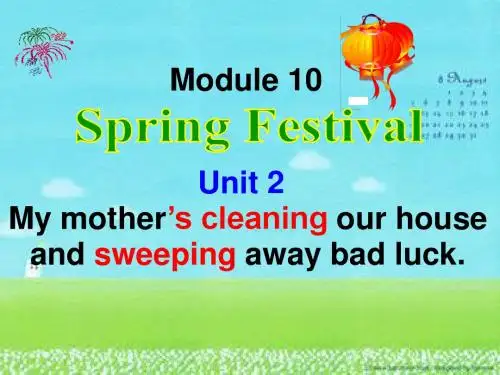
1 Work in pairs. Look at the pictures and talk about what’s happening. ① ②
③
— What’s Li Shan’s mother doing? — She’s cleaning the house.
Read the passage and match the paragraphs with the pictures in Activity 1. ① ②
2. It’s a few days before Spring Festival. 这是春节前的几天。 few n. 一些,很少 Few people enjoy this music. 几乎没人欣赏这种音乐。 There are a few people in the classroom. 教室里有几个人。 few作形容词,表示否定的概念, 为 “几乎没有”,修饰可数名词复数。 a few一些,表示肯定的概念,修饰 可数名词复数。
Some festivals of foreign countries
Easter
Thanksgiving Day
Christmas
Carnival
Mother’s Day
Festivals
Halloween Valentine’s Day
Review
Words and expressions
Read the words and expressions loudly.
learning a dragon dance They are _____________________.
setting off fireworks The two children are _________________.
外研版英语七年级上册Module10 Unit1课件
外研版英语七年级上册Module10 Unit1课件外研版英语七年级上册Module10 Unit1课件一、教学目标1、掌握并运用本模块的关键词汇和句型,如because, why, how等。
2、培养学生的听说读写能力,能够听懂并回答有关原因和建议的问题,能用英语表达自己的想法和观点。
3、提高学生的语用能力和跨文化意识,让学生能够根据不同的情境正确运用英语。
二、教学内容1、听力:听一段对话,回答有关原因和建议的问题。
2、口语:根据听力材料进行角色扮演,模仿对话并回答相关问题。
3、阅读:阅读一篇短文,理解文章大意,学习并运用本模块的关键词汇和句型。
4、写作:根据所给话题,写一篇短文,阐述自己的观点和想法。
三、教学步骤1、导入:通过问题导入,让学生思考并回答一些与本模块主题相关的问题,激发学生的学习兴趣。
2、听力:播放听力材料,让学生听懂对话并回答有关原因和建议的问题。
然后让学生再次听录音,跟读并模仿对话,纠正发音和语调。
3、口语:让学生进行角色扮演,模仿对话并回答相关问题。
教师进行巡视,及时给予指导和帮助。
4、阅读:阅读一篇短文,理解文章大意,学习并运用本模块的关键词汇和句型。
教师可以根据文章内容进行提问,检测学生的理解程度。
5、写作:根据所给话题,写一篇短文,阐述自己的观点和想法。
教师可以选择优秀作品进行展示和点评,鼓励学生发挥自己的想象力和创造力。
四、教学反思1、反思教学目标是否达成,学生对关键词汇和句型的掌握情况如何,是否能够正确运用英语表达自己的想法和观点。
2、反思教学内容是否合适,是否能够激发学生的学习兴趣和积极性,是否符合学生的认知水平和能力。
3、反思教学步骤是否合理,是否能够有效地实现教学目标,是否符合学生的认知规律和学习特点。
4、反思教学方法是否得当,是否能够激发学生的学习兴趣和积极性,是否能够有效地帮助学生掌握知识和技能。
五、教学评价1、评价学生的听说读写能力,是否能够听懂并回答有关原因和建议的问题,能否用英语表达自己的想法和观点。
最新外研版七年级英语上册词组归纳(1)
外研版七年级上册英语短语归纳Starter Module1 和Module2的重点词汇1.good morning 早上好2.good afternoon 下午好3。
work in pairs 两人一组练习 4.thank you 谢谢5。
see you 再见,回头见 6.stand up 起立,站起来7。
sit down 坐下,请坐Starter Module1 和Module2的重点句子1.What’s your name,please? 请问你叫什么名字?2.Can you spell it, please? 你能把它拼写出来吗?3.How are you? 你好吗?4.This is my friend,Tony。
这位是我的朋友,托尼。
5.Nice to meet you. 很高兴认识你。
6.It’s time to go now。
该走了;现在是时候走了。
7.See you tomorrow。
明天见。
8.Open your book. 打开你的书。
9.Close your book。
合上你的书。
10.Put up your hand。
举起你的手。
11.Are you a new student here? 你是一个新学生吗?12.What class are you in? 你在哪个班?13.I let it go again。
我把它放生了。
14.What’s your telephone number?你的电话号码是多少?15.How old are you? 你多大(几岁)了?Starter Module3和Module4的重点词汇1.in English 用英语,用英语说2.write on 在。
..上写3.write it on 把它写在。
.。
上4.of course 当然,当然可以5.in spring 在春天6。
after school 放学后7.good idea 好主意,好想法8。
外研版英语七年级上册Module10 Unit1
外研版英语七年级上册Module10 Unit1外研版英语七年级上册module10unit1模块10单元1你准备好参加春季音乐节了吗?1、教学目标[知识目标]1能用英语理解和表达春节前的准备活动。
2.能够使用现在进行时询问对方正在做什么3.能够描述春节前的准备活动[能力目标]使用现在进行时表达人们在春节前的活动。
【情感目标】本模块的主题与学生的实际生活经历相一致。
通过学习中国春节,我们可以了解中国传统文化,培养热爱祖国的情感。
2、教学重点是描述春节前的准备活动。
掌握有关描述的短语。
3、教学难点:现在进行时的使用四、教学资源互动教学系统、读笔、PPT v教学过程说明:教学活动具体描述包括教学任务的描述,教师的关键语言,板书呈现,教学资源的使用等。
教学环节教学活动具体描述1.师生互相问候教学资源学生头脑风暴,在春节人们常做的事情有哪些?(一)热身导入【设计意图】这个环节是热身活动。
用图片展示学生们熟悉的春节事物,给学生营造一种轻松愉快的学习氛围,尽快融入到所教知识中去,也可以为接下来的春节的教学作铺垫。
1.讨论:whataretheydoingbeforespringfestival?(二)2.搭配短语与图片ppt第8页ppt第9页ppt第2页ppt第4-7页新知呈现2.听力:听并且把图片与短语相搭配。
3.听并且标出序号。
playtherecording,andthen一ask.studentstonumberthepictures.【设计意图】图片可以把学生进一步带入春节的情景,有助于激发学生的兴趣,也为词汇的学习做准备。
1.听课文材料并且根据所听到的内容选择正确的答ppt第10页案。
2.观看动画并回答问题:(三)课文学习【设计意图】先看图,再带着问题听课文学习录音,有益于学生展开积极的联想,快速理解课文内容。
有层次的游戏设计帮助学生理解课文,强化重难点知识的操练。
另外,以游戏的方式进行操练,也提高了学生回答问题的积极性。
外研版英语七年级上册 Module 10 Unit 1 Language Point 课件 (共2
put away 收起;收拾好 如果其宾语为名词,该名词可放在away前 或后;如果其宾语为代词,只能放在put 与away之间。 e.g. Let’s help our teacher put those books
away.= Let’s help our teacher put away those books. After using the knife, you must put it away.
The students in Class Six are (1)cleaning in the classroom. Some are (2)cleaning the desks and chairs. Some are (3)cleaning the floor. Some are (4)cleaning the windows and doors. Look! The classroom is so (5)clean now — (6) clean windows, (7)clean doors, (8)clean desks and chairs and the (9)clean floor. 动词:__(_1_)、__(_2_)_、__(3_)_、__(4__) ___________ 形容词(作表语):___(5_)___________ 形容词(作定语):__(_6_)、__(_7_)_、__(8_)_、__(9__) ____
e.g. Your answer is quite right. Liu Ming runs quite fast.
Linda quite likes her teacher.
5. What are you doing at the moment? at the moment 此刻;目前 常与现在时连用
外研版英语七年级上册 module10 单词
外研版英语七年级上册 module10 单词Module 10 of the New Standard English textbook for seventh grade covers a variety of vocabulary words. In this article, we will explore these words in detail and provide examples to help students better understand and use them in their daily lives.The first set of words we will discuss are adjectives related to personal appearance. These words describe how someone looks. For example, "tall" means a person is higher in height than average, while "short" means the opposite. "Slim" describes someone who is thin, and "overweight" refers to someone who is heavier than the average weight for their height. It's important to remember that these words should be used respectfully and not to make fun of others.Moving on, we have a set of words related to leisure activities. These words can be used to talk about hobbies and things people do in their free time. For instance, "swimming" is a popular activity that involves moving through water using your arms and legs. "Cycling" refers to riding a bicycle, and "dancing" involves moving your body rhythmically to music. These activities are not only enjoyable but also help to keep us physically active and healthy.Next, we have a group of words related to school subjects. These words are essential for students as they describe the different subjects they study in school. For example, "mathematics" involves numbers, calculations, and problem-solving. "English" is the study of the English language, including reading, writing, and speaking skills. "Science" refers to the study of the natural world, and "history" is the study of past events. It's important for students to have a good understanding of these subjects to excel academically.Moving on, we have a set of words related to daily routines. These words describe the activities we do every day. For example, "wake up" means to stop sleeping and open your eyes in the morning. "Brush" refers to using a toothbrush to clean your teeth, and "have breakfast" means to eat a meal in the morning. "Go to school" is a phrase used todescribe the act of attending classes, and "do homework" means to complete assignments given by teachers. These words help us talk about our daily lives and routines.Next, we have a group of words related to food and drinks. These words describe different types of food and beverages. For example, "rice" is a staple food in many countries, and "noodles" are a type of pasta made from flour. "Juice" refers to a liquid that is extracted from fruits, and "water" is a clear, tasteless liquid that is essential for our survival. These words are important for students to know as they help us communicate about our dietary preferences and make food choices.Moving on, we have a set of words related to weather. These words describe different types of weather conditions. For example, "sunny" means the sun is shining brightly, and "cloudy" means the sky is covered with clouds. "Rainy" describes a situation where water falls from the sky, and "windy" means there is a lot of wind blowing. These words help us talk about the weather and plan our activities accordingly.Lastly, we have a group of words related to emotions. These words describe how we feel. For example, "happy" means feeling joyful and content, while "sad" means feeling unhappy or sorrowful. "Angry" describes a feeling of strong displeasure, and "excited" means feeling enthusiastic or eager. These words help us express our emotions and communicate with others effectively.In conclusion, Module 10 of the New Standard English textbook for seventh grade introduces a variety of vocabulary words. These words cover personal appearance, leisure activities, school subjects, daily routines, food and drinks, weather, and emotions. By understanding and using these words correctly, students can expand their vocabulary and improve their communication skills.。