
鲁教版六年级上册英语提纲整理
六年级上册
单元课题 语法 基本课时数
Unit1Good moring!
1)26个英文字母 2)如何问候他人
6课时
Unit2
What’s this in
English?
1)A,E,I,O,U的发音 2)指示代词
3课时
Unit3
What color is
it?
1) 颜色表达 2) What color问题
3课时
Unit4
My name’s
Gina. 1)Be 动词 2)形容词性物主代词 3)初识一般疑问句
9课时
Unit5
This is my
sister.
1)人称代词 2)指示代词
6课时
Unit6
Is this your
pencil? 1) 一般疑问句 2) 名词性物主代词
6课时
Unit7
Where’s my
schoolbag?
1)初识介词 2)where引导的特殊疑问句
3课时
Unit8
Do you have a
soccer ball? 1)初识have/has的一般现在式(陈述句、一般疑问句) 2)动词三单变化规则
9课时
Unit9
Do you like
bananas?
1)熟练掌握一般现在式 2)表达喜好like
6课时
Unit10
How much
are these socks?
1)基数词表达 2)How much引导的特殊疑问句
3课时
鲁教版五四制英语六年级上册Unit5复习资料
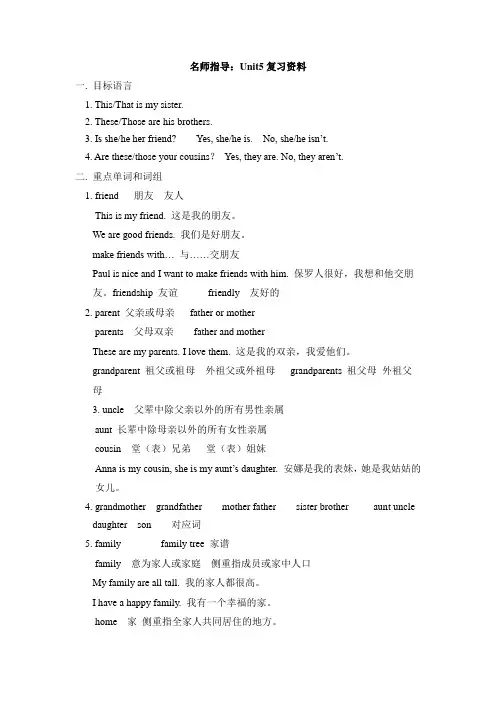
名师指导:Unit5复习资料一. 目标语言1. This/That is my sister.2. These/Those are his brothers.3. Is she/he her friend? Yes, she/he is. No, she/he isn’t.4. Are these/those your cousins?Yes, they are. No, they aren’t.二. 重点单词和词组1. friend 朋友友人This is my friend. 这是我的朋友。
We are good friends. 我们是好朋友。
make friends with… 与……交朋友Paul is nice and I want to make friends with him. 保罗人很好,我想和他交朋友。
friendship 友谊friendly 友好的2. parent 父亲或母亲father or motherparents 父母双亲father and motherThese are my parents. I love them. 这是我的双亲,我爱他们。
grandparent 祖父或祖母外祖父或外祖母grandparents 祖父母外祖父母3. uncle 父辈中除父亲以外的所有男性亲属aunt 长辈中除母亲以外的所有女性亲属cousin 堂(表)兄弟堂(表)姐妹Anna is my cousin, she is my aunt’s daughter. 安娜是我的表妹,她是我姑姑的女儿。
4. grandmother grandfather mother father sister brother aunt uncledaughter son 对应词5. family family tree 家谱family 意为家人或家庭侧重指成员或家中人口My family are all tall. 我的家人都很高。
(完整)鲁教版六年级英语上册语法复习

鲁教版六年级英语上册语法复习英语语法复习(一)代词选词填空:1. What ' _________ n ame? (you / your ) _________ name is Bob. ( My / I / me)2. _______ erasers are in _________ d rawer. (her / she / Her / She)3. Can _______(you / your ) do _____ (you / your ) homework?4. _______ is a cat. _______ n ame is Mimi. ( it / its / It / Its )5. _______ brother can speak Japa nese. (He '/ His / He )6. Please take ________ k eys to school. __________ are on the table.(they / their / them / They / Their / Them)st7. _________ i s thirteen years old. __________ birthday is March 1 .(He / His / Him)8. _________ f avorite vegetable is tomato. (her / she / Her / She)9. Can you help _____ ?( we / us / our) Please take ______ to school. (they / their / them)10. ________ c a'see __________ baseball. It 'sbehind ________ .( My / I /me / my )(三)完成句子:1. A: What 'this / that ? B: ____________ is a dresser.A:How do you spell ________ , please ? B:D-R-E-S-S-E-R.2. A: What are these / those ? B: ____________ are tomatoes.3. A: Does Ci ndy like salad? B: No, _________ does n't.4. A: How much are his shoes? B: ___________ are 100 dollars.5. A: Is Alan your frie nd? B: Yes, ___________ is.6. A: Do you have a soccer ball? B: Yes, _____________ do.7. A: Who is that girl? B: ___________ is Jacks sister.'8. This is David and this is Tim. ________ are our frien ds. We often help _______9. Those are strawberries. Sally likes _______ .10. The pants are nice. I 'take __________ .英语语法复习(二)冠词1. 种类:(1)不定冠词:a /an a unit/an uncle 元音开头的可数名词前用an :an egg / an apple/ an orange / an eraser / an answer / an ID card / an alarm clock // an hour an old man / an interesting book(2 )定冠词:the the egg the plane2. 用法: 定冠词的用法:(1 )特指某(些)人或某(些)物:The ruler is on the desk.(2 )复述上文提到的人或物:Hehas a sweater. The sweater is new.(3 )谈话双方都知道的人或物:Theboys aren 'tat school.(4 )在序数词前:John 'sbirthday is February the second.(5 )用于固定词组中:inthe morning / afternoon / evening 不用冠词的情况:(1 )专有名词前:Chinais a big country.(2 )名词前有定语:this ,that , my , your , some, any , no 等:This is mybaseball.(3 )复数名词表示一类人和事:Monkeyscan 't swim. They are teachers.(4 )在节日,日期,月份,季节前:Today is Christmas Day. It 'sSunday. (5 )一日三餐前:We havebreakfast at 6:30.(6 )球类棋类运动前:They often play football after class. He plays chess at home.* 但乐器前要用定冠词:I play the guitar very well.(7 )学科名称前:Myfavorite subject is music.(8)在称呼或头衔的名词前:Thisis Mr Li.(9 )固定词组中:atnoon at night by busExercises:一.填空:(在有必要的地方填上冠词,不填的划“/ ”)1. What 's this? It 's ____ clock.2. What 's that? It 's ____ alarmclock.3. What is it? It 's _____ w.4. What color is the jacket? It 's _______ orange. It 's ____ orange jacket.5. Jim 's mother is ____ MrsGreen. She is ____ teacher.6. Those pens are in ____ pencilcase.7. Here 's _____ interetsing familyphoto.8. When does Lily go to ____ bedin _____ evening?9. __ “h”, __ “o” and __ “w”are in the word “how ”.10. This is ____ my English book.11. Where is ____ bag? It 's under _____ table.12. I often go to ___ school at _____ 7:00.13. Take ___ things to _____ yourbrother.14. They like playing ___ football. My favorite subject is ____ P.E. .15. Do you have ___ pingpong bat?Yes, I do.16. Do you want to see ___ actionmovie? No, I want to play ____ chess.17. When 'shis sister 's birthday?It 's ____ April ____ eleventh.18. Does Bill like __ hamburgers?No, he doesn 't.19. A: Let 's play ____ soccer. B:I don 't have ____ soccer ball.A: Well, let 'splay _____ drums. B: That sounds good.20. How much are ___ two hats?They are 10 dollars.21. Do you have ___ Art Festivalat your school? Yes, we do.22. When do people usually eat _________ breakfast? They usually eat _________ it in ______ evening.23. Rick often goes to see ____ B eijing Opera ____ weekends.24. Can Tom play ____ piano? Yes,he can.Can he play ____ it well? No, he can 't.25. Please listen to ___ teachercarefully.英语语法复习(三)时态复习一、一般现在时1、Be 动词的一般现在时Ee动词要根据句中主语的人称和数而变化。
单元指导设计Unit1(鲁教版英语六年级上册)

一、预习内容Unit 1 Good morning!
二、预习目标
1.掌握英语26个字母的发音、顺序和书写规范;
2.准确掌握本单元出现的词汇:morning, afternoon, evening,
I, you, am,are, fine, good, hello, hi, how, thanks.
2d A——H的小写;
3.找出课本上的缩略词,大声朗读,能够掌握;
4.找出课本中的见面问候语,并且说出一个告别语;
5.给自己和同桌分别起一个英语名;
6.制作姓名卡片,正面用英文名字,背面用汉语名字,能够
做到正确拼写。
五、预习检测或措施
从设置情景测试学生的知识水平,增加学生的词汇为主,应以鼓励的方式,让学生开口说英语,不强求每个学生会做所有词汇的对话,为避免学生进入新环境的胆怯心理,教师可以采用小组分解方式进行。
3.能够找出课文中的功能局并尽量能做出对话;
4.感知be动词is, am, are的用法,感知人称代词I和you的
用法。
三、预习方法指导
1.听录音跟读,尝试在听的过程中抓住关键词;
2.小组合作,解决问题,纠正错误;
3.能够初步意识到英语学习有规律可循。
四、预习提纲
1.听录音,读字母、单词;
2.完成课本P2、2b a——h的大小写,
鲁教版英语(五四制)六年级上册_Unit1__词汇精讲
Unit1词汇精讲
1. good 好的
I have a good friend. 我有一个好朋友。
【拓展】good的反义词为bad,good的副词形式为well,意为“好地”。
2. morning 早晨,上午
Good morning! 早上好!
【拓展】in the morning是固定短语,意为“在早上,在上午”。
morning一般指12点以前的这段时间。
3. afternoon 下午
Good afternoon! 下午好!
【拓展】in the afternoon是固定短语,意为“在下午”。
4.evening 晚上,傍晚
Good evening!晚上好!
【拓展】in the evening 是固定短语,意为“在晚上。
5. how 怎样,如何
How are you? 你好吗?
【拓展】how是特殊疑问词,对身体、程度、交通方式等进行提问。
6.are 是
We are students. 我们是学生。
【拓展】are是be动词的一种形式,放在第一人称复数、第二人称单复数、第三人称复数之后。
1 / 1。
鲁教版英语(五四制)六年级上册_Unit5_SectionB_教材知识详解
Unit5 Section B 教材知识详解1. Here are two nice photos of my family.这里有两张我家人的漂亮照片。
分析:这是一个完全倒装句,正常语序为:Two nice photos of my family are here.知识点1:Here is/are ....的用法Here is/are ....意为“这是....”,常被用来介绍身边的事物。
be动词的形式应该根据最靠近be动词的名词的单复数而定。
如:Here is a book. 这儿有本书。
Here are some erasers.这儿有一些橡皮。
『拓展』部分倒装在here 引导的句式中,如果句子的主语是代词,则用部分倒装。
Here you are. 给你。
Here it is. 它在这里。
知识点2:photo 的用法photo是名词,意为“照片”,是photograph的缩写。
photo是可数名词,复数形式为photos。
The photo is Lucy’s. 这张照片是露西的。
『拓展』①photo 的常用短语:in the photo在照片上take photos 照相 a photo of ... 一幅......的照片②photo 与picture 的区别photo 常指用相机拍摄而成的相片,即“照片”,picture通常指一幅图画,凡是有图的东西都可以称为picture,既可以指照片也可以指画。
This is my father’s photo.这是我爸爸的照片。
This is a picture of my father.这是我爸爸的一张画。
知识点3:of 的用法of 做介词,意为“....的;属于(某人或某物)”。
“名词A+of +名词B”相当于名词B的所有格(’s或’)形式,如:the name of the girl=the girl’s name. 女孩儿的名字。
He is a friend of mine. 他是我朋友。
鲁教版五四制英语六年级上册Unit5教学重难点
名师指导:Unit5教学重难点一、单词导航台1.aunt/a:nt/n. 姨,姑,婶,伯母,舅母【引申】aunt和ant(蚂蚁)只有一个字母的差别,uncle叔伯舅。
2.brothern.兄,弟:The Smith brothers 史密斯兄弟们。
【引申】brotherhood兄弟之情;brother-in-law夫或妻的兄弟、姐或妹的丈夫。
3.cousinn.堂(表)兄弟姐妹【引申】nephew侄子、外甥,niece侄女;cousin-in-law堂姐(妹)夫,堂(表)嫂,堂(表)弟媳。
4.friendn.友人,朋友:We are good friends.我们是好朋友。
【考点】make friends with与……交朋友:I don’t want to make friends with him.我不想和他交朋友。
【引申】同义词:ally, comrade, mate;反义词:enemy, foe, opponent.5.grandfathern.祖父,外祖父【引申】grandmother祖母,外祖母。
6.hepron.他(用作主语)【考点】所有格;his;宾格;him;反身代词;himself;复数they。
7.parentn.父亲或母亲:He lost both his parents at the age of five.他五岁的时候就失去了双亲。
【记忆法】parent(父母)与peasant (农民)在词形上的差别。
【考点】become a parent初为人父(母)。
【引申】parent→ parental adj.父母的。
8.shepron她(用作主语)【考点】she也用于指代船舶、飞机、火车、汽车、国家、都市、月亮地球等可拟人化为女性之物。
9.sistern.姐,妹:an elder sister姐姐;a younger sister妹妹。
【引申】sister cities姐妹城市。
专题02 六年级上册Units1~2 复习课件 六年级英语上学期期中考点(鲁教版五四制2024)
19. play the guitar 弹吉他
13.be far from离……多远
20.a pet bird一只宠物鸟
14.next to紧挨着
21. speak some Chinese 说一些汉语
15.my favourite color我最喜欢的颜色
22.want to be想要成
16.hot pot火锅
19.I play the guitar in the school band. 我在学校乐队里弹吉他。
20. Would you like to be my friend? 你想要成为我的朋友吗?
二、重点句型
Unit 2
1.Whose are they? 它们是谁的? 2.Do you often play ping-pong together? 你们经常一起打乒乓球吗?
3.He spends a lot of time fishing. 他花大量时间钓鱼。
4.Does your mother have a piano? 你妈妈有钢琴吗?
5.This is Ella and Emma's classroom. 这是埃拉和埃玛的教室。
6.She is short, and she has long brown hair. 她很矮,留着棕色长发。
用法: am:主语是第一人称单数(I) 时使用,I 和am可缩写成I’m(在一般疑问 句的简略肯定回答中,I am 不能缩写。) 。 is:主语是第三人称单数(he,she,it) 、单数名词或不可数名词时使用。 are:主语是第二人称(you) 及表示复数概念的代词或名词时使用。
一般现在时中含有be 动词的基本句型
Unit 2
2017六年级上册英语语法整理鲁教版
2017 六年级上册英语语法整理(鲁教版)2017六年上册英法整理(教版)1 . be( is,a,are)的用法我 (I) 用 a, 你 (you) 用 are , is 随着他 (he) ,她 (she) ,它(it) 。
数名用 is ,复数名全用 are 。
否认,更简单, be 后 not 加上去。
疑,往前提,句末号莫弃。
有一条注意,句首大写莫忘。
2 .this, that和it用法(1)this和that是指示代,it是人称代。
(2)距离人近的人或物用this,距离人的人或物用 that 。
如:Thisisaflower.是一花。
( 近 )Thatisatree.那是一棵。
()(3)放在一同的两西,先this,后that。
如:Thisisapen.Thatisapencil.是一支笔。
那是一支笔。
(4)向人介某人 Thisis ⋯ , 不 Thatis ⋯。
如:ThisisHelen.Helen,thisisTo.是海,海,是姆。
(5)Thisis不可以写,而Thatis能够写。
如:Thisisabie.That ’ sacar. 是一自行。
那是一。
(6)打,介自己用 this, 方用 that 。
如:— Hello!IsthatissGreen?喂,是格林小姐?— yes,thisis.Who ’ sthat? 是的,我是,你是?注意:然中使用“我”和“你”,但英中打不可以够:Ia ⋯ ,Areyou ⋯? /Whoareyou?(7)在回答 this 或 that 作主的疑句 , 要用 it 代替 this 或 that 。
如:①— Isthisanoteboo?是笔本?— yes,itis.是的,它是。
②— What’ sthat? 那是什么?— It ’ saite. 是只筝。
3 .these 和 those 用法this,that,these 和 those 是指示代, these 是 this 的复数形式, 指 , 距离近的或下边要提到的人或事 ;those 是 that 的复数形式 , 指、距离或前方已提到的人或事物。
鲁教版 六年级英语上册语法复习
鲁教版六年级英语上册语法复习英语语法复习(一)代词 (pron.)选词填空:1. What’s ________ name? (you / your ) _________ name is Bob. ( My / I / me)2. _________ erasers are in ________drawer. (her / she / Her / She)3. Can ________(you / your ) do _______ (you / your ) homework?4. ________ is a cat. ________ name is Mimi. ( it / its / It / Its )5. _________ brother can speak Japanese. (He’s / His / He )6. Please take _________ keys to school. __________ are on the table.( they / their / them / They / Their / Them)7. __________ is thirteen years old. __________ birthday is March 1st.(He / His / Him)8. __________ favorite vegetable is tomato. (her / she / Her / She)9. Can you help ______ ?( we / us / our) Please take ______ to school. (they / their / them)10. _________ can’t see _________baseball. It’s behind _________.( My / I /me / my ) (三)完成句子:1. A: What’s this / that ? B: _________ is a dresser.A:How do you spell _________ , please ? B:D-R-E-S-S-E-R.2. A: What are these / those ? B: _________ are tomatoes.3. A: Does Cindy like salad? B: No, _________doesn’t.4. A: How much are his shoes? B: _________ are 100 dollars.5. A: Is Alan your friend? B: Yes, _________ is.6. A: Do you have a soccer ball? B: Yes, _________ do.7. A: Who is that girl? B: _________ is Jack’s sister.’8. This is David and this is Tim. _________are our friends. We often help _________.9. Those are strawberries. Sally likes_________.10. The pants are nice. I’ll take_________.英语语法复习(二)冠词1. 种类:(1)不定冠词:a / an a unit / an uncle元音开头的可数名词前用an :an egg / an apple/ an orange / an eraser / an answer / an ID card / an alarm clock / / an hour an old man / an interesting book(2)定冠词:the the egg the plane2. 用法:定冠词的用法:(1)特指某(些)人或某(些)物: The ruler is on the desk.(2)复述上文提到的人或物:Hehas a sweater. The sweater is new.(3)谈话双方都知道的人或物:Theboys aren’t at school.(4)在序数词前: John’sbirthday is February the second.(5)用于固定词组中: inthe morning / afternoon / evening不用冠词的情况:(1)专有名词前:Chinais a big country.(2)名词前有定语:this ,that , my , your , some, any , no 等:This is mybaseball.(3)复数名词表示一类人和事:Monkeyscan’t swim. They are teachers.(4)在节日,日期,月份,季节前:Today is Christmas Day. It’sSunday.(5)一日三餐前:We havebreakfast at 6:30.(6)球类棋类运动前:They often play football after class. He plays chess at home. * 但乐器前要用定冠词:I play the guitar very well.(7)学科名称前:Myfavorite subject is music.(8)在称呼或头衔的名词前:Thisis Mr Li.(9)固定词组中:atnoon at night by busExercises:一.填空:(在有必要的地方填上冠词,不填的划“/ ”)1. What’s this? It’s _____ clock.2. What’s that? It’s _____ alarmclock.3. What is it? It’s _____ w.4. What color is the jacket? It’s_____ orange. It’s _____ orange jacket.5. Jim’s mother is _____ MrsGreen. She is _____ teacher.6. Those pens are in _____ pencilcase.7. Here’s _____ interetsing familyphoto.8. When does Lily go to _____ bedin _____ evening?9. _____ “h”, _____ “o”and _____“w”are in the word “how”.10. This is _____ my English book.11. Where is _____ bag? It’s under_____ table.12. I often go to _____ school at _____ 7:00.13. Take _____ things to _____ yourbrother.14. They like playing _____football. My favorite subject is _____ P.E. .15. Do you have _____ pingpong bat?Yes, I do.16. Do you want to see _____ actionmovie? No, I want to play _____ chess.17. When’s his sister’s birthday?It’s _____ April _____ eleventh.18. Does Bill like _____hamburgers?No, he doesn’t.19. A: Let’s play _____ soccer. B:I don’t have _____ soccer ball.A: Well, let’splay _____ drums. B: That sounds good.20. How much are _____ two hats?They are 10 dollars.21. Do you have _____ Art Festivalat your school? Yes, we do.22. When do people usually eat_____ breakfast? They usually eat _____ it in _____ evening.23. Rick often goes to see _____Beijing Opera _____ weekends.24. Can Tom play _____ piano? Yes,he can.Can he play _____it well? No, he can’t.25. Please listen to _____ teachercarefully.英语语法复习(三)时态复习一、一般现在时1、Be 动词的一般现在时Be动词要根据句中主语的人称和数而变化。
鲁教版(五四学制)六年级英语上册Unit1SectionB1a1d说课稿
(一)教学策略
本节课我将主要采用以下教学方法:情景教学法、任务型教学法和合作学习法。情景教学法通过创建贴近学生生活的情景,让学生在实际语境中学习,这有助于提高学生的语言实践能力,并增强学习的真实感;任务型教学法鼓励学生在完成具体任务的过程中学习语言,这有助于激发学生的学习动机,提高解决问题的能力;合作学习法则通过小组活动促进学生之间的互动和交流,有助于培养学生的团队合作精神和社交能力。
(三)学习动机
为了激发学生的学习兴趣和动机,我将采取以下策略或活动:首先,通过设计贴近学生生活的情境,如模拟学校或家庭场景,让学生能够在真实的语境中使用英语;其次,引入游戏化的学习活动,如角色扮演、竞赛等,增加学习的趣味性和互动性;再次,通过小组合作学习,鼓励学生相互帮助和交流,提高他们的合作能力和自信心;最后,及时给予学生正面的反馈和鼓励,帮助他们建立成功的学习体验,从而增强他们学习英语的动力和兴趣。
(二)新知讲授
在新知讲授阶段,我会按照以下步骤逐步呈现知识点,引导学生深入理解:首先,通过实物或图片引入新词汇,让学生在直观的情境中学习单词的发音和意义;其次,通过简单的例句展示新句型的用法,让学生在具体的语境中感受语言的结构;然后,我会组织一些互动活动,如小组讨论或角色扮演,让学生在实际运用中巩固所学;最后,我会提供一些语法规则和注意事项,帮助学生更好地理解和掌握新知识。
四、教学过程设计
(一)导入新课
我的新课导入方式将采用情境创设和问题引导相结合的方法。首先,我会利用多媒体展示一个有趣的动画或短片,内容涉及本节课将要学习的主题,如一个关于学生介绍自己家庭的故事。这样的视觉刺激可以迅速吸引学生的注意力。接着,我会提出一些与动画内容相关的问题,如:“What's the boy's name? How old is he? What does his father do?”通过这些问题引导学生思考和回答,从而自然地过渡到本节课的主题。