
新概念英语第一册课文翻译及学习笔记Lesson95
新概念英语第一册课文翻译及学习笔记Lesson95【课文】
GEORGE: Two return tickets to London, please. What time will the next train leave?
ATTENDANT: At nineteen minutes past eight.
GEORGE: Which platform?
ATTENDANT: Platform Two. Over the bridge.
KEN: What time will the next train leave?
GEORGE: At eight nineteen.
KEN: We've got plenty of time.
GEORGE: It's only three minutes to eight.
KEN: Let's go and have a drink. There's a bar next door to the station.
GEORGE: We had better go back to the station now, Ken.
PORTER: Tickets, please.
GEORGE: We want to catch the eight nineteen to London.
PORTER: You've just missed it!
GEORGE: What! It's only eight fifteen.
PORTER: I'm sorry, sir. That clock's ten minutes slow.
GEORGE: When's the next train?
PORTER: In five hours' time!
【课文翻译】
乔治:买两张到伦敦的往返票。
下一班火车什么时候开?服务员:8点19分。
乔治:在哪个站台?
服务员:2号站台。
过天桥。
肯:下一班火车什么时候开?
乔治:8点19分。
肯:我们时间还很宽裕。
乔治:现在才7点57分。
肯:让我们去喝点东西吧,车站旁有一个酒吧。
乔治:肯,我们现在回车站去。
收票员:请把车票拿出来。
乔治:我们要乘8点19分的车去伦敦。
收票员:你们刚好错过了那班车。
乔治:什么!现在只有8点15分。
收票员:对不起,先生,那个钟慢了10分钟。
乔治:下一班车是什么时候?
收票员:5个小时以后!
【生词】
return n. 往返
train n. 火车
platform n. 站台
plenty n. 大量
bar n. 酒吧
station n. 车站,火车站
porter n. 收票员
catch (caught, caught) v. 赶上
miss v. 错过
【知识点讲解】
1. 这个课我们来学习表达准确时间的说法。
首先时、分、秒的
说法分别是:hour, minute, second;表达整点的说法很简单,能够直接说数字,或数字加o'clock。
比如8点钟,可说It's eight. 或者
It's eight o'clock.
表示更精确到分钟的方法有两种。
比如8点20分,能够直接按
顺序说出数字:It's eight twenty;也能够先说分秒,再说整点:
It's twenty past eight.
半点和15分钟有特别的表达方式,比如8点半,能够说成eight thrity,也能够说成half past eight;一刻钟也可说成a quarter,
比如8点15分可说成eight fifteen,或a quarter past eight(注
意不能说成eight a quarter);或者差一刻9点,可表达为eight fourty five,也能够说成a quarter to nine.
2. return ticket,往返票;在美式英语中讲 round ticket.
3. in five hours' time 意思是5小时之后。
裕兴新概念英语笔记:Lesson 95 Tickets
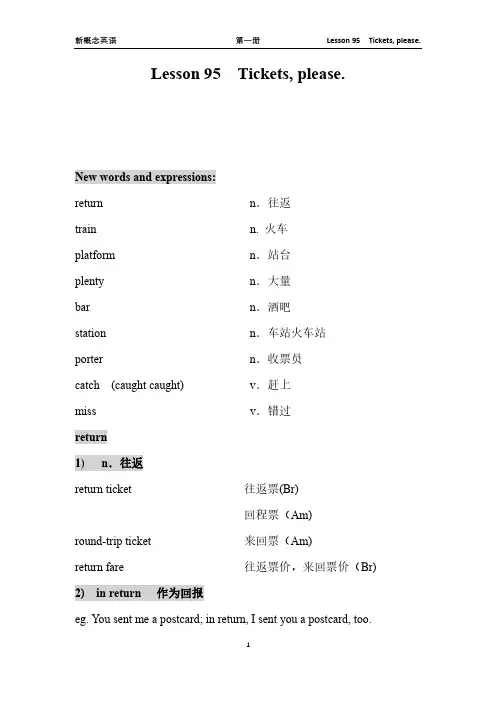
Lesson 95 Tickets, please.New words and expressions:return n.往返train n. 火车platform n.站台plenty n.大量bar n.酒吧station n.车站火车站porter n.收票员catch (caught caught)v.赶上miss v.错过return1)n.往返return ticket往返票(Br)回程票(Am)round-trip ticket 来回票(Am)return fare往返票价,来回票价(Br) 2) in return作为回报eg. You sent me a postcard; in return, I sent you a postcard, too.你给我寄来明信片,我也回寄一张明信片。
eg. The employees have worked so hard. Their boss is going to increase their salary in return.这些职员一直都在非常努力地工作。
他们老板打算给他们加薪作为回报。
3) v.回到return from… to… 从…回到…return to 回到(先前的状态,话题)return sth to sbreturn sb sth 把…归还某人train1) n.火车eg. We'11 take the 2:00 p.m. train to Shanghai.我们要搭下午2点的火车去上海。
an up train上行列车a down train下行列车an express train 快车2)v. 训练,培养eg. He is braining the horse for the race.他为了比赛在训练那匹马。
eg. I was trained as a nurse.我接受过护士的训练。
eg. You should train your children how to respect others.你应该教导你的孩子如何尊重别人。
新概念英语第一册95课课文

新概念英语第一册95课课文Lesson 95: The man who knew too muchOne rainy evening, a man named Peter Smith was sitting alone in a dimly lit cafe. He appeared to be lost in deep thought, staring out of the window into the pouring rain. Suddenly, a stranger approached him and asked if he could join him at the table. Peter nodded, gesturing for the stranger to take a seat.The stranger introduced himself as Mr. Brown and noticed the troubled look on Peter's face. Mr. Brown, a well-dressed and articulate man, began to ask Peter about his worries. Intrigued by Mr. Brown's genuine concern, Peter decided to open up and share his story.Peter explained that he possessed a unique ability - the power to see into the future. At first, this gift was exciting and exhilarating, as Peter could predict upcoming events accurately. However, as time went on, he started to feel overwhelmed by the weight of this knowledge. The burden of knowing too much had taken a toll on his mental and emotional well-being.Mr. Brown listened attentively, his eyes filled with empathy. He asked Peter how he had acquired thisextraordinary ability. Peter revealed that it was a result of a near-death experience he had as a child. Since then, visions of future events had appeared to him in dreams and as flashes in his waking moments.Deeply intrigued, Mr. Brown shared that he was a psychologist specializing in paranormal phenomena. He offered to help Peter find a way to cope with his gift and shared stories of other individuals who had faced similar challenges. He assured Peter that he was not alone and that there were ways to manage the overwhelming knowledge of the future.As their conversation continued, Peter felt a sense of relief and hope. He realized that he did not have to bear the burden of his gift alone. With Mr. Brown's guidance and support, Peter could learn to accept and control his ability, rather than allowing it to control him.Days turned into weeks, and Peter started to implement the coping strategies suggested by Mr. Brown. He began to meditate regularly, which helped him channel his thoughts and emotions. Through meditation, Peter learned to quiet his mind and find moments of peace amidst the chaos of his visions.Over time, Peter's mental and emotional well-being significantly improved. He was no longer consumed by the constant flood of future events. Instead, he used his gift to help others, offering guidance and support to those in need.Peter's story spread, and he became known as 'The Man Who Knew Too Much.' People from all walks of life sought his advice and comfort. Peter realized that his gift was not a curse but a unique opportunity to make a positive impact on the world.In the end, Peter Smith's journey of self-discovery taught him that even extraordinary abilities can be harnessed for good. His perseverance and the support he received from Mr. Brown helped him transform his burden into a source of strength and purpose.。
新概念英语第一册Lesson95-96笔记(语法点+配套练习+答案)
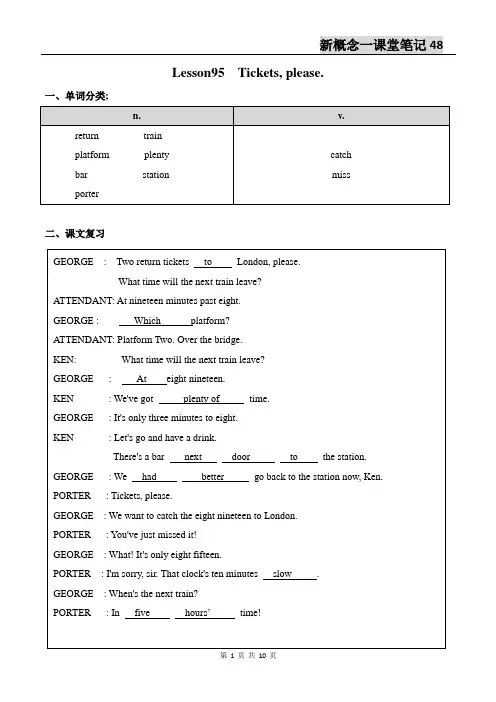
三张去纽约的往返车票。
Platform Two
2号站台
over the bridge
过桥
Over the bridge, you will see the cinema.
过桥,你就看到电影院了。
Let's goandhave a drink.
去...的往返车票
which
哪一个
what time
什么时候
plenty of
大量的
have a drink
喝一杯
return to sp.
回到某处
next door to
在...隔壁
in five hours’time
五小时后
had better do sth.
最好做某事
五、语法解析
1.had better和must
must do sth.必须,语气比较强烈
You mustfinish(finish) your work today.
had better do sth.做好做...,语气较委婉
It’s cold outside. You’s betterput(put) on your heavy coat.
had better not do sth.最好不要做
2.in +时间段’s + time =in +时间段,意为...之后
是一般将来时的标志词
1.三小时后in three hours’time =in three hours
2.两年后in two years’time= in two years
3.三天后in three days’time=in three days
新概念英语第一册学习手册【Lesson91、93、95】

新概念英语第一册学习手册【Lesson91、93、95】【课文】CATHERING: Has Ian sold his house yet?JENNY: Yes, he has. He sold it last week.CATHERING: Has he moved to his new house yet?JENNY: No, not yet. He's still here. He's going to move tomorrow.CATHERING: When? Tomorrow morning?JENNY: No. Tomorrow afternoon. I'll miss him. He has always been a good neighbour.LIDA: He's a very nice person. We'll all miss him.CATHERING: When will the new people move into this house?JENNY: I think that they'll move in the day after tomorrow.LINDA: Will you see Ian today, Jenny?JENNY: Yes, I will.LINDA: Please give him my regards.CATHERING: Poor Ian! He didn't want to leave this house.JENNY: No, he didn't want to leave, but his wife did!【课文翻译】凯瑟琳:伊恩已他的房子卖掉了吗?詹尼:是的,卖掉了。
他上星期卖掉的。
凯瑟琳:他已经迁进新居了吗?詹尼:不,还没有。
他仍在这里。
他打算明天搬家。
新概念第一册Lesson95-96

n. 站台 n. 大量 n. 火车 n. 车站,火车站 n. 酒吧 v. 赶上 n. 往返 v. 错过 n. 收票员,乘务
Listen to the tape then answer this question.
1.When will George and Ken's train leave? 2.Why did George and Ken miss the train?
KEN: What time will the next train leave? GEORGE:At eight nineteen. KEN: We've got plenty of time.
GEORGE: It's only three minutes to eight. KEN:Let's go and have a drink. There's a bar next door to the station.
3)v.染上(疾病),感染 I caught a bad cold. 我得了重感冒。
★ miss
1) v. 错过 He missed the target. 他没打中目标。 I threw the ball to him but he missed it. 我把球丢给他,但他没接着。
2)n.(政府机关等的)局,所,中心 a police station 警察局 a fire station 消防队 a gas station 加油站 a TV station 电视台
★ porter
[' pɔ:tə] n. 收票员
(1)(列车)服务员=attendant[英] The porter ushered us into the waiting room. 服务员把我们引进了候车室。 火车站的售票员:porter 汽车上的售票员:conductor
裕兴新概念英语第一册笔记Lesson 95
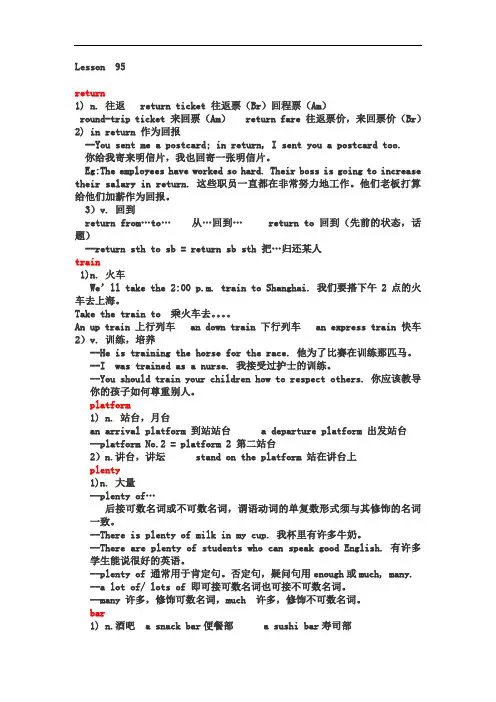
Lesson 95return1) n. 往返 return ticket 往返票(Br)回程票(Am)round-trip ticket 来回票(Am) return fare 往返票价,来回票价(Br)2) in return 作为回报--You sent me a postcard; in return, I sent you a postcard too.你给我寄来明信片,我也回寄一张明信片。
Eg:The employees have worked so hard. Their boss is going to increase their salary in return. 这些职员一直都在非常努力地工作。
他们老板打算给他们加薪作为回报。
3)v. 回到return from…to…从…回到… return to 回到(先前的状态,话题)--return sth to sb = return sb sth 把…归还某人train1)n. 火车We’ll take the 2:00 p.m. train to Shanghai. 我们要搭下午2点的火车去上海。
Take the train to 乘火车去。
An up train 上行列车 an down train 下行列车 an express train 快车2)v. 训练,培养--He is training the horse for the race. 他为了比赛在训练那匹马。
--I was trained as a nurse. 我接受过护士的训练。
--You should train your children how to respect others. 你应该教导你的孩子如何尊重别人。
platform1) n. 站台,月台an arrival platform 到站站台 a departure platform 出发站台--platform No.2 = platform 2 第二站台2)n.讲台,讲坛 stand on the platform 站在讲台上plenty1)n. 大量--plenty of…后接可数名词或不可数名词,谓语动词的单复数形式须与其修饰的名词一致。
新概念英语第一册自学笔记含课后练习答案:Lesson95-96
新概念英语第⼀册95-96课课⽂知识点 further notes on the text1.plenty of, 充⾜的,⾜够的。
后⾯可跟可数名词或不可数名词。
2.ten minutes slow, 慢 10分钟; ten minutes fast, 快 10分钟。
3.when's the next train?下⼀班车是什么时候?这个句⼦是⽤来询问⽕车启程时间时常见的句型。
新概念英语第⼀册95-96课语法知识点 grammar in usehad better与 musthad better表⽰“还是”、“”,表达某种忠告或建议。
must则表⽰“必须”、“⼀定”,语⽓⽐ had better强烈。
had better表⽰现在时或将来时,⽽不是过去时。
其否定形式为 had better not新概念英语第⼀册95-96课词汇学习 word study1.exact adj.(1)精确的;确切的;恰好的:what is the exact time? 确切时间是什么时候?this vase is an exact replica. 这只花瓶是件很巧妙的复制品。
it's the exact shape i've been looking for. 这恰好是我⼀直以来要寻找的形状。
(2)严格的;严厉的:the workers must obey exact rules. ⼯⼈们必须遵守严格的规定。
2.catch v.(1)赶上;及时赶到:we must hurry if we want to catch the last train. 如果我们想赶上最后⼀班⽕车就必须快点。
every morning she would catch the 7.30 train to town. 每天早上她都赶7点半的那班⽕车进城。
(2)听清楚;理解:i didn't catch what you said just now. 我没听清楚你刚才所说的话。
新概念英语第一册第95课
冯千禧五年级下第5次学习记录
Pay more attention
车站的钟慢了十分钟。 下一班车什么时候发车? 我想买一张到北京的往返票,谢谢。 英国西部总是雨水很充足。 我们有大量的蔬菜和水果。 我们去游泳吧! 理发店隔壁有个邮局。 你最好早点上床睡觉。 这个表快了两三分钟。 他说他四年后会回来的。 • 你们这儿有足球卖吗? • 请给我两支白色的粉笔,谢谢。
翻译以上短文
1.翻译短文。听写95,96,39,40单词,错一个 改五遍。并背会课文。
2.自己安排读课文、预习课文和自学课文.每天都 要保证高质量地读两遍。
3.每天复述一遍课文。 4.写一篇关于春天的短文。 5.准备演讲,题目自拟。准备Topic.
homework
日期 作业 态度 听力 发音 语音语调 语法 演讲
翻译以上短文
昨天我和妈妈去菜市场买菜,我们想要买些肉和 水果蔬菜,妈妈常常在同一家肉店买肉,我们买 了一些鸡肉,妈妈问店主:“请问你这里有牛排 肉吗?我想要一些。”店主说“今天没有牛排肉 了,但是有上好的猪肉,您想来点吗?”妈妈说: “不用了,谢谢。你这还有别的什么吗?”店主 说:“还有些鸭肉,您想要吗?”妈妈说:“我 们不是很喜欢吃鸭肉,谢谢。”后来我们买了些 土豆、番茄和豆腐,又买了些香蕉和苹果,就回 家了。
时间之后)
Pay more attention
When did… When will… 一般过去时和一般将来时的区别 When did they fly to Guangzhou? They flew there three days ago. When will they return to Chengdu? They’ll return in four days’ time.
裕兴新概念“英语”第一册笔记Lesson95
Lesson 95return1) n. 往返 return ticket 往返票(Br)回程票(Am)round-trip ticket 来回票(Am) return fare 往返票价,来回票价(Br)2) in return 作为回报--You sent me a postcard; in return, I sent you a postcard too.你给我寄来明信片,我也回寄一张明信片。
Eg:The employees have worked so hard. Their boss is going to increase their salary in return. 这些职员一直都在非常努力地工作。
他们老板打算给他们加薪作为回报。
3)v. 回到return from…to…从…回到… return to 回到(先前的状态,话题)--return sth to sb = return sb sth 把…归还某人train1)n. 火车We’ll take the 2:00 p.m. train to Shanghai. 我们要搭下午2点的火车去上海。
Take the train to 乘火车去。
An up train 上行列车 an down train 下行列车 an express train 快车2)v. 训练,培养--He is training the horse for the race. 他为了比赛在训练那匹马。
--I was trained as a nurse. 我接受过护士的训练。
--You should train your children how to respect others. 你应该教导你的孩子如何尊重别人。
platform1) n. 站台,月台an arrival platform 到站站台 a departure platform 出发站台--platform No.2 = platform 2 第二站台2)n.讲台,讲坛 stand on the platform 站在讲台上plenty1)n. 大量--plenty of…后接可数名词或不可数名词,谓语动词的单复数形式须与其修饰的名词一致。
新概念课堂笔记 第一册 Lesson 95-96
新概念英语课堂笔记第一册 Lesson 95-96【用法】n.往.v.返回;归还【词组】a return ticket 往返票a single ticket 单程票【扩展】a round ticket 往返票a double-way ticket往返票train【用法】n.火车;一连.,一系列v.培.,训练【词组】catch a train 赶火车change trains 换乘火车;中转goods train 货物列车passenger train 铁道客车express train 快车stopping train 慢车a train of 一系列……【扩展】trainin.n.训.,培养traine.n.教练员traine.n.受训练的.,实习.,练习生【词组】a training school 培训学校plenty【用法】n.大量【词组】plenty of 许多;大量〔接可数名词和不可数名词均可〕【扩展】plentifu.adj.丰富.,富饶的station【用法】n.车站;【词组】railway station 火车站train station 火车站bus station/stop公交车站police station 警察局space station 太空站radio station 电台TV station 电视台catch【用法】v.赶上;及时赶到挺清楚;理解引起〔注意等〕;吸引 ,迷住【词组】catch up with 赶上catc.sb.doin.当场抓住某人做某事【例句】s.train.如果我们想赶上最后一班火车就必须快点。
Ever.mornin.sh.woul.catc.th.7:3.trai.t.town.每天早上她都赶7点半的火车进城。
.didn’.catc.wha.yo.sai.jus.now.我没有挺清楚你刚刚所说的话。
【译文】下一班火车什么时候开? 8:19开【用法】what time和when的区别:○1 what time通常对时间点提问 ,答复多是“几点〞。