
部编人教版三年级下册英语Unit 3 At the zoo Part B 第4课时课件
Part B Let’s talk & Make a monster
PEP· 三年级下册
Sing a song
Revision and lead-in
Close your eyes.
Open your mouth.
Touch your nose. Touch your face.
It has a very big body.
正反
It has two small eyes.
ቤተ መጻሕፍቲ ባይዱt has four long legs.
It has a long neck, but it has a short tail.
Drive a train
long short tail short long
It's a pig.
What is it?
It has small ears and a small nose. It's a panda.
What is it?
It's tall. It has a long neck(脖子).
It's a giraffe.
Make dialogue
A: Look at my giraffe. B: Oh, it’s fat. It has a long
It has thin legs.
OK. Here’re thin legs.
It has one eye.
OK. Here’s one eye.
It has long ears.
OK. Here’re long ears.
It has a long tail.
OK. Here’s a long tail.
Clap your hands.
Touch your head.
Wave your arms.
Shake your body.
Stamp your foot.
Learn the word
He is a child, she is a child, and they are children.
Look and say
Wow! It has a long nose.
It has a short tail.
It has small eyes and big ears.
Can you guess?
What is it?
It has a long tail. It's a monkey.
What is it?
It has big eyes and short legs.
OK! What’s the animal?
Blackboard design
Unit 3 At the zoo
big ears
small eyes
short tail
long nose
It has…
Come here, children! Look at the elephant.
Wow! It has a long nose.
It has a short tail.
It has small eyes and big ears.
Read and act
Come here, children! Look at the elephant.
Watch and answer
What are they talking about?
They are talking about the elephant.
Watch and underline
➢ What does Chen Jie say about the elephant?
➢ What does John say about the elephant? ➢ What does Mike say about the elephant?
neck and long legs.
A: Look at my rabbit. B: Oh, it’s small. It has
two long ears and a short tail.
Watch and read
Make your monster
It has a big body.
OK. Here’s a big body.
Unit3Atthezoo(单元解读)三年级英语下册(人教PEP版)
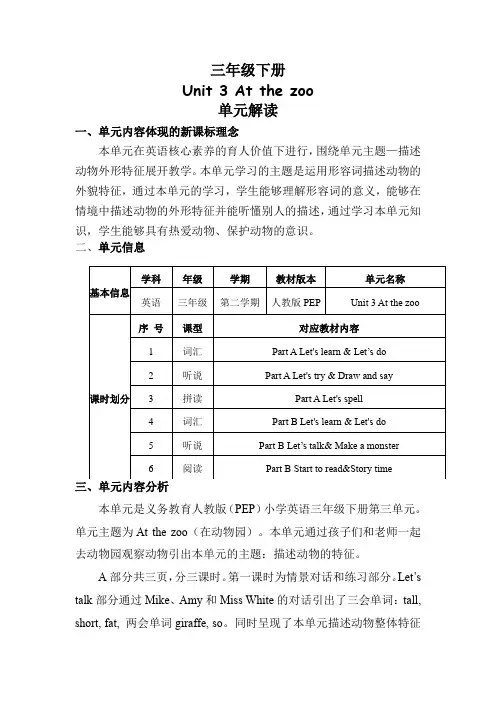
三年级下册Unit 3 At the zoo单元解读一、单元内容体现的新课标理念本单元在英语核心素养的育人价值下进行,围绕单元主题—描述动物外形特征展开教学。
本单元学习的主题是运用形容词描述动物的外貌特征,通过本单元的学习,学生能够理解形容词的意义,能够在情境中描述动物的外形特征并能听懂别人的描述,通过学习本单元知识,学生能够具有热爱动物、保护动物的意识。
二、单元信息本单元是义务教育人教版(PEP)小学英语三年级下册第三单元。
单元主题为At the zoo(在动物园)。
本单元通过孩子们和老师一起去动物园观察动物引出本单元的主题:描述动物的特征。
A部分共三页,分三课时。
第一课时为情景对话和练习部分。
Let’s talk部分通过Mike、Amy和Miss White的对话引出了三会单词:tall, short, fat, 两会单词giraffe, so。
同时呈现了本单元描述动物整体特征的句式:Look at that giraffe. It’s so tall. 在画一画,说一说的练习中,Chen Jie和John分别画了自己的动物,并使用重点句式来描述其特征。
学生通过这样的活动来操练在对话中学习到的重点句式。
第二课时为重点词汇和重点句型呈现,孩子们继续在动物园里游玩,发现了monkey和giraffe,从而呈现出三会词汇:tall, short, fat, thin,以及在Let’s talk中出现的描述动物的特征的句式:Look at that monkey. It’s fat. Let’s do是指令活动,学生需要根据指示做到变胖、变瘦、变高、变矮的动作,从而操练重点单词。
第三课时为语音学习,通过听一听、读一读、唱一唱、写一写活动,让学生理解并掌握字母i在单词里发的短音/ ɪ /。
B部分共四页,分三课时。
第一课时呈现情景对话和练习。
Miss White 带着孩子们观察大象,孩子们开始描述它具有的具体特征。
英语人教版三年级下册Unit 3 At the zoo Part B
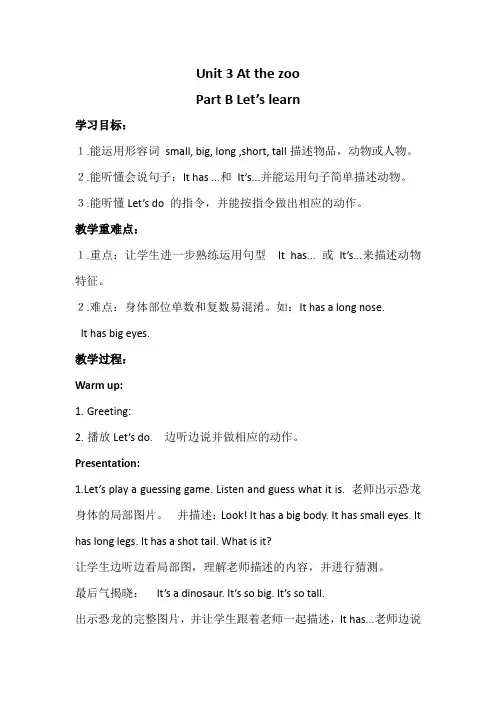
Unit 3 At the zooPart B Let’s learn学习目标:1.能运用形容词small, big, long ,short, tall描述物品,动物或人物。
2.能听懂会说句子:It has ...和It’s...并能运用句子简单描述动物。
3.能听懂Let’s do 的指令,并能按指令做出相应的动作。
教学重难点:1.重点:让学生进一步熟练运用句型It has... 或It’s...来描述动物特征。
2.难点:身体部位单数和复数易混淆。
如:It has a long nose.It has big eyes.教学过程:Warm up:1.Greeting:2.播放Let’s do.边听边说并做相应的动作。
Presentation:1.Let’s play a guessing game. Listen and guess what it is. 老师出示恐龙身体的局部图片。
并描述:Look! It has a big body. It has small eyes. It has long legs. It has a shot tail. What is it?让学生边听边看局部图,理解老师描述的内容,并进行猜测。
最后气揭晓:It’s a dinosaur. It’s so big. It’s so tall.出示恐龙的完整图片,并让学生跟着老师一起描述,It has...老师边说边帖上各个身体部位的形容词。
2.老师指图上帖好的词带读big, small, ....然后听跟读课文单词,教师纠正发音。
3.老师示范运用句子:出示动物图片。
Look at the pig. It’s so fat. It has a big body. ...让学生尝试运用所学过的词来描述动物身体特征。
提供更多图片,让更多的学生参与讨论。
教师及时纠正学生在表达过程中名词单数和复数运用的错漏。
4.学生反馈。
三年级下册英语教案Unit 3 At the zoo Part B_人教(PEP)(2018秋)1
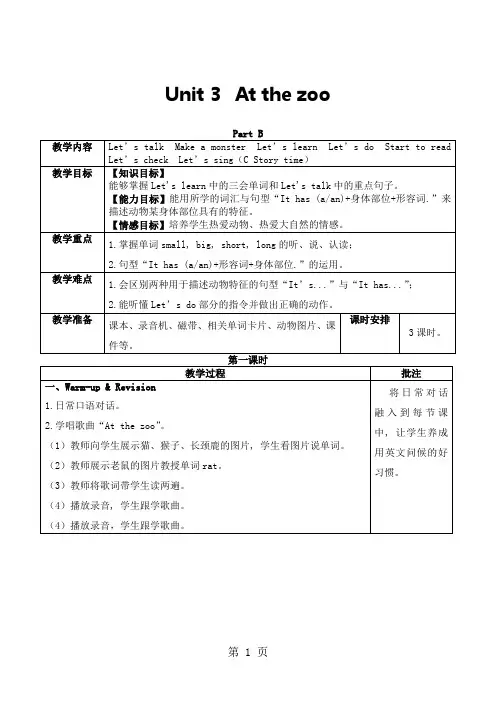
T:No.
S2:It’s a giraffe.
T:Yes.Good!
时间充裕, 在游戏环节可增加活动, 如:让一名学生描述, 其余学生来猜。
时间充裕,在游戏环节可增加活动,如: 让一名学生描述,其余学生来猜。
时间充裕,在游戏环节可增加活动,如:让一名学生描述,其余学生来猜。
二、Presentation & Practice
课堂上主要是以学生为主体, 通过说一说, 画一画, 改变了传统教学理念。
人教PEP版三年级英语下册《Unit 3 At the zoo》Part B

Wow! It has a small head. And a short tail.
Let’s read
Click to edit Master title style
Click to edit Master subtitle style
Let’s practice
Listen and number. 听录音,给下列图片排序。 Amy and Mike are looking at some animals.
1
பைடு நூலகம்
4
3
2
Let’s sing
Click to edit Master title style
Click to edit Master subtitle style
Let’s do
Click to edit Master title style
Click to edit Master subtitle style
Let’s do
Read and match
fish
rat
It’s small and thin.
It’s big and fat.
It has a long tail and big eyes. It has a long body and short legs.
Goodbye!
It’s so tall! It’s short and fat.
What animals do they see?
Click to edit Master title style
Click to edit Master subtitle style
人教(PEP)三年级下册英语课件-Unit 3 At the Zoo

It has a long nose. It has a short nose.
It has a long tail . It has a short tail .
It has a small head and a small body.
It has a big head and structure it has… The meaning of the adj such as tall, long, big and so on.
The students are able to talk
about the animalAsbwiliittyh theKirnowledge
friends.
objectives objectives
Ss will know that ainamls are different.
Emotion objectives
Teaching key and difficult points
The key points
It has ...
The difficult points
About animals
The students are familiar with the expressions It’s tall/ short
and so on.
The ss are unfamiliar with the sentence structure It has ...
Teaching objectives
Unit3 At the zoo
Part B Let’s talk PEP
Teaching analysis Teaching key and difficult points Teaching objectives Teaching procedures
人教pep三年级下册英语 《Unit3 At the zoo Part B》教案
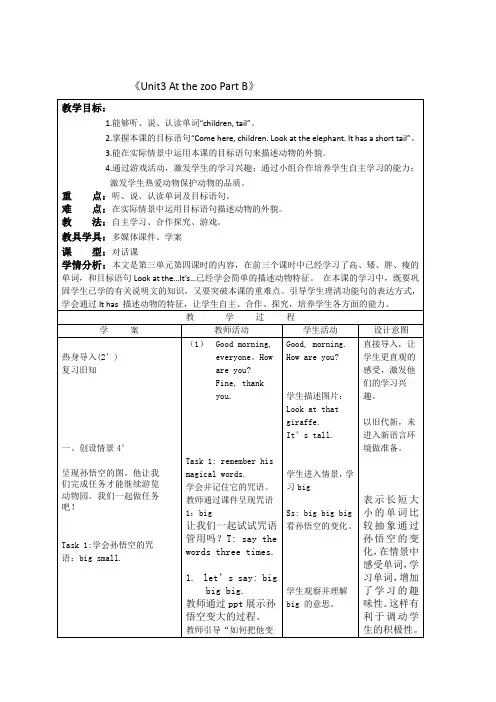
1.能够听、说、认读单词“children, tail”。
2.掌握本课的目标语句“Come here, children. Look at the elephant. It has a short tail”。
3.能在实际情景中运用本课的目标语句来描述动物的外貌。
4.通过游戏活动,激发学生的学习兴趣;通过小组合作培养学生自主学习的能力;激发学生热爱动物保护动物的品质。
We learnt
how to describe the animals with
the words and the sentence?
教师播放动物幻灯片
Whatshould we dofor the animals?
Good,morning.
How are you?
学生描述图片:
Look at that giraffe.
引导学生入情景,把孙悟空变回原样。
教师展示:孙悟空变小的过程,让学生理解small.
3.孙悟空has a stick. It can change, too.
教师带领学生通过孙悟空金箍棒的变化继续学习long, short.并在句子中运用It’s long. It’s short.
教师组织学生通过小组和作1号同学检查并教授新单词,巩固新单词的掌握情况。
重点:听、说、认读单词及目标语句。
难点:在实际情景中运用目标语句描述动物的外貌。
教法:自主学习、合作探究、游戏。
教具学具:多媒体课件、学案
课型:对话课
学情分析:本文是第三单元第四课时的内容,在前三个课时中已经学习了高、矮、胖、瘦的单词,和目标语句Look at the…It’s…已经学会简单的描述动物特征。在本课的学习中,既要巩固学生已学的有关说明文的知识,又要突破本课的重难点。引导学生理清功能句的表达方式,学会通过It has描述动物的特征,让学生自主、合作、探究,培养学生各方面的能力。