
八年级英语上册Unit2Howoftendoyouexercise知识点总结(新版)人教新目标版
1 Unit 2 How often do you exercise?
一、词组
go to the movies 去看电影 look after=take care of 照顾
surf the internet 上网 healthy lifestyle 健康的生活方式
go skate boarding 去划板 keep healthy=stay healthy 保持健康
eating habits 饮食习惯 take more exercise 做更多的运动
the same as 与什么相同 once a month 一月一次
be different from 不同 twice a week 一周两次
make a difference to 对什么有影响 how often 多久一次
although=though虽然 as for 至于
activity survey活动调查 do homework做家庭作业
do housework做家务事 eat less meat 吃更少的肉
junk food垃圾食物 be good for 对什么有益
be bad for对什么有害 want to do sth 想做某事
want sb to do sth想某人做某事 try to do sth 尽量做某事
come home from school放学回家 of course=certainly=sure 当然
get good grades 取得好成绩 some advice 一些建议
most of the students=most students 大多数学生
shop=go shopping=do some shopping 购物
exercise=take (much) exercise=do sports 锻炼
help sb to do sth=help sb with sth 帮助某人做某事
a lot of vegetables=many vegetables 许多蔬菜
hardly=not nearly/almost not 几乎不
keep/be in good health保持健康
二、词汇精讲
1、 always、usually、often、sometimes、hardly ever和never
always、usually、often、sometimes、hardly ever和never是英语中最常见的频度副词。
(1)always 的频度为100%,表示动作重复、状态继续,中间没有间断,意思是“总是”、“永远地”。
The sun always rises in the east and sets in the west. 太阳总是东升西落。
(2)usually 的频度为70%左右,意为“通常”、“平常”,即很少有例外。 2 He usually goes to bed at ten o’clock. 他通常10点钟睡觉。
(3)often 的频度为50%左右,意为“常常”,但不如usually那么频繁,表示动作重复,中间有间断。
He is often late for school. 他上学经常迟到。
(4)sometimes 的频度为20%左右,意为“有时”,表示动作偶尔发生。可以位于句首,以示强调。多用于一般现在时。
It is sometimes hot and sometimes cold. 天气忽冷忽热。
Sometimes he does it this way and sometimes he does it that way.
他有时这样做,有时那样做。
(5)hardly ever 的频度为5%左右,意为“几乎不”、“偶尔”,表频率,位置是“行前be后”。
I hardly ever go out these days. 这些天我几乎不出门。
(6)never 的频度为0,意为“从来不”、“永不”。
My parents are never late for work. 我父母上班从来不迟到。
【拓展】
(1)这些副词在句子中的位置基本相同,一般放在助动词、be动词或情态动词之后,行为动词之前。即:“行”前“助(系)”后。
Peter is always late for school. Peter上学总是迟到。
I usually do my homework in the evening. 我通常在晚上做作业。
(2)hardly和hard
hardly和hard形式上很接近,但意义截然不同。
1)hard作形容词时,意为“困难的;硬的;勤奋的;严厉的;苛刻的”。
hard作副词时常用来表示程度,意为“努力地;猛烈地;剧烈地”。
This ground is too hard to dig. 这块地太硬,挖不动。
They tried hard to succeed. 他们努力工作,以求得成功。
2)hardly是表频率的副词,意为“几乎不;几乎没有”,相当于almost not。
There is hardly any coffee left.= There’s almost no coffee left.
几乎没有剩余的咖啡了。
(3)sometimes、sometime、some time和some times
单词 词义 用法
sometimes 有时 用于一般现在时和一般过去时中
sometime 某时(时间点) 用于一般将来时或一般过去时中
some time 一段时间 可用于多种时态(指时间段) 3 some times 几次,几倍 表示次数或倍数
He was sometimes late for school. 他有时上学迟到。
He came here sometime. 他某个时候来过这里。
He will stay there for some time. 他将在那里待一段时间。
She came home some times. 她回了几次家。
2、 exercise
(1)作不及物动词,意为“锻炼、运动”。
— How often do you exercise? 你多久锻炼一次?
— I exercise every day. 我每天都锻炼。
(2)作不可数名词,意为“锻炼、运动”,常与动词take连用。
Exercise makes me keep healthy. 运动使我保持健康。
John likes to take exercise in the open air. 约翰喜欢在户外锻炼。
(3)作可数名词,意为“练习;操”。
We do morning exercises every day. 我们每天做早操。
We do English exercises to help us learn English well.
我们做英语练习以便学好英语。
3、 most
most表示“大部分,多半”的意思。
Most children like playing computer games. 大部分孩子喜欢玩电脑游戏。
【拓展】 most与most of 的区别:
(1)most后可直接跟名词(可数或不可数),同时,也可接有形容词修饰的名词。
Most boys like playing football. 大部分男孩都喜欢踢足球。
I always spend most time learning English.我总是花大部分时间学习英语。
(2)most后不能直接跟有定冠词、指示代词或物主代词所修饰的名词,遇到这些情况用most of
代替most。
I spent most of my time learning to play the piano last year.
去年我把大部分时间都花在学弹钢琴上了。
I did most of that difficult work. 那件困难的工作绝大部分都是由我做的。
(3)most of 后跟人称代词时,应用复数形式的人称代词宾格。
Most of them are going off to Guangzhou next week.
他们中的多数人都准备下星期去广州。
(4)most 前有定冠词时,可用来修饰多音节形容词,表示最高级,意为“最”。
This is the most beautiful flower. 这是最漂亮的花。
但是,如果most前有不定冠词a,则表示“非常;很”,相当于very。 4 She is a most beautiful girl. 她是个非常漂亮的姑娘。
4、 no
no是形容词,意为“无,没有”,一般用作定语,后接可数名词或不可数名词。相当于not…a/any。
I have no friends.=I don’t have a/any friend. 我没有朋友。
【拓展】
(1)no常用于省略句中,表示“不许,不可,不要”。
No smoking! 不要抽烟。
No photos! 禁止拍照!
(2)no和not
(1)no可单独使用,回答一般疑问句,而not则不能单独使用。
— Can I come? 我能来吗?
— No, you can’t. 不,你不能。
(2)no作形容词,其后可接单数、复数或不可数名词,而not是副词,常用来修饰谓语动词或形容词和副词等,故no相当于not a/an…或not any…
5、 health
health为名词,意为“健康”,其形容词形式为healthy,意为“健康的”。
在名词词尾加y构成形容词,类似的词还有:
rain—rainy 雨—下雨的 sun—sunny 太阳—晴朗的
luck—lucky 幸运—幸运的 wind—windy 风—刮风的
6、shop
shop可用作动词,意为“购物”,也可用go shopping“去购物”或do some shopping。
【拓展】
go swimming 去游泳 go skating 去滑冰 go fishing 去钓鱼
go boating 去划船 do some reading 阅读
do some washing 洗涮 do some cooking 做饭
do some swimming 游泳 do some speaking 多说
人教版新目标八年级英语上册1、2、3、4单元知识点总结材料
标准文案
大全 新目标八年级英语上册第一单元
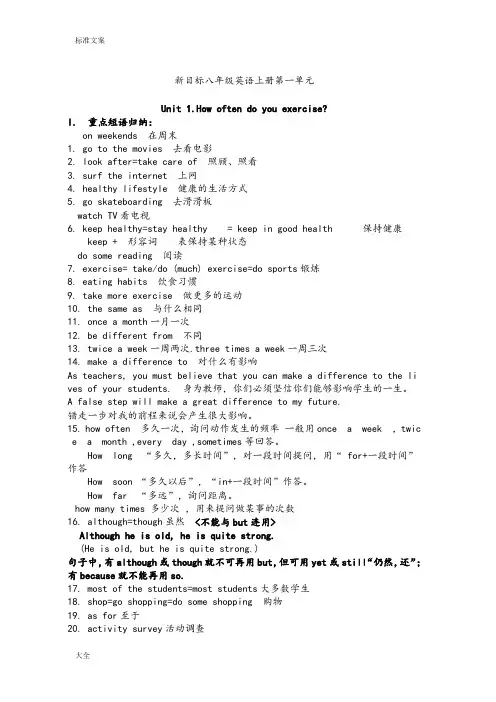
Unit 1.How often do you exercise?
I. 重点短语归纳:
on weekends 在周末
1. go to the movies 去看电影
2. look after=take care of 照顾、照看
3. surf the internet 上网
4. healthy lifestyle 健康的生活方式
5. go skateboarding 去滑滑板
watch TV看电视
6. keep healthy=stay healthy = keep in good health 保持健康
keep + 形容词 表保持某种状态
do some reading 阅读
7. exercise= take/do (much) exercise=do sports锻炼
8. eating habits 饮食习惯
9. take more exercise 做更多的运动
10. the same as 与什么相同
11. once a month一月一次
12. be different from 不同
13. twice a week一周两次.three times a week一周三次
14. make a difference to 对什么有影响
As teachers, you must believe that you can make a difference to the lives of your students. 身为教师,你们必须坚信你们能够影响学生的一生。
A false step will make a great difference to my future.
错走一步对我的前程来说会产生很大影响。
15. how often 多久一次,询问动作发生的频率 一般用once a week ,twice a month ,every day ,sometimes等回答。
人教新目标英语八年级上册unit2单元知识点总结 测试题(无答案)

1
Unit 2 How often do you exercise?
【重要词汇】
◆ ever adv. ◆ once. adv.
◆ twice adv. ◆ internet. n.
◆ program. n. ◆ hilltop. n.
◆ result. n. ◆ key. n.
◆ translate. v. ◆ song. n.
◆ junk. n. ◆ milk. n.
◆ interviewer. n. ◆ habit. n.
◆ difference. n. ◆ grade. n.
◆ although. conj. ◆ unhealthy. adj.
◆ skateboarding. n. ◆ exercise n. & v.
【重要词组】
◆ how often ◆ as for
◆ junk food ◆ eating habit
◆ of course ◆ look after
◆ start with ◆ make a difference
◆ go shopping ◆ have a party
人教新目标英语八年级上册Unit2知识讲解+练习题(含答案)

人教新目标英语八年级上册
Unit 2 How often do you exercise?
词句精讲精练
撰稿: 审稿:
词汇精讲
1. maybe
maybe是副词,意思是“也许,可能”,在句中作状语,相当于perhaps,常位于句首。 例如:
Maybe she’ll come this afternoon. 她可能今天下午来。
Maybe you put the letter in your pockets. 大概你把信放在衣袋里了。
【拓展】
(1)maybe和may be的辨析:
maybe是副词,而在may be中,may是情态动词,be是动词原形,两者构成完整的谓语形式,与主语形成系表结构,意为“也许是、可能是”。 例如:
I can’t find my watch. It may be in your pocket.
我找不到我的手表了,它可能在你的口袋里。
He may be a soldier. 他可能是军人。
(2)maybe和may be可相互转换。 例如:
He may be in the office. = Maybe he is in the office. 他或许在办公室。
You may be right. = Maybe you are right. 你或许是对的。
2. although
although的意思相当于though,意为“尽管,虽然”,用来引导让步状语从句。它所引导的从句不能与并列连词but; and; so等连用,但可以和yet; still等词连用。例如:
Although he lives alone, he doesn’t feel lonely.= He lives alone, but he doesn’t feel lonely.
虽然他一个人住,但他并不感到孤独。
初中英语 人教版八年级上册第二单元知识点
1 Unit 2 How often do you exercise?
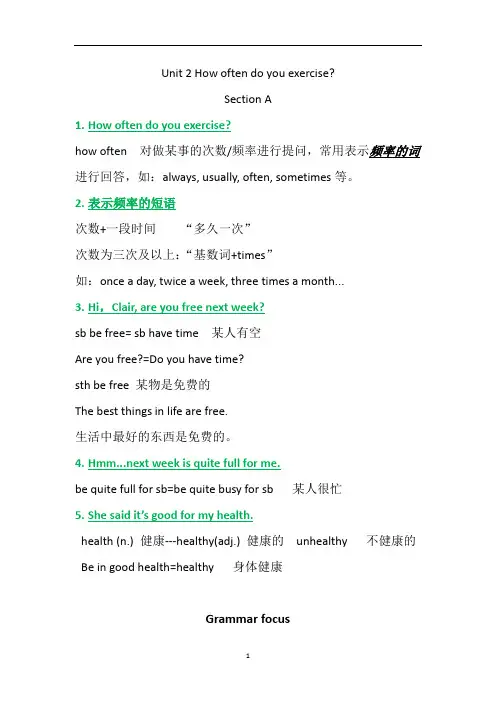
Section A
1. How often do you exercise?
how often 对做某事的次数/频率进行提问,常用表示频率的词进行回答,如:always, usually, often, sometimes等。
2. 表示频率的短语
次数+一段时间 “多久一次”
次数为三次及以上:“基数词+times”
如:once a day, twice a week, three times a month...
3. Hi,Clair, are you free next week?
sb be free= sb have time 某人有空
Are you free?=Do you have time?
sth be free 某物是免费的
The best things in life are free.
生活中最好的东西是免费的。
4. Hmm...next week is quite full for me.
be quite full for sb=be quite busy for sb 某人很忙
5. She said it’s good for my health.
health (n.) 健康---healthy(adj.) 健康的 unhealthy 不健康的
Be in good health=healthy 身体健康
Grammar focus
2 6. How often的用法
how often 用来对表示做某事的频率进行提问,回答时可以用表示频率副词或表示频率的短语进行回答。
如:
---How often do you go shopping?
(1)---I often go shopping. (频率副词回答)
(2)---I go shopping twice a week. (频率短语回答)
初中英语人教版八年级上册第二单元知识点
i
Unit 2 How often do you exercise?
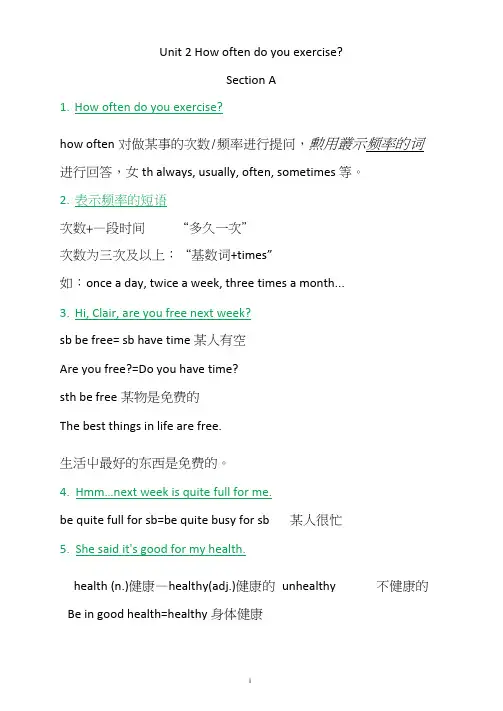
Section A
1. How often do you exercise?
how often对做某事的次数/频率进行提问,勲用叢示频率的词
进行回答,女th always, usually, often, sometimes 等。
2. 表示频率的短语
次数+—段时间 “多久一次”
次数为三次及以上:“基数词+times”
如:once a day, twice a week, three times a month...
3. Hi, Clair, are you free next week?
sb be free= sb have time 某人有空
Are you free?=Do you have time?
sth be free某物是免费的
The best things in life are free.
生活屮最好的东西是免费的。
4. Hmm…next week is quite full for me.
be quite full for sb=be quite busy for sb 某人很忙
5. She said it's good for my health.
health (n.)健康—healthy(adj.)健康的 unhealthy 不健康的
Be in good health=healthy 身体健康 ii
Grammar focus6. How often 的用法
how often用来对表示做某事的频率进行提问,回答时可以用表 示频率副词或表示频率的短语进行回答。
如:
—How often do you go shopping?
(1) —I often go shopping.(频率副词回答)
(2) …I go shopping twice a week.(频率短语回答)
初中英语人教版八年级上册第二单元知识点 2

初中英语人教版八年级上册第二单元知识点
Unit 2 How often do you exercise?
n A
1.How often do you exercise?
how often对做某事的次数/频率进行提问,常用表示频率的词进行回答,如:always。usually。often。sometimes等。
2.表示频率的短语
次数+一段时间“多久一次”
次数为三次及以上:“基数词+times”
如:once a day。twice a week。three times a month。
3.Hi,Clair。are you free next week?
sb be free= sb have time某人有空
Are you free?=Do you have time?
XXX某物是免费的
XXX.
糊口中最好的工具是免费的。
4.Hmm。next week is quite full for me.
be quite full for sb=be quite busy for sb某人很忙
5.She said it’s good for my health. health (n.)安康---XXX(adj.)安康的XXX
Be in good health=healthy身材安康
Grammar focus
1
不安康的6.How often的用法
how often用来对透露表现做某事的频次举行发问,回覆时能够用透露表现频次副词或透露表现频次的短语举行回覆。
如:
How often do you go shopping?
1)---Ioftengo shopping。(频次副词回覆)
2)---I go shopping twice a week。(频次短语回覆)
2.频次副词
位置:be之后,动之前。(be动词之后,Shiite动词之前)频率词及发生概率大小(由大到小):
人教版八年级上册英语第二单元知识点梳理
人教版八年级上册英语第二单元知识点梳理
How often do you exercise?
【语言目标】
● What do you usually do on weekends? I sometimes go to the
beach.
● How often do you eat vegetables? Every day.
● Most students do homework every day.
【重点词汇】
● always, usually , often, sometimes , hardly , ever, never.
● how often, once , twice , three times a week , every day.
【应掌握的词组】
1. go to the movies 2. look after = take care of
4. healthy lifestyle 3. surf the internet
6. keep healthy=stay healthy 7. exercise=take(much)exercise=do
sports
8. eating habits 9. take more exercise
10. the same as 11. be different from
12. once a month 13. twice a week
14. make a difference to 15. how often
16. although = though 17. most of the students=most
人教版八年级上册英语Unit 2 知识点语法归纳总结
1 / 5 Unit 2 How often do you exercise?
1. 短语归纳
① help with housework 帮助做家务活
② go shopping 购物
③ on weekends 在周末
④ how often 多久一次
⑤ hardly ever几乎不
⑥ once a week 每周一次
⑦ twice a month每月二次
⑧ go to the movies去看电影
⑨ every day 每天
⑩ use the Internet上网/用网
11 be free有空
12 have dance and piano lessons 上舞蹈钢琴课
13 swing dance摇摆舞
14 play tennis 打网球
15 stay up late 熬夜 16 at least至少
17 go to bed early 早睡
18 play sports 锻炼身体
19 be good for 对…有好处
20 go camping去野营
21 in one’s free time 在某人的空闲时间
22 not….at all 根本不
23 the most popular 最流行
24 such as例如
25 go to the dentist去看牙医
26 more than 超过/多于
27 Old habits die hard.旧习惯难改
28 hard=difficult 困难的 ,
29 less than 少于/不到
2. 典句必背
① —What do you usually do on weekends? 你周末通常做什么?
—I always exercise. 总是锻炼身体。
② —What do they do on weekends? 他们周末干什么?
八年级上册Unit 2 How often do you exercise 八年级英语
Unit 2 How often do you exercise?
Section A 1 (1a-2d)
一、教学目标:
1. 语言知识目标:
1) 能掌握以下单词: housework, hardly, ever, hardly ever, once, twice, Internet, program, full,
swing, swing dance, maybe, least, at least
能掌握以下句型:
① —What does he do on weekends? —He usually watches TV.
① —How often do you watch TV? —I watch TV every day.
① —Does he go shopping? —No, he never go shopping.
2) 能了解以下语法:
频度副词及一般现在时简单谈论周末活动情况。
2. 情感态度价值观目标:
通过本单元的学习,养成健康的饮食习惯,保证充足的睡眠时间,进行合理的运动锻炼,以保持健康的体魄。培养学生的逻辑表述能力,激发学生的积极思维,并使学生互相了解,增进友谊,加强人际交往,以形成良好的人际关系。
二、教学重难点
1. 教学重点:
1) 对6个频度副词细微差异的理解及使用。
2) 弄清一般现在时在不同人称下动词形式及提问的变化。
2. 教学难点:
1) 第三人称单数谓语动词在此核心句型中的运用。
2) 谈论课余时间的各项活动,以及初步认识和使用频率副词。 三、教学过程
Ⅰ. Warming up
Talk about your last weekend’s activities.
Ⅱ. Presentation
(1) 教师问:“What do you usually do on weekends ? ” (并且板书)让学生根据自己的实际回答 I
人教pep版八年级英语上册Unit2Howoftendoyouexercise短语语法知识点汇总
Unit 2 How often do you exercise
一、必背短 。
1.去看 影 go to the movies 2.多久一次 how often
3.几乎从不 hardly ever 4.在周末 on the weekend/on weekends
5.一周一次 once a week 6.一周两次 twice a week
7.一个月三次 three times a month 8.使用互 网 use the internet
9.充 ⋯ be full of 10. 上 琴 have piano lessons
11. 不得不做某事 have to do sth. 12. 帮助做家 help with housework
13. 起码 at least 14. 至多 at most
15. 保持健康 keep healthy/keep in good 16⋯ .的 果 the result of ⋯
health
17. 百分之二十 twenty percent 18. ⋯ 有利 be good for⋯
19. ⋯有害 be bad for 20. 垃圾食品 junk food
21. 多少个小 how many hours 22. 做运 play/do sports
23. 在某人空 in one’s free time 24. 根本不;一点也不 not⋯ at all
25. ⋯对于 ⋯ ask⋯ about 26. 熬夜 stay up late
27. 一个 16 的男孩 a 16-year-old boy 28. 超 、多于 more than
29. 少于 less than 30. 放松的最好方式 the best way to relax
【教材内容分析】
Section A
1. What do you usually do on weekends? (P. 9)