
广州七年级上册英语沪教牛津版U2复习
句型
How do/does sb go to school? 某人是如何去学校的?
They think of sth as … . 他们把…看作…。
语法
一般现在时频度副词、短语
知识点
◆talk about 意为“谈论”talk about it/them 人称代词作其宾语不必放中间
◆tooth 复数形式为teeth 类似的还有foot-feet goose-geese
◆by+某人可表示由某人创作by还可表示“在….旁边”by还可表示“用、靠、通过”
◆at介词,意为“在…”,后接时间时,一般跟表示钟点的词,其后也可接地点,用于较
小的地点名词前
◆be different from “与…不同”反义词the same as“与…相同”
◆end意为“结束”作名词时意为“结束、结尾”at the end of “在…的结尾处”
◆have a good time 意为“玩得高兴,过得愉快”= enjoy oneself = have fun
◆play with sth 意为“玩…,摆弄…”
◆一段时间+later 意为“…之后”
◆send 及物动词意为“送,寄”send sb sth 意为“寄/送给某人某物”= send sth to sb ◆go to bed 意为“去睡觉”go to sleep意为“入睡”
◆arrive in(大地方)arrive at(小地方)
◆cook 除了“做饭,烹饪”还可作“厨师”
◆help sb with sth 意为“帮助某人做某事= help sb (to) do sth help(to)do sth 意为“帮
助做某事”
◆by+doing sth 意为“通过做某事”by在这里是介词
◆at the beginning 意为“在开头”
◆keep a diary 意为“记日记”
◆from …to …意为“从…到…”。
2024年沪教牛津版七年级英语上册 Unit2重点短语句型和知识

2024年新沪教牛津版初一上册Unit 2重点短语和知识一.重点短语compare with与...作比较would like to do sth.想要做某事be different from与...不同brush teeth刷牙go to school去学校do sports做运动do the dishes洗碗do some reading阅读go home回家do one’s homework做作业do the housework做家务wash clothes洗衣服have a lot to say about关于...有很多要说的in the morning在早上teach us by playing games通过做游戏教我们do some morning exercise做一些早间锻炼do morning exercises做早操from...to...从...到...after that在那之后take part in参与(活动)look forward to期望the answer to the question问题的答案be close to靠近be excited about对...感到激动in fact事实上in daily life在日常生活中solve problems解决问题all the time一直at times偶尔have classes上课have breakfast吃早餐get up起床on foot走路tell sb. About sth.告诉某人某事write to写信给某人full of energy精力充沛the breaks between classes课间休息get ready for准备好be ready to do sth.准备好去做某事half an hour半小时go to bed上床睡觉keep a diary记日记pick up取回;开车接hurry to充忙去某地in a hurry匆忙in time及时on time准时;按时in a good mind有好心情a happy ending一个美好的结局二.重点句型1.Which of these things do you do every day?这些事情中哪件是你每天都做的?2.What about you?你呢?3.---What do you usually do on weekends?你周末通常做什么?---I often exercise.我经常锻炼。
牛津上海版七年级上Unit2复习教案
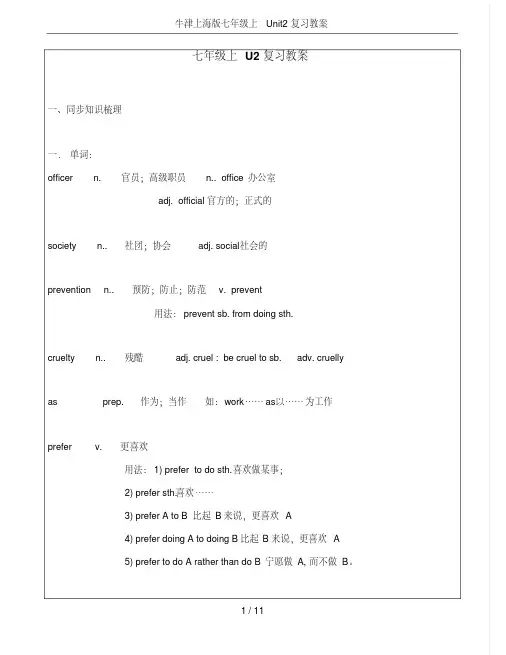
七年级上U2复习教案一、同步知识梳理一.单词:officer n. 官员;高级职员 n.. office 办公室adj. official 官方的;正式的society n.. 社团;协会 adj. social 社会的prevention n.. 预防;防止;防范 v. prevent用法:prevent sb. from doing sth.cruelty n.. 残酷 adj. cruel : be cruel to sb. adv. cruelly as prep. 作为;当作如:work……as 以……为工作prefer v. 更喜欢用法:1) prefer to do sth. 喜欢做某事;2) prefer sth. 喜欢……3) prefer A to B 比起B来说,更喜欢 A4) prefer doing A to doing B 比起B来说,更喜欢 A5) prefer to do A rather than do B 宁愿做A, 而不做B。
care n. 照料;照顾 adj. careful / careless n. carefulness / carelessness词组: take care of 照顾safely adv. 安全地; adj. safe n. safetypolice n. 警方该词做警方解释时是集体名词,没有复数形式,但后面的谓语动词要用复数。
thief n. 窃贼;小偷复数形式是:thieves v. thieve 偷missing adj. 失踪的 a missing boy = a lost boy 迷路的男孩v. missadj. missed二.词组:照看好look after …… well为……筹钱raise money for……保证做…… promise to do ……守护我们的家 guard our homes在很多方面 in many ways对……残忍be cruel to ……找到失踪的人 find lost people保护……使免受…… protect …… from浅棕色 light brown阻止,使免于…… keep……from欢迎来到…… welcome to ……把……扔在马路上 leave something in the street.愿意做…… would like to do something给……一碗水喝 give somebody a bowl of water to drink把……作为宠物keep …… as somebody’s pet三.课文中的语法点need 的用法:need 是个重要的词。
沪教牛津版英语广州深圳沈阳新版七年级上各单元综合练习(期末复习)含答案上课讲义

七年级(上) Unit 1综合知识专练一、单词和词组归纳与练习练一练:I.根据句意及首字母提示填写单词,使句子完整、通顺。
1. E _________ plays on the playground, so there are not any students in the classroom.2. It took him two days to c_________ his article.3. Our English teacher is very f_________. We all like her very much.4. My favorite h_________ is swimming. And I want to be a great swimmer.5. It is hard for many students to remember English words and learn English g_________.6. My friends and I spent an hour climbing the m_________.7. The soft s_________ makes me feel comfortable. I want to have a sleep.8. Tom is very rich. He lives in a big f_________.9. I don’t have any e_________ brothers. I am the only child in my family.10. I am an e_________. My work is to design (设计)different kinds of roads.II.根据汉语意思完成句子,每空一词。
11. 杰克擅长打篮球。
Jack_________ _________ _________ _________ basketball.12. 因为他是一个很好的男孩所以很多人都想和他交朋友。
沪教牛津版广州英语七年级上册Unit2讲义(精品资料).doc
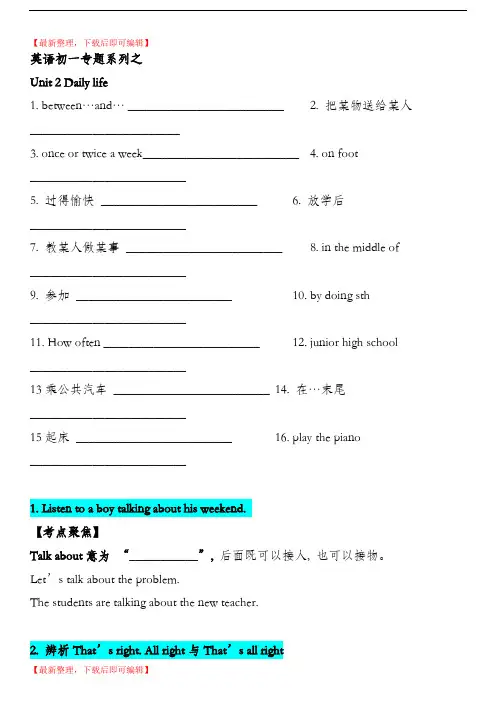
【最新整理,下载后即可编辑】英语初一专题系列之Unit 2 Daily life1. between…and… _________________________2. 把某物送给某人________________________3. once or twice a week_________________________4. on foot_________________________5. 过得愉快_________________________6. 放学后_________________________7. 教某人做某事_________________________ 8. in the middle of _________________________9. 参加_________________________ 10. by doing sth_________________________11. How often _________________________ 12. junior high school _________________________13乘公共汽车_________________________ 14. 在…末尾_________________________15起床_________________________ 16. play the piano_________________________1. Listen to a boy talking about his weekend.【考点聚焦】Talk about意为“___________”,后面既可以接人, 也可以接物。
Let’s talk about the problem.The students are talking about the new teacher.2. 辨析That’s right. All right与That’s all right[考点聚焦]①That’s right ___________。
沪教牛津初一上册Unit2语法复习
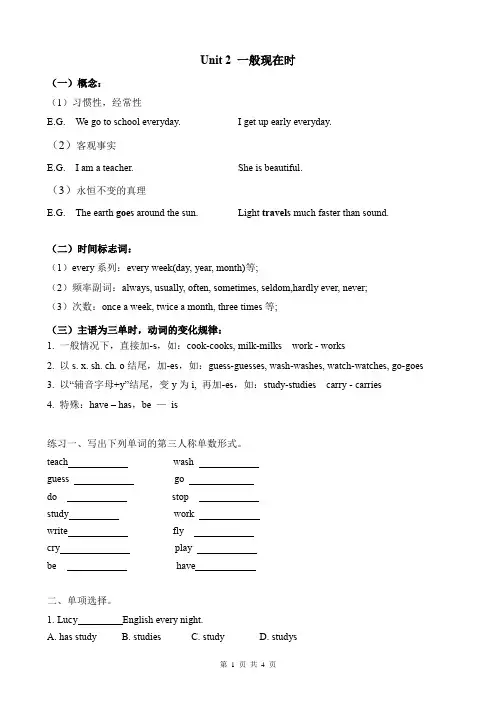
Unit 2 一般现在时(一)概念:(1)习惯性,经常性E.G. We go to school everyday. I get up early everyday.(2)客观事实E.G. I am a teacher. She is beautiful.(3)永恒不变的真理E.G. The earth goes around the sun. Light travels much faster than sound.(二)时间标志词:(1)every系列:every week(day, year, month)等;(2)频率副词:always, usually, often, sometimes, seldom,hardly ever, never;(3)次数:once a week, twice a month, three times等;(三)主语为三单时,动词的变化规律:1. 一般情况下,直接加-s,如:cook-cooks, milk-milks work - works2. 以s. x. sh. ch. o结尾,加-es,如:guess-guesses, wash-washes, watch-watches, go-goes3. 以“辅音字母+y”结尾,变y为i, 再加-es,如:study-studies carry - carries4. 特殊:have – has,be —is练习一、写出下列单词的第三人称单数形式。
teach washguess godo stopstudy workwrite flycry playbe have二、单项选择。
1. Lucy English every night.A. has studyB. studiesC. studyD. studys2. Jim always others.A. helpB. helpingC. helpsD. to help3.He said the sun in the east and in the west.A. rose; setB. rises; setsC. rises; setD. rise; sets4. Jim very hard, but he still can’t English very well.A. studies; speakB. studies; speaksC. studys; speaksD. study; speak5. The waiters to work at five every morning.A. startB. startsC. startingD.are studying6.Three and six nine.A. isB. areC. hasD. have7. Everyone I come from Sichuan, I come from ShanghaiA. thinkB. thinksC. thinkedD. thinking8. Mike is from America. He English.A. spokeB. will thinkC. speaksD. had spoken9. I bought this watch here yesterday, but it work.A. won’tB. didn’tC. doesn’tD. wouldn’t10.Mary classes on Sundays.A. hasB. haveC. hadD. have had三、用所给词的适当形式填空。
牛津沪教版英语七年级上Units1-2重点知识复习及易错题整理(无答案)
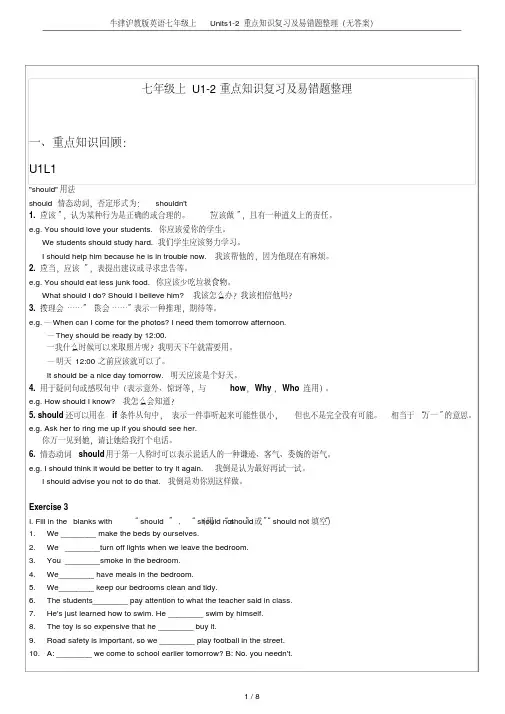
七年级上U1-2重点知识复习及易错题整理一、重点知识回顾:U1L1"should"用法should 情态动词,否定形式为:shouldn't1.“应该”,认为某种行为是正确的或合理的。
“应该做”,且有一种道义上的责任。
e.g. You should love your students. 你应该爱你的学生。
We students should study hard. 我们学生应该努力学习。
I should help him because he is in trouble now. 我该帮他的,因为他现在有麻烦。
2.“应当,应该”,表提出建议或寻求忠告等。
e.g. You should eat less junk food. 你应该少吃垃圾食物。
What should I do? Should I believe him? 我该怎么办?我该相信他吗?3.“按理会……”“该会……”表示一种推理,期待等。
e.g. —When can I come for the photos? I need them tomorrow afternoon.—They should be ready by 12:00.一我什么时候可以来取照片呢?我明天下午就需要用。
—明天12:00之前应该就可以了。
It should be a nice day tomorrow. 明天应该是个好天。
4. 用于疑问句或感叹句中(表示意外、惊讶等,与how,Why,Who连用)。
e.g. How should I know? 我怎么会知道?5. should还可以用在if条件从句中,表示一件事听起来可能性很小,但也不是完全没有可能。
相当于“万一”的意思。
e.g. Ask her to ring me up if you should see her.你万一见到她,请让她给我打个电话。
6. 情态动词should用于第一人称时可以表示说话人的一种谦逊、客气、委婉的语气。
(完整word版)沪教牛津版【广州专用】七年级上册英语期末复习Unit2
Unit 2 Daily life检测题(时间:60分钟;满分:100分)一、单项选择(每小题1分,共10分)16. My home is near my school, so I am late。
A. always B。
sometimes C。
often D. seldom17。
-When does your morning break start?—9:50.A. ToB. AtC. InD. About18。
Classes begin at 8:00 am and at 3:30 pm。
A。
over B。
end C. ends D。
over19。
It is 7:00 am now! I think it’s time for you _______school.A。
for B。
to go to C。
go D. go to 20。
- do you like English best?—Because I want to visit England in the future.A。
When B. Why C. How D。
What21。
-What Sam after class?-He takes part in the school band practice。
A. is; doB. does;do C。
do ;do D. does;does22. Tom is good at playing 。
A. pianoB. a pianoC. pianosD. the piano23。
-We will have a school trip next week.-_______.A。
Have a good time B。
We willC. I’m happy to hear itD. Don’t forget it24. Do you have time _______ me?I have something important to tell you.A。
牛津上海版七年级上Unit2复习教案
七年级上U2复习教案一、同步知识梳理一.单词:officer n. 官员;高级职员 n.. office 办公室adj. official 官方的;正式的society n.. 社团;协会 adj. social 社会的prevention n.. 预防;防止;防范 v. prevent用法:prevent sb. from doing sth.cruelty n.. 残酷 adj. cruel : be cruel to sb. adv. cruellyas prep. 作为;当作如:work……as 以……为工作prefer v. 更喜欢用法:1) prefer to do sth. 喜欢做某事;2) prefer sth. 喜欢……3) prefer A to B 比起B来说,更喜欢A4) prefer doing A to doing B 比起B来说,更喜欢A5) prefer to do A rather than do B 宁愿做A, 而不做B。
care n. 照料;照顾 adj. careful / careless n. carefulness / carelessness词组: take care of 照顾safely adv. 安全地; adj. safe n. safetypolice n. 警方该词做警方解释时是集体名词,没有复数形式,但后面的谓语动词要用复数。
thief n. 窃贼;小偷复数形式是:thieves v. thieve 偷missing adj. 失踪的 a missing boy = a lost boy 迷路的男孩v. missadj. missed二.词组:照看好look after …… well为……筹钱raise money for……保证做…… promise to do ……守护我们的家 guard our homes在很多方面 in many ways对……残忍be cruel to ……找到失踪的人 find lost people保护……使免受…… protect …… from浅棕色 light brown阻止,使免于…… keep……from欢迎来到…… welcome to ……把……扔在马路上 leave something in the street.愿意做…… would like to do something给……一碗水喝 give somebody a bowl of water to drink把……作为宠物keep …… as somebody’s pet三.课文中的语法点need 的用法:need 是个重要的词。
牛津沪教版英语七年级上Unit 2辅导讲义
七年级上U2Can 的用法:1,表示能力(如体力和脑力方面),意为“能;会”等。
例如:Can you speak English? 你会讲英语吗?Can you play the piano? 你会弹钢琴吗?2. 表示请求或允许,多用在口语中,意为“可以;能”等。
用于疑问句中用来提出要求,用于否定句表示不允许。
例如:Can I help you? 我能帮助你吗?You can’t play basketball. 你不能玩篮球。
3. 表示可能。
Errors Presentation1,An Englishman who ____not speak Italian was once traveling in Italy.A) must B) could C) may D) might2,He ____the 9:20 train because he didn't leave home till 9:25.A) can reach B) could catch C) may not catch D) couldn't have caught3.Mr Wang ______ be in Nanjing now, he went to Beijing only this morning.A. mustn’tB. may notC. can’tD. needn’t4. –Who is the man over there? Is it Mr Li?--No, it ______ be him. Mr Li is much taller.A. musn’tB. may notC. can’tD. needn’t5. A computer ______ think for itself, it must be told what to do.A. can’tB. couldn’tC. may notD. might notContent of courses重点单词:1.officer [ˈɒfɪsə(r)] n. 军官,警官; 高级职员; v. 指挥; 统率;变形过去分词: officered 复数: officersEg.He served during peace-time as an intelligence officer in the Navy.他在和平时期担任海军情报官员。
牛津上海版七年级上Unit2知识点复习及练习
牛津上海版七年级上Unit2知识点复习及练习1 / 10七年级上U2知识点复习及练习教案重点词汇和短语:life n .一生;终生;生活grade n .等级,级别;年级top a .顶尖的;头等的fail v .失败;不及格several a .几个;少许exam n .考试,测验gain v. 获得boring a .无趣的;乏味的own a .自己的usual a .平常的,通常的simple a .简单的,简易的duty n .义务;责任daily a. 每日的;每天的;日常的club n .俱乐部;社whiz-kid n .神童;优等生;领先者;achieve v .完成;达到assist n. 帮助accountant n.. 会计;会计师subtitle n .副标题client n .顾客;客户musical a .音乐的a day in the life of…… 生活中的一天one of the top students in Shanghai 全上海最好的学生之一too simple forsomebody .对某人来说太简单all of ……的全部;……的全体achieve A grades 获得A等work in one ’s business 从事某人的生意;在某人的公司上班in all one’s subjects 在某人全部学科中I. Simple Past Tense( 一般过去时)1.在英语中,表示过去发生的动作或存在的状态要用一般过去时。
一般过去时由动词的过去式构成,有三种形式:The visitor visited the school yesterday .(肯定式)He did not fight the robber .(否定式)。