
沪教牛津版-英语-八上-课件:U7 Reading
Read the second article and fill in the blanks.
1st reading D1 Read the articles on page 99 and fill in the blanks below.
Henry
To remember something
Imagine a (1) __p_ic_t_u_r_e__ : (2) __b_ig_____, (3) __s_tr_a_n_g_e_ or (4) __si_ll_y______(e.g. “smiles”: (5) _W__e__c_a_n_i_m_a_g_i_n_e_t_h_e_r_e__is__a__“_m_i_le_”__b_e_tw__e_e_n_t_he _f_ir_s_t__le_t_t_e_r__a_n_d_t_h_e__l_a_st__l_e_tt_e_r______).
Read the first article and fill in the blanks.
Read the second article and find out how Paula remembers the spelling of a word.
Paula A good method for remembering the spelling of a word is to make a short sentence with each letter of the word. For example, if you want to remember how to spell the word “because”, you can use the sentence “Big elephants can always understand small elephants”.
How do you remember the word “smiles”?
Read the first article and find out how Henry remembers things.
Henry A great way to help you remember something is to imagine a picture of it in your mind. If you make the picture big, strange or silly, you will remember it better. For example, to remember the word “smiles”, we can imagine there is a “mile” between the first letter and the last letter. This makes it the longest word in the world. Remember: a picture is worth a thousand words.
February monkey
baby window
How many words do you remember?
D 1. When you get old, your memory gets
better.
A 2. Making pictures in your mind helps you
remember things.
Millie You will forget something very quickly unless you understand it well. For example, you may have trouble remembering the list of steps in the water cycle. However, it is easier to remember these steps if you understand how the water cycle works.
Brainstorm: How do you remember the steps for using an encyclopaedia?
Read the third article and find out how to remember something more easily.
Millie You will forget something very quickly unless you understand it well. For example, you may have trouble remembering the list of steps in the water cycle. However, it is easier to remember these steps if you understand how the water cycle works.
4.What is Paula’s article mainly about? a. The importance of memory. b. A method for remembering the spelling of a
word.
巩固练习
(四)读课文,选择正确答案。
1 Henry, Paula and Millie want to help others improve
their
.
A. writing B. spelling
C. memory
2 Henry, Paula and Millie write articlene B. the school newspaper C. a book
3 Henry thinks it’s a good way to imagine a
a. Because they enjoy learning about memory.
b. Because they want to help students improve their memory.
• 3. What way does Henry’s article mention to help students remember something? a. To imagine a picture. b. To write it down.
Paula A good method for remembering the spelling of a word is to make a short sentence with each letter of the word. For example, if you want to remember how to spell the word “because”, you can use the sentence “Big elephants can always understand small elephants”.
U7 Memory
Reading
Try to remember………….
Try to remember………….
Try to remember………….
Try to remember………….
Share your experiences.
• If there is an English Test tomorrow, how will you try to remember the large amount of new words?
D 3. A man with a good memory can remember
everyone’s telephone number.
A 4. We remember things better if they happen
to us suddenly and surprisingly.
Before you read: Look at the introduction ,the title and the first sentence of each article on page 99. Then circle the correct answers.
Read the third article and fill in the blanks.
Read the articles
Read the articles together.
Henry A great way to help you remember something is to imagine a picture of it in your mind. If you make the picture big, strange or silly, you will remember it better. For example, to remember the word “smiles”, we can imagine there is a “mile” between the first letter and the last letter. This makes it the longest word in the world. Remember: a picture is worth a thousand words.
Millie
To remember something more easily
Try to (8)_re_m__e_m_b_e_r__s_o_m_e_t_h_i_ng__b_y__u_n_d_e_r_s_t_a_nd__in_g
沪教牛津版八年级上册英语教材
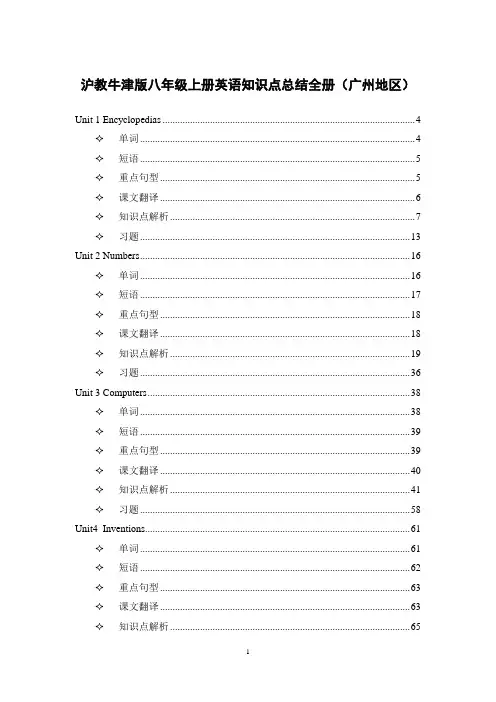
沪教牛津版八年级上册英语知识点总结全册(广州地区)Unit 1 Encyclopedias (4)✧单词 (4)✧短语 (5)✧重点句型 (5)✧课文翻译 (6)✧知识点解析 (7)✧习题 (13)Unit 2 Numbers (16)✧单词 (16)✧短语 (17)✧重点句型 (18)✧课文翻译 (18)✧知识点解析 (19)✧习题 (36)Unit 3 Computers (38)✧单词 (38)✧短语 (39)✧重点句型 (39)✧课文翻译 (40)✧知识点解析 (41)✧习题 (58)Unit4 Inventions (61)✧单词 (61)✧短语 (62)✧重点句型 (63)✧课文翻译 (63)✧知识点解析 (65)✧习题 (68)Unit5 Educational exchange (71)✧单词 (71)✧短语 (72)✧重点句型 (72)✧课文翻译 (73)✧知识点解析 (74)✧习题 (83)Unit 6 Ancient stories (85)✧单词 (85)✧短语 (87)✧重点句型 (87)✧课文翻译 (88)✧知识点解析 (89)✧习题 (95)Unit 7 Memory (100)✧单词 (100)✧短语 (101)✧重点句型 (101)✧课文翻译 (102)✧知识点解析 (103)✧习题 (109)Unit 8 English Week (114)✧单词 (114)✧短语 (115)✧重点句型 (115)✧课文翻译 (116)✧知识点解析 (117)✧习题 (122)每单元必考语法点预览Unit 1 some与any的用法& 复合不定代词somebody, anybody, nobody等的用法Unit 2基数词及数字的表达& 序数词Unit 3形容词的比较级与最高级Unit 4 good, bad, far & (not) as…as…Unit 5现在完成时& already, yet, ever, neverUnit 6 现在完成时中since, for & 现在完成时与一般过去时的区别Unit 7(真实性)条件状语从句& if…not 与unlessUnit 8情态动词should, had betterUnit 1 Encyclopedias 单词suddenly adv. [ˈsʌdn:lɪ] 意外地,忽然地nobody pron. [ˈnoˌ bədi] 没有人,无人fossil n. [ˈfɑsəl] 化石win v [wɪn] 获胜,赢dollar n [ˈdɑlɚ] 美元✧短语1.in the countryside 在乡村,在农村11.for example 例如2.human being 人12.next to 紧挨着3.die out 灭绝,消失13.look up 查阅4.find out 了解,弄清14.live on Earth 生活在地球上5.go for a walk 去散步15.an Italian painter 一位意大利画家6.be born 出生ed to do sth 过去常常做某事7.more than 多于,超过17.at the end of 在…末尾8.just like 正如,正像18.in the centre 在中心9.how long 多久e out of…从…出来10.would like 想要20.be famous for 以…而闻名✧重点句型1.Some dinosaurs were as small as chickens. 有的恐龙和鸡一样小。
沪教牛津版八年级英语上册课件Unit 7 Speaking
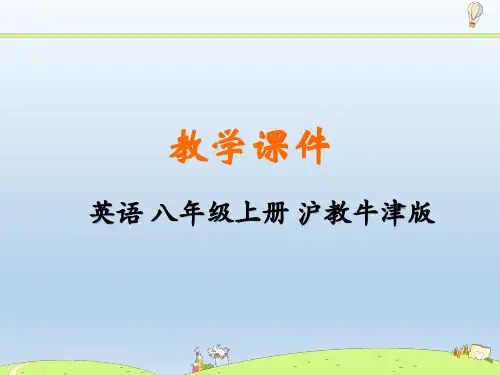
2. Act out the word I can remember “spider” if someone puts a spider on my hand.
3. Organize the words into a group Apples, oranges and pineapples are all fruit.
4. Divide a word We can divide “advantage” into three parts. “ad” “van” “tage”
教学课件
英语 八年级上册 沪教牛津版
Module 4 School Life
Unit 7 Memory Period 3
Talk
Talk about how to improve your memory.
objectives
➢ To learn the loss of plosion ➢ To talk about your special methods
weekend? S2: I usuaPlrlyacgteisteutpheatdhiaallofgpuaestintepnaairtst.he weekend. S1: When did you use to get up when you were a
student? S2: I used to get up at half past seven. I often went
A2. Read these sentences. (P 106) 1. Gla(d) to meet you. 2. This is a goo(d) boy. 3. That was the bes(t) day of my life! 4. I lef(t) bad about what happened. 5. Mos(t) people like flowers.
沪教牛津版-英语-八上-Unit 3 Computers Reading 课件

sub-headings
A sub-heading usually tells us the topic of the paragraph(s) below it.
Look at the pictures, the title and the sub-headings of the article on page 35.
4 S1: One day, computers may be able to do a better job than human beings.
S2: For example? S1:They__m__a_y_b_e__b_e_t_te_r__t_h_a_n_d_o_c_t_o_r_s_a_t_d_o_i_n_g_t_h_e_i_r_j_o_b_. __.
How much do you know about computers? Look at the photo below and complete the sentences with the correct names.
1 The _________ shows words and pictures. 2 We use the _________ for typing. 3 The “brain” of a computer is in the ___________. 4 We move the _________ to control the computer. 5 We hear sound from the __________.
沪教牛津版-英语-八上-初中英语八上 Unit7精编学案与习题
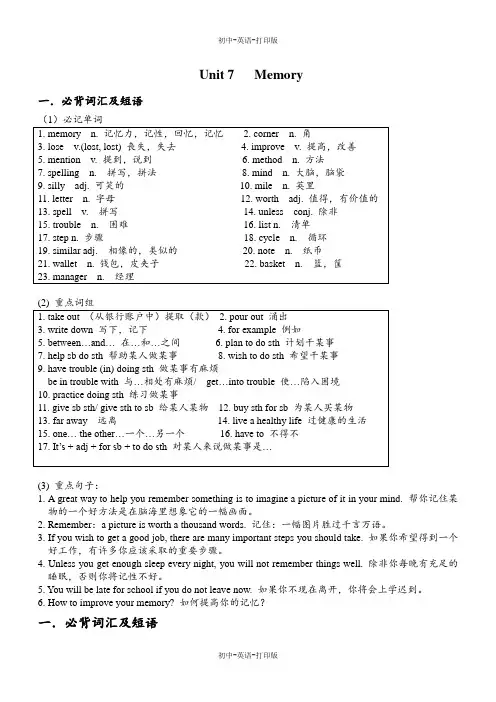
Unit 7 Memory一.必背词汇及短语(3) 重点句子:1. A great way to help you remember something is to imagine a picture of it in your mind. 帮你记住某物的一个好方法是在脑海里想象它的一幅画面。
2. Remember:a picture is worth a thousand words. 记住:一幅图片胜过千言万语。
3. If you wish to get a good job, there are many important steps you should take. 如果你希望得到一个好工作,有许多你应该采取的重要步骤。
4. Unless you get enough sleep every night, you will not remember things well. 除非你每晚有充足的睡眠,否则你将记性不好。
5. You will be late for school if you do not leave now. 如果你不现在离开,你将会上学迟到。
6. How to improve your memory? 如何提高你的记忆?一.必背词汇及短语单词1. memory n. v.记得=2. corner n.3. lose v. ( / ) n.4. improve v. = n.5. mention v.6. method n. =7. spelling n. v.拼写( / )8. mind n. v.介意9. silly adj. 同义词反义词10. mile n.11. letter n. 12. worth adj.13. spell v. n. 14. unless conj.15. trouble n. v. 16. list n. v.17. step n. v.迈步行走18. cycle n.19. similar adj. n.相似处20. note n. v.21. wallet n. 22. basket n.23. manager n. v. 管理成功n.管理短语1. take (从银行账户中)提取(款)2. out 涌出3. write 写下,记下4. 例如5. between…and…6. plan sth 计划干某事7. help sb sth 帮助某人做某事8. wish sth 希望干某事9. have trouble sth 做某事有麻烦be trouble 与…相处有麻烦/ …into trouble 使…陷入困境10. practice sth 练习做某事11. give / give sth sb 给某人某物12. buy sth sb 为某人买某物13. far away 14. a life 过健康的生活15. … …一个…另一个16. 不得不17. It’s + ad j + sb + sth 对某人来说做某事是…三.语言点1.When we make new memories,we lose old onesLose:(lost;lost):丢失;失去Ones: 代词;是one的复数;泛指前文提到的某些人或物2.Because they want to help students improve their memory?二者都有“因为”之意,但用法不同:because作连词,用于引导原因状语从句或作why开头问句的答语,常用于表示直接原因。
沪教牛津版-英语-八上-八上课件:Unit 4 Period 1

Homework
1. 抄写单词和短语:telephone,wheel, comfortable,carriage,century, passenger,invent,practical,since, distance,mobile phone,anytime, develop,lamp,candle,daytime,since then,keep in touch with,in the daytime 等。
4 __________can get free water at the airport.
5 A good reporter must _________________ what is happening in the world.
6 Could you help me change the left _______ of my car? The tyre is flat.
zxxkw
These inventions help us in many ways in our daily lives. We may use them anytime, anywhere.
7
They are very practical.
Look at the photos, the title, the introduction and the sub-headings of the article on page 51. Then answer the questions below.
1 Da Vinci is the most famous 15th ________ painter.
沪教版-英语-八上-牛津深圳版英语8A Unit 7 Period 1 教学设计

教学内容
Getting ready (p.97), Reading (pp.98-99), Vocabulary C1 (p. 100), Comprehension D1 (p. 101)
教学目标
语言知识
认读和理解单词memory, corner, lose, improve, mention, spelling, method, mind, silly, mile, letter, worth, spell, unless, trouble, list, step, cycle等。
Millie
To remembersomething more easily
Step 4运用图表,归纳主阅读篇章的主要内容。
1.学生开展“头脑风暴”,讨论问题:How do you remember the word“smiles”?。教师引入第一篇短文。学生认读和理解单词worth。
2.学生找读第一篇短文,并完成Comprehension D1第一组笔记,同时,找出主旨句并口头汇报。学生认读和理解单词mind, silly, mile和letter。
●What does Lo think of the course? (He thinks it is very good.)
●What does Hi want to do? (He wants to take the course too.)
●What does Hi want to know? (How much the course costs.)
语言技能
1.能通过图片及上下文猜测memory, corner, lose, improve等单词的含义。
牛津上海版英语八上《Chapter 7 Nobody wins(Part Ⅱ)》课件之一
2 Who is it written for?
Now, read the contents page of the book and answer: 1 How many units are
there?
2 How many sections are there in each unit?
7 In which module can you learn how to use an index?
8 In which unit can you learn how to write a letter?
Study the contents page of the book below and answer these questions.
In a book, the information is usually divided into parts and/or chapters. The titles of these parts and/or chapters are shown at the beginning of a book on the contents page.
5 The pictures below are from the book. In which chapters might you find them?
a
b
c
பைடு நூலகம்
d
e
f
Sometimes the contents page gives the titles of the chapters and one or two sentences about the contents of each chapter. Look at the contents page of the book People of the World below and complete the titles. Put one word in each blank. The first one has been done for you.
牛津上海版英语八上Unit 7《Nobody wins Ⅱ》课件3
Now, why did your kangaroos come into your room?
They heard (4)____________________.
And you say they didn’t help you. Why not?
It said to them, ‘(4)____________________ me!’
Now, Mr Gork, tell me how the aliens escaped from your cage.
I think they used a (1)____________________.
I see, but why couldn’t your magnet attract it?
2 Rita: Why couldn’t the magnet attract Captain King’s laser torch?
May: Because it was in a ______ ______.
3 Rita: Did Peters start speaking before Captain King finished speaking?
1 The magnet could pull metal objects towards it.
2 Captain King pointed the torch at Gork.
3 A short time later, Captain King and his crew all got out of the cage.
1 He started to snore.
Gork
2 We’ll use this to escape from the cage. the laser torch
沪教版-英语-八上-牛津深圳版英语8A unit 7 writing 参考课件
wallet
A In pairs, discuss what happens in the pictures below. Then complete the following paragraphs. Use the verbs from the box to help you.
Complete your writing Look at the pictures. Fill in the blanks.
1. Read these beautiful phrases and sentences. 2.以“A special memory”为题,根据教材第108
页练习C中的问题提示,写一篇作文。
Share your article with your classmates
Group leaders
Exchange
Checking
Conclusion
1.Help students to check the writing according to the handwriting and the words and the grammar. 2.List the beautiful sentences they wrote in the passages.
B Complete the rest of the story. Use the words from the box to help you.
Useful phrases and sentence patterns
1. put …in the basket. 2. the bank manager 3. be surprise to do sth. 4. the amount of money
沪教牛津版-英语-八上-Unit 1 Lesson 1 Computers reading
Unit 1 Lesson 1 Computers reading教学目标:Teaching objectives:Ⅰ. Knowledge and skills:1. Studen ts will be able to talk about computer skills.2. Students will be able to talk about the Internet.Ⅱ.Pr ogress and Methods:1. Students will be able to develop their abilities of learning independently,cooperation with others and sharing with others.2. Students will be able to learn how to use the knowledge into prac tice.Ⅲ.Emotions and values:1.S tudents will be able to arouse the interest of learning English.2.Students will be able to realize the advantages and disadvan tages of the Internetand have a right attitude to the Internet.3.Students will be able to realize that all the things have two sides.Language focus and difficult points:To talk about the Internet.Teaching procedures:Ⅰ.Pre-task:Daily Talk: The advantages and disadvantages of computersIt can help us:Do schoolworkKeep in touch with peopleGet the lastest informationMake friends with Net-palsBroaden our mindsEnrich our knowledgeRelaxSome of us may:Waste a lot of time onlinePay less attention to lessonsMake friends with bad peopleⅡ.While-task:1.Listen to the tape and then finish the exercise P6.2.Pair work: talk about your computer skills after the model.A: Were you able to do word processing before the computer lessons?B: No, I wasn’t, but I’m able to do it now.A: Are you able to surf the Internet now?B: I’m afraid not, but I’ll be able to do it after the computer lessons. Whatabout you?A: I can do both of them, but I’m not a ble to make a homepage yet.B: You ought to learn from Peter. His computer skills are excellent.3.read the reading by themselves and then fill in the blanks4.Underline some important phrases and sentences in the reading.5.Notes of the reading.key points in reading:1.among the greatest inventions of the twentieth century= one of…lions of websites and homepages3.need information for a school project4.play chess 下棋5.fun 乐趣 funny有“滑稽可笑”之意 a funny clownWhat a lot of fun=What great fun 多么大的乐趣啊6.比较:bring ,takebring here: “带来”, tak e there“带去”7.keep in touch with your friends in different places8.regular mail 常规的take some regular exercisemeet regularly 定期地,定时地9.need 情态动词 need do 否定:needn’t do实意动词 need to do don’t need to doneed sth don’t need sth_________ help me; ___________any help10.chat with sb 和某人交谈 chatted chattingenjoy doing sth.类似: finish完成, mind介意, practice练习, miss错过suggest建议, keep保持can’t help doing不禁 spend/waste time花时间/ 浪费时间be busy doing忙于11.Besides, = In addition, = What’s more,Be sides +A = In addition to +A12.order foodbe out of order 有毛病,出故障13.book tickets for cinema, theatres, and holidays14.in brief = in one/a word简言之= all in all= briefly= in short15.make sb./sth + adj. 使得某人/某物变得----类似的:keep sb/sth+adj.Ⅲ.Post-task:Homework1. Write about your computer skills.2. Recite new phrases in Reading。