
2020-2021年大学英语六级考试真题及参考答案(全三套)
精品 欢迎下载 可修改 2020年6月大学英语六级考试真题及参考答案(第1套) Part I Writing (30 minutes) Directions: For this part, you are allowed 30 minutes to write an essay on the importance of motivation and methods in learning. You should write at least 150 words but no more than 200 words. 【参考范文】
As an old saying goes, knowledge can change one’s life. In order to acquire knowledge, we have to study hard. However, it can not be ignored that effective learning needs both motivation and scientific methods.
It’s not difficult for us to come up with several possible reasons accounting for this perspective. In the first place, learning is a kind of serious and hard work. Therefore, not everyone is able to keep going without certain internal motivations. Besides, scientific methods play a significant role in improving learning efficiency. Many of us believe that the longer you study, the better grades you will get. But a lot of experiences of our classmates prove that this view is not entirely correct. In details, studying for a long time is exhausting and it is very likely to decrease study efficiency, which is critical to academic performance.
From what has been mentioned above, we can easily draw a conclusion that the importance of motivation and methods in learning is self-evident. And it is necessary for us to develop good learning methods.
【参考范文译文】 俗话说,知识能改变命运。因此,为了获得知识,我们必须努力学习。然而,不可忽略的是,有效的学习既离不开学习动力的存在,也离不开科学的学习方法。
不难列举上述观点的原因。首先,学习是一件严肃且困难的事。因此,不是每个人都能在没有某种内在动机的情况下一直继续。此外,科学的方法在提高学习效率方面发挥着重要的作用。我们当中有不少人都认为,学习的时间越长,成绩就会越好。但是我们周边同学的很多经历证明这个观点并不完全正确。具体来说,长时间的学习是累人的,因此它很可能会降低学习效率,而学习效率对于学业成绩来说却是至关重要的。
综上所述,我们可以很容易就得出如下结论:学习动机和方法的重要性是不言而喻的,因此我们非常有必要形成良好的学习方法。 精品 欢迎下载 可修改 PartⅡ Listening Comprehension (30 minutes) Section A Directions: In this section, you will hear two long conversations. At the end of each conversation, you will hear four questions. Both the conversation and the questions will be spoken only once. After you hear a question, you must choose the best answer from the four choices marked A),B),C) and D). Then mark the corresponding letter on Answer Sheet 1 with a single line through the centre. Questions 1 to 4 are based on the conversation you have just heard.
1. A) why Roman Holiday was more famous than Breakfast at Tiffany’s.
B)why Audrey Hepburn had more female fans than male ones. C)Why the woman wanted to be like Audrey Hepburn. D)why so many girls adored Audrey Hepburn. 2. A)Her unique personality. B)Her physical condition. C)Her shift of interest to performing arts. D)Her family’s suspension of financial aid. 3. A) She was not an outgoing person. B)She was modest and hardworking C)She was easy-going on the whole. D)She was usually not very optimistic. 4. A)She was influenced by the roles she played in the films. B)Her parents taught her to symbolize with the needy. C)She learned to volunteer when she was a child. 精品 欢迎下载 可修改 D)Her family benifited from other people’s help.
Questions 5 to 8 are based on the recording you have just heard. 5. A) Give a presentation.
B)Rise some questions. C)Start a new company. D)Ateed a board meeting. 6. A) It will cut production costs. B)It will raise productivities. C)No staff willl be dismissed. D)No new staff will be hired. 7. A) The timeline of restructuring. B) The reasons for restructuring. C) The communication channels. D) The company’s new missions. 8. A) By consulting their own department managers. B) By emailing questions to the man or the woman. C) By exploring various channels of communication. 精品 欢迎下载 可修改 D) By visiting the company’s own computer network.
Section B Directions:In this section, you will hear two passages. At the end of each passage, you will hear three or four questions. Both the passage and the questions will be spoken only once. After you hear a question, you must choose the best answer from the four choices marked A),B),C) and D). Then mark the corresponding letter on Answer Sheet 1 with a single line through the centre. Questions 9 to 11 are based on the passage you have just heard.
9.
A) It helps passengers to take care of their pet animals. B) It has animals to help passengers carry their language. C) It uses therapy animals to soothe nervous passengers. D) It allows passengers to have animal travel with them. 10. A) Avoiding possible dangers. B) Finding their way around. C) Identifying drug smugglers. D) Looking after sick passengers. 11. A) Schedule their flights around the animal visits. B) Photograph the therapy animals at the airport. C) Keep some animals for therapeutic purposes.
2021年12六级真题第3套
2021年12月大学英语六级考试真题(第3套)Part I Writing (30 minutes)Directions: For this part, you are allowed 30 minutes to write an essay related to the short passage given below. In your essay, you are to comment on the phenomenon described in the passage and suggest measures to address the issue. You should write at least 150 words but no more than 200 words.Some parents in China are overprotective of their children. They plan everything for their children, make all the decisions for them, and do not allow them to explore on their own in case they make mistakes or get hurt.Part II Listening Comprehension (30 minutes)淘宝店铺(新一文化)温馨提示:历年全国六级考试共考2套听力,第3套套真题听力与第2套内容完全相同,只是题目选项顺序不同,因此不再重复出现。
Part III Reading Comprehension (40 minutes) Section A光速考研温馨提示:2021年12月六级考试共考了2套阅读词汇理解,本套阅读词汇理解与第2套内容完全一样,因此在本套真题中不再重复出现。
Section BDirections: In this section, you are going to read a passage with ten statements attached to it. Each statement contains information given in one of the paragraphs. Identify the paragraph from which the information is derived. You may choose a paragraph more than once. Each paragraph is marked with a letter. Answer the questions by marking the corresponding letter on Answer sheet 2.Why facts don't change our mindsA)The economist J. K. Galbraith once wrote, “Faced with a choice between changing one's mindand proving th ere is no need to do so, almost everyone gets busy with the proof.”B)Leo Tolstoy was even bolder: "The most difficult subjects can be explained to the most slow-witted man if he has not formed any idea of them already; but the simplest thing cannot be made clear to the most intelligent man if he is firmly persuaded that he knows already, without a shadow of a doubt, what is laid beforeC)What's going on here? Why don't facts change our minds? And why would someone continue tobelieve a false or inaccurate idea anyway? How do such behaviors serve us? Humans need a reasonably accurate view of the world in order to survive. If your model of reality is wildly different from the actual world, then you struggle to take effective actions each day. However, truth and accuracy are not the only things that matter to the human mind. Humans also seem to have a deep desire to belong.D)In Atomic Habits,I wrote, “Humans are herd animals. We want to fit in, to bond with others, and to earn the respect and approval of our peers. Such inclinations are essential to our survival. For most of our evolutionary history, our ancestors lived in tribes. Becoming separated from the tribe一orworse, being cast out—as a death sentence.^,E)Understanding the truth of a situation is important, but so is remaining part of a tribe. While thesetwo desires often work well together, they occasionally come into conflict. In many circumstances, social connection is actually more helpful to your daily life than understanding the truth of a particular fac t or idea. The Harvard psychologist Steven Pinker put it this way, “People are embraced or condemned according to their beliefs, so one function of the mind may be to hold beliefs that bring the belief- holder the greatest number of allies, protectors, or disciples (信徒),rather than beliefs that are most likely to be true.,,F)We don't always believe things because they are correct. Sometimes we believe things becausethey make us look good to the people we care about. I thought Kevin Simler put it well when he wrote, “If a brain anticipates that it will be rewarded for adopting a particular belief, it's perfectly happy to do so, and doesn't much care where the reward comes from- whether it's pragmatic (实用主义的)(better outcomes resulting from better decisions), social (better treatment from one's peers), or some mix of the two."G)False beliefs can be useful in a social sense even if they are not useful in a factual sense. For lackof a better phrase, we might call this approach "factually false, but socially accurate.When we have to choose between the two, people often select friends and family over facts. This insight not only explains why we might hold our tongue at a dinner party or look the other way when our parents say something offensive, but also reveals a better way to change the minds of others. H)Convincing someone to change their mind is really the process of convincing them to change theirtribe. If they abandon their beliefs, they run the risk of losing social ties. You can't expect someone to change their mind if you take away their community too. You have to give them somewhere to go. Nobody wants their worldview tom apart if loneliness is the outcome.I)The way to change people's minds is to become friends with them, to integrate them into yourtribe, to bring them into your circle. Now, they can change their beliefs without the risk of being abandoned socially.J)Perhaps it is not difference, but distance, that breeds tribalism and hostility. As proximity increases, so does understanding. 1 am reminded of Abraham Lincoln's quote, T don't like that man. I must get to know him better.”K)Facts don't change our minds. Friendship does. Years ago, Ben Casnocha mentioned an idea to me that I haven't been able to shake: The people who are most likely to change our minds are the ones we agree with on 98 percent of topics. If someone you know, like, and trust believes a radical idea, you are more likely to give it merit, weight, or consideration. You already agree with them in most areas of life. Maybe you should change your mind on this one too. But if someone wildly different than you proposes the same radical idea, well, it's easy to dismiss them as nuts.L)One way to visualize this distinction is by mapping beliefs on a spectrum. If you divide this spectrum into 10 units and you find yourself at Position 7, then there is little sense in trying to convince someone at Position 1. The gap is too wide. When you're at Position 7, your time isbetter spent connecting with people who are at Positions 6 and 8, gradually pulling them in your direction.M)The most heated arguments often occur between people on opposite ends of the spectrum, but the most frequent learning occurs from people who are nearby. The closer you are to someone, the more likely it becomes that the one or two beliefs you don't share will bleed over into your own mind and shape your thinking. The further away an idea is from your current position, the more likely you are to reject it outright. When it comes to changing people's minds, it is very difficult to jump from one side to another. You can't jump down the spectrum. You have to slide down it. N)Any idea that is sufficiently different from your current worldview will feel threatening. And the best place to ponder a threatening idea is in a non-threatening environment. As a result, books are often a better vehicle for transforming beliefs than conversations or debates. In conversation, people have to carefully consider their status and appearance. They want to save face and avoid looking stupid. When confronted with an uncomfortable set of facts, the tendency is often to double down on their current position rather than publicly admit to being wrong. Books resolve this tension. With a book, the conversation takes place inside someone's head and without the risk of being judged by others. It's easier to be open-minded when you aren't feeling defensive.O)There is another reason bad ideas continue to live on, which is that people continue to talk about them. Silence is death for any idea. An idea that is never spoken or written down dies with the person who conceived it. Ideas can only be remembered when they are repeated. They can only be believed when they are repeated. I have already pointed out that people repeat ideas to signal they are part of the same social group. But here's a crucial point most people miss: People also repeat bad ideas when they complain about them. Before you can criticize an idea, you have to reference that idea. You end up repeating the ideas you're hoping people will forget—but, of course, people can't forget them because you keep talking about them. The more you repeat a bad idea, the more likely people are to believe it.P)Let's call this phenomenon Clear's Law of Recurrence: The number of people who believe an idea is directly proportional to the number of times it has been repeated during the last year—even if the idea is false.36.According to the author, humans can hardly survive if separated from their community.37.People often accept false beliefs because they prioritize social bonds rather than facts.38.Most often people learn from those close to them.39.Sometimes people adopt certain beliefs in order to leave a favorable impression on those dear tothem.pared with face-to-face communication, books often provide a better medium for changingpeople's beliefs.41.On many occasions in daily life, people benefit more from their social bonds than from knowingthe truth.42.If you want to change somebody's beliefs, you should first establish social connection with them.43.Humans cannot survive without a fair knowledge of the actual world.44.Repetition of bad ideas increases their chances of being accepted.45.Nobody is willing to give up their beliefs at the risk of getting isolated.Section CDirections: There are 2 passages in this section. Each passage is followed by some questions or unfinished statements. For each of them there are four choices marked A), B), C) and D). You should decide on the best choice and mark the corresponding letter on Answer Sheet 2 with a single line through the centre.Passage One Questions 46 to 50 are based on the following passage.The subject of automation and its role in our economy has taken hold in American public discourse. Technology broadly and automation specifically are dramatically reshaping the way we work. And we need to have a plan for what's still to come.We don't have to look further than our own communities to see the devastating impact of automation. From automated warehouses to cashierless grocery stores to neighborhood libraries that offer self-checkout lanes instead of employing real people一automation is increasingly replacing jobs and leaving too few good new jobs behind.The statistics in manufacturing are staggering. Despite the widespread fears about trade, a recent report showed that just 13 percent of jobs lost in manufacturing are due to trade—he rest of the losses have been due to advances in technology.That is why more people are criticizing the ever-increasing role of technology in our economy. Our country is manufacturing more than ever before, but we are doing it with fewer workers. However, it's not just factories that are seeing losses一software and information technology are also having a dramatic impact on jobs most people think are secure from the forces of a rapidly-changing economy. Something transformative is happening in America that is having an adverse effect on American families. Whether policymakers and politicians admit it or not, workers have made clear their feelings abouttheir economic insecurity and desire to keep good jobs in America.So why are people so insistent on ignoring the perils of automation? They are failing to look ahead at a time when planning for the future is more important than ever. Resisting automation is futile: it is as inevitable as industrialization was before it. I sincerely hope that those who assert that automation will make us more effective and pave the way for new occupations are right, but the reality of automation's detrimental effects on workers makes me skeptical. No one can currently say where the new jobs are coming from or when, and any sensible company or country should prepare for all alternatives.I'm not overstating the danger: look at what's happened to the labor force. According to economic research, one in six working-age men, 25 一54, doesn't have a job. Fifty years ago, nearly 100 percent of men that age were working. Women's labor force participation, meanwhile, has slipped back to the level it was at in the late 1980s.American families and prominent business leaders are aware that there9s a big problem with automation. The value of a college degree is diminishing, and our upward mobility is declining. If we want an economy that allows everyone to be economically secure, we need to start thinking abouthow we can rightfully address automation.46.What can we observe from the author's description of our communities?A)The growing passion for automation.B)The shift from manual jobs to IT ones.C)Their changing views on employment.D)Their fading employment opportunities.47.What do we learn from a recent report?A)The manufacturing sector is declining at a fast rate.B)The concerns about the effect of trade are exaggerated.C)The fears about trade have been spreading far and wide.D)The impact of trade on employment has been staggering.48.What does the passage tell us about American workers in an era of transformation?A)They feel ignored by politicians.B)They feel increasingly vulnerable.C)They keep adapting to the changes.D)They keep complaining but to no avail.49.What does the author think of automation?A)It will have the same impact as industrialization.B)It provides sensible companies with alternatives.C)Its alleged positive effects are doubtful.D)Its detrimental effects are unavoidable.50.What should we attach importance to when dealing with automation?A)College graduates9 job prospects. C) People's economic security.B)Women's access to employment. D) People's social mobility.Passage Two Questions 51 to 55 are based on the following passage.Look at the people around you. Some are passive, others more aggressive. Some work best alone, others crave companionship. We easily recognize that there is great variation among the individuals who live near us. Yet, when we speak of people from elsewhere, we seem to inevitably characterize them based on their country of origin.Statistics specialists, when they speak of national averages, often make the same mistake.Newly published research shows how erroneous such overviews are. Three researchers analyzed decades of values-based surveys and found that only between 16% and 21% of the variation in cultural values could be explained by differences between countries. In other words, the vast majority of what makes us culturally distinct from one another has nothing to do with our homeland.To determine what factors really are associated with culture, the authors combined data from 558 prior surveys that each measured one or more of Hofstede's cultural dimensions. These are traits, such as individualism and masculinity, that describe work-related cultural values. (They are not a measure of visible cultural traits, such as food or dress.) Though the validity of Hofstede's dimensions has been questioned, they have the singular benefit of having been in use for decades, which allows for historical and international comparisons.The researchers found that both demographic factors, such as age, and environmental factors, such as long-term unemployment rates, were more correlated with cultural values than nationality. Occupation and social economic status were the most strongly correlated, suggesting that our values are more economically driven than we usually give them credit for.The evidence implies that people with similar jobs and incomes are more culturally alike, regardless of where they live. Vas Taras, the lead author of the study, puts it this way: “Tell me how much you make and I will make a pretty accurate prediction about your cultural values. Tell me what your nationality is and I probably will make a wrong prediction.Taras says our erroneous belief that countries are cultures has caused businesses to teach their employees useless or even harmful ways of interacting with their international peers. Chinese and American lawyers might be trained to interact based on the assumption that the Chinese person is less individualistic, even though their similar social economic situations make it probable they are actually quite alike in that regard.The country, as the unit of authority, is often a convenient way of generalizing about a population.However, our focus on countries can mask broad variations within them. In themajority of cases we would be better off identifying people by the factors that constrain their lives, like income, rather than by the lines surrounding them on a map.51.What error do experts often make when describing people from other places?A)They tend to overly rely on nationality.B)They often exaggerate their differences.C)They often misunderstand their cultures.D)They tend to dwell on national averages.52.What do we learn about Hofstede's cultural dimensions?A)They are useful in comparing cultural values across time and space.B)They have brought unusual benefits to people of different cultures.C)They are widely used to identify people's individual traits.D)They provide valuable questions for researchers to study.53.What did researchers find about previous studies on factors determining people's values?A)Environmental factors were prioritized over other factors.B)An individuaPs financial status was often underestimated.C)Too much emphasis had been placed on one's occupation.D)The impact of social progress on one's values was ignored.54.What is the impact on employees when cultures are identified with countries?A)They may fail to see the cultural biases of their business partners.B)They may fail to attach sufficient importance to cultural diversity.C)They may not be taught how to properly interact with overseas partners.D)They may not be able to learn the legal procedures for business transactions.55.What does the author suggest at the end of the passage?A)There is sufficient reason to generalize about a country's population.B)The majority of people are still constrained by their national identity.C)It is arguable that the country should be regarded as the unit of authority.D)Nationality is less useful than socio-economic status as an indicator of one's values.Part IV Translation (30 minutes) Directions: For this part, you are allowed 30 minutes to translate a passage from Chinese into English. You should write your answer on Answer Sheet 2.井冈山地处湖南、江西两省交界处,因其辉煌的革命历史被誉为“中国革命红色摇篮1927 年10月,毛泽东、朱德等老一辈革命家率领中国工农红军来到这里,开展了艰苦卓绝的斗争, 创建了第一个农村革命根据地,点燃了中国革命的星星之火,开辟了“农村包围(besiege)城市,武装夺取政权"这一具有中国特色的革命道路,中国革命从这里迈向胜利。
大学英语六级历年真题2021年6月13日全国大学英语六级写作真题及答案
大学英语六级历年真题2021年6月13日全国大学英语六级写作真题及答案2021年6月13日全国大学英语六级写作真题及答案第一篇:Directions: For this part, you are allowed 30 minutes to write an essay commenting on the saying “Knowledge is a treasure, but practice is the key to it.” You can give one example or two to illustrate your point of view. You should write at least 150 words but no more than 200 words.命题分析本题要求评论英国教士Thomas Fuller的一句名言:“知识是一种财富,但实践是打开资产投资的钥匙。
”并要求可以给出一个或两个例子来阐述你的观点。
显而易见,本题理论知识与实践技能之间的关系,这是雅思(课程) 文学创作反复考察过的话题。
写作思路解析1、本题首段应该通过理论知识与实践技能之间的亲密关系引出主题;2、第二段可以进行举例论证,列举自己参加全职打工、志愿者活动等亲身经验证明实践技能的重要性;3、尾段可以进行归纳结论中后或提出建议措施:一方面我们应该努力积累理论知识,另一方面我们应该积极培养自己的实践技能。
参考范文:Would you want a doctor to operate on you who has only learned about operations from a textbook? The answer to thisis obviously a resounding “No!” Knowledge gained from b ooks must always be complemented by knowledge gained from actual experience, to be of real value.For me actually practicing a particular action or experiment myself and experiencing the result, leaves a much deeper and lasting impression than what I get from simply reading or listening. If I read about how to write an essay or listened to someone talk about writing an essay, I still wouldn’t feel that I knew how to write an essay until I wrote one for myself. It is the case, however, that writing the essay would be based on the methods I learned intellectually. The same can be said for other skills, like sports, for example. A person can know all the rules of a game, associated skillsand strategies, but until that person gets on a court with a ball in motion, the theory remains flat, useless.To sum up, as to theoretical knowledge and practical skills, the latter is certainly more important. Just as Briti sh churchman Thomas Fuller put it, “Knowledge is a treasure, but practice is the key to it.”参考译文一个大夫只学过课本上的手术知识,叫他给你主刀你是否愿?显然,这个问题的答案是一声响亮的“不”。
2021年6月大学英语六级作文真题及范文(3套)
2021年6月大学英语六级作文真题及范文(3套)卷一Part I Writing(30minutes)Directions:For this part,you are allowed30mimites to write an essay based on the chart below. You should start your essay with a brief description of the chart and comment on China's achievements in higher education.You should write at least150words but no more than200words.参考范文:The bar chart above explicitly demonstrates that the gross enrollment ratio in universities in China,according to the data from Ministry of Education,has increased dramatically from3.4% in1990to51.6%in2019.Obviously,the past thirty years have witnessed China⁵s great achievements in higher education.Firstly,higher education in China has become approachable to most Chinese citizens.This is partly due to the fact that ChinaJ s economy has been developing at a marvelous speed,but also because Chinese government has launched a wide range of favorable policies to support rural students to get admitted to colleges.Moreover,the quality of China"s universities has showed a marked improvement.Now,several seats of learning in China are among the top universities world-wide, and every year they draw numerous foreign students to come to China for higher education<Besides, Chinese government and a mass of big enterprises have been investing heavily into upgrading the campus sites,introducing the most advanced equipments,and increasing the facultyJ s salaries.In all,the China"s achievements in higher education are remarkable.I believe that this trend will surely continue,and will in turn benefit our great country.卷二PartⅠWriting(30minutes)Directions:For this part,you are allowed30mimites to write an essay based on the graph below. You should start your essay with a brief description of the graph and comment on China's achievements in urbanization.You should write at least150words but no more than200words.参考范文:The chart above displays the progress of urbanization in China over the last four decades.We can see that,in less than40years,the number of people in China who lived in cities had more than tripled.From1980to2010,the share of urban population had grown from19.39%to49.96%, which was a record high worldwide.As far as I am concerned,China’s extraordinary urbanization has gone hand-in-hand with its economic boom.Since its reform and opening-up in1978,China’s economy has taken off.During the past four decades,China underwent vast changes to its economic system and abundantopportunities emerged in the coastal area.As a result,people living in the rural areas came to big cities in the costal area to pursuit a better life,which speeded up the progress of urbanization.Urbanization,in return,contributes to the development of China’s fast-growing economy.Take, for example,the basic infrastructures in big cities.The government has invested a lot of money in buildings and facilities,which enables people to live and work in high-density in tall buildings, which greatly improvs efficiency and productivity.In conclusion,the urbanization in China not only enables people to enjoy a better living condition, but also lays foundations for sustainable economic growth.It is a great achievement and has far-reaching benefits.卷三PartⅠWriting(30minutes)Directions:For this part,you are allowed30mimites to write an essay based on the chart below. You should start your essay with a brief description of the chart and comment on China5s achievements in poverty alleviation.You should write at least150words but no more than200 words.参考范文:The bar chart above explicitly demonstrates the great achievements China has made in poverty alleviation.In2012,there are over80million rural people in poverty,which takes up almost 10%of the rural population.However,the following nine years witness the continuous decline in this figure,and in2020,all the Chinese rural people are alleviated from poverty.The achievements,however,can not be completely reflected by this figure.Firstly,Chinese rural people have become increasingly wealthier.More families possess their own automobiles,more rural people have access to high-tech devices,and their living conditions have also improved markedly. Moreover,the literate rate of rural population has greatly increased,too.Primary schools are so popular in rural area that almost every child can receive education,which will surely in turn propel the development of rural areas in the future.Besides,more rural people go to bigger cities to realize their Chinese dreams,and they have contributed a lot to the prosperity of our great country.In all,China"s achievements in alleviating poverty have attracted worldwide attention.I am very proud of being a Chinese citizen,and I believe our great country will become better,stronger, and more beautiful.。
2021年12月英语六级阅读真题及答案 第3套 仔细阅读2篇
2021年12月英语六级阅读真题及答案第3套仔细阅读2篇Passage OneQuestions 46 to 50 are based on the following passage.Schools are not just a microcosm (缩影) of society; they mediate it too. The best seek to alleviate the external pressures on their pupils while equipping them better to understand and handle the world outside -- at once sheltering them and broadening their horizons. This is ambitious in any circumstances, and in a divided and unequal society the two ideals can clash outright(直接地).Trips that many adults would consider the adventure of a lifetime -- treks in Bomeo, a sports tour to Barbados -- appear to have become almost routine at some state schools. Parents are being asked for thousands of pounds. Though schools cannot profit from these trips, the companies that arrange them do. Meanwhile, pupils arrive at school hungry because their families can't afford breakfast. The Child Poverty Action Group says nine out of 30 in every classroom fall below the poverty line. The discrepancy is startlingly apparent. Introducing afundraising requirement for students does not help, as better-off children can tap up richer aunts and neighbours.Probing the rock pools of a local beach or practising French on a language exchange can fire children's passions, boost their skills and open their eyes to life 's possibilities. Educational outings help bright but disadvantaged students to get better scores in A-level tests. In this globalised age, there is a good case for international travel, and some parents say they can manage the cost of a school trip abroad more easily than a family holiday. Even in the face of immense and mounting financial pressures, some schools have shown remarkable determination and ingenuity in ensuring that all their pupils are able to take up opportunities that may be truly life-changing. They should be applauded. Methods such as whole-school fundraising, with the proceeds(收益) pooled, can help to extend opportunities and fuel community spirit.But 3,000 pounds trips cannot be justified when the average income for families with children is just over 30,000 pounds. Such initiatives close doors for many pupils. Some parents pull their children out of school because of expensive field trips. Even parents who can see that a trip is little more than a party or celebration may well feel guilt that their child is leftbehind.The Department for Education 's guidance says schools can charge only for board and lodging if the trip is part of the syllabus, and that students receiving government aid are exempt from these costs. However, many schools seem to ignore the advice; and it does not cover the kind of glamorous, exotic trips, which are becoming increasingly common. Schools cannot be expected to bring together communities single-handed. But the least we should expect is that they do not foster divisions and exclude those who are already disadvantaged.46. What does the author say best schools should do?A) Prepare students to both challenge and change the divided unequal society.B) Protect students from social pressures and enable them to face the world.C) Motivate students to develop their physical as well as intellectual abilities.D) Encourage students to be ambitious and help them to achieve their goals.47. What does the author think about school field trips?A) They enable students from different backgrounds to mix with each other.B) They widen the gap between privileged and disadvantaged students.C) They give the disadvantaged students a chance to see the world.D) They only benefit students with rich relatives and neighbours.48. What does the author suggest can help build community spirit?A) Events aiming to improve community services.B) Activities that help to fuel students' ingenuity.C) Events that require mutual understanding,D) Activities involving all students on campus.49. What do we learn about low-income parents regarding school field trips?A) They want their children to participate even though they don't see much benefit.B) They don't want their kids to participate but find it hard to keep them from going.C) They don't want their kids to miss any chance to broaden their horizons despite the cost.D) They want their children to experience adventures but they don't want them to run risks.50. What is the author's expectation of schools?A) Bringing a community together with ingenuity.B) Resolving the existing discrepancies in society.C) Avoiding creating new gaps among students.D) Giving poor students preferential treatment.Passage TwoQuestions 51 to 55 are based on the following passage.Rising temperatures and overfishing in the pristine(未受污染的) waters around the Antarctic could see king penguin populations pushed to the brink of extinction by the end of the century, according to a new study. The study's report states that as global warming transforms the environment in the world's last great wilderness, 70 percent of king penguins could either disappear or be forced to find new breeding grounds.Co-author Celine Le Bohec, from the University of Strasbourg in France, warned: "If there're no actions aimed at halting or controlling global warming, and the pace of the current human-induced changes such as climate change and overfishing stays the same, the species may soon disappear." The findings come amid growing concern over the future of the Antarctic. Earlier this month a separate study found that a combination of climate change and industrial fishing isthreatening the krill(磷虾) population in Antarctic waters, with a potentially disastrous impact on whales, seals and penguins. But today's report is the starkest warming yet of the potentially devastating impact of climate change and human exploitation on the Antarctic's delicate ecosystems.Le Bohec said: "Unless current greenhouse gas emissions drop, 70 percent of king penguins -- 1.1 million breeding pairs -- will be forced to relocate their breeding grounds, or face extinction by 2100." King penguins are the second-largest type of penguin and only breed on specific isolated islands in the Southern Ocean where there is no ice cover and easy access to the sea. As the ocean warms, a body of water called the Antarctic Polar Front -- an upward movement of nutrient-rich sea that supports a huge abundance of marine life -- is being pushed further south. This means that king penguins, which feed on fish and kill in this body of water, have to travel further to their feeding grounds, leaving their hungry chicks for longer. And as the distance between their breeding, grounds and their fool prows, entire colonies could be wiped out.Le Bohec said: "The plight of the king penguin should serve as a warming about the future of the entire marine environment in the Antarctic. Penguins, like other seabirds and marinemammals, occupy higher levels in the food chain and they are what we call bio-indicators of their ecosystems." Penguins are sensitive indicators of changes in marine ecosystems. As such, they are key species for understanding and predicting impacts of global change on Antarctic and sub-Antarctic marine ecosystems. The report found that although some king penguins may be able to relocate to new breeding grounds closer to their retreating food source, suitable new habitats would be scarce. Only a handful of islands in the Southern Ocean are suitable for sustaining large breeding colonies.51. What will happen by 2100, according to a new study?A) King penguins in the Antarctic will be on the verge of dying out.B) Sea water will rise to a much higher level around the Antarctic.C) The melting ice cover will destroy the great Antarctic wilderness.D) The pristine waters around the Antarctic will disappear forever.52. What do we learn from the findings of a separate study?A) Shrinking krill population and rising temperatures could force Antarctic whales to migrate.B) Human activities have accelerated climate change in the Antarctic region in recent years.C) Industrial fishing and climate change could be fatal to certain Antarctic species.D) Krill fishing in the Antarctic has worsened the pollution of the pristine waters.53. What does the passage say about king penguins?A) They will turn out to be the second-largest species of birds to become extinct.B) Many of them will have to migrate to isolated islands in the Southern Ocean.C) They feed primarily on only a few kinds of krill in the Antarctic Polar Front.D) The majority of them may have to find new breeding grounds in the future.54. What happens when sea levels rise in the Antarctic?A) Many baby king penguins can't have food in time.B) Many king penguins could no longer live on kill.C) Whales will invade king penguins' breeding grounds.D) Whales will have to travel long distances to find food.55. What do we learn about the Southern Ocean?A) The king penguins there are reluctant to leave for newbreeding grounds.B) Its conservation is key to the sustainable propagation of Antarctic species.C) It is most likely to become the ultimate retreat for species like the king penguin.D) Only a few of its islands can serve as luge breeding grounds for king penguins.Passage one46.B47.B48.D49.A50.CPassage two51.A52.C53.D54.A55.D。
大学英语六级考试2021.12真题第3套

2021年12月大学英语六级考试真题(第3套)Part I Writing (30 minutes) Directions: For this part, you are allowed 30 minutes to write an essay related to the short passage given below. In your essay, you are to comment on the phenomenon described in the passage and suggest measures to address the issue. You should write at least 15..Q words but no more than虚wordsSome parents in China are overprotective of their children. They plan everything for their children, make all the decisions for them, and do not allow them to explore on their own in case they make mistakes or get hurt.Part II Listening Comprehension (30 minutes) 淘宝店铺(光速考研工作室)温馨提示:历年全国六级考试共考2套听力,第3套套真题听力与第2套内容完全相同,只是题目选项顺序不同,因此不再重复出现。
Part III Reading Comprehension (40 minutes) Section A光速考研温馨提示:2021年12月六级考试共考了2套阅读词汇理解,本套阅读词汇理解与第2套内容完全一样,因此在本套真题中不再重复出现。
Section BDirections: In this section, you are going to read a passage with ten statements attached to it. Each statement contains information given in one of the paragraphs. Identify the paragraph from which the information is derived. You may choose a paragraph more than once. Each paragraph is marked with a letter. Answer the questions by marking the corresponding letter on Answer sheet 2.Why facts don't change our mindsA)The economist J. K. Galbraith once wrote, "Faced with a choice between changing one's mind and proving there is no need to do so, almost everyone gets busy with the proof."B)Leo Tolstoy was even bolder: "The most difficult subjects can be explained to the most slow-witted man if he has not formed any idea of them already; but the simplest thing cannot be made clear to the most intelligent man if he is firmly persuaded that he knows already, without a shadow of a doubt, what is laid before him."C)What's going on here? Why don't facts change our minds? And why would someone continue to believe a false or inaccurate idea anyway? How do such behaviors serve us? Humans need a reasonably accurate view of the world in order to survive. If your model of reality is wildly different from the actual world, then you struggle to take effective actions each day. However, truth and accuracy are not the only things that matter to the human mind. Humans also seem to have a deep desire to belong.D)In Atomic Habits, I wrote, "Humans are herd animals. We want to fit in, to bond withothers, and to earn the respect and approval of our peers. Such inclinations are essential to our survival. For most of our evolutionary history, our ancestors lived in tribes. Becoming separated from the tribe—or worse, being cast out一was a death sentence."E)Understanding the truth of a situation is important, but so is remaining part of a tribe While these two desires often work well together, they occasionally come into conflict. In many circumstances, social connection is actually more helpful to your daily life than understanding the truth of a particular fact or idea. The Harvard psychologist Steven Pinker put it this way, "People are embraced or condemned according to their beliefs, so one function of the mind may be to hold beliefs that bring the belief-holder the greatest number of allies, protectors, or disciples(信徒),rather than beliefs that are most likely to be true."F)We don't always believe things because they are correct. Sometimes we believe things because they make us look good to the people we care about. I thought Kevin Simler put it well when he wrote, "If a brain anticipates that it will be rewarded for adopting a particular belief, it's perfectly happy to do so, and doesn't much care where the reward comes from-whether it's pragmatic(实用主义的)(better outcomes resulting from better decisions), social (better treatment from one's peers), or some mix of the two."G)False beliefs can be useful in a social sense even if they are not useful in a factual sense. For lack of a better phrase, we might call this approach "factually false, but socially accurate." When we have to choose between the two, people often select friends and family over facts. This insight not only explains why we might hold our tongue at a dinner party or look the other way when our parents say something offensive, but also reveals a better way to change the minds of others.H)Convincing someone to change their mind is really the process of convincing them to change their tribe. If they abandon their beliefs, they run the risk of losing social ties You can't expect someone to change their mind if you take away their community too You have to give them somewhere to go. Nobody wants their worldview tom apart if loneliness is the outcome.I)The way to change people's minds is to become friends with them, to integrate them into your tribe, to bring them into your circle. Now, they can change their beliefs without the risk of being abandoned socially.J)Perhaps it is not difference, but distance, that breeds tribalism and hostility. As proximity increases, so does understanding. l am reminded of Abraham Lincoln's quote, "I don't like that man. I must get to know him better."K)Facts don't change our minds. Friendship does. Years ago, Ben Casnocha mentioned an idea to me that I haven't been able to shake: The people who are most likely to change our minds are the ones we agree with on 98 percent of topics. If someone you know,like, and trust believes a radical idea, you are more likely to give it merit, weight, or consideration. You already agree with them in most areas of life. Maybe you should change your mind on this one too. But if someone wildly different than you proposes the same radical idea, well, it's easy to dismiss them as nuts.L)One way to visualize this小stinction is by mapping beliefs on a spectrum. If you divide this spectrum into 10 units and you find yourself at Position 7, then there is little sense in trying to convince someone at Position 1. The gap is too wide. When you're at Position 7, your time is better spent connecting with people who are at Positions 6 and 8, gradually pulling them in your direction.M)The most heated arguments often occur between people on opposite ends of the spectrum, but the most frequent learning occurs from people who are nearby. The closer you are to someone, the more likely it becomes that the one or two beliefs you don't share will bleed over into your own mind and shape your thinking. The further away an idea is from your current position, the more likely you are to reject it outright. When it comes to changing people's minds, it is very difficult to jump from one side to another. You can't jump down the spectrum. You have to slide down it.N)Any idea that is sufficiently different from your current worldview will feel threatening And the best place to ponder a threatening idea is in a non-threatening environment As a result, books are often a better vehicle for transforming beliefs than conversations or debates. In conversation, people have to carefully consider their status and appearance. They want to save face and avoid looking stupid. When confronted with an uncomfortable set of facts, the tendency is often to double down on their current position rather than publicly admit to being wrong. Books resolve this tension. With a book, the conversation takes place inside someone's head and without the risk of being judged by others. It's easier to be open-minded when you aren't feeling defensive 0)There is another reason bad ideas continue to live on, which is that people continue to talk about them.Silence is death for any idea. An idea that is never spoken or written down dies with the person who conceived it. Ideas can only be remembered when they are repeated. They can only be believed when they are repeated. I have already pointed out that people repeat ideas to signal they are part of the same social group. But here's a crucial point most people miss: People also repeat bad ideas when they complain about them. Before you can criticize an idea, you have to reference that idea. You end up repeating the ideas you're hoping people will forget—but, of course, people can't forget them because you keep talking about them. The more you repeat a bad idea, the more likely people are to believe it.P)Let's call this phenomenon Clear's Law of Recurrence: The number of people who believe an idea is directly proportional to the number of times it has been repeated during the last year even if the idea is false.36.According to the author, humans can hardly survive if separated from the订community.37.People often accept false beliefs because they prioritize social bonds rather than facts.38.Most often people learn from those close to them.39.Sometimes people adopt certain beliefs in order to leave a favorable impression on those dear to them.pared with face-to-face communication, books often provide a better medium for changing people's beliefs.41.On many occasions in daily life, people benefit more from their social bonds than from knowing the truth.42.If you want to change somebody's beliefs, you should first establish social connection with them.43.Humans cannot survive without a fair knowledge of the actual world.44.Repetition of bad ideas increases their chances of being accepted.45.Nobody is willing to give up their beliefs at the risk of getting isolated Section CDirections: There are 2 passages in this section. Each passage is followed by some questions or unfinished statements. For each of them there are four choices marked A), BJ, C) and D) You should decide on the best choice and mark the corresponding letter on Answer Sheet 2 with a single line through the centre.Passage OneQuestions 46 to 50 are based on the following passage.The subject of automation and its role in our economy has taken hold in American public discourse. Technology broadly and automation specifically are dramatically reshaping the way we work. And we need to have a plan for what's still to come.We don't have to look further than our own communities to see the devastating impact of automation. From automated warehouses to cashierless grocery stores to neighborhood libraries that offer self-checkout lanes instead of employing real people—automation is increasingly replacing jobs and leaving too few good new jobs behind.The statistics in manufacturing are staggering. Despite the widespread fears about trade, a recent report showed that just 13 percent of jobs lost in manufacturing are due to trade--the rest of the losses have been due to advances in technology.That is why more people are criticizing the ever-increasing role of technology in our economy. Our country is manufacturing more than ever before, but we are doing it with fewer workers. However, it's not just factories that are seeing losses—software and infom间ion technology are also having a dramatic impact on jobs most people think are secure from the forces of a rapidly-changing economy. Something transformative is happening in America that is having an adverse effect on American families. Whether policymakers and politicians admit it or not, workers have made clear their feelings abouttheir economic insecurity and desire to keep good j obs in America.So why are people so insistent on ignoring the perils of automation? They are failing to look ahead at a time when planning for the future is more important than ever. Resisting automation is futile: it is as inevitable as industrialization was before it.I sincerely hope that those who assert that automation will make us more effective and pave the way for new occupations are right, but the reality of automation's detrimental effects on workers makes me skeptical. No one can currently say where the new j obs are coming from or when, and any sensible company or country should prepare for all alternativesI'm not overstating the danger: look at what's happened to the labor force. According to economic research, one in six working-age men, 25—54, doesn't have a j ob Fifty years ago, nearly 100 percent of men that age were working. Women's labor force participation, meanwhile, has slipped back to the level it was at in the late 1980s. American families and prominent business leaders are aware that there's a big problem with automation. The value of a college degree is diminishing, and our upward mobility is declining. If we want an economy that allows everyone to be economically secure, we need to start thinking about how we can rightfully address automation46.What can we observe from the author's description of our communities?A)The growing passion for automation.B)The shift from manual j obs to IT ones.C)Their changing views on employmentD)Their fading employment opportunities.4 7. What do we learn from a recent report?A)The manufacturing sector is declining at a fast rateB)The concerns about the effect of trade are exaggerated.C)The fears about trade have been spreading far and wide.D)The impact of trade on employment has been staggering48.What does the passage tell us about American workers in an era of transformation?A)They feel ignored by politiciansB)They feel increasingly vulnerable.C)They keep adapting to the changes.D)They keep complaining but to no avail.49.What does the author think of automation?A)It will have the same impact as industrialization.B)It provides sensible companies with alternatives.C)Its alleged positive effects are doubtful.D)Its detrimental effects are unavoidable.50.What should we attach importance to when dealing with automation?e's economic secunty.A)College graduates'job prospects.C)People'B)Women's access to employment.D)People's social mobilityPassage TwoQuestions 51 to 55 are based on the following passage.Look at the people around you. Some are passive, others more aggressive. Some work best alone, others crave companionship. We easily recognize that there is great variation among the individuals who live near us. Yet, when we speak of people from elsewhere, we seem to inevitably characterize them based on their country of origin.Statistics specialists, when they speak of national averages, often make the same mistake.Newly published research shows how erroneous such overviews are. Three researchers analyzed decades of values-based surveys and found that only between 16% and 21 % of the variation in cultural values could be explained by differences between countries. In other words, the vast majority of what makes us culturally distinct from one another has nothing to do with our homeland.To determine what factors really are associated with culture, the authors combined data from 558 prior surveys that each measured one or more of Hofstede's cultural dimensions. These are traits, such as individualism and masculinity, that describe work-related cultural values. (They are not a measure of visible cultural traits, such as food or dress.) Though the validity of Hofstede's dimensions has been questioned, they have the singular benefit of having been in use for decades, which allows for historical and international comparisons.The researchers found that both demographic factors, such as age, and environmental factors, such as long-term unemployment rates, were more correlated with cultural values than nationality. Occupation and social economic status were the most strongly correlated, suggesting that our values are more economically driven than we usually give them credit for.The evidence implies that people with similar jobs and incomes are more culturally alike, regardless of where they live. Vas Taras, the lead author of the study, puts it this way: "Tell me how much you make and I will make a pretty accurate prediction about your cultural values. Tell me what your nationality is and I probably will make a wrong prediction."Taras says our erroneous belief that countries are cultures has caused businesses to teach their employees useless or even harmful ways of interacting with their international peers. Chinese and American lawyers might be trained to interact based on the assumption that the Chinese person is less individualistic, even though their similar social economic situations make it probable they are actually quite alike in that regardThe country, as the unit of authority, is often a convenient way of generalizing about a population.However, our focus on countries can mask broad variations within them. In themajority of cases we would be better off identifying people by the factors that constrain their lives, like income, rather than by the lines surrounding them on a map.51.What error do experts often make when describing people from other places?A)They tend to overly rely on nationalityB)They often exaggerate their differences.C)They often misunderstand their cultures.D)They tend to dwell on national averages.52.What do we learn about Hofstede's cultural dimensions?A)They are useful in comparing cultural values across time and spaceB)They have brought unusual benefits to people of different cultures.C)They are widely used to identify people's individual traits.D)They provide valuable questions for researchers to study53.What did researchers find about previous studies on factors determining people's values?A)Environmental factors were prioritized over other factors.B)An individual's financial status was often underestimated.C)Too much emphasis had been placed on one's occupationD)The impact of social progress on one's values was ignored54.What is the impact on employees when cultures are identified with countries?A)They may fail to see the cultural biases of their business partners.B)They may fail to attach sufficient importance to cultural diversit yC)They may not be taught how to properly interact with overseas partnersD)They may not be able to learn the legal procedures for business transactions.55.What does the author suggest at the end of the passage?A)There is sufficient reason to generalize about a country's population.B)The majority of people are still constrained by their national identity.C)It is arguable that the country should be regarded as the unit of authorit yD)Nationality is less useful than socio-economic status as an indicator of one's values.Part IV Translation (30 minutes) Directions: For this part, you are allowed 30 minutes to translate a passage f rom Chinese into English. You should write your answer on Answer Sheet 2井冈山地处湖南、江西两省交界处, 因其辉煌的革命历史被誉为"中国革命红色摇篮 1927年 10 月,毛泽东、朱德等老一辈革命家率领中国工农红军来到这里,开展了艰苦卓绝的斗争, 创建了第一个农村革命根据地, 点燃了中国革命的星星之火,开辟了 “农村旦旦_ (besiege) 城市, 武装夺取政权” 这一具有中国特色的革命道路, 中国革命从这里迈向胜利。
2021年6月六级真题及答案解析第三套
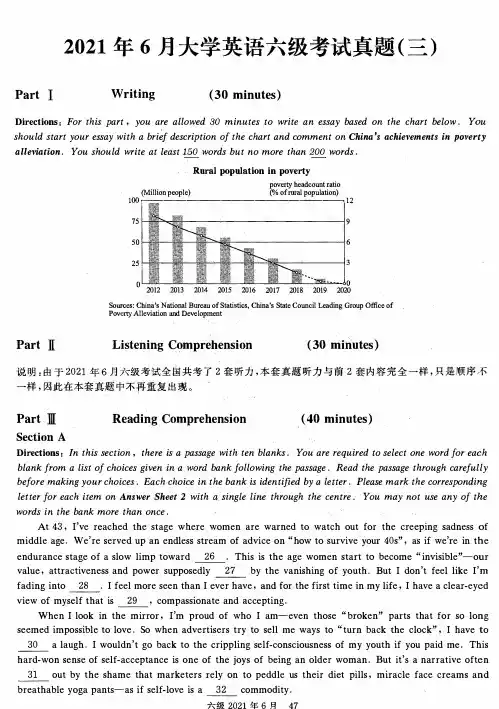
Part I Writing ( 30 minutes)Directions: For this part, you are allowed 30 minutes to write an essay based on the chart below. You should start your essay with a bri�f description of the chart and comment on China's achievements in poverty alleviation. You should write at least 150 words but no more than 200 words.Part ][Rural population in povertypoverty headcount ratio(% of rural population)(Million people)100.---����������������-.12155025Sources: China's National Bureau of Statistics, China's State Council Leading Group Office of Poverty Alleviation and DevelopmentListening Comprehension (30 minutes)i,Jigij: EEi 2021 6 � /,��"Jat�ij��T 2 �l!Jrf1 '*�1tlfffi11Jrj;J �mf 2 i:*1�1c�-�, flJl!:J®rJ¥� -� ,lz;l .tlt:f:E*� •MI IP� JHlU! ili J?-\LPart ][Section AReading Comprehension ( 40 minutes)Directions: In this section , there is a passage with ten blanks. You are required to select one word for each blank from a list of choices given in a word.bank following the passage. Read the passage through carefully before making your choices; Each choice in the bank is identified by a letter. Please mark the corresponding letter for each item on Answer Sheet 2 with. a.single line through the centre. You may not use any of the words in the bank more than once.At 43, I've reached the stage where women are warned to watch out for the creeping sadness of middle age. We're served up an endless stream of advice on "how to survive your 40s", as if we're in the endurance stage of a slow limp toward 26 . This is the age women start to become "invisible"-our value, attractiveness and power supposedly 27 by the vanishing of youth. But I don't feel like I'm fading into 28 . I feel more seen than I ever have, and for.the first time in my life, I have a clear-eyed view of myself that is 29 , compassionate and accepting.When I look in the mirror, I'm proud of who I am-even those "broken" parts that for so long seemed impossible to love. So when advertisers try to sell me ways to "turn back the clock", I have to 30 a laugh. I wouldn't go back to the crippling self-consciousness of my youth if you paid me. This hard-won sense of self-acceptance is one of the joys of being an older woman. But it's a narrative often 31 out by the shame that marketers rely on to peddle us their diet pills, miracle face creams and breathable yoga pants-as if self-love is a 32 commodity.For some women I know, this sense of trust and self-belief later in life gave them the courage to leave dysfunctional relationships or 33 on new career paths. Others talked about enjoying their own company, of growth through 34 , deepening bonds of friendships, the ability to be more compassionate, less judgmental and to listen more and appreciate the small pleasures. Life past 40 is far from smooth sailing, but it's so much more than the reductive 35 we see in women's magazines and on the Hollywood big screen.A)adversityB)authenticC)conveyD)depictionsE)diminished Section B F)drownedG)embarkH)fragilityI)neglectedJ)obscurityK)outlinesL)prevalentM)purchasableN)submit0)suppressDirections: In this section, you are going to read a passage with ten statements attached to it. Each statement contains information given in one of the paragraphs. Identify the paragraph from which the information is derived. You may choose a paragraph more than once. Each paragraph is marked with a letter. Answer the questions by marking the corresponding letter on Answer Sheet 2 .What Are the Ethics of CGI Actors-And Will They Replace Real Ones?A)Digital humans are coming to a screen near you. As computer-generated imagery ( CGI) has becomecheaper and more sophisticated, the film industry can now convincingly recreate people on screeneven actors who have been dead for decades. The technology's ability to effectively keep celebrities alive beyond the grave is raising questions about public legacies and image rights.B)Late in 2019, it was announced that US actor James Dean, who died in 1955, will star in a VietnamWar film scheduled for release later this year. In the film, which will be called Finding Jack , Dean will be recreated on screen with CGI based on old footage (�Jtfl�) and photographs, with another actor voicing him. The news was met with excitement by those keen to see Dean digitally brought back to life for only his fourth film, but it also drew sharp criticism. "This is puppeteering the dead for their fame alone," actress Zelda Williams wrote on Twitter. "It sets such an awful precedent for the future of performance." Het father, Robin Williams, who·died in 2014, was-keen to avoid the same:fate, Before his death, he filed a deed protecting the use of his image until 2039, preventing others from recreating him using CGI to appear in a film, TV show or as a hologram (�.i:lfft).C)The James Dean film is a way to keep the actor's image relevant for younger generations, says MarkRoesler of CMG Worldwide, the firm that represents Dean's estate. "I think this is the beginning of an entire wave," says Travis Cloyd, CEO of Worldwide XR, one of the companies behind the digital recreation of Dean. "Moving into the future, we want James Dean to be brought into different gaming environments, or different virtual reality environments, or augmented reality environments," he says.D)Other actors have been revived, with the permission of their estates, for advertising purposes: forexample, a 2011 advertisement for Dior featured contemporary actress Charlize Theron alongside iconic 20th-century stars Marilyn Monroe, Grace Kelly and Marlene Dietrich. Later, Audrey Hepburn was digitally recreated for a chocolate commercial in 2013. In the same year, a CGI Bruce Lee appeared in a Chinese-language ad for a whisky brand, which offended many fans because Lee was widely known not to drink alcohol at all. "In the last five years, it's become more affordable and more achievable in a whole movie," says Tim Webber at UK visual effects firm Framestore, the company behind the Hepburn chocolate ad. Framestore used body doubles with resemblance to Hepburn's facial structure and body shape as a framework for manual animation. The process was extremely difficult and expensive, says Webber, but the technology has moved on.7\� 2021 &j:'. 6 Y.I 48E) Now, a person can be animated from scratch. "If they're alive today, you can put them in scanningrigs, you can get every detail of their body analysed very carefully and that makes it much easier, whereas working from available photographs is tricky," says Webber, who won an Academy Award for his visual effects work on the 2013 film Gravity. "I also see a lot of actors today who will have the desire to take advantage of this technology: to have their likeness captured ·and stored for future content," says Cloyd. "They foresee this being something that could give their estates and give their families the ability to make money from their likeness when they're gone."F)A hidden hazard of digitally recreating a deceased ( B � Et9) celebrity is the risk of damaging theirlegacy. "We have to respect the security and the integrity of rights holders," says John Canning at Digital Domain, a US firm that created a hologram rapper (ill,nSt:.AJ·Tupac Shakur, which appeared at the Coachella music festival in 201Z, 15 years after his death.G)Legally, a person's rights to control the commercial use of their name and image beyond their deathdiffer between and even within countries. In certain US states, for example, these rights are treated similarly to property rights, and are transferable to a person's heirs. In California; under the Celebrities Rights Act, the personality rights for a celebrity last for 70 years after their death. "We've got a societal debate going on about access to our public commons, as it were, about famous faces,�' says Lilian Edwards at Newcastle University, UK. Should the public be allowed to use or reproduce images of famous people, given how iconic they are? And what is in. the best interest of a deceased person's legacy may conflict with the desires of their family or the public, says Edwards.H)A recreation, however lifelike, will never be indistinguishable from a real actor, says Webber. "Whenwe are bringing someone back, representing someone who is no longer alive on the screen, what we are doing is extremely sophisticated digital make"".up," he says; "A performance is a lot more than a physical resemblance."I)As it becomes easier to digitally recreate celebrities and to entirely manufacture on'."screen identities,could this kind of technology put actors out of jobs? "J think actors are worried about this," says Edwards. "But I think it will take a very long time. " This is partly because of the risk that viewers find virtual humans scary. Edwards cites widespread backlash to the digital recreation of Carrie Fisher as· a young Princess Leia in Rogue One, a trick later repeated in the recent Star Wars: The Rise of Skywalker, which was filmed after Fisher's death in 2016. "People didn't like it," she says. "They discovered the uncanny valley (ifit#�)."J)This refers to the idea that when objects trying to resemble humans aren't .quite perfect, they can make viewers feel uneasy because they fall somewhere between obviously non-human and fully human."That's always a danger when you're doing anything human or human-like," says Webber. "There're a thousand things that could go wrong with a computer-generated facial performance, and any one of those could make it fall into the uncanny valley," he says·;"Your brain j°:st knows there's something wrong." The problem often arises around the eyes or mouth, says Webber.. "They're the areas that you look at when you're talking to someone."K)An unfamiliar digital human that has been created through CGI will also face the same challenge as an unknown actor: they don't have the appeal of an established name. "You have to spend substantial capital in creating awareness around their likeness and making sure people are familiar with who they are," says Cloyd. This is now starting to happen. "The way you pre-sell a movie in a foreign market is based on relevant talent," he says. "I think we're a long way away from having virtual beings that have the ability to pre-sell content."L)Webber expects that we will see more digital humans on screen. "It's happening because it can happen," he says. Referring to a line from JurassicPark ({$t��d0!zm), he adds: "People are too busy thinking about what they c·a n do to think about whether they should do it."3B. There is an ongoing debate among the public as to whether the images of deceased celebrities should be recreated.37.The COi technology allows the image of the deceased James Dean to be presented to young people innew settings.38.It is very likely that the COi-recreated image of a deceased celebrity will fail to match the real actorespecially in facial expressions.39.The use of digital technology can bring images of deceased celebrities back to the screen.40.Recreating a deceased famous actor or actress may violate their legitimate rights.41.More COi-recreated images of deceased celebrities are expected to appear on screen.42.The image of James Dean will be recreated on screen with his voice dubbed by someone else.43.However advanced the COi technology is, the recreated image will differ in a way from the realactor.44.A lot of actors today are likely to make use of the COi technology to have their images stored for thebenefit of their families.45.Some actors are concerned that they may lose jobs because of the COi technology.Section CDirections: There are 2 passages in this section. Each passage is followed by some questions or unfinished statements. For each of them there are four choices marked A), B), C) and D). You should decide on the best choice and mark the corresponding letter on Answer Sheet 2 with a single line through the centre. Passage OneQuestions 46 to 50 are based on the foil o wing passage.You can't see it, smell it, or hear it, and people disagree on how precisely to define it, or where exactly it comes from. It isn't a school subject or an academic discipline, but it can be learned. It is a quality that is required of artists, but it is also present in the lives of scientists and entrepreneurs. All of us benefit from it and we thrive mentally and spiritually when we are able to wield it. It is a delicate thing, easily stamped out; in fact, it flourishes most fully when people are playful and childlike. Meanwhile, it works best in conjunction with deep knowledge and expertise.This mysterious-but teachable-quality is creativity, the subject of a recently-published report by Durham· Commission on Creativity and Education; The report concludes that· creativity-should not inhabit the school curriculum only as it relates to drama, music, art and other obviously creative subjects, but that creative thinking ought to run through all of school life, infusing (jEr,ffi) the way humanities and natural sciences are learned.The authors, who focus on education in England, off e r a number of sensible recommendations, some of which are an attempt to alleviate the uninspiring and fact-based approach to education that has crept into policy in recent years. When children are regarded as vessels to be filled with facts, creativity does not prosper; nor does it when teachers' sole objective is coaching children towards exams. One suggestion from the commission is a network of teacher-led "creativity collaboratives", along the lines of existing maths hubs. ( rp it:,,) ,with the aim of supporting teaching for creativity through the school curriculum.Nevertheless, it is arts subjects through which creativity can most obviously be fostered. The value placed on them by the independent education sector is clear. One only has to look at the remarkable arts facilities at Britain's top private schools to comprehend this. But in the state sector the excessive focus on English, maths and science threatens to crush arts subjects; meanwhile, reduced school budgets mean diminishing extracurricular activities. There has been a 28.1 %decline in students taking creative subjects at high schools since 2014, though happily, art and design have seen a recent increase.This discrepancy between state and private education is a matter of social justice. It is simply wrong and unfair that most children have a fraction of the access to choirs, orchestras, art studios and drama that2021 ip 6 }J 50their more privileged peers enjoy. As lives are affected by any number of looming challenges-climate crisis, automation in the workplace-humans are going to need creative thinking more than ever. For all of our sakes, creativity in education, and for all, must become a priority.46.What do we learn from the passage about creativity?A)It develops best when people are spiritually prepared.B)It is most often wielded by scientists and entrepreneurs.C)It is founded on scientific knowledge and analytical skills.D)It contributes to intellectual growth but can easily be killed.47.What is the conclusion of a recently-published report?A)Natural sciences should be learned the way humanities courses are.B)Cultivation of creativity should permeate the entire school curriculum.C)Art courses should be made compulsory for all students.D)Students should learn more obviously creative subjects.48.What does the report say is detrimental to the fostering of creativity?A)Alleviation of pressure.C)Test-oriented teaching.B)Teacher-led school activities.D)Independent learning.49.What do we learn about the private schools in the UK?A)They encourage extracurricular activities.B)They attach great importance to arts education.C)They prioritize arts subjects over maths and sciences.D)They cater to students from different family backgrounds.50.What should be done to meet the future challenges?A)Increasing government investment in school education.B)Narrowing the existing gap between the rich and the poor.C)Providing all children with equal access to arts education.D)Focusing on meeting the needs of under-privileged students.Passage TwoQuestions 51 to 55 are based on the following passage.Emulating your conversation partner's actions is a common human behavior classified as "mirroring" and has been known and studied by psychologists for years. We all tend to subconsciously copy gestures of people we like. But why do we act like this?As a rule, mirroring means that conversationalists enjoy their communication and that there's a certain level of agreement between them. The topic of discussion is equally interesting for both and they know their interests meet.Repeating someone's behavior is typical of talented communicators, not always because the person is sympathetic, but because there is a goal to be achieved. This way new idols have been brought to the stage: politicians, celebrities, and other big names. Popular culture makes people want to look popular, and act and speak like popular people.Nowadays celebrities steal lyrics from each other and struggle with copyright violation accusations or straightforwardly claim themselves to be the authors, even though all the work was done by other people .• Among celebrities, it's trendy nowadays to use their own speech writers as politicians do. The so-called "ghostwriting" can take various forms: books, articles, autobiographies, and even social media posts.Who is a true copycat (:t&��) and who gets copycatted? Sometimes, it is a hard nut to crack without an expert's help. But new authorship defending methods based on identifying individual writing patterns are already here. Their aim is to protect intellectual property. Using scientific methods, some of them candefine authorship with 85 %accuracy.Writing is not an easy craft to master. If you want to write like a professional without plagiarism (tf; �) , there are a few lessons to learn and the first one is: "Copy from one, it's plagiarism; copy from two, it's research." The correct interpretation of this statement is not about copying, but rather about creating your own style. When you study an author's writing style, don't stop on a single one, but explore numerous styles instead. Examine types of sentences they use, pay attention to their metaphors, and focus on stories you feel you could write a pretty cool sequel (�ID to.Imitation is rather paradoxical. As an integral part of learning, it brings about positive changes, making people develop and grow. However, it may do a lot of harm. Copying someone's thoughts, ideas or inventions is completely unacceptable. It infringes on intellectual property rights of others.Still, many things we do are about copying others one way.or another. So if you want to compliment someone on the work they have done and imitate it, just make sure you do it the right way to avoid committing plagiarism.51.What do people tend to do while engaging in a conversation?A)Repeat what their partners say one way or another.B)Focus as much as possible on topics of mutual interest.C)Imitate their partners' gestures without their knowing it.D)Observe carefully how their partners make use of gestures.52.When does mirroring usually take place in a conversation?A)When both sides are sympathetic with each other.B)When both sides have a lot of things in common.C)When both sides make interesting contributions.D)When both sides try to seek common ground.53.What do we learn about popular culture?A)It encourages people to imitate.C)I.t acquaints young people with their idols.B)It appeals mostly to big names.D)It .c an change people's mode of cognition.54.Why is the saying "copy from two, it's research" a lesson to learn?A)It facilitates the creation of one's own writing style.B)lt helps t�:t prottxt _ont!'S i n tellectµal pr9perty rights.C)It fosters correct interpretation of professional writing ..D)It enables one to write intriguing sequels to famous stories.55.Why does the author say imitation is rather paradoxical?A)It is liable to different interpretations.C)Jt can give rise to endless disputes.B)It is by and large a necessary evil.D)It may do harm as well as good.Part N Translation. ( 30 minutes)Directions: For this part , you are allowed 30 minutes to translate a passage from Chinese into English . You should write your answer on Answer Sheet 2.zi-1¥L�iftri:pr@i!!:fm�-1'-�f,},.1JZ:!$Ji'¥1/it 1 500 *o zi-mro!f.1�A,JxtitJhru ,�11*iLAo iim�� :£iFm1:Jtj8&,��$#$¥-F,��::fe.Jmr��tl�� 0 iimBS�$#W--iil�-JE��*�Wl,::fe.J�� � AJ���nUNd�T�*'l*14o25 -t-j>� re� ,1ik1i1:k$� El B , JJ m.� o iim!!k � El ?&it � -. � re �x1t1!J!Jt$;::fe.Ji:j=t 00:til��:ill!�:l*Wf. 13 �Jtl!.Z.-,m:1¥$�131�:k�r@pgj,J-Wf.�frrtl:�16:l*Wf.o/\� 2021 6 Jj 52。
2021年6月六级(B卷)权威参考答案(详细版)
XX年6月六级(B卷)权威参考答案(详细版) Part I Listening1. A It will ___inly benefit the wealthy2. C She prefers a life of continued exploration.3. C Keep his distan ___ from drug addicts4. D The mother5. B Stay away for a couple of weeks6. A He didn’t want to miss the game.7. C It was robbed..8. B She isn’t going to work in her brother’s firm9. D The ___n should phone the hotel for directions.10. B She has to do a lot of things within a short time.Part II Reading11. D they are driven by an overwhelming sense ofindividuali ___12. A It is getting closer to American-style capitali ___13. C healthy and wealthy14. A some modern women prefer a life of individual ___15 .B To examine the trend of young people living alone16. C Poor adjustment of her body clock to seasonal changes17. D realized what her problem was18. B It proves to be an effective therapy19. D Light therapy could be misused by ___rtain mental patients20. C Winter depressives prefer light therapy in spite of its inconvenien ___21. A it destroys rainforest soils22. B organic ___tter is quickly lost due to heat and rain23. B studying patches of fertile soils in the ___ntral A ___zon24. D They can recover easily after slash-and-burn farming25. C there on ___ existed an urban civilization in the A ___zon rainforests26. B over the possible adverse effect of a GM bacterium on plants27. A the results of an experiment she conducted herself28. C hasn’t given permission to field test the GM organi ___29. A shouldn’t de ___nd the Ingham be disciplined for voicing her views30. B Her testimony hasn’t been supported by the EPAPart III Vocabulary31. D transit32. A ensure33. C predominantly34. D paved35. A relian ___36. C cherish37. B embra ___s38. A do ___ins39. D mend40. B crisp41. C hasty42. D dwell on43. A reinfor ___d44. C tolerant45. B coinciden ___46. D motivated47. B multitude48. A gloomy49. C distracted50. D dilem ___51. A sensitive52. B trans ___nd53. D array54. A simultaneously55. B patible56. C mingled57. C dominant58. D surplus59. B per ___ptions60. B immersedPart IV Cloze61. A off62. D rely63. C breakthrough64. B sightless65. D scans66. B voi ___67. C on68. D printed69. B stride70. A However71. D but72. C for73. B esti ___tes74. A own75. B families76. D models77. C assisting78. D valuable79. A before80. C sense复合式听写答案S1. lie S2 associated S3. assign S4. spent S5. difficultyS6. afford S7 infantS8. she is entitled to a pla ___ of her own where she can be by herself, and keep her possessionsS9. people will have their private thoughts that might never be shared with anyoneS10. American’s houses, yards and even offi ___s can seem open and inviting. Yet in the minds of Americans, there are boundaries that other people are simply not supposed to cross.模板,内容仅供参考。
2021年6月大学英语六级真题卷听力原文答案详解
2021年6月大学英语六级真题Part Ⅰ Writing (30 minutes)Directions: For this part, you are allowed 30 minutes to write a short essay entitled The Certificate Craze. You should write at least 150 words following the outline given below.1.现在许多人热衷于各类证书考试2.其目的各不相同3.在我看来……The Certificate Craze注意:此部分试题在答题卡1上。
Minority ReportAmerican universities are accepting more minorities than ever. Graduating them is another matter.注意:此部分试题请在答题卡1上作答。
1. What is the author's main concern about American higher education?A) The small proportion of minority students.B) The low graduation rates of minority students.C) The growing conflicts among ethnic groups.D) The poor academic performance of students.2. What was the pride of President Barry Mills of Bowdoin College?A) The prestige of its liberal arts programs.B) Its ranking among universities in Maine.C) The high graduation rates of its students.D) Its increased enrollment of minority students.3. What is the risk facing America?A) Its schools will be overwhelmed by the growing number of illegal immigrants.B) The rising generation will be less well educated than the previous one.C) More poor and non-white students will be denied access to college.A) Fifty-six percent. C) Fifteen percent.B) Thirty-nine percent. D) Sixty-seven percent.5. Harvard, Yale, and Princeton show almost no gap between black and white graduation rates mainly because .A) their students work harder C) their classes are generally smallerB) they recruit the best students D) they give students more attention6. How does Amy Wilkins of the Education Trust view minority students' failure to get a degree?A) Universities are to blame.B) Students don't work hard.C) The government fails to provide the necessary support.D) Affirmative action should be held responsible.7. Why do some students drop out after a year or two according to the author?A) They have lost confidence in themselves.B) They cannot afford the high tuition.C) They cannot adapt to the rigor of the school.D) They fail to develop interest in their studies.8. To tackle the problem of graduation gap, the University of Wisconsin-Madison helps minority students get over the stereotype that _______.9. For years, private colleges such as Princeton and MIT have provided minority students with _______ during the summer before freshman year.10. Washington and Lee University is cited as an example to show that the gap of graduation rates between whites and minorities can _______.Section ADirections: In this section, you will hear 8 short conversations and 2 long conversations. At the end of each conversation, one or more questions will be asked about what was said. Both the conversation and the questions will be spoken only once. After each question there will be a pause. During the pause, you must read the four choices marked A), B), C) and D), and decide which is the best answer. Then mark the correspond ing letter on Answer Sheet 2 with a single line through the centre.注意:此部分试题请在答题卡2上作答。
【2021年】辽宁省大连市大学英语6级大学英语六级真题(含答案)
【2021年】辽宁省大连市大学英语6级大学英语六级真题(含答案)学校:________ 班级:________ 姓名:________ 考号:________一、1.Writing(10题)1. 1. 现代生活充满压力2. 压力的种种迹象3. 如何减轻压力How to Reduce Stress and Tension2. Directions: For this part, you are allowed 30 minutes to write a composition on the topic Class Skipping in Colleges. You should write at least 150 words following the outline given below in Chinese:1. 目前大学生逃课现象很普遍2. 分析大学生逃课的原因3. 你对这一现象的看法Class Skipping in Colleges3. For this part, you are allowed 30 minutes to write a composition on the topic Starbucks' Presence in the Palace Museum. You should write at least 150 words, and base your composition on the outline given in Chinese below: 1.有些人认为“星巴克进故宫”是一种“挑战传统文化”“崇洋媚外”的表现,主张将星巴克赶出故宫2.另一些人认为“星巴克进故宫”是一种“中西文化相互融合”的正常表现,可以接受3.你的看法Starbucks' Presence in the Palace Museum4. Directions: For this part, you are allowed 30 minutes to write a composition on the topic: Ability and Good Looks. You should write at least 150 words following the outline given below:1.老一辈常说,能力比相貌重要2. 如今很多人却认为相貌比能力重要3. 你的看法5. 1. 大家希望构建一个和谐社会,但社会上存在一些与和谐社会不相符合的现象2.分析造成这种现象的不良影响3.从自身应如何做起6. 1. 目前,国久“汉语热”持续升温2. 出现这种现象的主要原因3. “汉语热”给我的启示On Foreigners' Learning Chinese7. For this part, you are allowed 30 minutes to write a composition on the topic How to Solve the Housing Problem in Big Cities? You should write at least 150 words according to the outline given below in Chinese:1.住房问题在大城市变得越来越严重2.住房问题的产生原因和给城市带来的影响3.建议一个解决办法How to Solve the Housing Problem in Big Cities?8. For this part, you are allowed 30 minutes to write a short essay entitled My Views on Remedial Examinations. You should write at least 150 words based on the outline given in Chinese below:1. 补考是大学教育的一部分2. 我对补考的看法3. 如何发挥补考的作用My Views on Remedial Examinations9. Directions: For this part, you are allowed 30 minutes to write a composition on the title: Should Class Attendance Be Optional? You should write at least 150 words following the outline given below in Chinese.Should Class Attendance Be Optional1.描述现在大学课堂及讲座上常见的现象:态度不认真,睡觉,发短信及出勤率低……因此提出大学课堂是否应该采取自愿而非强制2.列举原因3.我的看法10. Direction:For this part, you are allowed 30 minutes to write a short essay entitled The Phenomenon of Empty Nest. You should write at least 150 words following the outline given below.“空巢老人”指那些到了退休年龄,身边却无子女与之共同生活的老人。
2021年大学英语六级考试真题与答案
12月大学英语六级真题Part IV Reading Comprehension (Reading in Depth) (25 minutes) Section ADirections:In this section,there is a short passage with 5 questions or incomplete statements. Read the passage carefully. Then answer the questions or complete the statements in the fewest possible words. Please write your answers on Answer Sheet 2.Questions 47 to 51 are based on the following passage.How good are you at saying "no"?For many,it's surprisingly difficult. This is especially true of editors,who by nature tend to be eager and engaged participants in everything they do. Consider these scenarios:It's late in the day. That front-page package you've been working on is nearly complete;one last edit and it's finished. Enter the executive editor,who makes a suggestion requiring amore-than-modest rearrangement of the design and the addition of an information box. You want to scream:"No!It's done!" What do you do?The first rule of saying no to the boss is don't say no. She probably has something in mind when she makes suggestions,and it's up to you to find out what. The second rule is don't raise the stakes by challenging her authority. That issue is already decided. The third rule is to be ready to cite options and consequences. The boss's suggestions might be appropriate,but there are always consequences. She might not know about the pages backing up that need attention,or about the designer who had to go home sick. Tell her she can have what she wants,but explain the consequences. Understand what she's trying to accomplish and propose a Plan B that will make it happen without destroying what you've done so far.Here's another case. Your least-favorite reporter suggests a dumb story idea. This one should be easy,but it's not. If you say no,even politely,you risk inhibiting further ideas,not just from thatreporter,but from others who heard that you turned down the idea. This scenario is common in newsrooms that lack a systematic way to filter story suggestions.Two steps are necessary. First,you need a system for how stories are proposed and reviewed. Reporters can tolerate rejection of their ideas if they believe they were given a fair hearing.Your gut reaction(本能反映) and dismissive rejection,even of a worthless idea,might not qualify as systematic or fair.Second,the people you work with need to negotiate a "What if ...?" agreement covering "What if my idea is turned down?" How are people expected to react?Is there an appeal process?Can they refine the idea and resubmit it?By anticipating "What if...?" situations before they happen,you can reach understanding that will help ease you out of confrontations.47. Instead of directly saying no to your boss,you should find out __________.48. The author's second warning is that we should avoid running a greater risk by __________.49. One way of responding to your boss's suggestion is to explain the __________ to her and offer an alternative solution.50. To ensure fairness to reporters,it is important to set up a system for stories to __________.51.People who learn to anticipate "What if...?" situations will be able to reach understanding and avoid __________.Section BDirections:There are 2 passages in this section. Each passage is followed by some questions or unfinished statements. For each of them there are four choices marked A),B),C) and D). You should decide on the best choice and mark the corresponding letter on Answer Sheet 2with a single line through the centre.Passage OneQuestions 52 to 56 are based on the following passage.At the heart of the debate over illegal immigration lies one key question:are immigrants good or bad for the economy?The American public overwhelmingly thinks they're bad. Yet the consensus among most economists is that immigration,both legal and illegal,provides a small net boost to the economy. Immigrants provide cheap labor,lower the prices of everything from farm produce to new homes,and leave consumers with a little more money in their pockets. So why is there such a discrepancy between the perception of immigrants' impact on the economy and the reality? There are a number of familiar theories. Some argue that people are anxious and feel threatened by an inflow of new workers. Others highlight the strain that undocumented immigrants place on public services,like schools,hospitals,and jails. Still others emphasize the role of race,arguing that foreigners add to the nation's fears and insecurities. There's some truth to all these explanations,but they aren't quite sufficient.To get a better understanding of what's going on,consider the way immigration's impact is felt. Though its overall effect may be positive,its costs and benefits are distributed unevenly. David Card,an economist at UC Berkeley,notes that the ones who profit most directly from immigrants' low-cost labor are businesses and employers– meatpacking plants in Nebraska,for instance,or agricultural businesses in California. Granted,these producers' savings probably translate into lower prices at the grocery store,but how many consumers make that mental connection at the checkout counter?As for the drawbacks of illegal immigration,these,too,are concentrated. Native low-skilled workers suffer most from the competition of foreign labor. According to a study by George Borjas,a Harvard economist,immigration reduced the wages of American high-school dropouts by 9% between 1980-.Among high-skilled,better-educated employees,however,opposition was strongest in states with both high numbers of immigrants and relatively generous social services. What worried them most,in other words,was the fiscal(财政)burden of immigration. That conclusion was reinforcedby another finding:that their opposition appeared to soften when that fiscal burden decreased,as occurred with welfare reform in the 1990s,which curbed immigrants' access to certain benefits. The irony is that for all the overexcited debate,the net effect of immigration is minimal. Even for those most acutely affected– say,low-skilled workers,or California residents– the impact isn't all that dramatic. "The unpleasant voices have tended to dominate our perceptions," says Daniel Tichenor,a political science professor at the University of Oregon. "But when all those factors are put together and the economists calculate the numbers,it ends up being a net positive,but a small one." Too bad most people don't realize it.注意:此某些试题请在答题卡2上作答。