
三年级英语(人教版)《Unit1 Myself》(第二课时)-练习题
-人教版英语九年级Unit1-Unit10 句子翻译练习(有答案)
Unit 1 How can we become good learners?1.不要一个单词一个单词地翻译这个句子。
(by)Don’t translate the sentence________________________.2.尽我们最大的努力帮助那些需要帮助的人是我们的职责。
(it)____________________________ to try our best to help those who need help.3.我没有钢笔写字。
(write)I don’t have a pen____________________________.4.他不敢再班上说英语,因为他怕犯错误。
(class)He is afraid to_______________________,because he is afraid of making mistakes.5.我发现听一些有趣的东西是学习语言的秘诀。
(listen)I discovered that___________________ is the secret to language learning.6.今天的中国不同于四十年前的中国了。
China today______________________ of 40 years ago.7.我们正背着书包艰难地向学校走。
We_______________ with our school came yesterday morning?8.在襄阳的这些年里,我习惯吃牛肉面了。
I__________________________ these years in Xiangyang.9.我们最好按年级把他们分成三个队。
________________________________ by grade.10.我在奇怪为什么刚才我的电脑突然被关掉了?________________________________ just now.1.word bu word2.It’s our duty3.to write with4.speak in class5.listening to something interesting6.is different from the one/China7.were making our way to school8.I’m/get used to having/eating beef noodles9.We’d better divide them into three teams.10.I was wondering why my computer was suddenly turned offUnit 2 I think that mooncakes are delicious.1.嫦娥拒绝给他,并且一口喝光了它。
Unit1Myclassroom第2课时learndo整体课堂教学设计
2. 动词“learn”和“do”基础知识讲解(10分钟)
目标: 让学生了解动词“learn”和“do”的基本用法和句型结构。
过程:
讲解动词“learn”和“do”的定地理解如何在实际场景中运用这两个动词。
(3)英语动画片:挑选一些适合小学生观看的英语动画片,如《Peppa Pig》中关于学校的片段,让学生在观看过程中学习英语表达。
(4)英语杂志:推荐一些英语儿童杂志,如《Magic English》,其中包含关于学校生活的文章和活动,有助于学生拓展英语知识。
2. 拓展建议
(1)阅读拓展:鼓励学生在课后阅读与学校生活相关的英语故事,将所学动词“learn”和“do”运用到实际语境中,提高阅读理解能力。
Unit 1 My classroom 第2 课时 learn do 整体课堂教学设计
课题:
科目:
班级:
课时:计划1课时
教师:
单位:
一、教学内容分析
本节课的主要教学内容为人教版小学英语三年级上册Unit 1 My classroom 第2课时,重点学习动词“learn”和“do”的用法。教学内容围绕教室物品及活动的描述,通过图片、歌曲、游戏等形式,让学生掌握词汇table、chair、window、blackboard以及句型“What do you do? I learn English./I do my homework.”。
(6)互动游戏:设计“动词接龙”游戏,让学生在游戏中熟练运用动词“learn”和“do”。
3. 确定教学媒体和资源的使用
(1)PPT:展示教室图片、动词用法、例句等,辅助教学内容的呈现。
课时练习四年级下册英语人教版三年级起点Unit 6 试题试卷 含答案解析(2)

Unit6Shopping
PartB
一、选择适当的单词或词组填空。
HowWhatHowmuchWhoseCan
1.—glovesarethese?—TheyareAmy's.
2.—isthissweater?—It's86yuan.
3.—colourarethey?—They'rewhite.
4.—Ihelpyou?—Yes.
5.—doyoulikethesepants?—Theyareverycool.
二、仿写句子。
例1:Theyareveryexpensive.
1.
例2:Theyaretoosmall.
2.
三、阅读短文,补全表格。
Hello,I'mAlice.Look!Thisismyumbrella.It'sgreen.It's40yuan.It'snice.Lookatmy
sunglasses.They'reblue.They're20yuan.They'recheap.Thatismyhat.It'sred.It's80yuan.It's
expensive.
What?Whatcolour?Howmuch?How?
umbrella1.____2.___nice
3.___4.__20yuan5.____
6.____red7.____8.___
参考答案
PartB
一、1.Whose2.Howmuch3.What4.Can5.How
二、1.Theyareverycheap.
2.Theyaretoolong.
三、1.green2.40yuan3.sunglasses4.blue5.cheap6.hat7.80
yuan8.expensive
人教版英语七年级上册StarterUnit1-Unit2练习题 (1) (含答案)
Starter Units1、Units1~2子主题良好的人际关系与人际交往Ⅰ.完形填空(每小题1分,拓展任务每小题2分,共14分)I have a good friend. I often call her Linda. Linda Miller is her 1 name. Linda has a warm 2 . She has two brothers and they are in the 3 school but in different grades. Their parents are doctors. And they live in a big house 4 Beijing now.At home, Linda often does housework(家务) 5 goes for a walk with her dog after dinner. The 6 is very lovely and clever. She loves to play with it.Linda and I are in the same 7 but not in the same class. She studies very hard.And she is good at maths and often helps her 8with maths. So her classmates all like her.She likes music too. She often plays the 9 at home. Sometimes, I ask Linda for some skills(技巧)in playing the guitar. She is happy to teach me and never 10 at me.All in all, I really learn a lot from Linda and I am happy to have a friend like her.1. A. short B. last C. new D.full2. A. factory B. family C. room D,hospital3. A. same B. similar C. different D. another4. A.in B.on C.of D. under5. A. because B. but C.and D.so6. A.bird B.pig C.cat D.dog7.A. bridge B. class C.grade D.train8. A. sisters B.classmates C. brothers D.teachers9.A.violin B.pipa C.guitar D.piano10.A. spells B. raises C. speaks ughs拓展任务再次阅读以上文章,选择正确答案。
小学英语三年级下册unit1The first period(第一课时)

Unit 1 Welcome back to school!教材分析本单元以同学们新学期开学重新回到校园为话题。教学内容是围绕国家、校园人物、自我介绍而展开的。教学重点是听、说、认读单词“China, Canada, UK, USA, he, she”和“teacher, student, pupil”及其复数形式。能听懂、会说核心句型“We have two new friends today.” “—Hi, I’m… I’m from… —Welcome!” “—Where are you from? —I’m from…” “He/She is…”。
教学目标知识目标:·能够听懂、会说句型“—Where are you from? —I’m from…” “He/She is…”·能够认读句子“—Where are you from? —I’m from…”·能够听、说、认读单词“China, Canada, UK, USA, he, she, teacher, student(pupil)”·知道元音字母a在单词中的短音发音/æ/能力目标:·能够在真实或模拟的情景中运用句型“I’m from…”“He’s/she’s a…”等简单介绍自己以及他人·能够在情景中运用句型“—Where are you from?—I’m from…”询问他人的国籍或籍贯并回答·能够正确说出元音字母a在单词中的短音发音/æ/,并能够根据其发音规则拼读学过的语音例词情感态度、文化意识、学习策略目标:·学会与人沟通、交流个人信息·学习对人有礼貌的好行为·通过学习国家名称,了解中国和主要英语国家的国旗以及标志性的建筑物·能够逐步做到见到符合发音规则的词能拼读,听到符合发音规则的词能拼写课时安排第一课时: Part A Let’s talk & Look and say第二课时: Part A Let’s learn & Let’s chant第三课时: Part A Let’s spell第四课时: Part B Let’s talk & Look and say第五课时: Part B Let’s learn & Let’s chant第六课时: Part B Start to read & Let’s check & Let’s singThe first period(第一课时)Part A Let’s talk & Look and say▶教学内容与目标课时教学内容课时教学目标Let’s talk ·通过观察、谈论Let’s talk板块的图片,并在PPT和教师的帮助下理解对话大意·能够按照正确的语音语调朗读对话,并能在小组中进行角色表演·能在情景中运用句型“We have two new friends today.” “Hi, I’m… I’m from…”进行初步的交流并介绍自己的国籍或籍贯Look and say ·通过教师展示的图片,操练核心句型“Hi, I’m… I’m from…”▶能够熟练运用句型“Hi, I’m… I’m from…”进行自我介绍。▶教学难点1.能够听懂对话大意,并能用正确的语音语调朗读对话。2.知道China, Canada的正确发音,知道国家名缩写UK和USA所表示的含义,并记住国家名缩写前必须带定冠词the。▶教学准备1.预习。2. PPT课件、课文录音、视频、人物头饰等。▶教学过程Step 1: Warm-up & Lead-in1.Greetings.T: Hello! Everyone. Welcome back to school! Nice to see youagain.Ss: Nice to see you, too.2.Sing a song—Hello. (播放课件)①3.Lead-in.T: Before the class, I’ll divide you into four groups. Group 1: China. Group 2: The UK. Group 3: Canada. Group 4: The USA. Let’s have a competition, OK?Ss: OK!Step 2: Presentation1.Look and learn.②T: Boys and girls, we have two new friends today. Let’s have a look! Teaching purpose①歌曲不仅可以激发学生的学习兴趣,还能帮助学生自然地进入学习英语的氛围中。Teaching purpose②利用学生熟悉的卡通形象自然导入,贴近学生实际生活。利用图片教学,使抽象知识具体化,更利于学生理解和掌握。(1)Panpan: Hello! I’m Panpan. I’m from China. Nice to see you!(课件出示:熊猫图片和五星红旗,并播放以上画外音,台词根据语音逐字出现)(2) Peppa Pig: H ello! I’m Peppa Pig. I’m from the UK. Nice to see you!(课件出示:小猪佩奇图片和英国国旗,并播放以上画外音,台词根据语音逐字出现)Teach the new words.T: Do you like your new friends?Ss: Yes.Write down the sentence “We have two new friends today.” on the blackboard (Write “new” and “friends” in red chalk.), and teach the words “new” and “friend(s)” in high and low voice.T: Do you still remember our old friends?Show the pictures of Chen Jie, Mike, Sarah, Wu Binbin and John on the PPT one by one.(出示课件)Lead students to introduce them by usi ng “Hi! I’m…”T: Well, they have two new friends today, too. Who are they?Show the pictures of Amy and Zhang Peng on the PPT. (出示课件) Teach the words “boy” and “girl” by pointing to different students on the PPT. Show the plural forms of “boy” and “girl” on the PPT. (出示课件)2.Watch and answer.③(1) Students watch the video. (课件出示:教材P4 Let’s talk的视频)T: So, can you answer the questions? You can look at your books. Brief answer is OK.S1: They are Amy and Zhang Peng.S2: Amy is from the UK and Zhang Peng is from Shandong.(2) Students watch again. The teacher shows the dialogue on thePPT, and circles the new words “and, today, welcome”. (出示课件) Show the meaning of these words on the PPT, and then teach the words. (出示课件)(Teaching methods: read one by one, group to group, boys vs girls, catch the finger.)3.Listen and repeat.④Teaching purpose③通过问题引导学生回忆课文视频并观察和讨论课文图片,整体感知文本内容,进入文本话题。多种游戏活动操练单词,增强趣味性。Teaching purpose④播放录音,学生听录音跟读。引导学生按照正确的语音语调朗读对话。小老师活动的设计能激发学生兴趣,鼓励学生,增强自信。(1) Let students read after the recording and pay attention to the pronunciation and the intonation. (出示课件)(2) Let students read the dialogue in groups.(3) Invite different students to be little teachers to lead the other students to read the new words for several times.4.Role-play.⑤Each group chooses one student to wear a headwear and role\|play.T: What’s your name, please?S1: I’m Amy.T: Where are you from?S1: I’m from the UK.T: Welcome! Now, introduce yourself to the class.S1: Hello! I’m Amy. I’m from the UK.Ss: Welcome!T: What’s your name, please?S2: I’m Zhang Peng.…The best group will be rewarded.Step 3: PracticeLook and say.⑥1.Play the recording of “Look and say”. (课件出示:教材P4 Look and say的音频)The teacher shows the dialogue on the PPT, and circles the words “Canada” and “the USA” as well as their flags on the PPT. (出示课件) Students read the words after the teacher.2.Read and match.Lead students to read and match, then let them introduce themselves by using the following sentence structures:I’m _______.I’m from (the) _______.3.Read and act.(1) Students practice the dialogue in groups and wear the head wears to act it out.(2) Students make their own dialogues, then show them to the class. Teaching purpose⑤通过戴头饰进行角色扮演,引导学生操练核心词汇及句型。Teaching purpose⑥在学习文本的基础上,让学生连线并且自我介绍,引导学生创编对话并进行操练,使学生易于掌握功能句型。Step 4: Consolidation & Extension⑦1.Train, train, train.Show a big map. (课件出示:世界地图) The teacher points to different cities or countries. Students are asked to introduce themselves one by one.For examples:(The teacher points to Beijing.)S1: Hi, I’m… I’m from Beijing.Ss: Welcome!(The teacher points to the UK.)S2: Hi, I’m… I’m from the UK.Ss: Welcome!…2.Dubbing Show.The teacher shows some pictures on the PPT like Ne Zha, Doraemon, Spiderman, Harry Potter and so on. Lead students to dub forthem by using the following sentences. (课件出示:哪吒、哆啦A梦、蜘蛛侠、哈利波特等照片)S1: Hello, I’m Ne Zha. I’m from China.S2: Hi, I’m Doraemon. I’m from Japan.…▶板书设计▶作业设计1. Practice the dialogues.2. Do the exercises. Teaching purpose⑦游戏活动设计与本课内容紧密相连,为学生创设真实的语境,让学生在轻松自然的氛围中学习。▶教学反思1.整个教学设计流程清晰,很好地达成了课程教学目标。2.活动设计丰富,易操作,由浅入深,层层深入,有效地提升了学生的核心素养。3.充分利用多媒体资源展开课堂教学。利用生动形象的图片、视频及课件来辅助教学,激发学生的学习兴趣。4.突出语用功能,通过创设合理的情景,帮助学生在情景中真实自然地使用所学语言。▶Teaching Contents & Teaching AimsLet’s talk·Be able to understand the main idea of the dialogue by observing and talking about the picture of “Let’s talk”.·Be able to read the dialogue with correct pronunciation and intonation, and be able to role\|play in groups.·Be able to use the sentence structures properly.Look and say·Be able to practice the sentence s tructures “Hi, I’m… I’m from…”▶Teaching Priorities·Be able to use the sentence structures “Hi, I’m… I’m from…” skillfully to introduce themselves.▶Teaching Difficulties·Be able to understand the dialogue and read it fluently and correctly.·Be able to master the pronunciation of “China” and “Canada”, as well as the meaning of “the UK” and “the USA”.▶Teaching Procedures。
人教版三年级英语下册课时作业含答案Unit4
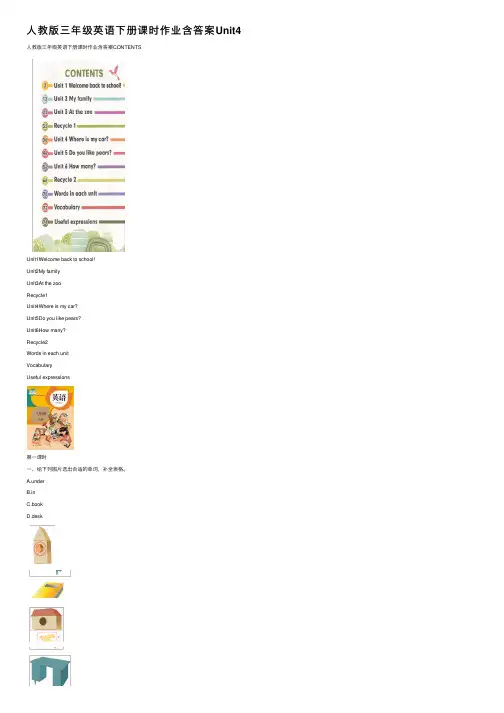
⼈教版三年级英语下册课时作业含答案Unit4⼈教版三年级英语下册课时作业含答案CONTENTSUnit1Welcome back to school!Unit2My familyUnit3At the zooRecycle1Unit4Where is my car?Unit5Do you like pears?Unit6How many?Recycle2Words in each unitVocabularyUseful expressions第⼀课时⼀、给下列图⽚选出合适的单词,补全表格。
A.underB.inC.bookD.desk()()()()⼆、单项选择。
()1.Where________my pencil?A.amB.areC.is()2.It’s________your desk.A.deskB.underC.Chair()3.Silly________!A.IB.meC.my()4.—Let’s go home.—________A.OK!B.Uh—oh!C.Oh!三、翻译下列句⼦。
1.Where is my pencil box?________________________________________________________ 2.It’s in your desk.________________________________________________________ 3.It’s under your book.________________________________________________________ 4.Let’s go home.________________________________________________________第⼆课时⼀、汉译英。
1.在桌⼦上______________________2.在椅⼦上_________________________3.在课本下______________________4.在书包⾥_________________________⼆、单项选择。
三年级下册英语优质教案-Unit 2 My family 第1课时 人教(PEP)
第一课时教学目标1.能够听懂、会说、会认读单词:man, father, dad。
2.能够听懂、会说、会认读句型:Who's that man? He's my father. Nice to meet you. Nice to meet you, too.3.能够根据家人的照片与同伴利用句型Who's that…? He's …/She's …来询问和介绍。
教学重点掌握三会单词和句子。
教学难点1.能够理解和运用句型:Who's that man? He's my father. Nice to meet you. Nice to meet you, too.2.运用本课所学单词及句型进行交际对话练习。
教学准备教师:课件,有关家庭成员的图片、单词卡、教材相配套的教学视频。
学生:课本、爸爸的照片。
教学方法1.图片展示教学法教师利用图片或动画形式展示Main Scene 中的人物和两组小对话,让同学根据图片和对话内容掌握家庭成员名词,创设英语氛围。
2.分角色表演教学法教师让同学们分角色表演两段小对话,创设英语情景,让同学感受英语的语言氛围。
教学过程Step 1: Warm-up/Revision1.播放Unit 1 B Let's talk动画,让学生模仿表演。
2.学生3人一组做自由对话表演,激发学生的学习兴趣,培养学生的创造力。
3.Main Scene(1)教师使用课件展示主情景图,让学生讨论此情景图的内容,引出话题“My family”。
(2)教师播放录音,让学生基本了解本单元的内容。
Step 2: Presentation1.以旧引新,学习新知(Let's talk)(1)教师:呈现Mr Jones的图片,问:Who's he?引导学生回答: He's Mr Jones.教师:Mr Jones is a man.(2)学习单词man,并扩展woman进行对比学习。
人教版英语必修1各单元必刷题对应练习(word版有答案)
⼈教版英语必修1各单元必刷题对应练习(word版有答案)⼈教版英语选修8各单元必刷题对应练习⽬录⼈教版英语选修8各单元必刷题对应练习 (1)必修1 Unit1 Friends (1)必修1 Unit2 English around the world (6)必修1 Unit3 Travel journal (8)必修1 Unit4 Earthquake (13)必修1 Unit5 Nelson Mandela a modern hero (16)⼈教版英语选修1各单元必刷题对应练习参考答案 (20)必修1 Unit1 Friends答案 (20)必修1 Unit2 English around the world答案 (22)必修1 Unit3 Travel journal答案 (23)必修1 Unit4 Earthquake (25)必修1 Unit5 Nelson Mandela a modern hero答案 (27)必修1 Unit1 Friends课时规范训练(⼀)Ⅰ.阅读理解A(2017·⿊龙江⼤庆模拟)It is really a happy thing to look back on the days I spent with Jennie. We met in night school. After Jennie and I had completed the required courses, we started teaching in the same school. For a time we were just casual friends, but one day, when I was telling Jennie about my problem son, we discovered we were kindred(同类的) spirits.“He's a difficult little character,” I explained.Jennie looked thoughtful.“Maybe you're only seeing him with your eyes.” She was silent for a moment and then added so ftly,“It is only with the heart that one can see rightly.” I stared at her.“You're quoting (引⽤) that! It's from The Little Prince, Antoine de Saint-Exupery's book for children, one of my favorites. You know it, too?”Jennie nodded.“I love it.I've read it s o often.I've practically memorized it.”Now, when I think of Jennie, I recall that book because Jennie—more than anyone I know—possessed the gift of seeing with the heart.From that moment of a treasured book shared, our friendship grew steadily. It wasn't that I didn't have an excellent relationship with my husband and son, but my mother had died shortly after my marriage, and I had neither sisters nor daughters. I realize, now,how I needed someone to share those little, seemingly unimportant things that add so much to life —things that must be shared to be fully appreciated.And it was Jennie who helped me with my fourth-grade problem child.One_day_I_was_at_my_wit's_end.“What he needs is a good beating!” I shouted.“He's probably had plenty of those,” Jennie said.“Maybe he just needs sincere praise for anything he does right, and a hug or two each day.” I followed this suggestion, and eventually, because of Jennie, I discovered a lovable littleboy.Looking back, I have to admit that she taught me so much. The days I spent with her have become one of my happiest memories.1.What does the underlined part mean in the fourth paragraph?A.I was unsure of how to deal with my son.B.I decided to give up my job.C.I faced financial difficulties.D.I was very disappointed with myself.2.How did the author and Jennie's friendship start to grow?A.They both were interested in children's education.B.They both liked a novel, The Little Prince.C.They often chatted together about their hobbies.D.They both studied in the same school.3.We learn from the text that ________.A.the author has the gift of seeing with the heartB.the author had many sisters before meeting JennieC.the author had lost her mother before her marriageD.the author seldom praised her son in the past4.The text is mainly about ________.A.how to control children properlyB.the fact that we should see nature differentlyC.the influence of friendship in lifeD.how friendship begins and disappearsB(2016·⾼考全国甲卷)Five years ago,when I taught art at a school in Seattle,I used Tinkertoys as a test at the beginning of a term to find out something about my students.I put a small set of Tinkertoys in front of each student,and said:“Make something out of the Tinkertoys.You have 45 minutes today—and 45 minutes each day for the rest of the week.”A few students hesitated to start.They waited to see what the rest of the class would do.Several others checked the instructions and made something according to one of the model plans provided.Another group built something out of their own imaginations.Once I had a boy who worked experimentally with Tinkertoys in his free time.His constructions filled a shelf in the art classroom and a good part of his bedroom at home.I was delighted at the presence of such a student.Here was an exceptionally creative mind at work.His presence meant that I had an unexpected teaching assistant in class whose creativity would infect (感染) other students.Encouraging this kind of thinking has a downside. I ran the risk of losing those students who had a different style of thinking.Without fail one would declare,“But I'm just not creative.”“Do you dream at night when you're asleep?”“Oh,sure.”“So tell me one of your most interesting dreams.”The student would tell something wildly imaginative.Fl ying in the sky or in a time machine or growing three heads.“That's pretty creative.Who does that for you?”“Nobody.I do it.”“Really—at night,when you're asleep?”“Sure.”“Try doing it in the daytime,in class,okay?”5.The teacher used Tinkertoys in class in order to________.A.know more about the studentsB.make the lessons more excitingC.raise the students' interest in artD.teach the students about toy design6.What do we know about the boy mentioned in Paragraph 3?A.He liked to help his teacher.B.He preferred to study alone.C.He was active in class.D.He was imaginative.7. What does the underlined word “downside” in Paragraph 4 probably mean?A.Mistake.B.Drawback.C.Difficulty. D.Burden.8.Why did the teacher ask the students to talk about their dreams?A.To help them to see their creativity.B.To find out about their sleeping habits.C.To help them to improve their memory.D.To find out about their ways of thinking.C(2017·北京东城联考)I really love my job because I enjoy working with small children and like the challenges and awards from the job. I also think my work is important. There was a time when I thought I would never have that sort of career (职业).I wasn't an excellent student because I didn't do much schoolwork. In my final term I started thinking what I might do and found I didn't have much to offer. I just accepted that I wasn't the type to have a career.I then found myself a job, looking after two little girls.It wasn't too bad at first. But the problems began when I agreed to live in, so that I would be there if my boss had to go out for business in the evening. We agreed that if I had to work extra hours one week,she'd give me time off the next. But unfortunately, it didn't often work out.I was getting extremely tired and fed up, because I had too many late nights and early mornings with the children.One Sunday, I was in the park with the children, and met Megan who used to go to school with me. I told her about my situation. She suggested that I should do a course and get a qualification (资格证书) if I wanted to work with children. I didn't think I would be accepted because I didn't take many exams in school. She persuaded me to phone thelocal college and they were really helpful. My experience counted for a lot and I got on a part-time course.I had to leave my job with the family,and got work helping out at a kindergarten.Now I've got a full-time job there. I shall always be thankful to Megan. I wish I had known earlier that you could have a career,even if you aren't top of the class at school.9.What is the author's present job?A.Working part-time in a college.B.Taking care of children for a family.C.Helping children with their schoolwork.D.Looking after children at a kindergarten.10.When staying with the two girls' family, the author ________.A.was paid for extra workB.often worked long hoursC.got much help from her bossD.took a day off every other week11.Why did the author leave her first job?A.She found a full-time job.B.She was fed up with children.C.She decided to attend a part-time course.D.She needed a rest after working extra hours.12.What has the author learned from her own experiences?A.Less successful students can still have a career.B.Qualifications are necessary for a career.C.Hard work makes an excellent student.D.One must choose the job she likes.D(2017·⽢肃兰州⾼三诊断)Your kids learn a lot from their friends—things you can't teach them, no matter how much you want to.Probably the most important thing kids learn is how to have peer relationships. As a parent, you can't do this, because you and your child aren't equals.For example, when you're sitting on your family room floor and your very young child asks you to pass him the blocks, you probably hand them right over. If your child is sitting with a peer and asks the same thing, though, he might not get what he wants.To succeed, your child will need to learn strategies for getting what he wants. For example, he might simply yank (猛拉) the toy out of his friend's hand. If he does that, he may learn that it's not the best way of getting what he wants because it leads to fighting and time-outs. The successful child will learn that he needs to negotiate a trade, to wait patiently, or to find something else equally fun to play with.Friends also provide emotional support, something that is part of the foundation of healthy adulthood. You can't be with your child on the elementary school playground or at the high school dance. Your child's friends will be the onesto stick_up_for her, to include her in games, and later, to tell her she looks great even if her lousy prom (糟糕的舞会) date wanders off instead of dancing with her.Friends also help your children learn. Friends solve problems together, imitate each other, and pass on knowledge.Some experts believe that the single biggest predictor of your child's success later in life is her ability to make friends. In fact, they claim it's even more important than IQ and grades.This doesn't mean that the kids who are most popular in school do the best later on in life. What matters is not the number of friends a child has but rather the quality of the relationships.This is good news for those of us who hate to think that popularity really is the Holy Grail of childhood and adolescence. While it's true that popularity has many advantages, and that many popular kids really are nice people—and not just the best dressed or best looking—it's better to have a few good friends than to have the admiration of the masses.13.By giving the example in Paragraph 3, the author wants to show that ________.A.kids can learn how to deal with the relationships when they stay with their peersB.parents should spend more spare time playing with their kidsC.kids should learn how to be polite when they ask their parents for helpD.parents can teach their kids how to be good members in the modern society in their daily life14.What does the underlined phrase “stick up for” in the fifth paragraph mean?A.Envy. B.Oppose.C.Support. D.Ignore.15.In the author's opinion,________ is more important than being popular for kids.A.getting high gradesB.having some real friendsC.developing a good habitD.knowing how to dress themselves up16.Which of the following can be the best title for the passage?A.How to Bridge the Generation GapB.What It Takes to Be a Good FriendC.Why Friends Are ImportantD.How to Be Popular in SchoolⅡ.七选五(2017·河南⾼考适应性测试)How to Be a Good FriendA good friend, who wouldn't want one? Ever felt yours just not good enough but don't know where to improve?____1____I used to annoy a lot of my friends before,just for the sake of having fun and from that I've learned how to be a good friend, and stay as a good friend.Listen.No one likes being interrupted when they're talking. So, when someone talks, keep yourself quiet and listen to them, especially if they're feeling down, you need to be the shoulder for them to cry on. If you have any comment to make, be sure that you word it in a way where you don't sound too negative.____2____When you just don't share the same interestor you're not in the mood to listen to them, politely let them know and ask them to understand.Always smile.3____The least you can do is, whenever you see your friends, smile and say hello. That way, if they had a bad day, you can make them feel better with your smile along with your ear, and maybe, you can share something funny to cheer them up. Don't ever lie.Everyone would hate being lied to, especially if it's by your own friend, so don't lie! It might seem alright to lie occasionally, but once you lose your friend's trust, you may lose them forever.____4____Keep secrets.Make sure you can keep a secret. If not, tell your friends straight away you cannot help yourself when it comes to secrets. Otherwise, when you let them tell you abo ut their secrets and you “accidentally” share it with someone else, you'll have your friends hating you for the rest of your life.____5____Secrets are not meant to be shared, so don't even try.A.Everyone has their bad days, and it's unavoidable.B.And that is something you surely do not want to happen.C.Well, you've come to the right place.D.A few people seem upset at you for being so direct.E.Otherwise, they may just take it as you are trying to put them down.F.This same thing happened to a good friend of mine.G.They'll probably call you “big mouth”.必修1 Unit2 English around the world课时规范训练(⼆)Ⅰ.完形填空If you want to learn a new language, the very first thing to think about is why. Do you need it for a __1__ reason, such as your job or your studies?__2__ perhaps you're interested in the __3__,films or music of a different country and you know how much it will help to have a good __4__ of the language.Most people learn best using a variety of __5__,but traditional classes are an ideal start for many people. They __6__ an environment where you can practice under the __7__ of someone who's good at the language. We all lead __8__ lives and learning a language takes __9__. You will have more success if you study regularly, so try to develop a __10__. It doesn't matter if you haven't got long. Becoming fluent in a language will take years, but learning to get by takes __11__.Many people start learning a language and soon give up.“I'm too __12__,” they say. Yes, children do learn languages more __13__ than adults, but research has shown that you can learn a language at any __14__.And learning is good for the health of your brain, too.I've also heard people __15__ about the mistakes they make when __16__. Well, relax and laugh about your mistakes __17__ you're much less likely to make them again.Learning a new language is never __18__. But with some work and devotion, you'll make progress. And you'll be __19__ by the positive reaction of some people when you say just a few words in __20__ own language.Good luck!1.A.technical B.political C.practical D.physical2. A.After B.So C.Though D.Or3.A.literature B.transport C.agriculture D.medicine4.A.view B.knowledge C.form D.database5.A.paintings B.regulations C.methods D.computers6.A.protect B.change C.respect D.provide7.A.control B.command C.guidance D.pressure8.A.busy B.happy C.simple D.normal9.A.courage B.time C.energy D.place10.A.theory B.business C.routine D.project11.A.some risks B.a lot less C.some notes D.a lot more12.A.old B.nervous C.weak D.tired13.A.closely B.quickly C.privately D.quietly14.A.age B.speed C.distance D.school15.A.worry B.hesitate C.think D.quarrel16.A.singing B.working C.bargaining D.learning17.A.if B.and C.but D.before18.A.tiresome B.hard C.interesting D.easy19.A.blamed B.amazed C.interrupted D.informed20.A.their B.his C.our D.yourⅡ.语法填空Keeping a diary in English is one of the 1.____________(effect) ways to improve our English writing ability.2.____________(compare) with other forms of writing, it is shorter and takes 3.____________(little) time. It can help us to develop the habit of thinking in English.4.____________ we persist in this practice, gradually we'll learn how to express ourselves in English. In keeping a diary in English, we certainly run up against many 5.____________(difficult). In the first place, it often happens that we have trouble finding appropriate words and phrases to give 6.____________(express) to our mind. Secondly, there are many idiomatic ways of saying things in Chinese. And it is extremely hard for us to put them into English properly.As far as I 7.____________(concern), my 8.____________(suggest) is that we should always have a notebook and a Chinese-English dictionary within easy reach. Whenever something beats us, we can first put it down in our notebook and then consult our dictionary. We can also turn to our English teacher for help, if necessary. In short, I believe that it is9.____________ great use to keep a diary in English for 10.____________ development of our writing skills.Ⅲ.短⽂改错(2017·云南第⼀次统⼀检测)A foreign student graduated with honors from a finely university in Germany. He expected to find a good job and have a bright future. But in his disappointment, he wasn't even giving the chance for an。
人教版(PEP)三年级英语上册Unit1 Hello PartB教案(2课时)[1]
2022年人教版三年级英语上册Unit 1 Hello PartB 教案第一课时I. Learning Contents人教版三年级起始第一学期第一单元Part B第一课时。
本部分通过情景会话,Let’s talk 的学习与第二部分Let’s paly的学习。
让学生学习如何用What’s your name? 询问对方的姓名以及另一种表达道别的说法:See you.II. Learning Aims1.Knowledge Aims复习所学的日常用语,并在实际的情景中进行运用。
学习怎样用英语进行自我介绍。
并能按指令做游戏。
2.Ability Aims激发学生学习英语的兴趣,调动学习积极性,引导学习积极与他人合作,在活动中培养学生的协作精神和竞争意识。
3.Emotion Aims培养学生的听、说、读的能力及想象力,发展学生综合运用语言的能力。
Ⅲ. Important points and difficult points1.Important Points:询问对方的姓名及回答的用语What’s your name? My name is… 的学习,以及另一种表达道别的表达法:See you.2.Difficult Points:W hat’s your name? My name is…中name 的发音和欢迎用语Welcome! 的发音。
IV.Teaching Aids1 教师应准备自己的名字卡及本课主要人物的头饰;2 要求学生准备一个面具,并制作一个写有本人姓名的头饰。
V.Teaching Methods and Study Tactics教师通过创设情境,引入本课教学重点句型,运用四环节教学法,展开本课教学活动。
学生在情境中通过小组合作学习,游戏等活动巩固并学习新旧知识。
并通过表演的方式进行对话操练,将所学到的英语知识转化为英语技能,运用于实践活动中。
VI. Learning Procedures Step1.Warm-up and presentation1) 唱“Hello”歌2) 师生互相问候Hello! /Hi!3) 学生将胸卡戴在胸前,分别起立做自我介绍。
人教版三年级下册英语Unit1教案
Unit 1 Welcome back to school!»单元教材及学情分析1.单元教材分析本单元是本学期的第一个单元Welcome back to school! 欢迎学生回到学校,从巩固问候语开始,如:Welcome back! Nice to see you again. Nice to see you, too. 接着学习自我介绍I'm- - I'm from •••及问句Where are you from?和9 个单词Canada, China, USA, UK, she, he, student, teacher, pupil 以及元音字母a的发音。
在上个学期知识点Good morning. Nice to meet you.的基础上进一步扩展新知识,学生易于接受,能更好地学习自我介绍。
通过本单元的学习,更好地为以后学习介绍他人奠定基础;字母的学习也为以后的学习打下基础。
课本通过新学期新学生与大家见面、学生之间做自我介绍的情景,让学生感知句型的意义及应用情景。
2.学情分析三年级学生经过半年的学习,对英语有了全新的认识,加上社会与家庭的渲染与影响,学生对新课程充满了好奇想了解英语究竟是怎么一回事,学习热情也比较高。
这也是学生从对英语的无知向求知发展的动力。
这对他们学好英语有很大帮助,教师应抓住这一有利因素在新学期的第一节课里充分展示英语的魅力,让他们从一开始就爱上这门学科,激发学生的学习兴趣。
»单元教学目标1.知识目标(1)能够听懂、会说句型Where are you from? I'm from …He/She is…(2)能够听、说、认读单词:UK, Canada,USA,China,teacher, student, pupil, he, she。
(3)掌握Let's spell中元音字母 a 在单词中的发音以及认读、书写含有这个字母的单词。