
八年级英语下学期lesson 36课件
根据释义写单词
1. question ________ what you ask
nderstand know the meaning 2. u ________ njoy 3. e________
like sth. very much
ove 4. m ________ change your house; go from one place to another ay 5. M ________ the fifth month of the year
天气写在日记右上角 处,可写当天或当时的天气 状况,如:
Windy(风)Rainy(雨)Fine(晴)等。 第二行写日记的标题(该项也可不写),再在 下面写日记的正文。
2.Hate that machine follows me
everywhere.
憎恶这机器处处跟着我
hate vt. 不喜欢,讨厌,恨,没有进行时。 她讨厌茶。 She hates tea. hate 后跟不定式,也可跟v.-ing 形式,意思 基本相同。所不同的是:接不定式通常指一次发 生的事,接v.-ing形式通常指经常发生的事, 如:那天晚上他们不愿出去。 They hated to go out that night . 在晚上,他们不愿出去。 They hated going out at night.
the world. / picture ainting on the 3. There is an old Chinese p_____ wall in my room. nderstood 4. I u_____ my teacher’s words in English yesterday morning. seful animal. It can drive 5. This is a u______ other animals on the hill.
6.In the afternoon, buy a Chinese painting for Susan buy bought 买 buy sb. sth. =buy sth. for sb. 买某物给某人
如:妈妈给我买了件新外套。 Mother bought me a new coat. =Mother bought a new coat for me.
he to The next morning,________went________a place was remember He couldn’t ___________because I_________not At lunch with him._____________ ____________,he met other England America ___________teachers from__________,_________, Hong __________. Kong He couldn’t ________and_________ Canada remember _________their names. In the afternoon, he bought a Chinese ____________ painting for Susan. _________ ___________ forgot name _________his______. of hotel He _________the _________ find it He couldn’t__________ _________.Then he met a policeman He helped__________ him __________ ____________. ____________his find hotel.
1.Mr. Mott’s Diary. Mott 先生的日记。 英语日记的组成部分及书写格式:
1)组成部分:A.日期 B.天气状况C.标题D.正文
2)书写格式:英语日记的日期及天气状况均写 在第一行 日期写在日记的左上角处,顺序通常是月, 日,年,星期。
如:Sept 20th,2001,Sunday(2001年9月20日: 星期日)
5.He finishedtalking ____ (talk )at 1:00.
改错 ____ to London with her parents. 1.Helen flied (flew) 2.In the afternoon, my teacher bought a (for) book __ to me.
a meeting was On Monday,he__________at_________ _________. talked In the morning. They____________for four hours. to catch In the afternoon,he went___________ ___________ his plane,but___________ got______________the to he too late He flew to Japan airport__________ ___________. __________ __________ __________ ___________. on the next plane
3.Good luck___ to your trip.
(with)
4.May I ask you____ any question? (some)
根据首字母及句子意思,在空格上填入一个正确的单词形式。
1. I hated the memory robot because he verywhere followed me e______. nvented many things in 2. Thomas Edison i_______
ห้องสมุดไป่ตู้
用动词的适当形式填空
did you _____(do) do 1.What ___ last night?
2.Theybegan ____(begin )to study English three months ago.
sing (sing) in the 3.I often hear the girl ____ morning. were (be) you yesterday 4.Where ____ morning?
he was On Sunday,___________ ____________in meeting _________ all day a _________ __________.He talked about ____________ __________English teaching talked in Japan. Other people______________ English __________in teaching about__________ other countries. to He ______couldn’t what they said. He went_________ sleep __________ in the afternoon.
I have two brothers. One is a teacher and the other is a doctor.
another
如:我不喜欢这个。请给我拿另一个。 I don’t like this one. Show me another,please. 如:其余的人在哪? Where’s are the others? 下午,我为苏珊买了一幅国画。
Lesson 36 The thirty-sixth lesson
On April 10,Mr. Mott left home in the morning. pack He He ________didn’t want to ________me._______ him everyme hated________because I followed _______ where. But Susan didn’t _________. Then he flew agree me food ________ on to Beijing with_________. The ________ was very to the plane _________ ________bad. He got ______ hotel late sleep the _______very_________. He couldn’t______.
4.Fly to Beijing with robot. 带着机器人一起乘飞机去往北京。 fly to +地方 “乘飞机去往……”, 相当于go to+地方+ by pane/by air. 如:他下周将乘飞机去东京。 He will fly to Tokyo next week. 5.At lunch,meet other teachers from England,America,Canada and Hongkong. 午饭时,(我)遇到了来自英国,美国,加拿 大和香港来的其 他教师。
went 5.Jim did ___(do) a lot yesterday. He______(go) shopping and______(cook) supper. cooked
一般过去时态练习 把下列句子改成相应时态 1. He usually gets up early in the morning. got up But______________________late today. 2. She usually works from 8 a.m. to 5 p.m. But yesterday she worked from 8 a.m. to 6 p.m. __________________________ They often go to the park 3. _____________________ on Sundays. But they went to the park last Monday. He reads the newspaper 4. _____________________at breakfast. But yesterday he didn’t read the newspaper.
北师大版2018初中英语八年级下册Lesson36A(9).ppt课件
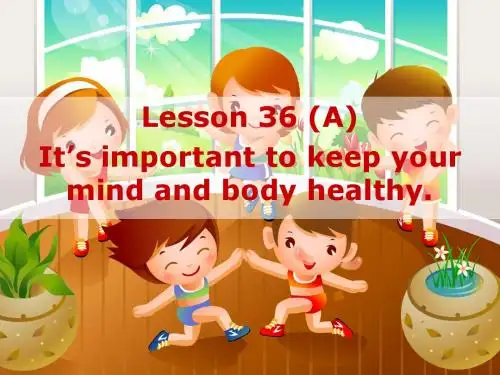
1. Study hard and feel prepared before exams.
2. Try to do your best and don’t think of the result when taking the exams.
5. 如果他们不吃早饭,他们的大脑就会得不到充足的 血液。
If they don’t have breakfast, they can’t get enough blood to their brain.
6. 如果我晚上喝太多的咖啡将会发生什么?
What will happen if I drink too much coffee at night?
What will do when you have the following feeling?
What will you do…?
1. when you are shy? 2. when you are under pressure? 3. when you feel nervous? 4. when you are angry / get angry? 5. when you are in a bad mood? 6. when you get upset? 7. when you are sad? 8. when you are mad?
3. 如果她吃太多的盐,会高血压。
If she eats too much salt, she will have high blood pressure.
4. 如果玛丽定时做运动她会保持健康。
If Mary do exercise regularly, she will keep healthy.
10.感到压力抽烟
牛津译林版八年级英语下册unit3 welcome to the unit精品课件(共36张PPT)
What do you usually do when you are free? Read books? Watch TV? Play the mobile phone? Or---
a computer
main unit 主机
keyboard 键盘
mouse 鼠标
•
mouse n. (pl. mice或mouses) 鼠标
main unit n. Байду номын сангаас电脑)主机
programme n. 节目; 计划,
方案
channel n. 频道
remote control n. 遥控器
• screen • keyboard • unit • main unit • mouse • programme • channel • remote control
Have you known these?
1. To name the different parts of a computer.
2. To grasp and talk about the basic uses of computers.
3. To know the main topic of this unit.
______________________.
3.很多人用电t脑o 来se搜ar寻ch信t息h。e informaton
Many people use the
c_o_m_p_u. tseern_d_s_a_n__d_r_e_c_e_iv_e_s__e_m_a_i_ls______
4.我爸爸每天都收发电子邮件。 My
chat with friends do word processing
北师大版初二英语下册Lesson 36
How to keep
healthy
3 go for a walk every day
4 keep your body clean 5 brush your teeth
6 give up smoking and drinking 7 never take drugs
First of all, you… _________________. Secondly, you shouldn’t ___________. On the other hand you’d better ______.
We mustn’t take any.
9) What old saying have you remember?
Look after your body and it will look
after you!
1 get enough sleep
2 drink a lot of water
Writing
every day?
At least one litre.
3) How often should we take a shower?
Once a day, I think.
4) How often should we brush our teeth?
Twice or three times a day.
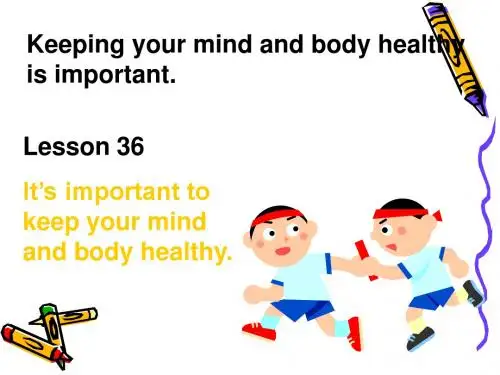
Keeping your mind and body healthy is important. Lesson 36 It’s important to keep your mind and body healthy.
• 教学目标
学生能够发现并总结归纳会引起青少 年心理健康的问题,并提出恰当的解决问 题的建议。om Causes Nervous before exams
冀教版八年级英语下册Lesson36-Let's-take-a-drive

No smoking 禁止吸烟 No spitting 禁止随地吐痰
No fishing禁止钓鱼
No photos 禁止拍照
park n. & v.
1) 公园
eg:I’m looking for a park.
3) vt. 停放(汽车等)
eg:Where did you park your car?
I think it’s a car_f_a_c_t_o_ry__. The workers are__m_a_k_in_g__ cars.
What can you see in the picture?
Some birds.
What do they use to fly? They use __w_i_n_g_s__ to fly.
a highway
公路;大路
Countryside 郊外;乡村;野外
.根据句子的意思和汉语提示填空.(每空一词)
1.The English__c_o_u_n_t_r_y_s_i_d_e___(郊外,乡村) looks
its best in May and June.
2. I _r_o_d_e____(骑)a bike to the zoo last sunday. 3.Where can we _p_a_r_k____(停放) the car?
take a bow=bow 鞠躬
2. Park by the sea. 把车停在海边。 by the sea在海边
by prep.1) 靠近,在……旁边,从旁边经过
eg.The boy was sitting close by me. 那个男孩紧挨着我坐。
eg.He passes by the park every day. 他每天从公园旁边经过。
八年级英语下册Lesson36教材内容详解冀教版
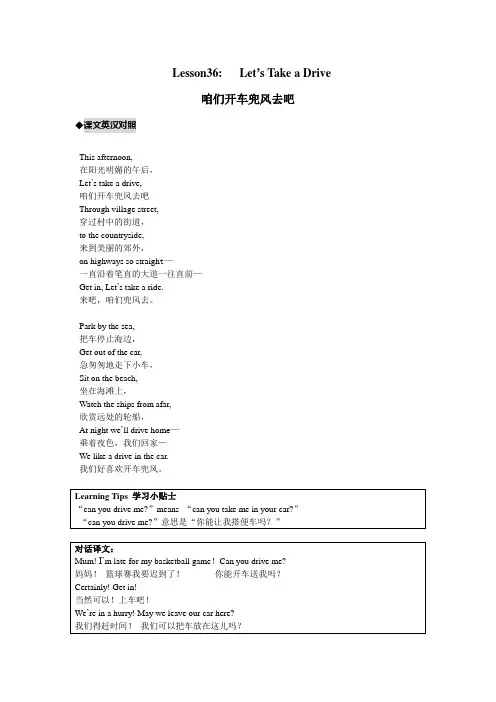
Lesson36: Let’s T ake a Drive咱们开车兜风去吧◆课文英汉对照This afternoon,在阳光明媚的午后,Let’s take a drive,咱们开车兜风去吧Through village street,穿过村中的街道,to the countryside,来到美丽的郊外,on highways so straigh t—一直沿着笔直的大道一往直前—Get in, Let’s take a ride.来吧,咱们兜风去。
Park by the sea,把车停止海边,Get out of the car,急匆匆地走下小车,Sit on the beach,坐在海滩上,Watch the ships from afar,欣赏远处的轮船,At night we’ll drive hom e—乘着夜色,我们回家—We like a drive in the car.我们好喜欢开车兜风。
LET’S DO IT! 做一做Make up a dialogue with a partner. Suppose you are going to the beach, but on the way, your 与同伴编一组对话,假设你正要去海滩,但是在路上,你的bike breaks. What will you do?自行车坏了。
你会怎样做?◆重点难点详解1. Let’s take a drive. 咱们开车兜风去吧⑪drive n. 意为“驾驶,乘坐,旅程”。
● Shall we go for a drive? 我们驱车玩一玩好吗?● My father took me out for a drive. 爸爸开车带我出去兜风。
⑫take a drive = drive 意为“驾驶(车辆)”。
2. Let’s take a ride. 咱们兜风去。
⑪ride n. 是可数名词,意为“骑,乘”。
新概念英语第二册Lesson36AcrosstheChannel共87张课件

succeed v. 成功
• succeed v. 成功,顺利完成;继…之后,接 着…发生(反义词fail)
• succeed in sth/succeed in doing sth • 做某事成功,在某方面成功 • 例:We succeed in the negotiation. 我们谈判成
功了. • Did he succeed in the examination? • Did he succeed in passing the examination? • 他考试及格了吗?
泳。 • float 漂浮 • dive 跳水 • drown 溺水 • breaststroke 蛙式游泳 • crawl 翻由式游泳 • butterfly 蝶式游泳 • backstroke 仰式游泳
• 2) v. 滑动(像游泳般) • 例:The white clouds swam across the sky. • 白云飘过天空。 • 3) 相关短语 • teach fish to swim • teach one' s grandmother to suck eggs • 班门弄斧 • swim with the tide/swim with the stream • 顺着潮流 • swim against the tide/swim against the stream • 违反潮流
• fail to do 没能作成某事 • fail in sth 在某方面失败 • fail in doing sth 做某事不成功 • 例: Several earthquakes succeeded the
eruption of the volcano. • 火山爆发后,发生过数次地震。
• The stormy night ended, and a beautiful morning succeeded.