
七年级英语上册Starter Unit1教案(英文)
Teaching Plan for Unit 1Period 1I. Teaching aims:1. To have the Ss know the way of greetings.2. To have the Ss introduce themselves and others.II. Key points and difficulties:1. Structures or sentences:a.Hi!/ Hello!b.Good morning /afternoon /evening.c.Nice to meet you.d.—How are you?—Fine, thanks.e.What’s your /his /her name?f.My /His /Her name is …2. Words: P100III. Time arrangement:1 periodTeaching procedure:Step ⅠLead-inShow the Ss some objects in the picture.Step ⅡPresentation1.Greetings.⑴Show the Ss some ways of greetings.⑵Ask the Ss to match the greeting sentences with the correct answer sentences.⑶Watch a video.2. Introduce self.⑴Question: How to introduce yourself and others?(Ask some Ss to try to answer it.)New structures and sentences.T: Just now I asked you how to introduce yourself and ask others’ names. Now please listen to me carefully. (Show the Ss some sample dialogues.)eg.1 A: What’s your name?B: My name is Gina. / I’m Gina.⑵1b Listen and number the conversations.(3) Chain work(4) Point to the photos of famous people and ask the Ss to make dialogues.eg.2 A: What’s his/her name?B: His/Her name is Gina./He/She is Gina.3. 2a Number the pictures.4. 2b ListeningStep ⅢPracticeGroup work: Making new friends用下面的对话, 介绍新朋友。
A:What’s his / her name?B:His / Her name’s ….A:And what’s his / her name?B:His / Her name is….Step ⅣExercises 改错Homework :1. 抄写p1-p2的新单词.(见p100单词表)2. 抄写p2 Grammar focus一遍(按照原文格式画表格再抄写)。
Feedback_______________________________________________________________________________ _______________________________________________________________________________ _______________________________________________________________________________Period 2I. Teaching aims:To have the Ss know the components of an English name.II. Key points and difficulties:1. Structures or sentences:What’s your /his /her first / last name?2. Words: P100Keys: first name, last nameDifficulties: the understanding of the difference between Chinese names and English names. III. Time arrangement:1 periodsTeaching procedure:Step ⅠReview1.Ask the Ss the way to greet people.2.Ask the Ss to introduce self and others.Step ⅡPresentation1.Ask the Ss what they know about the difference between Chinese names and English names.2.Culture notes. Tell the Ss every part of an English name.⑴first name (given name)⑵family name (last name)⑶middle name (常常省略)Step ⅢPractice1.Show the Ss some photos of famous people and ask and answer.2.Section A 3a.3.Pair work: Now make an interview about asking first names, last names.Step IV ExercisesHomework1. 抄写p3的新单词(包括人名)。
(见p100单词表)2. 把P3 3a彩图中的对话抄一遍,再用图中的四个姓名另做四段对话。
(每段对话之间空一行)Feedback_______________________________________________________________________________ _______________________________________________________________________________ _______________________________________________________________________________Period 3I. Teaching aims:1. To have the Ss master the numbers 0-15.2. To have the Ss know how to ask numbers.II. Key points and difficulties:1. Ask numbers2.Ask others’ telephone numbersIII. Time arrangement: 1 periodsTeaching procedure:Step ⅠReview1.Ask the Ss the way of greeting and introducing self.2.Ask the Ss about English names.Step ⅡPresentation1.Numbers 0-9⑴Show the Ss some pictures of numbers.⑵Show the Ss the numbers in English.⑶Practice. Show the Ss some pictures of numbers and ask them to speak out the numbers.⑷Have the Ss sing a number chant.2.Ask numbers.⑴Structures:eg.1 --What’s your telephone number?--My telephone number is … .eg.2 –What’s your QQ number?--It’s… .⑵Important telephone numbers in life.(3) 2a listening(4)Practice.A.Work in pairs and ask questions and get your partner’s telephone number.B.Make a survey.Homework:1. 抄写单词表中P4的生词四遍2.《英语周报》第二版SectionB_______________________________________________________________________________ _______________________________________________________________________________ _______________________________________________________________________________Period 4I. Teaching aims:1. To have the Ss consolidate the numbers 0-9 and how to ask telephone numbers.2. To make the Ss consolidate the components of an English name.3. To have the Ss make an ID card.II. Key points and difficulties:Make ID cardContents: Text book P4-P5Methods: have the Ss work in group and practice the conversation after making ID cards.III. Time arrangement: 1 periodsTeaching procedure:Step ⅠReviewNumbers1.Choose some of the Ss to count from 0-9.2.Choose some of the Ss to practice following numbers. (telephone numbers)Step ⅡPracticing and consolidation1.Work in pairs.T: We have already learnt how to introduce yourself and others; how to greet each others and ask about telephone numbers. Can you put them into a whole conversation? (Teacher makes an example with an excellent student.)2.Ask some of the Ss to show their conversation in class.3.ActivityMake your ID card⑴Show the Ss some ID cards.⑵Ask and answer according the information in the giving ID cards.⑶Ask the Ss to make their own ID card.Step III ExercisesHomework:1.完成英语周报unit12.复习unit1_______________________________________________________________________________ _______________________________________________________________________________ _______________________________________________________________________________。
Starter Unit1 1a-1c教案 人教版七年级上册英语

Greet Ss with“Good morning”.
T: Hi / Hello, … (板书hi, hello)
Use“Hi!”and Hello!”to greet Ss.
Step 5: Listening (1b)
Get Ss to listen and repeat.(录音1b)Ask them to pay attention to the pronunciation and intonation.
设计意图:输入性听力跟读,强调模仿语音、语调。
Step 6: Pair work (1c)
教学设计
设计人:_____ _______所在单位:____ _____
教材
人教版新目标(Go for it!)
年级
七年级上册
单元及内容
Starter Unit1 Good morning!
1a-1c
课型
听说课
1.教学内容分析
本课时是单元的第一课,通过听、说活动让学生巩固、运用问候的表达法。1a通过图文导入本单元的话题,并呈现表示问候的语言功能,以及以Aa-Hh为首的8个常见英文名字。1b通过听力输入的方式呈现了Hi./ Hello. / Good morning.三种问候表达法。1c让学生模仿录音并进行控制性的语言输出。
1. Ask Ss to practice the conversations in the picture one by one.(ppt-7)
2. Ask Ss to greettheirpartner freely.(ppt-8)
七年级英语上册StarterUnit1Goodmorning1a-2e教案(新版)人教新目标版

- 学生可以进行语法练习,通过做题和总结错误,巩固对一般现在时的掌握。
七、教学反思与总结
在今天的一般现在时教学过程中,我尝试采用了多种教学方法和策略,希望能够激发学生的学习兴趣,提高他们的语言运用能力。在导入新课时,我通过提问方式引导学生思考一般现在时的实际应用,学生们表现得积极参与,这让我感到很高兴。在理论介绍和案例分析环节,我尽量用生动的例子和实际情境来解释一般现在时的用法,希望学生们能够更好地理解和掌握。在实践活动和小组讨论环节,我鼓励学生积极参与,发挥团队合作的精神,学生们在讨论和实验操作中展现出了浓厚的兴趣和创造力。
针对这些问题和不足,我将在今后的教学中进行改进。首先,我会加强对第三人称单数动词变化的讲解和练习,通过更多的例子和练习题帮助学生理解和掌握。其次,我会提供更多的实际情境和练习机会,让学生们能够更好地运用一般现在时进行交流和表达。此外,我还会继续探索和尝试新的教学方法和策略,以激发学生的学习兴趣和积极性。同时,我会更加注重教学资源的整合和利用,提供更多元化的学习材料和资源,满足不同学生的学习需求。
2. 文化意识:学生能够了解并尊重不同文化背景下的交流习惯和方式,培养跨文化交际的意识。
3. 思维品质:通过 pair work 和 group work 等活动,学生能够培养合作意识和团队精神,提高解决问题的能力。
4. 学习策略:学生能够通过观察、模仿、实践等学习方式,自主探索并掌握一般现在时的基本结构和使用方法。
人教新目标英语七年级上册Starter Unit-1全单元教案
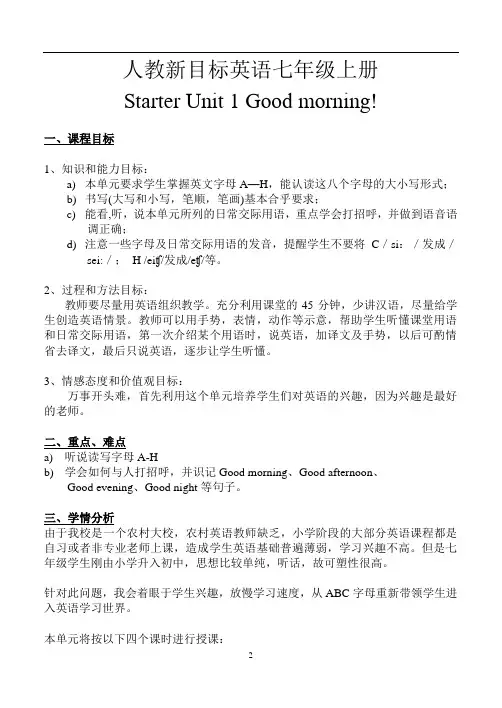
人教新目标英语七年级上册Starter Unit 1 Good morning!一、课程目标1、知识和能力目标:a)本单元要求学生掌握英文字母A—H,能认读这八个字母的大小写形式;b)书写(大写和小写,笔顺,笔画)基本合乎要求;c)能看,听,说本单元所列的日常交际用语,重点学会打招呼,并做到语音语调正确;d)注意一些字母及日常交际用语的发音,提醒学生不要将C/si:/发成/sei:/;H /eiʧ/发成/eʧ/等。
2、过程和方法目标:教师要尽量用英语组织教学。
充分利用课堂的45分钟,少讲汉语,尽量给学生创造英语情景。
教师可以用手势,表情,动作等示意,帮助学生听懂课堂用语和日常交际用语,第一次介绍某个用语时,说英语,加译文及手势,以后可酌情省去译文,最后只说英语,逐步让学生听懂。
3、情感态度和价值观目标:万事开头难,首先利用这个单元培养学生们对英语的兴趣,因为兴趣是最好的老师。
二、重点、难点a)听说读写字母A-Hb)学会如何与人打招呼,并识记Good morning、Good afternoon、Good evening、Good night等句子。
三、学情分析由于我校是一个农村大校,农村英语教师缺乏,小学阶段的大部分英语课程都是自习或者非专业老师上课,造成学生英语基础普遍薄弱,学习兴趣不高。
但是七年级学生刚由小学升入初中,思想比较单纯,听话,故可塑性很高。
针对此问题,我会着眼于学生兴趣,放慢学习速度,从ABC字母重新带领学生进入英语学习世界。
本单元将按以下四个课时进行授课:Period 1Step 1:IntroductionBegin by greeting the class with a smile and good morning!Now,introduce the words “teacher” and “class”.by using gestures.Repeatthis several times and have the class repeat after you.Students can answer as awhole group.As rows and as individuals.Repeat “I am your teacher and youa re the class” several times.Now,introduce the class to the instructions:Class,please sit down and class,please stand up by using actions and gestures.They can practice this severaltimes.Step 2:Lead—inYou may want to leave the class again to introduce the usual Good morningroutine.Say Good morning class.Help students respond with Goodmorning.Point to yourself and say I’m Ms.…Have them repeat.Repeat this a few times with rows and individuals or try a “back-chain” drill:Miss,Mr.… (Ss repeat)Morning,Miss/M r.… (S s repeat)Good morning,Miss,Mr.… (Ss repeat)Step 3:PracticeSay:Stand up,please! (Ss stand up)Leave the classroom,return and say Good morning,class! Help the studentsrespond with Good morning,Miss/,Mr.…Say Sit down,please.Now let’sstart the lesson.Step 4:Presentation and activityNow point to yourself and say My name is Miss/Mr. … I am your teacher.Find a student you know and say your name is…(Sarah).Then ask What isyour name? Help them respond with My name is…. When the studentanswers, respond with Hel lo…Nice to meet you! Repeat this activity severaltimes,first with students you know and then with others.Help them torespond with Nice to meet you,too.Explain the Word “too’’ in Chinese.Step 5:PracticeGet the students to practice the following dialogue in pairs.S1:Good morning.S2:Good morning.I’m (Sarah).What’s your name?Sl:My name is (Mary).Nice to meet you!S2:Nice to meet you.too.Call out several pairs of students to give their performance.Praise their efforts as much as possible.Help the slower students with patience.Step 6:PresentationDo activity 1a:Look at the picture.Find the small letters for these big letters.First present letters a-h,and get the students to repeat these letters.Call the students to attention the letter C/si:/not/sei:/.H /eiʧ/ not /eʧ/ Step 7:Listening and writingGet the students to listen to the tape and finish the task list on the book.Makesure all the students know what they should do.Have the students watch the teacher writing the letters on the blackboard, thenask them to follow the teacher and write down these letters on theirexercise—books.Let the students know the differences between the big lettersand the small letters.Step 8:Games timeLet the students do some letters games to enjoy your lesson,the following isthe instruction.抢读字母游戏:教师将全班分成若干小组,然后逐个出示字母卡片,学生们举手抢答。
部编版七年级英语上册《StarterUnit1Goodmorning》教案及教学反思

部编版七年级英语上册《StarterUnit1Goodmorning》教案及教学反思教学目标1.学生能够听懂、理解并运用日常用语问候和谈论天气的基本交际用语;2.学生能够准确朗读所学单词并正确认读发音,如morning、afternoon、evening、night、cloudy、windy 等;3.学生能够初步掌握时态——现在进行时;4.学生能够理解和运用课文中的文化知识。
重点难点1.新单词的掌握和正确发音;2.现在进行时的理解和基本运用;3.Who’s that? That’s…句型的理解和运用。
教学准备1.教师PPT课件;2.学生教材及练习册;3.视频、音频材料;4.多媒体课件。
教学过程一、导入(5分钟)1.通过播放Greeting的视频或音频以及问好(Good morning! Good afternoon! Good evening! Good night!)让学生掌握问候的基本表达;2.通过谈论天气以及播放相关视频、图片等素材,让学生掌握表达天气的基本用语。
二、讲解(15分钟)1.对单词morning、afternoon、evening、night、cloudy、windy等进行讲解,帮助学生掌握正确发音和词义;2.讲解现在进行时的基本构成和用法;3.对Who’s that? That’s…句型进行讲解,以及与该句型相关的文化知识。
三、练习(20分钟)1.单词听说练习,通过师生互动、小组合作等形式,让学生掌握单词的正确发音和基本用法;2.基础练习,通过口语练习、书面练习等形式巩固学生知识点;3.Listening部分,让学生掌握听力技巧及听懂日常口语表达。
四、拓展(10分钟)1.以Who’s that? That’s…句型为例让学生了解英语中更多的简略答语;2.通过讲解British English和American English的区别让学生了解英语的多样性。
五、总结(5分钟)回顾、总结本节课所学知识,以期加深对该知识的掌握。
英语人教版七年级上册 Starter Unit 1 Good morning! 第一课时教案
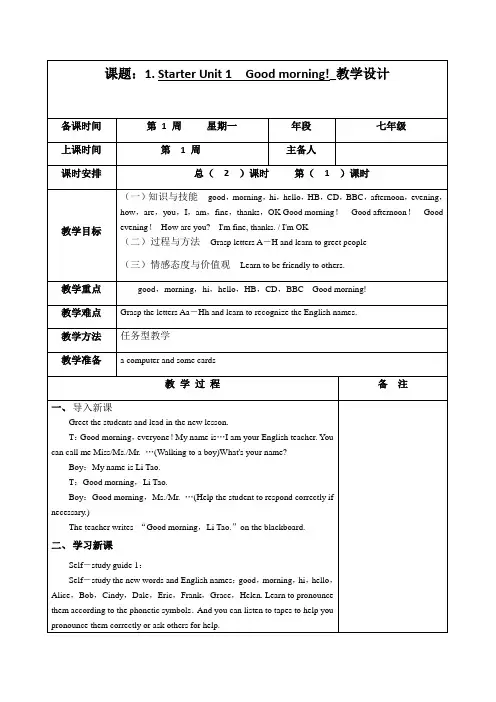
备课时间
第1周星期一
年段
Hale Waihona Puke 七年级上课时间第1周
主备人
课时安排
总(2)课时第(1)课时
教学目标
(一)知识与技能good,morning,hi,hello,HB,CD,BBC,afternoon,evening,how,are,you,I,am,fine,thanks,OK Good morning!Good afternoon!Good evening!How are you? I'm fine, thanks. / I'm OK
(二)过程与方法Grasp letters A-H and learn to greet people
(三)情感态度与价值观Learn to be friendly to others.
教学重点
good,morning,hi,hello,HB,CD,BBC Good morning!
教学难点
Grasp the letters Aa-Hh and learn to recognize the English names.
Self-study guide 2:
Try reading the sentences in 1a and try to tell boys' names from girls' names.
Self-study guide 3:
Self-study 2c and learn to write the eight letters.
教学方法
任务型教学
教学准备
a computer and some cards
人教版英语七年级上册StarterUnit1单元整体教学设计

6.结合教学内容,适时拓展文化背景知识,提高学生的跨文化交际能力。例如,介绍不同国家的问候方式和交际礼仪,让学生了解并尊重文化差异。
7.加强课后辅导,为学生提供更多的学习资源和练习机会。通过课后作业、网络平台等途径,帮助学生巩固所学知识,提高英语能力。
3.学生年龄较小,注意力容易分散,教师需要运用生动有趣的教学方法和手段,吸引学生的注意力,提高课堂参与度。
4.学生在小组合作学习中,可能存在依赖心理,教师应引导学生积极参与,培养他们的自主学习能力和团队合作精神。
5.学生对英语的实际运用能力较弱,教师在教学中要注重培养学生的听说读写能力,帮助他们将所学知识应用于实际情境中。
5.能够正确书写本节课所学的单词、短语和句子。
(二)过程与方法
在教学过程中,教师将采用以下方法帮助学生掌握本章节知识:
1.采用任务型教学法,设计丰富的课堂活动,如小组讨论、角色扮演、课堂游戏等,让学生在实际情境中运用所学知识。
2.运用多媒体教学手段,如PPT、视频等,形象生动地展示所学内容,提高学生的学习兴趣。
7.完成课后练习册相关习题,巩固所学知识,提高英语综合运用能力。
教师应鼓励学生在完成作业的过程中,积极思考、主动探索,将所学知识内化为自己的能力。同时,教师需关注学生的作业完成情况,及时给予反馈,指导学生改进学习方法,提高英语水平。
3.注重听说训练,培养学生的英语听说能力,同时加强读写训练,提高学生的英语综合素质。
4.鼓励学生积极参与课堂活动,敢于开口说英语,克服害羞、紧张等心理障碍。
5.教师及时给予反馈,帮助学生纠正发音、语法等错误,提高英语水平。
七年级英语上册(人教版)StarterUnit1单元整体教学设计
4.引导学生观察、模仿、实践,培养良好的英语发音和语调。
(三)情感态度与价值观
在本章节的学习中,学生将培养以下情感态度与价值观:
1.培养学生对英语学习的兴趣和自信心,使他们愿意主动参与课堂活动,积极与同学互动。
2.培养学生的团队协作意识,使他们学会与他人共同完成任务,相互关心、相互帮助。
5.预习作业:
-预习下一节课的内容,提前熟悉新的词汇和句型,为课堂学习做好准备。
-学生可以提前尝试用下一节课将要学习的新句型进行自我介绍,为课堂上的展示活动做好准备。
-难点:正确使用单词的复数形式和名词所有格,以及句型的时态和语序。
2.听力和口语表达:学生在听力理解和口语表达方面存在一定难度,特别是在识别和产出不同的物品名称时。
-难点:能够流利地使用目标语言进行物品的识别和描述,以及在实际对话中灵活运用所学。
3.读写技能的培养:本章节要求学生能够书写简单的句子并进行阅读理解,这对于部分学生来说是一个挑战。
2.学生在词汇量、语法知识、听说读写技能方面存在一定差异,需要因材施教,分层教学。
3.学生在小学阶段的英语学习主要以口语交流为主,对于书写、阅读和听力训练相对较少,需要加强这方面的技能培养。
4.学生在课堂上的注意力容易分散,需要教师运用生动有趣的教学方法和手段,吸引学生的注意力,提高课堂参与度。
5.学生在情感态度上,对英语学习存在一定程度的焦虑和恐惧,需要教师给予鼓励和支持,帮助他们建立自信心。
3.培养学生尊重他人、礼貌待人的品质,使他们学会用英语礼貌地进行日常交流。
4.通过学习英语,拓展学生的国际视野,使他们了解并尊重不同文化,为未来的跨文化交流打下基础。
七年级英语上册(人教版)StarterUnit1单元整体说课稿
2.角色扮演:学生扮演不同的角色,如学生、老师、家长等,进行角色扮演,练习在不同情境下的问候和自我介绍。
3.竞赛游戏:设计一些小竞赛,如快速问答、记忆挑战等,增加学习的趣味性,同时检验学生的掌握程度。
(四)总结反馈
在总结反馈阶段,我会采取以下措施引导学生自我评价并提供有效反馈:
1.自我评价:让学生回顾本节课的学习内容,自我评价自己的学习效果,包括掌握的知识点和存在的不足。
(三)学习动机
为了激发学生的学习兴趣和动机,我将采取以下策略或活动:
-创设情境:通过设计贴近学生生活的情境,如校园生活、家庭互动等,让学生在实际语境中使用英语,增强学习兴趣。
-游戏教学:利用英语学习游戏,如角色扮演、猜谜语等,使学生在轻松愉快的氛围中学习,提高学习积极性。
-小组合作:通过小组竞赛和合作学习,鼓励学生相互帮助,共同完成任务,培养团队精神和竞争意识。
具体措施如下:
-在课堂互动中,关注学生的发音、语调、语法等方面,及时纠正错误;
-设计难度适中的练习题,让学生在实际操作中巩固所学知识;
-鼓励学生大胆开口,培养他们的自信心和表达能力。
二、学情分析
(一)学生特点
本节课面向的是七年级的学生,他们正处于青春期初期,年龄大约在12至14岁之间。这个年龄段的学生具有以下特点:
1.教学重点:掌握基本的问候语、自我介绍及询问他人姓名的句型;学会本单元出现的名词。
具体措施如下:
-通过图片、实物等直观教具,引导学生学习问候语和名词;
秋七年级英语上册 Starter Unit 1 Good morning 3a-4d教案 (新版)人
Starter Unit 1 Good morning!Period 2 (3a–4d)【教学目标】●知识目标1. Master the new words:afternoon, evening, how, are, you, I, am, fine, thanks, OK2. Master the greeting sentences:Good afternoon/ evening!How are you?I’m fine, thanks./ I’m OK.3. Consolidate the eight names.●能力目标Be able to greet each other using the target language.●情感目标Try to train students to be polite and warm.【教学重难点】●重点1. Master the new words and expressions.2. Be able to greet each other.●难点Be able to greet each other using the target language.【教学准备】A tape recorder, some pictures and handouts.【教学方法】任务型教学法、情景交际法、自主学习与合作学习相结合【课时安排】One period【教学过程】Step 1: Lead-in1. Greet the students in English. Ask the students to read and match.2.Show the pictures to review the eight names learned. Ask the students toread the English names first and then put them in order according to the first letter.3. Review how to write the letters correctly.Step 2: Presentation1. Teach activity 3aT: First, have a quick look at the three pictures in 3a. Then tell me what you can see in these pictures, and what are they doing. Now let’s listen t o the tape.(1) Play the tape for the first time. The students listen only and pay attention to the pronunciation and intonation.(2) Play the tape again and ask the students to number the conversations.(3) Check the answers with the whole class.Answers:2 1 3(4) Ask the students to listen and repeat.2. Teach activity 3b(1) Put students into pairs to practice the conversation in 3a. Remind them to pay attention to the pronunciation and intonation.(2) Leave them several minutes to do it, and then invite some pairs to act out for the whole class.3. Teach activity 3c(1) Ask the students to listen only and pay attention to the pronunciation and intonation.(2) Ask the students to read after the tape and practice the dialogue in pairs.(3) Ask several pairs to act out their conversations for the whole class.4. Teach activity 3d(1)Let students look at the sample conversation in the box in 3d. And then ask students to read it together.(2)Ask students to choose an English name for themselves. Then make conversations with their deskmates like this.(3)Leave students several minutes to do it, offer help as needed.(4)Play a game--Who has the most friends?Students move around the classroom, try to know as many friends as they can and practice the dialogue with them. Let’s see “Who has the most friends?” in just three minutes. Students should point to the persons and tell their names. The winner can get a present.Step 4: Practice1. Teach activities 4a(1) Ask students to find out the names of the children on page S1.(2) Ask students to write names in alphabetical order and remind them that the first letter of the names should be capitalized.(3) Check the answers. Correct mistakes if any.Answers:Alice Bob Cindy Dale Eric Frank Grace Helen2. Teach activity 4b(1) Go over the pronunciation of the eight letters and show their phonetics.(2) Ask students to put the letters in the right phonetics group.(3) Ask the students to listen and repeat. Make sure the students understand the difference b etween the two “a” sounds and the two “e” sounds.(4) After the listening, invite some students to repeat, checking their progress.3. Teach activity 4c(1)Ask students to read through the instruction of this activity so that they can understand how to do it.(2)Leave students several minutes to read the letters and words in the box, move around and help the students if necessary.(3)Invite some students to read them for the whole class and explain the meanings of the new words.Step 5: ConsolidationTeach activity 4d(1)Ask the students to read the words in the song and find out the greetings and the answers.(2)Divide the class into two groups and ask them to read the words in the song.(3)Play the tape of the song, ask students to listen for the first time.(4)Play it again, ask students to repeat. After that, get students to sing together.(5)Let the boys have a try, then the girls.(6)Ask the students to sing it in groups and have a petition.【课堂小结】In this period, we’ve learned how to greet each other in different situations. And we’ve also consolidated the names of the children.【课后作业】1. Practice the conversation and recite it.2. Preview the next unit.。
人教版七年级上册英语starter unit1教学设计
Starter Unit 1 Good morning !Starter Unit 1是Go for it!预备篇三个单元的第一单元。
预备篇是为了使那些没有英语基础的学生更好地使用本套教材而编写的。
它的主要内容为26个字母和最基本的英语日常用语。
本单元的教学内容为:1.学习Aa --- Hh八个字母。
2.学习八个人名。
Alice, Bob, Cindy, Dale, Eric, Frank, Grace, Helen3.学习打招呼的用语:Hello!/ Good morning!/ Good afternoon!/ Good evening!4.学会问候熟识的朋友和应答:-- How are you?-- I’m fine, thanks. How are you? -- I’m OK教学重点:Aa --- Hh的字母教学。
Hello! Good morning. Good afternoon. Good evening.-- How are you? -- I’m fine, thanks. How are you? -- I’m OK.教学难点:课本中英语人名的学习和大、小写字母的学习及书写。
单元课时:5个课时第一课时:完成Section A 1a, 1b第二课时;完成Section A 2a, 2b,2c, 2d, 3, 4a第三课时:完成Section A 4b, 4c, Section B 1, 2a, 2b第四课时:完成Section B 3a, 3b, 4, 5第五课时:完成Self Check and Just for Fun教学目标A.语言知识目标1.词汇: Letters Aa --- Hh八个人名Alice, Bob, Cindy, Dale, Eric, Frank, Grace, Helen 2.句型:Good morning. Good afternoon. Good evening.-- How are you? -- I’m fine, thanks. How are you? -- I’m OK.B. 语言技能目标通过游戏等多种形式的学习活动,培养学生对初学知识的听、说、读、写能力和灵活运用初学的日常交际用语的能力。