
人教版八年级英语下册Unit1SectionA课件
1c
A:What’s the matter with him?
B:He talked too much yesterday and didn’t drink enough water.He has a very sore throat now.
too much 太多 修饰不可数名词
I always worried too much.
She has a sore throat.
What’s the matter?
He has a headache.
He has a toothache. He has a stomachache.
Grammar Focus
1.What’s the matter with sb? = What’s the trouble with sb? = What’s wrong with sb?
注:with为介词,后跟人称代词宾格, 如her,him,them等。
怎 么 了
eg:What’s the matter with your mother? What’s wrong with you? What’s the trouble with her?
Grammar Focus
在英语中,表达“疼痛或不舒服”时的常用结构:
Unit1 What’s the matter? SectionA
Language goals: 1. Talk about your health. 2. Give advice(建议).
body
feet tooth teeth
nose
faceear
toe
neck
face
leg
heel
elbow
Nurse: You don't look well. What's the matter, Sarah? Sarah: I was playing with my friends at the park yesterday. Then it got windy, but I didn't put on my jacket. Now I have a cold. have a cold= catch a cold
Conversation 1
A:You don't look well. Your face looks a bit red. B: Yeah, and my head feels very hot. What should I do? A: Maybe you have a fever. You should take your temperature. B: Yes, you're right.
have a stomachache 胃痛
have a (high) fever
发烧 have a toothache 牙痛 have a headache 头痛
have a sore back
背痛
have a sore throat
喉咙痛
What’s the matter with you ?
A: You should drink some hot tea with homey.
B:That sounds like a good idea.
Conversation 3
A: You look terrible! What’s the matter? B: I think I ate too much at dinner last night. It was an all-you-can-eat meal at the restaurant. But now I have a stomachache.
Work in pair
What’s the matter with him?
He has a cold. He catches/gets a cold.
• have a cold • catch/get a cold
have a cold 可以接一段时间,不能用于进行时 catch/get 不能接一段时间,瞬间动作 eg. How long have you had a cold? I have a cold for 6 days.
Conversation 4
Nurse: You look really tired. What’s the matter, Nancy? Nancy: I didn't sleep well last night. I have a toothache. It's terrible! I can't really eat anything either. It hurts a lot.
A: That's too bad. You shouldn't eat so much next time. Right now , you should lie down and rest. B: I guess I should.
Conversation 4
他胃痛。
What’s the matter with him? He has/has got a sore back/backache.
他背痛。
What’s the matter with him ?
He has a sore throat.
他喉咙痛。
What’s the matter with her ? She has/has got a (high) fever.
hea d knee
t
han d
finger
leg foot
sing a song
I have a sore back. What’s the matter?
I had a cold.
I have a stomachache.
What’s the matter? (你)怎么了?
have a (bad) cold 感冒
= have got a cold
Conversation 2
Nurse:What's the matter, David?Are you OK? David: I ate too much junk food at my friend's birthday party. So last night, I got a stomachache. I almost couldn't get myself out of bed this morning.
(1)主语+have/has+a +病症
have a cold/fever
பைடு நூலகம்
(2)主语+have/has+a+sore+发病部位
sore 是一个独立的形容词,指的是身体某一部位的酸痛。如: sore back, sore throat,sore back,sore neck.
(3)主语+have/has+a+部位-ache
-ache作后缀,常与表示身体部位的名词合成一个新词,
表身体某部位疼痛,如:toothache , headache , stomachache .
• (4)have/has a pain in/on the +身体部位 I have a pain in the arm. 我胳膊疼。 (5)(There is)something wrong with +one’s+部位 • 某人某部位不舒服/出了毛病。 • There is something wrong with my stomach. • 我肚子不舒服。
她发烧。
What’s the matter with her? She has a (bad) toothache.
她牙痛。
What’s the matter with him? He has a (bad) headache.他头痛。
What’s the matter?
He has a sore back He has a sore neck.
Conversation 5
Nurse: What's the matter, Judy? Judy: I'm sorry, but it's very difficult for me to talk. Nurse: Oh, dear.What's the matter?
Judy: I talked too much yesterday and didn't drink enough water. I have a very sore throat now.
Conversation 3
Nurse:What's the matter, Ben?
Can you move? Ben: Not really. I was playing soccer the other day and I hurt myself. It seemed OK at first, but now I have a really sore back.
常用sore 修饰的词: throat leg foot
eye
常加后缀-ache构成的词: head tooth stomach ear
两者都可用的词:back
Look and match
1. have a cold 2. have a fever 3. have a headache 4. have a stomachache 5. have a toothache 6. have a sore throat 7. have a sore back a. 喉咙痛 b. 背痛 c. 牙痛 d. 头痛 e. 胃痛
_Unit1 SectionA 知识点课件 2022-2023学年人教版八年级英语下册
③〔代词〕足够,充分,充足 可作主语或宾语。 Did you have enough yesterday? 昨天你吃饱了吗?
[拓展]“….enough(for+名词/代词 +)to do sth.”意为 “(某人/某物)足够……,能做某事”,可与 so...that...(如 此……以至于……)进行同义句转换。 The box is light enough for the boy to carry. =The box is so light that the boy can carry it. 这个箱子足够轻,这个男孩能搬动。
(2)rest ①〔不及物动词〕休息
He lies down and rests for an hour after lunch every day. 他每天午饭后躺下休息一个小时。 ②〔名词〕休息 take/have a(good)rest(好好)休息
You must take a rest from your work. 你必须放下工作休息一下。
-Would you like some coffee with sugar? 你想喝点儿加糖的咖啡吗?
No, thanks. I'd like tea without anything 不,谢谢,我想要清茶。
China is a country with a long history. 中国是一个历史悠久的国家。
I feel like a bird in the cage. 我感觉像在笼中的鸟儿。
It looks like there is a heavy rain. 天看起来要下大雨。
You need to take breaks away from the computer. 你需要离开电脑休息。 (1)need ①〔实义动词〕需要 后面可接名词、代 词、动词-ing形式及带to的动词不定式作宾语。 She needs a good rest. 她需要好好休息。
人教版新目标初二英语八年级下册Unit 1 What's the matter Section A(1a-2d)PPT课件

He hurt himself.
She hurt herself.
He has a stomachache.
She has a stomachache.
He has a cough.
She has a cough.
He has a headache.
She has a headache.
Pair Work
2
4
3
1
5
2b
Listen again. Match the problems with the advice.
1.fever
a. lie down and rest
2.sore throat
3.stomachache 4.toothache 5.cut myself
b. drink some hot tea with honey
g ___arm h ___back e ___ear ___eye i
b a ___foot ___hand
l ___leg ___mouth c
j ____head d ____neck
k m f ___nose ___stomach ____tooth
1b
Listen and look at the picture. Then number the names [1-5].
Look and say What’s the matter with him/her…?
He has a toothache. She has a toothache.Biblioteka He has a fever.
She has a fever.
He has a sore throat.
2020春七彩课堂人教版初中英语八年级下册教学课件Unit 1 Section A 3a-3c
helped him move the man __o_n_t_o__ the bus. __T__h_a_n_k__s_t_o__ these people, the man was saved in
2. Did the passengers think Wang Ping did the right thing? How do you know?
Yes, they did. Because they went with him together.
UNIT 1 SECTION A
3. Do you agree that people often do not help others because they don’t want to get into trouble ? Why or why not?
人教版八年级英语下册
Unit 1
What’s the matter?
Section A 3a-3c
UNIT 1 SECTION A
➢ Objectives
To read and learn about the story of the bus driver—Wang Ping.
To learn to help people when they’re in trouble.
road and a woman next to him shouting for help. He
stopped the bus without _t_h_i_n_k_i_n_g__t_w_i_c_e__. He got off and asked the woman __w_h__a_t_ happened. She said that the man had a heart _p__r_o_b_l_e_m__ and should go to the
人教版英语八年级下册Unit 1 Section A 1a-2d 课件
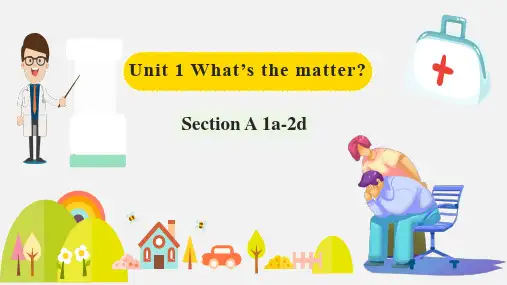
/eɪk/ have a headachehave a stomachache
v. /n. 疼痛
have a toothache
Look at the picture, and tell me what’s the trouble with them?
have/catch a cold
/fi:və(r)/
A: What’s the matter with Judy? B: She talked too much yesterday
and didn’t drink enough water. She has a very sore throat now.
Post-listening
1c Look at the picture. What are the students’ problems?
the first time. 8. If you agree, you can nod yohuera_d_____.
Look at the picture, and tell me what’s the matter with them?
Her eyes ached from lack of sleep. She felt an ache in her back.
Make conversations.
What’s the matter with Judy?
She talked too much yesterday and didn’t drink enough water. She has a very sore throat now.
Pre-listening
1. We look with our e_y__e_s___. 2. We listen with oure_a_r_s____. 3. We smell with ourn_o__s_e___. 4. We walk with our f_e_e_t____. 5. He carries a big bag on hbias_c_k____. 6. We doe_y_e__ exercises to protect our sight. 7. People sometimes shahkaen_d_s____ when they meet for
人教版八年级下册英语 Unit 1 习题课件 Period 1 Section A (1a-2c)
【点拨】used to do sth.“过去经常做某事” ,为固 定词组。根据后面的直接引语可知,这里是指 “疑问”。
Inthosedays, whenpeoplesawarunner, theyused______6, “Hey, what'sthehurry?” ortheymightsayto______7, “Ishecrazy?” Womenalmostnever______8. 7.AB. them B. themselvesC. theirs D. they
fruitjuiceorbread.My
______3
(I)
momisgoingshoppingnow.
Ihavesomemilk,
breadandaneggforb_r_e_a_k_f_a_s_t4.
It'simportanttohaveagoodbreakfast.
Ihaverice,
fishandvegetables______5lunch. for
toothache, what’sthematter, stomach, shtomuladc, h takeyourtemperature
toothache, what’s the matter, stomach, should, take your temperature
toothache, what’sthhoeumldatter, stomach, should, takeyourtemperature
toothache, what’s the matter,
人教版 八年级英语 下册 Unit1_what's_the_matter课件(完整)
Conversation 4 Girl :What’s wrong with your face? Boy: It’s not my face.It’s my tooth.I have a toothache. Girl:You should see a dentist and get an X-ray. Boy:But will it hurt? Girl:No,and if you don’t go to the dentist now,it’ll hurt even more later!
night,I got a stomachache. I almost couldn’t get myself out of bed this morning.
Conversation 3 Nurse:What’s the matter,Ben?Can you move? Ben:Not really.I was playing soccer the other day and I hurt myself.It
foot n. 脚;足 neck n. 颈;脖子
Words and expressions
stomach n. 胃;腹部 throat n. 咽喉;喉咙 fever n. 发烧 lie v.躺;平躺
lie down 躺下 rest v. 放松;休息
cough v. 咳嗽 X-ray n. X射线;X光
Lisa: OK. Thanks, Mandy.
3b Read the passage again and check the things that happened in the story.
八下英语第一单元课件人教版
八下英语第一单元课件人教版The problem is that I am unable to provide the specific English language courseware for the 8th grade, Unit 1, from the People's Education Press. However, I can discuss the general requirements and objectives of an English language course for 8th graders and the potential challenges that students may face in learning English at this level.In an 8th-grade English language course, students are typically expected to build on the foundational skills they have acquired in previous years and to further developtheir proficiency in reading, writing, speaking, and listening. The course may focus on expanding vocabulary, improving grammar and syntax, and enhancing comprehension and communication skills. Additionally, students may be introduced to more complex literary texts and be encouraged to analyze and interpret them critically.One potential challenge for students at this level is the increasing complexity of the English language. As theyprogress through their studies, students are likely to encounter more advanced vocabulary, intricate grammatical structures, and nuanced literary themes. This can be overwhelming for some students, especially those who may struggle with language acquisition or have learning differences.Furthermore, the demands of the course may require students to engage with English language materials that are culturally and contextually unfamiliar to them. This can present a barrier to comprehension and may require additional support and guidance from teachers.Another challenge for 8th-grade English language learners is the development of effective communication skills. As they navigate the complexities of the English language, students may find it challenging to express themselves clearly and coherently, particularly in spoken communication. Additionally, they may struggle with understanding and interpreting the perspectives and intentions of others in English-language interactions.In addition to the academic challenges, 8th-grade students may also face social and emotional obstacles in their English language learning. They may feel self-conscious about making mistakes or speaking in front of their peers, which can hinder their confidence and willingness to participate actively in class activities.Despite these challenges, 8th-grade English language learners have the potential to make significant strides in their language proficiency and to develop a deeper appreciation for the English language and its cultural significance. With the support of dedicated teachers, engaging course materials, and a supportive learning environment, students can overcome these obstacles and achieve success in their English language studies.。
Unit 1 第2课时 Section A【阅读课】八年级英语下册课件(人教版)
n. 乘客;旅客 adv. & prep. 离开;不工作;从……去掉 下车 使……惊讶的是;出乎……的意料 prep. 向;朝 n. 问题;苦恼 v. 击;打 立即;马上 陷入;参与
通过图片预测文章内容
Bus Driver and Passengers Save an Old Man
➢Do you think it comes from a newspaper or a book? ➢How do you know?
It’s short. It has the picture and title. It has time, place, people and the story.
Look at the picture and the title, guess what happened in the story.
A: What’s the matter with …? B:I guess she/he has a …
Offer help or not?
conscience良知 virtue美德
passenger off
get off to one’s surprise
onto trouble hit (hit) right away get into
Unit 1
语法课
1通过自主预习,能认读以下单词和短语:passenger, off, get off, to one‘s surprise. onto, trouble, hit. right away, get into 2.通过运用(skimming、scanning) 跳读策略,概括出文章大意及 段落人意查读策略,把握描述事件发生的五要素(时间地 点人物 事件结局) 3.能根据思维导图复述文中的新闻事件 4. 通过学习文中公交车司机的行为,鼓励学生主动帮助处于危 险中的人,并勇于在紧急时刻做出正确的决定。
Unit 1 第1课时 Section A【听说课】-八年级英语下册课件(人教版)
听说课
1.To practice some your listening. 2. To recite some important sentences skillfully.
1).--Where did you go on vacation?--I went to Guizhou. 2).What did you do ?I saw Huangguoshu Waterfull. 3). Did you buy anything special ? Yes, I bought something for my parents.
2b Listen again. Match the problems with the advice.
Girl 1: You don’t look well. Your face looks a bit red. Girl 2: Yeah, and my head feels very hot. What should I do? Girl 1: Maybe you have a fever. You should take your temperature. Girl 2: Yes, you’re right.
A: What’s the matter?
B: I have a toothache.
A: I think you should see a dentist and get an X-ray.
-I have a cough /kɔf/咳嗽
-I have a stomachache /ˈstʌməkeik/胃痛
-What’s the matter with her?
-She has a headache /ˈhedeik/头痛
新目标(人教) 八年级下册英语教学课件 Unit1 Section A(GF-4c)
4b Circle the best advice for these health problems. Then add your advice.
1. Jenny cut herself. She should (get an X-ray / put some medicine on the cut). My advice:
I hurt my back when I fell off my bike.
⑤ sb. get/got hit on the +身体部位. e.g. He got hit on his head when he passed by the
playground.
3. ache, sore和hurt 的区别: (1)ache 是一个名词后缀,表示某部位疼痛。
some sleep/rest; have colds; fall down. ➢ Key sentences:
1. Did you hurt yourself playing soccer? 2. You should go home and get some rest. 3. Should we go to school? ➢To learn the usage of should and reflexive pronoun.
1) Did you buy anything for yourself? 你为你自己买什么东西了吗?(做介词宾语)
2) The old man taught himself English. 那位老人自学英语。(做动词宾语)
3) The thing itself is not important. 事情本身并不重要。(做同位语)
see a doctor in time