
人教九年级英语unit2 测试卷(含答案)
九年级英语 Unit2 测试卷 时间:100分钟 满分:120分 一、语法与情景对话(共20小题;每小题1分,满分20分) ( )-1.Jenny, do Chinese people celebrate Easter Day(复活节)? -No.This is the first time I've celebrated festival. A.the; the B./; the C. the; a D./;a ( )2. -Do you have in Beijing? -Yes. My aunt and uncle live there. A.classmates B.cousins C. partners D. relative ( )3. -Who broke the window? - .A strong wind broke it last night. A. Somebody B. Anybody C. Nobody D. Everybody ( )4. Nowadays people who smoke in public places will be . A.hurt B. stolen C. punished D. admired ( )5. He told me he wanted to buy a present for his father. A.who B. that C. if D. which ( )6. Bill is a new student. You should him. A. look at B. care about C. listen to D. take after ( )7. He promised his old friend during his stay in Tianjin. A.see B. seeing C. saw D. to see ( )8. -Are you going out with Jade tonight? -That's my . Mind your own! A.offer B. business C. chance D. answer ( )9. He asked me . A. what did my mother say B. what will I do next year C. why I didn't pass the exam D. that I failed the exam ( )10. the Spring Festival is! A. How interesting B. How an interesting C. What interesting D. What an interesting ( )11. Lin Shuhao is famous all the basketball fans in China know him. A .too; to B. enough; to C. so; that D. as; as ( )12. -Will you go fishing or camping if it's fine tomorrow? - . A. Yes, I will B. No, I won’t C. I will go fishing D. I think so ( )13. -I am going back to America for Thanksgiving Day. - .And we will miss you. A. Enjoy yourself B. You're welcome C. That's interesting D. The same to you ( )14. leaves the classroom last should turn off the light. A. Whatever B. Wherever C. Whenever D Whoever ( )15. -I will have a math test tomorrow. - ! A.Good luck B. Thank you C. Well done D. Good idea ( )16. Ruby plans to stop eating these foods because they are making her Weight. A. put on B. turn on C. give up D. cut up ( )17. Your suitcase is to mine. I don't know which one is mine. A.same B. similar C. like D. likely ( )18. Look at the picture on the right! They are . A. celebrating the Songkran Water Festival B. celebrating the Dragon Boat Festival C. washing clothes D. watering flower ( )19. Many families plan abroad in the coming winter holiday. A.travel B. to travel C. will travel D. travels ( )20. Which Part is the VERB of the following sentence"I think that mooncakes are delicious"?
A. delicious B.that C. mooncakes D. think 二、完形填空(共10小题;每小题1分,满分10分) The main activities in the Qingming Festival are tomb sweeping(扫墓),taking a spring outing and flying kites.
Tomb sweeping is the most important 21 in the Qingming Festival. Cleaning the tomb and paying respect to the 22 person with offerings are the two important parts of
remembering the past relatives. People often 23 weeds(野草)around the tomb and add fresh soil to show care of the dead. They also take the dead person's favorite food and wine to sacrifice(供奉)to them as well as paper money. They take the food and bum the paper money to hope the dead won't lack(缺少) 24 . Kowtowing(叩头) is also necessary. The tradition of spring outing began in the Tang Dynasty and lasts till today. It is a day 25 remembering the dead and having a good time. During March, trees turn green, flowers blossom(开花), and the sun shines bright. It is a fine time to go out and 26 the beautiful scenes of nature. So visitors can be seen everywhere during the month of the festival. Spring outings 27 add joy to life but also help people develop a healthy body and mind. Flying kites is an activity loved by many people during Qingming Festival. 28 are own day and night. Little lanterns are tied to the kites.When the kites are flying in the sky, the lanterns look like twinkling(闪烁的) stars. That adds special scenery to the sky during the night. It is said that this 29 good luck and that diseases can be taken away. 30 , the Qingming Festival is special because it connects the tears to the dead with laughter from the spring outing. ( )21. A. tradition B. culture C. trick D. game ( )22. A. important B. dead C. useful D. beautiful ( )23. A. clear away B. wash away C. give away D. put on ( )24. A. clothes and money B. food and drinks C. food and money D. food and clothes ( )25. A. for B.in C. to D.with ( )26. A. discover B. admire C. treat D. draw ( )27. A. not only B. either C. not D. none ( )28. A. Clouds B. Birds C. Kites D. Flowers ( )29. A. brings B.lays C. spreads D.gives ( ) 30. A. As a result B. In a word C. In my opinion D. It is said 三、阅读理解(共15小题;每小题2分,满分30分) 阅读下列材料,根据其内容判断其后各小题正误。正确的选A,错误的选B。 A The Dragon Boat Festival is a folk festival which has a history of more than two thousand years. It is also named Duanwu Festival. There are many activities on the day.
九年级英语全册Unit2Ithinkthatmooncakesaredelicious单元综合检测题(含答案)
Unit 2 I think that mooncakes are delicious!满分:100分,限时:60分钟Ⅰ.单项选择(每小题1分,共15分)1.—It is reported that cancer can be controlled at a temperature lower than 110℃ below zero. —Really? nice surprise!A.HowB.WhatC.What aD.What an答案 C 本题考查感叹句的结构。
感叹名词surprise要用what,先排除A;此处surprise是可数名词单数,故what 后要用不定冠词a。
2.—Do you have in Beijing?—Yes. My aunt and uncle live there.A.classmatesB.cousinsC.partnersD.relatives答案 D 根据答语的“我姑姑和叔叔住在那里”可推断,问句问的是“你在北京有亲戚吗”,所缺的词是relatives,故答案为D。
3.He is so brave.We all him for his courage.A.warnB.punishC.admireD.remind答案 C 根据本题语境可知,我们都钦佩他的勇气,故所缺的词是admire。
4.I said thanks to him because he promised me with English.A.helpB.helpingC.to helpD.helped答案 C promise to do sth.意为“承诺做某事;答应做某事”。
5.The English teacher was a little disappointed when he knew that they ended up about it in English.A.talkB.talkingC.talkedD.to talk答案 B end up后若跟动词,只能跟动名词,故答案为B。
人教版九年级英语Unit2单元测试及答案
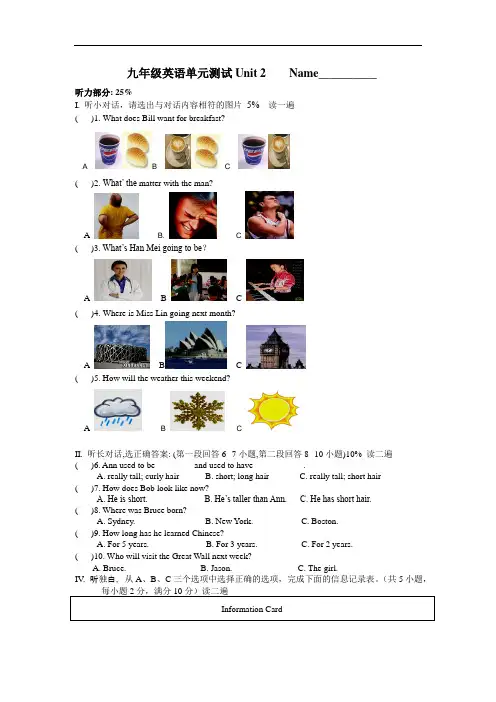
九年级英语单元测试Unit 2 Name__________听力部分: 25%I. 听小对话,请选出与对话内容相符的图片5%读一遍( )1. What does Bill want for breakfast?A B C( )2. What’ the matter with the man?A B. C( )3. What’s Han Mei going to be?A B C( )4. Where is Miss Lin going next month?A B C( )5. How will the weather this weekend?A B CII. 听长对话,选正确答案: (第一段回答6--7小题,第二段回答8--10小题)10% 读二遍( )6. Ann used to be ________ and used to have ___________.A. really tall; curly hairB. short; long hairC. really tall; short hair( )7. How does Bob look like now?A. He is short.B. He’s taller than Ann.C. He has short hair.( )8. Where was Bruce born?A. Sydney.B. New York.C. Boston.( )9. How long has he learned Chinese?A. For 5 years.B. For 3 years.C. For 2 years.( )10. Who will visit the Great Wall next week?A. Bruce.B. Jason.C. The girl.IV. 听独白,从A、B、C三个选项中选择正确的选项,完成下面的信息记录表。
(共5小题,()11. A. Today ()12. A. Drive a car ()13. A. closed ()14. A. Wind()15. A. music B. yesterday afternoonB. WalkB. open as usualB. SnowB. weatherC. last nightC. Take a busC. brokenC. CloudC. news笔试部分:I. 完形填空:15%Football may be the most 1of the games. People in many 2around the world like playing it. In the 19th century 3in England first played this kind of balls. The players moved the ball 4.The first international football game was between England and Scotland in 1872.Football is played by 5with eleven men on each team. Each team has one way to 6. It must score more goals (进球) 7the other team. Each 8in games is one point (分).Football is a round ball. Players may kick (踢) it and 9it by any part of the body except the 10. Only one player on the team can use his hands. This player is the goal keeper.A football game usually 11for ninety minutes. The teams play for forty-five minutes, and then take a short rest. After this halftime rest, they play again for 12forty-five minutes.Now football is one of 13played in the Olympics. Another important international football match is called the World Cup. The World Cup is had 14every four years. The 15of the World Cup match is the world champion football team.( )1. A. careful B. popular C. dangerous D. difficult( )2. A. towns B. cities C. villages D. countries ( )3. A. people B. English C. children D. football( )4. A. with his foot B. by his feet C. with their feet D. by their feet ( )5. A. two teams B. three teams C. one team D. four teams ( )6. A. win B. winning C. won D. winner( )7. A. as B. like C. than D. in( )8. A. football B. goal C. ball D. player( )9. A. move B. use C. carry D. lift( )10.A. feet B. heads C. hands D. bodies( )11.A. begins B. lasts C. kicks D. gets( )12.A. other B. others C. the others D. another( )13.A. the sport teams B. the sport team C. the team sports D. the team sport ( )14.A. first B. one C. once D. the first ( )15.A. win B. winning C. won D. winnerIII. 阅读理解: 40% (每小题2分)AWe spoke to three students from around the world about different national holidays. There are different customs (习俗) for each festival.Tan Xiaodong. 15. Hong Kong, China“It’ll soon be Chinese New Year> Before it we’ll clean the house and decorate it for good luck. Every shop is going to close for a few days and we’l l go out a lot to celebrate in the streets. We might go and see the lion and dragon dances in the city center. I love this festival. ”Wendy, 16, Sydney, Australia“Australia is on 26 th January and it’s an important holiday here. We al ways have a Monday off, so we celebrate for three days. My parents and I go to the countryside for a picnic and friends always come over. Many people go to beach parties or street parties and there’s lots of music and dancing. What fun!”Amy, 14, New York, the USA“The first Thanksgiving Day was hundreds years ago when Europeans who came to America thanked God for his help. It’s still a very important day for families to be together. This year we’re going to visit my parents and we’ll eat a delicious meal of turkey. Thanksgiving Day is on the fourth Thursday in November every year.”( )1. How many festivals are mentioned (提到) in the passage?A. Two.B. Three.C. Four.D. Five.( )2. During the Chinese New Year, tourists can _________.A. do a lot of shoppingB. see lion and dragon dancesC. decorate the house for good luckD. eat turkey( )3. On Australia Day, families often ___________.A. have a picnic in the countrysideB. go to a swimming poolC. have a party at schoolD. clean the house and dance( )4. What do you think a turkey is in the passage?A. A countryB. A festivalC. A birdD. A kind of drink( )5. From the passage, we can learn that _____________.A. Australia is an important day for family members to get togetherB. different festivals have different customsC. many go out for s picnic with friends before Chinese New YearD. the first Thanksgiving Day was born a hundred years agoBHere are some facts about homes in the United States and the people who live in them. In the early1990s, about 50% of the Americans owned their homes and the rest rented (租) their homes. The rentedhomes were usually apartments (公寓).74% of the people in the US make their homes in or around cities. 26% live in the country. Dogs live in about 40% of all homes in the US. About half that number have cats.Families in the US are becoming smaller. On the average (平均), 2.64 people lived at home in early 1990s. In 1960, the average was 3.5.Half of the teenagers in the US have their own bedrooms.An American moves, on the average, twelve times in his or her life. In Japan a person moves about five times, and in England a person moves eight times.( )6. Most Americans live ________, according to the passage.A. in or around the citiesB. in citiesC. around citiesD. in the country ( )7. Ho w many American families own a cat?A. About 40%.B. About 20%.C. About 74%.D. About 26%. ( )8. On the average, there were ________ people in an American family in 1994.A. more than 3B. only 3.5C. less than 2D. about 2.64( )9. ________ in the US have their own bedrooms.A. All of the peopleB. Most of the childrenC. Half of the teenagersD. Only some of the teenagers( )10. What can we learn from the passage?A. In the early 1990s, most of the Americans owned their homes.B. Families in the US are becoming bigger and bigger.C. A Japanese moves more often than an American.D. An American moves more often than an Englishman.CI wonder whether there is any girl or boy who does not like to see a rainbow(彩虹) in the sky. It is so beautiful.There is a story, saying that whenever you see a rainbow you should run at once to the place where it touches the ground, and there you would find a pot of gold. Of course it is not true. You could not find the pot of gold or its end. No matter how far you run, it always seems far away.A rainbow is not a thing which we can feel with our hands as we can feel a flower. It is only the effect(结果) of light shining on raindrops. The raindrops catch the sunlight and break it up into all the wonderful colours which we see. It is called a rainbow perhaps because it is made up of raindrops and looks like a bow(弓).That is why we can never see a rainbow in a clear sky. We see a rainbow only when there is rain in the air and the sun is shining brightly through the clouds.Every rainbow has many colours in the same order. The first or the top colour is always red, and the next comes orange, then yellow, and last of all, blue. A rainbow is indeed one of the wonders of nature.( )11. Children like rainbows because .A. they are beautifulB. they are like bowsC. they can find a pot of gold at the end of a rainbowD. they are good to crops( )12. We cannot feel with our hands.A. a pot of goldB. a flowerC. a rainbowD. a raindrop( )13. We can see a rainbow .A. when it is raining heavilyB. when it is snowingC. when it is cloudyD. when it is becomes fine shortly after raining( )14. Which of the following statements is NOT true?A.A rainbow is like bow.B.A rainbow is the effect of light shining on raindrops.C. Every rainbow has different colours in different orders.D.A rainbow is one of the wonders of nature.( )15. The first colour of a rainbow is always .A. yellowB. redC. green D .blueDJerry Green went to spend a year at the South Pole Station (南极站)as the only doctor in 1998 when she was 47. While working at the station that March. she discovered that there was a hard lump (肿块) in her stomach. She knew it was cancer, but she wasn’t able to go to a doctor for help. She couldn’t leave the station for the next seven until the snow thawed. Dr. Green didn’t wait for the death. But decided to fight against the cancer. She tried to the lump to a hospital in the United States. The doctors said it was cancer. Without the proper wouldn’t live for long. Soon a USA airplane came to provide her with some help. She started her own treatments(治疗)after getting instructions from American doctors. She finally spent the long winter there before she returned home that October .Since then, she had become a incubus (沉重的压力)in support of cancer charities. She also wrote a best-selling book called Ice Bound.Sadly, Dr. Green’s cancer finally returned. She died on June 23.2009.( )16. Jerry Green discovered that she bad a bard lump in her stomach in__________.A. March.1998B. May. 1998 CJune.2009 D. July,2009( )17. What does the underl ined word “ thawed ”mean in Chinese?A. 形成B. 堆积C. 融化D.覆盖( )18. When did she start her own treatments?A. After searching the Internet.B. After getting instructions from American doctors.C. After hearing from her paw lawD. After becoming a member in support of cancer charities.( )19. Which of the following statements is NOT true?A. Dr. Green decided to give up the treatments.B. She sent the information about the lump to a hospital in the United Stales.C. She wrote a book called Ice Bound.D. Dr Green died of cancer.( )20. What does the writer feel about Dr. Green’s death?A. excitingB. Happy. C Sad D. PleasedIII. 根据所给汉语和首字母,写出正确的英语单词,使其句意完整: 10%1. There’s a red (灯笼) _______________ hanging in the yard.2. The (民俗的) ____________ song has a good run in the area.3. The gardener picked off the (死的) ____________ flower.4. A (磅) ____________ in the purse is worth two in the book.5. Our dog rushed upon the (陌生人) ________________ and bit (咬) his leg.6. Her aunt is her nearest l____________ in this city.7. He planted roses(玫瑰花) in the middle of the g________________.8. After dinner, we had ice-cream for d______________.9. Had to l___________ down for a while to rest.10. My father will p_____________ me again if I am lateIV. 词汇运用:15%A. 阅读下面短文,根据括号内的汉语意思填写单词,使短文意思完整、通顺。
初中英语人教新目标九年级全册Unit 2填空练习(单词+短语+句型)(附参考答案)

九年级英语全册Unit 2填空练习班级考号姓名总分Section A【重点单词】[汉译英]n.月饼 _____________n.灯笼 _____________n.陌生人 _____________n.亲属;亲戚 _____________增加(体重); 发胖 _____________n.磅(重量单位); 英镑(英国货币单位) _____________adj.民间的 ; 民俗的 _____________n.女神 _____________pron.无论谁:不管什么人 _____________v.偷:窃取___________(——过去式_________ ——过去分词__________ )偷:窃取v.放置:安放:产(卵):下(蛋)________ (——过去式________——过去分词_________) 摆开;布置 _____________12.n.(饭后)甜点:甜食 _____________13.n.花园;园子 _____________14.n.传统 _____________15.v.欣赏;仰慕 _____________16.n.领带; v.捆:束 _____________【单词转换】l.strange adj.奇怪的;陌生的一 _____________ n.陌生人2.tradition n.传统一 _____________ adj.传统的3.shoot v.射击;发射一 ________ (过去式)一 _________ (过去分词)4.steal v.偷;窃取一 ________ (过去式)一 __________ (过去分词)5.fly v.飞;飞行;一 _________ (过去式)一 _________ (过去分词)6.touch v.触摸;感动一 _____________ adj.感人的7.describe v.描述一 ________________ n.描述【重点短语】[汉译英]l.听起来像… _____________2.从…...到…..._____________3.冲走;洗掉 _____________4.增加(体重):发胖 _____________5.与…相似 _____________6.呈…的形状 _____________7.摆开;布置 _____________8.至少 _____________9.拒绝做某事 _____________10.射下 _____________1l.赏月 _____________12.与…...分享 _____________【重点句型】1.__________ a great day!多么好的一天啊!2.Bill wonders _____________ they'll have zongzi again next year.比尔想知道他们明年是否将再吃粽子。
2022-2023学年人教新目标九年级英语 Unit 2单元综合测试卷附答案详析

2022-2023学年九年级英语Unit 2单元综合测试卷一、单项选择1.You’ll have to ______ the books because there aren’t enough for everyone.A.pack B.sell C.choose D.share2.— I watched the live(直播)NBA game last night. How about you?— Of course I did. ________ amazing game it was!A.What an B.How an C.What D.How3.We promise ________ the rubbish in the classroom.A.to pick B.to pick up C.not to pick D.not to pick up4.We all warn my uncle ________ so much wine, but he doesn’t follow our advice.A.to drink B.not to drink C.to not drink D.drinking5.—My grandpa is getting so forgetful.—I have to remind him ________his medicine.A.take B.takes C.to take D.taking6.—Will you take the normal train or the bullet train (高速火车) to Beijing?—The bullet train. I will have to ________ more money, but it will ________ less time.A.cost; pay B.take; spend C.pay; take D.spend; cost7.The driver saw an old man ________ on the side of the road, and he took the man to the hospital without thinking twice.A.lie B.lies C.lying D.to lie8.clever the boy is!A.How B.What C.How a D.What a9.The mooncakes are ________ delicious ________ he wants to eat another.A.too; to B.enough; to C.so; that D.as; as10.Before the guests arrived, my mother quickly some fruits and sweets on the table.A.lays out B.laid out C.lied out D.lain out11.Jim's ideas are similar _________ mine, but quite different _________ yours.A.to; from B.from; to C.with; of D.as; with12.The girl dresses up ________ a cartoon character called Minnie.A.on B.as C.for D.at13.I wonder ________ June is a good time to visit Hong Kong.A.what B.that C.whether D.when14.—Gina, ________ your coat, please. It’s time to go to school.—OK, mom. I will ________ myself right now.A.get dressed; wear B.put on; dress C.wear; dress D.dress; put on15.— Do you still remember that accident, Danny?— Of course. I’ll never forget it it happened so long ago.A.only if B.even thoughC.because of D.ever since二、完形填空Every April, there is a special day in China. It is called Qingming Festival,also called Tomb -Sweeping Day. on that the day,people____16____and honor (纪念) their ancestors (祖先).Qingming is a(n)___17___Chinese festival. It has a long history. It began over 2,000 years ago.A famous poem___18___the Tang Dynasty poet Du Mu describes the day: “Rains fall heavily as Qingming comes, and passers-by(行人) with lowered sprits go.”Tomb-Sweeping Day has been a public____19____ on the Chinese mainland(中国大陆) since 2008. On this day,____20____bring flowers, food and wine to their ancestors’ tombs (坟墓). They put food like cakes and fruits in front of the tombs. After that, they____21____the dirt off the tombs and remember their dead family members.____22____ do Chinese people do this? That’s because people think that visiting tombs to _____23_____ respect (尊重) to their dead family members.However, Tomb-Sweeping Day is not only about this. During that time, the weather is becoming____24____. People are also able to garden (从事园艺)and enjoy outdoor activities. Families often ___25___ for outings (远足) or fly kites at this time.16.A.remember B.meet C.see D.find17.A.popular B.famous C.traditional D.unhappy18.A.for B.by C.with D.as19.A.weekend B.weekday C.journey D.holiday20.A.classes B.families C.friends D.groups21.A.turn B.keep C.sweep D.go22.A.Why B.When C.Where D.Who23.A.bring B.show C.make D.take24.A.warmer B.colder C.cooler D.shorter25.A.have fun B.work hard C.pull together D.get together三、阅读单选Chinese netizens are again showing their skills for online humor by turning the image of a classic Hong Kong actor, Xu Jinjiang, into a “Chinese Santa”. The character, first played by Xu in the 1992 period comedy movie Royal Tramp(《鹿鼎记》), wearing a red hat and long beard, looks much like Old Saint Nick. While Chinese netizens enjoy the “Chinese Santa”, Westerners living in China are making it more interesting to celebrate Christmas.As we know, in the US, families get together and decorate their homes with colorful lights and a tree. They have a big fancy dinner with turkey and pie. And on Christmas morning, they all sit under the tree and open their presents.But here in Beijing, many foreign friends celebrate Christmas a bit differently. One of the things they like to do is to have a Christmas potluck dinner. This is a group dinner where each guest brings a dish they made at home. They bring dishes like mashed potatoes (土豆泥) and baked ham (烤火腿). It’s a fun way to get together and celebrate when they can’t all be with their own families.Another thing they enjoy is playing a game called “white elephant”. This is a gift-giving game where each person brings a “mystery gift”. They take turns trading the gifts with each other—and if someone else gets a gift that they think might be good, they even have one chance to steal it! Everyone ends up with an unusual gift.There is also an event called Santacon. It’s an all-day party where people dress like Santa Claus and go to different places in a big group. It’s a fun way to spend time with your friends and meet new people. 26.What does the “Chinese Santa” look like according to the passage?A.B.C.D.27.The second paragraph mainly describes .A.what people in the US receive on Christmas DayB.when people in the US exchange Christmas giftsC.how people in the US decorate their homesD.how people in the US celebrate Christmas28.What do people do at a potluck dinner?A.They go to a restaurant and have a big dinner together.B.Everybody brings a home-made dish to share with others.C.They get together to make dinner at a party.D.They order some food and share it at a party.29.Which of the following is a game?A.Potluck dinner. B.White elephant. C.Mashed potatoes. D.Holding a Santacon.30.The last paragraph is written to .A.compare different ways of celebrating ChristmasB.show a kind of Santa Claus dressC.describe a fun Christmas eventD.encourage Chinese people to celebrate ChristmasNo Car Day was first started by 34 cities in France on September 22, 1998. It was started to protect the environment. By now, more than 1,000 cities around the world have had a No Car Day.The first No Car Day in China was in Chengdu in 2001. Other cities, including Taipai, Shanghai and Wuhan, also support the day.In Beijing, more and more people are joining the campaign. It asks drivers to leave their cars at home for one day each month and walk or ride a bike to work. It also calls on Beijingers not to use cars on June 5(World Environment Day). The slogan for the day is, “If we drive for one less day, we can have one more nice day.”So far, more than 200,000 drivers have shown their support. “We can’t control the weather, but we can choose not to drive,” said Wu Zonghua, a car club chairman. Beijing is trying to have 238 blue sky days this year. In the first quarter of 2012, Beijing only had 52 blue sky days. This was 11 days less than the number for the same period the year before. Much of the dust comes from the desert, but cars cause most of the air pollution. We must do more for No Car Day.31.The first No Car Day fell on _______.A.February 2nd B.June 5th C.July 5th D.September 22nd32._______ was the first city to have No Car Day in China.A.Beijing B.Chengdu C.Shanghai D.Wuhan33.What does the underlined word “slogan” in Paragraph 3 mean?A.目的B.原因C.意义D.口号34.How many blue sky days did Beijing have in the first quarter of 2011?A.63.B.52.C.41.D.238.35.Which of the following statements is True?A.China is the first country to start No Car Day.B.No Car Day is World Environment Day.C.No Car Day has been supported by over 1,000 cities around the world so far.D.Much of the dust in the air comes from cars.1.D【详解】句意:你们不得不共用这些书,因为不够每个人一本。
Unit 2单元测试卷+2022-2023学年人教版九年级英语全册+

Unit 2 I think that mooncakes are delicious! 单元测试卷I. 听对话, 选答案(共15 小题, 计20 分)第一节:听下面10 段对话, 每段对话后有一个问题, 读两遍。
请根据每段对话的内容和后面的问题, 从所给的三个选项中选出最恰当的一项。
(共10 小题, 计10 分)1. A. In Canada. B. In Australia.C. In America.2. A. The Spring Festival. B. The Mid-Autumn Festival.C. The Lantern Festival.3. A. They drank some beer.B. They listened to music and sang traditional songs.C. They watched the fireworks.4. A. Mid-Autumn Day. B. Independence Day.C. Labor Day.5. A. It’s on May 1st. B. It’s on October 1st.C. It’s on the first Monday in September.6. A. Zongzi. B. Noodles.C. Dumplings.7. A. At 9:40 a.m. B. At 9:50 a.m.C. At 10:20 a.m.8. A. Christmas. B. Halloween.C. Easter.9. A. David. B. Jack, Henry and Betty.C. Tony.10. A. In Zhengzhou. B. In Guangzhou.C. In Hangzhou.第二节:听下面两段对话, 每段对话后有几道小题, 请根据每段对话的内容, 从所给的问题和三个选项中选出最恰当的一项。
九年级英语人教版全册 Unit2_名校好题提升卷(含答案)
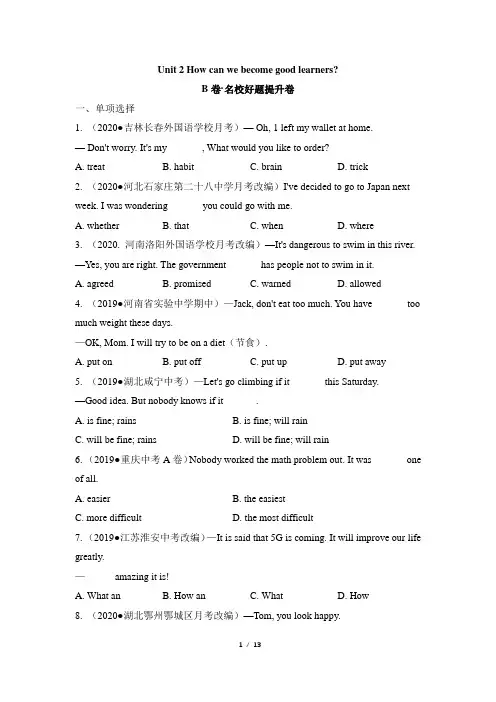
Unit 2 How can we become good learners?B卷·名校好题提升卷一、单项选择1. (2020●吉林长春外国语学校月考)— Oh, 1 left my wallet at home.— Don't worry. It's my ______ , What would you like to order?A. treatB. habitC. brainD. trick2. (2020●河北石家庄第二十八中学月考改编)I've decided to go to Japan next week. I was wondering ______ you could go with me.A. whetherB. thatC. whenD. where3. (2020. 河南洛阳外国语学校月考改编)—It's dangerous to swim in this river. —Yes, you are right. The government ______ has people not to swim in it.A. agreedB. promisedC. warnedD. allowed4. (2019●河南省实验中学期中)—Jack, don't eat too much. You have ______ too much weight these days.—OK, Mom. I will try to be on a diet(节食).A. put onB. put offC. put upD. put away5. (2019●湖北咸宁中考)—Let's go climbing if it ______ this Saturday. —Good idea. But nobody knows if it ______.A. is fine; rainsB. is fine; will rainC. will be fine; rainsD. will be fine; will rain6. (2019●重庆中考A卷)Nobody worked the math problem out. It was ______ one of all.A. easierB. the easiestC. more difficultD. the most difficult7. (2019●江苏淮安中考改编)—It is said that 5G is coming. It will improve our life greatly.—______amazing it is!A. What anB. How anC. WhatD. How8. (2020●湖北鄂州鄂城区月考改编)—Tom, you look happy.—______? I got an A in my English exam.A. How comeB. What forC. Why notD. Guess what二、(2019●湖北孝感中考改编)完形填空At a dark night, a man came to a lonely village. When he walked slowly, a yellow light suddenly 1 the end of the road. It came from a 2 which "Blind? "the man said. "That's too 3 . A blind man has no idea of day and night, can't 4 the beauty of nature, or even doesn't know what the light is. Wasn't he funny to carry a lantern? "As the lantern was coming near, the yellow light moved gradually to the man. The man asked, " 5 , may I ask you whether you're really blind? "The blind man answered, "Yes, the moment I stepped into the world, I can't see 6 ."The man asked," In that case, 7 do you carry a lantern? "The blind man smiled, "At night all the people without light are just as blind 8 me, so I light a lantern."The man said, "I see, you light for others."But the blind man said, "No, I do it for 9 .""For yourself? But there is no 10 to do that, "the man felt surprised again.The blind man explained, "Were you ever knocked by others 11 the dark? "The man nodded, "Yes, sometimes."The blind man said proudly, "Believe it or not, I 12 knocked anyone. Although I'm blind, I carry the lantern, not only to light for others, but to let others see me, 13 they won't knock me. "After hearing that, the man was lost in thought…In fact, everyone has a lamp in himself. Light it actively not only for others, but also for yourself —never put yourself in a dark 14 . When you feel left out and find it hard, to 15 well with others, are you ready to light your lamp?1. A. appeared B. fell C. went D. closed2. A. basket B. toy C. lantern D. bag3. A. folk B. clear C. useful D. strange4. A. hear B. enjoy C. steal D. punish5. A. Excuse me B. Come on C. I'm sorry D. Never mind6. A. something B. nothing C. everything D. anything7. A. how B. why C. where D. which8. A. as B. like C. to D. of9. A. yourself B. himself C. myself D. ourselves10. A. time B. need C. tradition D. problem11. A. such as B. instead of C. because of D. as for12. A. always B. never C. often D. usually13. A. after B. so C. if D. because14. A. situation B. village C. dream D. country15. A. turn on B. hold on C. put on D. get on三、阅读理解A(2019●福建莆田毕业班质量检查)1. What's the purpose of the competition?A. To send a photo.B. To design a bookmark.C. To win stationery.D. To celebrate the World Book Day.2. How many tips about designing are there in the text?A. One.B. Two.C. Three.D. Four.3. To take part in the competition, you should ______.A. mail your bookmark to STABILOB. take a photo of the stationeryC. send your entry to The Week JuniorD. design the bookmark after April 20th4. You can get more information on STABILO ______.A. by emailB. by letterC. on the phoneD. on the website5. The text is probably a ______.A. poemB. posterC. reportD. storyB(2019●吉林中考改编)In many countries around the world, May 1st is a holiday which is called Labor Day or Workers' Day. It is an interesting holiday that honors working people and their jobs. But do you know how it started?During the late 1880s, in many parts of the world, people worked for fourteen to sixteen hours a day in factories, but made very little money. Later, in the United States and Canada, working people got together to set up unions(工会). The union leaders asked factory bosses for shorter working time and higher salaries(工资), but many of the bosses ▲.On May 1st, 1886, men and women in the United States and Canada stopped working and went onto the streets. They walked through cities and towns to force bosses to let them work eight hours a day. In the city of Chicago, several people died in fighting with the police. Over the next few years, people in cities around the wordstopped working on May 1st to honor workers everywhere. By the early twentieth century, the first of May became a national holiday in many countries.However, in the United States and Canada, May 1st is not a holiday. North Americans celebrate Labor Day on the first Monday in September. Today in the United States, Labor Day is mostly about having fun. People enjoy a long weekend and often celebrate it by having picnics with friends or family. In many parts of the United States, Labor Day is also the last day of summer vacation, and students return to school the next day.6. How long did people work a day in factories in the late 1880s?A. For 8 - 10 hours.B. For 10 - 12 hours.C. For 12 - 14 hours.D. For 14 - 16 hours.7. Which can be the best for ▲?A. refused their ideasB. accepted their ideasC. agreed with themD. understood them8. Which is the right order(顺序)of the following events?①Working people began to fight for better life.②People stopped working on May 1st to honor workers.③Working people set up unions.A.①②③B.②①③C.③②①D.③①②9. How do people often celebrate Labor Day in America nowadays?A. By working all day.B. By giving gifts to working people.C. By having fun with friends or family.D. By having a big ceremony.四、任务型阅读阅读下面短文,根据短文内容,完成下列各题。
九年级英语Unit 2 单元测试卷(含答案)
Unit 2 单元测试卷(含答案)一、选择题(每小题1分, 共9分)1.—Jenny, do Chinese people celebrate ____ Easter Day?—No, this is the first time I’ve celebrated ____ festival.A. the; theB. the; aC. /; theD. /; a2.—Look at the photo I took in Jinghong, Yunnan Province. ____ the Dai people are having!—Wow! They were celebrating the Water festival.A. What funB. How funC. What a funD. How a fun3.Scrooge doesn’t treat others nicely. He just cares about____ he can make more money and he hates Christmas.A. whoB. whatC. whichD. whether4. The doctor warned my father____.A. to smokeB. not smokingC. not to smokeD. smoking5.Mr. Smith always ____ his students to work hard at all the subjects.A. makesB. mindsC. expectsD. sees6. —What should I do in order to play the piano well?—, you should make a reasonable plan; then practice every day, and stick to it.A. To begin withB. To be honestC. To my surprise7. Parents should let their children do housework in their free time instead of only studying to improve their living .A. activitiesB. stylesC. skills8. —You’re to be a volunteer of the Children’s Project, congratulations!8 / 8—Thank you very much. I’ll do my best to help the disabled children.A. joinedB. respectedC. chosen9. —It’s necessary for Chinese teenagers to know more about China. I wonder. —I think they should watch the documentary Amazing China.A. why they love China so muchB. when they can do something for ChinaC. how they can get a better understanding of China二、完形填空(每小题1分, 共10分)Thanksgiving Day was near. The first grade teacher asked 1 students to draw a picture of something that they were thankful for. People celebrated the holiday 2 turkey and other traditional foods of the season. So, most of her students’ pictures were about them.3 , Peter drew a different kind of picture. Peter was a different kind of boy. He always looked sad. When asked to draw a picture of something for which he was thankful, he drew a4 . Other students were all very interested in the picture. Whose hand could it be? One child guessed it was the hand of a farmer, because farmers feed5 . Another thought it was the hand of a policeman, because the police6 and care for people. Still others guessed it was the hand of God. The discussion went on until the teacher almost7 the young artist.During the break, all children ran out of the classroom except Peter. The teacher came to Peter’s ___8___, bent(俯身)down, and asked him whose hand it was. The little boy 9 said in a low voices, “It’s yours, teacher."She remembered the times she took his hand and walked with him here or there. She 10 said, “Take my hand, Peter. Let’s go outside” or “Let me show you how to use your pe ncil.” Peter was very thankful for his teacher.( ) 1. A. his B. her C. our D. my8 / 8( ) 2. A. at B. in C. for D. with( ) 3. A. Anyway B. Then C. However D. Instead( ) 4. A. head B. farmer C. hand D. policeman( ) 5. A. sheep B. cows C. pigs D. turkeys( ) 6. A. punish B. protect C. catch D. call( ) 7. A. admired B. noticed C. forgot D. found( ) 8. A. desk B. classroom C. house D. school( ) 9. A. gave up B. dressed up C. looked up D. stayed up( ) 10. A. still B. even C. often D. never三、阅读理解(一)(每小题2分, 共10分)阅读下面文字, 从A到F选项中为每个段落选出一个最合适的小标题。
最新人教版九年级全一册英语unit 2单元测评试卷及答案
Mike?
—Because he made too many mistakes in his homework.
A. see B. tell C. save D. punish
trick on
( B )23. —Can you tell the differences between these two pictures?
(Ⅱ)录音中有五组小对话, 听一遍后, 选择最佳答案。(5分) ( B )6. What festival is it? A. Spring Festival. B. Dragon Boat Festival. C. Mid-autumn Festival. ( C )7. What did the woman buy for her husband for Christmas? A. A coat. B. A tie. C. A watch.
( C )15. What did the boy see the people eat on Dragon Boat Festival? A. Dumplings. B. Fish. C. Zongzi.
(Ⅳ)录音中有一篇短文, 听两遍后, 选择最佳答案。(5分) ( B )16. When did Jenny write the letter to Lucy? A. On November 25th. B. On December 5th. C. On December 24th. ( B )17. When did Jenny leave Lucy? A. About four weeks ago. B. About two months ago. C. About one year ago.
选出最佳选项。 Every April, there is a special day in China. It is Qingming Festival, also
人教版新目标初中英语九年级上册Unit 2同步测试题及答案
人教版新目标初中英语九年级上册Unit 2同步测试题及答案第二部分英语知识运用Ⅰ. 根据句意和汉语或首字母提示补全单词(每小题1分,共10分)21. The old woman is afraid of flying in an_______ (飞机).22. —What _______(造成) the traffic accident?—The bad weather.23. T ell me_______(确切地) where he lives so that I can find him.24. In the end, they made a difficult _______ (决定) to send their son to a boys’ boarding school.25. My young brother likes reading _______ (连环漫画) very much.26. —T om, you should pay a_______ to your spelling.—Sorry, I will.27. Mary used to c______ gum a lot in class, but now she doesn’t do again.28. These days I hardly have time to c______ with my friends on the Internet.29. Our English teacher was very p_______ and helpful.30. You eat too much c_______. It’s bad for your teeth.Ⅱ. 单项选择(每小题1分,共15分)31. He_______ suffer the Internet after school, but now he doesn’t like it.A. use toB. using toC. used toD. uses to32. Mary is afraid to go out at night because she is ______ the dark.A. terrified ofB. interested inC. worried aboutD. angry with33. Many girls are terrified of _______ alone at night, but my sister isn’t.A. walkB. walkingC. walkedD. to walk34. —I don’t know how to study English well.—I think you should _______ your spelling.A. pay attention toB. listen toC. worry aboutD. pay for35. _______we are clever, we still need to work hard.A. IfB. UnlessC. Even thoughD. Since36. Her mother couldn’t _______to pay for her children’s education because her family is very poor.A. wantB. affordC. tryD. offer37. My brother likes to sleep ______ the light _______.A. on; on C. with; on C. with; turn on D. with; in38. —Do you have any trouble ______ the teachers in class, Jim?—Yes, especially in Chinese class.A. to understandB. understandC. understandingD. understood39. When he was young, he was ______ in science.A. interestingB. interestedC. interestsD. interest40. Mario used to ______ after school.A. practice playing the pianoB. practicing playing the pianoC. practice play the pianoD. to practice playing the piano41. I used to spend two hours ______ my homework, but now only one hour.A. doingB. doC. to doD. did42. Pleas e don’t give up ______ and you’ll succeed in the end.A. tryB. tryingC. to tryD. tries43. —Did they solve all the problems______?—Yes, they did.A. at the endB. at the end ofC. in the endD. by the end of44. It _______ that T ony has changed a lot.A. look likeB. seemsC. lookD. seemed45. —_______ work in a car factory?—No. I used to work in a computer company.A. Did you used toB. Did you use toC. Do you used toD. Do you usetoⅢ.46. When Martin was a child, he caused problems for _______ and his family.47. The girl is ______ of the dark, so she doesn’t go out in the evening.48. His father’s ______ made him very sad.49. T o our ______, he didn’t die and came back again.50. You have to make a quick _______ before it rains.Ⅳ. 句型转换(每小题2分,共10分)51. I used to watch TV in the evenings. (改为否定句)I ______ _____ to watch TV in the evenings.52. Jeff used to be shy. (改为反意疑问句)Jeff used to be shy, _______ ______?53. We walked to school before. But now we don’t. (合并为一句)We _______ ______ _______ to school.54. My mother used to work in a supermarket.(就划线部分提问)_______ did your mother use _______ ______?55. I used to spend two hours chatting online. (就划线部分提问)_______ ____ ______ you use to spend chatting online?Ⅴ. 根据汉语提示完成下列句子(每小题2分,共10分)56. 我以前非常惧怕黑暗。
九年级英语Unit2单元测试题(含答案)
九年级英语Unit2 单元测试卷第一卷 (共61分)一、单项选择(共10小题;每小题1分,满分10分)1. --- Why not put all our money into this business? We’ll make big money.--- _________! What if the business doesn’t go the way we want?A. It doesn’t make senseB. What a pityC. Good luckD. How wonderful2. _________ she was a clever student, she worked out the problem without difficulty.A. IfB. WhenC. SinceD. Although3. She hardly has breakfast at the school, _________?A. hasn’t sheB. doesn’t sheC. has sheD. does she4. Cathy feels _________ when her parents are _________ from home.A. alone; notB. lonely; awayC. alone; awayD. lonely; free5. _________ the war prisoners home is acceptable _________ both sides.A. Send; toB. Sent; fromC. Sending; toD. To send; from6. When they got _________, they found the door _________.A. close; closedB. closed; closeC. closely; closedD. closed; closed7. They had trouble _________ the way out.A. to findB. to look forC. looking forD. finding8. He doesn’t like the book. I don’t, _________.A. alsoB. tooC. eitherD. neither9. The soup has gone _________. Don’t try!A. badB. badlyC. worseD. worst10. The girl kept _________ when she _________ why she did that by her parents.A. quietly; was askedB. quiet; was askedC. quietly; askedD. quiet; asked二、语法选择(共15小题;每小题1分,满分15分)We may be very pleased with the rapid progress we have made in every field of study. But the way to test a student’s knowledge and ability still ___11___ poor. To a certain degree, it was even as terrible as it was one ___12___ years ago, and we have done almost ___13___ to improve our examination system.It is ___14___ known that the examination system we are now using may be a good way of testing a student’s memory, ___15___ it can tell you very little about a student’s ability. It does no good ___16___ students and teachers. As soon as a child begins school, he enters ___17___ world of examinations that will decide his future. So he has to bury himself in mountains of books and papers preparing for the tests.In fact, a good examination system ___18___ train a student to think for ___19___. But it now does nothing of the sort. So students ___20___ to remember what is taught. It does not enable them ___21___ more and more knowledge. The students who come ___22___ in the examination may often not be the best in their future career. The achievements ___23___ they make are not so excellent as we expected.Besides, examination often drives teachers to “teach to the test”. They are forced to train students what to do with the coming examination from time to time, which makes lessons ___24___. There must be some ___25___ and better way to test a student’s ability than memory test. That’s what we should do at once.11. A. remain B. remains C. remained D. to remain12. A. hundreds B. hundred of C. hundred D. hundreds of13. A. anything B. everything C. nothing D. something14. A. well B. better C. best D. good15. A. and B. if C. otherwise D. but16. A. to B. at C. on D. with17. A. a B. an C. the D. /18. A. must B. should C. can D. would19. A. him B. them C. themselves D. himself20. A. encouraged B. are encouraged C. have encourage D. to encourage21. A. gain B. gaining C. to gain D. gains22. A. firstly B. at first C. one D. first23. A. who B. when C. which D. what24. A. boring B. bored C. bore D. bores25. A. simply B. simple C. simplest D. simpler三、完形填空(共20小题;每小题0.5分,满分10分)“I just can’t help thinking that it isn’t fai r to Tara,” sighed my mother last week, for no obvious ___26___. I knew what she meant. In fact, I sort of feel it, too, ___27___ it’s almost impossible to explain.Two years ago, the situation was ___29___. We had two babies: Ruby, the older one, and Tara, the younger who was playful and cute. Even at five years old, Tara still felt like our baby. But then we had Orla. Ruby, aged seven at the time, became the eldest of three, but Tara lost her ___30___ as the baby, along with all its advantages. Now she is sandwiched between an outgoing ___31___ sister and a cute little one.Somehow, life can just seem ___32___ for Tara. Bedtime is a good example. Nine-year-old Ruby likes lots of ___33___ and some time on her own in bed, listening to her iPod, reading and playing. That’s ___34___ arranged. Orla likes to be hugged as she goes to sleep. ___35___, Tara would really like someone to lie with her, ___36___ her day and her book. Sometimes I’ll walk out of Orla’s room at 10 pm after falling asleep beside her, to find Tara ___37___, still waiting formy hug. She also gets signed up for the ___38___ after-school clubs as her elder sister although I know she isn’t interested in them.Of the three, Tara is the most likely to ___39___ around alone, saying, “It’s not ___40___.”And quite often she has a point. The middle child often has to watch the elder sibling ___41___ the way, getting all that ___42___ of the first-born. The youngest has the benefit of being the baby. So what ___43___ does the middle child play?I can ___44___ see the situation in Tara. She is the one who gets herself up and dressed every morning, who brushes her hair and her teeth, packs her bag for school and ___45___ me about all the things I’ve probably forgotten.26. A. blame B. reason C. purpose D. mistake27. A. now that B. as if C. even though D. in case28. A. naughty B. clever C. middle D. stupid29. A. simpler B. harder C. complex D. confusing30. A. place B. time C. space D. size31. A. taller B. smaller C. younger D. elder32. A. clear B. tough C. short D. colorful33. A. attention B. privacy C. admiration D. protection34. A. easily B. difficultly C. hardly D. softly35. A. Therefore B. However C. Otherwise D. Anyway36. A. stealing B. robbing C. sharing D. explaining37. A. asleep B. awake C. frozen D. gone38. A. right B. different C. big D. same39. A. wander B. jump C. run D. swim40. A. true B. perfect C. bad D. fair41. A. making B. leading C. losing D. waiting42. A. emotion B. insight C. focus D. mind43. A. game B. toy C. job D. role44. A. certainly B. doubtfully C. suddenly D. hopefully45. A. encourages B. records C. reminds D. guides四、阅读(共两节,满分26分)第一节阅读理解(共18小题:46-50每小题1分,51- 58每小题2分,满分21分) It is a question that has confused parents for many years: why do children refuse to eat greens? Now, two American experts believe they have the answer. After studying dozens of babies as they played with different objects, the researchers noted that they were far more unwilling to touch plants than other things. They believe this is because evolution (生物进化) has biologically made children be wary of plants.Because of susceptibility (敏感性) to illness or injury in the early years of life, the body has designed an inner defence mechanism (内部保护机制) that limits a child’s contact with plants,they think. The researchers believe this is why babies in the study were afraid of touching plants and why children turn their noses up when faced with a plate of broad beans.The findings are published in a paper by Dr Annie E Wertz and Dr Karen Wynn, both psychologists at Yale University. They wrote, “Throughout human evoluti o n…plants have been important in human’s life. Yet, for all of these benefits, plants have always caused very real dangers.”“Plants produce toxin (毒素) as defences that can be harmful, or even deadly. Some plants also produce physical defences, such as thorns (荆棘) can damage tissues (组织) and cause effects over the whole body.”They added, “We predicted that babies may have behavioural strategies that reduce dangers caused by plants.”To test their theory, the researchers studied how children aged eight to 18 months old reacted when presented with a variety of objects. It took much longer for children to grab plants; objects that were pretended to look like plants also caused a slow response time.For parents attempting to spoon some peas into the mouth of their child, this finding should come as welcome relief.46. The underlined word “they” in Paragraph 1 refers to __________.A. the parentsB. the researchersC. the babiesD. the plants47. What does the underlined word “wary” in t he first paragraph mean?A. curiousB. afraidC. tiredD. certain48. What did early humans probably do in order to keep away from ilLness or injury?A. They choose to make more man-made things.B. They didn’t allow their children to touch plants.C. They chose to have little contact with plants.D. They tried very hard to escape from the past.49. What was plants’ role in early human’s life?A. They were important, in spite of danger.B. They reacted badly to human evolution.C. They contributed to the most deaths and illness.D. They developed human physical defences against dangers.50. What’s the passage mainly about?A. Why some plants are harmful.B. How humans react to plants.C. Why children don’t like to eat greens.D. When children form behavioural strategies.BMoments before I could lift my case to put it in the plane’s overhead locker ahead of our recent holiday to Europe, my father gently urged me to stop. He held the thick handles of the case and lifted it with his thin arms, pushing it into place with a sigh. “You should relax and be the lady, and let me do the heavy tasks,” he said seriously. “In the future, someone special will come into your life and take over such tasks from me, but that will never happen if you do everything yourself.”I was stunned into silence. This was not the father I remembered from childhood, who trained me to study hard at school, asked me to earn my own pocket money as a teenager at a local coffee shop, and even taught me household chores so that my life alone i n London wouldn’t turn into a mess. But then, eight years after I left home and started a new life in the UK, I realized for the first time that my dad still has expectations for me to be like a princess and to stay dependent and delicate, which were considered necessary qualities of women in traditional China.Well, that came a little late. Little did dad know that over the three years of my university life, I moved flats five times all by myself, dragging suitcases of books and clothes, and waiting for the taxi in the rain while holding tight onto cardboard boxes. Meanwhile, living in the UK a country currently led by a female prime minister I have never thought there is anything girls cannot do. Most of my female friends are professionals working in the City of London, and after work, we frequently go down to the pub for a drink, just like the guys do something my mother never did.I wondered how I might make dad understand the new world his little girl has entered. Perhaps one day, he will realize that “someone special” in my life will appreciate my confidence and independence above dependence, and admit that times have changed.51. What does the underlined word “stunned” in Paragraph 2 probably mean?A. annoyed.B. embarrassed.C. surprised.D. excited.52. W hat qualities of women did traditional Chinese appreciate according to Paragraph 2?A. Dependent and gentle.B. Hardworking and tough.C. Beautiful and confident.D. Independent and ambitious.53. What’s the author’s purpose by mentioning her stay in London?A. To complain how strict her father was.B. To describe how hard her life in the UK was.C. To regret not working hard enough at school.D. To show she was used to living independently.54. What can we infer about the author according to the last paragraph?A. She has a misunderstanding of her father.B. She thinks women should be independent.C. She longs to meet her life partner in the UK:D. She is thankful for her father’s strict training.CWhen Liberia was my home, they called it sweet. Sweet was the word I remembered most during the war. When I was five, my father, two sisters and I fled from Monrovia, the capital city of Liberia, and headed north on foot among panicked masses of criers a journey that ended in a village where we hid from flying bullets (子弹). Every dawn, my sisters and I joined my father and covered the pages of his small journal with words. My favorite word to write was“‘sweet,” one that had the power to numb the reality of our 6-month abandonment (抛弃) by peace and civilization.Eventually, we were considered the lucky ones: part of the wave of refugees who left Liberia in 1990 to settle in America. My mother studied at Columbia University at the time, and we made our new home in her dormitory while awaiting her graduation. My father who left early in the mornings looked for work or news of a possible return to Liberia, only to return home with nothing to give us but new words to write in notebooks. He quickly found that the education he received in Liberia was not good enough for an engineering job in the United States. So he took whatever job he could find to make sure we always had food on the table and books.In 2011, I founded a children’s book publishing company: One More Book. It provides children’s literature for the children of countries with low literacy (识字) rates and underrepresented cultures by publishing culturally relevant books that have something meaningful to say to them. My hope is to give children the peace I was given through the words of my father, by allowing them to see themselves in literature. I also think it is important to provide books about foreign countries to children in the United States, to increase the overall awareness of the world outside them.I will never be able to give my father back the twenty years he spent working to educate us, or the home and life in Liberia he lost. I repay his sacrifice (牺牲) by honoring the education he fought for and offering my art to the world, with stories that make the histories of my people come alive, and with words to live by.55. What was the author’s family’s life like in Liberia?A. Sweet and peaceful.B Frightening but positive.C. Comfortable but boring.D. Adventurous and exciting.56. What can we infer from Paragraph 2 about the aut hor’s father?A. He was crazy about reading.B. He regretted moving to America.C. He worked bard to support his family.D. He tried to receive a higher education.57. Why did the author found One More Book?A. To meet poor children’s growing demands.B. To provide multicultural books for children.C. To support her father’s books about Liberia.D. To help immigrants understand American culture.58. What does the author want to express in the last paragraph?A. Her pity for her father’s suffering.B. Her th anks to her father’s devotion.C. Her pride in working for her people.D. Her disappointment over the life in Liberia.第二节阅读填空(共5小题;每小题1分,满分5分)Making Peace with Your ParentsAs a te en, you’re going trough big changes p hysically and mentally. Your interests are increasing. _____59_____. Here is the challenge: Kids need to explore the world in new ways, and parents need to protect them from the dangers that are all out in that word. These conflicts can easily set off fireworks in otherwise calm houses. Sometimes confl icts can’t be avoided. But by paying attention to the building blocks of successful relationships, you can work towards making home a happy and healthy place for you and your parents.For example, try to find a time to talk when your parents are not angry, tired, distracted or hungry. A good time to talk is when you’re all relaxed. Timing is everything. If the conversation begins to turn into an argument, you’d better calmly and coolly ask to stop the conversation for now. _____60_____. Listen to what your parents are saying, and repeat it back to therm. This shows them that you’re listening. _____61_____. Respect is the building block of good communication. People who respect each other and care about each others’ feelings can disagree without getting things ugly. _____62_____. How do you build trust? Trust comes by actually doing what you say you’re going to do. Some teens find that doing fun activities with their parents can improve their relationships. Sometimes we forget that parents are more than rule-maker—they’re interesting people who like to watch movies and go shopping—j ust like their teenagers!What do you do if you are trying your best, but your relationship with your parents continues to be rocky? _____63_____. You can find supportive adults, such as a teacher or a coach, who can lend an ear. Remember you can only change your own behavior. Your parents are the only ones who can change theirs.A. You may consider seeking outside help.B. And then you’ll be able to accept what yo ur parents say.C. You can pick it up again when everyone’s more relaxed.D. Faced with the challenge, children don’t know what to do.E. And your desire to take control of your own life is growing.F. It also gives them a chance to clear things up if you’re not on the same page.G. You are more likely to get along with your parents and have more independence if your parents believe in you.第二卷(共39分)五、写作(共四节,满分39分)第一节单词拼写(共20小题;每小题0.5分,满分10分)请使用第三单元课本的相关表达完成以下部分。