
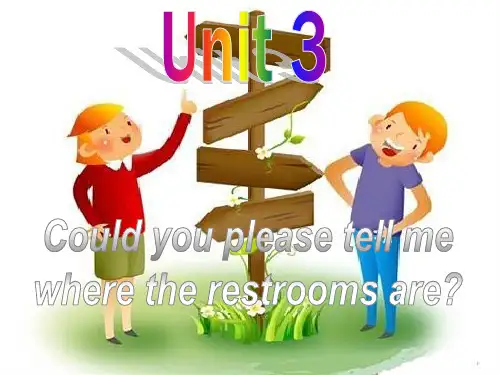
Unit 3 Could you please tell me where the
interesting, fascinating, inexpensive, quiet uncrowded, big, beautiful, convenient, safe, clean
The park is __b_e_a_u_ti_fu_l_,_in_t_e_r_es_t_in_g_,_s_a_f_e_, _b_ig__.
Translation
interesting fascinating inexpensive uncrowded
big beautiful convenient
safe clean
有趣的;引起兴趣的, 迷人的;极有吸引力的 不昂贵的 不用急的;人少的 大的 美丽的 便利的;方便的 安全的 干净的
3. …and the clerk tells her to go to the corner
of Market and Middle.
……工作人员告诉她去市场大街和中心大街 交汇的拐角处。 corner是可数名词,意为“拐角;角落”。 常构成短语: ①in the corner of...意为“在......的拐角处/角落里” ►I found a boy crying in the comer of the room. 我发现一个男孩在房间的角落里哭。 ②on/at the corner意为“在拐角处”。 ►The shop is on the corner. 那家商店在拐角处。
③un-表示“不,非”,如: able有能力的 — unable无能力的; like像—unlike不像; crowded拥挤的 — uncrowded不拥挤的;
2. convenient 便利的;方便的 convenient形容词,意为“便利的;方便的”, 其主语不能是表示人的词,常用于句型 It’s convenient for sb. to do sth.,意为“对于 某人来说做某事是方便的”。 It’s convenient for us to start working right now. 我们立刻开始工作是方便的。
1. Review the new words and expressions you’ve learned today.
interesting, fascinating, inexpensive, quiet uncrowded, big, beautiful, convenient, safe, clean
The museum is _i_n_t_er_e_s_ti_n_g_,_q_u_ie_t_,_f_as_c_i_n_a_ti_n_g_.
1b Talk about places in your city using the words in 1a.
The Fine Arts Museum is really interesting.
Yes, and it’s beautiful, too.
The subway is so convenient.
Conversation 3 The mother asks about _a__g_o_o_d_m__u_s_e_u_m__.
The father wants to go to a _h_is_t_o_r_y_museum. The girl wants to go to a _s_c_i_e_n_c_emuseum . The boy wants to go to a _c_h_i_ld_r_e_n_’_s_museum. The older girl wants to go to an__a_rt_ museum . The clerk suggests they go to the c_o_m__p_u_t_e_r__ museum .
For example:
Can you tell me where there’s a good
place to eat?
Of course. What kind of food do
you like?
I like vegetarian food.
There are a lot of good restaurants in Sunville. Why not go to Green Land. They have delicious salads.
2. The museum looks __n_cr_o_w_d_e_d_…__________. 3. The subway in Beijing is _c_o_n_v_e_n_ie_n_t and
_i_n_ex_p_e_n_s_iv_e__. 4. The Grand Canyon is __f_a_sc_i_na_t_in_g_. 5. The restroom is __c_le_a_n and tidy.
restaurant: delicious, clean, inexpensive, convenient park: beautiful, big, interesting, clean, inexpensive
subway: convenient, safe, uncroቤተ መጻሕፍቲ ባይዱded, inexpensive mall: inexpensive, clean, safe, convenient, beautiful
interesting, fascinating, inexpensive, quiet uncrowded, big, beautiful, convenient, safe, clean
Try to describe the places.
The restroom is _c_l_ea_n_,_u_n_c_r_o_w_d_e_d_,_c_o_n_v_e_n_i_en_t_.
Language Points
1. inexpensive 不昂贵的,便宜的 inexpensive形容词,意为“不昂贵的”,其同
义 词为 cheap,反义词为 expensive/dear。 inexpensive是由expensive加上否定前缀in-构 成的。
► The sweater is inexpensive.这件毛衣不贵。
interesting, fascinating, inexpensive, quiet uncrowded, big, beautiful, convenient, safe, clean
The mall is _i_n_e_x_p_e_n_s_iv_e_,_c_o_n_v_e_n_ie_n_t_, _b_ig__.
interesting, fascinating, inexpensive, quiet uncrowded, big, beautiful, convenient, safe, clean
The subway is __co_n_v_e_n_i_e_n_t,_s_a_f_e_, _u_n_cr_o_w__d_ed__.
Can you tell me if there are any public restrooms around here?
Yes, there’s one at the corner of Market and Middle Streets.
Are they clean?
Oh, no. They’re very dirty.
① dis-表示“不;非;相反”,如: like喜欢 — dislike 不喜欢; agree 同意—disagree 不同意。
② in-(im-,ir-)表示“不;非”,如: expensive 昂贵的— inexpensive便宜的; polite礼貌的— impolite不礼貌的; regular有规律的— irregular无规律的。
inexpensive 不贵的
uncrowded 不太拥挤的
beautiful 漂亮的
safe
安全的
fascinating 精彩的
quiet
安静的
big
大的
convenient 方便的
clean
干净的
restroom: clean, uncrowded, inexpensive, safe, big museum: interesting, fascinating, inexpensive, big
1a What qualities are important for each place?
Write the words from the box next to each place below. Write the most important words first!
interesting 有趣的
Unit 3 Could you please tell me where the restrooms are?
Section B
Period 4 1a-1e Period 5 2a-2d
1. To learn the adjectives describing qualities of places clean, interesting, fascinating… 2. To learn to talk about the qualities of places The Fine Arts Museum is really interesting. 3. To listen for specific information and take simple notes 4. To review to ask for information politely Can you tell me where there’s a good place to eat?
interesting, fascinating, inexpensive, quiet uncrowded, big, beautiful, convenient, safe, clean
Unit 3 Could you please tell me where 精品教案(九全)

SectionB(3a—3b)
一、教学目标
1.能够综合运用本单元的目标语言写一封询问信息的信件。
2.能够根据设定的情境,提出相关问题,并整理写作思路。
4.能够在不同的场合使用礼貌及得体的语言。
学生两人一组,写出问句。通过两人一组列问题写源自子的方式,为后面写出礼貌请求做准备。
3.教师引导学生回顾之前所学过的提出礼貌请求的句型。
学生回忆并说出前面所学的提出礼貌请求的句型。
通过回忆句型的活动,激活学生之前所学,为下面改写句子做准备。
4.教师引导学生将表格中的问句用礼貌用语进行改写。
学生进行句子改写。
同时为创设本节课的
情境做铺垫。
Pre-writing
1.教师创设情境(你将要去霍格沃兹学校进行短暂的学习,在出发之前,你想要知道哪些方面的问题),引导学生进行头脑风暴的活动。
学生根据教师创设的情境,思考问题。
通过头脑风暴的方式,激活学生的思维,为下一步的活动积累素材。
2.教师引导学生两人一组进行讨论,将上一步中的问题要点用问句的形式呈现出来。
第3课时SectionB(3a—3b)
How to write a letter of asking for information:
Greeting
A self-introduction
Writing purpose
Main body: your requests
Ending: your thanks and wish
Signature
学生根据自己的偏好,选择三个最想提出的问题。
通过选问题填空的活动,培养学生的思辨能力。同时引导学生形成使用连接词的意识。
课时夺冠九年级英语全册-Unit 3 Could you please tell me where
toilet
park
bookshop
Walk along this road, and take the first turning on the right. It’s about a hundred metres along the on the left.
a hundred metres
train station
• Boy 2: I’m not sure, but you can ask for _in_f_o_r_m_a_t_i_o_n_ over there.
• Boy 1: OK, thanks a lot .
• Boy 2: You’re welcome.
2c
Excuse me. Do you know where I can get some postcards? Sure. Go to the second floor. There is a bookstore between the bank and the supermarket.
• 2a Listen. Fill in the blanks
• Boy 1: Excuse me, can you tell me where I can buy some medicine?
• Boy 2: Yes, there’s a supermarketin this shopping center.
Turn left.
Turn right.
Go / Walk straight on until…
Go past…
Could you tell me where the supermarket is?
supermarket
郑州市九年级英语全册Unit3Couldyoupleasetellmewheretherestroo
郑州市九年级英语全册Unit3Couldyoupleasetellmewheretherestroomsare重点知识归纳单选题1、—Does my question sound ________ enough?—I don’t think so. You can ask more ________ by using “Could” instead of “Can”.A.polite; politelyB.politely; impolitelyC.impolitely; politeD.polite; impolitely答案:A句意:——我的问题听起来有礼貌吗?——我不这么认为。
你可以用“could”而不是“can”更礼貌地询问。
考查形容词和副词的用法。
polite礼貌的,是一个形容词;politely有礼貌地,副词。
第一个空前“sound”意为“听起来”,是系动词,后跟形容词作表语;第二个空修饰动词“ask”,应用副词。
故选A。
2、---_______ is it from Suqian to Jiuzhai valley?---About 1,200 kilometers away. But I’m not sure.A.How oftenB.How soonC.How longD.How far答案:D试题分析:句意:--从宿迁到九寨沟有多远?-大约1200公里远。
但是我不确定。
A.How often多久一次,向频率副词提问;B.How soon多快,询问动作多快将要发生;C.How long多久,问时间的长度;D. How far多远,询问距离。
答语1200千米,是距离,用how far提问。
故选D。
考点:考查特殊疑问词。
3、He asked me we could go to Beijing to watch the game by plane.A.thatB.ifC.howD.what答案:B句意:“他问我是否可以坐飞机去北京看比赛。
unit3Couldyoupleasetellmewheretherestroomsare知识点
例 1: He does come from America. 他的确来自美国。
例 2: Please do be quiet for a moment. 请务必安静一会儿。
11.I suggest Water City Restaurant in Water World. (P19-3a)我推荐水上世界的水城餐馆。
〖辨析〗 shout(动)“ 呼喊;呼叫;大声说 ” 区别 shout at 与 shout to
Shout at
冲 ...大声叫嚷 多指因为生气等而非善意地对某人吼叫
Shout to
对 ...大声叫喊
多指因距离远而不得不大声叫喊,不含感情色 彩
Don ’ sthout at people with your finger. He shouted to the girl so that she could notice him.
〖辨析 2〗until (连)引导时间状语从句,意为 “ 直到 ...为止。” 当 until 用于肯定句时,表示 “直
到...”, 主句的谓语动词必须 是延续性动词 ; 用于否定句时,构成 not...until 结构,表示 “ 直到 ...才”
例: He ran until he was breathless他. 一直跑到气喘吁吁才停下来。 例: I hadn ’t realized she was foreign until she spo她ke不. 说话我还一直不知道她是个外国人。
(P18-2a)超市在花店和书店
5.Turn left.(P18-2a)向左拐。
〖辨析〗 turn left 向”左拐 ” 而 turn right “ 向右拐 ”。 Turn 在此作不及物动词,意为 “ 转向;拐弯 ” 〖拓展〗 turn 的其他用法: ① 作不及物动词 “转动;转身 ” eg.Ricky turned and walked away. 里转身走开了 ②作及物动词 “ 使转动;旋转 ” eg.He turned the key in the lock. 他转动钥匙开锁。 ③作系动词 “ 使变成;成为 ” eg.When Spring comes,the trees turn green. 当春天来了,树变绿了。 ④ 作名词 “ 轮流 ” eg.It ’s your turn to clear off the blackboard.
Unit3Couldyoupleasetellmewheretherestroomsare重点短语句
人教版英语九年级全册第三单元重点短语、句子及其运用Unit 3 Could you please tell me where the restrooms are?1、Could you please tell me where the restrooms are?你能告诉我厕所在哪儿吗?这是一个典型的宾语从句引导特殊疑问句的情况。
原特殊疑问句是:Where are the restrooms? 改为宾语从句以后,变成了陈述语序:Where the restrooms are?2、Excuse me , could you please tell me where I can buy some stamps?打扰一下,你能告诉我在哪儿可以买到一些邮票吗?注意:当要向别人寻求帮助或者提问时,要用Excuse me开头,表示礼貌。
又如:Excuse me , I wonder where there is a restroom? 打扰一下,我想知道哪儿有一个洗手间?3、Sure , just go along Main Street until you pass Center Street.当然,只需要沿着主干道走,直到你经过中心街。
Until直到,有时候也可以用till代替。
另外,until还广泛用于not…until结构中,表示“直到…才”,例如:I won’t give up until I succeed. 我不会放弃,直到我成功为止。
4、Do you know when the bookstore closes today?你知道今天书店什么时候关门吗?这是一个由Do you know 引导特殊疑问句的情况。
另外,还要注意close除了本句中的“关”这个意思,还可以表示“近的、接近的”,常用于短语“be close to…中”。
例如:The supermarket is close to my house , it’s convenient for us to go shopping. 这个超市离我家很近,对我来说去购物是方便的。
九年级_unit_3_Could_you_please_tell_me_where_the_restrooms_are_课文重难点讲解
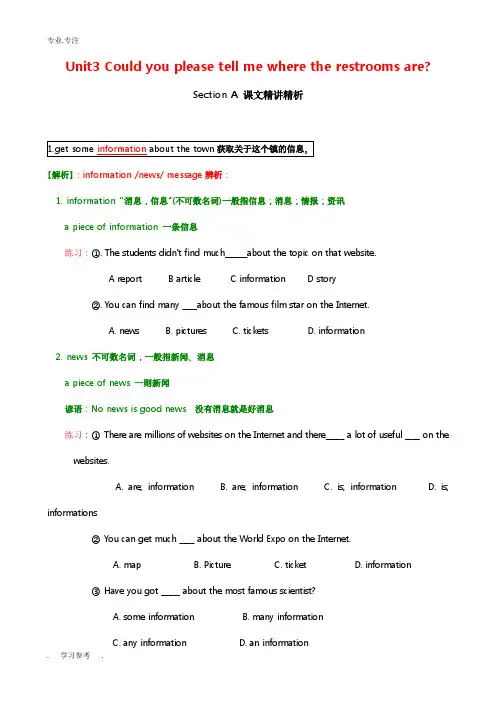
Unit3 Could you please tell me where the restrooms are?Section A 课文精讲精析【解析】:information /news/ message辨析:1. information “消息,信息”(不可数名词)一般指信息;消息;情报;资讯a piece of information 一条信息练习:①. The students didn't find much______about the topic on that website.A reportB articleC informationD story②. You can find many ____about the famous film star on the Internet.A. newsB. picturesC. ticketsD. information2. news 不可数名词,一般指新闻、消息a piece of news 一则新闻谚语:No news is good news 没有消息就是好消息练习:①There are millions of websites on the Internet and there_____ a lot of useful ____ on the websites.A. are; informationB. are; informationC. is; informationD. is; informations②You can get much ____ about the World Expo on the Internet.A. mapB. PictureC. ticketD. information③Have you got _____ about the most famous scientist?A. some informationB. many informationC. any informationD. an information④.----- What a good ________ you've given me! Thanks a lot. ---- My pleasure.A. informationB. newsC. suggestionD. advice3. message可数名词,一般指(书面或口头的)信息、消息、音信。
Unit3Couldyoupleasetellmewheretherestroomsare?知识梳理
Unit3 Could you please tell me where the restrooms are?短语归纳1.劳驾;请原谅____________________2. 到达____________________3.询问(某人)关于某事的情况_____________4. 获取有关……的一些信息_____5.一对;一双;一副____________________6.沿着……走________________________________________ ____________________9.路过;经过____________________ 10.以……开始___________________11快点儿;加油____________________ 12.在某人去…的路上___________ 13.抱歉,对不起;什么,请再说一遍______ 14.朝……走去_______________________________________ 16.引入;导入__________________17.停车场;停车区____________________ 18.准时;按时______________________________________ ____________________21.和……交流____________________ ____________________一/二/三……楼____________________ 24.依赖;取决于_______________ Section A1.get a pair of shoes买一双鞋a pair of一对,一双,一副常用于表示相同的两样东西成对出现或分为两个部分又彼此连接的物体的名词前,该名词要用复数形式。
数词+ pair(s) of+ 名词复数……对/双/副……The girl is wearing a new pair of shoes today.Would you like to buy me another two new pairs of socks?注意pair(s) of 后跟名词作主语时,谓语动词的数与pair的单复数保持一致。
unit3 Could you please tell me where the restaurants are主要知识点归纳
unit3 Could you please tell me where the restaurants are?一.短语归纳1.a pair of 一对,一双,一副2.between A and B在A和B之间3.on one’s / the way to 在去……的路上4.pardon me 什么,请再说一遍5.pass by 路过经过6.look forward to 盼望期待7.excuse me 打扰了请原谅8.get some magazines 得到一些杂志9.get some information about 获取有关……的一些信息10.turn left\right 向左\向右转11.go past 经过路过12.a little earlier 早一点儿13.a good place to eat 一个吃饭的好地方14.in different situation 在不同的情况下15.on time 准时按时16.get to 到达17.have dinner 吃晚餐18.on one’s / \the right在右边e on 快点请过来20.the shopping center 购物中心21.the corner of....... 的角落/拐角处22.lead into 导入引入二.用法集萃1.not ……· until……直到……猜…… You never know until you try something.2.let’s do sth 咱们做某事吧!3.spend time doing sth 话费时间做某事4.thank sb for doing sth 为做某事而感谢某5.would like to do sth 想要做某事6.look forward to doing sth 盼望做某事7. It seems (that)…It seems a rock band plays there every evening.8. Could you please tell me... ?Could you please tell me how to get to the post office?9.take的用法① take some food take some medicine (=have吃,喝)②take notes做笔记③ take one’s temperat ure ( 测量)④ It takes sb some time/money to do something (花费,需要)⑤ I’ll take this coat.(=buy购买)⑥ take somebody / something to (带领,拿去,取)⑦take a train to Chongqing (乘坐)⑧ take off(脱下)10.turn 的用法turn to page 80 翻到It is your turn.轮到你了。
Unit 3 Could you please tell me where the restrooms are知识点及练习
Unit 3. Could you please tell me where the restrooms are?一、宾语从句宾语从句在复合句中作主句的宾语。
句型构成:连接词+ 主语+ 谓语1. 常由下面的一些连接词引导:①由that 引导,表示陈述意义that 可省略E.g. He says (that) he is at home. 他说他在家里。
②由if , whether 引导,表示一般疑问意义(带有是否、已否、对否等)E.g. I don’t know if / whether Wei Hua likes fish. 我不知道韦华是否喜欢鱼。
③由连接代词(who, whom, whose, what, which)、连接副词(when, where, why, how)引导 ,表示特殊疑问意义E.g. Do you know what he wants to buy? 你知道他想要买什么吗?2. 宾语从句的语序宾语从句的语序应为陈述句的语序。
例如:I hear (that) physics isn’t easy.I think (that) you will like this school soon.Can you tell me how I can get to zoo?Please tell me when we’ll have the meeting.3. 从句时态要与主句一致①当主句是一般现在时,从句根据情况使用任何时态He says (that ) he is at home. 他说他在家里。
I don’t know (that) she is singing now. 我不知道她正在唱歌。
She wants to know if I have finished my homework. 她想知道我是否已经完成了我的作业。
Do you know when he will be back? 你知道他将会什么时候回来?②当主句是一般过去时,从句应使用过去某时态(一般过去时,过去进行时,过去将来时,过去完成时)He said (that) he was at home. 他说他在家里。
最新Unit-3-Could-you-please-tell-me-where-the-restrooms-are知识点整理资料
Unit 3 Could you tell me where the restrooms are?语法宾语从句的用法:1.定义:动词后的句子叫宾语从句。
I think我认为I wonder我想知道He said他说或He said to me 他对我说He asked他问或He asked me他问我He told me他告诉我2.语序:宾语从句用陈述语序(陈述语序=引导词+肯定句的构成)①一般现在时的陈述语序是:引导词+主语+ is/are/are +其他。
或引导词+主语+ 动词原形/三单+其他②一般过去时的陈述语序是:引导词+主语+was/were+其他。
或引导词+主语+动词的过去式+其他。
③现在进行时的陈述语序是:引导词+主语+ is/am/are+ 动词-ing +其他。
④过去进行时的陈述语序是:引导词+主语+ was/were+ 动词-ing +其他。
⑤一般将来时的陈述语序是:引导词+主语+is/am/are going to+动词原形+其他。
或引导词+主语+will+动词原形+其他。
⑥过去将来时的陈述语序是:引导词+主语+was/were going to+动词原形+其他。
或引导词+主语+would+动词原形+其他。
⑦现在完成时的陈述语序是:引导词+主语+have/has+动词过去分词+其他。
⑧过去完成时的陈述语序是:引导词+主语+had+动词过去分词+其他。
3.引导词:宾语从句的引导词有三类:①that可省略,不翻译。
He says (that) he will study hard next term.②if/whether是否I wondered if/whether he would come here.③特殊疑问词:如what,where,how,when等。
My teacher asked me where I lived.4.时态:当主句是一般过去时时,宾语从句必须用过去的某种时态(如一般过去时,过去进行时,过去将来时,过去完成时)①He does his homework every day.→His mother said that he did his homeworkevery day.②He is listening to tapes. →His mother said that he was listening to tapes.③He will return here next Friday. →His mother said that he would return herethe next Friday.④He has already finished reading the book. →His mother said that he hadalready finished reading the book.注意:当宾语从句是客观事实或普遍真理时,永远都用一般现在时。