
unit6 caring for your health
Unit 6 Caring for your health Ⅰ. 重点词汇 1. conduct v. 实施; 执行 n.行为,举止 I decided to conduct a survey on the eating habits of the students in our school. _____________________________________________________________ 【运用】 1. 我决定做一个实验来帮助我获得完整的数据。 I decided to ______ _______ ______ to help me get complete data. 2. force v. 强迫; 迫使 (某人做某事)→ ____________adj.强有力的,有说服力的 【搭配】force sb. to do sth _____________
1. No one can force you on this problem. You can decide by yourself. ____________________________________________________ 2. 她强迫自己对他们保持礼貌和耐心。 ___________________________________________________ 【运用】3. Bad health ______ (force) her into a long period of rest. 4. He was________ (force) to accept the task. 3. cheer v. 鼓励; 鼓舞→ ____________adj. 快乐的,高兴的 【搭配】cheer … up _______________
1. He noticed that the people around him were cheered by the President’s presence. _______________________________________________________________ 2. 她的歌总能使我振作起来。 _____________________________________________ 【运用】 4. 来自祖国的消息使他受到鼓舞。 He _____ _____ ______ the news from his country. 5. 我估计她是思念家乡了。也许你可以让她高兴起来。 I think she misses her hometown. Maybe you can _____ ______ _____. 4. sick adj. (身体或精神)生病的、有病的→ ____________n. 疾病、不健康 【区别】sick _________________________________________ ill___________________________________________ 【运用】1. She is taking care of the _________ child. 2. She’s been off work because of____________. 3. He is seriously__________in hospital. 5. quarrel n. 争吵 【搭配】have a quarrel with sb ________________ 【运用】他刚才与朋友争吵起来 _______________________________ Ⅱ. 重点句型 1. They focus too much on studying, dealing with peer pressure and worrying about what others think, and not enough on other things. ① focus on ________________ 1. Each exercise focuses on a different grammar point. focus 也可以作名词,意为“中心点” 2. It was the main focus of attention at the meeting. ② deal with 处理,解决=______________ He could deal with/do with the matter alone deal with 多与how 连用,而do with 则与what 连用 I really don’t know how to deal with this problem=I really don’t know what to do with this problem ③ worry about 担心=_________________ 他担心期末考试 _______________________________________________________________ 2. You may wonder whether stress is a serious matter. ① wonder 想知道=_____________后可接宾语从句 I wonder if he is right. wonder about sth 想知道 We are wondering about next Sunday for vacation. wonder 还可用作可数名词,意为“奇迹,奇观” It is one of the natural wonders of the world. ② whether,“是否”,其后接动词不定式或宾语从句。 1. 用在discuss之后。 They are discussing whether they clean the room. 2. 用于介词后。 He is not interested in whether he will win. 3. 后接不定式 I haven’t decided whether to go. 4. 直接与or not连用 I don’t know whether or not he will call me. 3. You should always look on the bright side of life, and image that you will have happy and successful future. ① look on the bright side (对不好的状态)持乐观的态度 It is important to look on the bright side of work when you fail. ② imagine 想象,认为,其后接名词、动名词、从句作宾语。 1. Try to imagine __________(be) in the sun. 2. 他认为父母不喜欢他。__________________________ ③ successful __________adj.成功的→ ___________v.成功→ ___________n.成功 succeed in doing sth ___________ If you put your heart into studying English, you will be__________(success) in the future. His efforts finally met with some ____________(success) I __________(success) in passing the exam. 4. When you are busy with a hobby, you leave all your worries behind. ① be busy with 忙于...... 那时汤姆正忙着做家庭作业。 _______________________________ be busy doing sth ___________________ Joyce is very busy working on the school newspaper. ② leave......behind 你应该学会将压力抛在后面。__________________________________ 5. Sometimes laughter is the best medicine for stress. Sometimes 有时=______________ 辨析: sometimes 有时 频度副词,表示动作发生的频率 用 how often 提问 some times 几次\倍 time 此处为可数名词,意为“倍;次” 用how many times 提问 sometime 某个时间 副词,用来指过去或将来某一不确定的时间 用when提问 some time 一段时间 用来表示一段时间 用how long提问 根据句意从上面选择适当的短语并用其正确形式填空, 补全句子。 1. You should ______ all your trouble _______, and just enjoy the party. 2. The speech made by our teacher was great success. His encouraging words ______ all the students _______. 3. You need to _______ the stranger who has been standing near your house for a long time. 4. Thousands of people are ______ food shortage in this area. 5. Don’t bother (打扰) us. We _______ our homework. 6. The new manager doesn’t know how to _________ the matter. I. 根据下列句子及所给单词的首字母写出所缺单词。 1. Some plants are e________ of nature because they destroy the balance of nature. 2. If you want to be healthy, you have to eat on time and keep a r_______ diet. 3. I don’t know w_______ he will come back next Friday. 4. We will c______ the picnic on the beach if it rains tomorrow. 5. Don’t f______ me to do anything. I won’t listen to you. 6. When he faces strangers, he always keeps s_______ and doesn’t say anything. 7. Everyone in this country has responsibility to g_____ this country. 8. There’ re different kinds of m______ in this shop, such as piano and guitar. 9. You shouldn’t have a q_____ with your parents. Their advice is good for you. 10. There will be a c_____ in the hall next month, and it will be held by a famous musician. II. 同义替换。 ( ) 11. If you want to get an answer to the question, you first have to conduct a survey. A. take out B. carry out C. think over ( ) 12. Leading a balanced life is helpful to reduce the pressure in our life. A. stress B. energy C. danger ( ) 13. They are cooking in the kitchen, and talking with each other now and then.
译林版八年级英语下册Unit 6 综合素质评价含答案

译林版八年级英语下册Unit 6 综合素质评价限时: 100分钟满分: 100分一、单项选择(每小题1 分,共15 分)从A、B、C、D 四个选项中,选出可以填入空白处的最佳选项。
( )1. —To build a better country, we should give _______ helping hand to the disabled.—Yes, we should have pity on them because they are part of our big family.A. /B. anC. theD. a( )2. —Could you tell me how to put together the robot I ordered online?—It’s easy. Just read the _______ carefully and follow the steps on the paper.A. introductionsB. instrumentsC. interviewsD. instructions ( )3. Amy’s been _______ for a month. She’s got a serious blood _______.A. ill; sicknessB. sickness; illnessC. sick; diseaseD. illness; disease( )4. As a top student in our class, it’s good _______ Jim to help us when we’re in need, and also good _______ him to exercise for an hour every day.A. of; ofB. for; forC. for; ofD. of; for ( )5. This is such a _______ movie that I _______ my parents to watch it soon.A. successfully; hopeB. successful; hopeC. successfully; expectD. successful; expect( )6. —Because of the sudden disease, we had to _______ the travel plan.—What a pity! But safety is the most important in our life.A. put upB. make upC. open upD. give up ( )7. —Please speak louder. My grandfather is a little _______.—Sorry, I _______.A. blind; doB. disabled; won’tC. deaf; willD. worried; don’t( )8. We’d better leave a note on the table. _______, Mum has no idea where we are going.A. HoweverB. AnywayC. InsteadD. Otherwise ( )9. —You look sad. What has happened?—Everyone _______ us to win the match, but we lost.A. expectsB. expectedC. hopeD. hoped ( )10. The _______ person is Mr Smith’s _______ friend.A. old; elderlyB. elderly; elderlyC. elderly; oldD. elder; old( )11. —Can you finish the work alone?—No, we need _______ persons.A. two moreB. more twoC. two elseD. else two( )12. The main job of the support team is to _______ the runners _______ water and food.A. provide; forB. protect; withC. prevent; forD. provide; with( )13. People _______ our support and help. We must do something at once.A. in needB. in need ofC. in need needD. in need of need( )14. _______, you can improve your English a lot.A. By this wayB. In this wayC. On this wayD. With this way( )15. According to the following text, ideas are organized in the way of _______.A. time orderB. general to specificC. space orderD. specific to general二、完形填空(每小题1 分,共15 分)阅读下面短文,从短文后每题所给的A、B、C、D 四个选项中,选出可以填入空白处的最佳选项。
牛津深圳版英语九下Unit 6《Caring for》教学设计5
牛津深圳版英语九下Unit 6《Caring for》教学设计5一. 教材分析牛津深圳版英语九下Unit 6《Caring for》主要讲述了关于照顾他人的话题。
本单元通过丰富的语境和真实的案例,引导学生学习如何关心和照顾身边的人,培养他们的同情心和责任感。
教材内容主要包括以下几个部分:1.词汇:家庭成员、疾病、照顾、关心等;2.语法:一般现在时、一般过去时、一般将来时;3.功能句型:How are you? I’m fine, thank you. What’s the matter?Nothing serious.4.听力:对话和短文,了解不同人物照顾他人的方式;5.阅读:短文,介绍照顾他人的方法和技巧;6.写作:撰写照顾他人的经历或计划。
二. 学情分析九年级的学生已经具备了一定的英语基础,能够运用所学知识进行简单的交流。
但部分学生对英语学习仍存在恐惧心理,课堂参与度不高。
此外,学生在生活中可能很少接触到关于照顾他人的话题,对于如何运用英语表达相关内容可能感到困惑。
三. 教学目标1.知识目标:–掌握本单元的词汇、语法和功能句型;–能够听懂、说清、读懂关于照顾他人的话题;–学会撰写照顾他人的经历或计划。
2.能力目标:–能够运用所学知识进行日常交流,表达关心和照顾他人的意愿;–提高学生的听力、口语、阅读和写作能力。
3.情感目标:–培养学生关心他人、乐于助人的品质;–增强学生的责任感和同情心。
四. 教学重难点•词汇:家庭成员、疾病、照顾、关心等;•语法:一般现在时、一般过去时、一般将来时;•功能句型:How are you? I’m fine, thank you. What’s the matter? Nothing serious.•如何运用英语表达照顾他人的方式和技巧;•听力、阅读和写作能力的提高。
五. 教学方法1.任务型教学法:通过设置不同任务,让学生在实际语境中运用所学知识;2.情境教学法:创设生活情境,激发学生学习兴趣;3.小组合作学习:培养学生团队合作精神,提高课堂参与度;4.情感教学:以情促知,以知育情,培养学生关心他人的品质。
深圳牛津英语(2014更新)9B-Unit6单词
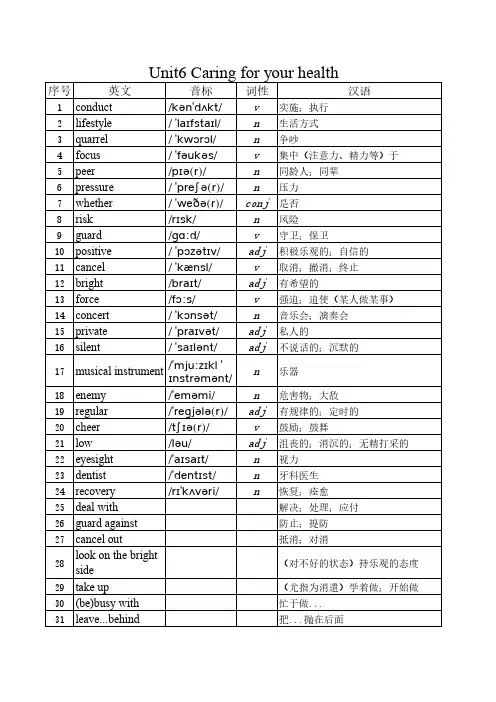
v n n v n n conj n v adj v adj v n adj adj n n adj v adj n n)变得更高兴;(使)振奋起来
实施;执行 生活方式 争吵 集中(注意力、精力等)于 同龄人;同辈 压力 是否 风险 守卫;保卫 积极乐观的;自信的 取消;撤消;终止 有希望的 强迫;迫使(某人做某事) 音乐会;演奏会 私人的 不说话的;沉默的 乐器 危害物;大敌 有规律的;定时的 鼓励;鼓舞 沮丧的;消沉的;无精打采的 视力 牙科医生 恢复;痊愈 解决;处理;应付 防止;提防 抵消;对消 (对不好的状态)持乐观的态度 (尤指为消遣)学着做;开始做 忙于做... 把...抛在后面
Unit6 Caring for your health
序号 音标 1 2 3 4 5 6 7 8 9 10 11 12 13 14 15 16 17 musical instrument 18 enemy 19 regular 20 cheer 21 low 22 eyesight 23 dentist 24 recovery 25 deal with 26 guard against 27 cancel out look on the bright 28 side 29 take up 30 (be)busy with 31 leave...behind 英文 conduct lifestyle quarrel focus peer pressure whether risk guard positive cancel bright force concert private silent 词性 汉语
1对1沪教版九年级英语下册UNIT6讲解与练习
教育1对1专用教案三、简短说话(5分)给你两分钟的时间准备。
当听到“开始录音”的信号时,请根据所给的提示用6句以上的英语句子在90秒钟内进行叙述。
当你听到要求“停止录音”的信号时,应立即终止叙述。
下周的“文化交流”活动即将举行,请你向到会外国友人介绍中国的传统节日----春节。
内容要点:1. 春节是中国的最大的传统节日;2. 除夕夜家人团聚吃“年夜饭”(family dinner);3. 长辈给小孩“压岁钱”(lucky money);4. 广州人喜欢逛花市买花,花的品种有很多。
三、简短说话(5分)给你两分钟的时间准备。
当听到“开始录音”的信号时,请根据所给的提示用6句以上的英语句子在90秒钟内进行叙述。
当你听到要求“停止录音”的信号时,应立即终止叙述。
在英语主题班会上,谈谈你对低碳生活(low-carbon)的看法。
主题:我的低碳生活重要性:保护环境,从我做起要求:1. 每天步行上学2. 离开教室时,关灯、电扇、电视等3. 不用水时,记得关水龙头(tap),循环(reuse)使用水4. 充分使用纸张5. 不使用塑料袋(plastic bags)九年级下册Unit 6 Caring for your health 必记单词1.conduct v.实施,执行(conduct a survey)2.quarrel n.争吵3.focus v.集中(注意力、精力等)于4.pressure n.压力5.whether conj.是否(& if)6.risk n.风险7.guard v.守卫,保卫8.cancel v.取消,撤退,终止9.bright adj.有希望的10.force v.强迫,迫使(某人做某事)11.concert n.音乐会,演奏会12.private adj.私人的13.silent adj.不说话的,沉默的14.enemy n.危害物,大敌15.cheer v.鼓励,鼓舞16.dentist n.牙科医生17.low adj.沮丧的,消沉的,无精打采的18.musical instrument 乐器19.regular adj. 有规律的20.eyesight n 视力21.recovery n. 恢复22. positive adj.积极地ughter n 笑声1.conduct v.实施;执行Conduct a survey about a healthy lifestyle.conduct此处用作及物动词,意为“实施,执行”。
九年级英语下册Module3Unit6Writing课件pptx牛津深圳版
假设你就读于九年级(3)班,班上教英语的李老师突患重病,需住 院数周,请你代表班上的同学写一封电子邮件慰问老师,内容包括: 1 表达同学对老师患病住院的遗憾心情; 2 询问老师目前病情; 3 传达同学们给老师的话语:您是好老师,大家都 挂念您;不要担心我们的学习,您不在的期间,班 上来了一位新的英语老师,大家仍会努力学习; 4 祝愿老师早日康复。 注意:词数80个左右,已给出部分不计入总词数。
一、审题
1 写什么? 慰问邮件
2 用第几人称? 第一、二人称
3 用什么时态? 现在时态 二、要点
1 我们对您生病住院感到难过;We are sorry to hear that _y_o_u_’v_e__g_o_t_a serious ______il_ln_e_s_s_a_n_d__h_av_e__to__s_ta_y__in__h_o_s_p_it_a_l _fo_r_c_o_u_p_l_e_s_o_f_w__e_ek_s________. 2 您现在感觉好些没有;___A_r_e_y_o_u__fe_e_l_in_g__b_e_tt_e_r_n_o_w_?____
Read the email in A and tick what is talked about in it.
What does Jim write about in the email? ( )How Jim will help Andy with his studies. ( )Questions about Andy’s illness. ( )Jim’s suggestions to Andy. ( )How Jim’s school life is now. ( )That Jim cares about Andy.
牛津深圳版英语九年级下册Unit 6《Caring for》(Reading)ppt课件 课件

private enemy
silent regular
2c.hYeeoru may lwoownder whether stress is a
Psherraioseuss: matter.
deal with guard against cancel out
look on the bright side
T_a_k_e_u_p__ a__h_o_b_b_y_
T_a_k_e__c_a_re_ o_f_y_o_u_r___ b_o_d_y_____
L_a_u_g_h_
Read and finish the following tasks. Task 1: Read Para. 1 and fill in the blanks.
Cause 1 Cause 2
Cause 3
...
_st_u_d_y_i_n_g
Dealing with p__ee_r__p_r_e_ss_u_r_e_
Worrying about _w_h_a_t_o_t_h_e_r_s_t_h_in__k
Effect
Many students _s_u_f_fe_r__fr_o_m__s_t_r_es_s_ in their daily lives. They are _u_n_d_e_r__st_r_e_s_s _ because _th__ei_r_l_i_v_es__a_r_e_n_o_t_b_a_l_a_n_c_e_d__.
take up
(be) busy with leave ... behind
cheer ... up
Look at the cartoon and answer the questions.
E英语视听说教程2教师手册 Unit 6
Unit 6 Spend or save? PronunciationScripts11 It’s only in the midd le of the month.2 I’m running ou t of pocket money now.3 In a word, different colors have different functions.4 The government will take stronger actions to track down borrowers.5 More than any other generation, millennials rely on word of mouth.21 I need to learn how to budget.2 You will place a heavy burden on your parents.3 We usually go Dutch when my friends and I go out together.4 Students get to know how money works before they spend it.5 Next time there is a concert, I’ll show you the beauty of the classical music.Answers21 I need to learn how to budget.2 You will place a heavy burden on your parents.3 We usually go Dutch when my friends and I go out together.4 Students get to know how money works before they spend it.5 Next t ime there is a concert, I’ll show you the beauty of the classical music. Listening to communicateConversation 1ScriptsW: Tom, how will you spend the weekend?M: Some freshmen from my hometown want me to show them around the city.W: Nice. Then you’ll need money, for the bus and something to eat, for example.M: Yes, I should plan for that.W: We usually go Dutch when my friends and I go out together.M: But it’s difficult for me to talk about money with them. I’m old enough to be their brother. W: Yes, you are. But you are spending your parents’ money now, not your own, just like the freshmen. If you offer to pay for everything yourself, you will place a heavy burden on your parents.M: So what should I do?W: “Short accounts make long friends.” Be honest with them and they’ll understand.M: OK. Thank you.Answers1 1 C2 D3 B2 1. money 2. spending 3. heavy 4. friendsConversation 2ScriptsLin Li: Hey, Amy! Come and see the beautiful dresses!Amy: Oh my! They are so nice, Lin Li!Lin Li: Do you want to buy one?Amy: Yes, very much. But I’ve already bought two dresses thi s month and they broke the bank.I’m running out of pocket money now.Lin Li: What?! It’s only in the middle of the month and you are running out of money?Amy: Yes. I never plan how to save and spend money. I live paycheck to paycheck.Lin Li: That’s wh at we call Yue Guang Zu, which means exactly what you said. If you are always like this, you’ll have no money left even for your food.Amy: Nobody wants to be like this. I really need to learn how to budget.Answers1 1 A2 B3 A21, 3Act-outConversation 1Answers1)Are you kidding me2)ReallyConversation 2Answers1)What2)My goodness3)Oh dearListening to exploreNews reportScriptsResearch shows that American millennials spend more money on comforts and conveniences like taxis and eating out than other generations.Sixty percent of them admit to spending more than $4 on one coffee; 79 percent choose to eat at the hottest restaurant in town, and 69 percent buy clothes they don’t necessarily need. According to the study, each year, millennials spend $5 billion on clothes and shoes, and $5.5 billion on drink. They spend another $2.4 billion on entertainment, including things like music, movies and video games.More than any other generation, millennials rely on word of mouth. They usually choose the goods with good online reviews when deciding what to buy.Answers1 1 B2 C3 D21)60%2)69%3)$5.5 billion4)$2.4 billionPassage 1ScriptsIn China, mobile payments develop very fast and are very popular. People can pay for almost everything wherever there is a QR code.Mobile payments are becoming part of Chinese people’s everyday life. Alibaba-owned Alipay and Tencent’s WeChat are the top two ways of paying by phone.With the apps, consumers are able to shop online, send money to friends or family members, pay for services, and even scan codes in stores to see if a product is cheaper online. It is very easy and saves a lot of time and bank fees. More and more people are starting to enjoy the convenience of going cashless.In history, China was the first country in the world to use paper money. Once again, China is leading the world in moving toward a cashless society.Answers1 1 D2 B3 A2 1. pay 2. convenience 3. first 4. leadingPassage 2ScriptsA study finds that people generally decide to buy goods within the first 90 seconds, and it is often the color that helps them to make a choice. For example, red is a bright, eye-catching color, so it is used to make people shop without thinking too much about the price. While red can be exciting, pink can make you feel less painful when you give your money to the sellers. Yellow can increase your energy and also make you feel hungry. This is why fast-food restaurants are often painted in yellow and gold. Green is associated with caring for the environment. It makes goods look more eco-friendly. Blue makes a store or a product more likely to be seen as trustworthy and dependable. Black makes a product look luxurious. No wonder it’s a popular color for dressing high-end goods.In a word, different colors have different functions. That’s why stores usually choose the right colors for goods to sell more.Answers1 1 A2 D3 B2A-5B-4C-1D-2E-3Sharing your ideasKey for reference:Step 1. Conduct a survey among five classmates about their consumption habits. Ask them the following questions:•How do you get your living cost? From your parents or from your part-time jobs?Answer 1: I get all my living cost from my parents.Answer 2: I get most of my living cost from my parents, and I earn some by doing a part time job as an art / music teacher / a coach for a little kid.Answer 3: I get some of my living cost from my parents, and I work hard and win scholarships (奖学金) and grants(助学金) this term.•What is your average monthly living cost?Answer 1: My average monthly living cost is about RMB 2000-2500.Answer 2: My average monthly living cost is about RMB 1500-2000.Answer 3: My average monthly living cost is about RMB 800-1200.•What is your living cost mostly spent on? Meals? Clothes and shoes? Or your hobbies, such as reading, sports, music and art?Answer 1: I spend my living cost mostly on meals and snack foods, trendy clothes and shoes. I play video games online and I buy lots of equipment for the heroes.Answer 2: I spend my living cost mostly on meals, some clothes and shoes.Answer 3: I spend my living cost mostly on meals. When necessary, I buy some clothes and shoes.•How can you keep a reasonable consumption habit in your opinion? By keeping accounts? By putting part of your living cost in the bank?Answer 1: I have never thought about this question before, because I don’t think my consumption habit is not reasonable.Answer 2: I think my consumption habit is reasonable. I usually keep a monthly account to record how much money I get and how much I spend and on what. If at the end of the month Istill have some left, I put that in the bank.Answer 3: I think my consumption habit is quite reasonable. I keep a monthly account to record how much money I get and how much I spend and on what. Since I usually don’t havesome left at the end of the month, I never put money in the bank. But if I plan mymoney more carefully next month, maybe I can save some in the bank.•Do you think it necessary to manage your money as a student? Why or why not?Answer 1: I don’t think it necessary to manage money as a student, because my parents give me money and they tell me just to study hard without worrying about it. They say they aremy bank.Answer 2: I think it necessary to manage money as a student, because mostly I rely on my parents to give me money. Although they tell me just to study hard without worrying about it, Istill don’t want to spend th eir money on something unnecessary. And also, I earn somemoney by teaching a little kid painting, and I know making money is not easy. So, Ishould learn to manage money.Answer 3: I think it quite necessary for me to manage money as a student, because mostly I rely on my parents to give me money. Although they tell me just to study hard withoutworrying about it, I know how hard they are working in order to support me in college. Idon’t want to waste their money on anything unnecessary. And al so, I earn some moneyby teaching a little kid painting, and I know money-making is not easy. So I should learnto manage money.Step 2. Write down your classmates’ answers to each question, and then use charts to present your survey result of each question to your class within 10 minutes.Answer: It is highly recommended that students use the Pie Chart given in Presentation skills to present their survey result of each question.Viewing to knowScriptsThe truth about savings and consumptionWe’ve all heard that consumption and spending grow the economy. Turns out that’s wrong. In fact, the exact opposite is true. It’s savings and production that make the economy grow, not consumption and spending.Here’s a fact. Society wouldn’t become wealthier if everyone just ran out and bought boats and houses and cars. If that were true, the larger everyone made their credit card debt, the wealthier society would be. Something about this seems strange.Think about it this way. A healthier economy is made up of goods and services people want. If wewant to understand why some economies have a lot of goods and others few, we have to ask, “Just how does the amount of goods in an economy grow?” In one word, produc tion.Let’s look at a family farm. How much food they produce depends on how much they work. When they work, their total amount of food increases. When they eat, their whole amount of food decreases. This consumption isn’t a bad thing. It’s really the wh ole point of working in the first place. But if they want to keep going, they must produce faster than they consume. And they decide to build a big farming machine to help increase their productivity, a machine that could produce twice as much in half the time. Well, farming machines don’t just come from nothing. It takes time to make them, and while the farming machine is being made, those workers won’t be producing any food, just consuming. Then they’ll need to save enough food before they make the machin e, so they can eat while they work. Without those savings, there’s no way for them to take time to build a farming machine. They’d run out of food. Once it’s finished, they can produce more food, more quickly, and the total amount of goods will grow. On top of that, because they no longer have to worry about not having enough food, time is freed up. They can now choose to produce other goods or services, or just relax and enjoy their free time.And this is what happens in the large-scale economy. Factorie s and bulldozers don’t just come from nothing either. They have to be constructed with a pool of savings as well. Here’s how it works. In a free market, when people save their money, and don’t spend it, money piles up in banks. In turn, this money is lent to business people who use it to purchase or create equipment which makes their business bigger and increases their level of production.And get this. The more goods that are being produced, the more savings that become available. As this pile of savings grows, even more money becomes available to even more business people. This makes an economy get bigger and bigger. All of this is made possible only by savings. Without it, there wouldn’t be any money available to borrow, and the economy would stop growing. And an economy based on consumption and not production can only last until there are no more goods to consume.AnswersPre-viewing1. A saver2. A spender3. A spenderWhile-viewing1 1, 2, 52A-2 B-3 C-1 D-4Post-viewingThis is a discussion with an open question. It is quite possible for different students to have different habits and then give different answers. However, no matter what answer they give, first, ask them to make it clear, and then make it reasonable.Here are some consumption habits for their reference:1. Set some money from my parents aside for food and study.2. Spend all the money I have.3. Buy all the things I like with all the money I have.4. Buy the things I like without thinking about the prices.5. Plan how to spend money and what to spend it on.6. Only buy the necessities for life and study.7. Buy the necessities for life and study and treat myself one or two times a month, suchas a big meal on weekend.8. Plan how much to spend and make savings every month.... ...If some students choose 2, 3, 4 or 6, then ask them whether they are good or bad ones. If some students say they are bad, do they want to change or not? If they do not want to change, why? If they want to change, why and how?Reference for 1. If they do not want to change, why?A. Although I know the habits are bad, I do not want to change them, simply because I don’t know how to form good consumption habits, and I don’t know how to budget my money.B. My parents and I don’t care how I spend my mone y and how much money I spend, simply because we are rich. So, it is not necessary to budget.C. Although my family is not rich, my parents tell me not to care about how I spend my money and how much money I spend, simply because they want me to live a good life, at least not worse than others. So, I don’t want to change.D. I don’t want to change them because it’s hard for me to kill bad habits....Reference for 2. If they want to change, why and how?Whys: Because if I spend money like this, IA. will have no money left for things I really need.B. waste my parents’ money.C. do not value my parents’ work.D. will run into debt which will even cause trouble.E. will not become a financially responsible person.....Hows: (good habits listed above)A. Set some money from my parents aside for food and study.B. Plan how to spend money and what to spend it on.C. Only buy the necessities for life and study.D. Buy the necessities for life and study and treat myself one or two times a month, such as abig meal on weekend.E. Plan how much to spend and save every month.......Finally, based on students’ discussion, the teacher sums up and guide the students to develop FI. Further listeningConversationScriptsW: Look! My favorite actor is in the magazine LOHAS!M: I don’t know him, but I know LOHAS.W: What is it?M: LOHAS is short for “Lifestyles of Health and Sustainability”. It refers to some lifestyles and also to a group of people who live in the styles.W: For example?M: For example, when LOHAS buy food, they prefer the green organic food with sustainable packaging.W: Oh, I know about this. I usually buy in-season fruits, and I like the fruits to be packaged in paper bags instead of plastic ones. This is good for the environment. Am I a LOHAS person? M: Yes, you are. Some food companies are also planning to use plant-based packages which can be reused. They think it’ll attract consumers.W: That’s good news for LOHAS.Answers1 C2 B3 ANews reportScriptsThe U.K. government has warned it will charge graduates who fail to pay their student loans back on time.As more people enter universities than before, the government wants to keep the U.K. as a world-class education system, while spending less money than it makes. Mr. Johnson, an official, said, “As more loans are given to new students each year, it is important the repayment process should work well for both borrowers and the sustainability of the student finance system.”Although he knows most borrowers do repay on time, Mr. Johnson said, “The government will take stronger actions to track down borrowers who avoid repaying, including those overseas.”Answers1 C2 DPassageScriptsFinancial intelligence is the ability to manage our wealth by understanding how money works. From counting coins in kindergarten to planning for retirement years, managing finances is a very important part of our life, no matter how much money we have. It is also increasingly regarded as the key to a successful life.As for students, it is equally necessary to have a basic understanding of finances. First, withfinancial intelligence, students get to know how money works before they spend it, and that makes them learn the value of money to avoid drowning in a sea of debt. And t hen, they’ll know how to pay for things wisely. Finally, students learn the importance of making money, saving, and managing their debt, which leads them to become a financially responsible adult.Answers1 D2 D3 CListening to appreciateScriptsShopping with a FriendPoet Rita El KhouryShopping with a friend is coolThere’s nothing forbidden, no ruleAnd no parents to say what’s suitableOr to tell you what’s unaffordableActually you don’t need to be richTo try on whatever your eyes wishShopping with a friend is so niceYou might forget budget and priceAnd buy things you don’t needJust by habit, not by greedLike get ten or eleven similar topsFrom two or three different shopsShopping with a friend is funnyEven if you don’t have mone yYou can try a formal blue shirtWith a long gypsy orange skirtPretend to buy them but act lostThen don’t, because they’re low-costShopping with a friend is naughtyYou can act humble or haughtyChange personalities between stores:Be a girl who laughs and snoresOr an English tourist, elegant and neatWho went walking on the streetBut shopping is more pleasant with a friendWho has a thousand dollars to lendAnswers1) rule2) habit3) funny4) laughs5) thousand。
牛津英语9B课文翻译
Unit1Greatexplorations和航和是一位有名的中国探家。
1405年,他从中国出,开始了七次大航行中的第一次。
是在克里斯托弗.哥布第一次起航美洲之旅的近一个世以前。
他的旅行这样重要以致于今日仍被人研究。
和1371年出生在云南。
他升明朝永皇帝一名得信的官。
皇帝命令和并探究中国以外的土地。
他的任是加与外国的关系,并与之成立易路。
在几年的里,他建立了一支巨大的船---当世界上最大的〔船〕。
那些船被称作宝船。
它足大,能承25000人以及大批的物。
从1405年到1433年,和七次旅行,了南、中地域,甚至非洲海岸。
仿佛他来没有什么地方是遥不行及的。
些旅行允中国交一些重物件,如金、和。
每次航束,和回了多在中国第一次到的西,比方一只非洲鹿。
除了增易以外,航行也促成了文化与科技的沟通。
它帮助了那些国家和地域的展。
1433年,和在他最后一次航行中逝世。
但是,他的航行是一这样巨大的成就,以致于人仍将他作开拓世界各地不一样民族文化系的先而。
Unit2Cultureshock在另一个国家生活我的名字叫布拉德.李。
今日我在里述我昨年在美国作一名交生的。
我必承,开初美国〔文化〕我来是个很大的文化冲。
多事物是陌生的:言、食品甚至学校。
我与小上的一个寄宿家庭生活在一同。
我寄宿家庭的父亲母亲,赫斯特先生和夫人,特别和善。
在我的空里,他我了多活,以便我不会想家,也不会感孤单。
但是,在某种程度上,美国的生活很适。
我的主假如言。
在最先的几周,我未能理解多少,因大家得很快。
然我很快勉力适了,但我仍旧有麻,因他用了多。
比如,患病,他常“undertheweather。
〞他的平时英与我在中国学的差很大。
另一个差是食品。
我寄宿的家庭吃是吃面包、土豆和沙拉。
我真的思念家的子、米和美味佳肴。
学校也是一个大的冲。
他不要修业生穿校服,所以学生几乎能够穿他喜的全部。
一些学生也留着奇异的型。
一些学生甚至留着粉色或紫色的!无怎样,那一年我有好多美好的回,特别是冬季在雪地里玩和打棒球。
牛津深圳版英语九下Unit 6《Caring for》(Speaking)ppt课件
Team racing
In pairs, make a conversation. One student acts as the doctor and the other the patient.
Which group is the best?
S1: What’s wrong with you? S2: I have a headache. S1: How long have you felt this way? S2: Since this morning. ...
What should the patient say to show his problem?
Talking about illness and health
Listen and answer the quesቤተ መጻሕፍቲ ባይዱions:
1.What is the matter with Ben? He has a really bad stomach ache. 2. How long has Ben suffered from the illness? Since he woke up this morning. 3. Why did Ben have the illness? He ate and drank too much on his birthday. 4. What should Ben do to recover from the illness? He should take the pills three times a day and get some rest. He should also eat more healthy food.
Let’s see which group does the best.
九年级下册第六单元语法练习
宾语从句【重点语法】★复习宾语从句宾语从句在句子中充当宾语。
通过下面的例子, 我们来复习一下所学的宾语从句。
1.that引导的宾语从句, that有时可以省略。
Peter doesn’t know (that) he bas passed the exam.2.what, which, who, whom, whose 等疑问代词引导的宾语从句。
He asked what I was doing just now.The boy didn’t see who saved him.I don’t know which one I should choose.3.when, where, how, why等疑问副词引导的宾语从句。
Do you know where she comes from?They are discussing how they can win the game.Can you explain why you didn’t come on time?4. if, whether引导的宾语从句。
I want to know if she can help me.I wonder whether he closed the door.5.有时候, 宾语从句之前有间接宾语或者介词短语结构。
The policeman asked the man if he drank some wine.The boy said to his mother that he would go for a picnic.6.有时候, 宾语从句可以和疑问词+ to do结构互换。
The speaker doesn’t know what he should do next.= The speaker doesn’t know what to do next.【语法笔记】1.宾语从句中连接词的选择:宾语从句的连接词因为在从句中所充当的成分不同, 也有所变化, 如果在从句中充当宾语、主语,或用于修饰名词, 则用的是疑问代词; 如果在从句中充当状语, 则用的是疑问副词; 如果在从句中不充当任何成分, 则用连接词that或whether / if。