
译林版英语七年级下册第二单元知识点
Unit2
1. visitor—visit v./n. on a visit to前往……的拜访
2. like像……prep./喜欢v. 她像她爸爸,喜欢做饭。She like her father, likes cooking.
3. waiter—waitress(女服务员)—waitv.—waiting-room(候车室、候诊室)
4. helpfuladj. 他帮我学习英语。He help me with my English.
(helpless adj.) 她忍不住哭了。She can’t help crying.
随便吃点水果吧。Help yourself to some fruit.
缇娜帮助妈妈打扫卫生。Tina help her mother do some housework.
5. skill表技巧,不可数名词,由much和great修饰。学习技能:study skills 高超的技巧:great skill
6. problem—有待解决的问题;question—有待回答的问题。
7. something我有重要的事情告诉你:I have something important to tell you.
8. check 支票n./v.+in(报道)/on(检查)/out(查证/结账)/over(仔细检查)
9. broken adj.打破v.break; 玻璃杯易打碎。Glass breaks easily.
10. someone/ anyone;作主语时,谓语动词三单:有人在讲话。Someone is talking.
11. fix—修理出差错的东西,使其稳固。repair—修理复杂且受损严重的如房屋、道路、机器。
12. college(学院)—大学生(a college student)—在大学(at college)—university(综合性大学)
13. luckyadj.—luckn.—luckilyadv. good luck to sb./good luck with sth.
14. fire(可n.-火炉、不可n.-火)—生火(make a fire)—着火(be on/catch fire)
15. officen.(办公室)—officern.(官员)—officialadj.(官方的)
16. policeman—police(警察、警方)—policewoman(女警察)--police dog(警犬)
17. job (可数名词)work(不可数名词) a piece of work=a job
18. in future=from now on—今后 in the future—将来
19. noticen.公告;墙上有一个公告
v.我注意到你了。I noticed you. 注意你的生活方式。Take notice of your lifestyle.
我没注意到他离开了。I didn’t notice him leaving.
20. information(不可数名词) a piece of information
21. below--above adv.看下面的书。See the book below.
(不一定垂直) prep.窗户下面有一把椅子。There is a chair below the window.
22. 现在进行时表将来,动词有come、leave、move、arrive
我要离开了。I’m leaving.
我快要到家了。I’m arriving home.
23. there be 将来时there be going to/there will be
今天下午将会有一场足球比赛。There will be a football match on the playground.
24. be afraid (that)担心……
be afraid of sth/doing sth害怕做某事
be afraid to do sth不敢做……
25. most;代词;大多数学生喜欢体育课。Most of the student like PE.(most of +定/指代/物代+n.)
副词=very;你来见我太好了。It’s most kind of you to meet me.
26. be ready to do sth.=be glad/willing to do sth.乐意做某事(get /be ready for为……做好准备)
27. 一般将来时:时间状语:next…/tomorrow/this…/in…/soon…
肯定句:我很快就是一名老师了。I will be a teacher soon.
我将要去洗碗。I’m going to wash dishes.
否定句:
一般疑问句:
28. elder(多用于兄弟姐妹的年长,不与than连用,不做表语/older可做表语与定语,与than连用)。
他不应该嘲笑比他年长的人.She shouldn’t laugh at her elder like this.
(形物代+elder表比……年长的人)
29. worry –worriedadj.
vt.他的健康叫我担心。His health worries me.
vi.(+about)我担心他的健康。I worry about his health.
30. ill -----He is an ill man.(定语) She is ill.(表语)
sick ---She is takeing care of her sick father.(定语) She feel sick.(表语)
必背词组
in Ninth Street9号街 helping hands帮手 help with帮助做 a day out一日游
help sb do帮助某人做 have a meeting开会 特殊疑问词+to each other相互
match…with与……相配 be afraid (that)害怕…… different skills不同的技能
ask…to do sth.要求做某事 need to do sth.需要做 different ways不同的方法
help sick people帮助生病的人 make sb. do sth.让某人做 be going to do将要做某事
all kinds of所有种类 in the future在将来 wait for sb to do sth等待某人做某事
most/some of them他们中的大部分/一些 be good/happy/lucky/ready to do sth.
there is something wrong with……出了问题 plan/make a plan to do sth.计划做某事(将)
plan on doing sth.计划做某事(现在) on the afternoon of 5 March3月5日下午
牛津译林英语七年级英语下册unit2neighbours知识点归纳
一、知识要点1.Where are you going?你打算去哪里?be going此处为“现在进行时表将来”。
现在进行时表将来主要用于表示按计划或安排将要发生的动作,常有“意图”“安排”或“打算”的含义。
这种现在进行时比较生动,给人一种期待感。
go, come, leave等表示位移的动词,都可以用于现在进行时表将来。
例如:He is going. 他要走了。
I’m coming. 我要来了。
Tom is leaving. 汤姆要走了。
2. I’m going to vi sit our new neighbours.我打算拜访我们的新邻居。
be going to意为“计划,打算”,后接动词原形,用于表将来。
例如:I’m going to wash the car if I have time. 若有时间我想洗洗车。
Where are we going to stay tonight? 我们今晚住哪里?3. I’m afraid they won’t welcome visitors like you.恐怕他们不会欢迎像你一样的拜访者。
(1)welcome作及物动词,意为“欢迎’’,可与介‘词to连用;也可作形容词,意为“受欢迎的"。
如:Welcome you to our school! 欢迎到我们学校来!You’re welcome.不用谢。
(2)句中like是介词,意为“像,相似’’,其反义词是unlike;作动词时,意为“喜欢’’,后可接动名词或不定式作宾语。
如:What is Jim like? 吉姆这个人怎么样?They like playing football on Sunday.他们喜欢在星期天踢足球。
(3)won’t是will与not的缩略形式。
“will+动词原形"也是一般将来时的构成之一。
如:We will take a bus to work.我们将乘公共汽车上班。
牛津译林版英语七年级下册Unit2知识点精讲(上)
牛津译林版英语七年级下册Unit2知识点精讲(上)1.邻居(英式英语)2.像,相似,类似1)Like用作介词,表示某人或某物“像,相似,类似”。
常用的固定搭配有像…样子、看起来像等。
例1:我不欢迎像你这样的人。
I don't e people like you.例2:这个女孩看起来像她的父亲。
练:1.___.2.I need a bike like yours.3.John。
like his ___。
___.练:1.---Good luck with your basketball game. Thank you.2.I'm sorry you lost the game。
You're an ___.3.Luckily。
I am the first one in this exam.4.___.5.I'm ___.6.She is lucky and always gets on the last bus.7.Fortune favors her and she always manages to get on the last bus.Practice:1.___.2.I'm two years older than you.3.My ___ is old。
He can't carry the box.4.My elder sister has an old bike.1.---What are you afraid of?I am afraid of snakes.2.I am ___ ___ ___.3.I am afraid of snakes so I’m afraid to catch them.4.---Can I smoke in the library?I’m afraid not.5.----Is Lily badly ill?3.Most of these buildings have 14 floors.A。
新译林版英语七年级下册第二单元Neighbours知识精讲
Unit 2 Neighbours一.词汇精讲1. likelike 作介词,意为“像;与……相似”,对应的反义词为unlike。
短语look like表示“看起来像……”。
例如:Draw it like this! 照这样画!She looks like her mother. 她长得像她妈妈。
【拓展】like与aslike与as作介词,都有“像”的意思。
但有一定区别。
(1)like意为“像……一样”。
用于相似关系,即两者在形态上或性质上有相似之处,但并不等于。
(2)as意为“作为;以……身份”。
用于说明同一关系,即两者实为一体。
例如:She talks to me like my mother. 她像我妈妈那样跟我说话。
(她不是我妈妈)She talks to me as a mother. 她以妈妈的身份跟我说话。
(她是我妈妈)2. most ofmost of意为“……中的大多数”,后面接可数名词复数作主语时,谓语动词用复数形式;也可接不可数名词,此时谓语动词用单数形式。
例如:Most of them are going off to Guangzhou next week.他们中的多数人都准备下星期去广州。
Most of the water is clean. 大部分水是干净的。
【注意】most of 后的名词是单数时,谓语动词也用单数形式。
例如:Most of the apple is red. 这个苹果大部分是红的。
3. something与anythingsomething作不定代词,意为“某事,某物”,多用于肯定句中。
在疑问句和否定句中常用anything;否定句中常用nothing。
作主语时谓语动词用单数形式。
anything还有“任何事物”的意思。
例如:Something happens. 有事发生了。
I’d like something to eat. 我想吃点东西。
Is there anything wrong with your bike? 你自行车是不是出问题了?Anything is possible. 一切皆有可能。
牛津译林版7B七年级下册英语 Unit2 知识点整理

7BU2知识点梳理1.be afraid +(that)宾从be afraid to do 不敢去做某事be afraid of sth/sb/doing sth 害怕某物,某人,做某事I’m afraid so.恐怕是的。
I’m afraid not. 恐怕不是这样的注:sure与afraid用法一样2.welcome sb. 欢迎某人welcome to sp. 欢迎到某地You are welcome. 没关系/ 不用谢。
3.Where do you live? \ Which place do you live in?Where are you going? \ Which place are you going to?4.There is something wrong with sth.Sth is broken.Sth doesn’t work.=Sth isn’t working.Something is wrong with sth. .......出故障了5.不定代词:someone/somebody/anyone/anybody/no one /nobody/something/anything/nothing 做主语,谓语动词用单数,形容词修饰不定代词后置如:something beautiful/something wrong6.It is + adj. + to do …做某事怎么样Ask/ tell/ invite sb(not )to do7.Like v.喜欢like doing sth / like to do sth(prep)像be like : He, like his elder brother, likes playing with others. 8.What be sb/sth like?你认为…怎么样(性格品质)?(用形容词回答)What do/does sb. like?某人喜欢什么?What do/does sb. look like?某人长什么样子(外貌)?9.help sb. with sth. 在某方面帮助某人helpful adj.乐于助人的Kind all kinds of 各种各样的different kinds of 不用种类的Be kind to sb 对某人友好10.Sick/ill区别:My sick son / My son is ill11.sound(听起来)/look(看起来)/feel(感觉)/smell(闻起来)/taste(尝起来)/become(变得,成为),后接形容词注:身体健康只能用feel well12.be ready to do sth. 准备/乐于做某事be ready for sth 为……做好准备13.特殊疑问词+to do sth Dob you know what to start ?14.worry v. sb worry about sb 某人担心某人Sth worry sb 某事让某人烦心Worried adj. Sb be worried about sb/sthworry about= be worried about 担心……15.make +宾语+adj. 使……觉得……16.do some shopping/washing/reading/cleaning17.her elder brother 她的哥哥go to work by train. 乘火车上班by +交通工具=Go to work on a train =Take the train to workHe often goes to work by bike=He often rides to work.18.on the afternoon of 5 March 在三月五号的下午19.Luck n.运气adj. lucky Adv. Luckily 反义词adj. unlucky20.be busy doing 忙于做某事be busy with…忙于某事21.there be 将来时there be going to/there will be22.different skills不同的技能different + n 复数23.be good/happy/lucky/ready to do sth.24.一般将来时标志:tomorrow, tomorrow morning, the day after tomorrow, nextweek, this afternoon, this evening, tonight, soon, how soon, in an hour, in the future …25.All right. 好的/行。
七年级英语译林版下册Unit2_Task_教材知识详解
Unit2 Task教材知识详解1.notice通知,布告notice用作名词,意思是“布告、通知”,与information意思相同。
如:Please look at the notice on the wall.请看墙上的通知布告。
notice用作动词时,意思是“注意”,之后常跟复合宾语,其结构是notice sb do sth/notice sb doing sth 注意某人做某事。
如:I noticed him go/going into the office.我看见他走进办公室的。
2. Are you worrying about what to wear to a party or how to design your home?你在为穿什么参加聚会或者怎么样设计你的家而着急吗?(1)句中的worry about是不及物动词加介词构成的动词短语。
这里的worry about 可以转换成be worried about。
如:D on’t worry about me. I can look after myself well. =Don’t be worried about me. I can take good care of myself.不要为我担心,我能照料自己。
(2)句中的what to wear to a party or how to design your home是两个并列的不定式短语,在句中作宾语。
前面一个短语是由疑问代词加不定式构成的短语;后面一个是由疑问副词加不定式构成的不定式短语。
该句是疑问句结构,两个短语之间要用连词or连接,不能用and。
如:I d o n’t know when to start.我不知道什么时候出发。
He has not a brother or a sister. =H e has no brother and sister.他没有哥哥和姐姐。
译林牛津版七年级英语下册7B Unit2 知识点详解
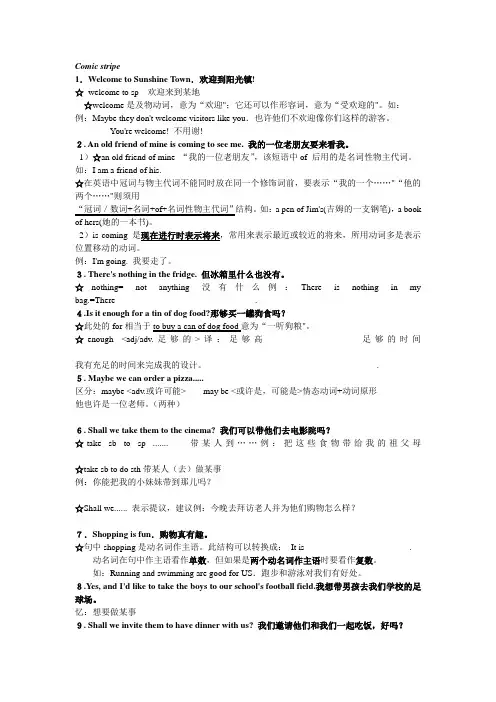
Comic stripe1.Welcome to Sunshine Town.欢迎到阳光镇!☆welcome to sp欢迎来到某地☆welcome是及物动词,意为“欢迎";它还可以作形容词,意为“受欢迎的"。
如:例:Maybe they don't welcome visitors like you.也许他们不欢迎像你们这样的游客。
You're welcome! 不用谢!2. An old friend of mine is coming to see me. 我的一位老朋友要来看我。
1)☆an old friend of mine “我的一位老朋友”,该短语中of 后用的是名词性物主代词。
如:I am a friend of his.☆在英语中冠词与物主代词不能同时放在同一个修饰词前,要表示“我的一个……"“他的两个……"则须用“冠词/数词+名词+of+名词性物主代词”结构。
如:a pen of Jim's(吉姆的一支钢笔),a book of hers(她的一本书)。
2)is coming 是现在进行时表示将来,常用来表示最近或较近的将来,所用动词多是表示位置移动的动词。
例:I'm going. 我要走了。
3. There's nothing in the fridge. 但冰箱里什么也没有。
☆nothing= not anything 没有什么例:There is nothing in my bag.=There________________________________.4.Is it enough for a tin of dog food?那够买一罐狗食吗?☆此处的for相当于to buy a can of dog food意为“一听狗粮"。
☆enough <adj/adv.足够的>译:足够高_____________________足够的时间________________________我有充足的时间来完成我的设计。
牛津译林版七年级英语下册Unit 2 Neighbours 重难点知识归纳总结
17.on the afternoon of 5 March在三月五号的下午
18.all the day整天
19.know a lot about styles and colours对风格和颜色很了解
20.be happy to give you some ideas很高兴给你一些主意
牛津译林版七年级英语下册
Unit 2 Neighbours重难点知识归纳总结
【重点单词】
1.neighbour ['neɪbə] n.邻居
2.will [wɪl] modal v.将;将会
3.visitor ['vɪzɪtə] n.访问者,参观者
4.like [laɪk] prep.像,类似;……怎么样
【重点句型】
1.I am afraid they won’t welcome visitors like you.
我恐怕他们不会欢迎像你这样的客人。
2.It’s good to live in a neighbourhood like that.
住在那样一个小区很好。
3.What are your neighbours like?
34.artist ['ɑːtɪst] n.艺术家
35.sound [saʊnd] linking v.听起来
36.sick [sɪk] adj.生病的;恶心的
37.notice ['nəʊtɪs] n.布告,通知
rmation [ˌɪnfΒιβλιοθήκη 'meɪʃən] n.信息
39.below [bɪ'ləʊ] adv.下面
5.waiter ['weɪtə] n.(餐馆等的)服务员
译林版牛津英语七年级下册全册Unites1-8单元知识点及语法归纳
译林版牛津英语七年级下册全册Unites1-8单元知识点及语法归纳一、重点词组、句型1、Would you like to live in the palace, Eddie? 埃迪,你想住宫殿里吗?①Would you like sth? 肯定答复: Yes, please. 否认答复: No, thanks.②Would you like to do sth? 肯定答复:Yes, I’d like/love to. 否认答复:I’d like/love to, but…2、There are twenty restaurants in town. 镇上有二十家餐馆。
There are about 8,000,000 people living in London. 大约有八百万人住在伦敦。
①表示某地有……,用there be 句型,谓语动词就近原那么。
There __________(be) an art room, a music room and two puter rooms in our school.②表示有事情要做,用there be sth to do。
Thereare lots of things ___________(see) in Beijing..③表示有某人正在做某事,用there be sb doingsth.。
On game shows, there are always famouspeople___________(talk) about their lives.3、I live in a town 15 miles from London. 我住在离伦敦15英里的一个镇上。
be far (away) from 离……远,但出现详细间隔时,不用farMy home is __________________from the school.My home is 5 kilometres ___________from the school.A. awayB. farC. closeD. next to4. have fun with sb./sth. 和某人/某物玩得开心have fun doing sth. 做某事很开心have(has/had) fun= have(has/had) a good time=enjo y(enjoyed) onself(myself/yourself/youselves……)5、I also have a bedroom of my own. =I also havemy own bedroom. 我也有自己的房间。
译林版英语七年级(初一)下单元知识点及语法归纳
七年级英语下册知识点总结Unit 1 Dream homes一、重点词组、句型1、Would you like to live in the palace, Eddie? 埃迪,你想住宫殿里吗?①Would you like sth? 肯定回答:Yes, please. 否定回答:No, thanks.②Would you like to do sth? 肯定回答:Yes, I’d like/love to. 否定回答:I’d like/love to, but…2、There are twenty restaurants in town. 镇上有二十家餐馆。
There are about 8,000,000 people living in London. 大约有八百万人住在伦敦。
①表示某地有……,用there be 句型,谓语动词就近原则。
There __________(be) an art room, a music room and two computer rooms in our school.②表示有事情要做,用there be sth to do。
There are lots of things ___________(see) in Beijing..③表示有某人正在做某事,用there be sb doing sth.。
On game shows, there are always famous people___________(talk) about their lives.3、I live in a town 15 miles from London. 我住在离伦敦15英里的一个镇上。
be far (away) from 离……远,但出现具体距离时,不用farMy home is __________________from the school.My home is 5 kilometres ___________from the school. A. away B. far C. close D. next to 4. have fun with sb./sth. 和某人/某物玩得开心have fun doing sth. 做某事很开心have(has/had) fun= have(has/had) a good time= enjoy(enjoyed) onself(myself/yourself/youselves……)5、I also have a bedroom of my own. =I also have my own bedroom. 我也有自己的房间。
Unit2知识点总结 练习 牛津译林版英语七年级下册
7B Unit2 知识点归纳与总结【重点单词】(1)名词visitor 访问者,参与者waiter 服务员volunteer 志愿者,义务工作者skill 技能,技巧problem 问题,难题community 社区engineer 工程师,技师college 学院fire 火manager 经理office 办公室policeman 警察postman 邮递员company 公司station 局,所,站post 邮政person 人artist 艺术家notice 布告,通知information 信息group 组,群neighbour <英>=neighbor<美> 邻居neighbourhood<英>=neighborhood<美>街区(2)形容词lucky 幸运的helpful 有用的,愿意帮忙的broken 损坏了的,破碎的elder 年纪较长的sick 生病的,恶心的better 较好,更好(good/well的比较级)(3)动词check 检查,核实fix 修理design 设计,构思(4)情态动词will 将,将会shall 将,将会(5)代词something 某事,某物someone 某人anyone 任何人anything 任何事(6)副词below 下面(7)感叹词wow 哇(8)介词like 像,类似,...怎么样(9)系动词sound 听起来【重点短语】1.welcome visitors like you 欢迎像你这样的来访者2.I’m afraid 恐怕3.most of them 他们中的大多数4.around your neighbourhood 在你的社区周围5.live in a neighbourhood like that 住在一个像那样的社区里6.kind and helpful 既友善又乐于助人7.share their different skills 分享他们不同的技能8.have a meeting 开会9.at weekends=at the weekend 在周末10.a sk someone to fix it 请某人修理它11.b e ready to do sth 准备做某事12.a mong the volunteers 在志愿者中13.b e like a big family 像一个大家庭14.c all him first 先打电话给他15.w ait for us to call back 等我们回电话16.p lan a day out 计划一天外出17.m ake a fire 生火18.g o to work by bike 骑车去上班19.w ork for a company 为一家公司工作20.a company far away from her home 一家离她家很远的公司21.i n the future 在未来22.s ound like a good idea 听上去像个好主意23.h elp sick people 帮助病人24.t he information below 下面的信息25.w orry about 担心26.w hat to wear 穿什么27.k now a lot about... 知道许多关于...28.s tyles and colours 样式和颜色29.f eel well 感觉健康30.e lder brother and elder sister 哥哥姐姐【重要句型】1.Where are you going?go可以用进行时态表示将来的动作He Paris.他要去巴黎了。