
牛津译林版英语9A Unit3 重点知识总结
Unit 3
一、重点词组
1.drive sb mad
使某人疯狂
2.deal with处置;处理
3.have no choice but to…
没有选择只能……
4.stay up熬夜
5.hand in上交
give sb a hand帮某人一把
6.feel sad about sth
对……感到难过
7.be worth doing
值得做某事
8.dream of/about
梦想;想象
9. hear from
收到某人的来信
10.be crazy about
对……感到疯狂
11.worry about担心
=be worried about
12.get into trouble
陷入麻烦
13.be strict with sb
对某人要求严格
14.stay out待在户外
15.look forward to渴望
16.make sure确保;确认
17.make a list of列出
18.work out算出;解决
19.according to根据
20.instead of代替;而不
21.youth worker
青少年辅导员
22.on show上演
ugh at嘲笑 24.go over复习;回顾
25.Don't mention it
不客气/不用谢/别提它
26.keep sth to oneself
秘而不宣
27.be of sb's age
与……同龄的
二、重点句型
1.I have a problem, but I wonder how I should deal with it.
我有一个问题,但是我想要知道我应该怎样处理它。
wonder用法
(1)wonder作及物动词,
表示“想知道”、“对……感到怀疑”、“纳闷”
a. 后接who,what,when等引导的宾语从句。
相当于want to know.
如:I wonder who he is. 我想知道他是谁。
b.后接that引导的宾语从句,
表示“感到惊奇”、“对……感到惊讶”,
that常可省去。
如: I wonder( that) Lu lost the game.
我对于鲁失掉比赛很惊讶。
c.后接if或whether引导的宾语从句,用于有礼貌的询问。
如:She wondered whether her mother was free that morning.
她想知道那天早上她的妈妈是否有空。
d.后接“疑问词+不定式”构成的短语。
如: I'm just wondering how to do it.我想要知道怎样做。
(2)wonder作名词,
表示“奇迹”、“奇观”、“奇才”、“惊奇;惊讶”等。如:
The pyramids are one of the Seven Wonders of the World.
金字塔是世界七大奇迹之一。
deal with与do with用法
都意为“处置;处理”。 do with常与连接代词what连用,而deal with常与连接副词how连用,
如: I don't know how they deal with the problem.
(=I don't know what they do with the problem.)
我不知道他们如何处理这个问题。
2. I have a lot of homework every day, and I have no choice but to finish all of it.
我每天有很多作业,我没有选择只能完成所有的作业。
choice作名词,意为“选择”,其动词:choose。
常见短语为have no choice but to do sth意为“没有别的选择只能做”。
I have no choice but to accept his invitation.
我除了接受他的邀请没有别的选择。
3.I often have to stay up late.我常常不得不熬夜到很晚。
stay up意为“熬夜”,后常接副词late。
Do you often stay up late?你常常熬夜到很晚吗?
常见的含有up的动词短语:
send up发出,射出
put up张贴/建造
finish up吃完或喝完
divide up使……分开
come up with想出
eat up吃光
give up放弃
3. However, I hardly have any spare time for my hobbies.
然而,我几乎没有任何空余时间来享受自己的爱好。
hardly意为“几乎不”。
hard 形容词意为“困难的”;作副词时,意为“努力地;猛烈地”。
如:As a student. we should work hard.
作为学生,我们应该努力学习。
4. I often doubt whether it is worth spending so much time on my homework.
我常常怀疑把这么多时间花费在作业上是否值得。
(1) doubt意为“怀疑”。后接宾语从句时,
如果主句为肯定句时用if或whether连接,
如果主句为否定句或疑问句时用that连接,表示“不信任,怀疑”。
如:I don't doubt that she's telling the truth. 我并不怀疑她讲的是真话。
(2) worth为形容词,意为“值得;值……钱”,
常见短语为be worth doing“值得做”,无被动。
worth习惯上不用very修饰,而是用well修饰。
如:
This film is well worth watching.
The Life I Know, by Han Han is worth reading.
韩寒写的《我所理解的生活》值得读。
5. I don't understand why they were so strict with me.
我不理解为什么他们对我如此的严格。
strict作形容词,意为“严格的;严厉的”。
常见短语:be strict with sb,意为“对某人严格要求”,
be strict in( doing) sth,意为“对(做)某事严格要求”。
如:Mr Smith is very strict with his children.
史密斯先生对他的孩子们要求十分严格。
6. I need someone to share my worries with.
我想要一个人来和我分担忧虑。
worry:
(1)worry作名词,意为“担心;令人担忧的事情”,
其复数形式为worries。
Too many worries are bad for your health.
太多的忧虑对你的健康有害。
(2) worry可作及物动词,意为“使烦恼”,“使焦虑”,常接sb作宾语。如:
What worried you so much?什么事使你这么着急?
(3) worry也可作不及物动词,常跟介词about。
They are worrying about the coming exam.
他们正为即将到来的考试而发愁。
7. How about reading English aloud every morning?
每天早上大声读英语怎么样?
区别:loud、aloud、loudly
8.Try to pronounce all the words correctly.
尽力拼读正确所有单词。
pronounce v.意为“发音”
n. pronunciation意为“发音;读音”。
Can you pronounce all the new words correctly? 你能正确地发所有新单词的音了吗?
三、语法
A.疑问词引导的宾语从句
语序:无论主句是陈述句还是疑问句,宾语从句都必须使用陈述语序,即“主句+连词+宾语从句(主语+谓语+……)”句式。
根据连接词在从句中所担任的不同成分,可分为以下四种:
(1) 连接词+谓语。连接词在从句中作主语。
常见的连接词有:who,what,which等:
如:The small children don't know what is in their stockings.
这些小孩子不知道袜子里有什么东西?
(2)连接词+名词+谓语。连接词在从句中作主语的定语。
常见的连接词有:whose,what,which,how many,how much等。
如:He asked whose handwriting was the best in our class.
他问我们班上谁的书法最好。
(3)连接词+主语+谓语。连接词在从句中作宾语、状语或表语。
常见的连接词有:who( m),what,which,how many, how much, when, why,
how, where等。
如:He hasn't decided when he'll go on a trip to Wuxi.
他还没决定什么时候去无锡旅行。
(4)连接词+名词+主语+谓语。连接词在从句中作宾语或表语的定语。
常见的连接词有:what,which,how many,how much,how等。如:
She asked me what colour my pen was.
她问我的钢笔是什么颜色。
做题技巧:在选择宾语从句时,首先应该注意从句的句式是否正确,然后主从的时态是否一致:
B 提建议的方法
初中常见的用英语提建议的句型归纳如下:
1. Why not和Why don't you 意为“为什么不……呢?”
“Why not+动词原形+其他?”这是个省略句,
其完整句式为“Why don't you (we)+动词原形+其他?”常用于间接地向对方提出建议,往往带有肯定的意味,一般不必回答。
Why not have a try?=Why don't you have a try?
为什么不试一试呢?
2.What about和How about “....怎么样”
What/ How about+名词/代词/动词的-ing形式+其他?
牛津译林版九年级上册9AUnit3 Teenage problems词汇趣味讲解(配练习含答案)
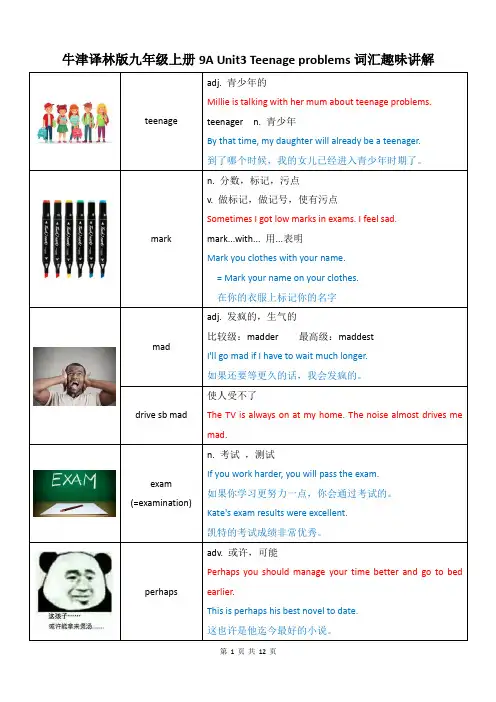
第 1 页 共 12 页 牛津译林版九年级上册9A Unit3 Teenage problems词汇趣味讲解
teenage adj. 青少年的
Millie is talking with her mum about teenage problems.
teenager n. 青少年
By that time, my daughter will already be a teenager.
到了哪个时候,我的女儿已经进入青少年时期了。
mark n. 分数,标记,污点
v. 做标记,做记号,使有污点
Sometimes I got low marks in exams. I feel sad.
mark...with... 用...表明
Mark you clothes with your name.
= Mark your name on your clothes.
在你的衣服上标记你的名字
mad adj. 发疯的,生气的
比较级:madder 最高级:maddest
I'll go mad if I have to wait much longer.
如果还要等更久的话,我会发疯的。
drive sb mad 使人受不了
The TV is always on at my home. The noise almost drives me
mad.
exam
(=examination) n. 考试 ,测试
If you work harder, you will pass the exam.
如果你学习更努力一点,你会通过考试的。
Kate's exam results were excellent.
凯特的考试成绩非常优秀。
perhaps adv. 或许,可能
Perhaps you should manage your time better and go to bed
牛津英语9AUnitUnit3单词短语重难点解析

牛津英语9AUnitUnit3单词短语重难点解析
牛津9A Unit3 teenage problems 重点单词短语解析
一.单词讲解
1.mad的用法
mad是形容词,意为“发疯的;生气的”。
drive sb mad使某人发疯/狂,mad在这里做宾补。
madly疯狂地。be mad at sb 生某人的气。go mad变疯了
根据汉语意思完成句子
1).工厂的噪音甚至使人发狂。The noise in the factory even
_____ ______ ________.
2).他在街上疯狂地开着车。He drove_________in the street.
单项选择
3).(绍兴中考)Linda’s teacher was so mad ____ her because
she made lots of mistakes in the test.
A.at B.in C.on D.about
4).(武汉中考)一what’s up?一I can’t stand the noise
outside.It’s nearly___ me m ad.
A.keeping B.turning C.causing D.driving
2. lonely的用法
lonely用做形容词,意为“孤独的,寂寞的,表示人内心的一种感觉。
alone不能作定语,意为“单独,独自”,不带感情色彩。alone做副词时,含义相当于by oneself.
选用lonely或alone填空
5).He was ___in the classroom·
6).They took him to a _____ house.
7).Don't leave your child ______.
8).Now he was old, he felt very _________.
3. choice的用法 choice是名词,意为“选择,挑选”,have no choice but to…意为“别无选择,只能……”。choose是choice 的动词形式,意为“选择”,后面可以跟名词、代词或动词不定式。
牛津译林版-英语-九上-9A 3单元 Teenage problems

初中-英语-打印版
初中-英语-打印版 9A Unit 3 Teenage problems(2)
第三单元 青少年问题
重点难点
21.I hope I cam offer you some useful suggestions.我希望我能够提供一些有用的建议给你。
▲offer 用作动词,意为“提供;”“为…提供机会,给予”常用短语“offer sb. sth或offer sth. For sb.”意思是“为某人提供某物”。如:
①I offered him a glass of wine.我敬了他一杯酒。
① will you offer the guests some coffee?请你给客人拿一些咖啡好吗?
② I﹐ve been offered a job in Japan.日本有份工作要聘请我去做。
③ The company has offered a high salary.公司提出高薪招聘。
④ She offered a reward for the return of her lost bracelet.她为寻回遗失的手镯提出以报酬答谢。
⑤ He offered §3,000 for the house.他提出了3000英镑买这间房子。
⑥ We offered him the house for $ 20,000.我们要他出20,0000美元买这间房子。
offer to do sth.的意思是“主动提出做某事。”如:
She offered to carry the box for her mother. 她主动提出要帮她母亲拿箱子。
We offered to leave. 我们表示要走了。
He offered to lend me his bike.他表示要把自行车借给我。
Never to teach fish to swim.莫班门弄斧。
牛津译林版九年级上册 9A Unit 1-8 语法和知识点

9A U1 语法和知识点复习
语法:
1.and 表示并列关系,用于肯定句中。I like apples and bananas.
2.or表示选择关系 , you can stay at home or go out.
or 在否定句中也表示 并列关系。I don’t like apples or bananas.
3.but 表示转折关系。He is very young ,but he knows a lot.
4.so表示因果关系。He got up late ,so he was late for school.
5. both …and…连接两个主语时,谓语动词用复数形式。
例如:both Lucy and Lily (study) hard
6. neither…nor….和 either … or…和not only…but also连接两个主语时,谓语动词要和最近的主语保持一致(就近原则) 例如:neither my parents nor she (know)it
知识点:
1. Look at the sign, it “No smoking”. A.speaks B. says C. writes
背诵:在英语中,报纸,杂志,广告等上面“写着”常用动词say,且多用一般现在时态。、
2.make做“使,让”的三种用法: a. make sb +形容词 b. make sb +动词原形。 c. be made to do sth.
例如:it makes them (feel) good to share things with others.
3. Let 做“使,让”时句型:let sb do sth. 4.同意某人的意见=agree with sb
5. 吃光= eat up 6. 使…保持井然有序= keep ….in good order
江苏省牛津译林版九年级上册 Unit 3 单词短语句型默写(含答案)答案版
江苏省牛津译林版9AU3单词短语句型默写
一、单词默写(单词默写答案,请参照课本)
备注:单词表是按照课本设计进行编写的,有需要的老师,可以自行进行删减和调整。
二、短语默写
1.变 胖 get fat
2.你怎么啦 what’s wrong/the matter?
3.吃太多 eat too much
4.为什么不少吃多锻炼 why not eat less and exercise more
5.得到足够的睡眠 get enough sleep
6.有足够多的时间做某事 have enough time to do something
7.电视机总是开着 The TV is always on
8.课堂上感觉累 feel tired in class
9.有亲密的朋友 have close friends
10.考试中得高分 get high marks in exams
11.使我受不了 drive me mad
12.更好得安排你的时间 manage your time better
13.别无选择,只有做…… have no choice but to do……
14.熬 夜 stay up late
15.保持清醒 stay awake
16.准 时 on time
17.值得做某事 be worth doing
18.梦想…… dream of
19.给某人提供一些建议 offer sb some suggestions/ advice
20.收到某人的来信 hear from 21.对……痴迷 be crazy about
22.陷入困境 get into trouble
23.对某人要求严格 be strict with sb/ in sth
24.在……和……获得平衡 achieve a balance between
牛津译林版 9A Unis 1-3中考语法复习总结讲义
牛津译林版 9A Unis 1-3中考语法复习总结讲义
1 / 17 9A 1-3单元中考语法总结
一、 知识引入
How many grammar points have we studied from Unit1 to Unit3?
二、 知识讲解
Unit1 宾语从句
在句子中起宾语作用的从句叫作宾语从句。宾语从句分为三类:动词的宾语从句、介词的宾语从句和形容词的宾语从句。
1.that引导的宾语从句
陈述句充当宾语从句时,由that引导。that在从句中不充当成分,只起连接作用,在非正式英语中可以省略。如:
He said (that) he would help me with my Physics.
他说他将帮助我学习物理。
I hope that yellow can bring me success.
我希望黄色能带给我成功。
形容词certain,sure和glad等后面也可以跟宾语从句。如:
I'm sure that Millie will come to our party.
我肯定米莉将会来参加我们的聚会。
当主句的主语是第一人称I/we,谓语动词是think,believe,suppose,expect和imagine等时,后面宾语从句的否定词要前移到主句中,即主句的谓语动词用否定式,而从句的谓语动词用肯定式。如:
I don't think I know you.
我想我并不认识你。
I don't believe he will come.
我相信他不会来。
注意:若主句的谓语动词为hope,宾语从句中的否定词不能前移。如: 牛津译林版 9A Unis 1-3中考语法复习总结讲义
2 / 17 I hope you weren't ill.
我希望你没有生病。
若主句的谓语动词是find,make和think等,后面又带有复合宾语时,常用it作形式宾语,而将实际的宾语从句置于宾语补足语之后。如:
牛津译林版九年级英语上册Unit3知识点归纳汇总
牛津译林版九年级英语上册Unit3知识点归纳汇总
短语
teenage problems 青少年问题
drive sb mad使人受不了
deal with处理,对付
stay up熬夜
be worth doing sth 值得做某事
offer me some suggestions 给我提供一些建议
be strict with sb 对某人要求严格
achieve a balance between...and....在…….和.…之间取得平衡
according to 根据
pay no attention to..无视……
go over复习;回顾
be proud of...为……感到自豪
be of sb's age 和……同龄的
be on(电器等)开着
feel lonely感觉孤独 have no choice but to do...除了做……之外别无选择
work out算出;解决
dream of/about梦想;想象
allow sb to do sth允许某人做某事
stay out待在户外;(晚上)不回家
laugh at嘲笑
make progress取得进步
don't mention it不客气
keep it to yourself把它藏在心里
care too much about...对……关注太多
句型
1.Why not+do为何不…
例:Why not eat less and exercise more?为何不少吃点,多锻炼呢?
2.What/How about doing sth?做.…….怎么样?
例:What about choosing your hobby according to the time you have?
根据你拥有的时间去选择你的爱好如何?
3.be worth doing sth值得做某事
例:I often doubt whether it is worth spending so much time on homework.
牛津译林版九年级英语上册Unit3知识点整理汇总
牛津译林版九年级英语上册Unit3知识点整理汇总
♦重点单词
根据汉语意思,写出相应的英文单词
1.青少年的 teenage
2.分数 mark
3.发疯的;生气的 mad
4.考试,测试 exam(=examination)
5.或许,可能 perhaps
6.处理 deal
7.选择 choice
8.除……外;只有 but
9.醒着的 awake
10.几乎不 hardly
11.想象,设想 imagine
12.怀疑 doubt
13.值得;值……钱 worth
14.建议 suggestion
15.原因 cause
16.严格的,严厉的 strict
17.课业 schoolwork
18.宝贵的;贵重的 valuable
19.友谊 friendship 20.清单 list
21.谁(宾格) whom
22.安静,寂静;沉默 silence
23.担心;令人担忧的事 worry
24.方法 method
25.解决;解答 solve
26.字典 dictionary
27.答复,回答 reply
28.化学 chemistry
29.书虫,书呆子 bookworm
30.进展,进步 progress
31.担心的,烦恼的 worried
32.大声地;出声地 aloud
33.vt.发音 pronounce
34.正确地 correctly
35.n.发音 pronunciation
36.提及;说起 mention
37.精神压力,紧张 stress
♦重点短语
根据汉语意思,写出相应的英文短语
1.使人受不了 drive sb mad
2.处理,对付 deal with 3.熬夜 stay up
4.值得做某事 be worth doing sth
牛津英语9A Unit3单词讲解
1 牛津9A Unit 3 重点词汇解析
1. teenage adj. 青少年的
He is too old now for teenage parties.
他年龄太大了, 不适于参加少年聚会。
a teenage idol. 青少年偶像
n. 青少年时期
2.mad adj. 发疯的,生气的
1.疯了的, 发疯的, 神经错乱的
Don't fight with him, he is a mad man. 别跟他打架, 他是疯子。
She must have been mad to do such a thing. 她干这种事情准是发疯了。
drive sb. mad 使(人)发狂; 害得某人精神失常
The noise outside the building nearly drove me mad. 楼外的噪音几乎使我发疯。
2.恼火的, 发怒的 be mad at 对...发怒
When the boss gets mad, leave him alone. 当老板生气时, 不要理他。
He was mad about being waked up so early. 他因这么早就被叫醒而生气。
3.狂热的; 着迷的
He is mad for fame. 他疯狂地追求名誉。
He is mad about her. 他对她着了迷。
4.愚蠢的
His mad mistakes amused all of us. 他愚蠢的错误使我们大家都发笑了。
go [run] mad 发怒, 发疯
3. disturb vt. 打扰,扰乱
1.打扰, 妨碍, 干扰
Don't disturb him. 别打扰他。
2.使焦虑, 使烦恼,使不安
His passion for his cause disturbed me. 他对事业的热情使我焦虑不安。
译林版九年级上册英语第三单元 9A Unit3 词组句型汇总
9A Unit 3词组句型
Comic & Welcome to the unit
P34
1. 青少年问题teenage problems
2. …出什么状况了 What's wrong (with)…?
3. 寻求帮助ask for advice
4. 解决问题solve problems
P35
5. 获得足够的睡眠/ 睡眠充足get enough sleep
6. 在课上in class
7. 有足够时间做某事have enough time to do sth.
8. (电视)开着be on
9. 使某人发疯drive sb. mad
10. 密友close friends
11. 考试得低分 get low marks in exams
12. 整天 all day
13. 打瞌睡 feel sleepy
14. 更好地安排时间manage your time better
Reading
P36
1. 初三学生 a Grade 9 student
2. 怎样处理 how to deal with=what to do with
3. 别无选择只能 have no choice but to do sth.
4. 熬夜 stay up (late)
5. 我有时发现第二天很难保持清醒。I sometimes find it hard to stay awake the next day.
6. 按时,准时 on time
7. 值得做某事be worth doing sth.
8. 想象做某事 imagine doing sth
9. 梦想(做某事) dream of (doing)
10. 为了 so that
11. (主动)给某人某物offer sb. sth. / offer sth. to sb.
12. 收到你的来信 hear from you
P37
13. 沉迷于 be crazy about sth / doing sth