
仁爱英语七年级上册Unit2知识点归纳
仁爱英语七年级上册Unit 2知识点归纳
Unit 2 Looking Different
一、重点句型
1.Who is your favorite actor?
2.We are in the same school, but we are in different grades.
3.What do/does +主语+look like? ……长得怎么样?
What does he look like? --- He is not very tall but very strong.
---She is tall and has short brown hair.
4.We don’t look the same, but we are good friends.
We look the same, but we are in different clothes.
5.What color is/are +主语?---It’s/ They’re +颜色.
What color is her hair? --- It’s blond.
6.This is my cap. = This cap is mine.
Is this your cap? = Is this cap yours?
Whose cap is this? = Whose is this cap? --- It’s Sally’s.
Whose are these bananas? --- They’re their bananas/ theirs.
7.His pants are blue and mine are white.(mine=my pants)
My T-shirt is green and his is brown.(his=his T-shirt)
8.I have small eyes, but he has big ones.(ones指代eyes)
My jacket is blue and white. That one is blue. (one指代jacket)
二、重点短语
1.give sb. sth. = give sth. to sb. 把某物给某人
Please give it to her.
2.look the same 长相相同look different 长相不同,看起来不一样
3.look like看起来像
He looks like his father. = He and his father look the same.
4.next to 在……旁边
The boy next to me is my good friend.
5.in +颜色穿着……颜色的衣服
in +a/an +颜色+衣服穿着……颜色的……
The boy in a yellow T-shirt and gray pants is my good friend.
6.(1)both两者都(Be动词之后,实义动词之前)
They both have brown hair and black eyes.
They are both office workers.
(2)all 三者或三者以上都
They are all kind to me. X K b1 .C om
7.数字+(形状、大小)+颜色+n. two big red apples
She has short blond hair.
三、动词原形和动词第三人称单数形式
(一)动词前是第三人称单数形式(he、she、it;单一的人;单一的名字;单一的事物):
动词要用单三形式。实义动词变第三人称单数的规则:
1)一般情况直接加“s”,如:come----comes,meet----meets
2) 动词以o,s,sh,ch, x结尾,加“es”,如:do---does; go----goes; teach---teaches;
3) 以辅音字母+y结尾,变y为i,再加es, 如:study---studies, fly---flies, try---tries
4)特殊情况:have----has
(二)句型转换:
1)当主语为第三人称单数:变否定句时,在动词前加doesn’t, 动词现原形;变一般疑问
句时,在句首加does,动词现原形。
一般疑问句的肯定回答:Yes, 人称代词+does。
否定回答:No, 人称代词+doesn’t. 如:
She has small eyes.
---She doesn’t have small eyes.
---Does she have small eyes?
---Yes, she does. /No, she doesn’t.
2) 当主语为除第三人称单数之外的人称:变否定句,在动词前加don’t;变一般疑问句,在句首
加do,肯定回答:Yes,人称代词+do.否定回答:No,人称代词+don’t.
They have small eyes.
---They don’t have small eyes.
--- Do they have small eyes?
---Yes, they do. / No, they don’t.
四、表示所属关系
1. 名词性物主代词=形容词性物主代词+名词
形容词性物主代词my your his her our their its
名词性物主代词mine yours his hers ours theirs its
?--Whose is this pen? Is it yours?
?--No, it’s not mine. My pen is blue.
2. 名词所有格,用于人或其他表示有生命的名词后:
?单数或不以s结尾的复数+’s,如:Jane’s book Women’s Day
?以s结尾的复数+’如:Teachers’Day
w W w . x K b 1.c o M
?Lucy’s and Lily’s bags分有Lucy and Lily’s room共有
Those are Jane’s shoes.= Those shoes are Jane’s.
3. of 表示所属关系,用于没有生命的物体,如a map of China a photo of my family
仁爱英语七年级上册单词表汇总(unit2)

仁爱英语七年级上册单词表汇总(unit2)ekʌm]v.来,来到comefromkʌmfrəm]出生(于),来自student'stju:dənt]n.学生sister'sɪstə]n.姐;妹different'dɪfərənt]adj.不同的,有差异的knifenaɪf]n.小刀;匕首;刀片don't]donotbothbəuθ]pron.两者;双方blackblæk]n.黑色blondblɔnd]adj.金黄色的;浅色的blueblu:]n.蓝色color'kʌlə]n.颜色pinkpɪŋk]a.粉红色的redred]n.红色purple'pɜ:pl]n.紫色brownbraʊn]n.褐色,棕色whitewaɪt]adj.白色的graygrei]adj.灰色的;灰白色的greengri:n]adj.绿色的;青的yellow'jeləʊ]adj.黄色的herehɪə]adv.这里,在这里;向这里givegiv]vt.给;递;付出;给予give...to...把...给...letter'letə]n.信;字母sorrysɒrɪ]adj.对不起,抱歉;难过的likelaɪk]prep.像,跟…一样looklike看起来像talltɔ:l]adj.高的willwɪl]v.将,会(表示将来);愿意I'll我会youngjʌŋ]adj.年轻的manmæn]n.成年男人;人,人类woman'wʊmən]n.妇女,女人snowman'snəʊ.mæn]n.雪人T-shirt'ti:ʃɜ:t]n.T恤(衫)shoeʃu:]n.鞋capkæp]n.(无檐或仅在前面有檐的)coatkəʊt]n.外套;大衣;涂层skirtskɜ:t]n.(女式)短裙pantspænts]n.(pl)裤子,长裤dressdres]n.女服,连衣裙atæt]prep.在;在(几点钟);lookatlukæt]看着photo'fəutəu]n.照片strongstrɒŋ]adj.强壮的;坚固的;影响coolku:l]adj.酷;凉的,凉爽的;minemine]pron.我的(名词性物主代whosehu:z]pron.谁的thenðen]adv.当时,那时;然后;那bikebaɪk]n.自行车catkæt]n.猫hershɜ:z]pron.她的(名词性物主代ouraʊə]pron.我们的(形容词性物oursaʊəz]pron.我们的(名词性物主bananabə'nɑ:nə]n.香蕉theirsðeəz]pron.他(或她、它)们的yoursjɔ:z]pron.你的;你们的(名词baby'beɪbɪ]n.婴儿;幼畜bagbæɡ]n.书包;提包;袋子shirtʃɜ:t]n衬衫(尤指男士)jacket'dʒækɪt]n.短上衣;夹克衫thinkθɪŋk]v.想;认为;考虑newnju:]adj.新的;新鲜的classmate'klɑ:smeɪt]n.同班同学clotheskləʊðz]n(pl).衣服findfaɪnd]vt.找到,发现,感到helphelp]v.帮助,帮忙usʌs]pron.我们(宾格)himhɪm]pron.他(宾格)。
仁爱英语七年级上册重点句汇总

七年级上册重点句Unit 1 Topic l Welcome to China!重点句1.Good morning!早上好Good afternoon!下午好Good evening!晚上好2.Hello!/Hi!你好3.--Welcome to China!欢迎来到中国--Thank you./Thanks.谢谢4.I'm Kangkang.我是康康5. -----Are you Michael" 你是迈克尔吗?-----Yes,I am./No,I'm not.是的,我是。
/不,我不是。
6.-----Nice to meet/see you.见到你很高兴-----Nice to meet/see you,too.见到你我也很高兴7.Mom,this is my teacher, Mr. Brown.妈妈,这是我的老师,布朗先生。
8.-----How do you do" 你好-----How do you do" 你好9. -----How are you" 你好吗?-----Fine,thanks./I'm fine,thank you.And you"我很好,谢谢,你呢?10. ----Goodbye.再见-----Bye.Unit 1 Topic 2 Where are you from" 重点句1.-----Excuse me.are you Jane" 请问,你是简吗?-----Yes,I am./No,I'm not.是的,我是。
/不,我不是2. -----What’s your name" 你叫什么名字?-----My name is Sally.我的名字叫莎莉3. -----Where are you from" 你来自哪里?-----I'm from Canada.我来自加拿大4. Are you from Canada, too.你也来自加拿大吗?5. ----- Is she Jane?她是简吗?-----Yes,she is.是的,她是。
七年级上册英语仁爱版unit2 topic2的笔记摘抄

七年级上册英语仁爱版unit2 topic2的笔记摘抄I enjoyed reading and taking notes on Unit 2 Topic 2 of the Ren'ai Version English textbook for 7th grade. It was an interesting topic that focused on the theme of travelling to different countries. 我很喜欢阅读和摘抄七年级上册英语仁爱版的第二单元第二课。
这是一个很有趣的主题,主要讲述了去不同国家旅行的故事。
One of the key points in this topic was learning about the different cultures and customs of various countries. It was fascinating to discover how people in other parts of the world live and what traditions they follow. 这个主题的一个关键点是了解各国不同的文化和风俗习惯。
发现世界其他地方的人们是如何生活的,以及他们遵循的传统是一件很有趣的事情。
I also learned about different types of transport used in different countries. From trains and buses to bicycles and boats, each country has its own unique way of getting around. 我还了解到不同国家使用不同类型的交通工具。
从火车和公共汽车到自行车和船只,每个国家都有其独特的出行方式。
The topic also touched upon the importance of language when travelling. Being able to communicate in the local language can enhance the travel experience and help you connect with the locals. 这个主题还涉及了旅行时语言的重要性。
仁爱英语七年级上册各单元重点词组和句型

仁爱英语七年级上册重点句型Unit1Topic11.元音字母:Aa Ee Ii Oo Uu2.包含有以下元音的字母:①/ei/Aa Hh Jj Kk②/i:/Ee Bb Cc Dd Gg Pp Tt Vv③/ai/Ii Yy④/ju:/Uu Qq Ww⑤/e/Ff Ll Mm Nn Ss Xx Zz⒈Good morning/afternoon/evening.早上好。
/下午好。
/晚上好。
⒉-Welcome to China!欢迎来到中国!-Thank you.谢谢。
⒊-I’m Kangkang.Are you Michael?-Yes,I am./No,I’m not我是康康,你是迈克吗?是的,我是。
/不,我不是。
⒋-Glad/Nice to meet you.见到你很高兴。
-Nice to meet you,too.见到你我也很高兴。
⒌-Mom,this is my teacher,Mr.Brown.妈妈,这是我的妈妈,布朗老师。
⒍-How do you do?你好!-How do you do?你好!⒎-Goodbye,Mr.Chen.再见,陈老师。
-Bye.⒏-How are you?你好吗?-Fine,thanks.And you?很好,谢谢。
你呢?-I’m OK.我很好.⒐-See you then.再见。
-See you.再见。
Unit1Topic2⒈Excuse me.请问,打扰了,劳驾,⒉-Are you Jane?-Yes,I am./No,I am not.你是简吗?是的,我是。
/不,我不是。
⒊-Is he Li Ming?-Yes,he is./No,he isn’t.他是李明吗?是的,他是。
/不,他不是。
⒋-Are they from England?他们来自英国吗?-Yes,they are./No,they aren’t.是的,他们是。
/不,他们不是。
⒌-Are you from Canada,too?你也来自加拿大吗?-Yes,I am./No,I’m not.I’m from...是的,我是。
仁爱版七年级英语上册Unit2 Topic1 _课文重难点讲解
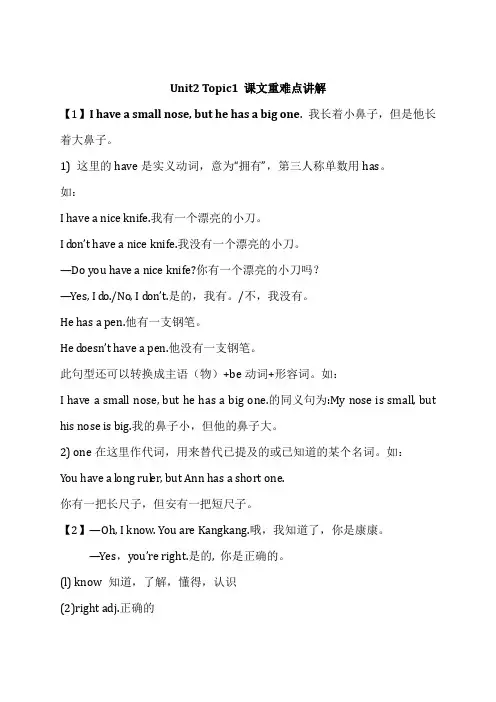
Unit2 Topic1 课文重难点讲解【1】I have a small nose, but he has a big one. 我长着小鼻子,但是他长着大鼻子。
1) 这里的have是实义动词,意为“拥有”,第三人称单数用has。
如:I have a nice knife.我有一个漂亮的小刀。
I don’t have a nice knife.我没有一个漂亮的小刀。
—Do you have a nice knife?你有一个漂亮的小刀吗?—Yes, I do./No, I don’t.是的,我有。
/不,我没有。
He has a pen.他有一支钢笔。
He doesn’t have a pen.他没有一支钢笔。
此句型还可以转换成主语(物)+be动词+形容词。
如:I have a small nose, but he has a big one.的同义句为:My nose is small, but his nose is big.我的鼻子小,但他的鼻子大。
2) one在这里作代词,用来替代已提及的或已知道的某个名词。
如:You have a long ruler, but Ann has a short one.你有一把长尺子,但安有一把短尺子。
【2】—Oh, I know. You are Kangkang.哦,我知道了,你是康康。
—Yes,you’re right.是的, 你是正确的。
(l) know 知道,了解,懂得,认识(2)right adj.正确的right在这里是形容词。
You are right.相当于That’s right.你是正确的(你说得对)。
【拓展】right n.右边反义词: left左边【3】Michael, who is your favorite actor? 迈克尔, 谁是你最喜欢的演员?favorite作形容词,意为“最喜欢的……”,相当于like …best。
仁爱英语七年级上册 Unit 2 单词
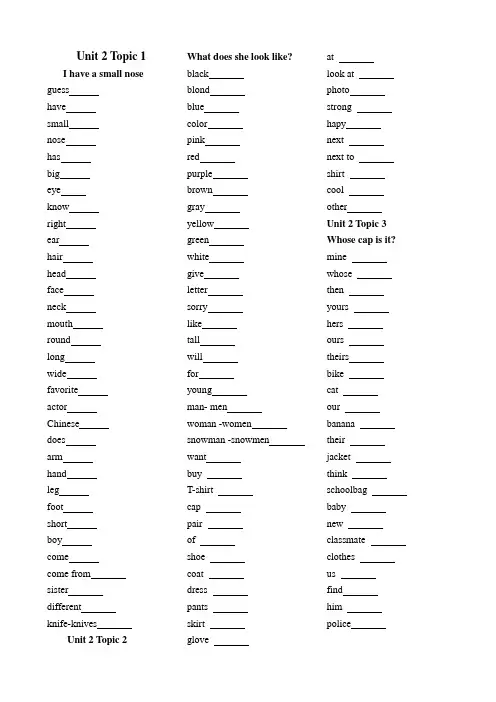
Unit 2 Topic 1I have a small nose guesshavesmallnosehasbigeyeknowrightearhairheadfaceneckmouthroundlongwidefavoriteactorChinesedoesarmhandlegfootshortboycomecome fromsisterdifferentknife-knivesUnit 2 Topic 2 What does she look like?blackblondbluecolorpinkredpurplebrowngrayyellowgreenwhitegivelettersorryliketallwillforyoungman- menwoman -womensnowman -snowmenwantbuyT-shirtcappairofshoecoatdresspantsskirtgloveatlook atphotostronghapynextnext toshirtcoolotherUnit 2 Topic 3Whose cap is it?minewhosethenyourshersourstheirsbikecatourbananatheirjacketthinkschoolbagbabynewclassmateclothesusfindhimpoliceUnit 2 Topic 1I have a small nose. 有v.小的adj.鼻子n.男孩n.有(三单)v.大的adj.眼睛n.短的adj.知道v.正确的adj.耳朵n.姐妹n.头发n.头n.脸n.脖子n.嘴n.不同的adj.来v.来自于圆形的adj.长的adj.宽的adj.最喜爱的adj.演员n.中国人n.汉语n.中国人的adj.胳膊n.猜v.手n.腿n.小刀n.脚n.Unit 2 Topic 2 What does she look like?黑色的adj.金黄色的adj.蓝色的adj.颜色n.给……着色,涂色v.粉红色n.adj.紫色n&adj.红色n&adj.棕色n&adj.灰色n&adj.黄色n&adj.绿色n&adj.白色n&adj.给v.信,字母n.对不起,抱歉interj.像,喜欢v.高的adj.会,将v.给prep年轻的adj.男人n.男人(pl.)妇女n.妇女(pl.)雪人n.雪人(pl.)想要v.买v.T恤衫n.便帽n.一双;一对n.……的prep.鞋子n.大衣n.连衣裙n.裤子n.短裙n.手套n.向;在prep.照片n.强壮的adj.幸福的adj.下一个的adj.在……近旁衬衫n.酷;凉爽的adj.其他的pron.Unit 2 Topic 3Whose cap is it?我的pron.形物谁的pron.那么,然后你的;你们的pron. 形物她的pron. 形物我们的pron. 形物他们的pron. 形物自行车n.猫n.我们的pron. 形物香蕉n.他她它们的pron. 形物夹克衫n.想,认为v.书包n.婴儿n.新的n.同学n.衣服n.我们pron.宾格找到v.他pron. 宾格警察n.。
仁爱英语七年级上册知识点归纳完整版
仁爱英语七年级上册知识点归纳完整版一、短语:come from 出生于;来自in 用表达look like 看起来像give sth. to sb. 把某物给某人look at 看着help sb. with sth. 帮助某人做某事a little 一点点each other 互相a lot 非常,更加,很much 非常,更加,很have a seat 坐下,就座look after 照顾,照看next time 下一次try on 试穿good idea 好主意such as 比如,例如wait a moment 稍候,等一会儿family tree 家谱look the same 看起来一样have a picnic 去野餐go fishing 去钓鱼go shopping 去购物do shopping 购物take one's order 记下顾客点的菜fly a kite 放风筝different looks 不同的相貌have breakfast 吃早餐have lunch 吃午饭have supper 吃晚饭have dinner 吃饭all right 好的on one's way home 在某人回家的路上find one's way home 找到回家的路a glass of 一玻璃杯a bottle of 一瓶a pair of 一双have fun 玩得开心think of 认为speak to sb. 对某人说call sb. back 回拨电话给某人get up 起床eat out 下馆子,出去吃饭go home 回家go to school 去上学help oneself to sth. 随便吃喝些什么be free 有空have no time 没时间over there 在那儿think about 考虑on a farm 在农场help sb. with sth. 帮助某人某事at night 在夜晚on Sunday 在星期天go out 出去go for a picnic 去野餐on Sunday morning 在星期天早晨at six o'clock 在六点钟be from 出生于;来自go to the zoo 去动物园Welcome to China 欢迎到中国来Don't worry 别担忧 in the same grade 在同一个年级in different classes 在不同的班级telephone number 电话号码junior high school 初中You're welcome 别客气Thank you 谢谢你 Can I help you 我能帮你什么忙吗Here you are 给你Here it is 它在这Here we are 我们到了 be afraid 恐怕,害怕in different clothes 不同的衣服be in blue 蓝色衣服be in a red T-shirt 红色T恤be in black pants 黑色裤子help sb. do sth. 助某人做某事want to do sth. 要做某事like to do sth. 欢做某事would like to do sth. 要做某事Are you kidding 是开玩笑吧Thank you all the same 是要谢谢你a bag of一袋That's right没错That's all right不用谢没关系 how many多少how much多少 too heavy太重this Sunday这个星期日forget to do sth.忘记去做某事See you later再见 's up怎么啦's wrong with you你怎么啦 have to 不得不carry water提水sing a song唱歌be in在家be out在外面ask sb. to do sth.要求某人做某事want sb. to do sth.想要某人去做某事would like sb. to do sth.想要某人去做某事at my home在我家What time is it几点了half past seven七点半a quarter to eight差一刻八点It's time to do sth.该做某事的时候了; What's the time几点了thank sb. for sth.因为某事而感谢某人thank sb. for doing sth.感谢某人做了某事 at the zoo在动物园二、知识点:Unit 11、Good morning/ afternoon / evening 早上/下午/晚上好 Good night 晚安2 、glad / nice to meet / see you 见到你很高兴回答也一样3、welcome to + 地点欢迎来到答:Thank you 或者 Thanks4、let’s + V原让我们做5、 stand up 起立 sit down 坐下6、this is 这是…… 用于介绍第三者的用语7、How do you do 你好回答也是:How do you do 8、 How are you 你好吗 Fine ,thank you .and you 很好;谢谢;你呢I’m OK / I’m fine , too . 我也很好;9、 see you = see you later = see you soon = good-bye 再见10、 excuse me 打扰一下;请问11、I’m = my name is 我是……12、 be from = come from 来自13、 in English 用英语14、 Can you spell it Yes / No 你能拼写它吗能/不能15、That’s OK / That’s all right / You’re welcome / Not at all 不用谢16、…… years old ……岁17、 telephone number 电话号码number 号码 ID number 身份证18、 the same 相同的反义词是different 不同的例: We are in the same grade, but we are in different classes. 句型:19、What is your name 你的名字是什么20、Where +be + 主语 + from 某人来自于哪里回答:主语+be+地点例: Where are you fromI am from quanzhou.21、How old + be + 主语某人几岁回答:主语 + be + 数字例:How old are you I’m forteen.22、What is your telephone number 你的电话号码是多少回答:My telephone number is或者It’s 注意:读出号码的时候要逐个读出;23、What class / grade +be + 主语 + in 某人在哪一个班级/年级例:what class are you in I am in Class Five. 注意:Class 和 Five 需要大写what grade are you in I am in Grade Seven. 注意: Glass 和 Seven 需要大写 24、What’s this/ that in English 这是什么回答:It’s a/an + 单数名词. 这是…… What’ re these/ those in English 这些是什么回答:They’re + 复数名词这些是……25、How do you spell it 你怎么拼写它 E-R-A-S-E-R, eraser. 注意拼读方法Unit 2 1、 sb + has/ have an /a + adj + 五官 === sb’s 五官 is / are + adj 描述长相例:Lily has a small nose. = Lily’s nose is small. 2、 I know = I see 我明白了 3、That’s right 那是对的 4、look the same look like 看起来相像look different 看起来不同例: Jim and Lilei look the same.== Jim looks like Lilei. . 5、 look at + n 看某物 look for +n 寻找某人/某物 look after +n 照顾某人 6、 both 两者都…… all 三者或者三者以上都Both 和all 位于 be 动词或情态动词后,位于行为动词前;例: We are both students. We both have black eyes. We can both speak English. 注意: 7、 give sth to sb = give sb sth 把某物给某人;注意:如果 sth 是 it 或 them,只能用前者注意 ,只能用前者8、 have different looks == look different 有着不同的长相看起来不相像have the same look. ==look the same 有着相同的长相看起来很相像 9、over there 在那边 come in 请进 go out 出去 10、 in + 颜色或 in a/an/the +颜色 + 衣服表示穿着……颜色的衣服常常接在名词的后面,表示穿颜色衣服的…… 如 the girl in red is my sister.11、 too + adj 太……12、 pants 和shoes 做主语,谓语动词用复数;但 a pair of pants/ shoes 作主语时,谓语动词用单数形式例: His shoes are black. A pair of shoes is under the bed. 13、 in the morning/ afternoom/ evening 在早上/下午/晚上 at night 在晚上 14、 go shopping = go to the shop 去购物类似的有 go swimming go fishing go skating 等等帮助某人做某事注意:sb 用代词时必须用宾格 15、 help sb. to do sth == help sb with sth 16、 high school 中学 17、 play +球类 play the 乐器 18、 think of 认为,想 think about 考虑 I think + 从句我认为……例: I think he you are right.否定式常否定主句,但翻译时要否定后面的从句例:I don’t think he can come. 我认为他不会来了.不能说:我不认为他会来19、What do/does + 主语 + look like 询问人的长相例: What does your English teacher look like 20、What’s and ……加……是什么回答:It’s例:What’s red and yellow It’s orange. What’s two and five It’s seven. 21、Whose + 东西 + is this/ that Whose + 东西 +are these/ those 这/这些是谁的……例:Whose coat is this It is mine. Whose shoes are these They are hers.22、Who is the letter from 这封信来自于谁It’s f rom Lily. 它来自于莉莉;23、What color be + 东西回答:It’s +颜色或者They’er + 颜色例:What color is your dress It’s black.Unit 31、Could you please…… 后接动词原形你愿意做某事吗我能做某事吗 MayI …… 后接动词原形2、 the English corner 英语角3、 live in + 地点住在某地 live with + 人和某人住在一起4、 What does he say in the letter 他在信里说了些什么 What does he say on the phone 在电话里说了些什么5、 a lot = very much 放在句末,修饰动词,非常……not at all 一点也不……例: I like the boy a lot/ very much.I don’t like the boy at all.. 6、 each other 相互,彼此例: S tudents often talk to each other in class. 7、 do sth with sb 和某人一起做某事 8、 No problem 没问题9、 speak + 语言说某种语言 speak English speak Chinese 10、 the Great Wall 长城 11、 come/go to + 地点去某地但 home 、 here 、 there 这些是副词,前面不能加 to例:go home / come here / go there go to do sth 去做某事例: They go to play basketball. 12、 like doing sth 喜欢做某事 like to do sth 想要做某事 13、It’s + adj +to sb 对某人来说是……的 14、 help sb with sth =help sb to do sth 帮助某人某事 15、 be at home = be in 在家 go home 回家 get home 到家in one’s home 在某人的家里 16、 have a seat / take a seat / sit down 请坐下 17、office worker 办公室职员 cook 厨师cooker 炊具 18、 on a farm 在农场上on the sofa 在沙发上 19、 a photo of one’s family 某人的全家照 Family Tree 家谱首字母都大写 20、 in a hospital 在医院纯属地点概念 in hospital 因病住院例:He is ill in hospital. 他生病住院 He is in a hospital.他在医院里不一定是因为生病来到医院 21、 look after sb = take care of sb 照顾某人22、 teach sb sth = teach sth to sb 教某人某东西 teach sb to do sth 教某人做某事23、help oneself to sth. 请随便吃…… help yourself/ yourselves to fish24、I’d like sth = I would like sth. 我想要……25、 Would like to do sth = want to do sth 想要做某事26、 Would you like something to eat drink 你想要一些吃喝的东西吗 to eat 或 to drink 修饰 something,作为后置定语; 27、 Here you are . 给你 Here we are. 我们到了28、What about …… == Howabout …… ……怎么样后接代词或名词,还可以接动名词即What about doing sth29、 all right 好的30、a cup of tea 一杯茶 two cups of tea 两杯茶31、 milk for me 我要牛奶32、Why not ……后接动词原形 = Why don’t you …… 后接动词原形为什么不做某事呢回答:Good idea 好主意;33、 May I take your order 可以点菜了吗34、 wait a moment = just a moment 等一下,请稍侯 wait for sb 等待某人35、 Can I help you = May I help you = What can I do for you 需点什么帮忙吗36、 eat out 出去吃饭37、 let sb do sth 让某人做某事38、 have dinner/ breakfast/lunch/supper 吃正/早/午/晚餐39、 a kind of 一种…… all kinds of 各种各样的……40、be friendly/kind to sb 对某人友好41、 such as 例如例:I like fruits, such as oranges,bananas and apples42、 be glad to do sth例: I am glad to meet you, I am glad to be here.. 句型:43、What do/does + 主语+ do == What +be+ 主语. == What’s one’s job 回答:主语 + be + 职业.例如: What does your father do = What is your father = What’s your father’s job He is a teacher.Unit 41、 try on 试穿……2、 we/I will take it 我们/我买下了这里的 take 相当于 buy3、 buy sth for sb = buy sb sth给某人买某物; 4、I’m just looking 我只是看看; 5、 three hundred and sixty-five 365 百位数和十位数之间加and , 十位数和个位数之间加”-“6、 a pair of 一对/一双……7、 running shoes 跑鞋8、 Are you kidding 你开玩笑吧;9、 think about 考虑;10、 thank you all the same 仍然谢谢你;11、 Is that all 就这么多吗That’s all. 就这么多吧 I12、 I think so. 我认为是这样的. I don’t think so.我认为不是这样的. 13、当把东西给某人时可以说: Here you are 或 Here be + 东西或 Here it is.14、Don’t worry.别担心① worry about + 宾语如:Do you worry about your leesson ②Worried 烦恼的 be worried about +宾语如:She is worried about her mother.15. a few +可数名词肯定一点,一些;;few + 可数名词:否定几乎没有 alittle +不可数名词肯定一点,一些;;little + + 不可数名词:否定几乎没有16、 be free = have time 有空的;反义词:be busy = have no time Are you free tomorrow == Do you have time tomorrow17、在某一天使用介词 on , 在某个时刻用 at 如:On Sunday at a half past six 当 this 接时间,不用介词, this Sunday18、What’s up = what’s wrong = What’s the matter 什么事19、 forget to do sth. 忘记去做某事事还没做 forget doing sth 忘记曾做过某事事已做完20、 tell sb about sth. 告诉某人某事tell sb sth = tell sth to sb 把某事告诉某人 ask/tell sb to do sth 叫某人做某事 ask/tell sb not to do sth 叫某人不要做某事21、电话用语:①Who’s this 你是哪位②Is this ……你是……吗③This is ……speaking 我是…… ④May I speak to……我可以找……吗 22、go for sth = go to do sth 去做某事如: go for class = go to have class.23、It’s fun 真是有趣的事24、 call sb = give sb a call 打电话给某人 call sb back 给某人回电话25、I’m afrai d /sorry that + 从句恐怕……/ 对不起,……26、I have no time = I don’t have any time 我没有时间 no = not any27、 be not in = be not at home = be out 出去了,不在家;28、 sing a song / sing some songs 唱歌; fly a kite 放风筝;draw picture 画画 play sports 做运动; watch TV 看电视 read books 看书 read newspaper 看报纸29、 let sb do sth 后接动词原形让某人做某事30、时间读法有顺读法和逆读法:顺读法eleven thirty-six 表示 11:36 逆读法分钟数小于等于 30 分用 past , 分钟数大于 30 分用 to,如 five past ten 表示 10:05; five to ten 表示 9:55,half past six 表示 6:30 , a querter to six 表示 5:4531、 show sth to sb = show sb sth 把……拿给某人看;作为名词表示演出,表演32、祈使句的否定句,直接在句首加上Don't 就可以了33、have to ……后接动词原形不得不……34.、It’s time for sth/ doing sth It’s time to do sth 该到做……的时候了It’s time for sb to do sth 是某人做某事的时候了35、 next time 下一次 next week 下个星期 the next day 第二天;36、next to…… = near…… 在……旁边37、 get up 起床 go to bed 上床睡觉;get sb up 叫某人起床38、do one’s homework 做作业;39、 have a picnic 野餐;have class 上课 have a meeting 开会 have a party 举办聚会 have dinner/ breakfast/lunch/supper 吃正/早/午/晚餐 have +东西吃/喝……have a good time =enjoy oneself 玩得很愉快 have sb to do sth 让某人做某事 have to do sth 不得不……40、on the weekday 在周末;41、lot of = lots of = many =much 许多的,大量的42、 in the sun 在阳光下;43、sb like best = sb’s favorite + 种类is / are …… 谁最喜欢…… 44、on one’s way to 在某人去……的路上;on one’s w ay home 在某人回家的路上45、 Here we are. 我们到了46、It’s very kind of you 你真是太好了;47、 thanks / thank you for + n /v-ing 为……而感谢你;48、 in the tree 在树上外物附着 on the tree 在树上树上本身长出的东西 In the wall 在墙里如 window on the wall 在墙上49、 What do you think of = How do you like 你认为……怎么样例:What do you think of your English teacher= How do you like your English teacher 50、 How much be + 主语回答:It’s / They’re + 价钱. How much is your English book 问价格还可以用what’s the price of …… 为什么不做某事呢 51、Why not ……后接动词原形= Why don’t you …… 后接动词原形回答:Good idea 好主意;52、 What time is it == What is the time 回答:It’s +时间考点归纳:1、英文中常用的问候语及其回答:-Hello. -Hello.—Hi. —Hi—Good morning. —Good morning.—Good afternoon. —Good afternoon. —Good evening. —Good evening. —Good night. —Good night.—How do you do —How do you do—How are you —Fine, thank you.注意:对“How do you do” 和“How are you” 两句话的回答不要弄混淆; 2、sorry “对不起” 用于引出某一过错; Excuse me. “对不起” 用于引起对方的注意;例如:I’m sorry I can’t speak English. Excuse me, is this your backpack3、be late for ... 做……迟到 be late for school/ class/ work/ the meeting 上学/上课/上班/开会迟到注意: late 的副词仍为 late, 不能写成 lately.例如:请不要晚到学校; Please don’t arrive lately for school. × Please don’t arrive late for school. √ 4、见到某人很高兴的几种表达:Nice to meet you. = Happy/ Glad/ Pleased to meet you.5、What’s this in English =What’s the English for this 这个用英语怎么说用什么语言,介词用in: “in + 语言”.例如: in English 用英语 in Chinese 用汉语 in Japanese 用日语注意:用钢笔:in ink = in pen = witha pen 让我们学英语;6、Let’s learn English. 让我们学英语;L et’s = let us 让我们Let’s do sth. = Why not do sth. = What/How about doing sth.如:Let’s learn English. = Why not learn English = What/How about learning English注意:let sb. do .. 中的 sb.即使是第三人称单数后面的动词仍用原形例如:Let her sing an English song.7、learn from 向……学习 learn to do sth. 学做……例如:Let us learn fromLei Feng. Lucy learns to play the guitar.8、对颜色提问的两种方法: Whatcolor … = What’s the color of … 例如: What color is your coat = What’s the color of your coatcolor 着色 color sth. + 颜色,例如: I want to color it red.color 是可数名词例如:I don’t like these colors.9、对姓名的几种提问及回答:What’s your name = May I have/know your nameMy name is … = I’m…10、call + sb. + at + … “给某人打电话”11、感谢你:Thanks. = Thank you. √ Thank. × Thanks you. × Thanks for + sth./doing sth. 为……而感谢你;例如:Thanks for your help. =Thanks for helping me.12、take, bring, carry 和 get 的区别:1take “带走”,从近处带到远处例如:Please take these books to your home after school.2 bring “带来”,从远处带来例如:Please bring me some cakes.3c arry “带”,无方向性,指移动较重、较大的东西,有“负重”的含义例如:The bag is too heavy for me. Can you carry it for me 4 get “去拿来”,相当于 go and bring例如:Can I get you something to drink 12、need 需要1 need + V原……” 例如:She need some cakes.2 need to do sth. “需要做……”例如:She needs to speak English often.13、There be 句型在某处有什么例如: There is a clock on the wall. There be 句型的就近原则:若有两个或两个以上的主语是,谓语常与靠近它的那个主语一致;例如:There is a book, two pens and some cups on the desk.There are two pens, some cups and a book on the desk.注意:There be与 have 的区别在于:have 表示某人或某物拥有什么;而There be 表示在什么地方存在什么; 14、want to do sth. “想要做……”例如:He wants to join the reading club.15、like v. 喜欢用法:like sth. / sb. 喜欢…like doing sth. 喜欢做…like to do sth. 想做…like sb. to do sth. 想要某人做…would like to do sth.想做… be like 像…look/sound like 看/听起来像…注意:like doing sth. 喜欢做…长期的喜好,习惯like to do sth. 想做…短期的,具体的某一次活动16、构词法:在动词后面加-er 或-or,将动词变为人的名词例如: sing-singer wait-waiter work-workerteach-teacher speak-speakervisit-visitor加-r: write-writer drive-driver双写尾字母: run-runnerswim-swimmer shop-shopper注意: cook烹调— cook 厨师-cooker 厨房用具17、a lot of = lots of 可以用来修饰可数名词和不可数名词;Jim drank a lot of/lots of beer. I have a lot of/lots of things to do. a lot 作状语,表示程度、数量或频率;例如:Thanks a lot. I know a lot about it.19、for 就……而言例如:I have some bread for supper.20、have/eat + 三餐“吃早/中/晚饭” 例如:I usually have lunch at home.21、对价格提问:How much …=What’s the price of …例如: How much is this sweater = What’s the price of this sweater 22、in + 颜色例如: She is in red. = She is in a red coat.\23、on, in, at 与时间状语连用: on + 具体某一天例如:I will do some shopping on Sunday.in + 时间段例如: in the morning / afternoon / eveningat + 几点例如:Our class is at 8:00注意:如果时间状语前面有这些词:this, that, next, tomorrow等, 则不用介词;例如: See you next time.24、对年龄的提问:How old are you What’s your age May I know/have your age 答:I’m ... years old. 注意:表达年龄的几个同义句: Tom is 15. =Tom is 15 years old. =Tom isa 15-year-old boy. =Tom is a boy of 15.25、think +句子例如:I think you are right.注意: think 的否定转移例如:I don’t think it is right.26、like ... best = favorite+…最喜欢…例如:Jack likes red best. =Jack’s favorite color is red.27、too/also/either的区别:too 用于句末例如: Tom is from America. Lucy is from America, too. also 用于句中be 动词后,行为动词前例如: Tom is from America. Lucy is also from America. either 用于否定句中例如:Tom isn’t from America. Lucy isn’t from America, either.28、speak/ say/ talk/ tell 的区别:speak+语言讲某种语言例如:She can speak Chinese. I can speak a little English. say 强调说话的内容例如:Let me say “Thanks” to you. talk 强调交谈:talk to/with ….和……交谈talk about … 谈论……tell 强调“告诉”:tell sb. sth. = tell sth. to sb.注意:say 还有“写着”的意思,例如:Look There is a card. It says “CLOSED”. 29、be good to 对…… 友好= be friendly/kind to…30、help oneself 随便吃……在使用时要注意反身代词的单复数;例如:Jim, help yourself, please. Help yourselves, boys. help sb. = give sb. a hand 帮助……help sb. with sth. 帮助某人做某事例如:Can you help kids with swimming 你能帮助孩子学游泳吗31、动词+介词构成的动词短语,其宾语是名词的时候,可放在动词与介词之间,也可以放在介词的后面例如: call sb. back = call back sb. 给……回电话 try sth on. = try on sth. 试穿……注意:如果宾语是代词 it 或 them 则只能放在中间例如:try it/them on.32、allof 全部,所有三者以上; bothand 两者都……放在助动词、情态动词、be 动词之后,行为动词之前例如:We are all students, we all work hard.My parents are both office workers.= Both my father and mother are office workers.All of the girls look nice.33、be from = come from…来自…… 注意:动词的变化: She’s from China. = She comes fromChina.She isn’t from England. = She doesn’t come from England.常见的错误: Where is he come from Where does he from国籍的几种表达方法: Tom 是个美国人;Tom is American. Tom is an American. Tom is an American boy. Tom is from America. Tom comes from America.售货员招呼顾客:① May I help you ② Can I help you③ What can I do for you ④ What would you like顾客常用语: ① No, thanks. I’m just looking . ② I’m looking for ... . ③ I’d like to have/buy ... . ④ Can you show me ...⑤ Could I have a look at ...询问顾客想买东西的特征: ① What kind would you like② What color would you like ③ What color would you like顾客询问价格: ① How much is itare they②What’s the pr ice of ...顾客决定要买:I’ll take/have itthem. 付钱: Here’s the money.。
仁爱版七年级英语上册知识点总结
仁爱版七年级英语上册知识点总结英语七年级上册知识点归纳Unit 1 Making New Friends. 一.重点短语1.Good morning/ afternoon / evening! 早上/下午/晚上好!Good night: 晚安(晚上告别)!2.Glad / Nice to meet / see you ! 见到你很高兴(回答也一样)3.Welcome to + 地点: 欢迎来到…… (回答:Thank you 或者Thanks)4.let’s + do(动词原形):让我们做……5.stand up: 起立sit down: 坐下6.单数: this is----- 这是…… (用于介绍第三者的用语)复数:these are----- 这些是7.How do you do ?你好(回答也是:How do you do ? )8.How are you ? 你好吗?Fine ,thank you/thanks .And you ? 很好,谢谢;你呢?I’m OK / I’m fine , too .我也很好。
9.See you = See you later = See you soon = good-bye 再见10.excuse me 打扰一下;请问11.做自我介绍:I’m -----= my name is ---- 我是……12. be from = come from: 来自13. in English: 用英语表示14.Can you spell it ? Yes / No. 你能拼写它吗?能/不能How do you spell it? M-A-P, map.你怎样拼写它?15.That’s OK / That’s all right / You’re welcome / Not at all!不用谢16.……years old:……岁如:I’m twelve years old.17. telephone number:电话号码QQ number:QQ号码ID number:身份证18.the same: 相同的反义词是different: 不同的例: We are in the same grade, but we are in different classes.二.重点句型:1. What is your name ? 你的名字是什么?2. Where +be +主语+ from? 某人来自于哪里?(回答:主语+be+地点)eg:Where are you from? I am from China.3. How old + be + 主语?某人几岁?(回答:主语+ be + 数字)例:How old are you ? I’m twelve.4.What is your telephone number? 你的电话号码是多少?回答:My telephone number is--或者It’s -- 注意:读出号码的时候要逐个读出。
仁爱英语七年级上册知识点归纳完整版
仁爱英语七年级上册知识点归纳完整版一、短语:comefrom出生(于);来自inEnglish用英语(表达)looklike看起来像.把(某物)给(某人) lookat看着.帮助(某人)做(某事)alittle一点点eachother互相alot非常,更加,很verymuch非常,更加,很haveaseat坐下,就座lookafter照顾,照看nexttime下一次tryon试穿goodidea好主意suchas比如,例如waitamoment稍候,等一会儿familytree 家谱lookthesame看起来一样haveapicnic去野餐gofishing去钓鱼goshopping去购物dosomeshopping购物takeone'sorder记下顾客点的菜flyakite放风筝differentlooks不同的相貌havebreakfast吃早餐havelunch吃午饭havesupper吃晚饭havedinner吃饭allright好的onone'swayhome在某人回家的路上findone'swayhome找到回家的路aglassof 一玻璃杯abottleof一瓶apairof一双havefun玩得开心thinkof认为speaktosb.对某人说回拨电话给某人getup起床eatout下馆子,出去吃饭gohome回家gotoschool去上学helponeselftosth.随便吃(喝)些什么befree有空havenotime没时间overthere在那儿thinkabout考虑onafarm在农场.帮助某人某事atnight在夜晚onSunday在星期天goout出去goforapicnic去野餐onSundaymorning在星期天早晨atsixo'clock在六点钟befrom出生(于);来自gotothezoo去动物园WelcometoChina!欢迎到中国来!Don'tworry!别担忧!inthesamegrade在同一个年级indifferentclasses在不同的班级telephonenumber电话号码juniorhighschool初中You'rewelcome!别客气!Thankyou!谢谢你!CanIhelpyou?我能帮你什么忙吗?Hereyouare!给你!Hereitis!它在这Hereweare!我们到了!beafraid恐怕,害怕indifferentclothes不同的衣服beinblue 蓝色衣服beinaredT-shirt红色T恤beinblackpants 黑色裤子.助某人做某事wanttodosth.要做某事liketodosth.欢做某事wouldliketodosth.要做某事?Areyoukidding?是开玩笑吧?Thankyouallthesame!是要谢谢你!abagof一袋That'sright!没错!That'sallright!不用谢!没关系!howmany 多少howmuch多少tooheavy太重thisSunday这个星期日forgettodosth.忘记去做某事Seeyoulater!再见!what'sup?怎么啦?What'swrongwithyou?你怎么啦?haveto 不得不carrywater提水singasong唱歌bein在家beout在外面.要求某人做某事.想要某人去做某事.想要某人去做某事atmyhome在我家Whattimeisit?几点了?halfpastseven七点半aquartertoeight差一刻八点It'stimetodosth.该做某事的时候了。
仁爱英语七年级上册知识点归纳完整版
仁爱英语七年级上册知识点归纳完整版一、短语:come from 出生(于);来自in English 用英语(表达)look like 看起来像give sth. to sb. 把(某物)给(某人)look at 看着help sb. with sth. 帮助(某人)做(某事)a little 一点点each other 互相a lot 非常,更加,很very much 非常,更加,很have a seat 坐下,就座look after 照顾,照看next time 下一次try on 试穿good idea 好主意such as 比如,例如wait a moment 稍候,等一会儿family tree 家谱look the same 看起来一样have a picnic 去野餐go fishing 去钓鱼go shopping 去购物do some shopping 购物take one's order 记下顾客点的菜fly a kite 放风筝different looks 不同的相貌have breakfast 吃早餐have lunch 吃午饭have supper 吃晚饭have dinner 吃饭all right 好的on one's way home 在某人回家的路上find one's way home 找到回家的路a glass of 一玻璃杯a bottle of 一瓶a pair of 一双have fun 玩得开心think of 认为speak to sb. 对某人说call sb. back 回拨电话给某人get up 起床eat out 下馆子,出去吃饭go home 回家go to school 去上学help oneself to sth. 随便吃(喝)些什么be free 有空have no time 没时间over there 在那儿think about 考虑on a farm 在农场help sb. with sth. 帮助某人某事at night 在夜晚on Sunday 在星期天go out 出去go for a picnic 去野餐on Sunday morning 在星期天早晨at six o'clock 在六点钟be from 出生(于);来自go to the zoo 去动物园Welcome to China! 欢迎到中国来!Don't worry! 别担忧!in the same grade 在同一个年级in different classes 在不同的班级telephone number 电话号码junior high school 初中You're welcome! 别客气!Thank you! 谢谢你!Can I help you? 我能帮你什么忙吗?Here you are! 给你!Here it is! 它在这Here we are! 我们到了!be afraid 恐怕,害怕in different clothes 不同的衣服be in blue 蓝色衣服be in a red T-shirt 红色T恤be in black pants 黑色裤子help sb. do sth. 助某人做某事want to do sth. 要做某事like to do sth. 欢做某事would like to do sth. 要做某事?Are you kidding? 是开玩笑吧?Thank you all the same! 是要谢谢你!a bag of一袋That's right!没错!That's all right!不用谢!没关系!how many多少how much多少too heavy太重this Sunday这个星期日forget to do sth.忘记去做某事See you later!再见!what's up?怎么啦?What's wrong with you?你怎么啦?have to不得不carry water提水sing a song唱歌be in在家be out在外面ask sb. to do sth.要求某人做某事want sb. to do sth.想要某人去做某事would like sb. to do sth.想要某人去做某事at my home在我家What time is it?几点了?half past seven七点半 a quarter to eight差一刻八点It's time to do sth.该做某事的时候了。