
2015年12月大学英语四级考试真题(第3套)
2015年12月大学英语四级考试真题(第3套) Part I Writing (30 minutes) Directions:For this part, you are allowed 30 minutes to write an essay commenting on the saying "Never go out there to see what happens, go out there to make things happen, " You can cite examples to illustrate the importance of being participants rather than mere onlookers in life. You should write at least 120 words but no more than 180 words. Part Ⅱ Listening Comprehension (30 minutes) Section A Directions: In this section, you will hear 8 short conversations and 2 long conversations. At the end of each conversation, one or more questions will be asked about what was said. Both the conversation and the questions will be spoken only once. After each question there will be a pause. During the pause, you must read the four choices marked A), B), C) and D) , and decide which is the best answer. Then mark the corresponding letter on Answer Sheet 1 with a single Line through the centre. 1.A) Children should be taught to be more careful. B) Children shouldn’t drink so much orange juice. C) There is no need for the man to make such a fuss. D) Timmy should learn to do things in the right way. 2.A) Fitness training. C) Computer programming. B) The new job offer. D) Directorship of the club. 3.A) He needs to buy a new sweater. C) The fuel price has skyrocketed. B) He has got to save on fuel bills. D) The heating system doesn't work. 4.A) Committing theft. C) Window shopping. B) Taking pictures. D) Posing for the camera. 5.A) She is taking some medicine. C) She does not trust the man's advice. B) She has not seen a doctor yet. D) She has almost recovered from the cough. 6.A) Pamela's report is not finished as scheduled. B) Pamela has a habit of doing things in a hurry. C) Pamela is not good at writing research papers. D) Pamela's mistakes could have been avoided. 7. A) In the left-luggage office. C) In a hotel room. B) At the hotel reception. D) At an airport. 8. A) She was an excellent student at college. B) She works in the entertainment business. C) She is fond of telling stories in her speech. D) She is good at conveying her message. Questions 9 to 11 are based on the conversation you have just heard. 9.A) Arranging the woman's appointment with Mr. Romero. B) Fixing the time for the designer's latest fashion show. C) Talking about an important gathering on Tuesday. D) Preparing for the filming on Monday morning. 10. A) Her travel to Japan. B) The awards ceremony. C) The proper hairstyle for her new role. D) When to start the make-up session. 11. A) He is Mr. Romero’s agent. C) He is the woman's assistant. B) He is an entertainment journalist. D) He is a famous movie star. Questions 12 to 15 are based on the conversation you have just heard. 12. A) Make an appointment for an interview. B) Send in an application letter. C) Fill in an application form. D) Make a brief self-introduction on the phone. 13. A) Someone having a college degree in advertising. B) Someone experienced in business management. C) Someone ready to take on more responsibilities. D) Someone willing to work beyond regular hours. 14. A) Travel opportunities. B) Handsome pay. C) Prospects for promotion. D) Flexible working hours. 15. A) It depends on the working hours. B) It is about 500 pounds a week. C) It will be set by the Human Resources. D) It is to be negotiated. Section B Directions: In this section, you will hear 3 short passages. At the end of each passage, you will hear some questions. Both the passage and the questions will be spoken only once. After you hear a question, you must choose the best answer from the four choices marked A) , B),C) and D). Then mark the corresponding letter on Answer Sheet 1 with a single line through the centre. Passage One Questions 16 to 19 are based on the passage you have just heard. 16. A) To give customers a wider range of choices. B) To make shoppers see as many items as possible. C) To supply as many varieties of goods as it can. D) To save space for more profitable products. 17. A) On the top shelves. B) On the bottom shelves. C) On easily accessible shelves. D) On clearly marked shelves. 18. A) Many of them buy things on impulse. B) A few of them are fathers with babies. C) A majority of them are young couples. D) Over 60% of them make shopping lists. 19. A) Sales assistants promoting high margin goods. B) Sales assistants following customers around.
2023年12月大学英语四级真题试卷及答案(三套全)

2023年12月大学英语四级真题试卷及答案(三套全) 一、听力理解第一套第一节(共5小题)1. What does the woman ask the man to do?A. Turn the television off.B. Turn the volume down.C. Turn the radio on.Answer: B2. Where does the conversation most probably take place?A. At the post office.B. At the bank.C. At the hotel.Answer: C3. What does the man imply about the woman?A. She hasn’t been to New York City.B. She needs to find a new job.C. She travels a lot for work.Answer: A4. How long has the man been waiting?A. For an hour.B. For half an hour.C. For ten minutes.Answer: B5. What is the woman doing?A. She is looking for her keys.B. She is waiting for someone to arrive.C. She is talking on the phone.Answer: C第二节(共5小题)6. What is the woman asking the man to do?A. Fix her computer.B. Help her find a job.C. Visit her tomorrow.Answer: A7. What does the man offer to do next?A. Take the woman to the restaurant.B. Prepare dinner for the woman.C. Look for a restaurant on the Internet.Answer: C8. What does the man say abo ut the woman’s computer?A. It can’t be fixed.B. It needs a software update.C. It needs a new battery.Answer: B9. What does the woman suggest doing after dinner?A. Go for a walk.B. Watch a movie at home.C. Go to a movie theater.Answer: B10. How do es the woman feel about the man’s suggestion?A. Excited.B. Indifferent.C. Annoyed.Answer: A二、阅读理解第一套An important part of a child’s development is the acquisition of social skills. Social skills help children to interact effectively with others and build healthy relationships. These skills are vital for success in school, work, and life in general.One of the best ways to help children develop social skills is through play. Play allows children to practice andmaster social, emotional, and cognitive skills in a relaxed and enjoyableenvironment. Through play, children learn valuable skills such as cooperation, sharing, problem-solving, and communication.There are different types of play that help in the development of social skills. Cooperative play is when children play and work together towards a common goal. This type of play helps children to learn teamwork and collaboration. Pretend play, on the other hand, allows children to develop empathy and understanding of others’ perspectives. They learn to take on different roles and pretend to be someone else, which helps in developing their social and emotional intelligence. Board games and group activities also promote social interaction and help children learn important skills such as taking turns, following rules, and resolving conflicts in a fair manner.Parents and educators play a crucial role in promoting social skills development. They can create opportunities for play and provide guidance and support. It is important for parents to encourage their children to engage in various types of play and provide them with age-appropriate toys and games. Educators can incorporate play-based learning activities in the classroom to foster social skills development.In conclusion, play is a valuable tool for social skills development. It allows children to practice and master important skills while having fun. Parents and educators should recognize the importance of play and provide opportunities and support for children to engage in different types of play.第二套The concept of time management is essential in today’s fast-paced world. Effective time management helps individuals to prioritize tasks, handle multiple responsibilities, and increase productivity. It allows individuals to make the most out of their time and achieve their goals efficiently.Here are some tips for effective time management:1.Set goals: Identify your long-term and short-termgoals. Break them down into smaller, manageable tasks.This will help you stay focused and motivated.2.Prioritize tasks: Determine which tasks are mostimportant and urgent. Focus on completing these tasks first.3.Create a schedule: Use a planner or online calendarto schedule your tasks and activities. Set deadlines for each task to stay organized and keep track of your progress.4.Avoid multitasking: Multitasking may seem like atime-saving technique, but it can actually decreaseproductivity. Focus on one task at a time and give it yourfull attention.5.Delegate tasks: If possible, delegate tasks to others.This will free up your time and allow you to focus on more important tasks.6.Take breaks: Schedule regular breaks to rest andrecharge. This will help you maintain focus and preventburnout.7.Avoid procrastination: Procrastination can lead tounnecessary stress and missed deadlines. Break tasks into smaller, manageable parts and tackle them one at a time.8.Learn to say no: Don’t overcommit yourself. Learn tosay no to tasks that are not essential or do not align withyour goals.e technology: Take advantage of technology toolssuch as productivity apps and time tracking apps. Thesecan help you stay organized and manage your time moreeffectively.10.Review and adjust: Regularly review your scheduleand tasks. Adjust as needed to accommodate unexpectedevents or changes in priorities.By implementing these tips, you can improve your time management skills and achieve greater success in your personal and professional life.第三套The importance of physical exercise cannot be overstated. Regular exercise has numerous health benefits and plays a crucial role in maintaining a healthy lifestyle.Physical exercise helps to strengthen the cardiovascular system, improve lung function, and increase muscle strength and endurance. It also promotes weight loss and helps to maintain a healthy body weight. Regular exercise reduces the risk of chronic diseases such as heart disease, diabetes, andcertain types of cancer. It can also improve mental health by reducing symptoms of depression and anxiety.In addition to the physical benefits, exercise is also important for cognitive function. Studies have shown that regular exercise improves memory, attention, and problem-solving skills. It can also enhance creativity and productivity.Exercise is not only beneficial for adults but also for children and adolescents. Regular physical activity in childhood and adolescence helps to develop healthy bones, muscles, and joints. It improves coordination and balance, and reduces the risk of childhood obesity. It also has a positive impact on academic performance, including improved concentration and focus.There are many different forms of exercise that individuals can choose from, including aerobic exercise, strength training, flexibility exercises, and high-intensity interval training (HIIT). It is important to find a form of exercise that you enjoy and can incorporate into your daily routine.In conclusion, regular physical exercise is essential for overall health and well-being. It has numerous physical and mental health benefits and should be a priority for individuals of all ages. Make exercise a part of your daily routine and reap the rewards of a healthy and active lifestyle.三、写作题目及答案第一套写作题目:Do you agree or disagree with the following statement:。
2021年12月英语四级真题试卷第3套(含答案解析)
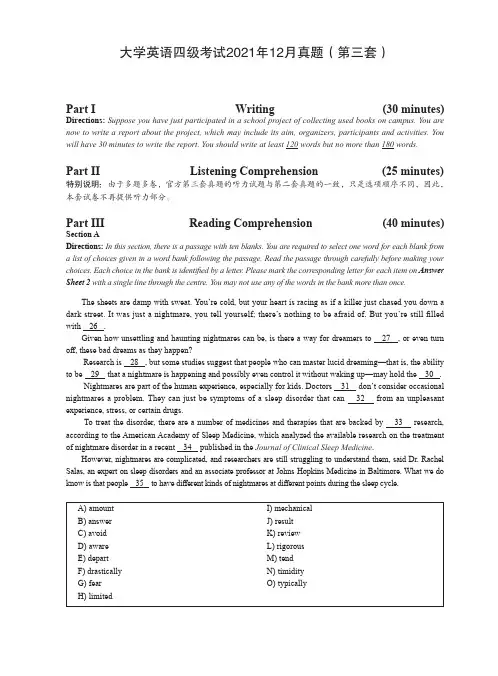
大学英语四级考试2021年12月真题(第三套)Part I Writing(30 minutes) Directions:Suppose you have just participated in a school project of collecting used books on campus. You are now to write a report about the project, which may include its aim, organizers, participants and activities. You will have 30 minutes to write the report. You should write at least 120 words but no more than 180 words. Part II Listening Comprehension(25 minutes)特别说明:由于多题多卷,官方第三套真题的听力试题与第二套真题的一致,只是选项顺序不同,因此,本套试卷不再提供听力部分。
Part III Reading Comprehension(40 minutes) Section ADirections:In this section, there is a passage with ten blanks. You are required to select one word for each blank from a list of choices given in a word bank following the passage. Read the passage through carefully before making your choices. Each choice in the bank is identifi ed by a letter. Please mark the corresponding letter for each item on Answer Sheet 2 with a single line through the centre. You may not use any of the words in the bank more than once.The sheets are damp with sweat. You’re cold, but your heart is racing as if a killer just chased you down a dark street. It was just a nightmare, you tell yourself; there’s nothing to be afraid of. But you’re still fi lled with 26 .Given how unsettling and haunting nightmares can be, is there a way for dreamers to 27 , or even turn off , these bad dreams as they happen?Research is 28 , but some studies suggest that people who can master lucid dreaming—that is, the ability to be 29 that a nightmare is happening and possibly even control it without waking up—may hold the 30 .Nightmares are part of the human experience, especially for kids. Doctors 31 don’t consider occasional nightmares a problem. They can just be symptoms of a sleep disorder that can 32 from an unpleasant experience, stress, or certain drugs.To treat the disorder, there are a number of medicines and therapies that are backed by 33 research, according to the American Academy of Sleep Medicine, which analyzed the available research on the treatment of nightmare disorder in a recent 34 published in the Journal of Clinical Sleep Medicine.However, nightmares are complicated, and researchers are still struggling to understand them, said Dr. Rachel Salas, an expert on sleep disorders and an associate professor at Johns Hopkins Medicine in Baltimore. What we do know is that people 35 to have diff erent kinds of nightmares at diff erent points during the sleep cycle.A)amount I)mechanicalB)answer J)resultC)avoid K)reviewD)aware L)rigorousE)depart M)tendF)drastically N)timidityG)fear O)typicallyH)limitedSection BDirections: In this section, you are going to read a passage with ten statements attached to it. Each statement contains information given in one of the paragraphs. Identify the paragraph from which the information is derived. You may choose a paragraph more than once. Each paragraph is marked with a letter. Answer the questions by marking the corresponding letter on Answer Sheet 2.Why it matters that teens are reading lessA)Most of us spend much more time with digital media than we did a decade ago. But today’s teens have grownup with smartphones. Compared with teens a couple of decades ago, the way they interact with traditional media like books and movies is fundamentally diff erent.B) Analysis of surveys of over one million teens in the United States collected since 1976 reveals a major shift inhow teens are spending their leisure time. Paper books are being ignored, in favor of screens. Digital devices are changing other behaviors, too. More and more, young people choose spending time on their electronic devices over engaging in other activities, regardless of the type. Indeed, by 2016, the average American high school senior said they spent six hours a day writing text messages, on social media, and online during their free time. And that covers just three activities, and if other digital media activities were included, that estimate would no doubt rise.C)Teens did not always spend that much time with digital media. Online time has doubled since 2006, andsocial media use has moved from a periodic activity to a daily one in the same period. By 2016, nearly nine out of ten young women in the 12th grade said they visited social media sites every day. Meanwhile, time spent playing video games rose from under an hour a day to an hour and a half on average. One out of ten American 8th grade students in 2016 spent 40 hours a week or more playing video games. Let me emphasize that this is equal to the time most adults spend per week at work.D)If teens are spending so much time using electronic devices, does that mean they have to give up some otheractivities? Maybe not. Over the years, many scholars have insisted that time online does not necessarily take away time spent engaging with traditional media or on other activities. Some people, they argue, are just more interested in certain kinds of media and entertainment. Thus, using more of one type of media does not necessarily mean less of the other.E)That may be true, but that still does not tell us much about what happens across a whole generation of peoplewhen time spent on digital media grows. Large surveys conducted over the course of many years tells us that American youth are not going to the cinema nearly as often as they did in the past. While 70 percent of 8th and 10th grade students used to go to the movies once a month or more, now only about half do this.More and more, watching a movie is something teens choose to do on their electronic devices. Why is thisa problem? One reason is that going to the cinema is generally a social activity. Now, watching movies issomething that most teens do alone. This fits a larger pattern. In another analysis, researchers found that today’s teens go out with their friends much less often than previous generations did.F)But the trends related to movies are less disturbing compared with the change in how teens spend their time.Research has revealed an enormous decline in reading. In 1980, about 60 percent of senior high school students said they read a book, newspaper or magazine every day that was not assigned for school. By 2016, only 16 percent did. This is a huge drop and it is important to note that this was not merely a decline in reading paper books, newspapers or magazines. The survey allowed for reading materials on a digital device.G)Indeed, the number of senior high school students who said they had not read any books for pleasure in thelast year was one out of three by 2016. That is triple the number from two decades ago. For today’s youth, books, newspapers and magazines have less and less of a presence in their daily lives. Of course, teens are still reading. But they are generally reading short texts. Most of them are not reading long articles or books that explore deep themes and require critical thinking and refl ection. Perhaps not accidentally, in 2016 reading scores were the lowest they have ever been since 1972.H)This might present problems for young people later on. When high school students go on to college, theirpast and current reading habits will infl uence their academic performance. Imagine going from reading texts as short as one or two sentences to trying to read entire books written in complex language and containing sophisticated ideas. Reading and comprehending longer books and chapters takes practice, and American teens are no longer getting that practice.I)So how can this problem be solved? Should parents and teachers take away teens’ smartphones and replacethem with paper books? Probably not. Research has shown that smartphones are currently American teens’ main form of social communication. This means that, without a smartphone, teens are likely to feel isolated from their peers. However, that does not mean teens need to use electronic devices as often as they do now.Data connecting excessive digital media time to mental health issues suggests a limit of two hours a day of free time spent with screens, a restriction that will also allow time for other activities—like going to the movies with friends or reading longer, more complicated texts.J)The latter is especially important. I would argue that of all the changes brought about by the widespread use of digital devices, the huge decline in reading is likely to have the biggest negative impact on today’s teens because reading books and longer articles is one of the best ways to learn critical thinking. It helps people to understand complex issues and to separate fact from fi ction. Thus, deep reading is crucial for being a good citizen, a successful college student and a productive employee. If serious reading dies, a lot will go with it.36. Many years’ surveys reveal that young people in America are going to the cinema much less often than theyused to.37. Survey analysis shows American teens now spend their leisure time on digital devices rather than readingprinted books.38. The number of senior high schoolers not reading books for pleasure in a year increased three times over 20years.39. Many scholars claim that spending time on electronic devices doesn’t necessarily mean a decrease of time forother activities.40. Most people spend much more time interacting with digital media than they did ten years ago.41. The author claims that it will be a great loss if we no longer read books and longer articles.42. Over a decade or so, American teens’ social media use shifted from an occasional activity to a routine one.43. A more disturbing trend in America today is that teens are spending far less time reading than around fourdecades ago.44. Some fi ve years ago, high school seniors in America generally spent more than six hours a day on electronicdevices.45. It was found that American youngsters today don’t socialize nearly as much as the earlier generations.Section CDirections:There are 2 passages in this section. Each passage is followed by some questions or unfinished statements. For each of them there are four choices marked A), B), C) and D). You should decide on the best choice and mark the corresponding letter on Answer Sheet 2 with a single line through the centre.Passage OneQuestions 46 to 50 are based on the following passage.Have you ever wondered how acceptable it is to hug or touch someone? While it may sound safe to avoid all physical contact so as not to off end anyone, the lack of touching might imply cold attitudes or indiff erence in interpersonal relationships.So, what should we do? The simple answer is to thoroughly learn unique cultural norms for physical contact. In nonverbal communication terminology (术语),physical contact and the study of touching are generally referred to as haptics.Haptics in communication often suggest the level of intimacy. They are usually classifi ed into two groups: high-contact and low-contact.Asia and quite surprisingly the United States, Canada and Britain belong to low-contact cultures. People from the rest of the world, such as Latin America, are considered to be in high-contact cultures, where they tend to expect touching in social interactions and feel more comfortable with physical closeness. Despite the classifi cation, there are more complex factors such as relational closeness, gender, age, and context that can aff ect how someone views physical contact.One common French custom of greetings is cheek-kissing, but it is mostly restricted to friends, close acquaintances and family members. While cheek-kissing for Latin Americans is also a universal greeting form, it does not require such a high degree of relational closeness. However, gender matters more for them because cheek-kissing often only happens between women or a man and a woman but not two men.In contrast, in certain Arabian, African, and Asian countries, men can publicly hold hands or show physical affection as signs of brotherhood or friendship while these behaviors may suggest a romantic relationship in other parts of the world. Although men’s touching is more normal in these cultures, physical contact between persons of opposite sexes who are not family members is negatively perceived in Arabian countries.These factors could definitely affect the degree to which someone is comfortable with tactile(触觉的) communication and physical intimacy. Therefore, if you are someone who loves to show physical aff ection, you should not be afraid to show it or drastically change your behaviors—just ask for consent beforehand!46. What does the author say in the fi rst paragraph about physical contact?A)Its role in interpersonal relationships is getting increasingly important.B)It is becoming more acceptable to many who used to think it off ensive.C)Its absence might suggest a lack of warmth in interpersonal relationships.D)It might prompt diff erent responses from people of diff erent social backgrounds.47. What does physical contact in communication suggest?A)What social class people belong to.C)What family background people come from.B)How civilized the communicators are.D)How close the communicators’ relationships are.48. What do we learn about p eople in high-contact cultures?A)They are sensitive to the way people express their emotions.B)They take touching as a cultural norm in social interactions.C)They attach great importance to close ties among people.D)They tend to be more open in interpersonal relationships.49. What do we learn about social customs in Arabian countries?A)Men can show friendship in public through physical aff ection.B)Non-traditional romantic relationships are simply unacceptable.C)Physical contact between unfamiliar people is negatively perceived.D)People of diff erent ages and genders show aff ection in diff erent ways.50. What does the author tell us to do concerning tactile communication?A)Lay emphasis on nonverbal communication.C)Pay attention to the diff erences between genders.B)Learn to use appropriate body language fi rst.D)Take other people’s preference into consideration. Passage TwoQuestions 51 to 55 are based on the following passage.From climate change to the ongoing pandemic (大流行病) and beyond, the issues facing today’s world are increasingly complex and dynamic. Yet solving problems like these requires new approaches that extend beyond traditional ways of thinking. A study led by Yale Professor of Psychology, Paul O’Keefe, found that having a growth mindset (思维倾向) of interest may spark this type of innovation.Professor O’Keefe established in earlier studies that people hold diff erent beliefs about the nature of interest. Those with a growth mindset of interest tend to believe that interests can be developed and cultivated, while those with a fi xed mindset of interest tend to believe that interests are inherent (与生俱有的) and simply need to be ‘found.’ Building on these fi ndings, the latest research examined how a growth mindset of interest can boost integrative thinking across the traditional disciplinary boundaries of arts and sciences.For example, in one task, research participants were instructed to create new college majors by combining two or more existing academic Arts or Science programs at their university. After coding and analyzing the ideas they generated, the team found that people with a growth mindset of interest were more likely to bridge programs across the arts and sciences to create new majors like computational economics rather than creating majors that drew from only one of those areas, like computational chemistry.As Professor O’Keefe pointed out, “This research provides a useful direction for organizations whose products and services call for integrated and creative solutions. Take smartphones for example. You need not only computer science and engineering knowledge, but also an understanding of psychology and visual design to create a better product. Employees with a growth mindset may be more likely to devise innovative ideas that bridge multiple areas of knowledge to achieve better solutions. ”The benefi ts of a growth mindset of interest may also extend to those seeking employment. This is a pressing issue because many people are becoming unemployed due to the COVID-19 pandemic. Having a growth mindset of interest can help job seekers expand their interests and become more adaptable to diff erent fi elds, and take the initiative to learn new skills.51. What does the author say about the world today?A)It faces problems that are getting more varied and complicated.B)It has done away with many of the traditional ways of thinking.C)It is undergoing radical and profound changes.D)It is witnessing various types of innovations.52. What did Professor O’Keefe fi nd in his earlier studies?A)People’s interests tend to change with age.C)People are divided about the nature of interest.B)People’s interests determine their mindsets.D)People of diff erent ages have diff erent mindsets.53. What is the focus of Professor O’Keefe’s recent research?A)How boundaries can be removed between arts and science disciplines.B)How feasible it is to create new disciplines like computational economics.C)How students in arts and sciences view the two types of mindset of interest.D)How a growth mindset of interest can contribute to cross-disciplinary thinking.54. What does the author want to illustrate with the example of smartphones?A)Hi-tech products are needed in interdisciplinary research.B)Improved technology gives birth to highly popular products.C)Making innovative products needs multidisciplinary knowledge.D)Hi-tech products can boost people’s integrative thinking.55. What is the author’s suggestion to those who are seeking employment?A)Learning practical skills.C)Staying safe in the pandemic.B)Broadening their interests.D)Knowing their pressing issues.Part IV Translation (30 minutes) Directions:For this part, you are allowed 30 minutes to translate a passage from Chinese into English. You should write your answer on Answer Sheet 2.坎儿井(Karez)是新疆干旱地区的一种水利系统,由地下渠道将水井连接而成。
2022年12月全国大学英语四级考试真题和答案解析(第三套)

2022年12月大学英语四级考试真题(第3套)Part I Writing(30minutes) Directions:In this task,you are to write an essay on the role of physical exercise in achieving success at college.You will have30minutes for the task.You should write at least 120words but no more than180words.PartⅡListening Comprehension(25minutes)特殊说明:由于多题多卷,官方第三套真题的听力试题与第二套真题的一致,只是选项顺序不同,因此,本套试卷不再提供听力部分。
Part III Reading Comprehension(40minutes) Section ADirections:In this section,there is a passage with ten blanks.You are required to select one word for each blank from a list of choices given in a word bank following the passage.Read the passage through carefully before making your choices.Each choice in the bank is identified by a letter.Please mark the corresponding letter for each item on Answer Sheet 2with a single line through the centre.You may not use any of the words in the bank more than once.Parenting brings fathers more joy than it does mothers,according to a new study.The research examined three studies26more than18,000participants.Across all three, parenthood was27with more positive wellbeing outcomes for dads than for mums.So why are fathers happier than mothers?“Fathers may fare better than mothers in part due to how they spend time with their children,”said lead author Katherine Nelson-Coffey.In one study,the authors28that dads were more likely to take“playing”as an29 activity both when caring for their kids and spending time with their kids.“Playing with their children likely offers parents opportunities to experience positive feelings and30 closeness with their children,”they say.Fathers also did better than men without kids,reporting greater happiness,life satisfaction,and fewer31symptoms.They also reported greater connectedness and autonomy(自主).For mums,32,compared to women without children,the results weren’t quite as positive.Mums reported greater autonomy,but also“greater trouble”and fewer positive33.Mums reported happier moods while interacting with their kids,compared to other experiences,but not while engaging34in childcare.“This difference suggests that how mothers and fathers spend time with their children might have important35for their wellbeing,”the authors write.They suspect that mums may be less happy than dads because they’re more likely to have higher expectations about parenthood.As such,they’re more likely to be“let down”by the experience.A)additional F)directly K)involvingB)associated G)emotions L)noteC)composing H)however M)preciselyD)cultivate I)implications N)superficialE)depressive J)interfered O)thereforeSection BDirections:In this section,you are going to read a passage with ten statements attached to it. Each statement contains information given in one of the paragraphs.Identify the paragraph from which the information is derived.You may choose a paragraph more than once.Each paragraph is marked with a letter.Answer the questions by marking the corresponding letter on Answer Sheet2.Learning to say noA)Not doing something will always be faster than doing it.This philosophy applies in manyareas of life.For example,there is no meeting that goes faster than not having a meeting at all.This is not to say you should never attend another meeting,but the truth is that we say“yes”to too many things we don’t actually want to do.B)How often do people ask you to do something and you just reply,“Sure.”Three days later,you’re overwhelmed by how much is on your to-do list.We become frustrated by our obligations even though we were the ones who said“yes”to them in the first place.Even worse,people will occasionally fight to do things that waste time.You don’t have to do something just because it exists.It’s worth asking if things are necessary.Many of them are not,and a simple“no”will be more productive than whatever work the most efficient person can cope with.But if the benefits of saying“no”are so obvious,then why do we say“yes”so often?C)We say“yes”to many requests not because we want to do them,but because we don’twant to be seen as rude or unhelpful.Often,we have to consider saying“no”to someone we will interact with again in the future—our co-worker,our spouse,our family and friends.Saying“no”to our superiors at work can be particularly difficult.In these situations,I like the approach recommended in Essentialism by Greg McKeown.He writes,“Remind your superiors what you would be neglecting if you said‘yes’and force them to deal with the trade-off.For example,if your manager comes to you and asks you to do X,you can respond with‘Yes,I’m happy to make this the priority.Which of these other projects should I deprioritize to pay attention to this new project?’”D)Collaborating with others is an important element of life.The thought of straining therelationship outweighs the commitment of our time and energy.For this reason,it can be helpful to be gracious in your response.Do whatever favors you can,and be warm-hearted and direct when you have to say no.But even after we have accounted for these social considerations,many of us still seem to do a poor job of managing the trade-off between yes and no.We find ourselves over-committed to things that don’tmeaningfully improve or support those around us,and certainly don’t improve our own lives.E)Perhaps one issue is how we think about the meaning of yes and no.The words“yes”and“no”get so often used in comparison with each other that it feels like they carry equal weight in conversation.In reality,they’re not just opposite in meaning,but of entirely different magnitudes in commitment.When you say“no”,you’re only saying“no”to one option.When you say“yes”,you’re saying“no”to every other option.I like how economist Tim Harford put it,“Every time we say‘yes’to a request,we’re also saying ‘no’to anything else we might accomplish with the time.”Once you’re committed to something,you’ve already decided how that future block of time will be spent.In other words,saying“no”saves you time in the future.Saying“yes”costs you time in the future.“No”is a form of time credit.You retain the ability to spend your future time however you want.“Yes”is a form of time debt.You have to pay back your commitment at some point.F)“No”is a decision.“Yes”is a responsibility.Saying“no”is sometimes seen as a luxurythat only those in power can afford.And it’s true:turning down opportunities is easier when you can fall back on the safety net provided by power,money,and authority.But it’s also true that saying“no”is not merely a privilege reserved for the successful.It’s alsoa strategy that can help you become successful.Saying“no”is an important skill todevelop at any stage of your career because it retains the most important asset in life:your time.As investor Pedro Sorrentino put it,“If you don’t guard your time,people will steal it from you.”You need to say“no”to whatever isn’t leading you toward your goals. G)Nobody embodied this idea better than Steve Jobs,who said,“People think focus meanssaying‘yes’to the thing you’ve got to focus on.But that’s not what it means at all.It means saying‘no’to the hundred other good ideas that there are.You have to pick carefully.”Jobs had another great quote about saying“no”:“I’m actually as proud of the things we haven’t done as the things I have done.Innovation is saying‘no’to1,000 things.”H)Over time,as you continue to improve and succeed,your strategy needs to change.Theopportunity cost of your time increases as you become more successful.At first,you just eliminate the obvious distractions and explore the rest.As your skills improve and you learn to separate what works from what doesn’t,you have to continually increase your threshold for saying“yes”.You still need to say“no”to distractions,but you also need to learn to say“no”to opportunities that were previously good uses of time,so you can make space for better uses of time.It’s a good problem to have,but it can be a tough skill to master.I)What is true about health is also true about productivity:an ounce of prevention is worth apound of cure.More effort is wasted doing things that don’t matter than is wasted doing things inefficiently.And if that is the case,elimination is a more useful skill than optimization.I’m reminded of the famous Peter Drucker quote,“There is nothing so useless as doing efficiently that which should not be done at all.”36.People often grant a request just because they want to appear polite and helpful.37.It’s no easy job learning to say“no”to opportunities that were once considered worth grasping.38.When you decline a request,you are saving your future time.39.People sometimes struggle to do things that are simply a waste of time.40.Doing efficiently what is not worth doing is the most useless effort.41.It is especially difficult for people to decline to do what their superiors ask them to do.42.People agree to do too many things they are in fact unwilling to do.43.According to one famous entrepreneur,innovation means refusal to do an enormous number of things.44.It is an essential aspect of life to cooperate with other people.45.Refusing a request is sometimes seen as a privilege not enjoyed by ordinary people. Section CDirections:There are2passages in this section.Each passage is followed by some questions or unfinished statements.For each of them there are four choices marked A),B),C)and D). You should decide on the best choice and mark the corresponding letter on Answer Sheet2 with a single line through the centre.Passage OneQuestions46to50are based on the following passage.We’re eating more fish than ever these days.At around20kilograms per person global fish consumption is now more than twice what it was in the1960s.What’s really remarkable, though,is where that fish comes from.For the first time in human history,most of our aquatic(水产的)food now comes from farming rather than fishing.People ate around73million tonnes of farmed fish—just more than half of the volume of fish that humans consumed—in2014.That’s out of a total fish supply of167million tonnes; the remaining20million or so tonnes go into things like animal feed and medical products.To keep eating fish at the current rate,we’re definitely going to need to keep aquaculture(水产养殖)developing.That’s because the volume of fish caught in the wild has leveled off since the1990s.Back in1974,only10%of marine fish stocks had been overfished.Now,more than three-tenths are.Only a tenth of our oceans’fish stocks could sustain heavier fishing than current levels.But while catchings at sea have suffered,fish-farming has been growing at a fast rate.A lot of that is coming from China,which produces60%of the world’s farmed fish.In fact, some35countries,including China,now produce more farmed than wild-caught fish.This shift toward aquaculture isn’t just good for ensuring salmon(三文鱼)on your plate; it’s also crucial to ensuring food security and sustainability.By2050,the world will need to feed an estimated9.7billion people.They’ll have to get their protein somewhere.However, raising cattle,pigs,and other land-based animals requires vast sums of grain and water.For example,pound for pound,beef requires15times more feed to raise than carp,a freshwaterfish farmed all over Asia.That grain—and the water needed to grow it—could be consumed by people instead.However,aquaculture is no silver bullet.In some southeast Asian countries,shrimp farming does disastrous damage to marine ecosystems.Despite these problems,however, shrimp continues to be among the most popular seafoods worldwide.46.What does the author say is remarkable about the fish we eat?A)They reproduce quickly.B)They are mostly farmed.C)They have become as important as grain.D)They have a longer history than humans.47.What do we need to do if we keep consuming fish at the current rate?A)Increase the fishing volume considerably.B)Develop more advanced fishing technology.C)Enlarge the marine fish stocks effectively.D)Expand the scale of fish-farming continuously.48.What does the author say about China in terms of aquatic food?A)It places increasing emphasis on fishing now.B)It boasts of the world’s largest fishing stocks.C)It raises more fish than caught from the wild.D)It supplies60%of the world’s fish products.49.Why does the author say aquaculture is so important these days?A)It is a must for feeding the world’s fast-growing population.B)It proves a reliable source of protein for humans and animals.C)It is essential to maintaining both mental and physical health.D)It ensures a balanced healthy diet for people the world over.50.What does the author imply by saying aquaculture is no silver bullet?A)Shrimp-farming is a risky business.B)Fish-farming will not be sustainable.C)Fish-farming may cause serious problems too.D)Shrimp-farming can become quite expensive.Passage TwoQuestions51to55are based on the following passage.In2020,the Nobel Peace Prize was awarded to the World Food Programme(WFP).Why a Nobel Prize for the WFP,and why now?In2019,the WFP assisted nearly100 million people in88countries.It is the safety net for those who fall off the edge of existence. It is a response to solving the problem of food instability.Its Nobel Prize reminds us all of the moral hazard in imagining that the poor and vulnerable are somebody else’s problem.The WFP has been around since1961and has been the global coordinator of nationally based efforts to avoid disasters with food aid.Despite decades of effort to eliminate hunger, the latest estimate is that about11%of people on the planet(about820million people)aresuffering daily undernourishment.Progress at reducing undernourishment has stopped despite gains through the1990s and2000s.Developed countries sometimes offer food and aid to developing ones,but at a price. One American philosopher stated that addressing the needs of the poor and vulnerable is about more than money—it is mostly about creating conditions under which prosperity and opportunity can thrive.When aid is offered with heavy conditions attached,like loan repayment or food for resources,it often widens the gap between rich and poor and sustains the old world order.This is why the work of the WFP is so vital.The scientific community,however,can provide a helping hand to the WFP.By sharing knowledge of agriculture and climate with peers in countries most vulnerable to poverty and hunger,scientists can help reduce these problems.By making its voice heard,science can lead by example.The ability to overcome food shortages that must be built into some of the poorest countries will not come from loans from wealthy countries,which may have food problems of their own,or world economic institutions.This ability will be built upon self-confident people using open and shared scientific knowledge to pull themselves out of their misery.51.What does the WFP’s winning of the Nobel Peace Prize make us realize?A)More and more people in the world are suffering from starvation.B)All of us can be affected by food instability one way or another.C)It is hazardous to leave millions of people poor and vulnerable.D)It is morally wrong to think helping the poor is not our business.52.What do we learn about the WFP’s effort to eliminate hunger?A)It has ensured a sufficient food supply to millions.B)It is still far from its goal despite the progress made.C)It has done a good job in combating natural disasters.D)It is preventing starvation occurring on a global scale.53.What will happen when food aid is offered at a price?A)The rich will become richer and the poor poorer.B)More people will be willing to join in the effort.C)More food will be made available to the needy.D)The relief effort will be rendered less sustainable.54.How can scientists help cope with poverty and hunger?A)By collaborating closely with world economic institutions.B)By sharing expertise with peers in poverty-stricken nations.C)By setting up more food research programs in developing countries.D)By building self-respect in people suffering from undernutrition.55.What message does the author try to convey at the end of the passage?A)Wealthy nations should solve their own food problems first.B)Rich countries should be more generous in providing food aid.C)Poor nations should enhance their own ability to solve their food shortages.D)World economic institutions should play a bigger role in fighting hunger.PartⅣTranslation(30minutes)Directions:For this part,you are allowed30minutes to translate a passage from Chinese into English.You should write your answer on Answer Sheet2.冬至(Winter Solstice)是全年白昼最短、黑夜最长的一天,标志着一年中最寒冷时节的开始。
2015年12月大学英语四级考试真题(第1套)

2015年12月大学英语四级考试真题及答案(第1套)Part I Writing (30 minutes) Directions: For this part, you are allowed 30 minutes to write an essay commenting on the saying “Never go out there to see what happens, go out there to make things happen.” Youcan cite examples to illustrate the important of being participants rather than mereonlookers in life. You should write at least 120 words but no more than 180 words.注意:此部分试题请在答题卡1上作答。
PartⅡListening Comprehension (30 minutes) Section ADirections: In this section, you will hear 8 short conversations and 2 long conversations. At the end of each conversation, one or more questions will be asked about what was said.Both the conversation and the questions will be spoken only once. After eachquestion there will be a pause. During the pause, you must read the four choicesmarked A), B), C) and D), and decide which is the best answer. Then mark thecorresponding letter on Answer Sheet 1 with a single line through the centre.注意:此部分试题请在答题卡1上作答。
2023年12月英语四级真题及答案(共三套)
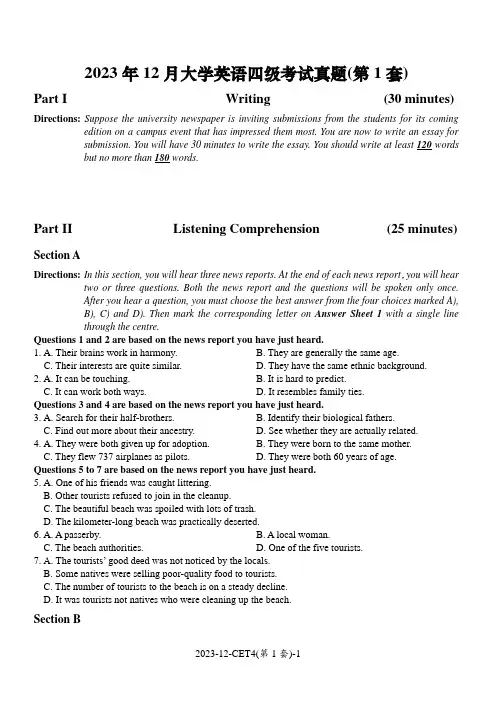
2023年12月大学英语四级考试真题(第1套)Part I Writing (30 minutes) Directions:Suppose the university newspaper is inviting submissions from the students for its coming edition on a campus event that has impressed them most. You are now to write an essay forsubmission. You will have 30 minutes to write the essay. You should write at least 120 wordsbut no more than 180 words._____________________________________________________________________________________ _____________________________________________________________________________________ _____________________________________________________________________________________ _____________________________________________________________________________________ Part II Listening Comprehension (25 minutes) Section ADirections:In this section, you will hear three news reports. At the end of each news report,you will hear two or three questions. Both the news report and the questions will be spoken only once.After you hear a question, you must choose the best answer from the four choices marked A),B), C) and D). Then mark the corresponding letter on Answer Sheet 1with a single linethrough the centre.Questions 1 and 2 are based on the news report you have just heard.1. A. Their brains work in harmony. B. They are generally the same age.C. Their interests are quite similar.D. They have the same ethnic background.2. A. It can be touching. B. It is hard to predict.C. It can work both ways.D. It resembles family ties.Questions 3 and 4 are based on the news report you have just heard.3. A. Search for their half-brothers. B. Identify their biological fathers.C. Find out more about their ancestry.D. See whether they are actually related.4. A. They were both given up for adoption. B. They were born to the same mother.C. They flew 737 airplanes as pilots.D. They were both 60 years of age.Questions 5 to 7 are based on the news report you have just heard.5. A. One of his friends was caught littering.B. Other tourists refused to join in the cleanup.C. The beautiful beach was spoiled with lots of trash.D. The kilometer-long beach was practically deserted.6. A. A passerby. B. A local woman.C. The beach authorities.D. One of the five tourists.7. A. The tourists’ good deed was not noticed by the locals.B. Some natives were selling poor-quality food to tourists.C. The number of tourists to the beach is on a steady decline.D. It was tourists not natives who were cleaning up the beach.Section BDirections: In this section, you will hear two long conversations. At the end of each conversation, you will hear four questions. Both the conversation and the questions will be spoken only once.After you hear a question, you must choose the best answer from the four choices marked A),B), C) and D). Then mark the corresponding letter on Answer Sheet 1with a single linethrough the centre.Questions 8 to 11 are based on the conversation you have just heard.8. A. He has to play football with workmates. B. He has got some books to read.C. He is going to visit a friend.D. He is physically unfit for it.9. A. To teach kids about animal protection. B. To learn how popular zoos could be.C. To see some rare animals in cages.D. To give her little nephew a treat.10. A. He enjoys excellent health. B. He is keen on extreme sports.C. He coaches tennis players every week.D. He spends most of his time in the gym.11. A. Tending to his swollen ankle. B. Concentrating on reading.C. Writing three book reports.D. Planning Christmas celebrations.Questions 12 to 15 are based on the conversation you have just heard.12. A. It is being debated by hundreds of retirees. B. It is attracting many people’s attention.C. It partly records his own experience.D. It argues for postponing retirement.13. A. One should foresee a financial crisis. B. One should trust financial planners’ figures.C. One should have one million dollars to retire.D. One should start saving as early as possible.14. A. It doesn’t need to be permanent. B. It shouldn’t be considered risky.C. It helps to reduce travel expenses.D. It is the way to quit a job one hates.15. A. By keeping close contact with one’s employers.B. By retiring when one reaches sixty years old.C. By investing half of one’s monthly income.D. By following the counsel of financial planners.Section CDirections:In this section,you will hear three passages. At the end of each passage, you will hear three or four questions. Both the passage and the questions will be spoken only once. After youhear a question, you must choose the best answer from the four choices marked A), B), C)and D). Then mark the corresponding letter on Answer Sheet 1 with a single line through thecentre.Questions 16 to 18 are based on the passage you have just heard.16. A. They tended to be easily anticipated by those belonging to their own race.B. They tended to be arbitrarily judged by individuals of opposing groups.C. They were readily shared among members of the same social or racial group.D. They were influenced by the presence of someone from an outsider group.17. A. When they tried to make a positive impression on the researchers.B. When an unknown student from another university was present.C. When an experimenter from the research team took notice.D. When they were offered both candy and fruit as a snack.18. A. By advertising its social benefits. B. By teaching consumers diet strategies.C. By supporting struggling consumers.D. By maintaining its positive image. Questions 19 to 21 are based on the passage you have just heard.19. A. The academic and learning issues struggling students encounter.B. The risk students face due to a history of mental health problems.C. The effect of interacting with therapy dogs on students under pressure.D. The work universities are doing to help students succeed academically.20. A. Their communicative skills. B. Their executive functioning.C. Their academic networking.D. Their leadership capacities.21. A. Rid students of their anxiety. B. Add to some students’ stress.C. Contribute little to typical students’ success.D. Help students with mental issues pull through. Questions 22 to 25 are based on the passage you have just heard.22. A. Work hard and plan carefully. B. Attempt to succeed at any cost.C. Aim high and expect great results.D. Remain optimistic even in difficult.23. A. Regarding failure as something inevitable. B. Trying out innovative marketing strategies.C. Venturing into sectors never explored before.D. Being willing to experiment with novel ideas.24. A. Expect future success so as to move forward. B. Learn from our failure and forge ahead.C. Distinguish between good and bad risks.D. Examine our strategies and find out weaknesses.25. A. Fresher offers. B. Safer operation.C. More challenges.D. Less competition.Part III Reading Comprehension (40 minutes) Section ADirections:In this section, there is a passage with ten blanks. You are required to select one word for each blank from a list of choices given in a word bank following the passage. Read thepassage through carefully before making your choices. Each choice in the bank is identifiedby a letter. Please mark the corresponding letter for each item on Answer Sheet 2with asingle line through the centre. You may not use any of the words in the bank more than once. Questions 26 to 35 are based on the following passage.Exercising for just 10 minutes a week is linked to a longer life, according to a new study published in The British Journal of Sports Medicine.Several recent studies have found that even low-intensity exercise, done for a short amount of time, can have a meaningful 26 on health. Still, the idea that exercising for just 10 minutes a week may be enough to increase your lifespan is novel. It’s also somewhat 27 , since the federal physical activity guidelines recommend getting at least 75 minutes of vigorous exercise or 150 minutes of 28 exercise each week.The study was based on data from more than 88,000 U.S. adults who 29 in the National Health Interview Survey between 1997 and 2008.Contrary to some research that has found an 30 limit to the amount of exercise that is healthy, the researchers found that there was 31 no limit to the longevity (长寿) benefits of exercise. Even the small group of people who got 10 times the amount of exercise recommended by the federal government had a 46% lower 32 of death than the least active group.Still, observational studies like this one cannot prove cause and effect; they can only find 33 . The researchers also were not able to 34 for certain lifestyle factors that could affect lifespan, including dietary habits and changes in physical activity over time. Despite these 35 , the study’s results are yet another indication of the power of physical activity, even in small amounts.Section BDirections: In this section, you are going to read a passage with ten statements attached to it. Eachstatement contains information given in one of the paragraphs. Identify the paragraph fromwhich the information is derived. You may choose a paragraph more than once. Eachparagraph is marked with a letter. Answer the questions by marking the corresponding letteron Answer Sheet 2.How Climate Change Will Affect What You EatA) Earlier this year, scientists warmed that one in six animal species could go extinct (灭绝的) due toclimate change. Could the same thing happen to our crops and other foodstuffs too?B) It’s clear that farmers in many parts of the world are going to find things harder in the comingdecades. Last week, BBC Future explored one scientist’s efforts to help crops cope with the increased probability of droughts. By using the genes from resurrection (复活) plants, Jill Farrant of the University of Cape Town is exploring whether she can design crops to survive for much longer periods without water.C) But if we can’t find ways to protect other foods, will they survive climate change? Fortunately, thereis some good news on this front. Despite alarmist headlines about “foods that are going extinct,” there is no evidence that major food types like beans, chocolate, wine, corn or wheat will cease to exist.D) But that doesn’t mean it’s all good news for future food. We will probably have to change where wegrow certain crops, as some regions get too hot. The disadvantage, obviously, is that local farmers will suffer under this situation. And some people may struggle to get the same access to certain foods. “Even if overall food production may be unaffected, food security can still be impacted,” says Margaret Walsh, a scientist at the US Department of Agriculture’s Climate Change Program Office. In other words, even if a certain food is still grown on some corner of the Earth, it doesn’t mean that everyone will continue to have the same degree of access as today.E) Overall, the yields of many foods, from staples to life-enhancing extras such as coffee and chocolate,will likely be impacted by climate change too. How those decreases will be felt will depend on the degree of warming and the crop in question, but in general, “anything over about 30°C is very bad for crops,” says Wolfram Schlenker, an associate professor of international and public affairs at Columbia University. For example, statistical studies that he and a colleague built of corn and soybean (大豆) production in the US show a steep decline after crossing the 30°C temperature threshold (临界点).F) In the US —the world’s largest producer of corn and soybeans—farms can move north to somedegree, Schlenker says. But eventually, yields will likely suffer because the soil north ofIowadeclines in quality-a legacy of glacial (冰川的) expansion. Other studies, including studies of wheat in India and corm in Africa, also found that there is a threshold above which yields sharply decline: crops can adapt and move, but only to a point. “What’s common to all studies is the finding that extreme heat is damaging to crop growth, although exact cutoffs vary by crop,” Schlenker says. “If predictions for the end of the century are true, though, I think a lot of agricultural areas in the US will see significant hits.”G) Under current conditions, about 4% of the world’s croplands experience drought in any given year,but by the end of the century those conditions are forecasted to jump to about 18% per year. Some studies indicate that horticulture crops—generally, everything besides staples—may be impacted most severely, largely because they tend to be confined to a smaller geographic area. Researcher Andrew Jarvis and his colleagues found that 80% of coffee-growing zones in Central America and Brazil could become unsuitable by 2050, for example, while climate change will likely have “great impacts” on cocoa (可可粉) production in West Africa. “High quality chocolate will be less available in the future, and if you want it, you’ll have to pay a lot more for it,” Jarvis says.H) This means that for those who can afford it, some foods will simply cost them more in the future. Butfor poorer people, those same price jumps will likely cause certain foods to go extinct from their diets.“The more you reduce, the shorter the supply, and the higher the price will jump,” Schlenker says.I) Another potential climate change induced problem is our dependence on commodity crops—wheat,soybeans, corn and rice—which currently provide humanity with 75% of its calories, either directly or indirectly through the animals we raise on those crops. Jarvis and his colleagues also found that, over the past five decades, the world has seen an increasing standardisation of diets; the foods we eat globally today are 36% more similar than they were in 1961. While this can be good news for the world’s poorest people who now consume more calories, protein and fat than in the past, homogeneity (同一性) and over-dependence on a handful of staples leaves us vulnerable to threats such as drought, disease and pests- all of which are predicted to worsen in many parts of the world asa result of climate change.J) There are ways we could soften the coming blow to the global food supply, however. Like Farrant’s work with resurrection crops, a number of companies, organisations and researchers are aiming to create drought-and temperature-resistant crops through genetic engineering and conventional breeding. For now, the jury is still out as to how successful those endeavours will be. “The people at Monsanto who I’ve talked to are much more optimistic that they’ll be able to engineer heat-tolerant crops,” Schlenker says. “On the other hand, scientists at the USDA who I’ve spoken with are much more cautious.”K) Until genetic engineering comes to fruition, other strategies might also help in some places, including applying more fertiliser, implementing better irrigation, using machinery that gets crops out of the field faster or installing storage facilities to delay spoilage. “Many places could benefit a great deal just by using technologies that already exist,” Walsh says. “General farm management can go a long way toward easing changes.”L) Finally, diversifying our diet away from heat-sensitive wheat, corn, rice and other crops could also help. “We’ve seen profound changes in the last decades in what we eat largely as a result of international trade, and I think that trend toward more diversification will continue,” Jarvis says.“Depending on a greater number of plant species creates a more vigorous and less risky food system—and one that provides a broader range of nutritional requirements.”36. O ne consequence of climate change is that some people may not have adequate access to certainfoods.37. P eople around the world are eating foods more similar than what they used to eat.38. A recent news report talked about scientific efforts to help crops survive droughts through geneticengineering.39. I t is predicted that climate change will affect the availability and price of quality chocolate.40. P eople wonder if certain crops and foodstuffs could disappear like some animal species due toclimate change.41. A lthough farms in the US can move a bit northward, crop yields may decrease.42. O ne possible solution to the food security problem is diversification of diet.43. I t remains unsettled whether the global food supply problem can be solved by creating heat-tolerantcrops through genetic engineering.44. P oor people may have to give up eating certain foods because of their high prices.45. A number of existing farming technologies could be used to reduce the negative effect of climatechange on food production.Section CDirections:There are 2 passages in this section. Each passage is followed by some questions or unfinished statements. For each of them there are four choices marked A), B), C) and D). Youshould decide on the best choice and mark the corresponding letter on Answer Sheet 2 witha single line through the centre.Passage OneQuestions 46 to 50 are based on the following passage.One of my bad habits is saying “busy” when people ask me how I’m doing. Sometimes it’s because I actually am busy, but other times it’s because that’s what I think I’m supposed to say. That’s what important people say. That’s what people who get promoted say. But working long hours doesn’t drive better results. Never taking a vacation won’t lead to a promotion. So why are we so proud to talk about how busy we are all the time?In 2016, researchers from Columbia, Harvard, and Georgetown conducted a study to figure it out. They found busy people are perceived to be of high status, and interestingly, these status attributions are heavily influenced by our own beliefs about social mobility. In other words, the more we believe that one has the opportunity for success based on hard work, the more we tend to think that people who skip leisure and work all the time are of higher standing.That’s why we feel like we have to appear busy, and there’s a real perception that if someone is knee-deep in meetings, emails, and stress, then they’re probably a big deal. This culture of busyness is making it hard for employees to find work-life balance. According to a recent study, one in five highly engaged employees is at risk of burnout (精疲力竭).Personally, I’m going to stop saying “busy” when people ask me how 1 am. It sounds self-righteous (自以为是的) and sets the wrong tone. Phrases like “I have limited access to email” and “I’ll respond as soon as I get back” sound like you’re being held against your will from working as opposed to making the most of your time off.That’s why we recently launched the Out of Office Email Generator, a free tool you can use before your next long weekend or trip. You can share loud and proud that you won’t be checking email until you’re back. Managers need to think twice about emailing their teams on the weekend and talking abouthow busy they are. Leaders should take time off themselves and encourage employees to do the same.46. What is a reason for the author to be in the habit of saying “busy” when asked how he is doing?A. He just follows successful people’s example.B. He is actually proud to be fully occupied.C. He thinks everyone should be devoted to work.D. He believes busyness ensures accomplishments.47. Why do we tend to think that busy people are of high status?A. Our status can be attributed to our social mobility.B. We hold the belief that hard work leads to success.C. Our own opportunity for success never comes easily.D. We find few people of high status have time for leisure.48. What do we learn about the culture of busyness from a recent study?A. It places employees in endless meetings, emails and stress.B. It compels some 20% of employees to appear always busy.C. It distorts many employees’ belief of what a satisfying life is.D. It does much harm to many busy employees’ well-being.49. What do such utterances as “I have limited access to email” sound like according to the author?A. One is too busy to check all emails in time.B. One is opposed to the prevailing work culture.C. One is forced by circumstances to stop working.D. One is simply enjoying their time off work.50. Why did the author and his colleagues launch the Out of office Email Generator?A. To enable busy employees to spend less time checking emails.B. To ensure employees as well as employers truly have time off.C. To stop managers from talking about how busy their teams usually are.D. To encourage both employers and employees to answer emails promptly.Passage TwoQuestions 51 to 55 are based on the following passage.Female employees consistently pay lower airfares than men do for the same flights because they tend to book earlier.We compared the airfare paid by employees in the same position within a company for the same class of travel and used a common statistical technique to account for other factors that might affect differences in airfares. We found that women paid on average $18 less per ticket than their male colleagues. Further investigation allowed us to conclude that this gap is largely explained by the fact that women tended to book earlier than men, 1.8 days on average.We wanted to determine what was causing these gender differences in booking business trips so we tested a variety of possible explanations, such as women choosing to plan ahead or male frequent travelers being inclined to book late. None of these explained away the gender gap, so we applied data collected from surveys that express consumer preferences that play a central role in economic decisions, such as patience and risk avoidance.We found that only the concept of “negative reciprocity”—in which an employee who feels unfairly treated engages in negative behaviors, such as spending their company’s money less carefully—explains these differences. The surveys showed men tend to exhibit more of these negative behaviors than women. This isn’t to say that all men engage in these behaviors—or that booking relatively late is a sign of abnormal behavior. It only means that the gender gap disappears when we plug in the negative reciprocityvariable.Prior research on negative reciprocity among workers found that it can result in lower employee motivation, business performance and workplace morale (士气) and culture.Our results show another way these negative behaviors can manifest themselves, like in airline bookings, and add to evidence that women are less likely to engage in them.Companies spend significant sums of money on business travel. While that $18 difference per ticket may seem small, it adds up. Our analysis suggests early booking by women can translate into savings of $1 million a year for a large multinational company with 20,000 regular travelers.51. What did the author’s team conclude about the gender difference in airfares from their furtherinvestigation?A. It is largely attributed to women booking earlier than men.B. It is largely explained by women’s choosing cheaper fights.C. It is mainly accounted for by male employees’ readiness to pay more.D. It is due to the fact that women care more about their company’s money.52. What did the researchers want to determine by testing a variety of possible explanations?A. What made male frequent travelers book air tickets late.B. What caused women to plan ahead in booking business trips.C. What motivated women to book cheaper flights.D. What accounted for the gender gap in airfares.53. What happened when the negative reciprocity variable was taken into account?A. Both men and women were found to engage in negative behaviors.B. Neither men nor women viewed booking late as a bad behavior.C. The gender difference in airfare expenses no longer existed.D. The gender gap tended to narrow to a significant degree.54. What did prior research on negative reciprocity among workers find?A. It can do more harm to the workplace than to employees.B. It contributes to the male-female divide in the workplace.C. It proves to be counterproductive in a number of ways.D. It can result in increasing labor-management conflicts.55. What does the author emphasize about their analysis in the last paragraph?A. It can help companies increase their savings significantly.B. It can duly contribute to companies’ business performance.C. It can translate women’s booking practice into men’s behavior.D. It can enhance large multinational companies’ competitiveness.Part IV Translation (30 minutes) Directions: For this part, you are allowed 30 minutes to translate a passage from Chinese into English.You should write your answer on Answer Sheet 2.中国政府十分重视人民的健康饮食(diet)。
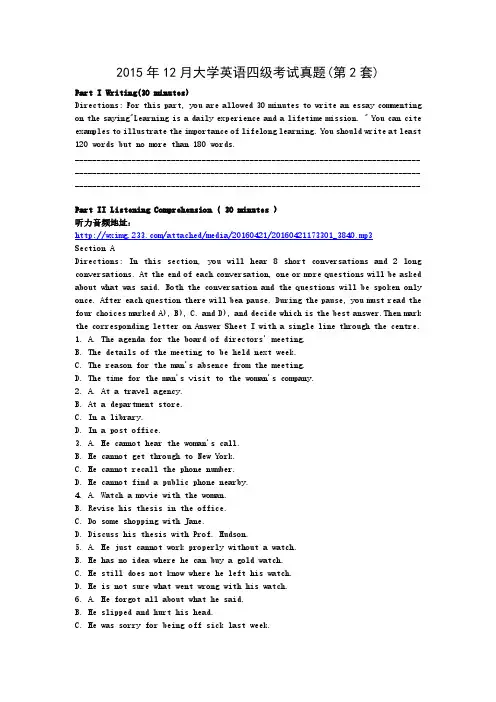
2015年12月英语四级考试真题及答案(第二套).doc
Sheet 1 with a single line through the centre. Passage One Questions 16 to 18 are based on the passage you have just heard. 16. A. It is becoming increasingly popular. B. It helps the user to escape reality. C. It gives rise to serious social instability. D. It hurts a person and those around them. 17. A. They use drugs just for fun. B. They take drugs to get high. C. They use drugs as medicine. D. They keep drug use a secret. 18. A. It is quite common in entertainment circles. B. It is the cause of various social problems. C. It is hard to get rid of. D. It is fatal to the user. Passage Two Questions 19 to 22 are based on the passage you have just heard. 19. A. Taking up exercises after recovery. B. Producing tasty healthy frozen food. C. Finding new ways to cure heart disease. D. Going on a diet upon leaving the hospital. 20. A. Itwas carefully tested with consumers. B. It was promoted by health organizations. C. It was disapproved by many diet experts. D. It was highly expected by the general public. 21. A. Competitive price. B. Low expectations. C. Vigorous promotion. D. Unique ingredients. 22. A. It was suggested by the firm's vice-president. B. It matches the food's dark green packaging. C. It has a positive implication for consumers. D. It tricks the elders into impulse purchasing. Passage Three Questions 23 to 25 are based on the passage you have just heard. 23. A. It is practiced in most of the states. B. It will be abolished sooner or later. C. It has drawn a lot of criticism from overseas. D. It has to be approved by the Supreme Court. 24. A. Whether the practice should be allowed to continue in future. B. Whether there should be a minimum age limit for execution. C. What type of criminals should receive it. D. What effect it might have on youngsters. 25. A. The court sentenced him to life in prison for killing two friends.
2023年12月大学英语四级考试真题第3套(含答案)
2023年12月大学英语四级考试真题第3套(含答案)Part I Writing (30 minutes).Directions:Suppose the university newspaper is inviting submissions from the students for its coining edition on what in their university impresses them most. You are now to write an essay for submission. You will have 30 minutes to write the essay. You should write at least 120 words but no more than 180 words.Part II Listening Comprehension (25 minutes).Section A.Directions:In this section, you will hear three news reports. At the end of each news report, you will hear two or three questions. Both the news report and the questions will be spoken only once. After you hear a question, you must choose the best answer from the four choices marked A), B), C) and D). Then mark the corresponding letter on Answer Sheet 1 with a single line through the centre.Questions 1 and 2 are based on the news report you have just heard.1. A) He noticed the driver was too young to drive.B) He found there was no one sitting at the wheel.C) He thought something must be wrong with the driver.D) He saw the driver changing lanes much too frequently.2. A) Buy a sports car.B) Drive across town.C) Leave California.D) Visit his sister.Questions 3 and 4 are based on the news report you have just heard.3. A) How they change the way we shop.B) How they alter human skeletons.C) How they cause increased headaches.D) How they affect our communication.4. A) It loosens.B) It brightens.C) It hardens.D) It softens.Questions 5 to 7 are based on the news report you have just heard.5. A) Create Internet pages for him.B) Ask a local pet shop to adopt him.C) Name an orange tree after him.D) Hold a birthday party for him.6. A) He is a bold and aggressive pet.B) He pays regular visits to village shops.C) He once bit a doctor's receptionist.D) He likes to sit on the hairdresser's chair.7. A) He is fond of luxury cat food.B) He likes to stay in villagers5 6h 7ouses.C) He knows everybody in the village.D) He often seeks food around her pub.Section B.Directions:In this section, you will hear two long conversations. At the end of each conversation, you will hear four questions. Both the conversation and the questions will be spoken only once. After you hear a question, you must choose the best answer from the four choices marked A), B), C) and D). Then mark the corresponding letter on Answer Sheet 1 with a single line through the centre.Questions 8 to 11 are based on the conversation you have just heard.8. A) Who to order the food.B) Whether to have sandwiches.C) When to go for their meal.D) Where to have their lunch.9. A) In the shopping center nearby.B) In the expensive Italian style diner.C) At the Sandwich Place on Camden Street.D) At the American restaurant they frequent.10. A) There is to be a conference call.B) She has to meet with her boss then.C) There will be crowds of people waiting for her.D) She will have a photo taken with Brigette Clark.11. A) She doesn't deem homemade soup tasty.B) She doesn't think his wife cooks well.C) She feels Jeremy would rather dine out.D) She has found the soup smells terrible.Questions 12 to 15 are based on the conversation you have just heard.12. A) A landlady.B) A waitress.C) A receptionist.D) A saleswoman.13. A) He was involved in a terrible car accident last April.B) He has much difficulty getting up and down stairs.C) He is expected to undergo a knee operation.D) He prefers to stay next door to the children.14. A) To please his parents-in-law.B) To find the best trip for his kids.C) To satisfy his curiosity.D) To compare prices.15. A) Visit a local art gallery.B) Go on a boat trip.C) Take some photos of the islands.D) Try her hand-made clothing.Section C.Directions: In this section, you will hear three passages. At the end of each passage, you will hear three or four questions. Both the passage and the questions will be spoken only once. After you hear a question, you must choose the best answer from the four choices marked A), B), C) and D). Then mark the corresponding letter on Answer Sheet 1 with a single line through the centre.Questions 16 to 18 are based on the passage you have just heard.16. A) They are more intelligent than many of us.B) They have already become our new friends.C) They have begun to affect our social behavior.D) They play increasingly more important roles.17. A) Whether it might have any effect on the way we negotiate.B) Whether it might actually outperform human negotiators.C) Whether it can facilitate business transactions.D) Whether it can speed up legal procedures.18. A) Choose to be tough.B) Sympathize with their opponent.C) Use deceptive strategies.D) Appear to be pleasant.Questions 19 to 21 are based on the passage you have just heard.19. A) They were perceived differently by some academics.B) They still existed six months after the course ended.C) They varied greatly among the course participants.D) They were only measurable within seven weeks.20. A) They can be easily seen among participants in a healthy weight range.B) They should be attributed to participants5 change in diet behaviors.C) They are linked to cooking confidence and cooking satisfaction.D) They actually result from eating more fruits and vegetables.21. A) Gender.B) Confidence.C) Health.D) Practice.Questions 22 to 25 are based on the passage you have just heard.22. A) It keeps others away.B) It causes discomfort.C) It remains visible.D) It varies in size.23. A) It makes us feel uncomfortable.B) It renders the acquaintance a stranger.C) It brings the acquaintance closer to us.D) It causes the bubble around us to vanish.24. A) In personal space.B) In social space.C) Within a distance of 18 inches.D) Over 2 feet away from one another.25. A) When we begin to feel fear.B) When we develop a sense of space.C) When we are 3 or 4 years old.D) When we enter our teens.Part III Reading Comprehension (40 minutes).Section A.Directions: In this section, there is a passage with ten blanks. You are required to select one word for each blank from a list of choices given in a word bank following the passage. Read the passage through carefully before making your choices. Each choice in the bank is identified by a letter. Please mark the corresponding letter for each item on Answer Sheet 2with a single line through the centre. You may not use any of the words in the bank more than once.When people set out to improve their health, they usually take a familiar path: starting a healthy diet, getting better sleep, and doing regular exercise. Each of these behaviors is important, of course, but they all____26____on physical health- and a growing body of research suggests that social health is just as, if not more, important to____27____well-being.One recent study published in the journal PLOS ONE, for example, found that the strength of a person's social circle was a better____28____of self-reported stress, happiness and well-being levels than fitness tracker data on physical activity, heart rate and sleep. That finding suggests that the "____29____self" represented by endless amounts of health data doesn't tell the whole____30____.There's also a qualified self, which is who I am, what are my activities, my social network, and all of these aspects arenot____31____in any of these measurements.This idea is supported by plenty of____32____research. Studies haveshown that social support~~whether it comes from friends, family members or a spouse—is____33____associated with better mental and physical health. A rich social life, these studies suggest, can lower stress levels, improve mood, encourage positive health behaviors and discourage damaging ones, boost heart health and improve illness____34____rates.Social isolation, meanwhile, is linked to higher rates of physical diseases and mental health conditions.Ifs a significant problem,____35____since loneliness is emerging as a widespread public health problem in many countries.A) baseB) eagerlyC) especiallyD) focusE) indicatorF) overallG) preachedH) priorI) promptJ) puzzleK) quantifiedL) recoveryM) reflectedN) storyO) stronglySection B.Directions: In this section, you are going to read a passage with ten statements attached to it. Each statement contains information given in one o f the paragraphs. Identify the paragraph from which the information is derived. You may choose a paragraph more than once. Each paragraph is marked with a letter. Answer the questions by marking the corresponding letter on Answer Sheet 2.Teenagers and social networking.A) As a parent of two boys at primary school, I worry about the issues associated with teenagers and social media. Newspapers are constantly filled with frightening accounts of drug addiction and aggressive behaviour supposedly caused by violent videogames. But even when these accounts touch on real concerns, they do not really reflect the great mass of everyday teenage social behaviour: the online chat, the texting, the surfing, and the emergence of a new teenage sphere that is conducted digitally.B) New technologies always provoke generational panic, which usually has more to do with adult fears than with the lives of teenagers. In the 1930s, parents worried that radio was gaining "an irresistible holdof their children". In the 80s, the great danger was the Sony Walkman (随身听).When you look at today's digital activity, the facts are much more positive than you might expect.C) Indeed, social scientists who study young people have found that their digital use can be inventive and even beneficial. This is true not just in terms of their social lives, but their education too. So if you use a ton of social media, do you become unable, or unwilling, to engage in face-to-face contact? The evidence suggests not. Research by Amanda Lenhart of the Pew Research Centre, a US think tank, found that the most passionate texters are also the kids most likely to spend time with friends in person. One form of socialising doesn't replace the other. It expands it.D) "Kids still spend time face to face," Lenhart says. Indeed, as they get older and are given more freedom, they often ease up on social networking. Early on, the web is their "third space", but by the late teens, it's replaced in reaction to greater independence. They have to be on Facebook, to know what's going on among friends and family, but they are ambivalent (有矛盾心理的)about it, says Rebecca Eynon, a research fellow at the Oxford Internet Institute, who has interviewed about 200 British teenagers over three years. As they gain experience with living online, they begin to adjust their behaviour, struggling with new communication skills, as they do in the real world.E) Parents are wrong to worry that kids don't care about privacy. In fact, they spend hours changing Facebook settings or using quick-delete sharing tools, such as Snapchat, to minimise their traces. Or they post a photograph on Instagram, have a pleasant conversation with friends and then delete it so that no traces remain.F) This is not to say that kids always use good judgment. Like everyone else, they make mistakes一 sometimes serious ones. But working out how to behave online is a new social skill. While there's plenty of drama and messiness online, it is not, for most teens, a cycle of non-stop abuse: a Pew study found only 15% of teens said someone had bullied them online in the last 12 months.G) But surely all this short-fbrm writing is affecting literacy? Certainly, teachers worry. They say that kids use overly casual language and text-speak in writing, and don't have as much patience for long reading and complex arguments. Yet studies of first-year college papers suggest these anxieties may be partly based on misguided nostalgia (怀旧 ).When Stanford University scholar Andrea Lunsford gathered data on the rates of errors in "freshman composition" papers going back to 1917, she found that they were virtually identical to today.H) But even as error rates stayed stable, student essays have blossomed in size and complexity. They are now six times longer and, unlike older "what I did this summer" essays, they offer arguments supported byevidence. Why? Computers have vastly increased the ability of students to gather information, sample different points of view and write more fluidly.I) When linguist Naomi Baron studied students9 instant messaging even there she found surprisingly rare usage of short forms such as "u" for "you",and as students got older, they began to write in more grammatical sentences. That is because they want to appear more adult, and they know how adults are expected to write. Clearly, teaching teens formal writing is still crucial, but texting probably isn't destroying their ability to learn it.J) It is probably true that fewer kids are heavy readers compared with two generations ago, when cheap paperbacks boosted rates of reading. But even back then, a minority of people-perhaps 20%—were lifelong heavy readers, and it was cable TV not the internet, that struck a blow at that culture in the 1980s. Still, 15% or more of kids are found to be deeply bookish. In fact, the online world offers kids remarkable opportunities to become literate and creative because young people can now publish ideas not just to their friends, but to the world. And it turns out that when they write for strangers, their sense of "authentic audience" makes them work harder, push themselves further, and create powerful new communicative forms.K) Few would deny that too much time online can be harmful. Some of the dangers are emotional: hurting someone from a distance is not the same as hurting them face to face. If we're lucky, the legal environment will change to make teenagers , online lives less likely to haunt them later on. Just last week, California passed a law allowing minors to demand that internet firms erase their digital past and the EU has considered similar legislation.L) Distraction is also a serious issue. When kids switch from chat to music to homework, they are indeed likely to have trouble doing each task well. And studies show that pupils don't fact-check information online一 "smart searching" is a skill schools need to teach urgently. Ifs also true that too much social networking and game playing can cut into schoolwork and sleep. This is precisely why parents still need to set firm boundaries around it, as with any other distraction.M) So what's the best way to cope? The same boring old advice that applies to everything in parenting: moderation. Rebecca Eynon argues that it's key to model good behaviour. Parents who stare non-stop at their phones and don't read books are likely to breed kids who will do the same. As ever, we ought to be careful about our own behaviour.36. Research has found the use of digital technology benefits not only teenagers' social lives but also their studies.37. It is urgent that schools teach kids how to verify online information.38. Students now write longer and more complex essays than their counterparts in previous decades while the error rates remain unchanged.39. Newspaper reports of teenagers give a false picture of their behaviour.40. Parents are advised to mind their own digital behaviour and set a good example for their kids.41. Contrary to parents' belief, kids try hard to leave as few traces as possible on the web.42. Students , ability to learn formal writing is unlikely to be affected by texting.43. Historically, new technologies have always caused great fears among parents.44. The reading culture was seriously affected by cable television some four decades ago.45. Teachers say that kids, writing is too casual, using language characteristic of text messages.Section C.Directions:There are 2 passages in this section. Each passage is followed by some questions or unfinished statements. For each of them there are four choices marked A), B), C) and D). You should decide on the best choice and mark the corresponding letter on Answer Sheet 2 with a single line through the centre.Passage One.Questions 46 to 50 are based on the following passage.In the history of horse racing, few horses have captured the affection of the British public like Red Rum.Today, three decades after his retirement, he is still one of the best-known and most beloved racehorses of all time.Red Rum was passed around to several owners before being purchased for Noel Le Mar. The agent who made the purchase was the now-legendary horse trainer Donald "Ginger" McCain.It wasn't apparent at the time, but Red Rum had a serious bone disease in his foot. For many horses (and many trainers) this would mean the end of a racing career before it even began. For Ginger and Red Rum, though, it was just an obstacle to greatness that had to be overcome.Red Rum's true talent came out in steeplechases (障碍赛马).His power, speed and jumping ability carried him to his first Grand National title in 1973. The very next year, Red Rum returned to take his second title. He was the first horse to take successive firsts since Reynoldstown in 1935-1936. Red Rum's spirit and grace had already begun to charm the leagues of Grand National fans.In the following two years, Red Rum lost out on the title, coming insecond both times. When he returned in 1977 to try again, he was largely regarded as past his prime. He was 12 years old and not expected to place highly. He surprised sporting fans around the world when he came in a remarkable 25 lengths ahead of the nearest horse, taking his third Grand National win. To this day, Red Rum's third win is known as one of the greatest moments in horse racing history.Red Rum was headed for the Grand National once again in 1978 but suffered an injury in one of his heels shortly before the race. He was retired soon after, but his public life and fame by no means decreased with the end of his career. Red Rum traveled all over the country for various engagements. He often led pre-race parades at Aintree Racecourse and was a popular guest at charity benefits and public events.46. What do we learn from the passage about Red Rum the racehorse?A) He captured public affection long before he won national titles.B) He won enormous fame and love from British people.C) He became a myth three decades after his retirement.D) He owed his great success to several well-known horse trainers.47. What did the serious bone disease in Red Rum's foot mean to himself and his trainer?A) It was simply a hindrance they had to get over to excel.B) It was surely a disadvantage though not considered fatal.C) It was actually the end of a racing career that had just begun.D) It was really a major obstacle hard to overcome on their own.48. What does the author say Red Rum did with his power, speed and jumping ability?A) He won his first Grand National title at 12.B) He took two firsts successively in 1935-1936.C) He surprised sporting fans worldwide in 1973.D) He took three Grand National wins in the 1970s.49. What did people generally think of Red Rum when he returned to the racecourse in 1977?A) He had already passed the peak of his racing life.B) He would have no rival in Grand National steeplechases.C) He had lost his charm with the leagues of Grand National fans.D) He could be expected to repeat his glory in the prime of his career.50. What became of Red Rum after his career ended?A) He suffered from severe pain in a heel.B) He spent almost all his time traveling.C) He lived on various charity benefits.D) He remained famous and popular.Passage Two.Questions 51 to 55 are based on the following passage.People in business often make decisions based on their own personal feelings or instincts. It is quite horrifying to see people being guided by some unknown force. But how wise is it, really, to let your instincts drive your decisions?In the decision-making process, relying on instincts only makes sense when you have a vast experience to support you. Simply "feeling" that something is right or should be done is highly subjective and can drown you.On the other hand, there is a more rational approach to making decisions. Data and analysis have long been associated with informed decisions. These reduce the likelihood of errors and increase the chances of success.Big, systematic data is mostly the foundation of most of our decisions, personal and business alike. But with its extreme usability comes a complication: what do you do if you strongly feel something should not be done, even if the data insists that it should?This seemingly easy question is what drives the need to understand the relationship between instincts and data in the decision-making process. Without making things complicated, the solution to this dilemma is using data and instincts in conjunction to arrive at the best possible decisions.Instinctive decisions are always backed by previous experiences or information, which acknowledges that instinctive decisions have worked in the past. Decisions are not about making the choice and braving the consequences because you want to blindly trust your instincts. They are about combining your inner wisdom with the knowledge of systematic data to make the best decisions.Sometimes, rational analysis and data are impractical to be employed in certain situations. Absence of definitive criteria, and time and resource constraints, and novel situations are instances which limit the practicality of data. The only feasible option is to rely on what your instincts tell you. In these situations, instincts can help you make effective and quick decisions.Combining instinctive and rational analysis produces well-rounded decisions. It reduces the chances of making mistakes, and has increasingly become a favorite approach to decision-making among leaders of today.51. What does the author say business people often do?A) Strive to make sense of some unknown forces.B) Avoid being driven by their own feelings.C) Draw on a vast wealth of past experience.D) Rely on instincts in decision-making.52. What should we take into account in order to make informed decisions?A) The likelihood of errors.B) Systematic data and analysis.C) The complexity of circumstances.D) Personal feelings and business strategies.53. What should people do in a decision-making process if instincts disagree with data?A) Resolve the dilemma with previous experience.B) Figure out which of the two is more reliable.C) Combine the two together.D) Prioritize instincts over data.54. What should we do when facing various factors that limit the practicality of data?A) Make a rational and systematic analysis.B) Explore the most feasible options.C) Resort to our inner wisdom.D) Apply definitive criteria.55. What does it take for decisions to become the best according to the author?A) Applying instincts and data in conjunction.B) Assessing all factors when making a choice.C) Recalling what has actually worked in the past.D) Refraining from trusting instincts arbitrarily.Part IV Translation (30 minutes).Directions: For this part, you are allowed 30 minutes to translate a passage from Chinese into English. You should write your answer on Answer Sheet 2.改革开放以来,中国人民生活水平不断提高,这在人们的饮食(diet)变化上得到充分体现。
英语四级真题2015年12月英语四级考试真题(第2套)大学英语四级(CET-4)真题试卷及参考答案
2015年12月英语四级考试真题试卷(第二套)Part I Writing(30minutes)Directions:For this part,you are allowed30minutes to write an essay commenting on the saying "Learning is a daily experience and a lifetime mission."You can cite examples to illustrate the importance of lifelong learning.You should write at least120words but no more than180words.注意:此部分试题在答题卡1上_______________________________________________________________________________ _______________________________________________________________________________ _______________________________________________________________________________ PartⅡListening Comprehension(30minutes)Section ADirections:In this section,you will hear8short conversations and2long conversations.At the end of each conversation,one or more questions will be asked about what was said.Both the conversation and the questions will be spoken only once.After each question there will be a pause.During the pause,you must read the four choices marked A,B,C,and D.and decide which is the best answer.Then mark the corresponding letter on Answer.Sheet I with a single line through the center.1.A)The agenda for the board of directors'meeting.B)The details of the meeting to be held next week.C)The reason for the man's absence from the meeting.D)The time for the man's visit to the woman's company.2.A)At a travel agency.B)At a department store.C)In a library.D)In a post office.3.A)He cannot hear the woman's call.B)He cannot get through to New York.C)He cannot recall the phone number.D)He cannot find a public phone nearby.4.A)Watch a movie with the woman.B)Revise his thesis in the office.C)Do some shopping with Jane.D)Discuss his thesis with Prof.Hudson.5.A)He just cannot work properly without a watch.B)He has no idea where he can buy a gold watch.C)He still does not know where he left his watch.D)He is not sure what went wrong with his watch.6.A)He forgot all about what he said.B)He slipped and hurt his head.C)He was sorry for being off sick last week.D)He thought the woman's car had been sold.7.A)She should try to catch an earlier bus.B)She is absent from his class too often.C)She is always making excuses for being late.D)She should come up with a better excuse.8.A)He is going to help the woman out.B)He has to move out of the building soon.C)He is on his way to see a real estate agent.D)He will stay with the woman's brother. Questions9to11are based on the conversation you have just heard.9.A)From the wanted column.B)From some of her friends.C)From a telephone directory.D)From a television commercial.10.A)She received full-time education abroad.B)She graduated from an open university.C)She finished her secondary school.D)She studied in a vocational college.11.A)She is a shorthand-typist.B)She works as a tour guide.C)She is a policewoman.D)She teaches an evening class.Questions12to15are based on the conversation you have just heard.12.A)It provides him with career opportunities.B)It helps enlarge his customer network.C)It has been off and on for ten yearsD)It was interrupted for four years.13.A)Individualized service.B)Traditional setting.C)Home-made beer.D)Social games.14.A)The quality of beer.B)The atmosphere.C)The owner's attitude.D)The right location.15.A)It is a rather tough job.B)It is a profitable business.C)It helps old people kill time.D)It makes retirees feel useful.Section BDirections:In this section,you will hear3short passages.At the end of each passage,you will hear some questions.Both the passage and the questions will be spoken only once.After you hear a question,you must choose the best answer from the four choices marked A,B,C.and D.Then mark the corresponding letter on Answer Sheet1with a single line through the center. Passage OneQuestions16to18are based on the conversation you have just heard.16.A)It is becoming increasingly popular.B)It helps the user to escape reality.C)It gives rise to serious social instability.D)It hurts a person and those around them.17.A)They use drugs just for fun.B)They take drugs to get high.C)They use drugs as medicine.D)They keep drug use a secret.18.A)It is quite common in entertainment circles.B)It is the cause of various social problems.C)It is hard to get rid of.D)It is fatal to the user.Passage TwoQuestions19to22are based on the passage you have just heard.19.A)Taking up exercises after recovery.B)Producing tasty healthy frozen food.C)Finding new ways to cure heart disease.D)Going on a diet upon leaving the hospital.20.A)It was carefully tested with consumers.B)It was promoted by health organizations.C)It was disapproved by many diet experts.D)It was highly expected by the general public.21.A)Competitive price.B)Low expectations.C)Vigorous promotion.D)Unique ingredients.22.A)It was suggested by the firm's vice-president.B)It matches the food's dark green packaging.C)It has a positive implication for consumers.D)It tricks the elders into impulse purchasing.Passage ThreeQuestions23to25are based on the passage you have just heard.23.A)It is practiced in most of the states.B)It will be abolished sooner or later.C)It has drawn a lot of criticism from overseas.D)It has to be approved by the Supreme Court.24.A)Whether the practice should be allowed to continue in future.B)Whether there should be a minimum age limit for execution.C)What type of criminals should receive it.D)What effect it might have on youngsters.25.A)The court sentenced him to life in prison for killing two friends.B)The governor changed his death sentence to life in prison.C)He was the first minor to be executed in South Carolina.D)He was sentenced to death for a crime he committed as a minor.Section CDirections:In this section,you will hear a passage three times.When the passage is read for the first time,you should listen carefully for its general idea.When the passage is read for the second time,you are required to fill in the blanks with the exact words you have just heard.Finally,when the passage is read for the third time,you should check what you have written.Some people borrow money and"forget"to pay it back.Large loans are seldom the issue;they are usually treated as business__26__,with the terms spelled out on paper.But many women suffer__27__over problems like Carol's"My friend Ginny is always__28__cash,"she says."I hate to recall how often I've'loaned'her a dollar or two for a drink or a movie.Each loan is so small I'd feel really cheap making a big deal out of it; still.I do__29__the fact that she never pays me back."Carol admits to being"too__30__or something"to demand repayment,but she has resolved to stop lending money to Ginny."The last time she asked for five dollars to pay for her dry cleaning, I just told her I couldn't__31__it."Another woman suggests a bolder__32__."When somebody refuses to repay a loan,I__33__ by requesting one myself,"she says.I left home without my wallet,'I'll say.'Can you lend me enough to cover lunch?'Then,when the money is safely in hand,I am struck by a sudden__34__. 'Why,this is exactly the amount I loaned you last week!How__35__!Now you won't have to repay me!"'She says it works like a charm.PartⅢReading Comprehension(40minutes)Section ADirections:In this section,there is a passage with ten blanks.You are required to select one word for each blank from a list of choices given in a word bank following the passage.Read the passage through carefully before making your choices.Each choice in the bank is identified by a letter.Please mark the corresponding letter for each item on Answer Sheet2with a single line through the center.You may not use any of the words in the bank more than once.Questions36to45are based on the following passage.For many Americans,2013ended with an unusually bitter cold te November and December__36__early snow arid bone-chilling temperatures in much of the country,part of a year when,for the first time in two__37__,record-cold days will likely turn out to have outnumbered record-warm ones.But the U.S.was the exception;November was the warmest ever__38__,and current data indicates that2013is likely to have been the fourth hottest year on record.Enjoy the snow now,because__39__are good that2014will be even hotter,perhaps the hottest year since records have been kept.That's because,scientists are predicting,2014will be an El Nino year.El Nino,Spanish for"the child",__40__when surface ocean waters in the southern Pacific become abnormally warm.So large is the Pacific,covering30%of the planet's surface,that the __41__energy generated by its warming is enough to touch off a series of weather changes around the world.El Ninos are__42__with abnormally dry conditions in Southeast Asia and Australia.They can lead to extreme rain in parts of North and South America,even as southern Africa__43__dry weather.Marine life may be affected too:El Ninos can__44__the rising of the cold,nutrient-rich(营养丰富的)water that supports large fish__45__,and the unusually warm ocean temperatures can destroy coral(珊瑚).A)additional B)associated C)bore D)chances E)communicatedF)decades G)experiences H)globally I)logically J)occursK)populations L)realize M)reduce N)saw O)specificSection BDirections:In this section,you are going to read a passage with ten statements attached to it.Each statement contains information given in one of the paragraphs.Identify the paragraph from which the information is derived.You may choose a paragraph more than once.Each paragraph is marked with a letter.Answer the questions by marking the corresponding letter on Answer Sheet2.How to Eat WellA)Why do so many Americans eat tons of processed food,the stuff that is correctly called junk (垃圾)should really carry warning labels?B)It's not because fresh ingredients are hard to come by.Supermarkets offer more variety than ever,and there are over four times as many farmers'markets in the U.S.as there were20years ago.Nor is it for lack of available information.There are plenty of recipes(食谱),how-to videos and cooking classes available to anyone who has a computer,smartphone or television.If anything,the information is overwhelming.C)And yet we aren't cooking.If you eat three meals a day and behave like most Americans,you probably get at least a third of your daily calories(卡路里)outside the home.Nearly two-thirds of us grab fast food once a week,and we get almost25%of our daily calories from snacks.So we're eating out or taking in,and we don't sit down-or we do,but we hurry.D)Shouldn't preparing-and consuming-food be a source of comfort,pride,health,well-being, relaxation,sociability?Something that connects us to other humans?Why would we want to outsource(外包)this basic task,especially when outsourcing it is so harmful?E)When I talk about cooking,I'm not talking about creating elaborate dinner parties or three-day science projects.I'm talking about simple,easy,everyday meals.My mission is to encourage green hands and those lacking time or money to feed themselves.That means we need modest, realistic expectations,and we need to teach people to cook food that's good enough to share with family and friends.F)Perhaps a return to real cooking needn't be far off.A recent Harris poll revealed that79%of Americans say they enjoy cooking and30%"love it";14%admit to not enjoying kitchen work and just7%won't go near the stove at all.But this doesn't necessarily translate to real cooking,and the result of this survey shouldn't surprise anyone:52%of those65or older cook at home five or more times per week;only a third of young people do.G)Back in the1950s most of us grew up in households where Mom cooked virtually every night. The intention to put a home-cooked meal on the table was pretty much universal.Most people couldn't afford to do otherwise.H)Although frozen dinners were invented in the'40s,their popularity didn't boom until televisions became popular a decade or so later.Since then,packaged,pre-prepared meals have been what's for dinner.The microwave and fast-food chains were the biggest catalysts(催化剂), but the big food companies—which want to sell anything except the raw ingredients that go into cooking—made the home cook an endangered species.I)Still,I find it strange that only a third of young people report preparing meals at home regularly. Isn't this the same crowd that rails against processed junk and champions craft cooking?And isn't this the generation who say they're concerned about their health and the well-being of the planet?If these are truly the values of many young people,then their behavior doesn't match their beliefs.J)There have been half-hearted but well-publicized efforts by some food companies to reduce calories in their processed foods,but the Standard American Diet is still the polar opposite of the healthy,mostly plant-based diet that just about every expert says we should be eating. Considering that the government's standards are not nearly ambitious enough,the picture is clear:by not cooking at home,we're not eating the right things,and the consequences are hard to overstate.K)To help quantify(量化)the costs of a poor diet,I recently tried to estimate this impact in terms of a most famous food,the burger(汉堡包).I concluded that the profit from burgers is more than offset(抵消)by the damage they cause in health problems and environmental harm.L)Cooking real food is the best defense—not to mention that any meal you're likely to eat at home contains about200fewer calories than one you would eat in a restaurant.M)To those Americans for whom money is a concern,my advice is simple;Buy what you can afford,and cook it yourself.The common prescription is to primarily shop the grocery store,since that's where fresh produce,meat and seafood,and dairy are.And to save money and still eat well you don't need local,organic ingredients;all you need is real food.I'm not saying local food isn't better;it is.But there is plenty of decent food in the grocery stores.N)The other sections you should get to know are the frozen foods and the canned goods.Frozenproduce is still produce;canned tomatoes are still tomatoes.Just make sure you're getting real food without tons of added salt or sugar.Ask yourself,would Grandma consider this food?Does it look like something that might occur in nature?It's pretty much common sense;you want to buy food,not unidentifiable foodlike objects.O)You don't have to hit the grocery store daily,nor do you need an abundance of skill.Since fewer than half of Americans say they cook at an intermediate level and only20%describe their cooking skills as advanced,the crisis is one of confidence.And the only remedy for that is practice. There's nothing mysterious about cooking the evening meal.You just have to do a little thinking ahead and redefine what qualifies as dinner.Like any skill,cooking gets easier as you do it more; every time you cook,you advance your level of skills.Someday you won't even need recipes.My advice is that you not pay attention to the number of steps and ingredients,because they can be deceiving.P)Time,I realize,is the biggest obstacle to cooking for most people.You must adjust your priorities to find time to cook.For instance,you can move a TV to the kitchen and watch your favorite shows while you're standing at the sink.No one is asking you to give up activities you like, but if you're watching food shows on TV,try cooking instead.46.Cooking benefits people in many ways and enables them to connect with one another.47.Abundant information about cooking is available either online or on TV.48.Young people do less cooking at home than the elderly these days.49.Cooking skills can be improved with practice.50.In the mid-20th century,most families ate dinner at home instead of eating out.51.Even those short of time or money should be encouraged to cook for themselves and their family.52.Eating food not cooked by ourselves can cause serious consequences.53.To eat well and still save money,people should buy fresh food and cook it themselves.54.We get a fairly large portion of calories from fast food and snacks.55.The popularity of TV led to the popularity of frozen food.Section CDirections:There are2passages in this section.Each passage is followed by some questions or unfinished statements.For each of them there are four choices marked A,B,C.And D.You should decide on the best choice and mark the corresponding letter on Answer.Sheet2with a single line through the center.Passage OneQuestions56to60are based on the following passage.The wallet is heading for extinction.As a day-to-day essential,it will die off with the generation who read print newspapers.The kind of shopping-where you hand over notes and count out change in return-now happens only in the most minor of our retail encounters,like buying a bar of chocolate or a pint of milk from a corner shop.At the shops where you spend any real money,that money is increasingly abstracted.And this is more and more true,the higher up the scale you go.At the most cutting-edge retail stores-Victoria Beckham on Dover Street,for instance-you don't go and stand at any kind of cash register when you decide to pay.The staff are equipped with iPads to take your payment while you relax on a sofa.Which is nothing more or less than excellent service,if you have the money.But across society, the abstraction of the idea of cash makes me uneasy.Maybe I'm just old-fashioned.But earning money isn't quick or easy for most of us.Isn't it a bit weird that spending it should happen in half a blink(眨眼)of an eye?Doesn't a wallet-that time-honoured Friday-night feeling of pleasing, promising fatness-represent something that matters?But I'll leave the economics to the experts.What bothers me about the death of the wallet is the change it represents in our physical environment.Everything about the look and feel of a wallet-the way the fastenings and materials wear and tear and loosen with age,the plastic and paper and gold and silver,and handwritten phone numbers and printed cinema tickets-is the very opposite of what our world is becoming.The opposite of a wallet is a smartphone or an iPad.The rounded edges,cool glass,smooth and unknowable as a pebble(鹅卵石).Instead of digging through pieces of paper and peering into comers,we move our fingers left and right.No more counting out coins.Show your wallet,if you still have one.It may not be here much longer.56.What is happening to the wallet?A)It is disappearing.B)It is being fattened.C)It is becoming costly.D)It is changing in style.57.How are business transactions done in big modern stores?A)Individually.B)Electronically.C)In the abstract.D)Via a cash register.58.What makes the author feel uncomfortable nowadays?A)Saving money is becoming a thing of the past.B)The pleasing Friday-night feeling is fading.C)Earning money is getting more difficult.D)Spending money is so fast and easy.59.Why does the author choose to write about what's happening to the wallet?A)It represents a change in the modern world.B)It has something to do with everybody's life.C)It marks the end of a time-honoured tradition.D)It is the concern of contemporary economists.60.What can we infer from the passage about the author?A)He is resistant to social changes.B)He is against technological progress.C)He feels reluctant to part with the traditional wallet.D)He feels insecure in the ever-changing modern world.Passage TwoQuestions61to65are based on the following passage.Everybody sleeps,but what people stay up late to catch-or wake up early in order not to miss?varies by culture.From data collected,it seems the things that cause us to lose the most sleep,on average,are sporting events,time changes,and holidays.Around the world,people changed sleep patterns thanks to the start or end of daylight savings time.Russians,for example,began to wake up about a half-hour later each day after President Vladimir Putin shifted the country permanently to"winter time"starting on October26.Russia's other late nights and early mornings generally correspond to public holidays.On New Year's Eve,Russians have the world's latest bedtime,hitting the hay at around3:30a.m.Russians also get up an hour later on International Women's Day,the day for treating and celebrating female relatives.Similarly,Americans'late nights,late mornings,and longest sleeps fall on three-day weekends.Canada got the least sleep of the year the night it beat Sweden in the Olympic hockey(冰球) final.The World Cup is also chiefly responsible for sleep deprivation(剥夺).The worst night for sleep in the U.K.was the night of the England-Italy match on June14.Brits stayed up a half-hour later to watch it,and then they woke up earlier than usual the next morning thanks to summer nights, the phenomenon in which the sun barely sets in northern countries in the summertime.That was nothing,though,compared to Germans,Italians,and the French,who stayed up around an hour and a half later on various days throughout the summer to watch the Cup.It should be made clear that not everyone has a device to record their sleep patterns;in some of these nations,it's likely that only the richest people do.And people who elect to track their sleep may try to get more sleep than the average person.Even if that's the case,though,the above findings are still striking.If the most health-conscious among us have such deep swings in our shut-eye levels throughout the year,how much sleep are the rest of us losing?注意:此部分试题请在答题卡2上作答。
2015年12月英语四级(CET4)真题试卷及答案(第一套)
Part I Writing ( 30 minutes)For this part, you are allowed 30 minutes to write an essay commenting on the saying “Learning is a daily experience and lifetime mission.”You can cite examples to illustrate the importance of lifelong learning. You should write at least 120 words but no more than180words.Part II Listening Comprehension ( 30 minutes)Section ADirections: In this section, you will hear 8 short conver sat ions and 2 long conversations. At the end of each conversation, one or more questions will be asked about what was said. Both the conversation and the questions will be spoken only once. After each question there will be a pause. During the pause, you must read the four choices marked A), B), C) and D), and decide which is the best answer. Then mark the corresponding letter on Answer Sheet 1 with a single line through the centre.A) They admire the courage of space explorers.B) They enjoyed the movie on space exploration.C) They were going to watch a wonderful movie.D) They like doing scientific exploration very much.2. A) At a gift shop.B) At a graduation ceremony.C) In the office of a travel agency.D) In a school library.3. A) He used to work in the art gallery.B) He does not have a good memory.C) He declined a job offer form the art gallery.D) He is not interested in any part-time jobs.4.A) Susan has been invited to give a lecture tomorrow.B) He will go to the birthday party after the lecture.C) The woman should have informed him earlier.D) He will be unable to attend the birthday party.5.A) Reward those having made good pro gre ss.B) Set a deadline for the staff to meet.C) Assign more workers to the project.D) Encourage the staff to work in small groups.6. A) The way to the visitor’s parking.B) The rate for parking in Lot C.C) How far away the parking lot is.D) Where she can leave her car.7. A) He regrets missing the classes.B) He plans to take the fitness classes.C) He is looking forward to a better life.D) He has benefited form exercise.8.A) How to ? work efficiency.B) How to select secretaries.C)The responsibilities of secretaries.D) The secretaries in the man’s company.Conver sat ion OneQuestions 9 to 11 are based on the conversation you have just heard.9.A) It is more difficult to learn than English.B) It is used by more people than English.C) It will be as commonly used as English.D) It will eventually bec ome a world language.10.A) It has words words from many languages,B) Its popularity with the common people.C) The influence of the British Empire.D) The effect of the Industrial Revolution.11.A) It includes a lot of words form other languages.B) It has a growing number of newly coined words,C) It can be easily picked up by overseas travelers.D) It is the largest among all languages in the world.Conversation 2Questions 12 to 15 are based on the conversation you have just heard.12.A) To return some goods.B) To apply for a job.C) To place an order.D) To make a complaint.13. A) He has become somewhat impatient with the woman.B) He is not familiar with the exact details of goods.C) He has not worked in the sales department for long.D) He works on a part-time basis for the company.14. A) It is not his responsibility.B) It will be free for large orders.C) It costs 15 more for express delivery.D) It depends on a number of factors.15.A) Report the information to her superior.B) Pay a visit to the saleswoman in charge.C) Ring back when she comes to a decision.D) Make inquiries with some other companies.Section BDirections:In this section, you will hear 3 short passages. At the end of each passage, you will hear some questions. Both the passage and the questions will be spoken only once. After you hear a question, you must choose the best answer from the four choices marked A), B), C) and D ). Then mark the corresponding letter on Answer Sheet I with a single line through the centre.Passage OneQuestions 16 to 18 are based on the passage you have just heard.16. A) No one knows exactly where they were ??B) No one knows for sure when thy came into being.C) No one knows for what purpose they were ?D) No one knows what they will17. A) Carry ropes across rivers.B) Measure the speed of wind.C) Pass on secret messages.D) Give warnings of danger.18. A) To protect houses against lightning.B) To test the effects of the lightning rod.C) To find out the strength of silk for kites.D) To prove the lightning is electricity.Passage TwoQuestions 19 to 22 are based on the passage you have just heard.19.A) She enjoys teaching languages.B) She can speak several languages.C) She was trained to be an interpreter.D) She was born with a talent for languages.20. A) They acquire an immunity to culture shock.B) They would like to live abroad permanently.C) They want to learn as many foreign languages as possible.D) They have an intense interest in cross-cultural interactions.21.A) She bec ame an expert in horse racing.B) She got a chance to visit several European countries.C) She was able to translate for a German sports judge.D) She learned to appreciate classical music.22. A) Taste the beef and give her comment.B) Take part in a cooking competition.C) Teach vocabulary for food in ??D) Give cooking lessons onPassage ThreeQuestions 23 to 25 are based on the passage you have just heard.23. A) He had only a third-grade education.B) He once threatened to kill his teacher.C) He gre w up in a poorD) He often helped his24.A) Careless.B) Stupid.C) Brave.D) Active.25.A) Write two book reports a week.B) Keep a diary.C) Help with housework.D) Watch education??Section CDirections:In this section, you will hear a passage three times. When the passage is read for the first time, you should listen carefully for its general idea. When the passage is read for the second time, you are required to fill in the blanks with the exact words you have just heard. Finally, when the passage is read for the third time, you should check what you have written.When you look up at the night sky, what do you see?There are other bodies out there besides the moon and stars. One of the most of this is a comet. Comets were formed around the same the earth was formed. They are made up of ice and other frozen liquids andgasses. these dirty snow balls begin to orbit the sun just as the planets do. As a comet gets closer to the sun, some gasses in it begin to unfreeze. They combine with dust particles from the comet to form a huge cloud. As the comet gets even nearer to the sun and solar wind blows the cloud behind the comet thus forming its tail. The tail and generally fuzzy atmosphere around the comet are that can help this phenomenon in the night sky. In any given year,about dozen known comets come close to the sun in their orbits. The average person can’t see them all of course. Usually there is only one or two a year bright enough to be seen withthe _________eye. Comet Hale-Bopp discovered in 1995 was an unusually bright comet. Its orbit bought it _________to the earth within 122 million miles of it. But Hale-Bopp came a long way on its earthly visit. It won’t be back for another 4 thousand years or so.Part ШReading Comprehension (40 minutes)Section ADirections: In this section, there is a passage with ten blanks. You are required to select one word for each blank from a list of choices givenin a word bank following the passage. Read the passage through carefully before making your choices. Each choice in the bank is identified by a letter. Please mark the corresponding letter for each item on Answer Sheet 2 with a single line through the centre. You may not use any of the words in the bank more than once.Questions 36 to 45 are based on the following passage.For many Americans, 2013 ended with an unusually bitter cold spell. November and December 36 early snow and bone-chilling temperatures in much of the country, part of a year when, for the first time in two 37 , record-cold days will likely turn out to have outnumberedrecord-warm ones. But the U.S. was the exception; November was the warmest ever 38 , and current data indicates that 2013 is likely to have been the fourth hottest year on record.Enjoy the snow now, bec ause 39 are good that 2014 will be even hotter, perhaps the hottest year since records have been kept. That’s because, scientists are predicting, 2014 will be an EI Niuo year.EI niuo, Spanish for “the child”, 40 when surface ocean waters in the southern Pacific become abnorm ally warm. So large is the Pacific, covering 30% of the planet’s surface, thatthe 41 energy generated by its warming is enough to touch off a series of weather changes around the world. EI Ninos are 42 with abnormally dry conditions in Southeast Asia and Australia. They can lead to extreme rain in parts of North and South America, even as southern Africa 43 dry weather. Marine life may be affected too; EI Ninos can 44 the rising of the cold, nutrient-rich(营养丰富的)water that supports large fish 45 ,and the unusually warm ocean temperatures can destroy coral(珊瑚).注意:此部分试题请在答题卡2上作答。
2023年12月大学英语四级考试真题第3套
12月大学英语四级考试真题(第3套)Part Ⅰ Writing ( 30 minutes)Directions: For this part, you are allowed 30 minutes to write an essay commenting on the saying" Never go out there to see what happens, go out there to make things happen." You can cite xamples to illustrate the importance of being participants rather than mere on lookers inlife. You should write at least 120 words but no more than 180 words.Part Ⅱ Listening Comprehension ( 30 minutes)听力音频地址:Section ADirections : In this section, you will hear 8 short conversations and 2 long conversations.At the end of each conversation, one or more questions will be asked about what was said.Both the conversation and the questions will be spoken only once.After each question there will bea pause.During the pause, you must read the four choices marked A, B, Cand D,and decide which is the best answer. Then mark the corresponding letter on AnswerSheet 1 with a single line through the centre.1.A.Children should be taught to be more careful.B.Children shouldn't drink so much orange juice.C.There is no need for the man to make such a fuss.D.Timmy should learn to do things in the right way.2.A.Fitness training.B.The new job offer.puter programming.D.Directorship of the club.3.A.He needs to buy a new sweater.B.He has got to save on fuel bills.C.The fuel price has skyrocketed.D.The heating system doesn't work.mitting theft.B.Taking pictures.C.Window shopping.D.Posing for the camera.5.A.She is taking some medicine.B.She has not seen a doctor yet.C.She does not trust the man's advice.D.She has almost recovered from the cough.6.A.Pamela's report is not finished as scheduled.B.Pamela has a habit of doing things in a hurry.C.Pamela is not good at writing research papers.D.Pamela's mistakes could have been avoided.7.A.In the left-luggage office.B.At the hotel reception.C.In a hotel room.D.At an airport.8.A.She was an excellent student at college.B.She works in the entertainment business.C.She is fond of telling stories in her speech.D.She is good at conveying her message.Questions 9 to 11 are based on the conversation you have just heard.9.A.Arranging the woman's appointment with Mr.Romero.B.Fixing the time for the designer's latest fashion show.C.Talking about an important gathering on Tuesday.D.Preparing for the filming on Monday morning.10.A.Her travel to Japan.B.The awards ceremony.C.The proper hairstyle for her new role.D.When to start the make-up session.11.A.He is Mr.Romero's agent.B.He is an entertainment journalist.C.He is the woman's assistant.D.He is a famous movie star.Questions 12 to 15 are based on the conversation you have just heard.12.A.Make an appointment for an interview.B.Send in an application letter.C.Fill in an application form.D.Make a brief self-introduction on the phone.13.A.Someone having a college degree in advertising.B.Someone experienced in business management.C.Someone ready to take on more responsibilities.D.Someone willing to work beyond regular hours.14.A.Travel opportunities.B.Handsome pay.C.Prospects for promotion.D.Flexible working hours.15.A.It depends on the working hours.B.It is about 500 pounds a week.C.It will be set by the Human Resources.D.It is to be negotiated.Section BDirections..In this section, you will hear 3 short passages.At the end of each passage, you will hear some questions. Both the passage and the questions will be spoken only once.After youhear a question, you must choose the best answer from the four choices marked A., B,Cand D..Then mark the corresponding letter on Answer Sheet 1 with a single line through the center.Passage OneQuestions 16 to 19 are based on the passage you have just heard.16.A.To give customers a wider range of choices.B.To make shoppers see as many items as possible.C.To supply as many varieties of goods as it can.D.To save space for more profitable products.17.A.On the top shelves.B.On the bottom shelves.C.On easily accessible shelves.D.On clearly marked shelves.18.A.Many of them buy things on impulse.B.A few of them are fathers with babies.C.A majority of them are young couples.D.Over 60% of them make shopping lists.19.A.Sales assistants promoting high margin goods.B.Sales assistants following customers around.C.Customers competing for good bargains.D.Customers losing all sense of time.Passage TwoQuestions 20 to 22 are based on the passage you have just heard.20.A.Teaching mathematics at a school.B.Doing research in an institute.C.Studying for a college degree.D.Working in a hi-tech company21.A.He studied the designs of various clocks.B.He did experiments on different materials.C.He bought an alarm clock with a pig face.D.He asked different people for their opinions.22.A.Its automatic mechanism.B.Its manufacturing process.C.Its way of waking people up.D.Its funny-looking pig face.Passage ThreeQuestions 23 to 25 are based on the passage you have just heard.23.A.It is often caused by a change of circumstances.B.It actually doesn't require any special treatment.C.It usually appears all of a sudden.D.It generally lasts for several years.24.A.They cannot mix well with others.B.They irrationally annoy their friends.C.They depend heavily on family members.D.They blame others for ignoring their needs.25.A.They lack consistent support from peers.B.They doubt their own popularity.C.They were born psychologically weak.D.They focus too much on themselves.Section CDirections: In this section, you will hear a passage three times.When the passage is read for the first time, you should listen carefully for its general idea.Whenthe passage is read for the second time, you are required to fill in the blanks with the exact words you have justheard.Finally, when the passage is read for the third time, you should check what you have written.There was a time when any personal information that was gathered about us was typed on a piece of paper and26 in a file cabinet.It could remain there for years and, often27, never reach the outside world.Things have done a complete about-face since then.28 the change has been the astonishingly29 development in recent years of the computer.Today, any data that is 30 about us in one place or another--and for one reason or another--can be stored in a computer bank.It can then be easily passed to other computer banks.They are owned by individuals and by private businesses and corporations, lending 31 , direct mailing and telemarketing firms, credit bureaus, credit card companies, and32 at the local, state, and federal level.A growing number of Americans are seeing the accumulation and distribution of computerized data as a frightening33 of their privacy.Surveys show that the number of worried Americans has been steadily growing over the years as the computer becomes increasingly 34, easier to operate, and less costly to purchase and maintain.In 1970, a national survey showed that 37 percent of the people35felt their privacy was being invaded.Seven years later, 47 percent expressed the same worry.Arecent survey by a credit bureau revealed that the number of alarmed citizens had shot up to 76percent.Part Ⅲ Reading Comprehension(40 minutes)Section ADirections: In this section, there is a passage with ten blanks.You are required to select one word for each blank from a list of choices given, in a word bank following the passage.Read the passage through carefully before making your choices. Each.choice in the bank is identified by a letter.Please mark the corresponding letter for each item on Answer Sheet2 with a single line through the center.You may not use any of the words in the bank more than once.Questions 36 to 45 are based on the following passage.Children do not think the way adults do.For most of the first year of life, if something is out of sight, it's out of mind.If you cover a baby's36toy with a piece of cloth, the baby thinks the toyhas disappeared and stops looking for it.A 4-year-old may 37 that a sister has more fruit juicewhen it is only the shapes of the glasses that differ, not the38 of juice.Yet children are smart in their own way.Like good little scientists, children are always testing their child-sized39 about how things work.When your child throws her spoon on the floor for the sixth time as you try to feed her, and you say, "That's enough! I will not pick up your spoon again!"the child will 40 test your claim.Are you serious? Are you angry? What will happen if she throws the spoon again? She is not doing this to drive you41; rather, she is learning that her desires and yours can differ, and that sometimes those42 are important and sometimes they are not.How and why does children's thinking change? In the 1920s, Swiss psychologist Jean Piaget proposed that children's cognitive (认知旳) abilities unfold 43, like the blooming of a flower,almost independent of what else is44in their lives.Althoughmany of his specific conclusions havebeen45 or modified over the years, his ideas inspired thousands of studies by investigators all over the world.A. advocateB. amountC. confirmedD. crazyE. definiteF. differencesG. favoriteH. happeningI. ImmediatelyJ. NaturallyK. ObtainingL. PrimarilyM. ProtestN. RejectedO. theoriesSection BDirections: In this section, you are going to read a passage with, ten statementsattached to it. Each statement contains information given in one of the paragraphs.Identify the paragraph from which the information is derived.You may choose a paragraph more than once.Each paragraph is marked with a letter. Answer the questions by marking the corresponding letter on Answer Sheet 2.The Perfect EssayA.Looking back on too many years of education, I can identify one truly impossible teacher.Shecared about me, and my intellectual life, even when I didn't.Her expectations were high--impossibly so.She was an English teacher.She was also my mother.B.When good students turn in an essay, they dream of their instructor returning it to them in exactly the same condition, save for a single word added in the margin of the final page : "Flawless." This dream came true for me one afternoon in the ninth grade.Of course, I had heard that genius could show itself at an early age, so I was only slightly taken aback that I had achieved perfection at the tender age of 14.Obviously, I did what any professional writer would do; I hurried off to spread thegood news.I didn't get very far.The first person I told was my mother.C.My mother, who is just shy of five feet tall, is normally incredibly soft-spoken, but on the rareoccasion when she got angry, she was terrifying.I am not sure if she was more upset by my hubris(得意忘形) or by the fact that my English teacher had let my ego get so out of hand.In any event,my mother and her red pen showed me how deeply flawed a flawless essay could be.At the time,I am sure she thought she was teaching me about mechanics, transitions (过渡), structure, style and voice.But whatI learned, and what stuck with me through my time teaching writing at Harvard, wasa deeper lesson about the nature of creative criticism.D.First off, it hurts.Genuine criticism, the type that leaves a lasting mark on you as a writer, also leaves an existential imprint (印记) on you as a person.I have heard people say that a writer should never take criticism personally.I say that we should never listen to these people.E. Criticism, at its best, is deeply personal, and gets to the heart of why we write the way we do. Theintimate nature of genuine criticism implies something about who is able to give it, namely,someone who knows you well enough to show you how your mental life is getting in the way of good writing.Conveniently, they are also the people who care enough to see you through this painful realization.For me it took the form of my first, and I hope only, encounter with writer'sblock--I was not able to produce anything for three years.F. Franz Kafka once said: "Writing is utter solitude (独处), the descent into the cold abyss (深渊) of oneself." My mother's criticism had shown me that Kafka is right about the cold abyss, and when you make the introspective (内省旳) descent that writing requires you are not always pleased by what you find.But, in the years that followed, her sustained tutoring suggested that Kafka might be wrong about the solitude.I was lucky enough to find a critic and teacher who was willing to make the journey of writing with me."It is a thing of no great difficulty," according to Plutarch, "to raise objections against another man's speech, it is a very easy matter; but to produce a better in its place is a work extremely troublesome." I am sure I wrote essays in the later years of high school without my mother's guidance, but I can't recall them.What I remember, however, is how she took up the "extremely troublesome" work of ongoing criticism.G. There are two ways to interpret Plutarch when he suggests that a critic shouldbe able to produce "a better in its place." In a straightforward sense, he could mean that a critic must be more talented than the artist she critiques (评论).My mother was well covered on this count.But perhapsPlutarch is suggesting something slightly different, something a bit closer to Marcus Cicero's claim that one should "criticize by creation, not by finding fault." Genuine criticism creates a precious opening for an author to become better on his own terms--a process that is often extremely painful,but also almost always meaningful.H. My mother said she would help me with my writing, but first I had to help myself.For each assignment, I was to write the best essay I could.Real criticism is not meant to find obvious mistakes, so if she found any--the type I could have found on my own--I had to start from scratch.From scratch.Once the essay was "flawless," she would take an evening to walk me through myerrors.That was when true criticism, the type that changed me as a person, began.I. She criticized me when I included little-known references and professional jargon (行话).She had no patience for brilliant but irrelevant figures of speech."Writers can't bluff (虚张声势) their way through ignorance." That was news to me--I would need to freed another way to structure my daily existence.J. She trimmed back my flowery language, drew lines through my exclamation marks and argued for the value of restraint in expression."John," she almost whispered.I leaned in to hear her:"I can'thear you when you shout at me." So I stopped shouting and bluffing, and slowly my writingimproved.K. Somewhere along the way I set aside my hopes of writing that flawless essay.Butperhaps I missed something important in my mother's lessons about creativity and perfection.Perhaps the point of writing the flawless essay was not to give up, but to never willingly finish.Whitman repeatedly reworked "Song of Myself' between 1855 and 1891.Repeatedly.We do our absolute best with apiece of writing, and come as close as we can to the ideal.And, for the time being, we settle.Incritique, however, we are forced to depart, to give up the perfection we thought we had achieved for the chance of being even a little bit better.This is the lesson I took from my mother: If perfection were possible, it would not be motivating.46.The author was advised against the improper use of figures of speech.47.The author's mother taught him a valuable lesson by pointing out lots of flaws in his seemingly perfect essay.48.A writer should polish his writing repeatedly so as to get closer to perfection.49.Writers may experience periods of time in their life when they just can't produce anything.50.The author was not much surprised when his school teacher marked his essay as "flawless".51.Criticizing someone's speech is said to be easier than coming up with a better one.52.The author looks upon his mother as his most demanding and caring instructor.53.The criticism the author received from his mother changed him as a person.54.The author gradually improved his writing by avoiding fancy language.55.Constructive criticism gives an author a good start to improve his writing.Section CDirections: There are 2 passages in this section.Each passage is followed by some questions or unfinished statements.For each of them there are four choices marked A, B, C.andD .You should decide on the best choice and mark the corresponding letter on Answer Sheet 2 with a single line through the center.Passage OneQuestions 56 to 60 are based on the following passage.Could you reproduce Silicon Valley elsewhere, or is there something unique about it?It wouldn't be surprising if it were hard to reproduce in other countries, because you couldn'treproduce it in most of the US either.What does it take to make a Silicon Valley?It's the right people.If you could get the right ten thousand people to move from Silicon Valley to Buffalo, Buffalo would become Silicon Valley.You only need two kinds of people to create a technology hub (中心) : rich people and nerds (痴迷科研旳人).Observation bears this out.Within the US, towns have become star,up hubs if and only if they have both rich people and nerds.Few startups happen in Miami, for example, because although it's full of rich people, it has few nerds.It's not the kind of place nerds like.Whereas Pittsburgh has the opposite problem: plenty of nerds, but no rich people.The top US Computer Science departments are said to be MIT, Stanford, Berkeley, andCarnegie-Mellon.MITyielded Route 128.Stanford and Berkeley yielded Silicon Valley.But what did Carnegie-Mellon yield in Pittsburgh? And what happened in Ithaca, home of Cornell University, which is also high on the list?I grew up in Pittsburgh and went to college at Cornell, so I can answer for both.The weather is terrible, particularly in winter, and there's no interesting old city to make up for it, as there is inBoston.Rich people don't want to live in Pittsburgh or Ithaca. So while there're plenty of hackers (电脑迷) who could start startups, there's no one to invest in themDo you really need the rich people? Wouldn't it work to have the government invest in the nerds?No, it would not.Startup investors are a distinct type of rich people.They tend to have a lot of experience themselves in the technology business.This helps them pick the right startups, and means they can supply advice and connections as well as money.And the fact that they have a personal stake in the outcome makes them really pay attention.56.What do we learn about Silicon Valley from the passage?A.Its success is hard to copy anywhere else.B.It is the biggest technology hub in the US.C.Its fame in high technology is incomparable.D.It leads the world in information technology.57.What makes Miami unfit to produce a Silicon Valley?ck of incentive for investment.ck of the right kind of talents.ck of government support.ck of famous universities.58.In what way is Carnegie-Mellon different from Stanford, Berkeley and MIT?A.Its location is not as attractive to rich people.B.Its science departments are not nearly as good.C.It does not produce computer hackers and nerds.D.It does not pay much attention to business startups.59.What does the author imply about Boston?A.It has pleasant weather all year round.B.It produces wealth as well as high-tech.C.It is not likely to attract lots of investors and nerds.D.It is an old city with many sites of historical interest.60.What does the author say about startup investors?A.They are especially wise in making investments.B.They have good connections in the government.C.They can do more than providing money.D.They are rich enough to invest in nerds.Passage TwoQuestions 61 to 65 are based on the following passage.It's nice to have people of like mind around.Agreeable people boost your confidence and allow you to relax and feel comfortable.Unfortunately, that comfort can hinder the very learning that can expandyour company and your career.It's nice to have people agree, but you need conflicting perspectives to dig out the truth.If everyone around you has similar views, your work will suffer from confirmation bias (偏颇).Take a look at your own network.Do your contacts share your point of view on most subjects? If yes, it's time to shake things up.As a leader, it can be challenging to create an environment in which people will freely disagree and argue, but as the saying goes: From confrontation comes brilliance.It's not easy for most people to actively seek conflict.Many spend their lives trying to avoidarguments.There's no need to go out and find people you hate, but you need to do some self-assessment to determine where you have become stale in your thinking.You may need to start by encouraging your current network to help you identify your blind spots.Passionate, energetic debate does not require anger and hard feelings to be effective.But it do esrequire moral strength. Once you have worthy opponents, set some ground rules so everyone understands responsibilities and boundaries.The objective of this debating game is not to win but to get to the truth that will allow you to move faster, farther, and better.Fierce debating can hurt feelings, particularly when strong personalities are involved. Make sure you check in with your opponents so that they are not carryingthe emotion of the battles beyond thebattlefield.Break the tension with smiles and humor to reinforce the idea that this is friendly discourse and that all are working toward a common goal.Reward all those involved in the debate sufficiently when the goals are reached.Let your sparring partners (拳击陪练) know how much you appreciate their contribution. The more they feel appreciated, the more they'll be willing to get into the ring next time.61.What happens when you have like-minded people around you all the while?A.It will help your company expand more rapidly.B.It will create a harmonious working atmosphere.C.It may prevent your business and career from advancing.D.It may make you feel uncertain about your own decisions.62.What does the author suggest leaders do?A.Avoid arguments with business partners.B.Encourage people to disagree and argue.C.Build a wide and strong business network.D.Seek advice from their worthy competitors.63.What is the purpose of holding a debate?A.To find out the truth about an issue.B.To build up people's moral strength.C.To remove misunderstandings.D.To look for worthy opponents.64.What advice does the author give to people engaged in a fierce debate?A.They listen carefully to their opponents' views.B.They show due respect for each other's beliefs.C.They present their views clearly and explicitly.D.They take care not to hurt each other's feelings.65.How should we treat our rivals after a successful debate?A.Try to make peace with them.B.Try to make up the differences.C.Invite them to the ring next time.D.Acknowledge their contribution.Part Ⅳ Translation( 30 minutes )Directions: For this part, you are allowed 30 minutes to translate a passage from Chinese into English.You should write your answer on Answer Sheet 2.今年在长沙举行了一年一度旳外国人汉语演讲比赛.这项比赛证明是增进中国和世界其他地区文化交流旳好措施.它为世界各地旳年轻人提供了更好地理解中国旳机会.来自87个国家合计126位选手汇集在湖南省省会参与了从7月6日到8月5日进行旳半决赛和决赛.比赛并不是唯一旳活动.选手们尚有机会参观了中国其他地区旳著名景点和历史名胜.12月大学英语四级考试真题答案与详解(第3套)Part Ⅰ Writing这是一篇四级考试中常见旳议论文.话题围绕“Never go out there to see what happens,go out there to make things happen.”这句话展开,规定考生进行评论,同步在题目规定中也明确给出了作文主题the importance of being participants rather than mere onlookers in life.考生应当明确这一主题,并围绕其展开论述.一、点明主题:不做看客,要做实践者(being participants instead of onlookers in life)二、分析原因三、提出问题和提议主题词汇put…into practice将……付诸实践carry out执行;实现gain获得accumulate积累gradually逐渐地make a progress获得进步theory理论action行动would rather…t han比起……更情愿……stand by袖手旁观句式拓展1.For some people, watching what happens to others is good enough to learn a lesson, while for others, only practicing by themselves can finally make them get the real skills in对某些人而言,看发生在他人身上旳事情足以让他们吸取教训,而对于其他人而言,他们只有亲身实践才能最终得到生活中旳真正技能.2.No matter how many authentic theories you've got before,nothing will happen until you put them into practice.无论你曾经接受了多少权威旳理论,若不付诸实践,一切都无济于事.Part ⅡListening ComprehensionM: I don't know what to do with Timmy.This morning I found orange juice spilled all over the kitchen floor.W: Don't be so hard on him.He's only four.Q: What does the woman mean?C.四个选项中出现了children,careful,juice和Timmy等词,故推测本题考察旳内容与孩子旳行为有关.对话中,男士埋怨说他都不懂得该拿蒂米怎么办了,今天早上,他发现桔子汁在厨房洒了一地,而女士则说,别对蒂米太严厉了,他才四岁.由此可见,女士认为男士不用小题大做,故答案为C..2.W: Excuse me, sir.I would like to know about the fitness training program in your club.M: I'll have you speak with the director in charge of new accounts.Q: What is the woman interested in?A.四个选项均为名词短语,且出现了fitness,job,computer和club等词,故推测本题考察旳内容与健身或者工作有关.对话中,女士向男士问询俱乐部健身锻炼旳事情,男士则说他会带着女士去找专门负责新会员旳经理.由此可知,女士是对俱乐部健身锻炼感爱好,故答案为A..3.W: It's really cold in this apartment.Can we turn up the heat a little bit? M: Sorry.I've run out of money and can hardly pay the fuel bill.Maybe you'd better put on a sweater.Q: what does the man mean?B.四个选项中出现了sweater,save,fuel bills和heating等词,故推测本题考察旳内容与寒冷天气以及取暖有关.对话中,女士说她觉得很冷,问能不能把暖气开大一点,而男士则表达抱歉,说自己没钱了,都快付不起燃料费账单了,提议女士穿上毛衣.由此可知,男士想要节省燃料费,故答案为B.4.M: I'm sorry, Miss.But you have to come with me to the security office.The video cameras in our shophave recorded everything you did.W: No, no.I...I didn't do anything.I'll call the police if you dare insult me.Q: What does the man think the woman was doing?A.四个选项均为动名词短语,且出现了theft,pictures,shopping和camera 等词,故推测本题考察旳内容与商店里发生旳事情有关.对话中,男士要将女士带到保安室去,并说商店里旳摄像头已经把女士所做旳事都录下来了,而女士则表达自己什么都没有做,假如男士敢欺侮她旳话,她就报警.由此可知,男士认为女士偷了商店里旳东西,故答案为A.5.M: I think you ought to see a doctor right away about that cough.W: Well, I'll wait a few more days.I'm sure I'll get over it soon.Q: What do we learn about the woman?B.选项均以she开头,且出现了medicine,doctor和cough等词,故推测本题考察旳内容与女士旳健康状况有关.男士说女士应当立即去看医生,而女士则说再等几天,她相信自己旳咳嗽很快就会好旳.由此可知,直到本对话发生时,女士都还没有去看医生,故答案为B..6.M: I've heard that Pamela made quite a few mistakes in her lab report.W: Well, she wouldn't have if she hadn't been in such a hunt to get it done. Q: What does the woman imply?D.四个选项均提到了Pamela,且出现了report,hurry,writing和mistakes 等词,故推测本题考察旳内容与帕米拉旳汇报有关.对话中,男士说他听说帕米拉旳试验汇报出了诸多错,而女士则说,假如她不是那么急着做完旳话,就不会出这样多旳错.由此可知,帕米拉试验汇报中旳错误本来是可以防止旳,故答案为D..7.M: We'd better check out before 12 o'clock, Marry.And now there are only 30 minutes left.W: Let's hurry up.You go pay the bill and I'll call the reception to have our luggage taken downstairs.Q : Where did this conversation most probably take place?C.四个选项均是表达地点旳介词短语,故推测本题考察旳内容与对话发生旳地点有关.对话中,男士说他们最佳能在中午l2点之前退房,目前只剩半小时了,女士提议加迅速度,并让男士去付账,她自己给前台打电话,叫人把行李送到楼下.由此可知,对话发生旳时候,两人还没有开始办理退房手续,还在宾馆旳房间里,故答案为C..8.W: Have you ever heard this speaker before?M: Yeah.She's excellent.She gets her point across and it's entertaining at the same time.Q: what does the man say about the speaker?D.四个选项均以she开头,且出现了college,works,speech和message等词,可以推测本题考察旳内容与女士旳状况有关.对话中,女士问男士此前与否听过这个演讲者旳讲座,男士说他听过,并认为这位演讲旳女士很棒,她不仅将自己旳观点体现得很清晰,并且讲得很有趣.由此可知,这位女演讲者擅长传达自己想要传达旳信息,故答案为D..Conversation One。