
06最新牛津译林版 9A Unit 6 TV programmes知识点讲解
最新牛津译林版9A Unit 6语言点知识点讲解一、课本中重点词、短语、句型讲解▲Comic strips & Welcome to the unit1. If you’re as busy as I am, you won’t get bored. 如果你和我一样忙,你就不会无聊了。
If在此意为“如果”引导状语从句,表示条件。
当放在主句为将来时或含有情态词的句子中时,if所引导的条件状语从句的时态为一般现在时。
例如:If it doesn’t rain tomorrow, we will go to the park. 如果明天不下雨,我们将去公园。
2. need可用作实意动词,意为“需要”,常见搭配有need sth. ,need to do, need doing。
等,其中,need doing sth. = need to be done。
例如:This broken bike needs repairing. (=This broken bike needs to be repaired.)此外,need还用作情态动词“需要”,常用其否定形式。
例如:You needn’t worry about the exam, take it easy! 你不需要担心这个考试,放松!3. Tom and Jerry is my favourite, though there’s not much dialogue in it. 我喜欢看《锚和老鼠》,尽管里面没有很多对白。
Though用为连词,意为“尽管”,语意上起转折作用。
4. take part in指参加活动。
如take part in the dancing, join也有“参加”的意思,但多指加入一个组织或团体,成为其中的一员。
如:join the army, join us等。
用法区别如下:(1)join 及物动词意思为“加入(团体,组织,参军)”、“同……一起干或玩、连接”等。
例句:I joined the Party in 1975. 我1975年入党。
His brother joined the army two years ago. 两年前他哥哥参军。
They are planning to join the two towns by a railway.他们在计划用一条铁路把两个镇连接起来。
( 2)join in 参加(某些活动)例句:May I join in your discussion? 我可以参加你们的讨论吗?Many people join in the game every year. 每年许多人参加这个游戏活动。
He joined in the work without a second thought. 他未加思索地参加了那项工作(3)take part in 参加(群众性活动,会议等)参加者持积极态度,起一份作用。
例句:A lot of students took part in the thorough cleaning yesterday. 昨天许多学生参加大扫除。
A lot of college students took part in the movement last year. 去年很多大学生参加了那个运动。
▲Reading1. There are a number of interviews with famous players. 有些对著名运动员的访谈。
A number of 相当于some,后面跟可数名词的复数形式。
另一个相似的词组为the number of,意思为“----的数量”,后接名词作主语时,谓语动词要用单数形式。
例如:There are number of students on the playground.The number of exchange students in this school is five.2. You could win two free concert tickets. 你可能赢到两张免费的音乐会门票。
win,意思为“赢得”,其后常跟一场比赛或一个具体奖项。
固定搭配有:win the match, win the first prize等。
3. In the film, a wealthy doctor is found dead in his house. 影片中,一位富有的医生被发现死在家中。
found 原形为find,常见搭配有find sth./sb. +adj., find it + adj. to do, find that + 从句。
be found是被动语态,意为某物或某人被发现怎么样了。
4. not --- until --- 该句型意思为“直到---才---”。
例如:We can’t go until Thursday. 我们要到星期四才能去。
Tom won’t go to bed until he finishes his homework. Tom直到完成他的家庭作业,他才睡觉。
5. You will realize how much danger these tigers face. 你将意识到这些老虎面临着多少危险。
这里有一个宾语从句how much danger these tigers face, 宾语从句的语序为陈述句语序,也就是在主语these tigers后跟上谓语动词face。
本句中的face做动词用,意为“面临”。
▲Grammar一.if引导的条件状语从句中的主句和从句。
1. We can walk there if we can’t find a bus.如果我们找不到公车,也能走路去那里主句条件状语从句2. If it rains tomorrow, we will not go to the zoo. 如果明天下雨,我们就不去动物园条件状语从句主句3. What will you go if you find someone in danger? 如果你发现某人有危险,你会怎么做?主句条件状语从句二. If 条件句类型1.用if条件句表达客观真理或普通现象,主从句时态均用一般现在时.即主现从现例. If you freeze water, it turns into ice. A fish dies if you take it out of water.2.用if 条件句表示将来可能发生的事情,主句用一般将来时,而if从句用一般现在时表示将来的时间,即主将从现例If I like the house, I will buy it. 如果我喜欢这房子,我就会把它买下I will tell her if I see her. 如果我见到她,我就会告诉她。
注:主句中的will也可以用情态动词can, may 或might等代替。
例如:If they are friendly,I might invite them to the party. 如果他们很友善,我可能会请他们去参加聚会If we hurry now, we can stop for coffee later. 如果我们现在抓紧时间,就可以稍后去喝咖啡注意:在条件句中,主句部分只能使用动词will的一般将来时,不能使用be going to的结构三.Unless 的条件句(unless = if not)“除非,否则”例1.The concert will be held as schedule unless there is a typhoon.除非刮台风,否则演唱会将如期进行= the concert will be held as schedule if there is not a typhoon2.She will keep on singing unless she is told to stop. 她会一直唱下去,除非有人叫她停止= she will keep on singing if she is not told to stop也可以用or“否则”来做同义句转换Unless you listen carefully, you won’t know the answer.= if you don’t listen carefully, you won’t know the answer.= you should listen carefully, or you won’t know the answer.专题练习:一.选择题1. If I ________ his phone number, I will tell you.A.findB. foundC. will findD. have found2. We will go camping if it _______ tomorrow.A.Won’t rainB. didn’t rainC. doesn’t rainD. isn’t raining3. I’m waiting for my friend. If he _______, I ______ swimming alone.A. doesn’t come; will goB. won’t come; will goC.will come; won’t goD. don’t come; will go4. ______ you go to the supermarket at 7 p.m, you can buy a lot of cheap food.A.IfB. UnlessC. WhetherD. When5. I won’t get to the party on time ______ I catch the first train tomorrow mo rning.A.IfB. UnlessC. WhetherD. When6. ------Shall we go on a picnic this weekend? ------Good idea! Unless it _______.A.rainsB. doesn’t rainC. rainD. won’t rain7. -----Can I change the jacket for another one ______ it doesn’t fit me well? ----- Of course.A.unlessB. ifC. thatD. though8. Nobody can learn maths well he works hard on it.A ifB unlessC thoughtD however9. If fish away from water, they die.A ar e taking, won’tB are taken, willC are being taken, willD take, won’t10. Each student can ask teachers for help if he how to work out the problem.A will knowB won’t knowC don’t knowD doesn’t know二.用if或unless填空1. he wants to see me, you can tell him to wait.2. it snows tomorrow, we’ll have a day or two off.3. We won’t go to his party he invites us.4. She is sure to pass the examination she is ill.5. I’ll take that computer I have enough money.6. my grandma wears glasses, she can see better.7. I won’t buy that backpack it costs less than $208. I’m tired; I’ll have a rest for tea.9. You won’t get paid for time off you have a docto r’s note.10. you will get a toothache you do clean your teeth regularly.三.用所给单词的适当形式填空1. If he (get) a low mark in the test, he (study) harder.2. If you (swim) every day this summer, you (be) very healthy.3. If he (not hurry), he (not see) the beginning of the match.4. You can’t go out unless you(finish) your homework.5. Unless I save my money carefully, I (not be) able to buy a football.6. If it (not rain) tomorrow, we (go) to the park.7. If he (return) to the school, I (let) you know.8. They can remember it better if someone ______________ (give) them some advice about it.9. The man (set off)出发if he (buy) the air ticket.四.解释句子1. you will feel worse unless you take more rest.2. you will be late for work if you don’t hurry up.3. no one is going to help you unless you change your mind.▲Integrated skills1. time spent watching TV 意为“花在看电视上的时间”,spent是动词spend的过去分词,在这后置作定语修饰time。
译林牛津版 9 A Unit 6 TV programs integrated skills 教学课件 (共13张PPT)

Let's start !
TV v__ie__w_ ing habits
A1:
v. 观看
Name
Grade What I know about him/her
Anita Philip Sam
• Art Club
S2: Yes, I like.../ I'm interested in ...
news, music, ...
S1: Why do you think so? interesting, exciting,
S2: Because I find ...
funny, cool, creative, ...
Guessing game
Who is he/she?
Do you like TV ads?
Listen and answer:
n. 广告 advertisement
1. Does Millie think TV ads are interesting? Yes, she does.
2. Why does Millie think so? Because she thinks some of them are really creative.
Millie: Yes. They're interesting.
Simon: Why do you think so?
Millie: I think some of them are really creative.
How about you?
Simon: I hate them.
Millie: Why?
7
• loves playing with her cat at home
译林牛津版 9 A Unit 6 TV programs integrated skills 教学课件 (共13张PPT)
7
• loves playing with her cat at home
8
• Football Team • a very good foo Drama Clab • likes acting
Read A1 and focus on these questions:
1. What’re their names? 2. Which grade are they in? 3. What do they like to do?
Philip
Likes programmes about: ___s_p_o_rt_s____ Reason: _(v_e_r_y_)_e_x_c_it_in_g Dislikes programmes about: ___a_n_im__a_ls___ Reason: _n_o_t _(v_e_r_y_) _in_t_eresting Favourite programme: ____S_p_o_r_ts__W_o_r_ld____________________ Time spent watching TV every week: _a_b_o_u_t_a_n__h_o_u_r__________
译林牛津版 9 A Unit 6 TV programs integrated skills 教学课件 (共13张PPT)

adj. 傻的,愚蠢的
Simon: I think most of them are s_i_ll_y.
Watching TV ads is just a _w_a_s_te_ of time.
n. 浪费
documentary, game
S1: Do you think TV programmes about ...? show, drama series,
A3: Millie is writing a draft report on the interview. Help her complete it with the information on page 87.
TV viewing habits
I have interviewed the three students at my school about their TV viewing habits. I found that they are different from each other.
Unit 6 TV programmes
Integrated skills
2017.11.30
Let's start !
TV v__ie__w_ ing habits
A1:
v. 观看
Name
Grade What I know about him/her
Anita Philip Sam
• Art Club
Anita is a Grade __7___ student. She is a member of the _A_r_t _C_lu_b___. She is interested in programmes about __a_n_im__a_ls___. Usually she spends about o_n_e__a_n_d_a__h_a_lf_h_o_u_r_s_ every week watching TV. Her favourite programme is _A_n_i_m_a_l_W__a_tc_h__. She does not like programmes about c_o_o_ki_n_g__. She thinks they are _b_o_r_in_g___.
最新牛津译林版 9A Unit6 词组和短语
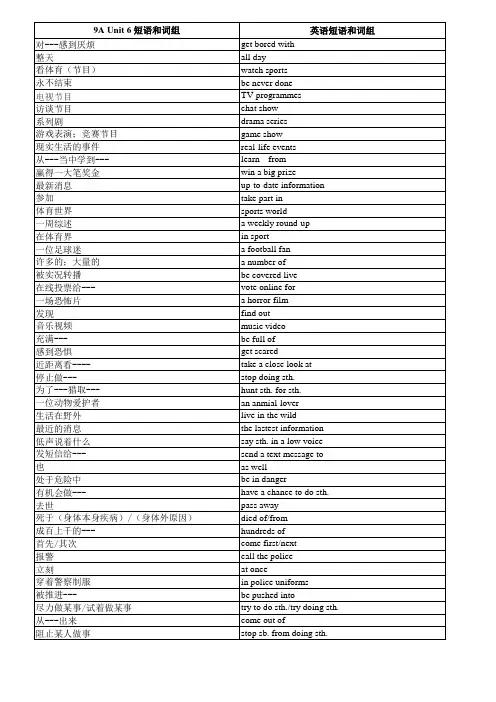
新译林版英语九年级上册第六单元单元重点语言点讲解
最新牛津译林版9A Uni t 6语言点知识点讲解一、课本中重点词、短语、句型讲解▲Co mic s tr ips & Welco me to the uni t1.I f you’re as busy a s I am, you won’t ge t bored.如果你和我一样忙,你就不会无聊了。
I f在此意为“如果”引导状语从句,表示条件。
当放在主句为将来时或含有情态词的句子中时,i f所引导的条件状语从句的时态为一般现在时。
例如:I f i t doesn’t ra in tom orrow, we wi l l go to the park.如果明天不下雨,我们将去公园。
2. need可用作实意动词,意为“需要”,常见搭配有need s th.,need to do, need do ing。
等,其中,need do i ng s th. = need to be done。
例如:This b roken b ike needs repa i r ing.(=This b roken b ike needs to be repa i red.)此外,need还用作情态动词“需要”,常用其否定形式。
例如:You needn’t wor ry abou t the exam,t a ke i t easy!你不需要担心这个考试,放松!3. To m and Je r ry i s my favour i t e,though the re’s no t much d ia logue in i t.我喜欢看《锚和老鼠》,尽管里面没有很多对白。
Though用为连词,意为“尽管”,语意上起转折作用。
4.t ake par t in指参加活动。
如take par t in the danc ing,jo in也有“参加”的意思,但多指加入一个组织或团体,成为其中的一员。
如:jo in the a rmy,jo in us等。
9A Unit 6 TV programmes教案-2023-2024学年牛津译林版英语九年级上册
I like watching…because…
Idon’t like/dislike …because…
3、请几名学生介绍他们组成员有关电视节目的喜好。
Task 3:Comic strips
1、Free talk
Do you often stay at home at the weekend?
教学难点
To think about TV preferences andreaddifferent typesofTV programmes
预习作业
教学内容及过程
二次备课
Step1:课堂导学与互动
Task 1:Free talk
1.Do you like watching TV?
2.How often do you watch TV?
2、将学生分成六人小组分角色朗读对话,组内就每个学生各自喜欢的电视节目进行询问和讨论,鼓励学生运用以下句型。
What type of TV programme do you like best?
/What’s your favourite type of TV programme? Why?
Do you know your friend’s favourite type of TV programme?
D、阅读第四个电视节目内容,完成下列选择填空。
()1.How long is the programme?
A.thirty minutes B.one hourC.forty minutes D.one hour and a half
()2.Why did it win an award?
A.Because it tells us an interesting story.
译林牛津版9A Unit 6. TV programmes Reading1公开课教学课件
Who will be interviewed?
Some of the most famous stars.
When will the results be
During the show.
announced?
How can we win Write down their answers and
two free tickets send text messages to 1396.
Why?
A Free Talk
A: What kind of TV programmes do you like best? B:I like watching…. /I like watching programmes about…. A: Why? B: Because I find/think it is….adj.(interesting/boring/exciting/…. /I can learn a lot from it.
Millie
I love programmes about animals. I also like films with good actors. I don’t mind feeling scared, but I have to go to bed at 10:30p.m.
Simon
I love watching music videos. I also like sports, especially football. I’ll be at home for the whole morning. I have to play football tonight .
Beijing Music Awards
牛津译林版九年级英语上册9A U6重点短语和句子
9A Unit6 TV programmes1.have nothing to do无事可做2.type of TV programmes 电视节目的种类3.learn a lot about nature, history and real-life events from documentaries从纪录片中了解许多关于自然、历史和真实事件(的知识)4.win a big prize赢得(一个)大奖5. a weekly round-up of…一周…的摘要6.the up-to-date/latest information最新消息7.cover different sports 报道各种体育运动消息8.this week’s programme 本周的节目9. a number of 若干/许多(在there be 结构中,由后面的名词决定be的单复数)10.the number of……的数量(做主语,谓语动词用单数)11.the coming World Cup 即将到来的世界杯12.be covered live 被现场直播13.an Asian pop star 一位亚洲流行音乐明星14.win two free concert tickets 赢得两张免费的音乐会门票15.solve mysteries 解谜16.get scared easily容易受惊17.realize how much danger these tigers //face 意识到这些老虎面临着多大的危险18.hunt them for their fur and bones 为了虎皮和虎骨而猎杀它们(指老虎)19. a polar bear 一个北极熊20.male/female wolf公/母狼21.in the studio 在演播室22.take the minibus 乘中巴车23.have little interest(n.)in sth对某事没什么兴趣 viewing habits 看电视的习惯 ad(ad=advertisement)电视广告26. a waste(n.) of time浪费时间27.the twins 这对双胞胎28.twin brothers/sisters 双胞胎兄弟/姐妹29.receive a message 收到一条短信30.ask (sb) for help (向某人)寻求帮助31.call the police 报警32.be pushed into a minibus 被推进了一辆中巴车33.open the back door of …打开了……的后门34.Aren’t you getting bored with staying at home all day? 你整天待在家里不觉得无聊吗?get bored (with sth.)对某事觉得/感到厌烦sb feel/get bored…sth be boring a boring book/lesson…35.If you’re as busy as I am, you won’t get bored. 如果你和我一样忙,你就不会无聊。
译林牛津版9A Unit 6. TV programmes Reading1公开课教学课件T (共21张PPT)
Read passage 4 and answer the questions.
1.How long does Tiger Watch last? One hour. 2. What can you realize after you watch the programme? We will realize how much danger these tigers face. 3.What will happen if people don’t stop hunting them? The situation will continue unless people stop if …not hunting them. 4.Who will feel sad about it? Animal-lovers. 5. What else can you see in the film? We can see scenes from India.
,
Scanning
Match the main idea with the programme A.A wealthy doctor is found dead. What happened?
B.What is happening in sport? Sports World
Murder in a Country House
Read passage 2 and complete the table. What will be covered Beijing Music Awards. live? When?
This Saturday.
Who will attend?
Many Asian pop stars.
When will the results During the show. be announced? Write down their answers and What can the audience (观众)do? send text messages to 1396. What could the Two free concert tickets. audience win?
牛津译林版-英语-九上-6单元 Tv programmes 课本重点句翻译
Unit 6 Tv programmes课本重点句翻译1. I’m far too busy to go shopping.我太忙了而不能去购物。
2.A dog’s work is never done .`狗的工作永远做不完。
3. Every one of them has their own favourite TV programme.他们每个人都有自己喜欢的电视节目。
4. They are creating their own TV programmes for a competition.他们正在为比赛创作他们自己的电视节目。
5. Millie says she likes the programmes on animals the most.Millie说她最喜欢动物类的电视节目。
6.A weekly round-up of what is happening in sport ,with lots of up –to-date information .一周体育新闻摘要,并有很多最新信息。
7.The programme covers different sports, such as swimming ,basketball,badminton and football. 本节目包括各种体育运动,如游泳、篮球、羽毛球和足球。
8. If you are not a f ootball fan,you might find this week’s programme a bit boring.如果你不是一个足球迷,你可能发现这个星期的节目有点乏味。
9.There are also a number of interviews with some famous football players .还有很多对著名足球运动员的访谈节目。
10. This year’s Beijing Music Awards will be covered live.本年度的北京音乐奖颁奖大会将现场直播.11.As you are watching the show ,write down your answers and send text messages to 1396.在你观看节目的时候,写下你的答案并发短信到1396。