
英语考试作文-2007年考研英语作文题目及范文
英语考试作文
2007年考研英语作文题目及范文
2007年考研英语作文命题解
析
首先,小作文考信,大作文考图画,这都没有出我们的预
料。信十分简单,用老师的方法:先用中文列个题纲。比如:①图书
馆开门太晚。②冬天不供应热水。③增添设备减少借还书时间,等等。
然后变成英文,100余词的作文屈指可成。其次,今年的大作文并未
按跟局势挂钩来出(去年跟“超女”、“追星”等话题挂钩),这也在
我们预测之中。但图画含义之深刻,却出乎大多数人的意料之外。用
郭老师的作文法,40分钟的大作文时间,起码抽出3~5分钟去想写
什么内容,千万不能跑题。至于何谓“不跑题”?这亦未有定论。比
如03年考“温室的花朵”,有人认为其暗指家长对独生子女的溺爱,
这因固然很好。但也有人认为其喻意是指一个国家或民族必须有强大
的政府保护,否则其人民将遭殃(如巴勒斯坦,黎巴嫩等),这也未
尝不可。
至于07年作文含义?有人认为守门员觉得门太宽,难以
守住,而踢球者觉得门太小而守门人太高,向影很大,无处不在,如
何路易呀?这都是缺少自信的表现,于是就以信心为题下笔来写。当
然,也有人不这么认为。他们认为07年图画代表了“主观”与“客
观”的区别。虽然球门宽窄是固定的,但在守者眼里太“宽”而在攻
者眼里又太“窄”。这有点象明月---“世人喜其朗亮,而盗贼恶其光
明”;又象春雨----“农夫喜其润泽,而旅人恨其泥泞”是一个道理。
这也说得过去。总之,作文没有固定答案,只要讲得有道理,就不算
跑题。然后,开始写。这就是英文表达的问题了。(见范文)
51.小作文
Dear Sir Jan 20 2007
I’m a student in our university and now,I would like
to convey in this letter my frank suggestions to improve our
library services to you.
In the first place,if you open much earlier in the
morning,for example,before 7:30 am,students would be able to
avoid the chilly wind waiting outside.In the second place,if
you provide students with hot water,they would feel grateful
to you because it is both inconvenient and improper to drink
cold water in winter.Last but not the least is that you
should,if possible,buy more computer equipment so as to
shorten the time of borrowing and returning books.
It is my sincere belief that if you do sth as I have
suggested above,it will not only benefit the students,but also
do googd to the university faculty.
Sincerely Yours Li Ming
52.大作文
Here is a picture of a football match in which a goal
keeper is standing in front of a goal,ready to protect it while
a footballer is trying to kick the ball in.At the same time,the
goal keeper is thinking:”How wide the goal is!How can I keep
it?”while the footballer is thingking about what is contrary
to this:”The goal keeper is so big that I nearly don’t’t
have any chance of kicking in.”
Obviously,as is shown in this cartoon,both of them
don’t’t have enough confidence and if you have no
confidence,how can you get your goal in life?!Losing one’s
self-confidence before doing things can not merely affect your
thoughts but also do harm to the actions you will take.
For example,when I was in the middle school,once,our
school basket ball team would play against another team which
was very famous in our city and eveyone in our team felt that
the only consequence would be our team’s failure.As a result,we
didn’t even make any preparations beforehand.of course,the
result was―we failed.One year later,we met the same team in
a match again.This time,our teacher inspired us with
confidence and hope.Then,we made a detailed plan and we
practiced and out of everybody’s imagination,we finally
won.So,our conclusion was―“Confidence is the first step to
success!”
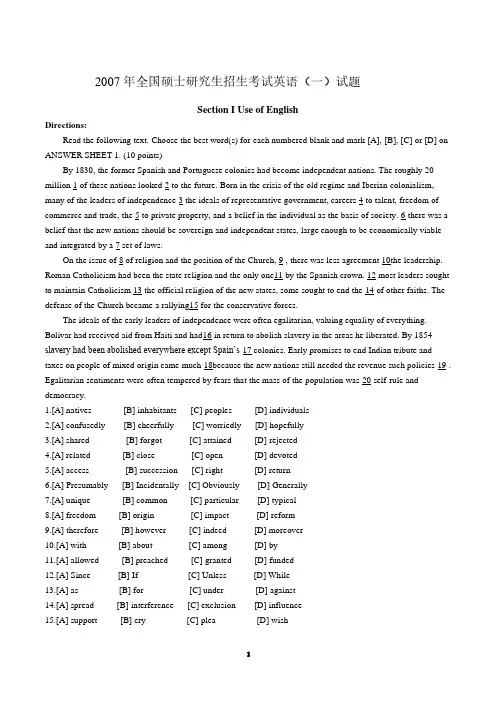
2007年考研英语真题及解析.pdf
2007年全国硕士研究生招生考试英语(一)试题Section I Use of EnglishDirections:Read the following text. Choose the best word(s) for each numbered blank and mark [A], [B], [C] or [D] on ANSWER SHEET 1. (10 points)By 1830, the former Spanish and Portuguese colonies had become independent nations. The roughly 20 million 1 of these nations looked 2 to the future. Born in the crisis of the old regime and Iberian colonialism, many of the leaders of independence 3 the ideals of representative government, careers 4 to talent, freedom of commerce and trade, the 5 to private property, and a belief in the individual as the basis of society. 6 there was a belief that the new nations should be sovereign and independent states, large enough to be economically viable and integrated by a 7 set of laws.On the issue of 8 of religion and the position of the Church, 9 , there was less agreement 10the leadership. Roman Catholicism had been the state religion and the only one11 by the Spanish crown. 12 most leaders sought to maintain Catholicism 13 the official religion of the new states, some sought to end the 14 of other faiths. The defense of the Church became a rallying15 for the conservative forces.The ideals of the early leaders of independence were often egalitarian, valuing equality of everything. Bolivar had received aid from Haiti and had16 in return to abolish slavery in the areas he liberated. By 1854 slavery had been abolished everywhere except Spain’s 17 colonies. Early promises to end Indian tribute and taxes on people of mixed origin came much 18because the new nations still needed the revenue such policies 19 . Egalitarian sentiments were often tempered by fears that the mass of the population was 20 self-rule and democracy.1.[A] natives [B] inhabitants [C] peoples [D] individuals2.[A] confusedly [B] cheerfully [C] worriedly [D] hopefully3.[A] shared [B] forgot [C] attained [D] rejected4.[A] related [B] close [C] open [D] devoted5.[A] access [B] succession [C] right [D] return6.[A] Presumably [B] Incidentally [C] Obviously [D] Generally7.[A] unique [B] common [C] particular [D] typical8.[A] freedom [B] origin [C] impact [D] reform9.[A] therefore [B] however [C] indeed [D] moreover10.[A] with [B] about [C] among [D] by11.[A] allowed [B] preached [C] granted [D] funded12.[A] Since [B] If [C] Unless [D] While13.[A] as [B] for [C] under [D] against14.[A] spread [B] interference [C] exclusion [D] influence15.[A] support [B] cry [C] plea [D] wish16.[A] urged [B] intended [C] expected [D] promised17.[A] controlling [B] former [C] remaining [D] original18.[A] slower [B] faster [C] easier [D] tougher19.[A] created [B] produced [C] contributed [D] preferred20.[A] puzzled by [B] hostile to [C]pessimistic about [D] unprepared forSection II Reading ComprehensionPart ADirections:Read the following four texts. Answer the questions below each text by choosing [A], [B], [C], or [D]. Mark your answers on ANSWER SHEET 1. (40 points)Text 1If you were to examine the birth certificates of every soccer pl ayer in 2006’s World Cup tournament, you would most likely find a noteworthy quirk: elite soccer players are more likely to have been born in the earlier months of the year than in the late months. If you then examined the European national youth teams that feed the World Cup and professional ranks, you would find this strange phenomenon to be ever more pronounced.What might account for this strange phenomenon? Here are a few guesses: a) certain astrological signs confer superior soccer skills; b) winter-born babies tend to have higher oxygen capacity, which increasessoccer stamina;c) soccer-mad parents are more likely to conceive children in springtime, at the annual peak of soccermania; d) none of the above.Anders Ericsson, a 58-year-old psychology professor at Florida State University, says he believes strongly in “none of the above.” Ericsson grew up in Sweden, and studied nuclear engineering until he realized he would have more opportunity to conduct his own research if he switched to psychology. His first experiment, nearly 30 years ago, involved memory: training a person to hear and then repeat a random series of numbers. “With the first subject, after about 20 hours of training, his digit span had risen from 7 to 20,” Ericsson recalls. “He kept impr oving, and after about 200 hours of training he had risen to over 80 numbers.”This success, coupled with later research showing that memory itself is not genetically determined, led Ericsson to conclude that the act of memorizing is more of a cognitive exercise than an intuitive one. In other words, whatever inborn differences two people may exhibit in their abilities to memorize, those differences are swamped by how well each person “encodes” the information. And the best way to learn how to encode information meaningfully, Ericsson determined, was a process known as deliberate practice. Deliberate practice entails more than simply repeating a task. Rather, it involves setting specific goals, obtaining immediate feedback and concentrating as much on technique as on outcome.Ericsson and his colleagues have thus taken to studying expert performers in a wide range of pursuits, including soccer. They gather all the data they can, not just performance statistics and biographical details but also the results of their own laboratory experiments with high achievers. Their work makes a rather startlingassertion: the trait we commonly call talent is highly overrated. Or, put another way, expert performers—whether in memory or surgery, ballet or computer programming—are nearly always made, not born.21. The birthday phenomenon found among soccer players is mentioned to[A] stress the importance of professional training.[B] spotlight the soccer superstars at the World Cup.[C] introduce the topic of what makes expert performance.[D] explain why some soccer teams play better than others.22. The word “mania” (Line 4, Paragraph 2) most probably means[A] fun.[B] craze.[C] hysteria.[D] excitement.23. According to Ericsson, good memory[A] depends on meaningful processing of information.[B] results from intuitive rather than cognitive exercises.[C] is determined by genetic rather than psychological factors.[D] requires immediate feedback and a high degree of concentration.24. Ericsson and his colleagues believe that[A] talent is a dominating factor for professional success.[B] biographical data provide the key to excellent performance.[C] the role of talent tends to be overlooked.[D] high achievers owe their success mostly to nurture.25. Which of the following proverbs is closest to the message the text tries to convey?[A] “Faith will move mountains.”[B] “One reaps what one sows.”[C] “Practice makes perfect.”[D] “Like father, like son.”Text 2For the past several years, the Sunday newspaper supplement Parade has featured a column called “Ask Marilyn.” People are invited to query Marilyn vos Savant, who at age 10 had tested at a mental level of someone about 23 years old; that gave her an IQ of 228—the highest score ever recorded. IQ tests ask you to complete verbal and visual analogies, to envision paper after it has been folded and cut, and to deduce numericalsequences, among other similar tasks. So it is a bit confusing when vos Savant fields such queries from the average Joe (whose IQ is 100) as, What’s t he difference between love and fondness? Or what is thenature of luck and coincidence? It’s not obvious how the capacity to visualize objects and to figure out numerical patterns suits one to answer questions that have eluded some of the best poets and philosophers.Clearly, intelligence encompasses more than a score on a test. Just what does it mean to be smart? How much of intelligence can be specified, and how much can we learn about it from neurology, genetics, computer science and other fields?The defining term of intelligence in humans still seems to be the IQ score, even though IQ tests are not given as often as they used to be. The test comes primarily in two forms: the Stanford-Binet Intelligence Scale and the Wechsler Intelligence Scales (both com e in adult and children’s version). Generally costing several hundred dollars, they are usually given only by psychologists, although variations of them populate bookstores and the World Wide Web. Superhigh scores like vos Savant’s are no longer possible, because scoring is now based on a statistical population distribution among age peers, rather than simply dividing the mental age by the chronological age and multiplying by 100. Other standardized tests, such as the Scholastic Assessment Test (SAT) and the Graduate Record Exam (GRE), capture the main aspects of IQ tests.Such standardized tests may not assess all the important elements necessary to succeed in school and in life, argues Robert J. Sternberg. In his article “How Intelligent Is Intelligence Testing?”, Sternberg notes that traditional tests best assess analytical and verbal skills but fail to measure creativity and practical knowledge, components also critical to problem solving and life success. Moreover, IQ tests do not necessarily predict so well once populations or situations change. Research has found that IQ predicted leadership skills when the tests were given under low-stress conditions, but under high-stress conditions, IQ was negatively correlated with leadership—that is, it predicted the opposite. Anyone who has toiled through SAT will testify that test-taking skill also matters, whether it’s knowing when to guess or what questions to skip.26. Which of the following may be required in an intelligence test?[A] Answering philosophical questions.[B] Folding or cutting paper into different shapes.[C] Telling the differences between certain concepts.[D] Choosing words or graphs similar to the given ones.27. What can be inferred about intelligence testing from Paragraph3?[A] People no longer use IQ scores as an indicator of intelligence.[B] More versions of IQ tests are now available on the Internet.[C] The test contents and formats for adults and children may be different.[D] Scientists have defined the important elements of human intelligence.28. People nowadays can no longer achieve IQ scores as high as vos Savant’s because[A] the scores are obtained through different computational procedures.[B] creativity rather than analytical skills is emphasized now.[C] vos Savant’s case is an extreme one that will not repeat.[D] the defining characteristic of IQ tests has changed.29. We can conclude from the last paragraph that[A] test scores may not be reliable indicators of one’s ability.[B] IQ scores and SAT results are highly correlated.[C] testing involves a lot of guesswork.[D] traditional tests are out of date.30. What is the author’s attitude towards IQ tests?[A] Supportive.[B] Skeptical.[C] Impartial.[D] Biased.Text 3During the past generation, the American middle-class family that once could count on hard work and fair play to keep itself financially secure has been transformed by economic risk and new realties. Now a pink slip, a bad diagnosis, or a disappearing spouse can reduce a family from solidly middle class to newly poor in a few months.In just one generation, millions of mothers have gone to work,transforming basic family economics. Scholars, policymakers, and critics of all stripes have debated the social implications of these changes, but few have looked at t he side effect: family risk has risen as well. Today’s families have budgeted to the limits of theirs new two-paycheck status. As a result, they have lost the parachute they once had in times of financial setback—a back-up earner (usually Mom) who could go into the workforce if the primary earner got laid off or fell sick. This “added-worker effect” could support the safety net offered by unemployment insurance or disability insurance to help families weather bad times. But today, a disruption to family fortunes can no longer be made up with extra income from an otherwise-stay-at-home partner.During the same period, families have been asked to absorb much more risk in their retirement income. Steelworkers, airline employees, and now those in the auto industry are joining millions of families who must worry about interest rates, stock market fluctuation, and the harsh reality that they may outlive their retirement money. For much of the past year, President Bush campaigned to move Social Security to a savings-account model, with retirees trading much or all of their guaranteed payments for payments depending on investment returns. For younger families, the picture is not any better. Both the absolute cost of healthcare and the share of it borne by families have risen—and newly fashionable health-savings plans are spreading from legislative halls to Wal-Mart workers, with much higher deductibles and a large new dose of investment risk for families’ futurehealthcare. Even demographics are working against the middle class family, as the odds of having a weak elderly parent—and all the attendant need for physical and financial assistance—have jumped eightfold in just one generation.From the middle-class family perspective, much of this, understandably, looks far less like an opportunity to exercise more financial responsibility, and a good deal more like a frightening acceleration of the wholesale shift of financial risk onto their already overburdened shoulders. The financial fallout has begun, and the political fallout may not be far behind.31. Today’s double-income families are at greater financial risk in that[A] the safety net they used to enjoy has disappeared.[B] their chances of being laid off have greatly increased.[C] they are more vulnerable to changes in family economics.[D] they are deprived of unemployment or disability insurance.32. As a result of President Bush’s reform, retired people may have[A] a higher sense of security.[B] less secured payments.[C] less chance to invest.[D] a guaranteed future.33. According to the author, health-savings plans will[A] help reduce the cost of healthcare.[B] popularize among the middle class.[C] compensate for the reduced pensions.[D] increase the families’ investment risk.34. It can be inferred from the last paragraph that[A] financial risks tend to outweigh political risks.[B] the middle class may face greater political challenges.[C] financial problems may bring about political problems.[D] financial responsibility is an indicator of political status.35. Which of the following is the best title for this text?[A] The Middle Class on the Alert[B] The Middle Class on the Cliff[C] The Middle Class in Conflict[D] The Middle Class in RuinsText 4It never rains but it pours. Just as bosses and boards have finally sorted out their worst accounting and compliance troubles, and improved their feeble corporation governance, a new problem threatens to earn them—especially in America—the sort of nasty headlines that inevitably lead to heads rolling in the executive suite: data insecurity. Left, until now, to odd, low-level IT staff to put right, and seen as a concern only of data-rich industries such as banking, telecoms and air travel, information protection is now high on the boss’s agenda in businesses of every variety.Several massive leakages of customer and employee data this year—from organizations as diverse as Time Warner, the American defense contractor Science Applications International Corp and even the University of California, Berkeley—have left managers hurriedly peering into their intricate IT systems and business processes in search of potential vulnerabilities.“Data is becoming an asset which needs to be guarded as much as any other asset,” says Haim Mendelson of Stanford University’s business school. “The ability to guard customer data is the key to market value, which the board is responsible for on behalf of shareholders”. Indeed, just as there is the concept of Generally Accepted Accounting Principles (GAAP), perhaps it is time for GASP, Generally Accepted Security Practices, suggested Eli Noam of New York’s Columbia Business School. “Setting the proper investment level for security, redundancy, and recovery is a management issue, not a technical one,” he says.The mystery is that this should come as a surprise to any boss. Surely it should be obvious to the dimmest executive that trust, that most valuable of economic assets, is easily destroyed and hugely expensive to restore—and that few things are more likely to destroy trust than a company letting sensitive personal data get into the wrong hands.The current state of affairs may have been encouraged—though not justified—by the lack of legal penalty (in America, but not Europe) for data leakage. Until California recently passed a law, American firms did not have to tell anyone, even the victim, when data went astray. That may change fast: lots of proposed data-security legislation is now doing the rounds in Washington, D.C. Meanwhile, the theft of information about some 40 million credit-card accounts in America, disclosed on June 17th, overshadowed a hugely important decision a day earlier by America’s Federal Trade Commission (FTC) that puts corporate America on notice that regulators will act if firms fail to provide adequate data security.36. The statement “It never rains but it pours” is used to introduce[A] the fierce business competition.[B] the feeble boss-board relations.[C] the threat from news reports.[D] the severity of data leakage.37. According to Paragraph 2, some organizations check their systems to find out[A] whether there is any weak point.[B] what sort of data has been stolen.[C] who is responsible for the leakage.[D] how the potential spies can be located.38. In bringing up the concept of GASP the author is making the point that[A] shareholders’ interests should be properly attended to.[B] information protection should be given due attention.[C] businesses should enhance their level of accounting security.[D] the market value of customer data should be emphasized.39. According to Paragraph 4, what puzzles the author is that some bosses fail to[A] see the link between trust and data protection.[B] perceive the sensitivity of personal data.[C] realize the high cost of data restoration.[D] appreciate the economic value of trust.40. It can be inferred from Paragraph 5 that[A] data leakage is more severe in Europe.[B] FTC’s decision is essential to data security.[C] California takes the lead in security legislation.[D] legal penalty is a major solution to data leakage.Part BDirections:You are going to read a list of headings and a text about what parents are supposed to do to guide their children into adulthood. Choose a heading from the list A-G that best fits the meaning of each numbered part of the text (41-45). The first and last paragraphs of the text are not numbered. There are two extra headings that you do not need to use. Mark your answers on ANSWER SHEET 1. (10 points)[A] Set a Good Example for Your Kids[B] Build Your Kids’ Work Skills[C] Place Time Limits on Leisure Activities[D] Talk about the Future on a Regular Basis[E] Help Kids Develop Coping Strategies[F] Help Your Kids Figure Out Who They Are[G] Build Your Kids’ Sense of ResponsibilityHow Can a Parent Help?Mothers and fathers can do a lot to ensure a safe landing in early adulthood for their kids. Even if a job’s starting salary seems too small to satisfy an emerging adult’s need for rapid content, the transition from school toYou can start this process when they are 11 or 12. Periodically review their emerging strengths and weaknesses with them and work together on any shortcomings, like difficulty in communicating well or collaborating. Also,Kids need a range of authentic role models—as opposed to members of their clique, pop stars and vaunted athletes. Have regular dinner-table discussions about people the family knows and how they got where they are. Discuss the joys and downsides of your own career and encourage your kids to form some ideas about their own future. When asked what they want to do, they should be discouraged from saying “I have no idea.” They canTeachers are responsible for teaching kids how to learn; parents should be responsible for teaching them how to work. Assign responsibilities around the house and make sure homework deadlines are met. Encourage teenagers to take a part-time job. Kids need plenty of practice delaying gratification and deploying effective organizationalThey should know how to deal with setbacks, stress and feelings of inadequacy. They should also learn how to solve problems and resolve conflicts, ways to brainstorm and think critically. Discussions at home can help kids practice doing these things and help them apply these skills to everyday life situations.What about the son or daughter who is grown but seems to be struggling and wandering aimlessly through early adulthood? Parents still have a major role to play, but now it is more delicate. They have to be careful not to come across as disappointed in their child. They should exhibit strong interest and respect for whatever currently interests their fledging adult (as naive or ill conceived as it may seem) while becoming a partner in exploring options for the future. Most of all, these new adults must feel that they are respected and supported by a family that appreciates them.Part CDirections:Read the following text carefully and then translate the underlined segments into Chinese. Your translation should be written neatly on ANSWER SHEET 2. (10 points)The study of law has been recognized for centuries as a basic intellectual discipline in European universities. However, only in recent years has it become a feature of undergraduate programs in Canadian universities.(46)Traditionally, legal learning has been viewed in such institutions as the special preserve of lawyers, rather than a necessary part of the intellectual equipment of an educated person. Happily, the older and more continental view of legal education is establishing itself in a number of Canadian universities and some have even begun to offer undergraduate degrees in law.If the study of law is beginning to establish itself as part and parcel of a general education, its aims and methods should appeal directly to journalism educators. Law is a discipline which encourages responsible judgment. On the one hand, it provides opportunities to analyze such ideas as justice, democracy and freedom. (47) On the other, it links theseconcepts to everyday realities in a manner which is parallel to the links journalists forge on a daily basis as they cover and comment on the news.For example, notions of evidence and fact, of basic rights and public interest are at work in the process of journalistic judgment and production just as in courts of law. Sharpening judgment by absorbing and reflecting on law is a desirable component of a journalist’s intellectual preparation for his or her career.(48) But the idea that the journalist must understand the law more profoundly than an ordinary citizen rests on an understanding of the established conventions and special responsibilities of the news media.Politics or, more broadly, the functioning of the state, is a major subject for journalists. The better informed they are about the way the state works, the better their reporting will be. (49) In fact, it is difficult to see how journalists who do not have a clear grasp of the basic features of the Canadian Constitution can do a competent job on political stories.Furthermore, the legal system and the events which occur within it are primary subjects for journalists. While the quality of legal journalism varies greatly, there is an undue reliance amongst many journalists on interpretations supplied to them by lawyers. (50) While comment and reaction from lawyers may enhance stories, it is preferable for journalists to rely on their own notions of significance and make their own judgments.Thesecan only come from a well-grounded understanding of the legal system.Section III WritingPart A51. DirectionsWrite a letter to your university library, making suggestions for improving its service.You should write about 100 words on ANSWER SHEET 2.Do not sign your own name at the end of the letter. Use “Li Ming” instead.Do not write the address. (10 points)Part B52. Directions:Write an essay of 160-200 words based on the following drawing. In your essay, you should1) describe the drawing briefly,2) explain its intended meaning, and then3) support your view with an example/examples.You should write neatly on ANSWER SHEET 2. (20 points)2007年全国硕士研究生招生考试英语(一)答案详解Section I Use of English一、文章结构分析本文主要论述了西班牙和葡萄牙的前殖民地在独立以后面临的各种问题。
2007英语一大作文

2007英语一大作文In the modern era, technology has become an integral part of our daily lives, and its influence on education is no exception. The purpose of this essay is to explore the waysin which technology has transformed the educational landscape and to discuss the implications of these changes.Firstly, the advent of the internet has revolutionized the way students access information. With a few keystrokes, a wealth of knowledge is at their fingertips. This has not only made research more efficient but also has exposed students to a diverse array of perspectives and sources, thereby enhancing their critical thinking skills.Secondly, the integration of digital tools such as tablets and laptops in the classroom has shifted the traditional teacher-centric model to a more student-centered approach. Interactive whiteboards, educational apps, and online collaboration platforms encourage active participation and peer-to-peer learning, which can lead to a more engaging and personalized educational experience.However, the reliance on technology in education also presents challenges. One of the primary concerns is thedigital divide, where unequal access to technology can exacerbate existing educational inequalities. Additionally, there is a risk that over-reliance on digital resources could diminish the importance of traditional skills such ashandwriting and memorization.Moreover, the use of technology in education must be balanced with the need for human interaction and social development. While technology can facilitate learning, it cannot replace the value of face-to-face communication and the development of soft skills, which are crucial for personal growth and future employability.In conclusion, technology has the potential to greatly enhance educational experiences and outcomes. However, it is imperative that its implementation is thoughtful and considers the broader educational goals. Educators muststrive to integrate technology in a way that complements traditional teaching methods and fosters a holistic learning environment. By doing so, we can harness the power of technology to prepare students for the challenges of the 21st century.。
2007全国卷二卷作文范文
2007全国卷二卷作文范文As the world becomes more interconnected, it is essential for individuals to be proficient in multiple languages. 随着世界变得更加互联互通,掌握多种语言对个人来说变得至关重要。
One of the benefits of being bilingual is the ability to communicate with people from different cultural backgrounds. 双语能力的一个好处是能够与来自不同文化背景的人交流。
Moreover, bilingualism has been shown to have cognitive benefits, such as improved multitasking and problem-solving skills. 此外,双语能力已被证明具有认知好处,例如提高了多任务处理和问题解决能力。
From a practical standpoint, being bilingual can also open up more job opportunities and increase one's earning potential. 从实际的角度来看,双语能力也可以为个人带来更多的就业机会,增加收入。
As someone who is bilingual, I can attest to the advantages that come with being able to switch between languages seamlessly. 作为一个双语者,我可以证明可以轻松切换语言的优势。
However, becoming bilingual requires dedication and effort, as it is not an easy feat to master a second language. 然而,要成为双语者需要付出努力和投入,因为掌握第二语言并非易事。
2007年考研英语真题及解析
8.[A]freedom [B] origin [C]impact [D] reform9。
[A] therefore [B]however [C] indeed [D]moreover10.[A]with [B] about [C] among [D] by11.[A] allowed [B]preached [C] granted [D] funded12。
[A] Since [B] If [C]Unless [D] While13.[A]as [B] for [C] under [D] against14.[A]spread [B]interference [C] exclusion [D]influence15。
[A]support [B]cry [C] plea [D]wish16.[A]urged [B] intended [C] expected [D] promised17。
[A] controlling [B]former [C]remaining [D] original18。
[A]slower [B] faster [C] easier [D]tougher19.[A] created [B] produced [C]contributed [D] preferred20.[A]puzzled by [B]hostile to [C]pessimistic about [D]unprepared forSection II Reading ComprehensionPart ADirections:Read the following four texts。
Answer the questions below each text by choosing [A],[B], [C], or [D]. Mark your answers on ANSWER SHEET 1。
(40 points)Text 1If you were to examine the birth certificates of every soccer player in 2006's World Cup tournament,youwould most likely find a noteworthy quirk: elite soccer players are more likely to have been born in the earlier months of the year than in the late months. If you then examined the European national youth teams that feed the World Cup and professional ranks,you would find this strange phenomenon to be ever more pronounced.What might account for this strange phenomenon?Here are a few guesses:a)certain astrological signs confer superior soccer skills; b)winter-born babies tend to have higher oxygen capacity,which increasessoccer stamina; c) soccer—mad parents are more likely to conceive children in springtime,at the annual peak of soccermania; d)none of the above。
2007年考研英语2卷子

2007年考研英语2卷子Certainly! Here's a creative piece written in American English, inspired by the title "2007 Graduate Entrance Examination English Paper II":As the clock ticked away, the room filled with the hum of concentration and the occasional scratch of a pen on paper.It was the year 2007, and the air was thick with anticipation. The Graduate Entrance Examination English Paper II was aboutto determine the academic fate of many.In the front corner, a young woman with a determined look on her face was carefully reading the instructions for the essay section. Her name was Emily, and this was her second attempt at the exam. She had spent countless hours preparing, her notes sprawled across her small apartment, each one a testament to her dedication.Across the aisle, a man named Daniel was nervouslytapping his pen against the desk. He had been out of schoolfor a few years, working in the IT sector, but the call of academia was too strong to ignore. He had left his job to pursue a master's degree, and this exam was his gateway back.The proctor announced the start of the exam, and the room fell silent. Students began to write, their minds racing to recall the vocabulary and grammar rules they had memorized. Emily's hand moved swiftly across the page, her essay on theimportance of cultural exchange in a globalized world taking shape with each word.Daniel, on the other hand, was struggling. The reading comprehension section was proving to be more challenging than he had anticipated. He forced himself to focus, to read between the lines and decipher the subtle nuances of the text.As the exam progressed, the room became a battleground of wits and wills. Each student was locked in their own personal struggle, the only sounds the rustling of papers and the soft sighs of concentration.The essay question asked the test-takers to discuss the impact of technology on education. Emily's eyes lit up as she began to outline the points she had practiced. She was passionate about the subject, having seen firsthand how technology could level the playing field for students fromall walks of life.Time was running short, and the proctor warned that there were only fifteen minutes left. A wave of tension washed over the room. Daniel, realizing he had fallen behind, began to skim through the questions, trying to cover as much aspossible in the remaining time.Finally, the proctor called time, and the students put down their pens. A collective exhale echoed through the roomas the papers were collected. Some students exchanged glances of relief or frustration, while others simply stared blankly ahead, their minds still processing the intense experiencethey had just endured.As they filed out of the room, Emily and Daniel, along with the rest of the test-takers, knew that their futures were now in the hands of the examiners. The Graduate Entrance Examination English Paper II had been a challenge, but it was only the beginning of their journey towards academic and professional growth.This piece is a fictional narrative inspired by the title and does not represent an actual exam paper or its content.。
2007年考研英语真题(答案解析)
2007年考研英语真题(答案解析)Passage 1It is a common experience that a problem difficult at night is resolved in the morning after the committee of sleep has worked on it.Many people have found that a good night's sleep is the best way to solve a problem. If you have been working hard on a problem all day and have made no progress, sometimesit is better to sleep on it. When you wake up in the morning, you may find that the problem has become much easier to solve. This is because your mind has been working on the problem while you were asleep.The committee of sleep is a name given to the way our minds continue to work on problems while we are asleep. The idea is that while we are asleep, the unconscious part of our mind is working on the problem. It is as if there is a committee of people in our mind who are working on the problem while we are asleep. When we wake up in the morning, we often find that the problem has been solved. The committee of sleep is not just a theory. It has been proved by experiments. In one experiment, people were given a problem to solve. They were then divided into two groups.One group was allowed to sleep, while the other group was kept awake. The group that slept was much more likely to solve the problem than the group that was kept awake.So next time you have a difficult problem to solve, try sleeping on it. You may find that your mind has been working on the problem while you were asleep and the problem has become much easier to solve.1. What is the common experience mentioned in the passage?A. A problem difficult at night is resolved in the morning.B. A problem easy at night is resolved in the morning.C. A problem difficult at night is resolved in the afternoon.D. A problem easy at night is resolved in the afternoon.2. Why is a good night's sleep the best way to solve a problem?A. Because it can help you forget the problem.B. Because it can help you relax.C. Because it can help you work out the problem.D. Because it can help you avoid the problem.3. What is the committee of sleep?A. A group of people who work on a problem.B. A group of people who sleep on a problem.C. A name given to the way our minds work on problems while we are asleep.D. A name given to the way our minds work on problems while we are awake.4. What is the idea of the committee of sleep?A. That the unconscious part of our mind works on a problem while we are asleep.B. That the unconscious part of our mind works on a problem while we are awake.C. That the conscious part of our mind works on a problem while we are asleep.D. That the conscious part of our mind works on a problem while we are awake.5. What has been proved by experiments?A. The committee of sleep is just a theory.B. The committee of sleep is not just a theory.C. The group that slept was much more likely to solve the problem than the group that was kept awake.D. The group that was kept awake was much more likely to solve the problem than the group that slept.答案:1. A2. C3. C4. A5. B。
2007年考研英语真题及解析
2007年全国硕士研究生招生考试英语(一)试题Section I Use of EnglishDirections:Read the following text. Choose the best word(s) for each numbered blank and mark [A], [B], [C] or [D] on ANSWER SHEET 1. (10 points)By 1830, the former Spanish and Portuguese colonies had become independent nations. The roughly 20 million 1 of these nations looked 2 to the future. Born in the crisis of the old regime and Iberian colonialism, many of the leaders of independence 3 the ideals of representative government, careers 4 to talent, freedom of commerce and trade, the 5 to private property, and a belief in the individual as the basis of society. 6 there was a belief that the new nations should be sovereign and independent states, large enough to be economically viable and integrated by a 7 set of laws.On the issue of 8 of religion and the position of the Church, 9 , there was less agreement 10the leadership. Roman Catholicism had been the state religion and the only one11 by the Spanish crown. 12 most leaders sought to maintain Catholicism 13 the official religion of the new states, some sought to end the 14 of other faiths. The defense of the Church became a rallying15 for the conservative forces.The ideals of the early leaders of independence were often egalitarian, valuing equality of everything. Bolivar had received aid from Haiti and had16 in return to abolish slavery in the areas he liberated. By 1854 slavery had been abolished everywhere except Spain’s 17 colonies. Early promises to end Indian tribute and taxes on people of mixed origin came much 18because the new nations still needed the revenue such policies 19 . Egalitarian sentiments were often tempered by fears that the mass of the population was 20 self-rule and democracy.1.[A] natives [B] inhabitants [C] peoples [D] individuals2.[A] confusedly [B] cheerfully [C] worriedly [D] hopefully3.[A] shared [B] forgot [C] attained [D] rejected4.[A] related [B] close [C] open [D] devoted5.[A] access [B] succession [C] right [D] return6.[A] Presumably [B] Incidentally [C] Obviously [D] Generally7.[A] unique [B] common [C] particular [D] typical8.[A] freedom [B] origin [C] impact [D] reform9.[A] therefore [B] however [C] indeed [D] moreover10.[A] with [B] about [C] among [D] by11.[A] allowed [B] preached [C] granted [D] funded12.[A] Since [B] If [C] Unless [D] While13.[A] as [B] for [C] under [D] against14.[A] spread [B] interference [C] exclusion [D] influence15.[A] support [B] cry [C] plea [D] wish16.[A] urged [B] intended [C] expected [D] promised17.[A] controlling [B] former [C] remaining [D] original18.[A] slower [B] faster [C] easier [D] tougher19.[A] created [B] produced [C] contributed [D] preferred20.[A] puzzled by [B] hostile to [C]pessimistic about [D] unprepared forSection II Reading ComprehensionPart ADirections:Read the following four texts. Answer the questions below each text by choosing [A], [B], [C], or [D]. Mark your answers on ANSWER SHEET 1. (40 points)Text 1If you were to examine the birth certificates of every soccer pl ayer in 2006’s World Cup tournament, you would most likely find a noteworthy quirk: elite soccer players are more likely to have been born in the earlier months of the year than in the late months. If you then examined the European national youth teams that feed the World Cup and professional ranks, you would find this strange phenomenon to be ever more pronounced.What might account for this strange phenomenon? Here are a few guesses: a) certain astrological signs confer superior soccer skills; b) winter-born babies tend to have higher oxygen capacity, which increasessoccer stamina;c) soccer-mad parents are more likely to conceive children in springtime, at the annual peak of soccermania; d) none of the above.Anders Ericsson, a 58-year-old psychology professor at Florida State University, says he believes strongly in “none of the above.” Ericsson grew up in Sweden, and studied nuclear engineering until he realized he would have more opportunity to conduct his own research if he switched to psychology. His first experiment, nearly 30 years ago, involved memory: training a person to hear and then repeat a random series of numbers. “With the first subject, after about 20 hours of training, his digit span had risen from 7 to 20,” Ericsson recalls. “He kept impr oving, and after about 200 hours of training he had risen to over 80 numbers.”This success, coupled with later research showing that memory itself is not genetically determined, led Ericsson to conclude that the act of memorizing is more of a cognitive exercise than an intuitive one. In other words, whatever inborn differences two people may exhibit in their abilities to memorize, those differences are swamped by how well each person “encodes” the information. And the best way to learn how to encode information meaningfully, Ericsson determined, was a process known as deliberate practice. Deliberate practice entails more than simply repeating a task. Rather, it involves setting specific goals, obtaining immediate feedback and concentrating as much on technique as on outcome.Ericsson and his colleagues have thus taken to studying expert performers in a wide range of pursuits, including soccer. They gather all the data they can, not just performance statistics and biographical details but also the results of their own laboratory experiments with high achievers. Their work makes a rather startlingassertion: the trait we commonly call talent is highly overrated. Or, put another way, expert performers—whether in memory or surgery, ballet or computer programming—are nearly always made, not born.21. The birthday phenomenon found among soccer players is mentioned to[A] stress the importance of professional training.[B] spotlight the soccer superstars at the World Cup.[C] introduce the topic of what makes expert performance.[D] explain why some soccer teams play better than others.22. The word “mania” (Line 4, Paragraph 2) most probably means[A] fun.[B] craze.[C] hysteria.[D] excitement.23. According to Ericsson, good memory[A] depends on meaningful processing of information.[B] results from intuitive rather than cognitive exercises.[C] is determined by genetic rather than psychological factors.[D] requires immediate feedback and a high degree of concentration.24. Ericsson and his colleagues believe that[A] talent is a dominating factor for professional success.[B] biographical data provide the key to excellent performance.[C] the role of talent tends to be overlooked.[D] high achievers owe their success mostly to nurture.25. Which of the following proverbs is closest to the message the text tries to convey?[A] “Faith will move mountains.”[B] “One reaps what one sows.”[C] “Practice makes perfect.”[D] “Like father, like son.”Text 2For the past several years, the Sunday newspaper supplement Parade has featured a column called “Ask Marilyn.” People are invited to query Marilyn vos Savant, who at age 10 had tested at a mental level of someone about 23 years old; that gave her an IQ of 228—the highest score ever recorded. IQ tests ask you to complete verbal and visual analogies, to envision paper after it has been folded and cut, and to deduce numericalsequences, among other similar tasks. So it is a bit confusing when vos Savant fields such queries from the average Joe (whose IQ is 100) as, What’s t he difference between love and fondness? Or what is thenature of luck and coincidence? It’s not obvious how the capacity to visualize objects and to figure out numerical patterns suits one to answer questions that have eluded some of the best poets and philosophers.Clearly, intelligence encompasses more than a score on a test. Just what does it mean to be smart? How much of intelligence can be specified, and how much can we learn about it from neurology, genetics, computer science and other fields?The defining term of intelligence in humans still seems to be the IQ score, even though IQ tests are not given as often as they used to be. The test comes primarily in two forms: the Stanford-Binet Intelligence Scale and the Wechsler Intelligence Scales (both com e in adult and children’s version). Generally costing several hundred dollars, they are usually given only by psychologists, although variations of them populate bookstores and the World Wide Web. Superhigh scores like vos Savant’s are no longer possible, because scoring is now based on a statistical population distribution among age peers, rather than simply dividing the mental age by the chronological age and multiplying by 100. Other standardized tests, such as the Scholastic Assessment Test (SAT) and the Graduate Record Exam (GRE), capture the main aspects of IQ tests.Such standardized tests may not assess all the important elements necessary to succeed in school and in life, argues Robert J. Sternberg. In his article “How Intelligent Is Intelligence Testing?”, Sternberg notes that traditional tests best assess analytical and verbal skills but fail to measure creativity and practical knowledge, components also critical to problem solving and life success. Moreover, IQ tests do not necessarily predict so well once populations or situations change. Research has found that IQ predicted leadership skills when the tests were given under low-stress conditions, but under high-stress conditions, IQ was negatively correlated with leadership—that is, it predicted the opposite. Anyone who has toiled through SAT will testify that test-taking skill also matters, whether it’s knowing when to guess or what questions to skip.26. Which of the following may be required in an intelligence test?[A] Answering philosophical questions.[B] Folding or cutting paper into different shapes.[C] Telling the differences between certain concepts.[D] Choosing words or graphs similar to the given ones.27. What can be inferred about intelligence testing from Paragraph3?[A] People no longer use IQ scores as an indicator of intelligence.[B] More versions of IQ tests are now available on the Internet.[C] The test contents and formats for adults and children may be different.[D] Scientists have defined the important elements of human intelligence.28. People nowadays can no longer achieve IQ scores as high as vos Savant’s because[A] the scores are obtained through different computational procedures.[B] creativity rather than analytical skills is emphasized now.[C] vos Savant’s case is an extreme one that will not repeat.[D] the defining characteristic of IQ tests has changed.29. We can conclude from the last paragraph that[A] test scores may not be reliable indicators of one’s ability.[B] IQ scores and SAT results are highly correlated.[C] testing involves a lot of guesswork.[D] traditional tests are out of date.30. What is the author’s attitude towards IQ tests?[A] Supportive.[B] Skeptical.[C] Impartial.[D] Biased.Text 3During the past generation, the American middle-class family that once could count on hard work and fair play to keep itself financially secure has been transformed by economic risk and new realties. Now a pink slip, a bad diagnosis, or a disappearing spouse can reduce a family from solidly middle class to newly poor in a few months.In just one generation, millions of mothers have gone to work,transforming basic family economics. Scholars, policymakers, and critics of all stripes have debated the social implications of these changes, but few have looked at t he side effect: family risk has risen as well. Today’s families have budgeted to the limits of theirs new two-paycheck status. As a result, they have lost the parachute they once had in times of financial setback—a back-up earner (usually Mom) who could go into the workforce if the primary earner got laid off or fell sick. This “added-worker effect” could support the safety net offered by unemployment insurance or disability insurance to help families weather bad times. But today, a disruption to family fortunes can no longer be made up with extra income from an otherwise-stay-at-home partner.During the same period, families have been asked to absorb much more risk in their retirement income. Steelworkers, airline employees, and now those in the auto industry are joining millions of families who must worry about interest rates, stock market fluctuation, and the harsh reality that they may outlive their retirement money. For much of the past year, President Bush campaigned to move Social Security to a savings-account model, with retirees trading much or all of their guaranteed payments for payments depending on investment returns. For younger families, the picture is not any better. Both the absolute cost of healthcare and the share of it borne by families have risen—and newly fashionable health-savings plans are spreading from legislative halls to Wal-Mart workers, with much higher deductibles and a large new dose of investment risk for families’ futurehealthcare. Even demographics are working against the middle class family, as the odds of having a weak elderly parent—and all the attendant need for physical and financial assistance—have jumped eightfold in just one generation.From the middle-class family perspective, much of this, understandably, looks far less like an opportunity to exercise more financial responsibility, and a good deal more like a frightening acceleration of the wholesale shift of financial risk onto their already overburdened shoulders. The financial fallout has begun, and the political fallout may not be far behind.31. Today’s double-income families are at greater financial risk in that[A] the safety net they used to enjoy has disappeared.[B] their chances of being laid off have greatly increased.[C] they are more vulnerable to changes in family economics.[D] they are deprived of unemployment or disability insurance.32. As a result of President Bush’s reform, retired people may have[A] a higher sense of security.[B] less secured payments.[C] less chance to invest.[D] a guaranteed future.33. According to the author, health-savings plans will[A] help reduce the cost of healthcare.[B] popularize among the middle class.[C] compensate for the reduced pensions.[D] increase the families’ investment risk.34. It can be inferred from the last paragraph that[A] financial risks tend to outweigh political risks.[B] the middle class may face greater political challenges.[C] financial problems may bring about political problems.[D] financial responsibility is an indicator of political status.35. Which of the following is the best title for this text?[A] The Middle Class on the Alert[B] The Middle Class on the Cliff[C] The Middle Class in Conflict[D] The Middle Class in RuinsText 4It never rains but it pours. Just as bosses and boards have finally sorted out their worst accounting and compliance troubles, and improved their feeble corporation governance, a new problem threatens to earn them—especially in America—the sort of nasty headlines that inevitably lead to heads rolling in the executive suite: data insecurity. Left, until now, to odd, low-level IT staff to put right, and seen as a concern only of data-rich industries such as banking, telecoms and air travel, information protection is now high on the boss’s agenda in businesses of every variety.Several massive leakages of customer and employee data this year—from organizations as diverse as Time Warner, the American defense contractor Science Applications International Corp and even the University of California, Berkeley—have left managers hurriedly peering into their intricate IT systems and business processes in search of potential vulnerabilities.“Data is becoming an asset which needs to be guarded as much as any other asset,” says Haim Mendelson of Stanford University’s business school. “The ability to guard customer data is the key to market value, which the board is responsible for on behalf of shareholders”. Indeed, just as there is the concept of Generally Accepted Accounting Principles (GAAP), perhaps it is time for GASP, Generally Accepted Security Practices, suggested Eli Noam of New York’s Columbia Business School. “Setting the proper investment level for security, redundancy, and recovery is a management issue, not a technical one,” he says.The mystery is that this should come as a surprise to any boss. Surely it should be obvious to the dimmest executive that trust, that most valuable of economic assets, is easily destroyed and hugely expensive to restore—and that few things are more likely to destroy trust than a company letting sensitive personal data get into the wrong hands.The current state of affairs may have been encouraged—though not justified—by the lack of legal penalty (in America, but not Europe) for data leakage. Until California recently passed a law, American firms did not have to tell anyone, even the victim, when data went astray. That may change fast: lots of proposed data-security legislation is now doing the rounds in Washington, D.C. Meanwhile, the theft of information about some 40 million credit-card accounts in America, disclosed on June 17th, overshadowed a hugely important decision a day earlier by America’s Federal Trade Commission (FTC) that puts corporate America on notice that regulators will act if firms fail to provide adequate data security.36. The statement “It never rains but it pours” is used to introduce[A] the fierce business competition.[B] the feeble boss-board relations.[C] the threat from news reports.[D] the severity of data leakage.37. According to Paragraph 2, some organizations check their systems to find out[A] whether there is any weak point.[B] what sort of data has been stolen.[C] who is responsible for the leakage.[D] how the potential spies can be located.38. In bringing up the concept of GASP the author is making the point that[A] shareholders’ interests should be properly attended to.[B] information protection should be given due attention.[C] businesses should enhance their level of accounting security.[D] the market value of customer data should be emphasized.39. According to Paragraph 4, what puzzles the author is that some bosses fail to[A] see the link between trust and data protection.[B] perceive the sensitivity of personal data.[C] realize the high cost of data restoration.[D] appreciate the economic value of trust.40. It can be inferred from Paragraph 5 that[A] data leakage is more severe in Europe.[B] FTC’s decision is essential to data security.[C] California takes the lead in security legislation.[D] legal penalty is a major solution to data leakage.Part BDirections:You are going to read a list of headings and a text about what parents are supposed to do to guide their children into adulthood. Choose a heading from the list A-G that best fits the meaning of each numbered part of the text (41-45). The first and last paragraphs of the text are not numbered. There are two extra headings that you do not need to use. Mark your answers on ANSWER SHEET 1. (10 points)[A] Set a Good Example for Your Kids[B] Build Your Kids’ Work Skills[C] Place Time Limits on Leisure Activities[D] Talk about the Future on a Regular Basis[E] Help Kids Develop Coping Strategies[F] Help Your Kids Figure Out Who They Are[G] Build Your Kids’ Sense of ResponsibilityHow Can a Parent Help?Mothers and fathers can do a lot to ensure a safe landing in early adulthood for their kids. Even if a job’s starting salary seems too small to satisfy an emerging adult’s need for rapid content, the transition from school to(46)Traditionally, legal learning has been viewed in such institutions as the special preserve of lawyers, rather than a necessary part of the intellectual equipment of an educated person. Happily, the older and more continental view of legal education is establishing itself in a number of Canadian universities and some have even begun to offer undergraduate degrees in law.If the study of law is beginning to establish itself as part and parcel of a general education, its aims and methods should appeal directly to journalism educators. Law is a discipline which encourages responsible judgment. On the one hand, it provides opportunities to analyze such ideas as justice, democracy and freedom. (47) On the other, it links theseconcepts to everyday realities in a manner which is parallel to the links journalists forge on a daily basis as they cover and comment on the news.For example, notions of evidence and fact, of basic rights and public interest are at work in the process of journalistic judgment and production just as in courts of law. Sharpening judgment by absorbing and reflecting on law is a desirable component of a journalist’s intellectual preparation for his or her career.(48) But the idea that the journalist must understand the law more profoundly than an ordinary citizen rests on an understanding of the established conventions and special responsibilities of the news media.Politics or, more broadly, the functioning of the state, is a major subject for journalists. The better informed they are about the way the state works, the better their reporting will be. (49) In fact, it is difficult to see how journalists who do not have a clear grasp of the basic features of the Canadian Constitution can do a competent job on political stories.Furthermore, the legal system and the events which occur within it are primary subjects for journalists. While the quality of legal journalism varies greatly, there is an undue reliance amongst many journalists on interpretations supplied to them by lawyers. (50) While comment and reaction from lawyers may enhance stories, it is preferable for journalists to rely on their own notions of significance and make their own judgments.Thesecan only come from a well-grounded understanding of the legal system.Section III WritingPart A51. DirectionsWrite a letter to your university library, making suggestions for improving its service.You should write about 100 words on ANSWER SHEET 2.Do not sign your own name at the end of the letter. Use “Li Ming” instead.Do not write the address. (10 points)Part B52. Directions:Write an essay of 160-200 words based on the following drawing. In your essay, you should1) describe the drawing briefly,2) explain its intended meaning, and then3) support your view with an example/examples.You should write neatly on ANSWER SHEET 2. (20 points)2007年全国硕士研究生招生考试英语(一)答案详解Section I Use of English一、文章结构分析本文主要论述了西班牙和葡萄牙的前殖民地在独立以后面临的各种问题。
2007综合英语作文
2007综合英语作文In 2007, I had the best summer of my life. I went on a road trip with my friends and we visited so many amazing places. We went hiking in the mountains, swam in the ocean, and even camped out under the stars. It was anunforgettable experience.One thing that really stood out to me in 2007 was the release of the first iPhone. I remember everyone being so excited about it and I couldn't wait to get my hands on one. It was such a game-changer in the world of technology andit's crazy to think about how far we've come since then.I also had the opportunity to volunteer at a local animal shelter in 2007. It was such a rewarding experienceto be able to help take care of the animals and find them loving homes. I made some great friends and learned a lot about responsibility and compassion.I'll never forget the music of 2007. There were so manygreat songs that year, and I have such fond memories of blasting them in my car with the windows down. It's amazing how music has the power to bring back such vivid memories and emotions.One of the biggest challenges I faced in 2007 was starting college. It was a huge adjustment and I felt so overwhelmed at times. But looking back, I'm grateful for the experience and the friends I made along the way. It was a time of growth and self-discovery for me.Overall, 2007 was a year of adventure, new experiences, and personal growth. I'll always look back on it with a sense of nostalgia and gratitude for all the memories I made.。
(完整word)2007年考研英语真题及解析
2007年全国硕士研究生招生考试英语(一)试题Section I Use of EnglishDirections:Read the following text. Choose the best word(s) for each numbered blank and mark [A],[B],[C] or [D] on ANSWER SHEET 1。
(10 points)By 1830, the former Spanish and Portuguese colonies had become independent nations。
The roughly 20 million 1 of these nations looked 2 to the future. Born in the crisis of the old regime and Iberian colonialism, many of the leaders of independence 3 the ideals of representative government, careers 4 to talent, freedom of commerce and trade, the 5 to private property, and a belief in the individual as the basis of society。
6 there was a belief that the new nations should be sovereign and independent states, large enough to be economically viable and integrated by a 7 set of laws.On the issue of 8 of religion and the position of the Church,9 , there was less agreement 10the leadership. Roman Catholicism had been the state religion and the only one11 by the Spanish crown. 12 most leaders sought to maintain Catholicism 13 the official religion of the new states, some sought to end the 14 of other faiths. The defense of the Church became a rallying15 for the conservative forces.The ideals of the early leaders of independence were often egalitarian, valuing equality of everything. Bolivar had received aid from Haiti and had16 in return to abolish slavery in the areas he liberated. By 1854 slavery had been abolished everywhere exceptSpain’s17 colonies. Early promises to end Indian tribute and taxes on people of mixed origin came much 18because the new nations still needed the revenue such policies 19 。
2007英语一大作文
2007英语一大作文The Impact of Technology on EducationIn the 21st century, the integration of technology into education has become a pivotal factor in shaping the learning experience. This essay will explore the profound impact that technology has had on the educational landscape, focusing on three main aspects: accessibility, interactivity, and the personalization of learning.AccessibilityThe advent of the internet has revolutionized the waystudents access information. Online resources such as e-books, academic journals, and educational websites have made a vast amount of knowledge readily available at the click of a button. This has not only made learning more convenient but has also democratized education, allowing students from all socioeconomic backgrounds to access quality educational materials.InteractivityInteractive technology, such as multimedia presentations and educational software, has transformed the classroom environment. These tools engage students in a more dynamic learning process, promoting active participation and critical thinking. For instance, simulations and virtual labs allowstudents to conduct experiments and explore concepts in a safe and controlled digital environment, enhancing their understanding and retention of complex subjects.PersonalizationOne of the most significant impacts of technology on education is the ability to personalize learning. Adaptive learning platforms and intelligent tutoring systems cantailor educational content to suit the individual needs and learning styles of each student. This personalized approach helps students to progress at their own pace and ensures that they receive the support they need to overcome learning challenges.ConclusionWhile technology has undoubtedly brought about significant changes in the field of education, it is essential to recognize that it is not a panacea for all educational challenges. The effective integration of technology into the classroom requires thoughtful planning, teacher training, and a commitment to ongoing evaluation and improvement. As we move forward, it is crucial that we harness the power of technology to enhance learning experiences, while also nurturing the human elements of education that cannot be replicated by machines.请注意,这是一个模拟的作文内容,实际的2007年英语一大作文题目可能与此不同。